CONTRACTING TO DELIVER INTEGRATED CARE TO PATIENTS: GPs AS BOTH PROVIDER AND COMMISSIONER Dr Tim Richardson GP Partner and Commissioning Lead The Integrated Care Partnership Epsom & Medical Director of Epsomedical (Diagnostic and Day Surgery Services) Ltd 09/11/10 TR/JSt
1991 reforms, fundholding and new service developments 1996-99 total budget management 1998 from commissioner to provider under PMS [+] 1999 end of GP practice commissioning 09/11/10 TR/JSt
DEVELOPMENTS IN EPSOM 1991 under fundholding set up a range of clinics and therapies  in-house 1994 open first free standing CQC registered day surgery centre in UK 1998 merge 3 practices to become ICP and move to PMS [+] contracts as provider of services 1999 to 2004 no influence 09/11/10 TR/JSt
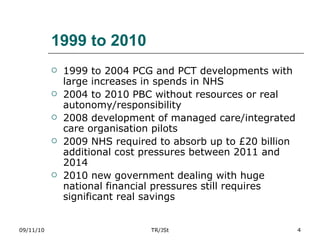
1999 to 2010 1999 to 2004 PCG and PCT developments with large increases in spends in NHS 2004 to 2010 PBC without resources or real autonomy/responsibility 2008 development of managed care/integrated care organisation pilots 2009 NHS required to absorb up to £20 billion additional cost pressures between 2011 and 2014 2010 new government dealing with huge national financial pressures still requires significant real savings 09/11/10 TR/JSt
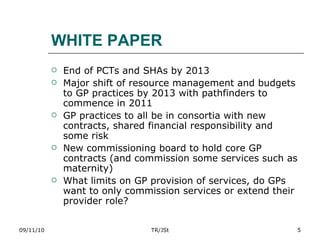
WHITE PAPER End of PCTs and SHAs by 2013 Major shift of resource management and budgets to GP practices by 2013 with pathfinders to commence in 2011 GP practices to all be in consortia with new contracts, shared financial responsibility and some risk New commissioning board to hold core GP contracts (and commission some services such as maternity) What limits on GP provision of services, do GPs want to only commission services or extend their provider role? 09/11/10 TR/JSt
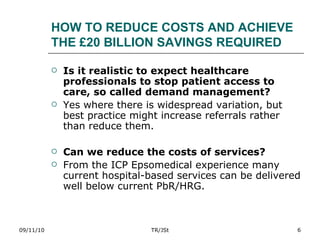
HOW TO REDUCE COSTS AND ACHIEVE THE £20 BILLION SAVINGS REQUIRED Is it realistic to expect healthcare professionals to stop patient access to care, so called demand management? Yes where there is widespread variation, but best practice might increase referrals rather than reduce them. Can we reduce the costs of services? From the ICP Epsomedical experience many current hospital-based services can be delivered well below current PbR/HRG. 09/11/10 TR/JSt
MID SURREY COMMISSIONING GROUP (MSCG)  PLANS WITH INTEGRATED HEALTH PARTNERS (IHP) EXPERT MANAGEMENT SUPPORT (SINCE 2006) Rather than hold a full commissioning budget, MSCG would consider taking a managed care (ICO) contract to ‘make or buy’ all diagnostics, planned and unplanned adult care for a fixed capitated amount for all their registered practice population. This would make the practices the joint provider/ pathway manager for all these services for their registered population. This would make the practices both clinically and financially responsible for the delivery of these services to their patients. Who would set this and monitor this contract?  What would the risk and reward arrangement be? 09/11/10 TR/JSt
The benefits would be real money to develop services in real time but with a cap and risk of funding some level of any overspend. Experience shows as many as 50% of acute admissions could be avoided but alternative services need to be in place to achieve this, thus investment is required. Experience shows that community-based providers can deliver the majority of planned care at rates 15 to 20% below current acute hospital-based HRG. Experience shows that incentives work to change GP behaviour (QoF) but so far there has been too little risk to ensure inappropriate clinical behaviour is penalised. 09/11/10 TR/JSt
Only a capitated managed care contract with manageable risk will deliver new, better value services closer to patients and allow the decommissioning of the over-provided, politically sensitive, acute-based services, which are currently bankrupting the NHS and adding to the need to cut costs in almost every other public service. 09/11/10 TR/JSt

Contracting to deliver integrated care closer to patients: GPs as both providers and commissioners - Tim Richardson

  • 1.
    CONTRACTING TO DELIVERINTEGRATED CARE TO PATIENTS: GPs AS BOTH PROVIDER AND COMMISSIONER Dr Tim Richardson GP Partner and Commissioning Lead The Integrated Care Partnership Epsom & Medical Director of Epsomedical (Diagnostic and Day Surgery Services) Ltd 09/11/10 TR/JSt
  • 2.
    1991 reforms, fundholdingand new service developments 1996-99 total budget management 1998 from commissioner to provider under PMS [+] 1999 end of GP practice commissioning 09/11/10 TR/JSt
  • 3.
    DEVELOPMENTS IN EPSOM1991 under fundholding set up a range of clinics and therapies in-house 1994 open first free standing CQC registered day surgery centre in UK 1998 merge 3 practices to become ICP and move to PMS [+] contracts as provider of services 1999 to 2004 no influence 09/11/10 TR/JSt
  • 4.
    1999 to 20101999 to 2004 PCG and PCT developments with large increases in spends in NHS 2004 to 2010 PBC without resources or real autonomy/responsibility 2008 development of managed care/integrated care organisation pilots 2009 NHS required to absorb up to £20 billion additional cost pressures between 2011 and 2014 2010 new government dealing with huge national financial pressures still requires significant real savings 09/11/10 TR/JSt
  • 5.
    WHITE PAPER Endof PCTs and SHAs by 2013 Major shift of resource management and budgets to GP practices by 2013 with pathfinders to commence in 2011 GP practices to all be in consortia with new contracts, shared financial responsibility and some risk New commissioning board to hold core GP contracts (and commission some services such as maternity) What limits on GP provision of services, do GPs want to only commission services or extend their provider role? 09/11/10 TR/JSt
  • 6.
    HOW TO REDUCECOSTS AND ACHIEVE THE £20 BILLION SAVINGS REQUIRED Is it realistic to expect healthcare professionals to stop patient access to care, so called demand management? Yes where there is widespread variation, but best practice might increase referrals rather than reduce them. Can we reduce the costs of services? From the ICP Epsomedical experience many current hospital-based services can be delivered well below current PbR/HRG. 09/11/10 TR/JSt
  • 7.
    MID SURREY COMMISSIONINGGROUP (MSCG) PLANS WITH INTEGRATED HEALTH PARTNERS (IHP) EXPERT MANAGEMENT SUPPORT (SINCE 2006) Rather than hold a full commissioning budget, MSCG would consider taking a managed care (ICO) contract to ‘make or buy’ all diagnostics, planned and unplanned adult care for a fixed capitated amount for all their registered practice population. This would make the practices the joint provider/ pathway manager for all these services for their registered population. This would make the practices both clinically and financially responsible for the delivery of these services to their patients. Who would set this and monitor this contract? What would the risk and reward arrangement be? 09/11/10 TR/JSt
  • 8.
    The benefits wouldbe real money to develop services in real time but with a cap and risk of funding some level of any overspend. Experience shows as many as 50% of acute admissions could be avoided but alternative services need to be in place to achieve this, thus investment is required. Experience shows that community-based providers can deliver the majority of planned care at rates 15 to 20% below current acute hospital-based HRG. Experience shows that incentives work to change GP behaviour (QoF) but so far there has been too little risk to ensure inappropriate clinical behaviour is penalised. 09/11/10 TR/JSt
  • 9.
    Only a capitatedmanaged care contract with manageable risk will deliver new, better value services closer to patients and allow the decommissioning of the over-provided, politically sensitive, acute-based services, which are currently bankrupting the NHS and adding to the need to cut costs in almost every other public service. 09/11/10 TR/JSt