2 Sports sceneSports scene AIMS
14
	 I name and describe sports.
	 I listen to and read a travel story on
a blog The survival guide.
	 I talk about what people are doing.
	 I find out about Australian and UK
culture.
	 I act out asking for information about
sports classes, in a role play.
	 I read about exercise and write a project.
In this unit:
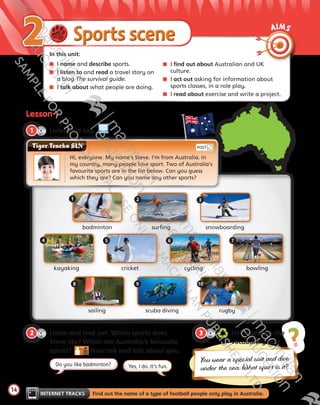
sailing scuba diving rugby
kayaking cricket cycling bowling
badminton surfing snowboarding
1 2 3
4
8 9 10
5 6 7
CD1
28
2  Listen and find out. Which sports does
Steve like? Which are Australia’s favourite
sports?  Now ask and talk about you.
CD1
29
3  Listen and do the
vocabulary quiz.
You wear a special suit and dive
under the sea. What sport is it?Do you like badminton? Yes, I do. It’s fun.
Lesson 1
INTERNET TRACKS   Find out the name of a type of football people only play in Australia.
Tiger Tracks SLN
Hi, everyone. My name’s Steve. I’m from Australia. In
my country, many people love sport. Two of Australia’s
favourite sports are in the list below. Can you guess
which they are? Can you name any other sports?
POST
CD1
27
1   Listen and say.
Tiger_SB5_9780230483767_text.indb 14 30/10/2014 11:28
15
6   Play The association game.
INTERNET TRACKS   Find out the name of one more Australian animal.
Australia
2
Lesson 2
CD1
30
4   Listen and read.
Hi, everyone! Here’s a leaflet about holiday tours
in Australia. There’s something for everyone. I hope
you can visit Australia one day. 
POST
5   Answer the questions.
1	 What famous sports do
you watch on the sports
tour?
2	 What famous building do
you visit on the city tour?
3	 What animals do you
discover on the rainforest
tour?
4	 Who do you learn about
on the outback tour?
You walk across a bridge.
Use the headings
to predict the
content.
READING
TIP
THINKING SKILLS
Associating
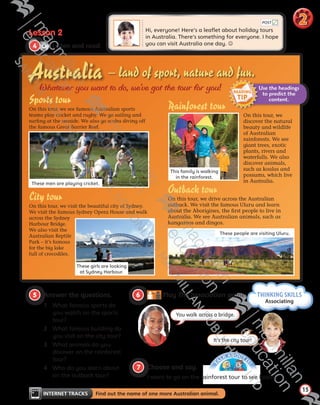
Sports tour
On this tour, we see famous Australian sports
teams play cricket and rugby. We go sailing and
surfing at the seaside. We also go scuba diving off
the famous Great Barrier Reef.
City tour
On this tour, we visit the beautiful city of Sydney.
We visit the famous Sydney Opera House and walk
across the Sydney
Harbour Bridge.
We also visit the
Australian Reptile
Park – it’s famous
for the big lake
full of crocodiles.
It’s the city tour!
– land of sport, nature and fun.
Whatever you want to do, we’ve got the tour for you!
ph2.15.3girlSydney
These men are playing cricket.
These girls are looking
at Sydney Harbour.
Rainforest tour
On this tour, we
discover the natural
beauty and wildlife
of Australian
rainforests. We see
giant trees, exotic
plants, rivers and
waterfalls. We also
discover animals,
such as koalas and
possums, which live
in Australia.
Outback tour
On this tour, we drive across the Australian
outback. We visit the famous Uluru and learn
about the Aborigines, the first people to live in
Australia. We see Australian animals, such as
kangaroos and dingos.
This family is walking
in the rainforest.
These people are visiting Uluru.
T
A
LK ABOUT IT
!
7   Choose and say.
I want to go on the rainforest tour to see koalas.
Tiger_SB5_9780230483767_text.indb 15 30/10/2014 11:28
Lesson 3
CD1
32
8   Listen to and read the story.
Hi there! This is a travel story about an 	
Australian family. They go on a bike ride in 	
the school holidays to raise money for a
children’s charity. Natalie is eleven years old 	
and her brother, Jack, is ten. Here are extracts
from Natalie’s blog.
9   Answer the questions.
1	 How far is it from Adelaide to Sydney?
2	 What do they see on Day 1?
3	 Why is Natalie happy on their first rest day?
4	 What stings Mum’s ankle?
5	 How many days does the bike ride take?
6	 How much money do they raise for charity?
16
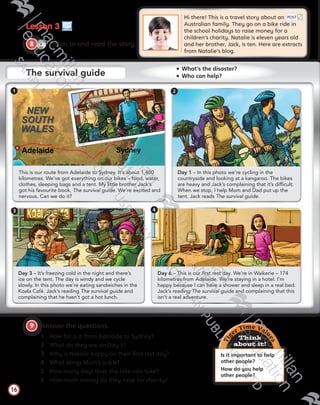
Day 3 – It’s freezing cold in the night and there’s
ice on the tent. The day is windy and we cycle
slowly. In this photo we’re eating sandwiches in the
Koala Café. Jack’s reading The survival guide and
complaining that he hasn’t got a hot lunch.
Day 1 – In this photo we’re cycling in the
countryside and looking at a kangaroo. The bikes
are heavy and Jack’s complaining that it’s difficult.
When we stop, I help Mum and Dad put up the
tent. Jack reads The survival guide.
Day 6 – This is our first rest day. We’re in Waikerie – 174
kilometres from Adelaide. We’re staying in a hotel. I’m
happy because I can have a shower and sleep in a real bed.
Jack’s reading The survival guide and complaining that this
isn’t a real adventure.
This is our route from Adelaide to Sydney. It’s about 1,400
kilometres. We’ve got everything on our bikes – food, water,
clothes, sleeping bags and a tent. My little brother Jack’s
got his favourite book, The survival guide. We’re excited and
nervous. Can we do it?
Tig
er Time Valu
es
Think
about it!
Is it important to help
other people?
How do you help
other people?
1 2
3 4
POST
The survival guide
  What’s the disaster? 
  Who can help?
Tiger_SB5_9780230483767_text.indb 16 30/10/2014 11:28
T
A
LK ABOUT IT
!
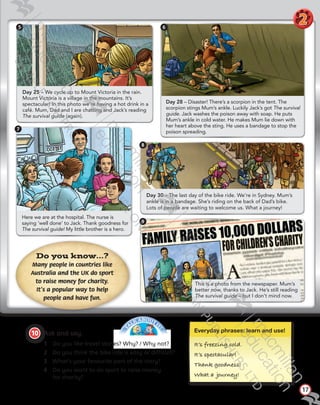
Here we are at the hospital. The nurse is
saying ‘well done’ to Jack. Thank goodness for
The survival guide! My little brother is a hero.
Day 30 – The last day of the bike ride. We’re in Sydney. Mum’s
ankle is in a bandage. She’s riding on the back of Dad’s bike.
Lots of people are waiting to welcome us. What a journey!
Day 25 – We cycle up to Mount Victoria in the rain.
Mount Victoria is a village in the mountains. It’s
spectacular! In this photo we’re having a hot drink in a
café. Mum, Dad and I are chatting and Jack’s reading
The survival guide (again).
17
Do you know…?
Many people in countries like
Australia and the UK do sport
to raise money for charity.
It’s a popular way to help
people and have fun.
8
9
5
7
Everyday phrases: learn and use!
It’s freezı˙ng cold.
It’s spectacular!
Thank goodness!
What a ourney!
10   Ask and say.
1	 Do you like travel stories? Why? / Why not?
2	 Do you think the bike ride is easy or difficult?
3	 What’s your favourite part of the story?
4	 Do you want to do sport to raise money
for charity?
This is a photo from the newspaper. Mum’s
better now, thanks to Jack. He’s still reading
The survival guide – but I don’t mind now.
Day 28 – Disaster! There’s a scorpion in the tent. The
scorpion stings Mum’s ankle. Luckily Jack’s got The survival
guide. Jack washes the poison away with soap. He puts
Mum’s ankle in cold water. He makes Mum lie down with
her heart above the sting. He uses a bandage to stop the
poison spreading.
6
2
Tiger_SB5_9780230483767_text.indb 17 30/10/2014 11:28
18
Grammar tracks
Lesson 4
CD1
33
11   Look, listen and read. Say the differences.
CD1
34
13   Listen, repeat and learn.
Present continuous tense
I’m
wearing
a brightly-	
coloured jacket.He’s / She’s
helmets.
You’re / We’re /
They’re
I’m not
cycling
on the road.
on the
pavement.
He / She isn’t
You / We /
They aren’t
Are you playing cricket?
surfing?
kayaking?
Yes,
I am.
No,
I’m not.
Is he / she he / she is. he / she isn’t.
Are we / they we / they are. we / they aren’t.
Can you find
three examples
of the present
continuous tense
in the story?
FAST TRACK GRAMMAR   Write five sentences using the present continuous tense.
12   Play Good or bad!
Good!
I’m wearing
a helmet.
14  Be a grammar detective!
Look at page 17 in the AB.
When do we use the present continuous?
How do we make the present continuous?
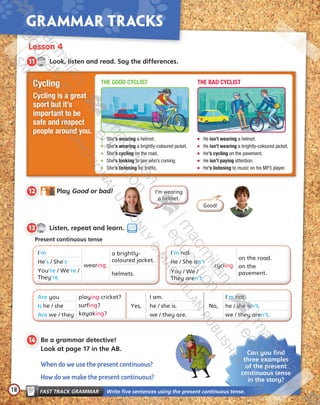
Cycling
Cycling is a great
sport but it’s
important to be
safe and respect
people around you.
	She’s wearing a helmet.
	She’s wearing a brightly-coloured jacket.
	She’s cycling on the road.
	She’s looking to see who’s coming.
	She’s listening for traffic.
	He isn’t wearing a helmet.
	He isn’t wearing a brightly-coloured jacket.
	He’s cycling on the pavement.
	He isn’t paying attention.
	He’s listening to music on his MP3 player.
THE GOOD CYCLIST THE BAD CYCLIST
Tiger_SB5_9780230483767_text.indb 18 30/10/2014 11:28
19
Lesson 5
CD1
35
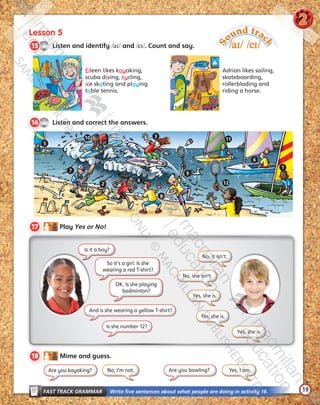
15   Listen and identify /aɪ/ and /eɪ/. Count and say.
CD1
36
16   Listen and correct the answers.
FAST TRACK GRAMMAR   Write five sentences about what people are doing in activity 16.
S
ound trac
k
/aɪ/ /eɪ/
Eileen likes kayaking,
scuba diving, cycling,
ice skating and playing
table tennis.
Adrian likes sailing,
skateboarding,
rollerblading and
riding a horse.
17   Play Yes or No!
18   Mime and guess.
No, it isn’t.
No, I’m not. Yes, I am.
No, she isn’t.
Yes, she is.
Yes, she is.
Yes, she is.
Is it a boy?
So it’s a girl. Is she
wearing a red T-shirt?
OK. Is she playing
badminton?
2
And is she wearing a yellow T-shirt?
Is she number 12?
Are you kayaking? Are you bowling?
2
3
1
4
5
6
7
8
9
10 11
12
Tiger_SB5_9780230483767_text.indb 19 30/10/2014 11:28
Cult u
20
Lesson 6
CD1
38
19   Listen and read.
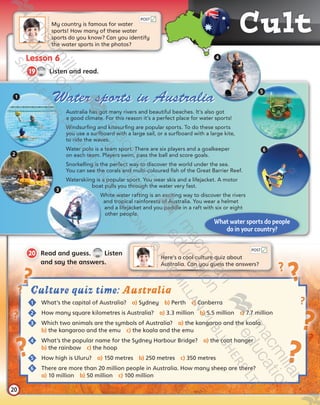
My country is famous for water 	
sports! How many of these water
sports do you know? Can you identify
the water sports in the photos?
Here’s a cool culture quiz about
Australia. Can you guess the answers?
20  Read and guess.
CD1
39
Listen
and say the answers.
POST
POST
What water sports do people
do in your country?
Australia has got many rivers and beautiful beaches. It’s also got
a good climate. For this reason it’s a perfect place for water sports!
Windsurfing and kitesurfing are popular sports. To do these sports
you use a surfboard with a large sail, or a surfboard with a large kite,
to ride the waves.
Water polo is a team sport. There are six players and a goalkeeper
on each team. Players swim, pass the ball and score goals.
Snorkelling is the perfect way to discover the world under the sea.
You can see the corals and multi-coloured fish of the Great Barrier Reef.
Waterskiing is a popular sport. You wear skis and a lifejacket. A motor
boat pulls you through the water very fast.
White water rafting is an exciting way to discover the rivers
and tropical rainforests of Australia. You wear a helmet
and a lifejacket and you paddle in a raft with six or eight
other people.
1
2
3
4
5
6
Culture quiz time: Australia
	1	 What’s the capital of Australia?  a) Sydney  b) Perth  c) Canberra
	2	 How many square kilometres is Australia?  a) 3.3 million  b) 5.5 million  c) 7.7 million
	3	 Which two animals are the symbols of Australia?  a) the kangaroo and the koala  	
b) the kangaroo and the emu  c) the koala and the emu
	4	 What’s the popular name for the Sydney Harbour Bridge?  a) the coat hanger  	
b) the rainbow  c) the hoop
	5	 How high is Uluru?  a) 150 metres  b) 250 metres  c) 350 metres
	6	There are more than 20 million people in Australia. How many sheep are there?  	
a) 10 million  b) 50 million  c) 100 million
Water sports in Australia
Tiger_SB5_9780230483767_text.indb 20 30/10/2014 11:28
21
t ure
21
Lesson 7
CD1
41
21   Listen and read. Say True or False.
1	 The name of the national stadium in England is Wembley.
2	 The main English national football team colour is blue.
3	 Manchester United is a popular club in the south of England.
4	 Chelsea, Arsenal, Tottenham Hotspur and West Ham United
are all clubs from Manchester.
5	 The top professional teams in England play in the
Premier League.
6	 There are some Spanish players in the English
professional leagues.
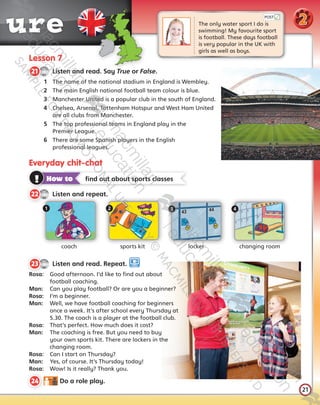
The only water sport I do is 	
swimming! My favourite sport
is football. These days football
is very popular in the UK with
girls as well as boys.
Everyday chit-chat
coach sports kit locker changing room
1 2 3 4
! How to   find out about sports classes
CD1
42
22   Listen and repeat.
POST
2
CD1
43
23   Listen and read. Repeat.
Rosa:	 Good afternoon. I’d like to find out about
football coaching.
Man:	 Can you play football? Or are you a beginner?
Rosa:	 I’m a beginner.
Man:	 Well, we have football coaching for beginners 	
once a week. It’s after school every Thursday at
5.30. The coach is a player at the football club.
Rosa:	 That’s perfect. How much does it cost?
Man:	 The coaching is free. But you need to buy
your own sports kit. There are lockers in the
changing room.
Rosa:	 Can I start on Thursday?
Man:	 Yes, of course. It’s Thursday today!
Rosa:	 Wow! Is it really? Thank you.
24   Do a role play.
Tiger_SB5_9780230483767_text.indb 21 30/10/2014 11:28
22
Science
CLIL
INTERNET TRACKS   Find out approximately how many muscles there are in the human body.
Lesson 8
CD1
44
25   Listen and read.
22
26  Read and correct the
sentences.
1	 Your muscles pump blood
around your body.
2	 With regular exercise,
you don’t sleep at night.
3	 Aerobic exercise makes
you breathe slowly.
4	 Strong muscles support
your lungs.
5	 It’s good to do one kind
of exercise.
28   Think and say.
What’s your favourite kind of exercise?
What do you do to get aerobic exercise,
strength training and flexibility training?
My words to remember
muscle   heart   oxygen   blood   lungs   oı˙nts
Hi there! We all know that exercise is 	
good for us. But do you know about the three
different kinds of exercise we need to do? Read
on … and enjoy! 
POST
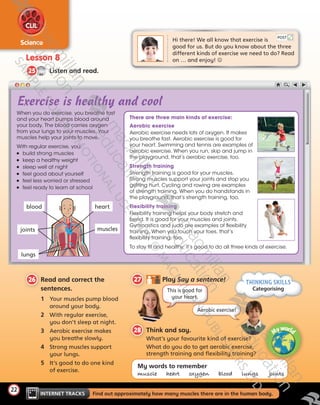
Exercise is healthy and cool
27   Play Say a sentence!
Aerobic exercise!
This is good for
your heart.
Aerobic exercise
Aerobic exercise needs lots of oxygen. It makes
you breathe fast. Aerobic exercise is good for
your heart. Swimming and tennis are examples of
aerobic exercise. When you run, skip and jump in
the playground, that’s aerobic exercise, too.
Strength training
Strength training is good for your muscles.
Strong muscles support your joints and stop you
getting hurt. Cycling and rowing are examples
of strength training. When you do handstands in
the playground, that’s strength training, too.
Flexibility training
Flexibility training helps your body stretch and
bend. It is good for your muscles and joints.
Gymnastics and judo are examples of flexibility
training. When you touch your toes, that’s
flexibility training, too.
There are three main kinds of exercise:
To stay fit and healthy, it’s good to do all three kinds of exercise.
When you do exercise, you breathe fast
and your heart pumps blood around
your body. The blood carries oxygen
from your lungs to your muscles. Your
muscles help your joints to move.
With regular exercise, you:
	 build strong muscles
	 keep a healthy weight
	 sleep well at night
	 feel good about yourself
	 feel less worried or stressed
	 feel ready to learn at school
THINKING SKILLS
Categorising
Myworld
joints
lungs
blood heart
muscles
Tiger_SB5_9780230483767_text.indb 22 30/10/2014 11:29
Pro ect: Do I get enough exercise?
23
2
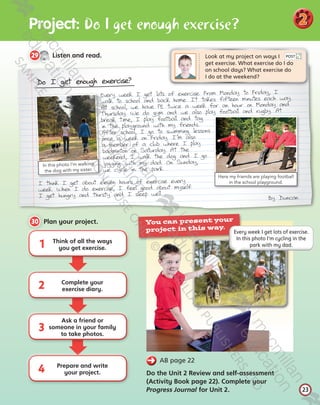
Do I get enough exercise?
Every week I get lots of exercise. From Monday to Friday, I
walk to school and back home. It takes fifteen minutes each way.
At school, we have PE twice a week for an hour on Monday and
Thursday. We do gym and we also play football and rugby. At
break time, I play football and tag
in the playground with my friends.
After school, I go to swimming lessons
once a week on Friday. I’m also
a member of a club where I play
badminton on Saturday. At the
weekend, I walk the dog and I go
jogging with my dad. On Sunday,
we cycle in the park.
I think I get about eleven hours of exercise every
week. When I do exercise, I feel good about myself.
I get hungry and thirsty and I sleep well.

By Duncan
In this photo I’m walking
the dog with my sister.
Here my friends are playing football
in the school playground.
CD2
2
29   Listen and read.
23
Look at my project on ways I 	
get exercise. What exercise do I do 	
on school days? What exercise do
I do at the weekend?
30   Plan your project.
2
3
4
Think of all the ways
you get exercise.
Complete your
exercise diary.
Ask a friend or
someone in your family
to take photos.
Prepare and write
your project.
1
POST
  AB page 22
Do the Unit 2 Review and self-assessment
(Activity Book page 22). Complete your
Progress Journal for Unit 2.
You can present your
project in this way.
Every week I get lots of exercise.
In this photo I’m cycling in the
park with my dad.
Tiger_SB5_9780230483767_text.indb 23 30/10/2014 11:29

Tiger time 2

  • 1.
    2 Sports sceneSportsscene AIMS 14 I name and describe sports. I listen to and read a travel story on a blog The survival guide. I talk about what people are doing. I find out about Australian and UK culture. I act out asking for information about sports classes, in a role play. I read about exercise and write a project. In this unit: sailing scuba diving rugby kayaking cricket cycling bowling badminton surfing snowboarding 1 2 3 4 8 9 10 5 6 7 CD1 28 2  Listen and find out. Which sports does Steve like? Which are Australia’s favourite sports?  Now ask and talk about you. CD1 29 3  Listen and do the vocabulary quiz. You wear a special suit and dive under the sea. What sport is it?Do you like badminton? Yes, I do. It’s fun. Lesson 1 INTERNET TRACKS   Find out the name of a type of football people only play in Australia. Tiger Tracks SLN Hi, everyone. My name’s Steve. I’m from Australia. In my country, many people love sport. Two of Australia’s favourite sports are in the list below. Can you guess which they are? Can you name any other sports? POST CD1 27 1   Listen and say. Tiger_SB5_9780230483767_text.indb 14 30/10/2014 11:28
  • 2.
    15 6   PlayThe association game. INTERNET TRACKS   Find out the name of one more Australian animal. Australia 2 Lesson 2 CD1 30 4   Listen and read. Hi, everyone! Here’s a leaflet about holiday tours in Australia. There’s something for everyone. I hope you can visit Australia one day.  POST 5   Answer the questions. 1 What famous sports do you watch on the sports tour? 2 What famous building do you visit on the city tour? 3 What animals do you discover on the rainforest tour? 4 Who do you learn about on the outback tour? You walk across a bridge. Use the headings to predict the content. READING TIP THINKING SKILLS Associating Sports tour On this tour, we see famous Australian sports teams play cricket and rugby. We go sailing and surfing at the seaside. We also go scuba diving off the famous Great Barrier Reef. City tour On this tour, we visit the beautiful city of Sydney. We visit the famous Sydney Opera House and walk across the Sydney Harbour Bridge. We also visit the Australian Reptile Park – it’s famous for the big lake full of crocodiles. It’s the city tour! – land of sport, nature and fun. Whatever you want to do, we’ve got the tour for you! ph2.15.3girlSydney These men are playing cricket. These girls are looking at Sydney Harbour. Rainforest tour On this tour, we discover the natural beauty and wildlife of Australian rainforests. We see giant trees, exotic plants, rivers and waterfalls. We also discover animals, such as koalas and possums, which live in Australia. Outback tour On this tour, we drive across the Australian outback. We visit the famous Uluru and learn about the Aborigines, the first people to live in Australia. We see Australian animals, such as kangaroos and dingos. This family is walking in the rainforest. These people are visiting Uluru. T A LK ABOUT IT ! 7   Choose and say. I want to go on the rainforest tour to see koalas. Tiger_SB5_9780230483767_text.indb 15 30/10/2014 11:28
  • 3.
    Lesson 3 CD1 32 8  Listen to and read the story. Hi there! This is a travel story about an Australian family. They go on a bike ride in the school holidays to raise money for a children’s charity. Natalie is eleven years old and her brother, Jack, is ten. Here are extracts from Natalie’s blog. 9   Answer the questions. 1 How far is it from Adelaide to Sydney? 2 What do they see on Day 1? 3 Why is Natalie happy on their first rest day? 4 What stings Mum’s ankle? 5 How many days does the bike ride take? 6 How much money do they raise for charity? 16 Day 3 – It’s freezing cold in the night and there’s ice on the tent. The day is windy and we cycle slowly. In this photo we’re eating sandwiches in the Koala Café. Jack’s reading The survival guide and complaining that he hasn’t got a hot lunch. Day 1 – In this photo we’re cycling in the countryside and looking at a kangaroo. The bikes are heavy and Jack’s complaining that it’s difficult. When we stop, I help Mum and Dad put up the tent. Jack reads The survival guide. Day 6 – This is our first rest day. We’re in Waikerie – 174 kilometres from Adelaide. We’re staying in a hotel. I’m happy because I can have a shower and sleep in a real bed. Jack’s reading The survival guide and complaining that this isn’t a real adventure. This is our route from Adelaide to Sydney. It’s about 1,400 kilometres. We’ve got everything on our bikes – food, water, clothes, sleeping bags and a tent. My little brother Jack’s got his favourite book, The survival guide. We’re excited and nervous. Can we do it? Tig er Time Valu es Think about it! Is it important to help other people? How do you help other people? 1 2 3 4 POST The survival guide   What’s the disaster?    Who can help? Tiger_SB5_9780230483767_text.indb 16 30/10/2014 11:28
  • 4.
    T A LK ABOUT IT ! Herewe are at the hospital. The nurse is saying ‘well done’ to Jack. Thank goodness for The survival guide! My little brother is a hero. Day 30 – The last day of the bike ride. We’re in Sydney. Mum’s ankle is in a bandage. She’s riding on the back of Dad’s bike. Lots of people are waiting to welcome us. What a journey! Day 25 – We cycle up to Mount Victoria in the rain. Mount Victoria is a village in the mountains. It’s spectacular! In this photo we’re having a hot drink in a café. Mum, Dad and I are chatting and Jack’s reading The survival guide (again). 17 Do you know…? Many people in countries like Australia and the UK do sport to raise money for charity. It’s a popular way to help people and have fun. 8 9 5 7 Everyday phrases: learn and use! It’s freezı˙ng cold. It’s spectacular! Thank goodness! What a ourney! 10   Ask and say. 1 Do you like travel stories? Why? / Why not? 2 Do you think the bike ride is easy or difficult? 3 What’s your favourite part of the story? 4 Do you want to do sport to raise money for charity? This is a photo from the newspaper. Mum’s better now, thanks to Jack. He’s still reading The survival guide – but I don’t mind now. Day 28 – Disaster! There’s a scorpion in the tent. The scorpion stings Mum’s ankle. Luckily Jack’s got The survival guide. Jack washes the poison away with soap. He puts Mum’s ankle in cold water. He makes Mum lie down with her heart above the sting. He uses a bandage to stop the poison spreading. 6 2 Tiger_SB5_9780230483767_text.indb 17 30/10/2014 11:28
  • 5.
    18 Grammar tracks Lesson 4 CD1 33 11  Look, listen and read. Say the differences. CD1 34 13   Listen, repeat and learn. Present continuous tense I’m wearing a brightly- coloured jacket.He’s / She’s helmets. You’re / We’re / They’re I’m not cycling on the road. on the pavement. He / She isn’t You / We / They aren’t Are you playing cricket? surfing? kayaking? Yes, I am. No, I’m not. Is he / she he / she is. he / she isn’t. Are we / they we / they are. we / they aren’t. Can you find three examples of the present continuous tense in the story? FAST TRACK GRAMMAR   Write five sentences using the present continuous tense. 12   Play Good or bad! Good! I’m wearing a helmet. 14  Be a grammar detective! Look at page 17 in the AB. When do we use the present continuous? How do we make the present continuous? Cycling Cycling is a great sport but it’s important to be safe and respect people around you. She’s wearing a helmet. She’s wearing a brightly-coloured jacket. She’s cycling on the road. She’s looking to see who’s coming. She’s listening for traffic. He isn’t wearing a helmet. He isn’t wearing a brightly-coloured jacket. He’s cycling on the pavement. He isn’t paying attention. He’s listening to music on his MP3 player. THE GOOD CYCLIST THE BAD CYCLIST Tiger_SB5_9780230483767_text.indb 18 30/10/2014 11:28
  • 6.
    19 Lesson 5 CD1 35 15  Listen and identify /aɪ/ and /eɪ/. Count and say. CD1 36 16   Listen and correct the answers. FAST TRACK GRAMMAR   Write five sentences about what people are doing in activity 16. S ound trac k /aɪ/ /eɪ/ Eileen likes kayaking, scuba diving, cycling, ice skating and playing table tennis. Adrian likes sailing, skateboarding, rollerblading and riding a horse. 17   Play Yes or No! 18   Mime and guess. No, it isn’t. No, I’m not. Yes, I am. No, she isn’t. Yes, she is. Yes, she is. Yes, she is. Is it a boy? So it’s a girl. Is she wearing a red T-shirt? OK. Is she playing badminton? 2 And is she wearing a yellow T-shirt? Is she number 12? Are you kayaking? Are you bowling? 2 3 1 4 5 6 7 8 9 10 11 12 Tiger_SB5_9780230483767_text.indb 19 30/10/2014 11:28
  • 7.
    Cult u 20 Lesson 6 CD1 38 19  Listen and read. My country is famous for water sports! How many of these water sports do you know? Can you identify the water sports in the photos? Here’s a cool culture quiz about Australia. Can you guess the answers? 20  Read and guess. CD1 39 Listen and say the answers. POST POST What water sports do people do in your country? Australia has got many rivers and beautiful beaches. It’s also got a good climate. For this reason it’s a perfect place for water sports! Windsurfing and kitesurfing are popular sports. To do these sports you use a surfboard with a large sail, or a surfboard with a large kite, to ride the waves. Water polo is a team sport. There are six players and a goalkeeper on each team. Players swim, pass the ball and score goals. Snorkelling is the perfect way to discover the world under the sea. You can see the corals and multi-coloured fish of the Great Barrier Reef. Waterskiing is a popular sport. You wear skis and a lifejacket. A motor boat pulls you through the water very fast. White water rafting is an exciting way to discover the rivers and tropical rainforests of Australia. You wear a helmet and a lifejacket and you paddle in a raft with six or eight other people. 1 2 3 4 5 6 Culture quiz time: Australia 1 What’s the capital of Australia?  a) Sydney  b) Perth  c) Canberra 2 How many square kilometres is Australia?  a) 3.3 million  b) 5.5 million  c) 7.7 million 3 Which two animals are the symbols of Australia?  a) the kangaroo and the koala  b) the kangaroo and the emu  c) the koala and the emu 4 What’s the popular name for the Sydney Harbour Bridge?  a) the coat hanger  b) the rainbow  c) the hoop 5 How high is Uluru?  a) 150 metres  b) 250 metres  c) 350 metres 6 There are more than 20 million people in Australia. How many sheep are there?  a) 10 million  b) 50 million  c) 100 million Water sports in Australia Tiger_SB5_9780230483767_text.indb 20 30/10/2014 11:28
  • 8.
    21 t ure 21 Lesson 7 CD1 41 21  Listen and read. Say True or False. 1 The name of the national stadium in England is Wembley. 2 The main English national football team colour is blue. 3 Manchester United is a popular club in the south of England. 4 Chelsea, Arsenal, Tottenham Hotspur and West Ham United are all clubs from Manchester. 5 The top professional teams in England play in the Premier League. 6 There are some Spanish players in the English professional leagues. The only water sport I do is swimming! My favourite sport is football. These days football is very popular in the UK with girls as well as boys. Everyday chit-chat coach sports kit locker changing room 1 2 3 4 ! How to   find out about sports classes CD1 42 22   Listen and repeat. POST 2 CD1 43 23   Listen and read. Repeat. Rosa: Good afternoon. I’d like to find out about football coaching. Man: Can you play football? Or are you a beginner? Rosa: I’m a beginner. Man: Well, we have football coaching for beginners once a week. It’s after school every Thursday at 5.30. The coach is a player at the football club. Rosa: That’s perfect. How much does it cost? Man: The coaching is free. But you need to buy your own sports kit. There are lockers in the changing room. Rosa: Can I start on Thursday? Man: Yes, of course. It’s Thursday today! Rosa: Wow! Is it really? Thank you. 24   Do a role play. Tiger_SB5_9780230483767_text.indb 21 30/10/2014 11:28
  • 9.
    22 Science CLIL INTERNET TRACKS   Findout approximately how many muscles there are in the human body. Lesson 8 CD1 44 25   Listen and read. 22 26  Read and correct the sentences. 1 Your muscles pump blood around your body. 2 With regular exercise, you don’t sleep at night. 3 Aerobic exercise makes you breathe slowly. 4 Strong muscles support your lungs. 5 It’s good to do one kind of exercise. 28   Think and say. What’s your favourite kind of exercise? What do you do to get aerobic exercise, strength training and flexibility training? My words to remember muscle   heart   oxygen   blood   lungs   oı˙nts Hi there! We all know that exercise is good for us. But do you know about the three different kinds of exercise we need to do? Read on … and enjoy!  POST Exercise is healthy and cool 27   Play Say a sentence! Aerobic exercise! This is good for your heart. Aerobic exercise Aerobic exercise needs lots of oxygen. It makes you breathe fast. Aerobic exercise is good for your heart. Swimming and tennis are examples of aerobic exercise. When you run, skip and jump in the playground, that’s aerobic exercise, too. Strength training Strength training is good for your muscles. Strong muscles support your joints and stop you getting hurt. Cycling and rowing are examples of strength training. When you do handstands in the playground, that’s strength training, too. Flexibility training Flexibility training helps your body stretch and bend. It is good for your muscles and joints. Gymnastics and judo are examples of flexibility training. When you touch your toes, that’s flexibility training, too. There are three main kinds of exercise: To stay fit and healthy, it’s good to do all three kinds of exercise. When you do exercise, you breathe fast and your heart pumps blood around your body. The blood carries oxygen from your lungs to your muscles. Your muscles help your joints to move. With regular exercise, you: build strong muscles keep a healthy weight sleep well at night feel good about yourself feel less worried or stressed feel ready to learn at school THINKING SKILLS Categorising Myworld joints lungs blood heart muscles Tiger_SB5_9780230483767_text.indb 22 30/10/2014 11:29
  • 10.
    Pro ect: DoI get enough exercise? 23 2 Do I get enough exercise? Every week I get lots of exercise. From Monday to Friday, I walk to school and back home. It takes fifteen minutes each way. At school, we have PE twice a week for an hour on Monday and Thursday. We do gym and we also play football and rugby. At break time, I play football and tag in the playground with my friends. After school, I go to swimming lessons once a week on Friday. I’m also a member of a club where I play badminton on Saturday. At the weekend, I walk the dog and I go jogging with my dad. On Sunday, we cycle in the park. I think I get about eleven hours of exercise every week. When I do exercise, I feel good about myself. I get hungry and thirsty and I sleep well. By Duncan In this photo I’m walking the dog with my sister. Here my friends are playing football in the school playground. CD2 2 29   Listen and read. 23 Look at my project on ways I get exercise. What exercise do I do on school days? What exercise do I do at the weekend? 30   Plan your project. 2 3 4 Think of all the ways you get exercise. Complete your exercise diary. Ask a friend or someone in your family to take photos. Prepare and write your project. 1 POST   AB page 22 Do the Unit 2 Review and self-assessment (Activity Book page 22). Complete your Progress Journal for Unit 2. You can present your project in this way. Every week I get lots of exercise. In this photo I’m cycling in the park with my dad. Tiger_SB5_9780230483767_text.indb 23 30/10/2014 11:29