"The Tiger King"
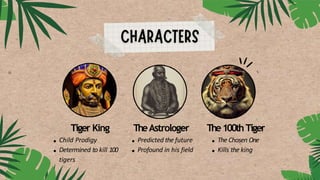
Tiger King
Child Prodigy
Determined to kill 100
tigers
TheAstrologer
Predicted the future
Profound in his field
The100thTiger
The Chosen One
Kills the king
The tiger symbolizes power,
corruption, and unchecked
ambition in the story, offering
insight into the human
condition and the dangers of
absolute authority and moral
compromise.
"The Tiger King," a chapter in the Class 1
2NCERT English textbook, tells the story of
Maharaja of Pratibandapuram, who was obsessed with hunting tigers. He kills a man-
eating tiger, but he is not satisfied and wants to kill more. He is warned that the Goddess
Durga will punish him if he kills another tiger, but he ignores the warning and kills
another. As a result, he is cursed by the Goddess, and a tiger kills him in the end.The
story highlights the consequences of one's irrational desires and the power of
superstition.
Stupefaction refers to a
condition of shock,
bewilderment or confusion
resulting in a state of being
stunned or astonished.
Stupefaction Proclamation
An official public
announcementmade by a
person in authority, often in a
formal or ceremonial manner.
Duraisani
Tamil word for wife of the
chief.
Here used for the British
officer's wife.
Harakiri, also known as
seppuku, is a form of
Japanese ritual suicide by
disembowelment, traditionally
practiced by samurai to
restore honor.
Harikiri Dewan
A high-ranking official who
served as a minister or
advisor to a ruler or
government.
Tuft
A cluster of long, projecting
strands of hair, feathers, or
other material, typically
arranged in a tufted form.
To pronounce or articulate
words or phrases clearly and
distinctly, with proper
intonation and emphasis on
each syllable.
Enunciated Transfixed
To be completely motionless or
held in place by something, as
if under a spell or hypnotized
by an object or experience.
Slivers
Small, thin, sharp fragments
or pieces of a material, such
as wood, glass, or metal, that
can easily penetrate skin.
TheBirth
The prince is born.
TheTigerHunt
Started hunting
Firstcomplication
Denying a British
personality
Secondcomplication
Scarcity of tigers.
TheFinalHunt
The last tiger
The birth of the Tiger King is shrouded in mystery and legend.
According to the story, the newborn prince spoke his first words at
just 10days old. During the prince's birth ceremony, the chief
astrologer predicted that the king would die from a tiger, as he was
born during the year of the Bull, which is an enemy of the tiger. This
news quickly spread throughout the kingdom, causing widespread
fear and apprehension.
As the Tiger King grew up, he was closely watched by his subjectswho
anxiously awaited the fulfillment of the astrologer's prediction.
Despite the pervasive sense of foreboding, the Tiger King went on to
become one of the most celebrated rulers in the kingdom's history,
leaving a lasting legacy as a symbol of destiny and the human spirit.
During his teenage years, the prodigal prince's life was uneventful,
but the kingdom remained uneasy about the prophecy made by the
chief astrologer. The prince, determined to lift the curse upon him,
vowed to slay 100 tigers, but the astrologer warned him to be cautious
of the hundredth tiger.
After becoming king, he banned tiger hunting for everyone except
himself, recognizing the importance of preserving the limited tiger
population. This decision showcased the king's wisdom, compassion,
and dedication for his goal, ensuring the survival of the majestic
creatures for himself to slay and no one other than him.
The King's quest to hunt tigers tested his physical and mental limits.
Despite occasional missed shots, he remained driven by unwavering
determination. The Maharaja's fearsomeness was on full display as he
engaged tigers in hand-to-hand combat, emerging victorious. With
every triumph, his confidence grew, bringing him closer to his
ultimate goal. His persistence and unwavering commitment inspired
awe and admiration, and after many battles, he achieved his goal,
becoming a legendary symbol of strength and courage for generations
to come.
As the King continued to hunt tigers, his skills improved, and he
learned to anticipate their movements by understanding their habits
and behaviors. Despite facing tough challenges, the King's unwavering
determination never faltered, inspiring awe and admiration among
his subjects. His relentless pursuit of his goal elevated him to legend
status, with his name becoming synonymous with bravery and
determination. After many long and arduous weeks, the King achieved
his ultimate triumph, conquering the last of the tigers and proving to
himself and others the power of determination and perseverance.
The King's pursuit of his dream to hunt a hundred tigers was not
without its challenges. When a British officer arrived in his state and
requested permission to hunt the tigers, the King knew that he could
not allow anyone else to diminish his chances of fulfilling his dream.
He politely refused the request, knowing that the tigers were a
limited resource and that allowing outsiders to hunt them would
jeopardize his own quest.
The British officer persisted, asking only for a picture with a dead
tiger and hunting gear. The King, however, saw through the request
and knew that the officer was only seeking publicity. He feared that
granting this request would attract more British hunters to his state
and put his own kingdom at risk.
The King's wisdom and foresight saved his kingdom from potential
disaster. He denied the request, knowing that it was not worth the
risk. Instead, he sent jewelry worth 3 lakhs at that time to the
British officer's wife, resolving the matter amicably. The King's
actions not only demonstrated his shrewdness and resourcefulness but
also his commitment to protecting his people and his kingdom.
The incident became a testament to the King's leadership and strategic
thinking. He had not only pursued his own dream but also protected
his kingdom from unwanted attention and interference. The King's
legacy would endure, not only for his remarkable hunting skills but
also for his ability to navigate complex political situations and protect
his people.
The King's dream to hunt a hundred tigers was not just a personal
ambition but also a matter of pride for his kingdom. However, the
limited number of tigers in his own kingdom posed a significant
challenge. After the unjust hunting of 70 tigers, the tiger population
in Pratibandapuram had significantly decreased, making it almost
impossible for the King to fulfill his dream.
The King realized that he needed to think outside the box to achieve
his goal. He called upon his trusted minister, the Dewan, to help him
find a solution. The King's ingenious plan was to seek a bride from a
kingdom with the highest number of tigers statistically. The Dewan
searched far and wide until he found the perfect match for the King,
a lady from a kingdom with a bountiful tiger population.
With his new wife's kingdom now his own, the King had access to an
abundance of tigers, and he could continue his quest to hunt them
down. Whenever he visited his father-in-law, he would seize the
opportunity to hunt tigers, bringing him closer to achieving his
lifelong dream.
The King's ability to solve problems through his ingenuity and
resourcefulness was a testament to his leadership skills. He had not
only fulfilled his personal ambition but also preserved his kingdom's
honor and pride. His legacy would endure, not only for his
remarkable hunting skills but also for his ability to think strategically
and solve complex problems.
The King's obsession with hunting one hundred tigers had led him
down a path of selfishness and disregard for the lives of the animals
he sought to kill. Despite the limited population of tigers in his own
kingdom and the harm caused to their population by his hunts, the
King remained focused on his personal ambition.
When the final tiger proved elusive, the King became desperate and
offered the village redemption from taxes in exchange for information
on the tiger's whereabouts. When the tiger was not found, the King's
fury led him to punish the entire village, regardless of their
innocence.
In a stroke of deceit, the Dewan procured an old tiger from a zoo
and released it in the field for the King to hunt. The King's
achievement was marred by the fact that the tiger he shot was still
alive when brought to him for a ceremony and feast. Two men killed
the tiger out of fear of the King's wrath, and the King was content
with his achievement, showing little regard for the life he had taken.
The King's downfall came in the form of a wooden tiger gift for his
son's birthday, which caused a fatal infection that ultimately led to his
demise.
His selfish pursuit of personal ambition had blinded him to the
consequences of his actions and left a legacy of disregard for the lives
of animals and the well-being of his subjects.
While the King's determination and resourcefulness were admirable,
his disregard for the consequences of his actions and lack of empathy
for others serve as a cautionary tale. The King's legacy is one of
personal ambition at the expense of others, rather than of true
leadership and compassion.
yash dhankhar
XII-A

Tiger King Class-12 PPT.pptx

  • 2.
  • 3.
    Tiger King Child Prodigy Determinedto kill 100 tigers TheAstrologer Predicted the future Profound in his field The100thTiger The Chosen One Kills the king
  • 4.
    The tiger symbolizespower, corruption, and unchecked ambition in the story, offering insight into the human condition and the dangers of absolute authority and moral compromise.
  • 5.
    "The Tiger King,"a chapter in the Class 1 2NCERT English textbook, tells the story of Maharaja of Pratibandapuram, who was obsessed with hunting tigers. He kills a man- eating tiger, but he is not satisfied and wants to kill more. He is warned that the Goddess Durga will punish him if he kills another tiger, but he ignores the warning and kills another. As a result, he is cursed by the Goddess, and a tiger kills him in the end.The story highlights the consequences of one's irrational desires and the power of superstition.
  • 6.
    Stupefaction refers toa condition of shock, bewilderment or confusion resulting in a state of being stunned or astonished. Stupefaction Proclamation An official public announcementmade by a person in authority, often in a formal or ceremonial manner. Duraisani Tamil word for wife of the chief. Here used for the British officer's wife.
  • 7.
    Harakiri, also knownas seppuku, is a form of Japanese ritual suicide by disembowelment, traditionally practiced by samurai to restore honor. Harikiri Dewan A high-ranking official who served as a minister or advisor to a ruler or government. Tuft A cluster of long, projecting strands of hair, feathers, or other material, typically arranged in a tufted form.
  • 8.
    To pronounce orarticulate words or phrases clearly and distinctly, with proper intonation and emphasis on each syllable. Enunciated Transfixed To be completely motionless or held in place by something, as if under a spell or hypnotized by an object or experience. Slivers Small, thin, sharp fragments or pieces of a material, such as wood, glass, or metal, that can easily penetrate skin.
  • 9.
    TheBirth The prince isborn. TheTigerHunt Started hunting Firstcomplication Denying a British personality Secondcomplication Scarcity of tigers. TheFinalHunt The last tiger
  • 10.
    The birth ofthe Tiger King is shrouded in mystery and legend. According to the story, the newborn prince spoke his first words at just 10days old. During the prince's birth ceremony, the chief astrologer predicted that the king would die from a tiger, as he was born during the year of the Bull, which is an enemy of the tiger. This news quickly spread throughout the kingdom, causing widespread fear and apprehension. As the Tiger King grew up, he was closely watched by his subjectswho anxiously awaited the fulfillment of the astrologer's prediction. Despite the pervasive sense of foreboding, the Tiger King went on to become one of the most celebrated rulers in the kingdom's history, leaving a lasting legacy as a symbol of destiny and the human spirit.
  • 11.
    During his teenageyears, the prodigal prince's life was uneventful, but the kingdom remained uneasy about the prophecy made by the chief astrologer. The prince, determined to lift the curse upon him, vowed to slay 100 tigers, but the astrologer warned him to be cautious of the hundredth tiger. After becoming king, he banned tiger hunting for everyone except himself, recognizing the importance of preserving the limited tiger population. This decision showcased the king's wisdom, compassion, and dedication for his goal, ensuring the survival of the majestic creatures for himself to slay and no one other than him.
  • 12.
    The King's questto hunt tigers tested his physical and mental limits. Despite occasional missed shots, he remained driven by unwavering determination. The Maharaja's fearsomeness was on full display as he engaged tigers in hand-to-hand combat, emerging victorious. With every triumph, his confidence grew, bringing him closer to his ultimate goal. His persistence and unwavering commitment inspired awe and admiration, and after many battles, he achieved his goal, becoming a legendary symbol of strength and courage for generations to come.
  • 13.
    As the Kingcontinued to hunt tigers, his skills improved, and he learned to anticipate their movements by understanding their habits and behaviors. Despite facing tough challenges, the King's unwavering determination never faltered, inspiring awe and admiration among his subjects. His relentless pursuit of his goal elevated him to legend status, with his name becoming synonymous with bravery and determination. After many long and arduous weeks, the King achieved his ultimate triumph, conquering the last of the tigers and proving to himself and others the power of determination and perseverance.
  • 14.
    The King's pursuitof his dream to hunt a hundred tigers was not without its challenges. When a British officer arrived in his state and requested permission to hunt the tigers, the King knew that he could not allow anyone else to diminish his chances of fulfilling his dream. He politely refused the request, knowing that the tigers were a limited resource and that allowing outsiders to hunt them would jeopardize his own quest. The British officer persisted, asking only for a picture with a dead tiger and hunting gear. The King, however, saw through the request and knew that the officer was only seeking publicity. He feared that granting this request would attract more British hunters to his state and put his own kingdom at risk.
  • 15.
    The King's wisdomand foresight saved his kingdom from potential disaster. He denied the request, knowing that it was not worth the risk. Instead, he sent jewelry worth 3 lakhs at that time to the British officer's wife, resolving the matter amicably. The King's actions not only demonstrated his shrewdness and resourcefulness but also his commitment to protecting his people and his kingdom. The incident became a testament to the King's leadership and strategic thinking. He had not only pursued his own dream but also protected his kingdom from unwanted attention and interference. The King's legacy would endure, not only for his remarkable hunting skills but also for his ability to navigate complex political situations and protect his people.
  • 16.
    The King's dreamto hunt a hundred tigers was not just a personal ambition but also a matter of pride for his kingdom. However, the limited number of tigers in his own kingdom posed a significant challenge. After the unjust hunting of 70 tigers, the tiger population in Pratibandapuram had significantly decreased, making it almost impossible for the King to fulfill his dream. The King realized that he needed to think outside the box to achieve his goal. He called upon his trusted minister, the Dewan, to help him find a solution. The King's ingenious plan was to seek a bride from a kingdom with the highest number of tigers statistically. The Dewan searched far and wide until he found the perfect match for the King, a lady from a kingdom with a bountiful tiger population.
  • 17.
    With his newwife's kingdom now his own, the King had access to an abundance of tigers, and he could continue his quest to hunt them down. Whenever he visited his father-in-law, he would seize the opportunity to hunt tigers, bringing him closer to achieving his lifelong dream. The King's ability to solve problems through his ingenuity and resourcefulness was a testament to his leadership skills. He had not only fulfilled his personal ambition but also preserved his kingdom's honor and pride. His legacy would endure, not only for his remarkable hunting skills but also for his ability to think strategically and solve complex problems.
  • 18.
    The King's obsessionwith hunting one hundred tigers had led him down a path of selfishness and disregard for the lives of the animals he sought to kill. Despite the limited population of tigers in his own kingdom and the harm caused to their population by his hunts, the King remained focused on his personal ambition. When the final tiger proved elusive, the King became desperate and offered the village redemption from taxes in exchange for information on the tiger's whereabouts. When the tiger was not found, the King's fury led him to punish the entire village, regardless of their innocence.
  • 19.
    In a strokeof deceit, the Dewan procured an old tiger from a zoo and released it in the field for the King to hunt. The King's achievement was marred by the fact that the tiger he shot was still alive when brought to him for a ceremony and feast. Two men killed the tiger out of fear of the King's wrath, and the King was content with his achievement, showing little regard for the life he had taken. The King's downfall came in the form of a wooden tiger gift for his son's birthday, which caused a fatal infection that ultimately led to his demise.
  • 20.
    His selfish pursuitof personal ambition had blinded him to the consequences of his actions and left a legacy of disregard for the lives of animals and the well-being of his subjects. While the King's determination and resourcefulness were admirable, his disregard for the consequences of his actions and lack of empathy for others serve as a cautionary tale. The King's legacy is one of personal ambition at the expense of others, rather than of true leadership and compassion.
  • 21.