Tibb-e-Unani in the New Millennium   Aftab Saeed Hamdard University  Madinat al-Hikmah Karachi-74700 Pakistan
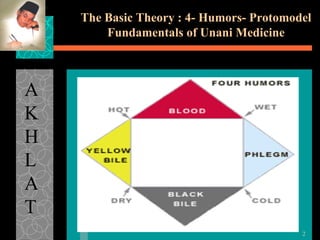
The Basic Theory : 4- Humors- Protomodel Fundamentals of Unani Medicine AK H L A T
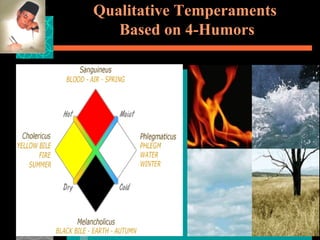
Qualitative Temperaments  Based on 4-Humors
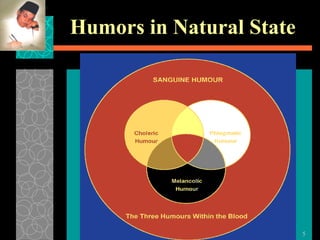
Humors in Natural State
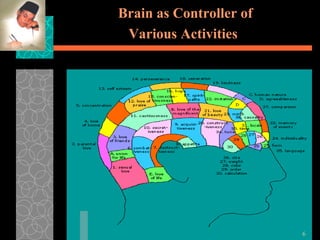
Brain as Controller of Various Activities
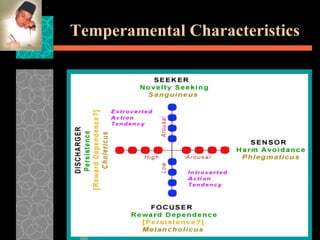
Temperamental Characteristics
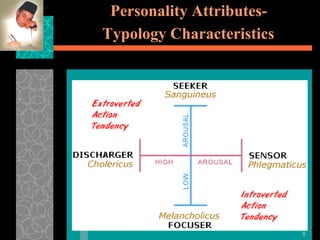
Personality Attributes-  Typology Characteristics
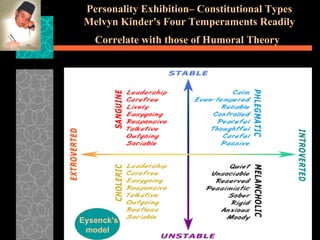
Personality Exhibition– Constitutional Types Melvyn Kinder's Four Temperaments Readily Correlate with those of Humoral Theory   Eysenck's   model
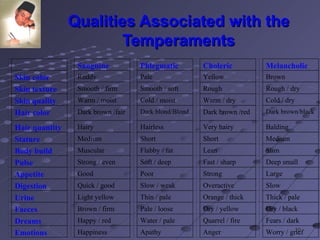
Qualities Associated with the Temperaments   Sanguine Phlegmatic Choleric Melancholic Skin color Ruddy Pale Yellow Brown Skin texture Smooth / firm Smooth / soft Rough Rough / dry Skin quality Warm / moist Cold / moist Warm / dry Cold / dry Hair color Dark brown /fair Dark blond/Blond Dark brown /red Dark brown/black Hair quantity Hairy Hairless Very hairy Balding Stature Medium Short Short Medium Body build Muscular Flabby / fat Lean Slim Pulse Strong / even Soft / deep Fast / sharp Deep small Appetite Good Poor Strong Large Digestion Quick / good Slow / weak Overactive Slow Urine Light yellow Thin / pale Orange / thick Thick / pale Faeces Brown / firm Pale / loose Dry / yellow Dry / black Dreams Happy / red Water / pale Quarrel / fire Fears / dark Emotions Happiness Apathy Anger Worry / grief
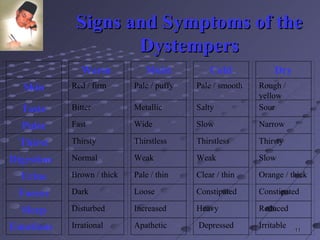
Signs and Symptoms of the Dystempers   Warm Moist Cold Dry Skin Red / firm Pale / puffy Pale / smooth Rough / yellow Taste Bitter Metallic Salty Sour Pulse Fast Wide Slow Narrow Thirst Thirsty Thirstless Thirstless Thirsty Digestion Normal  Weak Weak Slow Urine Brown / thick Pale / thin Clear / thin Orange / thick Faeces Dark Loose Constipated  Constipated Sleep Disturbed Increased Heavy Reduced Emotions Irrational Apathetic    Depressed Irritable
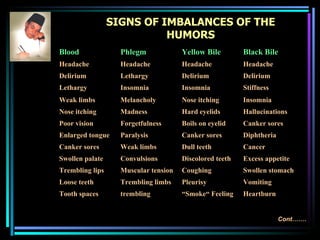
SIGNS OF IMBALANCES OF THE HUMORS Cont……. Blood Phlegm Yellow Bile Black Bile Headache Headache Headache Headache Delirium Lethargy Delirium Delirium Lethargy Insomnia Insomnia Stiffness Weak limbs Melancholy Nose itching Insomnia Nose itching Madness Hard eyelids Hallucinations Poor vision Forgetfulness Boils on eyelid Canker sores Enlarged tongue Paralysis Canker sores Diphtheria Canker sores Weak limbs Dull teeth Cancer Swollen palate Convulsions Discolored teeth Excess appetite Trembling lips Muscular tension Coughing Swollen stomach Loose teeth Trembling limbs Pleurisy Vomiting Tooth spaces trembling “ Smoke“ Feeling Heartburn
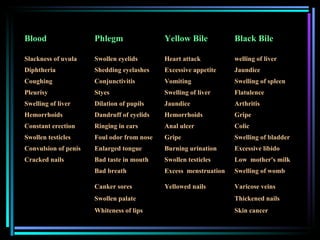
Blood Phlegm Yellow Bile Black Bile Slackness of uvula Swollen eyelids Heart attack welling of liver Diphtheria Shedding eyelashes Excessive appetite Jaundice Coughing Conjunctivitis Vomiting Swelling of spleen Pleurisy Styes Swelling of liver Flatulence Swelling of liver Dilation of pupils Jaundice Arthritis Hemorrhoids Dandruff of eyelids Hemorrhoids Gripe Constant erection  Ringing in ears Anal ulcer Colic Swollen testicles Foul odor from nose Gripe Swelling of bladder Convulsion of penis Enlarged tongue Burning urination Excessive libido Cracked nails Bad taste in mouth Swollen testicles Low  mother's milk   Bad breath Excess  menstruation Swelling of womb   Canker sores Yellowed nails Varicose veins   Swollen palate   Thickened nails   Whiteness of lips   Skin cancer
Phlegmatic Dominance in the West Further Phlegmatic Disorders :   Swelling of lips, Dull feeling in teeth, Ulcers of gums, Swelling of uvula, Diphtheria, Constriction of throat, Asthma, Coughing, Pleurisy, Heart feels as if being, pulled downward, Deficient appetite, Corrupted appetite, Severe thirst, Vomiting, Upset stomach, Convulsion of stomach, Obstruction of liver, Swelling of spleen, Swelling of liver, Itching of anus, Gripe, Colic, Constipation, Ulcers of kidneys, Swelling of bladder, Retention of urine, Inability to get erection, Swelling of testicles, Excessive menstrual flow, Sour mother's milk , Swelling of womb, Backache, Joint ache, Arthritis, Sebaceous cysts, Pimples, Acne, Baldness, No nail growth, Boils, Scabs, Severe perspiration, Dandruff
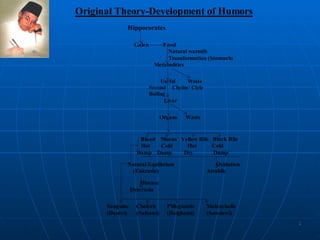
Eighteenth Century With the onset of the scientific revolutions of Copernicus, Galilei, and Harvey &  Andreas Rudiger in his  Physica Divina  reduced the number of elements responsible for temperamental differences to two:  aither  as cause of the light qualities, and  air  as cause of the heavy qualities. With Harvey's discoveries of the circulation of the blood, temperament emphasis shifted from the composition of the blood to its movement as the determinant of differences in temperament.  " In a word, the humoral doctrine was beginning to change into a solid theory."  (Roback, 1928, p.48).
Middle of the Eighteenth century Stahl and later Hoffman   proposed  three factors into their temperament theory: (a) the constitution of the blood, (b) the porosity of the tissue, and (c) the width of the blood vessels.  Haller laid the beginnings of modern experimental physiology resulting in permanent setback to the theory of humors.  He proposed that the connection between the blood and the temperaments is not a necessary one but that parts through which the blood flows, or rather their strength and irritability, are fundamental in accounting for temperamental differences Wrisberg a student of Haller combined the four humors into a double category, i.e. choleric-sanguine , and  melancholic-phlegmatic
Temperaments Defined Regionally Later in the Eighteenth Century, Phrenological temperaments became known as (a) the motive, based on the muscular system, (b) the vital, indicating a predominance of the alimentary system, and (c) the mental temperament, drawing its strength from the nervous system.  Toward the middle of the eighteenth century, the French physician Halle distinguished between general, partial and acquired temperaments. General temperaments were linked with the vascular, nervous, and motor systems. Partial temperaments corresponded to the various regions of the body and the fluids, pituita, and bile. The acquired temperaments resulted from environmental influences on the primary temperaments (Roback, 1928).
Nineteenth Century Study of temperament in the nineteenth century represents an embodiment of ideas from immediate predecessors.  Influenced by the powers of electricity, Schelling proposed  that  temperaments shared the same fate of opposites as did electricity .  Organisms were said to contain two polar principles of gravity and light (substance and movement) which  "were it not for the predominance of the one or the other in the individual, would yield total identity, where all differences would be obliterated"  (Roback, 1928, p.63). Temperament anomalies occurred when there was an imbalance in the three dimensions German-Jewish anatomist Jacob Henle, based  his theory of temperaments on the tone of the nervous system, speed of the   reaction and its duration (Roback, 1928)
Twentieth Century Quaternity Attributes related to temperamental differenciation based on humors   Four worldviews  :   Traditional, agnostic, dogmatic, innovative  (E. Adickes) Four life types  :   Theoretical, aesthetic, religious, economic (Eduard Spranger) Four abnormal temperaments : Anesthetic, hyperesthetic, melancholic, hypomanic (Ernst Kretschmer) Four attitude types based on psychological functions:   Thinking, intuition, feeling, sensation (CarlJung)
The Unani Diagnostic Process Any illness of a person is to be regarded as a product of : (a) the composition of the individual's body; (b) the kind of temperament, structure and strength of  faculties he or she has; (c) the type of factors operating on him from outside; and (d) Nature's own attempt to maintain individual’s physical functions and to avoid imbalance as much as possible . Keeping all such factors in mind, the cause and nature of illness is determined and a treatment plan is devised
Natural Response of the Body The most common sign of illness--fever--is a strange heat the body develops in order to make up for this long-standing lack of heat within the body. A fever rapidly accelerates the refining of accumulated superfluous matters in the body, "ripening" them so that they can be eliminated. Unani calls this process of elimination the healing crisis, which occurs in one of five forms:, vomiting, perspiration, nose bleeding, diarrhoea, and urination
Imbalance due to weak constitution Any imbalances to the humor constitutions or changes in their quantity and quality result in diseases.   To maintain the correct humoral balance there is a power of self- preservation or adjustment called  Quwwat-e-Mudabbira  ( vis medicatrix naturae ) in the body. If this power weakens, imbalance in the humoral composition is bound to occur which causes disease. In Unani Medicine, great reliance is placed on this power
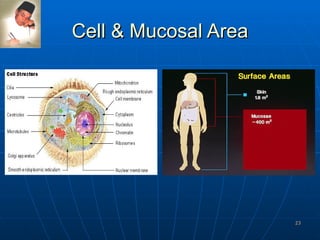
Cell & Mucosal Area
Diagnosis Nabz  (pulse), a rhythmic expansion of arteries which is felt by fingers. The reading of the pulse permits a rather straightforward assessment of several factors:  1) which humor is out of balance; 2) what is the nature of the imbalance; i.e., excess of heat or coldness, wetness or dryness  3) which of the primary organs are effected.  Other methods of diagnosis include: examination of Baul (urine), Baraz (stool), etc. Contemporary methods: Pathological, X-ray, ultrasound, Cardiograms etc.
Mother Nature  ( Howash-Shaafi ) If Unani principles in diagnostics are understood, it becomes clear that the symptoms associated with nausea, some non-specific fevers, diarrhoea, sweating, frequent urination, and most nosebleeds, are all, during youth and middle age, almost invariably signs of health, not disease. Even though medication may be prescribed, most of these complaints would get better by themselves even if nothing was done.  Here Nutritive Drugs of First Order bring desired results & This means that physicians spend an undue part of their practice misprescribing for ailments
Prevention- The Six Essentials  (Asbab Sitta Zaruriya) Air (Environmental) Drinks & Food Sleep & Wakefulness Excretion & Retention Physical Activity & Rest Mental Activity & Rest Currently employed:   Nutrition Supplements Exercise Primary Health care approaches Oral & Documented Islamic Traditional items & Recipes
Treatment Ilajbil Tadbeer (Regimenal Therapy)  Ilajbil Ghiza ( Dietotherapy)  Ilajbil Dava (Pharmacotherapy)  Ilajbil Yad ( Surgery)   (4 th  line of treatment).  1.Ilaj bil Tadbeer ( Regimenal Therapy ):-Some drugless regimens are advised for the treatment of certain ailments i.e. Exercise, Massage, Hamam(Turkish Bath), Douches (Cold and Hot), Fasd, Dalak, Kai (cauterization), Ishaal (purging) and the Regimen for Geriatrics.  2.Ilaj bil Ghiza ( Dietotherapy ):-Different diets are recommended for the patients of different diseases.  3. Ilaj bil Dava ( Pharmaco-therapy ):- The basic concept of treatment is to correct the cause of the disease that may be Abnormal temperament due to environmental factors. Single and Compound Drugs like; Safuf, Habub/Aqras, Electuaries, Confections, Triphalas, Decoctions etc.
Research Areas   Concentration should be made on therapeutic categories, viz. development of Unani products for chronic ailments,  adaptogens , immunomodulators, rheumatic disorders, degenerative diseases of old age, cancers, liver problems and diabetes, within the broad basic concepts and philosophy of the Unani System of Medicine
Unani Adaptogens-some examples   Curcuma longa   (Haldi) Asparagus adscendens   (Muslisafed)  Achyranthes aspera   ( Chirchitta) Andrographis paniculata   (Kalmegh) Asparagus racemosus   (Satawar) Centella asiatica   (Brahmi) Emblica officinalis   (Amla) Ocimum sanctum   (Tulsi) Piper longum   (Pipel Kalan) Terminalia belerica   (Behera) Tinospora cordifolia   (Gilo) Withania somnifera   (Asgand)
Evidence of Adaptogenic Activity   Haldi:  the curcuminoids as anti-oxidants are 8 times stronger than  vitamin E and also increase the number and activity of free radical destroying enzymes, like superoxide dismutase, catalase and glutathione peroxidase.  Curcumins to inhibit the Topoisomerase enzyme, which is required for the replication of cancer and parasite cells.  it increases the level of the enzyme glutathione S-transferase (GST), which is essential to detoxification  Asparagus:  (Safed musli) as rejuvanator, swimming performance test in rat, swimming stress induced ulceration test in rat, hypoxia, hypothermia and rota rod tests in mice  Chirchitta:  (Achyranthes aspera) The extract of herb was found to enhance the induction of ovalbumin (OVA)-specific humoral antibody response in mice . Furthermore, the plant extract was found to increase the induction of OVA-specific antibody response in a dose-dependent manner. A significant elevation of IgM, IgG1and IgG3 antibodies was observed In addition  Chirchitta  extract also decreases hepatic LPO suggesting a direct free radical scavenging activity
Evidence of Adaptogenic Activity Kalmegh   (Andrographis paniculata) Andrographolides present are observed to be potential enhancers of immune system,elicits release of an antiviral factor called interferon  A clinical trial supporting above fact is a phase- I dose escalating clinical trial of andrographolide from in  13 HIV  positive patients and 5 HIV uninfected, healthy volunteers.  Results of this trial shown that andrographolide inhibited HIV virus induced cell cycle dysregulation, leading to a rise in declined CD4(+) lymphocyte levels in HIV-1 infected individuals. These CD4(+) lymphocytes are also called as helper T cells assisting both B cells and cytotoxic T cells which are the two allied arms of our immune system contributing to humoral and cell mediated immunity respectively. Extract induced significant stimulation of antibody and delayed type hypersensitivity (DTH) response to sheep red blood cells (SRBC) in mice proving its immunostimualnt potency .
Evidence of Adaptogenic Activity Satawar   (Asparagus racemosus) Adaptogenic activity mediated through increase in WBC count (effective against leucopenia) and activation of phagocytic  and killing capacities of polymorphonuclear cells and monocyte- macrophage system, the potent arms of immune system .  Extract provide significant protection against cisplatin induced alterations in intestinal motility complying with definition of  an adaptogen. The herb shown activity against bone marrow suppression caused due to cyclophosphamide, a cytotoxic drug used in cancer chemotherapy. Also reduced lung fibrosis induced by Bleomycin . Brahmi   ( Centella asiatica) historically reputed for boosting mental activity, it is one of the best anti-stress anti-anxiety herbal drugs. Significant improvement has been observed in a double blind study of > 50 Children with intelligence quotient score from 90-110 with a dose of just 0.5 gram/day for One year. It is also a reputed Anti-Oxidant .
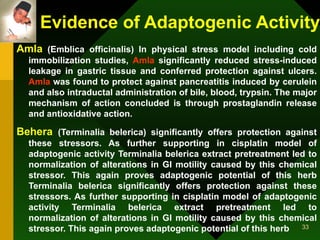
Evidence of Adaptogenic Activity Amla  (Emblica officinalis) In physical stress model including cold immobilization studies,  Amla  significantly reduced stress-induced leakage in gastric tissue and conferred protection against ulcers.  Amla  was found to protect against pancreatitis induced by cerulein and also intraductal administration of bile, blood, trypsin. The major mechanism of action concluded is through prostaglandin release and antioxidative action. Behera  ( Terminalia belerica) significantly offers protection against these stressors. As further supporting in cisplatin model of adaptogenic activity Terminalia belerica extract pretreatment led to normalization of alterations in GI motility caused by this chemical stressor. This again proves adaptogenic potential of this herb   Terminalia belerica significantly offers protection against these stressors. As further supporting in cisplatin model of adaptogenic activity Terminalia belerica extract pretreatment led to normalization of alterations in GI motility caused by this chemical stressor. This again proves adaptogenic potential of this herb
Evidence of Adaptogenic Activity Tulsi/ Rehan:   antistress activity produced by the Ocimum sanctum extract was comparable to that of desipramine, an antidepressant drug. increase in humoral immunologic response as represented by an increase in antibody titre in both the Widal and sheep erythrocyte agglutination tests as well as by the cellular immunologic response represented by E-rosette formation and lymphocytosis. Piper longum:  enhances thermogenic response, or release of metabolic heat energy in the body . induced significant activation of macrophages as evidenced by increased macrophage migration index (MMI) and phagocytic activity  Gilo (Tinospora):  adaptogenic activity of the herb, mediated through increase in white blood cell count and activation of phagocytic and killing capacities of polymorphonuclear cells and monocyte- macrophage system the potent arms of immune system. Asgand (Withania):  Induce leucocytosis with predominant neutrophilia and protect against leucopenia (decreased WBC count) and bone marrow suppression caused due to cyclophosphamide
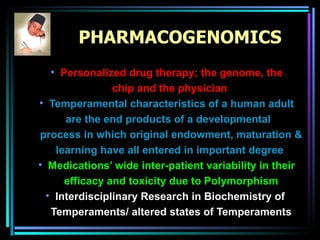
Detection  of invaders &  defence  which is triggered by that detection
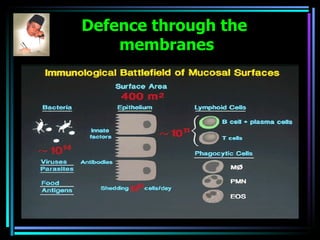
Defence through the  membranes
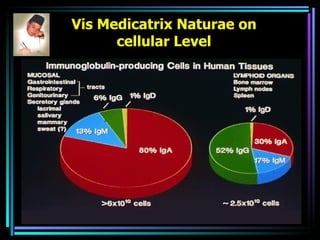
Vis Medicatrix Naturae on cellular Level
PHARMACOGENOMICS Personalized drug therapy; the genome, the chip and the physician   Temperamental characteristics of a human adult are the end products of a developmental  process in which original endowment, maturation & learning have all entered in important degree   Medications’ wide inter-patient variability in their efficacy and toxicity  due to Polymorphism Interdisciplinary Research in Biochemistry of  Temperaments/ altered states of Temperaments
Message for Future   On September 15, 2005, marking the birth anniversary of late Hakeem Abdul Hameed, founder of Jamia Hamdard, the unanimous message came out from the debate organized by the Indian Medicine Development Trust: “ This system has a vast scope and will always remain relevant. The need of the hour is that people should be made aware of its effectiveness and advantages ". Vol.3, No. 19
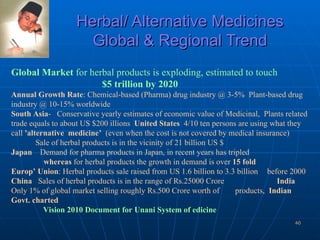
Herbal/ Alternative Medicines Global & Regional Trend Global Market  for herbal products is exploding, estimated to touch   $5 trillion by 2020 Annual Growth Rate : Chemical-based (Pharma) drug industry @ 3-5%  Plant-based drug industry @ 10-15% worldwide  South Asia -  Conservative yearly estimates of economic value of Medicinal,  Plants related trade equals to about US $200 illions  United States   4/10 ten persons are using what they call  'alternative  medicine’   (even when the cost is not covered by medical insurance)  Sale of herbal products is in the vicinity of 21 billion US $  Japan   Demand for pharma products in Japan, in recent years has tripled whereas  for herbal products the growth in demand is over  15 fold Europ’ Union : Herbal products sale raised from US 1.6 billion to 3.3 billion  before 2000 China   Sales of herbal products is in the range of Rs.25000 Crore   India   Only 1% of global market selling roughly Rs.500 Crore worth of  products,  Indian Govt. charted  Vision 2010 Document for Unani System of edicine
A Brief Overview of  Unani Medicine   Unani system of medicine was very strong and has a long history over thousand years. Unani system of medicine functions through two streams viz. Oral traditions  practiced by rural people (trial and error) selected plants from their habitat to treat ailments.  This stream was called the Local Health Tradition.  Other stream organized  Codified Written Systems  of medicine with their own theoretical and philosophical explanations, such as Ayurveda, Unani, Chinese systems of medicine. These are Mainstream & not Complementary or Alternative systems of medicines.  However, there has been  erosion and corrosion  in practice of these systems  + they have failed to appropriately inculcate the fast developing science and technology
The Importance of Terminology: Unani is Not Complementary or Alternative System There is need for standardization of entire Unani system of medicine and to determine the areas of highest priority, so that our resources could be used to  preserve it for posterity
Creating Interface Between Unani & Modern System of Medicine We have not utilized  the full benefits of traditional medicines in this part of the world, even with vast resources of knowledge, we have not added much in terms of new science, new methods or new developments.  The first and foremost requisite  is the  proper documentation of our vast  reservoir of  tremendous codified knowledge , there is need for a proper quality control system for traditional medicines & natural product-based research is required It is easy to work on a single synthetic compound , but in herbal-based products the problems multiply many fold due to the presence of a large number of active constituents. However, this problem can be solved using the tremendous technological advances in Analytical Chemistry e.g.
Proper quality control evaluation systems  chemical, biological and genomic markers as tools for quality assurance + chemoprofiling Proper safety and evaluation studies  drug interaction must be taken into consideration as important component at early stage Every drug , anywhere in the world, should first fulfil the  pharmacopoeial specifications  and only then can the drug be marketed. The increasing popularity and trade of nutraceuticals and herbal drugs all over the world has made these specifications all the more important Markers & Specifications
The West Needs a Deeper Understanding of Unani & Must Respect the Many Aspects of its Science Unani enjoys a fully authentic, organized and systematic knowledge of medicine.  It is essential to accept  Unani Medicine and its spirit  in toto .  Unani System of Medicine contains every aspect from collection to manufacture of drugs, however, modern pharmaceutical companies were not applying the Unani knowledge in its true spirit, and, as a result, the expected results are not achieved Without full acquaintance with all the fundamental principles of Unani, followers of modern science could not understand and appreciate the scientific authenticity of the claims of Unani system of medicine
The Revival of Unani System of Medicine Requires the Synergy of Research Work with Modern Systems of Medicine Preventive and curative aspects of life in a most comprehensive way Unani is a science in the sense that it is a qualitative, holistic science of health and longevity, and a system for healing the whole person, body and mind Recognition of the importance of therapeutic knowledge for preparing ethnomedicine  There is need for testing the simple herbal medicines used for high profile diseases to establish their utility as medicines
Problems Confronting Unani and  or Herbal Medicines There is great concern about the  loss of quality  of Unani medicines and their performance in the global market remains questionable.  Reluctance of the practitioners  of indigenous systems of medicine  Acceptance of modern scientific methods  & tools in pre-harvest to post-harvest processing of medicinal plants  Standard Procedures for preparation of herbal formulations/herbal drugs?  Failure to ensure consistency  in batch-to-batch production of herbal drugs/formulations and consequent failure to compete at the international level.  Inadequate standardization methods/tools.   Lack of systematic documentation  of herbal products.  Rarity and danger of extinction  of medicinal plant species from their natural ecosystems due to various anthropogenic activities (almost 85% of the medicinal plants required for the preparation of traditional remedies are collected from natural resources ).
Steps  to  Overcome  these Problems As far as possible, an integrated  research approach should be followed to make the best use of traditional knowledge while using the modern tools and technology for optimal utilization of the valuable resources of our wealth of medicinal plants and products being obtained from them. This should be done by:  Sharing and networking the information or creating inventories for the traditional remedies.  Formulating policy guidelines for establishment of different parameters and procedures that best suit herbal remedies in order to fix the standards of raw drugs and finished products using pharmacognostic, chemotaxonomic, molecular DNA fingerprinting and reverse pharmacology techniques, or guidelines for assessing the safety, efficacy and batch-to-batch consistency of herbal products/ drugs.
Steps to Overcome Problems The manufacturing process  should follow GMP compliance by being efficient, time and cost effective, with the development of in-process controls.  Regulatory issues  to be followed for manufacturing units.  Registration of herbal products,  viz., household remedies, herbal drugs, nutraceuticals, and traditional system remedies as separate entities.  Study the mode of action of drugs  at the cellular, molecular (receptor level) and system levels, having as holistic a view as possible. The validation of Unani and ethnobotanical claims using modern scientific methodology along with current professional practices should be undertaken.  Availability/cultivation of important medicinal plants  and standardization of post-harvest technology.  Contd…..
Phases of a clinical trial A step by step approach is usually followed in the development of new herbal medicines, but may ordinarily be less necessary for a study to validate the safety and efficacy of traditional herbal medicine. The point of entry to the phases will be determined by the nature and history of the herbal medicines being studied Phase I:  First trials for a new compound or a new formulation that are generally carried out with a small number of health volunteer or patients suffering from the disease for which the herbal medicine is intended. The main purpose of a phase I trial is to observe tolerance to the herbal medicine and therefore to get medication of the dose that might be used safely in subsequent studies. Continue next slide
Studies on a limited number of patients to determine clinical efficacy and to further confirm safety. Such trials are preferably designed as  randomized, double-blind, controlled studies , using for control groups either an existing alternative treatment or a placebo. The dosage schedules established in such studies are then used for a more extensive clinical study. Phase-III:   A larger patient group is usually studied at several centers  using a randomized double blind design to validate preliminary evidence of efficacy obtained in earlier studies. Ordinarily, such trials are conducted under conditions which are as close as possible to the anticipated conditions of normal use. Phase-II:
Studies performed after the dosage form is available for general use. The main purpose of such studies is to detect toxic events that may occur so rarely that they are not detected earlier. Market surveillance studies   Phase IV:
Sub-continental Species with known standard marker/ biomarker components 1. Adhatoda vasica   (0.5% Vasicine )  2.  Andrographis paniculata  (10% Andrographolide)  3.  Azadirachita indica  (2% Azadirachtin)  4.  Boswellia seratta  (40% & 70% Boswellic Acid)  5.  Centella asiatica  (3% Asiaticoside)  6.  Commiphora mukul  (5% Guggulsterones)  7.  Curcuma longa  (95% Curcumin)  8.  Glycyrrihiza glabra  (20% Glycyrrhizin)  9.  Gymnema sylvestre   (25% Gymnemic Acid).  10.  Momordica charantia    (3% bitters).  11.  Picrorrhiza kurroa    (10% bitters )  12.  Shilajit    (5% Fulvic Acid)  13.  Tribulus terrestris    (20% & 40%  Saponin)  14.  T t rigonella foenum- graceum  (10% Saponin)  15.  Withania somnifera   (1.5% Withanolides/1% alkaloid) 16.  Zingiber officinale    (5% Gingerols).
Standardization   I.   Pharmacognostic Characters  (Organoleptic and Microscopic  Observations, Study of Powdered Drugs and their Physico- chemical Studies, Colour Reactions, TLC, Physico-chemical Constants and Successive Extractive Values, Ash values (Acid insoluble, Water soluble, Loss on drying etc.).  II. Phytochemical Studies  (GLC, HPLC, NMR, MS, AAS or any other appropriate methodology to determine specific standards. III. Comparative Standards mentioned in other herbal/traditional  medicine pharmacopoeias (Survey of Literature) IV. Bioactivity of specific constituents (like Bench Top  Assays), and V.  Effects of Preservation/Storage  on the Quality of Herbal Drugs
Thank you

Tibb e-unani -dr aftab saeed

  • 1.
    Tibb-e-Unani in theNew Millennium Aftab Saeed Hamdard University Madinat al-Hikmah Karachi-74700 Pakistan
  • 2.
    The Basic Theory: 4- Humors- Protomodel Fundamentals of Unani Medicine AK H L A T
  • 4.
    Qualitative Temperaments Based on 4-Humors
  • 5.
  • 6.
    Brain as Controllerof Various Activities
  • 7.
  • 8.
    Personality Attributes- Typology Characteristics
  • 9.
    Personality Exhibition– ConstitutionalTypes Melvyn Kinder's Four Temperaments Readily Correlate with those of Humoral Theory Eysenck's model
  • 10.
    Qualities Associated withthe Temperaments   Sanguine Phlegmatic Choleric Melancholic Skin color Ruddy Pale Yellow Brown Skin texture Smooth / firm Smooth / soft Rough Rough / dry Skin quality Warm / moist Cold / moist Warm / dry Cold / dry Hair color Dark brown /fair Dark blond/Blond Dark brown /red Dark brown/black Hair quantity Hairy Hairless Very hairy Balding Stature Medium Short Short Medium Body build Muscular Flabby / fat Lean Slim Pulse Strong / even Soft / deep Fast / sharp Deep small Appetite Good Poor Strong Large Digestion Quick / good Slow / weak Overactive Slow Urine Light yellow Thin / pale Orange / thick Thick / pale Faeces Brown / firm Pale / loose Dry / yellow Dry / black Dreams Happy / red Water / pale Quarrel / fire Fears / dark Emotions Happiness Apathy Anger Worry / grief
  • 11.
    Signs and Symptomsof the Dystempers   Warm Moist Cold Dry Skin Red / firm Pale / puffy Pale / smooth Rough / yellow Taste Bitter Metallic Salty Sour Pulse Fast Wide Slow Narrow Thirst Thirsty Thirstless Thirstless Thirsty Digestion Normal Weak Weak Slow Urine Brown / thick Pale / thin Clear / thin Orange / thick Faeces Dark Loose Constipated Constipated Sleep Disturbed Increased Heavy Reduced Emotions Irrational Apathetic   Depressed Irritable
  • 12.
    SIGNS OF IMBALANCESOF THE HUMORS Cont……. Blood Phlegm Yellow Bile Black Bile Headache Headache Headache Headache Delirium Lethargy Delirium Delirium Lethargy Insomnia Insomnia Stiffness Weak limbs Melancholy Nose itching Insomnia Nose itching Madness Hard eyelids Hallucinations Poor vision Forgetfulness Boils on eyelid Canker sores Enlarged tongue Paralysis Canker sores Diphtheria Canker sores Weak limbs Dull teeth Cancer Swollen palate Convulsions Discolored teeth Excess appetite Trembling lips Muscular tension Coughing Swollen stomach Loose teeth Trembling limbs Pleurisy Vomiting Tooth spaces trembling “ Smoke“ Feeling Heartburn
  • 13.
    Blood Phlegm YellowBile Black Bile Slackness of uvula Swollen eyelids Heart attack welling of liver Diphtheria Shedding eyelashes Excessive appetite Jaundice Coughing Conjunctivitis Vomiting Swelling of spleen Pleurisy Styes Swelling of liver Flatulence Swelling of liver Dilation of pupils Jaundice Arthritis Hemorrhoids Dandruff of eyelids Hemorrhoids Gripe Constant erection Ringing in ears Anal ulcer Colic Swollen testicles Foul odor from nose Gripe Swelling of bladder Convulsion of penis Enlarged tongue Burning urination Excessive libido Cracked nails Bad taste in mouth Swollen testicles Low mother's milk   Bad breath Excess menstruation Swelling of womb   Canker sores Yellowed nails Varicose veins   Swollen palate   Thickened nails   Whiteness of lips   Skin cancer
  • 14.
    Phlegmatic Dominance inthe West Further Phlegmatic Disorders : Swelling of lips, Dull feeling in teeth, Ulcers of gums, Swelling of uvula, Diphtheria, Constriction of throat, Asthma, Coughing, Pleurisy, Heart feels as if being, pulled downward, Deficient appetite, Corrupted appetite, Severe thirst, Vomiting, Upset stomach, Convulsion of stomach, Obstruction of liver, Swelling of spleen, Swelling of liver, Itching of anus, Gripe, Colic, Constipation, Ulcers of kidneys, Swelling of bladder, Retention of urine, Inability to get erection, Swelling of testicles, Excessive menstrual flow, Sour mother's milk , Swelling of womb, Backache, Joint ache, Arthritis, Sebaceous cysts, Pimples, Acne, Baldness, No nail growth, Boils, Scabs, Severe perspiration, Dandruff
  • 15.
    Eighteenth Century Withthe onset of the scientific revolutions of Copernicus, Galilei, and Harvey & Andreas Rudiger in his Physica Divina reduced the number of elements responsible for temperamental differences to two: aither as cause of the light qualities, and air as cause of the heavy qualities. With Harvey's discoveries of the circulation of the blood, temperament emphasis shifted from the composition of the blood to its movement as the determinant of differences in temperament. " In a word, the humoral doctrine was beginning to change into a solid theory." (Roback, 1928, p.48).
  • 16.
    Middle of theEighteenth century Stahl and later Hoffman proposed three factors into their temperament theory: (a) the constitution of the blood, (b) the porosity of the tissue, and (c) the width of the blood vessels. Haller laid the beginnings of modern experimental physiology resulting in permanent setback to the theory of humors. He proposed that the connection between the blood and the temperaments is not a necessary one but that parts through which the blood flows, or rather their strength and irritability, are fundamental in accounting for temperamental differences Wrisberg a student of Haller combined the four humors into a double category, i.e. choleric-sanguine , and melancholic-phlegmatic
  • 17.
    Temperaments Defined RegionallyLater in the Eighteenth Century, Phrenological temperaments became known as (a) the motive, based on the muscular system, (b) the vital, indicating a predominance of the alimentary system, and (c) the mental temperament, drawing its strength from the nervous system. Toward the middle of the eighteenth century, the French physician Halle distinguished between general, partial and acquired temperaments. General temperaments were linked with the vascular, nervous, and motor systems. Partial temperaments corresponded to the various regions of the body and the fluids, pituita, and bile. The acquired temperaments resulted from environmental influences on the primary temperaments (Roback, 1928).
  • 18.
    Nineteenth Century Studyof temperament in the nineteenth century represents an embodiment of ideas from immediate predecessors. Influenced by the powers of electricity, Schelling proposed that temperaments shared the same fate of opposites as did electricity . Organisms were said to contain two polar principles of gravity and light (substance and movement) which "were it not for the predominance of the one or the other in the individual, would yield total identity, where all differences would be obliterated" (Roback, 1928, p.63). Temperament anomalies occurred when there was an imbalance in the three dimensions German-Jewish anatomist Jacob Henle, based his theory of temperaments on the tone of the nervous system, speed of the reaction and its duration (Roback, 1928)
  • 19.
    Twentieth Century QuaternityAttributes related to temperamental differenciation based on humors Four worldviews : Traditional, agnostic, dogmatic, innovative (E. Adickes) Four life types : Theoretical, aesthetic, religious, economic (Eduard Spranger) Four abnormal temperaments : Anesthetic, hyperesthetic, melancholic, hypomanic (Ernst Kretschmer) Four attitude types based on psychological functions: Thinking, intuition, feeling, sensation (CarlJung)
  • 20.
    The Unani DiagnosticProcess Any illness of a person is to be regarded as a product of : (a) the composition of the individual's body; (b) the kind of temperament, structure and strength of faculties he or she has; (c) the type of factors operating on him from outside; and (d) Nature's own attempt to maintain individual’s physical functions and to avoid imbalance as much as possible . Keeping all such factors in mind, the cause and nature of illness is determined and a treatment plan is devised
  • 21.
    Natural Response ofthe Body The most common sign of illness--fever--is a strange heat the body develops in order to make up for this long-standing lack of heat within the body. A fever rapidly accelerates the refining of accumulated superfluous matters in the body, "ripening" them so that they can be eliminated. Unani calls this process of elimination the healing crisis, which occurs in one of five forms:, vomiting, perspiration, nose bleeding, diarrhoea, and urination
  • 22.
    Imbalance due toweak constitution Any imbalances to the humor constitutions or changes in their quantity and quality result in diseases. To maintain the correct humoral balance there is a power of self- preservation or adjustment called Quwwat-e-Mudabbira ( vis medicatrix naturae ) in the body. If this power weakens, imbalance in the humoral composition is bound to occur which causes disease. In Unani Medicine, great reliance is placed on this power
  • 23.
  • 24.
    Diagnosis Nabz (pulse), a rhythmic expansion of arteries which is felt by fingers. The reading of the pulse permits a rather straightforward assessment of several factors: 1) which humor is out of balance; 2) what is the nature of the imbalance; i.e., excess of heat or coldness, wetness or dryness 3) which of the primary organs are effected. Other methods of diagnosis include: examination of Baul (urine), Baraz (stool), etc. Contemporary methods: Pathological, X-ray, ultrasound, Cardiograms etc.
  • 25.
    Mother Nature ( Howash-Shaafi ) If Unani principles in diagnostics are understood, it becomes clear that the symptoms associated with nausea, some non-specific fevers, diarrhoea, sweating, frequent urination, and most nosebleeds, are all, during youth and middle age, almost invariably signs of health, not disease. Even though medication may be prescribed, most of these complaints would get better by themselves even if nothing was done. Here Nutritive Drugs of First Order bring desired results & This means that physicians spend an undue part of their practice misprescribing for ailments
  • 26.
    Prevention- The SixEssentials (Asbab Sitta Zaruriya) Air (Environmental) Drinks & Food Sleep & Wakefulness Excretion & Retention Physical Activity & Rest Mental Activity & Rest Currently employed: Nutrition Supplements Exercise Primary Health care approaches Oral & Documented Islamic Traditional items & Recipes
  • 27.
    Treatment Ilajbil Tadbeer(Regimenal Therapy) Ilajbil Ghiza ( Dietotherapy) Ilajbil Dava (Pharmacotherapy) Ilajbil Yad ( Surgery) (4 th line of treatment). 1.Ilaj bil Tadbeer ( Regimenal Therapy ):-Some drugless regimens are advised for the treatment of certain ailments i.e. Exercise, Massage, Hamam(Turkish Bath), Douches (Cold and Hot), Fasd, Dalak, Kai (cauterization), Ishaal (purging) and the Regimen for Geriatrics. 2.Ilaj bil Ghiza ( Dietotherapy ):-Different diets are recommended for the patients of different diseases. 3. Ilaj bil Dava ( Pharmaco-therapy ):- The basic concept of treatment is to correct the cause of the disease that may be Abnormal temperament due to environmental factors. Single and Compound Drugs like; Safuf, Habub/Aqras, Electuaries, Confections, Triphalas, Decoctions etc.
  • 28.
    Research Areas Concentration should be made on therapeutic categories, viz. development of Unani products for chronic ailments, adaptogens , immunomodulators, rheumatic disorders, degenerative diseases of old age, cancers, liver problems and diabetes, within the broad basic concepts and philosophy of the Unani System of Medicine
  • 29.
    Unani Adaptogens-some examples Curcuma longa (Haldi) Asparagus adscendens (Muslisafed) Achyranthes aspera ( Chirchitta) Andrographis paniculata (Kalmegh) Asparagus racemosus (Satawar) Centella asiatica (Brahmi) Emblica officinalis (Amla) Ocimum sanctum (Tulsi) Piper longum (Pipel Kalan) Terminalia belerica (Behera) Tinospora cordifolia (Gilo) Withania somnifera (Asgand)
  • 30.
    Evidence of AdaptogenicActivity Haldi: the curcuminoids as anti-oxidants are 8 times stronger than vitamin E and also increase the number and activity of free radical destroying enzymes, like superoxide dismutase, catalase and glutathione peroxidase. Curcumins to inhibit the Topoisomerase enzyme, which is required for the replication of cancer and parasite cells. it increases the level of the enzyme glutathione S-transferase (GST), which is essential to detoxification Asparagus: (Safed musli) as rejuvanator, swimming performance test in rat, swimming stress induced ulceration test in rat, hypoxia, hypothermia and rota rod tests in mice Chirchitta: (Achyranthes aspera) The extract of herb was found to enhance the induction of ovalbumin (OVA)-specific humoral antibody response in mice . Furthermore, the plant extract was found to increase the induction of OVA-specific antibody response in a dose-dependent manner. A significant elevation of IgM, IgG1and IgG3 antibodies was observed In addition Chirchitta extract also decreases hepatic LPO suggesting a direct free radical scavenging activity
  • 31.
    Evidence of AdaptogenicActivity Kalmegh (Andrographis paniculata) Andrographolides present are observed to be potential enhancers of immune system,elicits release of an antiviral factor called interferon A clinical trial supporting above fact is a phase- I dose escalating clinical trial of andrographolide from in 13 HIV positive patients and 5 HIV uninfected, healthy volunteers. Results of this trial shown that andrographolide inhibited HIV virus induced cell cycle dysregulation, leading to a rise in declined CD4(+) lymphocyte levels in HIV-1 infected individuals. These CD4(+) lymphocytes are also called as helper T cells assisting both B cells and cytotoxic T cells which are the two allied arms of our immune system contributing to humoral and cell mediated immunity respectively. Extract induced significant stimulation of antibody and delayed type hypersensitivity (DTH) response to sheep red blood cells (SRBC) in mice proving its immunostimualnt potency .
  • 32.
    Evidence of AdaptogenicActivity Satawar (Asparagus racemosus) Adaptogenic activity mediated through increase in WBC count (effective against leucopenia) and activation of phagocytic and killing capacities of polymorphonuclear cells and monocyte- macrophage system, the potent arms of immune system . Extract provide significant protection against cisplatin induced alterations in intestinal motility complying with definition of an adaptogen. The herb shown activity against bone marrow suppression caused due to cyclophosphamide, a cytotoxic drug used in cancer chemotherapy. Also reduced lung fibrosis induced by Bleomycin . Brahmi ( Centella asiatica) historically reputed for boosting mental activity, it is one of the best anti-stress anti-anxiety herbal drugs. Significant improvement has been observed in a double blind study of > 50 Children with intelligence quotient score from 90-110 with a dose of just 0.5 gram/day for One year. It is also a reputed Anti-Oxidant .
  • 33.
    Evidence of AdaptogenicActivity Amla (Emblica officinalis) In physical stress model including cold immobilization studies, Amla significantly reduced stress-induced leakage in gastric tissue and conferred protection against ulcers. Amla was found to protect against pancreatitis induced by cerulein and also intraductal administration of bile, blood, trypsin. The major mechanism of action concluded is through prostaglandin release and antioxidative action. Behera ( Terminalia belerica) significantly offers protection against these stressors. As further supporting in cisplatin model of adaptogenic activity Terminalia belerica extract pretreatment led to normalization of alterations in GI motility caused by this chemical stressor. This again proves adaptogenic potential of this herb Terminalia belerica significantly offers protection against these stressors. As further supporting in cisplatin model of adaptogenic activity Terminalia belerica extract pretreatment led to normalization of alterations in GI motility caused by this chemical stressor. This again proves adaptogenic potential of this herb
  • 34.
    Evidence of AdaptogenicActivity Tulsi/ Rehan: antistress activity produced by the Ocimum sanctum extract was comparable to that of desipramine, an antidepressant drug. increase in humoral immunologic response as represented by an increase in antibody titre in both the Widal and sheep erythrocyte agglutination tests as well as by the cellular immunologic response represented by E-rosette formation and lymphocytosis. Piper longum: enhances thermogenic response, or release of metabolic heat energy in the body . induced significant activation of macrophages as evidenced by increased macrophage migration index (MMI) and phagocytic activity Gilo (Tinospora): adaptogenic activity of the herb, mediated through increase in white blood cell count and activation of phagocytic and killing capacities of polymorphonuclear cells and monocyte- macrophage system the potent arms of immune system. Asgand (Withania): Induce leucocytosis with predominant neutrophilia and protect against leucopenia (decreased WBC count) and bone marrow suppression caused due to cyclophosphamide
  • 35.
    Detection ofinvaders & defence which is triggered by that detection
  • 36.
  • 37.
    Vis Medicatrix Naturaeon cellular Level
  • 38.
    PHARMACOGENOMICS Personalized drugtherapy; the genome, the chip and the physician Temperamental characteristics of a human adult are the end products of a developmental process in which original endowment, maturation & learning have all entered in important degree Medications’ wide inter-patient variability in their efficacy and toxicity due to Polymorphism Interdisciplinary Research in Biochemistry of Temperaments/ altered states of Temperaments
  • 39.
    Message for Future On September 15, 2005, marking the birth anniversary of late Hakeem Abdul Hameed, founder of Jamia Hamdard, the unanimous message came out from the debate organized by the Indian Medicine Development Trust: “ This system has a vast scope and will always remain relevant. The need of the hour is that people should be made aware of its effectiveness and advantages ". Vol.3, No. 19
  • 40.
    Herbal/ Alternative MedicinesGlobal & Regional Trend Global Market for herbal products is exploding, estimated to touch $5 trillion by 2020 Annual Growth Rate : Chemical-based (Pharma) drug industry @ 3-5% Plant-based drug industry @ 10-15% worldwide South Asia - Conservative yearly estimates of economic value of Medicinal, Plants related trade equals to about US $200 illions United States 4/10 ten persons are using what they call 'alternative medicine’ (even when the cost is not covered by medical insurance) Sale of herbal products is in the vicinity of 21 billion US $  Japan Demand for pharma products in Japan, in recent years has tripled whereas for herbal products the growth in demand is over 15 fold Europ’ Union : Herbal products sale raised from US 1.6 billion to 3.3 billion before 2000 China Sales of herbal products is in the range of Rs.25000 Crore India Only 1% of global market selling roughly Rs.500 Crore worth of products, Indian Govt. charted Vision 2010 Document for Unani System of edicine
  • 41.
    A Brief Overviewof Unani Medicine Unani system of medicine was very strong and has a long history over thousand years. Unani system of medicine functions through two streams viz. Oral traditions practiced by rural people (trial and error) selected plants from their habitat to treat ailments. This stream was called the Local Health Tradition. Other stream organized Codified Written Systems of medicine with their own theoretical and philosophical explanations, such as Ayurveda, Unani, Chinese systems of medicine. These are Mainstream & not Complementary or Alternative systems of medicines. However, there has been erosion and corrosion in practice of these systems + they have failed to appropriately inculcate the fast developing science and technology
  • 42.
    The Importance ofTerminology: Unani is Not Complementary or Alternative System There is need for standardization of entire Unani system of medicine and to determine the areas of highest priority, so that our resources could be used to preserve it for posterity
  • 43.
    Creating Interface BetweenUnani & Modern System of Medicine We have not utilized the full benefits of traditional medicines in this part of the world, even with vast resources of knowledge, we have not added much in terms of new science, new methods or new developments. The first and foremost requisite is the proper documentation of our vast reservoir of tremendous codified knowledge , there is need for a proper quality control system for traditional medicines & natural product-based research is required It is easy to work on a single synthetic compound , but in herbal-based products the problems multiply many fold due to the presence of a large number of active constituents. However, this problem can be solved using the tremendous technological advances in Analytical Chemistry e.g.
  • 44.
    Proper quality controlevaluation systems chemical, biological and genomic markers as tools for quality assurance + chemoprofiling Proper safety and evaluation studies drug interaction must be taken into consideration as important component at early stage Every drug , anywhere in the world, should first fulfil the pharmacopoeial specifications and only then can the drug be marketed. The increasing popularity and trade of nutraceuticals and herbal drugs all over the world has made these specifications all the more important Markers & Specifications
  • 45.
    The West Needsa Deeper Understanding of Unani & Must Respect the Many Aspects of its Science Unani enjoys a fully authentic, organized and systematic knowledge of medicine. It is essential to accept Unani Medicine and its spirit in toto . Unani System of Medicine contains every aspect from collection to manufacture of drugs, however, modern pharmaceutical companies were not applying the Unani knowledge in its true spirit, and, as a result, the expected results are not achieved Without full acquaintance with all the fundamental principles of Unani, followers of modern science could not understand and appreciate the scientific authenticity of the claims of Unani system of medicine
  • 46.
    The Revival ofUnani System of Medicine Requires the Synergy of Research Work with Modern Systems of Medicine Preventive and curative aspects of life in a most comprehensive way Unani is a science in the sense that it is a qualitative, holistic science of health and longevity, and a system for healing the whole person, body and mind Recognition of the importance of therapeutic knowledge for preparing ethnomedicine There is need for testing the simple herbal medicines used for high profile diseases to establish their utility as medicines
  • 47.
    Problems Confronting Unaniand or Herbal Medicines There is great concern about the loss of quality of Unani medicines and their performance in the global market remains questionable. Reluctance of the practitioners of indigenous systems of medicine Acceptance of modern scientific methods & tools in pre-harvest to post-harvest processing of medicinal plants Standard Procedures for preparation of herbal formulations/herbal drugs? Failure to ensure consistency in batch-to-batch production of herbal drugs/formulations and consequent failure to compete at the international level. Inadequate standardization methods/tools. Lack of systematic documentation of herbal products. Rarity and danger of extinction of medicinal plant species from their natural ecosystems due to various anthropogenic activities (almost 85% of the medicinal plants required for the preparation of traditional remedies are collected from natural resources ).
  • 48.
    Steps to Overcome these Problems As far as possible, an integrated research approach should be followed to make the best use of traditional knowledge while using the modern tools and technology for optimal utilization of the valuable resources of our wealth of medicinal plants and products being obtained from them. This should be done by: Sharing and networking the information or creating inventories for the traditional remedies. Formulating policy guidelines for establishment of different parameters and procedures that best suit herbal remedies in order to fix the standards of raw drugs and finished products using pharmacognostic, chemotaxonomic, molecular DNA fingerprinting and reverse pharmacology techniques, or guidelines for assessing the safety, efficacy and batch-to-batch consistency of herbal products/ drugs.
  • 49.
    Steps to OvercomeProblems The manufacturing process should follow GMP compliance by being efficient, time and cost effective, with the development of in-process controls. Regulatory issues to be followed for manufacturing units. Registration of herbal products, viz., household remedies, herbal drugs, nutraceuticals, and traditional system remedies as separate entities. Study the mode of action of drugs at the cellular, molecular (receptor level) and system levels, having as holistic a view as possible. The validation of Unani and ethnobotanical claims using modern scientific methodology along with current professional practices should be undertaken. Availability/cultivation of important medicinal plants and standardization of post-harvest technology. Contd…..
  • 50.
    Phases of aclinical trial A step by step approach is usually followed in the development of new herbal medicines, but may ordinarily be less necessary for a study to validate the safety and efficacy of traditional herbal medicine. The point of entry to the phases will be determined by the nature and history of the herbal medicines being studied Phase I: First trials for a new compound or a new formulation that are generally carried out with a small number of health volunteer or patients suffering from the disease for which the herbal medicine is intended. The main purpose of a phase I trial is to observe tolerance to the herbal medicine and therefore to get medication of the dose that might be used safely in subsequent studies. Continue next slide
  • 51.
    Studies on alimited number of patients to determine clinical efficacy and to further confirm safety. Such trials are preferably designed as randomized, double-blind, controlled studies , using for control groups either an existing alternative treatment or a placebo. The dosage schedules established in such studies are then used for a more extensive clinical study. Phase-III: A larger patient group is usually studied at several centers using a randomized double blind design to validate preliminary evidence of efficacy obtained in earlier studies. Ordinarily, such trials are conducted under conditions which are as close as possible to the anticipated conditions of normal use. Phase-II:
  • 52.
    Studies performed afterthe dosage form is available for general use. The main purpose of such studies is to detect toxic events that may occur so rarely that they are not detected earlier. Market surveillance studies Phase IV:
  • 53.
    Sub-continental Species withknown standard marker/ biomarker components 1. Adhatoda vasica (0.5% Vasicine ) 2. Andrographis paniculata (10% Andrographolide) 3. Azadirachita indica (2% Azadirachtin) 4. Boswellia seratta (40% & 70% Boswellic Acid) 5. Centella asiatica (3% Asiaticoside) 6. Commiphora mukul (5% Guggulsterones) 7. Curcuma longa (95% Curcumin) 8. Glycyrrihiza glabra (20% Glycyrrhizin) 9. Gymnema sylvestre (25% Gymnemic Acid). 10. Momordica charantia (3% bitters). 11. Picrorrhiza kurroa (10% bitters ) 12. Shilajit (5% Fulvic Acid) 13. Tribulus terrestris (20% & 40% Saponin) 14. T t rigonella foenum- graceum (10% Saponin) 15. Withania somnifera (1.5% Withanolides/1% alkaloid) 16. Zingiber officinale (5% Gingerols).
  • 54.
    Standardization I. Pharmacognostic Characters (Organoleptic and Microscopic Observations, Study of Powdered Drugs and their Physico- chemical Studies, Colour Reactions, TLC, Physico-chemical Constants and Successive Extractive Values, Ash values (Acid insoluble, Water soluble, Loss on drying etc.). II. Phytochemical Studies (GLC, HPLC, NMR, MS, AAS or any other appropriate methodology to determine specific standards. III. Comparative Standards mentioned in other herbal/traditional medicine pharmacopoeias (Survey of Literature) IV. Bioactivity of specific constituents (like Bench Top Assays), and V. Effects of Preservation/Storage on the Quality of Herbal Drugs
  • 55.