Lecture By
Dr.N.Mugunthan.MS,DNB,MNAMS,PhD, MBA (Hosp.Adm.)
Professor of Preclinical Sciences,
KMMC
Competencies
Compete
ncy No.
Topic- Deep structures in the neck Domain Level Core
AN 35.2 Describe the parts, borders, surfaces,
contents, relations and nerve supply
of parotid gland with course of its duct
and surgical importance.
K KH Y
AN 35.8 Describe the anatomically relevant
clinical features of Thyroid
swellings
K KH Y
AN 43.2 Describe and draw the
microanatomical features of thyroid
K KH Y
AN 43.4 Describe the development and
developmental basis of congenital
anomalies of thyroid gland
K KH Y
© Dr.N.Mugunthan
Specific Learning Objectives
At the end of this lecture, Phase –I MBBS students should be
able to answer the questions asked in the case scenario
A 50 years old female visited to her primary
care physician with complaints of painless
swelling in front of neck in the midline since
last 6 months, weight & hair loss,
nervousness and eye pressure. She has no
other medical problems, but some of her
family members have similar symptoms and
taking medication.
On examination, a butterfly shaped swelling
moves with deglutition and lower margin of
swelling can be visualized on deglutition,
exophthalmos, an enlarged non-tender goiter,
hyperreflexia and a tremor when her arms
are outstretched. © Dr.N.Mugunthan
On the basis of your knowledge in anatomy answer
the following questions:
1. What is the probable clinical condition ?
2. State the reason why the thyroid swelling moves
with deglutition.
3. Describe the thyroid gland under following
headings: a) Coverings b) Presenting parts
c)Relations d) Applied anatomy
4. Name the arteries supplying the thyroid gland.
5. Name the structures accompanying which can be
injured while ligating the arteries during
thyroidectomy.
Specific Learning Objectives cont…
© Dr.N.Mugunthan
Overview
Thyroid gland
Situation & extent
Coverings
Presenting parts & its description
Relations
Blood supply
Lymphatic drainage
Nerve supply
Applied aspects
Microstructure
Development
© Dr.N.Mugunthan
MIDLINE STRUCTURES IN THE NECK
© Dr.N.Mugunthan
MIDLINE STRUCTURES IN THE NECK
© Dr.N.Mugunthan
MIDLINE STRUCTURES IN THE NECK
© Dr.N.Mugunthan
MIDLINE STRUCTURES IN THE NECK
© Dr.N.Mugunthan
MIDLINE STRUCTURES IN THE NECK
© Dr.N.Mugunthan
MIDLINE STRUCTURES IN THE NECK
© Dr.N.Mugunthan
MIDLINE STRUCTURES IN THE NECK
© Dr.N.Mugunthan
THYROID GLAND
Definition:
Endocrine gland
Highly vascular
Yellowish brown in
colour
Synthesis, stores &
releases thyroid
hormone (T3 & T4)
© Dr.N.Mugunthan
SHAPE
Butterfly or
H shaped
2 lateral lobes
connected by
Isthmus
© Dr.N.Mugunthan
SITUATION & EXTENT
Front & sides of neck
Deep to the floor of
muscular triangle
Opp. C5,C6,C7 & T1
Extent:
Each lobe – middle of
thyroid cartilage to 5th
tracheal ring
Isthmus – 2nd,3rd & 4th
tracheal ring
© Dr.N.Mugunthan
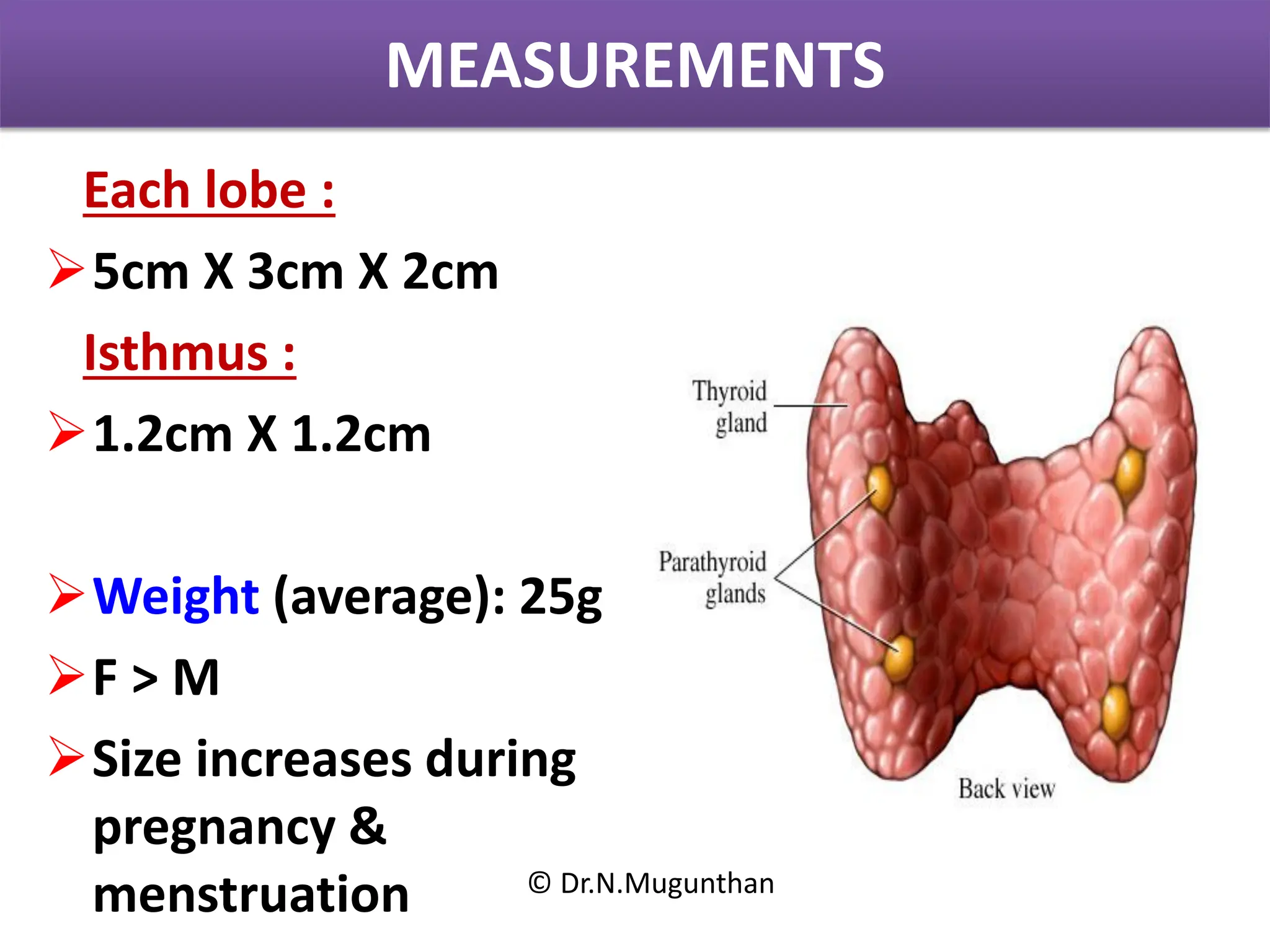
MEASUREMENTS
Each lobe :
5cm X 3cm X 2cm
Isthmus :
1.2cm X 1.2cm
Weight (average): 25g
F > M
Size increases during
pregnancy &
menstruation © Dr.N.Mugunthan
COVERINGS
2capsule:
1. Outer false capsule –
(splitting of pretracheal
fascia)
Thick on inner (medial)
surface of gland – forms
suspensory lig.of Berry
Suspensory lig.of Berry
connects the lobe with
cricoid cartilage
© Dr.N.Mugunthan
WHY DOES THYROID GLAND MOVES WITH
DEGLUTITION ?
1. Attachment of
pretracheal fascia (form
false capsule) from body
of hyoid bone to oblique
line of thyroid cartilage
2. Suspensory lig.of Berry
connects the lobe with
cricoid cartilage
© Dr.N.Mugunthan
THYROID GLAND MOVES WITH DEGLUTITION
WHY ?
Attachment of
pretracheal fascia (form
false capsule) from body
of hyoid bone to oblique
line of thyroid cartilage
Suspensory lig.of Berry
connects the lobe with
cricoid cartilage
© Dr.N.Mugunthan
2. Inner true capsule –
condensation of
fibrous stroma of gland
Deep to true capsule –
dense capillary plexus.
During thyroidectomy
– remove the gland
with capsule ( compare
with prostate)
COVERINGS cont…..
© Dr.N.Mugunthan
PRESENTING PARTS
1. Two lateral lobes
2. Isthmus (connecting 2 lateral lobes)
Lateral lobe :
Pyramidal in shape
• Apex
• Base
2 borders:
i. Anterior border
ii. Posterior border
3 surfaces:
i. Anterolateral surface
ii. Posterolateral surface
iii. Medial surface © Dr.N.Mugunthan
RELATIONS OF LATERAL LOBE
Apex:
Directed upwards towards
oblique line of thyroid
cartilage
Sandwiched between
inferior constrictor &
sternothyroid
Thyroid enlargement cannot
extend above
Related to sup.thyroid artery
& ext.laryngeal nerve
(ligate the artery close to
gland) © Dr.N.Mugunthan
BASE
Extends 5th or 6th tracheal
ring (T1)
Related to inf.thyroid
artery & recurrent
laryngeal nerve
(Ligate the artery away
from the gland)
© Dr.N.Mugunthan
ANTEROLATERAL (SUPERFICIAL) SURFACE
Overlapped by
infrahyoid muscles
( Within outwards )
o Sternothyroid
o Sternohyoid
o Superior belly of
omohyoid
o Sternomastoid (partly)
© Dr.N.Mugunthan
ANTEROLATERAL (SUPERFICIAL) SURFACE
Overlapped by
infrahyoid muscles
( Within outwards )
o Sternothyroid
o Sternohyoid
o Superior belly of
omohyoid
o Sternomastoid (partly)
© Dr.N.Mugunthan
ANTEROLATERAL (SUPERFICIAL) SURFACE
Overlapped by
infrahyoid muscles
( Within outwards )
o Sternothyroid
o Sternohyoid
o Superior belly of
omohyoid
o Sternomastoid (partly)
© Dr.N.Mugunthan
ANTEROLATERAL (SUPERFICIAL) SURFACE
Overlapped by
infrahyoid muscles
( Within outwards )
o Sternothyroid
o Sternohyoid
o Superior belly of
omohyoid
o Sternomastoid (partly)
© Dr.N.Mugunthan
ANTEROLATERAL (SUPERFICIAL) SURFACE
Overlapped by
infrahyoid muscles
( Within outwards )
o Sternothyroid
o Sternohyoid
o Superior belly of
omohyoid
o Sternomastoid (partly)
© Dr.N.Mugunthan
MEDIAL (DEEP) SURFACE
Related to -
2 tubes, 2 nerves, 2
muscles & 2 cartilages
2 tubes – larynx &trachea ,
pharynx & oesophagus
2 nerves- external &
recurrent laryngeal nerves
2 muscles-cricothyroid &
inferior constrictor
2 cartilages- thyroid &
cricoid
© Dr.N.Mugunthan
POSTEROLATERAL SURFACE
Related to carotid sheath
& its contents
Ansa cervicalis infront of
carotid sheath
Carotid sheath
Contents:
1. CCA & ICA
2. IJV
3. Vagus nerve
Sympathetic chain
behind the sheath
© Dr.N.Mugunthan
ANTERIOR BORDER
Separates anterolateral
surface from medial
surface
Related to anterior branch
of superior thyroid artery
© Dr.N.Mugunthan
POSTERIOR BORDER
Separates medial surface
from posterolateral surface
Related to:
 Anastomosis of sup. & inf.
thyroid arteries
 Parathyroid glands (superior
& inferior)
[Sup. parathyroid at the level
of C6 (cricoid)
Inf. parathyroid at lower pole
of gland]
 On left side thoracic duct
(lower part)
© Dr.N.Mugunthan
ISTHMUS
Connects both lateral
lobes across midline
Presents 2 surfaces 2
borders:
2 Surfaces:
1. Anterior surface
2. Posterior surface
 2 Borders:
1. Superior border
2. Inferior border
© Dr.N.Mugunthan
ANTERIOR SURFACE
Related to :-
Skin
Superficial fascia &
ant.jugular vein
Investing layer of deep
cervical fascia
Sternothyroid &
sternohyoid
© Dr.N.Mugunthan
POSTERIOR SURFACE
Related to :
2nd,3rd & 4th tracheal
rings
© Dr.N.Mugunthan
SUPERIOR BORDER
Anastomosis between 2
sup.thyroid arteries
Pyramidal lobe
(occasionally from
isthmus)
Levator glanduli thyroidae
– fibromuscular band
Extend from hyoid bone to
isthmus or pyramidal lobe
(Striated muscle in levator
glanduli thyroidae –
supplied by ext.laryngeal
nerve ) © Dr.N.Mugunthan
INFERIOR BORDER
Inferior thyroid veins
Arteria thyroidea ima
(if present)
© Dr.N.Mugunthan
BLOOD SUPPLY
Arterial supply:
1. Superior thyroid artery
(from ext.carotid artery)
Accompanied by external
laryngeal nerve
Ligate the artery close to
gland to avoid injury to this
nerve
(nerve is more intimately
related to artery a little
away from gland)
© Dr.N.Mugunthan
ARTERIAL SUPPLY cont….
2. Inferior thyroid artery
(from thyrocervical trunk)
Accompanied by recurrent
laryngeal nerve
Ligate the artery away from
the gland to avoid injury to
this nerve
(recurrent laryngeal nerve
cross infront of inf.thyroid
artery close to gland)
© Dr.N.Mugunthan
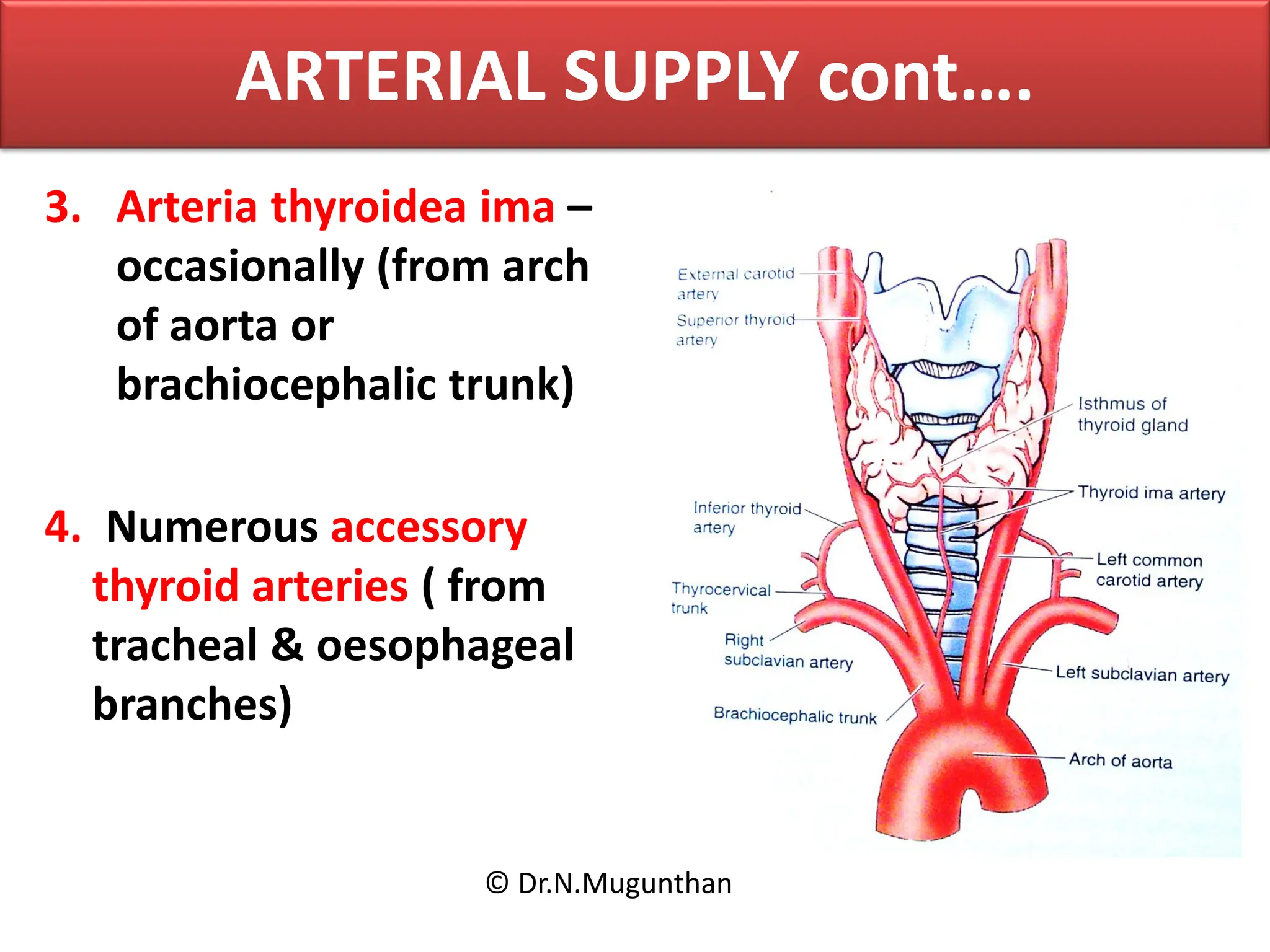
3. Arteria thyroidea ima –
occasionally (from arch
of aorta or
brachiocephalic trunk)
4. Numerous accessory
thyroid arteries ( from
tracheal & oesophageal
branches)
ARTERIAL SUPPLY cont….
© Dr.N.Mugunthan
SUPERIOR & INFERIOR THYROID ARTERIES
©Prof. Dr.N.Mugunthan
VENOUS DRAINAGE
Veins do not accompany the
arteries
 Arise from venous plexus
deep to true capsule
1. Sup.Thyroid vein (drains
into IJV)
2. Middle thyroid vein (drains
into IJV)
3. A bunch of inf.thyroid vein
drains into left
Brachiocephalic vein
4. Occasionally fourth thyroid
vein (Kocher’s vein) drains
into IJV
© Dr.N.Mugunthan
LYMPHATIC DRAINAGE
Upper medial portion –
prelaryngeal nodes
Lower medial portion –
pretracheal nodes
Upper lateral portion –
upper deep cervical nodes
Lower lateral portion –
lower deep cervical nodes
© Dr.N.Mugunthan
NERVE SUPPLY
1. Sympathetic nerves
2. Parasympathetic nerves
Sympathetic nerves:
From superior, middle &
inferior cervical ganglion
Vasomotor supply
Parasympathetic nerves:
From vagus & recurrent
laryngeal nerves
© Dr.N.Mugunthan
APPLIED ANATOMY
© Dr.N.Mugunthan
DEVELOPMENT OF THYROID GLAND
2 sources:
1. Median thyroid element
(floor of pharynx ,
endodermal
diverticulum -
Thyroglossal duct)
2. Lateral thyroid rudiment
(caudal pharyngeal
complex - 4th pouch)
© Dr.N.Mugunthan
Congenital anomalies
of thyroid:
a. Thyroglossal cyst
b. Thyroglossal fistula
c. Lingual thyroid
d. Retrosternal thyroid
e. Ectopic thyroid
f. Accessory thyroid
APPLIED ANATOMY
© Dr.N.Mugunthan
APPLIED ANATOMY cont….
Goitre - enlargement of
thyroid gland (hypo or
hyper function
Hyperthyroidism
(thyrotoxicosis)
Hypothyroidism
(myxoedema in adult &
cretinism in children)
Carcinoma of thyroid
gland
© Dr.N.Mugunthan
Carcinoma of thyroid
symptoms ( due to
compression)
Larynx/trachea –
dyspnoea
Pharynx/oesophagus –
dysphagia
Involvement of external &
recurrent laryngeal nerve
– hoarseness of voice
APPLIED ANATOMY cont….
© Dr.N.Mugunthan
Investigation:
 Thyroid function test
 Thyroid scan (ultra sound)
 Radioisotope scan using
Iodine 131(hot & cold nodule)
 Radionuclide scan
(Technetium)
 FNAC (fine needle aspiration
cytology)
Treatment: (medical & surgical)
Thyroidectomy
 Total thyroidectomy
 Subtotal thyroidectomy
 Hemithyroidectomy
APPLIED ANATOMY cont….
© Dr.N.Mugunthan
During thyroidectomy –
Ligate the sup.thyroid
artery close to apex of
gland to avoid injury to
ext.laryngeal nerve
Ligate the inf.thyroid
artery away from base of
gland to avoid injury to
recurrent laryngeal nerve
APPLIED ANATOMY cont….
© Dr.N.Mugunthan
During thyroidectomy –
To release the gland
suspensory lig.of Berry
should be cut.
While cutting avoid injury
to recurrent laryngeal
nerve (related post. to lig
of Berry)
Look for arteria thyroidea
ima
Look for Kocher’s vein (4th
vein)
APPLIED ANATOMY cont….
© Dr.N.Mugunthan
During thyroidectomy –
Accidental removal of
parathyroid -
hypoparathyroidism
(hypocalcaemia)
Carpopedal
spasm,convulsions &
neurovascular irritability
To avoid this, posterior part
of lateral lobe of thyroid
gland should be left behind
(to preserve parathyroid)
APPLIED ANATOMY cont….
© Dr.N.Mugunthan
Thyroid follicle at different levels
of activity
State of
the
follicle
Lining
epithelium
Amount of
colloid
Inactive/
Resting
Squamous Abundant
Active Cuboid Moderate
Highly
Active
Low
Columnar
Scanty
© Dr.N.Mugunthan
Parafollicular C cells
O Polyhedral cells with oval
nucleus
O Paler & larger than thyroid
follicular cells
O Present between basement
membrane and the
follicular cell
O Secretes - Thyrocalcitonin
[lowers the blood calcium
level]
© Dr.N.Mugunthan
Virtual Microscope –Thyroid gland
Specific Learning Objectives
At the end of this lecture, Phase –I MBBS students should be
able to answer the questions asked in the case scenario
A 50 years old female visited to her primary
care physician with complaints of painless
swelling in front of neck in the midline since
last 6 months, weight & hair loss,
nervousness and eye pressure. She has no
other medical problems, but some of her
family members have similar symptoms and
taking medication.
On examination, a butterfly shaped swelling
moves with deglutition and lower margin of
swelling can be visualized on deglutition,
exophthalmos, an enlarged non-tender goiter,
hyperreflexia and a tremor when her arms
are outstretched. © Dr.N.Mugunthan
On the basis of your knowledge in anatomy answer
the following questions:
1. What is the probable clinical condition ? Thyroid
swelling probably “Hyperthyroidism”
2. State the reason why the thyroid swelling moves
with deglutition.
3. Describe the thyroid gland under following
headings: a) Coverings b) Presenting parts
c)Relations d) Applied anatomy
4. Name the arteries supplying the thyroid gland.
5. Name the structures accompanying which can be
injured while ligating the arteries during
thyroidectomy.
Specific Learning Objectives
© Dr.N.Mugunthan
TAKE HOME MESSAGE
 Covered with true and false
capsule
 Moves with deglutition-
ligament of Berry
 Supplied by superior &
inferior thyroid arteries and
related with external &
recurrent laryngeal nerves.
 Development- median
thyroid element & lateral
thyroid rudiment
 Histology- thyroid follicles
and parafollicular cells
© Dr.N.Mugunthan
THYROID GLAND MOVES WITH DEGLUTITION
BECAUSE…..
Attachment of
pretracheal fascia (form
false capsule) from body
of hyoid bone to oblique
line of thyroid cartilage
Suspensory lig.of Berry
connects the lobe with
cricoid cartilage
© Dr.N.Mugunthan
1. Superior thyroid artery
2. Inferior thyroid artery
3. Arteria thyroidea ima –
4. Numerous accessory
thyroid arteries ( from
tracheal & oesophageal
branches)
ARTERIAL SUPPLY
© Dr.N.Mugunthan
During thyroidectomy
Ligate the sup.thyroid
artery close to apex of
gland to avoid injury to
ext.laryngeal nerve
Ligate the inf.thyroid
artery away from base of
gland to avoid injury to
recurrent laryngeal nerve
STRUCTURES MAY GET INJURED WHILE LIGATING THE
ARTERIES
© Dr.N.Mugunthan
© Dr.N.Mugunthan

THYROID GLAND -Prof.Dr.N.Mugunthan. KMMC,Muttom

  • 1.
    Lecture By Dr.N.Mugunthan.MS,DNB,MNAMS,PhD, MBA(Hosp.Adm.) Professor of Preclinical Sciences, KMMC
  • 2.
    Competencies Compete ncy No. Topic- Deepstructures in the neck Domain Level Core AN 35.2 Describe the parts, borders, surfaces, contents, relations and nerve supply of parotid gland with course of its duct and surgical importance. K KH Y AN 35.8 Describe the anatomically relevant clinical features of Thyroid swellings K KH Y AN 43.2 Describe and draw the microanatomical features of thyroid K KH Y AN 43.4 Describe the development and developmental basis of congenital anomalies of thyroid gland K KH Y © Dr.N.Mugunthan
  • 3.
    Specific Learning Objectives Atthe end of this lecture, Phase –I MBBS students should be able to answer the questions asked in the case scenario A 50 years old female visited to her primary care physician with complaints of painless swelling in front of neck in the midline since last 6 months, weight & hair loss, nervousness and eye pressure. She has no other medical problems, but some of her family members have similar symptoms and taking medication. On examination, a butterfly shaped swelling moves with deglutition and lower margin of swelling can be visualized on deglutition, exophthalmos, an enlarged non-tender goiter, hyperreflexia and a tremor when her arms are outstretched. © Dr.N.Mugunthan
  • 4.
    On the basisof your knowledge in anatomy answer the following questions: 1. What is the probable clinical condition ? 2. State the reason why the thyroid swelling moves with deglutition. 3. Describe the thyroid gland under following headings: a) Coverings b) Presenting parts c)Relations d) Applied anatomy 4. Name the arteries supplying the thyroid gland. 5. Name the structures accompanying which can be injured while ligating the arteries during thyroidectomy. Specific Learning Objectives cont… © Dr.N.Mugunthan
  • 5.
    Overview Thyroid gland Situation &extent Coverings Presenting parts & its description Relations Blood supply Lymphatic drainage Nerve supply Applied aspects Microstructure Development © Dr.N.Mugunthan
  • 6.
    MIDLINE STRUCTURES INTHE NECK © Dr.N.Mugunthan
  • 7.
    MIDLINE STRUCTURES INTHE NECK © Dr.N.Mugunthan
  • 8.
    MIDLINE STRUCTURES INTHE NECK © Dr.N.Mugunthan
  • 9.
    MIDLINE STRUCTURES INTHE NECK © Dr.N.Mugunthan
  • 10.
    MIDLINE STRUCTURES INTHE NECK © Dr.N.Mugunthan
  • 11.
    MIDLINE STRUCTURES INTHE NECK © Dr.N.Mugunthan
  • 12.
    MIDLINE STRUCTURES INTHE NECK © Dr.N.Mugunthan
  • 13.
    THYROID GLAND Definition: Endocrine gland Highlyvascular Yellowish brown in colour Synthesis, stores & releases thyroid hormone (T3 & T4) © Dr.N.Mugunthan
  • 14.
    SHAPE Butterfly or H shaped 2lateral lobes connected by Isthmus © Dr.N.Mugunthan
  • 15.
    SITUATION & EXTENT Front& sides of neck Deep to the floor of muscular triangle Opp. C5,C6,C7 & T1 Extent: Each lobe – middle of thyroid cartilage to 5th tracheal ring Isthmus – 2nd,3rd & 4th tracheal ring © Dr.N.Mugunthan
  • 16.
    MEASUREMENTS Each lobe : 5cmX 3cm X 2cm Isthmus : 1.2cm X 1.2cm Weight (average): 25g F > M Size increases during pregnancy & menstruation © Dr.N.Mugunthan
  • 17.
    COVERINGS 2capsule: 1. Outer falsecapsule – (splitting of pretracheal fascia) Thick on inner (medial) surface of gland – forms suspensory lig.of Berry Suspensory lig.of Berry connects the lobe with cricoid cartilage © Dr.N.Mugunthan
  • 18.
    WHY DOES THYROIDGLAND MOVES WITH DEGLUTITION ? 1. Attachment of pretracheal fascia (form false capsule) from body of hyoid bone to oblique line of thyroid cartilage 2. Suspensory lig.of Berry connects the lobe with cricoid cartilage © Dr.N.Mugunthan
  • 19.
    THYROID GLAND MOVESWITH DEGLUTITION WHY ? Attachment of pretracheal fascia (form false capsule) from body of hyoid bone to oblique line of thyroid cartilage Suspensory lig.of Berry connects the lobe with cricoid cartilage © Dr.N.Mugunthan
  • 20.
    2. Inner truecapsule – condensation of fibrous stroma of gland Deep to true capsule – dense capillary plexus. During thyroidectomy – remove the gland with capsule ( compare with prostate) COVERINGS cont….. © Dr.N.Mugunthan
  • 21.
    PRESENTING PARTS 1. Twolateral lobes 2. Isthmus (connecting 2 lateral lobes) Lateral lobe : Pyramidal in shape • Apex • Base 2 borders: i. Anterior border ii. Posterior border 3 surfaces: i. Anterolateral surface ii. Posterolateral surface iii. Medial surface © Dr.N.Mugunthan
  • 22.
    RELATIONS OF LATERALLOBE Apex: Directed upwards towards oblique line of thyroid cartilage Sandwiched between inferior constrictor & sternothyroid Thyroid enlargement cannot extend above Related to sup.thyroid artery & ext.laryngeal nerve (ligate the artery close to gland) © Dr.N.Mugunthan
  • 23.
    BASE Extends 5th or6th tracheal ring (T1) Related to inf.thyroid artery & recurrent laryngeal nerve (Ligate the artery away from the gland) © Dr.N.Mugunthan
  • 24.
    ANTEROLATERAL (SUPERFICIAL) SURFACE Overlappedby infrahyoid muscles ( Within outwards ) o Sternothyroid o Sternohyoid o Superior belly of omohyoid o Sternomastoid (partly) © Dr.N.Mugunthan
  • 25.
    ANTEROLATERAL (SUPERFICIAL) SURFACE Overlappedby infrahyoid muscles ( Within outwards ) o Sternothyroid o Sternohyoid o Superior belly of omohyoid o Sternomastoid (partly) © Dr.N.Mugunthan
  • 26.
    ANTEROLATERAL (SUPERFICIAL) SURFACE Overlappedby infrahyoid muscles ( Within outwards ) o Sternothyroid o Sternohyoid o Superior belly of omohyoid o Sternomastoid (partly) © Dr.N.Mugunthan
  • 27.
    ANTEROLATERAL (SUPERFICIAL) SURFACE Overlappedby infrahyoid muscles ( Within outwards ) o Sternothyroid o Sternohyoid o Superior belly of omohyoid o Sternomastoid (partly) © Dr.N.Mugunthan
  • 28.
    ANTEROLATERAL (SUPERFICIAL) SURFACE Overlappedby infrahyoid muscles ( Within outwards ) o Sternothyroid o Sternohyoid o Superior belly of omohyoid o Sternomastoid (partly) © Dr.N.Mugunthan
  • 29.
    MEDIAL (DEEP) SURFACE Relatedto - 2 tubes, 2 nerves, 2 muscles & 2 cartilages 2 tubes – larynx &trachea , pharynx & oesophagus 2 nerves- external & recurrent laryngeal nerves 2 muscles-cricothyroid & inferior constrictor 2 cartilages- thyroid & cricoid © Dr.N.Mugunthan
  • 30.
    POSTEROLATERAL SURFACE Related tocarotid sheath & its contents Ansa cervicalis infront of carotid sheath Carotid sheath Contents: 1. CCA & ICA 2. IJV 3. Vagus nerve Sympathetic chain behind the sheath © Dr.N.Mugunthan
  • 31.
    ANTERIOR BORDER Separates anterolateral surfacefrom medial surface Related to anterior branch of superior thyroid artery © Dr.N.Mugunthan
  • 32.
    POSTERIOR BORDER Separates medialsurface from posterolateral surface Related to:  Anastomosis of sup. & inf. thyroid arteries  Parathyroid glands (superior & inferior) [Sup. parathyroid at the level of C6 (cricoid) Inf. parathyroid at lower pole of gland]  On left side thoracic duct (lower part) © Dr.N.Mugunthan
  • 33.
    ISTHMUS Connects both lateral lobesacross midline Presents 2 surfaces 2 borders: 2 Surfaces: 1. Anterior surface 2. Posterior surface  2 Borders: 1. Superior border 2. Inferior border © Dr.N.Mugunthan
  • 34.
    ANTERIOR SURFACE Related to:- Skin Superficial fascia & ant.jugular vein Investing layer of deep cervical fascia Sternothyroid & sternohyoid © Dr.N.Mugunthan
  • 35.
    POSTERIOR SURFACE Related to: 2nd,3rd & 4th tracheal rings © Dr.N.Mugunthan
  • 36.
    SUPERIOR BORDER Anastomosis between2 sup.thyroid arteries Pyramidal lobe (occasionally from isthmus) Levator glanduli thyroidae – fibromuscular band Extend from hyoid bone to isthmus or pyramidal lobe (Striated muscle in levator glanduli thyroidae – supplied by ext.laryngeal nerve ) © Dr.N.Mugunthan
  • 37.
    INFERIOR BORDER Inferior thyroidveins Arteria thyroidea ima (if present) © Dr.N.Mugunthan
  • 38.
    BLOOD SUPPLY Arterial supply: 1.Superior thyroid artery (from ext.carotid artery) Accompanied by external laryngeal nerve Ligate the artery close to gland to avoid injury to this nerve (nerve is more intimately related to artery a little away from gland) © Dr.N.Mugunthan
  • 39.
    ARTERIAL SUPPLY cont…. 2.Inferior thyroid artery (from thyrocervical trunk) Accompanied by recurrent laryngeal nerve Ligate the artery away from the gland to avoid injury to this nerve (recurrent laryngeal nerve cross infront of inf.thyroid artery close to gland) © Dr.N.Mugunthan
  • 40.
    3. Arteria thyroideaima – occasionally (from arch of aorta or brachiocephalic trunk) 4. Numerous accessory thyroid arteries ( from tracheal & oesophageal branches) ARTERIAL SUPPLY cont…. © Dr.N.Mugunthan
  • 41.
    SUPERIOR & INFERIORTHYROID ARTERIES ©Prof. Dr.N.Mugunthan
  • 42.
    VENOUS DRAINAGE Veins donot accompany the arteries  Arise from venous plexus deep to true capsule 1. Sup.Thyroid vein (drains into IJV) 2. Middle thyroid vein (drains into IJV) 3. A bunch of inf.thyroid vein drains into left Brachiocephalic vein 4. Occasionally fourth thyroid vein (Kocher’s vein) drains into IJV © Dr.N.Mugunthan
  • 43.
    LYMPHATIC DRAINAGE Upper medialportion – prelaryngeal nodes Lower medial portion – pretracheal nodes Upper lateral portion – upper deep cervical nodes Lower lateral portion – lower deep cervical nodes © Dr.N.Mugunthan
  • 44.
    NERVE SUPPLY 1. Sympatheticnerves 2. Parasympathetic nerves Sympathetic nerves: From superior, middle & inferior cervical ganglion Vasomotor supply Parasympathetic nerves: From vagus & recurrent laryngeal nerves © Dr.N.Mugunthan
  • 45.
  • 46.
    DEVELOPMENT OF THYROIDGLAND 2 sources: 1. Median thyroid element (floor of pharynx , endodermal diverticulum - Thyroglossal duct) 2. Lateral thyroid rudiment (caudal pharyngeal complex - 4th pouch) © Dr.N.Mugunthan
  • 47.
    Congenital anomalies of thyroid: a.Thyroglossal cyst b. Thyroglossal fistula c. Lingual thyroid d. Retrosternal thyroid e. Ectopic thyroid f. Accessory thyroid APPLIED ANATOMY © Dr.N.Mugunthan
  • 48.
    APPLIED ANATOMY cont…. Goitre- enlargement of thyroid gland (hypo or hyper function Hyperthyroidism (thyrotoxicosis) Hypothyroidism (myxoedema in adult & cretinism in children) Carcinoma of thyroid gland © Dr.N.Mugunthan
  • 49.
    Carcinoma of thyroid symptoms( due to compression) Larynx/trachea – dyspnoea Pharynx/oesophagus – dysphagia Involvement of external & recurrent laryngeal nerve – hoarseness of voice APPLIED ANATOMY cont…. © Dr.N.Mugunthan
  • 50.
    Investigation:  Thyroid functiontest  Thyroid scan (ultra sound)  Radioisotope scan using Iodine 131(hot & cold nodule)  Radionuclide scan (Technetium)  FNAC (fine needle aspiration cytology) Treatment: (medical & surgical) Thyroidectomy  Total thyroidectomy  Subtotal thyroidectomy  Hemithyroidectomy APPLIED ANATOMY cont…. © Dr.N.Mugunthan
  • 51.
    During thyroidectomy – Ligatethe sup.thyroid artery close to apex of gland to avoid injury to ext.laryngeal nerve Ligate the inf.thyroid artery away from base of gland to avoid injury to recurrent laryngeal nerve APPLIED ANATOMY cont…. © Dr.N.Mugunthan
  • 52.
    During thyroidectomy – Torelease the gland suspensory lig.of Berry should be cut. While cutting avoid injury to recurrent laryngeal nerve (related post. to lig of Berry) Look for arteria thyroidea ima Look for Kocher’s vein (4th vein) APPLIED ANATOMY cont…. © Dr.N.Mugunthan
  • 53.
    During thyroidectomy – Accidentalremoval of parathyroid - hypoparathyroidism (hypocalcaemia) Carpopedal spasm,convulsions & neurovascular irritability To avoid this, posterior part of lateral lobe of thyroid gland should be left behind (to preserve parathyroid) APPLIED ANATOMY cont…. © Dr.N.Mugunthan
  • 54.
    Thyroid follicle atdifferent levels of activity State of the follicle Lining epithelium Amount of colloid Inactive/ Resting Squamous Abundant Active Cuboid Moderate Highly Active Low Columnar Scanty © Dr.N.Mugunthan
  • 55.
    Parafollicular C cells OPolyhedral cells with oval nucleus O Paler & larger than thyroid follicular cells O Present between basement membrane and the follicular cell O Secretes - Thyrocalcitonin [lowers the blood calcium level] © Dr.N.Mugunthan
  • 56.
  • 57.
    Specific Learning Objectives Atthe end of this lecture, Phase –I MBBS students should be able to answer the questions asked in the case scenario A 50 years old female visited to her primary care physician with complaints of painless swelling in front of neck in the midline since last 6 months, weight & hair loss, nervousness and eye pressure. She has no other medical problems, but some of her family members have similar symptoms and taking medication. On examination, a butterfly shaped swelling moves with deglutition and lower margin of swelling can be visualized on deglutition, exophthalmos, an enlarged non-tender goiter, hyperreflexia and a tremor when her arms are outstretched. © Dr.N.Mugunthan
  • 58.
    On the basisof your knowledge in anatomy answer the following questions: 1. What is the probable clinical condition ? Thyroid swelling probably “Hyperthyroidism” 2. State the reason why the thyroid swelling moves with deglutition. 3. Describe the thyroid gland under following headings: a) Coverings b) Presenting parts c)Relations d) Applied anatomy 4. Name the arteries supplying the thyroid gland. 5. Name the structures accompanying which can be injured while ligating the arteries during thyroidectomy. Specific Learning Objectives © Dr.N.Mugunthan
  • 59.
    TAKE HOME MESSAGE Covered with true and false capsule  Moves with deglutition- ligament of Berry  Supplied by superior & inferior thyroid arteries and related with external & recurrent laryngeal nerves.  Development- median thyroid element & lateral thyroid rudiment  Histology- thyroid follicles and parafollicular cells © Dr.N.Mugunthan
  • 60.
    THYROID GLAND MOVESWITH DEGLUTITION BECAUSE….. Attachment of pretracheal fascia (form false capsule) from body of hyoid bone to oblique line of thyroid cartilage Suspensory lig.of Berry connects the lobe with cricoid cartilage © Dr.N.Mugunthan
  • 61.
    1. Superior thyroidartery 2. Inferior thyroid artery 3. Arteria thyroidea ima – 4. Numerous accessory thyroid arteries ( from tracheal & oesophageal branches) ARTERIAL SUPPLY © Dr.N.Mugunthan
  • 62.
    During thyroidectomy Ligate thesup.thyroid artery close to apex of gland to avoid injury to ext.laryngeal nerve Ligate the inf.thyroid artery away from base of gland to avoid injury to recurrent laryngeal nerve STRUCTURES MAY GET INJURED WHILE LIGATING THE ARTERIES © Dr.N.Mugunthan
  • 63.