THYROID DISORDERS
Abdelaziz Elamin. MD, PhD, FRCPCH
Professor of Child Health
Consultant Pediatric Endocrinologist
Sultan Qaboos University, Oman
HYPOTHYROIDISM-EPIDEMIOLOGY
• Neonatal screening reveals incidence
that varies between 1-5/1000 live
births
• The most common cause of preventable
mental retardation in children
• Both acquired & congenital forms are
linked to iodine deficiency
• Diagnosis is easy & early treatment is
beneficial
ETIOLOGY
• CONGENITAL
Hypoplasia & mal-descent
Familial enzyme defects
Iodine deficiency (endemic cretinism)
Intake of goitrogens during pregnancy
Pituitary defects
Idiopathic
ETIOLOGY /2
• ACQUIRED
Iodine deficiency
Auto-immune thyroiditis
Thyroidectomy or RAI therapy
TSH or TRH deficiency
Medications (iodide & Cobalt)
Idiopathic
KILPATRIK GRADING OF GOITRE
• Grade 0: Not visible neck extended
& Not palpable
• Grade 1: Not visible, but palpable
• Grade 2: Visible only when neck is
extended & on swallowing,
• Grade 3: Visible in all positions
• Grade 4: Large goiter
THYROID GLAND
• Derived from pharyngeal endoderm at
4/40
• Migrate from base of the tongue to
cover the 2&3 tracheal rings.
• Blood supply from ext. carotid &
subclavian and blood flow is twice renal
blood flow/g tissue.
• Starts producing thyroxin at 14/40.
OVERVIEW (2)
• Maternal & fetal glands are independent
with little transplacental transfer of T4.
• TSH doesn’t cross the placenta.
• Fetal brain converts T4 to T3 efficiently.
• Average intake of iodine is 500 mg/day.
70% of this is trapped by the gland against
a concentration gradient up to 600:1
THYROID HORMONES
• Iodine & tyrosine form both T3 & T4 under
TSH stimulation. However, 10% of T4
production is autonomous and is present in
patients with central hypothyroidism.
• When released into circulation T4 binds to:
Globulin TBG 75%
Prealbumin TBPA 20%
Albumin TBA 5%
THYROID HORMONES (2)
• Less than 1% of T4 & T3 is free in
plasma.
• T4 is deiodinated in the tissues to either
T3 (active) or reverse T3 (inactive).
• At birth T4 level approximates maternal
level but increases rapidly during the
first week of life.
• High TSH in the first 5 days of life can
give false positive neonatal screening
TSH
 Is a Glico-protein with Molecular Wt of
28000
 Secreted by the anterior pituitary
under influence of TRH
 It stimulates iodine trapping,
oxidation, organification, coupling and
proteolysis of T4 & T3
 It also has trophic effect on thyroid
gland
TSH (2)
 T4 & T3 are feed-back regulators of TSH
 TSH is stimulated by a-adrenergic
agonists
 TSH secretion is inhibited by:
Dopamine
Bromocreptine
Somatostatin
Corticosteroids
THYROID HORMONES (3)
 Conversion of T4 to T3 is decreased by:
Acute & chronic illnesses
b-adrenergic receptor blockers
Starvation & severe PEM
Corticosteroids
Propylthiouracil
High iodine intake (Wolff-Chaikoff effect)
THYROXINE (T4)
 Total T4 level is decreased in:
Premature infants
Hypopituitarism
Nephrotic syndrome
Liver cirrhosis
PEM
Protein losing entropathy
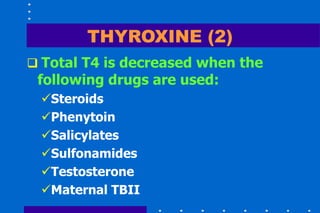
THYROXINE (2)
 Total T4 is decreased when the
following drugs are used:
Steroids
Phenytoin
Salicylates
Sulfonamides
Testosterone
Maternal TBII
THYROXINE (3)
 Total T4 is increased with:
Acute thyroiditis
Acute hepatitis
Estrogen therapy
Clofibrate
iodides
Pregnancy
Maternal TSI
FUNCTIONS OF THYROXINE
 Thyroid hormones are essential for:
Linear growth & pubertal development
Normal brain development & function
Energy production
Calcium mobilization from bone
Increasing sensitivity of b-adrenergic
receptors to catecholeamines
CLINICAL FEATURES
Gestational age > 42 weeks
Birth weight > 4 kg
Open posterior fontanel
Nasal stuffiness & discharge
Macroglossia
Constipation & abdominal distension
Feeding problems & vomiting
CLINICAL FEATURES (2)
• Non pitting edema of lower limbs & feet
• Coarse features
• Umbilical hernia
• Hoarseness of voice
• Anemia
• Decreased physical activity
• Prolonged (>2/52) neonatal jaundice
CLINICAL FEATURES (3)
• Dry, pale & mottled skin
• Low hair line & dry, scanty hair
• Hypothermia & peripheral cyanosis
• Hypercarotenemia
• Growth failure
• Retarded bone age
• Stumpy fingers & broad hands
CLINICAL FEATURES (5)
• Skeletal abnormalities:
Infantile proportions
Hip & knee flexion
Exaggerated lumbar lordosis
Delayed teeth eruption
Under developed mandible
Delayed closure of anterior fontanel
OCCASIONAL FEATURES
• Overt obesity
• Myopathy & rheumatic pains
• Speech disorder
• Impaired night vision
• Sleep apnea (central & obstructive)
• Anasarca
• Achlorhydria & low intrinsic factor
OCCASIONAL FEATURES (2)
• Decreased bone turnover
• Decreased VIII, IX & platelets adhesion
• Decreased GFR & hyponatremia
• Hypertension
• Increased levels of CK, LDH & AST
• Abnormal EEG & high CSF protein
• Psychiatric manifestations
ASSOCIATIONS
• Autoimmune diseases (Diabetes Mellitus)
• Cardiomyopathy & CHD
• Galactorrhoea
• Muscular dystrophy + pseudohypertrophy
(Kocher-Debre-Semelaigne)
GOITROGENS
• DRUGS
Anti-thyroid
Cough medicines
Sulfonamides
Lithium
Phenylbutazone
PAS
Oral hypoglycemic agents
GOITROGENS
 FOOD
Soybeans
Millet
Cassava
Cabbage
CLINICAL FEATURES (4)
 Neurological manifestations
Hypotonia & later spasticity
Lethargy
Ataxia
Deafness + Mutism
Mental retardation
Slow relaxation of deep tendon jerks
CONGENITAL HYPOTHYRODISM
• Primary thyroid defect: usually
associated with goiter.
• Secondary to hypothalamic or pituitary
lesions: not associated with goiter.
• 2 distinct types of presentation:
Neurological with MR-deafness & ataxia
Myxodematous with dwarfism &
dysmorphism
DIAGNOSIS
• Early detection by neonatal screening
• High index of suspicion in all infants
with increased risk
• Overt clinical presentation
• Confirm diagnosis by appropriate lab
and radiological tests
LABROTARY FINDINGS
• Low (T4, RI uptake & T3 resin uptake)
• High TSH in primary hypothyroidism
• High serum cholesterol & carotene levels
• Anaemia (normo, micro or macrocytic)
• High urinary creatinine/hydroxyproline
ratio
• CXR: cardiomegaly
• ECG: low voltage & bradycardia
IMAGING TESTS
 X-ray films can show:
Delayed bone age or epiphyseal dysgenesis
Anterior peaking of vertebrae
Coxavara & coxa plana
 Thyroid radio-isotope scan
 Thyroid ultrasound
 CT or MRI
TREATMENT (2)
• L-Thyroxin is the drug of choice. Start with
small dose to avoid cardiac strain.
• Dose is 10 mg/kg/day in infancy. In older
children start with 25 mg/day and increase
by 25 mg every 2 weeks till required dose.
• Monitor clinical progress & hormones level
TREATMENT
 Life-long replacement therapy
 5 types of preparations are available:
L-thyroxin (T4)
Triiodothyronine (T3)
Synthetic mixture T4/T3 in 4:1 ratio
Desiccated thyroid (38mg T4 & 9mg T3/grain)
Thyroglobulin (36mg T4 & 12mg T3/grain)
THYROID FUNCTION TESTS
1. Peripheral effects:
BMR
Deep Tendon Reflex
Cardiovascular indices (pulse, BP, LV function
tests)
Serum parameters (high cholesterol, CK, AST,
LDH & carcino-embryonic antigen)
THYROID FUNCTION TESTS (2)
2. Thyroid gland economy:
Radio iodine uptake
Perchlorate discharge test (+ve in Pendred
syndrome & autoimmune thyroiditis)
TSH level
TRH stimulation tests
Thyroid scan
THYROID FUNCTION TESTS (3)
3. Tests for thyroid hormone:
Total & free T4 & T3
Reverse T3 level
T3 Resin Uptake
T3RU x total T4= Thyroid Hormone Binding
Index (formerly Free Thyroxin Index)
THYROID FUNCTION TESTS (4)
 Special Tests:
Thyroglobulin level
Thyroid Stimulating Immunoglobulin
Thyroid antibodies
Thyroid radio-isotope scan
Thyroid ultrasound
CT & MRI
Thyroid biopsy
PROGNOSIS
Depends on:
Early diagnosis
Proper diabetes education
Strict diabetic control
Careful monitoring
Compliance
MYXOEDMATOUS COMA
 Impaired sensorium, hypoventilation
bradycardia, hypotension & hypothermia
 Precipitated by:
Infections
Trauma (including surgery)
Exposure to cold
Cardio-vascular problems
Drugs
PROGNOSIS
 Is good for linear growth & physical
features even if treatment is delayed, but
for mental and intellectual development
early treatment is crucial.
 Sometimes early treatment may fail to
prevent mental subnormality due to
severe intra-uterine deficiency of thyroid
hormones

Thyroid disorders

  • 1.
    THYROID DISORDERS Abdelaziz Elamin.MD, PhD, FRCPCH Professor of Child Health Consultant Pediatric Endocrinologist Sultan Qaboos University, Oman
  • 2.
    HYPOTHYROIDISM-EPIDEMIOLOGY • Neonatal screeningreveals incidence that varies between 1-5/1000 live births • The most common cause of preventable mental retardation in children • Both acquired & congenital forms are linked to iodine deficiency • Diagnosis is easy & early treatment is beneficial
  • 3.
    ETIOLOGY • CONGENITAL Hypoplasia &mal-descent Familial enzyme defects Iodine deficiency (endemic cretinism) Intake of goitrogens during pregnancy Pituitary defects Idiopathic
  • 4.
    ETIOLOGY /2 • ACQUIRED Iodinedeficiency Auto-immune thyroiditis Thyroidectomy or RAI therapy TSH or TRH deficiency Medications (iodide & Cobalt) Idiopathic
  • 5.
    KILPATRIK GRADING OFGOITRE • Grade 0: Not visible neck extended & Not palpable • Grade 1: Not visible, but palpable • Grade 2: Visible only when neck is extended & on swallowing, • Grade 3: Visible in all positions • Grade 4: Large goiter
  • 6.
    THYROID GLAND • Derivedfrom pharyngeal endoderm at 4/40 • Migrate from base of the tongue to cover the 2&3 tracheal rings. • Blood supply from ext. carotid & subclavian and blood flow is twice renal blood flow/g tissue. • Starts producing thyroxin at 14/40.
  • 7.
    OVERVIEW (2) • Maternal& fetal glands are independent with little transplacental transfer of T4. • TSH doesn’t cross the placenta. • Fetal brain converts T4 to T3 efficiently. • Average intake of iodine is 500 mg/day. 70% of this is trapped by the gland against a concentration gradient up to 600:1
  • 8.
    THYROID HORMONES • Iodine& tyrosine form both T3 & T4 under TSH stimulation. However, 10% of T4 production is autonomous and is present in patients with central hypothyroidism. • When released into circulation T4 binds to: Globulin TBG 75% Prealbumin TBPA 20% Albumin TBA 5%
  • 9.
    THYROID HORMONES (2) •Less than 1% of T4 & T3 is free in plasma. • T4 is deiodinated in the tissues to either T3 (active) or reverse T3 (inactive). • At birth T4 level approximates maternal level but increases rapidly during the first week of life. • High TSH in the first 5 days of life can give false positive neonatal screening
  • 10.
    TSH  Is aGlico-protein with Molecular Wt of 28000  Secreted by the anterior pituitary under influence of TRH  It stimulates iodine trapping, oxidation, organification, coupling and proteolysis of T4 & T3  It also has trophic effect on thyroid gland
  • 11.
    TSH (2)  T4& T3 are feed-back regulators of TSH  TSH is stimulated by a-adrenergic agonists  TSH secretion is inhibited by: Dopamine Bromocreptine Somatostatin Corticosteroids
  • 12.
    THYROID HORMONES (3) Conversion of T4 to T3 is decreased by: Acute & chronic illnesses b-adrenergic receptor blockers Starvation & severe PEM Corticosteroids Propylthiouracil High iodine intake (Wolff-Chaikoff effect)
  • 13.
    THYROXINE (T4)  TotalT4 level is decreased in: Premature infants Hypopituitarism Nephrotic syndrome Liver cirrhosis PEM Protein losing entropathy
  • 14.
    THYROXINE (2)  TotalT4 is decreased when the following drugs are used: Steroids Phenytoin Salicylates Sulfonamides Testosterone Maternal TBII
  • 15.
    THYROXINE (3)  TotalT4 is increased with: Acute thyroiditis Acute hepatitis Estrogen therapy Clofibrate iodides Pregnancy Maternal TSI
  • 16.
    FUNCTIONS OF THYROXINE Thyroid hormones are essential for: Linear growth & pubertal development Normal brain development & function Energy production Calcium mobilization from bone Increasing sensitivity of b-adrenergic receptors to catecholeamines
  • 17.
    CLINICAL FEATURES Gestational age> 42 weeks Birth weight > 4 kg Open posterior fontanel Nasal stuffiness & discharge Macroglossia Constipation & abdominal distension Feeding problems & vomiting
  • 18.
    CLINICAL FEATURES (2) •Non pitting edema of lower limbs & feet • Coarse features • Umbilical hernia • Hoarseness of voice • Anemia • Decreased physical activity • Prolonged (>2/52) neonatal jaundice
  • 19.
    CLINICAL FEATURES (3) •Dry, pale & mottled skin • Low hair line & dry, scanty hair • Hypothermia & peripheral cyanosis • Hypercarotenemia • Growth failure • Retarded bone age • Stumpy fingers & broad hands
  • 20.
    CLINICAL FEATURES (5) •Skeletal abnormalities: Infantile proportions Hip & knee flexion Exaggerated lumbar lordosis Delayed teeth eruption Under developed mandible Delayed closure of anterior fontanel
  • 21.
    OCCASIONAL FEATURES • Overtobesity • Myopathy & rheumatic pains • Speech disorder • Impaired night vision • Sleep apnea (central & obstructive) • Anasarca • Achlorhydria & low intrinsic factor
  • 22.
    OCCASIONAL FEATURES (2) •Decreased bone turnover • Decreased VIII, IX & platelets adhesion • Decreased GFR & hyponatremia • Hypertension • Increased levels of CK, LDH & AST • Abnormal EEG & high CSF protein • Psychiatric manifestations
  • 23.
    ASSOCIATIONS • Autoimmune diseases(Diabetes Mellitus) • Cardiomyopathy & CHD • Galactorrhoea • Muscular dystrophy + pseudohypertrophy (Kocher-Debre-Semelaigne)
  • 24.
  • 25.
  • 26.
    CLINICAL FEATURES (4) Neurological manifestations Hypotonia & later spasticity Lethargy Ataxia Deafness + Mutism Mental retardation Slow relaxation of deep tendon jerks
  • 27.
    CONGENITAL HYPOTHYRODISM • Primarythyroid defect: usually associated with goiter. • Secondary to hypothalamic or pituitary lesions: not associated with goiter. • 2 distinct types of presentation: Neurological with MR-deafness & ataxia Myxodematous with dwarfism & dysmorphism
  • 28.
    DIAGNOSIS • Early detectionby neonatal screening • High index of suspicion in all infants with increased risk • Overt clinical presentation • Confirm diagnosis by appropriate lab and radiological tests
  • 29.
    LABROTARY FINDINGS • Low(T4, RI uptake & T3 resin uptake) • High TSH in primary hypothyroidism • High serum cholesterol & carotene levels • Anaemia (normo, micro or macrocytic) • High urinary creatinine/hydroxyproline ratio • CXR: cardiomegaly • ECG: low voltage & bradycardia
  • 30.
    IMAGING TESTS  X-rayfilms can show: Delayed bone age or epiphyseal dysgenesis Anterior peaking of vertebrae Coxavara & coxa plana  Thyroid radio-isotope scan  Thyroid ultrasound  CT or MRI
  • 31.
    TREATMENT (2) • L-Thyroxinis the drug of choice. Start with small dose to avoid cardiac strain. • Dose is 10 mg/kg/day in infancy. In older children start with 25 mg/day and increase by 25 mg every 2 weeks till required dose. • Monitor clinical progress & hormones level
  • 32.
    TREATMENT  Life-long replacementtherapy  5 types of preparations are available: L-thyroxin (T4) Triiodothyronine (T3) Synthetic mixture T4/T3 in 4:1 ratio Desiccated thyroid (38mg T4 & 9mg T3/grain) Thyroglobulin (36mg T4 & 12mg T3/grain)
  • 33.
    THYROID FUNCTION TESTS 1.Peripheral effects: BMR Deep Tendon Reflex Cardiovascular indices (pulse, BP, LV function tests) Serum parameters (high cholesterol, CK, AST, LDH & carcino-embryonic antigen)
  • 34.
    THYROID FUNCTION TESTS(2) 2. Thyroid gland economy: Radio iodine uptake Perchlorate discharge test (+ve in Pendred syndrome & autoimmune thyroiditis) TSH level TRH stimulation tests Thyroid scan
  • 35.
    THYROID FUNCTION TESTS(3) 3. Tests for thyroid hormone: Total & free T4 & T3 Reverse T3 level T3 Resin Uptake T3RU x total T4= Thyroid Hormone Binding Index (formerly Free Thyroxin Index)
  • 36.
    THYROID FUNCTION TESTS(4)  Special Tests: Thyroglobulin level Thyroid Stimulating Immunoglobulin Thyroid antibodies Thyroid radio-isotope scan Thyroid ultrasound CT & MRI Thyroid biopsy
  • 37.
    PROGNOSIS Depends on: Early diagnosis Properdiabetes education Strict diabetic control Careful monitoring Compliance
  • 38.
    MYXOEDMATOUS COMA  Impairedsensorium, hypoventilation bradycardia, hypotension & hypothermia  Precipitated by: Infections Trauma (including surgery) Exposure to cold Cardio-vascular problems Drugs
  • 39.
    PROGNOSIS  Is goodfor linear growth & physical features even if treatment is delayed, but for mental and intellectual development early treatment is crucial.  Sometimes early treatment may fail to prevent mental subnormality due to severe intra-uterine deficiency of thyroid hormones