How the male and female character are
represented
THRILLER FILM ANALYSIS
Pulp Fiction
Tim Roth – Pumpkin/Ringo
Amanda Plummer – Honey Bunny/Yolanda
Shutter Island
Leonardo DiCaprio – Teddy Daniels
Michelle Williams – Dolores
Gravity
George Clooney – Matt Kowalski
Sandra Bullock – Ryan Stone
Inception
Leonardo DiCaprio – Cobb
Ellen Page - Ariadne
FILMS TO STUDY
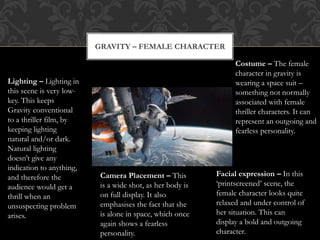
GRAVITY – FEMALE CHARACTER
Costume – The female
character in gravity is
wearing a space suit –
something not normally
associated with female
thriller characters. It can
represent an outgoing and
fearless personality.
Facial expression – In this
‘printscreened’ scene, the
female character looks quite
relaxed and under control of
her situation. This can
display a bold and outgoing
character.
Camera Placement – This
is a wide shot, as her body is
on full display. It also
emphasises the fact that she
is alone in space, which once
again shows a fearless
personality.
Lighting – Lighting in
this scene is very low-
key. This keeps
Gravity conventional
to a thriller film, by
keeping lighting
natural and/or dark.
Natural lighting
doesn’t give any
indication to anything,
and therefore the
audience would get a
thrill when an
unsuspecting problem
arises.
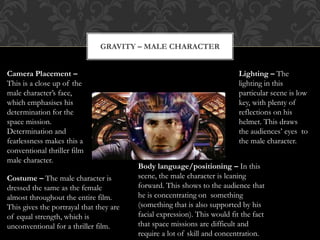
GRAVITY – MALE CHARACTER
Camera Placement –
This is a close up of the
male character’s face,
which emphasises his
determination for the
space mission.
Determination and
fearlessness makes this a
conventional thriller film
male character.
Costume – The male character is
dressed the same as the female
almost throughout the entire film.
This gives the portrayal that they are
of equal strength, which is
unconventional for a thriller film.
Body language/positioning – In this
scene, the male character is leaning
forward. This shows to the audience that
he is concentrating on something
(something that is also supported by his
facial expression). This would fit the fact
that space missions are difficult and
require a lot of skill and concentration.
Lighting – The
lighting in this
particular scene is low
key, with plenty of
reflections on his
helmet. This draws
the audiences’ eyes to
the male character.
Gravity is quite an unconventional film when it comes to conventional character roles.
Whilst the male character is fairly conventional with his outgoing personality and head-on
determination to complete the space mission, the female has almost the exact same roles
and state of mind. This is unusual because female characters usually play the damsel in
distress when it comes to thriller movies. As a result, Gravity takes a different route to
gender representation and therefore could potentially be more pleasing to the audience with
its unique style and unusual plot where the female ultimately ends up more successful in the
mission than the male character.
Summary of the character stereotypes:
Ryan (female character) – strong countertype, challenges many conventions of the female
role.
Matt (male character) – Conventional male character with his extroverted personality, but
also challenges conventions because he was inferior to the female character.
GRAVITY – QUICK CONCLUSION
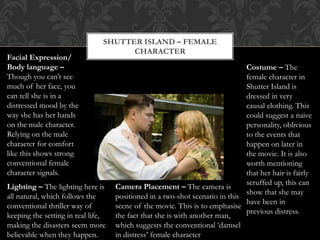
SHUTTER ISLAND – FEMALE
CHARACTER
Costume – The
female character in
Shutter Island is
dressed in very
causal clothing. This
could suggest a naive
personality, oblivious
to the events that
happen on later in
the movie. It is also
worth mentioning
that her hair is fairly
scruffed up, this can
show that she may
have been in
previous distress.
Camera Placement – The camera is
positioned in a two-shot scenario in this
scene of the movie. This is to emphasise
the fact that she is with another man,
which suggests the conventional ‘damsel
in distress’ female character
Facial Expression/
Body language –
Though you can’t see
much of her face, you
can tell she is in a
distressed mood by the
way she has her hands
on the male character.
Relying on the male
character for comfort
like this shows strong
conventional female
character signals.
Lighting – The lighting here is
all natural, which follows the
conventional thriller way of
keeping the setting in real life,
making the disasters seem more
believable when they happen.
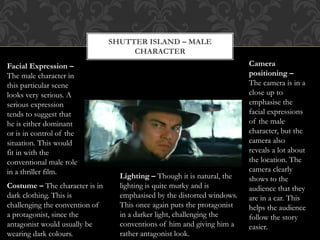
SHUTTER ISLAND – MALE
CHARACTER
Facial Expression –
The male character in
this particular scene
looks very serious. A
serious expression
tends to suggest that
he is either dominant
or is in control of the
situation. This would
fit in with the
conventional male role
in a thriller film.
Camera
positioning –
The camera is in a
close up to
emphasise the
facial expressions
of the male
character, but the
camera also
reveals a lot about
the location. The
camera clearly
shows to the
audience that they
are in a car. This
helps the audience
follow the story
easier.
Costume – The character is in
dark clothing. This is
challenging the convention of
a protagonist, since the
antagonist would usually be
wearing dark colours.
Lighting – Though it is natural, the
lighting is quite murky and is
emphasised by the distorted windows.
This once again puts the protagonist
in a darker light, challenging the
conventions of him and giving him a
rather antagonist look.
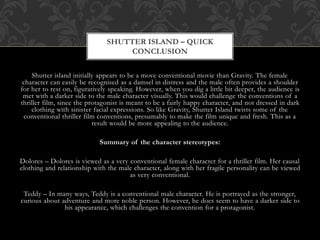
Shutter island initially appears to be a move conventional movie than Gravity. The female
character can easily be recognised as a damsel in distress and the male often provides a shoulder
for her to rest on, figuratively speaking. However, when you dig a little bit deeper, the audience is
met with a darker side to the male character visually. This would challenge the conventions of a
thriller film, since the protagonist is meant to be a fairly happy character, and not dressed in dark
clothing with sinister facial expressions. So like Gravity, Shutter Island twists some of the
conventional thriller film conventions, presumably to make the film unique and fresh. This as a
result would be more appealing to the audience.
Summary of the character stereotypes:
Dolores – Dolores is viewed as a very conventional female character for a thriller film. Her causal
clothing and relationship with the male character, along with her fragile personality can be viewed
as very conventional.
Teddy – In many ways, Teddy is a conventional male character. He is portrayed as the stronger,
curious about adventure and more noble person. However, he does seem to have a darker side to
his appearance, which challenges the convention for a protagonist.
SHUTTER ISLAND – QUICK
CONCLUSION
PULP FICTION – FEMALE
CHARACTER
Camera Placement –
The camera is
interestingly placed in a
low angle, which makes
the character seem
dominant and in control.
This is conventionally
unusual for a female
character, as they are
normally portrayed as the
lesser-powered character.
As a result, this camera
angle challenges the
female stereotypes.
Facial expressions/body
language – The female character
has a strong and determined look
on her face, suggesting that she is
in control in what she is doing.
This means that she is
countertyped for a thriller movie.
Costume – The female
character is wearing a
standard, baggy
cardigan. It could be
suggested that this goes
against the female
stereotype, as she is
clearly not being
exploited for [male]
audience pleasure,
unlike many female
characters in movies.
Lighting – The lighting is
ambient, but there is a noticeable
gloom to the character; her face is
not very well lit. This is to support
the gloominess of a gun scene,
such as this one.
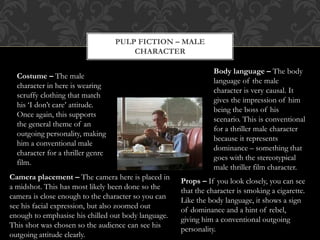
PULP FICTION – MALE
CHARACTER
Body language – The body
language of the male
character is very causal. It
gives the impression of him
being the boss of his
scenario. This is conventional
for a thriller male character
because it represents
dominance – something that
goes with the stereotypical
male thriller film character.
Props – If you look closely, you can see
that the character is smoking a cigarette.
Like the body language, it shows a sign
of dominance and a hint of rebel,
giving him a conventional outgoing
personality.
Camera placement – The camera here is placed in
a midshot. This has most likely been done so the
camera is close enough to the character so you can
see his facial expression, but also zoomed out
enough to emphasise his chilled out body language.
This shot was chosen so the audience can see his
outgoing attitude clearly.
Costume – The male
character in here is wearing
scruffy clothing that match
his ‘I don’t care’ attitude.
Once again, this supports
the general theme of an
outgoing personality, making
him a conventional male
character for a thriller genre
film.
Pulp Fiction is a movie of two halves when it comes to male and female representation. On one
hand, we have a male character who is outgoing and appears to follow by his own rules, which is
conventional to a male thriller character, though perhaps a bit different to how a typical
protagonist would be represented. And then on the other side of the spectrum we have the
female character who challenges female stereotypes in thriller movies. She is shown to be a
dominant character who has a strong personality, and does not need another typically male
character to rely on when she runs into trouble.
Summary of the character stereotypes:
Honey Bunny: Honey Bunny is viewed as a very unconventional character for a female in a
thriller film because she seems so dominant and in control of many parts of the movie. She is
therefore a complete countertype for thriller movies.
Pumpkin: Pumpkin is viewed as a stereotypical ‘lad’ type of guy. Interestingly, this is not the kind
of characteristic you would associate with a protagonist. Therefore, in some ways, Pumpkin is a
countertype for a protagonist, but her still supports the stereotype for a male character.
PULP FICTION – QUICK
CONCLUSION
INCEPTION – FEMALE
CHARACTER
Camera Positioning –
The camera is placed at a
high angle in this particular
shot. This shows the
audience that the character
may be a bit bewildered or
inferior to what she’s
looking at. The sense of
inferiority would be
conventional to a female
thriller film character.
Facial Expressions –
The facial expressions on
the female character in this
shot is a face of awe and
potential disbelief. Some
would say she looks a bit
clueless, to an extent. This
naïve approach would
support the female
stereotype of needing
another person for a
shoulder to rest on.
Costume – We can see that the character
is wearing generic clothing; a top and a
cardigan. This would go against the
stereotype of woman only playing a part
to pleasure the audience.
Framing – We can see that there is a male
character lurking behind the female
character. This could be to represent that the
female character needs a helping hand,
therefore supporting stereotypes of female
characters.
Lighting – The lighting is ambient,
suggesting a natural situation – a
natural reaction.
INCEPTION – MALE CHARACTER
Camera Positioning – The camera
positioning in this particular shot is of
a mid-shot level. This is to emphasise
to the audience the facial expression
that the character is pulling. The
character fills up the whole frame,
which could portray the male
dominance we see in thriller movies.
Lighting – The lighting
here is rather low-key.
This adds a sense of
mystery and scepticism
to the male character we
see in this shot. His dark
suit blends well into the
background of the
scene, which could
portray him as a
mysterious character.
This can be
conventional for a male
character in a thriller
genre film. However,
one may argue that it’s
not very conventional
for a protagonist.
Framing – There is very little
going on in the background, which
draws the audiences’ eyes to the
male character, and his distinctive
facial expression. This could be to
emphasise the point that this
character is a bit mysterious.
Facial Expression - The male
character’s facial expressions in this
scene is one of potential intimidation.
He could be pressuring the other
character into saying something. This
could tell the audience that this
character is potentially bullish and
alpha male – something that supports
the convention for male characters.
Inception is a film which is arguably the most conventional in all of the films I have analysed so far when it
comes to the representation of male and female characters. We have a female who is seen as inferior as a
result of the face of awe and of course the high angled shot with the camera. You could say though that she is
slightly unconventional in the sense that she is not used as a visual pleasure for the audience; she is wearing a
typical baggy cardigan. We also have a male character who gives off a strong sense of alpha male, because he
is intimidating another person in the scene with his dark clothing and squinted facial expressions. Though
once again, this is not really an applicable convention for a protagonist. So, like the female character, the male
character challenges some thriller film conventions as well as supporting some. Very much swings and
roundabouts here.
Summary of the character stereotypes:
Ariadne: Supports many conventions and stereotypes of thriller films when it comes to her physical and
mental strength, but challenges some when it comes to visual pleasure.
Cobb: In many ways, Cobb is very conventional when it comes to a male character. He is seen as alpha male
and in control of the situation. However, his intimidation does not match the stereotype of a protagonist.
INCEPTION – QUICK
CONCLUSION
After analysing the characters of these four films carefully, a clear and consistent pattern
has emerged. We see that the films follow the basic stereotypes of the male and female
characters quite well, but none were exactly the same. They did this to add a unique touch
to their work – a film that follows the conventions exactly will not impress the audience
because they would have seen the same kind of characters before in some previous films
they may have watched. However, it is important that the films follow the conventions and
stereotypes of thriller films to some extent, otherwise the film itself may not be
recognisable as a thriller and therefore less pleasurable to the audience.
This research will help me to produce my thriller opening sequence with my group, because
it will give us a clearer indication of how to present our characters. This will make our
sequence more recognisable to the audience seeking to watch a thriller film, and therefore
would be more enjoyable. The research has also opened my eyes and taught me not to be
too conventional with our video, otherwise it may become too repetitive with the other
videos from the class and potentially boring.
OVERALL EVALUATION

Thriller Film Analysis

  • 1.
    How the maleand female character are represented THRILLER FILM ANALYSIS
  • 2.
    Pulp Fiction Tim Roth– Pumpkin/Ringo Amanda Plummer – Honey Bunny/Yolanda Shutter Island Leonardo DiCaprio – Teddy Daniels Michelle Williams – Dolores Gravity George Clooney – Matt Kowalski Sandra Bullock – Ryan Stone Inception Leonardo DiCaprio – Cobb Ellen Page - Ariadne FILMS TO STUDY
  • 3.
    GRAVITY – FEMALECHARACTER Costume – The female character in gravity is wearing a space suit – something not normally associated with female thriller characters. It can represent an outgoing and fearless personality. Facial expression – In this ‘printscreened’ scene, the female character looks quite relaxed and under control of her situation. This can display a bold and outgoing character. Camera Placement – This is a wide shot, as her body is on full display. It also emphasises the fact that she is alone in space, which once again shows a fearless personality. Lighting – Lighting in this scene is very low- key. This keeps Gravity conventional to a thriller film, by keeping lighting natural and/or dark. Natural lighting doesn’t give any indication to anything, and therefore the audience would get a thrill when an unsuspecting problem arises.
  • 4.
    GRAVITY – MALECHARACTER Camera Placement – This is a close up of the male character’s face, which emphasises his determination for the space mission. Determination and fearlessness makes this a conventional thriller film male character. Costume – The male character is dressed the same as the female almost throughout the entire film. This gives the portrayal that they are of equal strength, which is unconventional for a thriller film. Body language/positioning – In this scene, the male character is leaning forward. This shows to the audience that he is concentrating on something (something that is also supported by his facial expression). This would fit the fact that space missions are difficult and require a lot of skill and concentration. Lighting – The lighting in this particular scene is low key, with plenty of reflections on his helmet. This draws the audiences’ eyes to the male character.
  • 5.
    Gravity is quitean unconventional film when it comes to conventional character roles. Whilst the male character is fairly conventional with his outgoing personality and head-on determination to complete the space mission, the female has almost the exact same roles and state of mind. This is unusual because female characters usually play the damsel in distress when it comes to thriller movies. As a result, Gravity takes a different route to gender representation and therefore could potentially be more pleasing to the audience with its unique style and unusual plot where the female ultimately ends up more successful in the mission than the male character. Summary of the character stereotypes: Ryan (female character) – strong countertype, challenges many conventions of the female role. Matt (male character) – Conventional male character with his extroverted personality, but also challenges conventions because he was inferior to the female character. GRAVITY – QUICK CONCLUSION
  • 6.
    SHUTTER ISLAND –FEMALE CHARACTER Costume – The female character in Shutter Island is dressed in very causal clothing. This could suggest a naive personality, oblivious to the events that happen on later in the movie. It is also worth mentioning that her hair is fairly scruffed up, this can show that she may have been in previous distress. Camera Placement – The camera is positioned in a two-shot scenario in this scene of the movie. This is to emphasise the fact that she is with another man, which suggests the conventional ‘damsel in distress’ female character Facial Expression/ Body language – Though you can’t see much of her face, you can tell she is in a distressed mood by the way she has her hands on the male character. Relying on the male character for comfort like this shows strong conventional female character signals. Lighting – The lighting here is all natural, which follows the conventional thriller way of keeping the setting in real life, making the disasters seem more believable when they happen.
  • 7.
    SHUTTER ISLAND –MALE CHARACTER Facial Expression – The male character in this particular scene looks very serious. A serious expression tends to suggest that he is either dominant or is in control of the situation. This would fit in with the conventional male role in a thriller film. Camera positioning – The camera is in a close up to emphasise the facial expressions of the male character, but the camera also reveals a lot about the location. The camera clearly shows to the audience that they are in a car. This helps the audience follow the story easier. Costume – The character is in dark clothing. This is challenging the convention of a protagonist, since the antagonist would usually be wearing dark colours. Lighting – Though it is natural, the lighting is quite murky and is emphasised by the distorted windows. This once again puts the protagonist in a darker light, challenging the conventions of him and giving him a rather antagonist look.
  • 8.
    Shutter island initiallyappears to be a move conventional movie than Gravity. The female character can easily be recognised as a damsel in distress and the male often provides a shoulder for her to rest on, figuratively speaking. However, when you dig a little bit deeper, the audience is met with a darker side to the male character visually. This would challenge the conventions of a thriller film, since the protagonist is meant to be a fairly happy character, and not dressed in dark clothing with sinister facial expressions. So like Gravity, Shutter Island twists some of the conventional thriller film conventions, presumably to make the film unique and fresh. This as a result would be more appealing to the audience. Summary of the character stereotypes: Dolores – Dolores is viewed as a very conventional female character for a thriller film. Her causal clothing and relationship with the male character, along with her fragile personality can be viewed as very conventional. Teddy – In many ways, Teddy is a conventional male character. He is portrayed as the stronger, curious about adventure and more noble person. However, he does seem to have a darker side to his appearance, which challenges the convention for a protagonist. SHUTTER ISLAND – QUICK CONCLUSION
  • 9.
    PULP FICTION –FEMALE CHARACTER Camera Placement – The camera is interestingly placed in a low angle, which makes the character seem dominant and in control. This is conventionally unusual for a female character, as they are normally portrayed as the lesser-powered character. As a result, this camera angle challenges the female stereotypes. Facial expressions/body language – The female character has a strong and determined look on her face, suggesting that she is in control in what she is doing. This means that she is countertyped for a thriller movie. Costume – The female character is wearing a standard, baggy cardigan. It could be suggested that this goes against the female stereotype, as she is clearly not being exploited for [male] audience pleasure, unlike many female characters in movies. Lighting – The lighting is ambient, but there is a noticeable gloom to the character; her face is not very well lit. This is to support the gloominess of a gun scene, such as this one.
  • 10.
    PULP FICTION –MALE CHARACTER Body language – The body language of the male character is very causal. It gives the impression of him being the boss of his scenario. This is conventional for a thriller male character because it represents dominance – something that goes with the stereotypical male thriller film character. Props – If you look closely, you can see that the character is smoking a cigarette. Like the body language, it shows a sign of dominance and a hint of rebel, giving him a conventional outgoing personality. Camera placement – The camera here is placed in a midshot. This has most likely been done so the camera is close enough to the character so you can see his facial expression, but also zoomed out enough to emphasise his chilled out body language. This shot was chosen so the audience can see his outgoing attitude clearly. Costume – The male character in here is wearing scruffy clothing that match his ‘I don’t care’ attitude. Once again, this supports the general theme of an outgoing personality, making him a conventional male character for a thriller genre film.
  • 11.
    Pulp Fiction isa movie of two halves when it comes to male and female representation. On one hand, we have a male character who is outgoing and appears to follow by his own rules, which is conventional to a male thriller character, though perhaps a bit different to how a typical protagonist would be represented. And then on the other side of the spectrum we have the female character who challenges female stereotypes in thriller movies. She is shown to be a dominant character who has a strong personality, and does not need another typically male character to rely on when she runs into trouble. Summary of the character stereotypes: Honey Bunny: Honey Bunny is viewed as a very unconventional character for a female in a thriller film because she seems so dominant and in control of many parts of the movie. She is therefore a complete countertype for thriller movies. Pumpkin: Pumpkin is viewed as a stereotypical ‘lad’ type of guy. Interestingly, this is not the kind of characteristic you would associate with a protagonist. Therefore, in some ways, Pumpkin is a countertype for a protagonist, but her still supports the stereotype for a male character. PULP FICTION – QUICK CONCLUSION
  • 12.
    INCEPTION – FEMALE CHARACTER CameraPositioning – The camera is placed at a high angle in this particular shot. This shows the audience that the character may be a bit bewildered or inferior to what she’s looking at. The sense of inferiority would be conventional to a female thriller film character. Facial Expressions – The facial expressions on the female character in this shot is a face of awe and potential disbelief. Some would say she looks a bit clueless, to an extent. This naïve approach would support the female stereotype of needing another person for a shoulder to rest on. Costume – We can see that the character is wearing generic clothing; a top and a cardigan. This would go against the stereotype of woman only playing a part to pleasure the audience. Framing – We can see that there is a male character lurking behind the female character. This could be to represent that the female character needs a helping hand, therefore supporting stereotypes of female characters. Lighting – The lighting is ambient, suggesting a natural situation – a natural reaction.
  • 13.
    INCEPTION – MALECHARACTER Camera Positioning – The camera positioning in this particular shot is of a mid-shot level. This is to emphasise to the audience the facial expression that the character is pulling. The character fills up the whole frame, which could portray the male dominance we see in thriller movies. Lighting – The lighting here is rather low-key. This adds a sense of mystery and scepticism to the male character we see in this shot. His dark suit blends well into the background of the scene, which could portray him as a mysterious character. This can be conventional for a male character in a thriller genre film. However, one may argue that it’s not very conventional for a protagonist. Framing – There is very little going on in the background, which draws the audiences’ eyes to the male character, and his distinctive facial expression. This could be to emphasise the point that this character is a bit mysterious. Facial Expression - The male character’s facial expressions in this scene is one of potential intimidation. He could be pressuring the other character into saying something. This could tell the audience that this character is potentially bullish and alpha male – something that supports the convention for male characters.
  • 14.
    Inception is afilm which is arguably the most conventional in all of the films I have analysed so far when it comes to the representation of male and female characters. We have a female who is seen as inferior as a result of the face of awe and of course the high angled shot with the camera. You could say though that she is slightly unconventional in the sense that she is not used as a visual pleasure for the audience; she is wearing a typical baggy cardigan. We also have a male character who gives off a strong sense of alpha male, because he is intimidating another person in the scene with his dark clothing and squinted facial expressions. Though once again, this is not really an applicable convention for a protagonist. So, like the female character, the male character challenges some thriller film conventions as well as supporting some. Very much swings and roundabouts here. Summary of the character stereotypes: Ariadne: Supports many conventions and stereotypes of thriller films when it comes to her physical and mental strength, but challenges some when it comes to visual pleasure. Cobb: In many ways, Cobb is very conventional when it comes to a male character. He is seen as alpha male and in control of the situation. However, his intimidation does not match the stereotype of a protagonist. INCEPTION – QUICK CONCLUSION
  • 15.
    After analysing thecharacters of these four films carefully, a clear and consistent pattern has emerged. We see that the films follow the basic stereotypes of the male and female characters quite well, but none were exactly the same. They did this to add a unique touch to their work – a film that follows the conventions exactly will not impress the audience because they would have seen the same kind of characters before in some previous films they may have watched. However, it is important that the films follow the conventions and stereotypes of thriller films to some extent, otherwise the film itself may not be recognisable as a thriller and therefore less pleasurable to the audience. This research will help me to produce my thriller opening sequence with my group, because it will give us a clearer indication of how to present our characters. This will make our sequence more recognisable to the audience seeking to watch a thriller film, and therefore would be more enjoyable. The research has also opened my eyes and taught me not to be too conventional with our video, otherwise it may become too repetitive with the other videos from the class and potentially boring. OVERALL EVALUATION