How does your
product represent
particular social
groups?
Profile
Name- Olivia
Gender-Female
Age-21
Ethnicity- White, British
Class- Unknown
Part in the film- Olivia has anterograde amnesia and when she wakes up she
loses all of her memories. She is being used for biological experiments
but is unaware as she forget every morning. She is vulnerable but wants
to fight and figure it out on her own.
Profile
Name- Samuel
Gender-Male
Age-32
Ethnicity- White, British
Class- Upper/middle class (Doctor)
Part in the film- Samuel is the man who is doing the experiments on Olivia
and has a very hard, cold personality. He is keeping her hostage after
being the one to cause her to lose her memory. He manipulates her into
thinking he is helping her cure her amnesia.
How have I
constructed
ideas about
your character
through mise
en scene,
camerawork,
editing and
sound?
Mise en scene- In our opening sequence we only
represent a few different social groups, such as
age and gender. Both genders are represented
as the antagonist is female (Olivia) and the
protagonist is male. Olivia is difficult to
represent anything other than young female as
she doesn't know much about herself or her
past. However, we can assume that Samuel had
a good upbringing as a result the he appear to
have a good job- a Doctor-which can be seen by
the flashbacks where someone is injecting
Olivia, however it is difficult to see from his
costume (as he doesn't want Olivia to know he is
her Doctor) which is a casual jumper and jeans,
which suggests he is from a middle class
background. There's very little props used to
furnish the home because it is meant to be as
plain as possible to represent Olivia's lack of
memory of her identity. From the flashbacks
however, it appears that Samuel owns a house
that has a laboratory which also
suggests Samuel has good job. Also the amount
of biological equipment he has shows that he
has a background in science and also that he
has the money and connections to keep his life
secret and separate from scoiety.
How have I
constructed
ideas about
your character
through mise
en scene,
camerawork,
editing and
sound?
Camerawork-We portray the character as weak
through the choice of angles. For example we
make sure to emphasize how daunting and her
reactions to waking up not knowing where she is
by using close ups of her face. There is also a
medium close up of her facial reaction and
confusion, this emphasizes to the audience her
vulnerability as she has very little idea as to wat is
going on. As she has little to no possessions, this
portrays the character as an unknown woman who
has no identity.
We also portray the male character as powerful
and having a sense of dominance over Olivia, this
is down by the use of the over the shoulder shot
where he is clearly looking down on Olivia as the
subject of his experiments rather than an actual
human.
How have I
constructed
ideas about
your character
through mise
en scene,
camerawork,
editing and
sound?
Editing- You can clearly tell that Olivia is the main
character by the fact that she is the main person
you see on the screen and it her memories you
are exposed to, this is also used to put
the audience in Olivia's mindset so they can
understand how vulnerable she feels. Also the
lack of Samuel in the memories shows that he is
not important to her, especially as he is only
present in bad memories.
Sound- Olivia's voice is used as non-diegetic
sound throughout the clip, which clearly
demonstrates that she is the main character and
her role is more important than Samuel's as he
only as one line. Also the sound of her voice is
very cold which shows how scared her character
is. Another aspect of both sound and editing, we
ensured that Samuel's call of Olivia at the end to
break her out of the trance was louder than
anything else, this was to show his power over her
and in a way her way of thinking, showing he is
brainwashing her and messing with her mind.
To what extent are your
character representations
typical of your film’s genre?
• Nicole Kidman plays Christine in the 2014 psychological thriller, Before I Go To
Sleep. She can be seen as very similar to the character Olivia in our opening
sequence. Both characters have very straight faces which can be made to look
plain without makeup or piercings, they are also both the female protagonists of
their films. It is rather unique to have a female protagonist in thriller films as
they tend to be portrayed as the victim of the person who has the mental illness
or psychological problem. However, recently a lot of producers have caught onto
this and released a lot of films around this nature, e.g. Gone Girl, Before I Go To
Sleep and Girl On The Train. We felt inspired by this, especially in Before I Go
To Sleep where through the use of camerawork Nicole Kidman's character gains
power and can prove to herself that she is strong enough to fight back. Although
we don't see this much in Olivia in the opening, you can tell she is not as weak as
she thinks as she does have some form of memories, and rather a lot of
them.Both characters are young females, in their mid twenties and challenge the
social stereotype of the wild and ditzy blonde. We can also compare Ben from the
film to Samuel as we see that both characters are well educated and from a good
background due to their large house and ability to help their secrets remain
secrets.
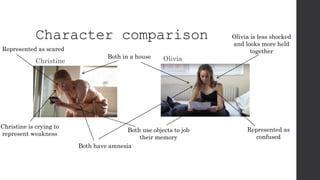
Character comparison
OliviaChristine
Both have amnesia
Olivia is less shocked
and looks more held
together
Both in a house
Both use objects to job
their memory
Represented as
confused
Represented as scared
Christine is crying to
represent weakness
Gender: We have represented a woman as the main
character as we know that women don't have a very high
representation of speaking main characters in films and
felt that it would be more of a USP if ours has a women
as the main character as in 2007-2012 in the top 500
films, only 30.8% of speaking characters were women
(source 1-https://www.nyfa.edu/film-school-blog/gender-
inequality-in-film/). We also wanted to have a female
main character as there's very little out there, only 11%
of all clearly identifiable protagonists were women
(source2-
https://londonfeministfilmfestival.com/resources/women-
on-screen/representations-of-women/) so therefore this
challenges the social stereotype that only men should
play the main protagonist.
However, he is shown to have dominance over her by the
shots we use (over the shoulder looking down on her),
which reinforces the social stereotype that men have the
power over women and they should lead, in the film
industry Men are much more likely than females to be
portrayed as leaders. Overall men accounted for 86%
and women 14% of leaders (source 2). He is also older
than her which reinforces the social stereotype
that younger women are more appealing to an audience
that most people assume is male dominated; The
majority of women characters were in their 20s (27%)
and 30s (28%). The majority of men characters were in
their 30s (29%) and 40s (25%) (source 2).
In what ways do
your
representations
reinforce or
challenge
social
stereotypes?
Race: She is a white British female and he is a white
British Male. Which means that are only
representing one races, this reinforces the idea that
black characters, especially females, do not want to be
seen on screen by this statistic, (source 2). However he is
violent towards her which is generally a stereotype
associated with people of colour.
Mental illness: In our film, we challenge the social
stereotype that people with Mental illnesses are violent,
which is reinforces so much by other film that A YouGov
survey commissioned for the report found that almost 50
per cent [3] (49 per cent) of the public have seen people
with a mental illness acting violently in films (source 3-
http://www.time-to-change.org.uk/news/mental-health-
stereotypes-movies-crueler-ever-new-report-claims).
However in ours, she is represented as confused and
vulnerable and we try to get the audience to feel bad for
her and make people more aware of how daunting an
frightening a mental illness can be.
In what ways do
your
representations
reinforce or
challenge
social
stereotypes?
Overall messages our
representations construct
• Our opening sequence/film suggests that troubled mentally illnesses do not
make a person violent or aggressive but confused, scared and vulnerable. It
also suggests that people with mental illnesses cannot be left as they
vulnerable and need help or it will continue to effect them
mentally. However it also has no representations of mixed race or black
people which could be represented in a good way as they are not represented
as bad and this is represented by a white middle class male rather than the
stereotypical black lower class male; on the other hand it is very bad that
there is no representation of people of colour in our clip.

Evaluation point 2

  • 1.
    How does your productrepresent particular social groups?
  • 2.
    Profile Name- Olivia Gender-Female Age-21 Ethnicity- White,British Class- Unknown Part in the film- Olivia has anterograde amnesia and when she wakes up she loses all of her memories. She is being used for biological experiments but is unaware as she forget every morning. She is vulnerable but wants to fight and figure it out on her own.
  • 3.
    Profile Name- Samuel Gender-Male Age-32 Ethnicity- White,British Class- Upper/middle class (Doctor) Part in the film- Samuel is the man who is doing the experiments on Olivia and has a very hard, cold personality. He is keeping her hostage after being the one to cause her to lose her memory. He manipulates her into thinking he is helping her cure her amnesia.
  • 4.
    How have I constructed ideasabout your character through mise en scene, camerawork, editing and sound? Mise en scene- In our opening sequence we only represent a few different social groups, such as age and gender. Both genders are represented as the antagonist is female (Olivia) and the protagonist is male. Olivia is difficult to represent anything other than young female as she doesn't know much about herself or her past. However, we can assume that Samuel had a good upbringing as a result the he appear to have a good job- a Doctor-which can be seen by the flashbacks where someone is injecting Olivia, however it is difficult to see from his costume (as he doesn't want Olivia to know he is her Doctor) which is a casual jumper and jeans, which suggests he is from a middle class background. There's very little props used to furnish the home because it is meant to be as plain as possible to represent Olivia's lack of memory of her identity. From the flashbacks however, it appears that Samuel owns a house that has a laboratory which also suggests Samuel has good job. Also the amount of biological equipment he has shows that he has a background in science and also that he has the money and connections to keep his life secret and separate from scoiety.
  • 5.
    How have I constructed ideasabout your character through mise en scene, camerawork, editing and sound? Camerawork-We portray the character as weak through the choice of angles. For example we make sure to emphasize how daunting and her reactions to waking up not knowing where she is by using close ups of her face. There is also a medium close up of her facial reaction and confusion, this emphasizes to the audience her vulnerability as she has very little idea as to wat is going on. As she has little to no possessions, this portrays the character as an unknown woman who has no identity. We also portray the male character as powerful and having a sense of dominance over Olivia, this is down by the use of the over the shoulder shot where he is clearly looking down on Olivia as the subject of his experiments rather than an actual human.
  • 6.
    How have I constructed ideasabout your character through mise en scene, camerawork, editing and sound? Editing- You can clearly tell that Olivia is the main character by the fact that she is the main person you see on the screen and it her memories you are exposed to, this is also used to put the audience in Olivia's mindset so they can understand how vulnerable she feels. Also the lack of Samuel in the memories shows that he is not important to her, especially as he is only present in bad memories. Sound- Olivia's voice is used as non-diegetic sound throughout the clip, which clearly demonstrates that she is the main character and her role is more important than Samuel's as he only as one line. Also the sound of her voice is very cold which shows how scared her character is. Another aspect of both sound and editing, we ensured that Samuel's call of Olivia at the end to break her out of the trance was louder than anything else, this was to show his power over her and in a way her way of thinking, showing he is brainwashing her and messing with her mind.
  • 7.
    To what extentare your character representations typical of your film’s genre? • Nicole Kidman plays Christine in the 2014 psychological thriller, Before I Go To Sleep. She can be seen as very similar to the character Olivia in our opening sequence. Both characters have very straight faces which can be made to look plain without makeup or piercings, they are also both the female protagonists of their films. It is rather unique to have a female protagonist in thriller films as they tend to be portrayed as the victim of the person who has the mental illness or psychological problem. However, recently a lot of producers have caught onto this and released a lot of films around this nature, e.g. Gone Girl, Before I Go To Sleep and Girl On The Train. We felt inspired by this, especially in Before I Go To Sleep where through the use of camerawork Nicole Kidman's character gains power and can prove to herself that she is strong enough to fight back. Although we don't see this much in Olivia in the opening, you can tell she is not as weak as she thinks as she does have some form of memories, and rather a lot of them.Both characters are young females, in their mid twenties and challenge the social stereotype of the wild and ditzy blonde. We can also compare Ben from the film to Samuel as we see that both characters are well educated and from a good background due to their large house and ability to help their secrets remain secrets.
  • 8.
    Character comparison OliviaChristine Both haveamnesia Olivia is less shocked and looks more held together Both in a house Both use objects to job their memory Represented as confused Represented as scared Christine is crying to represent weakness
  • 9.
    Gender: We haverepresented a woman as the main character as we know that women don't have a very high representation of speaking main characters in films and felt that it would be more of a USP if ours has a women as the main character as in 2007-2012 in the top 500 films, only 30.8% of speaking characters were women (source 1-https://www.nyfa.edu/film-school-blog/gender- inequality-in-film/). We also wanted to have a female main character as there's very little out there, only 11% of all clearly identifiable protagonists were women (source2- https://londonfeministfilmfestival.com/resources/women- on-screen/representations-of-women/) so therefore this challenges the social stereotype that only men should play the main protagonist. However, he is shown to have dominance over her by the shots we use (over the shoulder looking down on her), which reinforces the social stereotype that men have the power over women and they should lead, in the film industry Men are much more likely than females to be portrayed as leaders. Overall men accounted for 86% and women 14% of leaders (source 2). He is also older than her which reinforces the social stereotype that younger women are more appealing to an audience that most people assume is male dominated; The majority of women characters were in their 20s (27%) and 30s (28%). The majority of men characters were in their 30s (29%) and 40s (25%) (source 2). In what ways do your representations reinforce or challenge social stereotypes?
  • 10.
    Race: She isa white British female and he is a white British Male. Which means that are only representing one races, this reinforces the idea that black characters, especially females, do not want to be seen on screen by this statistic, (source 2). However he is violent towards her which is generally a stereotype associated with people of colour. Mental illness: In our film, we challenge the social stereotype that people with Mental illnesses are violent, which is reinforces so much by other film that A YouGov survey commissioned for the report found that almost 50 per cent [3] (49 per cent) of the public have seen people with a mental illness acting violently in films (source 3- http://www.time-to-change.org.uk/news/mental-health- stereotypes-movies-crueler-ever-new-report-claims). However in ours, she is represented as confused and vulnerable and we try to get the audience to feel bad for her and make people more aware of how daunting an frightening a mental illness can be. In what ways do your representations reinforce or challenge social stereotypes?
  • 11.
    Overall messages our representationsconstruct • Our opening sequence/film suggests that troubled mentally illnesses do not make a person violent or aggressive but confused, scared and vulnerable. It also suggests that people with mental illnesses cannot be left as they vulnerable and need help or it will continue to effect them mentally. However it also has no representations of mixed race or black people which could be represented in a good way as they are not represented as bad and this is represented by a white middle class male rather than the stereotypical black lower class male; on the other hand it is very bad that there is no representation of people of colour in our clip.