Written by Charley Bristow
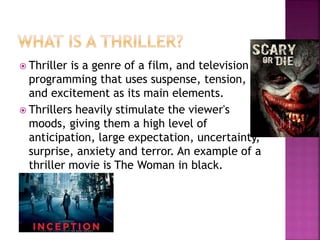
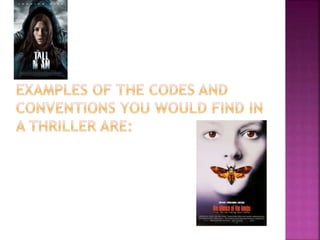
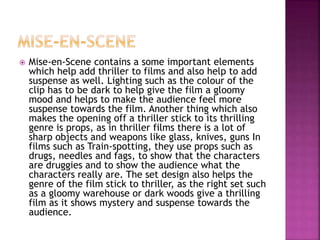
 Thriller is a genre of a film, and television
programming that uses suspense, tension,
and excitement as its main elements.
 Thrillers heavily stimulate the viewer's
moods, giving them a high level of
anticipation, large expectation, uncertainty,
surprise, anxiety and terror. An example of a
thriller movie is The Woman in black.
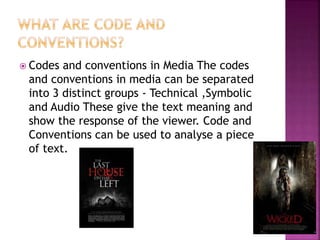
 Codes and conventions in Media The codes
and conventions in media can be separated
into 3 distinct groups - Technical ,Symbolic
and Audio These give the text meaning and
show the response of the viewer. Code and
Conventions can be used to analyse a piece
of text.
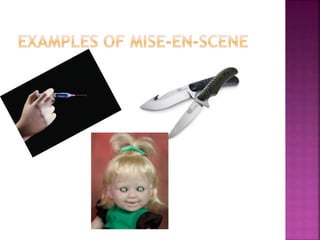
 Mise-en-Scene contains a some important elements
which help add thriller to films and also help to add
suspense as well. Lighting such as the colour of the
clip has to be dark to help give the film a gloomy
mood and helps to make the audience feel more
suspense towards the film. Another thing which also
makes the opening off a thriller stick to its thrilling
genre is props, as in thriller films there is a lot of
sharp objects and weapons like glass, knives, guns In
films such as Train-spotting, they use props such as
drugs, needles and fags, to show that the characters
are druggies and to show the audience what the
characters really are. The set design also helps the
genre of the film stick to thriller, as the right set such
as a gloomy warehouse or dark woods give a thrilling
film as it shows mystery and suspense towards the
audience.
This also contains very important elements which
make up a thriller using code and conventions For
example themes are shown in this genre of thriller,
as the different music themes produce a different
mood and feel for thriller films. The sound is
known to be very jumpy and quite scary music
which is played in each scene which can be named
as themes as they produce different moods and
settings for thriller films by just using sound.
Another sound element which is very important is
high pitched sounds/orchestral stabs such as
screeches. This adds suspense and thriller to the
film to give it its thrilling genre. A good example of
thriller than uses a sound track is exorcist as its
sound track has fast tempo and high pitch which
goes with the codes and conventions of a thriller.
 The directors of thrillers would use a lot of
jump cuts throughout their film, as their will
be times they want the audience to not know
what is happening and to make the audience
be in suspense and scared, which the film
must do in order for it to be called a thriller
and continuous editing is used to make the
whole thriller flow together to make the
story clear to the audience. Key Cutting is
also a type of editing that is key point to be
used in a thriller as it helps to build suspense
as well which is key in a thriller.
 Narrative structure is a literary element, which
is generally described as the structural
framework that outlines the order and manner of
how a something such as thriller is shown to the
audience. Examples of types of narrative
structures for thrillers are a film that pursues a
particular person to provide thrills and keep the
audience cliff hanging at the edge of their seats
as the plot builds to the climax. A second type of
narrative structure for a thriller is tension
usually arises when the main character is placed
in a threatening situation, mystery or an
dangerous mission from which escape seems
impossible.
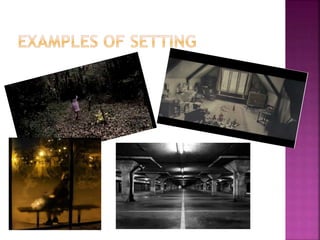
 The setting is very important to help
cooperate with the code and conventions of
a thriller. For example like abandoned houses
and woods are normally where thrillers are
found as they are dark lonely places, as most
thrillers only have a couple of actors in them
so isolated places are used for thriller to fit
in with the codes and conventions
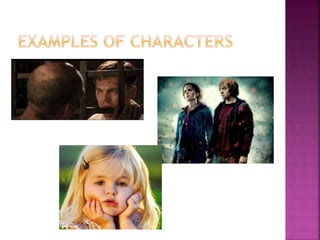
 Code and conventions of characters are also a
main part in thrillers the normal types of
characters you find would be:
 Convicts
 Soldiers
 Spies
 Law enforcement officers
 Stalkers
 Men associated in danger
 Criminals
 Assassins
 Innocent citizens
 Prison inmates
 Iconography means symbolic representation,
especially the conventional meanings attached
to images.
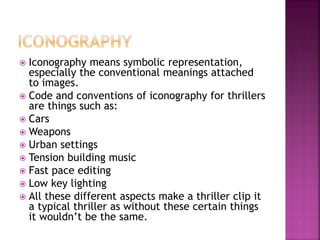
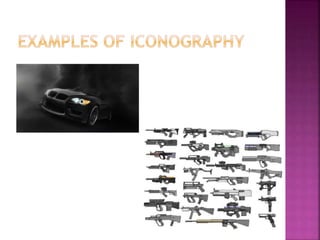
 Code and conventions of iconography for thrillers
are things such as:
 Cars
 Weapons
 Urban settings
 Tension building music
 Fast pace editing
 Low key lighting
 All these different aspects make a thriller clip it
a typical thriller as without these certain things
it wouldn’t be the same.
 Cinematography means certain camera shots and
movement which is very important when creating a
thriller. As camera shots show body language and different
emotions. Some camera shots mostly used are close ups to
shows a persons face to show exactly how their feeling so
a victim for example crying to show there scared or of a
possessed persons ugly face to scare the audience and
create tension a close up is very important in a thriller
film. Camera movements are also very vital for example if
the camera moves around a lot this can be used to show
someone heavily breathing, this makes the audience feel
as in they are in the film and make them seem as there the
ones breathing. Another type of camera movement is
tracking which can be known as dolly shot which is a fast
pace movement which follows someone. This makes the
audience feel more tensed and quite nervous about what is
going to happen next.

Thriller – codes and conventions

  • 1.
  • 2.
     Thriller isa genre of a film, and television programming that uses suspense, tension, and excitement as its main elements.  Thrillers heavily stimulate the viewer's moods, giving them a high level of anticipation, large expectation, uncertainty, surprise, anxiety and terror. An example of a thriller movie is The Woman in black.
  • 3.
     Codes andconventions in Media The codes and conventions in media can be separated into 3 distinct groups - Technical ,Symbolic and Audio These give the text meaning and show the response of the viewer. Code and Conventions can be used to analyse a piece of text.
  • 5.
     Mise-en-Scene containsa some important elements which help add thriller to films and also help to add suspense as well. Lighting such as the colour of the clip has to be dark to help give the film a gloomy mood and helps to make the audience feel more suspense towards the film. Another thing which also makes the opening off a thriller stick to its thrilling genre is props, as in thriller films there is a lot of sharp objects and weapons like glass, knives, guns In films such as Train-spotting, they use props such as drugs, needles and fags, to show that the characters are druggies and to show the audience what the characters really are. The set design also helps the genre of the film stick to thriller, as the right set such as a gloomy warehouse or dark woods give a thrilling film as it shows mystery and suspense towards the audience.
  • 7.
    This also containsvery important elements which make up a thriller using code and conventions For example themes are shown in this genre of thriller, as the different music themes produce a different mood and feel for thriller films. The sound is known to be very jumpy and quite scary music which is played in each scene which can be named as themes as they produce different moods and settings for thriller films by just using sound. Another sound element which is very important is high pitched sounds/orchestral stabs such as screeches. This adds suspense and thriller to the film to give it its thrilling genre. A good example of thriller than uses a sound track is exorcist as its sound track has fast tempo and high pitch which goes with the codes and conventions of a thriller.
  • 8.
     The directorsof thrillers would use a lot of jump cuts throughout their film, as their will be times they want the audience to not know what is happening and to make the audience be in suspense and scared, which the film must do in order for it to be called a thriller and continuous editing is used to make the whole thriller flow together to make the story clear to the audience. Key Cutting is also a type of editing that is key point to be used in a thriller as it helps to build suspense as well which is key in a thriller.
  • 9.
     Narrative structureis a literary element, which is generally described as the structural framework that outlines the order and manner of how a something such as thriller is shown to the audience. Examples of types of narrative structures for thrillers are a film that pursues a particular person to provide thrills and keep the audience cliff hanging at the edge of their seats as the plot builds to the climax. A second type of narrative structure for a thriller is tension usually arises when the main character is placed in a threatening situation, mystery or an dangerous mission from which escape seems impossible.
  • 10.
     The settingis very important to help cooperate with the code and conventions of a thriller. For example like abandoned houses and woods are normally where thrillers are found as they are dark lonely places, as most thrillers only have a couple of actors in them so isolated places are used for thriller to fit in with the codes and conventions
  • 12.
     Code andconventions of characters are also a main part in thrillers the normal types of characters you find would be:  Convicts  Soldiers  Spies  Law enforcement officers  Stalkers  Men associated in danger  Criminals  Assassins  Innocent citizens  Prison inmates
  • 14.
     Iconography meanssymbolic representation, especially the conventional meanings attached to images.  Code and conventions of iconography for thrillers are things such as:  Cars  Weapons  Urban settings  Tension building music  Fast pace editing  Low key lighting  All these different aspects make a thriller clip it a typical thriller as without these certain things it wouldn’t be the same.
  • 16.
     Cinematography meanscertain camera shots and movement which is very important when creating a thriller. As camera shots show body language and different emotions. Some camera shots mostly used are close ups to shows a persons face to show exactly how their feeling so a victim for example crying to show there scared or of a possessed persons ugly face to scare the audience and create tension a close up is very important in a thriller film. Camera movements are also very vital for example if the camera moves around a lot this can be used to show someone heavily breathing, this makes the audience feel as in they are in the film and make them seem as there the ones breathing. Another type of camera movement is tracking which can be known as dolly shot which is a fast pace movement which follows someone. This makes the audience feel more tensed and quite nervous about what is going to happen next.