Research Journal of Finance and Accounting                                                                  www.iiste.org
ISSN 2222-1697 (Paper) ISSN 2222-2847 (Online)
Vol 3, No 8, 2012


             Threshold autoregressive (TAR) &Momentum Threshold
                 autoregressive (MTAR) models Specification
                                  Muhammad Tayyab1, Ayesha Tarar2 and Madiha Riaz3*
                             1. Assistant Executive Engineer ,Resignalling Project , Pakistan
                              2. Lecturer at Federal Science College ,Gujranwala ,Pakistan
                          3. PhD Candidate, School of Social Sciences, University Sains Malaysia
                               * E-mail of the corresponding author: mdhtarar@gmail.com
Abstract
This paper proposes a testing integration and threshold integration procedure of interest rate and inflation rate. It
locates whether there have been a cointegrating relationship between them and recognizes the procedures of
addressing structural break. The most important issue is the testing of the hypothesis that whether effect of inflation
on interest rates depends on the movement of inflation declining or increasing. In this study we analyze the inflation
and interest rate of Canada for their long term relationships by applying co integration technique of EG-Model.
Further we test it for the structural break and threshold autoregressive (TAR) and Momentum Autoregressive
(MTAR) integration and stationarity. We generate real interest rate and test it for the same. We come to an end that
TAR best capture the adjustment process. We discover that our selected series are integrated at level one. There is
cointegration relationship between interest rate and inflation with the cointegrating vector (1,-1).We find no
asymmetry in our series and therefore conclude that there is same effect of inflation increase or decrease on interest
rate.
Keywords: Threshold autoregressive, Momentum autoregressive, Co integration, Stationarity

1. Introduction
Time series run into practice may not always exhibit characteristics of a linear process. Many processes occurring in
the real world exhibit some form of non-linear behavior. This has led to much interest in nonlinear time series
models including bilinear, exponential autoregressive, Threshold autoregressive (TAR) and many others. In recent
years non-linear time series has captured the attention of many researchers due to its uniqueness. Among the family
of non linear models, the threshold autoregressive (TAR), momentum threshold autoregressive (MTAR) and bilinear
model are perhaps the most popular ones in the literature. However, the TAR model has not been widely used in
practice due to the difficulty in identifying the threshold variable and in estimating the associated threshold value.
The threshold autoregressive model is one of the nonlinear time series models available in the literature. It was first
proposed by Tong (1978) and discussed in detail by Tong and Lim (1980) and Tong (1983). The major features of
this class of models are limit cycles, amplitude dependent frequencies, and jump phenomena. Much of the original
motivation of the model is concerned with limit cycles of a cyclical time series, and indeed the model is capable of
producing asymmetric limit cycles. The threshold autoregressive model, however, has not received much attention in
application. This is due to (a) the lack of a suitable modeling procedure and (b) the inability to identify the threshold
variable and estimate the threshold values. A TAR model is regarded as a piecewise –linear approximation to a
general non-linear model. This model can be seen as a piecewise linear AR model, with somewhat abrupt change,
from one equation or regime to another dependent on whether or not a threshold value © is exceeded by zt-d. In the
TAR models the regime is determined by the value of zt-d. where d=1,2,3….here d=delay parameter show that the
timing of the adjustment process is such that it takes more than one period for the regime switch to occur.TAR
models capture the deepness asymmetry in the data. A similar model which captures the steepness in the data is
momentum threshold autoregressive model (MTAR).If we say “zt” is stationary series then testing for deepness
hypothesis by TAR model is simply equivalent to the testing of no skewness in the data zt. Whereas testing the
steepness hypothesis is equivalent to the testing the no skewness in

The main focal point of this paper is application of the TAR model and MTAR model with two regimes. We
illustrate the proposed methodology by analysis of artificial data set. The problem of estimating the threshold
parameter, i.e., the change point, of a threshold autoregressive model is studied here.
The primary goal of this study is to suggest a simple yet widely applicable model-building procedure for threshold
autoregressive models. Based on some predictive residuals, a simple statistic is proposed to test for threshold
nonlinearity and specify the threshold variable.


                                                          119
Research Journal of Finance and Accounting                                                                  www.iiste.org
ISSN 2222-1697 (Paper) ISSN 2222-2847 (Online)
Vol 3, No 8, 2012

2. Methodology
We address the issue of time series stationarity e.g unit root testing, co integration (long run relationship) and
presence of structural break. Structural change is an important problem in time series and affects all the inferential
procedures. A structural break in the deterministic trend will lead to misleading conclusion that there is a unit root,
when in fact there might be not.
In order to find the long term relationship (co integration) we apply the co integration technique of EG-model (1979).
Further, we test the stationary and integration in TAR and MTAR. Generally for analysis, Firstly, we need to plot the
series and identify the presence of deterministic trends, secondly, we need to detrend the series and obtain the filtered
series, which are fluctuations around zero-horizontal line. Thirdly, we need to define the Heaviside function and
Estimate the specific model defined, then testing the related hypothesis. Finally, we need to test for deepness and
steepness asymmetric root for TAR and MTAR specification.
We collect the time series data of Canada from www.rba.gov.au . We generate the yearly inflation series from CPI
data by applying the formula.
       Inflation= (CPI Current-CPI last/CPI Last)*4             (1)
            Real Interest rate=Inflation-Interest rate            (2)

2.1-Test for integration
We follow the following steps for it.
 Consider a AR (1) model;
          Yt= Yt-1+et
          Case1-if |ф|<1 the series is stationary.
          Case2-if|ф|>1 the series is non-stationary and explodes.
          Case3-if|ф|=1 series contain a unit root and non-stationary.
A test for the order of integration is a test for the number of unit roots; it follows the step as under:
Step (a) - we Test “Yt” series if it is stationary then Yt is I(0). If No then Yt is I (n); n>0.
Step (b) - we Take first difference of Yt series as ∆yt=yt-yt-1 and test ∆yt to see if it is stationary.
      If yes then yt is I (1); if no then yt is I (n); n>0 and so on.

2.2 TAR& MTAR Models Specification
We detrend the series first and obtain the filtered series residuals. Define the Heaviside Indicator and decompose the
series in positive and negative. Estimate the models for testing the asymmetric unit root under the Null .We used
Enger and Granger (1998) critical values against F-statistics tabulated in order to draw the conclusion.


2.2.1- Testing for evidence of threshold stationarity

Actually when we conduct testing under TAR or MTAR model, the threshold parameter is unknown .We follow the
following steps to estimate the threshold parameters;
(a): define the first-differenced series: ∆yt=yt-yt-1
(b): making the series ∆yt sorted in ascending order
(c ): taking off 15% largest values and 15% smallest values.
(d): using remaining 70% values to estimate threshold parameters.
(e): estimate model ∆yt=It P1yt-1+(1-It)P2yt-1+et
 For each possible threshold parameter, we find the lowest AIC, it is best estimate of threshold parameter.
 To test yt is stationary or non-stationary: we do the following procedure:
                     H0: P1=P2=0
                     H1:P1<0 and P2<0
                     Construct F=[(SSER-SSEUR)/J]/[SSEUR/(N-K))             (4)
If this value is larger than critical value then null hypothesis is rejected, series is stationary. Then we can test
steepness asymmetric roots as:
           H0a: P1=P2
                H1a: P1≠P2
                Estimate model under H0a and H1a.
                Construct F=[(SSER-SSEUR)/J]/[SSEUR/(N-K))


                                                            120
Research Journal of Finance and Accounting                                                                     www.iiste.org
ISSN 2222-1697 (Paper) ISSN 2222-2847 (Online)
Vol 3, No 8, 2012


 If F-statistics is less than critical value, then accept H0a, that there is no steepness asymmetry.
In order to find the result of increasing and decreasing interest rate on inflation we follow MTAR procedure. We
divide the series into two regimes by defining the indicator functions for positive and negative values and then test
for these two regimes. If there is asymmetric adjustment it indicates that there is different effect of decling and
increasing interest and vice versa.
2.2.2 Structural break
There have been several studies deriving tests for structural change in cointegration relationship. We consider a
simple diagnostic test for structural change as used in previous studies.
Wright (1993) extends the CUMSUM test to non-stationary trended variables and to integrated variables. Hoa and
Inder (1996) extends the OLS-based CUMSUM test discussed by Ploberger and Kramer (1992), they suggest its use
as a diagnostic test for structural change. They consider FM-OLS residuals and long run variance estimate. Then
derive the asymptotic distribution of the FM-OLS based CUMSUM test statistic, tabulate the critical values, and
show that the test has nontribal local power irrespective of the particular type of structural change. If there is break
then we apply unit root testing in the presence of structural break by defining dummy variables, three model under
the unit root null and under trend stationary alternative hypothesis was tested by tabulating the critical values as
Perron(1989) did in its paper.
 However we can also use dummy variable to address this issue:
DTt=t if t≤T or DTt=0 if otherwise. “T” shows the time series and “t” shows the point where structural break occur.
Then put the dummy variable into the model and estimate the model, get the final results.
Sometimes, if the structural break is really affecting the final results in the cointergrating relationship, we can delete
these data and use remaining data to estimate the model.

3. Empirical Findings
We take the series of inflation and interest rate data for Canada from (1980-2009).It is usually consider about Time
series data it is volatile and may have autocorrelation problem. In this situation OLS estimation becomes biased and
spurious. To addresses all such problems we applied different test to our series.
Table 1,explains the results of unit root testing in interest rate, inflation rate and real interest rate series while the
results for TAR and MTAR stationaity of these series are in Table 2.
For the interest rate, we test whether it is I (1). From our output statistic we came to know that interest rate is non-
stationary at I (0) but stationary at first difference. Later on, we test for inflation and real interest rate; they all are
stationary at first difference. It shows that our series have unit root at level.
                                TABLE-1
                               Unit root results
variable                   difference               Test value               Critical value         Decision about null
                                                                                                    of unit root
Interest rate              no                       -2.4588                  -3.45                  Null of unit root
                                                                                                    accepted
Interest rate              yes                      -6.8017                  -3.45                  Rejected
Inflation rate             no                       -2.1876                  -3.45                  accepted
Inflation rate             yes                      -10.87643                -3.45                  rejected
Real interest rate         no                       -2.12                    -3.45                  accepted
Real interest rate         yes                      -8.8602                  -3.45                  rejected
Critical value is taken from Fuller (1976) for the model (constant and trend) at 5% level of significance. Table1 result
shows all our series are stationary at I(1).

Cointegration is an econometric property of time series variables. If the interest rate and inflation are themselves
non-stationary, but a linear combination of them is stationary then the series are said to be co integrated. We get our
residuals from the relation and find the value of -9.87102 is less than critical value – 2.8775 at 5% significant level.
We reject the null hypothesis of non statinarity for residuals. AS ut is I (0).Therefore, inflation rate and interest rate
are cointegrated .when we check it for cointegration vector we find , they are cointegrated with cointegrating vector
(1,-1).It depicts there is long term relationship between both variables. They cause each other. When we investigate
for structural break we find there is consistent relationship during our period of analysis. There is no break.


                                                           121
Research Journal of Finance and Accounting                                                              www.iiste.org
      ISSN 2222-1697 (Paper) ISSN 2222-2847 (Online)
      Vol 3, No 8, 2012


      If financial variables have asymmetric roots, then these variables should model to accommodate these roots,
      otherwise, model would be miss-specified and will results in misleading inferences. We test asymmetry root for
      interest rate, real interest rate and inflation. We test the deepness and steepness asymmetric root of interest rate and
      inflation.
      In the testing for the presence of asymmetric roots, we find that both of interest rate and inflation do not have
      asymmetric roots. We use nominal interest rate and inflation to calculate real interest rate. For real interest rate, we
      use TAR and MTAR model to test the presence of asymmetric root. The final result we get that there is no threshold
      asymmetry or steepness asymmetry in real interest rate. These results show there is same effect of increasing and
      decreasing interest on inflation and on the other side increasing and decreasing inflation on interest rate because there
      is no-asymmetry. When we find the MTAR results for inflation we also find there is no asymmetric adjustment in the
      inflation series too. Results are reported in Table 2
                                                                    TABLE-2
                                                            TAR and MTAR results
                                                                          Real Interest    F-stat      Critical-values Decision
                                  Interest rate        Inflation rate         Rate
            under H0 and H1
TAR         ESSr                           11.6725           3655.049          571450.3
            ESSur                         11.07116           2833.475          364201.6
            F-stat                          4.7526             5.2726             49.79
            Granger        –
            critical value                    4.56                4.56               4.56
                                       Null of non         Null of non       Null of non
                                        stationary          stationary        stationary
            Decision                   is rejected.        is rejected.       is rejected
            under H0a and
            H1a

            ESSr                          11.13526            2876.175          364247.1
            ESSur                         11.07116            2833.475          364201.6
            F-stat                          1.0132                 2.63          0.00218
            F-critical                        3.92                 4.64              3.92
                                                        Null accepted.    Null accepted.
                                   Null accepted.       Series does not   Series does not
                                   Series does not                have              have
                                             have          asymmetric        asymmetric
                                      asymmetric                  roots             roots
MTAR        Decision                         roots                    .
                                                                                                                           Null of
                                                                                                                              non
                                                                                                                        stationary
            ESSr                                                               571451.3     50.017   4.56                 rejected
            ESSur                                                                364358
 Real
Interest    under H0a and
Rate        H1a
                                                                                                                             NO
                                                                                                                      asymmetry
            ESSr                                                                 364610     0.1217   3.92               accepted
            ESSur                                                                364358


                                                                  122
Research Journal of Finance and Accounting                                                                www.iiste.org
ISSN 2222-1697 (Paper) ISSN 2222-2847 (Online)
Vol 3, No 8, 2012

3. Conclusion
The aim of this study is not to explore the economic issues related to inflation rate series or interest rate series of
Canada. Our objective is this study is to explain the TAR and MTAR model application on the data and issues related
to them for the further research.
The crucial point is that the dynamic adjustment process is usually assumed to be linear. But in the presence of
asymmetric adjustment it become non linear so in such situation test for unit root has low power, because it does not
capture appropriately the dynamic adjustment process. This study tries to explain the procedure for this dynamic
adjustment when we observe the unit root for our real interest rate and inflation series it shows high power of ADF
test which was indication that there is symmetric adjustment. The AIC and SBC both select the TAR model over
MTAR in our study because its value is lower here. Hence we conclude that TAR best capture the adjustment
process. The adjustment coefficient values are significant and according to hypothesis. We find that our selected
series are integrated at level one. There is cointegration relationship between interest rate and inflation with the
cointegrating vector (1,-1).We find no asymmetry in our series and therefore conclude that there is same effect of
inflation increase or decrease on interest rate.

References
Enders, W., and C. W. J. Granger, 1998, “Unit-Root Tests and Asymmetric Adjustment with an Example Using the
Term Structure of Interest Rates,” Journal of Business and Economic Statistics 16:3, 304-311.

Enders, W., K. S. Im, J. Lee, and M. C. Strazicich, 2010, “IV Threshold Cointegration Tests and the Taylor Rule,”
Economic Modelling 27, 1463-1472.

Li, J and J. Lee, 2010, “ADL Tests for Threshold Cointegration,” Journal of Time Series Analysis 31, 241-254.

Tong, H., 1983, Threshold Models in Non-Linear Time Series Analysis, New York: Springer-Verlag.


Appendix:
Graph (a)


                                                         123
Research Journal of Finance and Accounting             www.iiste.org
ISSN 2222-1697 (Paper) ISSN 2222-2847 (Online)
Vol 3, No 8, 2012

Graph (b)


Graph(c) :


                                                 124
Research Journal of Finance and Accounting             www.iiste.org
ISSN 2222-1697 (Paper) ISSN 2222-2847 (Online)
Vol 3, No 8, 2012

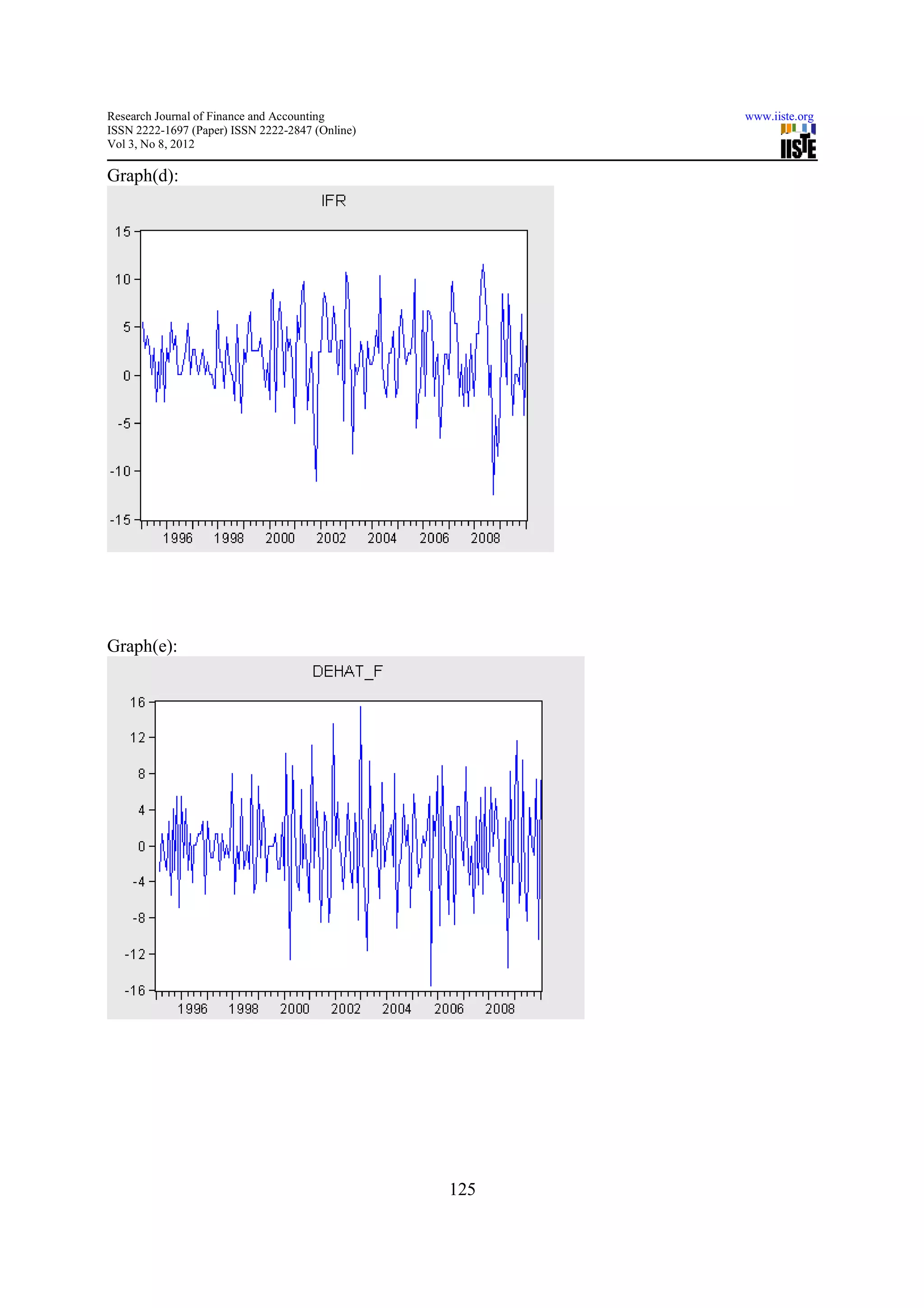
Graph(d):


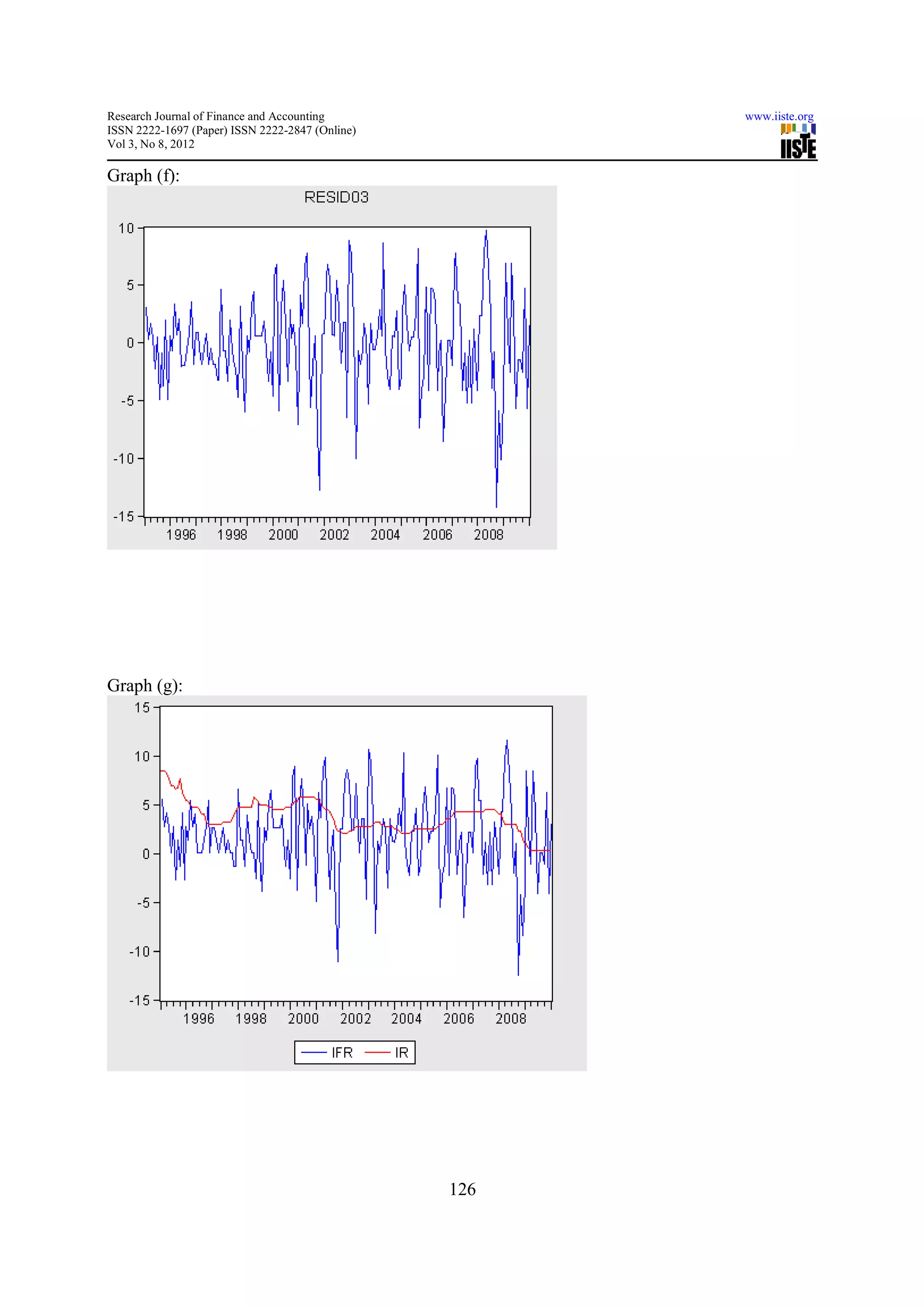
Graph(e):


                                                 125
Research Journal of Finance and Accounting             www.iiste.org
ISSN 2222-1697 (Paper) ISSN 2222-2847 (Online)
Vol 3, No 8, 2012

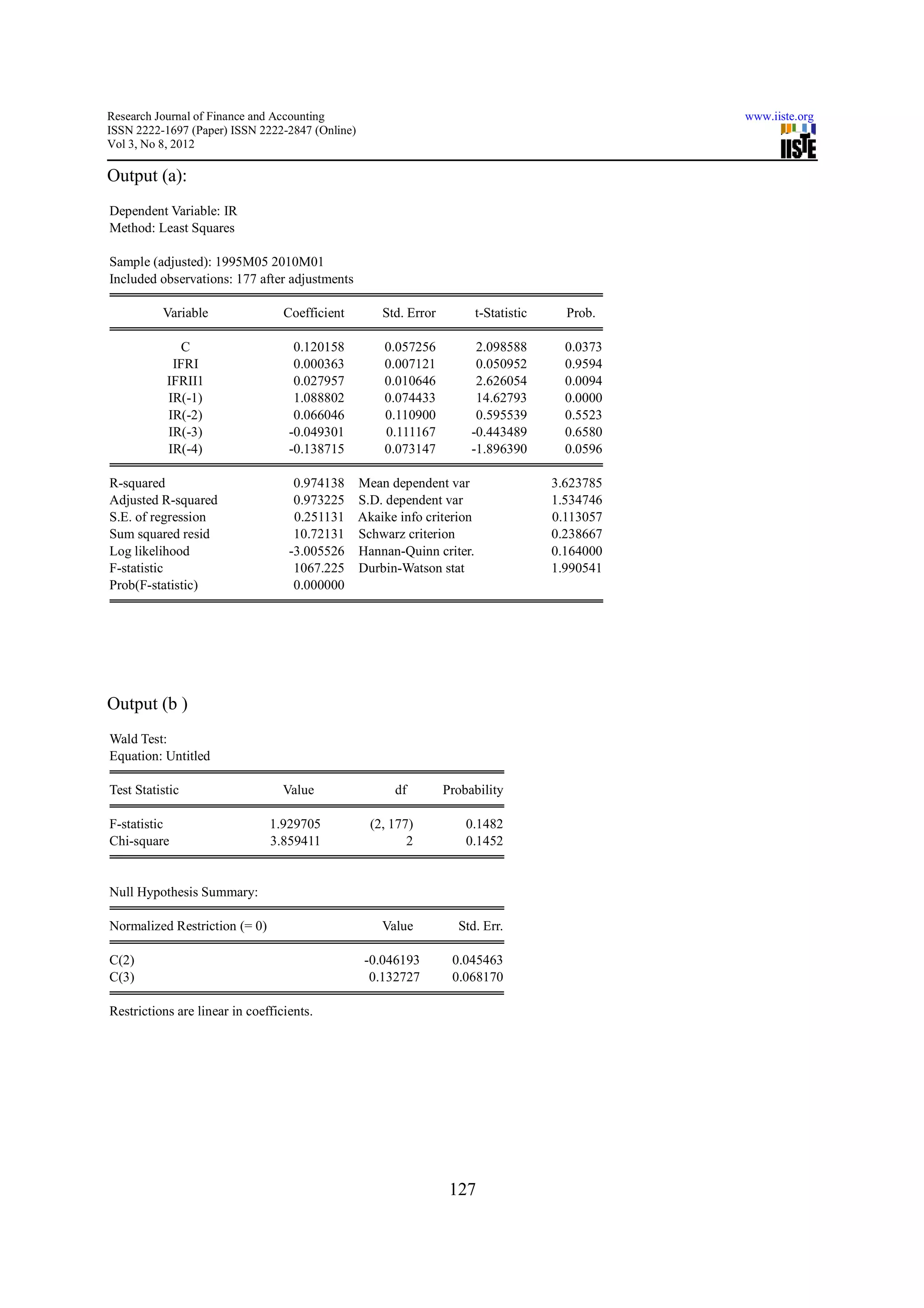
Graph (f):


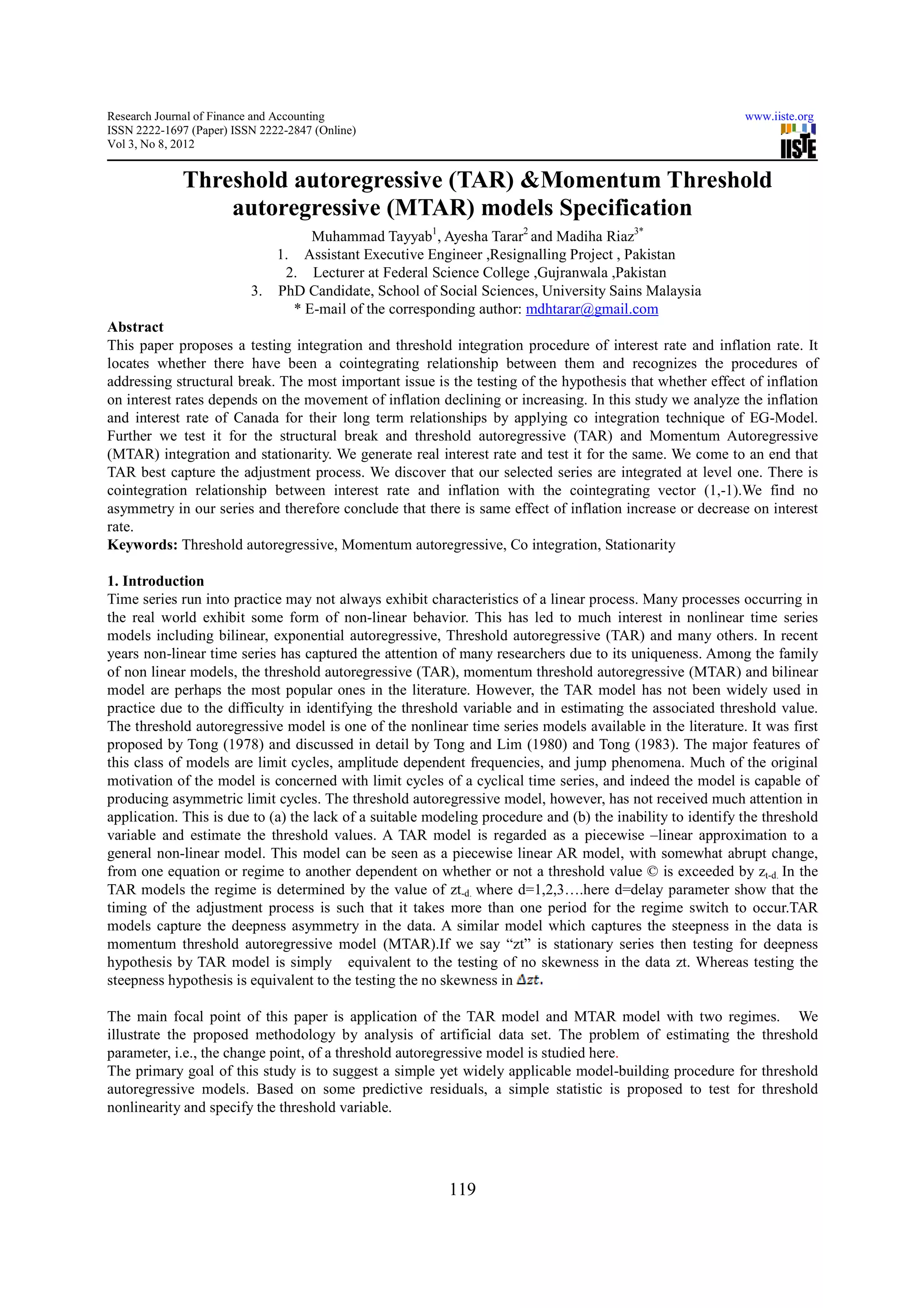
Graph (g):


                                                 126
Research Journal of Finance and Accounting                                                    www.iiste.org
ISSN 2222-1697 (Paper) ISSN 2222-2847 (Online)
Vol 3, No 8, 2012

Output (a):
Dependent Variable: IR
Method: Least Squares

Sample (adjusted): 1995M05 2010M01
Included observations: 177 after adjustments

          Variable                Coefficient      Std. Error        t-Statistic     Prob.

              C                     0.120158        0.057256          2.098588       0.0373
            IFRI                    0.000363        0.007121          0.050952       0.9594
           IFRII1                   0.027957        0.010646          2.626054       0.0094
           IR(-1)                   1.088802        0.074433          14.62793       0.0000
           IR(-2)                   0.066046        0.110900          0.595539       0.5523
           IR(-3)                  -0.049301        0.111167         -0.443489       0.6580
           IR(-4)                  -0.138715        0.073147         -1.896390       0.0596

R-squared                           0.974138 Mean dependent var                    3.623785
Adjusted R-squared                  0.973225 S.D. dependent var                    1.534746
S.E. of regression                  0.251131 Akaike info criterion                 0.113057
Sum squared resid                   10.72131 Schwarz criterion                     0.238667
Log likelihood                     -3.005526 Hannan-Quinn criter.                  0.164000
F-statistic                         1067.225 Durbin-Watson stat                    1.990541
Prob(F-statistic)                   0.000000


Output (b )
Wald Test:
Equation: Untitled

Test Statistic                    Value              df         Probability

F-statistic                    1.929705          (2, 177)           0.1482
Chi-square                     3.859411                 2           0.1452


Null Hypothesis Summary:

Normalized Restriction (= 0)                       Value          Std. Err.

C(2)                                             -0.046193       0.045463
C(3)                                              0.132727       0.068170

Restrictions are linear in coefficients.


                                                                 127

Threshold autoregressive (tar) &momentum threshold autoregressive (mtar) models specification

  • 1.
    Research Journal ofFinance and Accounting www.iiste.org ISSN 2222-1697 (Paper) ISSN 2222-2847 (Online) Vol 3, No 8, 2012 Threshold autoregressive (TAR) &Momentum Threshold autoregressive (MTAR) models Specification Muhammad Tayyab1, Ayesha Tarar2 and Madiha Riaz3* 1. Assistant Executive Engineer ,Resignalling Project , Pakistan 2. Lecturer at Federal Science College ,Gujranwala ,Pakistan 3. PhD Candidate, School of Social Sciences, University Sains Malaysia * E-mail of the corresponding author: mdhtarar@gmail.com Abstract This paper proposes a testing integration and threshold integration procedure of interest rate and inflation rate. It locates whether there have been a cointegrating relationship between them and recognizes the procedures of addressing structural break. The most important issue is the testing of the hypothesis that whether effect of inflation on interest rates depends on the movement of inflation declining or increasing. In this study we analyze the inflation and interest rate of Canada for their long term relationships by applying co integration technique of EG-Model. Further we test it for the structural break and threshold autoregressive (TAR) and Momentum Autoregressive (MTAR) integration and stationarity. We generate real interest rate and test it for the same. We come to an end that TAR best capture the adjustment process. We discover that our selected series are integrated at level one. There is cointegration relationship between interest rate and inflation with the cointegrating vector (1,-1).We find no asymmetry in our series and therefore conclude that there is same effect of inflation increase or decrease on interest rate. Keywords: Threshold autoregressive, Momentum autoregressive, Co integration, Stationarity 1. Introduction Time series run into practice may not always exhibit characteristics of a linear process. Many processes occurring in the real world exhibit some form of non-linear behavior. This has led to much interest in nonlinear time series models including bilinear, exponential autoregressive, Threshold autoregressive (TAR) and many others. In recent years non-linear time series has captured the attention of many researchers due to its uniqueness. Among the family of non linear models, the threshold autoregressive (TAR), momentum threshold autoregressive (MTAR) and bilinear model are perhaps the most popular ones in the literature. However, the TAR model has not been widely used in practice due to the difficulty in identifying the threshold variable and in estimating the associated threshold value. The threshold autoregressive model is one of the nonlinear time series models available in the literature. It was first proposed by Tong (1978) and discussed in detail by Tong and Lim (1980) and Tong (1983). The major features of this class of models are limit cycles, amplitude dependent frequencies, and jump phenomena. Much of the original motivation of the model is concerned with limit cycles of a cyclical time series, and indeed the model is capable of producing asymmetric limit cycles. The threshold autoregressive model, however, has not received much attention in application. This is due to (a) the lack of a suitable modeling procedure and (b) the inability to identify the threshold variable and estimate the threshold values. A TAR model is regarded as a piecewise –linear approximation to a general non-linear model. This model can be seen as a piecewise linear AR model, with somewhat abrupt change, from one equation or regime to another dependent on whether or not a threshold value © is exceeded by zt-d. In the TAR models the regime is determined by the value of zt-d. where d=1,2,3….here d=delay parameter show that the timing of the adjustment process is such that it takes more than one period for the regime switch to occur.TAR models capture the deepness asymmetry in the data. A similar model which captures the steepness in the data is momentum threshold autoregressive model (MTAR).If we say “zt” is stationary series then testing for deepness hypothesis by TAR model is simply equivalent to the testing of no skewness in the data zt. Whereas testing the steepness hypothesis is equivalent to the testing the no skewness in The main focal point of this paper is application of the TAR model and MTAR model with two regimes. We illustrate the proposed methodology by analysis of artificial data set. The problem of estimating the threshold parameter, i.e., the change point, of a threshold autoregressive model is studied here. The primary goal of this study is to suggest a simple yet widely applicable model-building procedure for threshold autoregressive models. Based on some predictive residuals, a simple statistic is proposed to test for threshold nonlinearity and specify the threshold variable. 119
  • 2.
    Research Journal ofFinance and Accounting www.iiste.org ISSN 2222-1697 (Paper) ISSN 2222-2847 (Online) Vol 3, No 8, 2012 2. Methodology We address the issue of time series stationarity e.g unit root testing, co integration (long run relationship) and presence of structural break. Structural change is an important problem in time series and affects all the inferential procedures. A structural break in the deterministic trend will lead to misleading conclusion that there is a unit root, when in fact there might be not. In order to find the long term relationship (co integration) we apply the co integration technique of EG-model (1979). Further, we test the stationary and integration in TAR and MTAR. Generally for analysis, Firstly, we need to plot the series and identify the presence of deterministic trends, secondly, we need to detrend the series and obtain the filtered series, which are fluctuations around zero-horizontal line. Thirdly, we need to define the Heaviside function and Estimate the specific model defined, then testing the related hypothesis. Finally, we need to test for deepness and steepness asymmetric root for TAR and MTAR specification. We collect the time series data of Canada from www.rba.gov.au . We generate the yearly inflation series from CPI data by applying the formula. Inflation= (CPI Current-CPI last/CPI Last)*4 (1) Real Interest rate=Inflation-Interest rate (2) 2.1-Test for integration We follow the following steps for it. Consider a AR (1) model; Yt= Yt-1+et Case1-if |ф|<1 the series is stationary. Case2-if|ф|>1 the series is non-stationary and explodes. Case3-if|ф|=1 series contain a unit root and non-stationary. A test for the order of integration is a test for the number of unit roots; it follows the step as under: Step (a) - we Test “Yt” series if it is stationary then Yt is I(0). If No then Yt is I (n); n>0. Step (b) - we Take first difference of Yt series as ∆yt=yt-yt-1 and test ∆yt to see if it is stationary. If yes then yt is I (1); if no then yt is I (n); n>0 and so on. 2.2 TAR& MTAR Models Specification We detrend the series first and obtain the filtered series residuals. Define the Heaviside Indicator and decompose the series in positive and negative. Estimate the models for testing the asymmetric unit root under the Null .We used Enger and Granger (1998) critical values against F-statistics tabulated in order to draw the conclusion. 2.2.1- Testing for evidence of threshold stationarity Actually when we conduct testing under TAR or MTAR model, the threshold parameter is unknown .We follow the following steps to estimate the threshold parameters; (a): define the first-differenced series: ∆yt=yt-yt-1 (b): making the series ∆yt sorted in ascending order (c ): taking off 15% largest values and 15% smallest values. (d): using remaining 70% values to estimate threshold parameters. (e): estimate model ∆yt=It P1yt-1+(1-It)P2yt-1+et For each possible threshold parameter, we find the lowest AIC, it is best estimate of threshold parameter. To test yt is stationary or non-stationary: we do the following procedure: H0: P1=P2=0 H1:P1<0 and P2<0 Construct F=[(SSER-SSEUR)/J]/[SSEUR/(N-K)) (4) If this value is larger than critical value then null hypothesis is rejected, series is stationary. Then we can test steepness asymmetric roots as: H0a: P1=P2 H1a: P1≠P2 Estimate model under H0a and H1a. Construct F=[(SSER-SSEUR)/J]/[SSEUR/(N-K)) 120
  • 3.
    Research Journal ofFinance and Accounting www.iiste.org ISSN 2222-1697 (Paper) ISSN 2222-2847 (Online) Vol 3, No 8, 2012 If F-statistics is less than critical value, then accept H0a, that there is no steepness asymmetry. In order to find the result of increasing and decreasing interest rate on inflation we follow MTAR procedure. We divide the series into two regimes by defining the indicator functions for positive and negative values and then test for these two regimes. If there is asymmetric adjustment it indicates that there is different effect of decling and increasing interest and vice versa. 2.2.2 Structural break There have been several studies deriving tests for structural change in cointegration relationship. We consider a simple diagnostic test for structural change as used in previous studies. Wright (1993) extends the CUMSUM test to non-stationary trended variables and to integrated variables. Hoa and Inder (1996) extends the OLS-based CUMSUM test discussed by Ploberger and Kramer (1992), they suggest its use as a diagnostic test for structural change. They consider FM-OLS residuals and long run variance estimate. Then derive the asymptotic distribution of the FM-OLS based CUMSUM test statistic, tabulate the critical values, and show that the test has nontribal local power irrespective of the particular type of structural change. If there is break then we apply unit root testing in the presence of structural break by defining dummy variables, three model under the unit root null and under trend stationary alternative hypothesis was tested by tabulating the critical values as Perron(1989) did in its paper. However we can also use dummy variable to address this issue: DTt=t if t≤T or DTt=0 if otherwise. “T” shows the time series and “t” shows the point where structural break occur. Then put the dummy variable into the model and estimate the model, get the final results. Sometimes, if the structural break is really affecting the final results in the cointergrating relationship, we can delete these data and use remaining data to estimate the model. 3. Empirical Findings We take the series of inflation and interest rate data for Canada from (1980-2009).It is usually consider about Time series data it is volatile and may have autocorrelation problem. In this situation OLS estimation becomes biased and spurious. To addresses all such problems we applied different test to our series. Table 1,explains the results of unit root testing in interest rate, inflation rate and real interest rate series while the results for TAR and MTAR stationaity of these series are in Table 2. For the interest rate, we test whether it is I (1). From our output statistic we came to know that interest rate is non- stationary at I (0) but stationary at first difference. Later on, we test for inflation and real interest rate; they all are stationary at first difference. It shows that our series have unit root at level. TABLE-1 Unit root results variable difference Test value Critical value Decision about null of unit root Interest rate no -2.4588 -3.45 Null of unit root accepted Interest rate yes -6.8017 -3.45 Rejected Inflation rate no -2.1876 -3.45 accepted Inflation rate yes -10.87643 -3.45 rejected Real interest rate no -2.12 -3.45 accepted Real interest rate yes -8.8602 -3.45 rejected Critical value is taken from Fuller (1976) for the model (constant and trend) at 5% level of significance. Table1 result shows all our series are stationary at I(1). Cointegration is an econometric property of time series variables. If the interest rate and inflation are themselves non-stationary, but a linear combination of them is stationary then the series are said to be co integrated. We get our residuals from the relation and find the value of -9.87102 is less than critical value – 2.8775 at 5% significant level. We reject the null hypothesis of non statinarity for residuals. AS ut is I (0).Therefore, inflation rate and interest rate are cointegrated .when we check it for cointegration vector we find , they are cointegrated with cointegrating vector (1,-1).It depicts there is long term relationship between both variables. They cause each other. When we investigate for structural break we find there is consistent relationship during our period of analysis. There is no break. 121
  • 4.
    Research Journal ofFinance and Accounting www.iiste.org ISSN 2222-1697 (Paper) ISSN 2222-2847 (Online) Vol 3, No 8, 2012 If financial variables have asymmetric roots, then these variables should model to accommodate these roots, otherwise, model would be miss-specified and will results in misleading inferences. We test asymmetry root for interest rate, real interest rate and inflation. We test the deepness and steepness asymmetric root of interest rate and inflation. In the testing for the presence of asymmetric roots, we find that both of interest rate and inflation do not have asymmetric roots. We use nominal interest rate and inflation to calculate real interest rate. For real interest rate, we use TAR and MTAR model to test the presence of asymmetric root. The final result we get that there is no threshold asymmetry or steepness asymmetry in real interest rate. These results show there is same effect of increasing and decreasing interest on inflation and on the other side increasing and decreasing inflation on interest rate because there is no-asymmetry. When we find the MTAR results for inflation we also find there is no asymmetric adjustment in the inflation series too. Results are reported in Table 2 TABLE-2 TAR and MTAR results Real Interest F-stat Critical-values Decision Interest rate Inflation rate Rate under H0 and H1 TAR ESSr 11.6725 3655.049 571450.3 ESSur 11.07116 2833.475 364201.6 F-stat 4.7526 5.2726 49.79 Granger – critical value 4.56 4.56 4.56 Null of non Null of non Null of non stationary stationary stationary Decision is rejected. is rejected. is rejected under H0a and H1a ESSr 11.13526 2876.175 364247.1 ESSur 11.07116 2833.475 364201.6 F-stat 1.0132 2.63 0.00218 F-critical 3.92 4.64 3.92 Null accepted. Null accepted. Null accepted. Series does not Series does not Series does not have have have asymmetric asymmetric asymmetric roots roots MTAR Decision roots . Null of non stationary ESSr 571451.3 50.017 4.56 rejected ESSur 364358 Real Interest under H0a and Rate H1a NO asymmetry ESSr 364610 0.1217 3.92 accepted ESSur 364358 122
  • 5.
    Research Journal ofFinance and Accounting www.iiste.org ISSN 2222-1697 (Paper) ISSN 2222-2847 (Online) Vol 3, No 8, 2012 3. Conclusion The aim of this study is not to explore the economic issues related to inflation rate series or interest rate series of Canada. Our objective is this study is to explain the TAR and MTAR model application on the data and issues related to them for the further research. The crucial point is that the dynamic adjustment process is usually assumed to be linear. But in the presence of asymmetric adjustment it become non linear so in such situation test for unit root has low power, because it does not capture appropriately the dynamic adjustment process. This study tries to explain the procedure for this dynamic adjustment when we observe the unit root for our real interest rate and inflation series it shows high power of ADF test which was indication that there is symmetric adjustment. The AIC and SBC both select the TAR model over MTAR in our study because its value is lower here. Hence we conclude that TAR best capture the adjustment process. The adjustment coefficient values are significant and according to hypothesis. We find that our selected series are integrated at level one. There is cointegration relationship between interest rate and inflation with the cointegrating vector (1,-1).We find no asymmetry in our series and therefore conclude that there is same effect of inflation increase or decrease on interest rate. References Enders, W., and C. W. J. Granger, 1998, “Unit-Root Tests and Asymmetric Adjustment with an Example Using the Term Structure of Interest Rates,” Journal of Business and Economic Statistics 16:3, 304-311. Enders, W., K. S. Im, J. Lee, and M. C. Strazicich, 2010, “IV Threshold Cointegration Tests and the Taylor Rule,” Economic Modelling 27, 1463-1472. Li, J and J. Lee, 2010, “ADL Tests for Threshold Cointegration,” Journal of Time Series Analysis 31, 241-254. Tong, H., 1983, Threshold Models in Non-Linear Time Series Analysis, New York: Springer-Verlag. Appendix: Graph (a) 123
  • 6.
    Research Journal ofFinance and Accounting www.iiste.org ISSN 2222-1697 (Paper) ISSN 2222-2847 (Online) Vol 3, No 8, 2012 Graph (b) Graph(c) : 124
  • 7.
    Research Journal ofFinance and Accounting www.iiste.org ISSN 2222-1697 (Paper) ISSN 2222-2847 (Online) Vol 3, No 8, 2012 Graph(d): Graph(e): 125
  • 8.
    Research Journal ofFinance and Accounting www.iiste.org ISSN 2222-1697 (Paper) ISSN 2222-2847 (Online) Vol 3, No 8, 2012 Graph (f): Graph (g): 126
  • 9.
    Research Journal ofFinance and Accounting www.iiste.org ISSN 2222-1697 (Paper) ISSN 2222-2847 (Online) Vol 3, No 8, 2012 Output (a): Dependent Variable: IR Method: Least Squares Sample (adjusted): 1995M05 2010M01 Included observations: 177 after adjustments Variable Coefficient Std. Error t-Statistic Prob. C 0.120158 0.057256 2.098588 0.0373 IFRI 0.000363 0.007121 0.050952 0.9594 IFRII1 0.027957 0.010646 2.626054 0.0094 IR(-1) 1.088802 0.074433 14.62793 0.0000 IR(-2) 0.066046 0.110900 0.595539 0.5523 IR(-3) -0.049301 0.111167 -0.443489 0.6580 IR(-4) -0.138715 0.073147 -1.896390 0.0596 R-squared 0.974138 Mean dependent var 3.623785 Adjusted R-squared 0.973225 S.D. dependent var 1.534746 S.E. of regression 0.251131 Akaike info criterion 0.113057 Sum squared resid 10.72131 Schwarz criterion 0.238667 Log likelihood -3.005526 Hannan-Quinn criter. 0.164000 F-statistic 1067.225 Durbin-Watson stat 1.990541 Prob(F-statistic) 0.000000 Output (b ) Wald Test: Equation: Untitled Test Statistic Value df Probability F-statistic 1.929705 (2, 177) 0.1482 Chi-square 3.859411 2 0.1452 Null Hypothesis Summary: Normalized Restriction (= 0) Value Std. Err. C(2) -0.046193 0.045463 C(3) 0.132727 0.068170 Restrictions are linear in coefficients. 127