Database
Management
Systems
Lecture - 4
Today’s Review
Continue 3-L architecture
Data Independence
Different aspect of DBMS
Level 3
Internal or Physical
View
Concerns about the physical implementation of
the database
Internal View
DBMS chooses type of data structures
lays out data on storage devices with operating
system access methods
Internal View
Internal record: a single stored record
Does not just contain what we see at the
conceptual level
DBMS adds other data
Physical Level
Generally same as Internal
Actual representation of data on the
storage device
In the binary format
OS responsibility
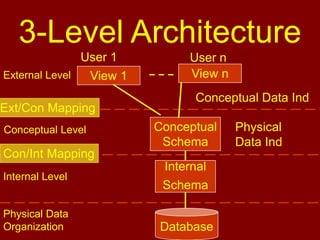
Inter-Schema
Mappings
Also, a part of 3-level architecture
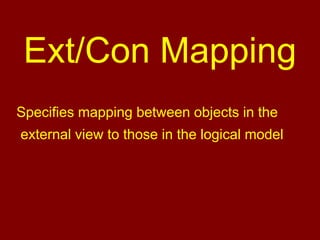
External/conceptual mapping
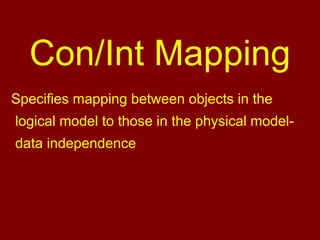
Conceptual/Internal
Ext/Con Mapping
Specifies mapping between objects in the
external view to those in the logical model
Con/Int Mapping
Specifies mapping between objects in the
logical model to those in the physical model-
data independence
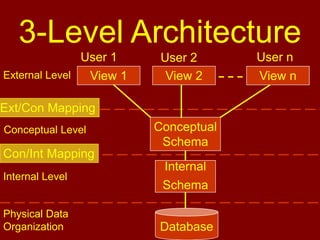
3-Level Architecture
External Level
Conceptual Level
Internal Level
Physical Data
Organization
Ext/Con Mapping
View 1 View 2 View n
Conceptual
Schema
Internal
Schema
Database
User 1 User 2 User n
Con/Int Mapping
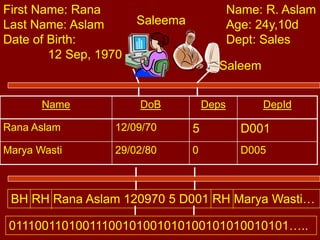
Name DoB Deps DepId
Rana Aslam 12/09/70 5 D001
Marya Wasti 29/02/80 0 D005
First Name: Rana
Last Name: Aslam
Date of Birth:
12 Sep, 1970
Name: R. Aslam
Age: 24y,10d
Dept: Sales
Saleem
Saleema
01110011010011100101001010100101010010101…..
BH RH Rana Aslam 120970 5 D001 RH Marya Wasti…
Data
Independence
Data Independence
A major outcome of 3-L Arch
The immunity of applications to change in
storage structure and access strategy
Changes in lower level do not affect the
upper levels
Don’t take it word to word
Mind the direction please
Data Independence
Data Independence
Types
• Logical Data Independence
• Physical Data Independence
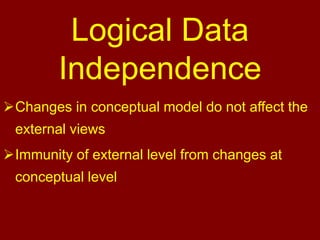
Logical Data
Independence
Changes in conceptual model do not affect the
external views
Immunity of external level from changes at
conceptual level
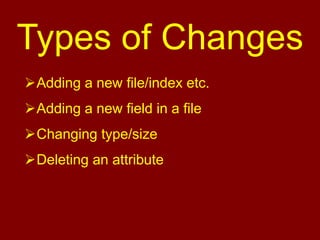
Types of Changes
Adding a new file/index etc.
Adding a new field in a file
Changing type/size
Deleting an attribute
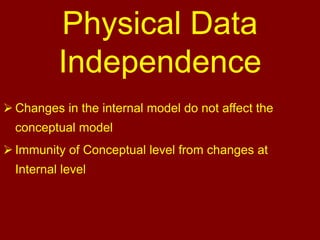
Physical Data
Independence
 Changes in the internal model do not affect the
conceptual model
 Immunity of Conceptual level from changes at
Internal level
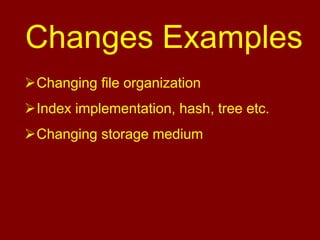
Changes Examples
Changing file organization
Index implementation, hash, tree etc.
Changing storage medium
3-Level Architecture
External Level
Conceptual Level
Internal Level
Physical Data
Organization
Ext/Con Mapping
View 1 View n
Conceptual
Schema
Internal
Schema
Database
User 1 User n
Con/Int Mapping
Conceptual Data Ind
Physical
Data Ind
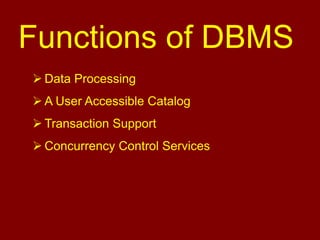
Functions of DBMS
 Data Processing
 A User Accessible Catalog
 Transaction Support
 Concurrency Control Services
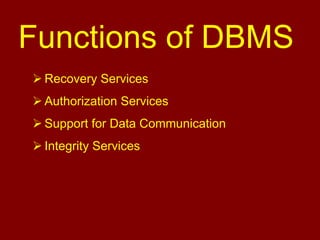
Functions of DBMS
 Recovery Services
 Authorization Services
 Support for Data Communication
 Integrity Services
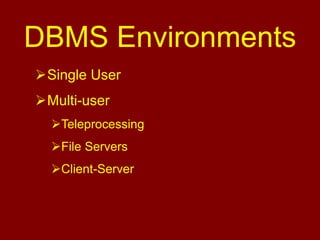
DBMS Environments
Single User
Multi-user
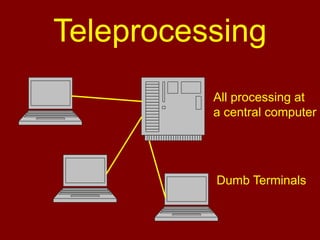
Teleprocessing
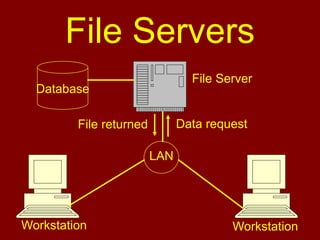
File Servers
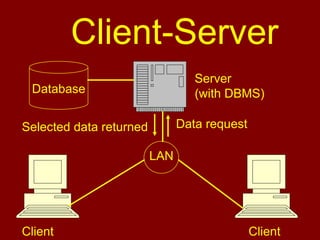
Client-Server
Teleprocessing
All processing at
a central computer
Dumb Terminals
File Servers
LAN
File returned Data request
Database
Workstation Workstation
File Server
Client-Server
LAN
Selected data returned Data request
Database
Client Client
Server
(with DBMS)
Today’s Summary
Completed 3-L architecture
Discussed data independence
Discussion on DBMS
Group Assignment
• Write a sample data that you may want to store about different
things around you.
• List the changes that may arise during the working of any
system, i.e., Railway Reservation System
• Write the different forms of data at the external and conceptual
levels. Also, try to define a mapping between them.
• Extend the format of data to include the physical and internal
levels. Complete your exercise by including data at all three
levels.
• Write the different natures of changes at all three levels of
database architecture and see, which ones will have no effect on
the existing applications, which will be adjusted in the inter-
schema mapping, and which will affect the existing applications.
Deadline
• Group Members
2-3
• Deadline
7 September 2023
• Submission
Hard copy
• Handwritten
No
© Virtual University of Pakistan
Thanks and
Allah Hafiz

Three schema Architecture in DBMS