THREAT
REPORT
2015
02
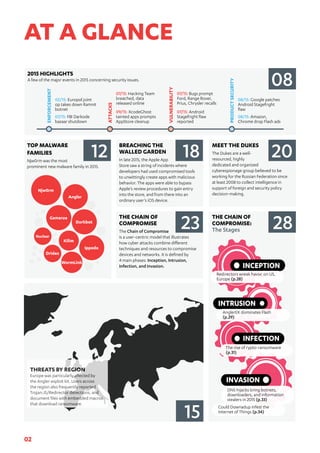
AT A GLANCE
INCEPTION
INTRUSION
INFECTION
INVASION
BREACHING THE
WALLED GARDEN
In late 2015, the Apple App
Store saw a string of incidents where
developers had used compromised tools
to unwittingly create apps with malicious
behavior. The apps were able to bypass
Apple’s review procedures to gain entry
into the store, and from there into an
ordinary user’s iOS device.
MEET THE DUKES
The Dukes are a well-
resourced, highly
dedicated and organized
cyberespionage group believed to be
working for the Russian Federation since
at least 2008 to collect intelligence in
support of foreign and security policy
decision-making.
THE CHAIN OF
COMPROMISE:
The Stages
2015 HIGHLIGHTS
A few of the major events in 2015 concerning security issues.
02/15: Europol joint
op takes down Ramnit
botnet
07/15: FBI Darkode
bazaar shutdown
ENFORCEMENT
07/15: Hacking Team
breached, data
released online
09/15: XcodeGhost
tainted apps prompts
AppStore cleanup
ATTACKS
07/15: Bugs prompt
Ford, Range Rover,
Prius, Chrysler recalls
07/15: Android
Stagefright flaw
reported
VULNERABILITY
08/15: Google patches
Android Stagefright
flaw
08/15: Amazon,
Chrome drop Flash ads
PRODUCTSECURITY
08
2018
28
Njw0rm
Gamarue
Angler
Dorkbot
Kilim
Nuclear
Ippedo
Dridex
WormLink
TOP MALWARE
FAMILIES
Njw0rm was the most
prominent new malware family in 2015.
12
THREATS BY REGION
Europe was particularly affected by
the Angler exploit kit. Users across
the region also frequently reported
Trojan:JS/Redirector detections, and
document files with embedded macros
that download ransomware.
15
THE CHAIN OF
COMPROMISE
The Chain of Compromise
is a user-centric model that illustrates
how cyber attacks combine different
techniques and resources to compromise
devices and networks. It is defined by
4 main phases: Inception, Intrusion,
Infection, and Invasion.
23
Redirectors wreak havoc on US,
Europe (p.28)
AnglerEK dominates Flash
(p.29)
The rise of rypto-ransomware
(p.31)
Could Downadup infest the
Internet of Things (p.34)
DNS hijacks bring botnets,
downloaders, and information
stealers in 2015 (p.33)
03
The 2015 Threat Report provides a comprehensive overview of the cyber
threat landscape facing both companies and individuals. Using data from 2015,
this report combines our observations on reported malware encounters with
threat intelligence, and identifies several key trends and developments.
The report introduces the Chain of Compromise as an analytical concept to
help readers, particularly those working in cyber security and information
technology roles, understand how attackers compromise security using
differentcombinationsoftacticsandresources.Someof2015’smostprominent
threats, such as exploit kits, ransomware, and DNS hijacks, are discussed in
relation to this model, demonstrating how users become compromised by
modern cyber attacks.
Key findings discussed in the report include the establishment of worms,
exploits, and macro malware as trending threats; the increasing use of crypto-
ransomware for online extortion; and an increase in the use and efficiency of
Flash vulnerabilities in exploit kits. The report also highlights the significance
ofdifferentcybersecurityeventsthatoccurredin2015,includingthediscovery
of the XcodeGhost bug in Apple’s App Store, the exposure of the Dukes
advanced persistent threat group, and signs that the intersection between
geopolitics and cyber security is paving the way toward a cyber arms race.
Information on the global threat landscape is supplemented with details on
the prominent threats facing different countries and regions, highlighting the
fact that while the Internet connects everyone, attackers can develop and
distribute resources to selectively target people and companies with greater
efficiency.
EXECUTIVE SUMMARY
Authors
Edilberto Cajucom Labs • Patricia Dacuno Threat Intelligence, Labs • Karmina Aquino • Threat Intelligence, Labs • Broderick
Aquilino Malware Protection, Labs • Alia Hilyati Antimalware Unit • Sarah Jamaludin Antimalware Unit • Adam Pilkey Global
Communications & Brand • Melissa Michael Global Communications & Brand
Contributors
Mikko Hypponen	Labs • Sean Sullivan Security Advisor • Andy Patel Technology Outreach • Zimry Ong Malware Protection, Labs •
Artturi Lehtiö Threat Intelligence, Labs • Janne Kauhanen Cyber Security Services • Dariusz Jastrzebski Cyber Security Services
04
Conflictusedtobeaboutborders.Alongtimeago,wewoulddefendourselves
bylivingincitiessurroundedbywalls.Thosewallskepttheenemiesaway.Over
time, the walls around cities became higher, longer and wider. The longer and
wider these walls, the more invisible they became, marking areas of wealth,
prosperity, power and belief systems. Eventually, those walls became borders.
And for hundreds of years, conflict was about borders. Conflicts were about
conquering land or converting people from one belief system to another.
Conflict and war have always been fueled by technology. Technology like
gunpowder, steel blades, and fighter jets. The staggering possibilities of
technology always seem to shine the strongest during periods of war. War has
been a real driver of technology. And technology has driven war.
One of the side effects of the cold war was that the Internet was created. The
US military created a way to uphold a chain of command during nuclear war. So
the Internet was created as a piece of military infrastructure. By developing the
Internet, mankind opened up a whole new way of waging war on one another.
And the Internet has no geography. It has no borders. By creating the Internet,
mankind opened up a Pandora’s Box where tangible borders and recognizable
enemies ceased to exist.
In addition, conflict used to be symmetric. Armies would fight other armies.
But now, the technology of war has moved on. We no longer know, or can
clearly describe who the enemy is, what they want to achieve, or what their
motives are. We go into battle using technologies we don’t fully understand,
against enemies that remain in the shadows, and into wars that we will never
know if they are over or not. Who is the enemy? Hackers? Anonymous? The
Russian Mafia? North Korea?
It’s a complex world of online conflict. And the only thing we can really be sure
of is that we’ve seen the beginning of the next arms race: the cyber arms race.
MIKKO HYPPÖNEN
Chief Research Officer
@mikko
FOREWORD
“WE GO INTO
BATTLE
USING
TECHNOLOGIES
WE DON’T FULLY
UNDERSTAND,
AGAINST ENEMIES
THAT REMAIN
IN THE SHADOWS”
05
CONTENTS
02RETROSPECTIVE
01GENERAL
02	 At A Glance
03	 Executive Summary
04	Foreword
05	Contents
06	 Of Note
35	Conclusion
36	Sources
40	Appendix
40	 Country reports
43	 Threat descriptions
08	 2015 Highlights
10	 Threat Summary
10	 Malware by type
11	 Top reporting countries
12	 Top Threats
12	 Top malware families
12	 Prevalence trend for top families
13	 Top legacy families & generics
13	 Prevalence trend for legacy families 	
	 & generics
14	 Mac malware
14	 Android malware
15	 Threats by region
03NOTABLE CASES
18	 Breaching the Walled Garden
20	 Meet the Dukes
04CHAIN OF COMPROMISE
23	 A user-centric model
24	 Stage by stage
25	 Top threats by stage
26	Njw0rm
27	CosmicDuke
28	 The stages
28	Inception
29	Intrusion
31	Infection
33	 Invasion: Infiltration
34	 Invasion: Infestation
06
Flash: The Last of the Low-Hanging Fruit
Malware exploits have been a commodity for more than a decade. So much so that during
2006, the day following Microsoft’s monthly “Patch Tuesday” began to be jokingly referred
to by InfoSec analysts as “Exploit Wednesday”. Quick turnaround was the key to success.
On Tuesday, Microsoft released its updates which were then quickly reverse engineered in order to
discover the underlying vulnerability. And then, once the vulnerability was known, an exploit was
crafted for use in malware attacks, which aimed to hit those who had not yet updated.
In late 2006, malware became further commoditized with the advent of malware kits. Early kits
such as MPack were victims of their own success, unable to scale rapidly to meet the ever-growing
demand. But such growing pains were soon enough overcome by malware services and today there
are numerous exploit kits available via underground markets.
Exploit Wednesday is no longer a thing. Microsoft’s software[1]
is far more secure than it was
10 years ago and its patches roll out much more quickly. Exploit kits moved on from Microsoft
to Adobe. Reader was the biggest target for a time (also Flash). But browsers began to offer native
PDF support and Reader became unnecessary for most. Adobe adopted strong update cycles and its
software moved, for a time, out of harm’s way. Then Java’s browser plugin became the favorite target
— the weakest of the herd. Browser developers more or less forced it into a very restricted place.
And so at the moment… Adobe’s Flash is the last “best” plugin still standing for exploit kits
to target. But for how long?
On April 29, 2010, Steve Jobs published an open letter called “Thoughts on Flash” explaining
why Apple would not allow Flash on iOS devices. Many technology analysts point to this as
the beginning of the end for Flash Player, at least on mobile devices. This proved to be true.
On June 28, 2012, Adobe announced there would be no certified implementations of Flash
Player for Android 4.1 and it would limit installations via Google Play on August 15th 2012 [2]
.
Flash has since hung on to its desktop market, but everywhere you look, it’s being deprecated.
In August 2015, Amazon announced that “Beginning September 1, 2015, Amazon no longer
accepts Flash ads.” Google followed Amazon’s lead in February 2016. Its ad networks, AdWords
and DoubleClick, will no longer accept Flash-based display ads starting from June 30th, 2016.
They’ll disable Flash-based ads on January 2nd, 2017.
It’s at this point that I’ll make the following prediction for early 2017 — once it no longer needs
to support Flash-based ads — the Google Chrome browser will start aggressively forcing users to
whitelist sites that require any sort of Flash. Mozilla’s Firefox and Microsoft Edge will do the same, and
by spring of 2017… Flash will be effectively decapitated as far as exploit kits are concerned.
Exploit kits face a disruptive future without much new fruit in sight. Commoditized
malware services will turn even further toward the use of malware attachments such as the
macro-based malware that is currently trending.
If only we could keep people from clicking “okay” to make the box go away.
SEAN SULLIVAN
Security Advisor
@5ean5ullivan
OF NOTE
1
Silverlight is a general exception, it is currently exploited by kits. But hopefully Silverlight will soon go extinct as Netflix is dumping the technology.
2
Ironically, a great deal of Android malware is pushed at people via deceptive ads claiming that a Flash update is required. Even when there is no Flash,
its legacy provides a social engineering vulnerability. Google’s search engineers are beginning to configure Chrome to warn about sites that display such ads.
07
02
RETROSPECTIVE
08	 2015 Highlights
10	 Threat Summary
11	 Top reporting countries
11	 Malware by type
12	 Top Threats
12	 Top malware families
12	 Prevalence trend for top families
13	 Top legacy families & generics
13	 Prevalence trend for legacy families & generics
14	 Mac malware
14	 Android malware
15	 Threats by region
07
2015 HIGHLIGHTS
MALWARE
August
Googlelaunches
monthlyNexus
securityupdates
PRODUCTSECURITY
VULNERABILITIES
August
Googlepatches
Android
Stagefrightflaw
DIGITAL
SECURITY
October
US-EU 'Safe Harbor'
dataagreement
invalidated
August
US'planningto
sanctionChinaover
cyberthefts'
September
China/UStalkon
cybersecuritybefore
statevisit
July
Chinaupdates
Internetcontrol
laws
July
FBIDarkode
bazaar
shutdown
February
Europol joint
optakes down
Ramnitbotnet
ATTACKS
July
Android
Stagefrightflaw
reported
October
Android
Stagefright2.0
flaw reported
August
AndroidCertifi-
Gateflaw
reported
March
FREAKflaw
foundinAndroid,
Windows
September
OSXGatekeeper
bypass exploit
reported
July
Dukes cyberattack
toolsets expand,
develop
March
Ransomware
ontherise
July
HackingTeam
breached,data
releasedonline
GLOBALPERSONALLIFEONLINE
08
November
NSAends bulkphone
surveillanceprogram
October
USSenateapproves
CISAActdespite
concerns
December
China
counterterrorism
bill causes concern
October
USDMCAexpands
listof 'legal
hacking'products
ENFORCEMENT
October
USjails Citadel
botnetauthorfor
4.5yrs
October
UK,UScharge
Dridexbotnet
author
October
EUpoliceraids
overDroidJack
malware
August
Amazon,Chrome
dropFlashads
October
Chinaarrests
hackersatUS
behest
October
Anglerexploit
kitoperations
disrupted
September
Turlamalware
‘contactingC&C
viasatellite’
October
Appleproduct
updates fixmultiple
securityissues
December
DDoSattackson
Turkishservers
reported
October
Overstepping
adblockerspulled
fromAppStore
September
New Dukecyber
attacktoolsets
identified
August
Researchers
demoChevy
Corvettehack
July
BugspromptFord,
RangeRover,Prius,
Chryslerrecalls
August
TeslaissuesOTA
ModelSpatch
forhack
September
Chryslermails
USB sticks with
softwarepatch
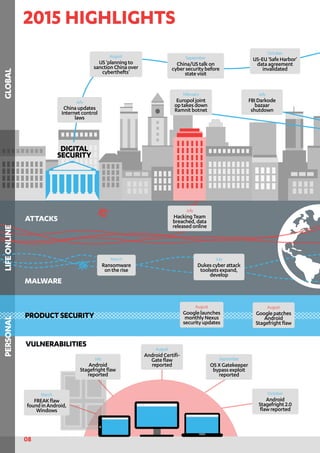
2015 was an eventful year for digital privacy and security. Listed below are just a few of the major
eventsthatoccurredduringtheyearthatwillhaveanimpactonhowusersinteractwithtechnology,
and each other. Sources for the listed items are on page 36.[ ]
September
XcodeGhost-tainted
appspromptsApp
Storecleanup
September
DDoSattack
‘launchedfrom
mobileads’
09
10
THREAT SUMMARY
The threat landscape in 2015 had similarities with trends that
were observed in 2014, but there were also some significant
differences. One surprise was the resurgence of macro
malware — something that hasn’t been seen since the early
2000s. Worms also accounted for a greater percentage of
overall malware detections, which is attributable largely to
the appearance of several new families in certain parts of the
globe.
However, exploits and exploit kits continue to be trending
threats facing people and companies in Europe and North
America. Not only are they frequently detected, but 2015 saw
indicators that they continue to expand their capabilities and
work across a variety of attack vectors. 2015 saw a decrease
in police-themed ransomware, but also more activity from a
diversenumberofcrypto-ransomwarefamilies(moreonpage
31) distributed through both exploit kits and macro malware.
While they don’t impact the majority of consumers,
Advanced Persistent Threats (APTs) are of particular interest
to governments and major corporations. In 2015, F-Secure
Labs published a whitepaper detailing the various toolsets
used by the Dukes, a well-resourced, highly dedicated and
well-organized cyber espionage group that we believe has
been working for the Russian Federation since at least 2008 to
collect intelligence in support of foreign and security policy
decision-making.
Worms
While the aging Downadup (also known as Conficker) worm’s
position as the perennial top detection has helped keep worms
in general more prominent in the threat landscape than they
would be otherwise, the appearance of several new families
that have successfully spread through networks in certain parts
of the world has made worms as a whole a more noticeable
presence overall.
The most prominent of these new families is Njw0rm — a VBS
worm that spreads through removable drives, malicious email
attachments and drive-by downloads. The worm has backdoor
capabilities and is essentially designed to steal information from
victims. Njw0rm was detected far more often in the latter half
of the year than the former, but it was more than enough to
make it the most notable new malware family in last year’s threat
landscape.
Dorkbot is another new worm that made a noticeable impact.
It shared many characteristics with Njw0rm. Both spread
using removable drives. Both use backdoors, are capable of
stealing information from their victims, and communicate
with remote servers in order to receive additional instructions
from attackers. However, Dorkbot is also able to spread itself
by posting malicious links in instant messages and social media
sites.
Ippedo, a third new worm that was reported frequently enough
to be considered one of 2015’s top threats, is another infostealer
that is distributed on removable drives. However, it was not
observed to be capable of spreading via other means, making it
considerably less prevalent than other families.
	
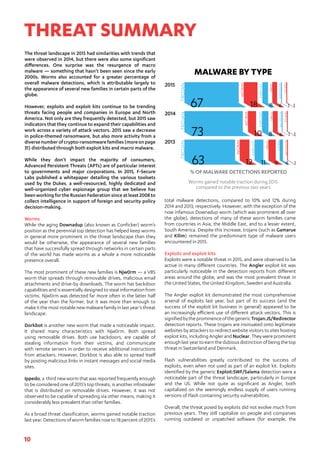
As a broad threat classification, worms gained notable traction
last year. Detections of worm families rose to 18 percent of 2015’s
total malware detections, compared to 10% and 12% during
2014 and 2013, respectively. However, with the exception of the
now infamous Downadup worm (which was prominent all over
the globe), detections of many of these worm families came
from countries in Asia, the Middle East, and to a lesser extent,
South America. Despite this increase, trojans (such as Gamarue
and Kilim) remained the predominant type of malware users
encountered in 2015.
Exploits and exploit kits
Exploits were a notable threat in 2015, and were observed to be
active in many different countries. The Angler exploit kit was
particularly noticeable in the detection reports from different
areas around the globe, and was the most prevalent threat in
the United States, the United Kingdom, Sweden and Australia.
The Angler exploit kit demonstrated the most comprehensive
arsenal of exploits last year, but part of its success (and the
success of the exploit kit business in general) appeared to be
an increasingly efficient use of different attack vectors. This is
signifiedbytheprominenceofthegenericTrojan:JS/Redirector
detection reports. These trojans are insinuated onto legitimate
websites by attackers to redirect website visitors to sites hosting
exploit kits, including Angler and Nuclear. They were prominent
enough last year to earn the dubious distinction of being the top
threat in Switzerland and Denmark.
Flash vulnerabilities greatly contributed to the success of
exploits, even when not used as part of an exploit kit. Exploits
identified by the generic Exploit:SWF/Salama detection were a
noticeable part of the threat landscape, particularly in Europe
and the US. While not quite as significant as Angler, both
capitalized on the seemingly endless supply of users running
versions of Flash containing security vulnerabilities.
Overall, the threat posed by exploits did not evolve much from
previous years. They still capitalize on people and companies
running outdated or unpatched software (for example, the
MALWARE BY TYPE
2015
2014
2013
WORM
TROJAN
EXPLOIT
VIRUS
BACKDOOR
OTHERS
67 18 8 6 1 1
WORM
TROJAN
EXPLOIT
VIRUS
BACKDOOR
OTHERS
73 10 8 6 1 1
WORM
TROJAN
EXPLOIT
VIRUS
OTHERS
BACKDOOR
63 12 11 9 4 1
% OF MALWARE DETECTIONS REPORTED
Worms gained notable traction during 2015
compared to the previous two years
11
WormLink exploits require users to open a document file that
contains code to exploit an unpatched vulnerability). They still
accounted for eight percent of overall malware detections,
just as they did in 2014. However, the malicious payloads that
exploits deliver, such as ransomware, have diversified and
become more severe, making it more important than ever to
ensure people update their software when new security patches
become available.
Macro malware
One interesting development in 2015’s threat landscape was the
resurgence of macro malware. Macro malware — documents
containing hidden malicious code — was a major threat in the
late 1990s to early 2000s. But when Microsoft released Office
2003, the default security settings were amended to stop
macros from automatically running when a document opened,
greatly stymieing attackers looking to spread malware with this
method.
However, beginning in June 2015, macro malware became a
notable presence in the telemetry reports again. While it was by
no means as prevalent as other threats, macro malware made an
impact in several European countries. They are typically spread
via malicious documents attached to emails, and utilize social
engineering techniques to manipulate users into opening the
documents and enabling the macros, allowing the malicious
code to run.
This type of macro malware is similar to exploits in that the
intent is to compromise users in a way that allows attackers
to drop malicious payloads. In 2015, these payloads included
severe threats such as the Dridex banking trojan, and crypto-
ransomware such as Cryptowall.
Android malware
The Android ecosystem saw Slocker rise to become a more
prominent threat in 2015. While premium SMS-sending trojans
remained significant — particularly in France — the growing
popularity of Slocker signals a shift in mobile malware toward
targeting content users store on their devices. Backdoors such
as CoudW also indicate an increasing shift of compromise types
on the operating system compared to previous years.
Mac and iOS
Backdoors were the dominant type of malware detected on
Apple’s operating systems in 2014 — an interesting contrast to
the consistent dominance of trojans for Windows and Android.
2015 saw the biggest attack yet on Apple’s ecosystem. In the
XcodeGhost incident, tainted copies of the company’s Xcode
app development tool being shared on public download
forums in China allowed attackers to infiltrate the highly secure
AppStore. By compromising the copies of the legitimate tool
that developers used to create their apps, the attackers were
abletoinsertmaliciouscodeintotheappswhichwereeventually
uploaded to the App Store.
In this instance, the attackers took advantage of a situation
unique to China, wherein developers having difficulties
accessing Apple’s download servers outside the country
resorted to obtaining copies of the tool from local sources. This
laid the foundation for the tainted apps to successfully make
their way into the App Store.
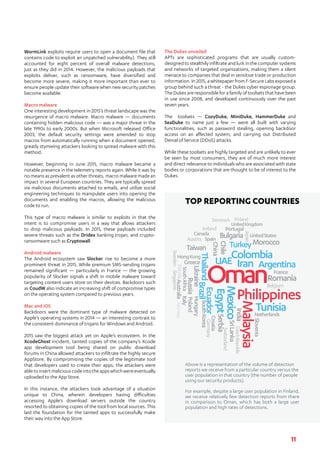
TOP REPORTING COUNTRIES
Above is a representation of the volume of detection
reports we receive from a particular country versus the
user population in that country (the number of people
using our security products).
For example, despite a large user population in Finland,
we receive relatively few detection reports from there
in comparison to Oman, which has both a large user
population and high rates of detections.
The Dukes unveiled
APTs are sophisticated programs that are usually custom-
designed to stealthily infiltrate and lurk in the computer systems
and networks of targeted organizations, making them a silent
menace to companies that deal in sensitive trade or production
information. In 2015, a whitepaper from F-Secure Labs exposed a
group behind such a threat - the Dukes cyber espionage group.
The Dukes are responsible for a family of toolsets that have been
in use since 2008, and developed continuously over the past
seven years.
The toolsets — CozyDuke, MiniDuke, HammerDuke and
SeaDuke to name just a few — were all built with varying
functionalities, such as password stealing, opening backdoor
access on an affected system, and carrying out Distributed
Denial of Service (DDoS) attacks.
While these toolsets are highly targeted and are unlikely to ever
be seen by most consumers, they are of much more interest
and direct relevance to individuals who are associated with state
bodies or corporations that are thought to be of interest to the
Dukes.
Oman
Philippines
Malaysia
Argentina
Colombia
Mexico
Egypt
Ecuador
IranUAE
Turkey
Tunisia
Romania
Morocco
Bulgaria
Taiwan
Greece
Ukraine
Russia
Hungary
SouthKorea
Serbia
SriLanka
India
Chile
China
Netherlands
France
UnitedStates
UnitedKingdom
Portugal
HongKong
Poland
Italy
Australia
SouthAfrica
Canada
Spain
CzechRepublic
Slovenia
Switzerland
Croatia
Germany
Singapore
Estonia
Japan
FinlandDenmark
Ireland
Austria
Belgium
ThailandBrazil
Norway
Sweden
12
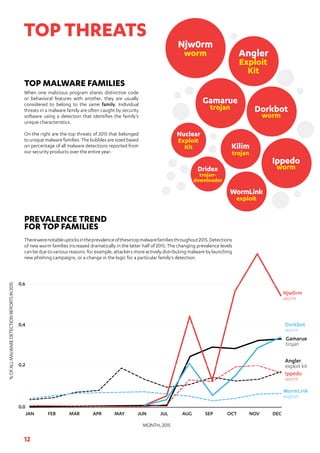
TOP MALWARE FAMILIES
When one malicious program shares distinctive code
or behavioral features with another, they are usually
considered to belong to the same family. Individual
threats in a malware family are often caught by security
software using a detection that identifies the family’s
unique characteristics.
On the right are the top threats of 2015 that belonged
to unique malware families. The bubbles are sized based
on percentage of all malware detections reported from
our security products over the entire year.
PREVALENCE TREND
FOR TOP FAMILIES
JAN FEB MAR APR MAY JUN JUL AUG SEP OCT NOV DEC
0.0
0.4
0.2
0.6
%OFALLMALWAREDETECTIONREPORTSIN2015
MONTH,2015
Njw0rm
worm
Gamarue
trojan
Angler
exploit kit
Dorkbot
worm
Ippedo
worm
WormLink
exploit
Therewerenotableupticksintheprevalenceofthesetopmalwarefamiliesthroughout2015.Detections
of new worm families increased dramatically in the latter half of 2015. The changing prevalence levels
can be due to various reasons: for example, attackers more actively distributing malware by launching
new phishing campaigns, or a change in the logic for a particular family’s detection.
TOP THREATS
Njw0rm
worm
Gamarue
trojan
Angler
Exploit
Kit
WormLink
exploit
Dorkbot
worm
Kilim
trojan
Nuclear
Exploit
Kit
Dridex
trojan-
downloader
Ippedo
worm
13
Trojan.LNK.Gen
Sality
bot
Downadup
worm
(Conficker)
Trojan:
W32/
Autorun
Exploit:
Java/
Majava
Ramnit
bot
Trojan:
JS/
Redirector
Worm:
W32/
Kataja
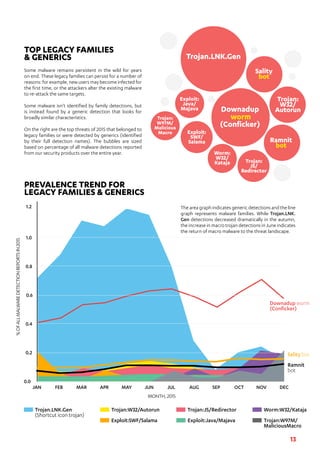
TOP LEGACY FAMILIES
& GENERICS
Some malware remains persistent in the wild for years
on end. These legacy families can persist for a number of
reasons: for example, new users may become infected for
the first time, or the attackers alter the existing malware
to re-attack the same targets.
Some malware isn’t identified by family detections, but
is instead found by a generic detection that looks for
broadly similar characteristics.
On the right are the top threats of 2015 that belonged to
legacy families or were detected by generics (identified
by their full detection names). The bubbles are sized
based on percentage of all malware detections reported
from our security products over the entire year.
PREVALENCE TREND FOR
LEGACY FAMILIES & GENERICS
Trojan:
W97M/
Malicious
Macro Exploit:
SWF/
Salama
JAN FEB MAR APR MAY JUN JUL AUG SEP OCT NOV DEC
0.0
0.2
0.4
0.6
0.8
1.0
1.2
MONTH,2015
Trojan.LNK.Gen
(Shortcut icon trojan)
Downadup worm
(Conficker)
Worm:W32/Kataja
Sality bot
Ramnit
bot
Trojan:W32/Autorun
Exploit:Java/Majava Trojan:W97M/
MaliciousMacro
Exploit:SWF/Salama
%OFALLMALWAREDETECTIONREPORTSIN2015
Trojan:JS/Redirector
The area graph indicates generic detections and the line
graph represents malware families. While Trojan.LNK.
Gen detections decreased dramatically in the autumn,
the increase in macro trojan detections in June indicates
the return of macro malware to the threat landscape.
14
JAN
FEB
MAR
APR
MAY
JUN
JUL
AUG
SEP
OCT
NOV
DEC
7 3 9 9 5 2 39 14 9 3 9 6
TOTAL SAMPLE COUNT
(TALLIED FROM JANUARY)
NUMBER OF SAMPLES
RECEIVED PER MONTH
7 10
19
28
33 35
74
88
97 100
109
115
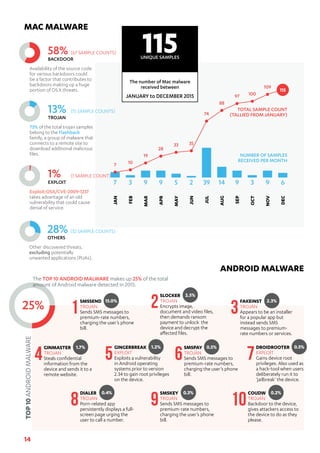
13+87+x TROJAN
13% (15 SAMPLE COUNTS)
73% of the total trojan samples
belong to the Flashback
family, a group of malware that
connects to a remote site to
download additional malicious
files.
58+42+x BACKDOOR
58% (67 SAMPLE COUNTS)
Availability of the source code
for various backdoors could
be a factor that contributes to
backdoors making up a huge
portion of OS X threats.
2+98+x EXPLOIT
1% (1 SAMPLE COUNT)
Exploit:OSX/CVE-2009-1237
takes advantage of an old
vulnerability that could cause
denial of service.
28+72+x OTHERS
28% (32 SAMPLE COUNTS)
Other discovered threats,
excluding potentially
unwanted applications (PUAs).
115
The number of Mac malware
received between
UNIQUE SAMPLES
JANUARY to DECEMBER 2015
MAC MALWARE
ANDROID MALWARE
SMSSEND
TROJAN
Sends SMS messages to
premium-rate numbers,
charging the user’s phone
bill.
1
SLOCKER
TROJAN
Encrypts image,
document and video files,
then demands ransom
payment to unlock the
device and decrypt the
affected files.
2 FAKEINST
TROJAN
Appears to be an installer
for a popular app but
instead sends SMS
messages to premium-
rate numbers or services.
3
25+75+N
The TOP 10 ANDROID MALWARE makes up 25% of the total
amount of Android malware detected in 2015.
25%
GINMASTER
TROJAN
Steals confidential
information from the
device and sends it to a
remote website.
4
GINGERBREAK
EXPLOIT
Exploits a vulnerability
in Android operating
systems prior to version
2.34 to gain root privileges
on the device.
5
SMSPAY
TROJAN
Sends SMS messages to
premium-rate numbers,
charging the user’s phone
bill.
6
DROIDROOTER
EXPLOIT
Gains device root
privileges. Also used as
a hack-tool when users
deliberately run it to
‘jailbreak’ the device.
7
DIALER
TROJAN
Porn-related app
persistently displays a full-
screen page urging the
user to call a number.
8
SMSKEY
TROJAN
Sends SMS messages to
premium-rate numbers,
charging the user’s phone
bill.
9
COUDW
TROJAN
Backdoor to the device,
gives attackers access to
the device to do as they
please.
10
TOP10ANDROIDMALWARE
15.0%
2.5%
2.3%
1.7% 1.2% 0.5% 0.5%
0.4% 0.3% 0.2%
15
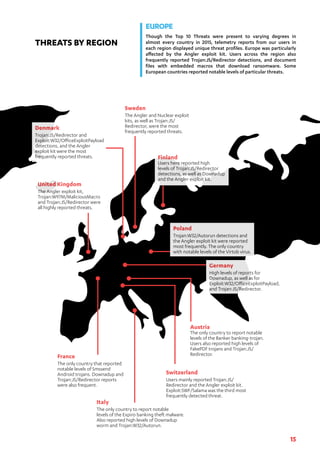
EUROPE
Finland
Users here reported high
levels of Trojan:JS/Redirector
detections, as well as Downadup
and the Angler exploit kit.
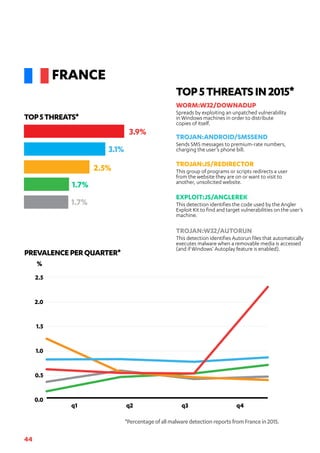
France
The only country that reported
notable levels of Smssend
Android trojans. Downadup and
Trojan:JS/Redirector reports
were also frequent.
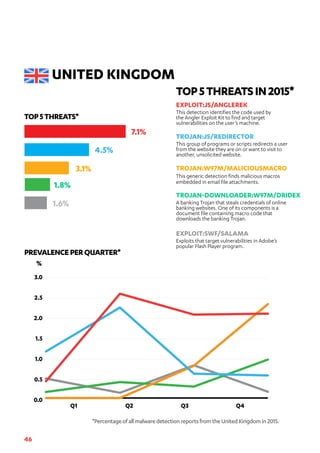
United Kingdom
The Angler exploit kit,
Trojan:W97M/MaliciousMacro
and Trojan:JS/Redirector were
all highly reported threats.
Italy
The only country to report notable
levels of the Expiro banking theft malware.
Also reported high levels of Downadup
worm and Trojan:W32/Autorun.
Denmark
Trojan:JS/Redirector and
Exploit:W32/OfficeExploitPayload
detections, and the Angler
exploit kit were the most
frequently reported threats.
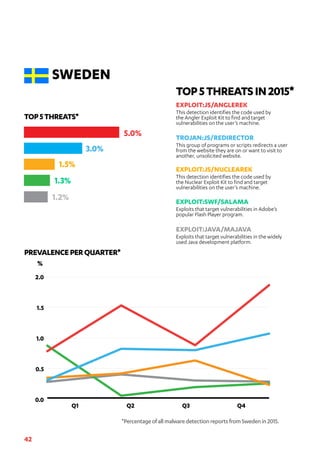
Sweden
The Angler and Nuclear exploit
kits, as well as Trojan:JS/
Redirector, were the most
frequently reported threats.
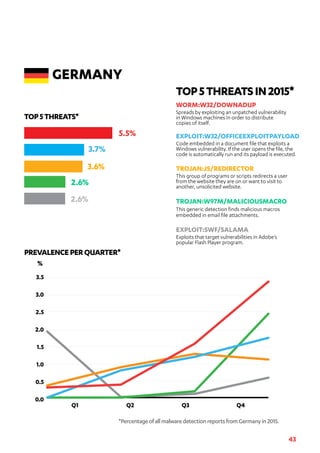
Germany
High levels of reports for
Downadup, as well as for
Exploit:W32/OfficeExploitPayload,
and Trojan:JS/Redirector.
Austria
The only country to report notable
levels of the Banker banking-trojan.
Users also reported high levels of
FakePDF trojans and Trojan:JS/
Redirector.
Switzerland
Users mainly reported Trojan:JS/
Redirector and the Angler exploit kit.
Exploit:SWF/Salama was the third most
frequently detected threat.
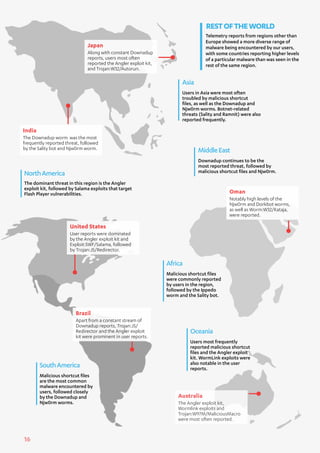
THREATS BY REGION
Though the Top 10 Threats were present to varying degrees in
almost every country in 2015, telemetry reports from our users in
each region displayed unique threat profiles. Europe was particularly
affected by the Angler exploit kit. Users across the region also
frequently reported Trojan:JS/Redirector detections, and document
files with embedded macros that download ransomware. Some
European countries reported notable levels of particular threats.
Poland
Trojan:W32/Autorun detections and
the Angler exploit kit were reported
most frequently. The only country
with notable levels of the Virtob virus.
16
Africa
Malicious shortcut files
were commonly reported
by users in the region,
followed by the Ippedo
worm and the Sality bot.
MiddleEast
Downadup continues to be the
most reported threat, followed by
malicious shortcut files and Njw0rm.
SouthAmerica
Malicious shortcut files
are the most common
malware encountered by
users, followed closely
by the Downadup and
Njw0rm worms.
Asia
Users in Asia were most often
troubled by malicious shortcut
files, as well as the Downadup and
Njw0rm worms. Botnet-related
threats (Sality and Ramnit) were also
reported frequently.
RESTOFTHEWORLD
Oceania
Users most frequently
reported malicious shortcut
files and the Angler exploit
kit. WormLink exploits were
also notable in the user
reports.
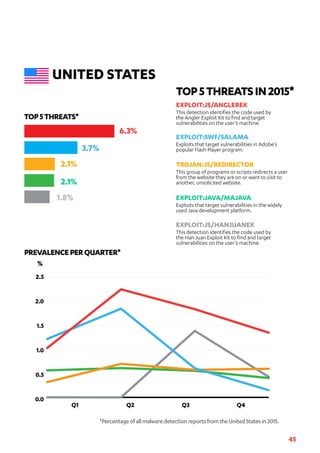
United States
User reports were dominated
by the Angler exploit kit and
Exploit:SWF/Salama, followed
by Trojan:JS/Redirector.
Japan
Along with constant Downadup
reports, users most often
reported the Angler exploit kit,
and Trojan:W32/Autorun.
Brazil
Apart from a constant stream of
Downadup reports, Trojan:JS/
Redirector and the Angler exploit
kit were prominent in user reports.
Telemetry reports from regions other than
Europe showed a more diverse range of
malware being encountered by our users,
with some countries reporting higher levels
of a particular malware than was seen in the
rest of the same region.
India
The Downadup worm was the most
frequently reported threat, followed
by the Sality bot and Njw0rm worm.
Oman
Notably high levels of the
Njw0rm and Dorkbot worms,
as well as Worm:W32/Kataja,
were reported.
Australia
The Angler exploit kit,
Wormlink exploits and
Trojan:W97M/MaliciousMacro
were most often reported.
NorthAmerica
The dominant threat in this region is the Angler
exploit kit, followed by Salama exploits that target
Flash Player vulnerabilities.
03NOTABLECASES
18	 Breaching the walled garden
20	 Meet the Dukes
17
18
Most attacks today are directly targeted at the user.
One popular method attackers use to get their malicious
programs onto a user’s device is by tricking the user into
unwittingly downloading and installing the malware
themselves (a tactic known as social engineering). Another
popular, but technically difficult, method used by attackers
is to exploit flaws or loopholes to quietly slip the malware
into the device. Usually these weak points are in the app
or the device itself. More rarely, they are in programs,
processes or systems that aren't directly related to the user.
Sometimes however, attacks don’t take the direct path.
In late 2015, the Apple App Store became the target of a
notable string of incidents that underlines the possible
ramifications when attackers change tactics and target the
app developers. In these incidents, the developers used
compromised tools to unwittingly create apps with secretly
malicious behavior. The apps were then able to bypass
Apple’s app code review procedures to gain entry into the
store, and from there, onto an ordinary user’s iOS device.
XCODEGHOST APPS PULLED FROM STORE
Apple’s software repository requires all submitted programs to
pass a rigorous vetting process before they can be offered in
the store, and has historically been admirably free of malicious
programs. In 2012, the first reported instance of malware was
found in the App Store[1]
when the Find & Call app turned out
to be misusing contact information on the device to send
spam. In the following three years, there were only a couple
of relatively minor incidents, when apps that did not play by
Apple's strict rules were booted from the store.
This happy state of affairs was shattered in September 2015
when news broke that Apple had removed multiple apps from
the store because they were found to be embedded with a
malicious program, dubbed XCodeGhost. Initial news reports
said over 30 apps were affected, though subsequent reports
put the number at over 300[2,3]
.
What was particularly noteworthy about the affected apps
was that at least some of them were from well-known and
reputable software development companies. Perhaps the best
known was WeChat, a popular messaging program. But other
apps such as Railway 12306, Camcard, NetEase Cloud Music
and so on had millions, or even tens of millions of users. While
the majority of these users were located in mainland China,
many of the apps also had users in other regions around the
world, such as the United States and Europe.
BREACHING
THE WALLED
GARDEN
Investigations by researchers from, among other
organizations, Weibo, Alibaba and Palo Alto Networks, traced
the 'contamination' of these apps to the use of a compromised
version of Apple’s Xcode software creation tool. Xcode is used
to compile apps for the iOS and OS X platforms and is provided
for free from the company’s own servers. As with many other
enterprise or commercial programs however, copies of the
Xcode program are also unofficially available on file-sharing
services, where they can be downloaded by developers who,
for one reason or another, are unable to use the official source.
According to news reports, due to the idiosyncracies of
Internet connectivity in mainland China, developers there
face significantly slower connections to servers located
outside the country, particularly for large files (the latest
Xcode version is about 3.5GB in size). This difficulty led many
of the developers to use copies of the Xcode tool that had
been hosted on servers within the country. Unfortunately,
some of these copies included extra lines of code. When the
developers used the compromised Xcode program to create
apps, it also quietly inserted additional code, without the
developer's knowledge.
The inserted code was designed to report details of the
affected device to a remote server. Researchers have however
been quick to note that they have found no evidence of actual
data theft or harm. Nevertheless, for users of affected apps,
the recommended action is to remove them from all devices
until an updated clean version is published by the developer,
and in the meantime change the login credentials for any
email and social media accounts associated with the apps.
UNITY FRAMEWORK ALSO AFFECTED
Shortly after news of the XcodeGhost apps broke, security
researchers at PwC announced that they found cloned copies
of the Unity framework being distributed that had been
modified in a similar manner to the cloned Xcode programs,
leading them to name the altered clones UnityGhost [4],
.
Unity is a commercial third-party development framework
that can be used to create iOS apps (as well as programs for
other platforms such as Android and Windows). Fortunately,
in this instance there were no reports of apps created with the
compromised framework copies being found in the App Store.
YOUMI-COMPILED APPS ALSO PULLED
A month later, a broadly similar situation cropped up again,
when apps were booted out of the App Store for quietly
collecting user and device information [5]
. In this case,
the affected apps had been created using the third-party
19
Youmi software development kit (SDK), which allowed the
developers to include ads in their app. Again, the developers
were unaware that the apps they had created were poisoned
with routines that would break Apple's strict security and
privacy guidelines. Though Apple didn’t specify how many
apps were removed, news reports mentioned “over 250 apps”
were affected. The China-based company that developed the
Youmi SDK also subsequently issued an apology [6]
and said it
was “working with Apple to resolve the issue”.
TARGETING THE DEVELOPERS
Taken together, these incidents clearly demonstrate that it is
possible to circumvent the protective walls guarding the App
StoreandreachiOSusersbyusingamoreindirectpathandfirst
targeting the app developers. In each case, the development
tool was tinkered with so that when it was used in good faith by
the developer, it also silently introduced unwanted code into
the final product.
This was not the first instance of this kind of attack - for
example, in 2010 the Delphi program was targeted by a virus
that inserted code whenever an executable was created using
the affected program [7, 8]
. It is, however, the first instance
where such an attack had this kind of public impact.
Most of today’s mobile device users have become wearily
familiar with the standard security advice: 'be wary of third-
party app stores'. Clearly, app developers are no more
immune from the same pressures that drive ‘the average user’
into patronizing such sources - most commonly, limitations
on bandwidth, restrictions on accessing extra-national
websites, and the tempting accessibility offered by third-party
repositories. To at least partly address some of these factors,
Apple has announced that it planned to also offer the official
Xcode program on servers located in China, making it more
accessible to developers in the country[9]
.
Despite the recent misfortune, the Apple App Store remains
a tougher nut to crack than the Android ecosystem (where
directly attacking the users via social engineering remains
the easiest and most effective attack vector). However, it is
not impregnable. The incidents highlight the importance of
maintaining rigorous security along the entire length of the
app development chain. The domino effects that result from
such a successful compromise impact not only the users’
security, but also the reputation and trustworthiness of the
affected developers and the App Store itself.
APP
DEVELOPERS
APP
STORE
App with
malicious code
Clean app
THIRD-PARTY SOURCEAPPLE
ATTACKER
COMPROMISING
APPDEVELOPMENT
Harvested
data
APP
USERS
>> Sources on page 38.
THE STORY
John Kasai of Klagenfurt
A large group of domain
names registered under
the alias John Kasai of
Klagenfurt, Austria.
These domains were used
in subsequent Dukes’
campaigns up to 2014.
Hiding in shadows
The Dukes lay low in
2012. CosmicDuke
and MiniDuke saw
active usage but
received minor
updates. GeminiDuke
and CozyDuke, on
the other hand, saw
less use but received
significant updates.
Chechnya
Two PinchDuke
campaigns traced
in November 2008,
with references to
two Turkish websites
containing Chechnya-
related content.
Campaigns against the
West
PinchDuke launched
two notable clusters
of campaigns. The first
targeted a US-based
foreign policy think
tank and government
institutions in Poland and
the Czech Republic. The
second one was aimed at
gathering information on
Georgia-NATO relations.
CosmicDuke in Caucasus
PinchDuke continued its
campaigns against some
countries in the Caucasus
— Turkey, Georgia,
Kazakhstan, Kyrgyzstan,
Azerbaijan and Uzbekistan
— while slowly passing the
baton to a new toolset,
CosmicDuke. Expansion of Dukes’
arsenal
MiniDuke and CozyDuke
entered the scene. The
former revolves around
a simplistic backdoor
component, while the
latter comprises an array
of modules to give it more
versatility.
PinchDuke &
GeminiDuke
Two toolsets believed
to be developed in
2008: (1) PinchDuke,
launched in the
same year, and (2)
GeminiDuke, launched
in January 2009.
MEET
DUKESTHE
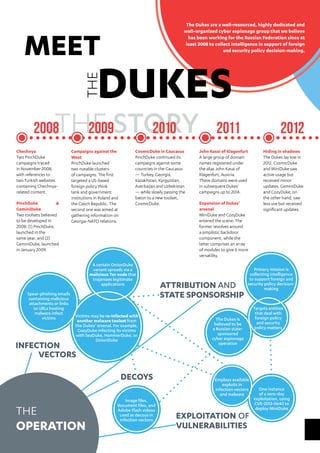
The Dukes are a well-resourced, highly dedicated and
well-organized cyber espionage group that we believe
has been working for the Russian Federation since at
least 2008 to collect intelligence in support of foreign
and security policy decision-making.
2008 2009 2010 2011 2012
DECOYS
EXPLOITATION OF
VULNERABILITIES
Spear-phishing emails
containing malicious
attachments or links
to URLs hosting
malware infect
victims
One instance
of a zero-day
exploitation, using
CVE-2013-0640 to
deploy MiniDuke
Employs available
exploits in
infection vectors
and malware
INFECTION
VECTORS
Image files,
document files, and
Adobe Flash videos
used as decoys in
infection vectors
ATTRIBUTION AND
STATE SPONSORSHIP
The Dukes is
believed to be
a Russian state-
sponsored
cyber espionage
operation
Targets entities
that deal with
foreign policy
and security
policy matters
Primary mission is
collecting intelligence
to support foreign and
security policy decision-
making
THE
OPERATION
Victims may be re-infected with
another malware toolset from
the Dukes’ arsenal. For example,
CozyDuke infecting its victims
with SeaDuke, HammerDuke, or
OnionDuke
A certain OnionDuke
variant spreads via a
malicious Tor node that
trojanizes legitimate
applications
MiniDuke flew too
close to the sun
MiniDuke attracted
the attention of
security researchers,
who proceeded to
dissect the samples
and publish their
findings in papers.
The curious case of
OnionDuke
OnionDuke made its
debut, equipped with
capabilities to steal
passwords, gather
data, perform DoS
attacks, and post
spam.
The Dukes and
Ukraine
In 2013, many decoy
documents used in
Dukes’ campaigns
were related to
Ukraine. But once the
country’s political
crisis erupted and
Russia made a stand,
Ukraine became
irrelevant to the
Dukes.
CosmicDuke’s war
on drugs
In September 2013,
a CosmicDuke
campaign targeted
Russian speakers
involved in the
trade of illegal
and controlled
substances.
MiniDuke rises from
ashes
After slowing down its
activities in 2013 to avoid
attention, MiniDuke was
back in full force in 2014.
Its components were
revamped to become more
stealthy.
CosmicDuke’s moment of
fame
F-Secure and Kaspersky
published research papers
on CosmicDuke. Despite
the exposure, the Dukes
prioritized continuing their
operations rather than go
into hiding.
CozyDuke and monkey
videos
CozyDuke launched spear-
phishing emails containing
a decoy Flash video file of
a Superbowl commercial
from 2007, purporting to
show monkeys at an office.
OnionDuke caught using
Tor node
In October 2014, the
Leviathan Security Group
discovered a malicious Tor
exit node. An investigation
by F-Secure found that
the node was used to
wrap executables with
OnionDuke. This variant
was not intended for
pursuing targeted attacks,
but rather to form a small
botnet.
The Dukes up the ante
January 2015 kickstarted
the most high-volume
Duke campaign yet by
sending spear-phishing
emails to a vast number
of recipients. CozyDuke
continued running its
campaigns, which were
later carried on by SeaDuke
and HammerDuke.
SeaDuke, writted in Python,
works on Windows and
Linux. HammerDuke,
written in .NET, only works
on Windows.
CloudDuke
Another large-scale
phishing campaign
launched in July 2015 using
a new toolset, CloudDuke.
The campaign was carried
out in two waves.
CosmicDuke continues
surgical strikes
While CozyDuke and
CloudDuke carried out
large-scale campaigns,
CosmicDuke focused on
covert, surgical campaigns.
2013 2014 2015
November 2008
-	
HTTP(S)
Multiple loaders,
information stealer
Debut:
Alias: 	
Communication:
Components:
PINCHDUKE
Debut:
Alias: 	
Communication: 	
Components:
January 2009
-	
HTTP(S)
Loaders, information
stealer, multiple
persistence components
GEMINIDUKE
Debut:
Alias: 	
Communication: 	
Components:
January 2010
Tinybaron,
BotgenStudios,
NemesisGemina
HTTP(S), FTP, WebDav
Information stealer, multiple loaders,
privilege escalation component,
multiple persistence components
COSMICDUKE
Debut:
Alias: 	
Communication: 	
Components:
July 2010 (loader), May
2011 (backdoor)
-
HTTP(S), Twitter
Downloader, backdoor,
loader
MINIDUKE
Debuts:
Alias:
Communication: 	
Components:
January 2010
CozyBear, CozyCar,
Cozer, EuroAPT
HTTP(S), Twitter
(backup)
Dropper, modular backdoor, multiple
persistence components, information
gathering module, screenshot module,
password stealing module, password
hash stealing module
COZYDUKE
Debut:
Alias: 	
Communication: 	
Components:
February 2013
-
HTTP(S), Twitter
(backup)
Dropper, loader,
multiple modular core components,
information stealer, DDoS module,
password stealing module, information
gathering module, social network
spamming module
ONIONDUKE
Debut:
Alias: 	
Communication: 	
Components:
October 2014
SeaDaddy, SeaDask
HTTP(S)
Backdoor
SEADUKE
Debut:
Alias: 	
Communication: 	
Components:
January 2015
HAMMERTOSS, Netduke
HTTP(S), Twitter
Backdoor
HAMMERDUKE
Debut:
Alias: 	
Communication: 	
Components:
June 2015
MiniDionis, CloudLook
HTTP(S), Microsoft
OneDrive
Downloader, loader,
two backdoor variants
CLOUDDUKE
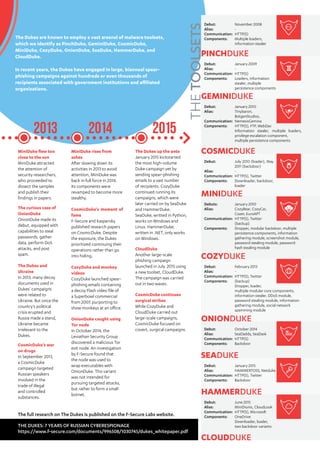
The Dukes are known to employ a vast arsenal of malware toolsets,
which we identify as PinchDuke, GeminiDuke, CosmicDuke,
MiniDuke, CozyDuke, OnionDuke, SeaDuke, HammerDuke, and
CloudDuke.
In recent years, the Dukes have engaged in large, biannual spear-
phishing campaigns against hundreds or even thousands of
recipients associated with government institutions and affiliated
organizations.
THE DUKES: 7 YEARS OF RUSSIAN CYBERESPIONAGE
https://www.f-secure.com/documents/996508/1030745/dukes_whitepaper.pdf
The full research on The Dukes is published on the F-Secure Labs website.
THETOOLSETS
04
CHAINOFCOMPROMISE
23	 A user-centric model
24	 Stage by stage
25	 Top threats by stage
26	Njw0rm
27	CosmicDuke
28	 The stages
28	Inception
29	Intrusion
31	Infection
33	 Invasion: Infiltration
34	 Invasion: Infestation
22
23
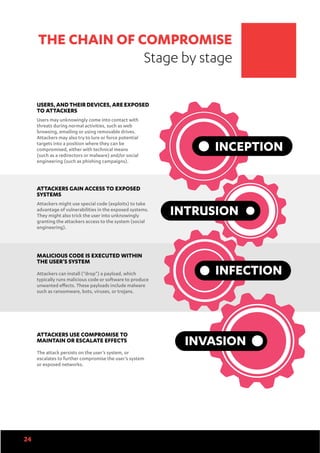
The different phases of the chain can be intuitively understood
as “the four in’s”:
zz 	Inception — the phase where a system or device
becomes exposed to a potential threat
zz 	Intrusion — the phase where an attacker successfully
gains access to a system
zz 	Infection — the phase where an attacker successfully
installs a malicious payload in an exposed system
zz 	Invasion — the phase where a malicious payload
persists beyond the initial infection, often escalating the
consequences of the attack
Examples of each of these phases will be discussed in the
following pages. However, it is important to highlight that the
Chain of Compromise has been formulated to be user-centric.
Because of this, the resources used in each phase are relative
to the way the user experiences the attack. The use of social
engineering exemplifies this dynamic: attackers can employ
such tactics during both the inception and intrusion phases.
Additionally, defenders should realize that becoming
compromised at one level does not mean that they are
suddenly “pwned”. This is particularly important for IT
administrators responsible for the security of networks.
Companies, even small ones, should have solutions in place
that can disrupt an attack at any point in the chain, as well as
a plan for limiting how attackers can move along this chain to
accomplish their goals.
>> Sources on page 39.
The Chain of Compromise is a user-centric model that
illustrates how cyber attacks combine different techniques
and resources to compromise devices and networks. Such
models are a necessity given the evolution of the threat
landscape over the past decade. Gone are the days of hobbyist
hackers who write computer viruses out of mere curiosity.
Today’s threats are dynamic and sophisticated, and created
by criminals, saboteurs, hacktivists, and even nation states,
who all have different goals and objectives they use cyber
attacks to achieve. As the threats have evolved, so must the
understanding of security researchers, IT administrators,
and the general public. The Chain of Compromise highlights
the sophistication of today’s threats by showing attacks as
multi-phased events, where the completion of each phase
has unique effects that are often combined by attackers to
increase the potential damage done during an attack.
The Chain of Compromise is not the only model designed
to break down cyber attacks as dynamic, multi-phased
processes. Lockheed Martin’s Cyber Kill Chain [1]
and
Mandiant’s Exploitation Life Cycle [2]
, for example, are both
familiar to security researchers around the world. But whereas
those models are designed to explicate the attack process
utilized by APTs, the Chain of Compromise provides a user-
centric model to help companies and individuals understand
threats in relation to their own systems. By understanding how
systems are compromised differently by different phases of an
attack,thehopeisthatITadministratorsandotherreaderscan
gain new insights into how to predict, prevent, and intercept
attacks before they escalate into costly data breaches or other
security incidents.
There are 4 main phases to the Chain of Compromise. While
attacks and toolsets can limit themselves to a single phase, this
is rarely the case in today’s threats. Modern attacks typically
connect different phases together, as this allows attackers
to accomplish much more with their efforts. And while it
is possible for attackers to abandon a particular attack or
campaign, it is often better for companies and individuals to
be prepared to defend against attacks with multiple phases
and components, which will prevent them from being an easy
target for attackers.
THE CHAIN OF COMPROMISE
Auser-centricmodel
24
MALICIOUS CODE IS EXECUTED WITHIN
THE USER’S SYSTEM
Attackers can install (“drop”) a payload, which
typically runs malicious code or software to produce
unwanted effects. These payloads include malware
such as ransomware, bots, viruses, or trojans.
ATTACKERS GAIN ACCESS TO EXPOSED
SYSTEMS
Attackers might use special code (exploits) to take
advantage of vulnerabilities in the exposed systems.
They might also trick the user into unknowingly
granting the attackers access to the system (social
engineering).
USERS,ANDTHEIRDEVICES,AREEXPOSED
TO ATTACKERS
Users may unknowingly come into contact with
threats during normal activities, such as web
browsing, emailing or using removable drives.
Attackers may also try to lure or force potential
targets into a position where they can be
compromised, either with technical means
(such as a redirectors or malware) and/or social
engineering (such as phishing campaigns).
ATTACKERS USE COMPROMISE TO
MAINTAIN OR ESCALATE EFFECTS
The attack persists on the user’s system, or
escalates to further compromise the user’s system
or exposed networks.
THE CHAIN OF COMPROMISE
Stage by stage
INCEPTION
INTRUSION
INFECTION
INVASION
24
25
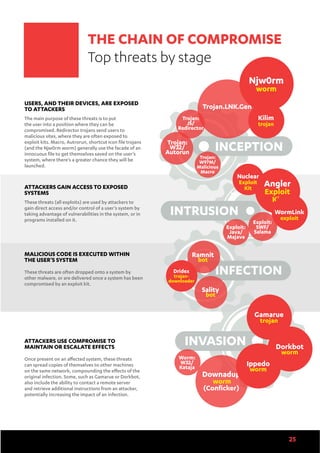
MALICIOUS CODE IS EXECUTED WITHIN
THE USER’S SYSTEM
These threats are often dropped onto a system by
other malware, or are delivered once a system has been
compromised by an exploit kit.
INCEPTION
INTRUSION
INFECTION
INVASION
ATTACKERS GAIN ACCESS TO EXPOSED
SYSTEMS
These threats (all exploits) are used by attackers to
gain direct access and/or control of a user’s system by
taking advantage of vulnerabilities in the system, or in
programs installed on it.
USERS, AND THEIR DEVICES, ARE EXPOSED
TO ATTACKERS
The main purpose of these threats is to put
the user into a position where they can be
compromised. Redirector trojans send users to
malicious sites, where they are often exposed to
exploit kits. Macro, Autrorun, shortcut icon file trojans
(and the Njw0rm worm) generally use the facade of an
innocuous file to get themselves saved on the user’s
system, where there’s a greater chance they will be
launched.
ATTACKERS USE COMPROMISE TO
MAINTAIN OR ESCALATE EFFECTS
Once present on an affected system, these threats
can spread copies of themselves to other machines
on the same network, compounding the effects of the
original infection. Some, such as Gamarue or Dorkbot,
also include the ability to contact a remote server
and retrieve additional instructions from an attacker,
potentially increasing the impact of an infection.
Gamarue
trojan
Angler
Exploit
Kit
WormLink
exploit
Nuclear
Exploit
Kit
Downadup
worm
(Conficker)
Ippedo
worm
Trojan.LNK.Gen
Sality
bot
Trojan:
W32/
Autorun
Ramnit
bot
Trojan:
JS/
Redirector
Worm:
W32/
Kataja
Trojan:
W97M/
Malicious
Macro
Exploit:
SWF/
Salama
Njw0rm
worm
Dorkbot
worm
Dridex
trojan-
downloader
THE CHAIN OF COMPROMISE
Top threats by stage
Kilim
trojan
Exploit:
Java/
Majava
25
26
NJW0RM
ChainofCompromise
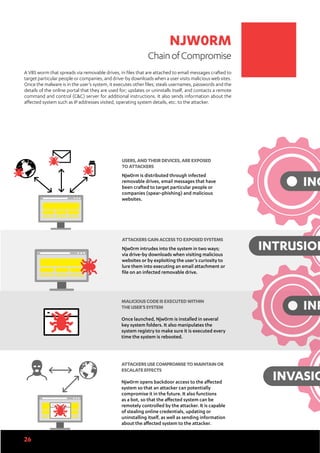
ATTACKERSGAINACCESSTOEXPOSEDSYSTEMS
Njw0rm intrudes into the system in two ways;
via drive-by downloads when visiting malicious
websites or by exploiting the user’s curiosity to
lure them into executing an email attachment or
file on an infected removable drive.
USERS,ANDTHEIRDEVICES,AREEXPOSED
TOATTACKERS
Njw0rm is distributed through infected
removable drives, email messages that have
been crafted to target particular people or
companies (spear-phishing) and malicious
websites.
ATTACKERSUSECOMPROMISETOMAINTAINOR
ESCALATEEFFECTS
Njw0rm opens backdoor access to the affected
system so that an attacker can potentially
compromise it in the future. It also functions
as a bot, so that the affected system can be
remotely controlled by the attacker. It is capable
of stealing online credentials, updating or
uninstalling itself, as well as sending information
about the affected system to the attacker.
MALICIOUSCODEISEXECUTEDWITHIN
THEUSER’SSYSTEM
Once launched, Njw0rm is installed in several
key system folders. It also manipulates the
system registry to make sure it is executed every
time the system is rebooted.
A VBS worm that spreads via removable drives, in files that are attached to email messages crafted to
target particular people or companies, and drive-by downloads when a user visits malicious web sites.
Once the malware is in the user’s system, it executes other files; steals usernames, passwords and the
details of the online portal that they are used for; updates or uninstalls itself, and contacts a remote
command and control (C&C) server for additional instructions. It also sends information about the
affected system such as IP addresses visited, operating system details, etc. to the attacker.
INC
INTRUSION
INF
INVASIO
26
27
COSMICDUKE
MALICIOUSCODEISEXECUTEDWITHIN
THEUSER’SSYSTEM
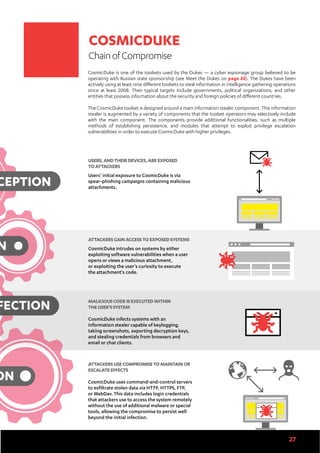
CosmicDuke infects systems with an
information stealer capable of keylogging,
taking screenshots, exporting decryption keys,
and stealing credentials from browsers and
email or chat clients.
ATTACKERSGAINACCESSTOEXPOSEDSYSTEMS
CosmicDuke intrudes on systems by either
exploiting software vulnerabilities when a user
opens or views a malicious attachment,
or exploiting the user’s curiosity to execute
the attachment’s code.
USERS,ANDTHEIRDEVICES,AREEXPOSED
TOATTACKERS
Users’ initial exposure to CosmicDuke is via
spear-phishing campaigns containing malicious
attachments.
ATTACKERSUSECOMPROMISETOMAINTAINOR
ESCALATEEFFECTS
CosmicDuke uses command-and-control servers
to exfiltrate stolen data via HTTP, HTTPS, FTP,
or WebDav. This data includes login credentials
that attackers use to access the system remotely
without the use of additional malware or special
tools, allowing the compromise to persist well
beyond the initial infection.
ChainofCompromise
CosmicDuke is one of the toolsets used by the Dukes — a cyber espionage group believed to be
operating with Russian state sponsorship (see Meet the Dukes on page 20). The Dukes have been
actively using at least nine different toolsets to steal information in intelligence gathering operations
since at least 2008. Their typical targets include governments, political organizations, and other
entities that possess information about the security and foreign policies of different countries.
The CosmicDuke toolset is designed around a main information stealer component. This information
stealer is augmented by a variety of components that the toolset operators may selectively include
with the main component. The components provide additional functionalities, such as multiple
methods of establishing persistence, and modules that attempt to exploit privilege escalation
vulnerabilities in order to execute CosmicDuke with higher privileges.
CEPTION
N
FECTION
ON
27
28
INCEPTION
Inception is the first phase in the Chain of Compromise. It involves users,
whether individuals or companies, exposing themselves to a particular threat
or threats. Businesses and individuals will often expose themselves to threats
unknowingly, which is something anticipated by today’s attackers. However, many
attackers will take a more active role, and employ technical means (such as malware),
social engineering (such as phishing campaigns) or both to manipulate potential
targets into a position where they can be compromised.
Trojan:JS/Redirector is a set of web-based attacks that allow attackers to redirect users from the
website they intend to visit toward a different, unsolicited website. While legitimate websites may
redirect visitors for a number of reasons, attackers have repurposed this tactic to manipulate traffic
toward malicious websites. Attackers typically conduct these attacks by compromising a legitimate
website with the intent to reach that website’s visitors.
Unsolicited websites used by Trojan:JS/Redirector may have
any or all of the following characteristics:
zz Hosting pornographic content
zz Pushing malware onto the visitor’s computer
zz Exfiltrating data from the visitor’s computer
zz Committing fraud by manipulating the incoming Internet
traffic
Redirects are a popular and effective way for attackers to
initiate attacks on potential victims, and using them to steer
traffic toward exploit kits was a particularly common attack
strategy in 2015.
Trojan:JS/Redirector.FE was the most active redirector
observed in 2015. It redirected users to servers hosting exploit
kits, including prominent threats such as Angler and Neutrino.
The majority of Trojan:JS/Redirector.FE hits were detected in
Germany, followed by France, Sweden, and the United States.
Trojan:JS/Redirector.FD (also known as BizCN[1]
) was another
active redirector in 2015. Initially it directed users toward
servers hosting FiestaEK, but later switched to NuclearEK
and NeutrinoEK. The redirector was detected far more
prominently in the United States than in other countries, but
was also a significant threat to users in the United Kingdom,
Finland, and Canada.
Trojan:SWF/Redirector.EW (also known as EITest Flash
Redirector[2]
) was another redirector that was quite
pronounced in 2015, particularly in the spring and autumn.
Attackers seemed to use it as an initiation technique for
AnglerEK campaigns in the spring and autumn. And once
again, it was detected prominently in North American and
European countries, including Sweden, the United States, the
United Kingdom, and the Netherlands.
As mentioned above, many of the websites hosting these
redirectors are not malicious themselves. They are simply
legitimate websites that have been built in a way that leaves
them susceptible to attacks, making them victims rather than
perpetrators. For example, many of the websites discovered
to be hosting Trojan:SWF/Redirector.EW were built using
WordPress. It’s entirely possible that the compromised
websites were targeted based on this, or possibly because
they were using a vulnerable plug-in.
However, there is also strong evidence suggesting the use of
other techniques, including the use of brute-force password
attacks to gain administrative rights to the targeted websites.
Once an attacker has administrative access to a website, it is
a trivial matter for them to upload malicious scripts such as
redirectors.
The prominence of Trojan:JS/Redirector detections in North
America and Europe is consistent with observations regarding
the prevalence of exploit kits in these regions. As such,
redirectors should be recognized as significant threats used
by attackers looking to initiate attacks against people and
companies in these regions.
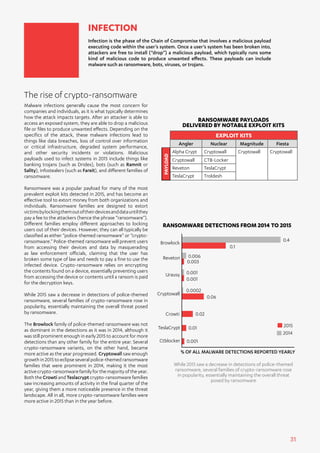
Redirectorswreak havoc on US,Europe
>> Sources on page 39.
COUNTRIESMOSTAFFECTED
%OFDETECTIONSREPORTED,BYCOUNTRY
TROJAN:JS/
REDIRECTOR.FE
Germany
France
Sweden
United States
Others
23
17
11
10
39
TROJAN:JS/
REDIRECTOR.FD
United States
United Kingdom
Canada
Finland
Others
58
10
8
8
17
TROJAN:SWF/
REDIRECTOR.EW
Sweden
United States
United Kingdom
Netherlands
Others
30
21
14
11
26
29
VULNERABILITIES TOP5EXPLOITKITS
Program CVE No. Angler Neutrino Nuclear Magnitude Rig
Flash Player CVE-2015-0310
Flash Player CVE-2015-0311
Flash Player CVE-2015-0313
Flash Player CVE-2015-0336
Flash Player CVE-2015-0359
Flash Player CVE-2015-3090
Flash Player CVE-2015-3105
Flash Player CVE-2015-3113
Flash Player CVE-2015-5119
Flash Player CVE-2015-5122
Silverlight CVE-2015-1671
Internet Explorer CVE-2015-2419
Flash Player CVE-2015-5560
Flash Player CVE-2015-7645
Flash Player CVE-2015-8446
Intrusion is the phase of the Chain of Compromise where the actual attack begins.
Companies and individuals who expose themselves to threats give attackers the
opportunity to break into exposed systems. Social engineering techniques can be
used to manipulate users into giving attackers access to systems. But perhaps the
most common Intrusion resource used by attackers is the exploit. Exploits allow the
attackers to utilize software vulnerabilities in exposed systems to acquire a degree of
access, or even control, over their targets.
those countries. Angler has demonstrated the capability to
add support for Flash vulnerabilities faster, and more often
than other prominent exploit kits. The 2015 hack of the Italian
surveillance software firm Hacking Team exemplifies how
efficiently exploit kits, particularly Angler, make use of new
vulnerabilities.
The Hacking Team incident
InthefirstweekofJuly2015,aconsiderableamountofHacking
Team’s data was made publicly available. Two zero-day Flash
vulnerabilities were included in this data dump.
The first vulnerability, CVE-2015-5119, was taken into use the
very same day by three different exploit kits (Angler, Neutrino,
andNuclear).Twoadditionalexploitkitsaddedsupportforthe
vulnerability within two days, despite Adobe releasing a patch
the day after the vulnerability was disclosed to the public [1]
.
AnglerEK adopted the second zero-day vulnerability, CVE-
2015-5122, the day after it was discovered in Hacking Team’s
data [2]
. NeutrinoEK added support for the vulnerability the
next day. Two days later, the authors behind NuclearEK and
RigEK added exploits for the vulnerability to their kits. All of
this occurred before Adobe was able to develop and release
a patch.
Exploits are bits of code written to take advantage of
vulnerabilitiesfoundincomputersoftware,andareaprominent
attack resource used in the modern threat landscape.
The success of an exploit is contingent upon it finding a
corresponding software vulnerability in users’ systems. These
exploits are often bundled together into groups by attackers
as part of an exploit kit, which scans the software on a user’s
device to find unpatched vulnerabilities and match it with an
appropriate exploit. After accomplishing this, the exploit kit
uses this vulnerability as a security hole to deliver malicious
payloads, such as ransomware.
ExploitkitsmakinguseofFlashvulnerabilitieswereaprominent
threat in 2015, which is consistent with observations from the
previous year. Whereas in 2013 exploit kits targeting multiple
Javavulnerabilitieswerefound,exploitkitauthorshavemoved
on to targeting Flash.
AnglerEK was the most active and most efficient at integrating
exploits for Flash vulnerabilities, and was observed to be active
in a number of campaigns throughout last year. The authors
behind AnglerEK integrated support for Flash vulnerabilities
more often than other prominent exploit kits. AnglerEK
detections in 2015 were prevalent in many different countries,
and prominent enough in Sweden, the United States, the
United Kingdom and Australia to make it the top threat in
INTRUSION
AnglerEKdominates Flash
TOPVULNERABILIITIESUSEDBYTOP5EXPLOITKITSIN2O15
Angler was the exploit kit that was most active and
efficient at integrating exploits into its arsenal
30
Public Vulnerability
becomes public
Patched Patch released
by vendor
Exploit added
to exploit kit
TIMELINEOFNOTABLEEXPLOITSBEINGADDEDTOEXPLOITKITS
Public
MAY JUN JUL AUG
CVE-2015-1671
MS15-065
Silverlight
CVE-2015-2419
MS15-044
Internet Explorer
Public
Angler Magnitude
Angler
Magnitude
Nuclear
Public
Public
Patched
6 127 8 9
Patched
10 11 13 14
RigMagnitude
Angler
Neutrino Nuclear
Rig
Magnitude
MONTHS
DAYS
*Flash Player vulnerabilities
exposed in Hacking Team hack
Angler
Nuclear
Neutrino
Neutrino
Flash vulnerabilities are attractive targets for exploit kit
developers because of Flash’s use on multiple platforms. The
speed and popularity of developing exploits targeting Flash
vulnerabilities contrasts with how exploit kit developers
adapt to vulnerabilities targeting other pieces of software.
For example, a Silverlight vulnerability (CVE-2015-1671) was
disclosed in May, but wasn’t integrated into Angler and
Magnitude exploit kits for two months. The top five exploit
kits had a similar reaction to an Internet Explorer vulnerability
disclosed in mid-July, waiting until August before adding
support for the vulnerability.
AnglerEK was detected prominently enough in 2015 to make it
one of the most commonly encountered forms of Intrusion by
both individuals and businesses.
CVE-2015-5119*
CVE-2015-5122*
Last April, the United States Computer Emergency Readiness
Team issued an alert regarding the use of unpatched software
by companies. According to the alert, as many as 85 percent
of targeted attacks are preventable, and companies should
be more diligent in patching and updating their software to
minimize their attack surface[3]
.
However, it appears that this warning has yet to have its
intended effect. According to research, over one in four
versions of WordPress currently in use within Finland contains
exploitable vulnerabilities. And historical data implies this is
getting worse. A similar investigation conducted in 2014 found
that 24 percent of WordPress versions were vulnerable, which
rose to 26 percent in 2015.
Software vulnerabilities are the lifeblood of the exploit
market, and the ongoing use of outdated/unpatched software
explains why this market is able to thrive. The use of software
with exploitable vulnerabilities helps create demand for the
very exploits that target them, thereby encouraging exploit
writers to create more supply for this demand. The fact that
the observed use of WordPress in Finland doubled between
2014 and 2015 should be seen as an indicator of the growing
potential market for WordPress exploits.
WORDPRESS USE
IN FINLAND
WordPress woes in Finland
25,000
15,000
5,000
0
2014 2015
Vulnerable Updated
>> Sources on page 39.
Flash vulnerabilities are attractive targets
for exploit kit developers because of Flash’s
use on multiple platforms
31
Malware infections generally cause the most concern for
companies and individuals, as it is what typically determines
how the attack impacts targets. After an attacker is able to
access an exposed system, they are able to drop a malicious
file or files to produce unwanted effects. Depending on the
specifics of the attack, these malware infections lead to
things like data breaches, loss of control over information
or critical infrastructure, degraded system performance,
and other security incidents or violations. Malicious
payloads used to infect systems in 2015 include things like
banking trojans (such as Dridex), bots (such as Ramnit or
Sality), infostealers (such as Fareit), and different families of
ransomware.
Ransomware was a popular payload for many of the most
prevalent exploit kits detected in 2015, and has become an
effective tool to extort money from both organizations and
individuals. Ransomware families are designed to extort
victimsbylockingthemoutoftheirdevicesanddatauntilthey
pay a fee to the attackers (hence the phrase “ransomware”).
Different families employ different approaches to locking
users out of their devices. However, they can all typically be
classified as either “police-themed ransomware” or “crypto-
ransomware.” Police-themed ransomware will prevent users
from accessing their devices and data by masquerading
as law enforcement officials, claiming that the user has
broken some type of law and needs to pay a fine to use the
infected device. Crypto-ransomware relies on encrypting
the contents found on a device, essentially preventing users
from accessing the device or contents until a ransom is paid
for the decryption keys.
While 2015 saw a decrease in detections of police-themed
ransomware, several families of crypto-ransomware rose in
popularity, essentially maintaining the overall threat posed
by ransomware.
The Browlock family of police-themed ransomware was not
as dominant in the detections as it was in 2014, although it
was still prominent enough in early 2015 to account for more
detections than any other family for the entire year. Several
crypto-ransomware variants, on the other hand, became
more active as the year progressed. Cryptowall saw enough
growth in 2015 to eclipse several police-themed ransomware
families that were prominent in 2014, making it the most
activecrypto-ransomwarefamilyforthemajorityoftheyear.
Both the Crowti and Teslacrypt crypto-ransomware families
saw increasing amounts of activity in the final quarter of the
year, giving them a more noticeable presence in the threat
landscape. All in all, more crypto-ransomware families were
more active in 2015 than in the year before.
EXPLOIT KITS
Angler Nuclear Magnitude Fiesta
Alpha Crypt Cryptowall Cryptowall Cryptowall
Cryptowall CTB-Locker
Reveton TeslaCrypt
TeslaCrypt Troldesh
RANSOMWARE PAYLOADS
DELIVERED BY NOTABLE EXPLOIT KITS
RANSOMWARE DETECTIONS FROM 2014 TO 2015
Browlock
Ctblocker
Reveton
Urausy
Cryptowall
Crowti
TeslaCrypt
2014
2015
% OF ALL MALWARE DETECTIONS REPORTED YEARLY
0.4
0.1
0.006
0.003
0.001
0.001
0.001
0.01
0.02
0.06
0.0002
PAYLOAD
Infection is the phase of the Chain of Compromise that involves a malicious payload
executing code within the user’s system. Once a user’s system has been broken into,
attackers are free to install (“drop”) a malicious payload, which typically runs some
kind of malicious code to produce unwanted effects. These payloads can include
malware such as ransomware, bots, viruses, or trojans.
INFECTION
The rise of crypto-ransomware
While 2015 saw a decrease in detections of police-themed
ransomware, several families of crypto-ransomware rose
in popularity, essentially maintaining the overall threat
posed by ransomware
32
Researchers have previously noted that crypto-ransomware
campaigns have support infrastructure in place to encourage
their targets to pay the ransom, and consistently give
victims decryption keys after receiving the payment [1]
.
Attackers behind police-themed ransomware campaigns,
on the other hand, tend to simply take the ransom without
helping the victims remove the infections [2]
. The fact that
the attackers behind crypto-ransomware families will often
help their victims to ensure payment, combined with the
relatively affordable payments requested, has lead the FBI to
recommend companies simply pay the ransom if infected [3]
.
In 2015, several police departments followed this advice and
paid online extortionists hundreds of dollars each to release
systems locked by ransomware [4]
. Stories like these highlight
both the effectiveness of using ransomware as an extortion
tool, and the importance of disrupting attacks before they
infect systems.
%OFALLMALWAREDETECTIONREPORTS,2015
JAN FEB OCTSEPAUGJULJUNMAYAPRMAR NOV DEC
TOP RANSOMWARE DETECTIONS IN 2015
Jan 2015
Browlock, 0.103%
Crowti
Cryptowall
Urausy
Reveton
TeslaCrypt
Ctblocker
0.002
0.004
0.006
0.008
0.010
0.012
0.014
0.016
0.018
>> Sources on page 39.
Cryptowall was the most frequently detected
ransomware family for the majority of 2015.
MONTHS, 2015
RANSOM DEMANDS DISPLAYED
Ransom demands displayed by police-themed ransomware
Browlock (left) and crypto-ransomware CryptoWall (right)
33
45+20+9+6+3+17+D
33+17+16+13+12+9+D
While DNS hijacks differ based on their target (for example,
a DNS hijack against a large corporation would look quite
different from the DNS hijack targeting an individual or micro
business), their basic aim is to alter the domain name system
(DNS) configurations of their targets in order to monitor or
manipulate Internet traffic. Various security flaws can lead
to these DNS hijacks, including weak passwords, software
vulnerabilities, or malware. DNS hijacks are an effective way
for attackers to make contact with a large number of potential
targets at once, as it provides them with the opportunity to
compromise all of the devices connected to a particular
network.
Although DNS hijacks are a frequent type of attack in today’s
threat landscape, a significant spike in these hijacks was
observed during the spring and summer months of 2015,
specifically April through August. These attacks changed the
default DNS configuration in order to manipulate Internet
traffic. The majority of the observed hijacks in 2015 occurred in
Italy and Poland, followed by Egypt, Sweden, and India.
Out of the observed DNS hijacks in 2015, the most common
strategy used by attackers was to direct Internet traffic to
malicious IP addresses that would then infect devices with
Kelihos malware. Kelihos is a prominent botnet that can be
used for sending spam and DDoS attacks. It can also steal
information from infected devices, including credentials.
Other prominent payloads delivered through these hijacks in
2015 included the Fareit, Pkybot, and Zbot trojans, as well as
the Aprox malware used in the botnet of the same name.
Like many modern cyber attacks, these DNS hijacks did not
limit themselves to a single phase in the Chain of Compromise
– altering DNS configurations was rather a means to an end.
Nearly half of all of these detections – 48 percent – were
used to establish botnets. Additionally, both Pkybot and
Fareit function as both information stealers and downloaders,
allowing the attackers to download additional payloads after
the initial infection.
Thus, an overwhelming 77 percent of these cases attempted to
give attackers persistent access to the users’ systems, allowing
them to further infiltrate systems to create new infections or
otherwise compromise devices on an ongoing basis. Based on
this, users should consider DNS hijacks as a potential ongoing
compromise of their devices and networks that can help
attackers achieve a variety of goals over an extended period
of time.
OTHERS
33
ITALY
17
POLAND
16
SWEDEN
12
EGYPT
13
INDIA
9
TOP
COUNTRIES
AFFECTED, %
OTHERS
17
KELIHOS
45
FAREIT
20
PKYBOT
9
ZBOT
6
ASPROX
3
TOP THREATS
USING
HIJACKED DNS
ROUTERS, %
Invasion is the final phase in the Chain of Compromise. During this phase, the initial
infection will persist until the victim takes measures to disrupt the attack, or escalate
in order to further compromise the user’s system or network. While the specifics of
such escalation varies according to the particulars of the attack, there are two main
evolutionary paths today’s attacks typically follow: infiltration and infestation.
Infiltration allows attackers to penetrate further into the user’s system, which can be
used in planning future attacks or creating a persistent compromise that prolongs the
effects of the attack for an extended period of time.
INVASION: INFILTRATION
DNS Hijacks bring bots, downloaders,
and information stealers in 2015
0
5
10
15
20
25
30
DECJUNJAN
INFECTIONS VIA DNS HIJACKING, 2015
%
MONTH
30
25
20
15
10
5
0
JAN JUN DEC
A spike in DNS hijacks was observed
from April to August in 2015.
34
In 2015, Downadup retained its previous position as the most
frequently detected type of malware. The computer worm
was first discovered in 2008, and is now recognized as one
of today’s most widepread malware infections. Downadup is
a computer worm that infects unpatched Windows machines
(including various versions of Windows Server), and then
invades exposed networks attached to infected devices.
Downadup has infected millions of computers since its release
in 2008, and caused disruptions on an industrial scale as
organizations attempted to combat the worm[1]
. At one point,
Microsoft was offering a USD 250,000 reward for information
regarding the worm’s authors[2]
. Downadup’s combination
of different tactics gave it a sophistication beyond other
computer worms known to researchers at the time, making it
one of history’s most invasive families of malware.
Downadup remains a prominent malware family to this
day, and is the most frequently detected threat in Finland,
France, Germany, India, Italy, and Norway. While many anti-
virus products can detect and remove the infection for
individual consumers, it is still quite challenging to purge the
worm once it infects large networks, such as those run by
telecommunication companies or global enterprises.
Invasion is the final phase in the Chain of Compromise. During this phase, the initial
infection will persist until the victim takes measures to disrupt the attack, or escalate
in order to further compromise the user’s system or network. While the specifics
of such escalation varies according to the particulars of the attack, there are two
main evolutionary paths today’s attacks typically follow: infiltration and infestation.
Infestation occurs when an attack successfully propagates beyond a single device or
system to compromise a larger network.
INVASION: INFESTATION
Could Downadup find new life through the Internet of Things?
And in spite of its age, Downadup is finding new ways to
propagate itself. Downadup infections were discovered
on wearable cameras manufactured for police officers in
November 2015[3]
. Because devices like wearable cameras and
many other Internet of Things (IoT) devices are unable to run
traditionalanti-virussoftware,itisentirelypossiblethatthreats
such as Downadup could see a resurgence if non-secure IoT
devices proliferate.
?
35
Themalwarecommoditizationmarketcontinuestostrengthen,withmalware-
as-a-service ventures becoming increasingly sophisticated and organized.
Customized end-to-end malware campaigns can be easily purchased online.
Once launched, botnets distribute spam which leads to infected machines.
Delivered payloads report back to a managed backend infrastructure that is
provided as part of the service. We’ve even observed beta tests happening
before a real campaign begins. Although predominantly being used for
financial gain, these malware-as-a-service campaigns are sometimes used
for other nefarious purposes, such as data theft or public embarassment.
Compared to the cost of damages that an organization or individual can incur,
the price of a malware campaign is incredibly cheap.
We’re continuing to see an upsurge in ransomware, and that trend is likely
to continue through 2016. Not only are ransomware campaigns becoming
increasingly organized and sophisticated, the malware itself is becoming
more insidious. Crypto-ransomware represents some of the most destructive
software we’ve seen in recent times. Files are encrypted wholesale on the
end-user’s machine, and the only recourse a victim has is to pay the criminals
for the decryption key. More recently, this malware has been able to encrypt
files on non-mapped network shares, making it a nightmare for company
networks. Ransoms per infected system can be upwards of $400.
We also expect APTs to continue gaining prevalence during 2016. Organized
groups such as nation states, hacktivists, industrial espionage and sabotage
providers, and cyber criminals are turning their eyes towards corporations and
government agencies with financial gain, data theft, operations disruption,
and destruction of reputation as their motives. Unlike criminalware, which will
indiscriminately target every system it can, advanced persistent threats are
highly focused and difficult to detect by conventional means. Tackling such
threats requires a much wider cyber security strategy.
Both ransomware and APTs are making headline news on an almost weekly
basis, and these stories are no longer confined solely to tech news sites. As
awareness of the reality of cyber crime and cyber war increases, governments
are scrambling to draft new regulations which will inevitably guide businesses
going forward. This coming year will also see a great deal of debate on
encryption and access to personal data — something that is likely to affect
every single computer and smartphone owner. On top of all of this, the
Internet of Things will continue to expand, and could very well play a role in
the ongoing dialogue about cyber security.
ANDY PATEL
Technology Outreach
@r0zetta
CONCLUSION
“AS AWARENESS
OF THE REALITY
OF CYBER CRIME
AND CYBER WAR
INCREASES,
GOVERNMENTS ARE
SCRAMBLING...”
36
2015 HIGHLIGHTS (PAGE 08-09)
Digital security
1.	 China updates Internet control laws
New York Times: Austin Ramzy; What You Need to Know
About China’s Draft Cybersecurity Law; published 9 Jul
2015;
http://sinosphere.blogs.nytimes.com/2015/07/09/what-
you-need-to-know-about-chinas-draft-cybersecurity-
law/?_r=1
2.	 US ‘planning to sanction China over cyberthefts’
Washington Post; Ellen Nakashima; U.S. developing
sanctions against China over cyberthefts; published 30
Aug 2015;
https://www.washingtonpost.com/world/national-
security/administration-developing-sanctions-against-
china-over-cyberespionage/2015/08/30/9b2910aa-480b-
11e5-8ab4-c73967a143d3_story.html
3.	 China/US talk on cybersecurity before state visit
The Guardian: US and China officials talk cybersecurity
after Obama’s warning about attacks; published 13 Sep
2015;
http://www.theguardian.com/us-news/2015/sep/13/
us-and-china-officials-talk-cybersecurity-after-obamas-
warning-about-attacks
4.	 US-EU ‘Safe Harbor’ data agreement invalidated
Washington Post; Ellen Nakashima; Top E.U. court
strikes down major data-sharing pact between U.S.
and Europe; published 6 Oct 2015; https://www.
washingtonpost.com/world/national-security/eu-court-
strikes-down-safe-harbor-data-transfer-deal-over-
privacy-concerns/2015/10/06/2da2d9f6-6c2a-11e5-b31c-
d80d62b53e28_story.html
5.	 US Senate approves CISA Act despite concerns
PCWorld; Martyn Williams; CISA sails through Senate
despite tech opposition; published 28 Oct 2015;
http://www.pcworld.com/article/2998171/privacy/cisa-
sails-through-senate-despite-tech-opposition.html
6.	 US DMCA expands list of ‘legal hacking’ products
Arstechnica; David Kravets; US regulators grant DMCA
exemption legalizing vehicle software tinkering; published
27 Oct 2015;
http://arstechnica.com/tech-policy/2015/10/us-
regulators-grant-dmca-exemption-legalizing-vehicle-
software-tinkering/
7.	 NSA ends bulk phone surveillance program
Engadget; Jon Fingas; The NSA’s mass US phone
surveillance ends tonight; published 28 Nov 2015;
http://www.engadget.com/2015/11/28/nsa-bulk-nsa-
phone-surveillance-ends/
8.	 China counterterrorism bill causes concern
PCWorld; Jeremy Kirk; New Chinese law takes aim at
encryption; published 27 Dec 2015;
http://www.pcworld.com/article/3018426/new-chinese-
law-takes-aim-at-encryption.html
SOURCES
Enforcement
1.	 Europol joint op takes down Ramnit botnet
The Wired UK; Emiko Jozuka; Europol cracks down on
botnet infecting 3.2m computers; published 25 Feb 2015;
http://www.wired.co.uk/news/archive/2015-02/25/
europol-ramnit-crackdown
2.	 FBI Darkode bazaar shutdown
Arstechnica; Dan Goodin; Criminal hacking bazaar
Darkode is dismantled and 70 members are busted;
published 15 Jul 2015;
http://arstechnica.com/tech-policy/2015/07/criminal-
hacking-bazaar-darkode-is-dismantled-and-70-
members-are-busted/
3.	 Angler exploit kit operations disrupted
PC Mag; Stephanie Mlot; Cisco Disrupts $30M
Ransomware Operation; published 7 Oct 2015;
http://www.pcmag.com/article2/0,2817,2492718,00.
asp?kc=PCRSS03069TX1K0001121
4.	 China arrests hackers at US behest
Washington Post; Ellen Nakashima and Adam Goldman;
In a first, Chinese hackers are arrested at the behest of
the U.S. government; published 9 Oct 2015; https://www.
washingtonpost.com/world/national-security/in-a-first-
chinese-hackers-are-arrested-at-the-behest-of-the-
us-government/2015/10/09/0a7b0e46-6778-11e5-8325-
a42b5a459b1e_story.html?postshare=9811444395972124
5.	 EU police raids over DroidJack malware
BBC; Chris Baraniuk; Police raid homes across Europe over
DroidJack malware; published 30 Oct 2015;
http://www.bbc.com/news/technology-34668337
6.	 US jails Citadel botnet author for 4.5yrs
Naked Security; John Zorabedian; Jail for Russian man
who distributed Citadel banking malware to thousands;
published 1 Oct 2015;
https://nakedsecurity.sophos.com/2015/10/01/jail-for-
russian-man-who-distributed-citadel-banking-malware-
to-thousands/
7.	 UK, US charge Dridex botnet author
Labs Weblog; Gerald Carsula; Dridex Takedown; published
15 Oct 2015;
https://labsblog.f-secure.com/2015/10/15/dridex-
takedown/
Attacks
1.	 Hacking Team breached, data released online
Forbes; Thomas Fox-Brewster; Hacking Team Breach
Exposes Insecurities Of A Controversial Surveillance
Dealer; published 6 Jul 2015;
http://www.forbes.com/sites/
thomasbrewster/2015/07/06/hacking-team-
hacked/#64c1d0cc350f
2.	 XcodeGhost-tainted apps prompts App Store cleanup
Reuters: Jum Finkle; Apple cleaning up iOS App Store after
first major attack; published 21 Sep 2015;
http://www.reuters.com/article/us-apple-china-malware-
idUSKCN0RK0ZB20150921
37
3.	 DDoS attack ‘launched from mobile ads’
PCWorld; Lucian Constantin; After pushing malware, ad
networks also used for DDoS; published 28 Sep 2015;
http://www.pcworld.com/article/2986966/security/after-
pushing-malware-ad-networks-also-used-for-ddos.html
4.	 DDoS attacks on Turkish servers reported
International Business Times; Vasudevan Sridharan;
Anonymous: Turkey reeling under cyberattack as
government and banks websites paralysed; 26 Dec
2015; http://www.ibtimes.co.uk/anonymous-turkey-
reeling-under-cyber-attack-government-banks-sites-
paralysed-1534984
Malware
1.	 Ransomware on the rise
United States Federal Bureau of Investigations;
Ransomware on the Rise: FBI and Partners Working to
Combat This Cyber Threat; published 20 Jan 2015; https://
www.fbi.gov/news/stories/2015/january/ransomware-on-
the-rise
2.	 Dukes cyberattack toolsets expand, develop
F-Secure Labs Weblog; Artturi Lehtio; Duke APT group’s
latest tools: cloud services and Linux support; published
22 Jul 2015;
https://www.f-secure.com/weblog/archives/00002822.
html
3.	 Turla malware ‘contacting C&C via satellite’
The Wired; Kim Zetter; Russian spy gang hijacks satellite
links to steal data; published 9 Sep 2015;
http://www.wired.com/2015/09/turla-russian-espionage-
gang-hijacks-satellite-connections-to-steal-data/
4.	 New Duke cyberattack toolsets identified
F-Secure Labs Weblog; Artturi Lehtio; The Dukes: 7 Years
Of Russian Cyber-Espionage; published 17 Sep 2015;
https://labsblog.f-secure.com/2015/09/17/the-dukes-7-
years-of-russian-cyber-espionage/
Product Security
1.	 Google launches monthly Nexus security updates
CNet: Scott Webster; Google’s Nexus line will get monthly
security updates; published 5 Aug 2015;
http://www.cnet.com/news/google-to-deploy-monthly-
security-updates-to-nexus-line
2.	 Google patches Android Stagefright flaw
PCWorld; Jeremy Kirk; Google has another try at patching
Stagefright flaw; published 13 Aug 2015;
http://www.pcworld.com/article/2971332/google-has-
another-try-at-patching-stagefright-flaw.html
3.	 Amazon, Chrome drop Flash ads
F-Secure Labs Weblog; Sean Sullivan; Amazon Says No to
Flash Ads; published 21 Aug 2015;
https://labsblog.f-secure.com/2015/08/21/amazon-says-
no-to-flash-ads/
4.	 Overstepping adblockers pulled from App Store
Business Insider; Lara O’Reilly; Apple has dumped ad
blockers that block in-app ads from the App Store;
published 9 Oct 2015;
http://www.businessinsider.my/apple-removes-
been-choice-and-other-ad-blockers-from-its-app-
store-2015-10/
5.	 Apple product updates fix multiple security issues
The Register; Shaun Nichols; Got an Apple Mac, iThing?
Update it right now - there’s a shedload of security holes
fixed; published 21 Oct 2015; http://www.theregister.
co.uk/2015/10/21/apple_updates_ios_os_x_and_watchos/
Vulnerabilities
1.	 FREAK flaw found in Android, Windows
Arstechnica; Dan Goodin; “FREAK” flaw in Android and
Apple devices cripples HTTPS crypto protection; 3 Mar
2015;
http://arstechnica.com/security/2015/03/freak-flaw-
in-android-and-apple-devices-cripples-https-crypto-
protection/
2.	 Android Stagefright flaw reported
Time; Robert Hackett; Stagefright: Everything You Need
To Know About Google’s Android Megabug; published 28
Jul 2015;
http://www.time.com/3976049/stagefright-google-
android-bug/
3.	 Android Certifi-Gate flaw reported
Endgadget; Roberto Baldwin; Stagefright: Researchers
can take complete control of Android phones; 6 Aug 2015;
http://www.engadget.com/2015/08/06/android-
certifigate/
4.	 OS X Gatekeeper bypass exploit reported
Macworld; Glenn Fleishman; Gatekeeper bypass in OS X
relies on renaming an app; published 30 Sep 2015;
http://www.macworld.com/article/2988059/security/
gatekeeper-bypass-in-os-x-relies-on-renaming-an-app.
html
5.	 Android Stagefright 2.0 flaw reported
The Guardian; Samuel Gibbs; Stagefright 2.0: over 1bn
Android smartphones vulnerable to latest bug; published
2 Oct 2015;
http://www.theguardian.com/technology/2015/oct/02/
stagefright-20-android-smartphones-vulnerable-
security-bug-hackers
6.	 Bugs prompt Ford, Range Rover, Prius, Chrysler recalls
Ford; Ford issues safety compliance recall in North
America; published 2 Jul 2015;
https://media.ford.com/content/fordmedia/fna/us/en/
news/2015/07/02/ford-issues-safety-compliance-recall-
in-north-america.html
BBC; Software bug prompts Range Rover recall; published
13 Jul 2015;
http://www.bbc.com/news/technology-33506486
Reuters; Toyota recalls 625,000 hybrid cars globally for
software glitch; published 15 Jul 2015;
http://www.reuters.com/article/us-toyota-recall-
idUSKCN0PP0EF20150715
38
7.	 Tesla issues OTA Model S patch for hack
TechCrunch; Fitz Tepper; Researchers Hack A Model S,
Tesla Sends Out Over-The-Air Fix; published 6 Aug 2015;
http://techcrunch.com/2015/08/06/researchers-hack-a-
model-s-tesla-sends-out-over-the-air-fix/
8.	 Researchers demo Chevy Corvette hack
The Wired; Andy Greenberg; Hackers cut a Corvette’s
brakes via common car gadget; published 11 Aug 2015;
http://www.wired.com/2015/08/hackers-cut-corvettes-
brakes-via-common-car-gadget/
9.	 Chrysler mails USB sticks with software patch
The Wired; Andy Greenberg; Chrysler Catches Flak for
Patching Hack Via Mailed USB; published 3 Sep 2015;
http://www.wired.com/2015/09/chrysler-gets-flak-
patching-hack-via-mailed-usb/
BREACHING THE WALLED GARDEN
(PAGE 18-19)
1.	 Arstechnica; Jacqui Cheng; “Find and Call” app becomes
first trojan to appear on iOS App Store; published 6 Jul
2012;
http://arstechnica.com/apple/2012/07/find-and-call-app-
becomes-first-trojan-to-appear-on-ios-app-store/
2.	 Palo Alto Networks; Claud Xiao; Malware XcodeGhost
Infects 39 iOS Apps, Including WeChat, Affecting
Hundreds of Millions of Users; published 18 Sept 2015;
http://researchcenter.paloaltonetworks.com/2015/09/
malware-xcodeghost-infects-39-ios-apps-including-
wechat-affecting-hundreds-of-millions-of-users/#
3.	 The Guardian; Alex Hern; Apple removes malicious
programs after first major attack on app store; published
21 Sep 2015;
http://www.theguardian.com/technology/2015/sep/21/
apple-removes-malicious-programs-after-first-major-
attack-on-app-store
4.	 PwC; Michael Yip; UnityGhost: the ghost adventure
continues; published 6 Oct 2015;
http://pwc.blogs.com/cyber_security_updates/2015/10/
unityghost-the-adventure-continues.html
5.	 Business Insider; Lisa Eadicicco; Hundreds of apps have
been banned from Apple’s App Store for spying on your
personal information; published 20 Oct 2015; http://www.
businessinsider.my/apple-removes-apps-youmi-sdk-
personal-information-2015-10/?op=1?r=US&IR=T
6.	 ZDNet; Charlie Osborne; Chinese firm behind snooping
iOS apps admits guilt; published 20 Oct 2015;
http://www.zdnet.com/article/chinese-firm-behind-
snooping-ios-apps-pulled-by-apple-apologizes/
7.	 The Wired; Kevin Poulsen; Malware Turns Software
Compilers into Virus Breeders; published 21 Aug 2009;
http://www.wired.com/2009/08/induc/
8.	 Naked Security; Graham Cluley; W32/Induc-A virus being
spread by Delphi software houses; published 19 Aug 2009;
https://nakedsecurity.sophos.com/2009/08/19/
w32induca-spread-delphi-software-houses/
9.	 Apple Insider; Apple to officially host Xcode on Chinese
servers in wake of malware issue; published 23 Sept 2015;
http://appleinsider.com/articles/15/09/23/apple-to-
officially-host-xcode-on-chinese-servers-in-wake-of-
malware-issue
CHAIN OF COMPROMISE
(PAGE 23-34)
Chain of Compromise
1.	 Lockheed Martin Corporation; Eric M. Hutchins, Michael
J. Clopperty, Rohan M. Amin; Intelligence-Driven
Computer
Network Defense Informed by Analysis of Adversary
Campaigns and Intrusion Kill Chains;
http://www.lockheedmartin.com/content/dam/
lockheed/data/corporate/documents/LM-White-Paper-
Intel-Driven-Defense.pdf
2.	 Mandiant; [the advanced persistent threat]; published
2010; https://dl.mandiant.com/EE/assets/PDF_
MTrends_2010.pdf
Inception: Redirectors
1.	 SANS ISC InfoSec Forums; Brad Duncan; BizCN gate actor
changes from Fiesta to Nuclear exploit kit;
https://isc.sans.edu/forums/diary/BizCN+gate+actor+
changes+from+Fiesta+to+Nuclear+exploit+kit/19875
2.	 Malwarebytes Labs; Jerome Segura; Exposing the Flash
‘EITest’ malware campaign; published 29 Oct 2014;
https://blog.malwarebytes.org/exploits-2/2014/10/
exposing-the-flash-eitest-malware-campaign/
Intrusion: Exploits
1.	 Malware don’t need coffee; Kafeine; CVE-2015-5119
(HackingTeam 0d - Flash up to 18.0.0.194) and Exploit Kits;
published 8 Jul 2015; http://malware.dontneedcoffee.
com/2015/07/hackingteam-flash-0d-cve-2015-xxxx-and.
html
2.	 Malware don’t need coffee; Kafeine; CVE-2015-5122
(HackingTeam 0d two - Flash up to 18.0.0.203) and Exploit
Kits;
published 11 Jul 2015; http://malware.dontneedcoffee.
com/2015/07/cve-2015-5122-hackingteam-0d-two-flash.
html
3.	 US-CERT; Alert (TA15-119A): Top 30 Targeted High Risk
Vulnerabilities; published 29 Apr 2015;
https://www.us-cert.gov/ncas/alerts/TA15-119A?hootPost
ID=b6821137ae5173095390bd502ae04892
39
Infection: Ransomware
1.	 Labs Weblog; Sean Sullivan; CryptoWall’s “Customer
Journey” Sounds Like A Real Nightmare; published 28 Sep
2015;
https://labsblog.f-secure.com/2015/09/28/cryptowalls-
customer-journey/
2.	 F-Secure Labs; Removal Instructions: Removing ‘Police-
Themed’ Ransomware; published 14 Aug 2014;
https://www.f-secure.com/en/web/labs_global/
removing-police-themed-ransomware
3.	 The Security Ledger; FBI’s Advice on Ransomware? Just
Pay The Ransom.; published 22 Oct 2015;
https://securityledger.com/2015/10/fbis-advice-on-
cryptolocker-just-pay-the-ransom/
4.	 Dark Reading; Sara Peters; Police Pay Off Ransomware
Operators, Again; published 14 Apr 2015;
http://www.darkreading.com/attacks-breaches/police-
pay-off-ransomware-operators-again/d/d-id/1319918
Invasion: Infestation
1.	 The Telegraph; Kim Willsher; French fighter planes
grounded by computer virus; published 7 Feb 2009;
http://www.telegraph.co.uk/news/worldnews/europe/
france/4547649/French-fighter-planes-grounded-by-
computer-virus.html
2.	 Microsoft; Microsoft Collaborates With Industry to Disrupt
Conficker Worm; published 12 Feb 2009;
https://news.microsoft.com/2009/02/12/microsoft-
collaborates-with-industry-to-disrupt-conficker-worm/
3.	 Arstechnica; Dan Goodin; Police body cams found pre-
installed with notorious Conficker worm; published 16
Nov 2016;
http://arstechnica.com/security/2015/11/police-body-
cams-found-pre-installed-with-notorious-conficker-
worm/
40
APPENDIX
TOP5THREATS*
*Percentageofallmalwaredetectionreportsin2015.
WORM:W32/NJW0RM
Spreads via infected removable drives and files
attached to e-mails. If the user unwittingly uses
the drive or file, it opens a backdoor on the
device, steals saved passwords, and contacts a
web site for more instructions.
WORM:W32/DOWNADUP
Spreads by exploiting an unpatched vulnerability
in Windows machines in order to distribute
copies of itself.
TROJAN.LNK.GEN
A generic detection for malicious .LNK files
that are created by AutoIT, VBS and Powershell
malware.
WIN32.SALITY
Adds an infected device into pool of similarly affected
machines (a botnet) that an attacker can control and
use to perform various malicious activities.
TROJAN:W32/GAMARUE
Uses the infected machine to send out spam emails.
May also download and install other malware.
TOP5THREATSIN2015*
GLOBAL
0.0
0.3
0.6
0.9
1.2
1.5
DecNovOctSepAugJulJunMayAprMarFebJan
PREVALENCETRENDS*
%
COUNTRY REPORTS|
7.9%
6.8%
2.5%
1.5%
1.5%
41
0.0
0.5
1.0
1.5
2.0
0.0
0.5
1.0
1.5
2.0
Q4Q3Q2Q1
TOP5THREATS*
PREVALENCEPERQUARTER*
*PercentageofallmalwaredetectionreportsfromFinlandin2015.
EXPLOIT:JS/ANGLEREK
This detection identifies the code used by
the Angler Exploit Kit to find and target
vulnerabilities on the user’s machine.
TROJAN:JS/REDIRECTOR
This group of programs or scripts redirects a user
from the website they are on or want to visit to
another, unsolicited website.
WORM:W32/DOWNADUP
Spreads by exploiting an unpatched vulnerability
in Windows machines in order to distribute
copies of itself.
TROJAN-DOWNLOADER:W97M/DRIDEX
A banking Trojan that steals credentials of online
banking websites. One of its components is a
document file containing macro code that
downloads the banking Trojan.
EXPLOIT:JAVA/MAJAVA
Exploits that target vulnerabilities in the widely
used Java development platform.
TOP5THREATSIN2015*
FINLAND
%
2.0%
1.8%
1.8%
1.7%
1.3%
42
0.0
0.5
1.0
1.5
2.0
Q4Q3Q2Q1
TOP5THREATS*
PREVALENCEPERQUARTER*
*PercentageofallmalwaredetectionreportsfromSwedenin2015.
EXPLOIT:JS/NUCLEAREK
This detection identifies the code used by
the Nuclear Exploit Kit to find and target
vulnerabilities on the user’s machine.
TROJAN:JS/REDIRECTOR
This group of programs or scripts redirects a user
from the website they are on or want to visit to
another, unsolicited website.
EXPLOIT:JS/ANGLEREK
This detection identifies the code used by
the Angler Exploit Kit to find and target
vulnerabilities on the user’s machine.
EXPLOIT:SWF/SALAMA
Exploits that target vulnerabilities in Adobe’s
popular Flash Player program.
EXPLOIT:JAVA/MAJAVA
Exploits that target vulnerabilities in the widely
used Java development platform.
TOP5THREATSIN2015*
SWEDEN
%
5.0%
3.0%
1.5%
1.3%
1.2%
43
0.0
0.5
1.0
1.5
2.0
2.5
3.0
3.5
Q4Q3Q2Q1
TOP5THREATS*
PREVALENCEPERQUARTER*
*PercentageofallmalwaredetectionreportsfromGermanyin2015.
TROJAN:JS/REDIRECTOR
This group of programs or scripts redirects a user
from the website they are on or want to visit to
another, unsolicited website.
EXPLOIT:W32/OFFICEEXPLOITPAYLOAD
Code embedded in a document file that exploits a
Windows vulnerability. If the user opens the file, the
code is automatically run and its payload is executed.
WORM:W32/DOWNADUP
Spreads by exploiting an unpatched vulnerability
in Windows machines in order to distribute
copies of itself.
TROJAN:W97M/MALICIOUSMACRO
This generic detection finds malicious macros
embedded in email file attachments.
EXPLOIT:SWF/SALAMA
Exploits that target vulnerabilities in Adobe’s
popular Flash Player program.
TOP5THREATSIN2015*
GERMANY
%
5.5%
3.7%
3.6%
2.6%
2.6%
44
0.0
0.5
1.0
1.5
2.0
2.5
q4q3q2q1
TOP5THREATS*
PREVALENCEPERQUARTER*
*PercentageofallmalwaredetectionreportsfromFrancein2015.
TROJAN:JS/REDIRECTOR
This group of programs or scripts redirects a user
from the website they are on or want to visit to
another, unsolicited website.
TROJAN:ANDROID/SMSSEND
Sends SMS messages to premium-rate numbers,
charging the user’s phone bill.
WORM:W32/DOWNADUP
Spreads by exploiting an unpatched vulnerability
in Windows machines in order to distribute
copies of itself.
EXPLOIT:JS/ANGLEREK
This detection identifies the code used by the Angler
Exploit Kit to find and target vulnerabilities on the user’s
machine.
TROJAN:W32/AUTORUN
This detection identifies Autorun files that automatically
executes malware when a removable media is accessed
(and if Windows’ Autoplay feature is enabled).
TOP5THREATSIN2015*
FRANCE
%
3.9%
3.1%
2.5%
1.7%
1.7%
45
7
8
0.0
0.5
1.0
1.5
2.0
2.5
Q4Q3Q2Q1
TOP5THREATS*
PREVALENCEPERQUARTER*
*PercentageofallmalwaredetectionreportsfromtheUnitedStatesin2015.
UNITED STATES
     
     
     
     
     
    
    
    
    
%
EXPLOIT:SWF/SALAMA
Exploits that target vulnerabilities in Adobe’s
popular Flash Player program.
EXPLOIT:JS/ANGLEREK
This detection identifies the code used by
the Angler Exploit Kit to find and target
vulnerabilities on the user’s machine.
EXPLOIT:JAVA/MAJAVA
Exploits that target vulnerabilities in the widely
used Java development platform.
TOP5THREATSIN2015*
TROJAN:JS/REDIRECTOR
This group of programs or scripts redirects a user
from the website they are on or want to visit to
another, unsolicited website.
EXPLOIT:JS/HANJUANEK
This detection identifies the code used by
the Han Juan Exploit Kit to find and target
vulnerabilities on the user’s machine.
6.3%
3.7%
2.1%
2.1%
1.8%
46
0
1
2
3
4
5
6
7
8
0.0
0.5
1.0
1.5
2.0
2.5
3.0
Q4Q3Q2Q1
TOP5THREATS*
PREVALENCEPERQUARTER*
*PercentageofallmalwaredetectionreportsfromtheUnitedKingdomin2015.
TROJAN:W97M/MALICIOUSMACRO
This generic detection finds malicious macros
embedded in email file attachments.
TROJAN:JS/REDIRECTOR
This group of programs or scripts redirects a user
from the website they are on or want to visit to
another, unsolicited website.
EXPLOIT:JS/ANGLEREK
This detection identifies the code used by
the Angler Exploit Kit to find and target
vulnerabilities on the user’s machine.
TROJAN-DOWNLOADER:W97M/DRIDEX
A banking Trojan that steals credentials of online
banking websites. One of its components is a
document file containing macro code that
downloads the banking Trojan.
EXPLOIT:SWF/SALAMA
Exploits that target vulnerabilities in Adobe’s
popular Flash Player program.
TOP5THREATSIN2015*
UNITED KINGDOM
%
7.1%
4.5%
3.1%
1.8%
1.6%
47
APPENDIX THREATDESCRIPTIONS|
Alpha Crypt	
This is ransomware that silently encrypts files on the user’s
machine and demands a ransom to provide the decryption
key needed to decrypt the files.
AnglerEK (Angler exploit kit)	
This detection identifies the code used by the Angler Exploit
Kit to find and target vulnerabilities on the user’s machine.
Asprox	
Also known as Kuluoz, this malware is able to download and
execute additional components. It is able to send spam emails
and has been associated with ad-fraud activities.
Banker	
Banker variants attempt to steal access information for
various online banking and payment system websites. Details
stolen include login credentials, passwords, PINs and so
on. The stolen information is usually uploaded to a hacker’s
website using a webform.
Browlock	
A “police-themed” ransomware family that steals control of
the users’ system, allegedly for possession of illegal materials.
It then demands payment of a “fine” to restore normal access.
CloudDuke	
CloudDuke is a malware toolset known to consist of, at least,
a downloader, a loader and two backdoor variants.
CosmicDuke	
The CosmicDuke toolset is designed around a main
information stealer component. This information stealer
is augmented by a variety of components that the toolset
operators may selectively include with the main component
to provide additional functionalities.
CoudW	
Backdoor to the device, gives attackers access to the device
to do as they please.
CozyDuke	
CozyDuke is a modular malware platform formed around
a core backdoor component. This component can be
instructed by the C&C server to download and execute
arbitrary modules.
Crowti	
This is ransomware that silently encrypts files on the user’s
machine and demands a ransom to provide the decryption
key needed to decrypt the files.
Cryptowall	
Trojan:W32/Cryptowall is a ransomware that silently encrypts
files on the user’s machine and demands a ransom to provide
the decryption key needed to decrypt the files.
CTB-Locker	
CTB-Locker is ransomware that encrypts files on the affected
machine and demands payment in return for the decryption
key needed to restore access to the files.
Dialer	
Porn-related app persistently displays a fullscreen page
urging the user to call a number.
Dorkbot	
This worm spreads via removable drives and Instant
messaging networks. It steals passwords, downloads malware
and contacts a web site for more instructions.
Downadup/Conficker	
This ancient worm family exploits a vulnerability in unpatched
Windows systems to spread copies of itself to any other
accessible machines on the same network. It also attempts to
download a file from a web site.
Dridex	
A banking Trojan that steals credentials of online banking
websites. One of its components is a document file
containing macro code that downloads the banking Trojan.
DroidRooter	
Gains device root privileges. Also used as a hack-tool when
users deliberately run it to ‘jailbreak’ the device.
Expiro	
Infects executable files and uses a keylogger component to
steal credit card details.
Exploit:Java/Majava	
This generic detection finds exploits that target flaws in the
Java platform.
Exploit:W32/OfficeExploitPayload
Code embedded in a document file that exploits a
Windows vulnerability. If the user opens the file, the code is
automatically run and its payload is executed.
Exploit:OSX/CVE-2009-1237	
This detection identifies the exploit code used by attackers
to target the CVE-2009-1237 vulnerability in Apple Mac OS X
10.5.6 and earlier.
Exploit:SWF/Salama	
This generic detection finds exploits that target flaws in
Adobe Flash Player.
Fakeinst	
Appears to be an installer for a popular app but instead sends
SMS messages to premium rate numbers or services.
48
FakePDF	
This malware is distributed via fraudulent spam e-mail
attachments; once it has infected a system, the trojan
downloads additional files onto the affected machine.
Fareit	
This malware steals credentials from FTP clients and
cryptocurrency wallets, and passwords stored in web
browsers. It also downloads other malware, including Zbot.
FiestaEK (Fiesta exploit kit)
This detection identifies the code used by the Fiesta Exploit
Kit to find and target vulnerabilities on the user’s machine.
Flashback	
A family of malicious applications which when installed on a
computer will download a payload from a remote site, then
modify targeted webpages displayed in the web browser.
Variants in the Flashback family may include additional
malicious functionalities or characteristics.
Gamarue	
Also known as Andromeda, this malware ropes an infected
device into a botnet. It will often also download and install
other malware onto the infected machine.
GeminiDuke	
The GeminiDuke toolset consists of a core information
stealer, a loader and multiple persistence-related
components. It primarily collects information on the victim
computer’s configuration.
Gingerbreak	
Exploits a vulnerability in Android operating systems prior to
version 2.34 to gain root privileges on the device.
Ginmaster	
Steals confidential information from the device and sends it
to a remote website.
HammerDuke	
HammerDuke is a simple backdoor. The only known
infection vector for HammerDuke is to be downloaded and
executed by CozyDuke onto a victim that has already been
compromised by that toolset.
HanJuanEK (Han Juan exploit kit)	
This detection identifies the code used by the Han Juan
Exploit Kit to find and target vulnerabilities on the user’s
machine.
Ippedo	
This worm spreads via removable drives. It steals information
from the infected machine and downloads other malware.
Kelihos	
This malware steals credentials from FTP and mail clients,
browsers, etc. It also harvests email addresses from the
infected machine, and functions as a bot that is able to send
spam emails using a peer-to-peer (P2P) infrastructure.
Kilim	
This family of malicious web browser extensions post
unauthorized content to a user’s Facebook Wall.
MagnitudeEK (Magnitude exploit kit)	
This detection identifies the code used by the Magnitude
Exploit Kit to find and target vulnerabilities on the user’s
machine.
MiniDuke	
The MiniDuke toolset consists of multiple downloader and
backdoor components. Additionally, a specific loader is often
associated with the MiniDuke toolset and is referred to as the
“MiniDuke loader”.
NeutrinoEK (Neutrino exploit kit)	
This detection identifies the code used by the Neutrino
Exploit Kit to find and target vulnerabilities on the user’s
machine.
Njw0rm	
This worm spreads via infected removable drives and files
attached to e-mails. If the user unwittingly uses the drive
or file, it opens a backdoor on the device, steals saved
passwords, and contacts a web site for more instructions.
NuclearEK (Nuclear exploit kit)	
This detection identifies the code used by the Nuclear Exploit
Kit to find and target vulnerabilities on the user’s machine.
OnionDuke	
The OnionDuke toolset includes at least dropper, a loader, an
information stealer trojan and multiple modular variants with
associated modules.
PinchDuke	
The PinchDuke toolset consists of multiple loaders and a
core information stealer trojan. The PinchDuke information
stealer gathers system configuration information, steals user
credentials, and collects user files from the compromised
host transferring these via HTTP(S) to a C&C server.
Pkybot	
Also known as Bublik, this malware gathers system
information from the infected machine and communicates
it back the malware’s command and control (C&C) server. It
is able to download further malware and has a man-in-the-
browser functionality.
49
Ramnit	
This ancient malware will add the infected device to a botnet
that is known for engaging in stealing account logins and
online banking theft.
Reveton
Reveton fraudulently claims to be from a legitimate law
enforcement authority and prevents users from accessing
their infected machine, demanding that a ‘fine’ must be paid
to restore normal access.
RigEK (Rig exploit kit)
This detection identifies the code used by the Rig Exploit Kit
to find and target vulnerabilities on the user’s machine.
Sality	
This malware adds an infected device into pool of similarly
affected machines (a botnet) that an attacker can control and
use to perform various malicious activities.
SeaDuke	
A simple backdoor that focuses on executing commands
retrieved from its C&C server, such as uploading and
downloading files, executing system commands and
evaluating additional Python code.
Slocker	
Encrypts image, document and video files, then demands
ransom payment to unlock the device and encrypt the
affected files.
SmsKey	
Sends SMS messages to premium-rate numbers, charging the
user’s phone bill.
SmsPay	
Sends SMS messages to premium-rate numbers, charging the
user’s phone bill.
SmsSend	
Sends SMS messages to premium-rate numbers, charging the
user’s phone bill.
TeslaCrypt	
TeslaCrypt is ransomware that silently encrypts files on
the user’s machine and demands a ransom to provide the
decryption key needed to decrypt the files.
Trojan.LNK.Gen	
A generic detection for malicious .LNK files that are created
by AutoIT, VBS and Powershell malware.
Trojan:JS/Redirector	
This group of programs or scripts redirects a user from the
website they are on or want to visit to another, unsolicited
website.
Trojan:W32/Autorun
This detection identifies Autorun files that automatically
executes malware when a removable media is accessed (and
if Windows’ Autoplay feature is enabled).
Trojan:W97M/MaliciousMacro.GEN	
This generic detection finds malicious macros embedded in
email file attachments.
Troldesh
This is ransomware that silently encrypts files on the user’s
machine and demands a ransom to provide the decryption
key needed to decrypt the files.
UnityGhost
Identifies iOS apps that include code introduced when the
software was created using a maliciously-modified version of
the Unity app development tool.
Urausy	
This is ransomware that fraudulently claims to be from a
legitimate law enforcement authority and prevents users
from accessing their infected machine, demanding that a
‘fine’ must be paid to restore normal access.
Virtob	
Viruses belonging to this family (also known as Virut) infect
files with .EXE and .SCR extensions. All viruses belonging to
the Virut family also contain an IRC-based backdoor that
provides unauthorized access to infected computers.
WornLink
A generic detection for malicious shortcut (.LNK) files
embedded in a document file that can exploit the CVE-2010-
2568 vulnerability in various versions of Windows.
Worm:W32/Kataja	
This generic detection identifies shortcut icon files used by
some USB worms to trick users into running malicious code.
WormLink	
This detection identifies shortcut icon files embedded in
documents that exploit a vulnerability in Windows.
XcodeGhost	
Identifies iOS apps that include code introduced when the
software was created using a maliciously-modified version of
the Xcode app creation framework.
Zbot	
Trojan:W32/Zbot (also known as Zeus or Wsnpoem) is a large
family of malware that steals information from an infected
system.
© F-Secure Corporation 2016. All rights reserved.

Threat report 2015_v1

  • 1.
  • 2.
    02 AT A GLANCE INCEPTION INTRUSION INFECTION INVASION BREACHINGTHE WALLED GARDEN In late 2015, the Apple App Store saw a string of incidents where developers had used compromised tools to unwittingly create apps with malicious behavior. The apps were able to bypass Apple’s review procedures to gain entry into the store, and from there into an ordinary user’s iOS device. MEET THE DUKES The Dukes are a well- resourced, highly dedicated and organized cyberespionage group believed to be working for the Russian Federation since at least 2008 to collect intelligence in support of foreign and security policy decision-making. THE CHAIN OF COMPROMISE: The Stages 2015 HIGHLIGHTS A few of the major events in 2015 concerning security issues. 02/15: Europol joint op takes down Ramnit botnet 07/15: FBI Darkode bazaar shutdown ENFORCEMENT 07/15: Hacking Team breached, data released online 09/15: XcodeGhost tainted apps prompts AppStore cleanup ATTACKS 07/15: Bugs prompt Ford, Range Rover, Prius, Chrysler recalls 07/15: Android Stagefright flaw reported VULNERABILITY 08/15: Google patches Android Stagefright flaw 08/15: Amazon, Chrome drop Flash ads PRODUCTSECURITY 08 2018 28 Njw0rm Gamarue Angler Dorkbot Kilim Nuclear Ippedo Dridex WormLink TOP MALWARE FAMILIES Njw0rm was the most prominent new malware family in 2015. 12 THREATS BY REGION Europe was particularly affected by the Angler exploit kit. Users across the region also frequently reported Trojan:JS/Redirector detections, and document files with embedded macros that download ransomware. 15 THE CHAIN OF COMPROMISE The Chain of Compromise is a user-centric model that illustrates how cyber attacks combine different techniques and resources to compromise devices and networks. It is defined by 4 main phases: Inception, Intrusion, Infection, and Invasion. 23 Redirectors wreak havoc on US, Europe (p.28) AnglerEK dominates Flash (p.29) The rise of rypto-ransomware (p.31) Could Downadup infest the Internet of Things (p.34) DNS hijacks bring botnets, downloaders, and information stealers in 2015 (p.33)
  • 3.
    03 The 2015 ThreatReport provides a comprehensive overview of the cyber threat landscape facing both companies and individuals. Using data from 2015, this report combines our observations on reported malware encounters with threat intelligence, and identifies several key trends and developments. The report introduces the Chain of Compromise as an analytical concept to help readers, particularly those working in cyber security and information technology roles, understand how attackers compromise security using differentcombinationsoftacticsandresources.Someof2015’smostprominent threats, such as exploit kits, ransomware, and DNS hijacks, are discussed in relation to this model, demonstrating how users become compromised by modern cyber attacks. Key findings discussed in the report include the establishment of worms, exploits, and macro malware as trending threats; the increasing use of crypto- ransomware for online extortion; and an increase in the use and efficiency of Flash vulnerabilities in exploit kits. The report also highlights the significance ofdifferentcybersecurityeventsthatoccurredin2015,includingthediscovery of the XcodeGhost bug in Apple’s App Store, the exposure of the Dukes advanced persistent threat group, and signs that the intersection between geopolitics and cyber security is paving the way toward a cyber arms race. Information on the global threat landscape is supplemented with details on the prominent threats facing different countries and regions, highlighting the fact that while the Internet connects everyone, attackers can develop and distribute resources to selectively target people and companies with greater efficiency. EXECUTIVE SUMMARY Authors Edilberto Cajucom Labs • Patricia Dacuno Threat Intelligence, Labs • Karmina Aquino • Threat Intelligence, Labs • Broderick Aquilino Malware Protection, Labs • Alia Hilyati Antimalware Unit • Sarah Jamaludin Antimalware Unit • Adam Pilkey Global Communications & Brand • Melissa Michael Global Communications & Brand Contributors Mikko Hypponen Labs • Sean Sullivan Security Advisor • Andy Patel Technology Outreach • Zimry Ong Malware Protection, Labs • Artturi Lehtiö Threat Intelligence, Labs • Janne Kauhanen Cyber Security Services • Dariusz Jastrzebski Cyber Security Services
  • 4.
    04 Conflictusedtobeaboutborders.Alongtimeago,wewoulddefendourselves bylivingincitiessurroundedbywalls.Thosewallskepttheenemiesaway.Over time, the wallsaround cities became higher, longer and wider. The longer and wider these walls, the more invisible they became, marking areas of wealth, prosperity, power and belief systems. Eventually, those walls became borders. And for hundreds of years, conflict was about borders. Conflicts were about conquering land or converting people from one belief system to another. Conflict and war have always been fueled by technology. Technology like gunpowder, steel blades, and fighter jets. The staggering possibilities of technology always seem to shine the strongest during periods of war. War has been a real driver of technology. And technology has driven war. One of the side effects of the cold war was that the Internet was created. The US military created a way to uphold a chain of command during nuclear war. So the Internet was created as a piece of military infrastructure. By developing the Internet, mankind opened up a whole new way of waging war on one another. And the Internet has no geography. It has no borders. By creating the Internet, mankind opened up a Pandora’s Box where tangible borders and recognizable enemies ceased to exist. In addition, conflict used to be symmetric. Armies would fight other armies. But now, the technology of war has moved on. We no longer know, or can clearly describe who the enemy is, what they want to achieve, or what their motives are. We go into battle using technologies we don’t fully understand, against enemies that remain in the shadows, and into wars that we will never know if they are over or not. Who is the enemy? Hackers? Anonymous? The Russian Mafia? North Korea? It’s a complex world of online conflict. And the only thing we can really be sure of is that we’ve seen the beginning of the next arms race: the cyber arms race. MIKKO HYPPÖNEN Chief Research Officer @mikko FOREWORD “WE GO INTO BATTLE USING TECHNOLOGIES WE DON’T FULLY UNDERSTAND, AGAINST ENEMIES THAT REMAIN IN THE SHADOWS”
  • 5.
    05 CONTENTS 02RETROSPECTIVE 01GENERAL 02 At AGlance 03 Executive Summary 04 Foreword 05 Contents 06 Of Note 35 Conclusion 36 Sources 40 Appendix 40 Country reports 43 Threat descriptions 08 2015 Highlights 10 Threat Summary 10 Malware by type 11 Top reporting countries 12 Top Threats 12 Top malware families 12 Prevalence trend for top families 13 Top legacy families & generics 13 Prevalence trend for legacy families & generics 14 Mac malware 14 Android malware 15 Threats by region 03NOTABLE CASES 18 Breaching the Walled Garden 20 Meet the Dukes 04CHAIN OF COMPROMISE 23 A user-centric model 24 Stage by stage 25 Top threats by stage 26 Njw0rm 27 CosmicDuke 28 The stages 28 Inception 29 Intrusion 31 Infection 33 Invasion: Infiltration 34 Invasion: Infestation
  • 6.
    06 Flash: The Lastof the Low-Hanging Fruit Malware exploits have been a commodity for more than a decade. So much so that during 2006, the day following Microsoft’s monthly “Patch Tuesday” began to be jokingly referred to by InfoSec analysts as “Exploit Wednesday”. Quick turnaround was the key to success. On Tuesday, Microsoft released its updates which were then quickly reverse engineered in order to discover the underlying vulnerability. And then, once the vulnerability was known, an exploit was crafted for use in malware attacks, which aimed to hit those who had not yet updated. In late 2006, malware became further commoditized with the advent of malware kits. Early kits such as MPack were victims of their own success, unable to scale rapidly to meet the ever-growing demand. But such growing pains were soon enough overcome by malware services and today there are numerous exploit kits available via underground markets. Exploit Wednesday is no longer a thing. Microsoft’s software[1] is far more secure than it was 10 years ago and its patches roll out much more quickly. Exploit kits moved on from Microsoft to Adobe. Reader was the biggest target for a time (also Flash). But browsers began to offer native PDF support and Reader became unnecessary for most. Adobe adopted strong update cycles and its software moved, for a time, out of harm’s way. Then Java’s browser plugin became the favorite target — the weakest of the herd. Browser developers more or less forced it into a very restricted place. And so at the moment… Adobe’s Flash is the last “best” plugin still standing for exploit kits to target. But for how long? On April 29, 2010, Steve Jobs published an open letter called “Thoughts on Flash” explaining why Apple would not allow Flash on iOS devices. Many technology analysts point to this as the beginning of the end for Flash Player, at least on mobile devices. This proved to be true. On June 28, 2012, Adobe announced there would be no certified implementations of Flash Player for Android 4.1 and it would limit installations via Google Play on August 15th 2012 [2] . Flash has since hung on to its desktop market, but everywhere you look, it’s being deprecated. In August 2015, Amazon announced that “Beginning September 1, 2015, Amazon no longer accepts Flash ads.” Google followed Amazon’s lead in February 2016. Its ad networks, AdWords and DoubleClick, will no longer accept Flash-based display ads starting from June 30th, 2016. They’ll disable Flash-based ads on January 2nd, 2017. It’s at this point that I’ll make the following prediction for early 2017 — once it no longer needs to support Flash-based ads — the Google Chrome browser will start aggressively forcing users to whitelist sites that require any sort of Flash. Mozilla’s Firefox and Microsoft Edge will do the same, and by spring of 2017… Flash will be effectively decapitated as far as exploit kits are concerned. Exploit kits face a disruptive future without much new fruit in sight. Commoditized malware services will turn even further toward the use of malware attachments such as the macro-based malware that is currently trending. If only we could keep people from clicking “okay” to make the box go away. SEAN SULLIVAN Security Advisor @5ean5ullivan OF NOTE 1 Silverlight is a general exception, it is currently exploited by kits. But hopefully Silverlight will soon go extinct as Netflix is dumping the technology. 2 Ironically, a great deal of Android malware is pushed at people via deceptive ads claiming that a Flash update is required. Even when there is no Flash, its legacy provides a social engineering vulnerability. Google’s search engineers are beginning to configure Chrome to warn about sites that display such ads.
  • 7.
    07 02 RETROSPECTIVE 08 2015 Highlights 10 Threat Summary 11 Top reporting countries 11 Malware by type 12 Top Threats 12 Top malware families 12 Prevalence trend for top families 13 Top legacy families & generics 13 Prevalence trend for legacy families & generics 14 Mac malware 14 Android malware 15 Threats by region 07
  • 8.
    2015 HIGHLIGHTS MALWARE August Googlelaunches monthlyNexus securityupdates PRODUCTSECURITY VULNERABILITIES August Googlepatches Android Stagefrightflaw DIGITAL SECURITY October US-EU 'SafeHarbor' dataagreement invalidated August US'planningto sanctionChinaover cyberthefts' September China/UStalkon cybersecuritybefore statevisit July Chinaupdates Internetcontrol laws July FBIDarkode bazaar shutdown February Europol joint optakes down Ramnitbotnet ATTACKS July Android Stagefrightflaw reported October Android Stagefright2.0 flaw reported August AndroidCertifi- Gateflaw reported March FREAKflaw foundinAndroid, Windows September OSXGatekeeper bypass exploit reported July Dukes cyberattack toolsets expand, develop March Ransomware ontherise July HackingTeam breached,data releasedonline GLOBALPERSONALLIFEONLINE 08
  • 9.
    November NSAends bulkphone surveillanceprogram October USSenateapproves CISAActdespite concerns December China counterterrorism bill causesconcern October USDMCAexpands listof 'legal hacking'products ENFORCEMENT October USjails Citadel botnetauthorfor 4.5yrs October UK,UScharge Dridexbotnet author October EUpoliceraids overDroidJack malware August Amazon,Chrome dropFlashads October Chinaarrests hackersatUS behest October Anglerexploit kitoperations disrupted September Turlamalware ‘contactingC&C viasatellite’ October Appleproduct updates fixmultiple securityissues December DDoSattackson Turkishservers reported October Overstepping adblockerspulled fromAppStore September New Dukecyber attacktoolsets identified August Researchers demoChevy Corvettehack July BugspromptFord, RangeRover,Prius, Chryslerrecalls August TeslaissuesOTA ModelSpatch forhack September Chryslermails USB sticks with softwarepatch 2015 was an eventful year for digital privacy and security. Listed below are just a few of the major eventsthatoccurredduringtheyearthatwillhaveanimpactonhowusersinteractwithtechnology, and each other. Sources for the listed items are on page 36.[ ] September XcodeGhost-tainted appspromptsApp Storecleanup September DDoSattack ‘launchedfrom mobileads’ 09
  • 10.
    10 THREAT SUMMARY The threatlandscape in 2015 had similarities with trends that were observed in 2014, but there were also some significant differences. One surprise was the resurgence of macro malware — something that hasn’t been seen since the early 2000s. Worms also accounted for a greater percentage of overall malware detections, which is attributable largely to the appearance of several new families in certain parts of the globe. However, exploits and exploit kits continue to be trending threats facing people and companies in Europe and North America. Not only are they frequently detected, but 2015 saw indicators that they continue to expand their capabilities and work across a variety of attack vectors. 2015 saw a decrease in police-themed ransomware, but also more activity from a diversenumberofcrypto-ransomwarefamilies(moreonpage 31) distributed through both exploit kits and macro malware. While they don’t impact the majority of consumers, Advanced Persistent Threats (APTs) are of particular interest to governments and major corporations. In 2015, F-Secure Labs published a whitepaper detailing the various toolsets used by the Dukes, a well-resourced, highly dedicated and well-organized cyber espionage group that we believe has been working for the Russian Federation since at least 2008 to collect intelligence in support of foreign and security policy decision-making. Worms While the aging Downadup (also known as Conficker) worm’s position as the perennial top detection has helped keep worms in general more prominent in the threat landscape than they would be otherwise, the appearance of several new families that have successfully spread through networks in certain parts of the world has made worms as a whole a more noticeable presence overall. The most prominent of these new families is Njw0rm — a VBS worm that spreads through removable drives, malicious email attachments and drive-by downloads. The worm has backdoor capabilities and is essentially designed to steal information from victims. Njw0rm was detected far more often in the latter half of the year than the former, but it was more than enough to make it the most notable new malware family in last year’s threat landscape. Dorkbot is another new worm that made a noticeable impact. It shared many characteristics with Njw0rm. Both spread using removable drives. Both use backdoors, are capable of stealing information from their victims, and communicate with remote servers in order to receive additional instructions from attackers. However, Dorkbot is also able to spread itself by posting malicious links in instant messages and social media sites. Ippedo, a third new worm that was reported frequently enough to be considered one of 2015’s top threats, is another infostealer that is distributed on removable drives. However, it was not observed to be capable of spreading via other means, making it considerably less prevalent than other families. As a broad threat classification, worms gained notable traction last year. Detections of worm families rose to 18 percent of 2015’s total malware detections, compared to 10% and 12% during 2014 and 2013, respectively. However, with the exception of the now infamous Downadup worm (which was prominent all over the globe), detections of many of these worm families came from countries in Asia, the Middle East, and to a lesser extent, South America. Despite this increase, trojans (such as Gamarue and Kilim) remained the predominant type of malware users encountered in 2015. Exploits and exploit kits Exploits were a notable threat in 2015, and were observed to be active in many different countries. The Angler exploit kit was particularly noticeable in the detection reports from different areas around the globe, and was the most prevalent threat in the United States, the United Kingdom, Sweden and Australia. The Angler exploit kit demonstrated the most comprehensive arsenal of exploits last year, but part of its success (and the success of the exploit kit business in general) appeared to be an increasingly efficient use of different attack vectors. This is signifiedbytheprominenceofthegenericTrojan:JS/Redirector detection reports. These trojans are insinuated onto legitimate websites by attackers to redirect website visitors to sites hosting exploit kits, including Angler and Nuclear. They were prominent enough last year to earn the dubious distinction of being the top threat in Switzerland and Denmark. Flash vulnerabilities greatly contributed to the success of exploits, even when not used as part of an exploit kit. Exploits identified by the generic Exploit:SWF/Salama detection were a noticeable part of the threat landscape, particularly in Europe and the US. While not quite as significant as Angler, both capitalized on the seemingly endless supply of users running versions of Flash containing security vulnerabilities. Overall, the threat posed by exploits did not evolve much from previous years. They still capitalize on people and companies running outdated or unpatched software (for example, the MALWARE BY TYPE 2015 2014 2013 WORM TROJAN EXPLOIT VIRUS BACKDOOR OTHERS 67 18 8 6 1 1 WORM TROJAN EXPLOIT VIRUS BACKDOOR OTHERS 73 10 8 6 1 1 WORM TROJAN EXPLOIT VIRUS OTHERS BACKDOOR 63 12 11 9 4 1 % OF MALWARE DETECTIONS REPORTED Worms gained notable traction during 2015 compared to the previous two years
  • 11.
    11 WormLink exploits requireusers to open a document file that contains code to exploit an unpatched vulnerability). They still accounted for eight percent of overall malware detections, just as they did in 2014. However, the malicious payloads that exploits deliver, such as ransomware, have diversified and become more severe, making it more important than ever to ensure people update their software when new security patches become available. Macro malware One interesting development in 2015’s threat landscape was the resurgence of macro malware. Macro malware — documents containing hidden malicious code — was a major threat in the late 1990s to early 2000s. But when Microsoft released Office 2003, the default security settings were amended to stop macros from automatically running when a document opened, greatly stymieing attackers looking to spread malware with this method. However, beginning in June 2015, macro malware became a notable presence in the telemetry reports again. While it was by no means as prevalent as other threats, macro malware made an impact in several European countries. They are typically spread via malicious documents attached to emails, and utilize social engineering techniques to manipulate users into opening the documents and enabling the macros, allowing the malicious code to run. This type of macro malware is similar to exploits in that the intent is to compromise users in a way that allows attackers to drop malicious payloads. In 2015, these payloads included severe threats such as the Dridex banking trojan, and crypto- ransomware such as Cryptowall. Android malware The Android ecosystem saw Slocker rise to become a more prominent threat in 2015. While premium SMS-sending trojans remained significant — particularly in France — the growing popularity of Slocker signals a shift in mobile malware toward targeting content users store on their devices. Backdoors such as CoudW also indicate an increasing shift of compromise types on the operating system compared to previous years. Mac and iOS Backdoors were the dominant type of malware detected on Apple’s operating systems in 2014 — an interesting contrast to the consistent dominance of trojans for Windows and Android. 2015 saw the biggest attack yet on Apple’s ecosystem. In the XcodeGhost incident, tainted copies of the company’s Xcode app development tool being shared on public download forums in China allowed attackers to infiltrate the highly secure AppStore. By compromising the copies of the legitimate tool that developers used to create their apps, the attackers were abletoinsertmaliciouscodeintotheappswhichwereeventually uploaded to the App Store. In this instance, the attackers took advantage of a situation unique to China, wherein developers having difficulties accessing Apple’s download servers outside the country resorted to obtaining copies of the tool from local sources. This laid the foundation for the tainted apps to successfully make their way into the App Store. TOP REPORTING COUNTRIES Above is a representation of the volume of detection reports we receive from a particular country versus the user population in that country (the number of people using our security products). For example, despite a large user population in Finland, we receive relatively few detection reports from there in comparison to Oman, which has both a large user population and high rates of detections. The Dukes unveiled APTs are sophisticated programs that are usually custom- designed to stealthily infiltrate and lurk in the computer systems and networks of targeted organizations, making them a silent menace to companies that deal in sensitive trade or production information. In 2015, a whitepaper from F-Secure Labs exposed a group behind such a threat - the Dukes cyber espionage group. The Dukes are responsible for a family of toolsets that have been in use since 2008, and developed continuously over the past seven years. The toolsets — CozyDuke, MiniDuke, HammerDuke and SeaDuke to name just a few — were all built with varying functionalities, such as password stealing, opening backdoor access on an affected system, and carrying out Distributed Denial of Service (DDoS) attacks. While these toolsets are highly targeted and are unlikely to ever be seen by most consumers, they are of much more interest and direct relevance to individuals who are associated with state bodies or corporations that are thought to be of interest to the Dukes. Oman Philippines Malaysia Argentina Colombia Mexico Egypt Ecuador IranUAE Turkey Tunisia Romania Morocco Bulgaria Taiwan Greece Ukraine Russia Hungary SouthKorea Serbia SriLanka India Chile China Netherlands France UnitedStates UnitedKingdom Portugal HongKong Poland Italy Australia SouthAfrica Canada Spain CzechRepublic Slovenia Switzerland Croatia Germany Singapore Estonia Japan FinlandDenmark Ireland Austria Belgium ThailandBrazil Norway Sweden
  • 12.
    12 TOP MALWARE FAMILIES Whenone malicious program shares distinctive code or behavioral features with another, they are usually considered to belong to the same family. Individual threats in a malware family are often caught by security software using a detection that identifies the family’s unique characteristics. On the right are the top threats of 2015 that belonged to unique malware families. The bubbles are sized based on percentage of all malware detections reported from our security products over the entire year. PREVALENCE TREND FOR TOP FAMILIES JAN FEB MAR APR MAY JUN JUL AUG SEP OCT NOV DEC 0.0 0.4 0.2 0.6 %OFALLMALWAREDETECTIONREPORTSIN2015 MONTH,2015 Njw0rm worm Gamarue trojan Angler exploit kit Dorkbot worm Ippedo worm WormLink exploit Therewerenotableupticksintheprevalenceofthesetopmalwarefamiliesthroughout2015.Detections of new worm families increased dramatically in the latter half of 2015. The changing prevalence levels can be due to various reasons: for example, attackers more actively distributing malware by launching new phishing campaigns, or a change in the logic for a particular family’s detection. TOP THREATS Njw0rm worm Gamarue trojan Angler Exploit Kit WormLink exploit Dorkbot worm Kilim trojan Nuclear Exploit Kit Dridex trojan- downloader Ippedo worm
  • 13.
    13 Trojan.LNK.Gen Sality bot Downadup worm (Conficker) Trojan: W32/ Autorun Exploit: Java/ Majava Ramnit bot Trojan: JS/ Redirector Worm: W32/ Kataja TOP LEGACY FAMILIES &GENERICS Some malware remains persistent in the wild for years on end. These legacy families can persist for a number of reasons: for example, new users may become infected for the first time, or the attackers alter the existing malware to re-attack the same targets. Some malware isn’t identified by family detections, but is instead found by a generic detection that looks for broadly similar characteristics. On the right are the top threats of 2015 that belonged to legacy families or were detected by generics (identified by their full detection names). The bubbles are sized based on percentage of all malware detections reported from our security products over the entire year. PREVALENCE TREND FOR LEGACY FAMILIES & GENERICS Trojan: W97M/ Malicious Macro Exploit: SWF/ Salama JAN FEB MAR APR MAY JUN JUL AUG SEP OCT NOV DEC 0.0 0.2 0.4 0.6 0.8 1.0 1.2 MONTH,2015 Trojan.LNK.Gen (Shortcut icon trojan) Downadup worm (Conficker) Worm:W32/Kataja Sality bot Ramnit bot Trojan:W32/Autorun Exploit:Java/Majava Trojan:W97M/ MaliciousMacro Exploit:SWF/Salama %OFALLMALWAREDETECTIONREPORTSIN2015 Trojan:JS/Redirector The area graph indicates generic detections and the line graph represents malware families. While Trojan.LNK. Gen detections decreased dramatically in the autumn, the increase in macro trojan detections in June indicates the return of macro malware to the threat landscape.
  • 14.
    14 JAN FEB MAR APR MAY JUN JUL AUG SEP OCT NOV DEC 7 3 99 5 2 39 14 9 3 9 6 TOTAL SAMPLE COUNT (TALLIED FROM JANUARY) NUMBER OF SAMPLES RECEIVED PER MONTH 7 10 19 28 33 35 74 88 97 100 109 115 13+87+x TROJAN 13% (15 SAMPLE COUNTS) 73% of the total trojan samples belong to the Flashback family, a group of malware that connects to a remote site to download additional malicious files. 58+42+x BACKDOOR 58% (67 SAMPLE COUNTS) Availability of the source code for various backdoors could be a factor that contributes to backdoors making up a huge portion of OS X threats. 2+98+x EXPLOIT 1% (1 SAMPLE COUNT) Exploit:OSX/CVE-2009-1237 takes advantage of an old vulnerability that could cause denial of service. 28+72+x OTHERS 28% (32 SAMPLE COUNTS) Other discovered threats, excluding potentially unwanted applications (PUAs). 115 The number of Mac malware received between UNIQUE SAMPLES JANUARY to DECEMBER 2015 MAC MALWARE ANDROID MALWARE SMSSEND TROJAN Sends SMS messages to premium-rate numbers, charging the user’s phone bill. 1 SLOCKER TROJAN Encrypts image, document and video files, then demands ransom payment to unlock the device and decrypt the affected files. 2 FAKEINST TROJAN Appears to be an installer for a popular app but instead sends SMS messages to premium- rate numbers or services. 3 25+75+N The TOP 10 ANDROID MALWARE makes up 25% of the total amount of Android malware detected in 2015. 25% GINMASTER TROJAN Steals confidential information from the device and sends it to a remote website. 4 GINGERBREAK EXPLOIT Exploits a vulnerability in Android operating systems prior to version 2.34 to gain root privileges on the device. 5 SMSPAY TROJAN Sends SMS messages to premium-rate numbers, charging the user’s phone bill. 6 DROIDROOTER EXPLOIT Gains device root privileges. Also used as a hack-tool when users deliberately run it to ‘jailbreak’ the device. 7 DIALER TROJAN Porn-related app persistently displays a full- screen page urging the user to call a number. 8 SMSKEY TROJAN Sends SMS messages to premium-rate numbers, charging the user’s phone bill. 9 COUDW TROJAN Backdoor to the device, gives attackers access to the device to do as they please. 10 TOP10ANDROIDMALWARE 15.0% 2.5% 2.3% 1.7% 1.2% 0.5% 0.5% 0.4% 0.3% 0.2%
  • 15.
    15 EUROPE Finland Users here reportedhigh levels of Trojan:JS/Redirector detections, as well as Downadup and the Angler exploit kit. France The only country that reported notable levels of Smssend Android trojans. Downadup and Trojan:JS/Redirector reports were also frequent. United Kingdom The Angler exploit kit, Trojan:W97M/MaliciousMacro and Trojan:JS/Redirector were all highly reported threats. Italy The only country to report notable levels of the Expiro banking theft malware. Also reported high levels of Downadup worm and Trojan:W32/Autorun. Denmark Trojan:JS/Redirector and Exploit:W32/OfficeExploitPayload detections, and the Angler exploit kit were the most frequently reported threats. Sweden The Angler and Nuclear exploit kits, as well as Trojan:JS/ Redirector, were the most frequently reported threats. Germany High levels of reports for Downadup, as well as for Exploit:W32/OfficeExploitPayload, and Trojan:JS/Redirector. Austria The only country to report notable levels of the Banker banking-trojan. Users also reported high levels of FakePDF trojans and Trojan:JS/ Redirector. Switzerland Users mainly reported Trojan:JS/ Redirector and the Angler exploit kit. Exploit:SWF/Salama was the third most frequently detected threat. THREATS BY REGION Though the Top 10 Threats were present to varying degrees in almost every country in 2015, telemetry reports from our users in each region displayed unique threat profiles. Europe was particularly affected by the Angler exploit kit. Users across the region also frequently reported Trojan:JS/Redirector detections, and document files with embedded macros that download ransomware. Some European countries reported notable levels of particular threats. Poland Trojan:W32/Autorun detections and the Angler exploit kit were reported most frequently. The only country with notable levels of the Virtob virus.
  • 16.
    16 Africa Malicious shortcut files werecommonly reported by users in the region, followed by the Ippedo worm and the Sality bot. MiddleEast Downadup continues to be the most reported threat, followed by malicious shortcut files and Njw0rm. SouthAmerica Malicious shortcut files are the most common malware encountered by users, followed closely by the Downadup and Njw0rm worms. Asia Users in Asia were most often troubled by malicious shortcut files, as well as the Downadup and Njw0rm worms. Botnet-related threats (Sality and Ramnit) were also reported frequently. RESTOFTHEWORLD Oceania Users most frequently reported malicious shortcut files and the Angler exploit kit. WormLink exploits were also notable in the user reports. United States User reports were dominated by the Angler exploit kit and Exploit:SWF/Salama, followed by Trojan:JS/Redirector. Japan Along with constant Downadup reports, users most often reported the Angler exploit kit, and Trojan:W32/Autorun. Brazil Apart from a constant stream of Downadup reports, Trojan:JS/ Redirector and the Angler exploit kit were prominent in user reports. Telemetry reports from regions other than Europe showed a more diverse range of malware being encountered by our users, with some countries reporting higher levels of a particular malware than was seen in the rest of the same region. India The Downadup worm was the most frequently reported threat, followed by the Sality bot and Njw0rm worm. Oman Notably high levels of the Njw0rm and Dorkbot worms, as well as Worm:W32/Kataja, were reported. Australia The Angler exploit kit, Wormlink exploits and Trojan:W97M/MaliciousMacro were most often reported. NorthAmerica The dominant threat in this region is the Angler exploit kit, followed by Salama exploits that target Flash Player vulnerabilities.
  • 17.
    03NOTABLECASES 18 Breaching thewalled garden 20 Meet the Dukes 17
  • 18.
    18 Most attacks todayare directly targeted at the user. One popular method attackers use to get their malicious programs onto a user’s device is by tricking the user into unwittingly downloading and installing the malware themselves (a tactic known as social engineering). Another popular, but technically difficult, method used by attackers is to exploit flaws or loopholes to quietly slip the malware into the device. Usually these weak points are in the app or the device itself. More rarely, they are in programs, processes or systems that aren't directly related to the user. Sometimes however, attacks don’t take the direct path. In late 2015, the Apple App Store became the target of a notable string of incidents that underlines the possible ramifications when attackers change tactics and target the app developers. In these incidents, the developers used compromised tools to unwittingly create apps with secretly malicious behavior. The apps were then able to bypass Apple’s app code review procedures to gain entry into the store, and from there, onto an ordinary user’s iOS device. XCODEGHOST APPS PULLED FROM STORE Apple’s software repository requires all submitted programs to pass a rigorous vetting process before they can be offered in the store, and has historically been admirably free of malicious programs. In 2012, the first reported instance of malware was found in the App Store[1] when the Find & Call app turned out to be misusing contact information on the device to send spam. In the following three years, there were only a couple of relatively minor incidents, when apps that did not play by Apple's strict rules were booted from the store. This happy state of affairs was shattered in September 2015 when news broke that Apple had removed multiple apps from the store because they were found to be embedded with a malicious program, dubbed XCodeGhost. Initial news reports said over 30 apps were affected, though subsequent reports put the number at over 300[2,3] . What was particularly noteworthy about the affected apps was that at least some of them were from well-known and reputable software development companies. Perhaps the best known was WeChat, a popular messaging program. But other apps such as Railway 12306, Camcard, NetEase Cloud Music and so on had millions, or even tens of millions of users. While the majority of these users were located in mainland China, many of the apps also had users in other regions around the world, such as the United States and Europe. BREACHING THE WALLED GARDEN Investigations by researchers from, among other organizations, Weibo, Alibaba and Palo Alto Networks, traced the 'contamination' of these apps to the use of a compromised version of Apple’s Xcode software creation tool. Xcode is used to compile apps for the iOS and OS X platforms and is provided for free from the company’s own servers. As with many other enterprise or commercial programs however, copies of the Xcode program are also unofficially available on file-sharing services, where they can be downloaded by developers who, for one reason or another, are unable to use the official source. According to news reports, due to the idiosyncracies of Internet connectivity in mainland China, developers there face significantly slower connections to servers located outside the country, particularly for large files (the latest Xcode version is about 3.5GB in size). This difficulty led many of the developers to use copies of the Xcode tool that had been hosted on servers within the country. Unfortunately, some of these copies included extra lines of code. When the developers used the compromised Xcode program to create apps, it also quietly inserted additional code, without the developer's knowledge. The inserted code was designed to report details of the affected device to a remote server. Researchers have however been quick to note that they have found no evidence of actual data theft or harm. Nevertheless, for users of affected apps, the recommended action is to remove them from all devices until an updated clean version is published by the developer, and in the meantime change the login credentials for any email and social media accounts associated with the apps. UNITY FRAMEWORK ALSO AFFECTED Shortly after news of the XcodeGhost apps broke, security researchers at PwC announced that they found cloned copies of the Unity framework being distributed that had been modified in a similar manner to the cloned Xcode programs, leading them to name the altered clones UnityGhost [4], . Unity is a commercial third-party development framework that can be used to create iOS apps (as well as programs for other platforms such as Android and Windows). Fortunately, in this instance there were no reports of apps created with the compromised framework copies being found in the App Store. YOUMI-COMPILED APPS ALSO PULLED A month later, a broadly similar situation cropped up again, when apps were booted out of the App Store for quietly collecting user and device information [5] . In this case, the affected apps had been created using the third-party
  • 19.
    19 Youmi software developmentkit (SDK), which allowed the developers to include ads in their app. Again, the developers were unaware that the apps they had created were poisoned with routines that would break Apple's strict security and privacy guidelines. Though Apple didn’t specify how many apps were removed, news reports mentioned “over 250 apps” were affected. The China-based company that developed the Youmi SDK also subsequently issued an apology [6] and said it was “working with Apple to resolve the issue”. TARGETING THE DEVELOPERS Taken together, these incidents clearly demonstrate that it is possible to circumvent the protective walls guarding the App StoreandreachiOSusersbyusingamoreindirectpathandfirst targeting the app developers. In each case, the development tool was tinkered with so that when it was used in good faith by the developer, it also silently introduced unwanted code into the final product. This was not the first instance of this kind of attack - for example, in 2010 the Delphi program was targeted by a virus that inserted code whenever an executable was created using the affected program [7, 8] . It is, however, the first instance where such an attack had this kind of public impact. Most of today’s mobile device users have become wearily familiar with the standard security advice: 'be wary of third- party app stores'. Clearly, app developers are no more immune from the same pressures that drive ‘the average user’ into patronizing such sources - most commonly, limitations on bandwidth, restrictions on accessing extra-national websites, and the tempting accessibility offered by third-party repositories. To at least partly address some of these factors, Apple has announced that it planned to also offer the official Xcode program on servers located in China, making it more accessible to developers in the country[9] . Despite the recent misfortune, the Apple App Store remains a tougher nut to crack than the Android ecosystem (where directly attacking the users via social engineering remains the easiest and most effective attack vector). However, it is not impregnable. The incidents highlight the importance of maintaining rigorous security along the entire length of the app development chain. The domino effects that result from such a successful compromise impact not only the users’ security, but also the reputation and trustworthiness of the affected developers and the App Store itself. APP DEVELOPERS APP STORE App with malicious code Clean app THIRD-PARTY SOURCEAPPLE ATTACKER COMPROMISING APPDEVELOPMENT Harvested data APP USERS >> Sources on page 38.
  • 20.
    THE STORY John Kasaiof Klagenfurt A large group of domain names registered under the alias John Kasai of Klagenfurt, Austria. These domains were used in subsequent Dukes’ campaigns up to 2014. Hiding in shadows The Dukes lay low in 2012. CosmicDuke and MiniDuke saw active usage but received minor updates. GeminiDuke and CozyDuke, on the other hand, saw less use but received significant updates. Chechnya Two PinchDuke campaigns traced in November 2008, with references to two Turkish websites containing Chechnya- related content. Campaigns against the West PinchDuke launched two notable clusters of campaigns. The first targeted a US-based foreign policy think tank and government institutions in Poland and the Czech Republic. The second one was aimed at gathering information on Georgia-NATO relations. CosmicDuke in Caucasus PinchDuke continued its campaigns against some countries in the Caucasus — Turkey, Georgia, Kazakhstan, Kyrgyzstan, Azerbaijan and Uzbekistan — while slowly passing the baton to a new toolset, CosmicDuke. Expansion of Dukes’ arsenal MiniDuke and CozyDuke entered the scene. The former revolves around a simplistic backdoor component, while the latter comprises an array of modules to give it more versatility. PinchDuke & GeminiDuke Two toolsets believed to be developed in 2008: (1) PinchDuke, launched in the same year, and (2) GeminiDuke, launched in January 2009. MEET DUKESTHE The Dukes are a well-resourced, highly dedicated and well-organized cyber espionage group that we believe has been working for the Russian Federation since at least 2008 to collect intelligence in support of foreign and security policy decision-making. 2008 2009 2010 2011 2012 DECOYS EXPLOITATION OF VULNERABILITIES Spear-phishing emails containing malicious attachments or links to URLs hosting malware infect victims One instance of a zero-day exploitation, using CVE-2013-0640 to deploy MiniDuke Employs available exploits in infection vectors and malware INFECTION VECTORS Image files, document files, and Adobe Flash videos used as decoys in infection vectors ATTRIBUTION AND STATE SPONSORSHIP The Dukes is believed to be a Russian state- sponsored cyber espionage operation Targets entities that deal with foreign policy and security policy matters Primary mission is collecting intelligence to support foreign and security policy decision- making THE OPERATION Victims may be re-infected with another malware toolset from the Dukes’ arsenal. For example, CozyDuke infecting its victims with SeaDuke, HammerDuke, or OnionDuke A certain OnionDuke variant spreads via a malicious Tor node that trojanizes legitimate applications
  • 21.
    MiniDuke flew too closeto the sun MiniDuke attracted the attention of security researchers, who proceeded to dissect the samples and publish their findings in papers. The curious case of OnionDuke OnionDuke made its debut, equipped with capabilities to steal passwords, gather data, perform DoS attacks, and post spam. The Dukes and Ukraine In 2013, many decoy documents used in Dukes’ campaigns were related to Ukraine. But once the country’s political crisis erupted and Russia made a stand, Ukraine became irrelevant to the Dukes. CosmicDuke’s war on drugs In September 2013, a CosmicDuke campaign targeted Russian speakers involved in the trade of illegal and controlled substances. MiniDuke rises from ashes After slowing down its activities in 2013 to avoid attention, MiniDuke was back in full force in 2014. Its components were revamped to become more stealthy. CosmicDuke’s moment of fame F-Secure and Kaspersky published research papers on CosmicDuke. Despite the exposure, the Dukes prioritized continuing their operations rather than go into hiding. CozyDuke and monkey videos CozyDuke launched spear- phishing emails containing a decoy Flash video file of a Superbowl commercial from 2007, purporting to show monkeys at an office. OnionDuke caught using Tor node In October 2014, the Leviathan Security Group discovered a malicious Tor exit node. An investigation by F-Secure found that the node was used to wrap executables with OnionDuke. This variant was not intended for pursuing targeted attacks, but rather to form a small botnet. The Dukes up the ante January 2015 kickstarted the most high-volume Duke campaign yet by sending spear-phishing emails to a vast number of recipients. CozyDuke continued running its campaigns, which were later carried on by SeaDuke and HammerDuke. SeaDuke, writted in Python, works on Windows and Linux. HammerDuke, written in .NET, only works on Windows. CloudDuke Another large-scale phishing campaign launched in July 2015 using a new toolset, CloudDuke. The campaign was carried out in two waves. CosmicDuke continues surgical strikes While CozyDuke and CloudDuke carried out large-scale campaigns, CosmicDuke focused on covert, surgical campaigns. 2013 2014 2015 November 2008 - HTTP(S) Multiple loaders, information stealer Debut: Alias: Communication: Components: PINCHDUKE Debut: Alias: Communication: Components: January 2009 - HTTP(S) Loaders, information stealer, multiple persistence components GEMINIDUKE Debut: Alias: Communication: Components: January 2010 Tinybaron, BotgenStudios, NemesisGemina HTTP(S), FTP, WebDav Information stealer, multiple loaders, privilege escalation component, multiple persistence components COSMICDUKE Debut: Alias: Communication: Components: July 2010 (loader), May 2011 (backdoor) - HTTP(S), Twitter Downloader, backdoor, loader MINIDUKE Debuts: Alias: Communication: Components: January 2010 CozyBear, CozyCar, Cozer, EuroAPT HTTP(S), Twitter (backup) Dropper, modular backdoor, multiple persistence components, information gathering module, screenshot module, password stealing module, password hash stealing module COZYDUKE Debut: Alias: Communication: Components: February 2013 - HTTP(S), Twitter (backup) Dropper, loader, multiple modular core components, information stealer, DDoS module, password stealing module, information gathering module, social network spamming module ONIONDUKE Debut: Alias: Communication: Components: October 2014 SeaDaddy, SeaDask HTTP(S) Backdoor SEADUKE Debut: Alias: Communication: Components: January 2015 HAMMERTOSS, Netduke HTTP(S), Twitter Backdoor HAMMERDUKE Debut: Alias: Communication: Components: June 2015 MiniDionis, CloudLook HTTP(S), Microsoft OneDrive Downloader, loader, two backdoor variants CLOUDDUKE The Dukes are known to employ a vast arsenal of malware toolsets, which we identify as PinchDuke, GeminiDuke, CosmicDuke, MiniDuke, CozyDuke, OnionDuke, SeaDuke, HammerDuke, and CloudDuke. In recent years, the Dukes have engaged in large, biannual spear- phishing campaigns against hundreds or even thousands of recipients associated with government institutions and affiliated organizations. THE DUKES: 7 YEARS OF RUSSIAN CYBERESPIONAGE https://www.f-secure.com/documents/996508/1030745/dukes_whitepaper.pdf The full research on The Dukes is published on the F-Secure Labs website. THETOOLSETS
  • 22.
    04 CHAINOFCOMPROMISE 23 A user-centricmodel 24 Stage by stage 25 Top threats by stage 26 Njw0rm 27 CosmicDuke 28 The stages 28 Inception 29 Intrusion 31 Infection 33 Invasion: Infiltration 34 Invasion: Infestation 22
  • 23.
    23 The different phasesof the chain can be intuitively understood as “the four in’s”: zz Inception — the phase where a system or device becomes exposed to a potential threat zz Intrusion — the phase where an attacker successfully gains access to a system zz Infection — the phase where an attacker successfully installs a malicious payload in an exposed system zz Invasion — the phase where a malicious payload persists beyond the initial infection, often escalating the consequences of the attack Examples of each of these phases will be discussed in the following pages. However, it is important to highlight that the Chain of Compromise has been formulated to be user-centric. Because of this, the resources used in each phase are relative to the way the user experiences the attack. The use of social engineering exemplifies this dynamic: attackers can employ such tactics during both the inception and intrusion phases. Additionally, defenders should realize that becoming compromised at one level does not mean that they are suddenly “pwned”. This is particularly important for IT administrators responsible for the security of networks. Companies, even small ones, should have solutions in place that can disrupt an attack at any point in the chain, as well as a plan for limiting how attackers can move along this chain to accomplish their goals. >> Sources on page 39. The Chain of Compromise is a user-centric model that illustrates how cyber attacks combine different techniques and resources to compromise devices and networks. Such models are a necessity given the evolution of the threat landscape over the past decade. Gone are the days of hobbyist hackers who write computer viruses out of mere curiosity. Today’s threats are dynamic and sophisticated, and created by criminals, saboteurs, hacktivists, and even nation states, who all have different goals and objectives they use cyber attacks to achieve. As the threats have evolved, so must the understanding of security researchers, IT administrators, and the general public. The Chain of Compromise highlights the sophistication of today’s threats by showing attacks as multi-phased events, where the completion of each phase has unique effects that are often combined by attackers to increase the potential damage done during an attack. The Chain of Compromise is not the only model designed to break down cyber attacks as dynamic, multi-phased processes. Lockheed Martin’s Cyber Kill Chain [1] and Mandiant’s Exploitation Life Cycle [2] , for example, are both familiar to security researchers around the world. But whereas those models are designed to explicate the attack process utilized by APTs, the Chain of Compromise provides a user- centric model to help companies and individuals understand threats in relation to their own systems. By understanding how systems are compromised differently by different phases of an attack,thehopeisthatITadministratorsandotherreaderscan gain new insights into how to predict, prevent, and intercept attacks before they escalate into costly data breaches or other security incidents. There are 4 main phases to the Chain of Compromise. While attacks and toolsets can limit themselves to a single phase, this is rarely the case in today’s threats. Modern attacks typically connect different phases together, as this allows attackers to accomplish much more with their efforts. And while it is possible for attackers to abandon a particular attack or campaign, it is often better for companies and individuals to be prepared to defend against attacks with multiple phases and components, which will prevent them from being an easy target for attackers. THE CHAIN OF COMPROMISE Auser-centricmodel
  • 24.
    24 MALICIOUS CODE ISEXECUTED WITHIN THE USER’S SYSTEM Attackers can install (“drop”) a payload, which typically runs malicious code or software to produce unwanted effects. These payloads include malware such as ransomware, bots, viruses, or trojans. ATTACKERS GAIN ACCESS TO EXPOSED SYSTEMS Attackers might use special code (exploits) to take advantage of vulnerabilities in the exposed systems. They might also trick the user into unknowingly granting the attackers access to the system (social engineering). USERS,ANDTHEIRDEVICES,AREEXPOSED TO ATTACKERS Users may unknowingly come into contact with threats during normal activities, such as web browsing, emailing or using removable drives. Attackers may also try to lure or force potential targets into a position where they can be compromised, either with technical means (such as a redirectors or malware) and/or social engineering (such as phishing campaigns). ATTACKERS USE COMPROMISE TO MAINTAIN OR ESCALATE EFFECTS The attack persists on the user’s system, or escalates to further compromise the user’s system or exposed networks. THE CHAIN OF COMPROMISE Stage by stage INCEPTION INTRUSION INFECTION INVASION 24
  • 25.
    25 MALICIOUS CODE ISEXECUTED WITHIN THE USER’S SYSTEM These threats are often dropped onto a system by other malware, or are delivered once a system has been compromised by an exploit kit. INCEPTION INTRUSION INFECTION INVASION ATTACKERS GAIN ACCESS TO EXPOSED SYSTEMS These threats (all exploits) are used by attackers to gain direct access and/or control of a user’s system by taking advantage of vulnerabilities in the system, or in programs installed on it. USERS, AND THEIR DEVICES, ARE EXPOSED TO ATTACKERS The main purpose of these threats is to put the user into a position where they can be compromised. Redirector trojans send users to malicious sites, where they are often exposed to exploit kits. Macro, Autrorun, shortcut icon file trojans (and the Njw0rm worm) generally use the facade of an innocuous file to get themselves saved on the user’s system, where there’s a greater chance they will be launched. ATTACKERS USE COMPROMISE TO MAINTAIN OR ESCALATE EFFECTS Once present on an affected system, these threats can spread copies of themselves to other machines on the same network, compounding the effects of the original infection. Some, such as Gamarue or Dorkbot, also include the ability to contact a remote server and retrieve additional instructions from an attacker, potentially increasing the impact of an infection. Gamarue trojan Angler Exploit Kit WormLink exploit Nuclear Exploit Kit Downadup worm (Conficker) Ippedo worm Trojan.LNK.Gen Sality bot Trojan: W32/ Autorun Ramnit bot Trojan: JS/ Redirector Worm: W32/ Kataja Trojan: W97M/ Malicious Macro Exploit: SWF/ Salama Njw0rm worm Dorkbot worm Dridex trojan- downloader THE CHAIN OF COMPROMISE Top threats by stage Kilim trojan Exploit: Java/ Majava 25
  • 26.
    26 NJW0RM ChainofCompromise ATTACKERSGAINACCESSTOEXPOSEDSYSTEMS Njw0rm intrudes intothe system in two ways; via drive-by downloads when visiting malicious websites or by exploiting the user’s curiosity to lure them into executing an email attachment or file on an infected removable drive. USERS,ANDTHEIRDEVICES,AREEXPOSED TOATTACKERS Njw0rm is distributed through infected removable drives, email messages that have been crafted to target particular people or companies (spear-phishing) and malicious websites. ATTACKERSUSECOMPROMISETOMAINTAINOR ESCALATEEFFECTS Njw0rm opens backdoor access to the affected system so that an attacker can potentially compromise it in the future. It also functions as a bot, so that the affected system can be remotely controlled by the attacker. It is capable of stealing online credentials, updating or uninstalling itself, as well as sending information about the affected system to the attacker. MALICIOUSCODEISEXECUTEDWITHIN THEUSER’SSYSTEM Once launched, Njw0rm is installed in several key system folders. It also manipulates the system registry to make sure it is executed every time the system is rebooted. A VBS worm that spreads via removable drives, in files that are attached to email messages crafted to target particular people or companies, and drive-by downloads when a user visits malicious web sites. Once the malware is in the user’s system, it executes other files; steals usernames, passwords and the details of the online portal that they are used for; updates or uninstalls itself, and contacts a remote command and control (C&C) server for additional instructions. It also sends information about the affected system such as IP addresses visited, operating system details, etc. to the attacker. INC INTRUSION INF INVASIO 26
  • 27.
    27 COSMICDUKE MALICIOUSCODEISEXECUTEDWITHIN THEUSER’SSYSTEM CosmicDuke infects systemswith an information stealer capable of keylogging, taking screenshots, exporting decryption keys, and stealing credentials from browsers and email or chat clients. ATTACKERSGAINACCESSTOEXPOSEDSYSTEMS CosmicDuke intrudes on systems by either exploiting software vulnerabilities when a user opens or views a malicious attachment, or exploiting the user’s curiosity to execute the attachment’s code. USERS,ANDTHEIRDEVICES,AREEXPOSED TOATTACKERS Users’ initial exposure to CosmicDuke is via spear-phishing campaigns containing malicious attachments. ATTACKERSUSECOMPROMISETOMAINTAINOR ESCALATEEFFECTS CosmicDuke uses command-and-control servers to exfiltrate stolen data via HTTP, HTTPS, FTP, or WebDav. This data includes login credentials that attackers use to access the system remotely without the use of additional malware or special tools, allowing the compromise to persist well beyond the initial infection. ChainofCompromise CosmicDuke is one of the toolsets used by the Dukes — a cyber espionage group believed to be operating with Russian state sponsorship (see Meet the Dukes on page 20). The Dukes have been actively using at least nine different toolsets to steal information in intelligence gathering operations since at least 2008. Their typical targets include governments, political organizations, and other entities that possess information about the security and foreign policies of different countries. The CosmicDuke toolset is designed around a main information stealer component. This information stealer is augmented by a variety of components that the toolset operators may selectively include with the main component. The components provide additional functionalities, such as multiple methods of establishing persistence, and modules that attempt to exploit privilege escalation vulnerabilities in order to execute CosmicDuke with higher privileges. CEPTION N FECTION ON 27
  • 28.
    28 INCEPTION Inception is thefirst phase in the Chain of Compromise. It involves users, whether individuals or companies, exposing themselves to a particular threat or threats. Businesses and individuals will often expose themselves to threats unknowingly, which is something anticipated by today’s attackers. However, many attackers will take a more active role, and employ technical means (such as malware), social engineering (such as phishing campaigns) or both to manipulate potential targets into a position where they can be compromised. Trojan:JS/Redirector is a set of web-based attacks that allow attackers to redirect users from the website they intend to visit toward a different, unsolicited website. While legitimate websites may redirect visitors for a number of reasons, attackers have repurposed this tactic to manipulate traffic toward malicious websites. Attackers typically conduct these attacks by compromising a legitimate website with the intent to reach that website’s visitors. Unsolicited websites used by Trojan:JS/Redirector may have any or all of the following characteristics: zz Hosting pornographic content zz Pushing malware onto the visitor’s computer zz Exfiltrating data from the visitor’s computer zz Committing fraud by manipulating the incoming Internet traffic Redirects are a popular and effective way for attackers to initiate attacks on potential victims, and using them to steer traffic toward exploit kits was a particularly common attack strategy in 2015. Trojan:JS/Redirector.FE was the most active redirector observed in 2015. It redirected users to servers hosting exploit kits, including prominent threats such as Angler and Neutrino. The majority of Trojan:JS/Redirector.FE hits were detected in Germany, followed by France, Sweden, and the United States. Trojan:JS/Redirector.FD (also known as BizCN[1] ) was another active redirector in 2015. Initially it directed users toward servers hosting FiestaEK, but later switched to NuclearEK and NeutrinoEK. The redirector was detected far more prominently in the United States than in other countries, but was also a significant threat to users in the United Kingdom, Finland, and Canada. Trojan:SWF/Redirector.EW (also known as EITest Flash Redirector[2] ) was another redirector that was quite pronounced in 2015, particularly in the spring and autumn. Attackers seemed to use it as an initiation technique for AnglerEK campaigns in the spring and autumn. And once again, it was detected prominently in North American and European countries, including Sweden, the United States, the United Kingdom, and the Netherlands. As mentioned above, many of the websites hosting these redirectors are not malicious themselves. They are simply legitimate websites that have been built in a way that leaves them susceptible to attacks, making them victims rather than perpetrators. For example, many of the websites discovered to be hosting Trojan:SWF/Redirector.EW were built using WordPress. It’s entirely possible that the compromised websites were targeted based on this, or possibly because they were using a vulnerable plug-in. However, there is also strong evidence suggesting the use of other techniques, including the use of brute-force password attacks to gain administrative rights to the targeted websites. Once an attacker has administrative access to a website, it is a trivial matter for them to upload malicious scripts such as redirectors. The prominence of Trojan:JS/Redirector detections in North America and Europe is consistent with observations regarding the prevalence of exploit kits in these regions. As such, redirectors should be recognized as significant threats used by attackers looking to initiate attacks against people and companies in these regions. Redirectorswreak havoc on US,Europe >> Sources on page 39. COUNTRIESMOSTAFFECTED %OFDETECTIONSREPORTED,BYCOUNTRY TROJAN:JS/ REDIRECTOR.FE Germany France Sweden United States Others 23 17 11 10 39 TROJAN:JS/ REDIRECTOR.FD United States United Kingdom Canada Finland Others 58 10 8 8 17 TROJAN:SWF/ REDIRECTOR.EW Sweden United States United Kingdom Netherlands Others 30 21 14 11 26
  • 29.
    29 VULNERABILITIES TOP5EXPLOITKITS Program CVENo. Angler Neutrino Nuclear Magnitude Rig Flash Player CVE-2015-0310 Flash Player CVE-2015-0311 Flash Player CVE-2015-0313 Flash Player CVE-2015-0336 Flash Player CVE-2015-0359 Flash Player CVE-2015-3090 Flash Player CVE-2015-3105 Flash Player CVE-2015-3113 Flash Player CVE-2015-5119 Flash Player CVE-2015-5122 Silverlight CVE-2015-1671 Internet Explorer CVE-2015-2419 Flash Player CVE-2015-5560 Flash Player CVE-2015-7645 Flash Player CVE-2015-8446 Intrusion is the phase of the Chain of Compromise where the actual attack begins. Companies and individuals who expose themselves to threats give attackers the opportunity to break into exposed systems. Social engineering techniques can be used to manipulate users into giving attackers access to systems. But perhaps the most common Intrusion resource used by attackers is the exploit. Exploits allow the attackers to utilize software vulnerabilities in exposed systems to acquire a degree of access, or even control, over their targets. those countries. Angler has demonstrated the capability to add support for Flash vulnerabilities faster, and more often than other prominent exploit kits. The 2015 hack of the Italian surveillance software firm Hacking Team exemplifies how efficiently exploit kits, particularly Angler, make use of new vulnerabilities. The Hacking Team incident InthefirstweekofJuly2015,aconsiderableamountofHacking Team’s data was made publicly available. Two zero-day Flash vulnerabilities were included in this data dump. The first vulnerability, CVE-2015-5119, was taken into use the very same day by three different exploit kits (Angler, Neutrino, andNuclear).Twoadditionalexploitkitsaddedsupportforthe vulnerability within two days, despite Adobe releasing a patch the day after the vulnerability was disclosed to the public [1] . AnglerEK adopted the second zero-day vulnerability, CVE- 2015-5122, the day after it was discovered in Hacking Team’s data [2] . NeutrinoEK added support for the vulnerability the next day. Two days later, the authors behind NuclearEK and RigEK added exploits for the vulnerability to their kits. All of this occurred before Adobe was able to develop and release a patch. Exploits are bits of code written to take advantage of vulnerabilitiesfoundincomputersoftware,andareaprominent attack resource used in the modern threat landscape. The success of an exploit is contingent upon it finding a corresponding software vulnerability in users’ systems. These exploits are often bundled together into groups by attackers as part of an exploit kit, which scans the software on a user’s device to find unpatched vulnerabilities and match it with an appropriate exploit. After accomplishing this, the exploit kit uses this vulnerability as a security hole to deliver malicious payloads, such as ransomware. ExploitkitsmakinguseofFlashvulnerabilitieswereaprominent threat in 2015, which is consistent with observations from the previous year. Whereas in 2013 exploit kits targeting multiple Javavulnerabilitieswerefound,exploitkitauthorshavemoved on to targeting Flash. AnglerEK was the most active and most efficient at integrating exploits for Flash vulnerabilities, and was observed to be active in a number of campaigns throughout last year. The authors behind AnglerEK integrated support for Flash vulnerabilities more often than other prominent exploit kits. AnglerEK detections in 2015 were prevalent in many different countries, and prominent enough in Sweden, the United States, the United Kingdom and Australia to make it the top threat in INTRUSION AnglerEKdominates Flash TOPVULNERABILIITIESUSEDBYTOP5EXPLOITKITSIN2O15 Angler was the exploit kit that was most active and efficient at integrating exploits into its arsenal
  • 30.
    30 Public Vulnerability becomes public PatchedPatch released by vendor Exploit added to exploit kit TIMELINEOFNOTABLEEXPLOITSBEINGADDEDTOEXPLOITKITS Public MAY JUN JUL AUG CVE-2015-1671 MS15-065 Silverlight CVE-2015-2419 MS15-044 Internet Explorer Public Angler Magnitude Angler Magnitude Nuclear Public Public Patched 6 127 8 9 Patched 10 11 13 14 RigMagnitude Angler Neutrino Nuclear Rig Magnitude MONTHS DAYS *Flash Player vulnerabilities exposed in Hacking Team hack Angler Nuclear Neutrino Neutrino Flash vulnerabilities are attractive targets for exploit kit developers because of Flash’s use on multiple platforms. The speed and popularity of developing exploits targeting Flash vulnerabilities contrasts with how exploit kit developers adapt to vulnerabilities targeting other pieces of software. For example, a Silverlight vulnerability (CVE-2015-1671) was disclosed in May, but wasn’t integrated into Angler and Magnitude exploit kits for two months. The top five exploit kits had a similar reaction to an Internet Explorer vulnerability disclosed in mid-July, waiting until August before adding support for the vulnerability. AnglerEK was detected prominently enough in 2015 to make it one of the most commonly encountered forms of Intrusion by both individuals and businesses. CVE-2015-5119* CVE-2015-5122* Last April, the United States Computer Emergency Readiness Team issued an alert regarding the use of unpatched software by companies. According to the alert, as many as 85 percent of targeted attacks are preventable, and companies should be more diligent in patching and updating their software to minimize their attack surface[3] . However, it appears that this warning has yet to have its intended effect. According to research, over one in four versions of WordPress currently in use within Finland contains exploitable vulnerabilities. And historical data implies this is getting worse. A similar investigation conducted in 2014 found that 24 percent of WordPress versions were vulnerable, which rose to 26 percent in 2015. Software vulnerabilities are the lifeblood of the exploit market, and the ongoing use of outdated/unpatched software explains why this market is able to thrive. The use of software with exploitable vulnerabilities helps create demand for the very exploits that target them, thereby encouraging exploit writers to create more supply for this demand. The fact that the observed use of WordPress in Finland doubled between 2014 and 2015 should be seen as an indicator of the growing potential market for WordPress exploits. WORDPRESS USE IN FINLAND WordPress woes in Finland 25,000 15,000 5,000 0 2014 2015 Vulnerable Updated >> Sources on page 39. Flash vulnerabilities are attractive targets for exploit kit developers because of Flash’s use on multiple platforms
  • 31.
    31 Malware infections generallycause the most concern for companies and individuals, as it is what typically determines how the attack impacts targets. After an attacker is able to access an exposed system, they are able to drop a malicious file or files to produce unwanted effects. Depending on the specifics of the attack, these malware infections lead to things like data breaches, loss of control over information or critical infrastructure, degraded system performance, and other security incidents or violations. Malicious payloads used to infect systems in 2015 include things like banking trojans (such as Dridex), bots (such as Ramnit or Sality), infostealers (such as Fareit), and different families of ransomware. Ransomware was a popular payload for many of the most prevalent exploit kits detected in 2015, and has become an effective tool to extort money from both organizations and individuals. Ransomware families are designed to extort victimsbylockingthemoutoftheirdevicesanddatauntilthey pay a fee to the attackers (hence the phrase “ransomware”). Different families employ different approaches to locking users out of their devices. However, they can all typically be classified as either “police-themed ransomware” or “crypto- ransomware.” Police-themed ransomware will prevent users from accessing their devices and data by masquerading as law enforcement officials, claiming that the user has broken some type of law and needs to pay a fine to use the infected device. Crypto-ransomware relies on encrypting the contents found on a device, essentially preventing users from accessing the device or contents until a ransom is paid for the decryption keys. While 2015 saw a decrease in detections of police-themed ransomware, several families of crypto-ransomware rose in popularity, essentially maintaining the overall threat posed by ransomware. The Browlock family of police-themed ransomware was not as dominant in the detections as it was in 2014, although it was still prominent enough in early 2015 to account for more detections than any other family for the entire year. Several crypto-ransomware variants, on the other hand, became more active as the year progressed. Cryptowall saw enough growth in 2015 to eclipse several police-themed ransomware families that were prominent in 2014, making it the most activecrypto-ransomwarefamilyforthemajorityoftheyear. Both the Crowti and Teslacrypt crypto-ransomware families saw increasing amounts of activity in the final quarter of the year, giving them a more noticeable presence in the threat landscape. All in all, more crypto-ransomware families were more active in 2015 than in the year before. EXPLOIT KITS Angler Nuclear Magnitude Fiesta Alpha Crypt Cryptowall Cryptowall Cryptowall Cryptowall CTB-Locker Reveton TeslaCrypt TeslaCrypt Troldesh RANSOMWARE PAYLOADS DELIVERED BY NOTABLE EXPLOIT KITS RANSOMWARE DETECTIONS FROM 2014 TO 2015 Browlock Ctblocker Reveton Urausy Cryptowall Crowti TeslaCrypt 2014 2015 % OF ALL MALWARE DETECTIONS REPORTED YEARLY 0.4 0.1 0.006 0.003 0.001 0.001 0.001 0.01 0.02 0.06 0.0002 PAYLOAD Infection is the phase of the Chain of Compromise that involves a malicious payload executing code within the user’s system. Once a user’s system has been broken into, attackers are free to install (“drop”) a malicious payload, which typically runs some kind of malicious code to produce unwanted effects. These payloads can include malware such as ransomware, bots, viruses, or trojans. INFECTION The rise of crypto-ransomware While 2015 saw a decrease in detections of police-themed ransomware, several families of crypto-ransomware rose in popularity, essentially maintaining the overall threat posed by ransomware
  • 32.
    32 Researchers have previouslynoted that crypto-ransomware campaigns have support infrastructure in place to encourage their targets to pay the ransom, and consistently give victims decryption keys after receiving the payment [1] . Attackers behind police-themed ransomware campaigns, on the other hand, tend to simply take the ransom without helping the victims remove the infections [2] . The fact that the attackers behind crypto-ransomware families will often help their victims to ensure payment, combined with the relatively affordable payments requested, has lead the FBI to recommend companies simply pay the ransom if infected [3] . In 2015, several police departments followed this advice and paid online extortionists hundreds of dollars each to release systems locked by ransomware [4] . Stories like these highlight both the effectiveness of using ransomware as an extortion tool, and the importance of disrupting attacks before they infect systems. %OFALLMALWAREDETECTIONREPORTS,2015 JAN FEB OCTSEPAUGJULJUNMAYAPRMAR NOV DEC TOP RANSOMWARE DETECTIONS IN 2015 Jan 2015 Browlock, 0.103% Crowti Cryptowall Urausy Reveton TeslaCrypt Ctblocker 0.002 0.004 0.006 0.008 0.010 0.012 0.014 0.016 0.018 >> Sources on page 39. Cryptowall was the most frequently detected ransomware family for the majority of 2015. MONTHS, 2015 RANSOM DEMANDS DISPLAYED Ransom demands displayed by police-themed ransomware Browlock (left) and crypto-ransomware CryptoWall (right)
  • 33.
    33 45+20+9+6+3+17+D 33+17+16+13+12+9+D While DNS hijacksdiffer based on their target (for example, a DNS hijack against a large corporation would look quite different from the DNS hijack targeting an individual or micro business), their basic aim is to alter the domain name system (DNS) configurations of their targets in order to monitor or manipulate Internet traffic. Various security flaws can lead to these DNS hijacks, including weak passwords, software vulnerabilities, or malware. DNS hijacks are an effective way for attackers to make contact with a large number of potential targets at once, as it provides them with the opportunity to compromise all of the devices connected to a particular network. Although DNS hijacks are a frequent type of attack in today’s threat landscape, a significant spike in these hijacks was observed during the spring and summer months of 2015, specifically April through August. These attacks changed the default DNS configuration in order to manipulate Internet traffic. The majority of the observed hijacks in 2015 occurred in Italy and Poland, followed by Egypt, Sweden, and India. Out of the observed DNS hijacks in 2015, the most common strategy used by attackers was to direct Internet traffic to malicious IP addresses that would then infect devices with Kelihos malware. Kelihos is a prominent botnet that can be used for sending spam and DDoS attacks. It can also steal information from infected devices, including credentials. Other prominent payloads delivered through these hijacks in 2015 included the Fareit, Pkybot, and Zbot trojans, as well as the Aprox malware used in the botnet of the same name. Like many modern cyber attacks, these DNS hijacks did not limit themselves to a single phase in the Chain of Compromise – altering DNS configurations was rather a means to an end. Nearly half of all of these detections – 48 percent – were used to establish botnets. Additionally, both Pkybot and Fareit function as both information stealers and downloaders, allowing the attackers to download additional payloads after the initial infection. Thus, an overwhelming 77 percent of these cases attempted to give attackers persistent access to the users’ systems, allowing them to further infiltrate systems to create new infections or otherwise compromise devices on an ongoing basis. Based on this, users should consider DNS hijacks as a potential ongoing compromise of their devices and networks that can help attackers achieve a variety of goals over an extended period of time. OTHERS 33 ITALY 17 POLAND 16 SWEDEN 12 EGYPT 13 INDIA 9 TOP COUNTRIES AFFECTED, % OTHERS 17 KELIHOS 45 FAREIT 20 PKYBOT 9 ZBOT 6 ASPROX 3 TOP THREATS USING HIJACKED DNS ROUTERS, % Invasion is the final phase in the Chain of Compromise. During this phase, the initial infection will persist until the victim takes measures to disrupt the attack, or escalate in order to further compromise the user’s system or network. While the specifics of such escalation varies according to the particulars of the attack, there are two main evolutionary paths today’s attacks typically follow: infiltration and infestation. Infiltration allows attackers to penetrate further into the user’s system, which can be used in planning future attacks or creating a persistent compromise that prolongs the effects of the attack for an extended period of time. INVASION: INFILTRATION DNS Hijacks bring bots, downloaders, and information stealers in 2015 0 5 10 15 20 25 30 DECJUNJAN INFECTIONS VIA DNS HIJACKING, 2015 % MONTH 30 25 20 15 10 5 0 JAN JUN DEC A spike in DNS hijacks was observed from April to August in 2015.
  • 34.
    34 In 2015, Downadupretained its previous position as the most frequently detected type of malware. The computer worm was first discovered in 2008, and is now recognized as one of today’s most widepread malware infections. Downadup is a computer worm that infects unpatched Windows machines (including various versions of Windows Server), and then invades exposed networks attached to infected devices. Downadup has infected millions of computers since its release in 2008, and caused disruptions on an industrial scale as organizations attempted to combat the worm[1] . At one point, Microsoft was offering a USD 250,000 reward for information regarding the worm’s authors[2] . Downadup’s combination of different tactics gave it a sophistication beyond other computer worms known to researchers at the time, making it one of history’s most invasive families of malware. Downadup remains a prominent malware family to this day, and is the most frequently detected threat in Finland, France, Germany, India, Italy, and Norway. While many anti- virus products can detect and remove the infection for individual consumers, it is still quite challenging to purge the worm once it infects large networks, such as those run by telecommunication companies or global enterprises. Invasion is the final phase in the Chain of Compromise. During this phase, the initial infection will persist until the victim takes measures to disrupt the attack, or escalate in order to further compromise the user’s system or network. While the specifics of such escalation varies according to the particulars of the attack, there are two main evolutionary paths today’s attacks typically follow: infiltration and infestation. Infestation occurs when an attack successfully propagates beyond a single device or system to compromise a larger network. INVASION: INFESTATION Could Downadup find new life through the Internet of Things? And in spite of its age, Downadup is finding new ways to propagate itself. Downadup infections were discovered on wearable cameras manufactured for police officers in November 2015[3] . Because devices like wearable cameras and many other Internet of Things (IoT) devices are unable to run traditionalanti-virussoftware,itisentirelypossiblethatthreats such as Downadup could see a resurgence if non-secure IoT devices proliferate. ?
  • 35.
    35 Themalwarecommoditizationmarketcontinuestostrengthen,withmalware- as-a-service ventures becomingincreasingly sophisticated and organized. Customized end-to-end malware campaigns can be easily purchased online. Once launched, botnets distribute spam which leads to infected machines. Delivered payloads report back to a managed backend infrastructure that is provided as part of the service. We’ve even observed beta tests happening before a real campaign begins. Although predominantly being used for financial gain, these malware-as-a-service campaigns are sometimes used for other nefarious purposes, such as data theft or public embarassment. Compared to the cost of damages that an organization or individual can incur, the price of a malware campaign is incredibly cheap. We’re continuing to see an upsurge in ransomware, and that trend is likely to continue through 2016. Not only are ransomware campaigns becoming increasingly organized and sophisticated, the malware itself is becoming more insidious. Crypto-ransomware represents some of the most destructive software we’ve seen in recent times. Files are encrypted wholesale on the end-user’s machine, and the only recourse a victim has is to pay the criminals for the decryption key. More recently, this malware has been able to encrypt files on non-mapped network shares, making it a nightmare for company networks. Ransoms per infected system can be upwards of $400. We also expect APTs to continue gaining prevalence during 2016. Organized groups such as nation states, hacktivists, industrial espionage and sabotage providers, and cyber criminals are turning their eyes towards corporations and government agencies with financial gain, data theft, operations disruption, and destruction of reputation as their motives. Unlike criminalware, which will indiscriminately target every system it can, advanced persistent threats are highly focused and difficult to detect by conventional means. Tackling such threats requires a much wider cyber security strategy. Both ransomware and APTs are making headline news on an almost weekly basis, and these stories are no longer confined solely to tech news sites. As awareness of the reality of cyber crime and cyber war increases, governments are scrambling to draft new regulations which will inevitably guide businesses going forward. This coming year will also see a great deal of debate on encryption and access to personal data — something that is likely to affect every single computer and smartphone owner. On top of all of this, the Internet of Things will continue to expand, and could very well play a role in the ongoing dialogue about cyber security. ANDY PATEL Technology Outreach @r0zetta CONCLUSION “AS AWARENESS OF THE REALITY OF CYBER CRIME AND CYBER WAR INCREASES, GOVERNMENTS ARE SCRAMBLING...”
  • 36.
    36 2015 HIGHLIGHTS (PAGE08-09) Digital security 1. China updates Internet control laws New York Times: Austin Ramzy; What You Need to Know About China’s Draft Cybersecurity Law; published 9 Jul 2015; http://sinosphere.blogs.nytimes.com/2015/07/09/what- you-need-to-know-about-chinas-draft-cybersecurity- law/?_r=1 2. US ‘planning to sanction China over cyberthefts’ Washington Post; Ellen Nakashima; U.S. developing sanctions against China over cyberthefts; published 30 Aug 2015; https://www.washingtonpost.com/world/national- security/administration-developing-sanctions-against- china-over-cyberespionage/2015/08/30/9b2910aa-480b- 11e5-8ab4-c73967a143d3_story.html 3. China/US talk on cybersecurity before state visit The Guardian: US and China officials talk cybersecurity after Obama’s warning about attacks; published 13 Sep 2015; http://www.theguardian.com/us-news/2015/sep/13/ us-and-china-officials-talk-cybersecurity-after-obamas- warning-about-attacks 4. US-EU ‘Safe Harbor’ data agreement invalidated Washington Post; Ellen Nakashima; Top E.U. court strikes down major data-sharing pact between U.S. and Europe; published 6 Oct 2015; https://www. washingtonpost.com/world/national-security/eu-court- strikes-down-safe-harbor-data-transfer-deal-over- privacy-concerns/2015/10/06/2da2d9f6-6c2a-11e5-b31c- d80d62b53e28_story.html 5. US Senate approves CISA Act despite concerns PCWorld; Martyn Williams; CISA sails through Senate despite tech opposition; published 28 Oct 2015; http://www.pcworld.com/article/2998171/privacy/cisa- sails-through-senate-despite-tech-opposition.html 6. US DMCA expands list of ‘legal hacking’ products Arstechnica; David Kravets; US regulators grant DMCA exemption legalizing vehicle software tinkering; published 27 Oct 2015; http://arstechnica.com/tech-policy/2015/10/us- regulators-grant-dmca-exemption-legalizing-vehicle- software-tinkering/ 7. NSA ends bulk phone surveillance program Engadget; Jon Fingas; The NSA’s mass US phone surveillance ends tonight; published 28 Nov 2015; http://www.engadget.com/2015/11/28/nsa-bulk-nsa- phone-surveillance-ends/ 8. China counterterrorism bill causes concern PCWorld; Jeremy Kirk; New Chinese law takes aim at encryption; published 27 Dec 2015; http://www.pcworld.com/article/3018426/new-chinese- law-takes-aim-at-encryption.html SOURCES Enforcement 1. Europol joint op takes down Ramnit botnet The Wired UK; Emiko Jozuka; Europol cracks down on botnet infecting 3.2m computers; published 25 Feb 2015; http://www.wired.co.uk/news/archive/2015-02/25/ europol-ramnit-crackdown 2. FBI Darkode bazaar shutdown Arstechnica; Dan Goodin; Criminal hacking bazaar Darkode is dismantled and 70 members are busted; published 15 Jul 2015; http://arstechnica.com/tech-policy/2015/07/criminal- hacking-bazaar-darkode-is-dismantled-and-70- members-are-busted/ 3. Angler exploit kit operations disrupted PC Mag; Stephanie Mlot; Cisco Disrupts $30M Ransomware Operation; published 7 Oct 2015; http://www.pcmag.com/article2/0,2817,2492718,00. asp?kc=PCRSS03069TX1K0001121 4. China arrests hackers at US behest Washington Post; Ellen Nakashima and Adam Goldman; In a first, Chinese hackers are arrested at the behest of the U.S. government; published 9 Oct 2015; https://www. washingtonpost.com/world/national-security/in-a-first- chinese-hackers-are-arrested-at-the-behest-of-the- us-government/2015/10/09/0a7b0e46-6778-11e5-8325- a42b5a459b1e_story.html?postshare=9811444395972124 5. EU police raids over DroidJack malware BBC; Chris Baraniuk; Police raid homes across Europe over DroidJack malware; published 30 Oct 2015; http://www.bbc.com/news/technology-34668337 6. US jails Citadel botnet author for 4.5yrs Naked Security; John Zorabedian; Jail for Russian man who distributed Citadel banking malware to thousands; published 1 Oct 2015; https://nakedsecurity.sophos.com/2015/10/01/jail-for- russian-man-who-distributed-citadel-banking-malware- to-thousands/ 7. UK, US charge Dridex botnet author Labs Weblog; Gerald Carsula; Dridex Takedown; published 15 Oct 2015; https://labsblog.f-secure.com/2015/10/15/dridex- takedown/ Attacks 1. Hacking Team breached, data released online Forbes; Thomas Fox-Brewster; Hacking Team Breach Exposes Insecurities Of A Controversial Surveillance Dealer; published 6 Jul 2015; http://www.forbes.com/sites/ thomasbrewster/2015/07/06/hacking-team- hacked/#64c1d0cc350f 2. XcodeGhost-tainted apps prompts App Store cleanup Reuters: Jum Finkle; Apple cleaning up iOS App Store after first major attack; published 21 Sep 2015; http://www.reuters.com/article/us-apple-china-malware- idUSKCN0RK0ZB20150921
  • 37.
    37 3. DDoS attack‘launched from mobile ads’ PCWorld; Lucian Constantin; After pushing malware, ad networks also used for DDoS; published 28 Sep 2015; http://www.pcworld.com/article/2986966/security/after- pushing-malware-ad-networks-also-used-for-ddos.html 4. DDoS attacks on Turkish servers reported International Business Times; Vasudevan Sridharan; Anonymous: Turkey reeling under cyberattack as government and banks websites paralysed; 26 Dec 2015; http://www.ibtimes.co.uk/anonymous-turkey- reeling-under-cyber-attack-government-banks-sites- paralysed-1534984 Malware 1. Ransomware on the rise United States Federal Bureau of Investigations; Ransomware on the Rise: FBI and Partners Working to Combat This Cyber Threat; published 20 Jan 2015; https:// www.fbi.gov/news/stories/2015/january/ransomware-on- the-rise 2. Dukes cyberattack toolsets expand, develop F-Secure Labs Weblog; Artturi Lehtio; Duke APT group’s latest tools: cloud services and Linux support; published 22 Jul 2015; https://www.f-secure.com/weblog/archives/00002822. html 3. Turla malware ‘contacting C&C via satellite’ The Wired; Kim Zetter; Russian spy gang hijacks satellite links to steal data; published 9 Sep 2015; http://www.wired.com/2015/09/turla-russian-espionage- gang-hijacks-satellite-connections-to-steal-data/ 4. New Duke cyberattack toolsets identified F-Secure Labs Weblog; Artturi Lehtio; The Dukes: 7 Years Of Russian Cyber-Espionage; published 17 Sep 2015; https://labsblog.f-secure.com/2015/09/17/the-dukes-7- years-of-russian-cyber-espionage/ Product Security 1. Google launches monthly Nexus security updates CNet: Scott Webster; Google’s Nexus line will get monthly security updates; published 5 Aug 2015; http://www.cnet.com/news/google-to-deploy-monthly- security-updates-to-nexus-line 2. Google patches Android Stagefright flaw PCWorld; Jeremy Kirk; Google has another try at patching Stagefright flaw; published 13 Aug 2015; http://www.pcworld.com/article/2971332/google-has- another-try-at-patching-stagefright-flaw.html 3. Amazon, Chrome drop Flash ads F-Secure Labs Weblog; Sean Sullivan; Amazon Says No to Flash Ads; published 21 Aug 2015; https://labsblog.f-secure.com/2015/08/21/amazon-says- no-to-flash-ads/ 4. Overstepping adblockers pulled from App Store Business Insider; Lara O’Reilly; Apple has dumped ad blockers that block in-app ads from the App Store; published 9 Oct 2015; http://www.businessinsider.my/apple-removes- been-choice-and-other-ad-blockers-from-its-app- store-2015-10/ 5. Apple product updates fix multiple security issues The Register; Shaun Nichols; Got an Apple Mac, iThing? Update it right now - there’s a shedload of security holes fixed; published 21 Oct 2015; http://www.theregister. co.uk/2015/10/21/apple_updates_ios_os_x_and_watchos/ Vulnerabilities 1. FREAK flaw found in Android, Windows Arstechnica; Dan Goodin; “FREAK” flaw in Android and Apple devices cripples HTTPS crypto protection; 3 Mar 2015; http://arstechnica.com/security/2015/03/freak-flaw- in-android-and-apple-devices-cripples-https-crypto- protection/ 2. Android Stagefright flaw reported Time; Robert Hackett; Stagefright: Everything You Need To Know About Google’s Android Megabug; published 28 Jul 2015; http://www.time.com/3976049/stagefright-google- android-bug/ 3. Android Certifi-Gate flaw reported Endgadget; Roberto Baldwin; Stagefright: Researchers can take complete control of Android phones; 6 Aug 2015; http://www.engadget.com/2015/08/06/android- certifigate/ 4. OS X Gatekeeper bypass exploit reported Macworld; Glenn Fleishman; Gatekeeper bypass in OS X relies on renaming an app; published 30 Sep 2015; http://www.macworld.com/article/2988059/security/ gatekeeper-bypass-in-os-x-relies-on-renaming-an-app. html 5. Android Stagefright 2.0 flaw reported The Guardian; Samuel Gibbs; Stagefright 2.0: over 1bn Android smartphones vulnerable to latest bug; published 2 Oct 2015; http://www.theguardian.com/technology/2015/oct/02/ stagefright-20-android-smartphones-vulnerable- security-bug-hackers 6. Bugs prompt Ford, Range Rover, Prius, Chrysler recalls Ford; Ford issues safety compliance recall in North America; published 2 Jul 2015; https://media.ford.com/content/fordmedia/fna/us/en/ news/2015/07/02/ford-issues-safety-compliance-recall- in-north-america.html BBC; Software bug prompts Range Rover recall; published 13 Jul 2015; http://www.bbc.com/news/technology-33506486 Reuters; Toyota recalls 625,000 hybrid cars globally for software glitch; published 15 Jul 2015; http://www.reuters.com/article/us-toyota-recall- idUSKCN0PP0EF20150715
  • 38.
    38 7. Tesla issuesOTA Model S patch for hack TechCrunch; Fitz Tepper; Researchers Hack A Model S, Tesla Sends Out Over-The-Air Fix; published 6 Aug 2015; http://techcrunch.com/2015/08/06/researchers-hack-a- model-s-tesla-sends-out-over-the-air-fix/ 8. Researchers demo Chevy Corvette hack The Wired; Andy Greenberg; Hackers cut a Corvette’s brakes via common car gadget; published 11 Aug 2015; http://www.wired.com/2015/08/hackers-cut-corvettes- brakes-via-common-car-gadget/ 9. Chrysler mails USB sticks with software patch The Wired; Andy Greenberg; Chrysler Catches Flak for Patching Hack Via Mailed USB; published 3 Sep 2015; http://www.wired.com/2015/09/chrysler-gets-flak- patching-hack-via-mailed-usb/ BREACHING THE WALLED GARDEN (PAGE 18-19) 1. Arstechnica; Jacqui Cheng; “Find and Call” app becomes first trojan to appear on iOS App Store; published 6 Jul 2012; http://arstechnica.com/apple/2012/07/find-and-call-app- becomes-first-trojan-to-appear-on-ios-app-store/ 2. Palo Alto Networks; Claud Xiao; Malware XcodeGhost Infects 39 iOS Apps, Including WeChat, Affecting Hundreds of Millions of Users; published 18 Sept 2015; http://researchcenter.paloaltonetworks.com/2015/09/ malware-xcodeghost-infects-39-ios-apps-including- wechat-affecting-hundreds-of-millions-of-users/# 3. The Guardian; Alex Hern; Apple removes malicious programs after first major attack on app store; published 21 Sep 2015; http://www.theguardian.com/technology/2015/sep/21/ apple-removes-malicious-programs-after-first-major- attack-on-app-store 4. PwC; Michael Yip; UnityGhost: the ghost adventure continues; published 6 Oct 2015; http://pwc.blogs.com/cyber_security_updates/2015/10/ unityghost-the-adventure-continues.html 5. Business Insider; Lisa Eadicicco; Hundreds of apps have been banned from Apple’s App Store for spying on your personal information; published 20 Oct 2015; http://www. businessinsider.my/apple-removes-apps-youmi-sdk- personal-information-2015-10/?op=1?r=US&IR=T 6. ZDNet; Charlie Osborne; Chinese firm behind snooping iOS apps admits guilt; published 20 Oct 2015; http://www.zdnet.com/article/chinese-firm-behind- snooping-ios-apps-pulled-by-apple-apologizes/ 7. The Wired; Kevin Poulsen; Malware Turns Software Compilers into Virus Breeders; published 21 Aug 2009; http://www.wired.com/2009/08/induc/ 8. Naked Security; Graham Cluley; W32/Induc-A virus being spread by Delphi software houses; published 19 Aug 2009; https://nakedsecurity.sophos.com/2009/08/19/ w32induca-spread-delphi-software-houses/ 9. Apple Insider; Apple to officially host Xcode on Chinese servers in wake of malware issue; published 23 Sept 2015; http://appleinsider.com/articles/15/09/23/apple-to- officially-host-xcode-on-chinese-servers-in-wake-of- malware-issue CHAIN OF COMPROMISE (PAGE 23-34) Chain of Compromise 1. Lockheed Martin Corporation; Eric M. Hutchins, Michael J. Clopperty, Rohan M. Amin; Intelligence-Driven Computer Network Defense Informed by Analysis of Adversary Campaigns and Intrusion Kill Chains; http://www.lockheedmartin.com/content/dam/ lockheed/data/corporate/documents/LM-White-Paper- Intel-Driven-Defense.pdf 2. Mandiant; [the advanced persistent threat]; published 2010; https://dl.mandiant.com/EE/assets/PDF_ MTrends_2010.pdf Inception: Redirectors 1. SANS ISC InfoSec Forums; Brad Duncan; BizCN gate actor changes from Fiesta to Nuclear exploit kit; https://isc.sans.edu/forums/diary/BizCN+gate+actor+ changes+from+Fiesta+to+Nuclear+exploit+kit/19875 2. Malwarebytes Labs; Jerome Segura; Exposing the Flash ‘EITest’ malware campaign; published 29 Oct 2014; https://blog.malwarebytes.org/exploits-2/2014/10/ exposing-the-flash-eitest-malware-campaign/ Intrusion: Exploits 1. Malware don’t need coffee; Kafeine; CVE-2015-5119 (HackingTeam 0d - Flash up to 18.0.0.194) and Exploit Kits; published 8 Jul 2015; http://malware.dontneedcoffee. com/2015/07/hackingteam-flash-0d-cve-2015-xxxx-and. html 2. Malware don’t need coffee; Kafeine; CVE-2015-5122 (HackingTeam 0d two - Flash up to 18.0.0.203) and Exploit Kits; published 11 Jul 2015; http://malware.dontneedcoffee. com/2015/07/cve-2015-5122-hackingteam-0d-two-flash. html 3. US-CERT; Alert (TA15-119A): Top 30 Targeted High Risk Vulnerabilities; published 29 Apr 2015; https://www.us-cert.gov/ncas/alerts/TA15-119A?hootPost ID=b6821137ae5173095390bd502ae04892
  • 39.
    39 Infection: Ransomware 1. LabsWeblog; Sean Sullivan; CryptoWall’s “Customer Journey” Sounds Like A Real Nightmare; published 28 Sep 2015; https://labsblog.f-secure.com/2015/09/28/cryptowalls- customer-journey/ 2. F-Secure Labs; Removal Instructions: Removing ‘Police- Themed’ Ransomware; published 14 Aug 2014; https://www.f-secure.com/en/web/labs_global/ removing-police-themed-ransomware 3. The Security Ledger; FBI’s Advice on Ransomware? Just Pay The Ransom.; published 22 Oct 2015; https://securityledger.com/2015/10/fbis-advice-on- cryptolocker-just-pay-the-ransom/ 4. Dark Reading; Sara Peters; Police Pay Off Ransomware Operators, Again; published 14 Apr 2015; http://www.darkreading.com/attacks-breaches/police- pay-off-ransomware-operators-again/d/d-id/1319918 Invasion: Infestation 1. The Telegraph; Kim Willsher; French fighter planes grounded by computer virus; published 7 Feb 2009; http://www.telegraph.co.uk/news/worldnews/europe/ france/4547649/French-fighter-planes-grounded-by- computer-virus.html 2. Microsoft; Microsoft Collaborates With Industry to Disrupt Conficker Worm; published 12 Feb 2009; https://news.microsoft.com/2009/02/12/microsoft- collaborates-with-industry-to-disrupt-conficker-worm/ 3. Arstechnica; Dan Goodin; Police body cams found pre- installed with notorious Conficker worm; published 16 Nov 2016; http://arstechnica.com/security/2015/11/police-body- cams-found-pre-installed-with-notorious-conficker- worm/
  • 40.
    40 APPENDIX TOP5THREATS* *Percentageofallmalwaredetectionreportsin2015. WORM:W32/NJW0RM Spreads via infectedremovable drives and files attached to e-mails. If the user unwittingly uses the drive or file, it opens a backdoor on the device, steals saved passwords, and contacts a web site for more instructions. WORM:W32/DOWNADUP Spreads by exploiting an unpatched vulnerability in Windows machines in order to distribute copies of itself. TROJAN.LNK.GEN A generic detection for malicious .LNK files that are created by AutoIT, VBS and Powershell malware. WIN32.SALITY Adds an infected device into pool of similarly affected machines (a botnet) that an attacker can control and use to perform various malicious activities. TROJAN:W32/GAMARUE Uses the infected machine to send out spam emails. May also download and install other malware. TOP5THREATSIN2015* GLOBAL 0.0 0.3 0.6 0.9 1.2 1.5 DecNovOctSepAugJulJunMayAprMarFebJan PREVALENCETRENDS* % COUNTRY REPORTS| 7.9% 6.8% 2.5% 1.5% 1.5%
  • 41.
    41 0.0 0.5 1.0 1.5 2.0 0.0 0.5 1.0 1.5 2.0 Q4Q3Q2Q1 TOP5THREATS* PREVALENCEPERQUARTER* *PercentageofallmalwaredetectionreportsfromFinlandin2015. EXPLOIT:JS/ANGLEREK This detection identifiesthe code used by the Angler Exploit Kit to find and target vulnerabilities on the user’s machine. TROJAN:JS/REDIRECTOR This group of programs or scripts redirects a user from the website they are on or want to visit to another, unsolicited website. WORM:W32/DOWNADUP Spreads by exploiting an unpatched vulnerability in Windows machines in order to distribute copies of itself. TROJAN-DOWNLOADER:W97M/DRIDEX A banking Trojan that steals credentials of online banking websites. One of its components is a document file containing macro code that downloads the banking Trojan. EXPLOIT:JAVA/MAJAVA Exploits that target vulnerabilities in the widely used Java development platform. TOP5THREATSIN2015* FINLAND % 2.0% 1.8% 1.8% 1.7% 1.3%
  • 42.
    42 0.0 0.5 1.0 1.5 2.0 Q4Q3Q2Q1 TOP5THREATS* PREVALENCEPERQUARTER* *PercentageofallmalwaredetectionreportsfromSwedenin2015. EXPLOIT:JS/NUCLEAREK This detection identifiesthe code used by the Nuclear Exploit Kit to find and target vulnerabilities on the user’s machine. TROJAN:JS/REDIRECTOR This group of programs or scripts redirects a user from the website they are on or want to visit to another, unsolicited website. EXPLOIT:JS/ANGLEREK This detection identifies the code used by the Angler Exploit Kit to find and target vulnerabilities on the user’s machine. EXPLOIT:SWF/SALAMA Exploits that target vulnerabilities in Adobe’s popular Flash Player program. EXPLOIT:JAVA/MAJAVA Exploits that target vulnerabilities in the widely used Java development platform. TOP5THREATSIN2015* SWEDEN % 5.0% 3.0% 1.5% 1.3% 1.2%
  • 43.
    43 0.0 0.5 1.0 1.5 2.0 2.5 3.0 3.5 Q4Q3Q2Q1 TOP5THREATS* PREVALENCEPERQUARTER* *PercentageofallmalwaredetectionreportsfromGermanyin2015. TROJAN:JS/REDIRECTOR This group ofprograms or scripts redirects a user from the website they are on or want to visit to another, unsolicited website. EXPLOIT:W32/OFFICEEXPLOITPAYLOAD Code embedded in a document file that exploits a Windows vulnerability. If the user opens the file, the code is automatically run and its payload is executed. WORM:W32/DOWNADUP Spreads by exploiting an unpatched vulnerability in Windows machines in order to distribute copies of itself. TROJAN:W97M/MALICIOUSMACRO This generic detection finds malicious macros embedded in email file attachments. EXPLOIT:SWF/SALAMA Exploits that target vulnerabilities in Adobe’s popular Flash Player program. TOP5THREATSIN2015* GERMANY % 5.5% 3.7% 3.6% 2.6% 2.6%
  • 44.
    44 0.0 0.5 1.0 1.5 2.0 2.5 q4q3q2q1 TOP5THREATS* PREVALENCEPERQUARTER* *PercentageofallmalwaredetectionreportsfromFrancein2015. TROJAN:JS/REDIRECTOR This group ofprograms or scripts redirects a user from the website they are on or want to visit to another, unsolicited website. TROJAN:ANDROID/SMSSEND Sends SMS messages to premium-rate numbers, charging the user’s phone bill. WORM:W32/DOWNADUP Spreads by exploiting an unpatched vulnerability in Windows machines in order to distribute copies of itself. EXPLOIT:JS/ANGLEREK This detection identifies the code used by the Angler Exploit Kit to find and target vulnerabilities on the user’s machine. TROJAN:W32/AUTORUN This detection identifies Autorun files that automatically executes malware when a removable media is accessed (and if Windows’ Autoplay feature is enabled). TOP5THREATSIN2015* FRANCE % 3.9% 3.1% 2.5% 1.7% 1.7%
  • 45.
    45 7 8 0.0 0.5 1.0 1.5 2.0 2.5 Q4Q3Q2Q1 TOP5THREATS* PREVALENCEPERQUARTER* *PercentageofallmalwaredetectionreportsfromtheUnitedStatesin2015. UNITED STATES                                                  % EXPLOIT:SWF/SALAMA Exploits that target vulnerabilities in Adobe’s popular Flash Player program. EXPLOIT:JS/ANGLEREK This detection identifies the code used by the Angler Exploit Kit to find and target vulnerabilities on the user’s machine. EXPLOIT:JAVA/MAJAVA Exploits that target vulnerabilities in the widely used Java development platform. TOP5THREATSIN2015* TROJAN:JS/REDIRECTOR This group of programs or scripts redirects a user from the website they are on or want to visit to another, unsolicited website. EXPLOIT:JS/HANJUANEK This detection identifies the code used by the Han Juan Exploit Kit to find and target vulnerabilities on the user’s machine. 6.3% 3.7% 2.1% 2.1% 1.8%
  • 46.
    46 0 1 2 3 4 5 6 7 8 0.0 0.5 1.0 1.5 2.0 2.5 3.0 Q4Q3Q2Q1 TOP5THREATS* PREVALENCEPERQUARTER* *PercentageofallmalwaredetectionreportsfromtheUnitedKingdomin2015. TROJAN:W97M/MALICIOUSMACRO This generic detectionfinds malicious macros embedded in email file attachments. TROJAN:JS/REDIRECTOR This group of programs or scripts redirects a user from the website they are on or want to visit to another, unsolicited website. EXPLOIT:JS/ANGLEREK This detection identifies the code used by the Angler Exploit Kit to find and target vulnerabilities on the user’s machine. TROJAN-DOWNLOADER:W97M/DRIDEX A banking Trojan that steals credentials of online banking websites. One of its components is a document file containing macro code that downloads the banking Trojan. EXPLOIT:SWF/SALAMA Exploits that target vulnerabilities in Adobe’s popular Flash Player program. TOP5THREATSIN2015* UNITED KINGDOM % 7.1% 4.5% 3.1% 1.8% 1.6%
  • 47.
    47 APPENDIX THREATDESCRIPTIONS| Alpha Crypt Thisis ransomware that silently encrypts files on the user’s machine and demands a ransom to provide the decryption key needed to decrypt the files. AnglerEK (Angler exploit kit) This detection identifies the code used by the Angler Exploit Kit to find and target vulnerabilities on the user’s machine. Asprox Also known as Kuluoz, this malware is able to download and execute additional components. It is able to send spam emails and has been associated with ad-fraud activities. Banker Banker variants attempt to steal access information for various online banking and payment system websites. Details stolen include login credentials, passwords, PINs and so on. The stolen information is usually uploaded to a hacker’s website using a webform. Browlock A “police-themed” ransomware family that steals control of the users’ system, allegedly for possession of illegal materials. It then demands payment of a “fine” to restore normal access. CloudDuke CloudDuke is a malware toolset known to consist of, at least, a downloader, a loader and two backdoor variants. CosmicDuke The CosmicDuke toolset is designed around a main information stealer component. This information stealer is augmented by a variety of components that the toolset operators may selectively include with the main component to provide additional functionalities. CoudW Backdoor to the device, gives attackers access to the device to do as they please. CozyDuke CozyDuke is a modular malware platform formed around a core backdoor component. This component can be instructed by the C&C server to download and execute arbitrary modules. Crowti This is ransomware that silently encrypts files on the user’s machine and demands a ransom to provide the decryption key needed to decrypt the files. Cryptowall Trojan:W32/Cryptowall is a ransomware that silently encrypts files on the user’s machine and demands a ransom to provide the decryption key needed to decrypt the files. CTB-Locker CTB-Locker is ransomware that encrypts files on the affected machine and demands payment in return for the decryption key needed to restore access to the files. Dialer Porn-related app persistently displays a fullscreen page urging the user to call a number. Dorkbot This worm spreads via removable drives and Instant messaging networks. It steals passwords, downloads malware and contacts a web site for more instructions. Downadup/Conficker This ancient worm family exploits a vulnerability in unpatched Windows systems to spread copies of itself to any other accessible machines on the same network. It also attempts to download a file from a web site. Dridex A banking Trojan that steals credentials of online banking websites. One of its components is a document file containing macro code that downloads the banking Trojan. DroidRooter Gains device root privileges. Also used as a hack-tool when users deliberately run it to ‘jailbreak’ the device. Expiro Infects executable files and uses a keylogger component to steal credit card details. Exploit:Java/Majava This generic detection finds exploits that target flaws in the Java platform. Exploit:W32/OfficeExploitPayload Code embedded in a document file that exploits a Windows vulnerability. If the user opens the file, the code is automatically run and its payload is executed. Exploit:OSX/CVE-2009-1237 This detection identifies the exploit code used by attackers to target the CVE-2009-1237 vulnerability in Apple Mac OS X 10.5.6 and earlier. Exploit:SWF/Salama This generic detection finds exploits that target flaws in Adobe Flash Player. Fakeinst Appears to be an installer for a popular app but instead sends SMS messages to premium rate numbers or services.
  • 48.
    48 FakePDF This malware isdistributed via fraudulent spam e-mail attachments; once it has infected a system, the trojan downloads additional files onto the affected machine. Fareit This malware steals credentials from FTP clients and cryptocurrency wallets, and passwords stored in web browsers. It also downloads other malware, including Zbot. FiestaEK (Fiesta exploit kit) This detection identifies the code used by the Fiesta Exploit Kit to find and target vulnerabilities on the user’s machine. Flashback A family of malicious applications which when installed on a computer will download a payload from a remote site, then modify targeted webpages displayed in the web browser. Variants in the Flashback family may include additional malicious functionalities or characteristics. Gamarue Also known as Andromeda, this malware ropes an infected device into a botnet. It will often also download and install other malware onto the infected machine. GeminiDuke The GeminiDuke toolset consists of a core information stealer, a loader and multiple persistence-related components. It primarily collects information on the victim computer’s configuration. Gingerbreak Exploits a vulnerability in Android operating systems prior to version 2.34 to gain root privileges on the device. Ginmaster Steals confidential information from the device and sends it to a remote website. HammerDuke HammerDuke is a simple backdoor. The only known infection vector for HammerDuke is to be downloaded and executed by CozyDuke onto a victim that has already been compromised by that toolset. HanJuanEK (Han Juan exploit kit) This detection identifies the code used by the Han Juan Exploit Kit to find and target vulnerabilities on the user’s machine. Ippedo This worm spreads via removable drives. It steals information from the infected machine and downloads other malware. Kelihos This malware steals credentials from FTP and mail clients, browsers, etc. It also harvests email addresses from the infected machine, and functions as a bot that is able to send spam emails using a peer-to-peer (P2P) infrastructure. Kilim This family of malicious web browser extensions post unauthorized content to a user’s Facebook Wall. MagnitudeEK (Magnitude exploit kit) This detection identifies the code used by the Magnitude Exploit Kit to find and target vulnerabilities on the user’s machine. MiniDuke The MiniDuke toolset consists of multiple downloader and backdoor components. Additionally, a specific loader is often associated with the MiniDuke toolset and is referred to as the “MiniDuke loader”. NeutrinoEK (Neutrino exploit kit) This detection identifies the code used by the Neutrino Exploit Kit to find and target vulnerabilities on the user’s machine. Njw0rm This worm spreads via infected removable drives and files attached to e-mails. If the user unwittingly uses the drive or file, it opens a backdoor on the device, steals saved passwords, and contacts a web site for more instructions. NuclearEK (Nuclear exploit kit) This detection identifies the code used by the Nuclear Exploit Kit to find and target vulnerabilities on the user’s machine. OnionDuke The OnionDuke toolset includes at least dropper, a loader, an information stealer trojan and multiple modular variants with associated modules. PinchDuke The PinchDuke toolset consists of multiple loaders and a core information stealer trojan. The PinchDuke information stealer gathers system configuration information, steals user credentials, and collects user files from the compromised host transferring these via HTTP(S) to a C&C server. Pkybot Also known as Bublik, this malware gathers system information from the infected machine and communicates it back the malware’s command and control (C&C) server. It is able to download further malware and has a man-in-the- browser functionality.
  • 49.
    49 Ramnit This ancient malwarewill add the infected device to a botnet that is known for engaging in stealing account logins and online banking theft. Reveton Reveton fraudulently claims to be from a legitimate law enforcement authority and prevents users from accessing their infected machine, demanding that a ‘fine’ must be paid to restore normal access. RigEK (Rig exploit kit) This detection identifies the code used by the Rig Exploit Kit to find and target vulnerabilities on the user’s machine. Sality This malware adds an infected device into pool of similarly affected machines (a botnet) that an attacker can control and use to perform various malicious activities. SeaDuke A simple backdoor that focuses on executing commands retrieved from its C&C server, such as uploading and downloading files, executing system commands and evaluating additional Python code. Slocker Encrypts image, document and video files, then demands ransom payment to unlock the device and encrypt the affected files. SmsKey Sends SMS messages to premium-rate numbers, charging the user’s phone bill. SmsPay Sends SMS messages to premium-rate numbers, charging the user’s phone bill. SmsSend Sends SMS messages to premium-rate numbers, charging the user’s phone bill. TeslaCrypt TeslaCrypt is ransomware that silently encrypts files on the user’s machine and demands a ransom to provide the decryption key needed to decrypt the files. Trojan.LNK.Gen A generic detection for malicious .LNK files that are created by AutoIT, VBS and Powershell malware. Trojan:JS/Redirector This group of programs or scripts redirects a user from the website they are on or want to visit to another, unsolicited website. Trojan:W32/Autorun This detection identifies Autorun files that automatically executes malware when a removable media is accessed (and if Windows’ Autoplay feature is enabled). Trojan:W97M/MaliciousMacro.GEN This generic detection finds malicious macros embedded in email file attachments. Troldesh This is ransomware that silently encrypts files on the user’s machine and demands a ransom to provide the decryption key needed to decrypt the files. UnityGhost Identifies iOS apps that include code introduced when the software was created using a maliciously-modified version of the Unity app development tool. Urausy This is ransomware that fraudulently claims to be from a legitimate law enforcement authority and prevents users from accessing their infected machine, demanding that a ‘fine’ must be paid to restore normal access. Virtob Viruses belonging to this family (also known as Virut) infect files with .EXE and .SCR extensions. All viruses belonging to the Virut family also contain an IRC-based backdoor that provides unauthorized access to infected computers. WornLink A generic detection for malicious shortcut (.LNK) files embedded in a document file that can exploit the CVE-2010- 2568 vulnerability in various versions of Windows. Worm:W32/Kataja This generic detection identifies shortcut icon files used by some USB worms to trick users into running malicious code. WormLink This detection identifies shortcut icon files embedded in documents that exploit a vulnerability in Windows. XcodeGhost Identifies iOS apps that include code introduced when the software was created using a maliciously-modified version of the Xcode app creation framework. Zbot Trojan:W32/Zbot (also known as Zeus or Wsnpoem) is a large family of malware that steals information from an infected system.
  • 50.
    © F-Secure Corporation2016. All rights reserved.