Text
!
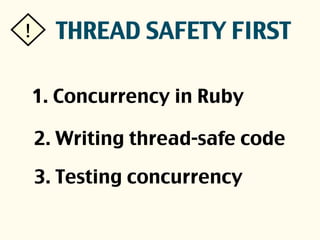
THREAD
SAFETY
FIRST
Emily Stolfo
Ruby Engineer at , Adjunct Faculty at Columbia
@EmStolfo
There is no such thing as
thread-safe Ruby code.
Ruby Engineer at
Adjunct Faculty at Columbia
Expert
Emily Stolfo
require 'set'
members = Set.new
threads = []
200.times do |n|
threads << Thread.new do
if n % 2 == 0
members << n
else
members.first.nil?
end
end
end
threads.each(&:join)
Demo code
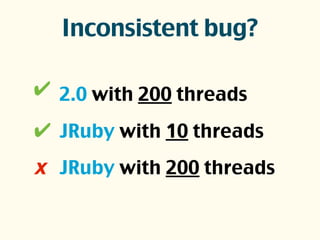
Inconsistent bug?
2.0 with 200 threads
JRuby with 10 threads
JRuby with 200 threads
✔
𝙭
✔
1. Concurrency in Ruby
! THREAD SAFETY FIRST
3. Testing concurrency
2. Writing thread-safe code
CONCURRENCY IN RUBY
There are different
Ruby implementations.
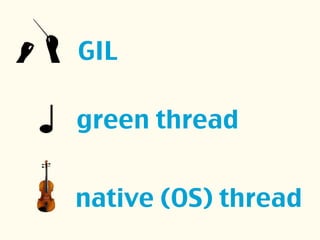
Threads are like
music.
GIL
green thread
native (OS) thread
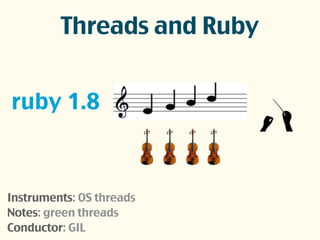
ruby 1.8
Threads and Ruby
Instruments: OS threads
Notes: green threads
Conductor: GIL
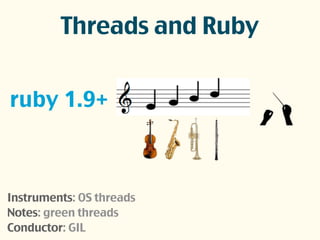
ruby 1.9+
Instruments: OS threads
Notes: green threads
Conductor: GIL
Threads and Ruby
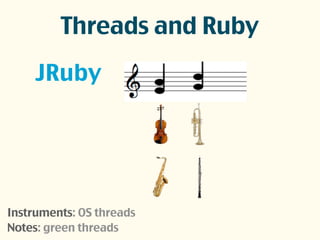
JRuby
Instruments: OS threads
Notes: green threads
Threads and Ruby
Different Rubies?
Different semantics.
Our code
sometimes works by
sheer luck.
You’re lucky your code
hasn’t run on JRuby.
You’re lucky
there is a GIL.
Example:
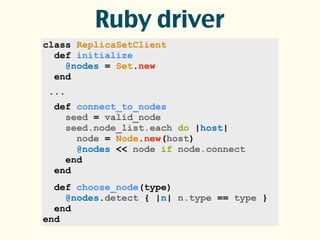
MongoDB Ruby driver
and Replica Sets
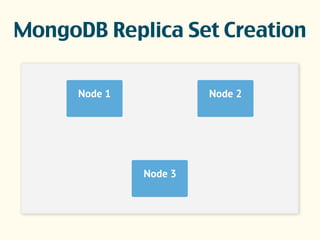
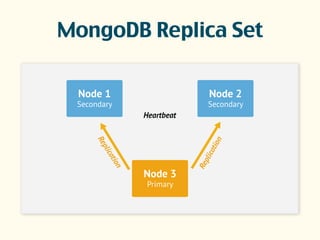
MongoDB Replica Set Creation
MongoDB Replica Set
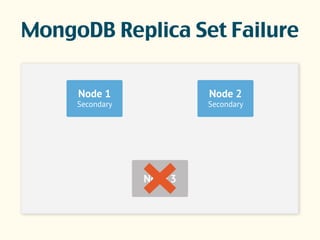
MongoDB Replica Set Failure
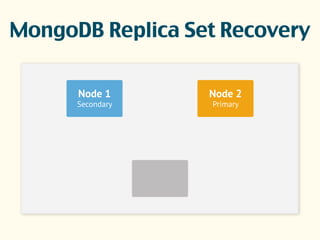
MongoDB Replica Set Recovery
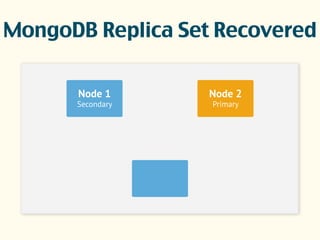
MongoDB Replica Set Recovered
Mutable shared state.
class ReplicaSetClient
def initialize
@nodes = Set.new
end
...
def connect_to_nodes
seed = valid_node
seed.node_list.each do |host|
node = Node.new(host)
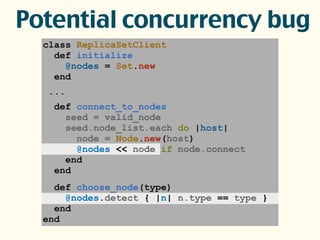
@nodes << node if node.connect
end
end
def choose_node(type)
@nodes.detect { |n| n.type == type }
end
end
Ruby driver
class ReplicaSetClient
def initialize
@nodes = Set.new
end
...
def connect_to_nodes
seed = valid_node
seed.node_list.each do |host|
node = Node.new(host)
@nodes << node if node.connect
end
end
def choose_node(type)
@nodes.detect { |n| n.type == type }
end
end
Potential concurrency bug
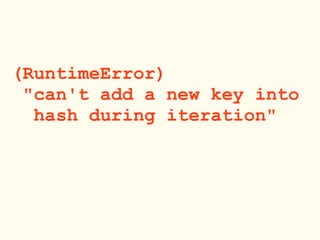
(RuntimeError)
"can't add a new key into
hash during iteration"
We often use
hashes as caches.
Hashes and their
derivatives are not
thread-safe in JRuby.
!
How do we write this
code thread-safely?
WRITING
THREAD-SAFE CODE
Shared data:
Avoid across threads.
If you can’t avoid shared
data, at least avoid
shared mutable data.
If you can’t avoid
shared mutable data,
use concurrency primitives.
The top 2
concurrency primitives
class ReplicaSetClient
def initialize
@nodes = Set.new
@connect_mutex = Mutex.new
end
...
def connect_to_nodes
seed = valid_node
seed.node_list.each do |host|
node = Node.new(host)
@connect_mutex.synchronize do
@nodes << node if node.connect
end
end
end
def choose_node(type)
@connect_mutex.synchronize do
@nodes.detect { |n| n.type == type }
end
end
end
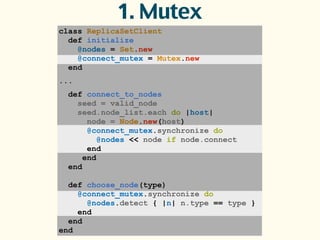
1. Mutex
class ReplicaSetClient
def initialize
@nodes = Set.new
@connect_mutex = Mutex.new
end
...
def connect_to_nodes
seed = valid_node
seed.node_list.each do |host|
node = Node.new(host)
@connect_mutex.synchronize do
@nodes << node if node.connect
end
end
end
def choose_node(type)
@connect_mutex.synchronize do
@nodes.detect { |n| n.type == type }
end
end
end
1. Mutex
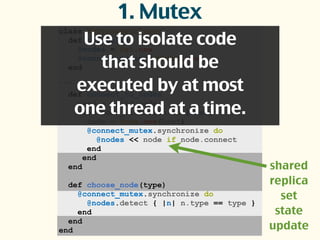
Use to isolate code
that should be
executed by at most
one thread at a time.
shared
replica
set
state
update
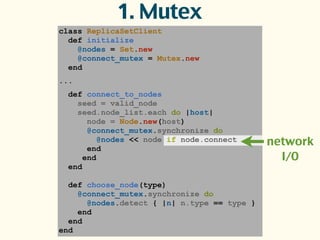
A mutex is not magic.
Avoid locking
around I/O.
class ReplicaSetClient
def initialize
@nodes = Set.new
@connect_mutex = Mutex.new
end
...
def connect_to_nodes
seed = valid_node
seed.node_list.each do |host|
node = Node.new(host)
@connect_mutex.synchronize do
@nodes << node if node.connect
end
end
end
def choose_node(type)
@connect_mutex.synchronize do
@nodes.detect { |n| n.type == type }
end
end
end
1. Mutex
network
I/O
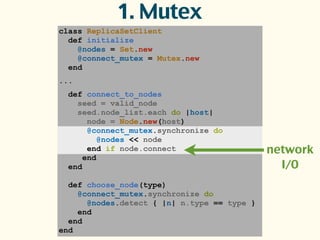
class ReplicaSetClient
def initialize
@nodes = Set.new
@connect_mutex = Mutex.new
end
...
def connect_to_nodes
seed = valid_node
seed.node_list.each do |host|
node = Node.new(host)
@connect_mutex.synchronize do
@nodes << node
end if node.connect
end
end
def choose_node(type)
@connect_mutex.synchronize do
@nodes.detect { |n| n.type == type }
end
end
end
1. Mutex
network
I/O
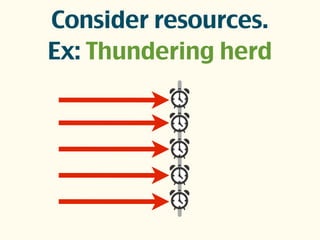
Consider resources.
Ex: Thundering herd
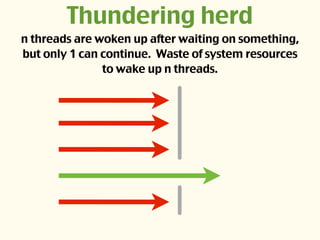
Thundering herd
n threads are woken up after waiting on something,
but only 1 can continue. Waste of system resources
to wake up n threads.
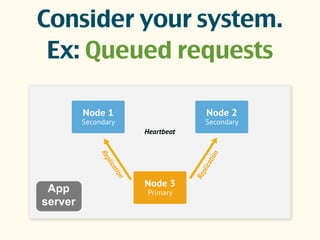
Consider your system.
Ex: Queued requests
App
server
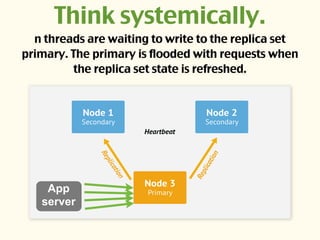
Think systemically.
n threads are waiting to write to the replica set
primary. The primary is flooded with requests when
the replica set state is refreshed.
App
server
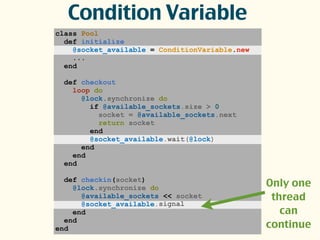
2. Condition Variable
Use to communicate between threads.
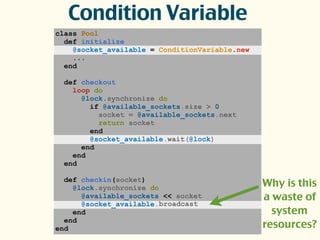
class Pool
def initialize
@socket_available = ConditionVariable.new
...
end
def checkout
loop do
@lock.synchronize do
if @available_sockets.size > 0
socket = @available_sockets.next
return socket
end
@socket_available.wait(@lock)
end
end
end
def checkin(socket)
@lock.synchronize do
@available_sockets << socket
@socket_available.
end
end
end
Condition Variable
broadcast
Why is this
a waste of
system
resources?
class Pool
def initialize
@socket_available = ConditionVariable.new
...
end
def checkout
loop do
@lock.synchronize do
if @available_sockets.size > 0
socket = @available_sockets.next
return socket
end
@socket_available.wait(@lock)
end
end
end
def checkin(socket)
@lock.synchronize do
@available_sockets << socket
@socket_available.
end
end
end
Condition Variable
signal
Only one
thread
can
continue
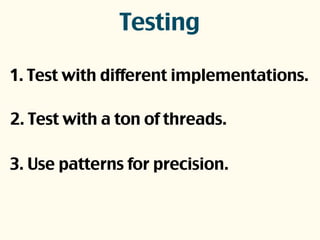
TESTING CONCURRENCY
Testing
1. Test with different implementations.
2. Test with a ton of threads.
3. Use patterns for precision.
require 'set'
members = Set.new
threads = []
10.times do |n|
threads << Thread.new do
if n % 2 == 0
members << n
else
members.first.nil?
end
end
end
threads.each(&:join)
Test with a ton of threads.
require 'set'
members = Set.new
threads = []
200.times do |n|
threads << Thread.new do
if n % 2 == 0
members << n
else
members.first.nil?
end
end
end
threads.each(&:join)
Test with a ton of threads.
Use synchronization
methods if you need
more precision.
ex: rendezvous / barrier
pattern
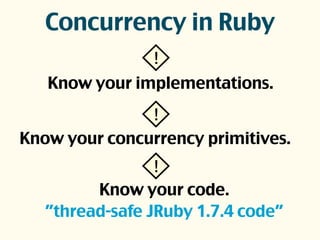
Concurrency in Ruby
Know your implementations.
!
Know your concurrency primitives.
!
Know your code.
”thread-safe JRuby 1.7.4 code”
!
Thanks
Emily Stolfo
@EmStolfo

Ruby thread safety first