*
*


    Developing an assertion
       Crafting a thesis
    Outlining your paragraphs
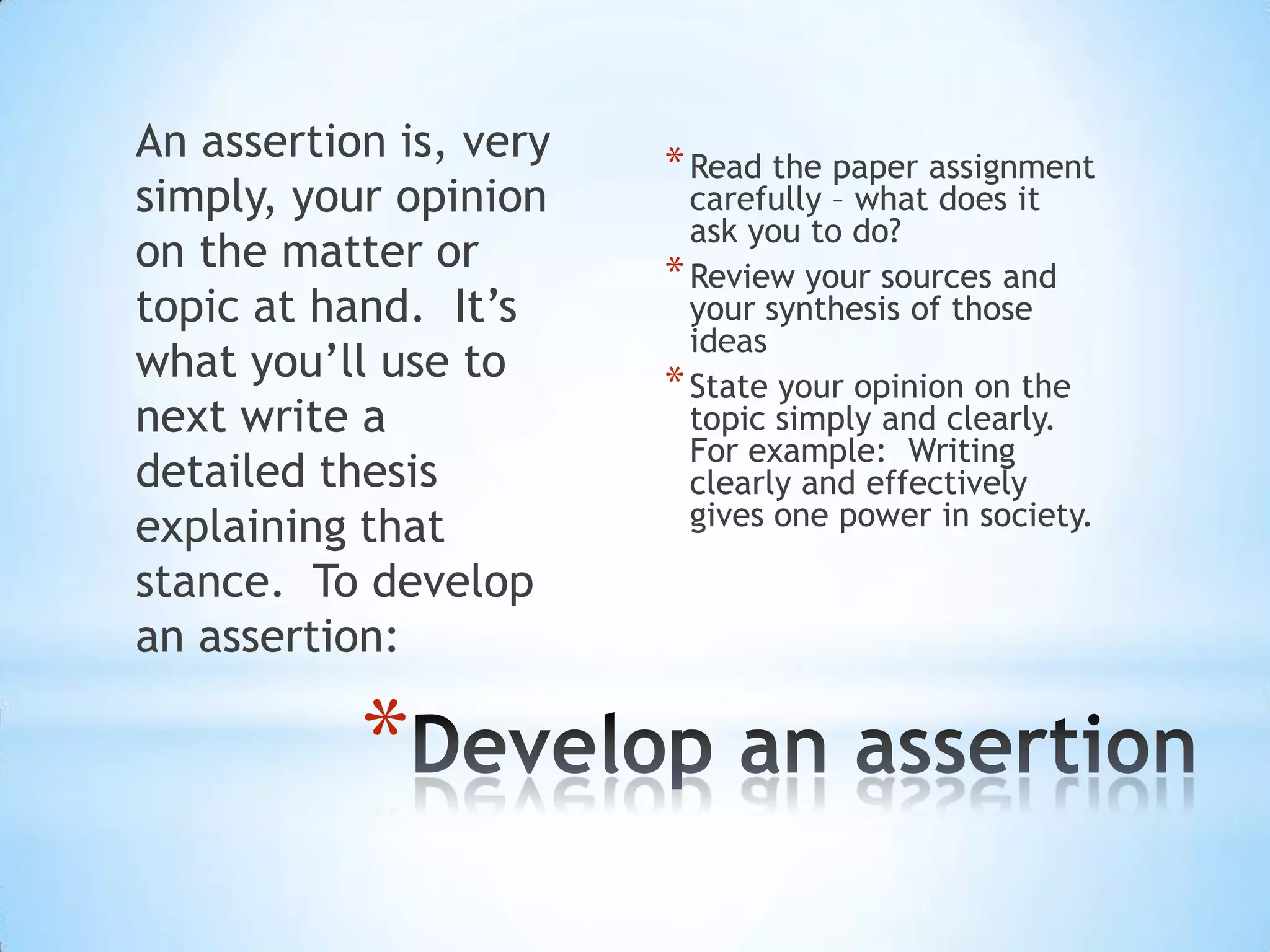
An assertion is, very   * Read the paper assignment
simply, your opinion      carefully – what does it
                          ask you to do?
on the matter or        * Review your sources and
topic at hand. It’s       your synthesis of those
                          ideas
what you’ll use to      * State your opinion on the
next write a              topic simply and clearly.
                          For example: Writing
detailed thesis           clearly and effectively
explaining that           gives one power in society.

stance. To develop
an assertion:

           *
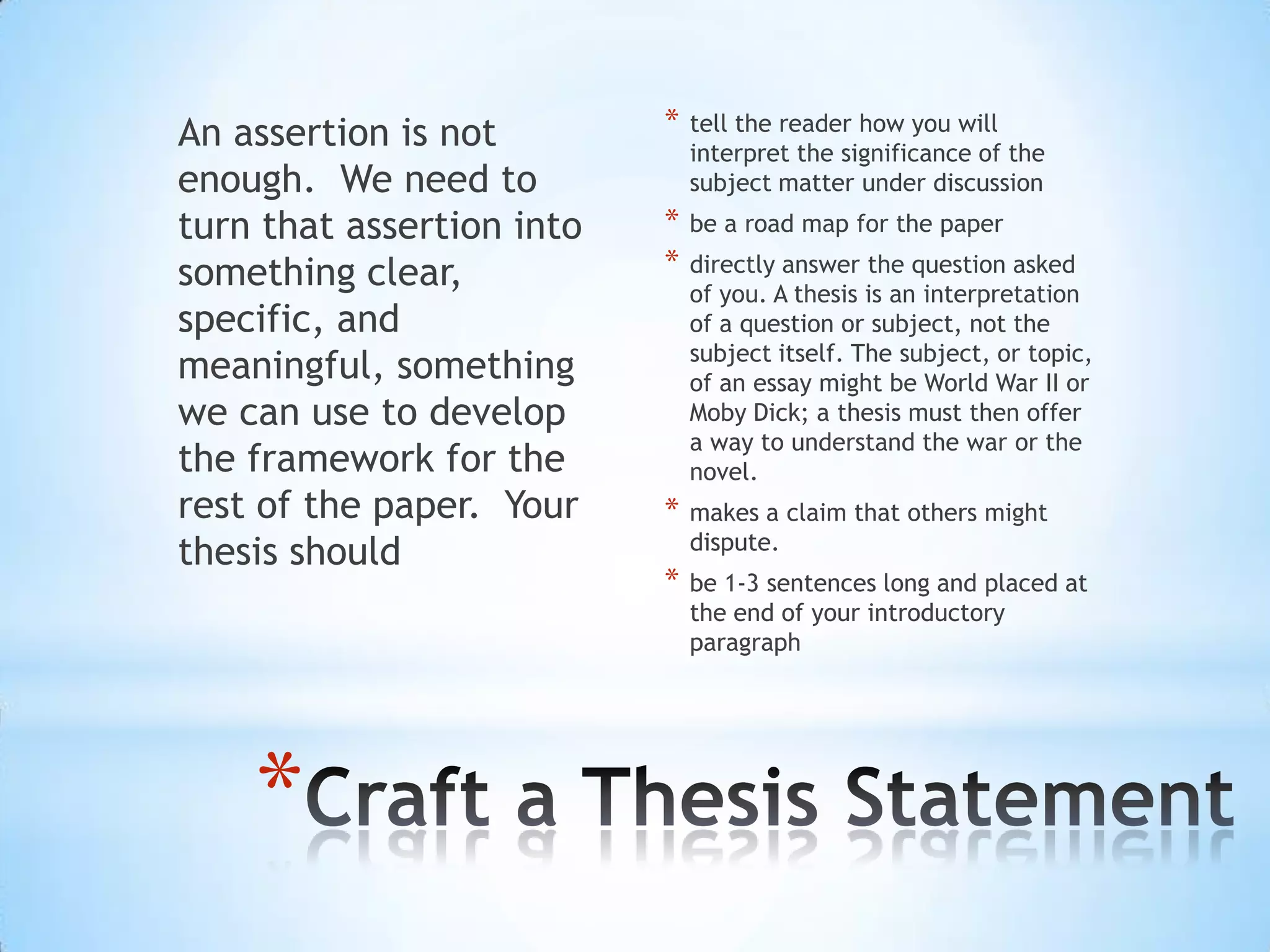
An assertion is not        *   tell the reader how you will
                               interpret the significance of the
enough. We need to             subject matter under discussion
turn that assertion into   *   be a road map for the paper

something clear,           *   directly answer the question asked
                               of you. A thesis is an interpretation
specific, and                  of a question or subject, not the
                               subject itself. The subject, or topic,
meaningful, something          of an essay might be World War II or
we can use to develop          Moby Dick; a thesis must then offer
                               a way to understand the war or the
the framework for the          novel.
rest of the paper. Your    *   makes a claim that others might
                               dispute.
thesis should
                           *   be 1-3 sentences long and placed at
                               the end of your introductory
                               paragraph


    *
In addition to the          * “So What?” – do I provide
                              significance for my opinion.
previous guidelines,          In other words, do I address
                              what’s at stake?
your thesis also needs to   * “How and Why” – Have I
pass a few tests in order     answered these questions to
                              adequately explain my
to be effective:              position?
                            * “Specific?” – Have I been
                              clear and specific, or do I
                              have vague words or phrases
                              that need clarification?


                    *
Let’s start with the assertion example we used at the beginning of
this lesson:


*Writing clearly and effectively gives
 one power in society.
This is an assertion, an opinion with which someone else might
disagree, but it doesn’t yet provide the specificity we need to write
a paper on the subject. Let’s turn it into a thesis statement…


                                            *
*Writing clearly and effectively gives
 one power in society.
We might begin by asking a few questions that will help us delve
deeper into the topic. For example:

* What does it mean to write clearly and effectively?
* What kind of power does it provide?
* In all societies or just specific ones?
* So what? In other words, why does it matter that one has power
 in society?
*The ability to write according to standard
  guidelines and with proper grammar
  control gives one power in society
  because it is a reflection of one’s
  professionalism and he or she can
  communicate more clearly.
Now we’re talking! Here we have a more specific statement that better
reflects the writer’s argument about writing and power. Notice we’ve
answered a few of the questions we developed earlier:

* What does it mean to write clearly and effectively?
   * According to standard guidelines and with grammar control
* What kind of power does it provide?
   * Professionalism and communication
* So what? In other words, why does it matter that one has power in society?
   * Hmmm – let’s look more closely at this…
*The ability to write according to
 standard guidelines and with proper
 grammar control gives one power in
 society because it is a reflection of
 one’s professionalism and he or she
 can communicate more clearly.
Our statement here does a great job at answering the how and why,
but it doesn’t yet pass the “So What” test. Why does it matter that
one is professional and communicates clearly? Remember, don’t
presume any assumptions of your readers. Not everyone will agree
that it’s a good thing to be professional. You have to PROVE it!

One more time…
* The ability to write according to standard
  guidelines and with proper grammar control gives
  one power in society because it is a reflection of
  one’s professionalism and he or she can
  communicate more clearly. As a result, he or she is
  more likely to be successful in his or her career.

Remember the “As a result,” trick! This little introductory clause can easily
help you get at the significance of your argument. This writer could have
chosen any number of things to state. For instance, she could have focused
on personal relationships or academics. Instead, she chose to look at the
relationship between writing and power in terms of one’s career.
Now that you have a strong,         *   Review your thesis statement
specific, and clear                     closely. Break it down into smaller
argumentative thesis                    points. What individual ideas need
statement, you can move                 to be proven for your thesis to be
forward in the planning                 true?
process.
                                    *   Use those individual points as the
                                        basis for each of your body
Your thesis statement provides          paragraphs. You may have three, or
the groundwork for everything           you may have five. There is no
else that is to come in the rest        magic number.
of the essay. It is a road map of   *   Craft mini thesis statements for
sorts. So, what do we do with           each of your individual points.
it?                                     These will serve as topic sentences
                                        for the body paragraphs of your
                                        essay.
                                    *   Let’s do an example…


                                                     *
* The ability to write according to standard guidelines and with
  proper grammar control gives one power in society because it
  is a reflection of one’s professionalism and he or she can
  communicate more clearly. As a result, he or she is more likely
  to be successful in his or her career.
Here’s our thesis statement. Now, how can we break it down into smaller points?
What needs to be proven in order for this statement to be true?

   *   Writing according to standard guidelines and with control of grammar
       reflects one’s professionalism.
   *   Writing according to standard guidelines and with control of grammar allows
       one to communicate more clearly.
   *   Being professional and communicating clearly results in more success in
       one’s career.

These three smaller points are all related to our thesis and require development
and support. We can use them to organize the body paragraphs of our essay.
Now we have our three main points that support our thesis. It’s
time to turn those points into topic sentences. Think of topic
sentences as mini-thesis statements: they are individual points
that will be proven in that paragraph.

   *   Writing according to standard guidelines and with control of grammar
       reflects one’s professionalism.
           *   This works already as a topic sentence! It’s clear and specific, and it’s
               something we can provide evidence to support in the paragraph.
   *   Writing according to standard guidelines and with control of grammar allows
       one to communicate more clearly.
           *   This works but is a little repetitive. Let’s edit it a bit to read: One’s
               communication will be clearer if he or she writes by standard rules and
               with control of grammar.
   *   Being professional and communicating clearly results in more success in
       one’s career.
           *   This also works at it is!
Now you have the basis for your
outline. In our class, what your
outline looks like doesn’t matter as
much as what it accomplishes.

When outlines are due, I expect to see
them reflect a clear thesis statement,
topic sentences, and notes on
evidence for each point. Here’s an
example with our sample
Working thesis: The ability to write according to standard guidelines and with proper grammar
control gives one power in society because it is a reflection of one’s professionalism and he or she
can communicate more clearly. As a result, he or she is more likely to be successful in his or her
career.


*   Paragraph #1: Writing according to standard guidelines and with proper grammar control is a
    reflection of one’s professionalism.
         *   Quotes from business owners on topic
         *   Example of employee
*       Paragraph #2: One’s communication will be clearer if he or she writes by standard rules and
        with control of grammar.
        *        Examples from workplace A
        *        Examples from workplace B
*   Paragraph #3: Being professional and communicating clearly results in more success in one’s
    career.
         *   Examples of successful people
         *   Quotes from experts


You’ll notice in this outline the writer has notes about what evidence will be used to support each
paragraph’s point. As you develop your outline, you can insert page numbers and other notes to help
you organize your source information.


An outline will be do for your papers throughout the semester. You will find a worksheet on
Blackboard under “handouts” that will help you through the outlining process.
By developing an assertion, crafting a
thesis, and outlining your major
points, you can ensure you are well-
organized before you begin drafting
your paper.

Most students also find that this makes
writing a lot easier since most of the
work is already done!

Thesis Statements and Outlines

  • 1.
  • 2.
    * Developing an assertion Crafting a thesis Outlining your paragraphs
  • 3.
    An assertion is,very * Read the paper assignment simply, your opinion carefully – what does it ask you to do? on the matter or * Review your sources and topic at hand. It’s your synthesis of those ideas what you’ll use to * State your opinion on the next write a topic simply and clearly. For example: Writing detailed thesis clearly and effectively explaining that gives one power in society. stance. To develop an assertion: *
  • 4.
    An assertion isnot * tell the reader how you will interpret the significance of the enough. We need to subject matter under discussion turn that assertion into * be a road map for the paper something clear, * directly answer the question asked of you. A thesis is an interpretation specific, and of a question or subject, not the subject itself. The subject, or topic, meaningful, something of an essay might be World War II or we can use to develop Moby Dick; a thesis must then offer a way to understand the war or the the framework for the novel. rest of the paper. Your * makes a claim that others might dispute. thesis should * be 1-3 sentences long and placed at the end of your introductory paragraph *
  • 5.
    In addition tothe * “So What?” – do I provide significance for my opinion. previous guidelines, In other words, do I address what’s at stake? your thesis also needs to * “How and Why” – Have I pass a few tests in order answered these questions to adequately explain my to be effective: position? * “Specific?” – Have I been clear and specific, or do I have vague words or phrases that need clarification? *
  • 6.
    Let’s start withthe assertion example we used at the beginning of this lesson: *Writing clearly and effectively gives one power in society. This is an assertion, an opinion with which someone else might disagree, but it doesn’t yet provide the specificity we need to write a paper on the subject. Let’s turn it into a thesis statement… *
  • 7.
    *Writing clearly andeffectively gives one power in society. We might begin by asking a few questions that will help us delve deeper into the topic. For example: * What does it mean to write clearly and effectively? * What kind of power does it provide? * In all societies or just specific ones? * So what? In other words, why does it matter that one has power in society?
  • 8.
    *The ability towrite according to standard guidelines and with proper grammar control gives one power in society because it is a reflection of one’s professionalism and he or she can communicate more clearly. Now we’re talking! Here we have a more specific statement that better reflects the writer’s argument about writing and power. Notice we’ve answered a few of the questions we developed earlier: * What does it mean to write clearly and effectively? * According to standard guidelines and with grammar control * What kind of power does it provide? * Professionalism and communication * So what? In other words, why does it matter that one has power in society? * Hmmm – let’s look more closely at this…
  • 9.
    *The ability towrite according to standard guidelines and with proper grammar control gives one power in society because it is a reflection of one’s professionalism and he or she can communicate more clearly. Our statement here does a great job at answering the how and why, but it doesn’t yet pass the “So What” test. Why does it matter that one is professional and communicates clearly? Remember, don’t presume any assumptions of your readers. Not everyone will agree that it’s a good thing to be professional. You have to PROVE it! One more time…
  • 10.
    * The abilityto write according to standard guidelines and with proper grammar control gives one power in society because it is a reflection of one’s professionalism and he or she can communicate more clearly. As a result, he or she is more likely to be successful in his or her career. Remember the “As a result,” trick! This little introductory clause can easily help you get at the significance of your argument. This writer could have chosen any number of things to state. For instance, she could have focused on personal relationships or academics. Instead, she chose to look at the relationship between writing and power in terms of one’s career.
  • 11.
    Now that youhave a strong, * Review your thesis statement specific, and clear closely. Break it down into smaller argumentative thesis points. What individual ideas need statement, you can move to be proven for your thesis to be forward in the planning true? process. * Use those individual points as the basis for each of your body Your thesis statement provides paragraphs. You may have three, or the groundwork for everything you may have five. There is no else that is to come in the rest magic number. of the essay. It is a road map of * Craft mini thesis statements for sorts. So, what do we do with each of your individual points. it? These will serve as topic sentences for the body paragraphs of your essay. * Let’s do an example… *
  • 12.
    * The abilityto write according to standard guidelines and with proper grammar control gives one power in society because it is a reflection of one’s professionalism and he or she can communicate more clearly. As a result, he or she is more likely to be successful in his or her career. Here’s our thesis statement. Now, how can we break it down into smaller points? What needs to be proven in order for this statement to be true? * Writing according to standard guidelines and with control of grammar reflects one’s professionalism. * Writing according to standard guidelines and with control of grammar allows one to communicate more clearly. * Being professional and communicating clearly results in more success in one’s career. These three smaller points are all related to our thesis and require development and support. We can use them to organize the body paragraphs of our essay.
  • 13.
    Now we haveour three main points that support our thesis. It’s time to turn those points into topic sentences. Think of topic sentences as mini-thesis statements: they are individual points that will be proven in that paragraph. * Writing according to standard guidelines and with control of grammar reflects one’s professionalism. * This works already as a topic sentence! It’s clear and specific, and it’s something we can provide evidence to support in the paragraph. * Writing according to standard guidelines and with control of grammar allows one to communicate more clearly. * This works but is a little repetitive. Let’s edit it a bit to read: One’s communication will be clearer if he or she writes by standard rules and with control of grammar. * Being professional and communicating clearly results in more success in one’s career. * This also works at it is!
  • 14.
    Now you havethe basis for your outline. In our class, what your outline looks like doesn’t matter as much as what it accomplishes. When outlines are due, I expect to see them reflect a clear thesis statement, topic sentences, and notes on evidence for each point. Here’s an example with our sample
  • 15.
    Working thesis: Theability to write according to standard guidelines and with proper grammar control gives one power in society because it is a reflection of one’s professionalism and he or she can communicate more clearly. As a result, he or she is more likely to be successful in his or her career. * Paragraph #1: Writing according to standard guidelines and with proper grammar control is a reflection of one’s professionalism. * Quotes from business owners on topic * Example of employee * Paragraph #2: One’s communication will be clearer if he or she writes by standard rules and with control of grammar. * Examples from workplace A * Examples from workplace B * Paragraph #3: Being professional and communicating clearly results in more success in one’s career. * Examples of successful people * Quotes from experts You’ll notice in this outline the writer has notes about what evidence will be used to support each paragraph’s point. As you develop your outline, you can insert page numbers and other notes to help you organize your source information. An outline will be do for your papers throughout the semester. You will find a worksheet on Blackboard under “handouts” that will help you through the outlining process.
  • 16.
    By developing anassertion, crafting a thesis, and outlining your major points, you can ensure you are well- organized before you begin drafting your paper. Most students also find that this makes writing a lot easier since most of the work is already done!