Common Errors
Avoiding easy pitfalls
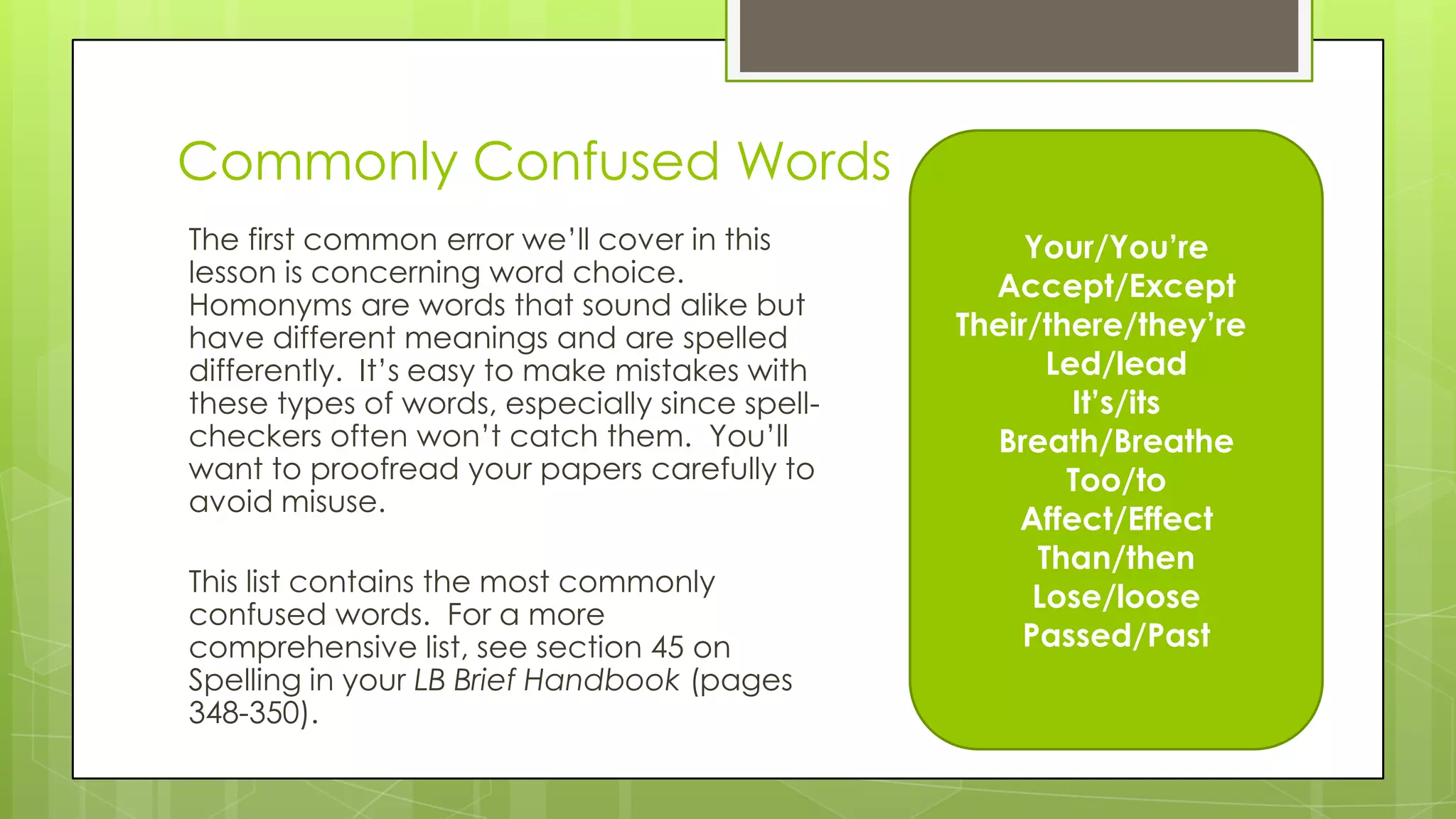
Your/You’re
Accept/Except
Their/there/they’re
Led/lead
It’s/its
Breath/Breathe
Too/to
Affect/Effect
Than/then
Lose/loose
Passed/Past
The first common error we’ll cover in this
lesson is concerning word choice.
Homonyms are words that sound alike but
have different meanings and are spelled
differently. It’s easy to make mistakes with
these types of words, especially since spell-
checkers often won’t catch them. You’ll
want to proofread your papers carefully to
avoid misuse.
This list contains the most commonly
confused words. For a more
comprehensive list, see section 45 on
Spelling in your LB Brief Handbook (pages
348-350).
Commonly Confused Words
Sentence Fragments
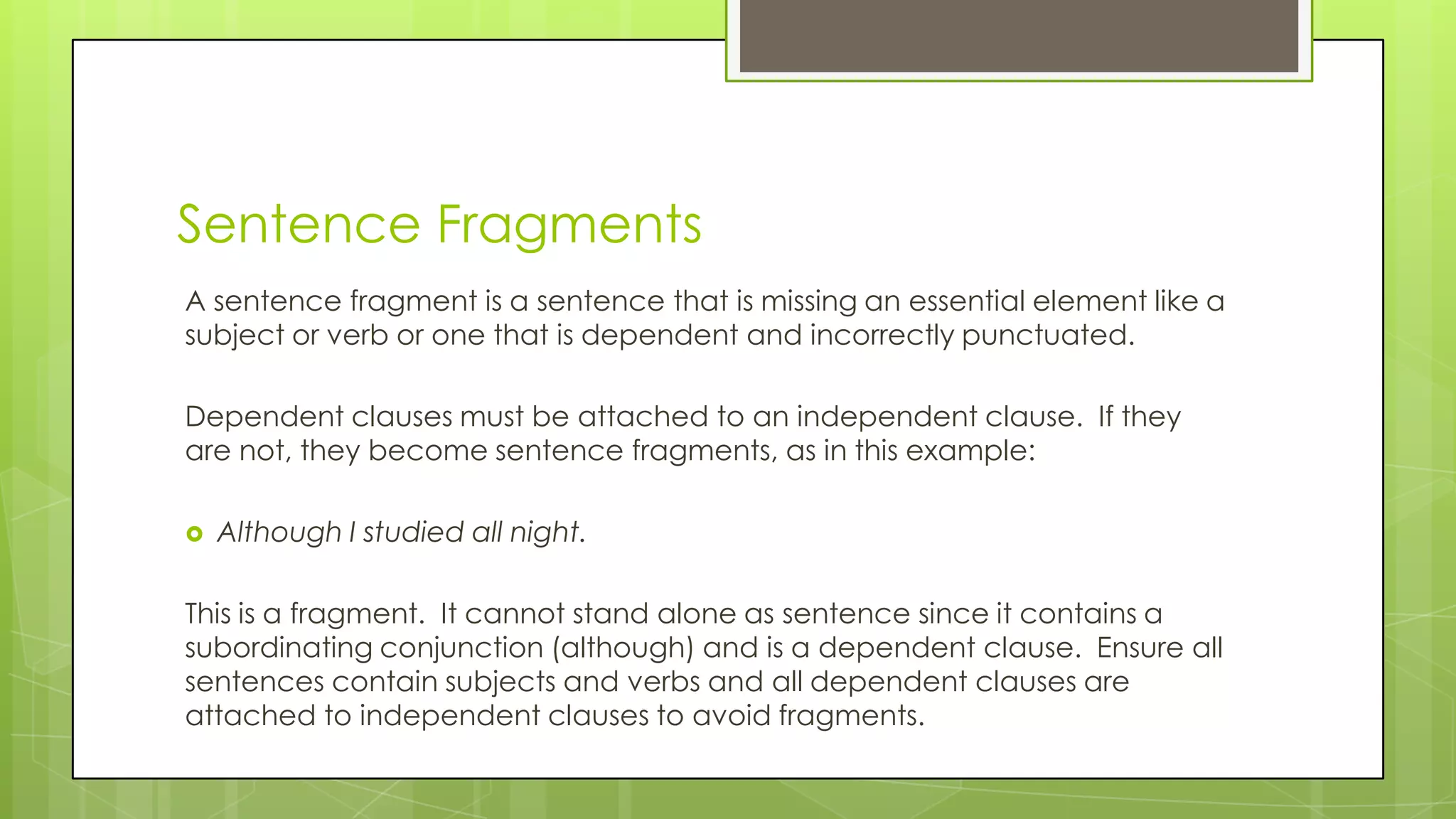
A sentence fragment is a sentence that is missing an essential element like a
subject or verb or one that is dependent and incorrectly punctuated.
Dependent clauses must be attached to an independent clause. If they
are not, they become sentence fragments, as in this example:
 Although I studied all night.
This is a fragment. It cannot stand alone as sentence since it contains a
subordinating conjunction (although) and is a dependent clause. Ensure all
sentences contain subjects and verbs and all dependent clauses are
attached to independent clauses to avoid fragments.
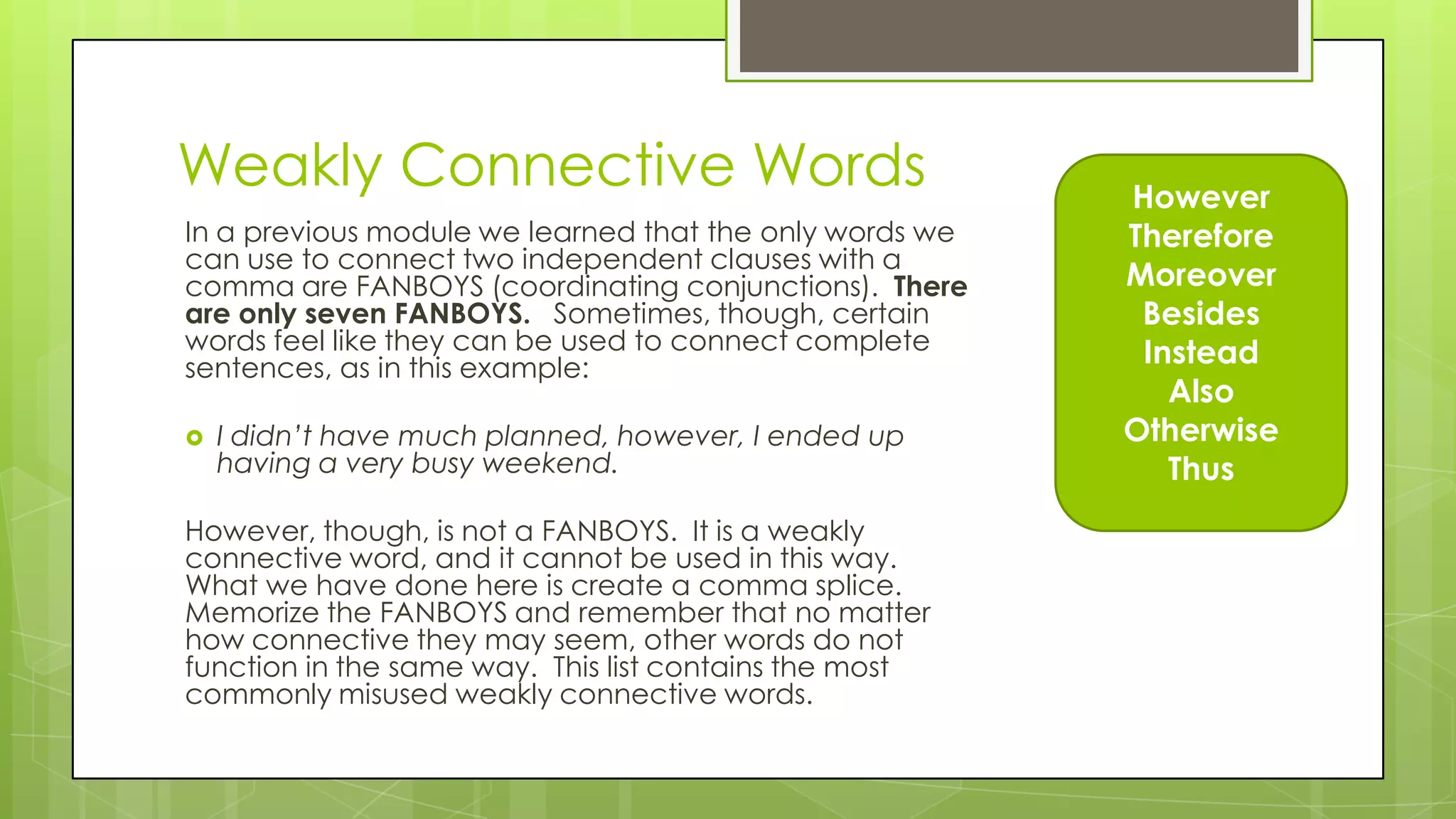
However
Therefore
Moreover
Besides
Instead
Also
Otherwise
Thus
In a previous module we learned that the only words we
can use to connect two independent clauses with a
comma are FANBOYS (coordinating conjunctions). There
are only seven FANBOYS. Sometimes, though, certain
words feel like they can be used to connect complete
sentences, as in this example:
 I didn’t have much planned, however, I ended up
having a very busy weekend.
However, though, is not a FANBOYS. It is a weakly
connective word, and it cannot be used in this way.
What we have done here is create a comma splice.
Memorize the FANBOYS and remember that no matter
how connective they may seem, other words do not
function in the same way. This list contains the most
commonly misused weakly connective words.
Weakly Connective Words
Let’s Review!
Common Errors
Along with errors with sentence boundaries and commas, these are
common errors for which you need to proofread carefully in your writing:
 Commonly confused words such as their/there/they’re
 Sentence fragments
 Weakly connective words such as however and although
Additional Resources
For an excellent, condensed list of common writing errors See the
Purdue Online Writing Lab resource on common errors.
Click here to visit the page (opens in new window).
<http://owl.english.purdue.edu/owl/resource/561/2/>

Common errors

  • 1.
  • 2.
    Your/You’re Accept/Except Their/there/they’re Led/lead It’s/its Breath/Breathe Too/to Affect/Effect Than/then Lose/loose Passed/Past The first commonerror we’ll cover in this lesson is concerning word choice. Homonyms are words that sound alike but have different meanings and are spelled differently. It’s easy to make mistakes with these types of words, especially since spell- checkers often won’t catch them. You’ll want to proofread your papers carefully to avoid misuse. This list contains the most commonly confused words. For a more comprehensive list, see section 45 on Spelling in your LB Brief Handbook (pages 348-350). Commonly Confused Words
  • 3.
    Sentence Fragments A sentencefragment is a sentence that is missing an essential element like a subject or verb or one that is dependent and incorrectly punctuated. Dependent clauses must be attached to an independent clause. If they are not, they become sentence fragments, as in this example:  Although I studied all night. This is a fragment. It cannot stand alone as sentence since it contains a subordinating conjunction (although) and is a dependent clause. Ensure all sentences contain subjects and verbs and all dependent clauses are attached to independent clauses to avoid fragments.
  • 4.
    However Therefore Moreover Besides Instead Also Otherwise Thus In a previousmodule we learned that the only words we can use to connect two independent clauses with a comma are FANBOYS (coordinating conjunctions). There are only seven FANBOYS. Sometimes, though, certain words feel like they can be used to connect complete sentences, as in this example:  I didn’t have much planned, however, I ended up having a very busy weekend. However, though, is not a FANBOYS. It is a weakly connective word, and it cannot be used in this way. What we have done here is create a comma splice. Memorize the FANBOYS and remember that no matter how connective they may seem, other words do not function in the same way. This list contains the most commonly misused weakly connective words. Weakly Connective Words
  • 5.
    Let’s Review! Common Errors Alongwith errors with sentence boundaries and commas, these are common errors for which you need to proofread carefully in your writing:  Commonly confused words such as their/there/they’re  Sentence fragments  Weakly connective words such as however and although
  • 6.
    Additional Resources For anexcellent, condensed list of common writing errors See the Purdue Online Writing Lab resource on common errors. Click here to visit the page (opens in new window). <http://owl.english.purdue.edu/owl/resource/561/2/>

Editor's Notes

  • #2 Hello.Welcome to the grammar module on common errors. In this module we’ll cover several errors that are seen often in first-year writing.
  • #3 Let’s begin with commonly confused words. These are usually homonyms, words that sound alike but have different meanings and spellings. Spell checkers often don’t catch these mistakes, so you’ll need to proofread carefully to avoid misuse. The most commonly misused words are there, your, and its. For a bigger list and definitions, see page 348 of your LB Brief.
  • #4 Sentence fragments are very common errors. Fragments occur when a sentence is missing a subject or a verb or when it is a dependent clause that has been punctuated as independent. This example is a fragment. It cannot stand alone as sentence since it contains a subordinating conjunction (although) and is a dependent clause. Ensure all sentences contain subjects and verbs and all dependent clauses are attached to independent clauses to avoid fragments.
  • #5 Students often make many errors with weakly connective words. In a previous module we learned that the only words we can use to connect two independent clauses with a comma are FANBOYS (coordinating conjunctions). There are only seven FANBOYS. Sometimes, though, certain words feel like they can be used to connect complete sentences, as in this example. But “however” is NOT a FANBOYS. By using this way, we have created a comma splice. This list contains the most common weakly connective words, but there are others, too.
  • #6 Along with errors with sentence boundaries and commas, keep an eye out for errors with commonly confused words, fragments, and weakly connective words in your writing. Proofread carefully!
  • #7 Finally, use these additional resources to learn more about commas or to review as we build on this knowledge in upcoming modules.