*
*
                  Synthesize
            Gather Information
               Integrate

Strong academic writing most often requires the use of
sources to relay information beyond general knowledge
and to support your own ideas and conclusions. You will
learn to use sources correctly for effective engagement
and to avoid plagiarism.
When you synthesize material
– between one writer’s
                                * Respond to sources
opinions and another’s or
between a writer’s ideas and
                                * Connect sources
your own experiences – you
develop new knowledge and
                                * Develop your own
create the material that will    ideas
inform the content of your
own writing.
                                * See pages 410-413 LBB
Use the following guidelines
when synthesizing the ideas
of others.


                                 *
As you read, be sure to   * Take notes about main
assess and organize the    ideas
information in your       * Keep accurate records
sources. This will help    about how to find
you understand and         sources and material
synthesize the ideas.
                          * Annotate as you read
                           by underlining or
                           highlighting important
                           passages


          *
Once you have gathered      * Summary
information and             * Paraphrase
synthesized your
sources, it’s time to put   * Direct Quotation
them to work!
You’ll integrate
information from your
sources in your own
essays to support your
ideas and conclusions.
There are three primary
ways we do this:                *
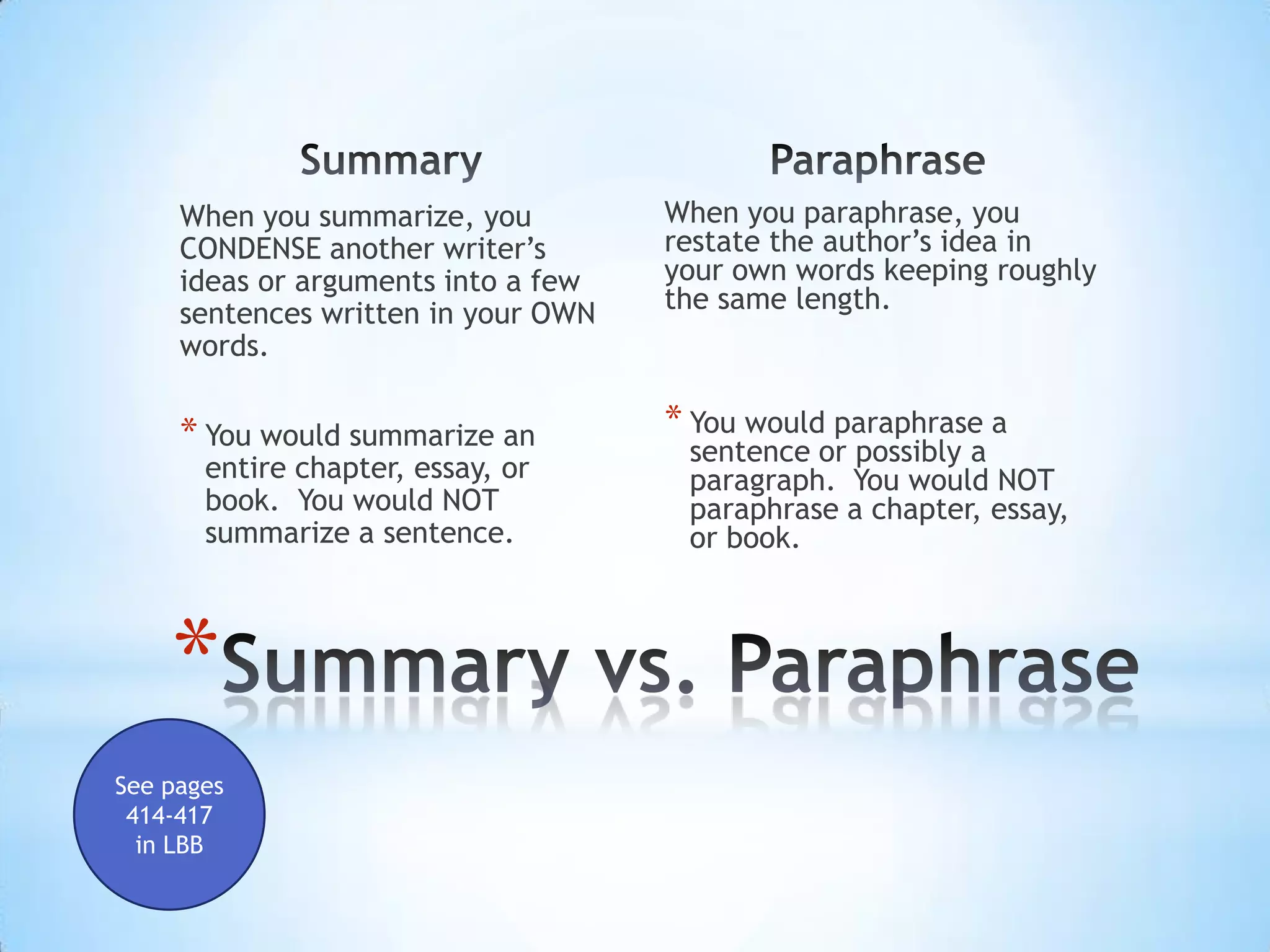
When you summarize, you         When you paraphrase, you
     CONDENSE another writer’s       restate the author’s idea in
     ideas or arguments into a few   your own words keeping roughly
     sentences written in your OWN   the same length.
     words.

     * You would summarize an        * You would paraphrase a
                                      sentence or possibly a
       entire chapter, essay, or      paragraph. You would NOT
       book. You would NOT            paraphrase a chapter, essay,
       summarize a sentence.          or book.


    *
See pages
 414-417
  in LBB
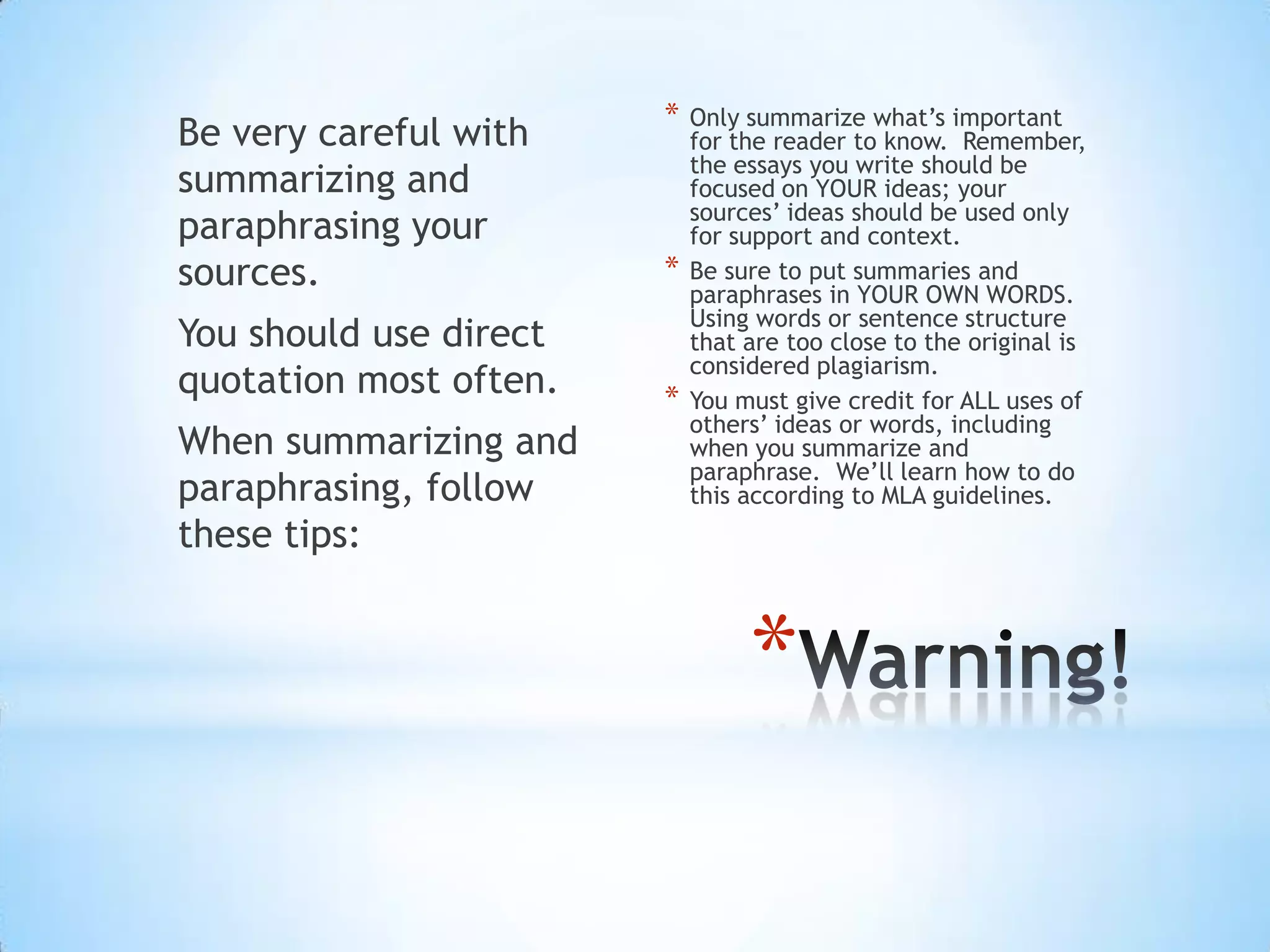
*   Only summarize what’s important
Be very careful with        for the reader to know. Remember,
                            the essays you write should be
summarizing and             focused on YOUR ideas; your
                            sources’ ideas should be used only
paraphrasing your           for support and context.
sources.                *   Be sure to put summaries and
                            paraphrases in YOUR OWN WORDS.
                            Using words or sentence structure
You should use direct       that are too close to the original is
                            considered plagiarism.
quotation most often.   *   You must give credit for ALL uses of
                            others’ ideas or words, including
When summarizing and        when you summarize and
                            paraphrase. We’ll learn how to do
paraphrasing, follow        this according to MLA guidelines.
these tips:


                                 *
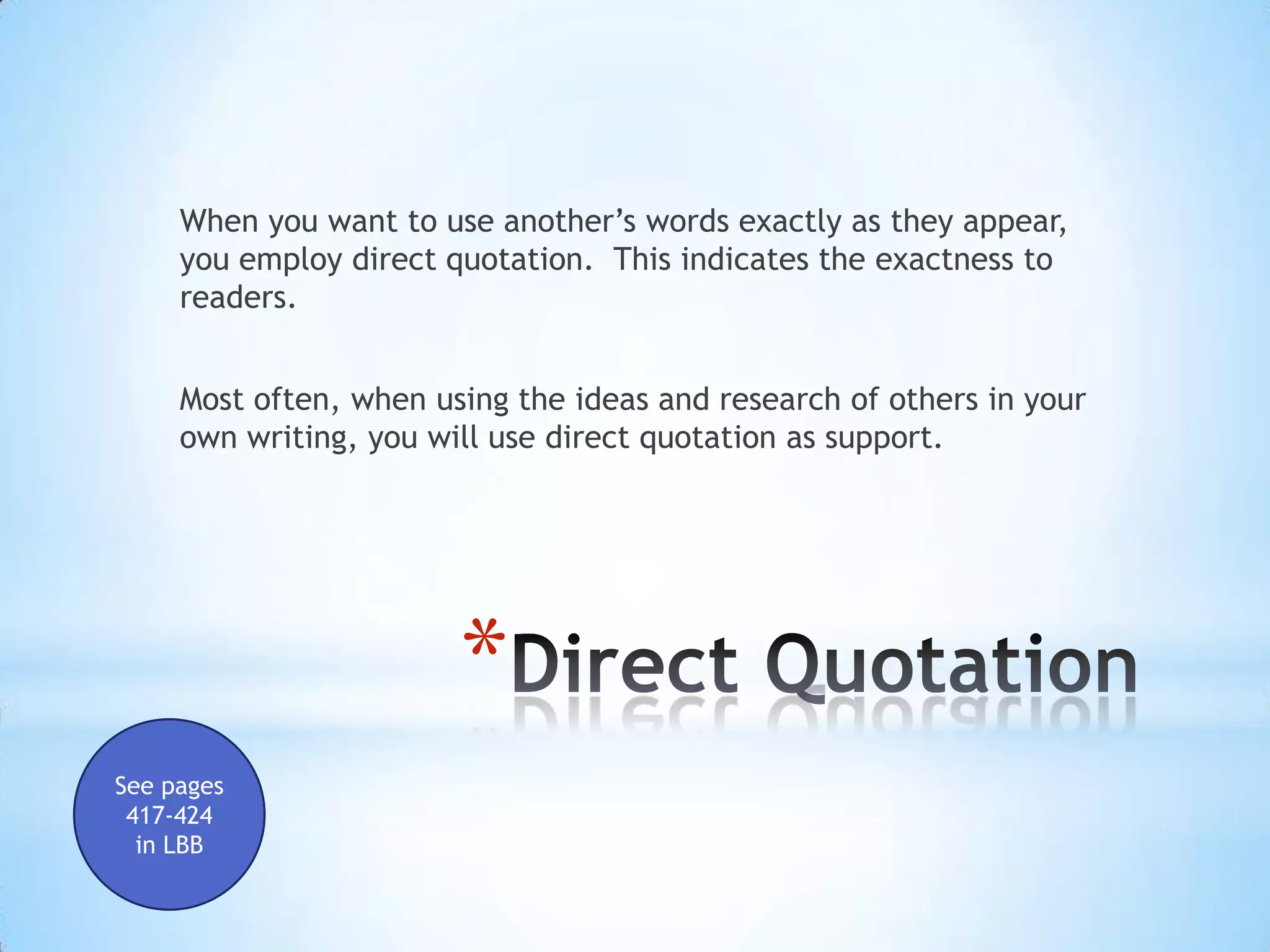
When you want to use another’s words exactly as they appear,
     you employ direct quotation. This indicates the exactness to
     readers.


     Most often, when using the ideas and research of others in your
     own writing, you will use direct quotation as support.


                        *
See pages
 417-424
  in LBB
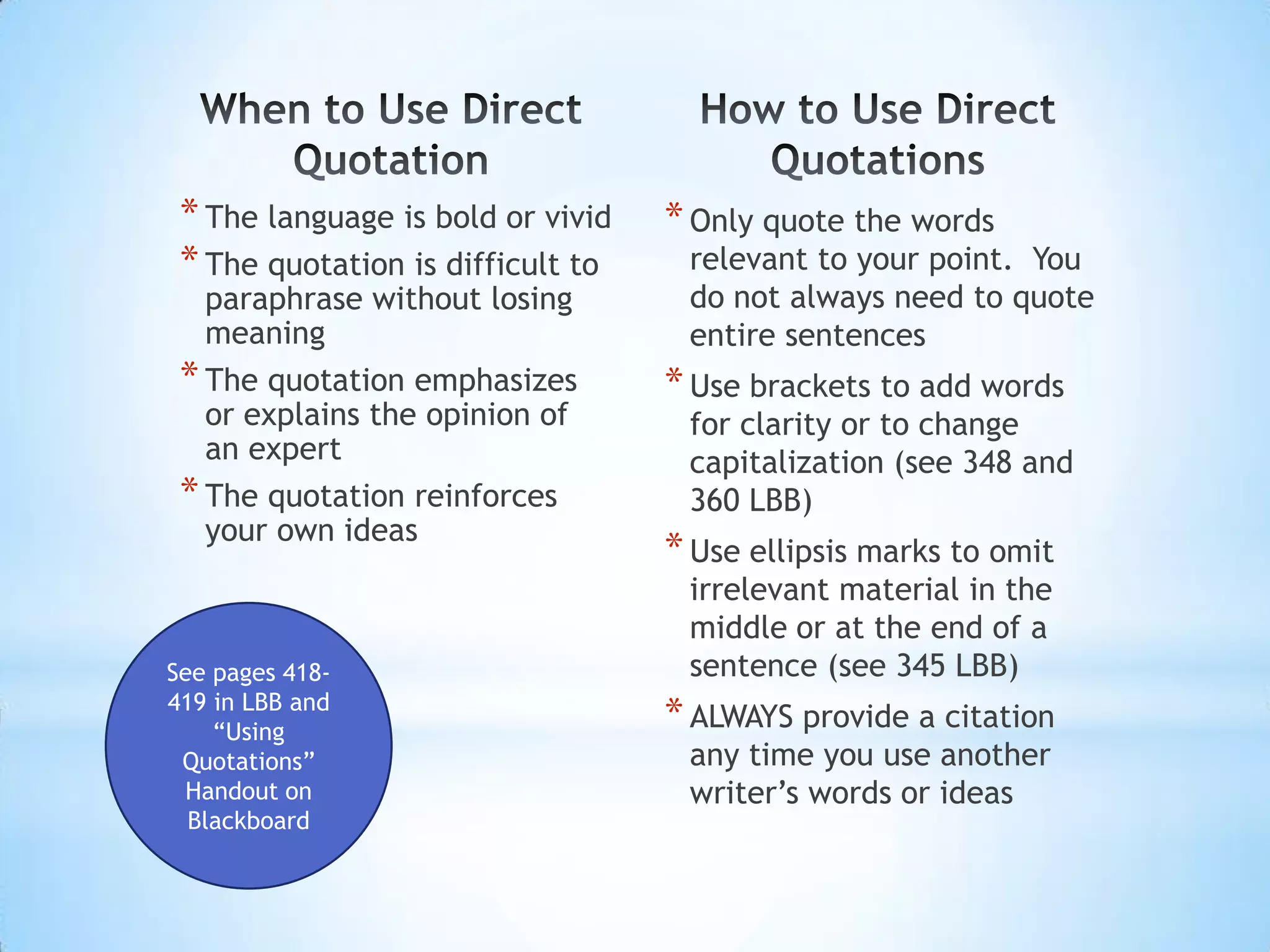
* The language is bold or vivid   * Only quote the words
 * The quotation is difficult to    relevant to your point. You
   paraphrase without losing        do not always need to quote
   meaning                          entire sentences
 * The quotation emphasizes        * Use brackets to add words
   or explains the opinion of       for clarity or to change
   an expert                        capitalization (see 348 and
 * The quotation reinforces         360 LBB)
   your own ideas
                                   * Use ellipsis marks to omit
                                    irrelevant material in the
                                    middle or at the end of a
See pages 418-                      sentence (see 345 LBB)
419 in LBB and
    “Using
                                   * ALWAYS provide a citation
 Quotations”                        any time you use another
 Handout on                         writer’s words or ideas
  Blackboard
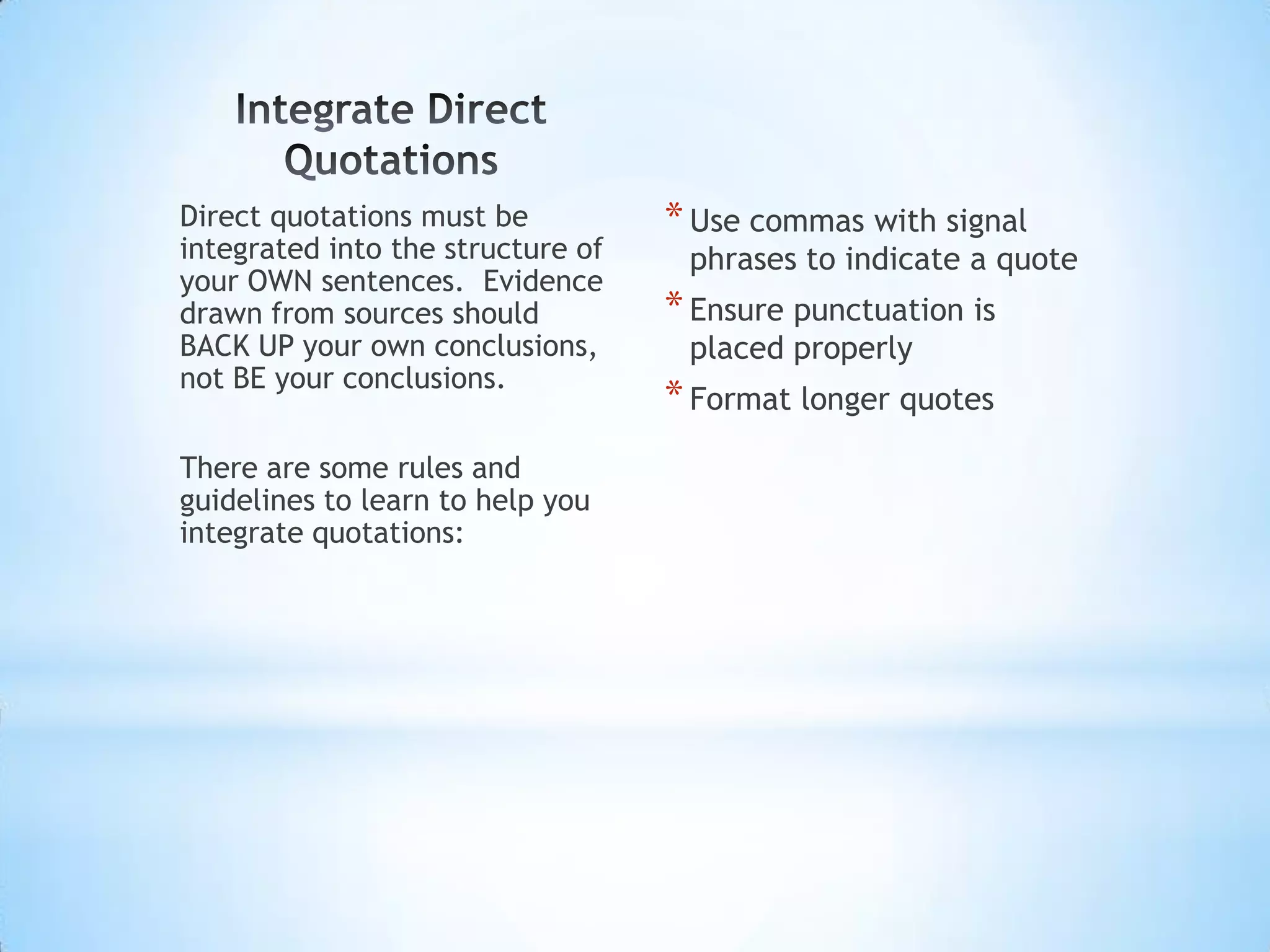
Direct quotations must be          * Use commas with signal
integrated into the structure of    phrases to indicate a quote
your OWN sentences. Evidence
drawn from sources should          * Ensure punctuation is
BACK UP your own conclusions,       placed properly
not BE your conclusions.
                                   * Format longer quotes
There are some rules and
guidelines to learn to help you
integrate quotations:
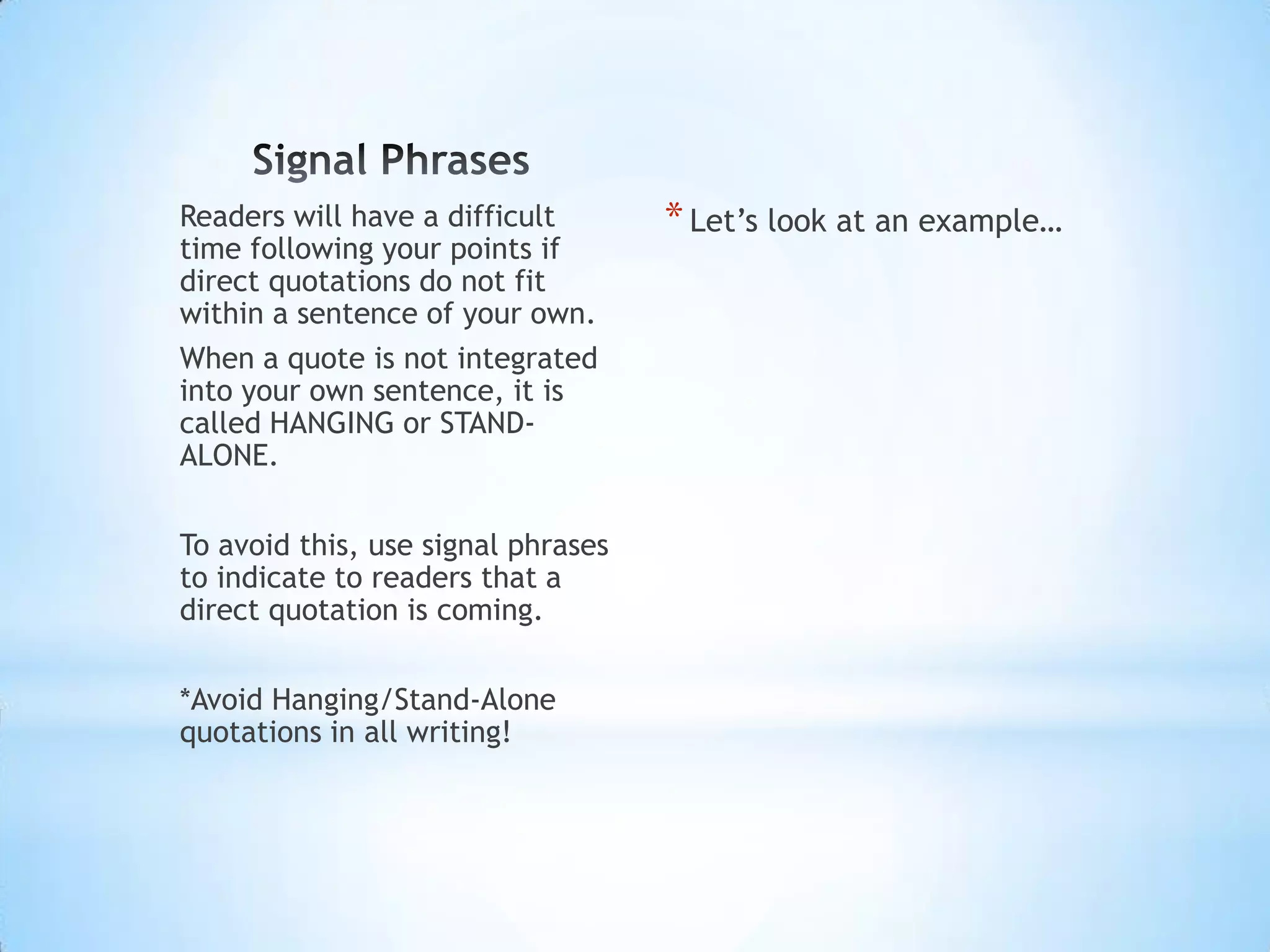
Readers will have a difficult       * Let’s look at an example…
time following your points if
direct quotations do not fit
within a sentence of your own.
When a quote is not integrated
into your own sentence, it is
called HANGING or STAND-
ALONE.

To avoid this, use signal phrases
to indicate to readers that a
direct quotation is coming.

*Avoid Hanging/Stand-Alone
quotations in all writing!
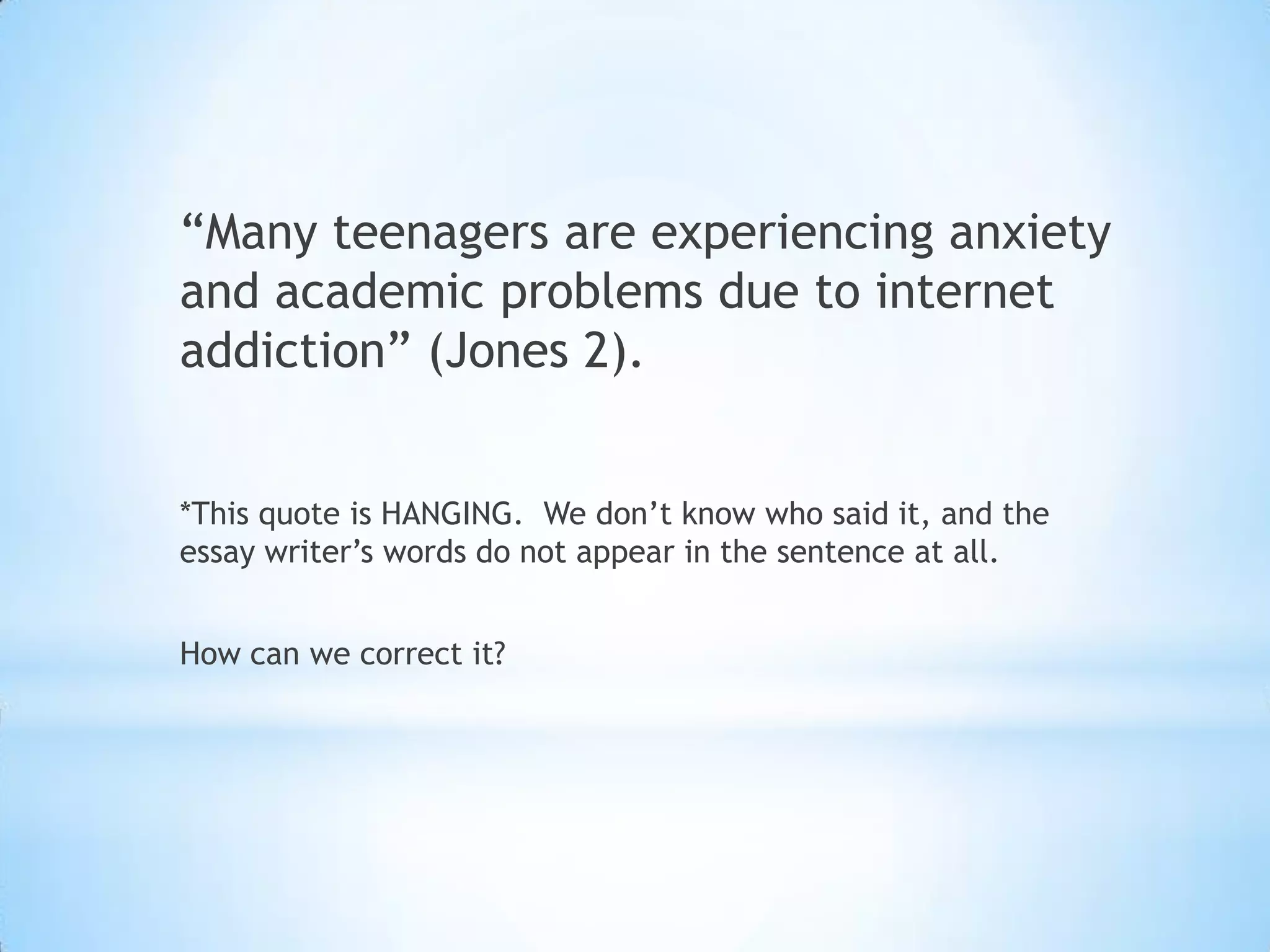
“Many teenagers are experiencing anxiety
and academic problems due to internet
addiction” (Jones 2).


*This quote is HANGING. We don’t know who said it, and the
essay writer’s words do not appear in the sentence at all.


How can we correct it?
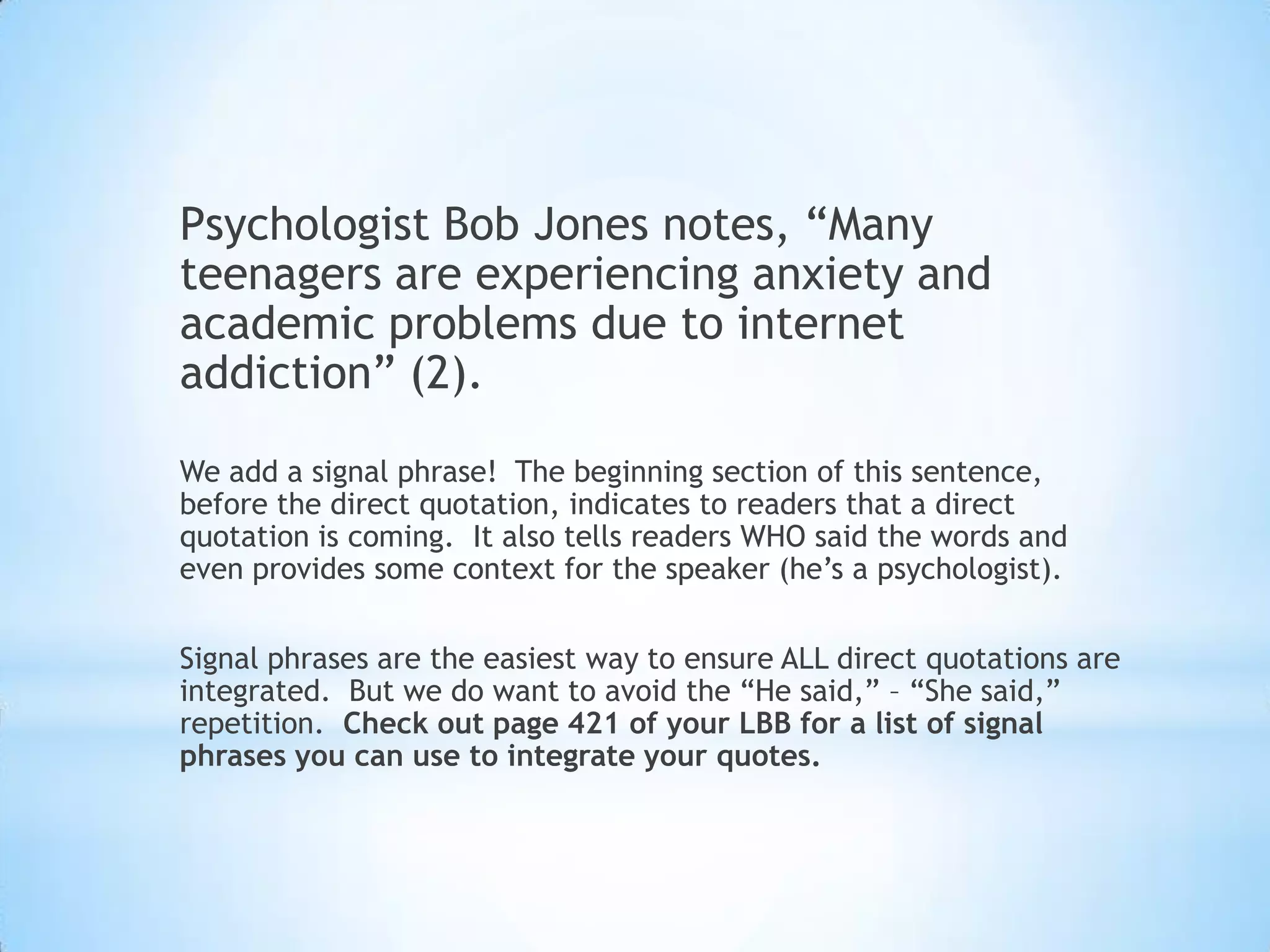
Psychologist Bob Jones notes, “Many
teenagers are experiencing anxiety and
academic problems due to internet
addiction” (2).

We add a signal phrase! The beginning section of this sentence,
before the direct quotation, indicates to readers that a direct
quotation is coming. It also tells readers WHO said the words and
even provides some context for the speaker (he’s a psychologist).

Signal phrases are the easiest way to ensure ALL direct quotations are
integrated. But we do want to avoid the “He said,” – “She said,”
repetition. Check out page 421 of your LBB for a list of signal
phrases you can use to integrate your quotes.
When a quotation runs more than four typed lines, you must use
block quote formatting. Maintain regular spacing but start your
quotation on a new line and indent one full inch from the left
margin. You do NOT need quotation marks with a block quotation,
and punctuation precedes the citation.


See page 481 in your LB Brief for an example.


                       *
There are several punctuation and formatting
rules that apply when using direct quotations.
Let’s take a look at the most common ones.


             *
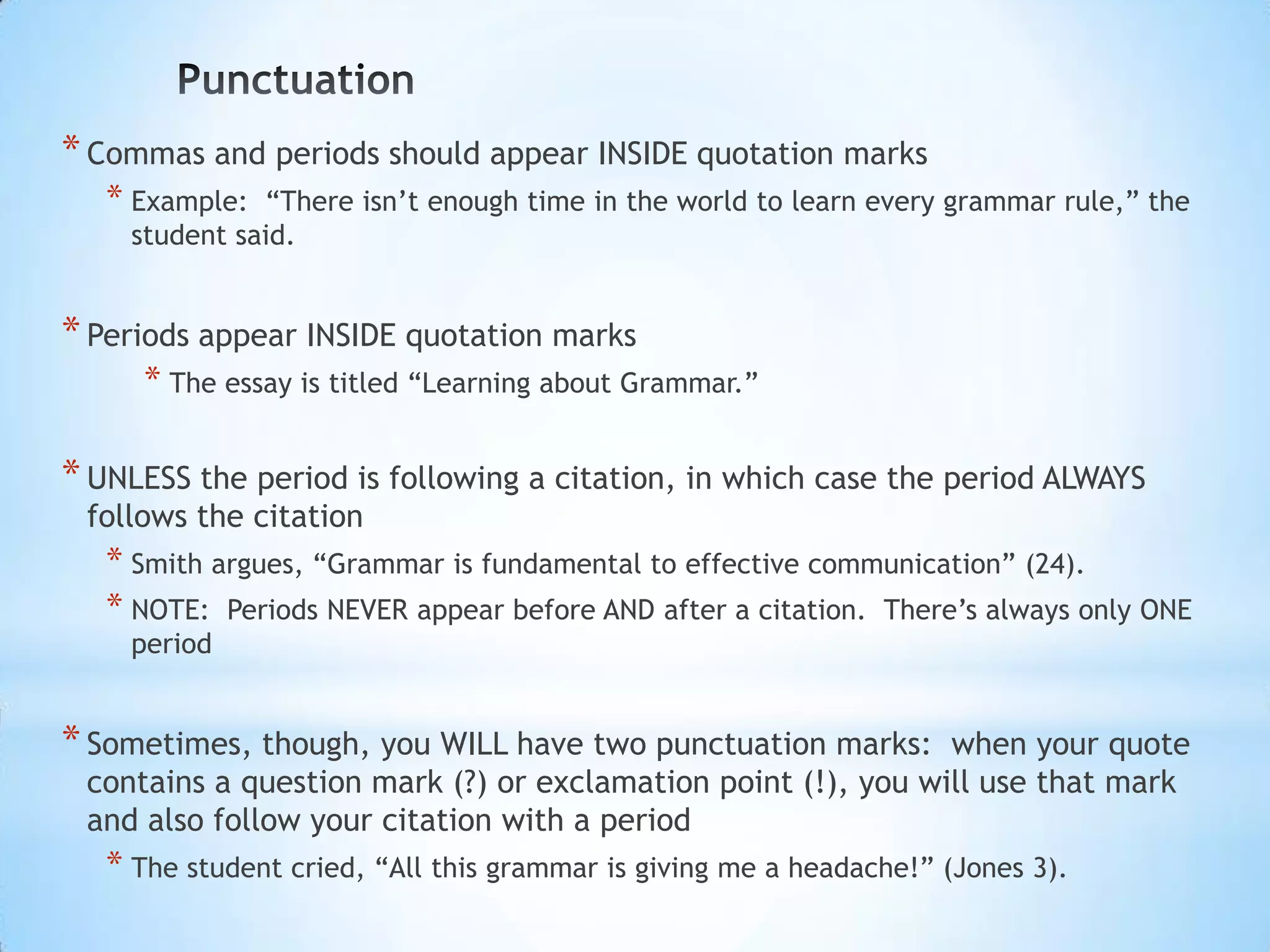
* Commas and periods should appear INSIDE quotation marks
   * Example: “There isn’t enough time in the world to learn every grammar rule,” the
    student said.


* Periods appear INSIDE quotation marks
     * The essay is titled “Learning about Grammar.”

* UNLESS the period is following a citation, in which case the period ALWAYS
 follows the citation
   * Smith argues, “Grammar is fundamental to effective communication” (24).
   * NOTE: Periods NEVER appear before AND after a citation. There’s always only ONE
    period


* Sometimes, though, you WILL have two punctuation marks:     when your quote
 contains a question mark (?) or exclamation point (!), you will use that mark
 and also follow your citation with a period
   * The student cried, “All this grammar is giving me a headache!” (Jones 3).
*See pages 410-424 in LLB to review the
 information covered in this Powerpoint
*See pages 338-342 in LLB for punctuation
 rules with quotation marks
*See the “MLA Citation and Formatting”
 Powerpoint for more information on
 citations
*See the using quotations handout for a
 printable tips list to use while writing


*

Using Sources

  • 1.
  • 2.
    * Synthesize Gather Information Integrate Strong academic writing most often requires the use of sources to relay information beyond general knowledge and to support your own ideas and conclusions. You will learn to use sources correctly for effective engagement and to avoid plagiarism.
  • 3.
    When you synthesizematerial – between one writer’s * Respond to sources opinions and another’s or between a writer’s ideas and * Connect sources your own experiences – you develop new knowledge and * Develop your own create the material that will ideas inform the content of your own writing. * See pages 410-413 LBB Use the following guidelines when synthesizing the ideas of others. *
  • 4.
    As you read,be sure to * Take notes about main assess and organize the ideas information in your * Keep accurate records sources. This will help about how to find you understand and sources and material synthesize the ideas. * Annotate as you read by underlining or highlighting important passages *
  • 5.
    Once you havegathered * Summary information and * Paraphrase synthesized your sources, it’s time to put * Direct Quotation them to work! You’ll integrate information from your sources in your own essays to support your ideas and conclusions. There are three primary ways we do this: *
  • 6.
    When you summarize,you When you paraphrase, you CONDENSE another writer’s restate the author’s idea in ideas or arguments into a few your own words keeping roughly sentences written in your OWN the same length. words. * You would summarize an * You would paraphrase a sentence or possibly a entire chapter, essay, or paragraph. You would NOT book. You would NOT paraphrase a chapter, essay, summarize a sentence. or book. * See pages 414-417 in LBB
  • 7.
    * Only summarize what’s important Be very careful with for the reader to know. Remember, the essays you write should be summarizing and focused on YOUR ideas; your sources’ ideas should be used only paraphrasing your for support and context. sources. * Be sure to put summaries and paraphrases in YOUR OWN WORDS. Using words or sentence structure You should use direct that are too close to the original is considered plagiarism. quotation most often. * You must give credit for ALL uses of others’ ideas or words, including When summarizing and when you summarize and paraphrase. We’ll learn how to do paraphrasing, follow this according to MLA guidelines. these tips: *
  • 8.
    When you wantto use another’s words exactly as they appear, you employ direct quotation. This indicates the exactness to readers. Most often, when using the ideas and research of others in your own writing, you will use direct quotation as support. * See pages 417-424 in LBB
  • 9.
    * The languageis bold or vivid * Only quote the words * The quotation is difficult to relevant to your point. You paraphrase without losing do not always need to quote meaning entire sentences * The quotation emphasizes * Use brackets to add words or explains the opinion of for clarity or to change an expert capitalization (see 348 and * The quotation reinforces 360 LBB) your own ideas * Use ellipsis marks to omit irrelevant material in the middle or at the end of a See pages 418- sentence (see 345 LBB) 419 in LBB and “Using * ALWAYS provide a citation Quotations” any time you use another Handout on writer’s words or ideas Blackboard
  • 10.
    Direct quotations mustbe * Use commas with signal integrated into the structure of phrases to indicate a quote your OWN sentences. Evidence drawn from sources should * Ensure punctuation is BACK UP your own conclusions, placed properly not BE your conclusions. * Format longer quotes There are some rules and guidelines to learn to help you integrate quotations:
  • 11.
    Readers will havea difficult * Let’s look at an example… time following your points if direct quotations do not fit within a sentence of your own. When a quote is not integrated into your own sentence, it is called HANGING or STAND- ALONE. To avoid this, use signal phrases to indicate to readers that a direct quotation is coming. *Avoid Hanging/Stand-Alone quotations in all writing!
  • 12.
    “Many teenagers areexperiencing anxiety and academic problems due to internet addiction” (Jones 2). *This quote is HANGING. We don’t know who said it, and the essay writer’s words do not appear in the sentence at all. How can we correct it?
  • 13.
    Psychologist Bob Jonesnotes, “Many teenagers are experiencing anxiety and academic problems due to internet addiction” (2). We add a signal phrase! The beginning section of this sentence, before the direct quotation, indicates to readers that a direct quotation is coming. It also tells readers WHO said the words and even provides some context for the speaker (he’s a psychologist). Signal phrases are the easiest way to ensure ALL direct quotations are integrated. But we do want to avoid the “He said,” – “She said,” repetition. Check out page 421 of your LBB for a list of signal phrases you can use to integrate your quotes.
  • 14.
    When a quotationruns more than four typed lines, you must use block quote formatting. Maintain regular spacing but start your quotation on a new line and indent one full inch from the left margin. You do NOT need quotation marks with a block quotation, and punctuation precedes the citation. See page 481 in your LB Brief for an example. *
  • 15.
    There are severalpunctuation and formatting rules that apply when using direct quotations. Let’s take a look at the most common ones. *
  • 16.
    * Commas andperiods should appear INSIDE quotation marks * Example: “There isn’t enough time in the world to learn every grammar rule,” the student said. * Periods appear INSIDE quotation marks * The essay is titled “Learning about Grammar.” * UNLESS the period is following a citation, in which case the period ALWAYS follows the citation * Smith argues, “Grammar is fundamental to effective communication” (24). * NOTE: Periods NEVER appear before AND after a citation. There’s always only ONE period * Sometimes, though, you WILL have two punctuation marks: when your quote contains a question mark (?) or exclamation point (!), you will use that mark and also follow your citation with a period * The student cried, “All this grammar is giving me a headache!” (Jones 3).
  • 17.
    *See pages 410-424in LLB to review the information covered in this Powerpoint *See pages 338-342 in LLB for punctuation rules with quotation marks *See the “MLA Citation and Formatting” Powerpoint for more information on citations *See the using quotations handout for a printable tips list to use while writing *