RUUT VEENHOVEN
HEDONISM AND HAPPINESS∗
ABSTRACT. Hedonism is a way of life, characterised by openness to pleasurable experience.
There are many qualms about hedonism. It is rejected on moral
grounds and said to be detrimental tolong-term happiness. Several mechanisms for
this ‘paradox of hedonism’ have been suggested and telling examples of pleasure
seekers ending up in despair have been given. But is that the rule? If so, how much
pleasure is too much? An overview of the available knowledge is given in this paper.
The relation between hedonism and happiness has been studied at two levels:
that of the nation and the individual. At the national level average happiness is correlated
with moral acceptance of pleasure and with active leisure. At the individual
level it is similarly linked with hedonistic attitudes and also correlated with hedonistic
behaviours such as frequent sex and use of stimulants. In most cases the pattern is linearly
positive. The relation between happiness and consumption of stimulants follows
an inverted U-curve, spoilsports and guzzlers are less happy than modest consumers.
Yet, these data cannot settle the issue, since the observed relations may be spurious
or due to the effects of happiness on hedonism rather than the reverse. Even if we can
prove a positive effect of (mild) hedonism on happiness, there is still the question of
how that gains balances against a possible loss of health. A solution is to assess the
effect of hedonistic living on the numberof years lived happily.
KEY WORDS: happiness, lifestyle, pleasure cross-cultural
limitation that this study only reported correlations. The relationship between smoking and
happiness has also been studied at the national level. At this level a clear negative relationship
emerges (see Figure 5).
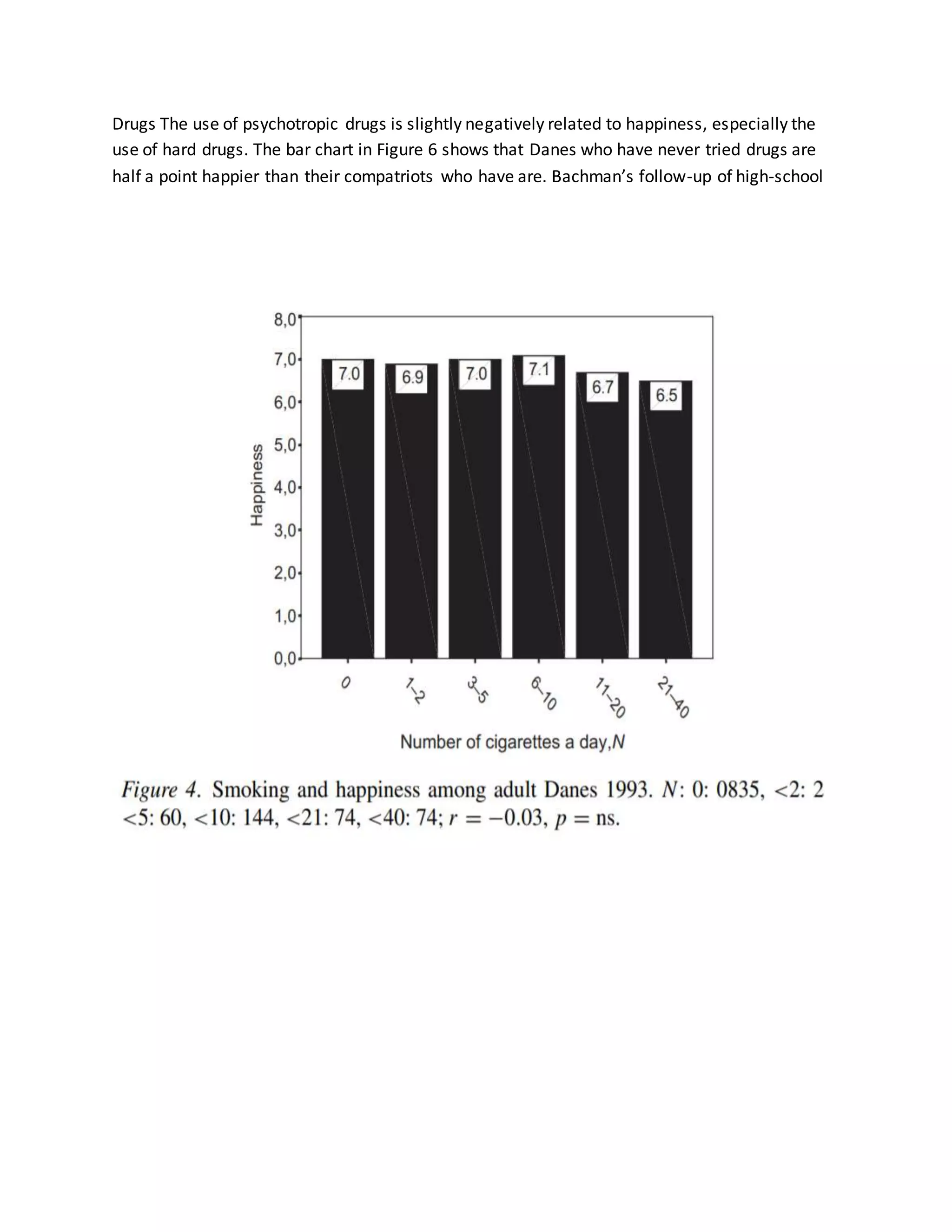
Drugs The use of psychotropic drugs is slightly negatively related to happiness, especially the
use of hard drugs. The bar chart in Figure 6 shows that Danes who have never tried drugs are
half a point happier than their compatriots who have are. Bachman’s follow-up of high-school
HEDONISM
INDIANA UNIVERSITY–PURDUE UNIVERSITY INDIANAPOLIS (IUPUI)
jtilley@iupui.edu
[Final (orpenultimate?) draftof anarticle that appearedinthe Encyclopediaof AppliedEthics,2nded.,
ed.Ruth Chadwick(SanDiego:AcademicPress,2012),vol.2: 566–73.]
I. AncientHedonism
II.Ethical Hedonism
III.Axiological Hedonism
IV.Psychological Hedonism
V.ImplicationsforAppliedEthics
GLOSSARY
ancient hedonismA termfor the normative viewsof the CyrenaicandEpicureanphilosophers.
The Cyrenaicsflourishedinthe fourthcenturyB.C.;the Epicureansinthe twocenturies
followingthatone.Bothgroupsprescribedpleasure asthe goal of life,buttheyhelddifferent
viewsaboutthe essence of pleasureandaboutthe bestwayto obtainit.
axiological hedonismA theoryof intrinsicvalue,withtwocore components:first,all pleasure
isintrinsicallygood;andsecond,nothingbutpleasure isintrinsicallygood.
ethical hedonismThe thesisthatthe moral rightnessof anact derivesfromthe pleasurethe act
produces.Itcomesin twomainversions:hedonisticethical egoism;andhedonisticact
utilitarianism.
extrinsicvalue Such value ispossessedbyathingowingtoits relationstootherthingsof value.
For instance,athinghas extrinsicvalue if itresultsin,orisa meansto,somethingelse of
value.Unlike intrinsicvalue,extrinsicvalue vanishesif the thinginwhichitresidesis
viewedintotal abstractionfromeverythingelse.(Here andelsewhere,“thing”hasits
broadestmeaning.Itextendsnotonlytotablesandchairs,butalsoto pleasure,pain,
knowledge,justice,andsoforth.)
intrinsicvalue The value a thingpossessesinsofarasitisvaluable initself,takeninabstraction
fromeverythingelse,includingitseffects,itsaccompaniments,andthe endsitpromotes.
Intrinsicvalue contrastswithextrinsicvalue,butthe twodonot exclude eachother.A single
thingcan have both kindsof value.
nonhedonistsThose whorejecthedonism.The termusuallystandsforthose whoreject
axiological hedonism.Some of the latterare monists:theythinkthere isasingle intrinsic
good,a good that isnot pleasure.Othersare pluralists:theythinkthere are twoor more
intrinsicgoods,atleastone of whichisnot pleasure.Possibleintrinsicgoodsinclude (in
additiontopleasure) life,justice,beauty,andknowledge.Some prominentnonhedonistsare
Plato(428–348 B.C.),Aristotle (384–322 B.C.),Immanuel Kant(1724–1804), T. H. Green
(1836–1882), F.H. Bradley(1846–1924), and G. E. Moore (1873–1958).
psychological egoismThe viewthathuman beingsare soconstitutedthateverypurposive
humanact ultimatelyderivesfromself-interest.Wheneverapersonacts,her ultimate aimis
onlyto promote herownsurvival,orherownpleasure,etc.
psychological hedonismA versionof psychological egoism.Itassertsthateverypurposive
humanact ultimatelyspringsfromthe agent’sdesire forpleasure—specifically,hisown
pleasure.
qualitative hedonismA form of axiological hedonismaccordingtowhichthe intrinsicvalue of
a pleasure increaseswiththe quantityandqualityof the pleasure,notmerelywithitsquantity
alone.
quantitative hedonismA formof axiological hedonismaccordingtowhichthe intrinsicvalue
of a pleasure variesdirectly,andsolely,withthe quantityof pleasure.
HAPPIEST COUNTRIES IN THE WORLD
2019
HOW DO WE ASSESS HAPPINESS?
That is not to say the report is without a scientific basis. Economic and social
influences are considered along with the survey (namely GDP per capita,
social support, life expectancy, freedom to make life choices, generosity and
perceptions of corruption), but the focus is on how happy citizens say they
are; not how happy statisticians think they should be
OTHER KEY HEADLINES INCLUDE:
Australia has dropped out of the top 10 happiest countries in the world and
now sits as position 11. Austria has gained two spots to take its place.
The 10 countries with the largest declines typically suffered some combination
of economic, political and social stresses. The five largest drops since 2005-
2008 were in Yemen, India, Syria, Botswana and Venezuela
There are no superpowers in the top 10 happiest countries in the world
indicating that a country’s economic strength does not always correlate with
the happiness of its citizens.
HAPPIEST COUNTRIES IN THE W ORLD 2019
– RANKED
RANK COUNTRY SCORE
1 Finland 7.769
2 Denmark 7.600
3 Norway 7.554
4 Iceland 7.494
RANK COUNTRY SCORE
5 Netherlands 7.488
6 Switzerland 7.480
7 Sweden 7.343
8 New Zealand 7.307
9 Canada 7.278
10 Austria 7.246
11 Australia 7.228
12 Costa Rica 7.167
13 Israel 7.139
14 Luxembourg 7.090
15 United Kingdom 7.054
16 Ireland 7.021
17 Germany 6.985
18 Belgium 6.923
19 United States 6.892
20 Czech Republic 6.852
RANK COUNTRY SCORE
21 United Arab Emirates 6.825
22 Malta 6.726
23 Mexico 6.595
24 France 6.592
25 Taiwan 6.446
26 Chile 6.444
27 Guatemala 6.436
28 Saudi Arabia 6.375
29 Qatar 6.374
30 Spain 6.354
31 Panama 6.321
32 Brazil 6.300
33 Uruguay 6.293
34 Singapore 6.262
35 El Salvador 6.253
36 Italy 6.223
RANK COUNTRY SCORE
37 Bahrain 6.199
38 Slovakia 6.198
39 Trinidad and Tobago 6.192
40 Poland 6.182
41 Uzbekistan 6.174
42 Lithuania 6.149
43 Colombia 6.125
44 Slovenia 6.118
45 Nicaragua 6.105
46 Kosovo 6.100
47 Argentina 6.086
48 Romania 6.070
49 Cyprus 6.046
50 Ecuador 6.028
51 Kuwait 6.021
52 Thailand 6.008
RANK COUNTRY SCORE
53 Latvia 5.940
54 South Korea 5.895
55 Estonia 5.893
56 Jamaica 5.890
57 Mauritius 5.888
58 Japan 5.886
59 Honduras 5.86
60 Kazakhstan 5.809
61 Bolivia 5.779
62 Hungary 5.758
63 Paraguay 5.743
64 North Cyprus 5.718
65 Peru 5.697
66 Portugal 5.693
67 Pakistan 5.653
68 Russia 5.648
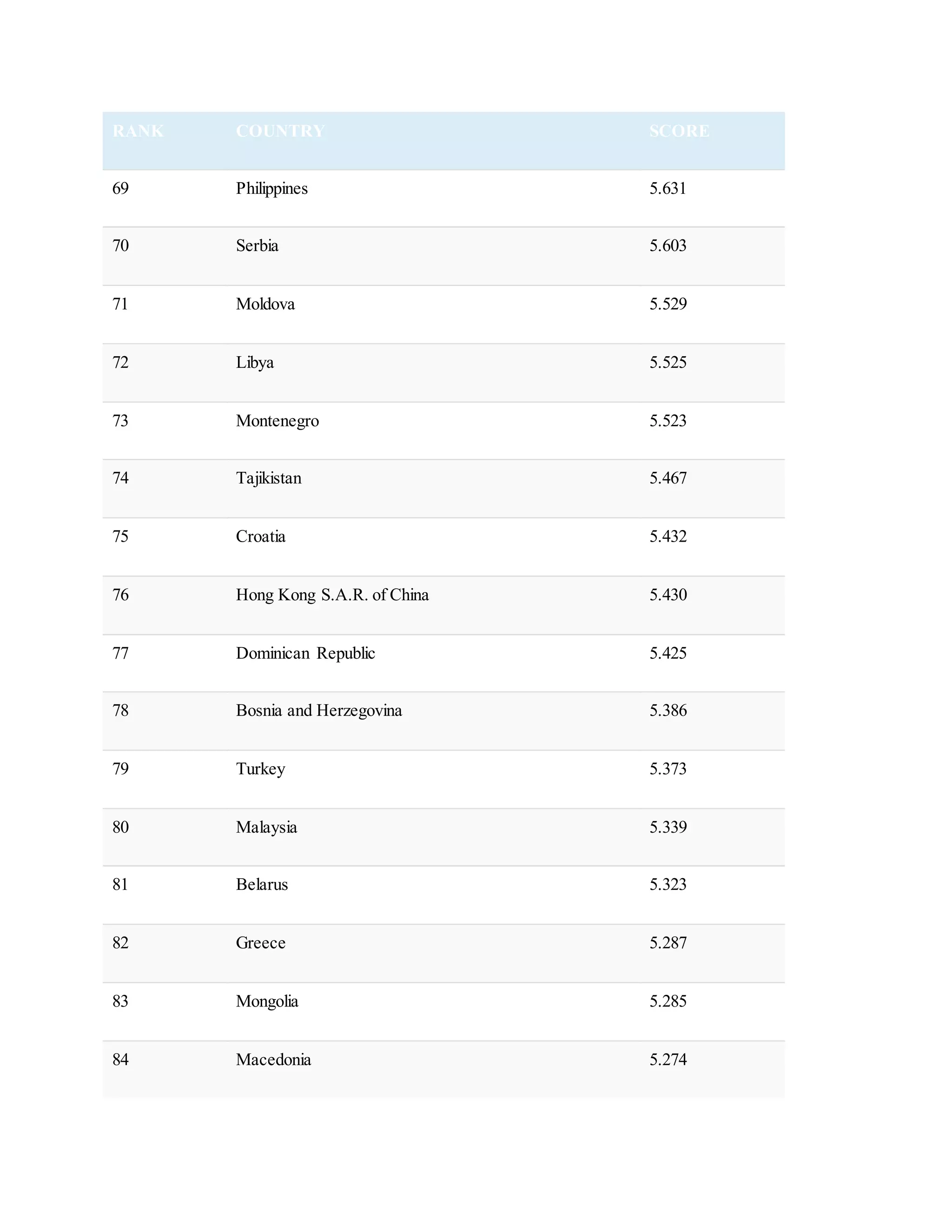
RANK COUNTRY SCORE
69 Philippines 5.631
70 Serbia 5.603
71 Moldova 5.529
72 Libya 5.525
73 Montenegro 5.523
74 Tajikistan 5.467
75 Croatia 5.432
76 Hong Kong S.A.R. of China 5.430
77 Dominican Republic 5.425
78 Bosnia and Herzegovina 5.386
79 Turkey 5.373
80 Malaysia 5.339
81 Belarus 5.323
82 Greece 5.287
83 Mongolia 5.285
84 Macedonia 5.274
RANK COUNTRY SCORE
85 Nigeria 5.265
86 Kyrgyzstan 5.261
87 Turkmenistan 5.247
88 Algeria 5.211
89 Morocco 5.208
90 Azerbaijan 5.208
91 Lebanon 5.197
92 Indonesia 5.192
93 China 5.191
94 Vietnam 5.175
95 Bhutan 5.082
96 Cameroon 5.044
97 Bulgaria 5.011
98 Ghana 4.996
99 Ivory Coast 4.944
100 Nepal 4.913
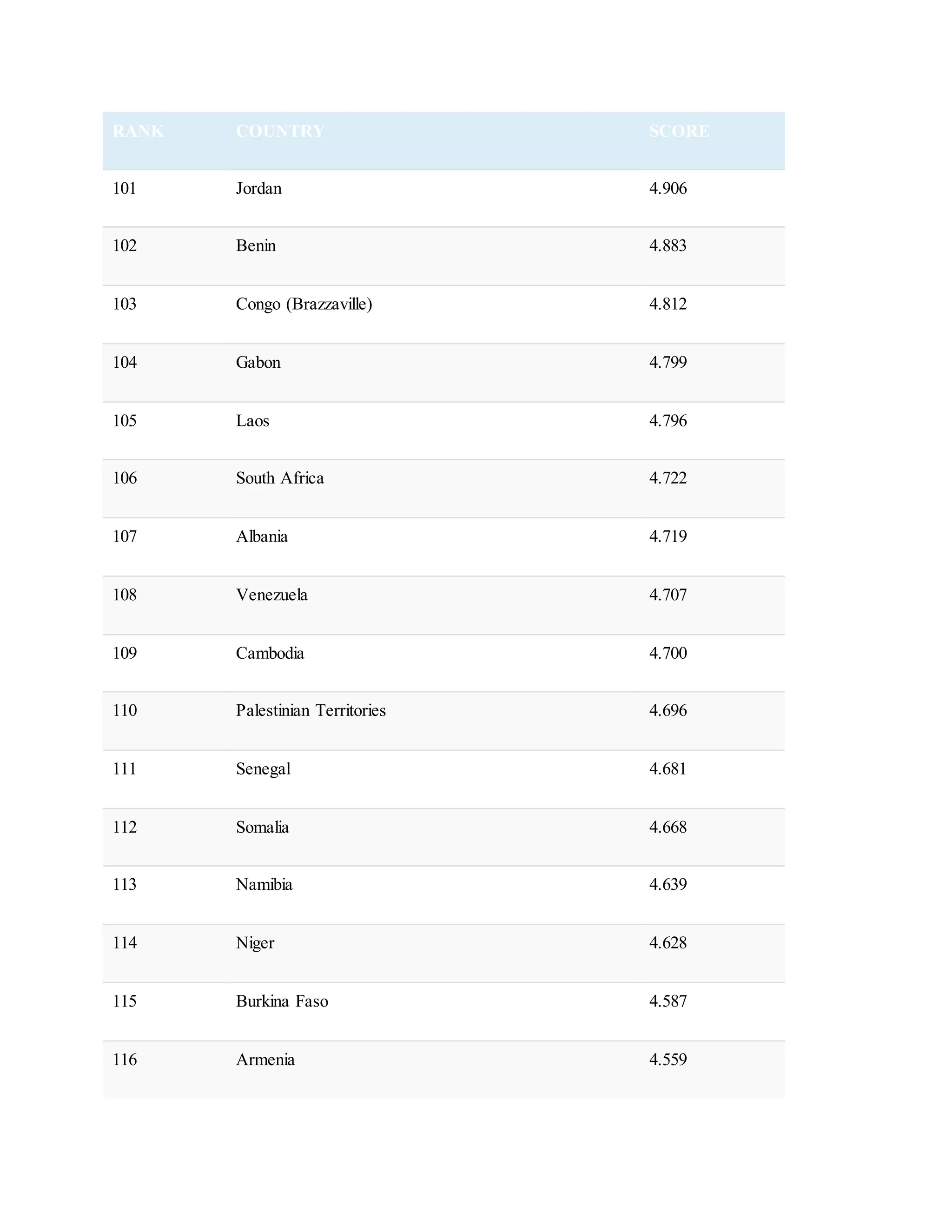
RANK COUNTRY SCORE
101 Jordan 4.906
102 Benin 4.883
103 Congo (Brazzaville) 4.812
104 Gabon 4.799
105 Laos 4.796
106 South Africa 4.722
107 Albania 4.719
108 Venezuela 4.707
109 Cambodia 4.700
110 Palestinian Territories 4.696
111 Senegal 4.681
112 Somalia 4.668
113 Namibia 4.639
114 Niger 4.628
115 Burkina Faso 4.587
116 Armenia 4.559
RANK COUNTRY SCORE
117 Iran 4.548
118 Guinea 4.534
119 Georgia 4.519
120 Gambia 4.516
121 Kenya 4.509
122 Mauritania 4.490
123 Mozambique 4.466
124 Tunisia 4.461
125 Bangladesh 4.456
126 Iraq 4.437
127 Congo (Kinshasa) 4.418
128 Mali 4.390
129 Sierra Leone 4.374
130 Sri Lanka 4.366
131 Myanmar 4.360
132 Chad 4.350
RANK COUNTRY SCORE
133 Ukraine 4.332
134 Ethiopia 4.286
135 Swaziland 4.212
136 Uganda 4.189
137 Egypt 4.166
138 Zambia 4.107
139 Togo 4.085
140 India 4.015
141 Liberia 3.975
142 Comoros 3.973
143 Madagascar 3.933
144 Lesotho 3.802
145 Burundi 3.775
146 Zimbabwe 3.663
147 Haiti 3.597
148 Botswana 3.488
RANK COUNTRY SCORE
149 Syria 3.462
150 Malawi 3.410
151 Yemen 3.380
152 Rwanda 3.334
153 Tanzania 3.231
154 Afghanistan 3.203
155 Central African Republic 3.083
156 South Sudan 2.853
Thesis
Thesis

Thesis

  • 1.
    RUUT VEENHOVEN HEDONISM ANDHAPPINESS∗ ABSTRACT. Hedonism is a way of life, characterised by openness to pleasurable experience. There are many qualms about hedonism. It is rejected on moral grounds and said to be detrimental tolong-term happiness. Several mechanisms for this ‘paradox of hedonism’ have been suggested and telling examples of pleasure seekers ending up in despair have been given. But is that the rule? If so, how much pleasure is too much? An overview of the available knowledge is given in this paper. The relation between hedonism and happiness has been studied at two levels: that of the nation and the individual. At the national level average happiness is correlated with moral acceptance of pleasure and with active leisure. At the individual level it is similarly linked with hedonistic attitudes and also correlated with hedonistic behaviours such as frequent sex and use of stimulants. In most cases the pattern is linearly positive. The relation between happiness and consumption of stimulants follows an inverted U-curve, spoilsports and guzzlers are less happy than modest consumers. Yet, these data cannot settle the issue, since the observed relations may be spurious or due to the effects of happiness on hedonism rather than the reverse. Even if we can prove a positive effect of (mild) hedonism on happiness, there is still the question of how that gains balances against a possible loss of health. A solution is to assess the effect of hedonistic living on the numberof years lived happily. KEY WORDS: happiness, lifestyle, pleasure cross-cultural
  • 2.
    limitation that thisstudy only reported correlations. The relationship between smoking and happiness has also been studied at the national level. At this level a clear negative relationship emerges (see Figure 5).
  • 3.
    Drugs The useof psychotropic drugs is slightly negatively related to happiness, especially the use of hard drugs. The bar chart in Figure 6 shows that Danes who have never tried drugs are half a point happier than their compatriots who have are. Bachman’s follow-up of high-school
  • 6.
    HEDONISM INDIANA UNIVERSITY–PURDUE UNIVERSITYINDIANAPOLIS (IUPUI) jtilley@iupui.edu [Final (orpenultimate?) draftof anarticle that appearedinthe Encyclopediaof AppliedEthics,2nded., ed.Ruth Chadwick(SanDiego:AcademicPress,2012),vol.2: 566–73.] I. AncientHedonism II.Ethical Hedonism III.Axiological Hedonism IV.Psychological Hedonism V.ImplicationsforAppliedEthics GLOSSARY ancient hedonismA termfor the normative viewsof the CyrenaicandEpicureanphilosophers. The Cyrenaicsflourishedinthe fourthcenturyB.C.;the Epicureansinthe twocenturies followingthatone.Bothgroupsprescribedpleasure asthe goal of life,buttheyhelddifferent viewsaboutthe essence of pleasureandaboutthe bestwayto obtainit. axiological hedonismA theoryof intrinsicvalue,withtwocore components:first,all pleasure isintrinsicallygood;andsecond,nothingbutpleasure isintrinsicallygood. ethical hedonismThe thesisthatthe moral rightnessof anact derivesfromthe pleasurethe act produces.Itcomesin twomainversions:hedonisticethical egoism;andhedonisticact utilitarianism. extrinsicvalue Such value ispossessedbyathingowingtoits relationstootherthingsof value. For instance,athinghas extrinsicvalue if itresultsin,orisa meansto,somethingelse of value.Unlike intrinsicvalue,extrinsicvalue vanishesif the thinginwhichitresidesis
  • 7.
    viewedintotal abstractionfromeverythingelse.(Here andelsewhere,“thing”hasits broadestmeaning.Itextendsnotonlytotablesandchairs,butalsotopleasure,pain, knowledge,justice,andsoforth.) intrinsicvalue The value a thingpossessesinsofarasitisvaluable initself,takeninabstraction fromeverythingelse,includingitseffects,itsaccompaniments,andthe endsitpromotes. Intrinsicvalue contrastswithextrinsicvalue,butthe twodonot exclude eachother.A single thingcan have both kindsof value. nonhedonistsThose whorejecthedonism.The termusuallystandsforthose whoreject axiological hedonism.Some of the latterare monists:theythinkthere isasingle intrinsic good,a good that isnot pleasure.Othersare pluralists:theythinkthere are twoor more intrinsicgoods,atleastone of whichisnot pleasure.Possibleintrinsicgoodsinclude (in additiontopleasure) life,justice,beauty,andknowledge.Some prominentnonhedonistsare Plato(428–348 B.C.),Aristotle (384–322 B.C.),Immanuel Kant(1724–1804), T. H. Green (1836–1882), F.H. Bradley(1846–1924), and G. E. Moore (1873–1958). psychological egoismThe viewthathuman beingsare soconstitutedthateverypurposive humanact ultimatelyderivesfromself-interest.Wheneverapersonacts,her ultimate aimis onlyto promote herownsurvival,orherownpleasure,etc. psychological hedonismA versionof psychological egoism.Itassertsthateverypurposive humanact ultimatelyspringsfromthe agent’sdesire forpleasure—specifically,hisown pleasure. qualitative hedonismA form of axiological hedonismaccordingtowhichthe intrinsicvalue of a pleasure increaseswiththe quantityandqualityof the pleasure,notmerelywithitsquantity alone. quantitative hedonismA formof axiological hedonismaccordingtowhichthe intrinsicvalue of a pleasure variesdirectly,andsolely,withthe quantityof pleasure.
  • 8.
    HAPPIEST COUNTRIES INTHE WORLD 2019 HOW DO WE ASSESS HAPPINESS? That is not to say the report is without a scientific basis. Economic and social influences are considered along with the survey (namely GDP per capita, social support, life expectancy, freedom to make life choices, generosity and perceptions of corruption), but the focus is on how happy citizens say they are; not how happy statisticians think they should be OTHER KEY HEADLINES INCLUDE: Australia has dropped out of the top 10 happiest countries in the world and now sits as position 11. Austria has gained two spots to take its place. The 10 countries with the largest declines typically suffered some combination of economic, political and social stresses. The five largest drops since 2005- 2008 were in Yemen, India, Syria, Botswana and Venezuela There are no superpowers in the top 10 happiest countries in the world indicating that a country’s economic strength does not always correlate with the happiness of its citizens. HAPPIEST COUNTRIES IN THE W ORLD 2019 – RANKED RANK COUNTRY SCORE 1 Finland 7.769 2 Denmark 7.600 3 Norway 7.554 4 Iceland 7.494
  • 9.
    RANK COUNTRY SCORE 5Netherlands 7.488 6 Switzerland 7.480 7 Sweden 7.343 8 New Zealand 7.307 9 Canada 7.278 10 Austria 7.246 11 Australia 7.228 12 Costa Rica 7.167 13 Israel 7.139 14 Luxembourg 7.090 15 United Kingdom 7.054 16 Ireland 7.021 17 Germany 6.985 18 Belgium 6.923 19 United States 6.892 20 Czech Republic 6.852
  • 10.
    RANK COUNTRY SCORE 21United Arab Emirates 6.825 22 Malta 6.726 23 Mexico 6.595 24 France 6.592 25 Taiwan 6.446 26 Chile 6.444 27 Guatemala 6.436 28 Saudi Arabia 6.375 29 Qatar 6.374 30 Spain 6.354 31 Panama 6.321 32 Brazil 6.300 33 Uruguay 6.293 34 Singapore 6.262 35 El Salvador 6.253 36 Italy 6.223
  • 11.
    RANK COUNTRY SCORE 37Bahrain 6.199 38 Slovakia 6.198 39 Trinidad and Tobago 6.192 40 Poland 6.182 41 Uzbekistan 6.174 42 Lithuania 6.149 43 Colombia 6.125 44 Slovenia 6.118 45 Nicaragua 6.105 46 Kosovo 6.100 47 Argentina 6.086 48 Romania 6.070 49 Cyprus 6.046 50 Ecuador 6.028 51 Kuwait 6.021 52 Thailand 6.008
  • 12.
    RANK COUNTRY SCORE 53Latvia 5.940 54 South Korea 5.895 55 Estonia 5.893 56 Jamaica 5.890 57 Mauritius 5.888 58 Japan 5.886 59 Honduras 5.86 60 Kazakhstan 5.809 61 Bolivia 5.779 62 Hungary 5.758 63 Paraguay 5.743 64 North Cyprus 5.718 65 Peru 5.697 66 Portugal 5.693 67 Pakistan 5.653 68 Russia 5.648
  • 13.
    RANK COUNTRY SCORE 69Philippines 5.631 70 Serbia 5.603 71 Moldova 5.529 72 Libya 5.525 73 Montenegro 5.523 74 Tajikistan 5.467 75 Croatia 5.432 76 Hong Kong S.A.R. of China 5.430 77 Dominican Republic 5.425 78 Bosnia and Herzegovina 5.386 79 Turkey 5.373 80 Malaysia 5.339 81 Belarus 5.323 82 Greece 5.287 83 Mongolia 5.285 84 Macedonia 5.274
  • 14.
    RANK COUNTRY SCORE 85Nigeria 5.265 86 Kyrgyzstan 5.261 87 Turkmenistan 5.247 88 Algeria 5.211 89 Morocco 5.208 90 Azerbaijan 5.208 91 Lebanon 5.197 92 Indonesia 5.192 93 China 5.191 94 Vietnam 5.175 95 Bhutan 5.082 96 Cameroon 5.044 97 Bulgaria 5.011 98 Ghana 4.996 99 Ivory Coast 4.944 100 Nepal 4.913
  • 15.
    RANK COUNTRY SCORE 101Jordan 4.906 102 Benin 4.883 103 Congo (Brazzaville) 4.812 104 Gabon 4.799 105 Laos 4.796 106 South Africa 4.722 107 Albania 4.719 108 Venezuela 4.707 109 Cambodia 4.700 110 Palestinian Territories 4.696 111 Senegal 4.681 112 Somalia 4.668 113 Namibia 4.639 114 Niger 4.628 115 Burkina Faso 4.587 116 Armenia 4.559
  • 16.
    RANK COUNTRY SCORE 117Iran 4.548 118 Guinea 4.534 119 Georgia 4.519 120 Gambia 4.516 121 Kenya 4.509 122 Mauritania 4.490 123 Mozambique 4.466 124 Tunisia 4.461 125 Bangladesh 4.456 126 Iraq 4.437 127 Congo (Kinshasa) 4.418 128 Mali 4.390 129 Sierra Leone 4.374 130 Sri Lanka 4.366 131 Myanmar 4.360 132 Chad 4.350
  • 17.
    RANK COUNTRY SCORE 133Ukraine 4.332 134 Ethiopia 4.286 135 Swaziland 4.212 136 Uganda 4.189 137 Egypt 4.166 138 Zambia 4.107 139 Togo 4.085 140 India 4.015 141 Liberia 3.975 142 Comoros 3.973 143 Madagascar 3.933 144 Lesotho 3.802 145 Burundi 3.775 146 Zimbabwe 3.663 147 Haiti 3.597 148 Botswana 3.488
  • 18.
    RANK COUNTRY SCORE 149Syria 3.462 150 Malawi 3.410 151 Yemen 3.380 152 Rwanda 3.334 153 Tanzania 3.231 154 Afghanistan 3.203 155 Central African Republic 3.083 156 South Sudan 2.853