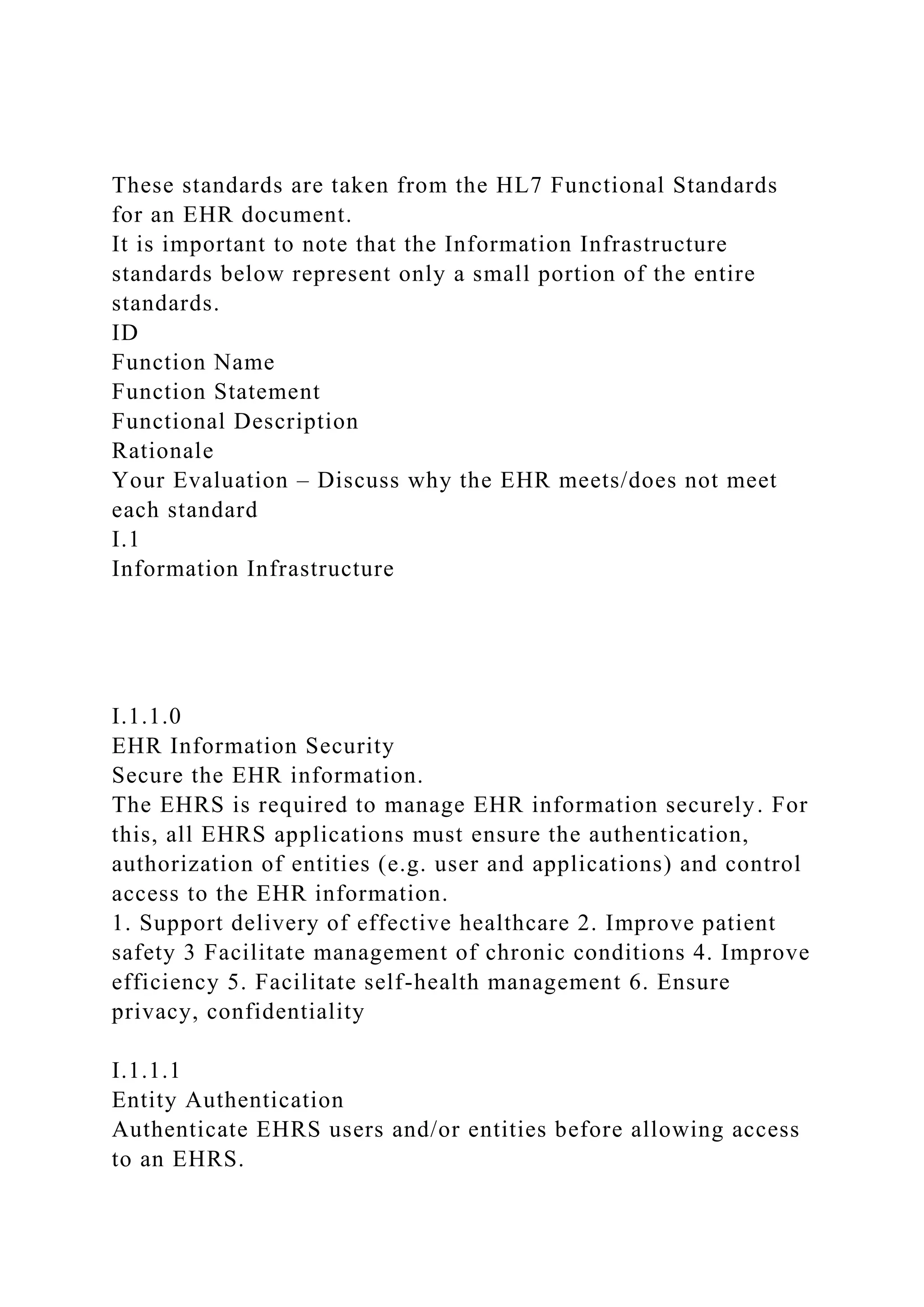
These standards are taken from the HL7 Functional Standards
for an EHR document.
It is important to note that the Information Infrastructure
standards below represent only a small portion of the entire
standards.
ID
Function Name
Function Statement
Functional Description
Rationale
Your Evaluation – Discuss why the EHR meets/does not meet
each standard
I.1
Information Infrastructure
I.1.1.0
EHR Information Security
Secure the EHR information.
The EHRS is required to manage EHR information securely. For
this, all EHRS applications must ensure the authentication,
authorization of entities (e.g. user and applications) and control
access to the EHR information.
1. Support delivery of effective healthcare 2. Improve patient
safety 3 Facilitate management of chronic conditions 4. Improve
efficiency 5. Facilitate self-health management 6. Ensure
privacy, confidentiality
I.1.1.1
Entity Authentication
Authenticate EHRS users and/or entities before allowing access
to an EHRS.
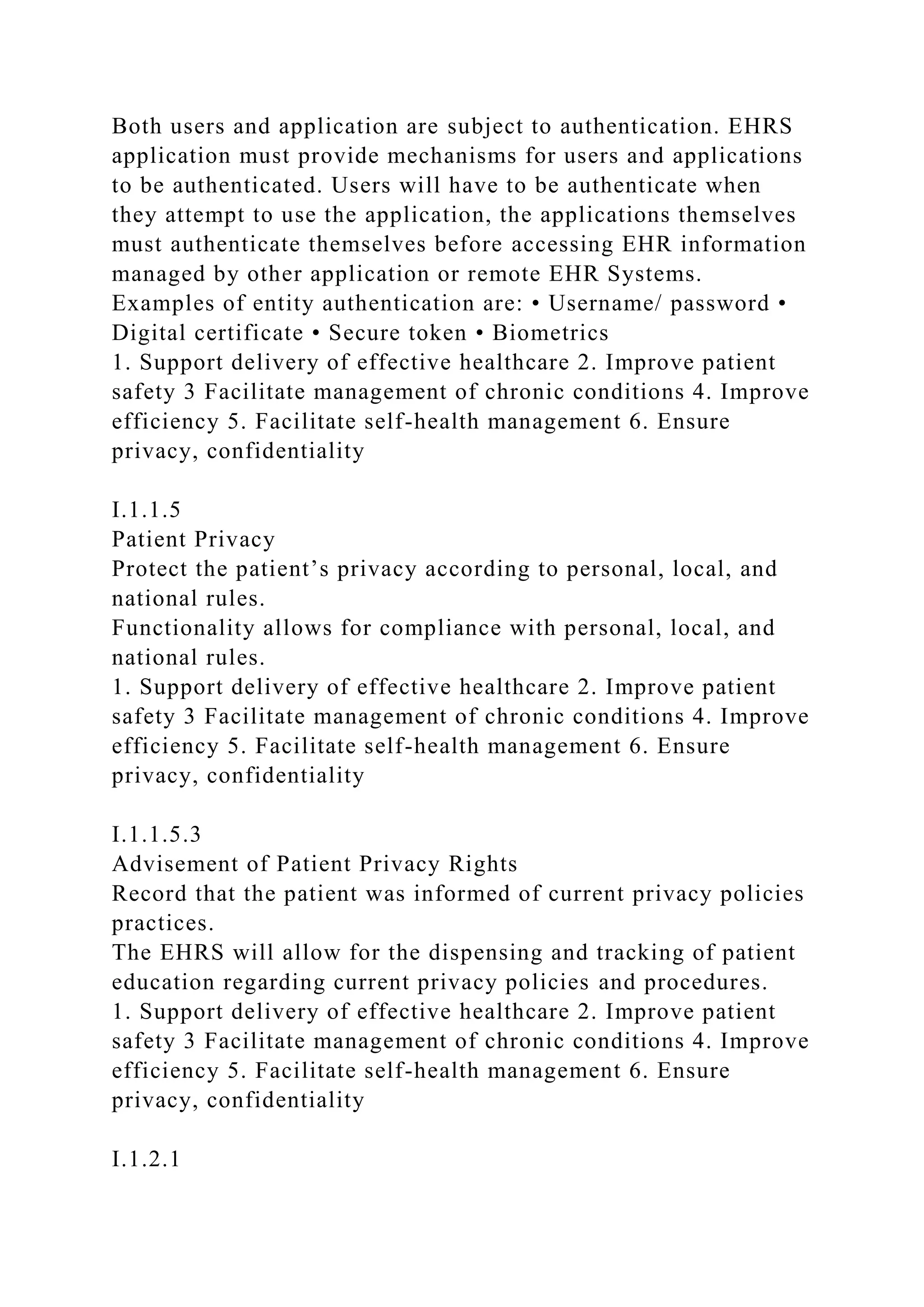
Both users and application are subject to authentication. EHRS
application must provide mechanisms for users and applications
to be authenticated. Users will have to be authenticate when
they attempt to use the application, the applications themselves
must authenticate themselves before accessing EHR information
managed by other application or remote EHR Systems.
Examples of entity authentication are: • Username/ password •
Digital certificate • Secure token • Biometrics
1. Support delivery of effective healthcare 2. Improve patient
safety 3 Facilitate management of chronic conditions 4. Improve
efficiency 5. Facilitate self-health management 6. Ensure
privacy, confidentiality
I.1.1.5
Patient Privacy
Protect the patient’s privacy according to personal, local, and
national rules.
Functionality allows for compliance with personal, local, and
national rules.
1. Support delivery of effective healthcare 2. Improve patient
safety 3 Facilitate management of chronic conditions 4. Improve
efficiency 5. Facilitate self-health management 6. Ensure
privacy, confidentiality
I.1.1.5.3
Advisement of Patient Privacy Rights
Record that the patient was informed of current privacy policies
practices.
The EHRS will allow for the dispensing and tracking of patient
education regarding current privacy policies and procedures.
1. Support delivery of effective healthcare 2. Improve patient
safety 3 Facilitate management of chronic conditions 4. Improve
efficiency 5. Facilitate self-health management 6. Ensure
privacy, confidentiality
I.1.2.1
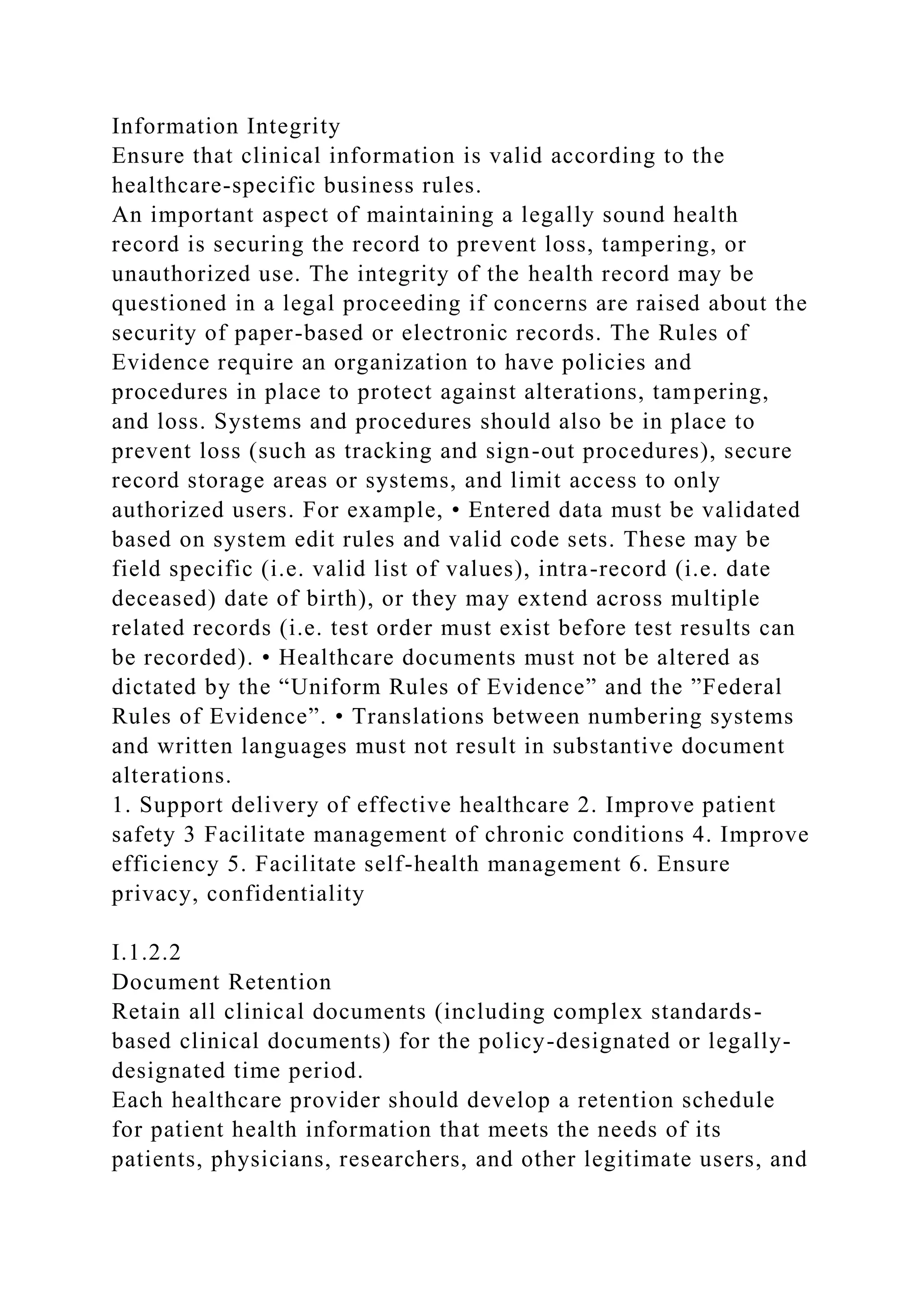
Information Integrity
Ensure that clinical information is valid according to the
healthcare-specific business rules.
An important aspect of maintaining a legally sound health
record is securing the record to prevent loss, tampering, or
unauthorized use. The integrity of the health record may be
questioned in a legal proceeding if concerns are raised about the
security of paper-based or electronic records. The Rules of
Evidence require an organization to have policies and
procedures in place to protect against alterations, tampering,
and loss. Systems and procedures should also be in place to
prevent loss (such as tracking and sign-out procedures), secure
record storage areas or systems, and limit access to only
authorized users. For example, • Entered data must be validated
based on system edit rules and valid code sets. These may be
field specific (i.e. valid list of values), intra-record (i.e. date
deceased) date of birth), or they may extend across multiple
related records (i.e. test order must exist before test results can
be recorded). • Healthcare documents must not be altered as
dictated by the “Uniform Rules of Evidence” and the ”Federal
Rules of Evidence”. • Translations between numbering systems
and written languages must not result in substantive document
alterations.
1. Support delivery of effective healthcare 2. Improve patient
safety 3 Facilitate management of chronic conditions 4. Improve
efficiency 5. Facilitate self-health management 6. Ensure
privacy, confidentiality
I.1.2.2
Document Retention
Retain all clinical documents (including complex standards-
based clinical documents) for the policy-designated or legally-
designated time period.
Each healthcare provider should develop a retention schedule
for patient health information that meets the needs of its
patients, physicians, researchers, and other legitimate users, and
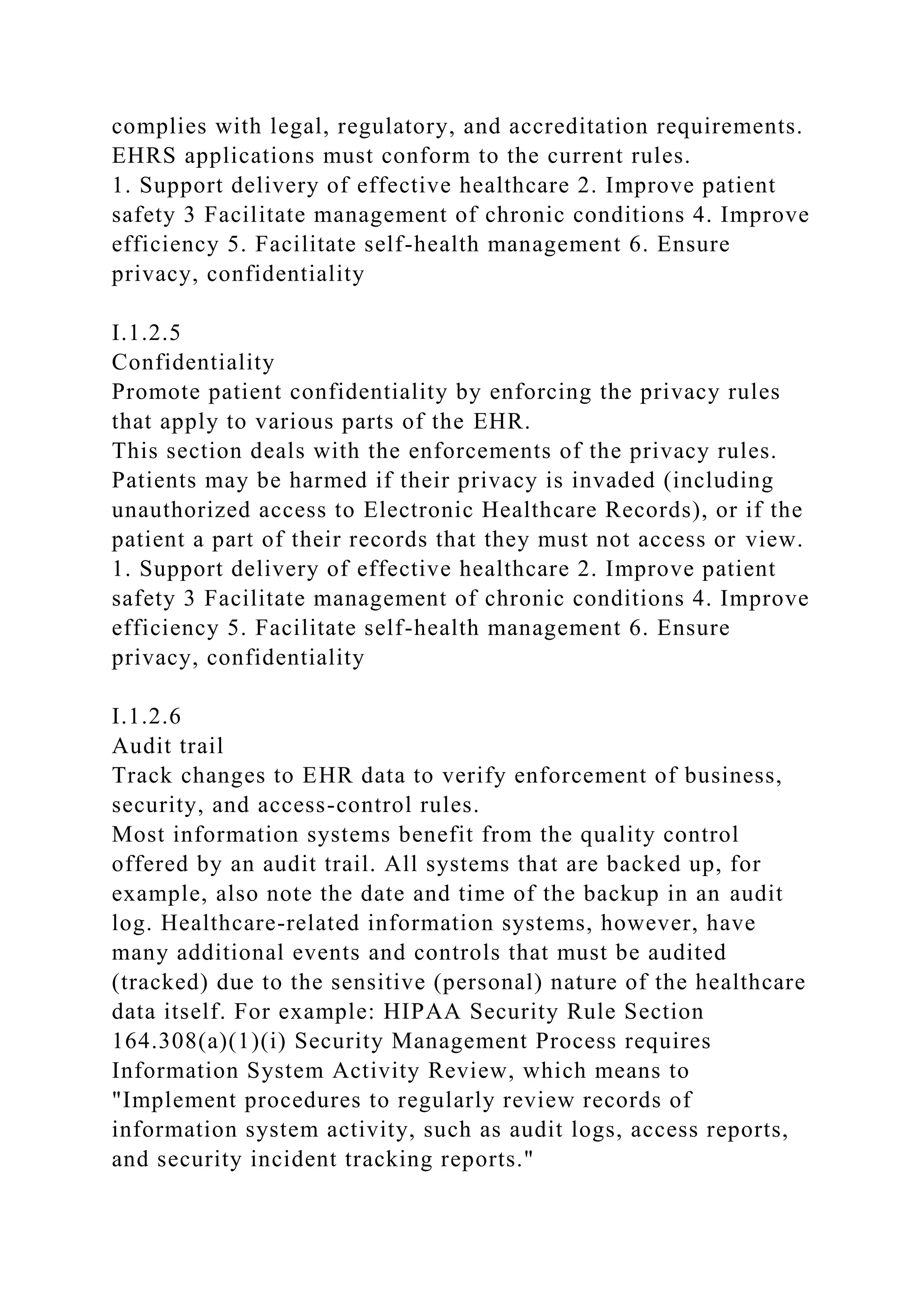
complies with legal, regulatory, and accreditation requirements.
EHRS applications must conform to the current rules.
1. Support delivery of effective healthcare 2. Improve patient
safety 3 Facilitate management of chronic conditions 4. Improve
efficiency 5. Facilitate self-health management 6. Ensure
privacy, confidentiality
I.1.2.5
Confidentiality
Promote patient confidentiality by enforcing the privacy rules
that apply to various parts of the EHR.
This section deals with the enforcements of the privacy rules.
Patients may be harmed if their privacy is invaded (including
unauthorized access to Electronic Healthcare Records), or if the
patient a part of their records that they must not access or view.
1. Support delivery of effective healthcare 2. Improve patient
safety 3 Facilitate management of chronic conditions 4. Improve
efficiency 5. Facilitate self-health management 6. Ensure
privacy, confidentiality
I.1.2.6
Audit trail
Track changes to EHR data to verify enforcement of business,
security, and access-control rules.
Most information systems benefit from the quality control
offered by an audit trail. All systems that are backed up, for
example, also note the date and time of the backup in an audit
log. Healthcare-related information systems, however, have
many additional events and controls that must be audited
(tracked) due to the sensitive (personal) nature of the healthcare
data itself. For example: HIPAA Security Rule Section
164.308(a)(1)(i) Security Management Process requires
Information System Activity Review, which means to
"Implement procedures to regularly review records of
information system activity, such as audit logs, access reports,
and security incident tracking reports."
1. Support delivery of effective healthcare 2. Improve patient
safety 3 Facilitate management of chronic conditions 4. Improve
efficiency 5. Facilitate self-health management 6. Ensure
privacy, confidentiality
I.1.2.6.1
Amendment history
Track amendments to clinical documents.
Once an clinical document receives a mark of attestation by a
healthcare provider, (e.g., a signature), it becomes a legal
document and must be preserved in an unaltered fashion.
Sometimes, however, corrections or amendments need to be
made to the document. In these cases, the EHRS must keep
track of the corrections or amendments such that the integrity of
the original (signed) document is still preserved.
1. Support delivery of effective healthcare 2. Improve patient
safety 3 Facilitate management of chronic conditions 4. Improve
efficiency 5. Facilitate self-health management 6. Ensure
privacy, confidentiality
I.1.2.6.3
Information Lifecycle Access-Event audit
Track who, when, and by which system an EHR record was
viewed or extracted.
The EHRS application must be able to record information
required to determine who viewed or extracted EHR related
information from that application.
1. Support delivery of effective healthcare 2. Improve patient
safety 3 Facilitate management of chronic conditions 4. Improve
efficiency 5. Facilitate self-health management 6. Ensure
privacy, confidentiality
I.1.2.6.4
Record audit
Generate an audit report for an EHR record (or for a set of EHR
records).
Differing care-settings benefit from being able to identity the
various people or systems that viewed or altered a patient's (or
set of patient's) EHR's. For example, a judge might want to
know how many patients a given healthcare provider treated
while the provider's license was suspended. Similarly, in some
cases a report detailing all those who modified or viewed a
certain patient record might be needed.
1. Support delivery of effective healthcare 2. Improve patient
safety 3 Facilitate management of chronic conditions 4. Improve
efficiency 5. Facilitate self-health management 6. Ensure
privacy, confidentiality
I.1.2.6.6
Information-Exchange audit
Retain any information exchange details along with any
amendment history sent with clinical documents by an external
clinical or EHR system.
If EHR information is exchanged between EHRS application for
viewing or other purposes, the receiving application must log
information about the sender and the nature, history, and
content of the information exchanged in the transaction If any
translations are necessary (.e.g. vocabulary lookup) then a
record of the transformation must be created by the receiving
application. For example, in addition to receiving an EHR from
an external system, receive the amendment history for that
record, the identity of the originating system, and details about
the receiving system’s reception event (including, when and by
whom the EHR and its audit trail were received).
1. Support delivery of effective healthcare 2. Improve patient
safety 3 Facilitate management of chronic conditions 4. Improve
efficiency 5. Facilitate self-health management 6. Ensure
privacy, confidentiality
I.1.2.7.4
Data Availability
Make clinical information readily available (as required by a
clinical care setting).
Not only must clinical information be available for recall, in
certain care-settings the data must also be available within a
proscribed period of time. For example, if the EHRS fails to
present a report that it has received from a laboratory in a
timely fashion, the patient may die. Depending on the care
setting, the EHRS must make all or some of the EHR
information available when, where, and how the users need it.
1. Support delivery of effective healthcare 2. Improve patient
safety 3 Facilitate management of chronic conditions 4. Improve
efficiency 5. Facilitate self-health management 6. Ensure
privacy, confidentiality

These standards are taken from the HL7 Functional Standards for an.docx

  • 1.
    These standards aretaken from the HL7 Functional Standards for an EHR document. It is important to note that the Information Infrastructure standards below represent only a small portion of the entire standards. ID Function Name Function Statement Functional Description Rationale Your Evaluation – Discuss why the EHR meets/does not meet each standard I.1 Information Infrastructure I.1.1.0 EHR Information Security Secure the EHR information. The EHRS is required to manage EHR information securely. For this, all EHRS applications must ensure the authentication, authorization of entities (e.g. user and applications) and control access to the EHR information. 1. Support delivery of effective healthcare 2. Improve patient safety 3 Facilitate management of chronic conditions 4. Improve efficiency 5. Facilitate self-health management 6. Ensure privacy, confidentiality I.1.1.1 Entity Authentication Authenticate EHRS users and/or entities before allowing access to an EHRS.
  • 2.
    Both users andapplication are subject to authentication. EHRS application must provide mechanisms for users and applications to be authenticated. Users will have to be authenticate when they attempt to use the application, the applications themselves must authenticate themselves before accessing EHR information managed by other application or remote EHR Systems. Examples of entity authentication are: • Username/ password • Digital certificate • Secure token • Biometrics 1. Support delivery of effective healthcare 2. Improve patient safety 3 Facilitate management of chronic conditions 4. Improve efficiency 5. Facilitate self-health management 6. Ensure privacy, confidentiality I.1.1.5 Patient Privacy Protect the patient’s privacy according to personal, local, and national rules. Functionality allows for compliance with personal, local, and national rules. 1. Support delivery of effective healthcare 2. Improve patient safety 3 Facilitate management of chronic conditions 4. Improve efficiency 5. Facilitate self-health management 6. Ensure privacy, confidentiality I.1.1.5.3 Advisement of Patient Privacy Rights Record that the patient was informed of current privacy policies practices. The EHRS will allow for the dispensing and tracking of patient education regarding current privacy policies and procedures. 1. Support delivery of effective healthcare 2. Improve patient safety 3 Facilitate management of chronic conditions 4. Improve efficiency 5. Facilitate self-health management 6. Ensure privacy, confidentiality I.1.2.1
  • 3.
    Information Integrity Ensure thatclinical information is valid according to the healthcare-specific business rules. An important aspect of maintaining a legally sound health record is securing the record to prevent loss, tampering, or unauthorized use. The integrity of the health record may be questioned in a legal proceeding if concerns are raised about the security of paper-based or electronic records. The Rules of Evidence require an organization to have policies and procedures in place to protect against alterations, tampering, and loss. Systems and procedures should also be in place to prevent loss (such as tracking and sign-out procedures), secure record storage areas or systems, and limit access to only authorized users. For example, • Entered data must be validated based on system edit rules and valid code sets. These may be field specific (i.e. valid list of values), intra-record (i.e. date deceased) date of birth), or they may extend across multiple related records (i.e. test order must exist before test results can be recorded). • Healthcare documents must not be altered as dictated by the “Uniform Rules of Evidence” and the ”Federal Rules of Evidence”. • Translations between numbering systems and written languages must not result in substantive document alterations. 1. Support delivery of effective healthcare 2. Improve patient safety 3 Facilitate management of chronic conditions 4. Improve efficiency 5. Facilitate self-health management 6. Ensure privacy, confidentiality I.1.2.2 Document Retention Retain all clinical documents (including complex standards- based clinical documents) for the policy-designated or legally- designated time period. Each healthcare provider should develop a retention schedule for patient health information that meets the needs of its patients, physicians, researchers, and other legitimate users, and
  • 4.
    complies with legal,regulatory, and accreditation requirements. EHRS applications must conform to the current rules. 1. Support delivery of effective healthcare 2. Improve patient safety 3 Facilitate management of chronic conditions 4. Improve efficiency 5. Facilitate self-health management 6. Ensure privacy, confidentiality I.1.2.5 Confidentiality Promote patient confidentiality by enforcing the privacy rules that apply to various parts of the EHR. This section deals with the enforcements of the privacy rules. Patients may be harmed if their privacy is invaded (including unauthorized access to Electronic Healthcare Records), or if the patient a part of their records that they must not access or view. 1. Support delivery of effective healthcare 2. Improve patient safety 3 Facilitate management of chronic conditions 4. Improve efficiency 5. Facilitate self-health management 6. Ensure privacy, confidentiality I.1.2.6 Audit trail Track changes to EHR data to verify enforcement of business, security, and access-control rules. Most information systems benefit from the quality control offered by an audit trail. All systems that are backed up, for example, also note the date and time of the backup in an audit log. Healthcare-related information systems, however, have many additional events and controls that must be audited (tracked) due to the sensitive (personal) nature of the healthcare data itself. For example: HIPAA Security Rule Section 164.308(a)(1)(i) Security Management Process requires Information System Activity Review, which means to "Implement procedures to regularly review records of information system activity, such as audit logs, access reports, and security incident tracking reports."
  • 5.
    1. Support deliveryof effective healthcare 2. Improve patient safety 3 Facilitate management of chronic conditions 4. Improve efficiency 5. Facilitate self-health management 6. Ensure privacy, confidentiality I.1.2.6.1 Amendment history Track amendments to clinical documents. Once an clinical document receives a mark of attestation by a healthcare provider, (e.g., a signature), it becomes a legal document and must be preserved in an unaltered fashion. Sometimes, however, corrections or amendments need to be made to the document. In these cases, the EHRS must keep track of the corrections or amendments such that the integrity of the original (signed) document is still preserved. 1. Support delivery of effective healthcare 2. Improve patient safety 3 Facilitate management of chronic conditions 4. Improve efficiency 5. Facilitate self-health management 6. Ensure privacy, confidentiality I.1.2.6.3 Information Lifecycle Access-Event audit Track who, when, and by which system an EHR record was viewed or extracted. The EHRS application must be able to record information required to determine who viewed or extracted EHR related information from that application. 1. Support delivery of effective healthcare 2. Improve patient safety 3 Facilitate management of chronic conditions 4. Improve efficiency 5. Facilitate self-health management 6. Ensure privacy, confidentiality I.1.2.6.4 Record audit Generate an audit report for an EHR record (or for a set of EHR records).
  • 6.
    Differing care-settings benefitfrom being able to identity the various people or systems that viewed or altered a patient's (or set of patient's) EHR's. For example, a judge might want to know how many patients a given healthcare provider treated while the provider's license was suspended. Similarly, in some cases a report detailing all those who modified or viewed a certain patient record might be needed. 1. Support delivery of effective healthcare 2. Improve patient safety 3 Facilitate management of chronic conditions 4. Improve efficiency 5. Facilitate self-health management 6. Ensure privacy, confidentiality I.1.2.6.6 Information-Exchange audit Retain any information exchange details along with any amendment history sent with clinical documents by an external clinical or EHR system. If EHR information is exchanged between EHRS application for viewing or other purposes, the receiving application must log information about the sender and the nature, history, and content of the information exchanged in the transaction If any translations are necessary (.e.g. vocabulary lookup) then a record of the transformation must be created by the receiving application. For example, in addition to receiving an EHR from an external system, receive the amendment history for that record, the identity of the originating system, and details about the receiving system’s reception event (including, when and by whom the EHR and its audit trail were received). 1. Support delivery of effective healthcare 2. Improve patient safety 3 Facilitate management of chronic conditions 4. Improve efficiency 5. Facilitate self-health management 6. Ensure privacy, confidentiality I.1.2.7.4 Data Availability Make clinical information readily available (as required by a
  • 7.
    clinical care setting). Notonly must clinical information be available for recall, in certain care-settings the data must also be available within a proscribed period of time. For example, if the EHRS fails to present a report that it has received from a laboratory in a timely fashion, the patient may die. Depending on the care setting, the EHRS must make all or some of the EHR information available when, where, and how the users need it. 1. Support delivery of effective healthcare 2. Improve patient safety 3 Facilitate management of chronic conditions 4. Improve efficiency 5. Facilitate self-health management 6. Ensure privacy, confidentiality