Thermal unit operation exercise questions (1).pptx
1.
Thermal unit operationexercise questions
Adama Science and Technology University
School of Mechanical, Chemical & Materials
Engineering
Department of Chemical Engineering
Thermal Unit Operation exercise questions
(ChEg3212)
05/29/2025 Tutor questions 1
2.
2
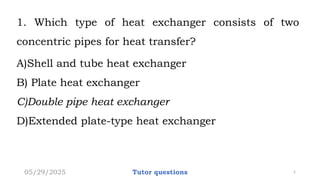
1. Which typeof heat exchanger consists of two
concentric pipes for heat transfer?
A)Shell and tube heat exchanger
B) Plate heat exchanger
C)Double pipe heat exchanger
D)Extended plate-type heat exchanger
05/29/2025 Tutor questions
3.
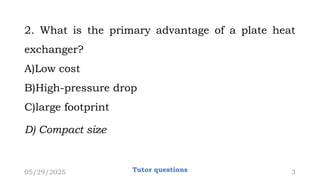
2. What isthe primary advantage of a plate heat
exchanger?
A)Low cost
B)High-pressure drop
C)large footprint
D) Compact size
05/29/2025 Tutor questions 3
4.
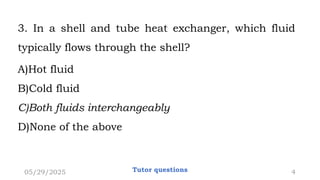
3. In ashell and tube heat exchanger, which fluid
typically flows through the shell?
A)Hot fluid
B)Cold fluid
C)Both fluids interchangeably
D)None of the above
05/29/2025 4
Tutor questions
5.
4. What distinguishesan extended plate type heat
exchanger from a regular plate heat exchanger?
A)Increased number of plates
B)Addition of fins on plates
C)larger plate size
D)Higher operating pressure
05/29/2025 Tutor questions 5
6.
5. What isthe purpose of baffles in a shell and tube
heat exchanger?
A) To enhance heat transfer
B) To increase pressure drop
C) To reduce fouling
D) To control fluid flow
05/29/2025 Tutor questions 6
7.
6. What isthe purpose of using fins in extended
plate-type heat exchangers?
A)To increase the surface area for heat transfer
B)To reduce the pressure drop
C)To decrease the temperature difference between
fluids
D)To prevent fouling
05/29/2025 Tutor questions 7
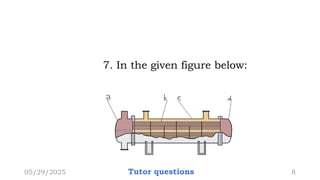
Letters a, andd represent:
A) Front header and Bundle
B)Front header and Shell
C)Front header and Rear header
D)Rear header and Bundle
05/29/2025 Tutor questions 9
10.
8. In theabove question no 7, letters c and b
represent respectively:
A)Bundle and shell
B)Shell and Bundle
C)Rear header and bundle
D)Front header and shell
05/29/2025 Tutor questions 10
11.
9. ________is aniterative process that is normally
carried out using computer programs from
organizations such as the Heat Transfer and Fluid
Flow Service (HTFS) or Heat Transfer Research
Incorporated (HTRI).
A)Thermal design
B)Hydraulic design
C)Mechanical Design
D)All
05/29/2025 Tutor questions 11
12.
10. ______ typeof baffle is used to obtain a lower
shell side velocity and pressure drop.
A)Disc and Doughnut
B)Single Segmental
C)Double Segmental
D)Orifice type
05/29/2025 Tutor questions 12
13.
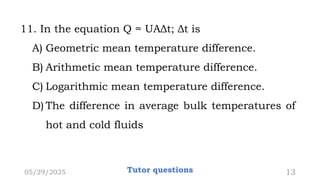
11. In theequation Q = UAΔt; Δt is
A) Geometric mean temperature difference.
B) Arithmetic mean temperature difference.
C) Logarithmic mean temperature difference.
D) The difference in average bulk temperatures of
hot and cold fluids
05/29/2025 Tutor questions 13
14.
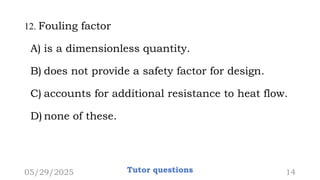
12. Fouling factor
A)is a dimensionless quantity.
B) does not provide a safety factor for design.
C) accounts for additional resistance to heat flow.
D) none of these.
05/29/2025 Tutor questions 14
15.
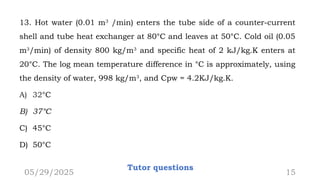
13. Hot water(0.01 m3
/min) enters the tube side of a counter-current
shell and tube heat exchanger at 80°C and leaves at 50°C. Cold oil (0.05
m3
/min) of density 800 kg/m3
and specific heat of 2 kJ/kg.K enters at
20°C. The log mean temperature difference in °C is approximately, using
the density of water, 998 kg/m3
, and Cpw = 4.2KJ/kg.K.
A) 32°C
B) 37°C
C) 45°C
D) 50°C
05/29/2025
Tutor questions
15
16.
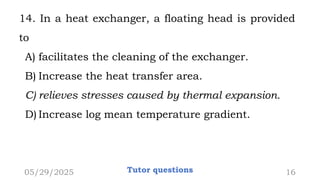
14. In aheat exchanger, a floating head is provided
to
A) facilitates the cleaning of the exchanger.
B) Increase the heat transfer area.
C) relieves stresses caused by thermal expansion.
D) Increase log mean temperature gradient.
05/29/2025 Tutor questions 16
17.
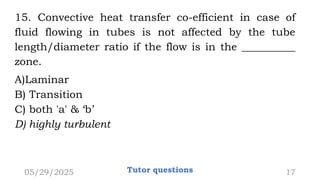
15. Convective heattransfer co-efficient in case of
fluid flowing in tubes is not affected by the tube
length/diameter ratio if the flow is in the __________
zone.
A)Laminar
B) Transition
C) both 'a' & ‘b’
D) highly turbulent
05/29/2025 Tutor questions 17
18.
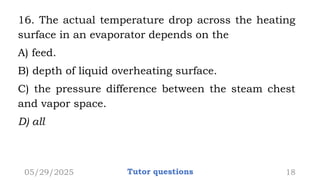
16. The actualtemperature drop across the heating
surface in an evaporator depends on the
A) feed.
B) depth of liquid overheating surface.
C) the pressure difference between the steam chest
and vapor space.
D) all
05/29/2025 Tutor questions 18
19.
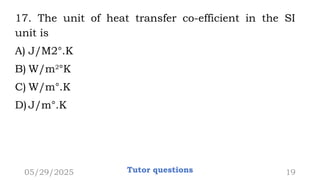
17. The unitof heat transfer co-efficient in the SI
unit is
A) J/M2°.K
B) W/m2
°K
C) W/m°.K
D) J/m°.K
05/29/2025 Tutor questions 19
20.
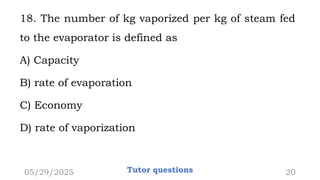
18. The numberof kg vaporized per kg of steam fed
to the evaporator is defined as
A) Capacity
B) rate of evaporation
C) Economy
D) rate of vaporization
05/29/2025 Tutor questions 20
21.
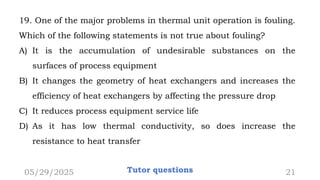
19. One ofthe major problems in thermal unit operation is fouling.
Which of the following statements is not true about fouling?
A) It is the accumulation of undesirable substances on the
surfaces of process equipment
B) It changes the geometry of heat exchangers and increases the
efficiency of heat exchangers by affecting the pressure drop
C) It reduces process equipment service life
D) As it has low thermal conductivity, so does increase the
resistance to heat transfer
05/29/2025 Tutor questions 21
22.
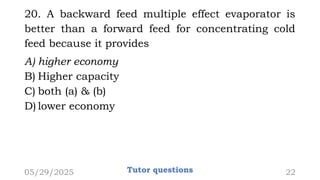
20. A backwardfeed multiple effect evaporator is
better than a forward feed for concentrating cold
feed because it provides
A) higher economy
B) Higher capacity
C) both (a) & (b)
D) lower economy
05/29/2025 Tutor questions 22
23.
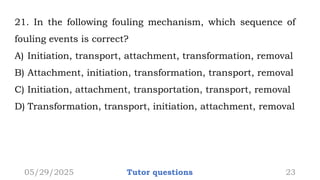
21. In thefollowing fouling mechanism, which sequence of
fouling events is correct?
A) Initiation, transport, attachment, transformation, removal
B) Attachment, initiation, transformation, transport, removal
C) Initiation, attachment, transportation, transport, removal
D) Transformation, transport, initiation, attachment, removal
05/29/2025 Tutor questions 23
24.
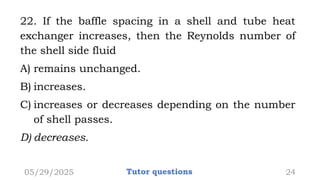
22. If thebaffle spacing in a shell and tube heat
exchanger increases, then the Reynolds number of
the shell side fluid
A) remains unchanged.
B) increases.
C) increases or decreases depending on the number
of shell passes.
D) decreases.
05/29/2025 Tutor questions 24
25.
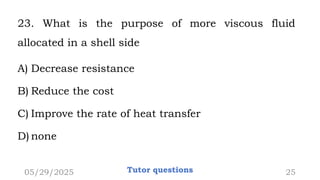
23. What isthe purpose of more viscous fluid
allocated in a shell side
A) Decrease resistance
B) Reduce the cost
C) Improve the rate of heat transfer
D) none
05/29/2025 Tutor questions 25
26.
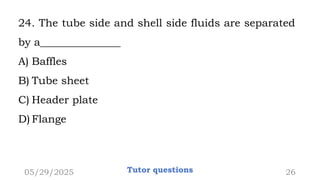
24. The tubeside and shell side fluids are separated
by a_______________
A) Baffles
B) Tube sheet
C) Header plate
D) Flange
05/29/2025 Tutor questions 26
27.
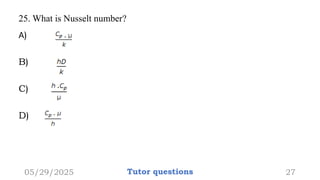
25. What isNusselt number?
A)
B)
C)
D)
05/29/2025 Tutor questions 27
28.
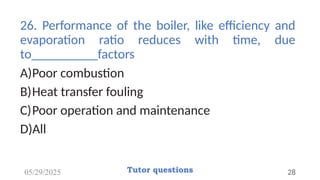
26. Performance ofthe boiler, like efficiency and
evaporation ratio reduces with time, due
to__________factors
A)Poor combustion
B)Heat transfer fouling
C)Poor operation and maintenance
D)All
05/29/2025 Tutor questions 28
29.
27. In boilerefficiency tests the indirect method testing is preferred
over than direct method Why?
A) Does not give clues to the operator as to why the efficiency of the system
is lower
B) calculates the various heat losses associated with boiler
C) Does not calculate various losses accountable for various efficiency levels
D) Evaporation ratio and efficiency may mislead if the steam is highly wet
due to water carryover
05/29/2025 Tutor questions 29
30.
28. Which oneis the greatest boiler heat loss in indirect
method testing?
A) Heat loss due to moisture present in the fuel
B) Heat loss due to moisture present in the air
C) Heat loss due to dry flue gas
D) Heat loss due to radiation and convection
05/29/2025 Tutor questions 30
31.
29. In aparallel flow heat exchanger, if the outlet temperature
of hot and cold fluids are the same, then the log mean
temperature difference (LMTD) is
A) Minimum
B) Infinity
C) Maximum
D) zero
05/29/2025 Tutor questions 31
32.
30. In counterflow compared to parallel flow,
A) LMTD is greater.
B) Less surface area is required for a given heat transfer rate.
C) Both (a) and (b).
D) More surface area is required for a given heat transfer
rate.
05/29/2025 Tutor questions 32
33.
31. In evaporatordesign if the concentrated product may
degenerate if exposed to high temperature, which feeding
arrangement is best?
A) Forward feed
B) Backward feed
C) Mixed feed
D) Parallel feed
05/29/2025 Tutor questions 33
34.
05/29/2025 34
Compiled examsThermal, Fundamentals of Biochem, & apparatus, Mechanical Unit Operation Course,
Reaction Engineering Model Exam, Chemical Engineering Thermodynamic II, Plant design and
engineering economics, Heat and mass transfer model questions, Fluid Mechanics, Mass Transfer Unit
Operation, Fundamentals of chemical engineering,
•