Thermal Control Activities


       Andrea Bartolini
       a.bartolini@unibo.it
Outline

•   Thermal Management
•   Thermal Model Learning
•   Model Predictive Controller
•   Computational Sprinting
•   Reliability Borrowing
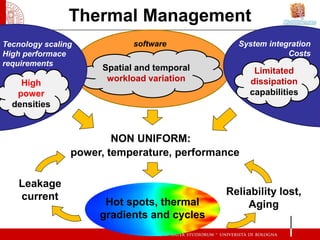
Thermal Management
Tecnology scaling           software          System integration
High performace                                           Costs
requirements
                     Spatial and temporal          Limitated
                      workload variation          dissipation
    High
   power                                          capabilities
  densities


                        NON UNIFORM:
                power, temperature, performance

   Leakage
   current                                  Reliability lost,
                      Hot spots, thermal        Aging
                     gradients and cycles
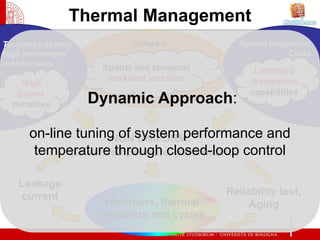
Thermal Management
Tecnology scaling           software          System integration
High performace                                           Costs
requirements
                     Spatial and temporal         Limitated
                      workload variation         dissipation
    High
   power                                         capabilities
  densities         Dynamic Approach:

      on-line tuning of system performance and
                     NON UNIFORM:
       temperature through closed-loop control
             power, temperature, performance

   Leakage
   current                                  Reliability lost,
                      Hot spots, thermal        Aging
                     gradients and cycles
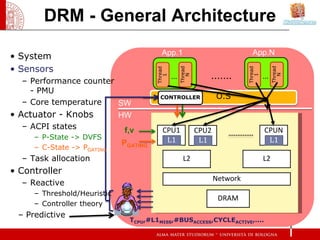
DRM - General Architecture
                                         App.1                                    App.N
• System
• Sensors


                                                                                               Thread
                                                                                Thread
                                                      Thread
                                       Thread
                                                                  .......


                                                                                                 N
                                                        N


                                                                                  1
                                         1
                                                ...                                      ...
  – Performance counter
    - PMU
                                         CONTROLLER                   O.S
  – Core temperature    SW
• Actuator - Knobs           HW


                                           L1                   L1                        L1
  – ACPI states              f,v          CPU1                 CPU2                      CPUN
     – P-State -> DVFS
                             PGATING
     – C-State -> PGATING
  – Task allocation                                    L2                                L2
• Controller
                                                                      Network
  – Reactive
     – Threshold/Heuristic                               Simulation snap-shot
                                                                  DRAM
     – Controller theory
 – Predictive
                               TCPU,#L1MISS,#BUSACCESS,CYCLEACTIVE,....
Thermal Controller
                                                                            Model Predictive
                                                                                Controller
                                                                      •Internal prediction:
                                                                                avoid overshoot
                                                                      •Optimization:
                  [Intel®, ISSCC 2007]
                                                                          maximizes performance
                                                                                                 Target
                                                                                               frequency
                                             Classical feed-back      Past input
                                                                       & output    Thermal   Future       +
                                                 controller                         Model    output   -
                                                                           Future            Future
                                         • PID controllers                  input
                                                                                   Optimizer   error
    Threshold based                      • Better than threshold               Cost
                                                                               function Constraint
       controller                          based approach                                         MPC
                                                                      • Centralized
                                         • Cannot prevent overshoot
•T > Tmax  low freq                                                      • aware of neighbor
•T < Tmin  high freq                                                       cores thermal
• cannot prevent overshoot                                                  influence
• thermal cycle                                                           • All at once – MIMO
                                                                            controller
                                                                          • Complexity !!!
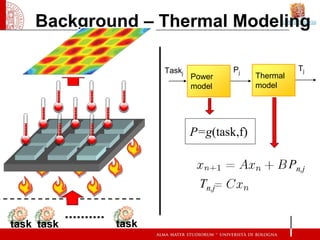
Background – Thermal Modeling

                   Taskj                Pj               Tj
                           Power
                           Modello di        Thermal
                                             Modello
                           model
                           potenza           model
                                             Termico


                           P=g(task,f)

                                                       Pn,j
                             Tn,j


task task   task
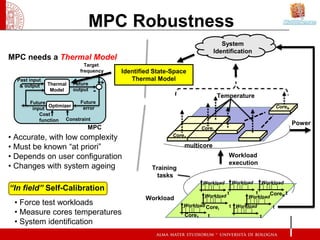
MPC Robustness
                                                                                  System
                                                                               Identification
MPC needs a Thermal Model
                             Target
                           frequency      Identified State-Space
  Past input                                 Thermal Model
   & output    Thermal   Future       +
                Model    output   -
                                                                                Temperature
       Future            Future
               Optimizer   error                                                                             CoreN
        input
           Cost
           function Constraint
                                                                                                                     Power
                              MPC                                      Corei
                                                           Core1
• Accurate, with low complexity
• Must be known “at priori”                                    multicore
• Depends on user configuration                                                     Workload
                                                                                    execution
• Changes with system ageing                        Training
                                                      tasks
                                                                       Workload         Workload     Workload
“In field” Self-Calibration                                                                     t
                                                                        Workload
                                                                                    t                  CoreN t
                                                  Workload                                    Workload
 • Force test workloads                                        Workload Core            t Workload       t
                                                                                i
 • Measure cores temperatures                                  Core1     t                           t
 • System identification
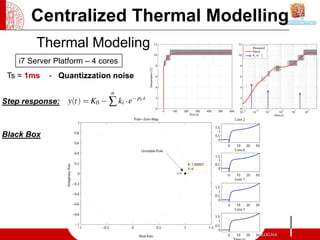
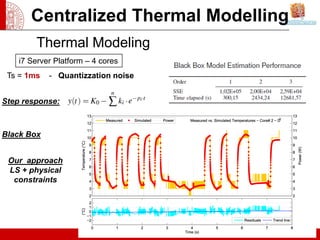
Centralized Thermal Modelling
        Thermal Modeling
    i7 Server Platform – 4 cores
 Ts = 1ms   - Quantizzation noise


Step response:


Black Box
Centralized Thermal Modelling
        Thermal Modeling
    i7 Server Platform – 4 cores
 Ts = 1ms   - Quantizzation noise


Step response:


Black Box


 Our approach
 LS + physical
  constraints
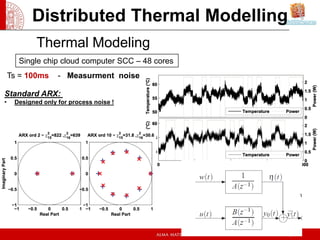
Distributed Thermal Modelling
            Thermal Modeling
      Single chip cloud computer SCC – 48 cores
    Ts = 100ms     - Measurment noise

Standard ARX:
•    Designed only for process noise !
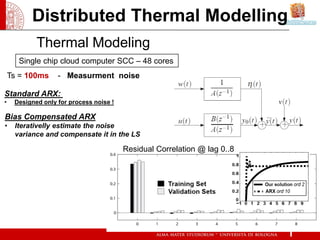
Distributed Thermal Modelling
            Thermal Modeling
      Single chip cloud computer SCC – 48 cores
    Ts = 100ms     - Measurment noise

Standard ARX:
•    Designed only for process noise !

Bias Compensated ARX
•    Iterativelly estimate the noise
     variance and compensate it in the LS

                                         Residual Correlation @ lag 0..8
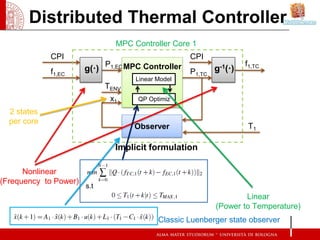
Distributed Thermal Controller
                                MPC Controller Core 1
             CPI                                     CPI
                              P1,EC MPC Controller                    f1,TC
             f1,EC     g(·)                          P1,TC   g-1(·)
                                      Linear Model
                              TENV
                               x1     QP Optimiz

  2 states
  per core
                                     Observer                          T1

                                Implicit formulation

      Nonlinear
(Frequency to Power)
                       s.t
                                                                     Linear
                                                             (Power to Temperature)
                                             Classic Luenberger state observer
Outline

•   Thermal Management
•   Thermal Model Learning
•   Model Predictive Controller
•   Computational Sprinting
•   Reliability Borrowing
Computational Sprinting
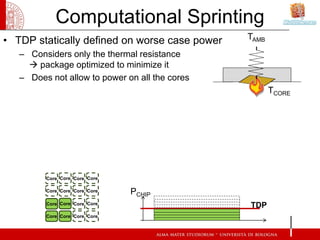
• TDP statically defined on worse case power    TAMB
   – Considers only the thermal resistance
      package optimized to minimize it
   – Does not allow to power on all the cores
                                                       TCORE


         Core Core Core Core

         Core Core Core Core   PCHIP
         Core Core Core Core                    TDP
         Core Core Core Core
Computational Sprinting
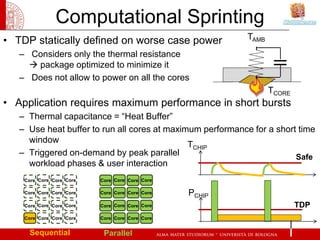
• TDP statically defined on worse case power                TAMB
   – Considers only the thermal resistance
      package optimized to minimize it
   – Does not allow to power on all the cores
                                                                   TCORE
• Application requires maximum performance in short bursts
   – Thermal capacitance = “Heat Buffer”
   – Use heat buffer to run all cores at maximum performance for a short time
     window
                                              TCHIP
   – Triggered on-demand by peak parallel                               Safe
     workload phases & user interaction
    Core Core Core Core   Core Core Core Core

    Core Core Core Core   Core Core Core Core   PCHIP
    Core Core Core Core   Core Core Core Core                              TDP
    Core Core Core Core   Core Core Core Core


     Sequential            Parallel
Computational Sprinting
• TDP statically defined on worse case power                TAMB
   – Considers only the thermal resistance
      package optimized to minimize it             PCM

   – Does not allow to power on all the cores
                                                                   TCORE
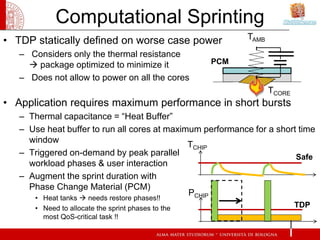
• Application requires maximum performance in short bursts
   – Thermal capacitance = “Heat Buffer”
   – Use heat buffer to run all cores at maximum performance for a short time
     window
                                              TCHIP
   – Triggered on-demand by peak parallel                               Safe
     workload phases & user interaction
   – Augment the sprint duration with
     Phase Change Material (PCM)
                                              PCHIP
      • Heat tanks  needs restore phases!!
      • Need to allocate the sprint phases to the                          TDP
        most QoS-critical task !!
Re-Sprinting Controller
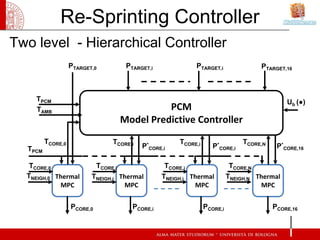
Two level - Hierarchical Controller
                   PTARGET,0            PTARGET,i             PTARGET,i                PTARGET,16


    TPCM                                                                                        Ub (●)
    TAMB                                         PCM
                                       Model Predictive Controller
         TCORE,0                  TCORE,i                TCORE,i                  TCORE,N
  TPCM                                       P*CORE,i                 P*CORE,i               P*CORE,16

   TCORE,0                   TCORE,i                TCORE,i                  TCORE,N
  TNEIGH,0 Thermal        TNEIGH,i Thermal          TNEIGH,i Thermal         TNEIGH,N Thermal
            MPC                     MPC                       MPC                      MPC


                   PCORE,0                PCORE,i                  PCORE,i                  PCORE,16
Guaranteed re-sprinting
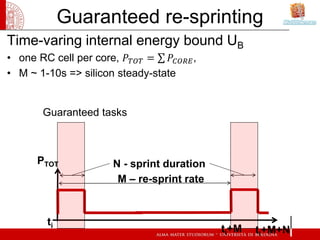
• one RC cell per core, 𝑃𝑃 𝑇𝑇𝑇𝑇𝑇𝑇 = ∑ 𝑃𝑃𝐶𝐶𝐶𝐶𝐶𝐶𝐶𝐶 ,
Time-varing internal energy bound UB

• M ~ 1-10s => silicon steady-state


         Guaranteed tasks


       PTOT                 N - sprint duration
                             M – re-sprint rate


          ti
                                                     ti+M   ti+M+N
Guaranteed re-sprinting
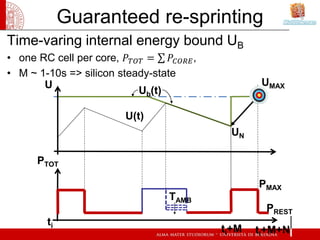
• one RC cell per core, 𝑃𝑃 𝑇𝑇𝑇𝑇𝑇𝑇 = ∑ 𝑃𝑃𝐶𝐶𝐶𝐶𝐶𝐶𝐶𝐶 ,
Time-varing internal energy bound UB

• M ~ 1-10s => silicon steady-state
       U                                                     UMAX
                               Ub(t)

                               U(t)
                                                      UN

       PTOT

                                                            PMAX
                                          TAMB
                                                             PREST
          ti
                                                     ti+M   ti+M+N
Outline

•   Thermal Management
•   Thermal Model Learning
•   Model Predictive Controller
•   Computational Sprinting
•   Reliability Borrowing
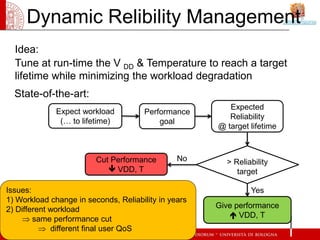
Dynamic Relibility Management
  Idea:
  Tune at run-time the V DD & Temperature to reach a target
  lifetime while minimizing the workload degradation
  State-of-the-art:
                                                         Expected
              Expect workload          Performance
                                                         Reliability
               (… to lifetime)             goal
                                                      @ target lifetime


                         Cut Performance        No      > Reliability
                             VDD, T                       target

Issues:                                                        Yes
1) Workload change in seconds, Reliability in years
2) Different workload                                 Give performance
     ⇒ same performance cut                               VDD, T
          ⇒ different final user QoS
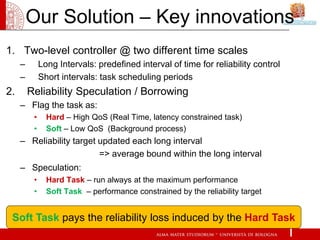
Our Solution – Key innovations
1. Two-level controller @ two different time scales
     –        Long Intervals: predefined interval of time for reliability control
     –        Short intervals: task scheduling periods
2.       Reliability Speculation / Borrowing
     – Flag the task as:
          •     Hard – High QoS (Real Time, latency constrained task)
          •     Soft – Low QoS (Background process)
     – Reliability target updated each long interval
                          => average bound within the long interval
     – Speculation:
          •     Hard Task – run always at the maximum performance
          •     Soft Task – performance constrained by the reliability target


 Soft Task pays the reliability loss induced by the Hard Task
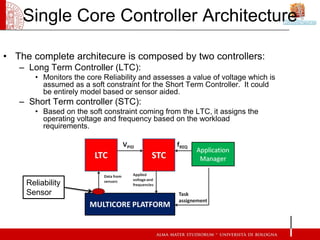
Single Core Controller Architecture

• The complete architecure is composed by two controllers:
   – Long Term Controller (LTC):
       • Monitors the core Reliability and assesses a value of voltage which is
         assumed as a soft constraint for the Short Term Controller. It could
         be entirely model based or sensor aided.
   – Short Term controller (STC):
       • Based on the soft constraint coming from the LTC, it assigns the
         operating voltage and frequency based on the workload
         requirements.


     Reliability
     Sensor
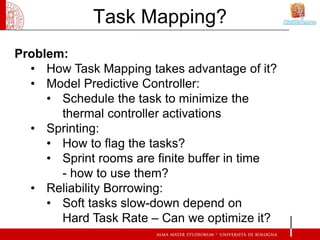
Task Mapping?
Problem:
  • How Task Mapping takes advantage of it?
  • Model Predictive Controller:
     • Schedule the task to minimize the
       thermal controller activations
  • Sprinting:
     • How to flag the tasks?
     • Sprint rooms are finite buffer in time
       - how to use them?
  • Reliability Borrowing:
     • Soft tasks slow-down depend on
       Hard Task Rate – Can we optimize it?

Thermal Control Overview

  • 1.
    Thermal Control Activities Andrea Bartolini a.bartolini@unibo.it
  • 2.
    Outline • Thermal Management • Thermal Model Learning • Model Predictive Controller • Computational Sprinting • Reliability Borrowing
  • 3.
    Thermal Management Tecnology scaling software System integration High performace Costs requirements Spatial and temporal Limitated workload variation dissipation High power capabilities densities NON UNIFORM: power, temperature, performance Leakage current Reliability lost, Hot spots, thermal Aging gradients and cycles
  • 4.
    Thermal Management Tecnology scaling software System integration High performace Costs requirements Spatial and temporal Limitated workload variation dissipation High power capabilities densities Dynamic Approach: on-line tuning of system performance and NON UNIFORM: temperature through closed-loop control power, temperature, performance Leakage current Reliability lost, Hot spots, thermal Aging gradients and cycles
  • 5.
    DRM - GeneralArchitecture App.1 App.N • System • Sensors Thread Thread Thread Thread ....... N N 1 1 ... ... – Performance counter - PMU CONTROLLER O.S – Core temperature SW • Actuator - Knobs HW L1 L1 L1 – ACPI states f,v CPU1 CPU2 CPUN – P-State -> DVFS PGATING – C-State -> PGATING – Task allocation L2 L2 • Controller Network – Reactive – Threshold/Heuristic Simulation snap-shot DRAM – Controller theory – Predictive TCPU,#L1MISS,#BUSACCESS,CYCLEACTIVE,....
  • 6.
    Thermal Controller Model Predictive Controller •Internal prediction: avoid overshoot •Optimization: [Intel®, ISSCC 2007] maximizes performance Target frequency Classical feed-back Past input & output Thermal Future + controller Model output - Future Future • PID controllers input Optimizer error Threshold based • Better than threshold Cost function Constraint controller based approach MPC • Centralized • Cannot prevent overshoot •T > Tmax  low freq • aware of neighbor •T < Tmin  high freq cores thermal • cannot prevent overshoot influence • thermal cycle • All at once – MIMO controller • Complexity !!!
  • 7.
    Background – ThermalModeling Taskj Pj Tj Power Modello di Thermal Modello model potenza model Termico P=g(task,f) Pn,j Tn,j task task task
  • 8.
    MPC Robustness System Identification MPC needs a Thermal Model Target frequency Identified State-Space Past input Thermal Model & output Thermal Future + Model output - Temperature Future Future Optimizer error CoreN input Cost function Constraint Power MPC Corei Core1 • Accurate, with low complexity • Must be known “at priori” multicore • Depends on user configuration Workload execution • Changes with system ageing Training tasks Workload Workload Workload “In field” Self-Calibration t Workload t CoreN t Workload Workload • Force test workloads Workload Core t Workload t i • Measure cores temperatures Core1 t t • System identification
  • 9.
    Centralized Thermal Modelling Thermal Modeling i7 Server Platform – 4 cores Ts = 1ms - Quantizzation noise Step response: Black Box
  • 10.
    Centralized Thermal Modelling Thermal Modeling i7 Server Platform – 4 cores Ts = 1ms - Quantizzation noise Step response: Black Box Our approach LS + physical constraints
  • 11.
    Distributed Thermal Modelling Thermal Modeling Single chip cloud computer SCC – 48 cores Ts = 100ms - Measurment noise Standard ARX: • Designed only for process noise !
  • 12.
    Distributed Thermal Modelling Thermal Modeling Single chip cloud computer SCC – 48 cores Ts = 100ms - Measurment noise Standard ARX: • Designed only for process noise ! Bias Compensated ARX • Iterativelly estimate the noise variance and compensate it in the LS Residual Correlation @ lag 0..8
  • 13.
    Distributed Thermal Controller MPC Controller Core 1 CPI CPI P1,EC MPC Controller f1,TC f1,EC g(·) P1,TC g-1(·) Linear Model TENV x1 QP Optimiz 2 states per core Observer T1 Implicit formulation Nonlinear (Frequency to Power) s.t Linear (Power to Temperature) Classic Luenberger state observer
  • 14.
    Outline • Thermal Management • Thermal Model Learning • Model Predictive Controller • Computational Sprinting • Reliability Borrowing
  • 15.
    Computational Sprinting • TDPstatically defined on worse case power TAMB – Considers only the thermal resistance  package optimized to minimize it – Does not allow to power on all the cores TCORE Core Core Core Core Core Core Core Core PCHIP Core Core Core Core TDP Core Core Core Core
  • 16.
    Computational Sprinting • TDPstatically defined on worse case power TAMB – Considers only the thermal resistance  package optimized to minimize it – Does not allow to power on all the cores TCORE • Application requires maximum performance in short bursts – Thermal capacitance = “Heat Buffer” – Use heat buffer to run all cores at maximum performance for a short time window TCHIP – Triggered on-demand by peak parallel Safe workload phases & user interaction Core Core Core Core Core Core Core Core Core Core Core Core Core Core Core Core PCHIP Core Core Core Core Core Core Core Core TDP Core Core Core Core Core Core Core Core Sequential Parallel
  • 17.
    Computational Sprinting • TDPstatically defined on worse case power TAMB – Considers only the thermal resistance  package optimized to minimize it PCM – Does not allow to power on all the cores TCORE • Application requires maximum performance in short bursts – Thermal capacitance = “Heat Buffer” – Use heat buffer to run all cores at maximum performance for a short time window TCHIP – Triggered on-demand by peak parallel Safe workload phases & user interaction – Augment the sprint duration with Phase Change Material (PCM) PCHIP • Heat tanks  needs restore phases!! • Need to allocate the sprint phases to the TDP most QoS-critical task !!
  • 18.
    Re-Sprinting Controller Two level- Hierarchical Controller PTARGET,0 PTARGET,i PTARGET,i PTARGET,16 TPCM Ub (●) TAMB PCM Model Predictive Controller TCORE,0 TCORE,i TCORE,i TCORE,N TPCM P*CORE,i P*CORE,i P*CORE,16 TCORE,0 TCORE,i TCORE,i TCORE,N TNEIGH,0 Thermal TNEIGH,i Thermal TNEIGH,i Thermal TNEIGH,N Thermal MPC MPC MPC MPC PCORE,0 PCORE,i PCORE,i PCORE,16
  • 19.
    Guaranteed re-sprinting • oneRC cell per core, 𝑃𝑃 𝑇𝑇𝑇𝑇𝑇𝑇 = ∑ 𝑃𝑃𝐶𝐶𝐶𝐶𝐶𝐶𝐶𝐶 , Time-varing internal energy bound UB • M ~ 1-10s => silicon steady-state Guaranteed tasks PTOT N - sprint duration M – re-sprint rate ti ti+M ti+M+N
  • 20.
    Guaranteed re-sprinting • oneRC cell per core, 𝑃𝑃 𝑇𝑇𝑇𝑇𝑇𝑇 = ∑ 𝑃𝑃𝐶𝐶𝐶𝐶𝐶𝐶𝐶𝐶 , Time-varing internal energy bound UB • M ~ 1-10s => silicon steady-state U UMAX Ub(t) U(t) UN PTOT PMAX TAMB PREST ti ti+M ti+M+N
  • 21.
    Outline • Thermal Management • Thermal Model Learning • Model Predictive Controller • Computational Sprinting • Reliability Borrowing
  • 22.
    Dynamic Relibility Management Idea: Tune at run-time the V DD & Temperature to reach a target lifetime while minimizing the workload degradation State-of-the-art: Expected Expect workload Performance Reliability (… to lifetime) goal @ target lifetime Cut Performance No > Reliability  VDD, T target Issues: Yes 1) Workload change in seconds, Reliability in years 2) Different workload Give performance ⇒ same performance cut  VDD, T ⇒ different final user QoS
  • 23.
    Our Solution –Key innovations 1. Two-level controller @ two different time scales – Long Intervals: predefined interval of time for reliability control – Short intervals: task scheduling periods 2. Reliability Speculation / Borrowing – Flag the task as: • Hard – High QoS (Real Time, latency constrained task) • Soft – Low QoS (Background process) – Reliability target updated each long interval => average bound within the long interval – Speculation: • Hard Task – run always at the maximum performance • Soft Task – performance constrained by the reliability target Soft Task pays the reliability loss induced by the Hard Task
  • 24.
    Single Core ControllerArchitecture • The complete architecure is composed by two controllers: – Long Term Controller (LTC): • Monitors the core Reliability and assesses a value of voltage which is assumed as a soft constraint for the Short Term Controller. It could be entirely model based or sensor aided. – Short Term controller (STC): • Based on the soft constraint coming from the LTC, it assigns the operating voltage and frequency based on the workload requirements. Reliability Sensor
  • 25.
    Task Mapping? Problem: • How Task Mapping takes advantage of it? • Model Predictive Controller: • Schedule the task to minimize the thermal controller activations • Sprinting: • How to flag the tasks? • Sprint rooms are finite buffer in time - how to use them? • Reliability Borrowing: • Soft tasks slow-down depend on Hard Task Rate – Can we optimize it?