DMI-ST. JOHN THE BAPTIST UNIVERSITY
LILONGWE, MALAWI
Module Code: 055CS62
Subject Name: Theory of computation
Unit II Detail Notes
School of Computer Science
Module Teacher: Fanny Chatola
Syllabus
Operators of RE, Building RE, Precedence of operators, Algebraic laws for RE, Conversions: NFA to DFA, RE to DFA
Conversions: RE to DFA, DFA to RE Conversions: State/loop elimination, Arden‘s theorem Properties of Regular
Languages: Pumping Lemma for Regular languages, Closure and Decision properties. Case Study: RE in text search
and replace
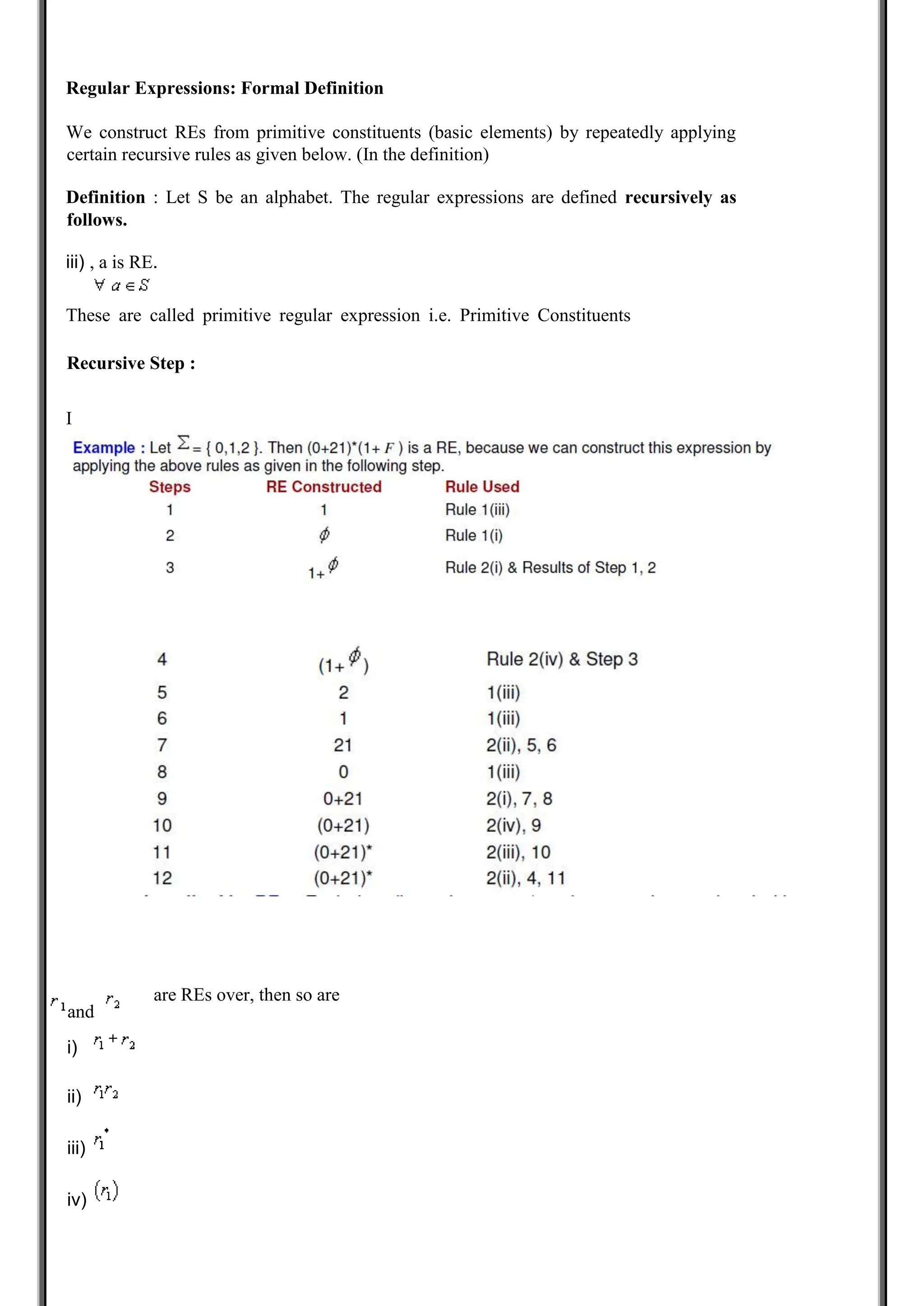
Regular Expressions: Formal Definition
We construct REs from primitive constituents (basic elements) by repeatedly applying
certain recursive rules as given below. (In the definition)
Definition : Let S be an alphabet. The regular expressions are defined recursively as
follows.
iii) , a is RE.
These are called primitive regular expression i.e. Primitive Constituents
Recursive Step :
I
are REs over, then so are
i)
ii)
iii)
iv)
and
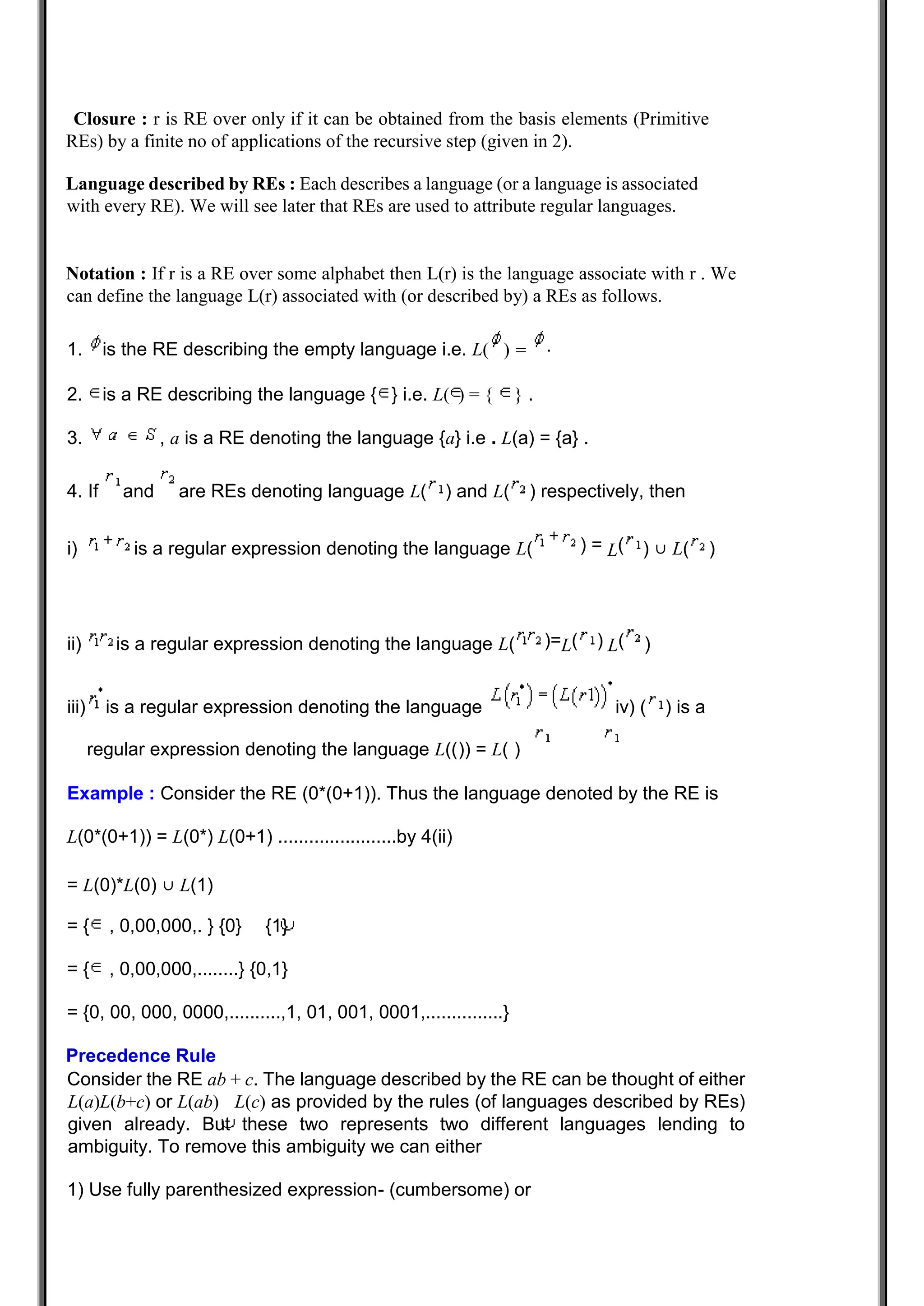
Closure : r is RE over only if it can be obtained from the basis elements (Primitive
REs) by a finite no of applications of the recursive step (given in 2).
Language described by REs : Each describes a language (or a language is associated
with every RE). We will see later that REs are used to attribute regular languages.
Notation : If r is a RE over some alphabet then L(r) is the language associate with r . We
can define the language L(r) associated with (or described by) a REs as follows.
1. is the RE describing the empty language i.e. L(
2. is a RE describing the language { } i.e. L( ) = { } .
3. , a is a RE denoting the language {a} i.e . L(a) = {a} .
4. If and are REs denoting language L( ) and L( ) respectively, then
i) is a regular expression denoting the language L( ) ∪ L( )
ii) is a regular expression denoting the language L( )
iii) is a regular expression denoting the language iv) ( ) is a
regular expression denoting the language L(()) = L( )
Example : Consider the RE (0*(0+1)). Thus the language denoted by the RE is
L(0*(0+1)) = L(0*) L(0+1) .......................by 4(ii)
= L(0)*L(0) ∪ L(1)
= { , 0,00,000,. } {0} {1}
= { , 0,00,000,........} {0,1}
= {0, 00, 000, 0000,..........,1, 01, 001, 0001,...............}
Precedence Rule
Consider the RE ab + c. The language described by the RE can be thought of either
L(a)L(b+c) or L(ab) L(c) as provided by the rules (of languages described by REs)
given already. But these two represents two different languages lending to
ambiguity. To remove this ambiguity we can either
1) Use fully parenthesized expression- (cumbersome) or
) = .
) = L(
)=L( ) L(
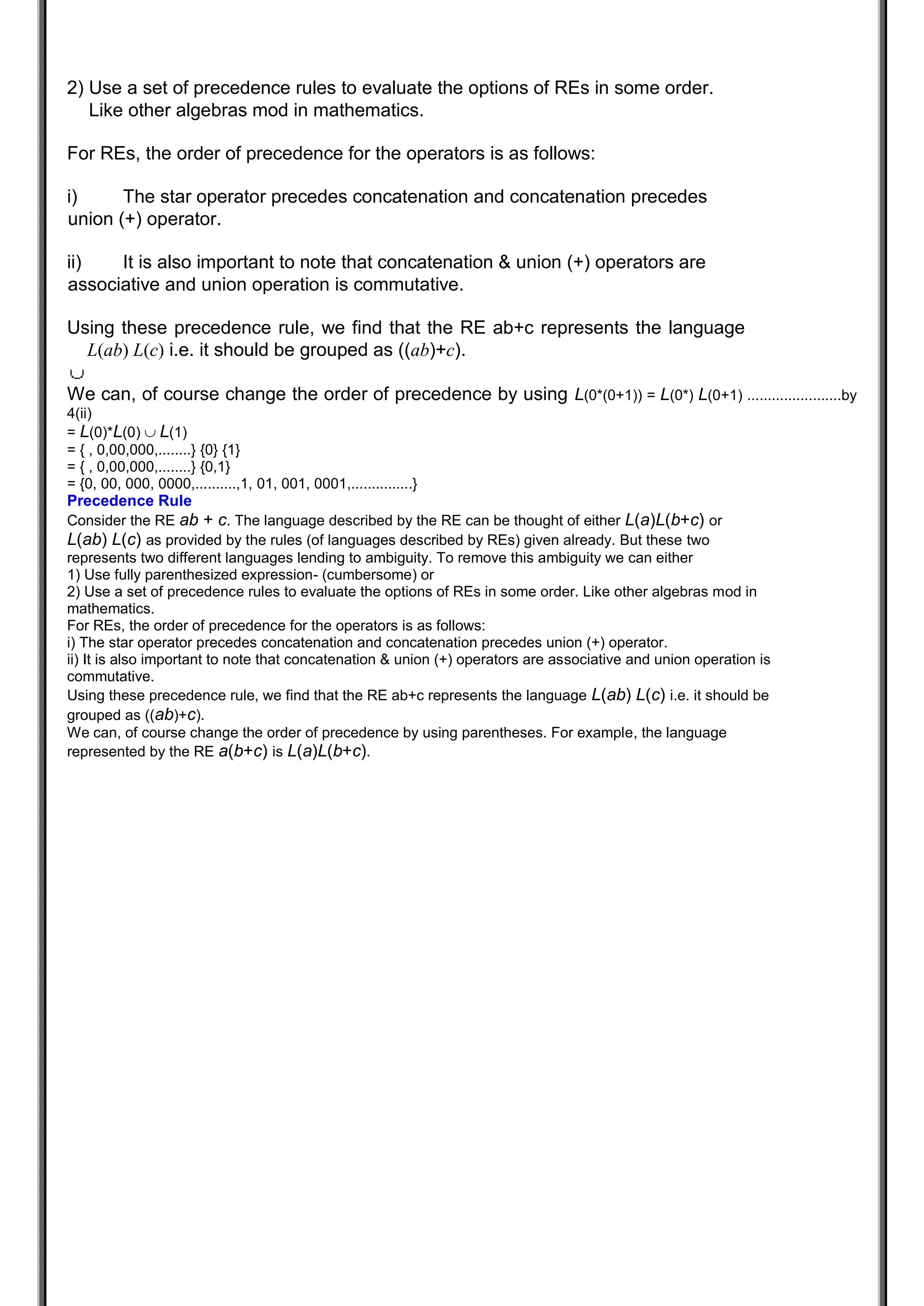
2) Use a set of precedence rules to evaluate the options of REs in some order.
Like other algebras mod in mathematics.
For REs, the order of precedence for the operators is as follows:
i) The star operator precedes concatenation and concatenation precedes
union (+) operator.
ii) It is also important to note that concatenation & union (+) operators are
associative and union operation is commutative.
Using these precedence rule, we find that the RE ab+c represents the language
L(ab) L(c) i.e. it should be grouped as ((ab)+c).
We can, of course change the order of precedence by using L(0*(0+1)) = L(0*) L(0+1) .......................by
4(ii)
= L(0)*L(0) L(1)
= { , 0,00,000,........} {0} {1}
= { , 0,00,000,........} {0,1}
= {0, 00, 000, 0000,..........,1, 01, 001, 0001,...............}
Precedence Rule
Consider the RE ab + c. The language described by the RE can be thought of either L(a)L(b+c) or
L(ab) L(c) as provided by the rules (of languages described by REs) given already. But these two
represents two different languages lending to ambiguity. To remove this ambiguity we can either
1) Use fully parenthesized expression- (cumbersome) or
2) Use a set of precedence rules to evaluate the options of REs in some order. Like other algebras mod in
mathematics.
For REs, the order of precedence for the operators is as follows:
i) The star operator precedes concatenation and concatenation precedes union (+) operator.
ii) It is also important to note that concatenation & union (+) operators are associative and union operation is
commutative.
Using these precedence rule, we find that the RE ab+c represents the language L(ab) L(c) i.e. it should be
grouped as ((ab)+c).
We can, of course change the order of precedence by using parentheses. For example, the language
represented by the RE a(b+c) is L(a)L(b+c).
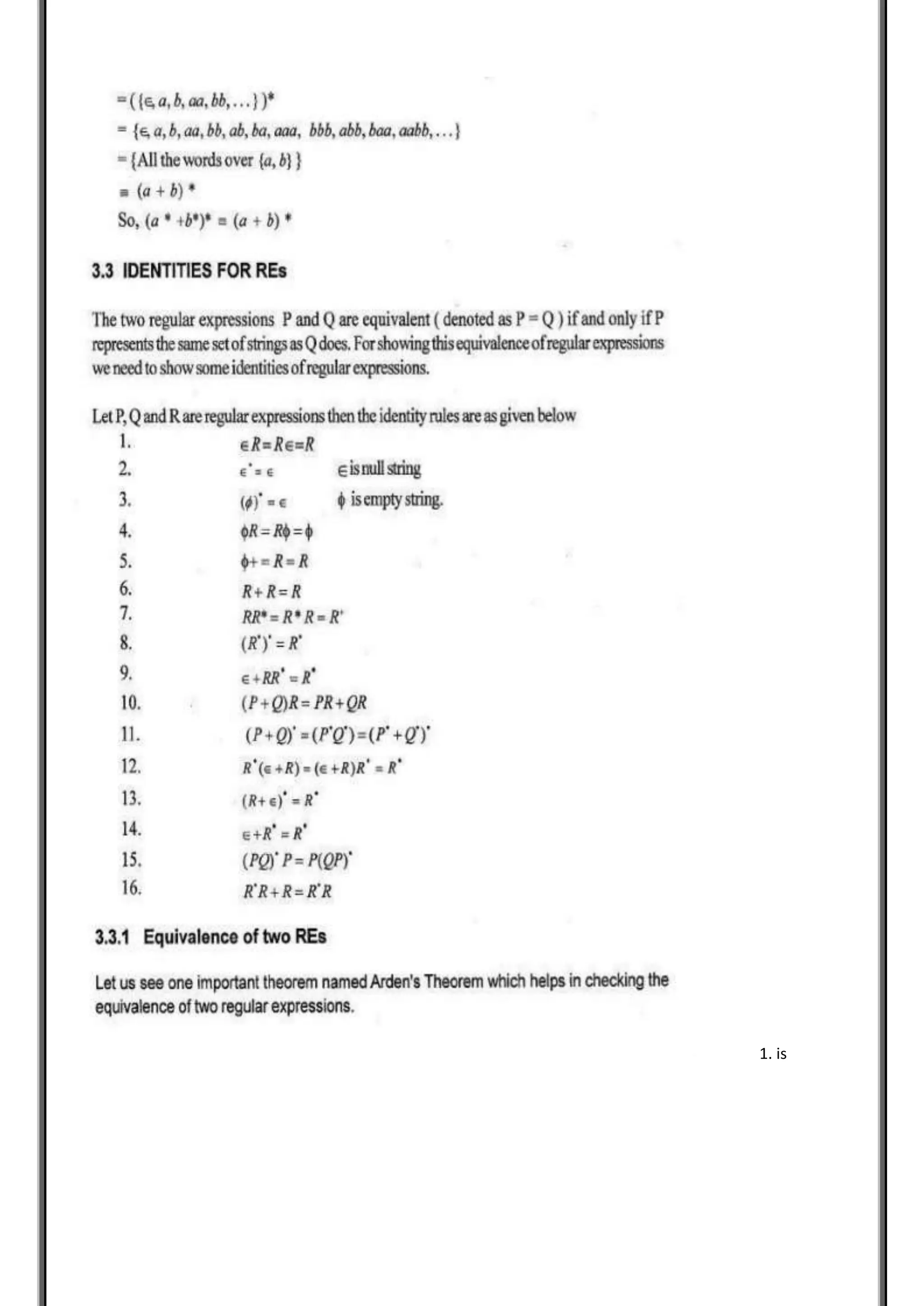
1. is
PUMPING LEMMA FOR REGULAR LANGUAGES
 This is a basic and important theorem used for checking whether given string is accepted by regular
expression or not.
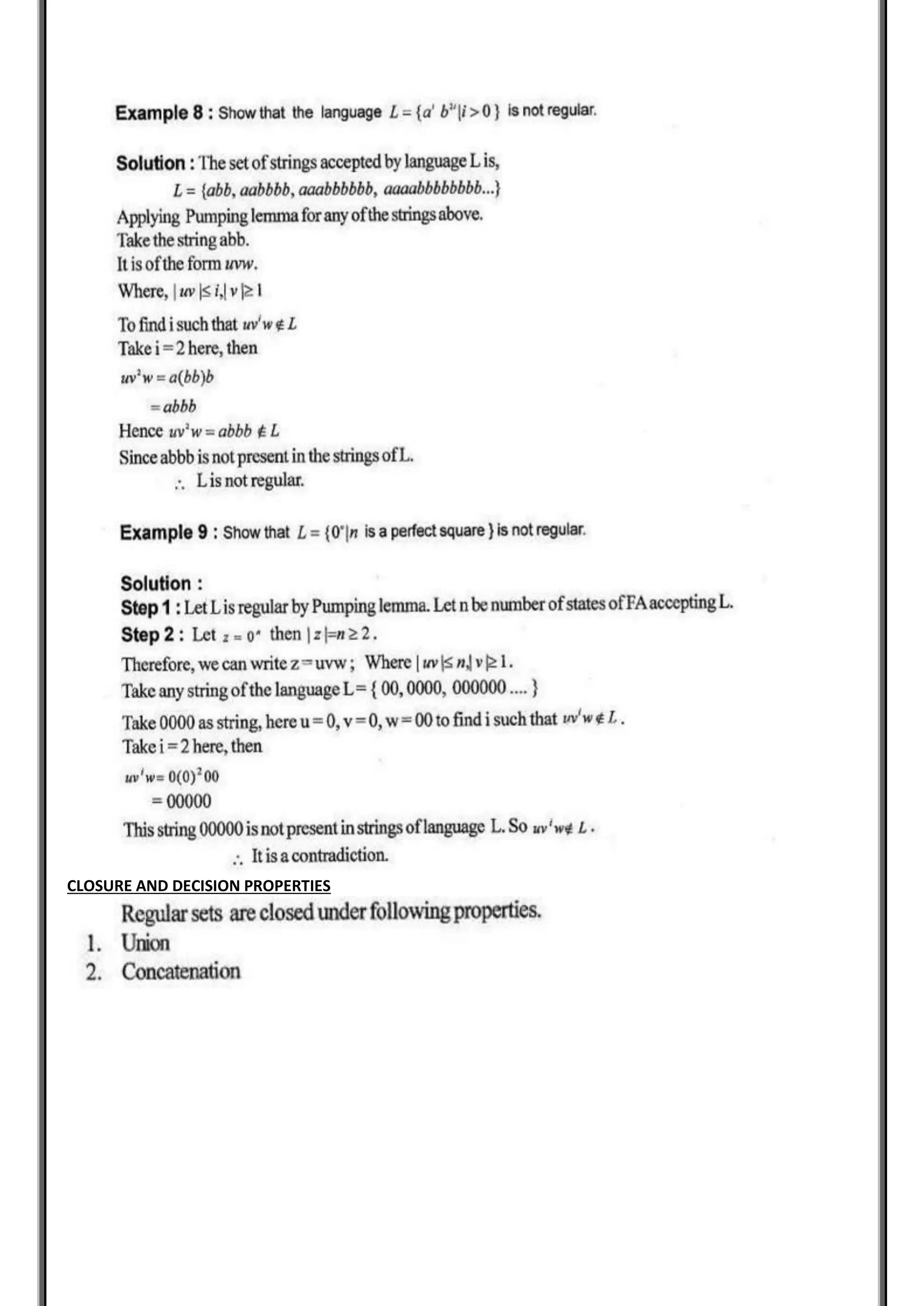
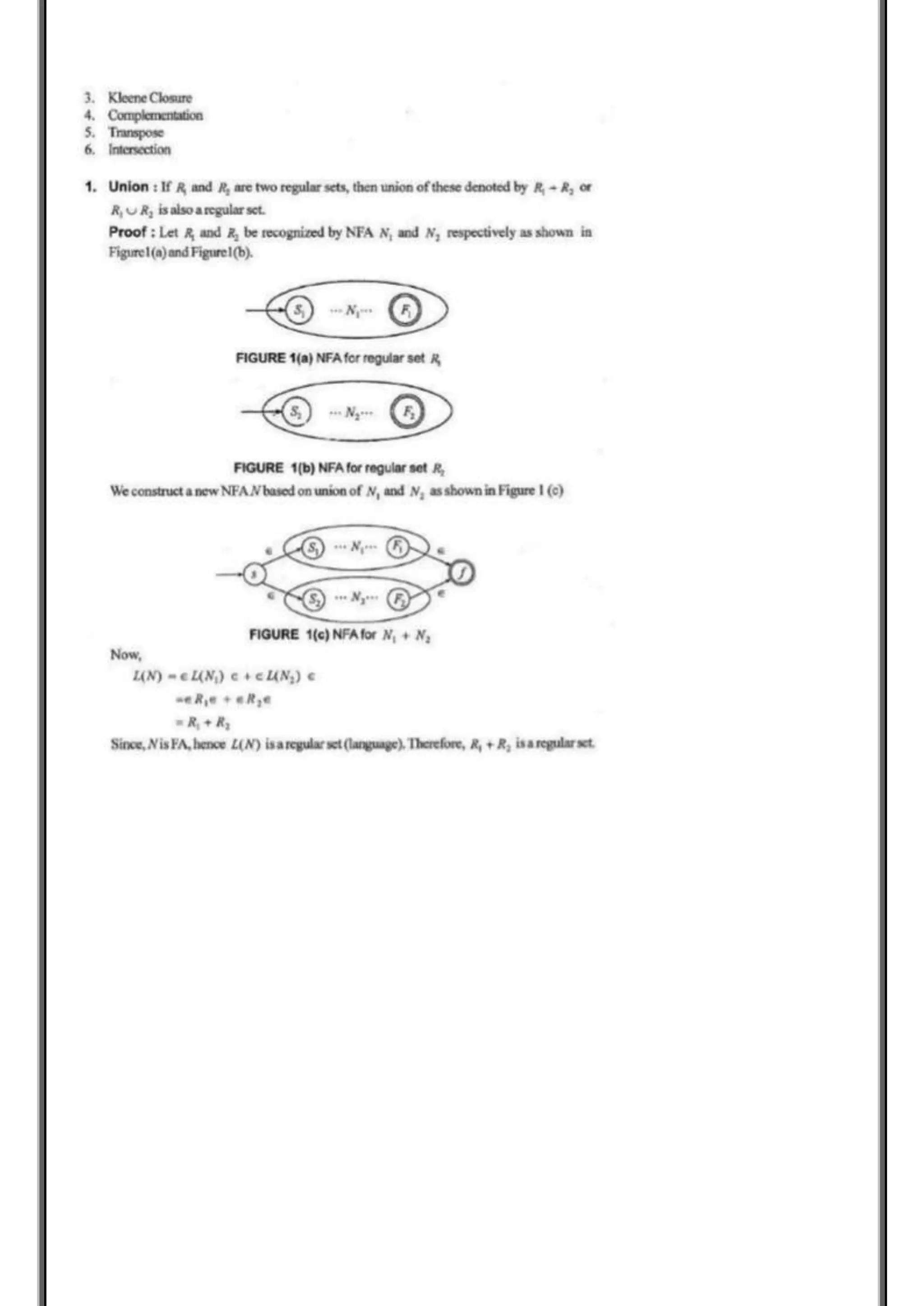
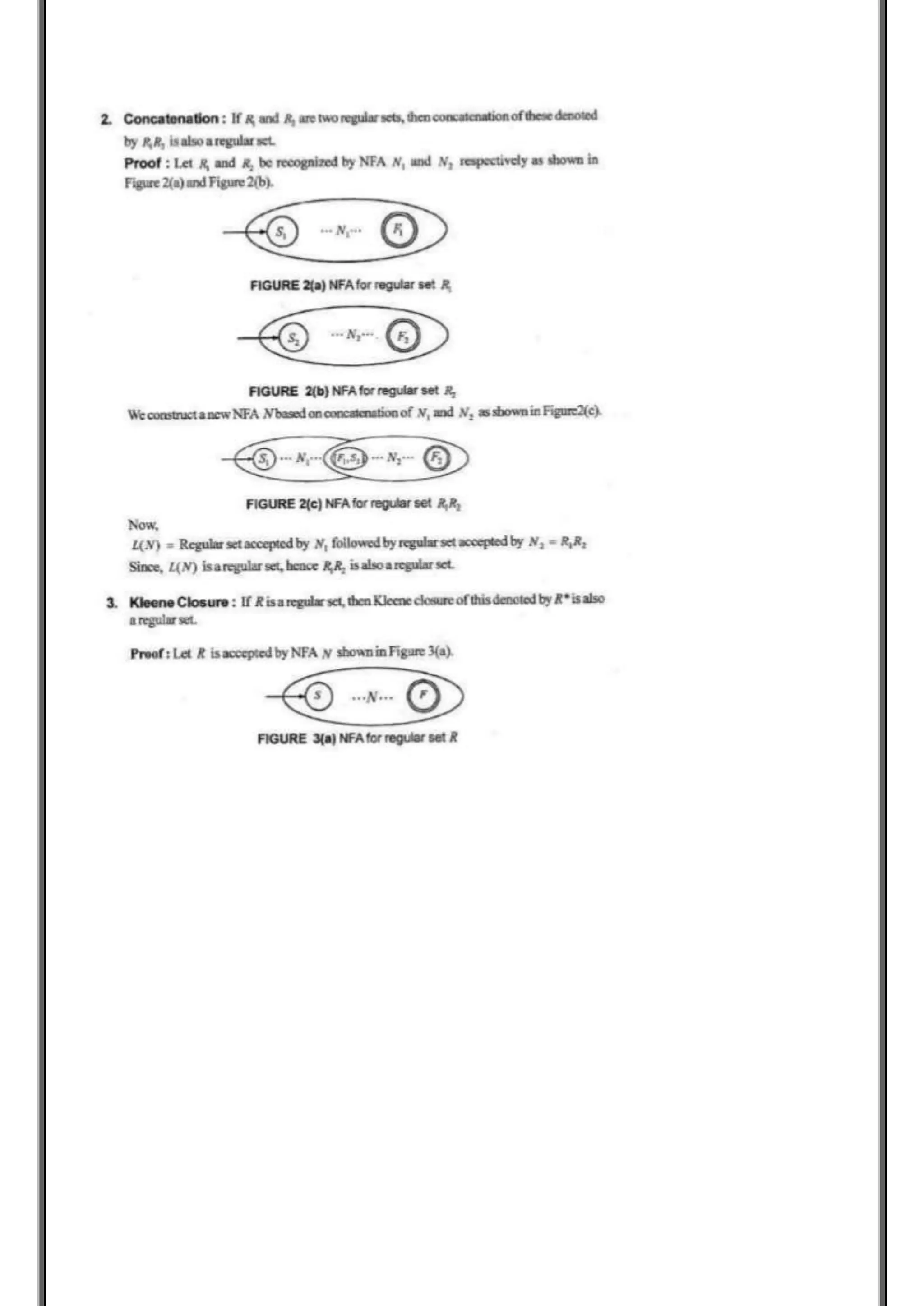
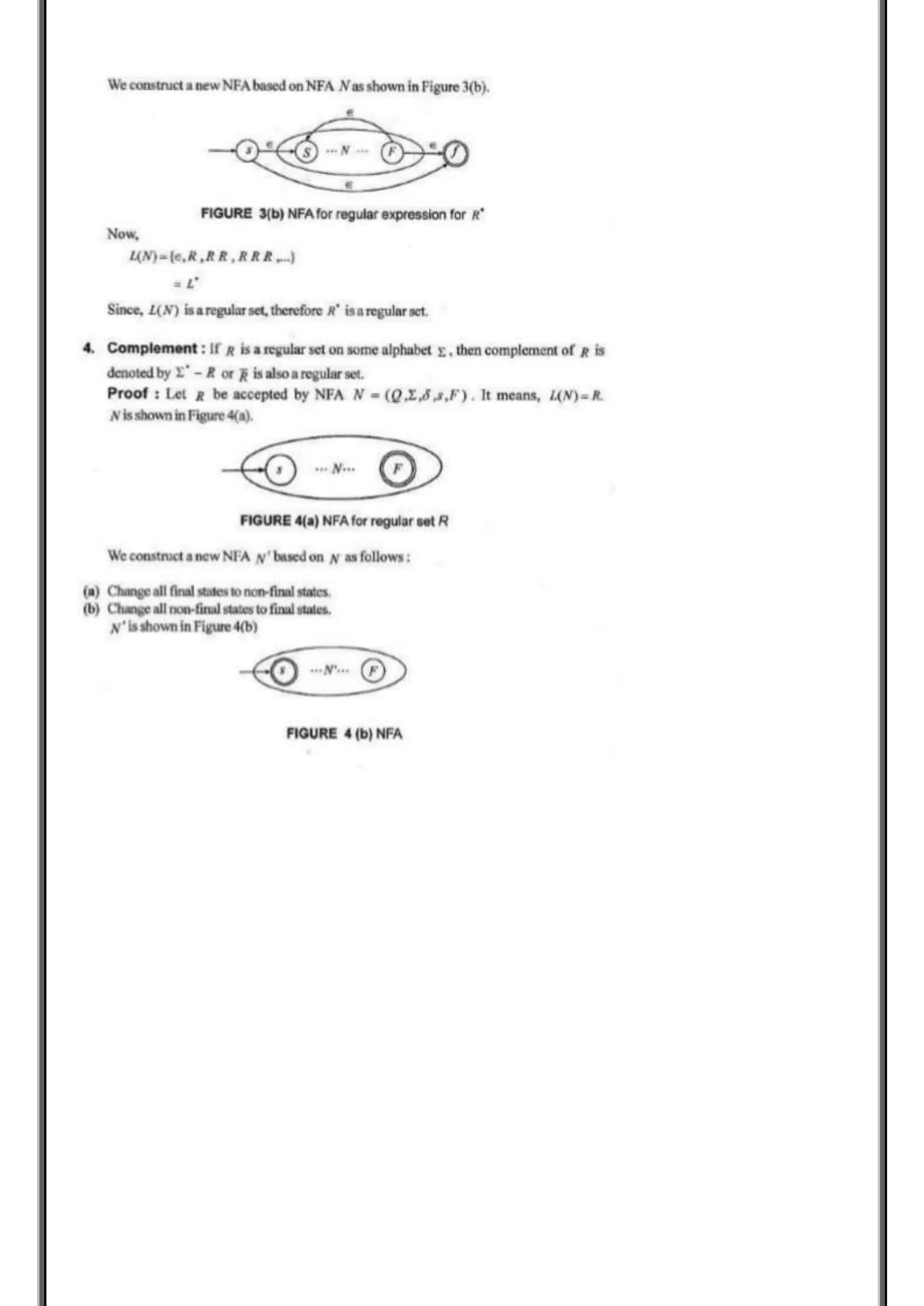
CLOSURE AND DECISION PROPERTIES
CASE STUDY: RE in text search and replace
When u want to search a specific pattern of text, use regular expressions. They can help you in pattern
matching, parsing, filtering of results, and so on. Once you learn the regex syntax, you can use it for almost
any language.

theory of computation notes for school of engineering

  • 1.
    DMI-ST. JOHN THEBAPTIST UNIVERSITY LILONGWE, MALAWI Module Code: 055CS62 Subject Name: Theory of computation Unit II Detail Notes School of Computer Science Module Teacher: Fanny Chatola
  • 2.
    Syllabus Operators of RE,Building RE, Precedence of operators, Algebraic laws for RE, Conversions: NFA to DFA, RE to DFA Conversions: RE to DFA, DFA to RE Conversions: State/loop elimination, Arden‘s theorem Properties of Regular Languages: Pumping Lemma for Regular languages, Closure and Decision properties. Case Study: RE in text search and replace
  • 3.
    Regular Expressions: FormalDefinition We construct REs from primitive constituents (basic elements) by repeatedly applying certain recursive rules as given below. (In the definition) Definition : Let S be an alphabet. The regular expressions are defined recursively as follows. iii) , a is RE. These are called primitive regular expression i.e. Primitive Constituents Recursive Step : I are REs over, then so are i) ii) iii) iv) and
  • 4.
    Closure : ris RE over only if it can be obtained from the basis elements (Primitive REs) by a finite no of applications of the recursive step (given in 2). Language described by REs : Each describes a language (or a language is associated with every RE). We will see later that REs are used to attribute regular languages. Notation : If r is a RE over some alphabet then L(r) is the language associate with r . We can define the language L(r) associated with (or described by) a REs as follows. 1. is the RE describing the empty language i.e. L( 2. is a RE describing the language { } i.e. L( ) = { } . 3. , a is a RE denoting the language {a} i.e . L(a) = {a} . 4. If and are REs denoting language L( ) and L( ) respectively, then i) is a regular expression denoting the language L( ) ∪ L( ) ii) is a regular expression denoting the language L( ) iii) is a regular expression denoting the language iv) ( ) is a regular expression denoting the language L(()) = L( ) Example : Consider the RE (0*(0+1)). Thus the language denoted by the RE is L(0*(0+1)) = L(0*) L(0+1) .......................by 4(ii) = L(0)*L(0) ∪ L(1) = { , 0,00,000,. } {0} {1} = { , 0,00,000,........} {0,1} = {0, 00, 000, 0000,..........,1, 01, 001, 0001,...............} Precedence Rule Consider the RE ab + c. The language described by the RE can be thought of either L(a)L(b+c) or L(ab) L(c) as provided by the rules (of languages described by REs) given already. But these two represents two different languages lending to ambiguity. To remove this ambiguity we can either 1) Use fully parenthesized expression- (cumbersome) or ) = . ) = L( )=L( ) L(
  • 5.
    2) Use aset of precedence rules to evaluate the options of REs in some order. Like other algebras mod in mathematics. For REs, the order of precedence for the operators is as follows: i) The star operator precedes concatenation and concatenation precedes union (+) operator. ii) It is also important to note that concatenation & union (+) operators are associative and union operation is commutative. Using these precedence rule, we find that the RE ab+c represents the language L(ab) L(c) i.e. it should be grouped as ((ab)+c). We can, of course change the order of precedence by using L(0*(0+1)) = L(0*) L(0+1) .......................by 4(ii) = L(0)*L(0) L(1) = { , 0,00,000,........} {0} {1} = { , 0,00,000,........} {0,1} = {0, 00, 000, 0000,..........,1, 01, 001, 0001,...............} Precedence Rule Consider the RE ab + c. The language described by the RE can be thought of either L(a)L(b+c) or L(ab) L(c) as provided by the rules (of languages described by REs) given already. But these two represents two different languages lending to ambiguity. To remove this ambiguity we can either 1) Use fully parenthesized expression- (cumbersome) or 2) Use a set of precedence rules to evaluate the options of REs in some order. Like other algebras mod in mathematics. For REs, the order of precedence for the operators is as follows: i) The star operator precedes concatenation and concatenation precedes union (+) operator. ii) It is also important to note that concatenation & union (+) operators are associative and union operation is commutative. Using these precedence rule, we find that the RE ab+c represents the language L(ab) L(c) i.e. it should be grouped as ((ab)+c). We can, of course change the order of precedence by using parentheses. For example, the language represented by the RE a(b+c) is L(a)L(b+c).
  • 7.
  • 10.
    PUMPING LEMMA FORREGULAR LANGUAGES  This is a basic and important theorem used for checking whether given string is accepted by regular expression or not.
  • 11.
  • 16.
    CASE STUDY: REin text search and replace When u want to search a specific pattern of text, use regular expressions. They can help you in pattern matching, parsing, filtering of results, and so on. Once you learn the regex syntax, you can use it for almost any language.