r 2010 American Chemical Society and Division of Chemical Education, Inc.
_
pubs.acs.org/jchemeduc
_
Vol. 87 No. 4 April 2010
_
Journal of Chemical Education 435
10.1021/ed800124m Published on Web 03/09/2010
Research: Science and Education
Theoretical Basis and Correct Explanation of the
Periodic System: Review and Update
W. H. Eugen Schwarz*
Theoretical Chemistry, University Siegen, 57068 Siegen, Germany
*schwarz@chemie.uni-siegen.de
Ronald L. Rich*
Scholar in Residence, Bluffton University, Bluffton, Ohio 45817
*richr@bluffton.edu
The periodic system of chemical elements (PSE) is one of
the most ingenious inventions of human culture; it is one of the
most essential ordering concepts of chemistry (1). Since its
creation nearly one and a half centuries ago, its principles remain
a hot topic of scientific, educational, historic, and philosophic
discussions. In this century alone, about 50-100 articles related
to the periodic system have already been published just in this
Journal. These discussions, and parallel ones in other journals
and in about 20 books and brochures of the past decade, are in
general quite illuminating concerning chemical and cultural
aspects.1
Theoretical and physical aspects, however, are often
afflicted with serious misconceptions. Scientific achievements
sometimes diffuse rather slowly among different scientific com-
munities. To promote this process, we ask a series of modest
questions and give short answers without detailed explanations
(Table 1). Then, a coherent theoretical background is explicated.
Novel, logically consistent views on old empirical and theoretical
facts (2) supply the foundation of a deeper understanding of the
structure of the PSE, as represented by different periodic tables.
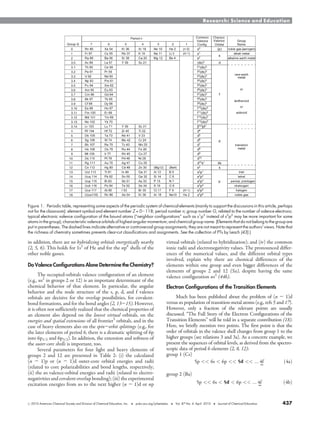
A representative periodic table is shown in Figure 1.
The Backbone of the Periodic System
The atomic weight (mass), Aave, was clarified at the Karlsruhe
congress in 1860 (1). In 1862, de Chancourtois was the first to
arrange the chemical elements linearly according to Aave. He
wound up the array of elements to a spiral so that elements with
characteristic chemical properties periodically appeared one
below the other. Since then, a significant fraction of all graphical
representations of the periodic system has been cyclic (7). The
horizontally and vertically “doubly connected” arrangements
display a comparatively large fraction of the relations between
the elements (1, 2, 8). According to recent empirical chemo-
metric investigations, the groups of most similar elements are the
main groups just before and after the noble gasses (group G = 18
or 0 in Figure 1) (9). These groups are the nonmetallic halogens,
chalcogens, and pnictogens (G = 17, 16, 15) and the alkali, alkaline-
earth, and earth metals (G = 1, 2, 3). The strong variation of
properties of just these groups, 15 to 18 and 0 to 3, strongly
contributes to the appearance of periodicities of 8, 18, and 32
elements. This has recently been re-examined by mathematical
Fourier analysis (10). The periodicity of the transition-element
groups is empirically less well pronounced than that of the main-
group elements (9).
Meyer's (11) first, simple, rectangular periodic table of 1862
explicitly contained groups 14 (C, Si, [73
E], Sn, Pb), 15 (N, P, As,
Sb, Bi), 16 (O, S, Se, Te), 17 (F, Cl, Br, I), 1 (Li, Na, K, Rb, Cs,
Tl?), and 2 (Be?, Mg, Ca, Sr, Ba). The yet unknown noble gasses
were still missing in the center, and the unknown earth metals
were missing at the right edge.7
Meyer had labeled the groups by
their typical valence numbers, which now can be explained by the
dominant electronic configurations of the bonded atoms. Soon,
rectangular tables with the valence (electron) numbers running
from 1 to 8 (or 18) became the prevailing type of graphical
representations. Thereby, the backbone of the periodic system
was split up. Since then, the noble gasses form the left or right
edges of nonspiral, flat, easily printable tables.
Core-Valence Gaps
The empirical chemical center of the periodic system, the
noble-gas family, is microscopically characterized by very stable 1s2
or np6
(n e 6) closed “valence” shells with high ionization
potentials. The three preceding elements of the noble gasses have
1, 2, or 3 strongly electronegative (i.e., energetically low lying) np
vacancies in period n, giving rise to oxidation states 1-, 2-, or 3-.
Each electron pair can then form a polar double bond, for example,
to an O atom, or two polar single bonds, for example, to two
halogen atoms. Therefore, the oxidation or valence numbers are
changed in steps of two (e.g., for S from 2- to 0, 2þ, 4þ, or 6þ).
The successor elements in period (nþ1) have 1, 2, 3, and so
forth weakly bound electrons in the (nþ1)s or nd valence shells
above the np6
closed-core shell. This gives rise to common
oxidation states 1þ, 2þ, 3þ, and so forth. For the next groups,
the number of electrons in the d shell can vary in steps of one. The
most stable oxidation state qþ depends on the balance between
the total ionization energy, µþ(q3
), and the lattice or solvation
energy, µ-(q2
). The decisive point for the successor elements is
the energy sequence np , nd, (nþ1)s. The comparatively stable
outer shells, 1s2
of He, 2p6
of Ne, 3p6
of Ar, and so forth, with
large energy gaps above and the energetic distances between the
different nl shells, determine the successive lengths of the periods
from one to the next noble gas, namely, 2, 8, 8, 18, 18, and 32 (2).
Energetic Sequences of the nl Shells
The next question is now, why does a large energy gap
appear above the outer np shells? In the hydrogen atom, levels
436 Journal of Chemical Education
_
Vol. 87 No. 4 April 2010
_
pubs.acs.org/jchemeduc
_
r 2010 American Chemical Society and Division of Chemical Education, Inc.
Research: Science and Education
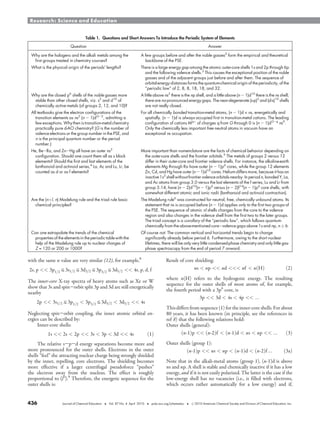
with the same n value are very similar (12), for example,8
2s; p << 3p1=2 j3s1=2 j3d3=2 j3p3=2 j3d5=2 << 4s; p; d; f
The inner-core X-ray spectra of heavy atoms such as Xe or W
show that 3s and spin-orbit split 3p and 3d are still energetically
nearby
2p << 3s1=2 j3p1=2 < 3p3=2 j3d3=2 < 3d5=2 << 4s
Neglecting spin-orbit coupling, the inner atomic orbital en-
ergies can be described by:
Inner-core shells:
1s << 2s < 2p << 3s < 3p < 3d << 4s ð1Þ
The relative s-p-d energy separations become more and
more pronounced for the outer shells. Electrons in the outer
shells “feel” the attracting nuclear charge being strongly shielded
by the inner, repelling, core electrons. The shielding becomes
more effective if a larger centrifugal pseudoforce “pushes”
the electron away from the nucleus. The effect is roughly
proportional to Æl2
æ.9
Therefore, the energetic sequence for the
outer shells is:
Result of core shielding:
ns < np << nd <<< nf < nðHÞ ð2Þ
where n(H) refers to the hydrogenic energy. The resulting
sequence for the outer shells of most atoms of, for example,
the fourth period with a 3p6
core, is
3p << 3d < 4s < 4p << :::
This differs from sequence (1) for the inner-core shells. For about
80 years, it has been known (in principle, see the references in
ref 8) that the following relations hold:
Outer shells (general):
ðn-1Þp << ðn-2Þf < ðn-1Þd < ns < np << ::: ð3Þ
Outer shells (group 1):
ðn-1Þp << ns < np < ðn-1Þd < ðn-2Þf::: ð3aÞ
Note that in the alkali-metal atoms (group 1), (n-1)d is above
ns and np. A shell is stable and chemically inactive if it has a low
energy, and if it is not easily polarized. The latter is the case if the
low-energy shell has no vacancies (i.e., is filled with electrons,
which occurs rather automatically for a low energy) and if,
Table 1. Questions and Short Answers To Introduce the Periodic System of Elements
Question Answer
Why are the halogens and the alkali metals among the
first groups treated in chemistry courses?
A few groups before and after the noble gasses2
form the empirical and theoretical
backbone of the PSE.
What is the physical origin of the periods' lengths? There is a large energy gap among the atomic outer-core shells 1s and 2p through 6p
and the following valence shells.3
This causes the exceptional position of the noble
gasses and of the adjacent groups just before and after them. The sequence of
orbital-energy distances forms the quantum-chemical origin of the periodicity, of the
“periodic law” of 2, 8, 8, 18, 18, and 32.
Why are the closed p6
shells of the noble gasses more
stable than other closed shells, viz. s2
and d10
of
chemically active metals (of groups 2, 12, and 10)?
A little above ns2
there is the np shell, and a little above (n - 1)d10
there is the ns shell;
there are no pronounced energy gaps. The near-degenerate (s-p)2
and (d-s)10
shells
are not really closed.
All textbooks give the electron configurations of the
transition elements as ns2
(n - 1)dG-2
, admitting a
few exceptions. Why then is transition-metal chemistry
practically pure d-AO chemistry? (G is the number of
valence electrons or the group number in the PSE, and
n is the principal quantum number or the period
number.)
For all chemically bonded transition-metal atoms, (n - 1)d < ns, energetically and
spatially. (n - 1)d is always occupied first in transition-metal cations. The leading
configuration of cations Mqþ
of charges q from G through 0 is (n - 1)dG-q
ns0
.
Only the chemically less important free neutral atoms in vacuum have an
exceptional ns occupation.
He, Be-Ra, and Zn-Hg all have an outer ns2
configuration. Should one count them all as s block
elements? Should the first and last elements of the
lanthanoid and actinoid series,4
La, Ac and Lu, Lr, be
counted as d or as f elements?
More important than nomenclature are the facts of chemical behavior depending on
the outer-core shells and the frontier orbitals.5
The metals of groups 2 versus 12
differ in their outer-core and frontier valence shells. For instance, the alkaline-earth
elements Mg through Ra have outer (n - 1)p6
cores, while the group 12 elements
Zn, Cd, and Hg have outer (n - 1)d10
cores. Helium differs more, because it has an
inactive 1s2
shell without frontier valence orbitals nearby. In period n, bonded Y, La,
and Ac atoms from group 3.0 versus the last elements of the f series, Lu and Lr from
group 3.14, have (n - 2)d10
(n - 1)p6
versus (n - 2)f14
(n - 1)p6
core shells, with
somewhat different atomic and ionic radii (lanthanoid and actinoid contraction).
Are the (nþl, n) Madelung rule and the triad rule basic
chemical principles?
The Madelung rule6
was constructed for neutral, free, chemically unbound atoms. Its
statement that ns is occupied before (n - 1)d applies only to the first two groups of
the PSE. The sequence of atomic nl shells changes from the core to the valence
region and also changes in the valence shell from the first two to the later groups.
The triad concept is a corollary of the “periodic law”, which follows quantum-
chemically from the above-mentioned core-valence gaps above 1s and np, n e 6.
Can one extrapolate the trends of the chemical
properties of the elements in the periodic table with the
help of the Madelung rule up to nuclear charges of
Z = 120 or 200 or 1000?
Of course not. The common vertical and horizontal trends begin to change
significantly already below period 6. Furthermore, owing to the short nuclear
lifetimes, there will be only very little condensed-phase chemistry and only little gas-
phase spectroscopy from the end of period 7 onward.
r 2010 American Chemical Society and Division of Chemical Education, Inc.
_
pubs.acs.org/jchemeduc
_
Vol. 87 No. 4 April 2010
_
Journal of Chemical Education 437
Research: Science and Education
in addition, there are no hybridizing orbitals energetically nearby
(2, 5, 6). This holds for 1s2
of He and for the np6
shells of the
other noble gasses.
Do Valence Configurations Alone Determine the Chemistry?
The occupied-orbitals valence configuration of an element
(e.g., ns2
in groups 2 or 12) is an important determinant of the
chemical behavior of that element. In particular, the angular
behavior and the node structure of the s, p, d, and f valence
orbitals are decisive for the overlap possibilities, for covalent-
bond formations, and for the bond angles (2, 13-15). However,
it is often not sufficiently realized that the chemical properties of
an element also depend on the lowest virtual orbitals, on the
energies and spatial extensions of all frontier5
orbitals, and in the
case of heavy elements also on the spin-orbit splittings (e.g., for
the later elements of period 6, there is a dramatic splitting of 6p
into 6p1/2 and 6p3/2). In addition, the extension and softness of
the outer-core shells is important, too.
Several parameters for four light and heavy elements of
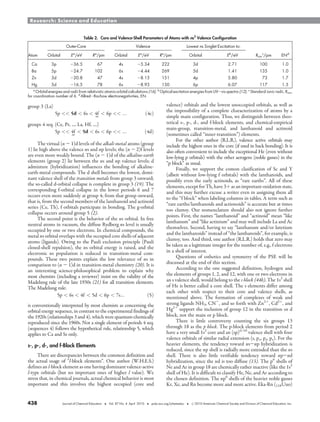
groups 2 and 12 are presented in Table 2: (i) the calculated
(n - 1)p or (n - 1)d outer-core orbital energies and radii
(related to core polarizabilities and bond lengths, respectively;
(ii) the ns valence-orbital energies and radii (related to electro-
negativities and covalent overlap bonding); (iii) the experimental
excitation energies from ns to the next higher (n - 1)d or np
virtual orbitals (related to hybridization); and (iv) the common
ionic radii and electronegativity values. The pronounced differ-
ences of the numerical values, and the different orbital types
involved, explain why there are chemical differences of the
elements within one group and even bigger differences of the
elements of groups 2 and 12 (5a), despite having the same
valence configuration ns2
(44b).
Electron Configurations of the Transition Elements
Much has been published about the problem of (n - 1)d
versus ns population of transition-metal atoms (e.g., refs 5 and 17).
However, only a fraction of the relevant points are usually
discussed. “The Full Story of the Electron Configurations of the
Transition Elements” will be told in a separate contribution (18).
Here, we briefly mention two points. The first point is that the
order of orbitals in the valence shell changes from group 1 to the
higher groups (see relations 3 and 3a). As a concrete example, we
present the sequences of orbital levels, as derived from the spectro-
scopic data of period 6 elements (2, 8, 12):
group 1 (Cs)
5p << 6s < 6p << 5d << ::: 4f
d
ð4aÞ
group 2 (Ba)
5p << 6s < 5d < 6p << ::: 4f
d
ð4bÞ
Figure 1. Periodic table, representing some aspects of the periodic system of chemical elements (mainly to support the discussions in this article, perhaps
not for the classroom): element symbol and element number Z = 0-118; period number n; group number G, related to the number of valence electrons;
typical electronic valence configuration of the bound atoms (“neighbor configurations” such as s1
p3
instead of s2
p2
may be more important for some
atoms in the group); characteristic valence orbitals of highest angular momentum; and chemical group name. (Elements that do not belong to the group are
put in parentheses. The dashed lines indicate alternative or controversial group assignments; they are not meant to represent the authors' views. Note that
the richness of chemistry sometimes prevents clear-cut classifications and assignments. See the collection of PTs by Leach (43).)
438 Journal of Chemical Education
_
Vol. 87 No. 4 April 2010
_
pubs.acs.org/jchemeduc
_
r 2010 American Chemical Society and Division of Chemical Education, Inc.
Research: Science and Education
group 3 (La)
5p << 5d < 6s < 4f
d
< 6p << ::: ð4cÞ
groups 4 seq. (Ce, Pr, ..., La, Hf, ....)
5p << 4f
d
< 5d < 6s < 6p << ::: ð4dÞ
The virtual (n - 1)d levels of the alkali-metal atoms (group
1) lie high above the valence ns and np levels; the (n - 2)f levels
are even more weakly bound. The (n - 1)d of the alkaline-earth
elements (group 2) lie between the ns and np valence levels; d
admixture (hybridization) influences the bonding of alkaline-
earth-metal compounds. The d shell becomes the lowest, domi-
nant valence shell of the transition metals from group 3 onward;
the so-called d-orbital collapse is complete in group 3 (19). The
corresponding f-orbital collapse in the lower periods 6 and 7
occurs even more suddenly at group 4; from that group onward,
that is, from the second members of the lanthanoid and actinoid
series (Ce, Th), f orbitals participate in bonding. The g-orbital
collapse occurs around group 5 (2).
The second point is the behavior of the ns orbital. In free
neutral atoms in vacuum, the diffuse Rydberg ns level is usually
occupied by one or two electrons. In chemical compounds, the
metal ns orbital overlaps with the occupied core shells of adjacent
atoms (ligands). Owing to the Pauli exclusion principle (Pauli
closed-shell repulsion), the ns orbital energy is raised, and the
electronic ns population is reduced in transition-metal com-
pounds. These two points explain the low relevance of ns in
comparison to (n - 1)d in transition-metal chemistry (20). It is
an interesting science-philosophical problem to explain why
most chemists (including a reviewer) insist on the validity of the
Madelung rule of the late 1930s (21) for all transition elements.
The Madelung rule:
5p < 6s < 4f < 5d < 6p < 7s::: ð5Þ
is conventionally interpreted by most chemists as concerning the
orbital energy sequence, in contrast to the experimental findings of
the 1920s (relationships 3 and 4), which were quantum-chemically
reproduced since the 1960s. Not a single element of periods 4 seq.
(sequences 4) follows the hypothetical rule, relationship 5, which
applies to Ca and Sr only.
s-, p-, d-, and f-Block Elements
There are discrepancies between the common definition and
the actual usage of “l-block elements”. One author (W.H.E.S.)
defines an l-block element as one having dominant valence-active
l-type orbitals (but no important ones of higher l value). We
stress that, in chemical journals, actual chemical behavior is most
important and this involves the highest occupied (core and
valence) orbitals and the lowest unoccupied orbitals, as well as
the impossibility of a complete characterization of atoms by a
simple main configuration. Thus, we distinguish between theo-
retical s-, p-, d-, and f-block elements, and chemical-empirical
main-group, transition-metal, and lanthanoid and actinoid
(sometimes called “inner-transition”) elements.
For the other author (R.L.R.), valence active orbitals may
include the highest ones in the core (if used in back bonding). It is
also often convenient to include the exceptional He (even without
low-lying p orbitals) with the other aerogens (noble gasses) in the
“p block” as usual.
Finally, we support the comon clasification of Sc and Y
(albeit without low-lying f orbitals) with the lanthanoids, and
possibly even the early actinoids, as “rare earths”. All of these
elements, except for Th, have 3þ as an important oxidation state,
and this may further excuse a writer even in assigning them all
to the “f block” when labeling columns in tables. A term such as
“rare earths/lanthanoids and actionoids” is accurate but at times
too clumsy. Our nomenclature should also not ignore further
points. First, the names “lanthanoid” and “actinoid” mean “like
lanthanum” and “like actinium” and may well include La and Ac
themselves. Second, having to say “lanthanum and/or lutetium
and the lanthanoids” instead of “the lanthanoids”, for example, is
clumsy, too. And third, one author (R.L.R.) holds that zero may
be taken as a legitimate integer for the number of, e.g., f electrons
in a shell of interest.
Questions of esthetics and symmetry of the PSE will be
discussed at the end of this section.
According to the one suggested definition, hydrogen and
the elements of groups 1, 2, and 12, with one or two electrons in
an s valence shell, would belong to the s block (44b). The 1s2
shell
of He is better called a core shell. The s elements differ among
each other with respect to their core and valence shells, as
mentioned above. The formation of complexes of weak and
strong ligands NH3, CN-
, and so forth with Zn2þ
, Cd2þ
, and
Hg2þ
support the inclusion of group 12 in the transition or d
block, not the main or p block.
There is little controversy counting the six groups 13
through 18 as the p block. The p-block elements from period 2
have a very small 1s2
core and an (sp)G-10
valence shell with four
valence orbitals of similar radial extension (s, px, py, pz). For the
heavier elements, the tendency toward ns-np hybridization is
reduced, since the np shell is radially more extended than the ns
shell. There is also little verifiable tendency toward np-nd
hybridization, since the nd is too diffuse (13). The p6
shells of
Ne and Ar in group 18 are chemically rather inactive (like the 1s2
shell of He). It is difficult to classify He, Ne, and Ar according to
the chosen definition. The np6
shells of the heavier noble gasses
Kr, Xe, and Rn become more and more active. Eka-Rn (118Uuo)
Table 2. Core and Valence-Shell Parameters of Atoms with ns2
Valence Configuration
Outer-Core Valence Lowest ns Singlet Excitation to:
Atom Orbital Ea
/eV Ra
/pm Orbital Ea
/eV Ra
/pm Orbital Eb
/eV Rion
c
/pm ENd
Ca 3p -36.5 67 4s -5.34 222 3d 2.71 100 1.0
Ba 5p -24.7 102 6s -4.44 269 5d 1.41 135 1.0
Zn 3d -20.8 47 4s -8.13 151 4p 5.80 73 1.7
Hg 5d -16.5 78 6s -8.93 150 6p 6.07 117 1.5
a
Orbital energies and radii from relativistic atomic-orbital calculations (16). b
Optical excitation energies from UV-vis spectra (12). c
Standard ionic radii, Rion,
for coordination number of 6. d
Allred-Rochow electronegativities, EN.
r 2010 American Chemical Society and Division of Chemical Education, Inc.
_
pubs.acs.org/jchemeduc
_
Vol. 87 No. 4 April 2010
_
Journal of Chemical Education 439
Research: Science and Education
is predicted not to be noble or a gas. It has neither a low-lying p
shell (the 7p3/2 level is destabilized by spin-orbit coupling) nor
is there a large gap to the relativistically stabilized 8s (20).
Groups 3 to 11 have active (n - 1)d valence orbitals. By one
definition, these nine groups would be counted in the d block.
Again, another definition includes group 12. The dominant
configurations of ions of charge qþ, and of neutral bonded
atoms in chemical compounds, are (n - 1)dG-q
and (n - 1)dG
,
respectively, in groups G = 3-10 (21). Bonded coinage metals
(G = 11) also have valence-active ns orbitals. Concerning the ns
occupation of single, unbound, transition-metal atoms, see ref 18.
Correspondingly, one might count only the elements with
“active” f valence electrons as the f-block elements. In periods 6
and 7, this would be the case for the 13 lanthanoid elements after
d element La (22), namely, for Ce (Ce3þ
4f1
) through Yb
(Yb3þ
4f13
) and for the 13 actinoid elements after d element
Ac, namely, for Th through No. When the f shell is filled up at
the end of the series, f14
becomes the closed-core shell for Lu, Hf,
and so forth and for Lr, Rf, and so forth. They have 4f14
5p6
and
5f14
6p6
cores, respectively. The dominant valence shell of Lu, Hf,
and so forth in period 6 is 5d; we might then count ten d elements,
La and Lu through Au. The chemical properties in period 7
deviate already from the trends in the upper periods (23). The
6p6
core is no longer that inert (core participation in bonding),
the 5f is not that compact (f contribution to covalence), and in
addition, the 5f and 6d are strongly spin-orbit split. Therefore,
the early actinoids (e.g., Th, U, or Pu) prove to be less similar to
the early lanthanoids (Ce, Nd, or Sm, respectively); it happens,
however, that they show many similarities with the heavy d
elements Hf, W, Os. And while Lu is a typical 5d element,
bonded Lr has more 7sp than 6d orbital contribution. On the
other hand, according to their similar chemical behavior, the
elements with barely empty f0
and barely full f14
shells are legiti-
mately counted in the series of 15 lanthanoid elements.
Any chemical substance, any molecule, or any element has
its characteristic individual properties, both of empirical and of
quantum-theoretical kinds. Cluster and factor analyses of the
properties of the chemical substances have uncovered about half
a dozen important independent basic properties of the chemical
elements (see the reviews in section 3 of ref 2a or in sections 2 and
3 of ref 8). The chemical elements form more or less pronounced
similarity clusters in the multidimensional space of basic proper-
ties. One must choose somewhat arbitrary borderlines on the
continuous property scales (e.g., see ref 24) to classify the
chemical compounds and elements. The empirical classification
of the elements as metals and nonmetals, and as semimetals and
metalloids in between, is not fully unique. The horizontal array
of the 10 elements from Sc to Zn is usually called the “light
transition-metals”. Sometimes the zinc family (G = 12) is ex-
cluded from the transition elements. The 17 trivalent elements,
Sc, Y, and La through Lu, are often counted as the rare-earth
elements (25). Sometimes the 15 actinoids Ac through Lr are
included, too. The heaviest of the noble gasses are no longer
chemically noble. There are continuing discussions about the
best positions of H, He, Zn, La, or Lu, and so forth in the PSE,
see for example (1, 22, 26). The decision on how to classify the
elements depends somewhat on the specific scientific interests of
the author; one can then argue if one's own taste is different.
The interpretations of empirical definitions are more
“flexible” than those of theoretically based definitions. The
unique theoretical definition of l-block elements as given here
overlaps well with the different possible choices of main-group,
transition, and lanthanoid elements, but it is not fully equivalent
to them. Many authors adopt, at least implicitly, another
theoretical definition of l-block elements, namely, as the ones
with the highest-occupied orbitals of l-type of the chemically
unbound, free atoms. According to the empirically (or theo-
retically) derived sequences of orbital energies of the free atoms,
many transition elements and lanthanoids would then belong to
the s block. Thus, the often-implied l-block definition is not
meaningful. Indeed, the present authors do not apply it. In
reality, many periodic tables are divided in an “esthetic” manner
into 2 s, 6 p, 10 d, and 14 f groups. Under this unscrutinized pre-
supposition, e.g. (22), group 12 is included among the d groups,
although Zn and Cd do not have any d valence orbitals (as one of
us interprets them); and one and only one of the fringe elements
of the lanthanoids is included in the f block, although f orbitals
are less important for the bonding of both La and Lu. For
additional mitigation, however, we also note that the outer d
orbitals of group 12 are indeed useful for back bonding, for
example, in cyanide complexes. This type of “core-shell binding”
also plays a role for the early seventh period elements at least up to
U, namely, by the [Rn]6p6
shell.
Limits of the “Periodic Law” and Its Corollary, the Triad
Rule
Döbereiner's triad rule of 1817 concerning the (atomic or)
equivalence weights of the elements was instrumental for the
introduction of physical numbers into the arrangement of chemi-
cal elements (1, 8, 27). From time to time, connections between
the proton (Z), neutron (N), or mass numbers (A, Z þ N = A)
and the chemistry of the elements were investigated. It has been
argued, for instance, that the identity of the elements resides in the
chemically invariable nuclei (correct), but “not at the ever-chan-
ging level of [the valence] electrons” (28). However, the typical
behavior of the chemical elements is determined by their domi-
nant valence configurations. The orbital occupation numbers of
differently bonded atoms vary only a little, and they change
systematically from element to element, corresponding to orbital
energy sequences (4). It is a logical slip to miss the fact that the
average valence configurations of the elements determine the
double-step periodicity of 8, 8, 18, 18, 32, and 32. A consequence
of this quantum-chemically based “periodic law” is the Triad rule:
2AaveðnÞ ≈ Aaveðn - 1Þ þ Aaveðn þ 1Þ, and
nowadays 2ZðnÞ ¼ Zðn - 1Þ þ Zðn þ 1Þ ð6Þ
which holds for one-half of the elements of periods n, n - 1, and
n þ 1 in a given vertical group. The number of triads can be
changed by changing the most common arrangement of elements
in the periodic tables (e.g., see 27). Shifting H from group 1 to 17,
one obtains the triad 1H-9F-17Cl. Shifting He from group 18 to
2, one loses the triad 2He-10Ne-18Ar. Shifting B and Al from
group 13 to 3, one gains the triad 5B-13Al-21Sc, but loses
13Al-31Ga-49In, and so forth. This has no deep chemical
meaning, it simply shifts the focus from these to those relations
among the elements. Or one may maximize the number of triads by
placing some elements more than once in the chart (25 p. 3, 44a)
Meyer (11), and later Mendeleyev, were quite successful
with the triad rule to predict atomic weights by interpolation, for
440 Journal of Chemical Education
_
Vol. 87 No. 4 April 2010
_
pubs.acs.org/jchemeduc
_
r 2010 American Chemical Society and Division of Chemical Education, Inc.
Research: Science and Education
example, Aave ≈ 73 for the element between Si and Sn (Aave,(Ge) =
72.64). However, the prediction of the atomic masses of the super
heavy elements by extrapolation (29) is an order of magnitude less
reliable, with errors up to 15 u, since the factor f(Z) in the relation
Aave = f(Z)3Z is not at all constant. In any case, the approximate
validity of the triad rule ends where the periodic law ends.
The quantum-theoretical structure of the PSE is as complex
as the empirical trends of properties of the elements. Each period
and each l block has different outer-core shells and different
(occupied and virtual) valence shells. In addition, there are
quantitative differences of the orbitals, for example, in spatial
extension (2s ∼ 2p, but ns < np for n > 2, and other “primogenic”
orbital effects) (13, 14). These cause the “secondary” vertical
periodicity, that is, the second period's specific character, the
fourth-period scandoid and sixth-period lanthanoid contractions,
and so forth (13, 14, 30). Some details are summarized in Table 3.
In addition to these complex shell effects, which can be
understood at the nonrelativistic level of approximation, correc-
tions toward relativistic reality become more and more impor-
tant in the lower parts of the periodic system. The relativistic
effects increase with some power g2 of Z. Therefore, it is hardly
possible to extrapolate from the lighter elements into the
hypothetical eighth or even the seventh period. Already the
properties of the elements of the sixth period deviate from
simple extrapolation (23, 31, 32). In general, going down in a
group, the atomic and ionic radii increase and the electronega-
tivities decrease. These trends are attenuated or even inverted for
the elements following the first d elements Sc-Cu (i.e., Zn, Ga,
etc.) and the first f elements La-Lu (i.e., Hf, Ta etc.) (33). As one
example we mention the ionic radii of the monovalent coinage
elements: R[Cu(I)CN=2] = 46 pm, R[Ag(I)CN=2] = 67 pm, and
R[Au(I)CN=2] = 58 pm.10
For many years, most tables displayed a
large ionic radius for Au(I) comparable to the metallic radius of
about 135 pm, although experimental structure determinations
repeatedly gave indications of the order Cu(I) < Au(I) < Ag(I).
Only after theoretical clarification (34) did correct entries
R[Au(I)CN=2] around 58 pm appear. The periodic system can
be extended into the region of super-heavy elements only on the
basis of modern quantum-chemical calculations.
Hypothetical extensions of the periodic table (35) based
on the Madelung rule let the 5g shell begin misleadingly in
group 3, while 5g really becomes relevant only from group
5 or 6 onward (2, 31). In addition, in some regions of the eighth
period, there are small energy separations between the upper
7p3/2 “core shell” and a whole “band” of valence shells 8s, 8p1/2,
7d3/2, 7d5/2, 6f5/2, 6f7/2, 5g7/2, 5g9/2, 9s, and 9p1/2. This
suggests a “new chemistry”. From the present scientific point
of view, the “construction of a table of elements with the 8th
and 9th periods (100 super heavy elements) is not meaningful”,
because little is known about the stability and existence of the
nuclei and about the electronic configurations in superheavy
compounds (36).
From bismuth onward (Z = 83, A = 209),11
the lifetimes are
finite for all isotopes and decrease roughly as e-1.3Z
, with large
deviations in both directions. If the lifetime of the most stable
isotope is less than a year (i.e., for 85At, 86Rn, 87Fr, and from
100Fm onward), the radiation damage will quickly destroy solid
compounds. For elements Eka-Tl (113Uut) and Eka-Pb (114Uuq)
the lifetime reaches 1 s; these and the heavier elements seem
unamenabletochemicalinvestigation.Thesingle,fleetingmolecules
of elements with lifetimes in the ms to μs range such as Eka-Rn
(118Uuo) and following will be hard even to investigate spectro-
scopically.Ordinarychemistryseemstoendwiththeseventhperiod,
unless the hoped-for heavier “island of stability” is found.
The Original Meaning of the Madelung Rule
The quantum-theoretical understanding of the complex
spin-orbit coupled J-states of many-electron atoms was devel-
oped in the late 1920s and early 1930s and reviewed by Condon
Table 3. Dominant Valence Shells (Upper Line) and Outer-Core Shells (Lower Line) of the Traditional s-, p-, d-, and f-Block Elements in Periods 1-7
Row n s Block f Block d Block p Block
1 1sa
2 2s(2p)b
2s2pa,b,c
[He] = 1s2
[He] = 1s2
3 3s(3p) 3s3pa
[Ne] = ...2s2
2p6
[Ne] = ...2s2
2p6
4 4s(4p,3d)d
3d(4s)d,e
4s4pa
[Ar] = ...3s2
3p6
[Ar] = ...3s2
3p6
[Zn2þ
] = ...3s2
3p6
3d10
5 5s(5p,4d) 4d(5s)e
5s5p
[Kr] = ...3d10
4s2
4p6
[Kr] = ...3d10
4s2
4p6
[Cd2þ
] = ...4s2
4p6
4d10
6 6s(6p,5d) 4f5d(6s)f,g,h
5d3/25d5/2(6s)e
,i
6s6p1/26p3/2
i
[Xe] = ...4d10
5s2
5p6
[Xe] = ...4d10
5s2
5p6
[Lu3þ
] = ...4f14
5s2
5p6
[Hg2þ
] = ...5s2
5p6
5d10
7 7s(7p,6d)j
5f5/2,7/26d3/2,5/2(7s)g,h,i,j
6d3/2,5/27s7pi
7s7p1/27p3/2
i
,k
[Rn] = ...5d10
6s2
6p6
[Rn] = ...5d10
6s2
6p6
[Lr3þ
] = ...5f14
6s2
6p6
[Uub2þ
] = ...6s2
6p6
6d10
a
The 1s2
of He and the ns2
np6
of Ne and Ar behave as inert-core shells. b
No Pauli repulsion on the 2p shell; therefore, it is small (i.e. radially nearly as compact
as the 2s shell, not like the higher np > ns). c
The 1s2
2s2
of O and F behave as core, with only a 2p valence shell. d
No Pauli repulsion on the 3d shell, which is small
(i.e. radially nearly as compact as the 3p core shell). e
Zn, Cd, and Hg have s2
p6
d10
cores and primarily s(p) valence shells, with polarizable d10
core. f
No Pauli
repulsion on the 4f shell, which is small (i.e. radially inside the 5p core shell). g
But for La and Ac, the f is still diffuse; they have primarily d(s) valence shells. h
Lu and Lr
have f14
s2
p6
d10
cores and primarily d(sp) valence shells, with polarizable f14
core. i
The spin-orbit splitting can no longer be neglected even at the qualitative level.
j
The early row-7 elements have chemically active, polarizable 6p6
cores. k
The 7s2
7p6
shell is no longer an inert, noble-gas shell.
r 2010 American Chemical Society and Division of Chemical Education, Inc.
_
pubs.acs.org/jchemeduc
_
Vol. 87 No. 4 April 2010
_
Journal of Chemical Education 441
Research: Science and Education
and Shortley (38). A simple approximate mnemonic was sought
in the 1930s (39) for the configurations of the J ground states
of neutral free atoms. Madelung's empirically based construct
reproduces a selection of four facts on the periodic system,
namely, (i) that np is occupied after ns in the later main groups;
(ii) that ns is occupied after (n - 1)p in the first two main groups;
(iii) that the spin-orbit-coupled ground states of more than
half of the transition-metal atoms in vacuum derive from
(n - 1)dG-2
ns2
configurations; and (iv) the period lengths of
2, 8, 18, and 32 that result from (i) through (iii). However,
several other facts do not fit, namely, (i) that the energetic
sequence of orbitals changes from group 1 to group 2 to the
subsequent groups (see relationships 4), (ii) that for all atoms of
groups 3 through 18, the (n - 1)d orbital is below the ns,
(iii) that the lower states of all bound transition-metal atoms
have (nearly) empty ns orbitals, that is, that transition-metal
chemistry is mainly d chemistry, (iv) that the (n - 2)f orbital is
still unoccupied in group 3, (v) that all cations M2þ
, M3þ
, and so
forth have unoccupied s orbitals in chemical substances and in
vacuum, and (vi) that 10 of the 27 d elements (according to one
definition) do not have free neutral atoms M0
with a filled ns2
shell. In any case, free atoms are not so interesting in chemistry.
It has been deplored from time to time that the Madelung
rule has not yet been derived quantum-theoretically. Of course,
this is impossible since this approximate rule of thumb is at
variance with too many facts. A more general and correct rule
had already been derived in the 1960s, corresponding to relations
4 (40).
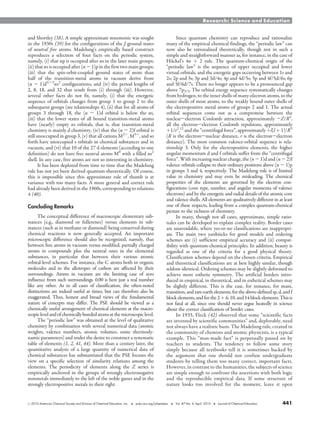
Concluding Remarks
The conceptual difference of macroscopic elementary sub-
stances (e.g., diamond or fullerenes) versus elements in sub-
stances (such as in methane or diamond) being conserved during
chemical reactions is now generally accepted. An important
microscopic difference should also be recognized, namely, that
between free atoms in vacuum versus modified, partially charged
atoms in compounds plus the neutral ones in the elemental
substances, in particular that between their various atomic
orbital-level schemes. For instance, the C atoms both in organic
molecules and in the allotropes of carbon are affected by their
surroundings. Atoms in vacuum are the limiting case of zero
influence from such surroundings. 0.00 is here just a real number
like any other. As in all cases of classification, the often-noted
distinctions are indeed useful at times, but can therefore also be
exaggerated, Thus, honest and broad views of the fundamental
nature of concepts may differ. The PSE should be viewed as a
chemically useful arrangement of chemical elements at the macro-
scopiclevelandofchemicallybondedatomsatthemicroscopiclevel.
The “periodic law” was obtained at the level of qualitative
chemistry by combination with several numerical data (atomic
weights, valence numbers, atomic volumes, some thermody-
namic parameters) and under the desire to construct a systematic
table of elements (1, 2, 41, 44). More than a century later, the
quantitative analysis of a large quantity of numerical data of
chemical substances has substantiated that the PSE focuses the
view on a specific selection of similarity relations among the
elements. The periodicity of elements along the Z series is
empirically anchored in the groups of strongly electronegative
nonmetals immediately to the left of the noble gasses and in the
strongly electropositive metals to their right.
Since quantum chemistry can reproduce and rationalize
many of the empirical chemical findings, the “periodic law” can
now also be rationalized theoretically, though not in such a
simple and straightforward manner as, for instance, in the case of
Hu.ckel's 4n þ 2 rule. The quantum-chemical origin of the
“periodic law” is the sequence of upper occupied and lower
virtual orbitals, and the energetic gaps occurring between 1s and
2s; 2p and 3s; 3p and 3d/4s; 4p and 4d/5s; 5p and 4f/5d/6s; 6p
and 5f/6d/7s. There no longer appears to be a pronounced gap
above 7p3/2. The orbital energy sequence systematically changes
from hydrogen, to the inner shells of many-electron atoms, to the
outer shells of most atoms, to the weakly bound outer shells of
the electropositive metal atoms of groups 2 and 1. The actual
orbital sequences come out as a compromise between the
nuclear-electron Coulomb attraction, approximately -Z/R2
,
all the electron-electron Coulomb repulsions, approximately
þ1/r2
,12
and the “centrifugal force”, approximately þl(l þ 1)/R3
(R is the electron-nuclear distance, r is the electron-electron
distance). The most common valence-orbital sequence is rela-
tionship 3. Only for the electropositive elements, the higher
angular momentum d and f orbitals suffer from the “centrifugal
force”. With increasing nuclear charge, the (n - 1)d and (n - 2)f
valence orbitals collapse to their ordinary positions above (n - 1)p
in groups 3 and 4, respectively. The Madelung rule is of limited
value in chemistry and may even be misleading. The chemical
properties of the elements are governed by the electron con-
figurations (core type, number, and angular momenta of valence
electrons) and by the energetic and radial details of the atomic core
and valence shells. All elements are qualitatively different in at least
one of these respects, leading from a complex quantum-chemical
picture to the richness of chemistry.
In many, though not all cases, approximate, simple ratio-
nales can be developed to explain complex reality. Border cases
are unavoidable, where yes-or-no classifications are inappropri-
ate. The main two yardsticks for good models and ordering
schemes are (i) sufficient empirical accuracy and (ii) compat-
ibility with quantum-chemical principles. In addition, beauty is
regarded as one of the criteria for a good physical theory.
Classification schemes depend on the chosen criteria. Empirical
and theoretical classifications are at best highly similar, though
seldom identical. Ordering schemes may be slightly deformed to
achieve more esthetic symmetry. The artificial borders intro-
duced in empirical, in theoretical, and in esthetical schemes may
be slightly different. This is the case, for instance, for main,
transition, and rare-earth elements, for the above-defined sp, d, and f
block elements, and for the 2 þ 6, 10, and 14 block elements. This is
not fatal at all, since one should never argue heatedly in science
about the correct classification of border cases.
In 1935, Fleck (42) observed that some “scientific facts
are invented by scientific communities” and, deplorably, need
not always have a realistic basis. The Madelung rule, created in
the community of chemists and atomic physicists, is a typical
example. This “man-made fact” is perpetually passed on by
teachers to students. The tendency to follow some story
simply because all textbooks tell it is sometimes backed by
the argument that one should not confuse undergraduate
students by telling them too many correct, important facts.
However, in contrast to the humanities, the subjects of science
are simple enough to confront the assertions with both logic
and the reproducible empirical data. If some structure of
nature looks too involved for the moment, leave it open
442 Journal of Chemical Education
_
Vol. 87 No. 4 April 2010
_
pubs.acs.org/jchemeduc
_
r 2010 American Chemical Society and Division of Chemical Education, Inc.
Research: Science and Education
instead of preaching a clear-cut, though incorrect, doctrine.
Then there would be no more need to reeducate the students,
for instance, against the Madelung rule, when they meet
transition-element chemistry. So, the final lesson from the
present discussion is the appeal to guard chemistry against
nonscientific tendencies.
Notes
1. See the collection of references in ref 2a, in particular to recent
books, ref 3 therein. A good example is the reflection on
periodic tables in Nature Chemistry (3) that focuses on
empirical data arrangement, on cognitive reproducibility, and
on graphical outlay, colors, and typeface. This is characteristic
for the purely empirically interested members of a scientific
community being less interested in embedding their field of
knowledge into a broader scientific context.
2. Chemists and dictionaries differ about the spelling “gasses”. We
retain the double “s” to mark the previous vowel as short and
accented when another vowel follows.
3 We use the common terms n shell, nl shell, and nlj shell,
although some chemists and educators prefer the term nl
subshell, while never mentioning nlj (subsub)shells.
4. The IUPAC recommends “lanthanoids” and “actinoids” in-
stead of “lanthanides” and “actinides”, since -ides are usually
anionic compounds such as halides, sulfides, etc. See http://en.
wikipedia.org/wiki/Lanthanoid (accessed Jan 2010).
5. Frontier orbitals are the orbitals energetically near the border-
line between the highest occupied and lowest unoccupied
(virtual) orbitals. They dominate bond formation and chemical
reactions. The (partially) occupied valence orbitals alone are
not sufficient to explain chemistry (4-6).
6. Madelung (39c) said that the tabulation of “idealized” (i.e.,
artificially made more regular) orbital occupations in the
SLJ coupled ground states of the free uncharged atoms empiri-
cally follows the (nþl),n sequence. He did not mention orbital
energies nor charged atoms.
7. The transition elements, being characterized by more nonver-
tical similarities, compare ref 9, were still tentatively and
separately grouped by Meyer in the early 1860s (11).
8. The subscripts are the “total angular-momentum quantum
numbers” j = l ( 1/2, describing the spin-orbit splitting.
The spin-energy contributions are spectroscopically relevant,
but usually less important in the chemistry of the light elements.
However, spin-orbit coupling is important for all so-called
spin-forbidden processes, for the valence shells in the lower
periods, and for all inner core shells.
9. Æl2
æ means the square of the orbital angular momentum: 0 p2
for s (l = 0); 2 p2
for p (l = 1); 6 p2
for d (l = 2); and 12 p2
for f
(l = 3).
10. CN is the coordination number. The effective ionic radii
increase strongly with the number of adjacent atoms.
11. The (meta)stable 209
Bi isotope has the longest lifetime ever
determined (2 Â 1019
years), orders of magnitude longer than
the lifetime of the world (37). Every second, more than 1016
Bi
atoms decay on our earth.
12. The electron-electron Coulomb repulsion is often theoreti-
cally split up into three contributions, direct Coulomb (so-
called Coulomb), exchange Coulomb (so-called exchange),
and Coulomb correlation (so-called correlation). There is no
exchange force in addition to the Coulomb force.
Acknowledgment
W.H.E.S is grateful for constructive criticism by many
open-minded colleagues and by some among the reviewers.
Literature Cited
1. Scerri, E. R. The Periodic Table. Its Story and Its Significance;
Oxford University Press: Oxford, 2007. Gorin, G. J. Chem. Educ.
1996, 73, 490–493.
2. (a) Wang, S. G.; Schwarz, W. H. E. Angew. Chem., Int. Ed. 2009,
48, 3404–3415. Wang, S. G.; Schwarz, W. H. E. Angew. Chem.
2009, 121, 3456–3467. (b) Wang, S. G.; Qiu, Y. X.; Fang, H.;
Schwarz, W. H. E. Chem.;Eur. J. 2006, 12, 4101–4014.
3. Francl, M. Nature Chem. 2009, 1, May, 97-98.
4. Bradley, J. D.; Gerrans, G. C. J. Chem. Educ. 1973, 50, 463–
466.
5. (a) Rich, R. L. J. Chem. Educ. 2005, 82, 1761–1763. (b) Rich, R. L.;
Suter, R. W. J. Chem. Educ. 1988, 65, 702–704.
6. Schmid, R. J. Chem. Educ. 2003, 80, 931–937.
7. Mazurs, E. G. Graphic Representations of the Periodic System During
One Hundred Years, 2nd ed.; University of Alabama Press:
Tuscaloosa, AL, 1974.
8. Schwarz, W. H. E. Found. Chem. 2007, 9, 139–188.
9. Restrepo, G.; Pachon, L. Found. Chem. 2007, 9, 189–214. Restrepo,
G.; Llanos, E. J.; Mesa, H. J. Math. Chem. 2006, 39, 401-416 and
other works of this and other authors cited therein.
10. Khramov, N. N.; Bartenev, S. A.; Markov, G. S.; Romanovskij,
V. N.; Khlopin, V. G. In The Mathematics of the Periodic Table;
Rouvray, D. H., King, R. B., Eds.; Nova Science: New York,
2006; pp 32-49.
11. Meyer, L. Die Modernen Theorien der Chemie (Printed after the
‘Lecture Notes’, manuscript, 1862); Maruschke  Berendt:
Breslau, 1864; p 137.
12. http://physics.nist.gov/PhysRefData/ASD/levels_form.html. Moore,
C. E. Atomic Energy Levels as Derived from the Analyses of Optical
Spectra; U.S. Government Printing Office: Washington DC, 1949,
1952, 1958; 3 Vols.
13. Kutzelnigg, W. Angew. Chem. 1984, 96, 262–286. Kutzelnigg, W.
Angew. Chem., Int. Ed. 1984, 23, 272–295.
14. Pyykko., P. J. Chem. Res., Synop. 1979, 380. Pyykko., P. Int. J.
Quantum Chem. 2001, 85, 18–21.
15. Kaupp, M. J. Comput. Chem. 2006, 28, 320–325.
16. Desclaux, J. P. At. Data Nucl. Data Tables 1973, 12, 311–406.
17. (a) Bills, J. L. J. Chem. Educ. 1998, 75, 589–593. (b) Bills, J. L.
J. Chem. Educ. 2006, 83, 473–476. (c) Melrose, M. P.; Scerri, E. R.
J. Chem. Educ. 1996, 73, 498–503. (d) Vanquickenborne, L. G.;
Pierloot, K.; Devoghel, D. J. Chem. Educ. 1994, 71, 469–471.
(e) Vanquickenborne, L. G.; Pierloot, K.; Devoghel, D. Inorg. Chem.
1989, 28, 1805–1813.
18. Schwarz, W. H. E. J. Chem. Educ. 2010, 87, DOI: 10.1021/
ed8001286.
19. Connerade, J. P. J. Phys. B 1991, 24, L109–L115.
20. (a) Han, Y. K.; Bae, C.; Son, S. K.; Lee, Y. S. J. Chem. Phys. 2000,
112, 2684–2691. (b) Nash, C. S. J. Phys. Chem. A 2005, 109, 3493–
2500. (c) Filatov, M.; Cremer, D. Phys. Chem. Chem. Phys. 2003, 5,
1103–1105. (d) Liao, M. S.; Zhang, Q. E. J. Phys. Chem. A 1998,
102, 10647–10654.
21. Frenking, G.; Fröhlich, N. Chem. Rev. 2000, 100, 717-774; in
particular §III, pp 720 seq.
22. Lavelle, L. J. Chem. Educ. 2008, 85, 1482–1483.
p.444-448.
r 2010 American Chemical Society and Division of Chemical Education, Inc.
_
pubs.acs.org/jchemeduc
_
Vol. 87 No. 4 April 2010
_
Journal of Chemical Education 443
Research: Science and Education
23. (a) Pershina, V. In Relativistic Electronic Structure Theory, Part 2.
Applications; Schwerdtfeger, P., Ed.; Elsevier: Amsterdam,
2004; pp 1 seq. (b) Lee, Y. S. In Relativistic Electronic Structure
Theory, Part 2. Applications; Schwerdtfeger, P., Ed.; Elsevier:
Amsterdam, 2004; p 352 seq.
24. Nelson, P. G. J. Chem. Educ. 2000, 77, 245–248.
25. Rich, R. L. Inorganic Reactions in Water; Springer: Berlin, 2007.
26. Jensen, W. B. J. Chem. Educ. 2003, 80, 952–961. Jensen, W. B.
J. Chem. Educ. 2008, 85, 1182-1183, 1491-1492.
27. Scerri, E. J. Chem. Educ. 2008, 85, 585–589.
28. Scerri, E. Int. J. Quantum Chem. 2009, 109, 959–971. See also:
Schwarz, W. H. E.; Wang, S. G. Int. J. Quantum Chem. 2009,
online, 2010, 110, in press.
29. Ibrahim, S. A. J. Chem. Educ. 2005, 82, 1658–1659.
30. (a) Biron, V. Zh. Russ. Fiz.-Khim. O-va. Chast. Khim. 1915,
47, 964. (b) Smith, J. D. M. Chemistry and Atomic Structure;
Ernest Benn: London, 1924. (c) Sanderson, R. T. J. Am. Chem.
Soc. 1952, 74, 4792. (d) Sanderson, R. T. Chemical Periodicity;
Reinhold: New York, 1960.
31. Fricke, B. Struct. Bonding (Berlin) 1975, 21, 89.
32. (a) Thayer, J. S. J. Chem. Educ. 2005, 82, 1721. (b) Hoffman, D. C.;
Lee, D. M. J. Chem. Educ. 1999, 76, 331.
33. Pyykko., P. Chem. Rev. 1988, 88, 563–594.
34. Liao, M. S.; Schwarz, W. H. E. Acta Crystallogr. B 1994, 50, 9.
35. Karol, P. J. J. Chem. Educ. 2002, 79, 60, http://en.wikipedia.org/
wiki/G-block (accessed Jan 2010).
36. Khazan, A. Prog. Phys. 2007, 2, 104.
37. de Marcillac, P.; Coron, N.; Dambier, G.; Leblanc, J.; Moalic, J. P.
Nature 2003, 422, 876–878.
38. Condon, E. U.; Shortley, G. H. The Theory of Atomic Spectra;
University Press: Cambridge, 1935.
39. (a) Karapetoff, V. J. Franklin Inst. 1930, 210, 609. (b) Janet, C.
Concordance de 1’arrangement quantique de base electrons
planetaires des atomes avec la classification scalariforme helicoïdale
des elements chimiques. Imp. Dept. de l’Oise, Beauvais, 1930.
(c) Madelung, E. Die Mathematischen Hilfsmittel des Physikers,
3rd ed.; Springer: Berlin, 1936; 7th ed., 1964; p 511.
40. Goudsmit, S. A.; Richards, P. L. Proc. Natl. Acad. Sci. U.S.A. 1964,
51, 664, 906.
41. Cahn, R. M. Philosophische und Historische Aspekte des Period-
ensystems der Chemischen Elemente; Hyle: Karlsruhe, 2002, http://
www.hyle.org/publications/books/cahn/cahn.pdf (accessed Jan
2010).
42. Fleck, L. Entstehung und Entwicklung einer wissenschaftlichen
Tatsache; Schwabe: Basel, 1935; English edition by Trenn,
T. J.; Merton, T. K. The Genesis and Development of a Scientific
Fact; University of Chicago Press: Chicago, 1979.
43. Leach, M. R. Meta-Synthesis 2004, 2009, http://www.meta-synth-
esis.com/webbook/35_pt/pt3.html (accessed Jan 2010).
44. (a) Laing, M. J. Chem. Educ. 1989, 66, 746. (b) Laing, M.
Educ. Chem. 2001, 38, 161–163. (c) Laing, M. Educ. Chem.
2004, 41, 28.

Theoretical basis and_correct_explanatio

  • 1.
    r 2010 AmericanChemical Society and Division of Chemical Education, Inc. _ pubs.acs.org/jchemeduc _ Vol. 87 No. 4 April 2010 _ Journal of Chemical Education 435 10.1021/ed800124m Published on Web 03/09/2010 Research: Science and Education Theoretical Basis and Correct Explanation of the Periodic System: Review and Update W. H. Eugen Schwarz* Theoretical Chemistry, University Siegen, 57068 Siegen, Germany *schwarz@chemie.uni-siegen.de Ronald L. Rich* Scholar in Residence, Bluffton University, Bluffton, Ohio 45817 *richr@bluffton.edu The periodic system of chemical elements (PSE) is one of the most ingenious inventions of human culture; it is one of the most essential ordering concepts of chemistry (1). Since its creation nearly one and a half centuries ago, its principles remain a hot topic of scientific, educational, historic, and philosophic discussions. In this century alone, about 50-100 articles related to the periodic system have already been published just in this Journal. These discussions, and parallel ones in other journals and in about 20 books and brochures of the past decade, are in general quite illuminating concerning chemical and cultural aspects.1 Theoretical and physical aspects, however, are often afflicted with serious misconceptions. Scientific achievements sometimes diffuse rather slowly among different scientific com- munities. To promote this process, we ask a series of modest questions and give short answers without detailed explanations (Table 1). Then, a coherent theoretical background is explicated. Novel, logically consistent views on old empirical and theoretical facts (2) supply the foundation of a deeper understanding of the structure of the PSE, as represented by different periodic tables. A representative periodic table is shown in Figure 1. The Backbone of the Periodic System The atomic weight (mass), Aave, was clarified at the Karlsruhe congress in 1860 (1). In 1862, de Chancourtois was the first to arrange the chemical elements linearly according to Aave. He wound up the array of elements to a spiral so that elements with characteristic chemical properties periodically appeared one below the other. Since then, a significant fraction of all graphical representations of the periodic system has been cyclic (7). The horizontally and vertically “doubly connected” arrangements display a comparatively large fraction of the relations between the elements (1, 2, 8). According to recent empirical chemo- metric investigations, the groups of most similar elements are the main groups just before and after the noble gasses (group G = 18 or 0 in Figure 1) (9). These groups are the nonmetallic halogens, chalcogens, and pnictogens (G = 17, 16, 15) and the alkali, alkaline- earth, and earth metals (G = 1, 2, 3). The strong variation of properties of just these groups, 15 to 18 and 0 to 3, strongly contributes to the appearance of periodicities of 8, 18, and 32 elements. This has recently been re-examined by mathematical Fourier analysis (10). The periodicity of the transition-element groups is empirically less well pronounced than that of the main- group elements (9). Meyer's (11) first, simple, rectangular periodic table of 1862 explicitly contained groups 14 (C, Si, [73 E], Sn, Pb), 15 (N, P, As, Sb, Bi), 16 (O, S, Se, Te), 17 (F, Cl, Br, I), 1 (Li, Na, K, Rb, Cs, Tl?), and 2 (Be?, Mg, Ca, Sr, Ba). The yet unknown noble gasses were still missing in the center, and the unknown earth metals were missing at the right edge.7 Meyer had labeled the groups by their typical valence numbers, which now can be explained by the dominant electronic configurations of the bonded atoms. Soon, rectangular tables with the valence (electron) numbers running from 1 to 8 (or 18) became the prevailing type of graphical representations. Thereby, the backbone of the periodic system was split up. Since then, the noble gasses form the left or right edges of nonspiral, flat, easily printable tables. Core-Valence Gaps The empirical chemical center of the periodic system, the noble-gas family, is microscopically characterized by very stable 1s2 or np6 (n e 6) closed “valence” shells with high ionization potentials. The three preceding elements of the noble gasses have 1, 2, or 3 strongly electronegative (i.e., energetically low lying) np vacancies in period n, giving rise to oxidation states 1-, 2-, or 3-. Each electron pair can then form a polar double bond, for example, to an O atom, or two polar single bonds, for example, to two halogen atoms. Therefore, the oxidation or valence numbers are changed in steps of two (e.g., for S from 2- to 0, 2þ, 4þ, or 6þ). The successor elements in period (nþ1) have 1, 2, 3, and so forth weakly bound electrons in the (nþ1)s or nd valence shells above the np6 closed-core shell. This gives rise to common oxidation states 1þ, 2þ, 3þ, and so forth. For the next groups, the number of electrons in the d shell can vary in steps of one. The most stable oxidation state qþ depends on the balance between the total ionization energy, µþ(q3 ), and the lattice or solvation energy, µ-(q2 ). The decisive point for the successor elements is the energy sequence np , nd, (nþ1)s. The comparatively stable outer shells, 1s2 of He, 2p6 of Ne, 3p6 of Ar, and so forth, with large energy gaps above and the energetic distances between the different nl shells, determine the successive lengths of the periods from one to the next noble gas, namely, 2, 8, 8, 18, 18, and 32 (2). Energetic Sequences of the nl Shells The next question is now, why does a large energy gap appear above the outer np shells? In the hydrogen atom, levels
  • 2.
    436 Journal ofChemical Education _ Vol. 87 No. 4 April 2010 _ pubs.acs.org/jchemeduc _ r 2010 American Chemical Society and Division of Chemical Education, Inc. Research: Science and Education with the same n value are very similar (12), for example,8 2s; p << 3p1=2 j3s1=2 j3d3=2 j3p3=2 j3d5=2 << 4s; p; d; f The inner-core X-ray spectra of heavy atoms such as Xe or W show that 3s and spin-orbit split 3p and 3d are still energetically nearby 2p << 3s1=2 j3p1=2 < 3p3=2 j3d3=2 < 3d5=2 << 4s Neglecting spin-orbit coupling, the inner atomic orbital en- ergies can be described by: Inner-core shells: 1s << 2s < 2p << 3s < 3p < 3d << 4s ð1Þ The relative s-p-d energy separations become more and more pronounced for the outer shells. Electrons in the outer shells “feel” the attracting nuclear charge being strongly shielded by the inner, repelling, core electrons. The shielding becomes more effective if a larger centrifugal pseudoforce “pushes” the electron away from the nucleus. The effect is roughly proportional to Æl2 æ.9 Therefore, the energetic sequence for the outer shells is: Result of core shielding: ns < np << nd <<< nf < nðHÞ ð2Þ where n(H) refers to the hydrogenic energy. The resulting sequence for the outer shells of most atoms of, for example, the fourth period with a 3p6 core, is 3p << 3d < 4s < 4p << ::: This differs from sequence (1) for the inner-core shells. For about 80 years, it has been known (in principle, see the references in ref 8) that the following relations hold: Outer shells (general): ðn-1Þp << ðn-2Þf < ðn-1Þd < ns < np << ::: ð3Þ Outer shells (group 1): ðn-1Þp << ns < np < ðn-1Þd < ðn-2Þf::: ð3aÞ Note that in the alkali-metal atoms (group 1), (n-1)d is above ns and np. A shell is stable and chemically inactive if it has a low energy, and if it is not easily polarized. The latter is the case if the low-energy shell has no vacancies (i.e., is filled with electrons, which occurs rather automatically for a low energy) and if, Table 1. Questions and Short Answers To Introduce the Periodic System of Elements Question Answer Why are the halogens and the alkali metals among the first groups treated in chemistry courses? A few groups before and after the noble gasses2 form the empirical and theoretical backbone of the PSE. What is the physical origin of the periods' lengths? There is a large energy gap among the atomic outer-core shells 1s and 2p through 6p and the following valence shells.3 This causes the exceptional position of the noble gasses and of the adjacent groups just before and after them. The sequence of orbital-energy distances forms the quantum-chemical origin of the periodicity, of the “periodic law” of 2, 8, 8, 18, 18, and 32. Why are the closed p6 shells of the noble gasses more stable than other closed shells, viz. s2 and d10 of chemically active metals (of groups 2, 12, and 10)? A little above ns2 there is the np shell, and a little above (n - 1)d10 there is the ns shell; there are no pronounced energy gaps. The near-degenerate (s-p)2 and (d-s)10 shells are not really closed. All textbooks give the electron configurations of the transition elements as ns2 (n - 1)dG-2 , admitting a few exceptions. Why then is transition-metal chemistry practically pure d-AO chemistry? (G is the number of valence electrons or the group number in the PSE, and n is the principal quantum number or the period number.) For all chemically bonded transition-metal atoms, (n - 1)d < ns, energetically and spatially. (n - 1)d is always occupied first in transition-metal cations. The leading configuration of cations Mqþ of charges q from G through 0 is (n - 1)dG-q ns0 . Only the chemically less important free neutral atoms in vacuum have an exceptional ns occupation. He, Be-Ra, and Zn-Hg all have an outer ns2 configuration. Should one count them all as s block elements? Should the first and last elements of the lanthanoid and actinoid series,4 La, Ac and Lu, Lr, be counted as d or as f elements? More important than nomenclature are the facts of chemical behavior depending on the outer-core shells and the frontier orbitals.5 The metals of groups 2 versus 12 differ in their outer-core and frontier valence shells. For instance, the alkaline-earth elements Mg through Ra have outer (n - 1)p6 cores, while the group 12 elements Zn, Cd, and Hg have outer (n - 1)d10 cores. Helium differs more, because it has an inactive 1s2 shell without frontier valence orbitals nearby. In period n, bonded Y, La, and Ac atoms from group 3.0 versus the last elements of the f series, Lu and Lr from group 3.14, have (n - 2)d10 (n - 1)p6 versus (n - 2)f14 (n - 1)p6 core shells, with somewhat different atomic and ionic radii (lanthanoid and actinoid contraction). Are the (nþl, n) Madelung rule and the triad rule basic chemical principles? The Madelung rule6 was constructed for neutral, free, chemically unbound atoms. Its statement that ns is occupied before (n - 1)d applies only to the first two groups of the PSE. The sequence of atomic nl shells changes from the core to the valence region and also changes in the valence shell from the first two to the later groups. The triad concept is a corollary of the “periodic law”, which follows quantum- chemically from the above-mentioned core-valence gaps above 1s and np, n e 6. Can one extrapolate the trends of the chemical properties of the elements in the periodic table with the help of the Madelung rule up to nuclear charges of Z = 120 or 200 or 1000? Of course not. The common vertical and horizontal trends begin to change significantly already below period 6. Furthermore, owing to the short nuclear lifetimes, there will be only very little condensed-phase chemistry and only little gas- phase spectroscopy from the end of period 7 onward.
  • 3.
    r 2010 AmericanChemical Society and Division of Chemical Education, Inc. _ pubs.acs.org/jchemeduc _ Vol. 87 No. 4 April 2010 _ Journal of Chemical Education 437 Research: Science and Education in addition, there are no hybridizing orbitals energetically nearby (2, 5, 6). This holds for 1s2 of He and for the np6 shells of the other noble gasses. Do Valence Configurations Alone Determine the Chemistry? The occupied-orbitals valence configuration of an element (e.g., ns2 in groups 2 or 12) is an important determinant of the chemical behavior of that element. In particular, the angular behavior and the node structure of the s, p, d, and f valence orbitals are decisive for the overlap possibilities, for covalent- bond formations, and for the bond angles (2, 13-15). However, it is often not sufficiently realized that the chemical properties of an element also depend on the lowest virtual orbitals, on the energies and spatial extensions of all frontier5 orbitals, and in the case of heavy elements also on the spin-orbit splittings (e.g., for the later elements of period 6, there is a dramatic splitting of 6p into 6p1/2 and 6p3/2). In addition, the extension and softness of the outer-core shells is important, too. Several parameters for four light and heavy elements of groups 2 and 12 are presented in Table 2: (i) the calculated (n - 1)p or (n - 1)d outer-core orbital energies and radii (related to core polarizabilities and bond lengths, respectively; (ii) the ns valence-orbital energies and radii (related to electro- negativities and covalent overlap bonding); (iii) the experimental excitation energies from ns to the next higher (n - 1)d or np virtual orbitals (related to hybridization); and (iv) the common ionic radii and electronegativity values. The pronounced differ- ences of the numerical values, and the different orbital types involved, explain why there are chemical differences of the elements within one group and even bigger differences of the elements of groups 2 and 12 (5a), despite having the same valence configuration ns2 (44b). Electron Configurations of the Transition Elements Much has been published about the problem of (n - 1)d versus ns population of transition-metal atoms (e.g., refs 5 and 17). However, only a fraction of the relevant points are usually discussed. “The Full Story of the Electron Configurations of the Transition Elements” will be told in a separate contribution (18). Here, we briefly mention two points. The first point is that the order of orbitals in the valence shell changes from group 1 to the higher groups (see relations 3 and 3a). As a concrete example, we present the sequences of orbital levels, as derived from the spectro- scopic data of period 6 elements (2, 8, 12): group 1 (Cs) 5p << 6s < 6p << 5d << ::: 4f d ð4aÞ group 2 (Ba) 5p << 6s < 5d < 6p << ::: 4f d ð4bÞ Figure 1. Periodic table, representing some aspects of the periodic system of chemical elements (mainly to support the discussions in this article, perhaps not for the classroom): element symbol and element number Z = 0-118; period number n; group number G, related to the number of valence electrons; typical electronic valence configuration of the bound atoms (“neighbor configurations” such as s1 p3 instead of s2 p2 may be more important for some atoms in the group); characteristic valence orbitals of highest angular momentum; and chemical group name. (Elements that do not belong to the group are put in parentheses. The dashed lines indicate alternative or controversial group assignments; they are not meant to represent the authors' views. Note that the richness of chemistry sometimes prevents clear-cut classifications and assignments. See the collection of PTs by Leach (43).)
  • 4.
    438 Journal ofChemical Education _ Vol. 87 No. 4 April 2010 _ pubs.acs.org/jchemeduc _ r 2010 American Chemical Society and Division of Chemical Education, Inc. Research: Science and Education group 3 (La) 5p << 5d < 6s < 4f d < 6p << ::: ð4cÞ groups 4 seq. (Ce, Pr, ..., La, Hf, ....) 5p << 4f d < 5d < 6s < 6p << ::: ð4dÞ The virtual (n - 1)d levels of the alkali-metal atoms (group 1) lie high above the valence ns and np levels; the (n - 2)f levels are even more weakly bound. The (n - 1)d of the alkaline-earth elements (group 2) lie between the ns and np valence levels; d admixture (hybridization) influences the bonding of alkaline- earth-metal compounds. The d shell becomes the lowest, domi- nant valence shell of the transition metals from group 3 onward; the so-called d-orbital collapse is complete in group 3 (19). The corresponding f-orbital collapse in the lower periods 6 and 7 occurs even more suddenly at group 4; from that group onward, that is, from the second members of the lanthanoid and actinoid series (Ce, Th), f orbitals participate in bonding. The g-orbital collapse occurs around group 5 (2). The second point is the behavior of the ns orbital. In free neutral atoms in vacuum, the diffuse Rydberg ns level is usually occupied by one or two electrons. In chemical compounds, the metal ns orbital overlaps with the occupied core shells of adjacent atoms (ligands). Owing to the Pauli exclusion principle (Pauli closed-shell repulsion), the ns orbital energy is raised, and the electronic ns population is reduced in transition-metal com- pounds. These two points explain the low relevance of ns in comparison to (n - 1)d in transition-metal chemistry (20). It is an interesting science-philosophical problem to explain why most chemists (including a reviewer) insist on the validity of the Madelung rule of the late 1930s (21) for all transition elements. The Madelung rule: 5p < 6s < 4f < 5d < 6p < 7s::: ð5Þ is conventionally interpreted by most chemists as concerning the orbital energy sequence, in contrast to the experimental findings of the 1920s (relationships 3 and 4), which were quantum-chemically reproduced since the 1960s. Not a single element of periods 4 seq. (sequences 4) follows the hypothetical rule, relationship 5, which applies to Ca and Sr only. s-, p-, d-, and f-Block Elements There are discrepancies between the common definition and the actual usage of “l-block elements”. One author (W.H.E.S.) defines an l-block element as one having dominant valence-active l-type orbitals (but no important ones of higher l value). We stress that, in chemical journals, actual chemical behavior is most important and this involves the highest occupied (core and valence) orbitals and the lowest unoccupied orbitals, as well as the impossibility of a complete characterization of atoms by a simple main configuration. Thus, we distinguish between theo- retical s-, p-, d-, and f-block elements, and chemical-empirical main-group, transition-metal, and lanthanoid and actinoid (sometimes called “inner-transition”) elements. For the other author (R.L.R.), valence active orbitals may include the highest ones in the core (if used in back bonding). It is also often convenient to include the exceptional He (even without low-lying p orbitals) with the other aerogens (noble gasses) in the “p block” as usual. Finally, we support the comon clasification of Sc and Y (albeit without low-lying f orbitals) with the lanthanoids, and possibly even the early actinoids, as “rare earths”. All of these elements, except for Th, have 3þ as an important oxidation state, and this may further excuse a writer even in assigning them all to the “f block” when labeling columns in tables. A term such as “rare earths/lanthanoids and actionoids” is accurate but at times too clumsy. Our nomenclature should also not ignore further points. First, the names “lanthanoid” and “actinoid” mean “like lanthanum” and “like actinium” and may well include La and Ac themselves. Second, having to say “lanthanum and/or lutetium and the lanthanoids” instead of “the lanthanoids”, for example, is clumsy, too. And third, one author (R.L.R.) holds that zero may be taken as a legitimate integer for the number of, e.g., f electrons in a shell of interest. Questions of esthetics and symmetry of the PSE will be discussed at the end of this section. According to the one suggested definition, hydrogen and the elements of groups 1, 2, and 12, with one or two electrons in an s valence shell, would belong to the s block (44b). The 1s2 shell of He is better called a core shell. The s elements differ among each other with respect to their core and valence shells, as mentioned above. The formation of complexes of weak and strong ligands NH3, CN- , and so forth with Zn2þ , Cd2þ , and Hg2þ support the inclusion of group 12 in the transition or d block, not the main or p block. There is little controversy counting the six groups 13 through 18 as the p block. The p-block elements from period 2 have a very small 1s2 core and an (sp)G-10 valence shell with four valence orbitals of similar radial extension (s, px, py, pz). For the heavier elements, the tendency toward ns-np hybridization is reduced, since the np shell is radially more extended than the ns shell. There is also little verifiable tendency toward np-nd hybridization, since the nd is too diffuse (13). The p6 shells of Ne and Ar in group 18 are chemically rather inactive (like the 1s2 shell of He). It is difficult to classify He, Ne, and Ar according to the chosen definition. The np6 shells of the heavier noble gasses Kr, Xe, and Rn become more and more active. Eka-Rn (118Uuo) Table 2. Core and Valence-Shell Parameters of Atoms with ns2 Valence Configuration Outer-Core Valence Lowest ns Singlet Excitation to: Atom Orbital Ea /eV Ra /pm Orbital Ea /eV Ra /pm Orbital Eb /eV Rion c /pm ENd Ca 3p -36.5 67 4s -5.34 222 3d 2.71 100 1.0 Ba 5p -24.7 102 6s -4.44 269 5d 1.41 135 1.0 Zn 3d -20.8 47 4s -8.13 151 4p 5.80 73 1.7 Hg 5d -16.5 78 6s -8.93 150 6p 6.07 117 1.5 a Orbital energies and radii from relativistic atomic-orbital calculations (16). b Optical excitation energies from UV-vis spectra (12). c Standard ionic radii, Rion, for coordination number of 6. d Allred-Rochow electronegativities, EN.
  • 5.
    r 2010 AmericanChemical Society and Division of Chemical Education, Inc. _ pubs.acs.org/jchemeduc _ Vol. 87 No. 4 April 2010 _ Journal of Chemical Education 439 Research: Science and Education is predicted not to be noble or a gas. It has neither a low-lying p shell (the 7p3/2 level is destabilized by spin-orbit coupling) nor is there a large gap to the relativistically stabilized 8s (20). Groups 3 to 11 have active (n - 1)d valence orbitals. By one definition, these nine groups would be counted in the d block. Again, another definition includes group 12. The dominant configurations of ions of charge qþ, and of neutral bonded atoms in chemical compounds, are (n - 1)dG-q and (n - 1)dG , respectively, in groups G = 3-10 (21). Bonded coinage metals (G = 11) also have valence-active ns orbitals. Concerning the ns occupation of single, unbound, transition-metal atoms, see ref 18. Correspondingly, one might count only the elements with “active” f valence electrons as the f-block elements. In periods 6 and 7, this would be the case for the 13 lanthanoid elements after d element La (22), namely, for Ce (Ce3þ 4f1 ) through Yb (Yb3þ 4f13 ) and for the 13 actinoid elements after d element Ac, namely, for Th through No. When the f shell is filled up at the end of the series, f14 becomes the closed-core shell for Lu, Hf, and so forth and for Lr, Rf, and so forth. They have 4f14 5p6 and 5f14 6p6 cores, respectively. The dominant valence shell of Lu, Hf, and so forth in period 6 is 5d; we might then count ten d elements, La and Lu through Au. The chemical properties in period 7 deviate already from the trends in the upper periods (23). The 6p6 core is no longer that inert (core participation in bonding), the 5f is not that compact (f contribution to covalence), and in addition, the 5f and 6d are strongly spin-orbit split. Therefore, the early actinoids (e.g., Th, U, or Pu) prove to be less similar to the early lanthanoids (Ce, Nd, or Sm, respectively); it happens, however, that they show many similarities with the heavy d elements Hf, W, Os. And while Lu is a typical 5d element, bonded Lr has more 7sp than 6d orbital contribution. On the other hand, according to their similar chemical behavior, the elements with barely empty f0 and barely full f14 shells are legiti- mately counted in the series of 15 lanthanoid elements. Any chemical substance, any molecule, or any element has its characteristic individual properties, both of empirical and of quantum-theoretical kinds. Cluster and factor analyses of the properties of the chemical substances have uncovered about half a dozen important independent basic properties of the chemical elements (see the reviews in section 3 of ref 2a or in sections 2 and 3 of ref 8). The chemical elements form more or less pronounced similarity clusters in the multidimensional space of basic proper- ties. One must choose somewhat arbitrary borderlines on the continuous property scales (e.g., see ref 24) to classify the chemical compounds and elements. The empirical classification of the elements as metals and nonmetals, and as semimetals and metalloids in between, is not fully unique. The horizontal array of the 10 elements from Sc to Zn is usually called the “light transition-metals”. Sometimes the zinc family (G = 12) is ex- cluded from the transition elements. The 17 trivalent elements, Sc, Y, and La through Lu, are often counted as the rare-earth elements (25). Sometimes the 15 actinoids Ac through Lr are included, too. The heaviest of the noble gasses are no longer chemically noble. There are continuing discussions about the best positions of H, He, Zn, La, or Lu, and so forth in the PSE, see for example (1, 22, 26). The decision on how to classify the elements depends somewhat on the specific scientific interests of the author; one can then argue if one's own taste is different. The interpretations of empirical definitions are more “flexible” than those of theoretically based definitions. The unique theoretical definition of l-block elements as given here overlaps well with the different possible choices of main-group, transition, and lanthanoid elements, but it is not fully equivalent to them. Many authors adopt, at least implicitly, another theoretical definition of l-block elements, namely, as the ones with the highest-occupied orbitals of l-type of the chemically unbound, free atoms. According to the empirically (or theo- retically) derived sequences of orbital energies of the free atoms, many transition elements and lanthanoids would then belong to the s block. Thus, the often-implied l-block definition is not meaningful. Indeed, the present authors do not apply it. In reality, many periodic tables are divided in an “esthetic” manner into 2 s, 6 p, 10 d, and 14 f groups. Under this unscrutinized pre- supposition, e.g. (22), group 12 is included among the d groups, although Zn and Cd do not have any d valence orbitals (as one of us interprets them); and one and only one of the fringe elements of the lanthanoids is included in the f block, although f orbitals are less important for the bonding of both La and Lu. For additional mitigation, however, we also note that the outer d orbitals of group 12 are indeed useful for back bonding, for example, in cyanide complexes. This type of “core-shell binding” also plays a role for the early seventh period elements at least up to U, namely, by the [Rn]6p6 shell. Limits of the “Periodic Law” and Its Corollary, the Triad Rule Döbereiner's triad rule of 1817 concerning the (atomic or) equivalence weights of the elements was instrumental for the introduction of physical numbers into the arrangement of chemi- cal elements (1, 8, 27). From time to time, connections between the proton (Z), neutron (N), or mass numbers (A, Z þ N = A) and the chemistry of the elements were investigated. It has been argued, for instance, that the identity of the elements resides in the chemically invariable nuclei (correct), but “not at the ever-chan- ging level of [the valence] electrons” (28). However, the typical behavior of the chemical elements is determined by their domi- nant valence configurations. The orbital occupation numbers of differently bonded atoms vary only a little, and they change systematically from element to element, corresponding to orbital energy sequences (4). It is a logical slip to miss the fact that the average valence configurations of the elements determine the double-step periodicity of 8, 8, 18, 18, 32, and 32. A consequence of this quantum-chemically based “periodic law” is the Triad rule: 2AaveðnÞ ≈ Aaveðn - 1Þ þ Aaveðn þ 1Þ, and nowadays 2ZðnÞ ¼ Zðn - 1Þ þ Zðn þ 1Þ ð6Þ which holds for one-half of the elements of periods n, n - 1, and n þ 1 in a given vertical group. The number of triads can be changed by changing the most common arrangement of elements in the periodic tables (e.g., see 27). Shifting H from group 1 to 17, one obtains the triad 1H-9F-17Cl. Shifting He from group 18 to 2, one loses the triad 2He-10Ne-18Ar. Shifting B and Al from group 13 to 3, one gains the triad 5B-13Al-21Sc, but loses 13Al-31Ga-49In, and so forth. This has no deep chemical meaning, it simply shifts the focus from these to those relations among the elements. Or one may maximize the number of triads by placing some elements more than once in the chart (25 p. 3, 44a) Meyer (11), and later Mendeleyev, were quite successful with the triad rule to predict atomic weights by interpolation, for
  • 6.
    440 Journal ofChemical Education _ Vol. 87 No. 4 April 2010 _ pubs.acs.org/jchemeduc _ r 2010 American Chemical Society and Division of Chemical Education, Inc. Research: Science and Education example, Aave ≈ 73 for the element between Si and Sn (Aave,(Ge) = 72.64). However, the prediction of the atomic masses of the super heavy elements by extrapolation (29) is an order of magnitude less reliable, with errors up to 15 u, since the factor f(Z) in the relation Aave = f(Z)3Z is not at all constant. In any case, the approximate validity of the triad rule ends where the periodic law ends. The quantum-theoretical structure of the PSE is as complex as the empirical trends of properties of the elements. Each period and each l block has different outer-core shells and different (occupied and virtual) valence shells. In addition, there are quantitative differences of the orbitals, for example, in spatial extension (2s ∼ 2p, but ns < np for n > 2, and other “primogenic” orbital effects) (13, 14). These cause the “secondary” vertical periodicity, that is, the second period's specific character, the fourth-period scandoid and sixth-period lanthanoid contractions, and so forth (13, 14, 30). Some details are summarized in Table 3. In addition to these complex shell effects, which can be understood at the nonrelativistic level of approximation, correc- tions toward relativistic reality become more and more impor- tant in the lower parts of the periodic system. The relativistic effects increase with some power g2 of Z. Therefore, it is hardly possible to extrapolate from the lighter elements into the hypothetical eighth or even the seventh period. Already the properties of the elements of the sixth period deviate from simple extrapolation (23, 31, 32). In general, going down in a group, the atomic and ionic radii increase and the electronega- tivities decrease. These trends are attenuated or even inverted for the elements following the first d elements Sc-Cu (i.e., Zn, Ga, etc.) and the first f elements La-Lu (i.e., Hf, Ta etc.) (33). As one example we mention the ionic radii of the monovalent coinage elements: R[Cu(I)CN=2] = 46 pm, R[Ag(I)CN=2] = 67 pm, and R[Au(I)CN=2] = 58 pm.10 For many years, most tables displayed a large ionic radius for Au(I) comparable to the metallic radius of about 135 pm, although experimental structure determinations repeatedly gave indications of the order Cu(I) < Au(I) < Ag(I). Only after theoretical clarification (34) did correct entries R[Au(I)CN=2] around 58 pm appear. The periodic system can be extended into the region of super-heavy elements only on the basis of modern quantum-chemical calculations. Hypothetical extensions of the periodic table (35) based on the Madelung rule let the 5g shell begin misleadingly in group 3, while 5g really becomes relevant only from group 5 or 6 onward (2, 31). In addition, in some regions of the eighth period, there are small energy separations between the upper 7p3/2 “core shell” and a whole “band” of valence shells 8s, 8p1/2, 7d3/2, 7d5/2, 6f5/2, 6f7/2, 5g7/2, 5g9/2, 9s, and 9p1/2. This suggests a “new chemistry”. From the present scientific point of view, the “construction of a table of elements with the 8th and 9th periods (100 super heavy elements) is not meaningful”, because little is known about the stability and existence of the nuclei and about the electronic configurations in superheavy compounds (36). From bismuth onward (Z = 83, A = 209),11 the lifetimes are finite for all isotopes and decrease roughly as e-1.3Z , with large deviations in both directions. If the lifetime of the most stable isotope is less than a year (i.e., for 85At, 86Rn, 87Fr, and from 100Fm onward), the radiation damage will quickly destroy solid compounds. For elements Eka-Tl (113Uut) and Eka-Pb (114Uuq) the lifetime reaches 1 s; these and the heavier elements seem unamenabletochemicalinvestigation.Thesingle,fleetingmolecules of elements with lifetimes in the ms to μs range such as Eka-Rn (118Uuo) and following will be hard even to investigate spectro- scopically.Ordinarychemistryseemstoendwiththeseventhperiod, unless the hoped-for heavier “island of stability” is found. The Original Meaning of the Madelung Rule The quantum-theoretical understanding of the complex spin-orbit coupled J-states of many-electron atoms was devel- oped in the late 1920s and early 1930s and reviewed by Condon Table 3. Dominant Valence Shells (Upper Line) and Outer-Core Shells (Lower Line) of the Traditional s-, p-, d-, and f-Block Elements in Periods 1-7 Row n s Block f Block d Block p Block 1 1sa 2 2s(2p)b 2s2pa,b,c [He] = 1s2 [He] = 1s2 3 3s(3p) 3s3pa [Ne] = ...2s2 2p6 [Ne] = ...2s2 2p6 4 4s(4p,3d)d 3d(4s)d,e 4s4pa [Ar] = ...3s2 3p6 [Ar] = ...3s2 3p6 [Zn2þ ] = ...3s2 3p6 3d10 5 5s(5p,4d) 4d(5s)e 5s5p [Kr] = ...3d10 4s2 4p6 [Kr] = ...3d10 4s2 4p6 [Cd2þ ] = ...4s2 4p6 4d10 6 6s(6p,5d) 4f5d(6s)f,g,h 5d3/25d5/2(6s)e ,i 6s6p1/26p3/2 i [Xe] = ...4d10 5s2 5p6 [Xe] = ...4d10 5s2 5p6 [Lu3þ ] = ...4f14 5s2 5p6 [Hg2þ ] = ...5s2 5p6 5d10 7 7s(7p,6d)j 5f5/2,7/26d3/2,5/2(7s)g,h,i,j 6d3/2,5/27s7pi 7s7p1/27p3/2 i ,k [Rn] = ...5d10 6s2 6p6 [Rn] = ...5d10 6s2 6p6 [Lr3þ ] = ...5f14 6s2 6p6 [Uub2þ ] = ...6s2 6p6 6d10 a The 1s2 of He and the ns2 np6 of Ne and Ar behave as inert-core shells. b No Pauli repulsion on the 2p shell; therefore, it is small (i.e. radially nearly as compact as the 2s shell, not like the higher np > ns). c The 1s2 2s2 of O and F behave as core, with only a 2p valence shell. d No Pauli repulsion on the 3d shell, which is small (i.e. radially nearly as compact as the 3p core shell). e Zn, Cd, and Hg have s2 p6 d10 cores and primarily s(p) valence shells, with polarizable d10 core. f No Pauli repulsion on the 4f shell, which is small (i.e. radially inside the 5p core shell). g But for La and Ac, the f is still diffuse; they have primarily d(s) valence shells. h Lu and Lr have f14 s2 p6 d10 cores and primarily d(sp) valence shells, with polarizable f14 core. i The spin-orbit splitting can no longer be neglected even at the qualitative level. j The early row-7 elements have chemically active, polarizable 6p6 cores. k The 7s2 7p6 shell is no longer an inert, noble-gas shell.
  • 7.
    r 2010 AmericanChemical Society and Division of Chemical Education, Inc. _ pubs.acs.org/jchemeduc _ Vol. 87 No. 4 April 2010 _ Journal of Chemical Education 441 Research: Science and Education and Shortley (38). A simple approximate mnemonic was sought in the 1930s (39) for the configurations of the J ground states of neutral free atoms. Madelung's empirically based construct reproduces a selection of four facts on the periodic system, namely, (i) that np is occupied after ns in the later main groups; (ii) that ns is occupied after (n - 1)p in the first two main groups; (iii) that the spin-orbit-coupled ground states of more than half of the transition-metal atoms in vacuum derive from (n - 1)dG-2 ns2 configurations; and (iv) the period lengths of 2, 8, 18, and 32 that result from (i) through (iii). However, several other facts do not fit, namely, (i) that the energetic sequence of orbitals changes from group 1 to group 2 to the subsequent groups (see relationships 4), (ii) that for all atoms of groups 3 through 18, the (n - 1)d orbital is below the ns, (iii) that the lower states of all bound transition-metal atoms have (nearly) empty ns orbitals, that is, that transition-metal chemistry is mainly d chemistry, (iv) that the (n - 2)f orbital is still unoccupied in group 3, (v) that all cations M2þ , M3þ , and so forth have unoccupied s orbitals in chemical substances and in vacuum, and (vi) that 10 of the 27 d elements (according to one definition) do not have free neutral atoms M0 with a filled ns2 shell. In any case, free atoms are not so interesting in chemistry. It has been deplored from time to time that the Madelung rule has not yet been derived quantum-theoretically. Of course, this is impossible since this approximate rule of thumb is at variance with too many facts. A more general and correct rule had already been derived in the 1960s, corresponding to relations 4 (40). Concluding Remarks The conceptual difference of macroscopic elementary sub- stances (e.g., diamond or fullerenes) versus elements in sub- stances (such as in methane or diamond) being conserved during chemical reactions is now generally accepted. An important microscopic difference should also be recognized, namely, that between free atoms in vacuum versus modified, partially charged atoms in compounds plus the neutral ones in the elemental substances, in particular that between their various atomic orbital-level schemes. For instance, the C atoms both in organic molecules and in the allotropes of carbon are affected by their surroundings. Atoms in vacuum are the limiting case of zero influence from such surroundings. 0.00 is here just a real number like any other. As in all cases of classification, the often-noted distinctions are indeed useful at times, but can therefore also be exaggerated, Thus, honest and broad views of the fundamental nature of concepts may differ. The PSE should be viewed as a chemically useful arrangement of chemical elements at the macro- scopiclevelandofchemicallybondedatomsatthemicroscopiclevel. The “periodic law” was obtained at the level of qualitative chemistry by combination with several numerical data (atomic weights, valence numbers, atomic volumes, some thermody- namic parameters) and under the desire to construct a systematic table of elements (1, 2, 41, 44). More than a century later, the quantitative analysis of a large quantity of numerical data of chemical substances has substantiated that the PSE focuses the view on a specific selection of similarity relations among the elements. The periodicity of elements along the Z series is empirically anchored in the groups of strongly electronegative nonmetals immediately to the left of the noble gasses and in the strongly electropositive metals to their right. Since quantum chemistry can reproduce and rationalize many of the empirical chemical findings, the “periodic law” can now also be rationalized theoretically, though not in such a simple and straightforward manner as, for instance, in the case of Hu.ckel's 4n þ 2 rule. The quantum-chemical origin of the “periodic law” is the sequence of upper occupied and lower virtual orbitals, and the energetic gaps occurring between 1s and 2s; 2p and 3s; 3p and 3d/4s; 4p and 4d/5s; 5p and 4f/5d/6s; 6p and 5f/6d/7s. There no longer appears to be a pronounced gap above 7p3/2. The orbital energy sequence systematically changes from hydrogen, to the inner shells of many-electron atoms, to the outer shells of most atoms, to the weakly bound outer shells of the electropositive metal atoms of groups 2 and 1. The actual orbital sequences come out as a compromise between the nuclear-electron Coulomb attraction, approximately -Z/R2 , all the electron-electron Coulomb repulsions, approximately þ1/r2 ,12 and the “centrifugal force”, approximately þl(l þ 1)/R3 (R is the electron-nuclear distance, r is the electron-electron distance). The most common valence-orbital sequence is rela- tionship 3. Only for the electropositive elements, the higher angular momentum d and f orbitals suffer from the “centrifugal force”. With increasing nuclear charge, the (n - 1)d and (n - 2)f valence orbitals collapse to their ordinary positions above (n - 1)p in groups 3 and 4, respectively. The Madelung rule is of limited value in chemistry and may even be misleading. The chemical properties of the elements are governed by the electron con- figurations (core type, number, and angular momenta of valence electrons) and by the energetic and radial details of the atomic core and valence shells. All elements are qualitatively different in at least one of these respects, leading from a complex quantum-chemical picture to the richness of chemistry. In many, though not all cases, approximate, simple ratio- nales can be developed to explain complex reality. Border cases are unavoidable, where yes-or-no classifications are inappropri- ate. The main two yardsticks for good models and ordering schemes are (i) sufficient empirical accuracy and (ii) compat- ibility with quantum-chemical principles. In addition, beauty is regarded as one of the criteria for a good physical theory. Classification schemes depend on the chosen criteria. Empirical and theoretical classifications are at best highly similar, though seldom identical. Ordering schemes may be slightly deformed to achieve more esthetic symmetry. The artificial borders intro- duced in empirical, in theoretical, and in esthetical schemes may be slightly different. This is the case, for instance, for main, transition, and rare-earth elements, for the above-defined sp, d, and f block elements, and for the 2 þ 6, 10, and 14 block elements. This is not fatal at all, since one should never argue heatedly in science about the correct classification of border cases. In 1935, Fleck (42) observed that some “scientific facts are invented by scientific communities” and, deplorably, need not always have a realistic basis. The Madelung rule, created in the community of chemists and atomic physicists, is a typical example. This “man-made fact” is perpetually passed on by teachers to students. The tendency to follow some story simply because all textbooks tell it is sometimes backed by the argument that one should not confuse undergraduate students by telling them too many correct, important facts. However, in contrast to the humanities, the subjects of science are simple enough to confront the assertions with both logic and the reproducible empirical data. If some structure of nature looks too involved for the moment, leave it open
  • 8.
    442 Journal ofChemical Education _ Vol. 87 No. 4 April 2010 _ pubs.acs.org/jchemeduc _ r 2010 American Chemical Society and Division of Chemical Education, Inc. Research: Science and Education instead of preaching a clear-cut, though incorrect, doctrine. Then there would be no more need to reeducate the students, for instance, against the Madelung rule, when they meet transition-element chemistry. So, the final lesson from the present discussion is the appeal to guard chemistry against nonscientific tendencies. Notes 1. See the collection of references in ref 2a, in particular to recent books, ref 3 therein. A good example is the reflection on periodic tables in Nature Chemistry (3) that focuses on empirical data arrangement, on cognitive reproducibility, and on graphical outlay, colors, and typeface. This is characteristic for the purely empirically interested members of a scientific community being less interested in embedding their field of knowledge into a broader scientific context. 2. Chemists and dictionaries differ about the spelling “gasses”. We retain the double “s” to mark the previous vowel as short and accented when another vowel follows. 3 We use the common terms n shell, nl shell, and nlj shell, although some chemists and educators prefer the term nl subshell, while never mentioning nlj (subsub)shells. 4. The IUPAC recommends “lanthanoids” and “actinoids” in- stead of “lanthanides” and “actinides”, since -ides are usually anionic compounds such as halides, sulfides, etc. See http://en. wikipedia.org/wiki/Lanthanoid (accessed Jan 2010). 5. Frontier orbitals are the orbitals energetically near the border- line between the highest occupied and lowest unoccupied (virtual) orbitals. They dominate bond formation and chemical reactions. The (partially) occupied valence orbitals alone are not sufficient to explain chemistry (4-6). 6. Madelung (39c) said that the tabulation of “idealized” (i.e., artificially made more regular) orbital occupations in the SLJ coupled ground states of the free uncharged atoms empiri- cally follows the (nþl),n sequence. He did not mention orbital energies nor charged atoms. 7. The transition elements, being characterized by more nonver- tical similarities, compare ref 9, were still tentatively and separately grouped by Meyer in the early 1860s (11). 8. The subscripts are the “total angular-momentum quantum numbers” j = l ( 1/2, describing the spin-orbit splitting. The spin-energy contributions are spectroscopically relevant, but usually less important in the chemistry of the light elements. However, spin-orbit coupling is important for all so-called spin-forbidden processes, for the valence shells in the lower periods, and for all inner core shells. 9. Æl2 æ means the square of the orbital angular momentum: 0 p2 for s (l = 0); 2 p2 for p (l = 1); 6 p2 for d (l = 2); and 12 p2 for f (l = 3). 10. CN is the coordination number. The effective ionic radii increase strongly with the number of adjacent atoms. 11. The (meta)stable 209 Bi isotope has the longest lifetime ever determined (2 Â 1019 years), orders of magnitude longer than the lifetime of the world (37). Every second, more than 1016 Bi atoms decay on our earth. 12. The electron-electron Coulomb repulsion is often theoreti- cally split up into three contributions, direct Coulomb (so- called Coulomb), exchange Coulomb (so-called exchange), and Coulomb correlation (so-called correlation). There is no exchange force in addition to the Coulomb force. Acknowledgment W.H.E.S is grateful for constructive criticism by many open-minded colleagues and by some among the reviewers. Literature Cited 1. Scerri, E. R. The Periodic Table. Its Story and Its Significance; Oxford University Press: Oxford, 2007. Gorin, G. J. Chem. Educ. 1996, 73, 490–493. 2. (a) Wang, S. G.; Schwarz, W. H. E. Angew. Chem., Int. Ed. 2009, 48, 3404–3415. Wang, S. G.; Schwarz, W. H. E. Angew. Chem. 2009, 121, 3456–3467. (b) Wang, S. G.; Qiu, Y. X.; Fang, H.; Schwarz, W. H. E. Chem.;Eur. J. 2006, 12, 4101–4014. 3. Francl, M. Nature Chem. 2009, 1, May, 97-98. 4. Bradley, J. D.; Gerrans, G. C. J. Chem. Educ. 1973, 50, 463– 466. 5. (a) Rich, R. L. J. Chem. Educ. 2005, 82, 1761–1763. (b) Rich, R. L.; Suter, R. W. J. Chem. Educ. 1988, 65, 702–704. 6. Schmid, R. J. Chem. Educ. 2003, 80, 931–937. 7. Mazurs, E. G. Graphic Representations of the Periodic System During One Hundred Years, 2nd ed.; University of Alabama Press: Tuscaloosa, AL, 1974. 8. Schwarz, W. H. E. Found. Chem. 2007, 9, 139–188. 9. Restrepo, G.; Pachon, L. Found. Chem. 2007, 9, 189–214. Restrepo, G.; Llanos, E. J.; Mesa, H. J. Math. Chem. 2006, 39, 401-416 and other works of this and other authors cited therein. 10. Khramov, N. N.; Bartenev, S. A.; Markov, G. S.; Romanovskij, V. N.; Khlopin, V. G. In The Mathematics of the Periodic Table; Rouvray, D. H., King, R. B., Eds.; Nova Science: New York, 2006; pp 32-49. 11. Meyer, L. Die Modernen Theorien der Chemie (Printed after the ‘Lecture Notes’, manuscript, 1862); Maruschke Berendt: Breslau, 1864; p 137. 12. http://physics.nist.gov/PhysRefData/ASD/levels_form.html. Moore, C. E. Atomic Energy Levels as Derived from the Analyses of Optical Spectra; U.S. Government Printing Office: Washington DC, 1949, 1952, 1958; 3 Vols. 13. Kutzelnigg, W. Angew. Chem. 1984, 96, 262–286. Kutzelnigg, W. Angew. Chem., Int. Ed. 1984, 23, 272–295. 14. Pyykko., P. J. Chem. Res., Synop. 1979, 380. Pyykko., P. Int. J. Quantum Chem. 2001, 85, 18–21. 15. Kaupp, M. J. Comput. Chem. 2006, 28, 320–325. 16. Desclaux, J. P. At. Data Nucl. Data Tables 1973, 12, 311–406. 17. (a) Bills, J. L. J. Chem. Educ. 1998, 75, 589–593. (b) Bills, J. L. J. Chem. Educ. 2006, 83, 473–476. (c) Melrose, M. P.; Scerri, E. R. J. Chem. Educ. 1996, 73, 498–503. (d) Vanquickenborne, L. G.; Pierloot, K.; Devoghel, D. J. Chem. Educ. 1994, 71, 469–471. (e) Vanquickenborne, L. G.; Pierloot, K.; Devoghel, D. Inorg. Chem. 1989, 28, 1805–1813. 18. Schwarz, W. H. E. J. Chem. Educ. 2010, 87, DOI: 10.1021/ ed8001286. 19. Connerade, J. P. J. Phys. B 1991, 24, L109–L115. 20. (a) Han, Y. K.; Bae, C.; Son, S. K.; Lee, Y. S. J. Chem. Phys. 2000, 112, 2684–2691. (b) Nash, C. S. J. Phys. Chem. A 2005, 109, 3493– 2500. (c) Filatov, M.; Cremer, D. Phys. Chem. Chem. Phys. 2003, 5, 1103–1105. (d) Liao, M. S.; Zhang, Q. E. J. Phys. Chem. A 1998, 102, 10647–10654. 21. Frenking, G.; Fröhlich, N. Chem. Rev. 2000, 100, 717-774; in particular §III, pp 720 seq. 22. Lavelle, L. J. Chem. Educ. 2008, 85, 1482–1483. p.444-448.
  • 9.
    r 2010 AmericanChemical Society and Division of Chemical Education, Inc. _ pubs.acs.org/jchemeduc _ Vol. 87 No. 4 April 2010 _ Journal of Chemical Education 443 Research: Science and Education 23. (a) Pershina, V. In Relativistic Electronic Structure Theory, Part 2. Applications; Schwerdtfeger, P., Ed.; Elsevier: Amsterdam, 2004; pp 1 seq. (b) Lee, Y. S. In Relativistic Electronic Structure Theory, Part 2. Applications; Schwerdtfeger, P., Ed.; Elsevier: Amsterdam, 2004; p 352 seq. 24. Nelson, P. G. J. Chem. Educ. 2000, 77, 245–248. 25. Rich, R. L. Inorganic Reactions in Water; Springer: Berlin, 2007. 26. Jensen, W. B. J. Chem. Educ. 2003, 80, 952–961. Jensen, W. B. J. Chem. Educ. 2008, 85, 1182-1183, 1491-1492. 27. Scerri, E. J. Chem. Educ. 2008, 85, 585–589. 28. Scerri, E. Int. J. Quantum Chem. 2009, 109, 959–971. See also: Schwarz, W. H. E.; Wang, S. G. Int. J. Quantum Chem. 2009, online, 2010, 110, in press. 29. Ibrahim, S. A. J. Chem. Educ. 2005, 82, 1658–1659. 30. (a) Biron, V. Zh. Russ. Fiz.-Khim. O-va. Chast. Khim. 1915, 47, 964. (b) Smith, J. D. M. Chemistry and Atomic Structure; Ernest Benn: London, 1924. (c) Sanderson, R. T. J. Am. Chem. Soc. 1952, 74, 4792. (d) Sanderson, R. T. Chemical Periodicity; Reinhold: New York, 1960. 31. Fricke, B. Struct. Bonding (Berlin) 1975, 21, 89. 32. (a) Thayer, J. S. J. Chem. Educ. 2005, 82, 1721. (b) Hoffman, D. C.; Lee, D. M. J. Chem. Educ. 1999, 76, 331. 33. Pyykko., P. Chem. Rev. 1988, 88, 563–594. 34. Liao, M. S.; Schwarz, W. H. E. Acta Crystallogr. B 1994, 50, 9. 35. Karol, P. J. J. Chem. Educ. 2002, 79, 60, http://en.wikipedia.org/ wiki/G-block (accessed Jan 2010). 36. Khazan, A. Prog. Phys. 2007, 2, 104. 37. de Marcillac, P.; Coron, N.; Dambier, G.; Leblanc, J.; Moalic, J. P. Nature 2003, 422, 876–878. 38. Condon, E. U.; Shortley, G. H. The Theory of Atomic Spectra; University Press: Cambridge, 1935. 39. (a) Karapetoff, V. J. Franklin Inst. 1930, 210, 609. (b) Janet, C. Concordance de 1’arrangement quantique de base electrons planetaires des atomes avec la classification scalariforme helicoïdale des elements chimiques. Imp. Dept. de l’Oise, Beauvais, 1930. (c) Madelung, E. Die Mathematischen Hilfsmittel des Physikers, 3rd ed.; Springer: Berlin, 1936; 7th ed., 1964; p 511. 40. Goudsmit, S. A.; Richards, P. L. Proc. Natl. Acad. Sci. U.S.A. 1964, 51, 664, 906. 41. Cahn, R. M. Philosophische und Historische Aspekte des Period- ensystems der Chemischen Elemente; Hyle: Karlsruhe, 2002, http:// www.hyle.org/publications/books/cahn/cahn.pdf (accessed Jan 2010). 42. Fleck, L. Entstehung und Entwicklung einer wissenschaftlichen Tatsache; Schwabe: Basel, 1935; English edition by Trenn, T. J.; Merton, T. K. The Genesis and Development of a Scientific Fact; University of Chicago Press: Chicago, 1979. 43. Leach, M. R. Meta-Synthesis 2004, 2009, http://www.meta-synth- esis.com/webbook/35_pt/pt3.html (accessed Jan 2010). 44. (a) Laing, M. J. Chem. Educ. 1989, 66, 746. (b) Laing, M. Educ. Chem. 2001, 38, 161–163. (c) Laing, M. Educ. Chem. 2004, 41, 28.