THEFT, EXTORTION, ROBBERY, DACOITY
DR. NEEPA VYAS
Criminal Law 2 (Specific Offences)
2
WHAT IS THEFT?
 Whoever, intending to take dishonestly
any movable property out of the
possession of any person without that
person’s consent, moves that property in
order to such taking, is said to commit
theft. (Section 378)
 Imprisonment upto 3 yrs, fine, both
(Section 379)
3
OFFENCE AGAINST PROPERTY
 Immovable and movable property
 Timber, Standing crop, furniture etc..
 Unique properties : Idol, salt, Gas-
Electricity, water, Human Body,
Animal-birds
4
ELEMENT OF MENS REA
 Intention , Dishonestly (24)
 Wrongful gain/loss (23)
5
MENS REA : INTENTION
Peter Wright
6
7
YET ON INTENTION
 Steamer company, umbrella case
 Vithal v/s State of Bombay
Handcuff case
 Keshri Chand : Debtor’s camel was
seized to compel repayment
 A product from automatic box
8
TWO MAIN QUESTIONS…
 In whose possession? - “ANY PERSON”
Hung carpet case,
Property on dead body.
Joint possession
 What constitutes “moved”?
Covering, hiding, shifting, temporary --
permanently
9
Question Time
10
 Soham puts a bait for dogs in his
pocket, and thus secretly induces
Roahn’s Dog follow it.
Does it amount to THEFT?
11
YES
12
NOW THE TRICKY ONE
Zinnat was going on a journey, so
entrusted her Gold ingot to Amit till she
returns. Amit sells the ingot to
goldsmith.
Is it a THEFT?
13
AND THE ANSWER IS…
NO
Reason :
Possession.
14
EXTORTION - 383
 Whoever intentionally puts any person
in fear of any injury to that person or
to any other and thereby dishonestly
induces the person so put in fear to
deliver to any person any property or
valuable security, commits extortion.
 3 Years imprisonment (384)
15
CASES ON ELEMENTS
 Ramjee Singh v/s State of Bihar
“Fear must be of such nature and extent
as to unsettle the mind of the person on
whom it operates.”
 In Re., Labhshanker, The offence of
extortion is not complete before actual
delivery of the possession of the property
by the person put in fear.
16
PROBLEM TIME
Munna threatens to publish a
defamatory statement concerning Zahir
unless Zahir gives him money. He thus
induces Zahir to give him money.
Munna has committed Extortion
17
THEFT-EXTORTION COMPARISON
 Intention
 Property
 Consent
 Moving- inducement
 Fear factor
18
19
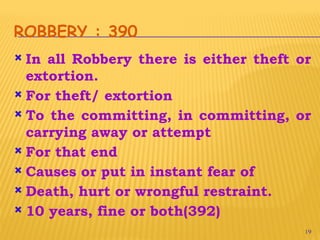
ROBBERY : 390
 In all Robbery there is either theft or
extortion.
 For theft/ extortion
 To the committing, in committing, or
carrying away or attempt
 For that end
 Causes or put in instant fear of
 Death, hurt or wrongful restraint.
 10 years, fine or both(392)
20
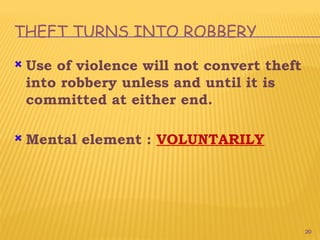
THEFT TURNS INTO ROBBERY
 Use of violence will not convert theft
into robbery unless and until it is
committed at either end.
 Mental element : VOLUNTARILY
21
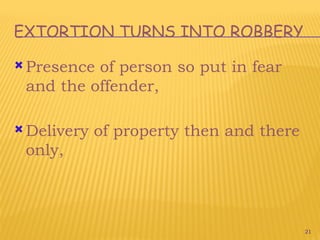
EXTORTION TURNS INTO ROBBERY
 Presence of person so put in fear
and the offender,
 Delivery of property then and there
only,
22
23
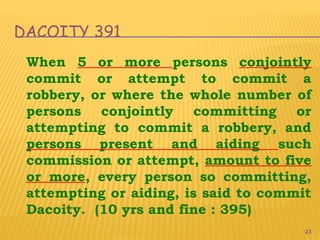
DACOITY 391
When 5 or more persons conjointly
commit or attempt to commit a
robbery, or where the whole number of
persons conjointly committing or
attempting to commit a robbery, and
persons present and aiding such
commission or attempt, amount to five
or more, every person so committing,
attempting or aiding, is said to commit
Dacoity. (10 yrs and fine : 395)
24
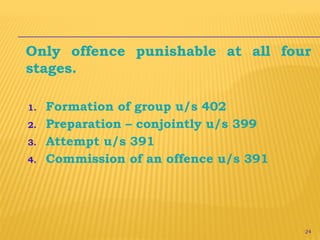
Only offence punishable at all four
stages.
1. Formation of group u/s 402
2. Preparation – conjointly u/s 399
3. Attempt u/s 391
4. Commission of an offence u/s 391
25
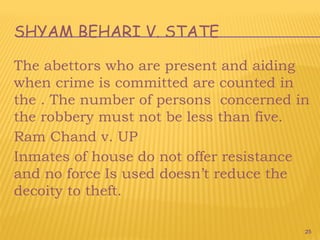
SHYAM BEHARI V. STATE
The abettors who are present and aiding
when crime is committed are counted in
the . The number of persons concerned in
the robbery must not be less than five.
Ram Chand v. UP
Inmates of house do not offer resistance
and no force Is used doesn’t reduce the
decoity to theft.
26
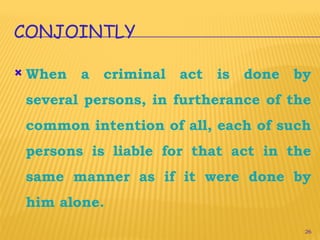
CONJOINTLY
 When a criminal act is done by
several persons, in furtherance of the
common intention of all, each of such
persons is liable for that act in the
same manner as if it were done by
him alone.
27
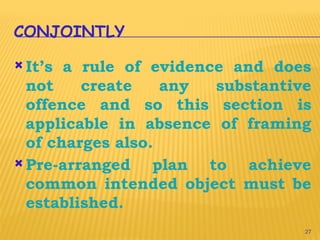
CONJOINTLY
 It’s a rule of evidence and does
not create any substantive
offence and so this section is
applicable in absence of framing
of charges also.
 Pre-arranged plan to achieve
common intended object must be
established.
28

Theft, Extortion, robbery, Dacoity, Comparison under ipc

  • 1.
    THEFT, EXTORTION, ROBBERY,DACOITY DR. NEEPA VYAS Criminal Law 2 (Specific Offences)
  • 2.
    2 WHAT IS THEFT? Whoever, intending to take dishonestly any movable property out of the possession of any person without that person’s consent, moves that property in order to such taking, is said to commit theft. (Section 378)  Imprisonment upto 3 yrs, fine, both (Section 379)
  • 3.
    3 OFFENCE AGAINST PROPERTY Immovable and movable property  Timber, Standing crop, furniture etc..  Unique properties : Idol, salt, Gas- Electricity, water, Human Body, Animal-birds
  • 4.
    4 ELEMENT OF MENSREA  Intention , Dishonestly (24)  Wrongful gain/loss (23)
  • 5.
    5 MENS REA :INTENTION Peter Wright
  • 6.
  • 7.
    7 YET ON INTENTION Steamer company, umbrella case  Vithal v/s State of Bombay Handcuff case  Keshri Chand : Debtor’s camel was seized to compel repayment  A product from automatic box
  • 8.
    8 TWO MAIN QUESTIONS… In whose possession? - “ANY PERSON” Hung carpet case, Property on dead body. Joint possession  What constitutes “moved”? Covering, hiding, shifting, temporary -- permanently
  • 9.
  • 10.
    10  Soham putsa bait for dogs in his pocket, and thus secretly induces Roahn’s Dog follow it. Does it amount to THEFT?
  • 11.
  • 12.
    12 NOW THE TRICKYONE Zinnat was going on a journey, so entrusted her Gold ingot to Amit till she returns. Amit sells the ingot to goldsmith. Is it a THEFT?
  • 13.
    13 AND THE ANSWERIS… NO Reason : Possession.
  • 14.
    14 EXTORTION - 383 Whoever intentionally puts any person in fear of any injury to that person or to any other and thereby dishonestly induces the person so put in fear to deliver to any person any property or valuable security, commits extortion.  3 Years imprisonment (384)
  • 15.
    15 CASES ON ELEMENTS Ramjee Singh v/s State of Bihar “Fear must be of such nature and extent as to unsettle the mind of the person on whom it operates.”  In Re., Labhshanker, The offence of extortion is not complete before actual delivery of the possession of the property by the person put in fear.
  • 16.
    16 PROBLEM TIME Munna threatensto publish a defamatory statement concerning Zahir unless Zahir gives him money. He thus induces Zahir to give him money. Munna has committed Extortion
  • 17.
    17 THEFT-EXTORTION COMPARISON  Intention Property  Consent  Moving- inducement  Fear factor
  • 18.
  • 19.
    19 ROBBERY : 390 In all Robbery there is either theft or extortion.  For theft/ extortion  To the committing, in committing, or carrying away or attempt  For that end  Causes or put in instant fear of  Death, hurt or wrongful restraint.  10 years, fine or both(392)
  • 20.
    20 THEFT TURNS INTOROBBERY  Use of violence will not convert theft into robbery unless and until it is committed at either end.  Mental element : VOLUNTARILY
  • 21.
    21 EXTORTION TURNS INTOROBBERY  Presence of person so put in fear and the offender,  Delivery of property then and there only,
  • 22.
  • 23.
    23 DACOITY 391 When 5or more persons conjointly commit or attempt to commit a robbery, or where the whole number of persons conjointly committing or attempting to commit a robbery, and persons present and aiding such commission or attempt, amount to five or more, every person so committing, attempting or aiding, is said to commit Dacoity. (10 yrs and fine : 395)
  • 24.
    24 Only offence punishableat all four stages. 1. Formation of group u/s 402 2. Preparation – conjointly u/s 399 3. Attempt u/s 391 4. Commission of an offence u/s 391
  • 25.
    25 SHYAM BEHARI V.STATE The abettors who are present and aiding when crime is committed are counted in the . The number of persons concerned in the robbery must not be less than five. Ram Chand v. UP Inmates of house do not offer resistance and no force Is used doesn’t reduce the decoity to theft.
  • 26.
    26 CONJOINTLY  When acriminal act is done by several persons, in furtherance of the common intention of all, each of such persons is liable for that act in the same manner as if it were done by him alone.
  • 27.
    27 CONJOINTLY  It’s arule of evidence and does not create any substantive offence and so this section is applicable in absence of framing of charges also.  Pre-arranged plan to achieve common intended object must be established.
  • 28.