The Diffraction Grating
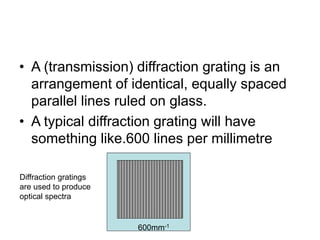
• A (transmission) diffraction grating is an
arrangement of identical, equally spaced
parallel lines ruled on glass.
• A typical diffraction grating will have
something like.600 lines per millimetre
600mm-1
Diffraction gratings
are used to produce
optical spectra
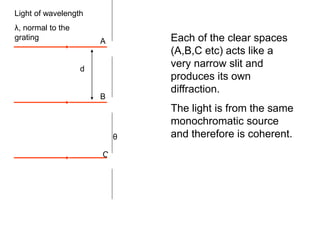
θ
d
C
A
B
Light of wavelength
λ, normal to the
grating Each of the clear spaces
(A,B,C etc) acts like a
very narrow slit and
produces its own
diffraction.
The light is from the same
monochromatic source
and therefore is coherent.
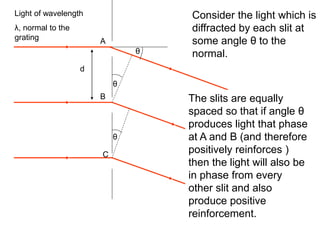
θ
θ
θ
d
C
A
B
Light of wavelength
λ, normal to the
grating
Consider the light which is
diffracted by each slit at
some angle θ to the
normal.
The slits are equally
spaced so that if angle θ
produces light that phase
at A and B (and therefore
positively reinforces )
then the light will also be
in phase from every
other slit and also
produce positive
reinforcement.
θ
θ
θ
d
C
A
B
Light of wavelength
λ, normal to the
grating
N
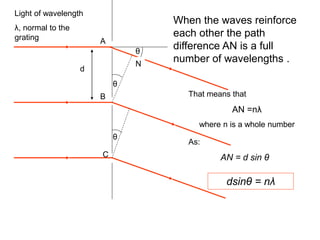
When the waves reinforce
each other the path
difference AN is a full
number of wavelengths .
That means that
AN =nλ
where n is a whole number
As:
AN = d sin θ
dsinθ = nλ
Diffraction Grating
• The angle θ will be slightly different for
each wavelength of light and so the
grating separates white light into its
spectrum and does this much more
effectively than a prism.
• The light needs to be focussed with the
eyepiece lens of a telescope or
spectrometer ( or the lens of the eye) after
it emerges from the grating.
The Diffraction Grating
• A diffraction grating with a large number of
lines produces very sharp maxima and
completely destructive interference at
other angles
Calculations
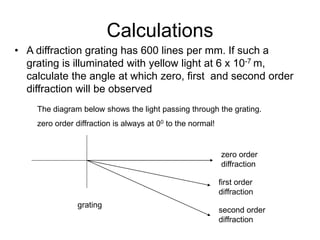
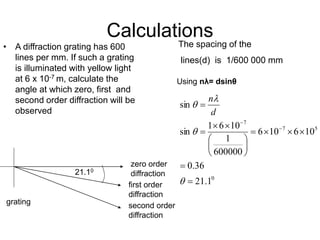
• A diffraction grating has 600 lines per mm. If such a
grating is illuminated with yellow light at 6 x 10⁻⁷ m,
calculate the angle at which zero, first and second order
diffraction will be observed
grating
zero order
diffraction
second order
diffraction
first order
diffraction
The diagram below shows the light passing through the grating.
zero order diffraction is always at 00 to the normal!
Calculations
• A diffraction grating has 600
lines per mm. If such a grating
is illuminated with yellow light
at 6 x 10⁻⁷ m, calculate the
angle at which zero, first and
second order diffraction will be
observed
Using nλ= dsinθ
The spacing of the
lines(d) is 1/600 000 mm
grating
zero order
diffraction
second order
diffraction
first order
diffraction
0
5
7
7
1
.
21
36
.
0
10
6
10
6
600000
1
10
6
1
sin
sin






















d
n
21.10
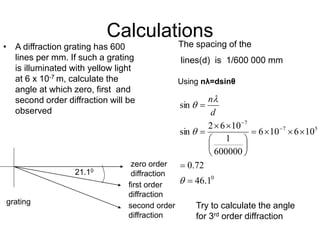
Calculations
• A diffraction grating has 600
lines per mm. If such a grating
is illuminated with yellow light
at 6 x 10⁻⁷ m, calculate the
angle at which zero, first and
second order diffraction will be
observed
Using nλ=dsinθ
The spacing of the
lines(d) is 1/600 000 mm
grating
zero order
diffraction
second order
diffraction
first order
diffraction
0
5
7
7
1
.
46
72
.
0
10
6
10
6
600000
1
10
6
2
sin
sin






















d
n
21.10
Try to calculate the angle
for 3rd order diffraction
Calculations
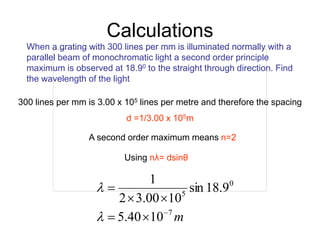
When a grating with 300 lines per mm is illuminated normally with a
parallel beam of monochromatic light a second order principle
maximum is observed at 18.90 to the straight through direction. Find
the wavelength of the light
300 lines per mm is 3.00 x 10⁵ lines per metre and therefore the spacing
d =1/3.00 x 105m
A second order maximum means n=2
Using nλ= dsinθ
m
7
0
5
10
40
.
5
9
.
18
sin
10
00
.
3
2
1









The_Diffraction_Grating.ppt

  • 1.
  • 2.
    • A (transmission)diffraction grating is an arrangement of identical, equally spaced parallel lines ruled on glass. • A typical diffraction grating will have something like.600 lines per millimetre 600mm-1 Diffraction gratings are used to produce optical spectra
  • 3.
    θ d C A B Light of wavelength λ,normal to the grating Each of the clear spaces (A,B,C etc) acts like a very narrow slit and produces its own diffraction. The light is from the same monochromatic source and therefore is coherent.
  • 4.
    θ θ θ d C A B Light of wavelength λ,normal to the grating Consider the light which is diffracted by each slit at some angle θ to the normal. The slits are equally spaced so that if angle θ produces light that phase at A and B (and therefore positively reinforces ) then the light will also be in phase from every other slit and also produce positive reinforcement.
  • 5.
    θ θ θ d C A B Light of wavelength λ,normal to the grating N When the waves reinforce each other the path difference AN is a full number of wavelengths . That means that AN =nλ where n is a whole number As: AN = d sin θ dsinθ = nλ
  • 6.
    Diffraction Grating • Theangle θ will be slightly different for each wavelength of light and so the grating separates white light into its spectrum and does this much more effectively than a prism. • The light needs to be focussed with the eyepiece lens of a telescope or spectrometer ( or the lens of the eye) after it emerges from the grating.
  • 7.
    The Diffraction Grating •A diffraction grating with a large number of lines produces very sharp maxima and completely destructive interference at other angles
  • 8.
    Calculations • A diffractiongrating has 600 lines per mm. If such a grating is illuminated with yellow light at 6 x 10⁻⁷ m, calculate the angle at which zero, first and second order diffraction will be observed grating zero order diffraction second order diffraction first order diffraction The diagram below shows the light passing through the grating. zero order diffraction is always at 00 to the normal!
  • 9.
    Calculations • A diffractiongrating has 600 lines per mm. If such a grating is illuminated with yellow light at 6 x 10⁻⁷ m, calculate the angle at which zero, first and second order diffraction will be observed Using nλ= dsinθ The spacing of the lines(d) is 1/600 000 mm grating zero order diffraction second order diffraction first order diffraction 0 5 7 7 1 . 21 36 . 0 10 6 10 6 600000 1 10 6 1 sin sin                       d n 21.10
  • 10.
    Calculations • A diffractiongrating has 600 lines per mm. If such a grating is illuminated with yellow light at 6 x 10⁻⁷ m, calculate the angle at which zero, first and second order diffraction will be observed Using nλ=dsinθ The spacing of the lines(d) is 1/600 000 mm grating zero order diffraction second order diffraction first order diffraction 0 5 7 7 1 . 46 72 . 0 10 6 10 6 600000 1 10 6 2 sin sin                       d n 21.10 Try to calculate the angle for 3rd order diffraction
  • 11.
    Calculations When a gratingwith 300 lines per mm is illuminated normally with a parallel beam of monochromatic light a second order principle maximum is observed at 18.90 to the straight through direction. Find the wavelength of the light 300 lines per mm is 3.00 x 10⁵ lines per metre and therefore the spacing d =1/3.00 x 105m A second order maximum means n=2 Using nλ= dsinθ m 7 0 5 10 40 . 5 9 . 18 sin 10 00 . 3 2 1        