The World of Stocks

“In the business world, the rear view mirror is
always clearer than the windshield”.
Warren Buffett
Agenda of the module
1

Stock

2

Types of Stock

3

Company Development Cycles

4

Mechanics of Stock Investing: Buying Stocks

5

Cash and Margin Trading

6

Getting the Low Down on Quotes

7

Types of Orders

8

Getting Started
1

2

3

4

5

6

7

8

Stock
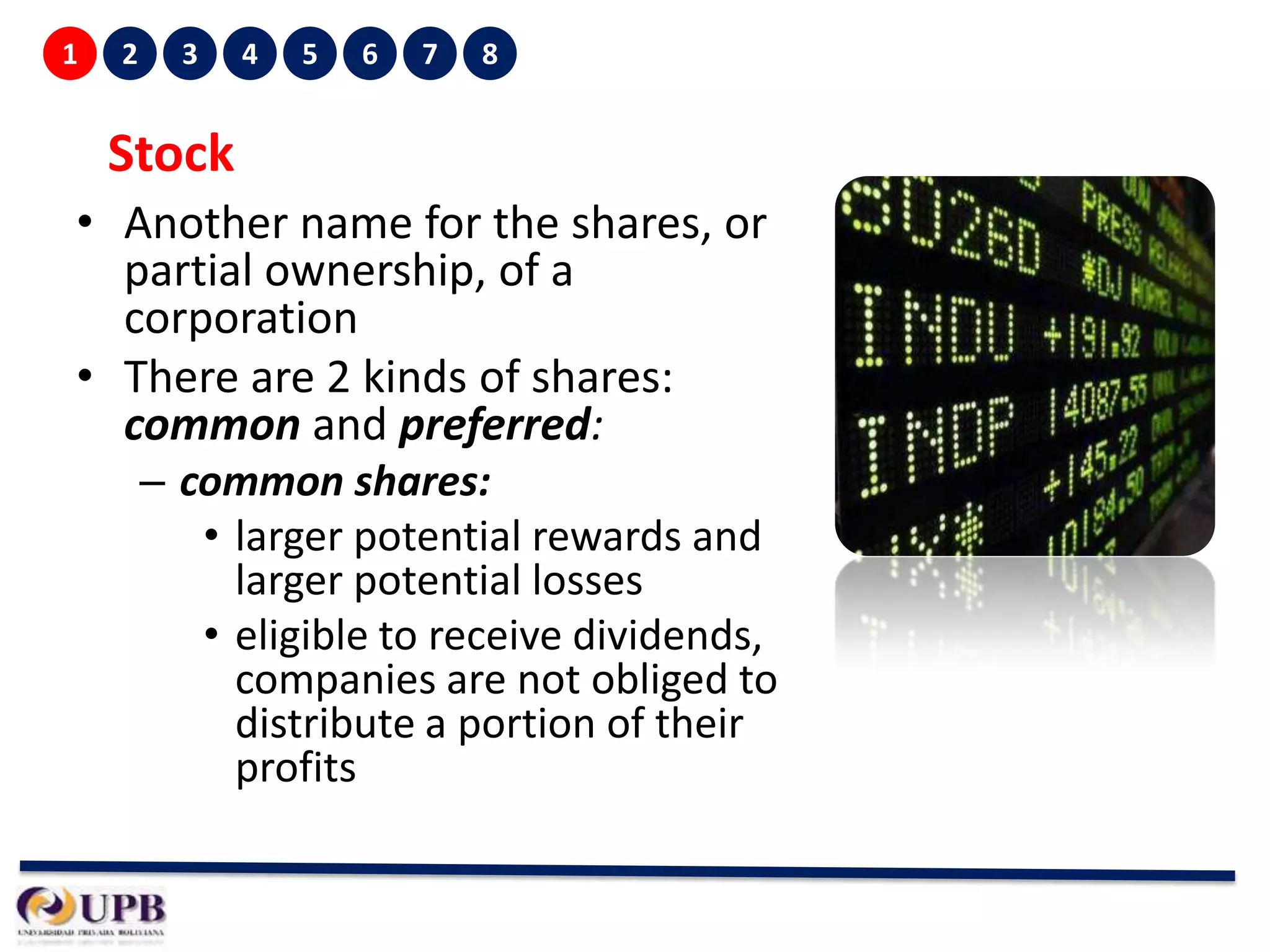
• Another name for the shares, or
partial ownership, of a
corporation
• There are 2 kinds of shares:
common and preferred:
– common shares:
• larger potential rewards and
larger potential losses
• eligible to receive dividends,
companies are not obliged to
distribute a portion of their
profits
1

2

3

4

5

6

7

8

Stock
– preferred shares:
• hybrid between bonds and common stock, the more
like a bond the more the return will reflect the
return of a bond / the more like a stock the more
the return like reflect the return on a stock
• features of preferred may or may not include:
– guaranteed dividends at regular intervals
– limited dividends, does not rise relative to profits
– voting superiority depending on agreement
– possible convertibility into common stock or bonds
– in case of bankruptcy preferreds get paid before
common stock
1

2

3

4

5

6

7

8

Stock
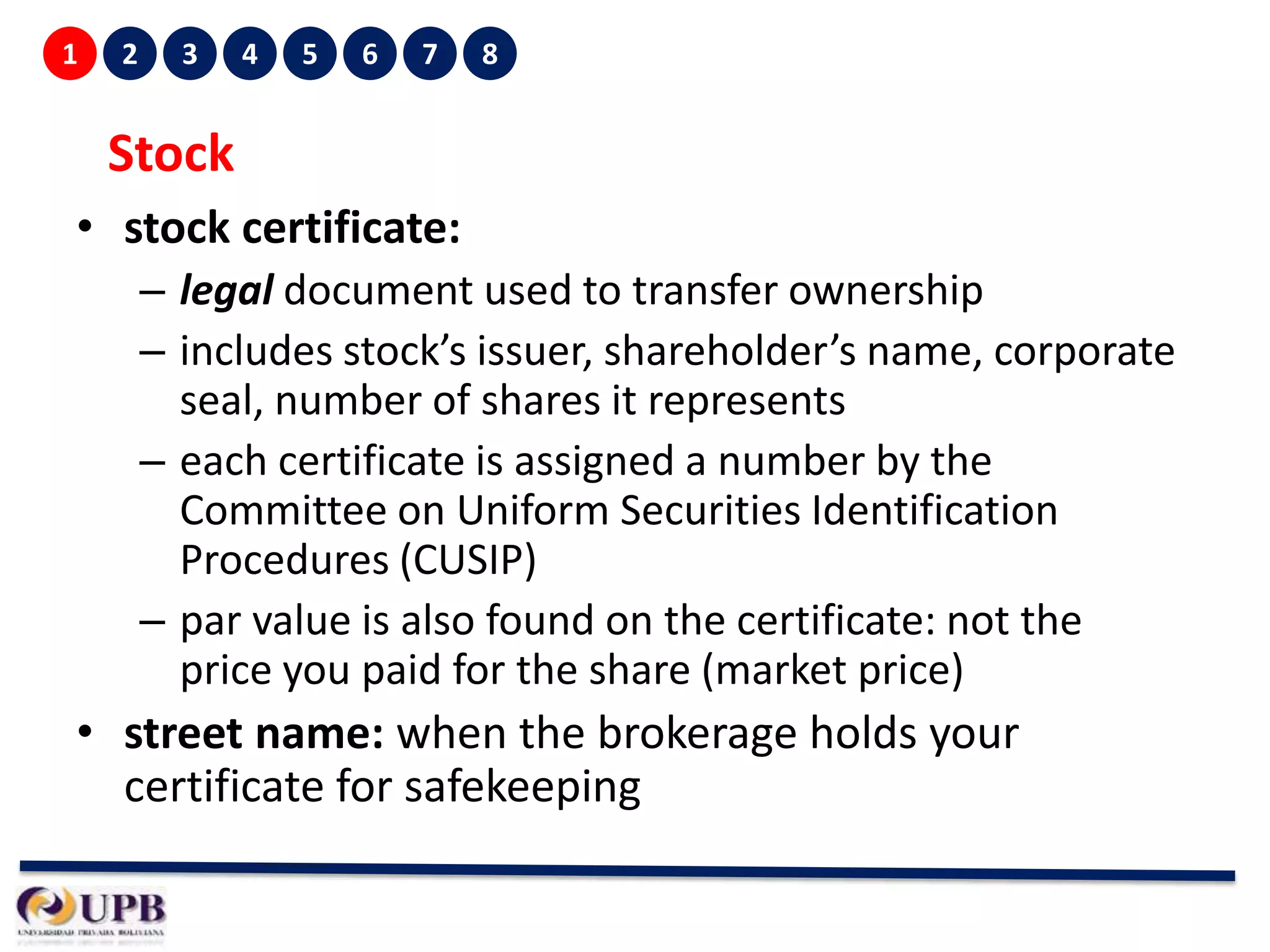
• stock certificate:
– legal document used to transfer ownership
– includes stock’s issuer, shareholder’s name, corporate
seal, number of shares it represents
– each certificate is assigned a number by the
Committee on Uniform Securities Identification
Procedures (CUSIP)
– par value is also found on the certificate: not the
price you paid for the share (market price)

• street name: when the brokerage holds your
certificate for safekeeping
1

2

3

4

5

6

7

8

Stock
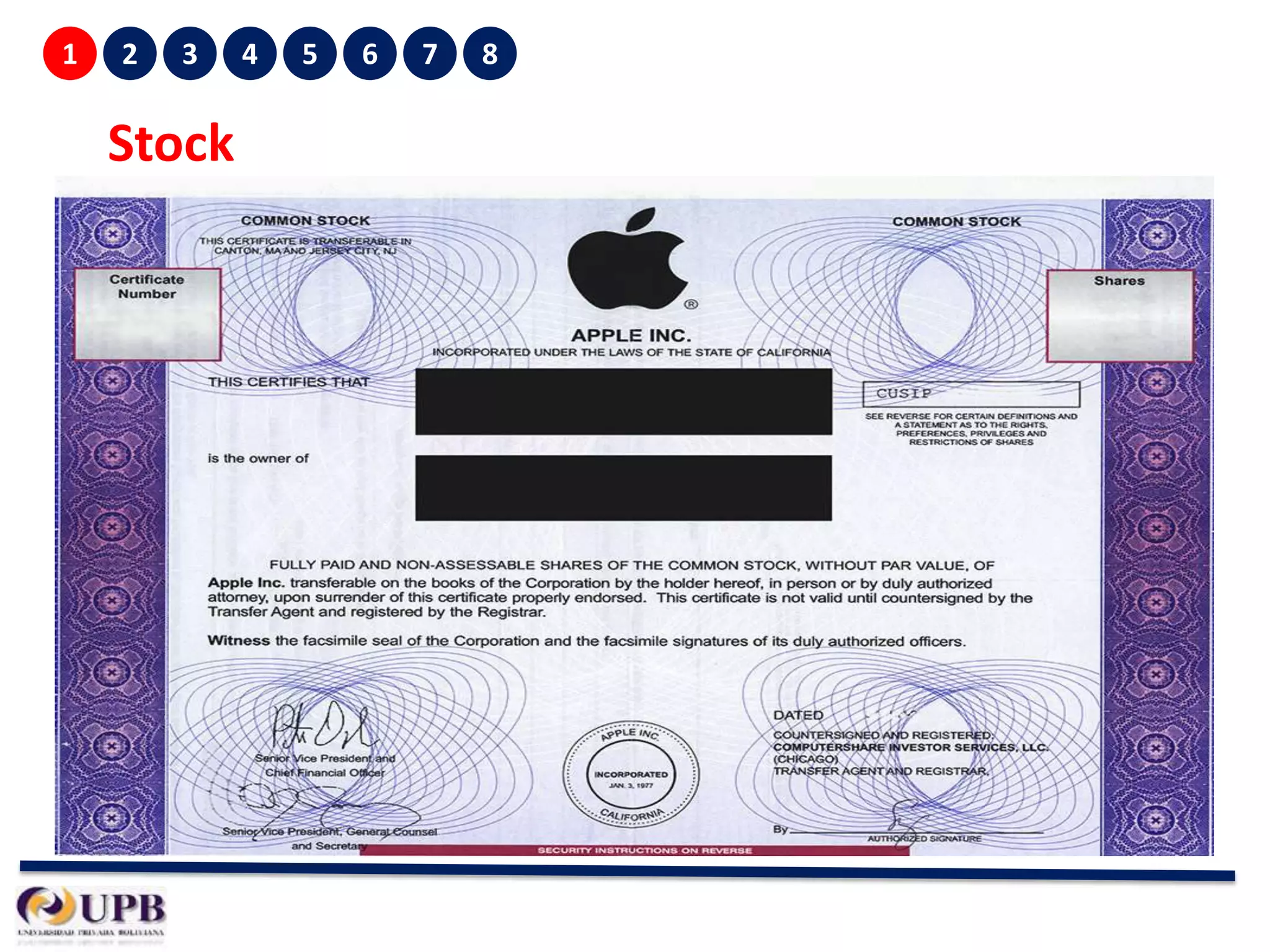
• stock certificate:
– legal document used to transfer ownership
– includes stock’s issuer, shareholder’s name, corporate
seal, number of shares it represents
– each certificate is assigned a number by the
Committee on Uniform Securities Identification
Procedures (CUSIP)
– par value is also found on the certificate: not the
price you paid for the share (market price)

• street name: when the brokerage holds your
certificate for safekeeping
1

2

3

4

5

6

7

8

Type of Stock
• No official list divides stocks into
separate categories
• Stocks are unofficially classified by:
– size (primarily dependent on its
market capitalization)
• (multiply the number of
outstanding shares X price)

– sector (technology, industrial
energy or biotechnology)
1

2

3

4

5

6

7

8

Type of Stock
• Using Market cap, stocks can be broken down into
four size categories:
– large-cap: blue chip (more than $ 5
billion) – AAPL, GE, MSFT,PG
• Dow Jones Industrial Average is
comprised of Blue Chip stocks
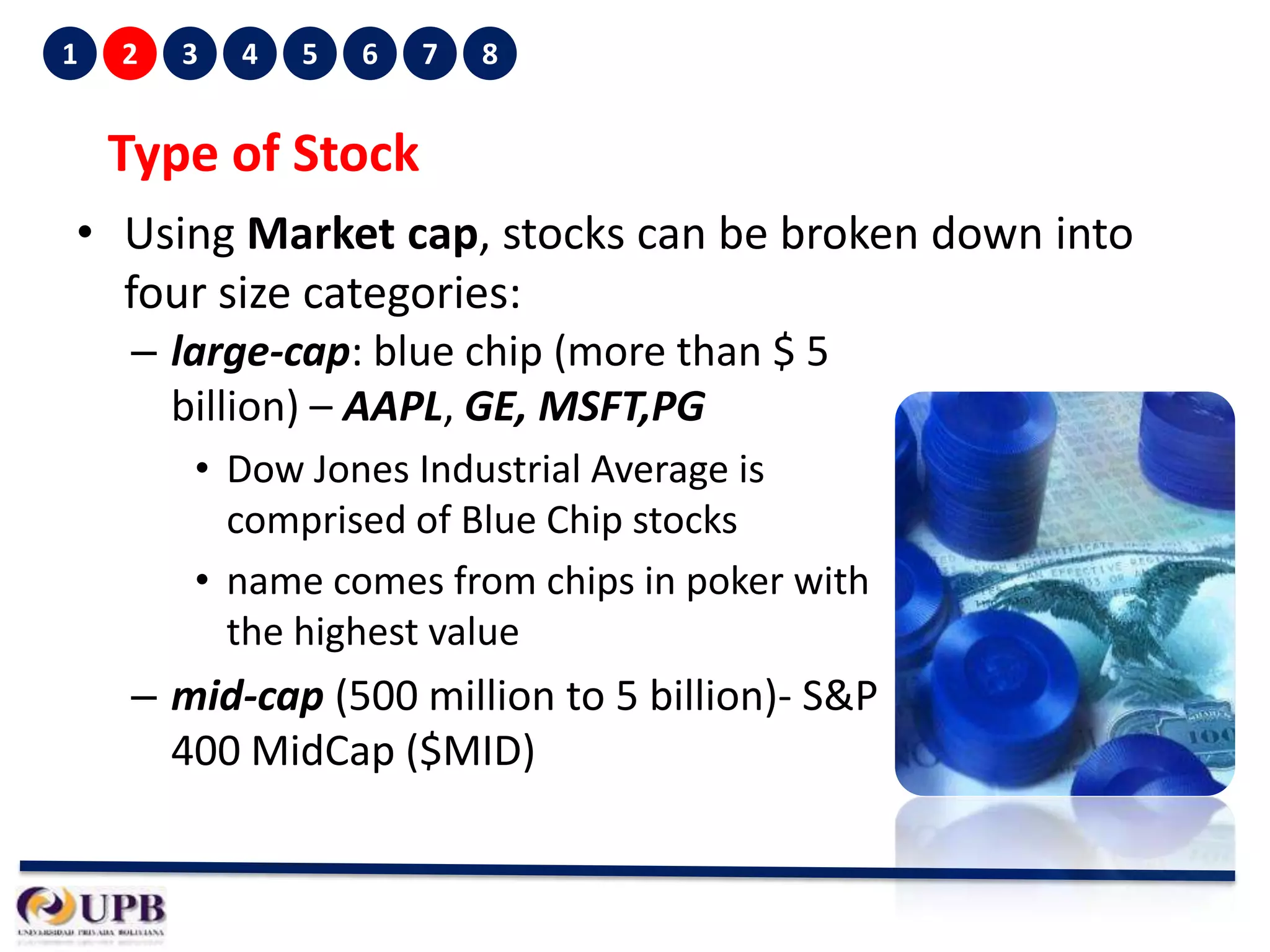
• name comes from chips in poker with
the highest value

– mid-cap (500 million to 5 billion)- S&P
400 MidCap ($MID)
1

2

3

4

5

6

7

8

Type of Stock
• Market cap:
– small-cap (150 million to 500 million) – Russell 2000
Index ($RUT) & S&P SmallCap 600 ($SML)
• often undervalued because analysts have not began
coverage
• institutional investors often can not buy because
smaller stocks do not meet fiscal requirements that
govern the investments of many money managers and
pension funds
• http://www.smallcapnetwork.com/
– helps investors find undervalued and overlooked small
cap stocks
1

2

3

4

5

6

7

8

Type of Stock
• Market cap:
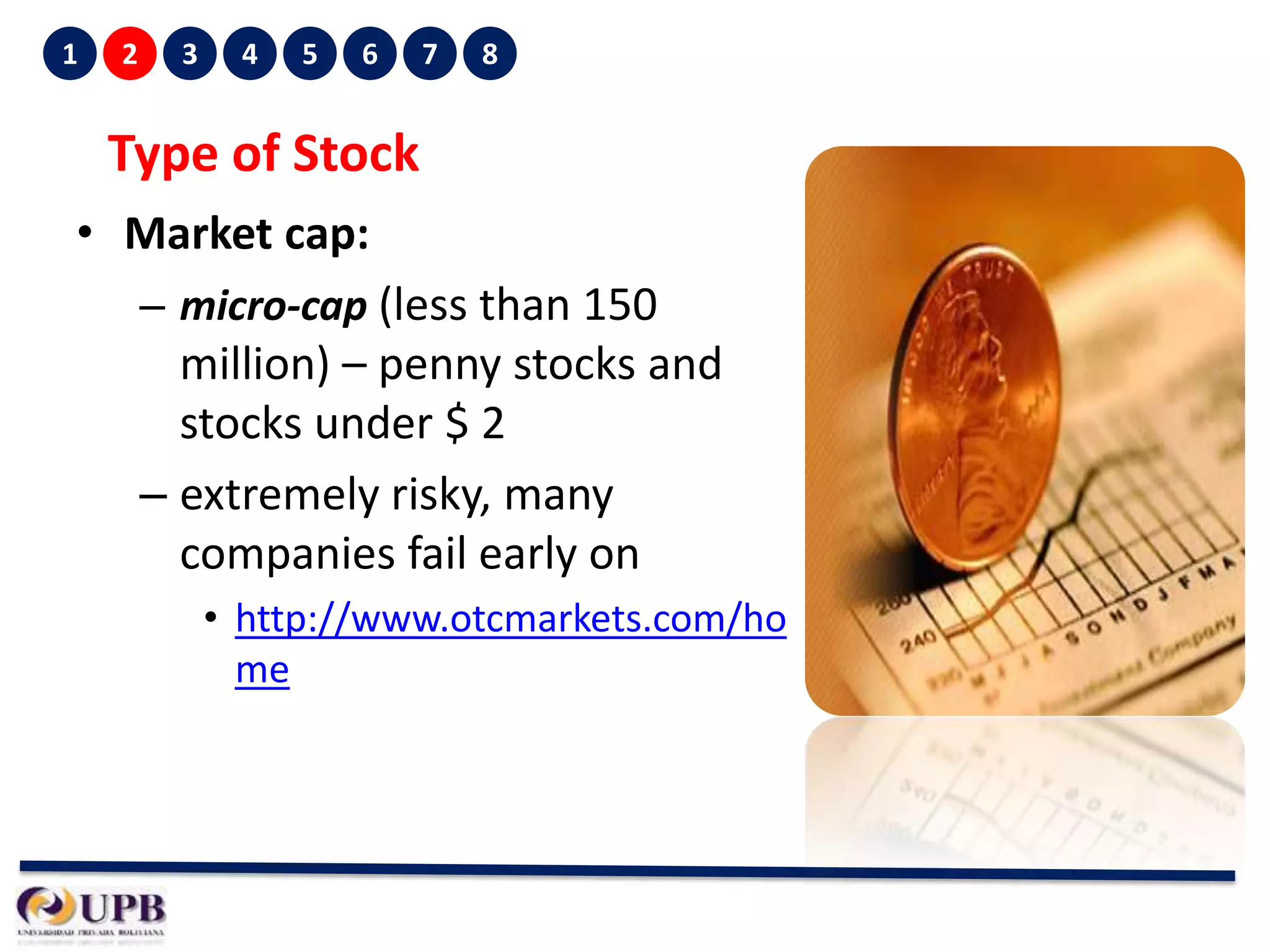
– micro-cap (less than 150

million) – penny stocks and
stocks under $ 2
– extremely risky, many
companies fail early on
• http://www.otcmarkets.com/ho
me
1

2

3

4

5

6

7

8

Type of Stock
• Another way to classify a stock is by its nature of its
objectives:
– income (conservative)
• solid companies that offer slow but steady growth
• regularly pay dividends
• i.e. Exxon Mobil (XOM), Bank of America (BAC)

– cyclical (conservative)
• fluctuate in relation to the economy , seasons, events
• good gauge of the economy
• i.e. Alcoa (AA)
1

2

3

4

5

6

7

8

Type of Stock
• Nature of its objectives:
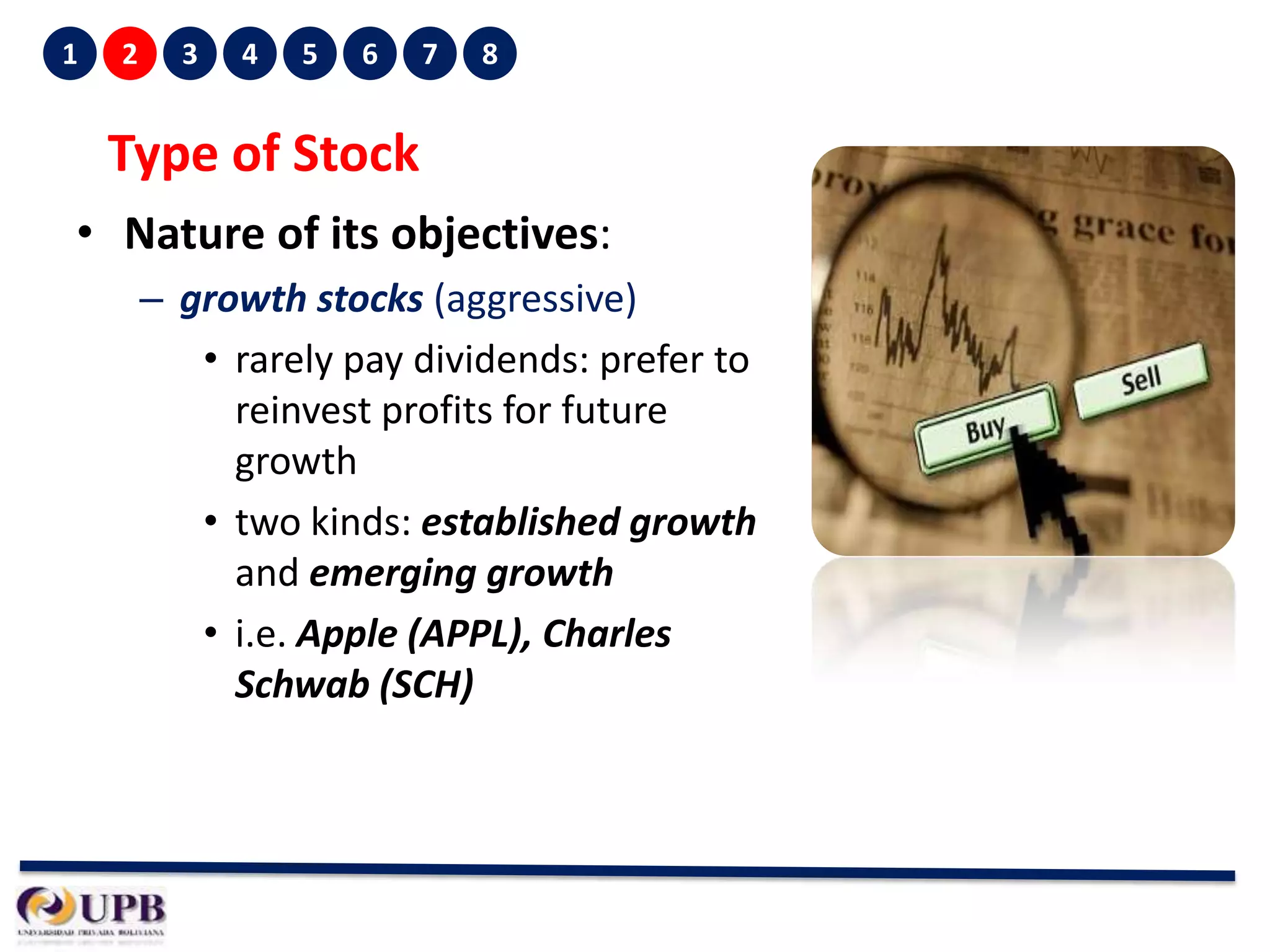
– growth stocks (aggressive)
• rarely pay dividends: prefer to
reinvest profits for future
growth
• two kinds: established growth
and emerging growth
• i.e. Apple (APPL), Charles
Schwab (SCH)
1

2

3

4

5

6

7

8

Type of Stock
• Nature of its objectives:
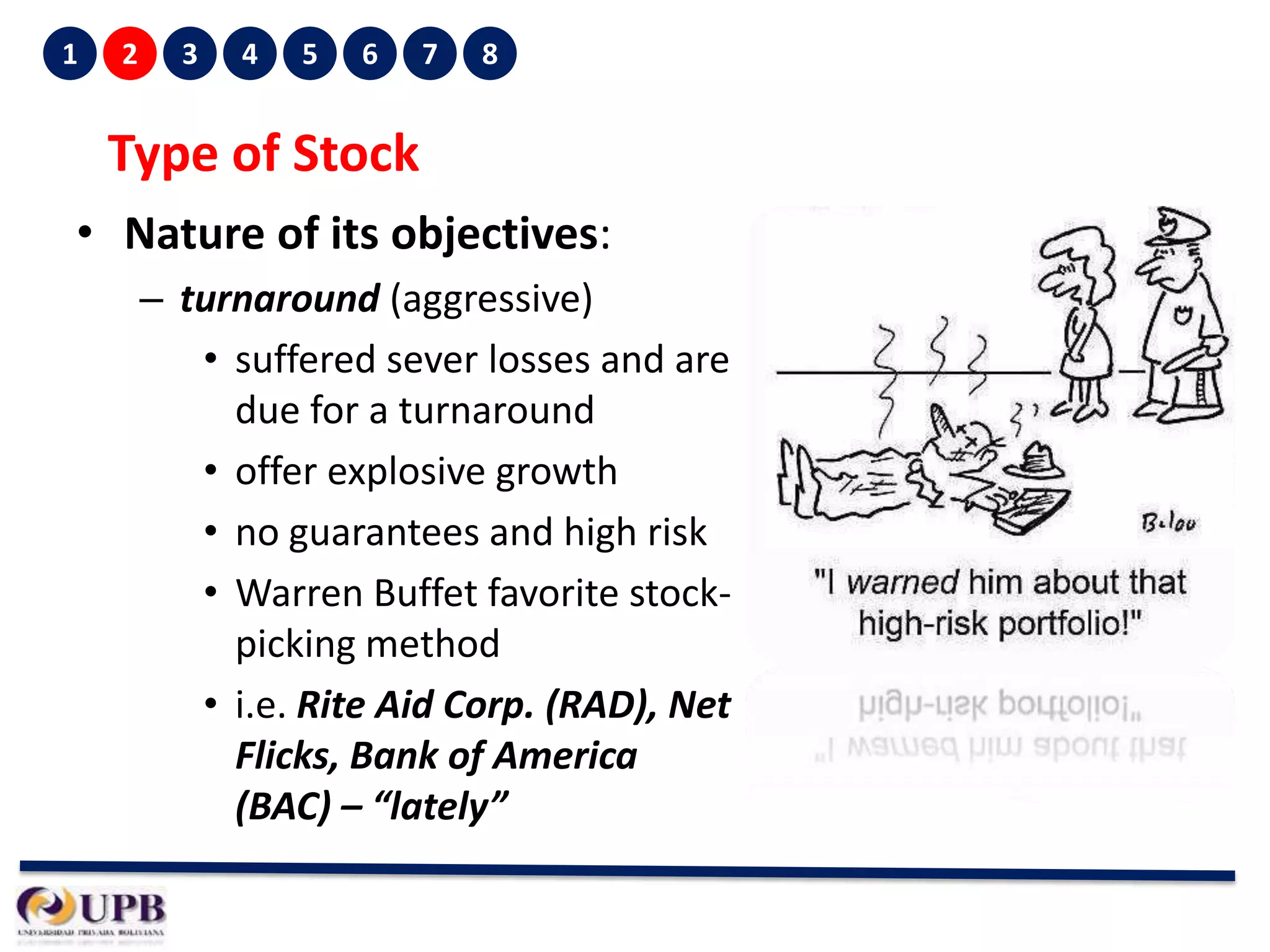
– turnaround (aggressive)
• suffered sever losses and are
due for a turnaround
• offer explosive growth
• no guarantees and high risk
• Warren Buffet favorite stockpicking method
• i.e. Rite Aid Corp. (RAD), Net
Flicks, Bank of America
(BAC) – “lately”
1

2

3

4

5

6

7

8

Type of Stock
• Nature of its objectives:
– green stocks (varies)
• environmentally friendly
and socially conscious
i.e. Ben & Jerry’s (BJICA)
• www.greenmoney.com or www.goodmoney.com

• The advantages and disadvantages of each stock
depend on your investment goals and risk tolerance
1

2

3

4

5

6

7

8

Company Development Cycles
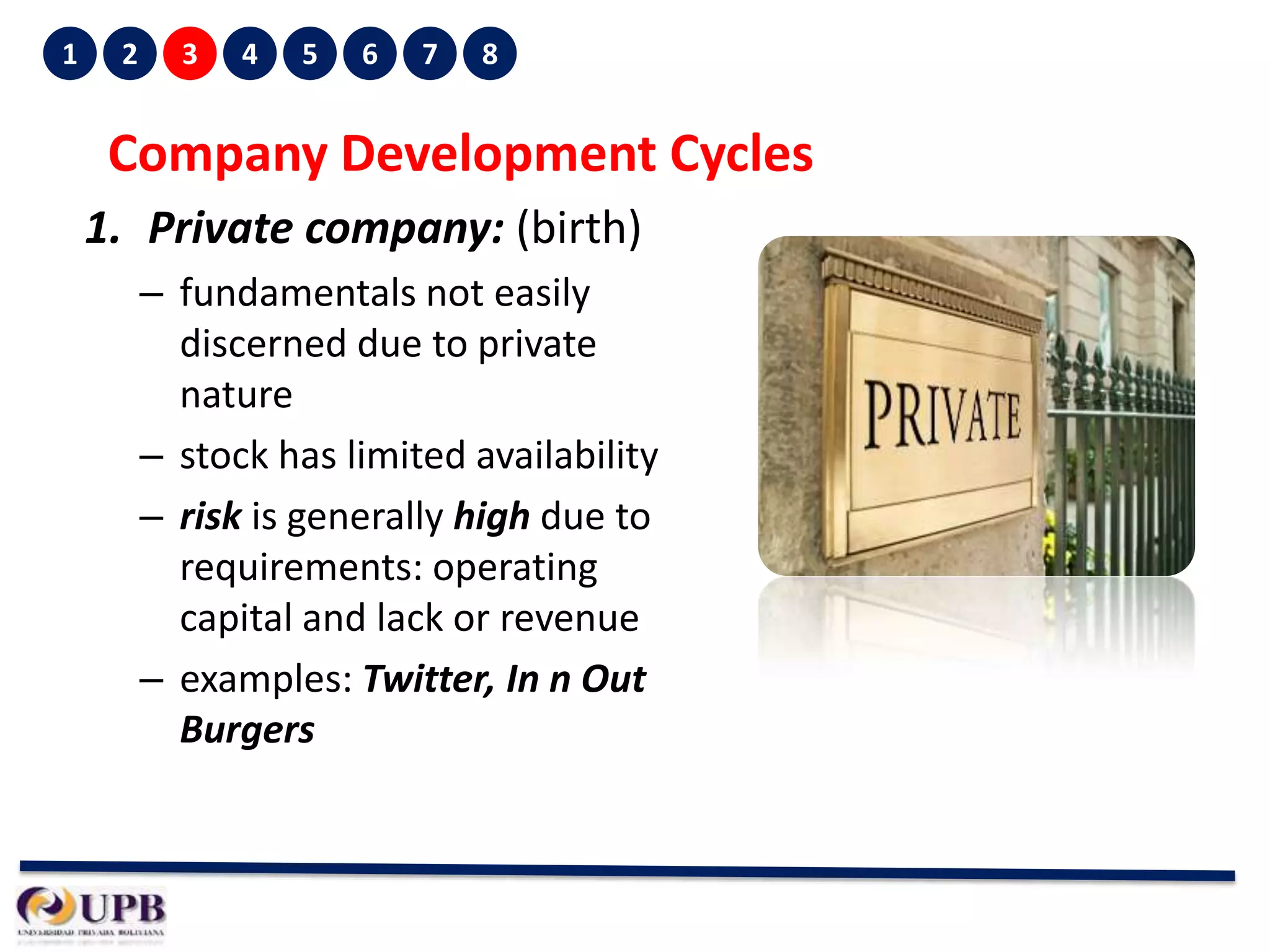
1. Private company: (birth)
– fundamentals not easily
discerned due to private
nature
– stock has limited availability
– risk is generally high due to
requirements: operating
capital and lack or revenue
– examples: Twitter, In n Out
Burgers
1

2

3

4

5

6

7

8

Company Development Cycles
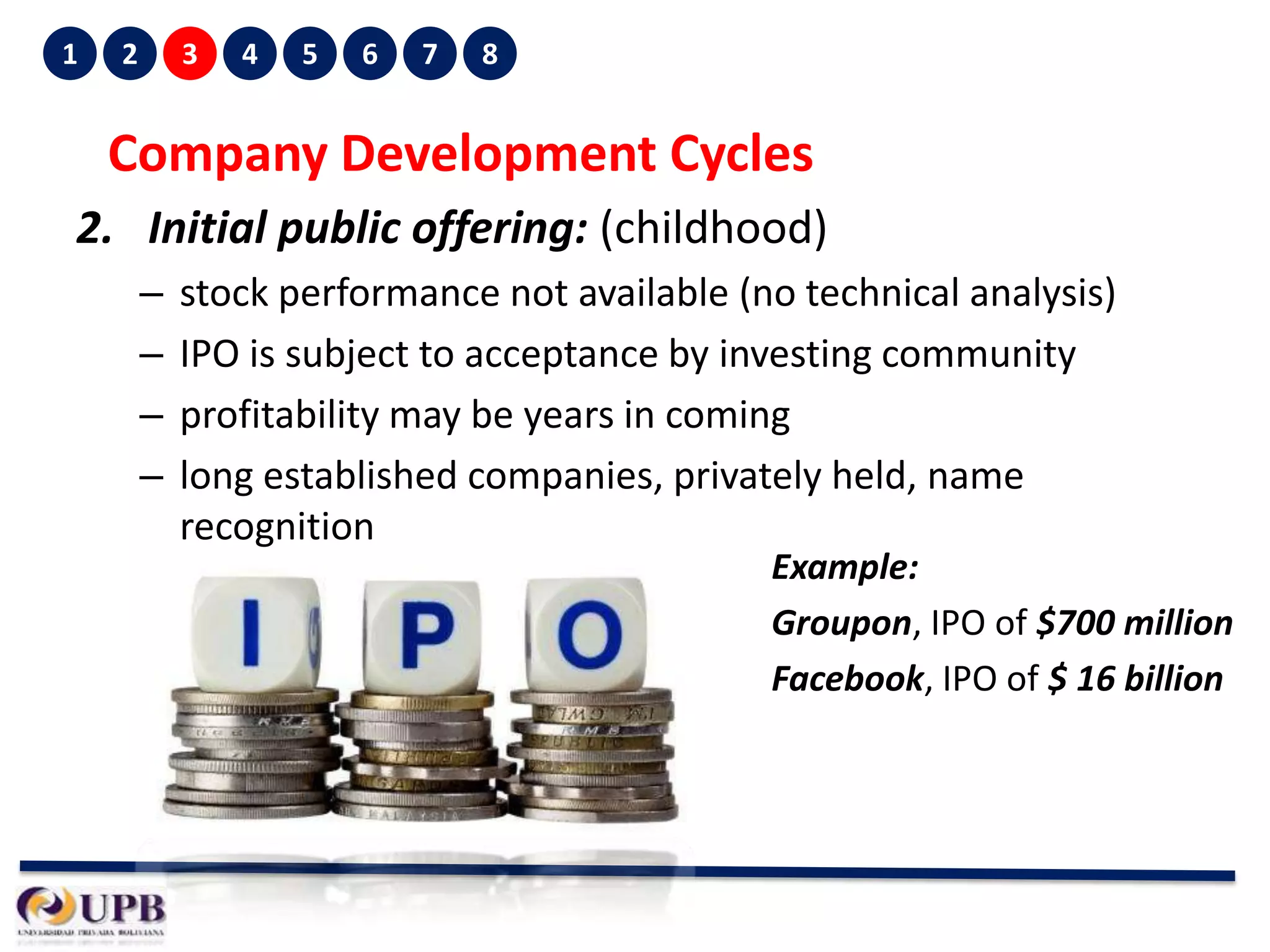
2. Initial public offering: (childhood)
–
–
–
–

stock performance not available (no technical analysis)
IPO is subject to acceptance by investing community
profitability may be years in coming
long established companies, privately held, name
recognition

Example:
Groupon, IPO of $700 million
Facebook, IPO of $ 16 billion
1

2

3

4

5

6

7

8

Company Development Cycles
3. Early-stage growth: (adolescence)
–
–
–
–

rarely (if ever) pay dividends
stocks in thus stage are considered aggressive
critical stage of “make it or break it”
example: Facebook (460 million shares/$ 16 billion/cap 125
billion-September 30, 2013), Skype

4. Successful growth: (adulthood)
–
–
–
–

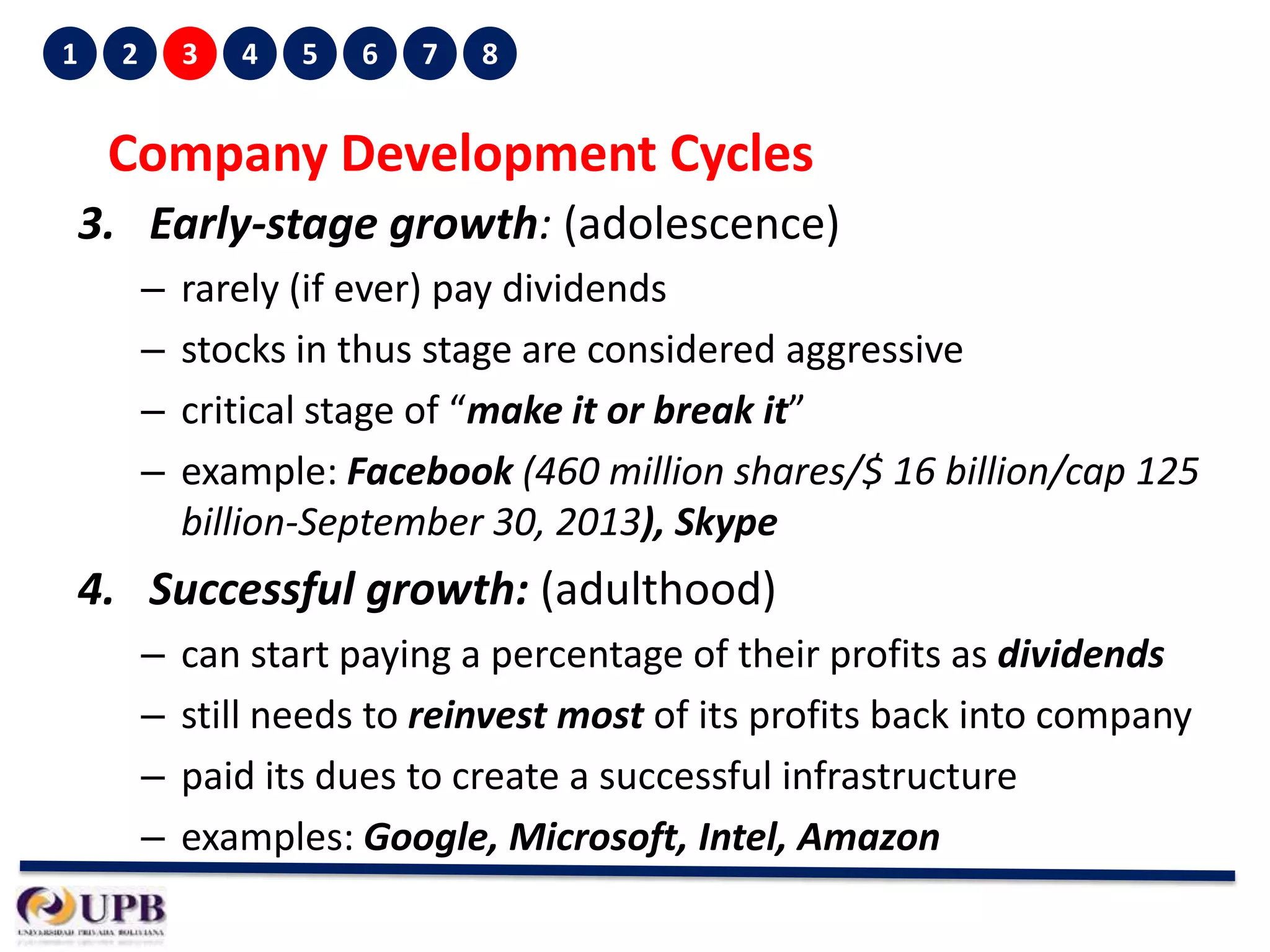
can start paying a percentage of their profits as dividends
still needs to reinvest most of its profits back into company
paid its dues to create a successful infrastructure
examples: Google, Microsoft, Intel, Amazon
1

2

3

4

5

6

7

8

Company Development Cycles
5. Mature company: (old age)
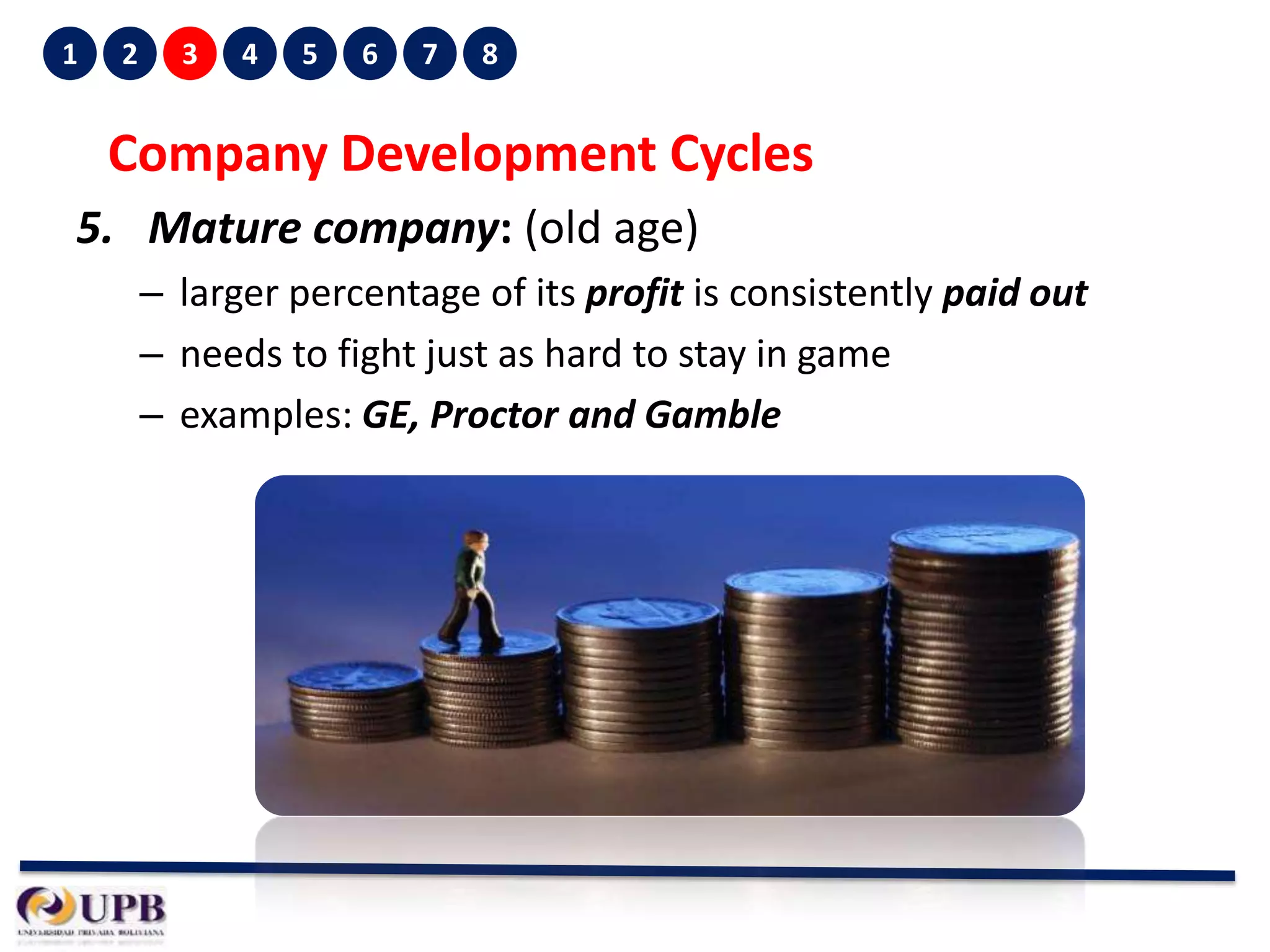
– larger percentage of its profit is consistently paid out
– needs to fight just as hard to stay in game
– examples: GE, Proctor and Gamble
1

2

3

4

5

6

7

8

The Mechanics of Stock Investing
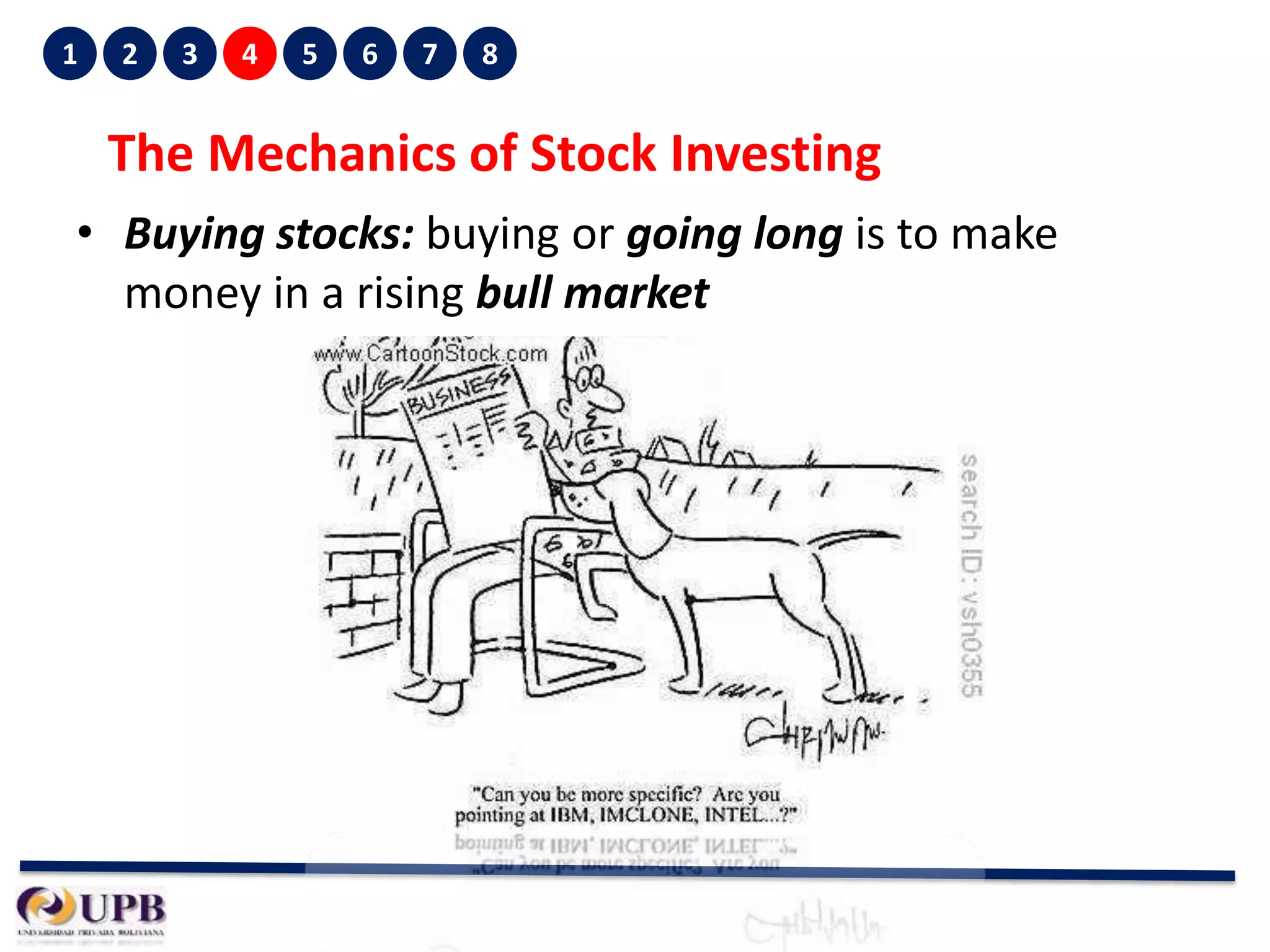
• Buying stocks: buying or going long is to make
money in a rising bull market
1

2

3

4

5

6

7

8

The Mechanics of Stock Investing
• Buying stocks:
– two ways to buy stocks: cash and margin
•
•
•
•

cash is a straight debit from your account
margin: brokerage lends you part of the purchase price
maximum risk: price of the stock as it approaches zero
maximum profit: unlimited

– in volatile markets, traders hedge their positions
with options or bonds
1

2

3

4

5

6

7

8

The Mechanics of Stock Investing
• Short Selling Stocks:
– strategy used by George Soros in 1992: Black Wednesday
• made $1 billion dollars from a $10 billion short position on the
sterling
• he was dubbed the man who broke the bank of England

– can be used to take advantage of a drop in prices
– you can borrow shares from your brokerage and sell them at
a higher price and later buy them at a lower price to
replenish them
– cover the short: to buy shares of stock to replenish those
borrowed from your brokerage to place a short sale
1

2

3

4

5

6

7

8

The Mechanics of Stock Investing
• Short Selling Stocks:
• example of the mathematics of shorting:
•
•
•
•

EMC is currently trading @ 85 ½ per share
you want to short 100 shares
you will receive 8,550 in your account for shorting
to place the trade, most brokerages will require
you to post a margin deposit of $150% or $12,825
($8,850 x 1.5)
• price drops to $75
• you profit $1,050 = $8,550 – 7,500 ($75 x 100
shares to close position)
1

2

3

4

5

6

7

8

The Mechanics of Stock Investing
• Short Selling Stocks:
– holding a short position in the stock for over a year
does not constitute a long term capital gain
– capital gain shelters are for long term stockholders not
short sellers
– examples of short selling: Bank of England, Goldman
Sacks
– maximum risk: unlimited to the upside
– maximum profit: limited to the full price of the stock
shares as they fall to zero
1

2

3

4

5

6

7

8

The Mechanics of Stock Investing
• Short selling stocks:
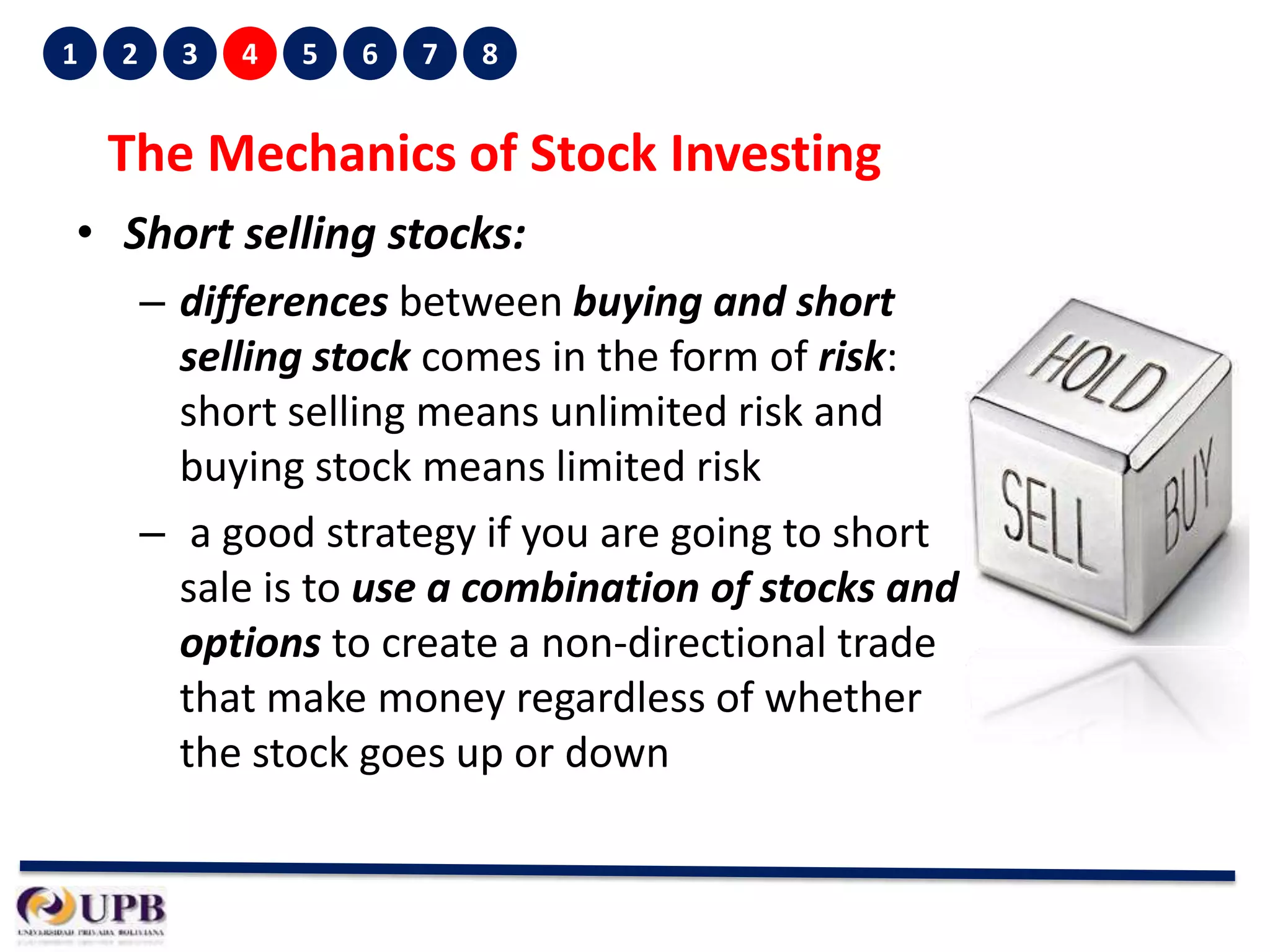
– differences between buying and short
selling stock comes in the form of risk:
short selling means unlimited risk and
buying stock means limited risk
– a good strategy if you are going to short
sale is to use a combination of stocks and
options to create a non-directional trade
that make money regardless of whether
the stock goes up or down
1

2

3

4

5

6

7

8

Cash and Margin Trading
• Cash trades
– require that you put 100% of the money in cash
– EMC goes from $85 ½ to $90 ½, so if you bought 100
shares you made a profit of $500, or a 5.8% return on
investment (ROI)
• ROI – the reward on a trade divided by the trade’s risk
1

2

3

4

5

6

7

8

Cash and Margin Trading
• Margin trades
– allows you to put a percentage of the
total cost of the trade amount in cash
and the rest in “on account”
– the term margin refers to the
amount of money an investor must
pay to enter a trade with the
remainder of the cash being
borrowed from the brokerage firm:
the shares you have bought secure
the trade
1

2

3

4

5

6

7

8

Cash and Margin Trading
• Margin trades
– margin account is usually
required for short positions and
options trading
– brokerages are usually willing to
let you borrow 50% of a trade’s
cost but require a certain
amount of money be left
untouched in your account to
secure the loan – this money is
referred to as a margin
requirement
1

2

3

4

5

6

7

8

Cash and Margin Trading
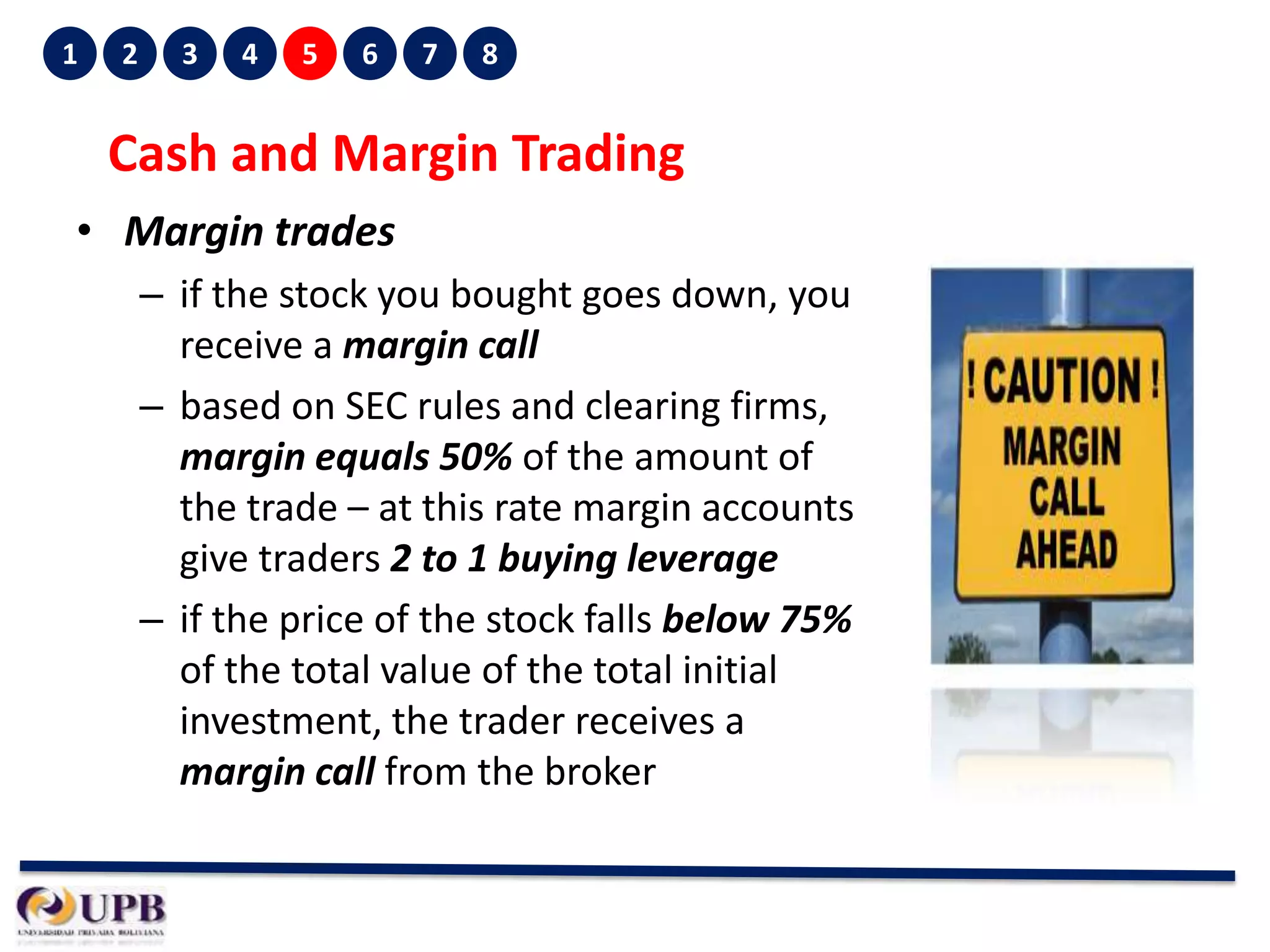
• Margin trades
– if the stock you bought goes down, you
receive a margin call
– based on SEC rules and clearing firms,
margin equals 50% of the amount of
the trade – at this rate margin accounts
give traders 2 to 1 buying leverage
– if the price of the stock falls below 75%
of the total value of the total initial
investment, the trader receives a
margin call from the broker
1

2

3

4

5

6

7

8

Cash and Margin Trading
• Margin trades
– brokers may set their own margin requirements, but they
are never less than 75% - the amount required by the Fed
– margin interest is cheaper than most loans , as it is a
secure loan
– margin on short selling is extremely expensive, cost of
stock plus 50%
1

2

3

4

5

6

7

8

Getting the Low Down on Quotes
– there are hundreds of websites that provide quote, some
real time (eSignal – www.dbc.com) while more are delayed
(15 to 20 minutes)
– example: www.optionetics.com - Qualcomm (QCOM)
– bid: the highest price a prospective buyer is prepared to pay
(floor trader) – off floor trader buys at the ask price
– ask: the lowest price acceptable to a prospective seller
(floor trader) – off floor trader sells at the bid price
– the quote price gives you a general feel for the stock, but if
you want to know the stock you must look deeper than that
– off floor trader buys at the ask price and sells at the bid
price
1

2

3

4

5

6

7

8

Getting the Low Down on Quotes
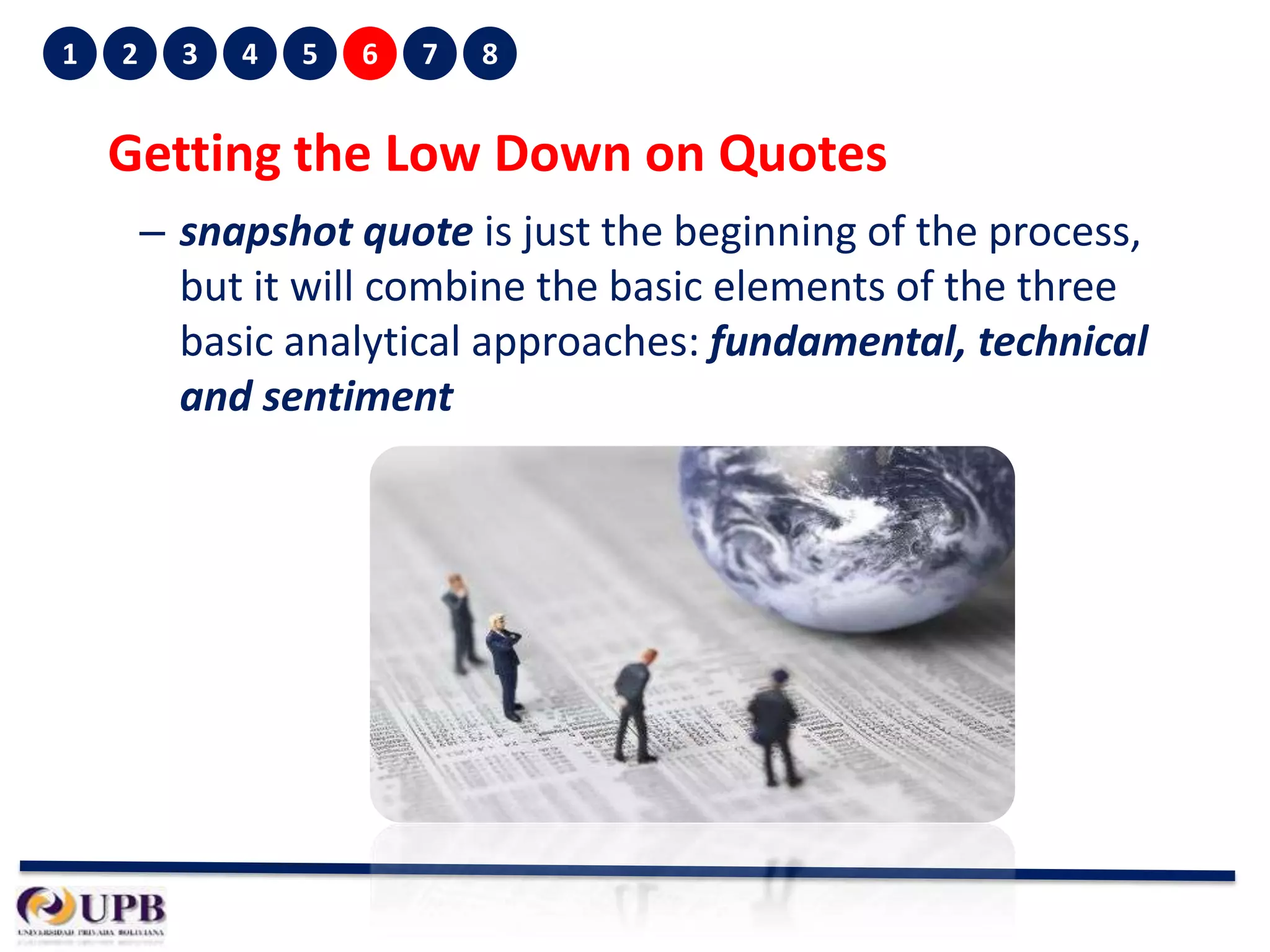
– snapshot quote is just the beginning of the process,
but it will combine the basic elements of the three
basic analytical approaches: fundamental, technical
and sentiment
1

2

3

4

5

6

7

8

Getting the Low Down on Quotes
– Quote terms Definitions
•
•
•
•
•
•
•

Last – last price that the option/stock traded at
Open – price of the first transaction of the current day
Change – amount last sale differs from previous closing
% Change – percentage price change from previous day
High – highest price for current trading day
Low – lowest price for current trading day
Bid – highest price a prospective buyer (floor trader) is
prepared to pay
• Ask – lowest price acceptable to a prospective seller
(floor trader)
1

2

3

4

5

6

7

8

Getting the Low Down on Quotes
– Quote terms Definitions
•
•
•
•
•
•
•
•

52-Week High – the highest stock price in the past 52 weeks
52 Week Low – the lowest stock price in the past 52 weeks
Earnings per Share – net pre-tax profit divided by the shares
Volume – total number of shares traded that day
Share Outstanding – total number of shares the Co. issued
Market Cap – shares outstanding multiplied by the price
P/E Ratio – stock price divided by the earnings per share
Exchange – indicates where a company lists its shares
1

2

3

4

5

6

7

8

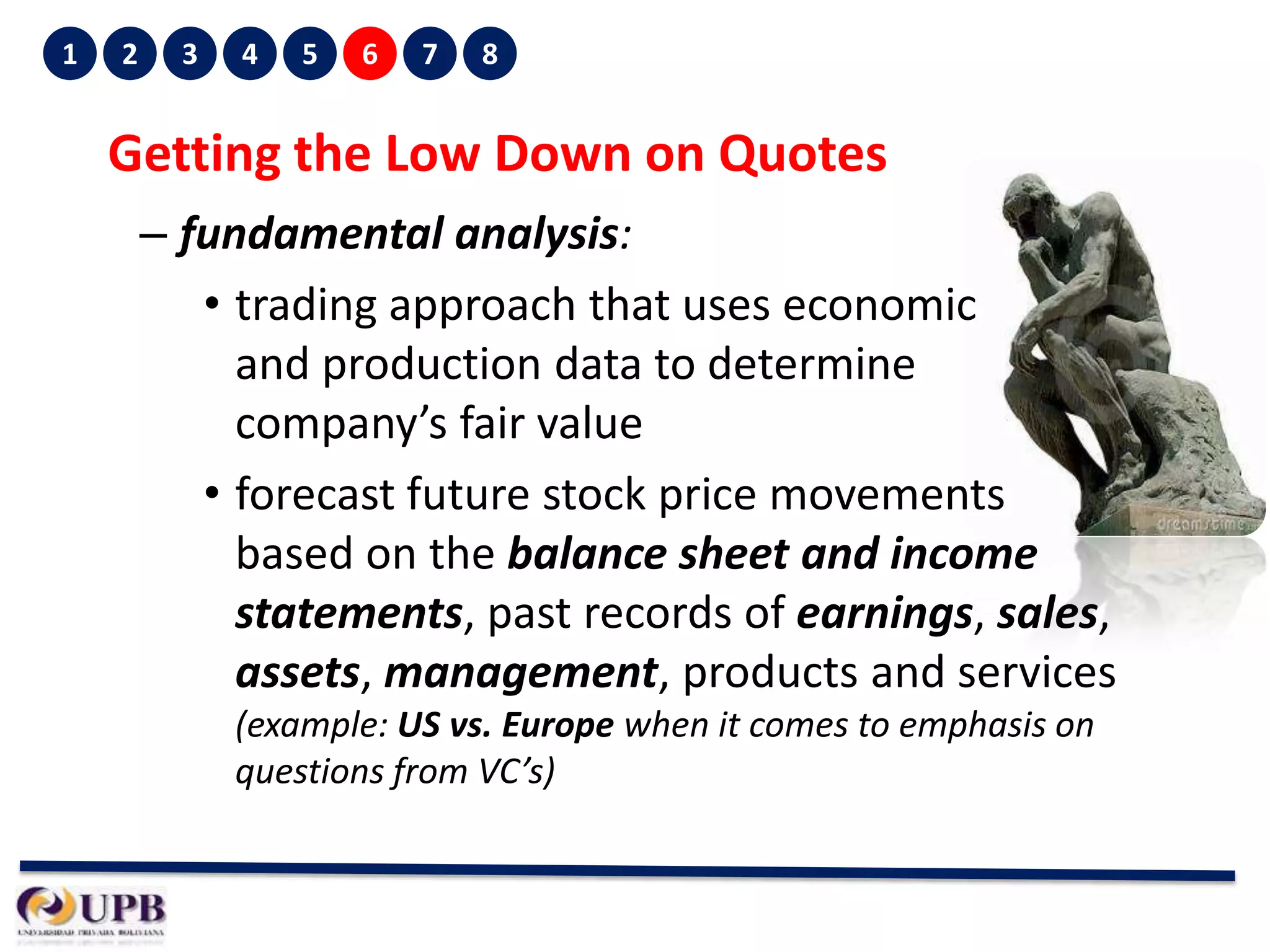
Getting the Low Down on Quotes
– fundamental analysis:
• trading approach that uses economic
and production data to determine
company’s fair value
• forecast future stock price movements
based on the balance sheet and income
statements, past records of earnings, sales,
assets, management, products and services
(example: US vs. Europe when it comes to emphasis on
questions from VC’s)
1

2

3

4

5

6

7

8

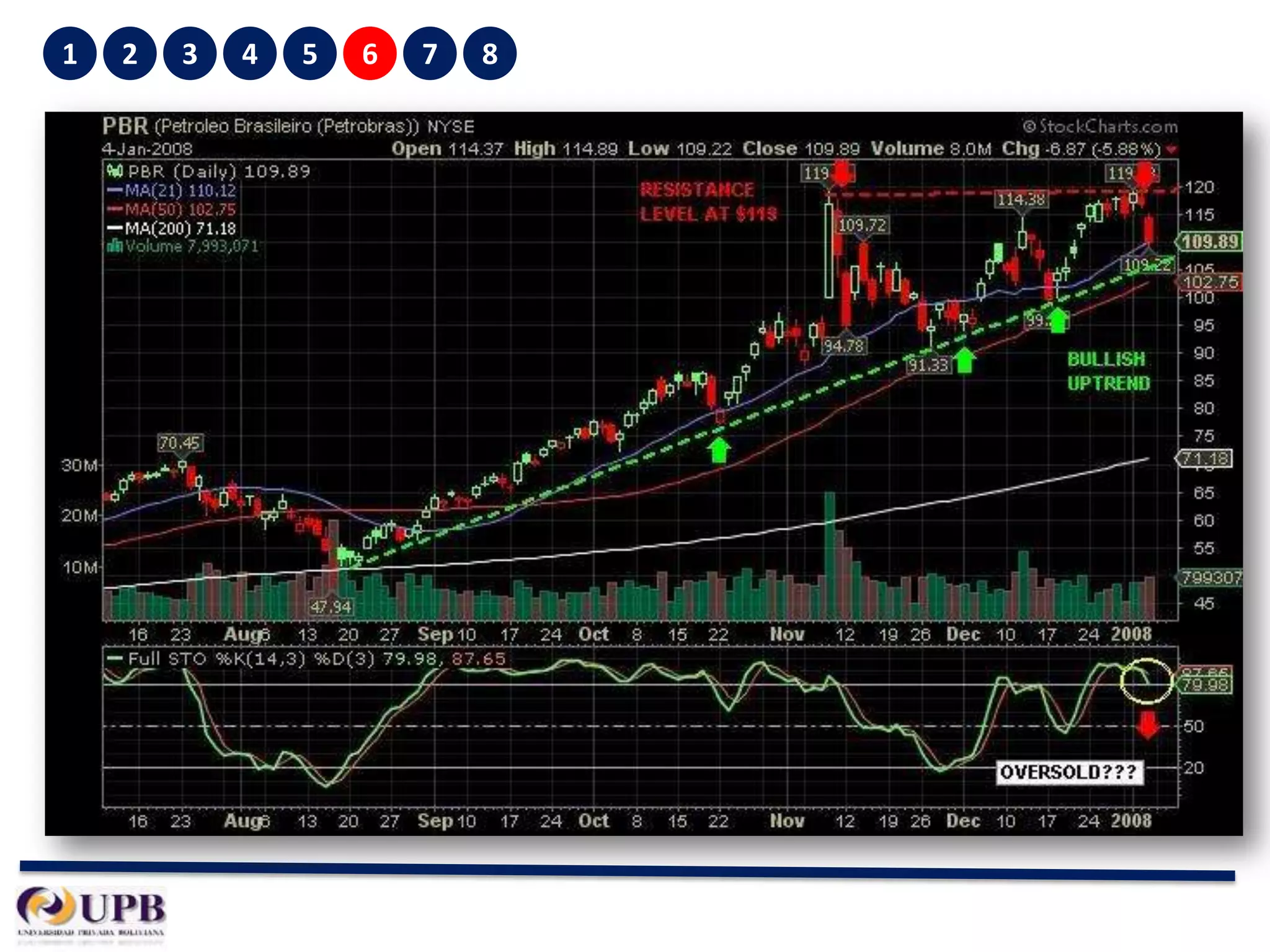
Getting the Low Down on Quotes
– technical analysis:
• based on the theory that market prices display
repetitive patterns that can be traced and
used to forecast future stock price movement
• analyze chart patterns and statistics generated
by market activities , such as, past prices,
volume, momentum and stochastic
1

2

3

4

5

6

7

8
1

2

3

4

5

6

7

8

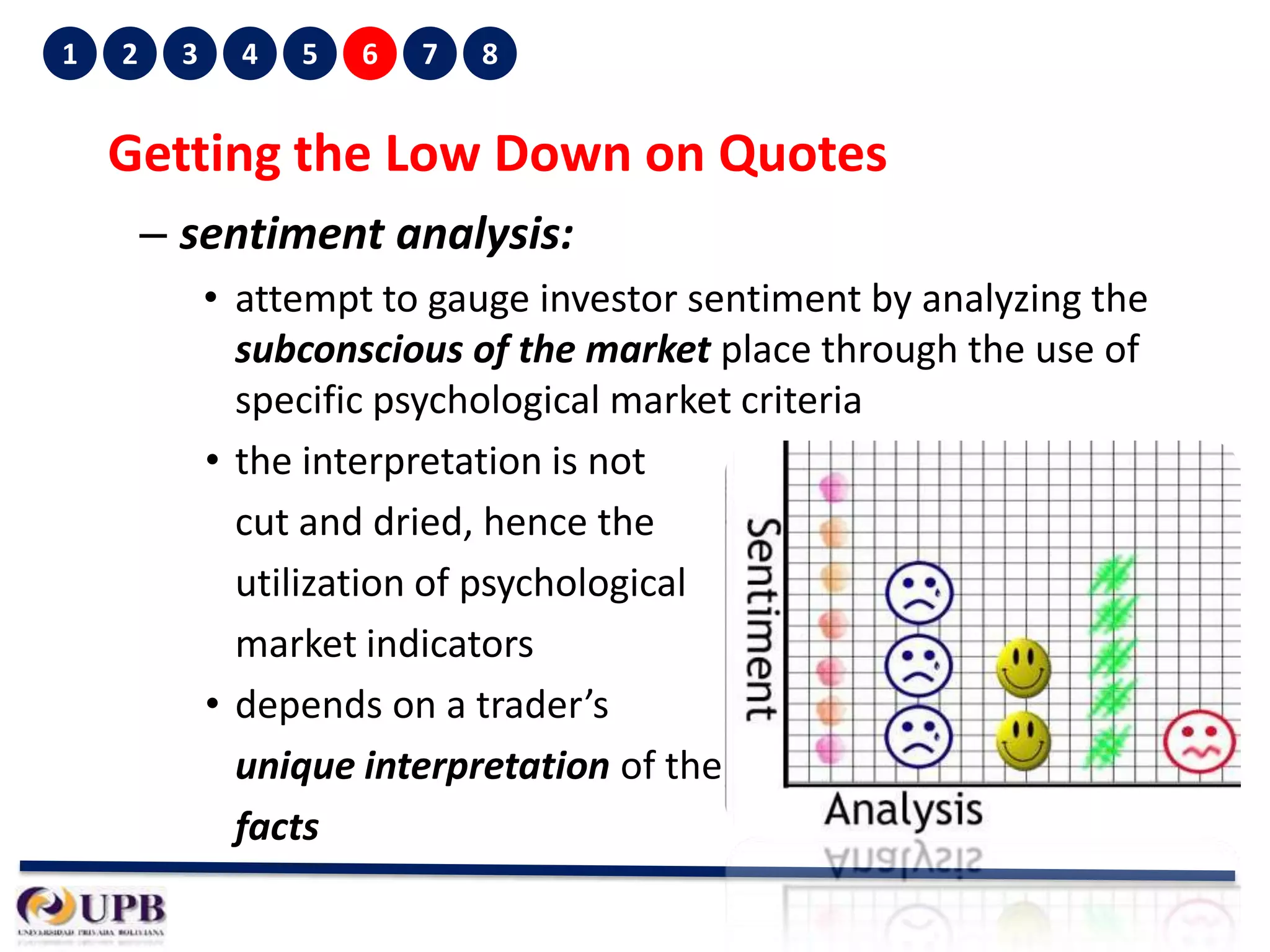
Getting the Low Down on Quotes
– sentiment analysis:
• attempt to gauge investor sentiment by analyzing the
subconscious of the market place through the use of
specific psychological market criteria
• the interpretation is not
cut and dried, hence the
utilization of psychological
market indicators
• depends on a trader’s
unique interpretation of the
facts
1

2

3

4

5

6

7

8

Types of Order
• As a trader you have to find the right trade and use
the right order technique that will enhance the trade’s
success
• The two most popular ones are the market order and
the limit order
– at-even order: wait until the market gets to the right price
for your trade to be placed
– at-the opening order: executed at the opening of the
market or be cancelled
– day order: remain good only for the duration of the day
1

2

3

4

5

6

7

8

Types of Order
– good til cancelled: remain in effect until executed or
explicitly cancelled
– immediate or cancel order: must be executed in whole or
part as soon as entered, any part not executed is
automatically cancelled
– fill or kill orders: must be executed immediately or by a
specific date as a whole order, if not order is cancelled
– limit order: specify a maximum buying or a minimum selling
price
– limit-buy-order: must be executed below current price
1

2

3

4

5

6

7

8

Types of Order
– limit-sell-order: must be executed above current price
– market-on-order: must be executed during the opening of
trading
– market-on-close-orders: must be executed during the
closing of trading
– market-orders: the most common type at the price given at
the time the order reaches the market / only order that
guarantees execution
– market-if-touched-orders: combined market and limit
orders, where the order becomes market order when the
options or stocks reach a specified price
1

2

3

4

5

6

7

8

Types of Order
– market-if-touched-buy-orders: become buy market orders
when the options or stock fall below the current price
– market-if-touched-sell-orders: become sell orders when the
options or stocks rise above the current price
– stop-orders: used to limit risk, they become market orders
when the options or stocks reach a certain price
– buy-stop-orders: become market buy orders upon trade at or
above the specified price
1

2

3

4

5

6

7

8

Types of Order
– sell-stop-orders: become market sell orders upon trade at or
below the specified price
– stop-limit-orders: an extension of stop orders, where the
activated order becomes a limit order instead of a market
order
1

2

3

4

5

6

7

8

Getting Started
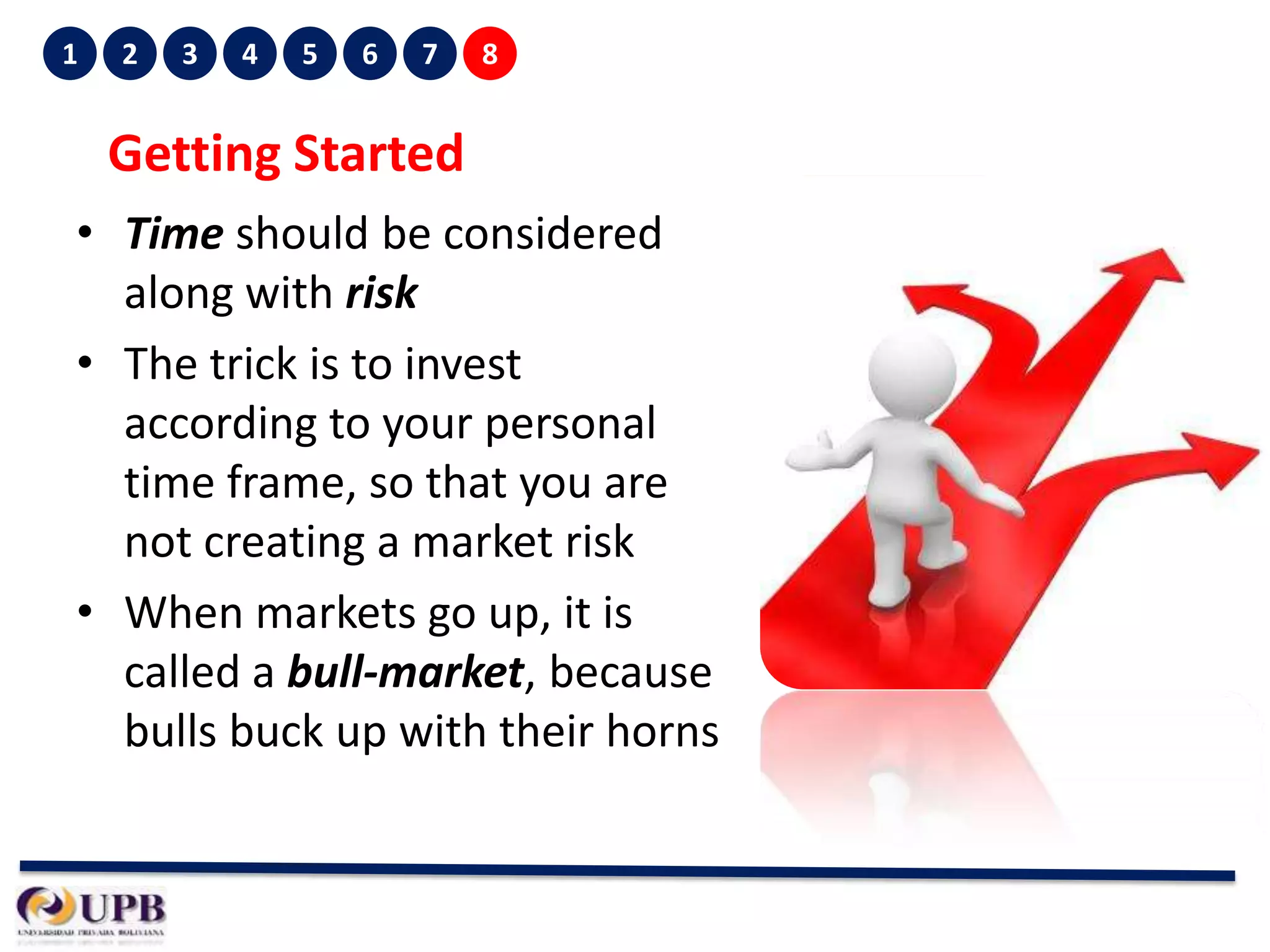
• Time should be considered
along with risk
• The trick is to invest
according to your personal
time frame, so that you are
not creating a market risk
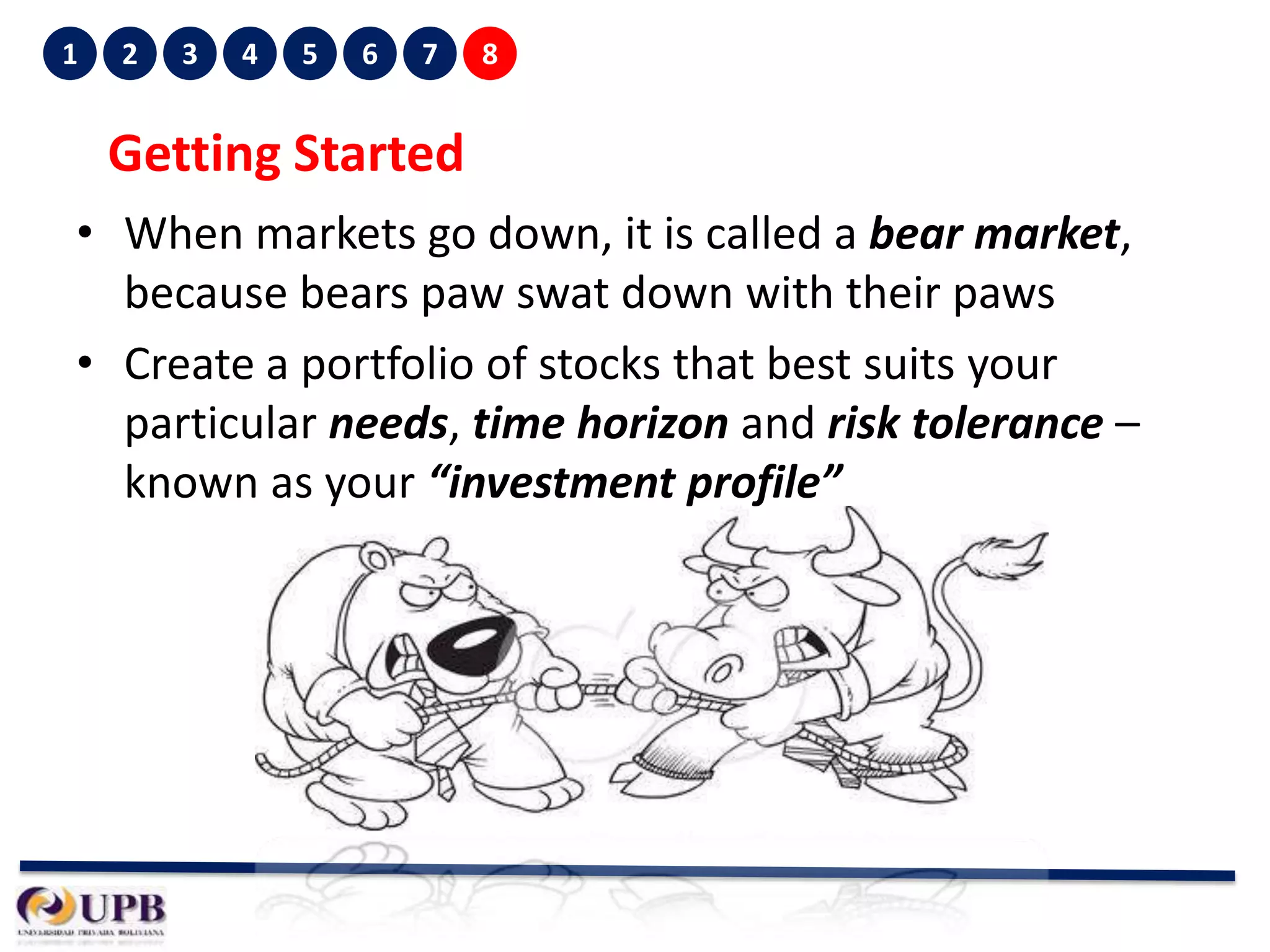
• When markets go up, it is
called a bull-market, because
bulls buck up with their horns
1

2

3

4

5

6

7

8

Getting Started
• When markets go down, it is called a bear market,
because bears paw swat down with their paws
• Create a portfolio of stocks that best suits your
particular needs, time horizon and risk tolerance –
known as your “investment profile”
1

2

3

4

5

6

7

8

Getting Started
• Categories of stock:
–
–
–
–
–

income: utility stocks
growth and income: blue chip stocks with a dividend
growth: mid sized to large cap stocks
aggressive growth: small to mid-cap stocks
speculative: start-ups, turnaround situations
• great potential lies in identifying growth companies with
mid to large capitalization
• future prospects of high tech stocks
THANK YOU VERY MUCH

The World of Stocks (session 2)

  • 1.
    The World ofStocks “In the business world, the rear view mirror is always clearer than the windshield”. Warren Buffett
  • 2.
    Agenda of themodule 1 Stock 2 Types of Stock 3 Company Development Cycles 4 Mechanics of Stock Investing: Buying Stocks 5 Cash and Margin Trading 6 Getting the Low Down on Quotes 7 Types of Orders 8 Getting Started
  • 3.
    1 2 3 4 5 6 7 8 Stock • Another namefor the shares, or partial ownership, of a corporation • There are 2 kinds of shares: common and preferred: – common shares: • larger potential rewards and larger potential losses • eligible to receive dividends, companies are not obliged to distribute a portion of their profits
  • 4.
    1 2 3 4 5 6 7 8 Stock – preferred shares: •hybrid between bonds and common stock, the more like a bond the more the return will reflect the return of a bond / the more like a stock the more the return like reflect the return on a stock • features of preferred may or may not include: – guaranteed dividends at regular intervals – limited dividends, does not rise relative to profits – voting superiority depending on agreement – possible convertibility into common stock or bonds – in case of bankruptcy preferreds get paid before common stock
  • 5.
    1 2 3 4 5 6 7 8 Stock • stock certificate: –legal document used to transfer ownership – includes stock’s issuer, shareholder’s name, corporate seal, number of shares it represents – each certificate is assigned a number by the Committee on Uniform Securities Identification Procedures (CUSIP) – par value is also found on the certificate: not the price you paid for the share (market price) • street name: when the brokerage holds your certificate for safekeeping
  • 6.
    1 2 3 4 5 6 7 8 Stock • stock certificate: –legal document used to transfer ownership – includes stock’s issuer, shareholder’s name, corporate seal, number of shares it represents – each certificate is assigned a number by the Committee on Uniform Securities Identification Procedures (CUSIP) – par value is also found on the certificate: not the price you paid for the share (market price) • street name: when the brokerage holds your certificate for safekeeping
  • 7.
    1 2 3 4 5 6 7 8 Type of Stock •No official list divides stocks into separate categories • Stocks are unofficially classified by: – size (primarily dependent on its market capitalization) • (multiply the number of outstanding shares X price) – sector (technology, industrial energy or biotechnology)
  • 8.
    1 2 3 4 5 6 7 8 Type of Stock •Using Market cap, stocks can be broken down into four size categories: – large-cap: blue chip (more than $ 5 billion) – AAPL, GE, MSFT,PG • Dow Jones Industrial Average is comprised of Blue Chip stocks • name comes from chips in poker with the highest value – mid-cap (500 million to 5 billion)- S&P 400 MidCap ($MID)
  • 9.
    1 2 3 4 5 6 7 8 Type of Stock •Market cap: – small-cap (150 million to 500 million) – Russell 2000 Index ($RUT) & S&P SmallCap 600 ($SML) • often undervalued because analysts have not began coverage • institutional investors often can not buy because smaller stocks do not meet fiscal requirements that govern the investments of many money managers and pension funds • http://www.smallcapnetwork.com/ – helps investors find undervalued and overlooked small cap stocks
  • 10.
    1 2 3 4 5 6 7 8 Type of Stock •Market cap: – micro-cap (less than 150 million) – penny stocks and stocks under $ 2 – extremely risky, many companies fail early on • http://www.otcmarkets.com/ho me
  • 11.
    1 2 3 4 5 6 7 8 Type of Stock •Another way to classify a stock is by its nature of its objectives: – income (conservative) • solid companies that offer slow but steady growth • regularly pay dividends • i.e. Exxon Mobil (XOM), Bank of America (BAC) – cyclical (conservative) • fluctuate in relation to the economy , seasons, events • good gauge of the economy • i.e. Alcoa (AA)
  • 12.
    1 2 3 4 5 6 7 8 Type of Stock •Nature of its objectives: – growth stocks (aggressive) • rarely pay dividends: prefer to reinvest profits for future growth • two kinds: established growth and emerging growth • i.e. Apple (APPL), Charles Schwab (SCH)
  • 13.
    1 2 3 4 5 6 7 8 Type of Stock •Nature of its objectives: – turnaround (aggressive) • suffered sever losses and are due for a turnaround • offer explosive growth • no guarantees and high risk • Warren Buffet favorite stockpicking method • i.e. Rite Aid Corp. (RAD), Net Flicks, Bank of America (BAC) – “lately”
  • 14.
    1 2 3 4 5 6 7 8 Type of Stock •Nature of its objectives: – green stocks (varies) • environmentally friendly and socially conscious i.e. Ben & Jerry’s (BJICA) • www.greenmoney.com or www.goodmoney.com • The advantages and disadvantages of each stock depend on your investment goals and risk tolerance
  • 15.
    1 2 3 4 5 6 7 8 Company Development Cycles 1.Private company: (birth) – fundamentals not easily discerned due to private nature – stock has limited availability – risk is generally high due to requirements: operating capital and lack or revenue – examples: Twitter, In n Out Burgers
  • 16.
    1 2 3 4 5 6 7 8 Company Development Cycles 2.Initial public offering: (childhood) – – – – stock performance not available (no technical analysis) IPO is subject to acceptance by investing community profitability may be years in coming long established companies, privately held, name recognition Example: Groupon, IPO of $700 million Facebook, IPO of $ 16 billion
  • 17.
    1 2 3 4 5 6 7 8 Company Development Cycles 3.Early-stage growth: (adolescence) – – – – rarely (if ever) pay dividends stocks in thus stage are considered aggressive critical stage of “make it or break it” example: Facebook (460 million shares/$ 16 billion/cap 125 billion-September 30, 2013), Skype 4. Successful growth: (adulthood) – – – – can start paying a percentage of their profits as dividends still needs to reinvest most of its profits back into company paid its dues to create a successful infrastructure examples: Google, Microsoft, Intel, Amazon
  • 18.
    1 2 3 4 5 6 7 8 Company Development Cycles 5.Mature company: (old age) – larger percentage of its profit is consistently paid out – needs to fight just as hard to stay in game – examples: GE, Proctor and Gamble
  • 19.
    1 2 3 4 5 6 7 8 The Mechanics ofStock Investing • Buying stocks: buying or going long is to make money in a rising bull market
  • 20.
    1 2 3 4 5 6 7 8 The Mechanics ofStock Investing • Buying stocks: – two ways to buy stocks: cash and margin • • • • cash is a straight debit from your account margin: brokerage lends you part of the purchase price maximum risk: price of the stock as it approaches zero maximum profit: unlimited – in volatile markets, traders hedge their positions with options or bonds
  • 21.
    1 2 3 4 5 6 7 8 The Mechanics ofStock Investing • Short Selling Stocks: – strategy used by George Soros in 1992: Black Wednesday • made $1 billion dollars from a $10 billion short position on the sterling • he was dubbed the man who broke the bank of England – can be used to take advantage of a drop in prices – you can borrow shares from your brokerage and sell them at a higher price and later buy them at a lower price to replenish them – cover the short: to buy shares of stock to replenish those borrowed from your brokerage to place a short sale
  • 22.
    1 2 3 4 5 6 7 8 The Mechanics ofStock Investing • Short Selling Stocks: • example of the mathematics of shorting: • • • • EMC is currently trading @ 85 ½ per share you want to short 100 shares you will receive 8,550 in your account for shorting to place the trade, most brokerages will require you to post a margin deposit of $150% or $12,825 ($8,850 x 1.5) • price drops to $75 • you profit $1,050 = $8,550 – 7,500 ($75 x 100 shares to close position)
  • 23.
    1 2 3 4 5 6 7 8 The Mechanics ofStock Investing • Short Selling Stocks: – holding a short position in the stock for over a year does not constitute a long term capital gain – capital gain shelters are for long term stockholders not short sellers – examples of short selling: Bank of England, Goldman Sacks – maximum risk: unlimited to the upside – maximum profit: limited to the full price of the stock shares as they fall to zero
  • 24.
    1 2 3 4 5 6 7 8 The Mechanics ofStock Investing • Short selling stocks: – differences between buying and short selling stock comes in the form of risk: short selling means unlimited risk and buying stock means limited risk – a good strategy if you are going to short sale is to use a combination of stocks and options to create a non-directional trade that make money regardless of whether the stock goes up or down
  • 25.
    1 2 3 4 5 6 7 8 Cash and MarginTrading • Cash trades – require that you put 100% of the money in cash – EMC goes from $85 ½ to $90 ½, so if you bought 100 shares you made a profit of $500, or a 5.8% return on investment (ROI) • ROI – the reward on a trade divided by the trade’s risk
  • 26.
    1 2 3 4 5 6 7 8 Cash and MarginTrading • Margin trades – allows you to put a percentage of the total cost of the trade amount in cash and the rest in “on account” – the term margin refers to the amount of money an investor must pay to enter a trade with the remainder of the cash being borrowed from the brokerage firm: the shares you have bought secure the trade
  • 27.
    1 2 3 4 5 6 7 8 Cash and MarginTrading • Margin trades – margin account is usually required for short positions and options trading – brokerages are usually willing to let you borrow 50% of a trade’s cost but require a certain amount of money be left untouched in your account to secure the loan – this money is referred to as a margin requirement
  • 28.
    1 2 3 4 5 6 7 8 Cash and MarginTrading • Margin trades – if the stock you bought goes down, you receive a margin call – based on SEC rules and clearing firms, margin equals 50% of the amount of the trade – at this rate margin accounts give traders 2 to 1 buying leverage – if the price of the stock falls below 75% of the total value of the total initial investment, the trader receives a margin call from the broker
  • 29.
    1 2 3 4 5 6 7 8 Cash and MarginTrading • Margin trades – brokers may set their own margin requirements, but they are never less than 75% - the amount required by the Fed – margin interest is cheaper than most loans , as it is a secure loan – margin on short selling is extremely expensive, cost of stock plus 50%
  • 30.
    1 2 3 4 5 6 7 8 Getting the LowDown on Quotes – there are hundreds of websites that provide quote, some real time (eSignal – www.dbc.com) while more are delayed (15 to 20 minutes) – example: www.optionetics.com - Qualcomm (QCOM) – bid: the highest price a prospective buyer is prepared to pay (floor trader) – off floor trader buys at the ask price – ask: the lowest price acceptable to a prospective seller (floor trader) – off floor trader sells at the bid price – the quote price gives you a general feel for the stock, but if you want to know the stock you must look deeper than that – off floor trader buys at the ask price and sells at the bid price
  • 31.
    1 2 3 4 5 6 7 8 Getting the LowDown on Quotes – snapshot quote is just the beginning of the process, but it will combine the basic elements of the three basic analytical approaches: fundamental, technical and sentiment
  • 32.
    1 2 3 4 5 6 7 8 Getting the LowDown on Quotes – Quote terms Definitions • • • • • • • Last – last price that the option/stock traded at Open – price of the first transaction of the current day Change – amount last sale differs from previous closing % Change – percentage price change from previous day High – highest price for current trading day Low – lowest price for current trading day Bid – highest price a prospective buyer (floor trader) is prepared to pay • Ask – lowest price acceptable to a prospective seller (floor trader)
  • 33.
    1 2 3 4 5 6 7 8 Getting the LowDown on Quotes – Quote terms Definitions • • • • • • • • 52-Week High – the highest stock price in the past 52 weeks 52 Week Low – the lowest stock price in the past 52 weeks Earnings per Share – net pre-tax profit divided by the shares Volume – total number of shares traded that day Share Outstanding – total number of shares the Co. issued Market Cap – shares outstanding multiplied by the price P/E Ratio – stock price divided by the earnings per share Exchange – indicates where a company lists its shares
  • 34.
    1 2 3 4 5 6 7 8 Getting the LowDown on Quotes – fundamental analysis: • trading approach that uses economic and production data to determine company’s fair value • forecast future stock price movements based on the balance sheet and income statements, past records of earnings, sales, assets, management, products and services (example: US vs. Europe when it comes to emphasis on questions from VC’s)
  • 35.
    1 2 3 4 5 6 7 8 Getting the LowDown on Quotes – technical analysis: • based on the theory that market prices display repetitive patterns that can be traced and used to forecast future stock price movement • analyze chart patterns and statistics generated by market activities , such as, past prices, volume, momentum and stochastic
  • 36.
  • 37.
    1 2 3 4 5 6 7 8 Getting the LowDown on Quotes – sentiment analysis: • attempt to gauge investor sentiment by analyzing the subconscious of the market place through the use of specific psychological market criteria • the interpretation is not cut and dried, hence the utilization of psychological market indicators • depends on a trader’s unique interpretation of the facts
  • 38.
    1 2 3 4 5 6 7 8 Types of Order •As a trader you have to find the right trade and use the right order technique that will enhance the trade’s success • The two most popular ones are the market order and the limit order – at-even order: wait until the market gets to the right price for your trade to be placed – at-the opening order: executed at the opening of the market or be cancelled – day order: remain good only for the duration of the day
  • 39.
    1 2 3 4 5 6 7 8 Types of Order –good til cancelled: remain in effect until executed or explicitly cancelled – immediate or cancel order: must be executed in whole or part as soon as entered, any part not executed is automatically cancelled – fill or kill orders: must be executed immediately or by a specific date as a whole order, if not order is cancelled – limit order: specify a maximum buying or a minimum selling price – limit-buy-order: must be executed below current price
  • 40.
    1 2 3 4 5 6 7 8 Types of Order –limit-sell-order: must be executed above current price – market-on-order: must be executed during the opening of trading – market-on-close-orders: must be executed during the closing of trading – market-orders: the most common type at the price given at the time the order reaches the market / only order that guarantees execution – market-if-touched-orders: combined market and limit orders, where the order becomes market order when the options or stocks reach a specified price
  • 41.
    1 2 3 4 5 6 7 8 Types of Order –market-if-touched-buy-orders: become buy market orders when the options or stock fall below the current price – market-if-touched-sell-orders: become sell orders when the options or stocks rise above the current price – stop-orders: used to limit risk, they become market orders when the options or stocks reach a certain price – buy-stop-orders: become market buy orders upon trade at or above the specified price
  • 42.
    1 2 3 4 5 6 7 8 Types of Order –sell-stop-orders: become market sell orders upon trade at or below the specified price – stop-limit-orders: an extension of stop orders, where the activated order becomes a limit order instead of a market order
  • 43.
    1 2 3 4 5 6 7 8 Getting Started • Timeshould be considered along with risk • The trick is to invest according to your personal time frame, so that you are not creating a market risk • When markets go up, it is called a bull-market, because bulls buck up with their horns
  • 44.
    1 2 3 4 5 6 7 8 Getting Started • Whenmarkets go down, it is called a bear market, because bears paw swat down with their paws • Create a portfolio of stocks that best suits your particular needs, time horizon and risk tolerance – known as your “investment profile”
  • 45.
    1 2 3 4 5 6 7 8 Getting Started • Categoriesof stock: – – – – – income: utility stocks growth and income: blue chip stocks with a dividend growth: mid sized to large cap stocks aggressive growth: small to mid-cap stocks speculative: start-ups, turnaround situations • great potential lies in identifying growth companies with mid to large capitalization • future prospects of high tech stocks
  • 46.