


The World Is
Getting Better
February 13th 2016
Dammam Office Building
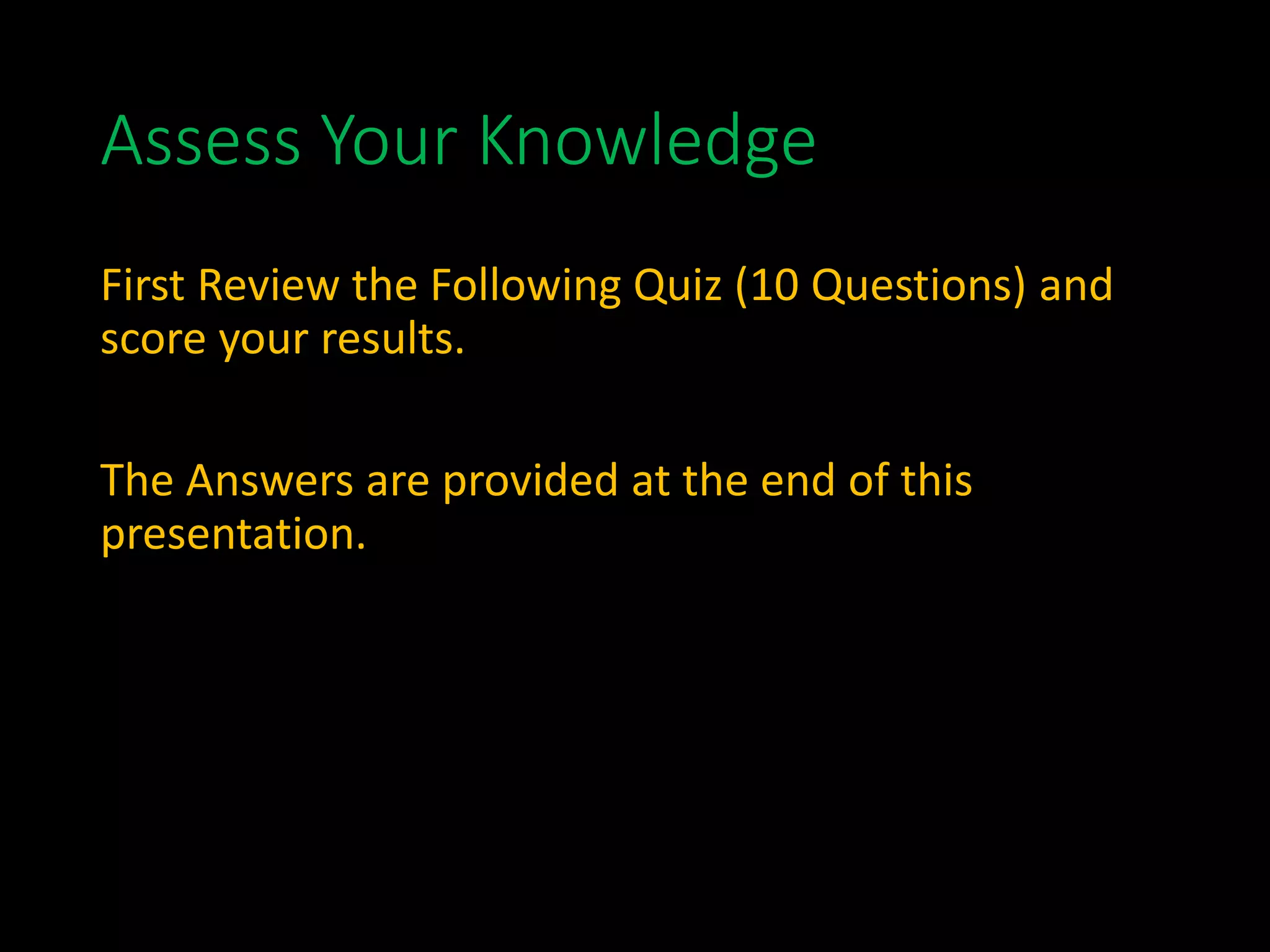
Agenda
• Introduction
• Population Quiz
• The World is (pick one):
• turning really ugly
• getting worse
• not evolving at all
• improving
• becoming a wonderful place where to live
• VISION 2030 Intro
• Group Exercise
• VISION 2030 Review and Analysis
2-3 min
15 min
15 min
T
T
T
t
5 min
20 min
Until Lunch Time
Assess Your Knowledge
First Review the Following Quiz (10 Questions) and
score your results.
The Answers are provided at the end of this
presentation.
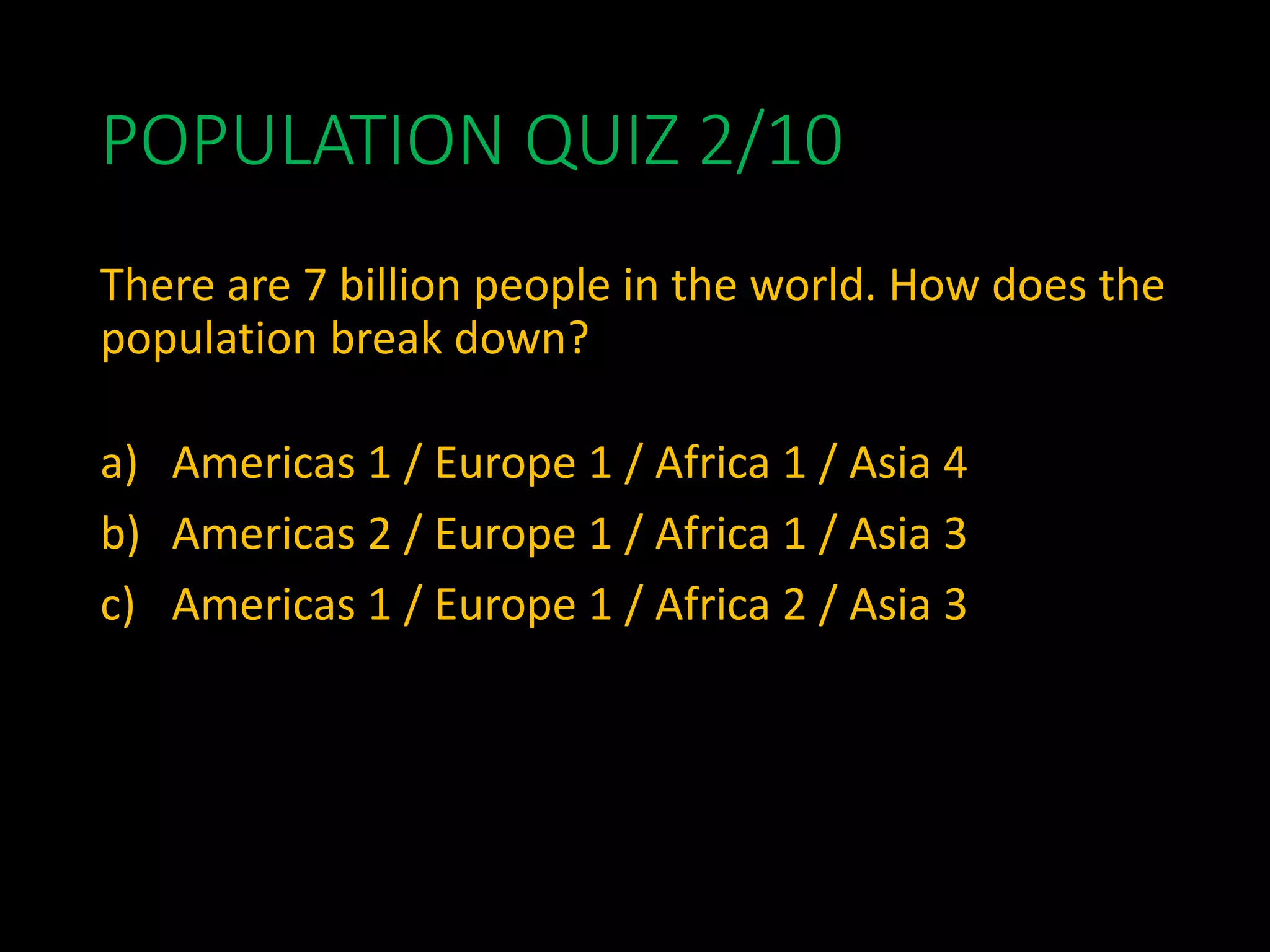
POPULATION QUIZ 1/10
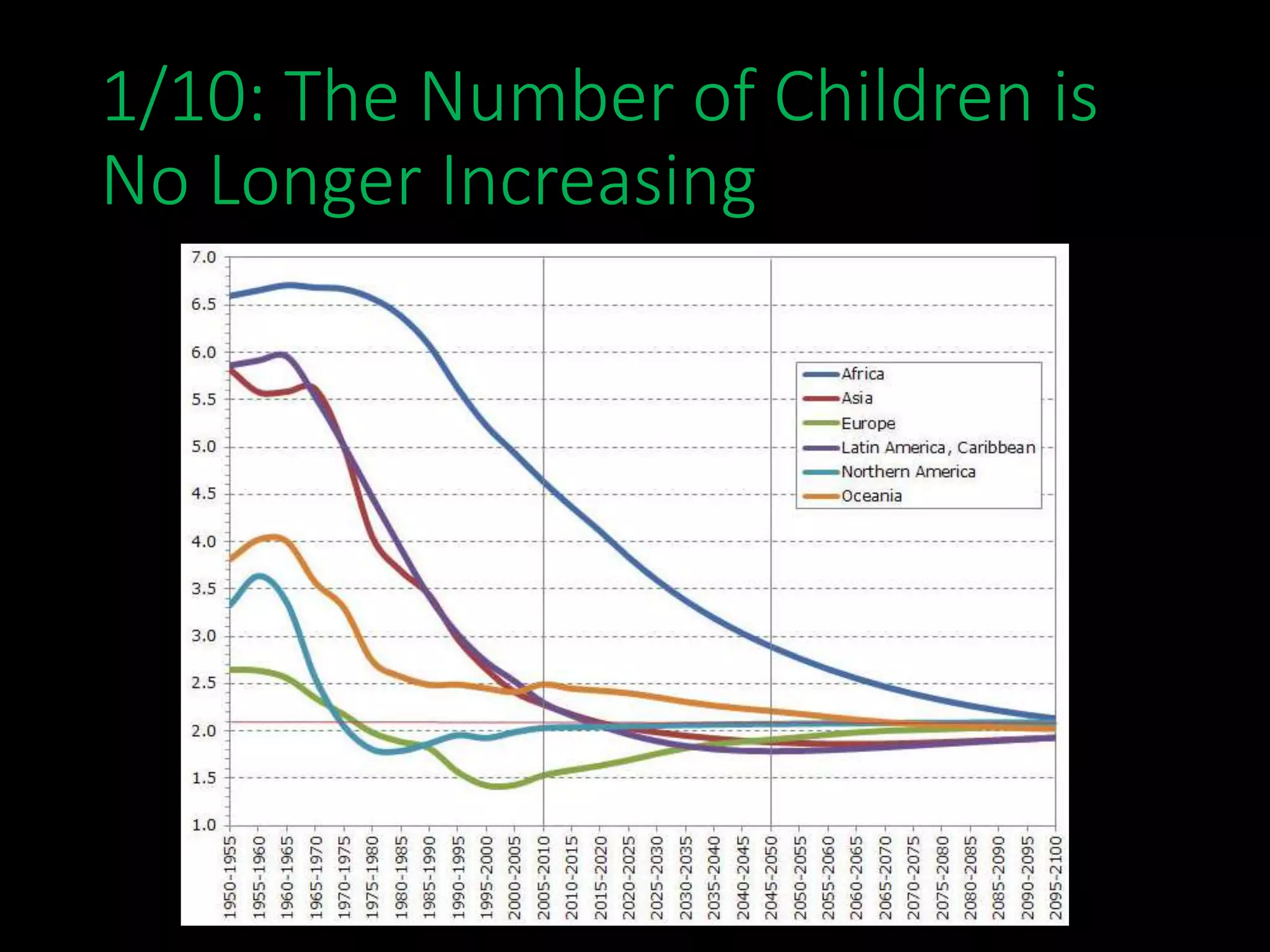
In 1950 there were fewer than 1 billion children
(aged 0-14) worldwide; by 2000 this figure increased
to almost 2 billion. How many children does the UN
estimate there will be by 2100?
a) 2 billion
b) 3 billion
c) 4 billion
POPULATION QUIZ 2/10
There are 7 billion people in the world. How does the
population break down?
a) Americas 1 / Europe 1 / Africa 1 / Asia 4
b) Americas 2 / Europe 1 / Africa 1 / Asia 3
c) Americas 1 / Europe 1 / Africa 2 / Asia 3
POPULATION QUIZ 3/10
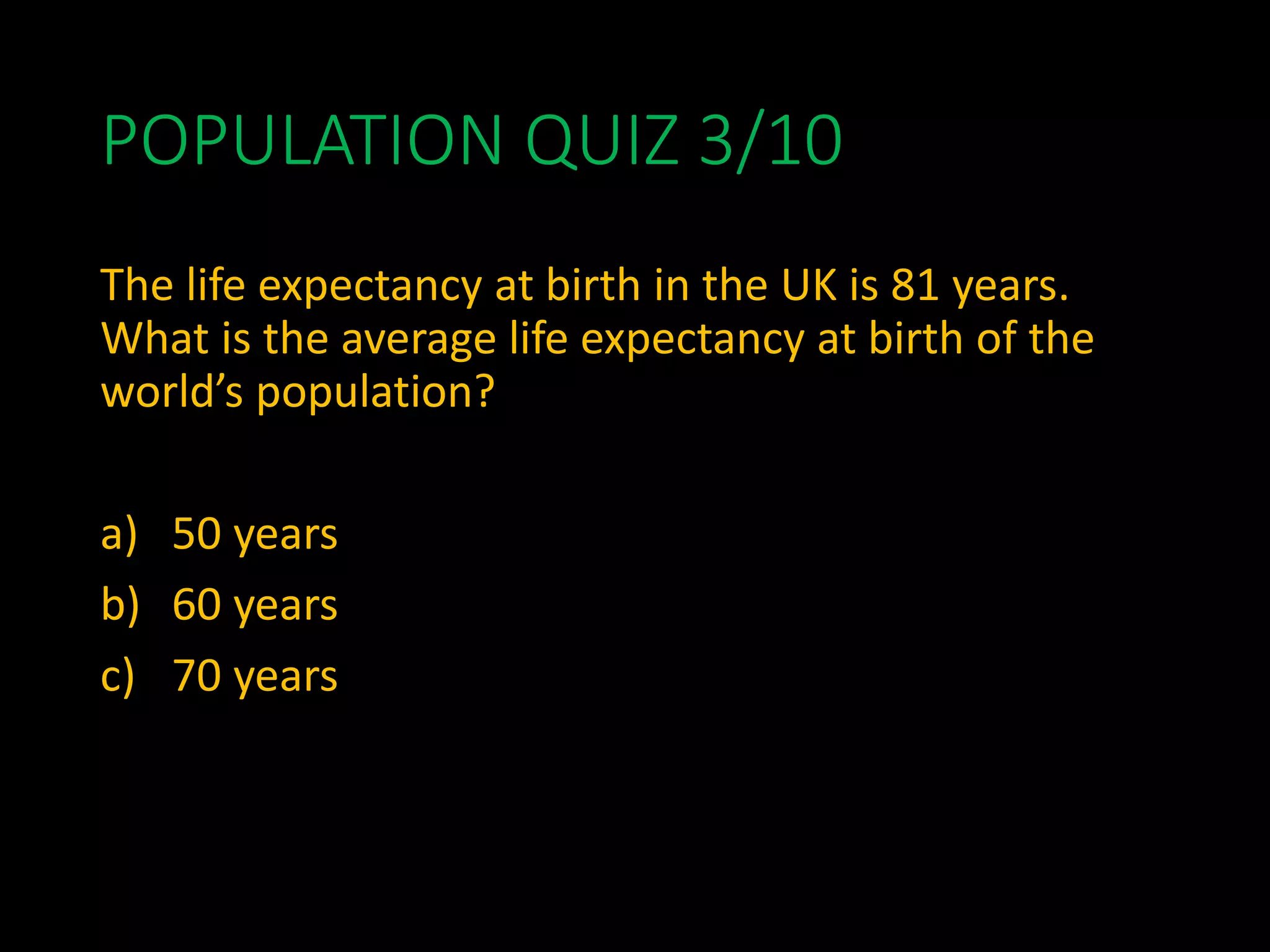
The life expectancy at birth in the UK is 81 years.
What is the average life expectancy at birth of the
world’s population?
a) 50 years
b) 60 years
c) 70 years
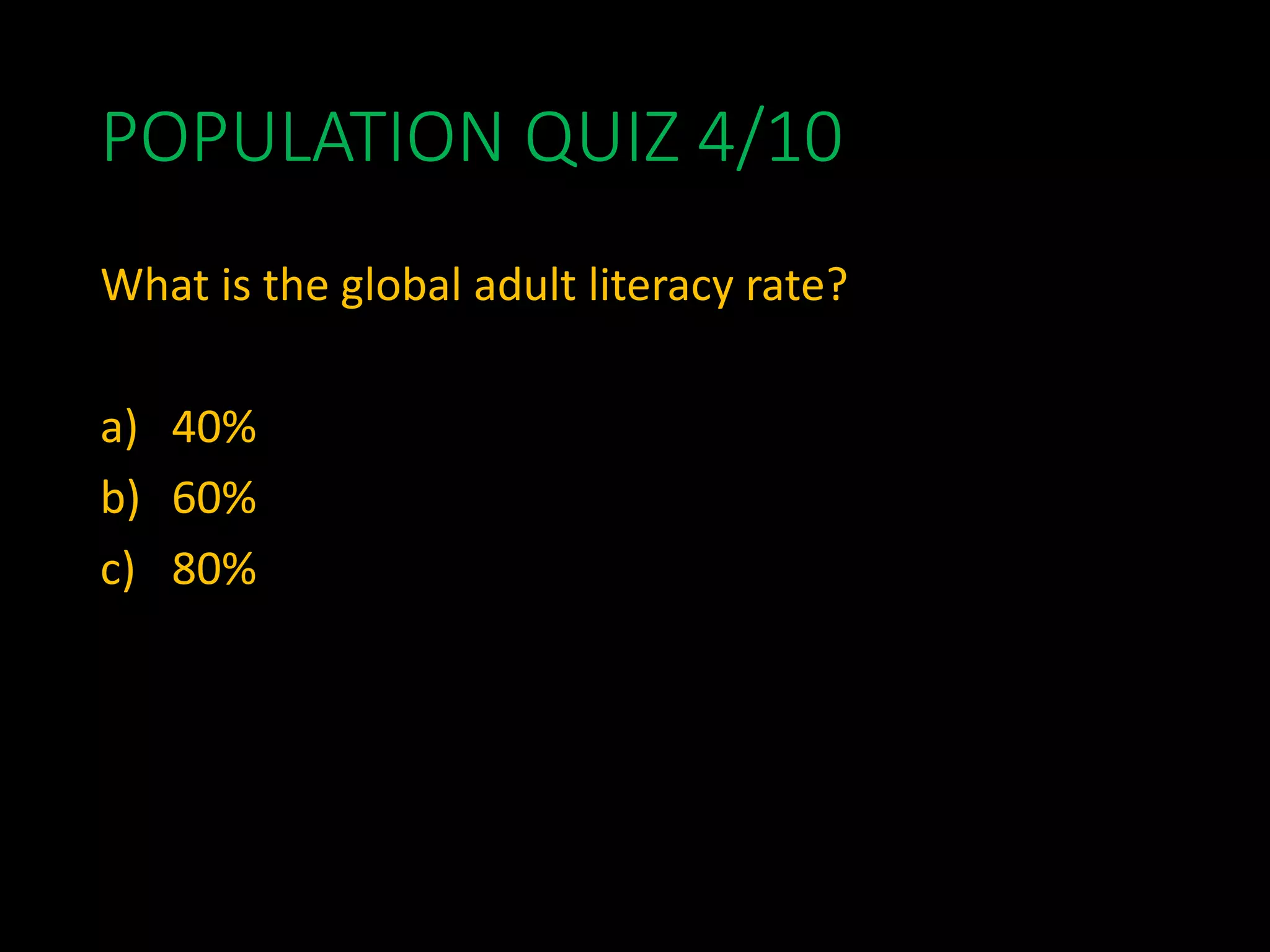
POPULATION QUIZ 4/10
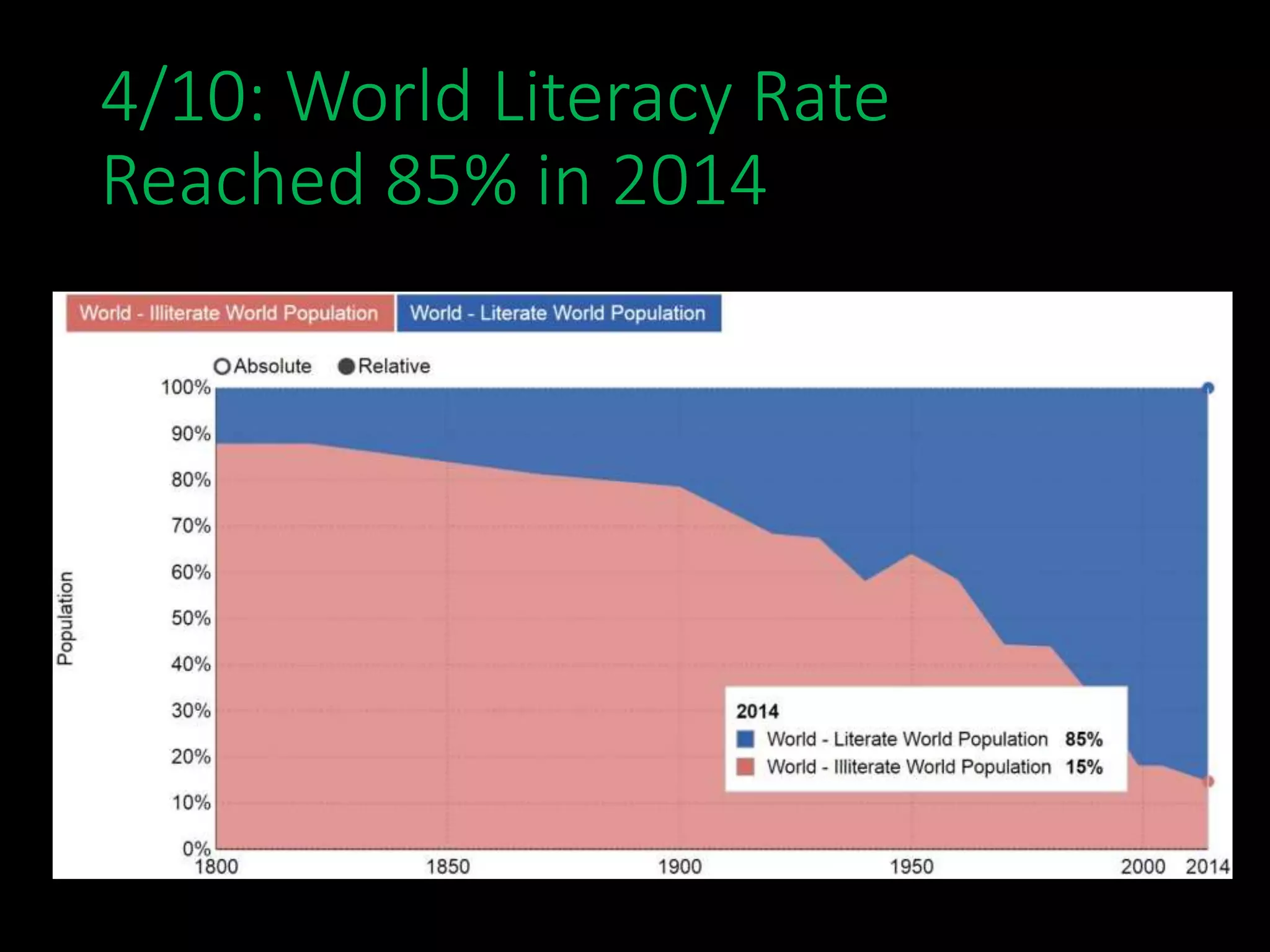
What is the global adult literacy rate?
a) 40%
b) 60%
c) 80%
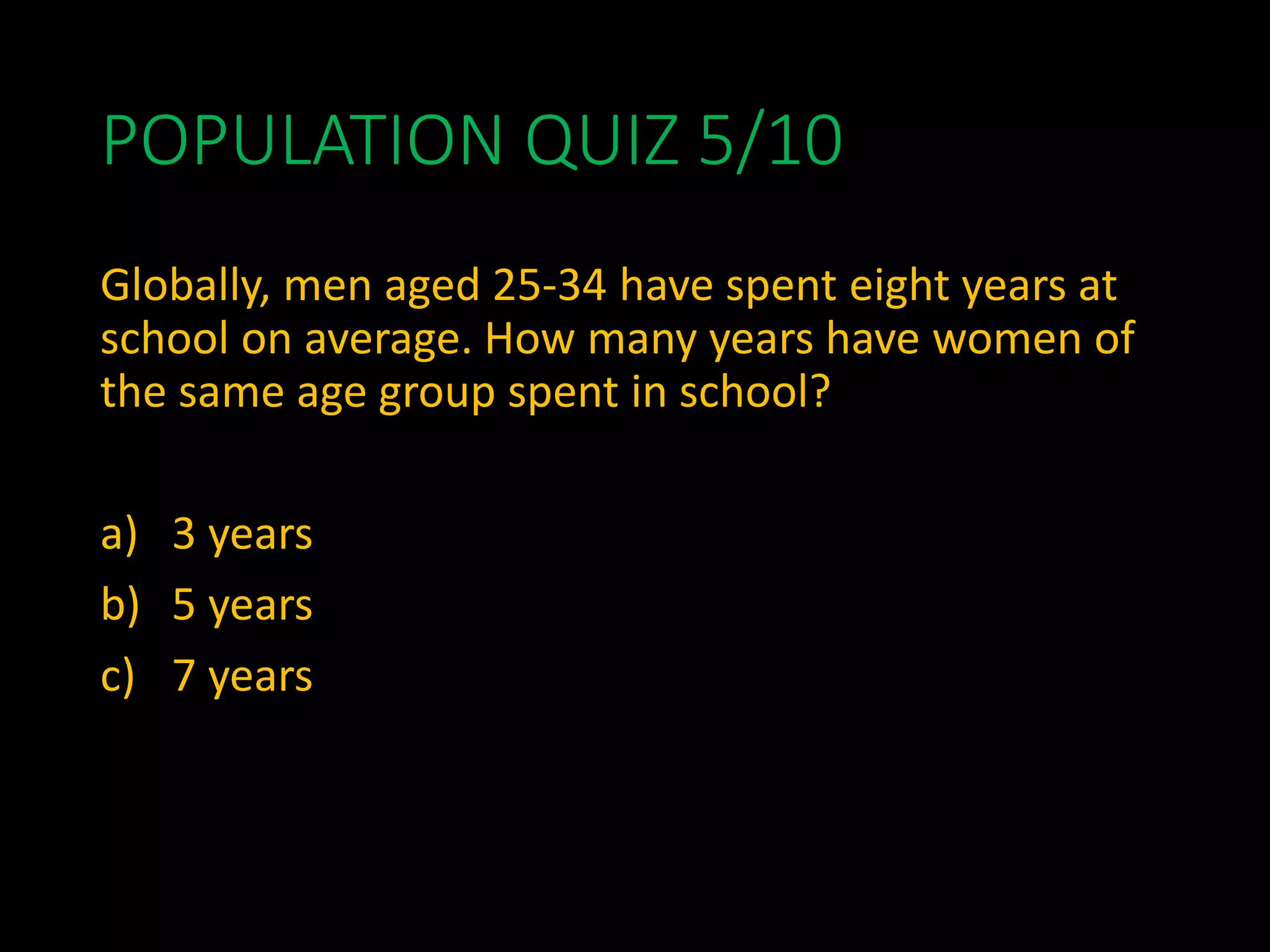
POPULATION QUIZ 5/10
Globally, men aged 25-34 have spent eight years at
school on average. How many years have women of
the same age group spent in school?
a) 3 years
b) 5 years
c) 7 years
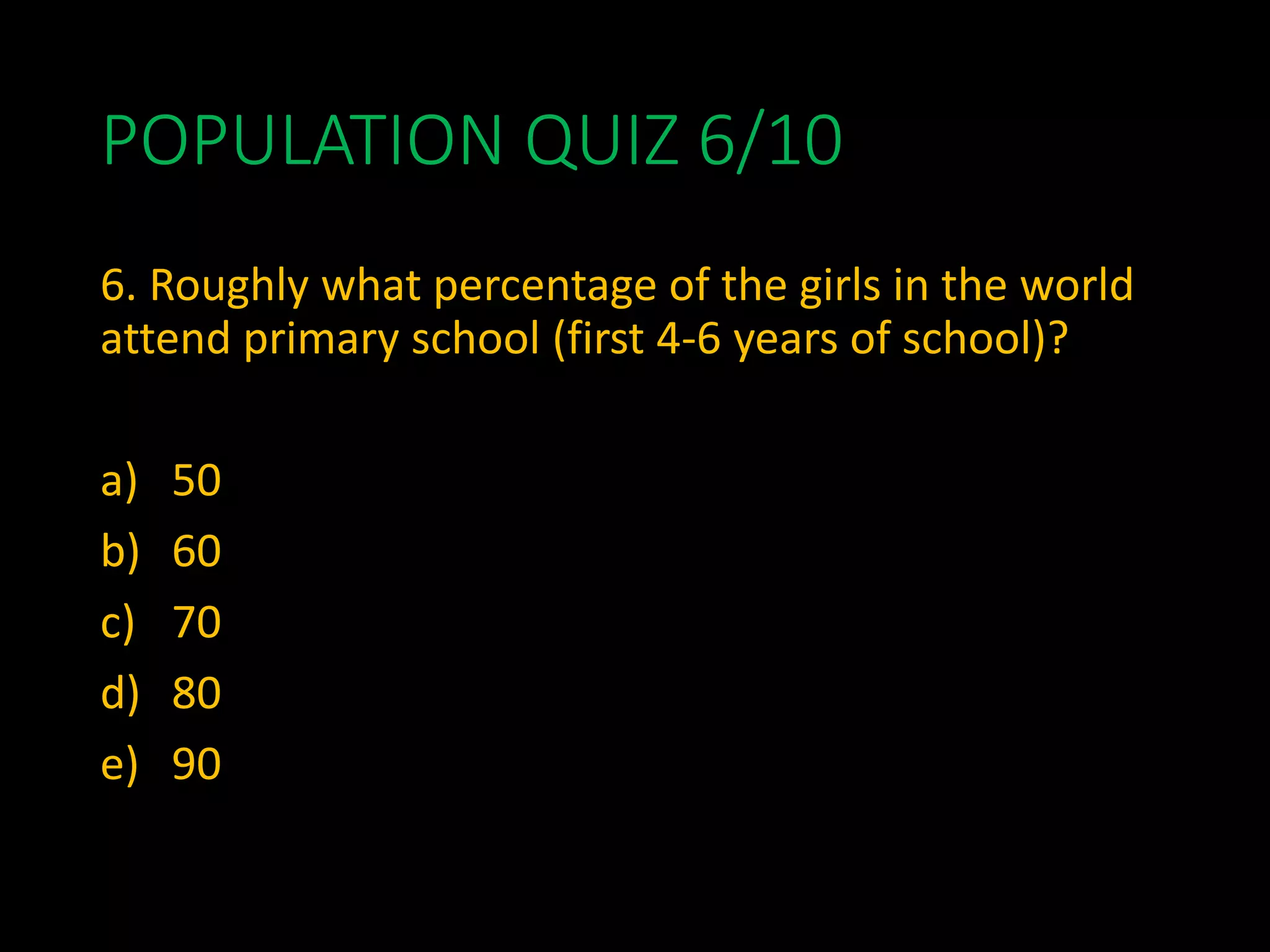
POPULATION QUIZ 6/10
6. Roughly what percentage of the girls in the world
attend primary school (first 4-6 years of school)?
a) 50
b) 60
c) 70
d) 80
e) 90
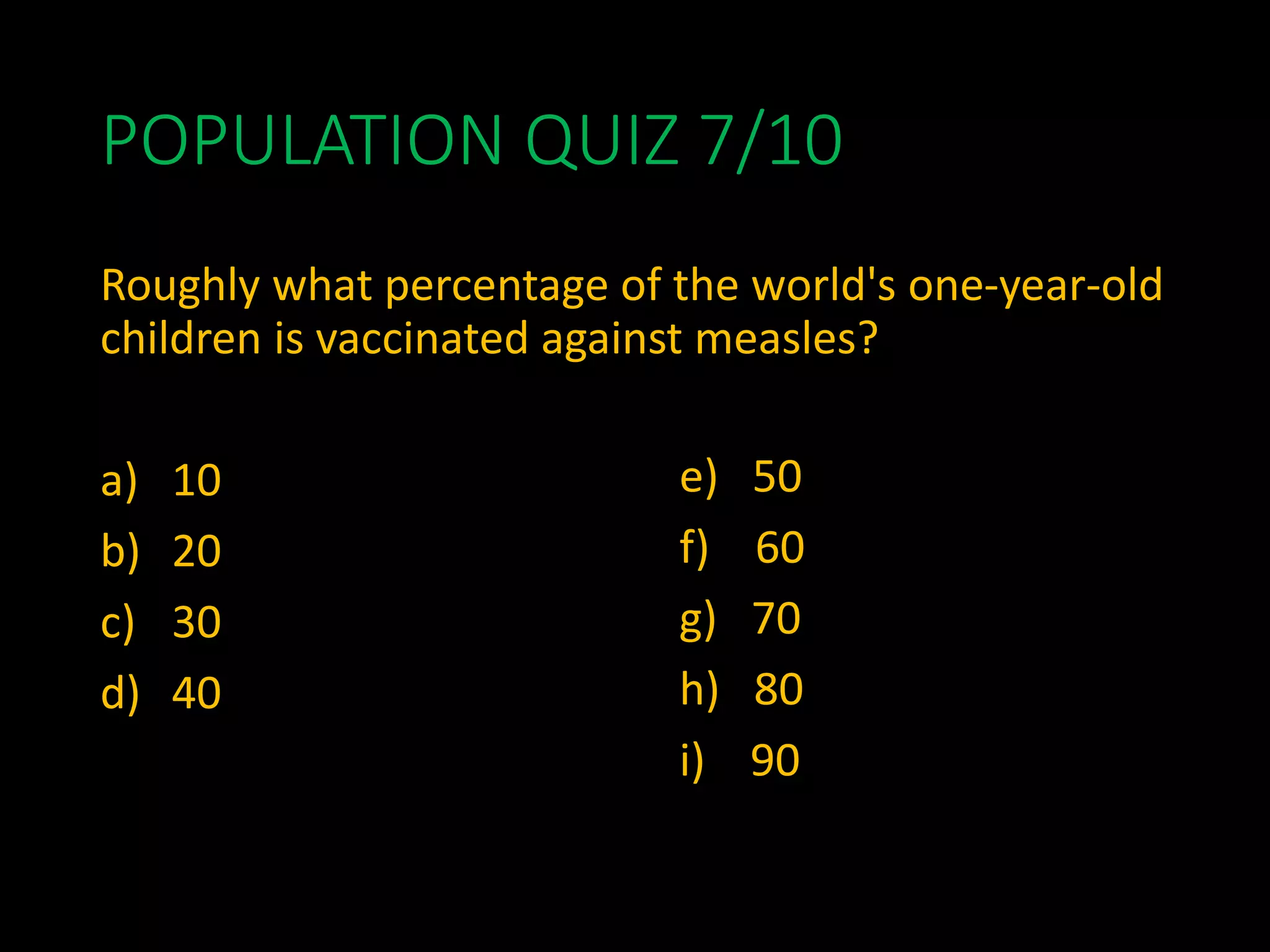
POPULATION QUIZ 7/10
Roughly what percentage of the world's one-year-old
children is vaccinated against measles?
a) 10
b) 20
c) 30
d) 40gave you the points if you rounded up or
down.
e) 50
f) 60
g) 70
h) 80
i) 90
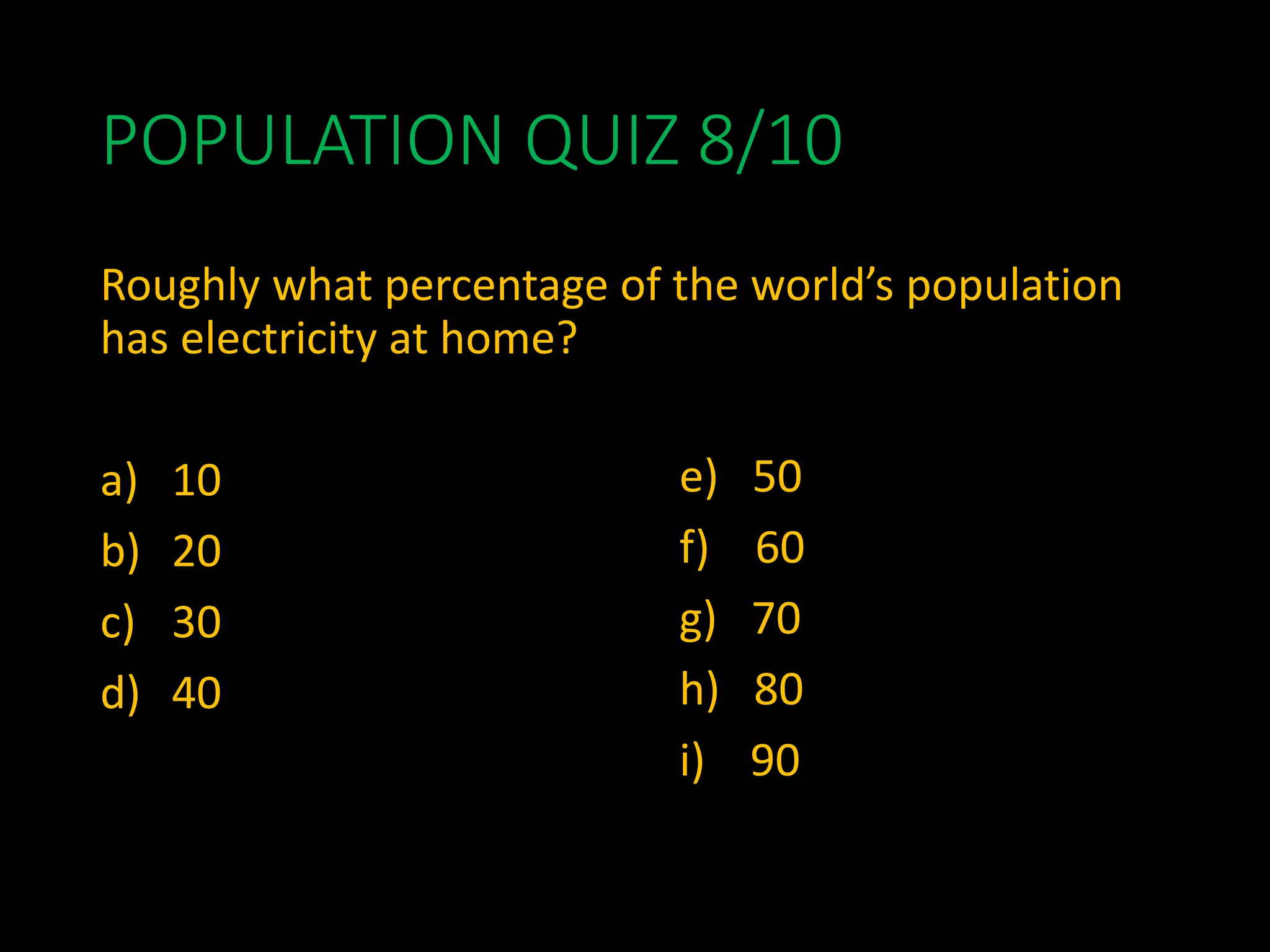
POPULATION QUIZ 8/10
Roughly what percentage of the world’s population
has electricity at home?
a) 10
b) 20
c) 30
d) 40gave you the points if you rounded up or
down.
e) 50
f) 60
g) 70
h) 80
i) 90
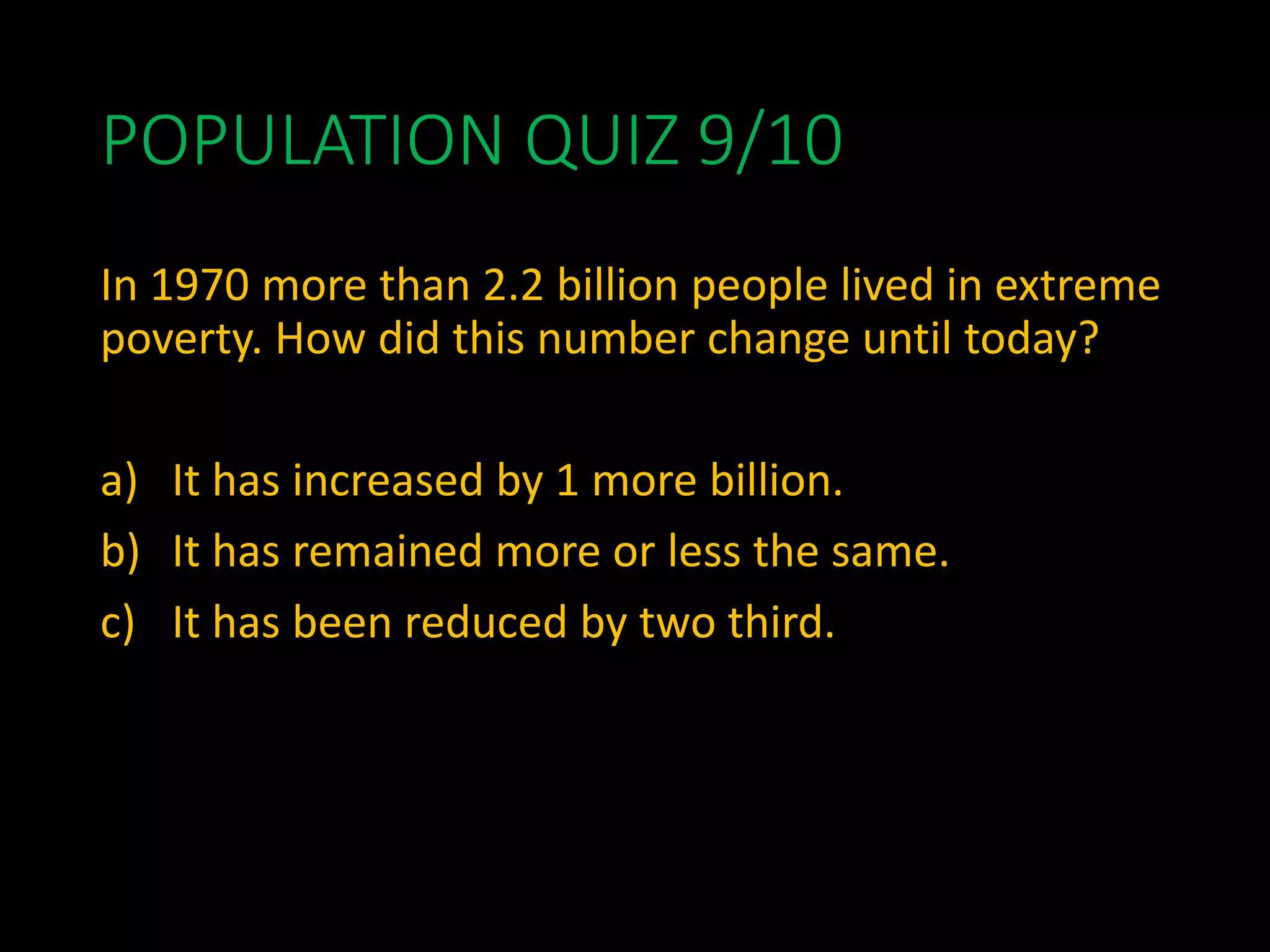
POPULATION QUIZ 9/10
In 1970 more than 2.2 billion people lived in extreme
poverty. How did this number change until today?
a) It has increased by 1 more billion.
b) It has remained more or less the same.
c) It has been reduced by two third.
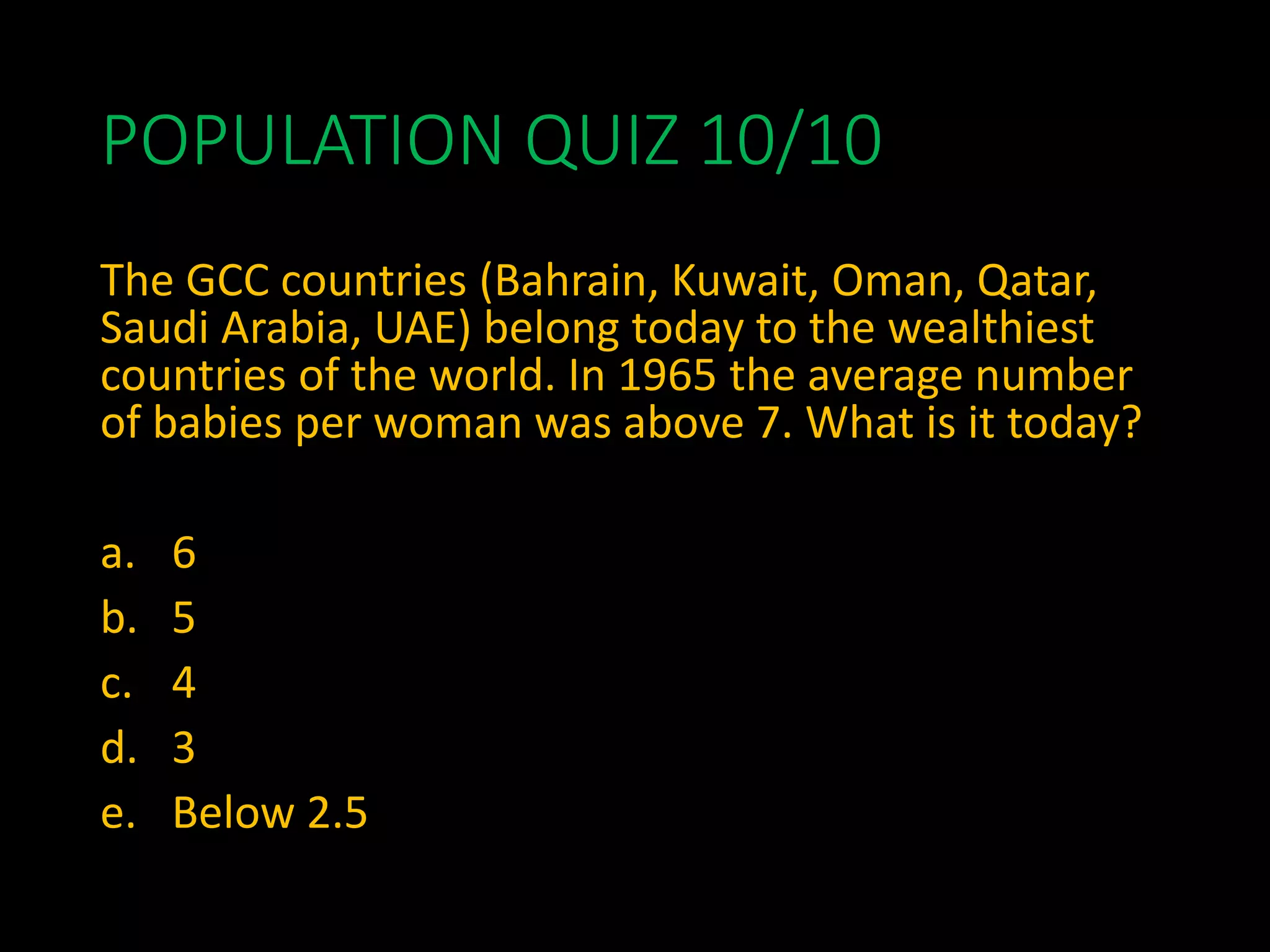
POPULATION QUIZ 10/10
The GCC countries (Bahrain, Kuwait, Oman, Qatar,
Saudi Arabia, UAE) belong today to the wealthiest
countries of the world. In 1965 the average number
of babies per woman was above 7. What is it today?
a. 6
b. 5
c. 4
d. 3
e. Below 2.5
If it bleeds, It leads
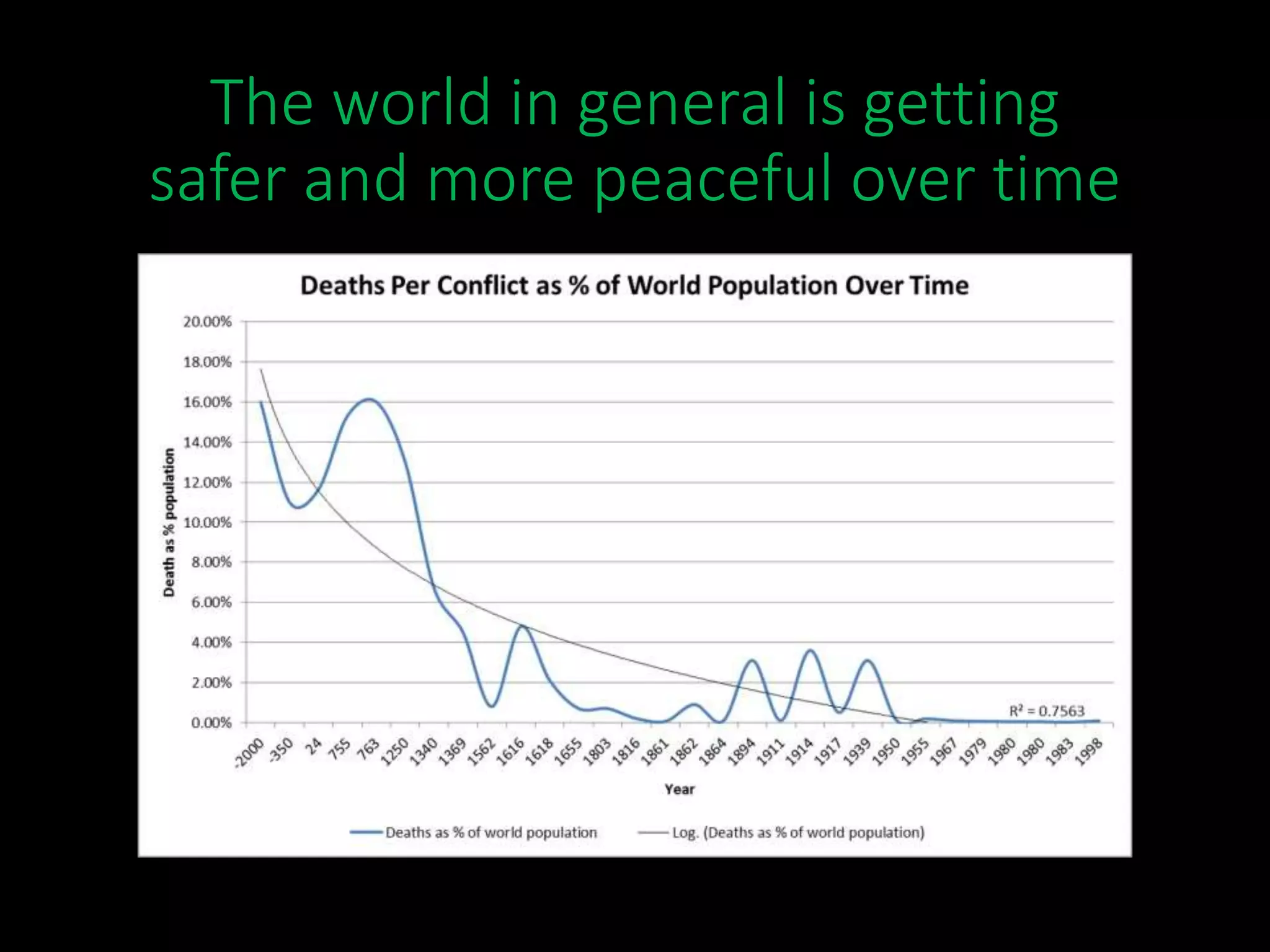
The world in general is getting
safer and more peaceful over time
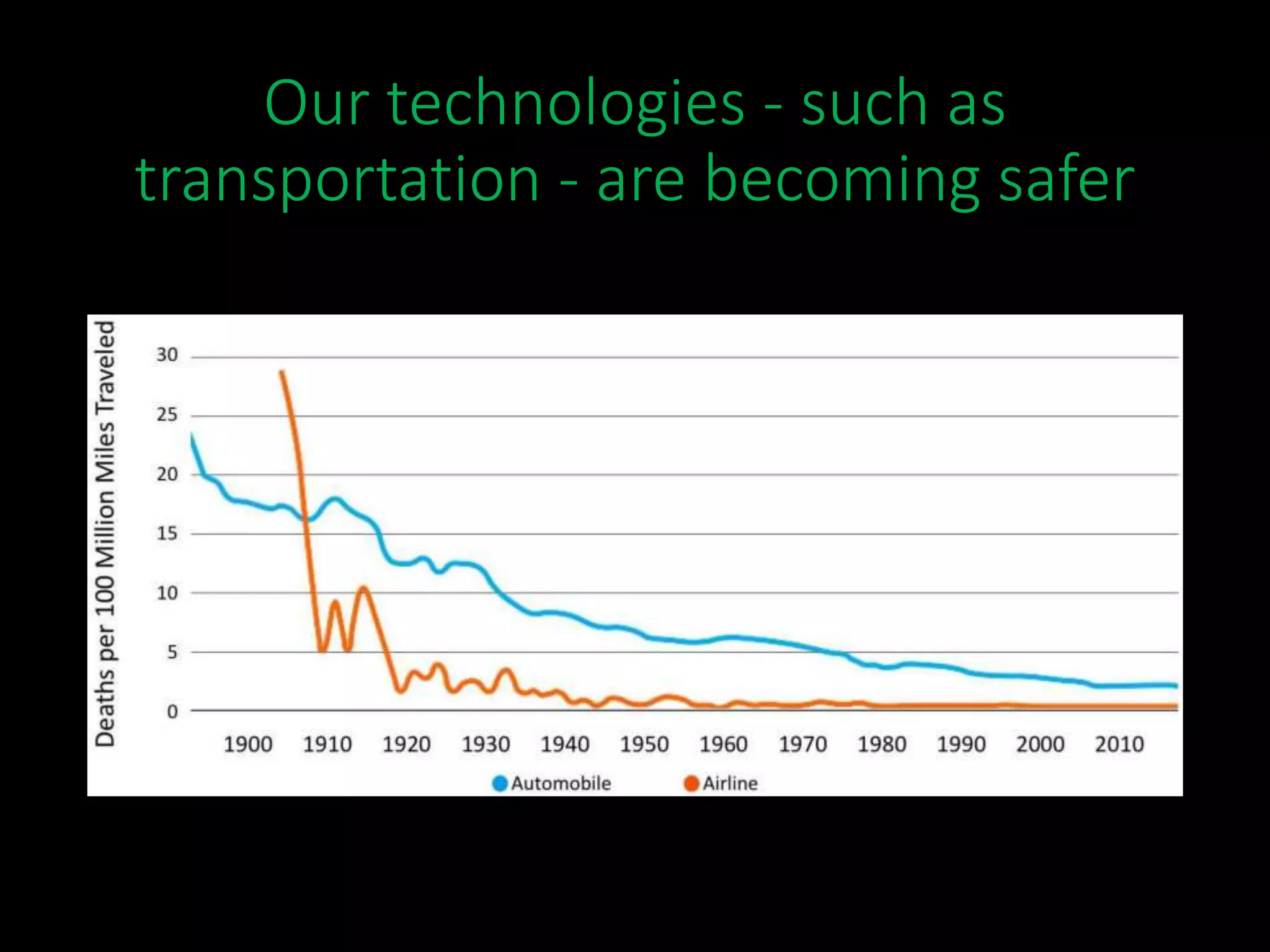
Our technologies - such as
transportation - are becoming safer
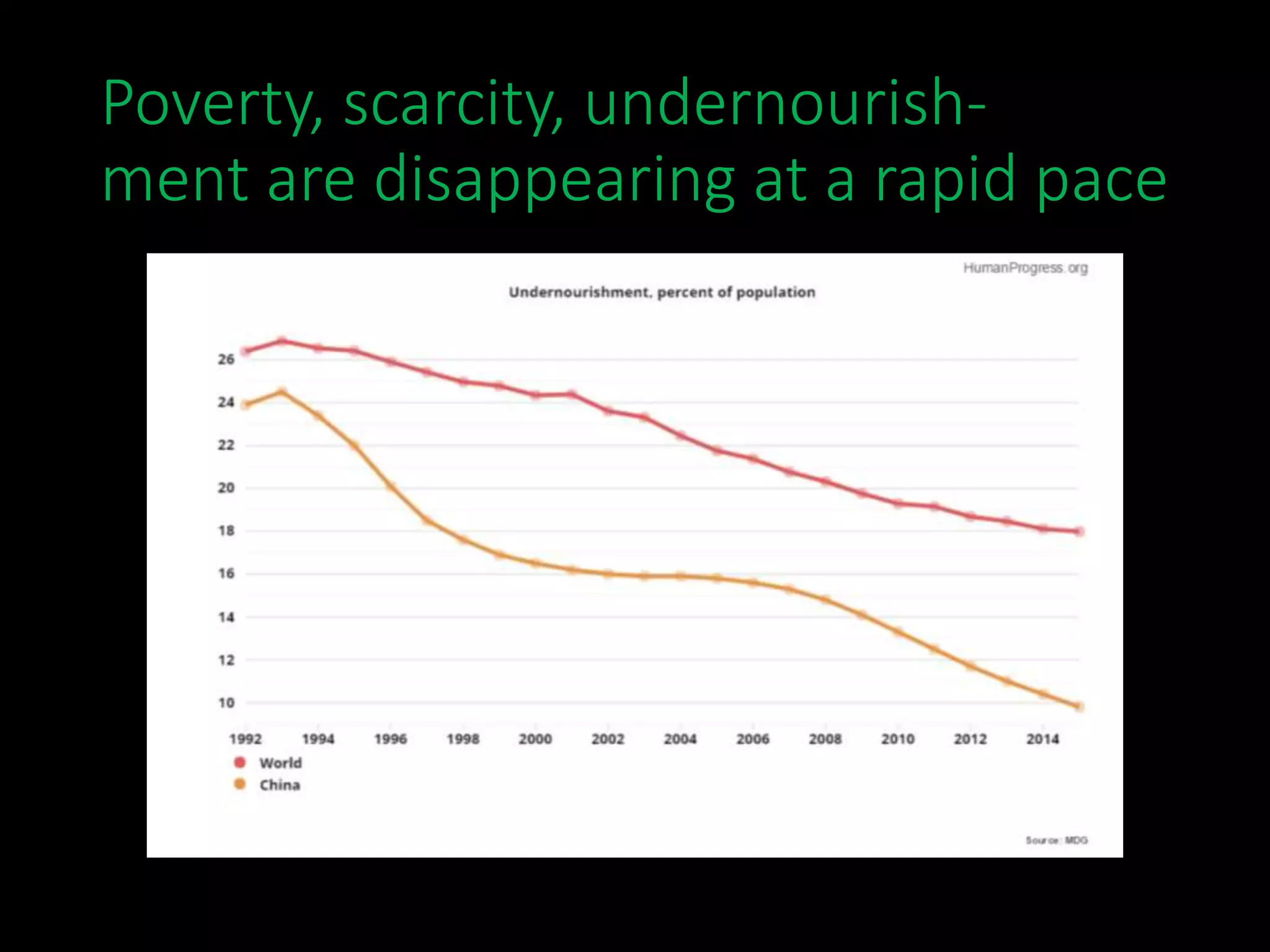
Poverty, scarcity, undernourish-
ment are disappearing at a rapid pace
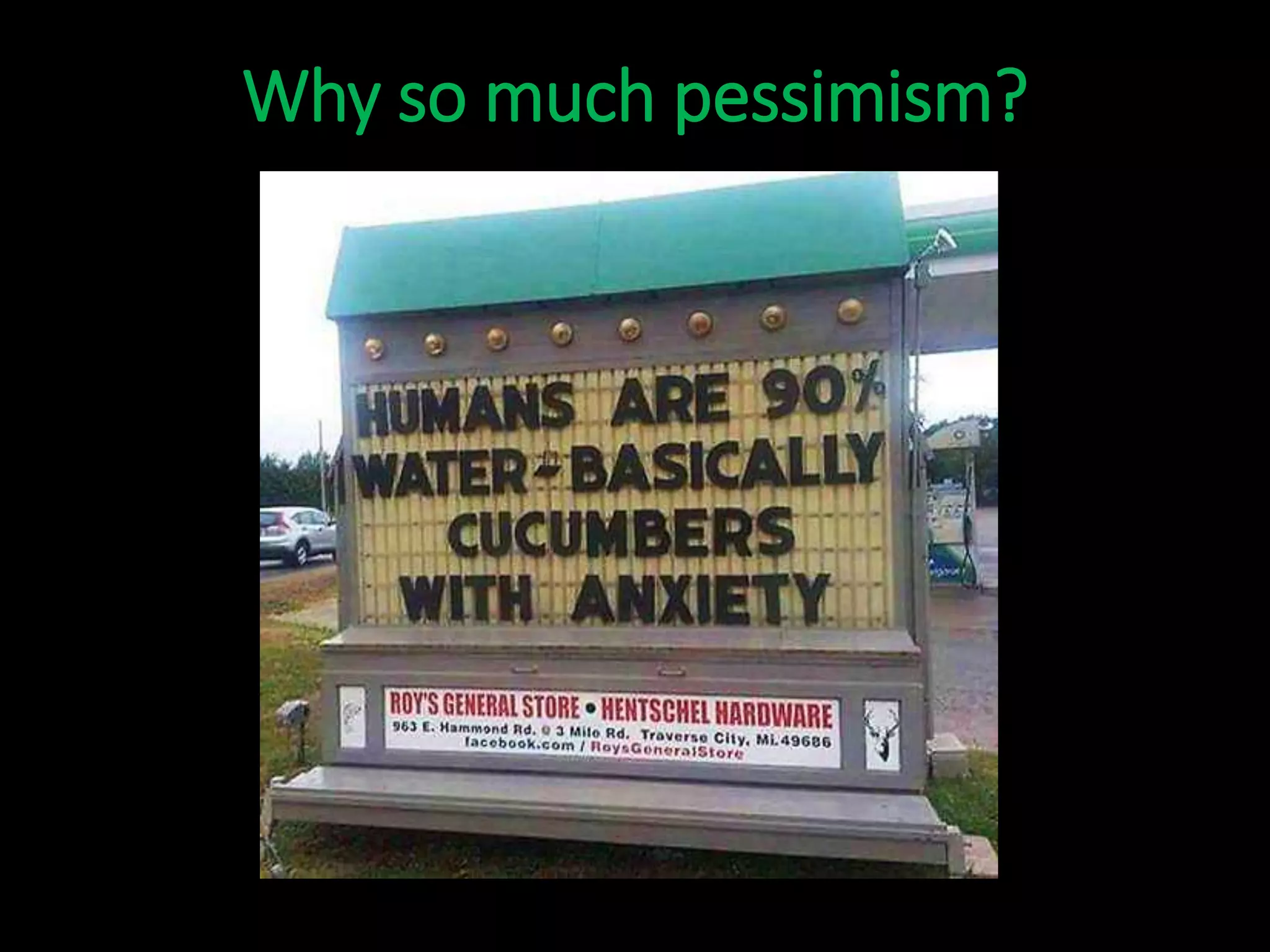
Why so much pessimism?
We pay 10 times more attention to
negative news than to positive news
Spot something here?
Historical Pessimism:
Thomas Malthus, 1779
“The power of
population is so
superior to the
power of the earth
to produce
subsistence for man,
that premature
death must in
some shape or other
visit the human race.”
US corn production
Historical Pessimism:
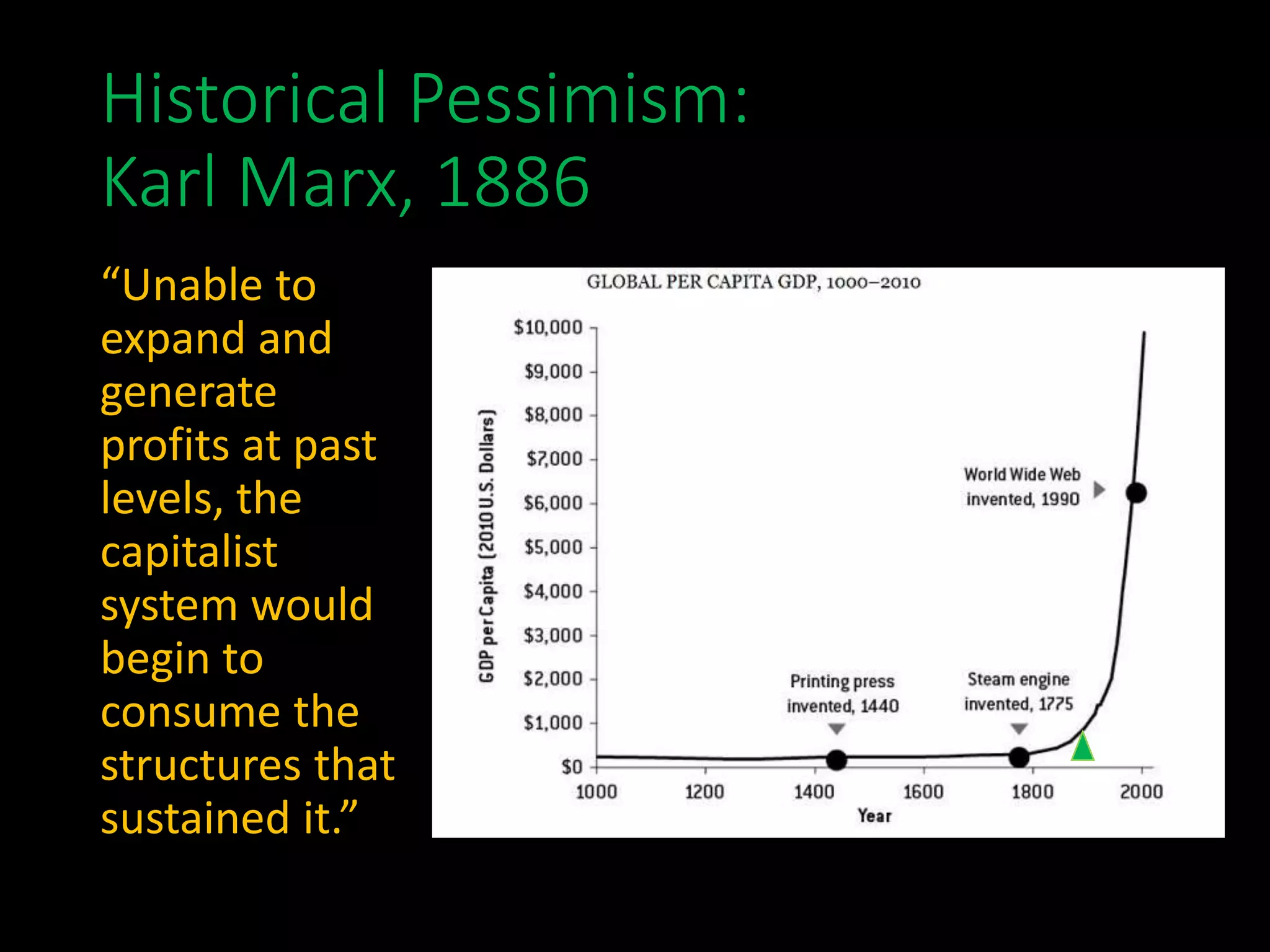
Karl Marx, 1886
“Unable to
expand and
generate
profits at past
levels, the
capitalist
system would
begin to
consume the
structures that
sustained it.”
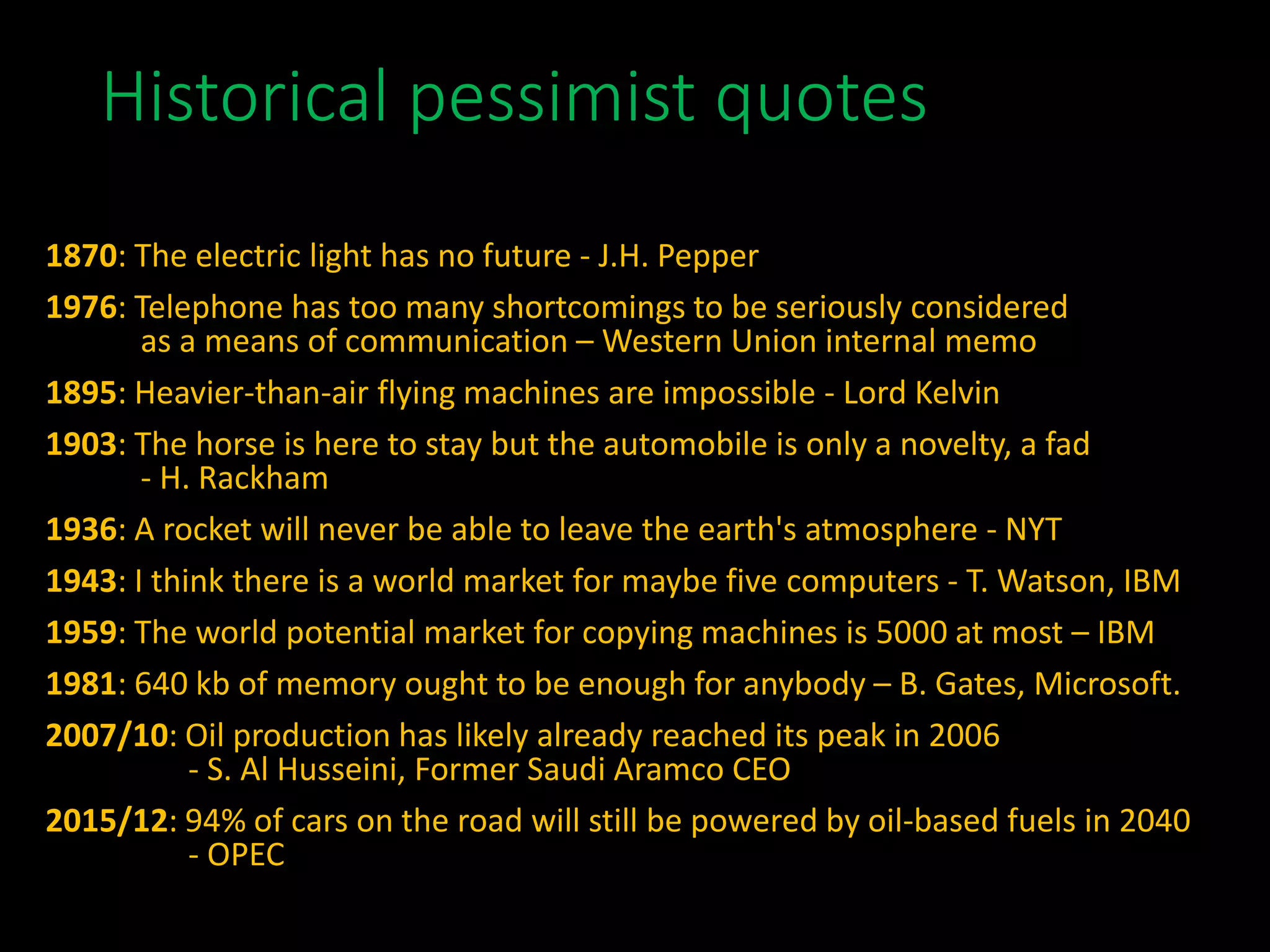
Historical pessimist quotes
1870: The electric light has no future - J.H. Pepper
1976: Telephone has too many shortcomings to be seriously considered
as a means of communication – Western Union internal memo
1895: Heavier-than-air flying machines are impossible - Lord Kelvin
1903: The horse is here to stay but the automobile is only a novelty, a fad
- H. Rackham
1936: A rocket will never be able to leave the earth's atmosphere - NYT
1943: I think there is a world market for maybe five computers - T. Watson, IBM
1959: The world potential market for copying machines is 5000 at most – IBM
1981: 640 kb of memory ought to be enough for anybody – B. Gates, Microsoft.
2007/10: Oil production has likely already reached its peak in 2006
- S. Al Husseini, Former Saudi Aramco CEO
2015/12: 94% of cars on the road will still be powered by oil-based fuels in 2040
- OPEC
Futuristic Pessimism:
A dystopian world
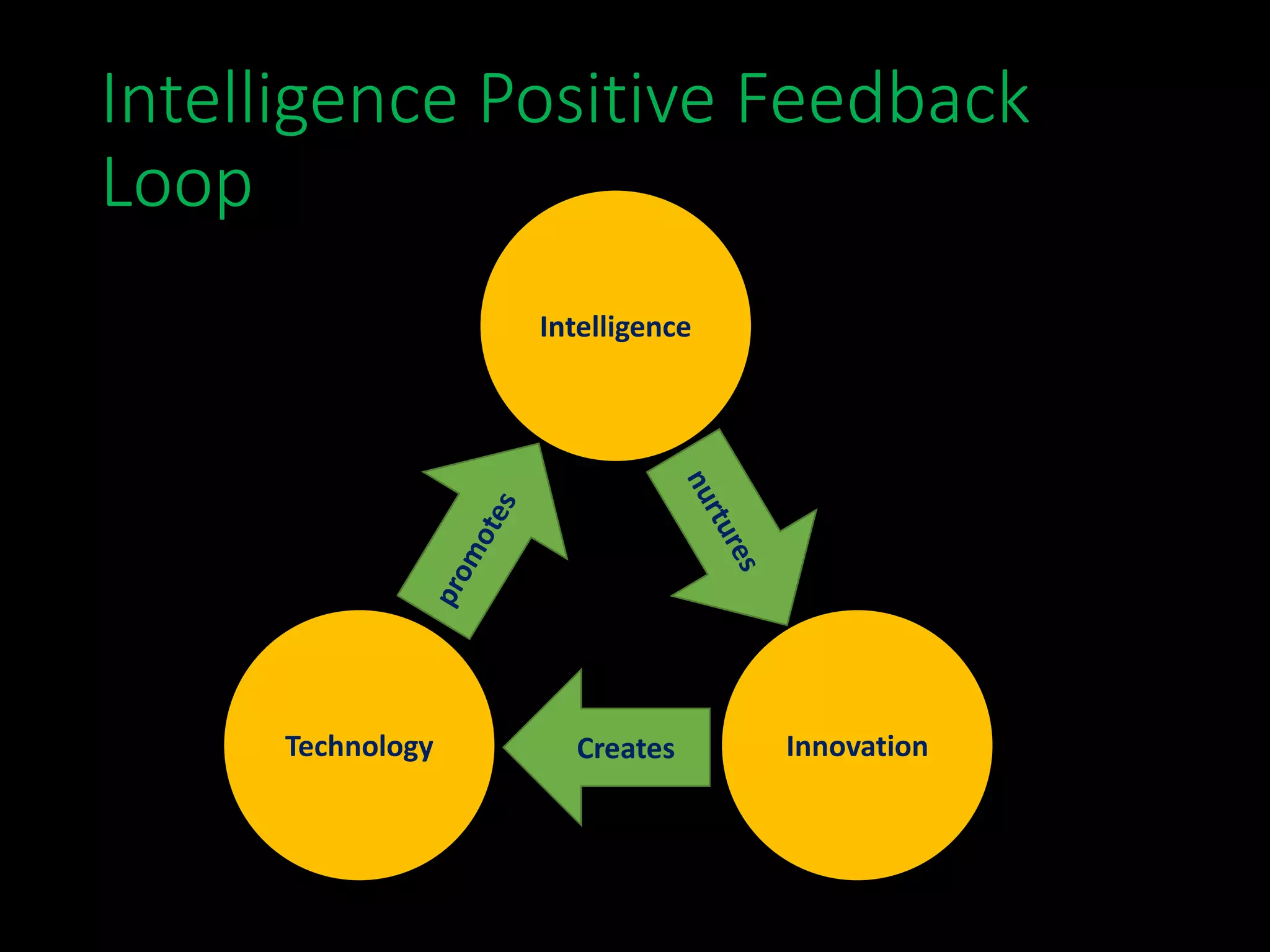
Intelligence Positive Feedback
Loop
Intelligence
InnovationTechnology Creates
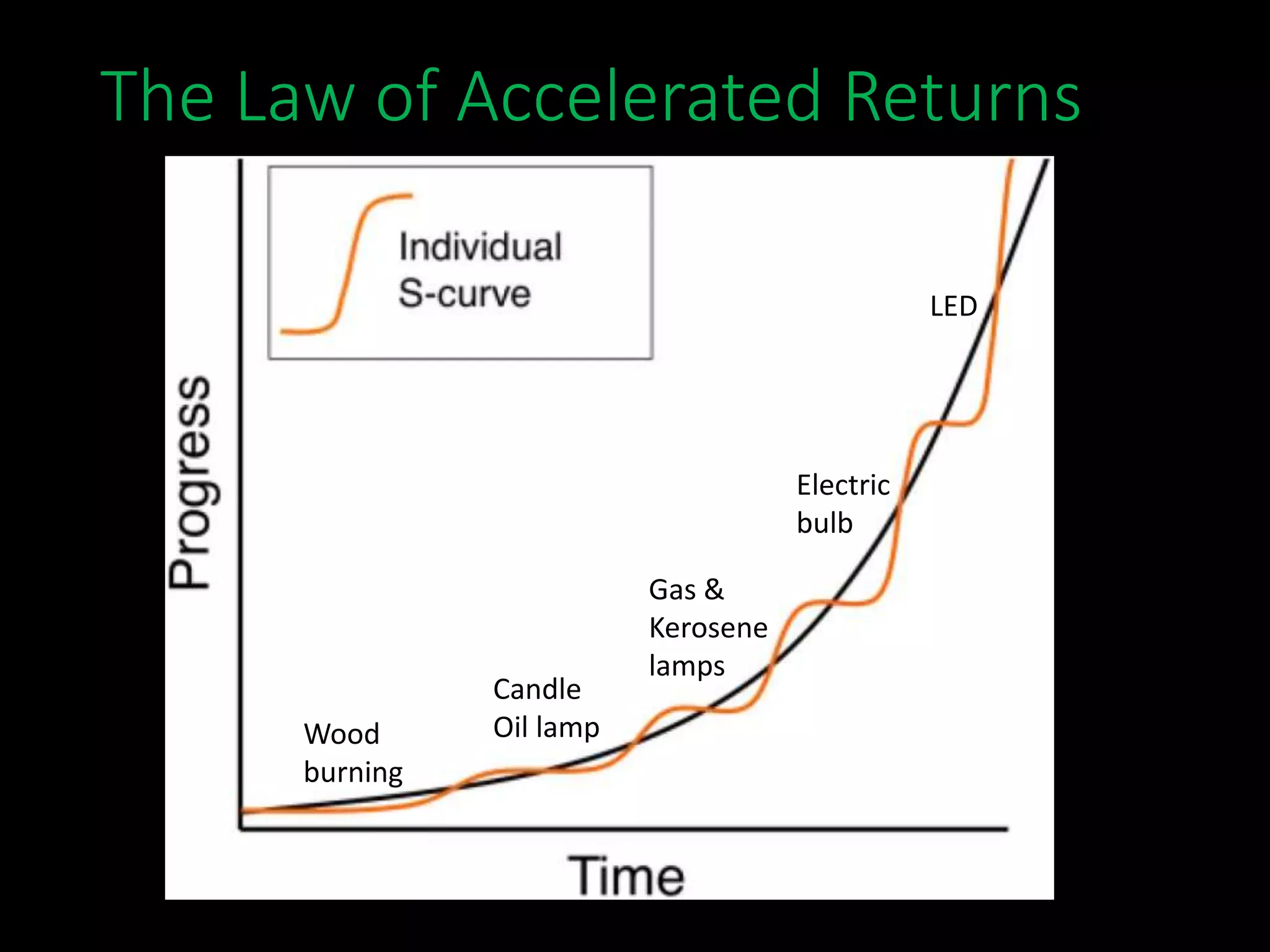
The Law of Accelerated Returns
Walking
Horse
Train
Car
Plane
The Law of Accelerated Returns
Wood
burning
Candle
Oil lamp
Gas &
Kerosene
lamps
Electric
bulb
LED
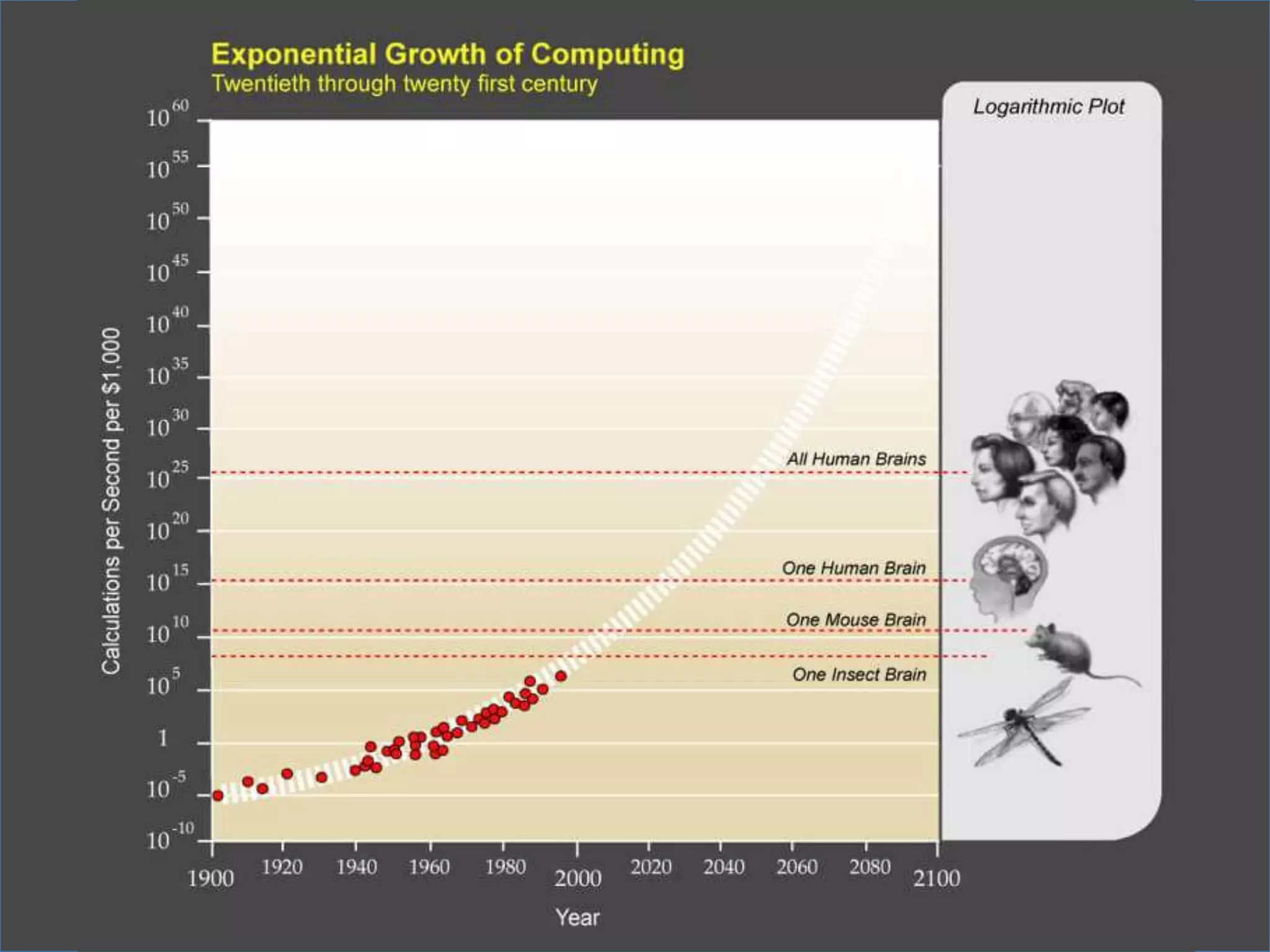
Cost of Computing Power
Equal to an iPad 2
Cost has been
reduced 1 trillion
of times in 60 years
Technology is the force
which makes abundant
what was once scarce
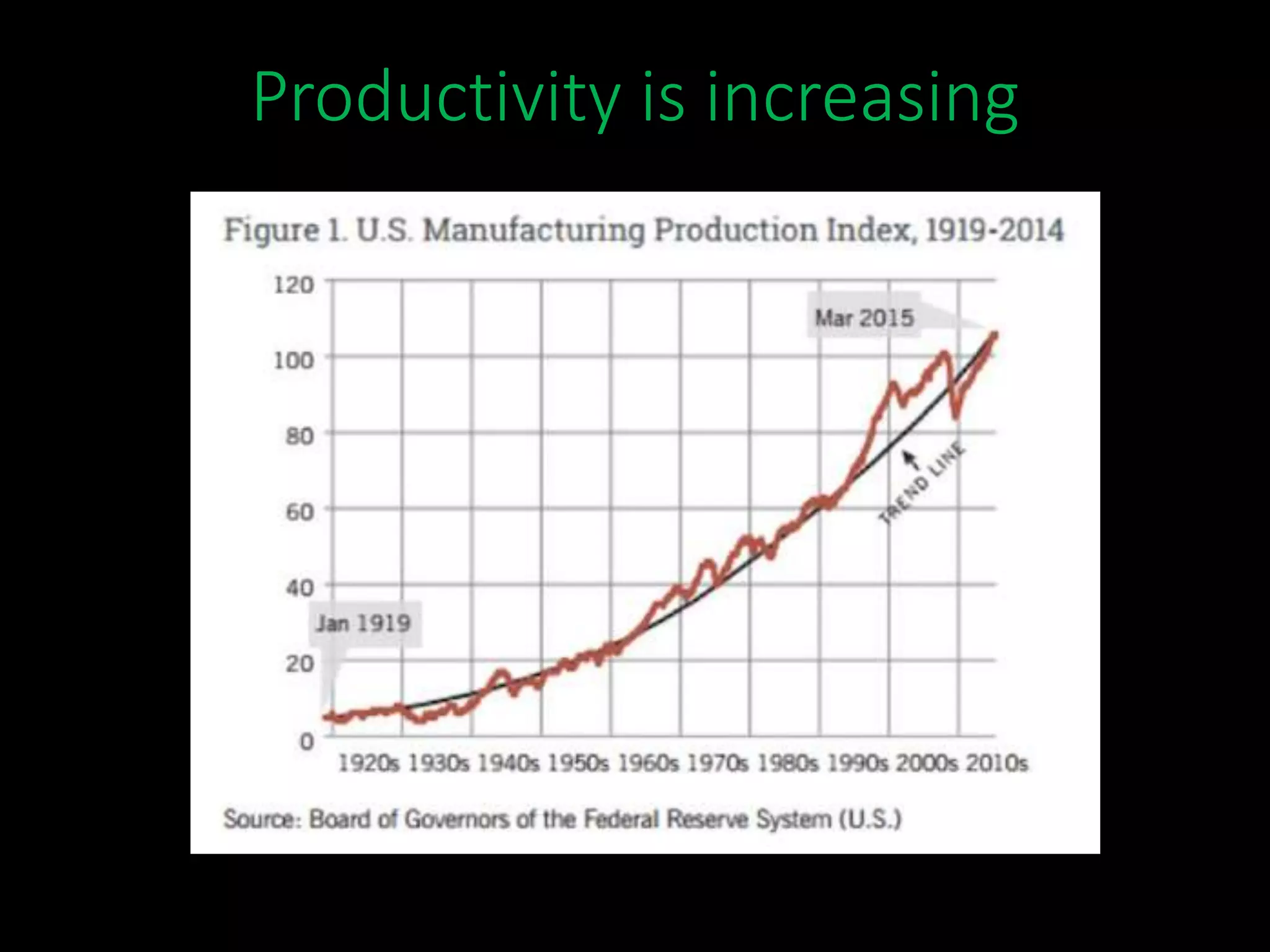
Productivity is increasing
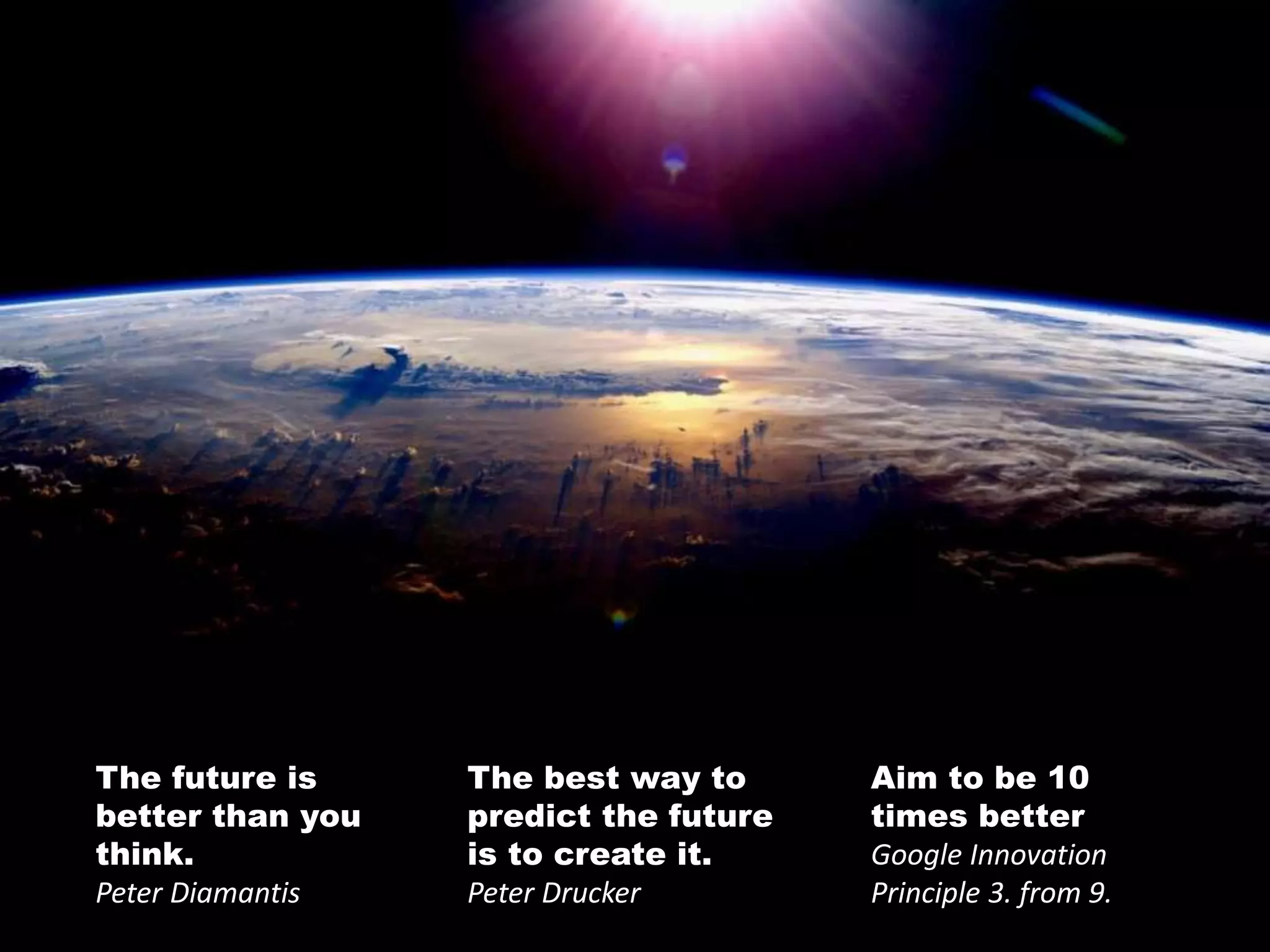
The best way to
predict the future
is to create it.
Peter Drucker
The future is
better than you
think.
Peter Diamantis
Aim to be 10
times better
Google Innovation
Principle 3. from 9.
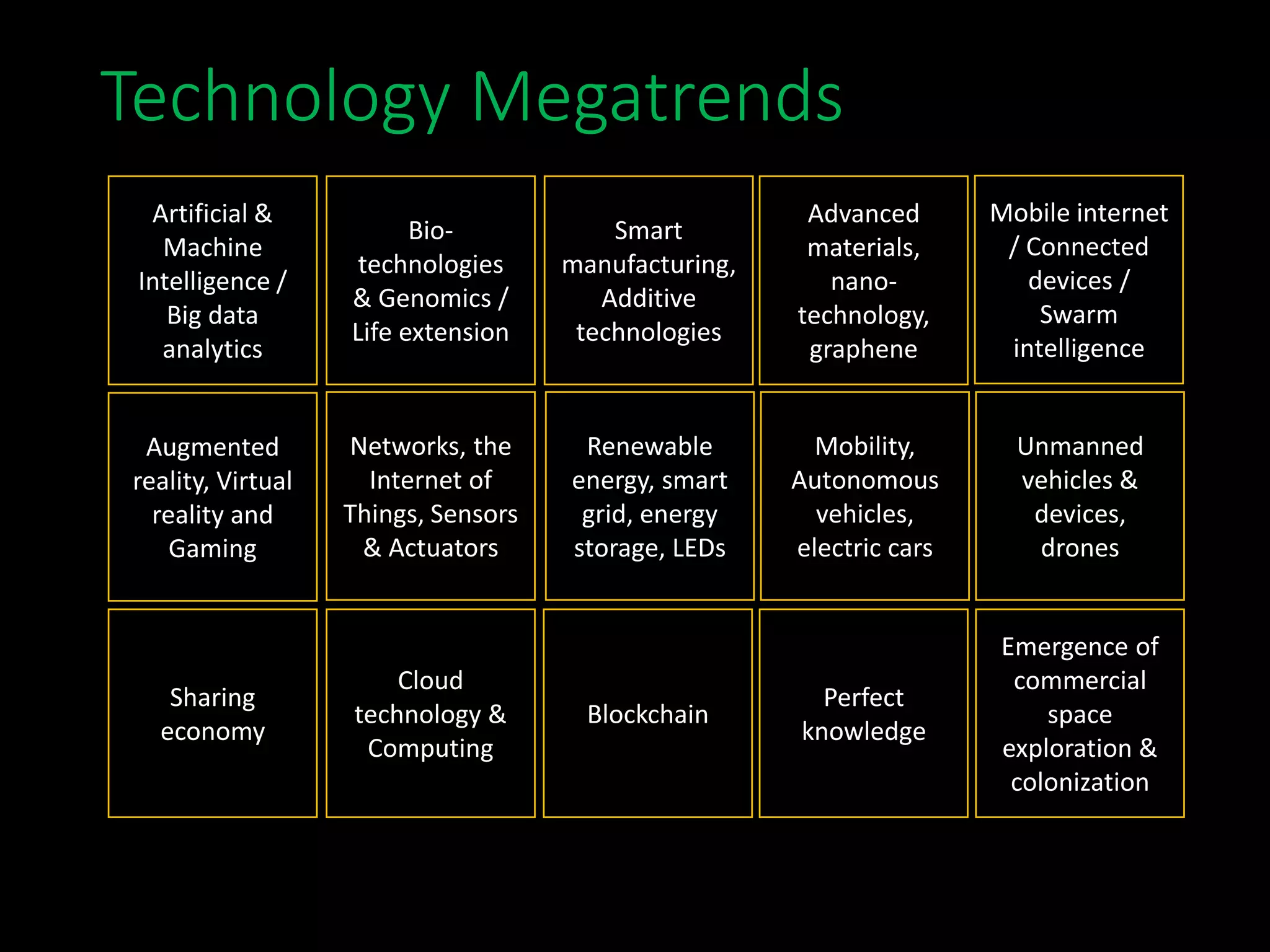
Technology Megatrends
Artificial &
Machine
Intelligence /
Big data
analytics
Bio-
technologies
& Genomics /
Life extension
Smart
manufacturing,
Additive
technologies
Advanced
materials,
nano-
technology,
graphene
Mobile internet
/ Connected
devices /
Swarm
intelligence
Augmented
reality, Virtual
reality and
Gaming
Renewable
energy, smart
grid, energy
storage, LEDs
Mobility,
Autonomous
vehicles,
electric cars
Unmanned
vehicles &
devices,
drones
Blockchain
Perfect
knowledge
Sharing
economy
Networks, the
Internet of
Things, Sensors
& Actuators
Cloud
technology &
Computing
Emergence of
commercial
space
exploration &
colonization
Quiz Answers
1/10: The Number of Children is
No Longer Increasing
2/10: Population Distribution:
4 Billion People in Asia
3/10: Life Expectancy of the
World Now Exceeds 70 Years
4/10: World Literacy Rate
Reached 85% in 2014
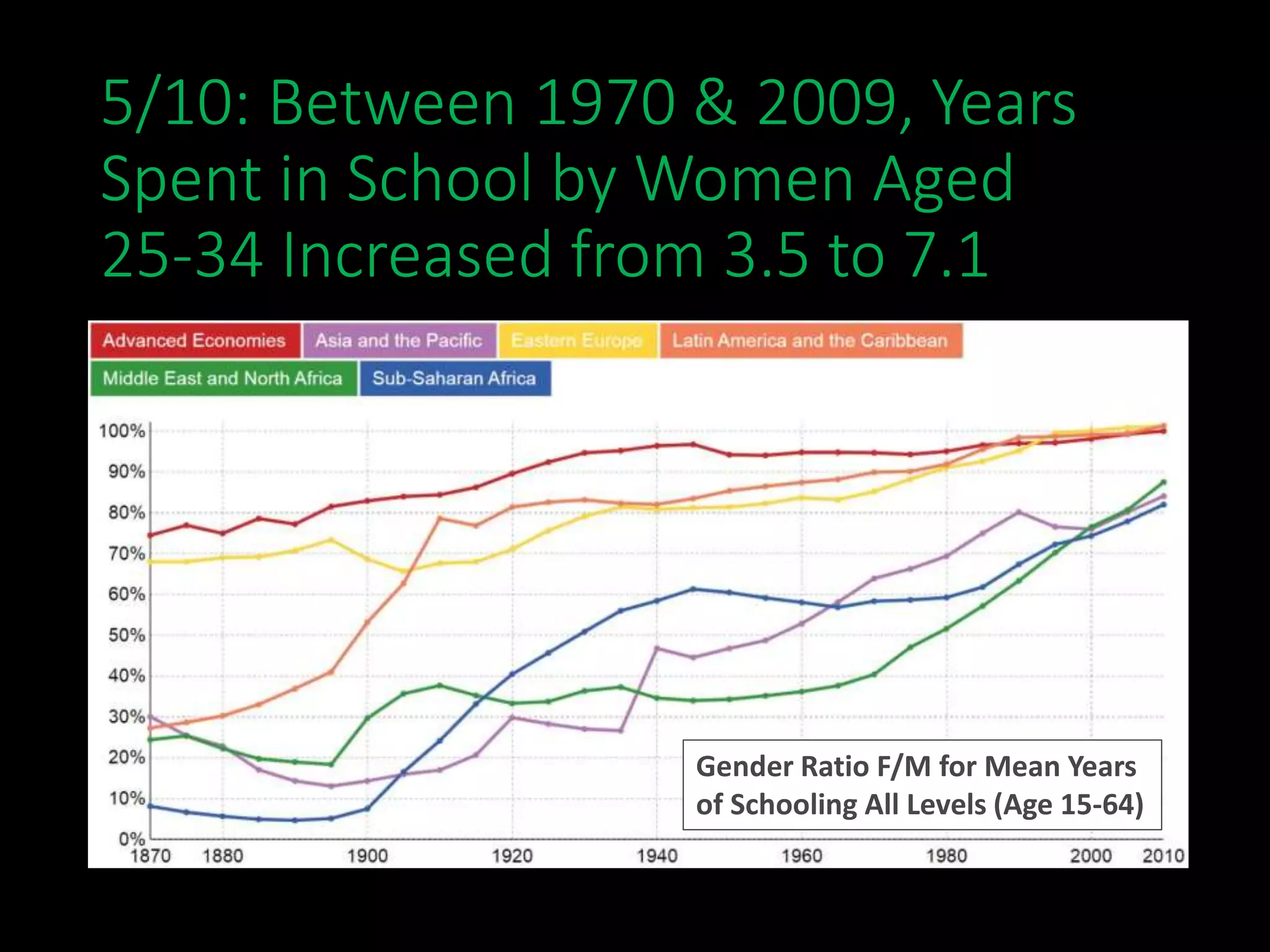
5/10: Between 1970 & 2009, Years
Spent in School by Women Aged
25-34 Increased from 3.5 to 7.1
Gender Ratio F/M for Mean Years
of Schooling All Levels (Age 15-64)
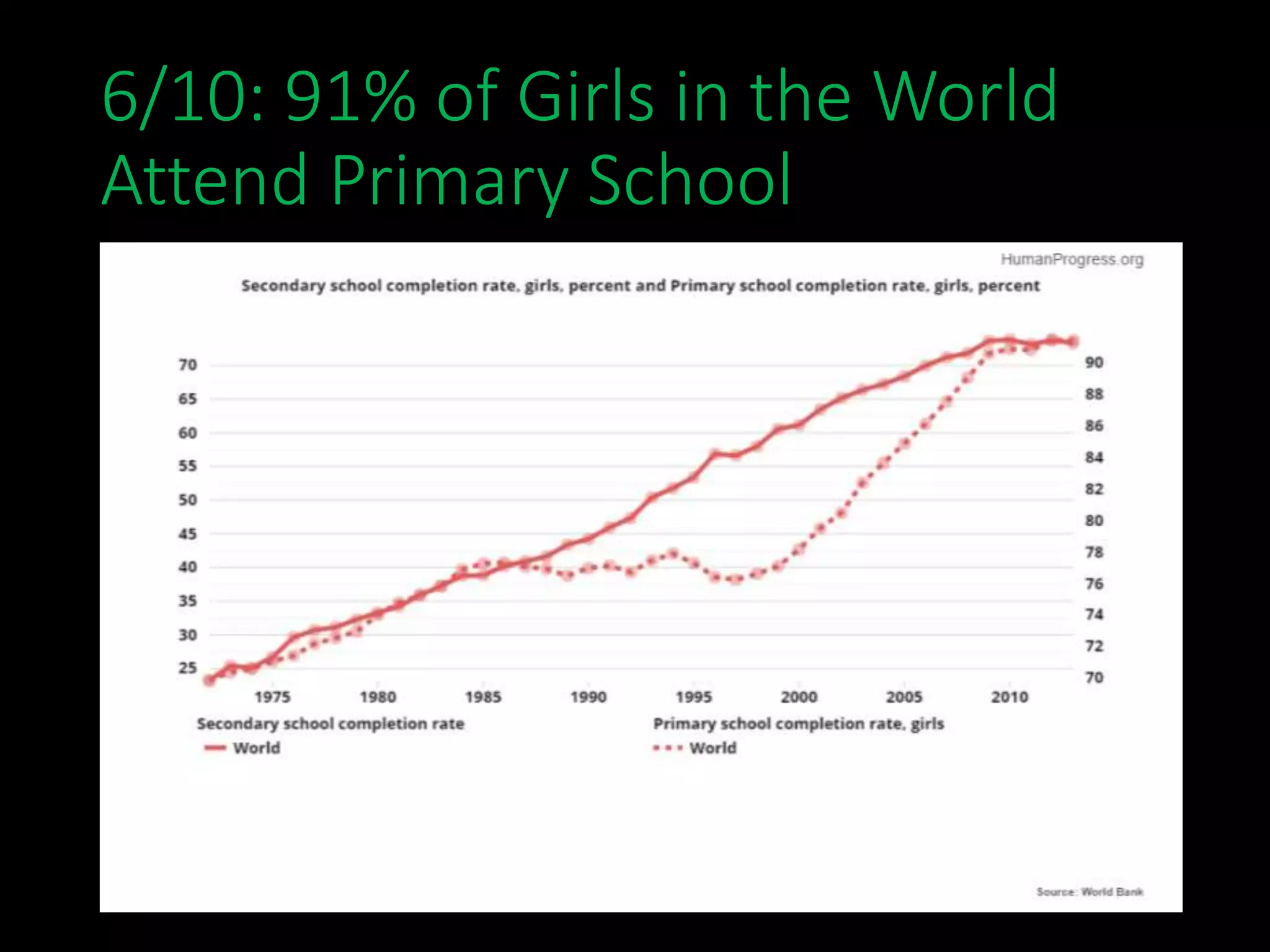
6/10: 91% of Girls in the World
Attend Primary School
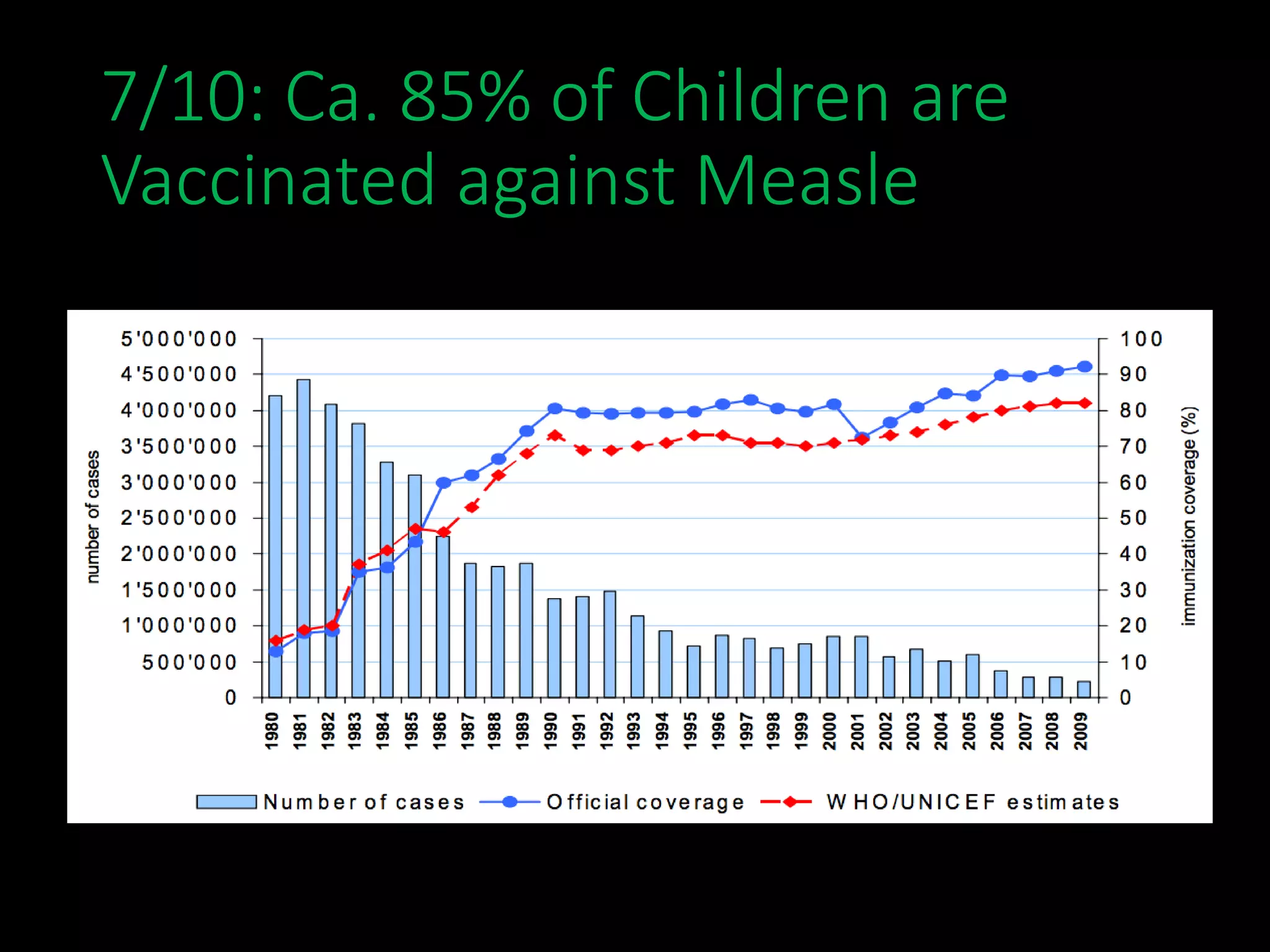
7/10: Ca. 85% of Children are
Vaccinated against Measle
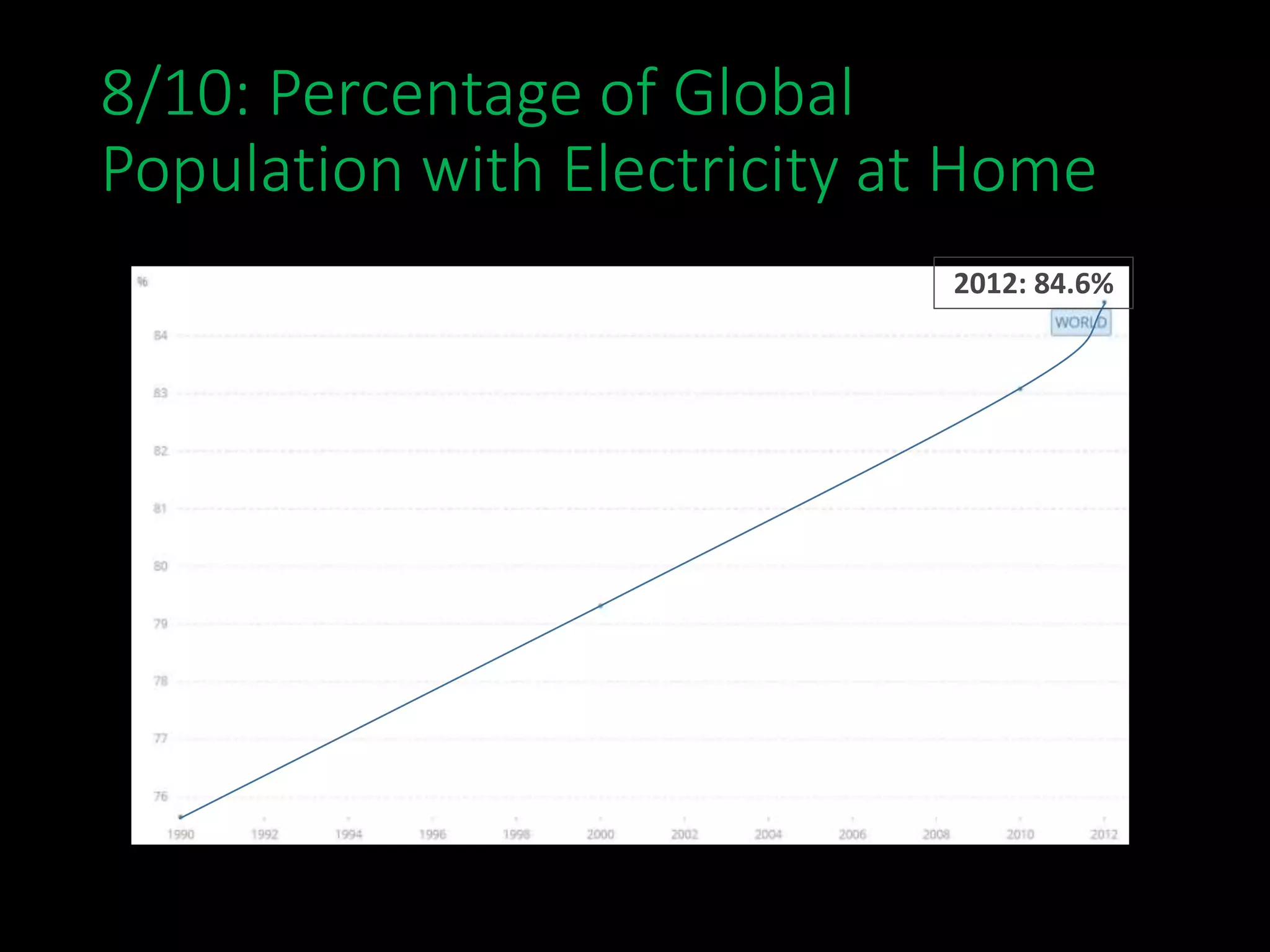
8/10: Percentage of Global
Population with Electricity at Home
2012: 84.6%
9/10: People Living in Extreme
Poverty
1820
61 million
1,082 million
1970
1,473 million
2,218 million
2015
6,644 million
705 million
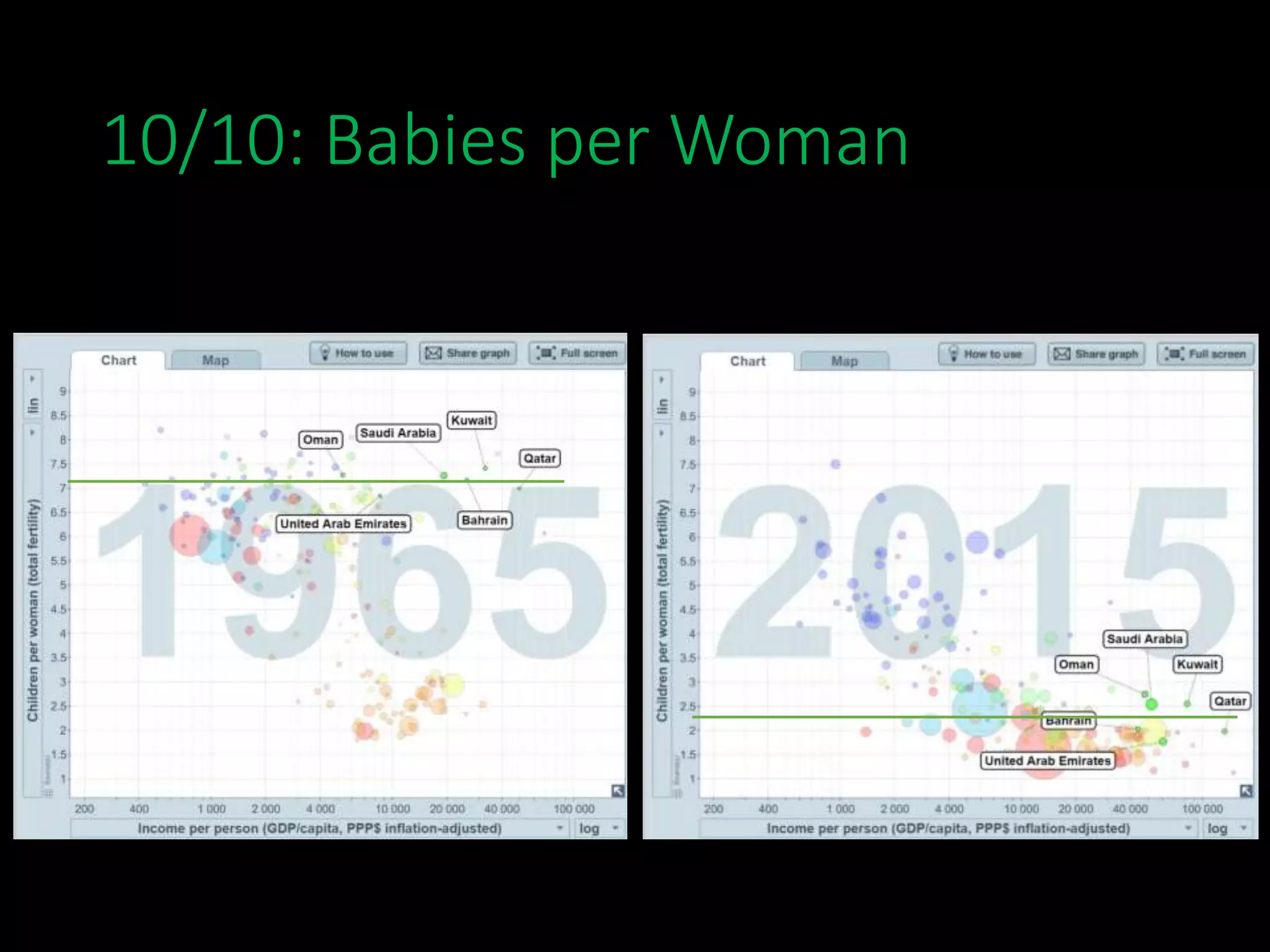
10/10: Babies per Woman

The world is getting better

  • 1.
    The World Is GettingBetter February 13th 2016 Dammam Office Building
  • 2.
    Agenda • Introduction • PopulationQuiz • The World is (pick one): • turning really ugly • getting worse • not evolving at all • improving • becoming a wonderful place where to live • VISION 2030 Intro • Group Exercise • VISION 2030 Review and Analysis 2-3 min 15 min 15 min T T T t 5 min 20 min Until Lunch Time
  • 3.
    Assess Your Knowledge FirstReview the Following Quiz (10 Questions) and score your results. The Answers are provided at the end of this presentation.
  • 4.
    POPULATION QUIZ 1/10 In1950 there were fewer than 1 billion children (aged 0-14) worldwide; by 2000 this figure increased to almost 2 billion. How many children does the UN estimate there will be by 2100? a) 2 billion b) 3 billion c) 4 billion
  • 5.
    POPULATION QUIZ 2/10 Thereare 7 billion people in the world. How does the population break down? a) Americas 1 / Europe 1 / Africa 1 / Asia 4 b) Americas 2 / Europe 1 / Africa 1 / Asia 3 c) Americas 1 / Europe 1 / Africa 2 / Asia 3
  • 6.
    POPULATION QUIZ 3/10 Thelife expectancy at birth in the UK is 81 years. What is the average life expectancy at birth of the world’s population? a) 50 years b) 60 years c) 70 years
  • 7.
    POPULATION QUIZ 4/10 Whatis the global adult literacy rate? a) 40% b) 60% c) 80%
  • 8.
    POPULATION QUIZ 5/10 Globally,men aged 25-34 have spent eight years at school on average. How many years have women of the same age group spent in school? a) 3 years b) 5 years c) 7 years
  • 9.
    POPULATION QUIZ 6/10 6.Roughly what percentage of the girls in the world attend primary school (first 4-6 years of school)? a) 50 b) 60 c) 70 d) 80 e) 90
  • 10.
    POPULATION QUIZ 7/10 Roughlywhat percentage of the world's one-year-old children is vaccinated against measles? a) 10 b) 20 c) 30 d) 40gave you the points if you rounded up or down. e) 50 f) 60 g) 70 h) 80 i) 90
  • 11.
    POPULATION QUIZ 8/10 Roughlywhat percentage of the world’s population has electricity at home? a) 10 b) 20 c) 30 d) 40gave you the points if you rounded up or down. e) 50 f) 60 g) 70 h) 80 i) 90
  • 12.
    POPULATION QUIZ 9/10 In1970 more than 2.2 billion people lived in extreme poverty. How did this number change until today? a) It has increased by 1 more billion. b) It has remained more or less the same. c) It has been reduced by two third.
  • 13.
    POPULATION QUIZ 10/10 TheGCC countries (Bahrain, Kuwait, Oman, Qatar, Saudi Arabia, UAE) belong today to the wealthiest countries of the world. In 1965 the average number of babies per woman was above 7. What is it today? a. 6 b. 5 c. 4 d. 3 e. Below 2.5
  • 14.
    If it bleeds,It leads
  • 15.
    The world ingeneral is getting safer and more peaceful over time
  • 16.
    Our technologies -such as transportation - are becoming safer
  • 17.
    Poverty, scarcity, undernourish- mentare disappearing at a rapid pace
  • 18.
    Why so muchpessimism?
  • 19.
    We pay 10times more attention to negative news than to positive news Spot something here?
  • 20.
    Historical Pessimism: Thomas Malthus,1779 “The power of population is so superior to the power of the earth to produce subsistence for man, that premature death must in some shape or other visit the human race.” US corn production
  • 21.
    Historical Pessimism: Karl Marx,1886 “Unable to expand and generate profits at past levels, the capitalist system would begin to consume the structures that sustained it.”
  • 22.
    Historical pessimist quotes 1870:The electric light has no future - J.H. Pepper 1976: Telephone has too many shortcomings to be seriously considered as a means of communication – Western Union internal memo 1895: Heavier-than-air flying machines are impossible - Lord Kelvin 1903: The horse is here to stay but the automobile is only a novelty, a fad - H. Rackham 1936: A rocket will never be able to leave the earth's atmosphere - NYT 1943: I think there is a world market for maybe five computers - T. Watson, IBM 1959: The world potential market for copying machines is 5000 at most – IBM 1981: 640 kb of memory ought to be enough for anybody – B. Gates, Microsoft. 2007/10: Oil production has likely already reached its peak in 2006 - S. Al Husseini, Former Saudi Aramco CEO 2015/12: 94% of cars on the road will still be powered by oil-based fuels in 2040 - OPEC
  • 23.
  • 24.
  • 25.
    The Law ofAccelerated Returns Walking Horse Train Car Plane
  • 26.
    The Law ofAccelerated Returns Wood burning Candle Oil lamp Gas & Kerosene lamps Electric bulb LED
  • 28.
    Cost of ComputingPower Equal to an iPad 2 Cost has been reduced 1 trillion of times in 60 years
  • 29.
    Technology is theforce which makes abundant what was once scarce
  • 30.
  • 31.
    The best wayto predict the future is to create it. Peter Drucker The future is better than you think. Peter Diamantis Aim to be 10 times better Google Innovation Principle 3. from 9.
  • 32.
    Technology Megatrends Artificial & Machine Intelligence/ Big data analytics Bio- technologies & Genomics / Life extension Smart manufacturing, Additive technologies Advanced materials, nano- technology, graphene Mobile internet / Connected devices / Swarm intelligence Augmented reality, Virtual reality and Gaming Renewable energy, smart grid, energy storage, LEDs Mobility, Autonomous vehicles, electric cars Unmanned vehicles & devices, drones Blockchain Perfect knowledge Sharing economy Networks, the Internet of Things, Sensors & Actuators Cloud technology & Computing Emergence of commercial space exploration & colonization
  • 33.
  • 34.
    1/10: The Numberof Children is No Longer Increasing
  • 35.
    2/10: Population Distribution: 4Billion People in Asia
  • 36.
    3/10: Life Expectancyof the World Now Exceeds 70 Years
  • 37.
    4/10: World LiteracyRate Reached 85% in 2014
  • 38.
    5/10: Between 1970& 2009, Years Spent in School by Women Aged 25-34 Increased from 3.5 to 7.1 Gender Ratio F/M for Mean Years of Schooling All Levels (Age 15-64)
  • 39.
    6/10: 91% ofGirls in the World Attend Primary School
  • 40.
    7/10: Ca. 85%of Children are Vaccinated against Measle
  • 41.
    8/10: Percentage ofGlobal Population with Electricity at Home 2012: 84.6%
  • 42.
    9/10: People Livingin Extreme Poverty 1820 61 million 1,082 million 1970 1,473 million 2,218 million 2015 6,644 million 705 million
  • 43.

Editor's Notes

  • #2 Welcome everybody and thank you for joining today. The purpose of this meeting is to review an evaluation of the VISION 2030 that we have done in order to align the delovelopment of the Saudi Aramco’s downstream business with the objective of the VISION. Our workshop today is a kind of warming-up exercise before repeating it with other departments such as NBD, CP and R&D.
  • #3 In order to be able to determine the future we need to be able to understand the present, where we are coming from, and where we are heading to. To test your understanding of the present I am proposing to start with a population quiz. After reviewing the conclusions of the quiz, we will try to comprehend how the world is actually doing. Is it turning really ugly, maybe getting worse, staying the same, improving, or perhaps becoming a wonderfull place to live in. Make your choice… I will give you the answer. It will follow with a short introduction about the VISION 2030 and from there, before presenting my own conclusions, would like to involve you in a group exercise. The 1st hour more or less is intended to bring you in a positive mood with the kind of mindset that is required to stimulate your creative thinking.
  • #4 a) is correct
  • #5 a) is correct
  • #6 Is correct
  • #7 There has been a 10-year rise in life expectancy in the past 50 years. 
  • #8 c) is correct.
  • #9 c) is correct Between 1970 and 2009, the number increased from 3.5 to 7.1 years.
  • #10 e) is correct. 90%. The number of children who never have the benefits of primary education fell steadily between 2000 and 2007. The proportion has continued to fall since then, but much more slowly. In 2014, the out-of-school rate was 9%. 
  • #11 h) or i) are correct. The World Health Organization calculates that about 85% of children have been vaccinated against measles.
  • #12 h) or i) are correct. Again, nearly 85% of homes have electricity worldwide. We gave you the points if you rounded up or down.
  • #13 c) is correct.
  • #14 e) is correct.
  • #15 https://www.psychologytoday.com/blog/two-takes-depression/201106/if-it-bleeds-it-leads-understanding-fear-based-media CNN: The Crisis News Network https://www.psychologytoday.com/blog/wired-success/201411/why-we-love-bad-news-more-good-news Most news we see and hear is negative, and replete with disasters, terrorism, crime, scandals and corruption, social conflicts, plagues, cataclysms, catastrophs, accidents, threats of all kind such as from overpopulation, climate change, technology, or even political turmoil. Media studies show that bad news far outweighs good news by as much as seventeen negative news reports for every one good news report. http://www.spectator.co.uk/2016/08/why-cant-we-see-that-were-living-in-a-golden-age/ The larger a community the highest the frequency of dramatic and negative incidents, and most of us are watching international news. Profound anxiety results from following the daily news because of its predominant focus on negativity.
  • #16 https://msjjonsey.com/2014/09/25/whats-with-all-this-war-stuff-anyway/ https://www.theguardian.com/commentisfree/2015/sep/11/news-isis-syria-headlines-violence-steven-pinker
  • #17 https://msjjonsey.com/2014/09/25/whats-with-all-this-war-stuff-anyway/ https://www.theguardian.com/commentisfree/2015/sep/11/news-isis-syria-headlines-violence-steven-pinker
  • #18 https://msjjonsey.com/2014/09/25/whats-with-all-this-war-stuff-anyway/ https://www.theguardian.com/commentisfree/2015/sep/11/news-isis-syria-headlines-violence-steven-pinker
  • #20 http://www.spectator.co.uk/2016/08/why-cant-we-see-that-were-living-in-a-golden-age/ Our brains evolved in a hunter-gatherer environment where anything novel or dramatic had to be attended to immediately for survival. So while we no longer defend ourselves against saber-toothed tigers, our brains have not caught up. We’ve evolved to be suspicious and fretful: fear and worry are tools for survival. The hunters and gatherers who survived sudden storms and predators were the ones who had a tendency to scan the horizon for new threats, rather than sit back and enjoy the view. http://www.abundance360summit.com/podcast/2015/09/03/episode-8-negativity-bias-why-we-pay-attention-to-bad-news/
  • #21 Decoupling of US corn production from area farmed. Data source: US Census Bureau (1975, 2012). Source: Nature rebounds, 2016
  • #22 https://wattsupwiththat.com/2016/02/22/a-stunning-hockey-stick-how-access-to-energy-brought-humanity-forward/ Multiplier technologies: printing press: information sharing Steam engine: freeing humans from the need of manpowered activities www: multiplication of information storage and communications via digitilisation
  • #23 http://humanscience.wikia.com/wiki/Worst_Predictions http://www.pcworld.com/article/155984/worst_tech_predictions.html http://www.telegraph.co.uk/technology/0/worst-tech-predictions-of-all-time/ https://en.wikipedia.org/wiki/Predicting_the_timing_of_peak_oil
  • #24 https://www.ipsos-mori.com/researchpublications/researcharchive/3568/Over-half-of-public-think-that-the-future-will-be-worse-for-young-people.aspx http://www.livescience.com/44886-poll-americans-future-tech-infographic.html http://money.cnn.com/2016/01/28/news/economy/donald-trump-bernie-sanders-us-economy/
  • #25  Faster transportation give us more time for more productive activitities.
  • #26 http://www.kurzweilai.net/the-law-of-accelerating-returns
  • #27 http://www.kurzweilai.net/the-law-of-accelerating-returns Succession of technological paradygms. http://humanprogress.org/blog/how-the-cost-of-light-has-fallen-by-a-factor-of-500-000
  • #28 Moore’s law. http://www.kurzweilai.net/the-law-of-accelerating-returns
  • #29 http://aiimpacts.org/trends-in-the-cost-of-computing/ The “cost per GFLOPS” is the cost for a set of hardware that would theoretically operate at one billion floating-point operations per second http://www.hamiltonproject.org/charts/cost_of_computing_power_equal_to_an_ipad2 The iPad2 has computing power equal to 1,600 million instructions per second (MIPS). Each data point represents the cost of 1,600 MIPS of computing power based on the power and price of a specific computing device released that year. Reduction by 1 Trilllion in a 60 years time span
  • #30 http://diamandis.com/data
  • #32 https://singularityhub.com/2016/06/27/why-the-world-is-better-than-you-think-in-10-powerful-charts/ The world is a wonderful place to live in and there has never been a better time to be alive.
  • #34 The number of children in the world is no longer increasing.
  • #35 The number of children in the world is no longer increasing.
  • #36 4 Billion people in Asia
  • #37 c) is correct There has been a 10-year rise in life expectancy in the past 50 years.  https://ourworldindata.org/life-expectancy/
  • #38 https://ourworldindata.org/literacy/
  • #39 Between 1970 and 2009, the number increased from 3.5 to 7.1 years. https://ourworldindata.org/global-rise-of-education
  • #40 90%. The number of children who never have the benefits of primary education fell steadily between 2000 and 2007. The proportion has continued to fall since then, but much more slowly. In 2014, the out-of-school rate was 9%.  http://humanprogress.org/blog/20-graphs-to-celebrate-womens-progress-around-the-world?utm_content=buffera69d5&utm_medium=social&utm_source=facebook.com&utm_campaign=buffer
  • #41 The World Health Organization calculates that about 85% of children have been vaccinated against measles. https://ourworldindata.org/vaccination/
  • #42 Again, nearly 85% of homes have electricity worldwide. We gave you the points if you rounded up or down. http://data.worldbank.org/indicator/EG.ELC.ACCS.ZS?end=2012&start=1990&view=chart
  • #43 According to the most recent estimates, 10% of the world’s population lives on less than US$1.90 per day, down from 35% in 1990. https://ourworldindata.org/global-rise-of-education
  • #44 e) is correct.