How Demographic Change Affects
Development?
By Ashikur rahman
mail: ashikur.rahman.nazil@gmail.com
Demographic
Demographic analysis, the statistical description of human
populations, is a tool used by government agencies,
political parties, and manufacturers of consumer goods.
Polls conducted on every topic imaginable, from age to
toothpaste preference, give the government and
corporations an idea of who the public is and what it needs
and wants.The government's census, which is conducted
every ten years, is the largest demographic survey of all.
Today demographic is also being used as a noun; so, for
example,TV advertisers are constantly worrying about
how to appeal to "the 18-to-24-year-old demographic".
So we Understand Demography is
•Demography is the statically study of human
populations.
•It encompasses the study of the size, structure, and
distribution of these populations, and spatial and /
or temporal changes in them in response to time,
birth, migration, aging, and death.
Demographic Development
Development means developing something where we live in society.
Human live in a Society.Time to time go Human are change and
development. Development effect society. Demographic means
people where we are live in. So without Demographic society cant
develop.We will describe D Nugent, Rachel and Barbara Seligman
"How Demographic Change affects Development" Demographic and
Development in the 21st century Initiative technical Background
Paper, Center for Global Development.
Population is undeniably important, but –how, for
whom, and with what consequences is a complex
story.Two things are certain:
• Population issues in the 21st century are different from those in the last
century.
• With the development world midway through an uncertain effort to reach
the Millennium Development Goal by 2015, population issues will be central
to the success or failure od six of the eight goals.
Demographic issues are insufficiently addressed by international agencies
concerned with global development.The United Nations’ Millennium
Development Goals (MDGs) provide a framework for global development
assistance but omit reference to population growth, fertility, aging, or internal
or international migration.The United States, which for years led the world in
championing slower population growth in poor countries as a development
priority, no longer includes reference to any demographic variables in its
current strategic plan for foreign assistance.
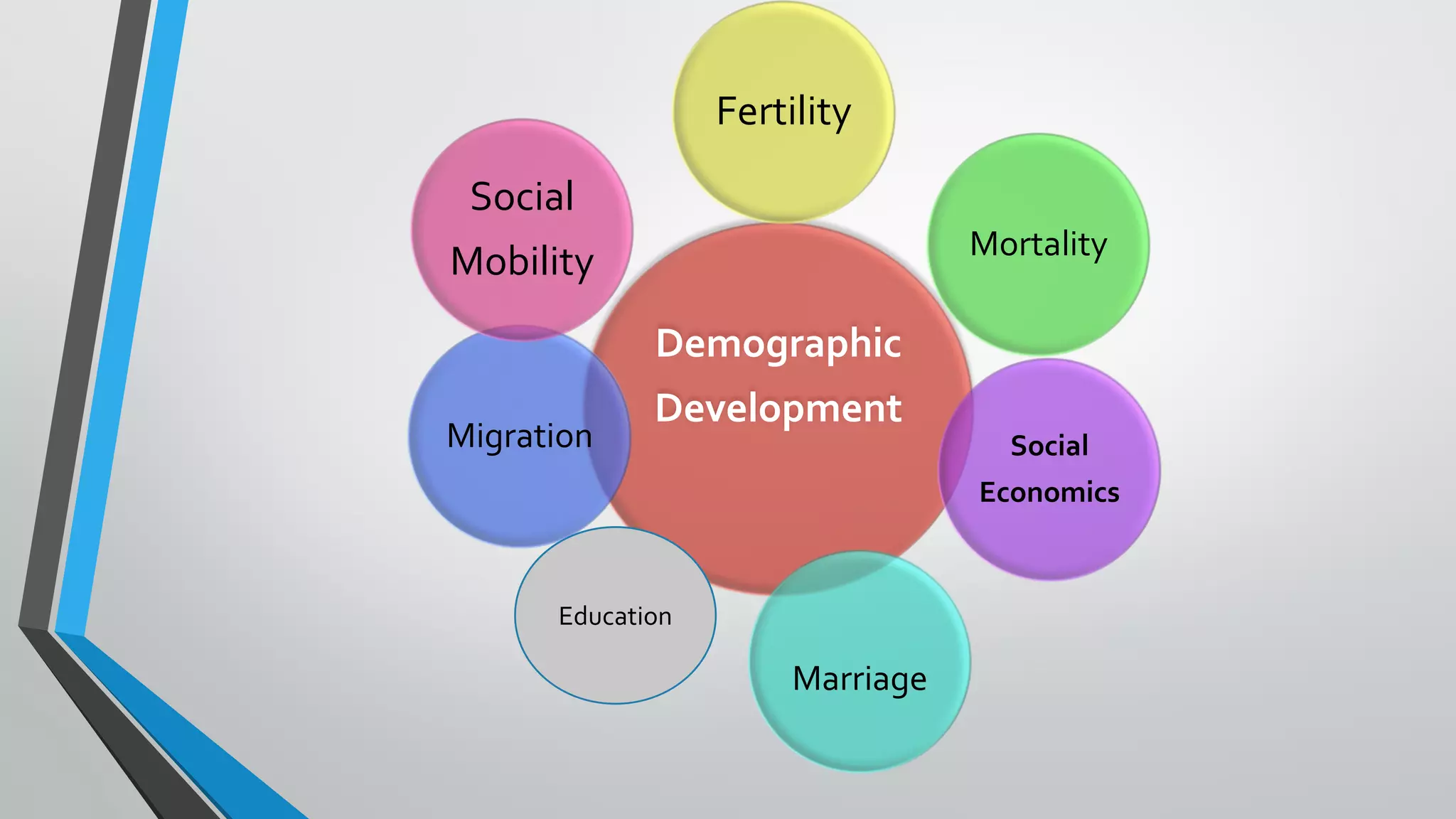
Demographic
Development
Fertility
Mortality
Marriage
Migration Social
Economics
Social
Mobility
Education
Fertility
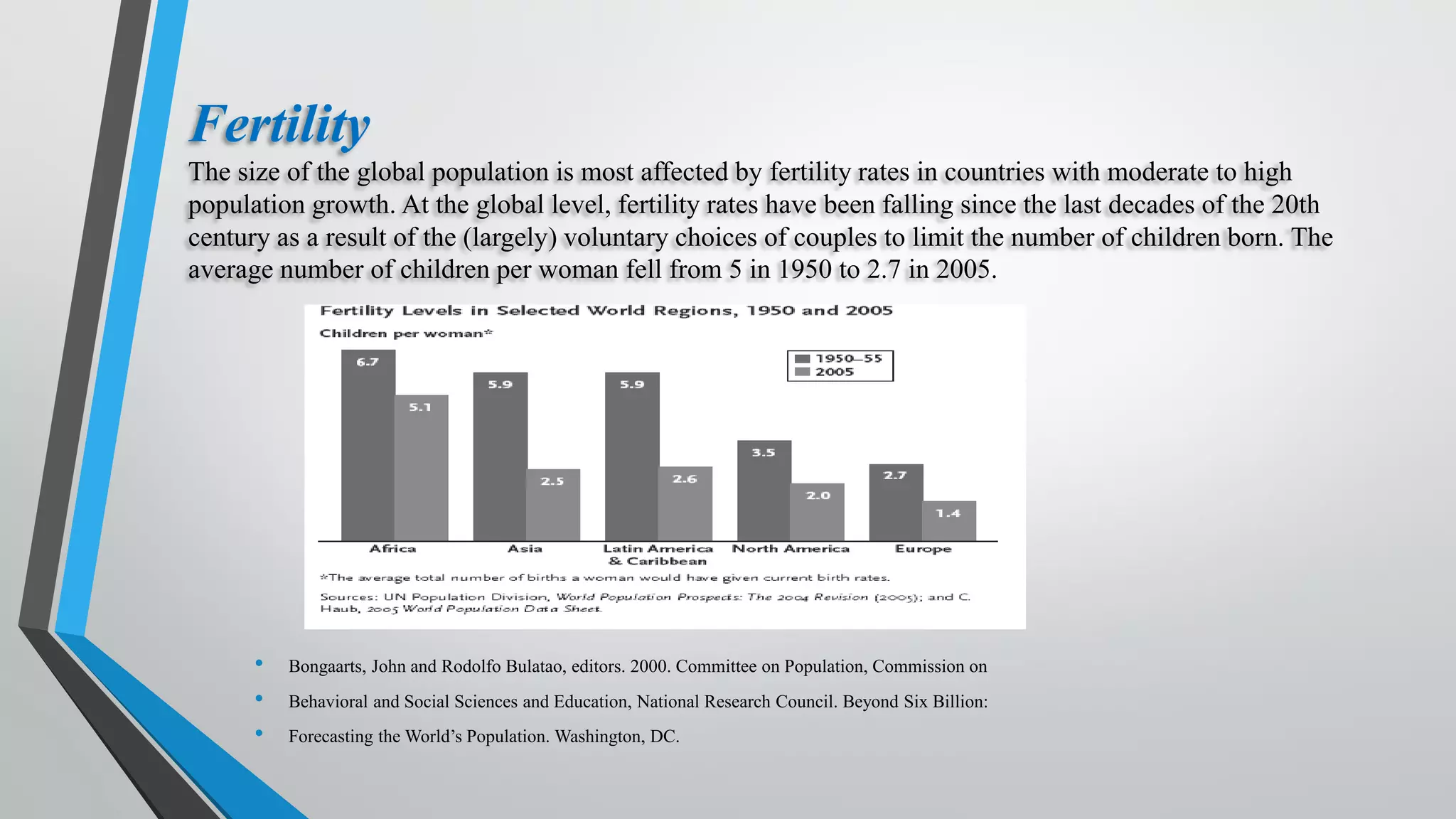
The size of the global population is most affected by fertility rates in countries with moderate to high
population growth. At the global level, fertility rates have been falling since the last decades of the 20th
century as a result of the (largely) voluntary choices of couples to limit the number of children born. The
average number of children per woman fell from 5 in 1950 to 2.7 in 2005.
• Bongaarts, John and Rodolfo Bulatao, editors. 2000. Committee on Population, Commission on
• Behavioral and Social Sciences and Education, National Research Council. Beyond Six Billion:
• Forecasting the World’s Population. Washington, DC.
Mortality
Mortality rates—determined chiefly by child countries are experiencing gains in longevity
mortality and longevity—show animprovement worldwide. Child mortality rates appear to be
improving after a period of stagnation, while more and more developing.
Child mortality. As with fertility decline, developing countries in the 20th century experienced
unprecedented gains in child survival. The fastest global improvements occurred during the
1960s as a result of substantial gains in China. Between the 1960s and 1970s, child mortality
rates fell in other parts of Asia and Latin America, while sub-Saharan Africa experienced a
marked decline around 1980.
Stalled rates of decline in child mortality. The rate of child mortality decline has slowed
since around 1980 although it may now be picking up again. The slowdown occurred
both in those countries where child mortality rates have fallen to the levels of
industrialized countries, and in high mortality regions, including sub-Saharan Africa. A
few countries with high rates of HIV prevalence (such as South Africa and Zimbabwe)
actually experienced increases in child mortality rates between 1990 and 2006.
HIV/AIDS mortality. Globally,AIDS mortality will have a modest effect on future
world population size; indeed, no single country is expected to see a decline in population
size due to AIDS.12 UNAIDS estimates that the number of new HIV infections
Robert Black, Saul Morris and Jennifer Bryce, 2003. “Where andWhy are 10 MillionChildren Dying
EveryYear?” Lancet, vol. 361: 2226-34.
See Countdown Coverage Writing Group, 2008, “Countdown to 2015” for maternal, newborn, and
child survival: the 2008 report on tracking coverage of interventions, Lancet, 371: 1247-58.
AIDS causes more than half of child deaths in some small countries, such as Botswana and
Zimbabwe. But in the 42 countries where most child deaths occur, AIDS accounts for more than 10
percent of these
deaths in only three countries (see Countdown Coverage Writing Group, 2008). Kenneth Hill,
September 12, 2008, email communication.
UN Population Division, 2005. Population Challenges and Development Goals. NewYork: United
Nations.
Immigration and economic development of sending countries
An emerging movement argues that it is no longer relevant to ask whether
immigration contributes to development but rather to ask how much it contributes.
Conventional measures of development hide the full contributions of immigration.
Better measures represent a key first step toward identifying the point at which
migration which is one of the biggest forces moving people in developing countries
out of poverty—becomes a major engine for economic development.33 A proposed
new metric, “income per natural born” resident—or the mean annual income of
persons born in a given country regardless of where a person now lives—would more
fully capture the economic benefits of development for the source country. For rich
countries there is relatively little difference between income per natural and more
conventional measures of national income.The difference is pronounced, however,
in countries where a high percentage of the population migrates to work overseas, a
move that often moves the migrant out of poverty.
33 Michael Clemens and Lant Pritchett, 2007. “Is Migration Development? Global Estimates of Income per
Natural.” Northeastern Universities Development Consortium Conference, Harvard University, Oct 26–
27.
Education
In Europe an aging population may lead to savings in public education costs. But for
many second wave countries, any savings arising from having fewer children to
educate are likely to be quickly consumed by investments in universal education and
in increasing the number of years of schooling children complete. Public spending on
education in many second wave countries ranges between 2 and 4 percent of GDP. In
settings where public financing is concentrated in the primary years (such as India),
and where governments provide relatively little financing for secondary and tertiary
education, one might expect to see this share fall to 1 percent as early as 2010.41Yet,
increases to productivity, the growth engine on which the success of emerging
market economies so greatly depends, will require improving the quality of
education, increasing enrollment in higher education, and placing greater emphasis
on costly technical and professional education.The net prospect for reducing public
education expenditures to partly offset the health and social security expenses of an
elderly population is thus much less certain in second wave countries than in the
industrialized world.
Rakesh Mohan, 2004. “Fiscal Challenges of Population Aging:The Asian Experience.” Symposium on Global
Demographic Change: Economic Implications and Policy Challenges. Jackson Hole,Wyoming. August 26–28.
Demographic development
Past, Present, and Future
The World at Six Billion
According to United Nations estimates, world population reaches the six
billion mark on 12 October 1999. The World at Six Billion was prepared
in response to the widespread global attention to this historic milestone.
The World at Six Billion provides in tabular and graphic form salient
characteristics of past, current and future world population growth. The
publication is based largely on the publications and databases of the
Population Division, including the official United Nations world population
estimates and projections, prepared and biennially updated by the
Population Division for the United Nations system
http://www.un.org/esa/population/publications/sixbillion/sixbillion.htm
HOW DEMOGRAPHY AFFECT
DEVELOPMENT ?
• Poverty and inequality
• Fertility and poverty.
• Fewer dependents , more workers and faster growth .
• Immigration and economic development of sending countries .
• Public finance (pensions, health care , education ).
• Demographic changes and infrastructure needs .
• Demographic dynamics and climate changes.
Main point
• The” demographic bonus” and “window of opportunity” (AsianTigers’ CelticTiger)
• New consensus emerging that reducing in fertility and lowering the ratio of dependent to working age population
creates a “window of opportunity” .
• At both macro and micro levels moderating fertility enhances economic prospects.
• A cohesive approach to reducing poverty and inequality requires understanding linkages to demographic change
at each level.
• Declining birth rates and raising living standards are mutually reinforcing virtuous circle. the process can be
started either through investing in family planning or investing in human development, but it works best when
they are done simultaneously .
• There is no region that many African countries, which are today where Korea was in the 1950,Should not be able
to achieve Korea like outcomes by 2050 if they pursue similar development strategies, including high quality
family planning programs.
Conclusion
The evaluation of the data quality there are some problems concerning deaths
and population counts over the age of 80 years, generation heaping and age
misstatement are at levels similar to those found in comparable countries and
that the main problems concern the centenarians overstatement of age at
death and errors in census age declarations.
Reference

How demographic change affects development

  • 2.
    How Demographic ChangeAffects Development? By Ashikur rahman mail: ashikur.rahman.nazil@gmail.com
  • 3.
    Demographic Demographic analysis, thestatistical description of human populations, is a tool used by government agencies, political parties, and manufacturers of consumer goods. Polls conducted on every topic imaginable, from age to toothpaste preference, give the government and corporations an idea of who the public is and what it needs and wants.The government's census, which is conducted every ten years, is the largest demographic survey of all. Today demographic is also being used as a noun; so, for example,TV advertisers are constantly worrying about how to appeal to "the 18-to-24-year-old demographic".
  • 4.
    So we UnderstandDemography is •Demography is the statically study of human populations. •It encompasses the study of the size, structure, and distribution of these populations, and spatial and / or temporal changes in them in response to time, birth, migration, aging, and death.
  • 5.
    Demographic Development Development meansdeveloping something where we live in society. Human live in a Society.Time to time go Human are change and development. Development effect society. Demographic means people where we are live in. So without Demographic society cant develop.We will describe D Nugent, Rachel and Barbara Seligman "How Demographic Change affects Development" Demographic and Development in the 21st century Initiative technical Background Paper, Center for Global Development.
  • 6.
    Population is undeniablyimportant, but –how, for whom, and with what consequences is a complex story.Two things are certain: • Population issues in the 21st century are different from those in the last century. • With the development world midway through an uncertain effort to reach the Millennium Development Goal by 2015, population issues will be central to the success or failure od six of the eight goals.
  • 7.
    Demographic issues areinsufficiently addressed by international agencies concerned with global development.The United Nations’ Millennium Development Goals (MDGs) provide a framework for global development assistance but omit reference to population growth, fertility, aging, or internal or international migration.The United States, which for years led the world in championing slower population growth in poor countries as a development priority, no longer includes reference to any demographic variables in its current strategic plan for foreign assistance.
  • 8.
  • 9.
    Fertility The size ofthe global population is most affected by fertility rates in countries with moderate to high population growth. At the global level, fertility rates have been falling since the last decades of the 20th century as a result of the (largely) voluntary choices of couples to limit the number of children born. The average number of children per woman fell from 5 in 1950 to 2.7 in 2005. • Bongaarts, John and Rodolfo Bulatao, editors. 2000. Committee on Population, Commission on • Behavioral and Social Sciences and Education, National Research Council. Beyond Six Billion: • Forecasting the World’s Population. Washington, DC.
  • 10.
    Mortality Mortality rates—determined chieflyby child countries are experiencing gains in longevity mortality and longevity—show animprovement worldwide. Child mortality rates appear to be improving after a period of stagnation, while more and more developing. Child mortality. As with fertility decline, developing countries in the 20th century experienced unprecedented gains in child survival. The fastest global improvements occurred during the 1960s as a result of substantial gains in China. Between the 1960s and 1970s, child mortality rates fell in other parts of Asia and Latin America, while sub-Saharan Africa experienced a marked decline around 1980. Stalled rates of decline in child mortality. The rate of child mortality decline has slowed since around 1980 although it may now be picking up again. The slowdown occurred both in those countries where child mortality rates have fallen to the levels of industrialized countries, and in high mortality regions, including sub-Saharan Africa. A few countries with high rates of HIV prevalence (such as South Africa and Zimbabwe) actually experienced increases in child mortality rates between 1990 and 2006.
  • 11.
    HIV/AIDS mortality. Globally,AIDSmortality will have a modest effect on future world population size; indeed, no single country is expected to see a decline in population size due to AIDS.12 UNAIDS estimates that the number of new HIV infections Robert Black, Saul Morris and Jennifer Bryce, 2003. “Where andWhy are 10 MillionChildren Dying EveryYear?” Lancet, vol. 361: 2226-34. See Countdown Coverage Writing Group, 2008, “Countdown to 2015” for maternal, newborn, and child survival: the 2008 report on tracking coverage of interventions, Lancet, 371: 1247-58. AIDS causes more than half of child deaths in some small countries, such as Botswana and Zimbabwe. But in the 42 countries where most child deaths occur, AIDS accounts for more than 10 percent of these deaths in only three countries (see Countdown Coverage Writing Group, 2008). Kenneth Hill, September 12, 2008, email communication. UN Population Division, 2005. Population Challenges and Development Goals. NewYork: United Nations.
  • 12.
    Immigration and economicdevelopment of sending countries An emerging movement argues that it is no longer relevant to ask whether immigration contributes to development but rather to ask how much it contributes. Conventional measures of development hide the full contributions of immigration. Better measures represent a key first step toward identifying the point at which migration which is one of the biggest forces moving people in developing countries out of poverty—becomes a major engine for economic development.33 A proposed new metric, “income per natural born” resident—or the mean annual income of persons born in a given country regardless of where a person now lives—would more fully capture the economic benefits of development for the source country. For rich countries there is relatively little difference between income per natural and more conventional measures of national income.The difference is pronounced, however, in countries where a high percentage of the population migrates to work overseas, a move that often moves the migrant out of poverty. 33 Michael Clemens and Lant Pritchett, 2007. “Is Migration Development? Global Estimates of Income per Natural.” Northeastern Universities Development Consortium Conference, Harvard University, Oct 26– 27.
  • 13.
    Education In Europe anaging population may lead to savings in public education costs. But for many second wave countries, any savings arising from having fewer children to educate are likely to be quickly consumed by investments in universal education and in increasing the number of years of schooling children complete. Public spending on education in many second wave countries ranges between 2 and 4 percent of GDP. In settings where public financing is concentrated in the primary years (such as India), and where governments provide relatively little financing for secondary and tertiary education, one might expect to see this share fall to 1 percent as early as 2010.41Yet, increases to productivity, the growth engine on which the success of emerging market economies so greatly depends, will require improving the quality of education, increasing enrollment in higher education, and placing greater emphasis on costly technical and professional education.The net prospect for reducing public education expenditures to partly offset the health and social security expenses of an elderly population is thus much less certain in second wave countries than in the industrialized world. Rakesh Mohan, 2004. “Fiscal Challenges of Population Aging:The Asian Experience.” Symposium on Global Demographic Change: Economic Implications and Policy Challenges. Jackson Hole,Wyoming. August 26–28.
  • 14.
  • 15.
    The World atSix Billion According to United Nations estimates, world population reaches the six billion mark on 12 October 1999. The World at Six Billion was prepared in response to the widespread global attention to this historic milestone. The World at Six Billion provides in tabular and graphic form salient characteristics of past, current and future world population growth. The publication is based largely on the publications and databases of the Population Division, including the official United Nations world population estimates and projections, prepared and biennially updated by the Population Division for the United Nations system http://www.un.org/esa/population/publications/sixbillion/sixbillion.htm
  • 17.
    HOW DEMOGRAPHY AFFECT DEVELOPMENT? • Poverty and inequality • Fertility and poverty. • Fewer dependents , more workers and faster growth . • Immigration and economic development of sending countries . • Public finance (pensions, health care , education ). • Demographic changes and infrastructure needs . • Demographic dynamics and climate changes.
  • 18.
    Main point • The”demographic bonus” and “window of opportunity” (AsianTigers’ CelticTiger) • New consensus emerging that reducing in fertility and lowering the ratio of dependent to working age population creates a “window of opportunity” . • At both macro and micro levels moderating fertility enhances economic prospects. • A cohesive approach to reducing poverty and inequality requires understanding linkages to demographic change at each level. • Declining birth rates and raising living standards are mutually reinforcing virtuous circle. the process can be started either through investing in family planning or investing in human development, but it works best when they are done simultaneously . • There is no region that many African countries, which are today where Korea was in the 1950,Should not be able to achieve Korea like outcomes by 2050 if they pursue similar development strategies, including high quality family planning programs.
  • 19.
    Conclusion The evaluation ofthe data quality there are some problems concerning deaths and population counts over the age of 80 years, generation heaping and age misstatement are at levels similar to those found in comparable countries and that the main problems concern the centenarians overstatement of age at death and errors in census age declarations.
  • 20.