TheTimelessnessof
LeanManagement
Presented by Sanjiv Augustine
Sanjiv.Augustine@LitheSpeed.com
@Saugustine, @LitheSpeed, @VersionOne, #AgilePalooza
State of Agile Adoption
Organizations are realizing real benefits
with agile methods…
2 State of Agile Development Survey, http://www.versionone.com
State of Agile Adoption
And so, agile adoption continues apace…
3 State of Agile Development Survey, http://www.versionone.com
State of Agile Adoption (Cont’d)
But, we need to raise our game to
overcome systemic problems…
4 State of Agile Development Survey, http://www.versionone.com
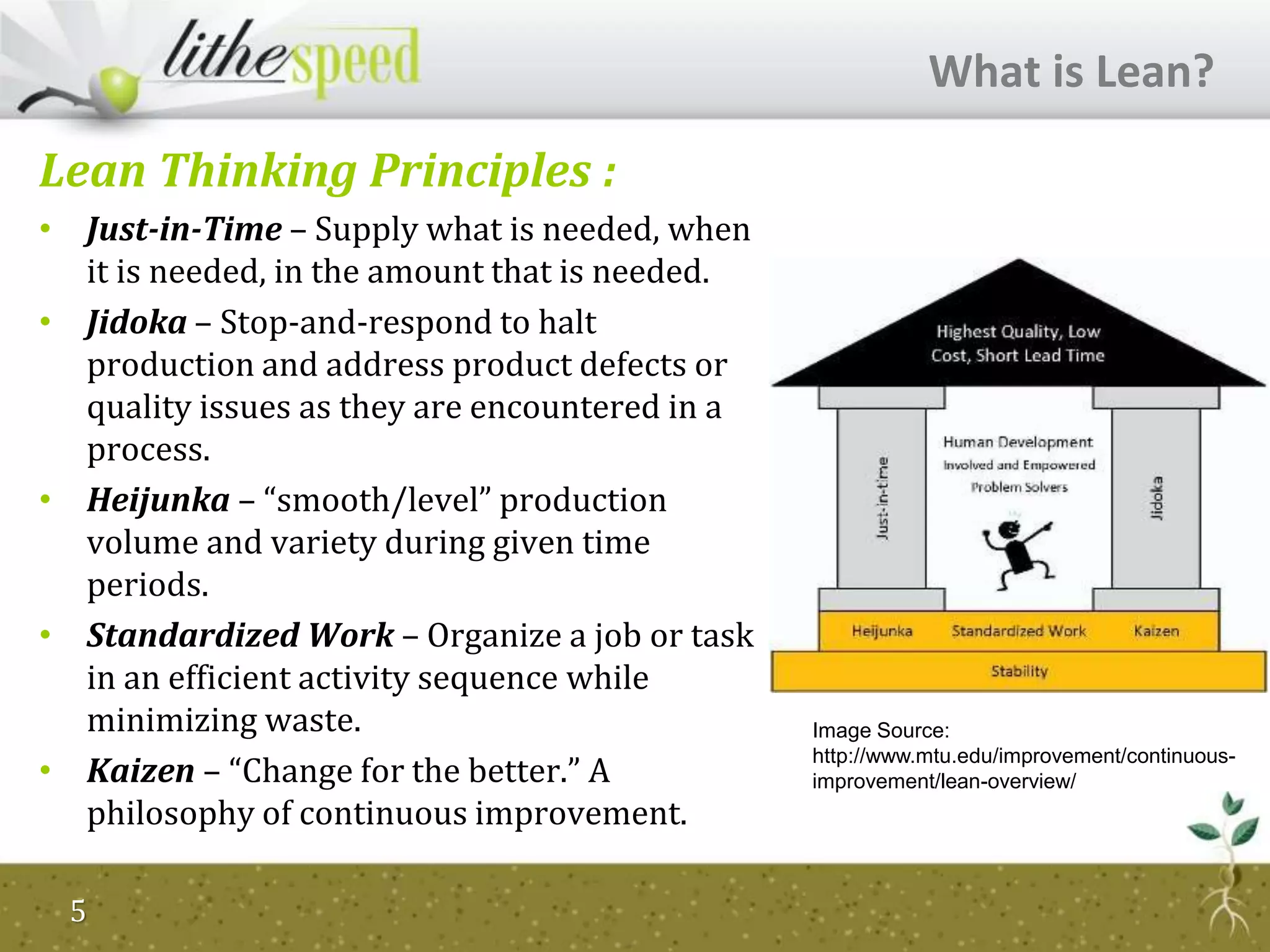
Lean Thinking Principles :
• Just-in-Time – Supply what is needed, when
it is needed, in the amount that is needed.
• Jidoka – Stop-and-respond to halt
production and address product defects or
quality issues as they are encountered in a
process.
• Heijunka – “smooth/level” production
volume and variety during given time
periods.
• Standardized Work – Organize a job or task
in an efficient activity sequence while
minimizing waste.
• Kaizen – “Change for the better.” A
philosophy of continuous improvement.
What is Lean?
Image Source:
http://www.mtu.edu/improvement/continuous-
improvement/lean-overview/
5
1. Organize around a
Network of Small
Teams
2. Drive Lean
Innovation
3. Practice Wise
Leadership
Three Timeless Lean-Agile Solutions
6
1.NetworkofSmall
Teams
Intense collaboration
via:
1. Face-to-face
communication
2. Generalizing
specialists
3. Self-discipline and
decentralized
control
Traditional Silos Customer BA Designer DeveloperPM
Core
Team
(EXAMPLE)
BA /
Tester
BA
Tester
Product
Owner
Developer
Designer
Developer /
BA
SM
Release
Manager
Capacity
Planner
Prod.
Architect
Tech
Ops
Business
Sponsor
Risk
Assessor
Security
A Sample Agile Team
8
BAAnalysts
DeveloperDeveloperDeveloper
Designers Tester
The Core Project
Team ideally
consists of 5-9
dedicated members
(7 +/- 2).
The Extended Team
can contain many
additional
members, each
playing an
important role, but
they are typically
not dedicated to
the effort.
TesterTestersDevs
9
“…for a large organization to
work it must behave like a
related group of small
organizations.”
- E. F. Schumacher , Small is
Beautiful
Scaling may require, at
certain levels:
• Chief ScrumMasters
• Strategic Product Owners
• Tactical Product Owners
• Lightweight Agile PMOs
serving as a “guiding
coalition”
Network of Small Teams
Accelerate! By John Kotter, HBR, November 2012
• Encourage face-to-face dialogue across levels
• Create overlapping management with “linking pins”
• Run the Council as an Agile project team
Source: The Lean-Agile PMO, Sanjiv Augustine and Roland Cuellar (Cutter
Consortium 2006)
10
Lean-Agile PMO
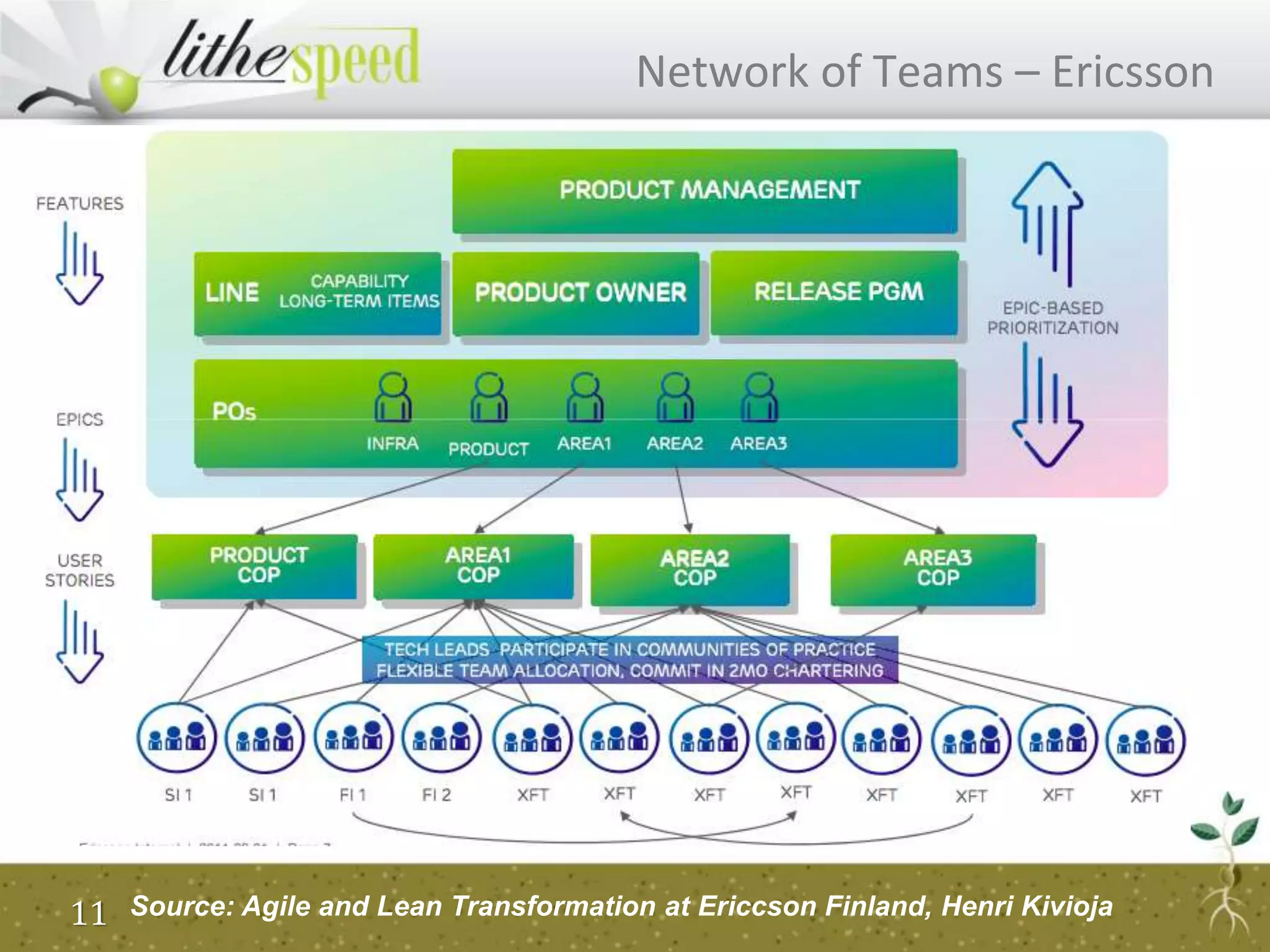
Network of Teams – Ericsson
11 Source: Agile and Lean Transformation at Ericcson Finland, Henri Kivioja
2.LeanInnovation
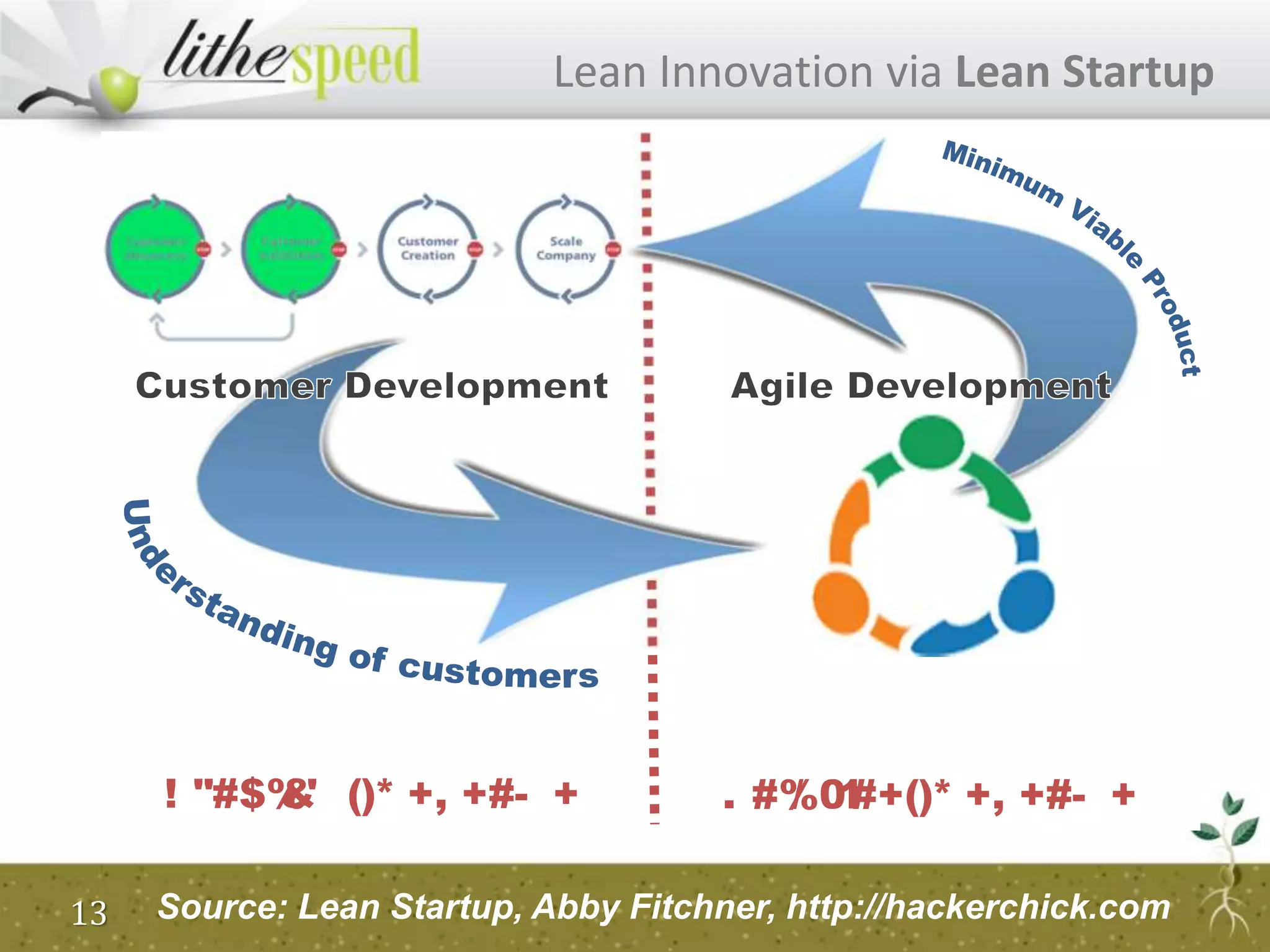
Lean Innovation via Lean Startup
13
! "#$%&' ()* +, +#- + . #%/ 01#+()* +, +#- +
Source: Lean Startup, Abby Fitchner, http://hackerchick.com
Lean Startup Methodology
14
Thanks to Ash Maurya, author of Running Lean:
http://www.runningleanhq.com/
Lean Startup in a Nutshell
• Clear, short-term experiments
• Direct customer observation and
interaction
• Release planning informed by
feedback data
• High-quality agile development with
strong UX
15
Process Execution
Product Planning
In the RoomOutside the Room
Pre-
Discovery
Discovery
Release
Planning
Sprint
Planning
Sprint
Review
Sprint
Participants:
• Product Team
• IT Architecture
• UX Team
• Key Business
Stakeholders
Participants:
• Whole Team
• Key Business
Stakeholders
16
Incorporating UX into Agile
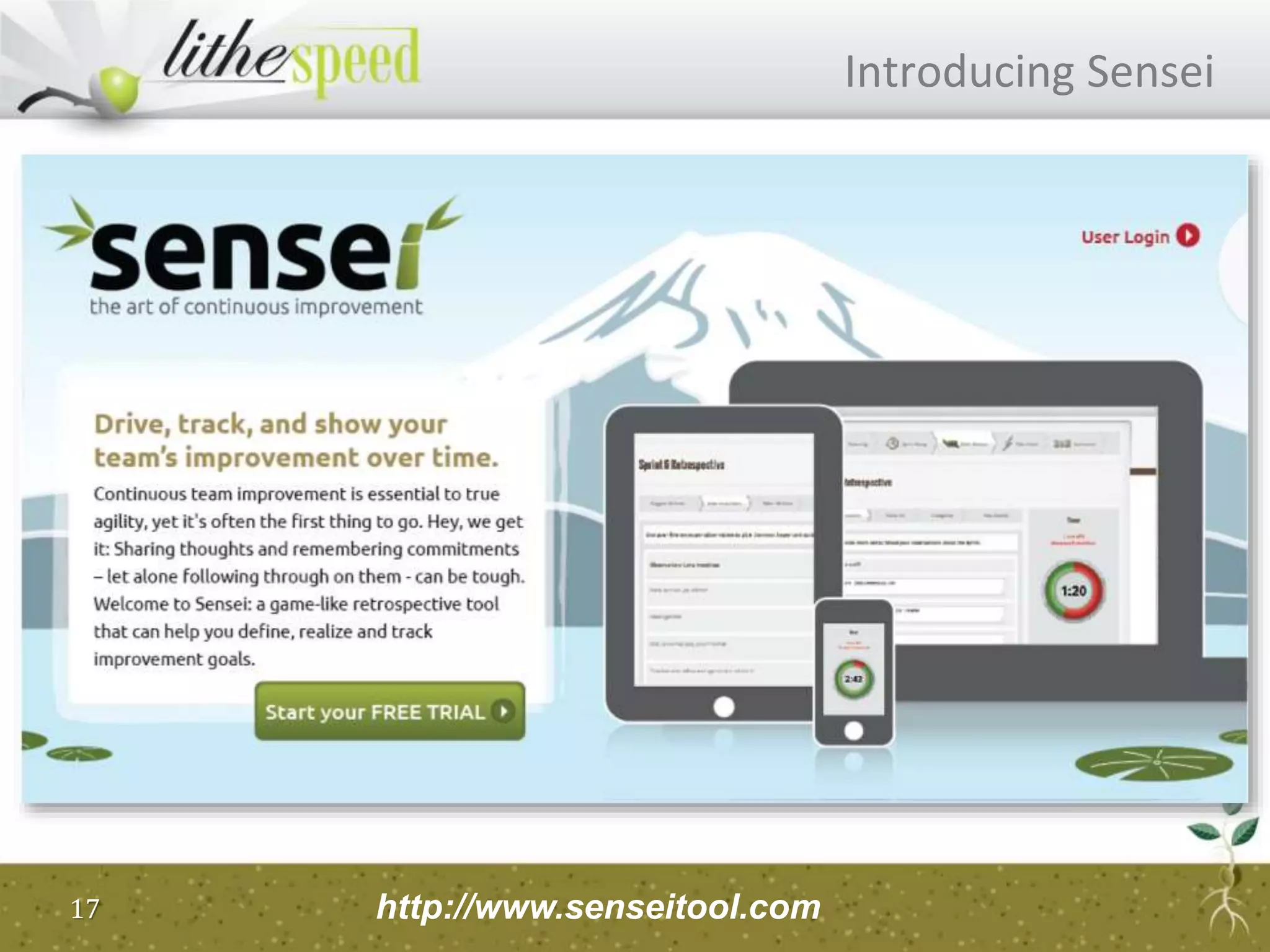
Introducing Sensei
17 http://www.senseitool.com
Sensei Lean Startup
18
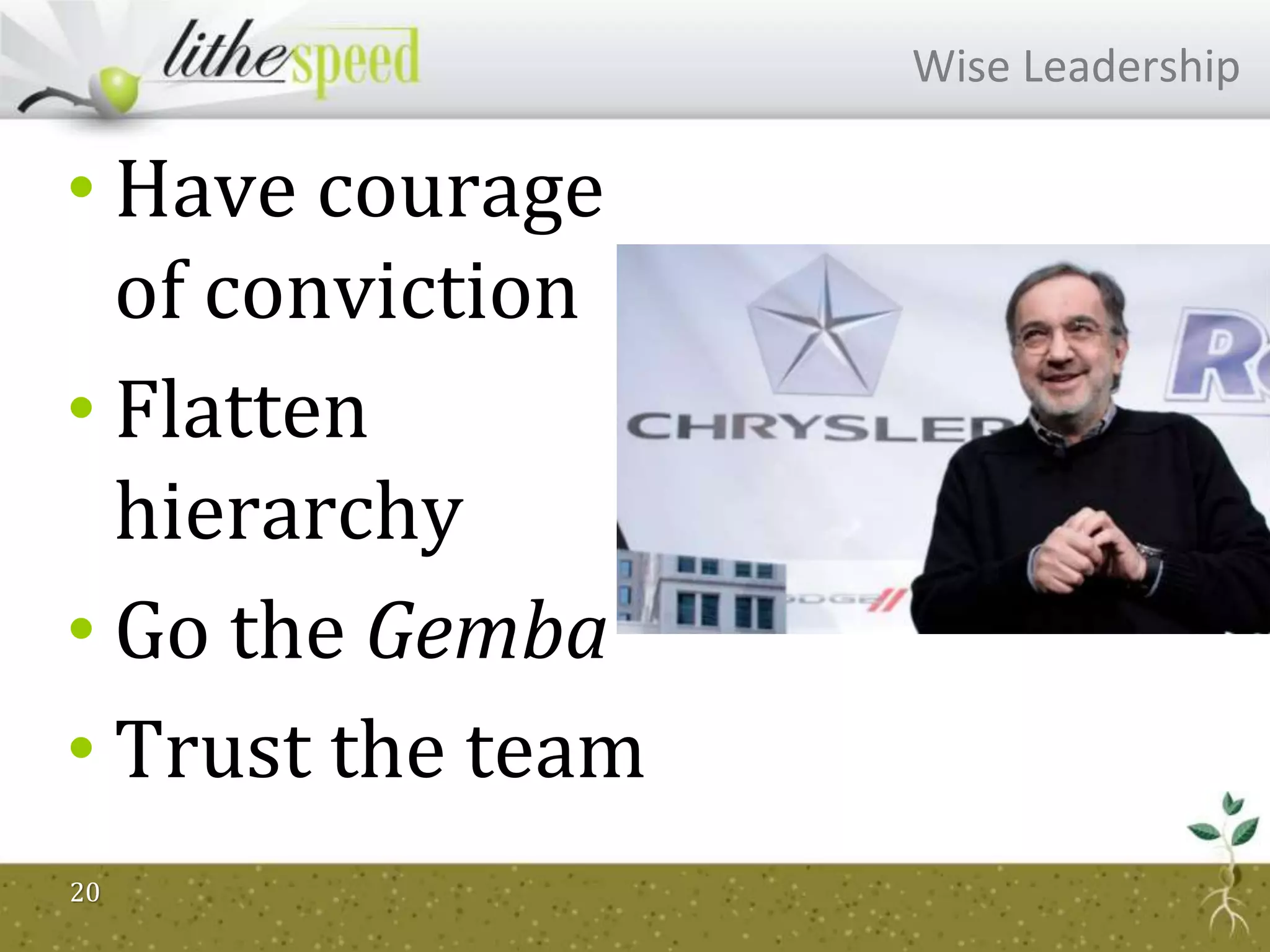
3.WiseLeadership
• Have courage
of conviction
• Flatten
hierarchy
• Go the Gemba
• Trust the team
20
Wise Leadership
21
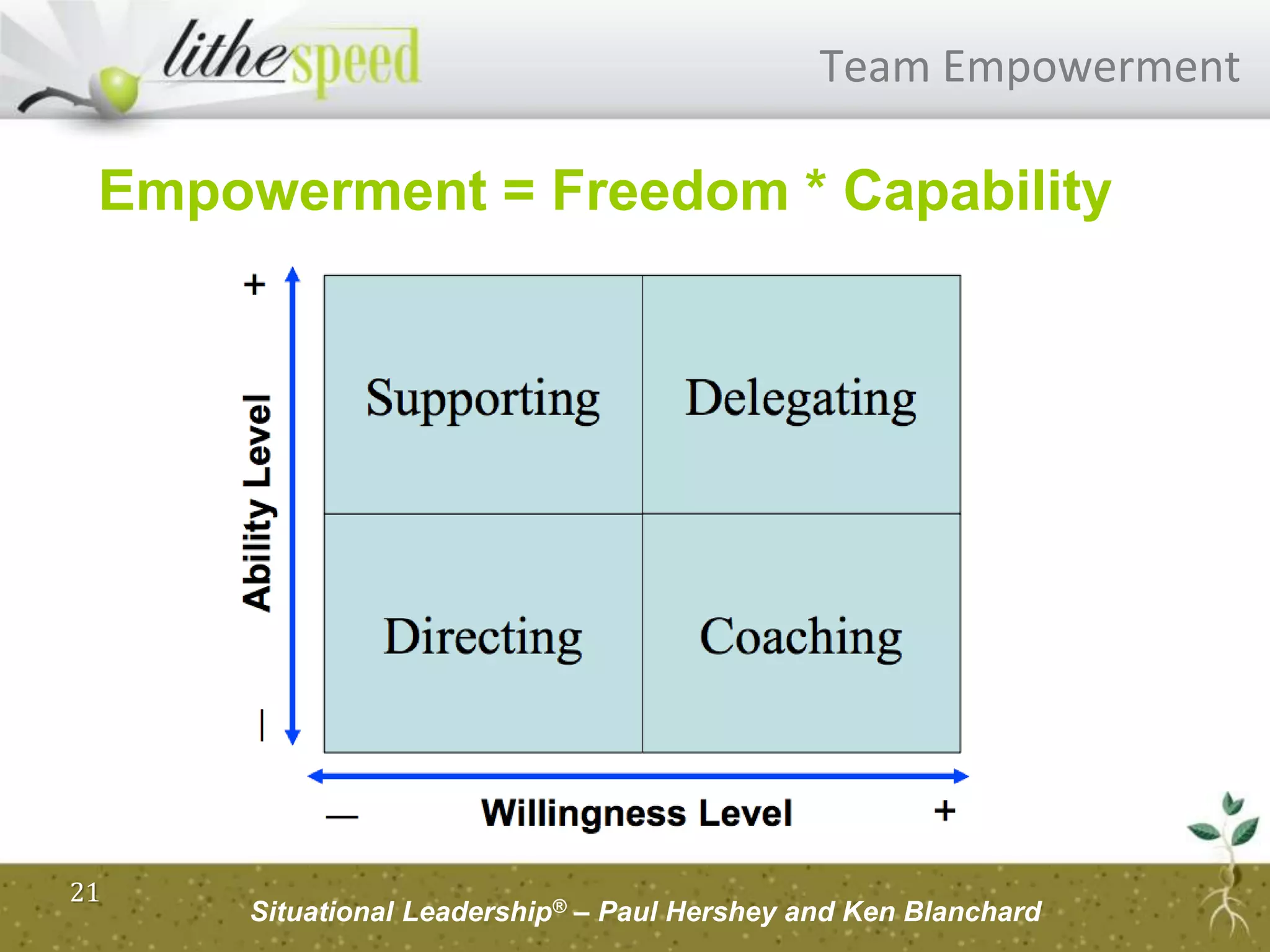
Team Empowerment
Empowerment = Freedom * Capability
Situational Leadership® – Paul Hershey and Ken Blanchard
• Knowledge workers need responsibility
for their own productivity:
o Knowledge drives productivity
o Continuous innovation, learning and teaching
need to be part of the job
o Knowledge worker productivity is dependent on
quality at least as much as quantity
o Optimal quality is the path to high productivity
• Knowledge workers must understand:
o What is our business?
o Who is our customer?
o What does our customer consider valuable?
Team Empowerment
22
1. Organize around a
Network of Small
Teams
2. Drive Lean
Innovation
3. Practice Wise
Leadership
Three Timeless Lean-Agile Solutions
23
24
Contact Us for Further Information
Sanjiv Augustine
President
Sanjiv.Augustine@LitheSpeed.com
Twitter: @saugustine, @lithespeed
On the Web:
http://www.lithespeed.com
http://www.senseitool.com
http://www.sanjivaugustine.com
"I only wish I had read this book when I started my career in
software product management, or even better yet, when I was
given my first project to manage. In addition to providing an
excellent handbook for managing with agile software development
methodologies, Managing Agile Projects offers a guide to more
effective project management in many business settings."
John P. Barnes, former Vice President of Product Management at
Emergis, Inc.
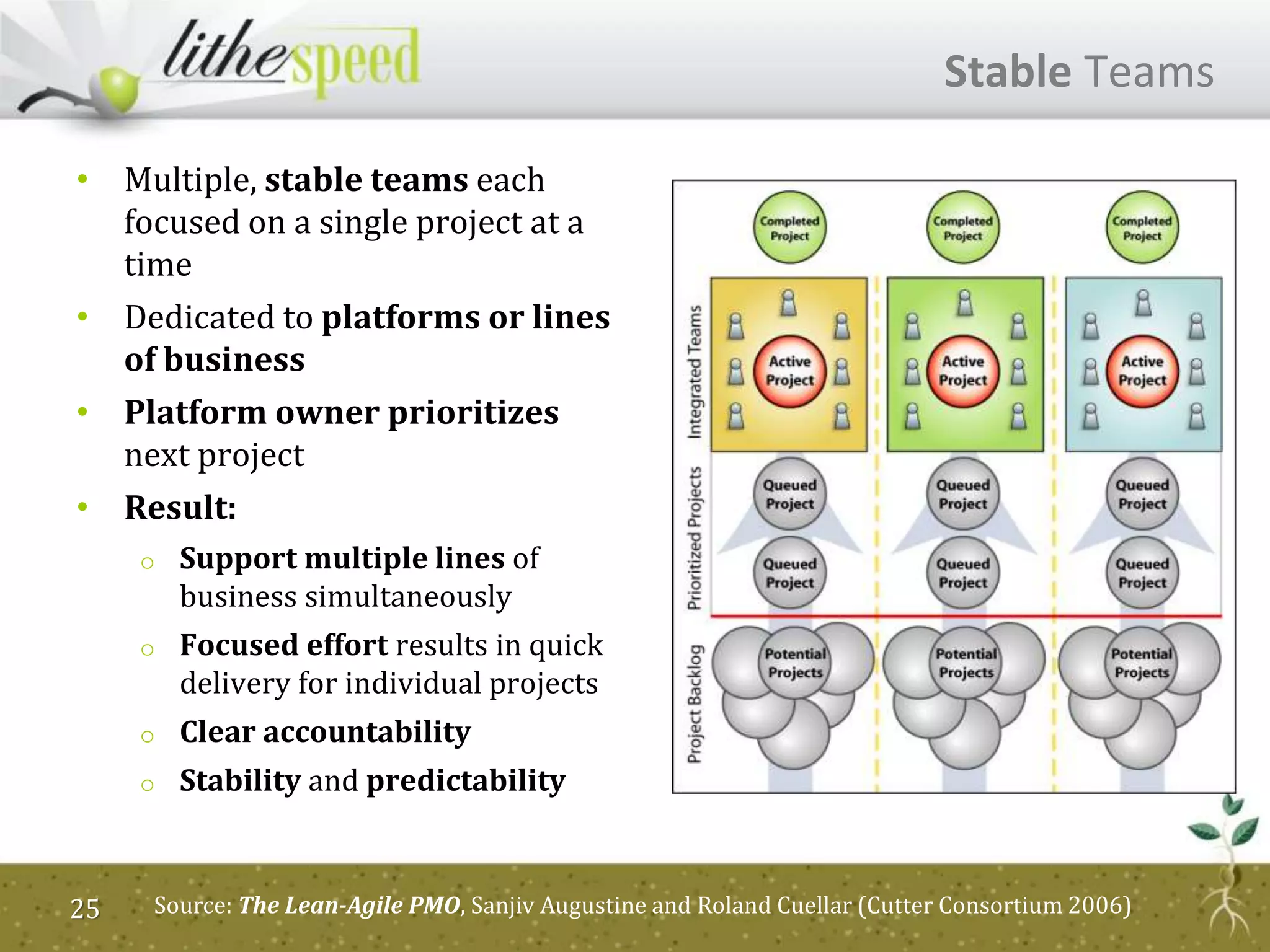
• Multiple, stable teams each
focused on a single project at a
time
• Dedicated to platforms or lines
of business
• Platform owner prioritizes
next project
• Result:
o Support multiple lines of
business simultaneously
o Focused effort results in quick
delivery for individual projects
o Clear accountability
o Stability and predictability
Source: The Lean-Agile PMO, Sanjiv Augustine and Roland Cuellar (Cutter Consortium 2006)25
Stable Teams

The Timelessness of Lean Management

  • 1.
    TheTimelessnessof LeanManagement Presented by SanjivAugustine Sanjiv.Augustine@LitheSpeed.com @Saugustine, @LitheSpeed, @VersionOne, #AgilePalooza
  • 2.
    State of AgileAdoption Organizations are realizing real benefits with agile methods… 2 State of Agile Development Survey, http://www.versionone.com
  • 3.
    State of AgileAdoption And so, agile adoption continues apace… 3 State of Agile Development Survey, http://www.versionone.com
  • 4.
    State of AgileAdoption (Cont’d) But, we need to raise our game to overcome systemic problems… 4 State of Agile Development Survey, http://www.versionone.com
  • 5.
    Lean Thinking Principles: • Just-in-Time – Supply what is needed, when it is needed, in the amount that is needed. • Jidoka – Stop-and-respond to halt production and address product defects or quality issues as they are encountered in a process. • Heijunka – “smooth/level” production volume and variety during given time periods. • Standardized Work – Organize a job or task in an efficient activity sequence while minimizing waste. • Kaizen – “Change for the better.” A philosophy of continuous improvement. What is Lean? Image Source: http://www.mtu.edu/improvement/continuous- improvement/lean-overview/ 5
  • 6.
    1. Organize arounda Network of Small Teams 2. Drive Lean Innovation 3. Practice Wise Leadership Three Timeless Lean-Agile Solutions 6
  • 7.
  • 8.
    Intense collaboration via: 1. Face-to-face communication 2.Generalizing specialists 3. Self-discipline and decentralized control Traditional Silos Customer BA Designer DeveloperPM Core Team (EXAMPLE) BA / Tester BA Tester Product Owner Developer Designer Developer / BA SM Release Manager Capacity Planner Prod. Architect Tech Ops Business Sponsor Risk Assessor Security A Sample Agile Team 8 BAAnalysts DeveloperDeveloperDeveloper Designers Tester The Core Project Team ideally consists of 5-9 dedicated members (7 +/- 2). The Extended Team can contain many additional members, each playing an important role, but they are typically not dedicated to the effort. TesterTestersDevs
  • 9.
    9 “…for a largeorganization to work it must behave like a related group of small organizations.” - E. F. Schumacher , Small is Beautiful Scaling may require, at certain levels: • Chief ScrumMasters • Strategic Product Owners • Tactical Product Owners • Lightweight Agile PMOs serving as a “guiding coalition” Network of Small Teams Accelerate! By John Kotter, HBR, November 2012
  • 10.
    • Encourage face-to-facedialogue across levels • Create overlapping management with “linking pins” • Run the Council as an Agile project team Source: The Lean-Agile PMO, Sanjiv Augustine and Roland Cuellar (Cutter Consortium 2006) 10 Lean-Agile PMO
  • 11.
    Network of Teams– Ericsson 11 Source: Agile and Lean Transformation at Ericcson Finland, Henri Kivioja
  • 12.
  • 13.
    Lean Innovation viaLean Startup 13 ! "#$%&' ()* +, +#- + . #%/ 01#+()* +, +#- + Source: Lean Startup, Abby Fitchner, http://hackerchick.com
  • 14.
    Lean Startup Methodology 14 Thanksto Ash Maurya, author of Running Lean: http://www.runningleanhq.com/
  • 15.
    Lean Startup ina Nutshell • Clear, short-term experiments • Direct customer observation and interaction • Release planning informed by feedback data • High-quality agile development with strong UX 15
  • 16.
    Process Execution Product Planning Inthe RoomOutside the Room Pre- Discovery Discovery Release Planning Sprint Planning Sprint Review Sprint Participants: • Product Team • IT Architecture • UX Team • Key Business Stakeholders Participants: • Whole Team • Key Business Stakeholders 16 Incorporating UX into Agile
  • 17.
  • 18.
  • 19.
  • 20.
    • Have courage ofconviction • Flatten hierarchy • Go the Gemba • Trust the team 20 Wise Leadership
  • 21.
    21 Team Empowerment Empowerment =Freedom * Capability Situational Leadership® – Paul Hershey and Ken Blanchard
  • 22.
    • Knowledge workersneed responsibility for their own productivity: o Knowledge drives productivity o Continuous innovation, learning and teaching need to be part of the job o Knowledge worker productivity is dependent on quality at least as much as quantity o Optimal quality is the path to high productivity • Knowledge workers must understand: o What is our business? o Who is our customer? o What does our customer consider valuable? Team Empowerment 22
  • 23.
    1. Organize arounda Network of Small Teams 2. Drive Lean Innovation 3. Practice Wise Leadership Three Timeless Lean-Agile Solutions 23
  • 24.
    24 Contact Us forFurther Information Sanjiv Augustine President Sanjiv.Augustine@LitheSpeed.com Twitter: @saugustine, @lithespeed On the Web: http://www.lithespeed.com http://www.senseitool.com http://www.sanjivaugustine.com "I only wish I had read this book when I started my career in software product management, or even better yet, when I was given my first project to manage. In addition to providing an excellent handbook for managing with agile software development methodologies, Managing Agile Projects offers a guide to more effective project management in many business settings." John P. Barnes, former Vice President of Product Management at Emergis, Inc.
  • 25.
    • Multiple, stableteams each focused on a single project at a time • Dedicated to platforms or lines of business • Platform owner prioritizes next project • Result: o Support multiple lines of business simultaneously o Focused effort results in quick delivery for individual projects o Clear accountability o Stability and predictability Source: The Lean-Agile PMO, Sanjiv Augustine and Roland Cuellar (Cutter Consortium 2006)25 Stable Teams