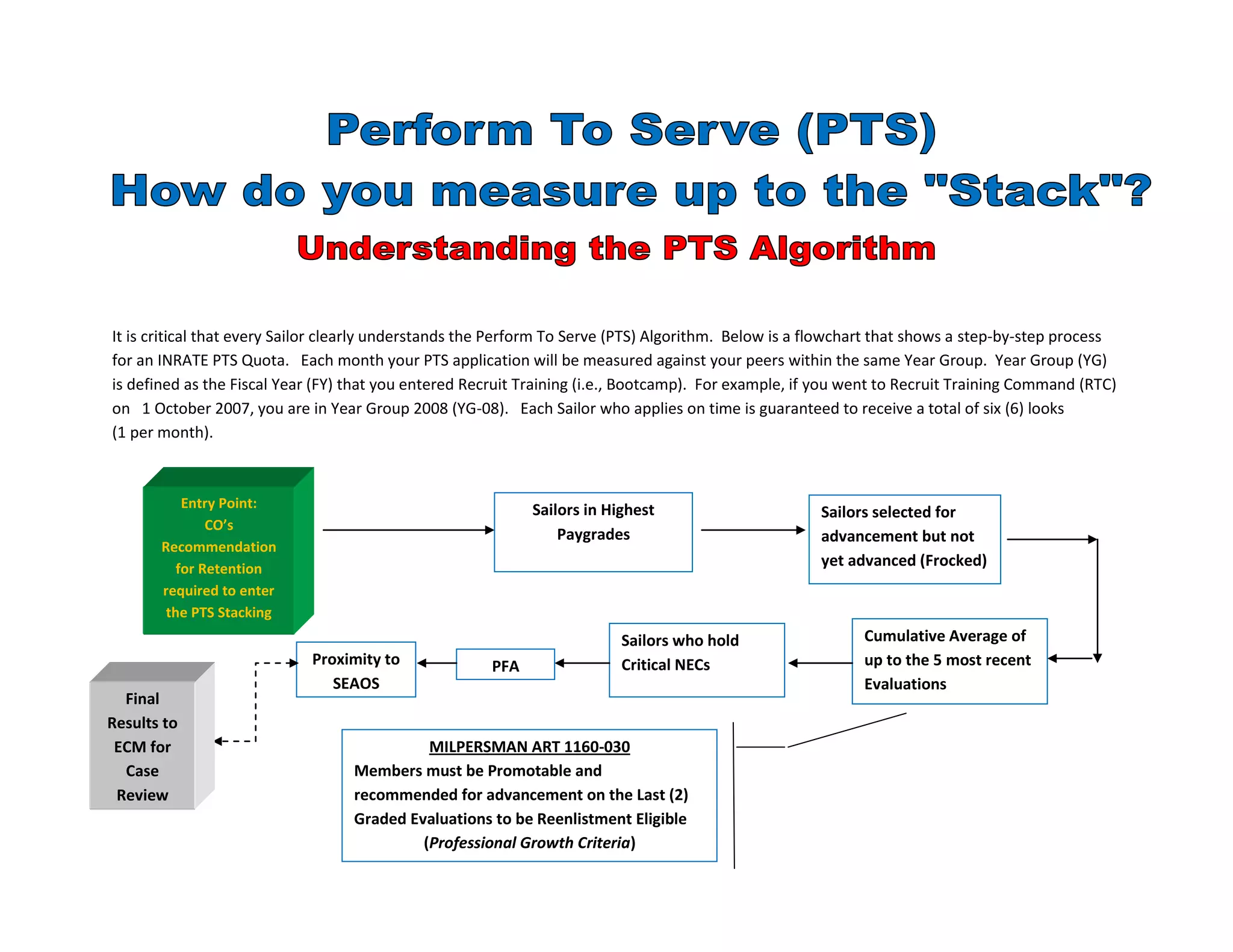
It is critical that every Sailor clearly understands the Perform To Serve (PTS) Algorithm. Below is a flowchart that shows a step-by-step process
for an INRATE PTS Quota. Each month your PTS application will be measured against your peers within the same Year Group. Year Group (YG)
is defined as the Fiscal Year (FY) that you entered Recruit Training (i.e., Bootcamp). For example, if you went to Recruit Training Command (RTC)
on 1 October 2007, you are in Year Group 2008 (YG-08). Each Sailor who applies on time is guaranteed to receive a total of six (6) looks
(1 per month).


            Entry Point:                                    Sailors in Highest                        Sailors selected for
                CO’s
                                                                Paygrades                             advancement but not
        Recommendation
           for Retention
                                                                                                      yet advanced (Frocked)
        required to enter
         the PTS Stacking
                                                                         Sailors who hold                   Cumulative Average of
                            Proximity to              PFA                Critical NECs                      up to the 5 most recent
                               SEAOS                                                                        Evaluations
  Final
Results to
 ECM for                                    MILPERSMAN ART 1160-030
   Case                           Members must be Promotable and
 Below is the r’
 Review                           recommended for advancement on the Last (2)
                                  Graded Evaluations to be Reenlistment Eligible
                                           (Professional Growth Criteria)
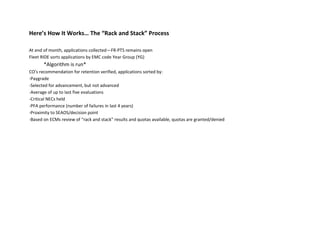
Here’s How It Works… The “Rack and Stack” Process

At end of month, applications collected—FR-PTS remains open
Fleet RIDE sorts applications by EMC code Year Group (YG)
       *Algorithm is run*
CO’s recommendation for retention verified, applications sorted by:
-Paygrade
-Selected for advancement, but not advanced
-Average of up to last five evaluations
-Critical NECs held
-PFA performance (number of failures in last 4 years)
-Proximity to SEAOS/decision point
-Based on ECMs review of “rack and stack” results and quotas available, quotas are granted/denied
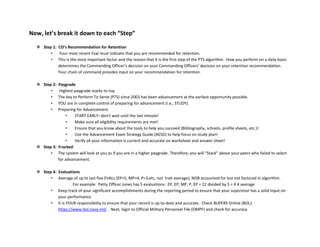
Now, let’s break it down to each “Step”

   Step 1: CO’s Recommendation for Retention
        •   Your most recent Eval must indicate that you are recommended for retention.
        • This is the most important factor and the reason that it is the first step of the PTS algorithm. How you perform on a daily basis
            determines the Commanding Officer’s decision on your Commanding Officers’ decision on your retention recommendation.
            Your chain of command provides input on your recommendation for retention.

   Step 2: Paygrade
        •    Highest paygrade stacks to top
        •   The key to Perform To Serve (PTS) since 2003 has been advancement at the earliest opportunity possible.
        •   YOU are in complete control of preparing for advancement (i.e., STUDY).
        •   Preparing for Advancement
                •    START EARLY--don’t wait until the last minute!
                •    Make sure all eligibility requirements are met!
                •    Ensure that you know about the tools to help you succeed (Bibliography, schools, profile sheets, etc.)!
                •    Use the Advancement Exam Strategy Guide (AESG) to help focus on study plan!
                •    Verify all your information is current and accurate on worksheet and answer sheet!
   Step 3: Frocked
        • The system will look at you as if you are in a higher paygrade. Therefore, you will “Stack” above your peers who failed to select
            for advancement.

   Step 4: Evaluations
        • Average of up to last five EVALs (EP=5, MP=4, P=3,etc, not trait average); NOB accounted for but not factored in algorithm.
                    For example: Petty Officer Jones has 5 evaluations: EP, EP, MP, P, EP = 22 divided by 5 = 4.4 average
        • Keep track of your significant accomplishments during the reporting period to ensure that your supervisor has a solid input on
            your performance.
        • It is YOUR responsibility to ensure that your record is up-to-date and accurate. Check BUPERS Online (BOL):
            https://www.bol.navy.mil/ . Next, login to Official Military Personnel File (OMPF) and check for accuracy.
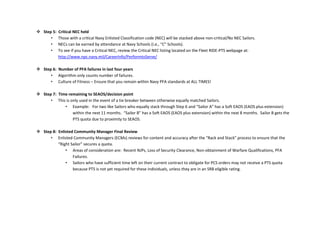
 Step 5:   Critical NEC held
      •     Those with a critical Navy Enlisted Classification code (NEC) will be stacked above non-critical/No NEC Sailors.
      •     NECs can be earned by attendance at Navy Schools (i.e., “C” Schools).
      •     To see if you have a Critical NEC, review the Critical NEC listing located on the Fleet RIDE-PTS webpage at:
            http://www.npc.navy.mil/CareerInfo/PerformtoServe/

 Step 6: Number of PFA failures in last four years
      • Algorithm only counts number of failures.
      • Culture of Fitness – Ensure that you remain within Navy PFA standards at ALL TIMES!

 Step 7: Time remaining to SEAOS/decision point
      • This is only used in the event of a tie breaker between otherwise equally matched Sailors.
             • Example: For two like Sailors who equally stack through Step 6 and “Sailor A” has a Soft EAOS (EAOS plus extension)
                 within the next 11 months. “Sailor B” has a Soft EAOS (EAOS plus extension) within the next 8 months. Sailor B gets the
                 PTS quota due to proximity to SEAOS.

 Step 8: Enlisted Community Manager Final Review
      • Enlisted Community Managers (ECMs) reviews for content and accuracy after the “Rack and Stack” process to ensure that the
          “Right Sailor” secures a quota.
              • Areas of consideration are: Recent NJPs, Loss of Security Clearance, Non-obtainment of Warfare Qualifications, PFA
                  Failures.
              • Sailors who have sufficient time left on their current contract to obligate for PCS orders may not receive a PTS quota
                  because PTS is not yet required for these individuals, unless they are in an SRB eligible rating.

The stack

  • 1.
    It is criticalthat every Sailor clearly understands the Perform To Serve (PTS) Algorithm. Below is a flowchart that shows a step-by-step process for an INRATE PTS Quota. Each month your PTS application will be measured against your peers within the same Year Group. Year Group (YG) is defined as the Fiscal Year (FY) that you entered Recruit Training (i.e., Bootcamp). For example, if you went to Recruit Training Command (RTC) on 1 October 2007, you are in Year Group 2008 (YG-08). Each Sailor who applies on time is guaranteed to receive a total of six (6) looks (1 per month). Entry Point: Sailors in Highest Sailors selected for CO’s Paygrades advancement but not Recommendation for Retention yet advanced (Frocked) required to enter the PTS Stacking Sailors who hold Cumulative Average of Proximity to PFA Critical NECs up to the 5 most recent SEAOS Evaluations Final Results to ECM for MILPERSMAN ART 1160-030 Case Members must be Promotable and Below is the r’ Review recommended for advancement on the Last (2) Graded Evaluations to be Reenlistment Eligible (Professional Growth Criteria)
  • 2.
    Here’s How ItWorks… The “Rack and Stack” Process At end of month, applications collected—FR-PTS remains open Fleet RIDE sorts applications by EMC code Year Group (YG) *Algorithm is run* CO’s recommendation for retention verified, applications sorted by: -Paygrade -Selected for advancement, but not advanced -Average of up to last five evaluations -Critical NECs held -PFA performance (number of failures in last 4 years) -Proximity to SEAOS/decision point -Based on ECMs review of “rack and stack” results and quotas available, quotas are granted/denied
  • 3.
    Now, let’s breakit down to each “Step”  Step 1: CO’s Recommendation for Retention • Your most recent Eval must indicate that you are recommended for retention. • This is the most important factor and the reason that it is the first step of the PTS algorithm. How you perform on a daily basis determines the Commanding Officer’s decision on your Commanding Officers’ decision on your retention recommendation. Your chain of command provides input on your recommendation for retention.  Step 2: Paygrade • Highest paygrade stacks to top • The key to Perform To Serve (PTS) since 2003 has been advancement at the earliest opportunity possible. • YOU are in complete control of preparing for advancement (i.e., STUDY). • Preparing for Advancement • START EARLY--don’t wait until the last minute! • Make sure all eligibility requirements are met! • Ensure that you know about the tools to help you succeed (Bibliography, schools, profile sheets, etc.)! • Use the Advancement Exam Strategy Guide (AESG) to help focus on study plan! • Verify all your information is current and accurate on worksheet and answer sheet!  Step 3: Frocked • The system will look at you as if you are in a higher paygrade. Therefore, you will “Stack” above your peers who failed to select for advancement.  Step 4: Evaluations • Average of up to last five EVALs (EP=5, MP=4, P=3,etc, not trait average); NOB accounted for but not factored in algorithm. For example: Petty Officer Jones has 5 evaluations: EP, EP, MP, P, EP = 22 divided by 5 = 4.4 average • Keep track of your significant accomplishments during the reporting period to ensure that your supervisor has a solid input on your performance. • It is YOUR responsibility to ensure that your record is up-to-date and accurate. Check BUPERS Online (BOL): https://www.bol.navy.mil/ . Next, login to Official Military Personnel File (OMPF) and check for accuracy.
  • 4.
     Step 5: Critical NEC held • Those with a critical Navy Enlisted Classification code (NEC) will be stacked above non-critical/No NEC Sailors. • NECs can be earned by attendance at Navy Schools (i.e., “C” Schools). • To see if you have a Critical NEC, review the Critical NEC listing located on the Fleet RIDE-PTS webpage at: http://www.npc.navy.mil/CareerInfo/PerformtoServe/  Step 6: Number of PFA failures in last four years • Algorithm only counts number of failures. • Culture of Fitness – Ensure that you remain within Navy PFA standards at ALL TIMES!  Step 7: Time remaining to SEAOS/decision point • This is only used in the event of a tie breaker between otherwise equally matched Sailors. • Example: For two like Sailors who equally stack through Step 6 and “Sailor A” has a Soft EAOS (EAOS plus extension) within the next 11 months. “Sailor B” has a Soft EAOS (EAOS plus extension) within the next 8 months. Sailor B gets the PTS quota due to proximity to SEAOS.  Step 8: Enlisted Community Manager Final Review • Enlisted Community Managers (ECMs) reviews for content and accuracy after the “Rack and Stack” process to ensure that the “Right Sailor” secures a quota. • Areas of consideration are: Recent NJPs, Loss of Security Clearance, Non-obtainment of Warfare Qualifications, PFA Failures. • Sailors who have sufficient time left on their current contract to obligate for PCS orders may not receive a PTS quota because PTS is not yet required for these individuals, unless they are in an SRB eligible rating.