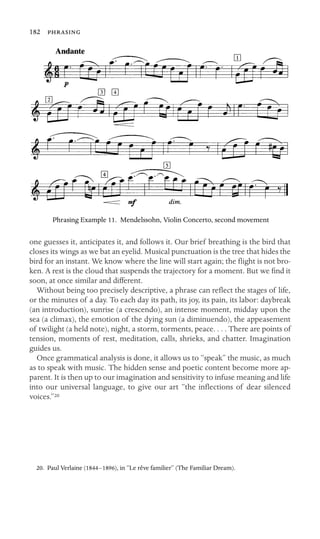
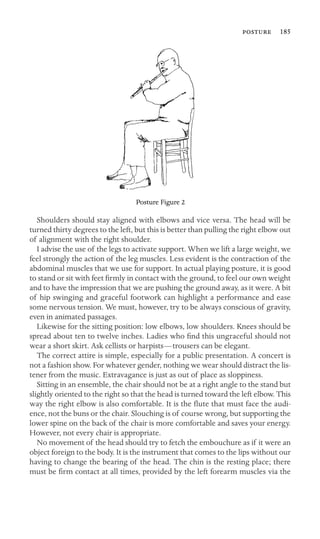
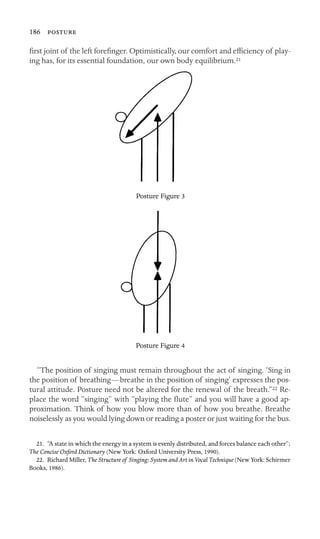
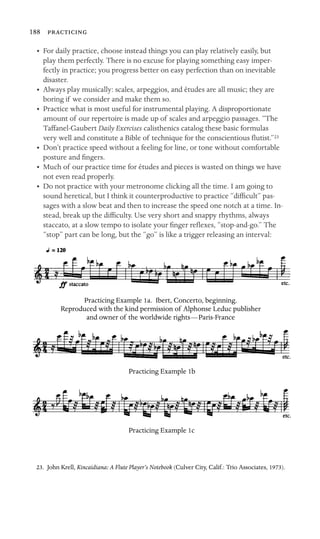
The Simple Flute:

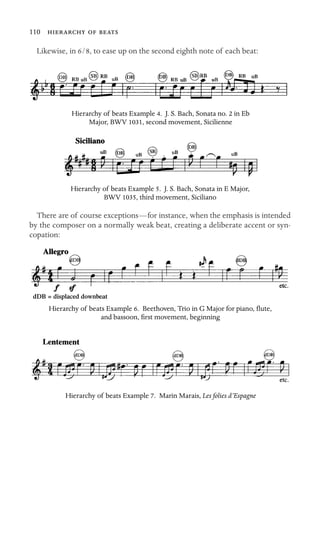
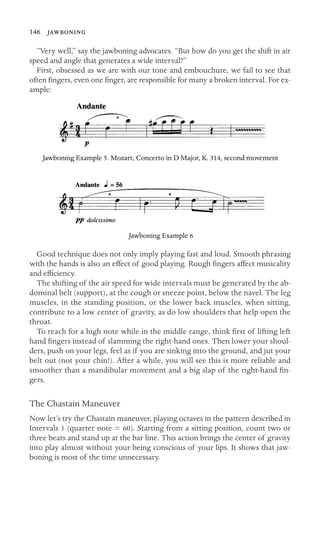
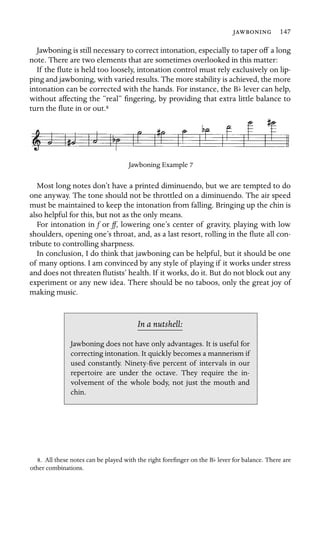
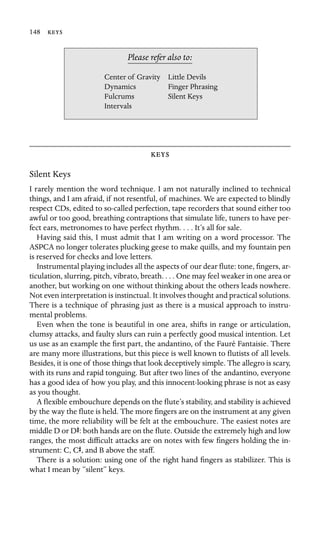
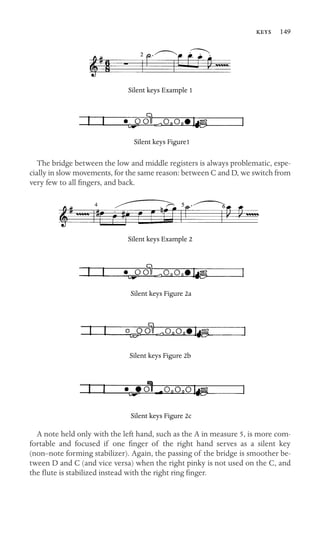
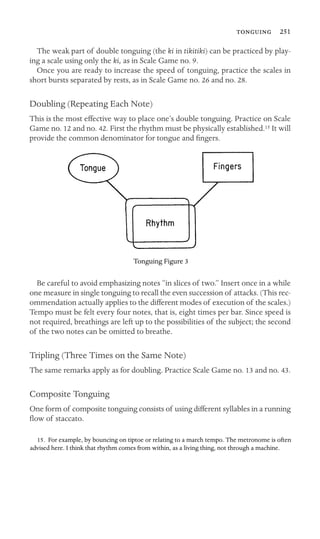
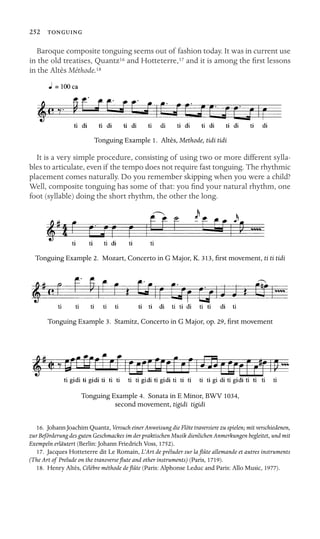
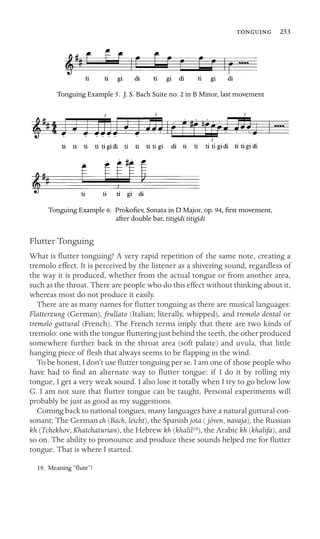
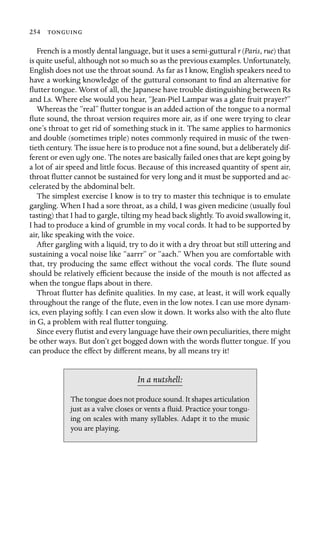
From A to Z

Michel Debost
OXFORD UNIVERSITY PRESS
  
This page intentionally left blank


 

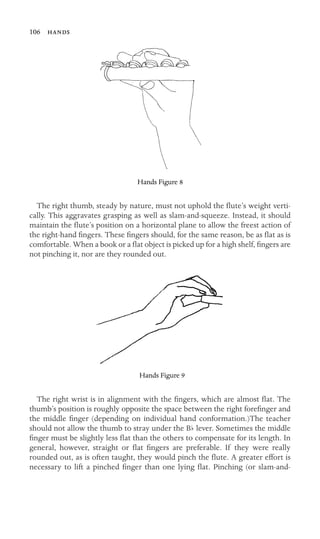
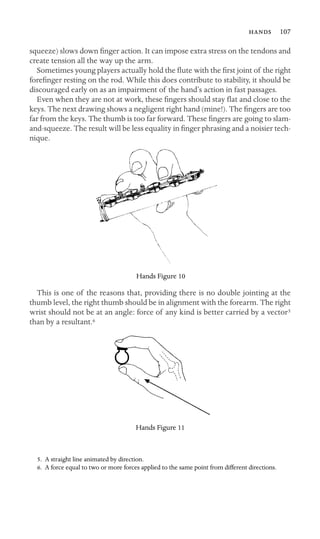
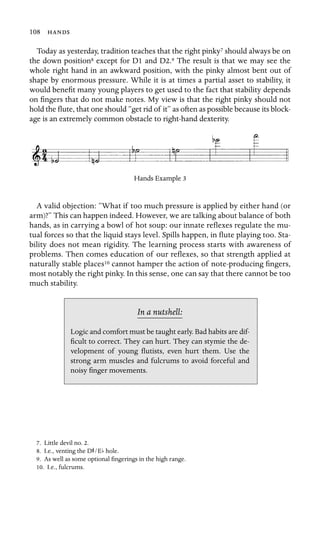
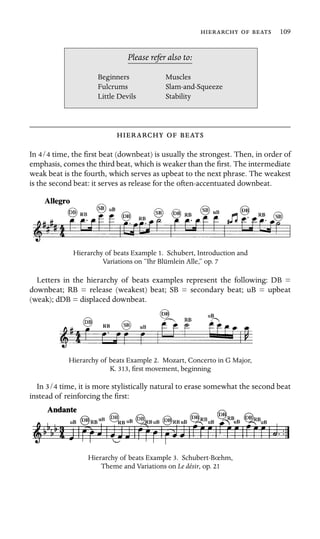
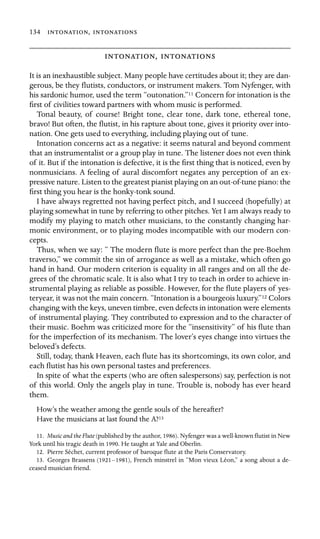
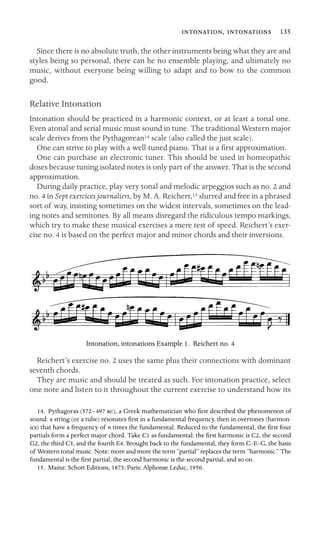
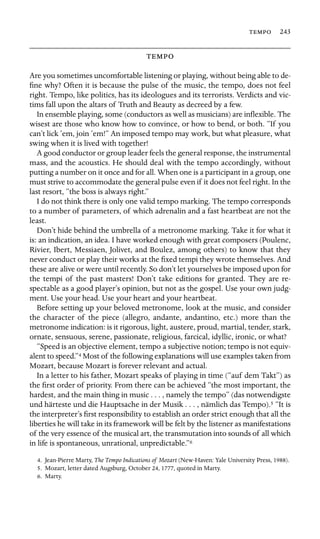
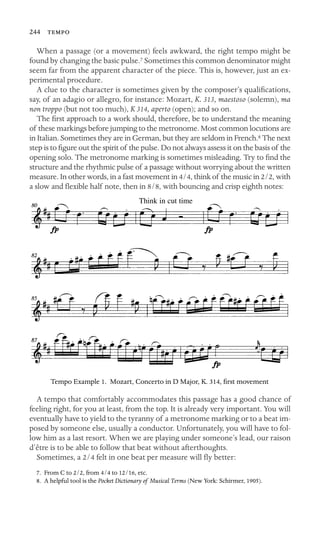
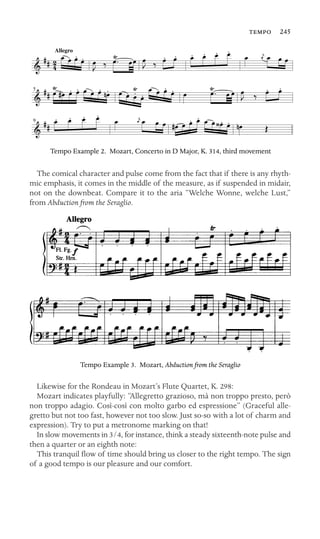
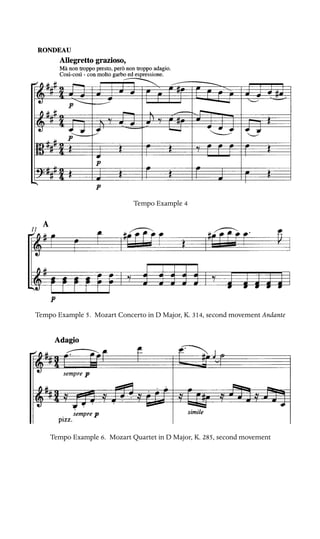


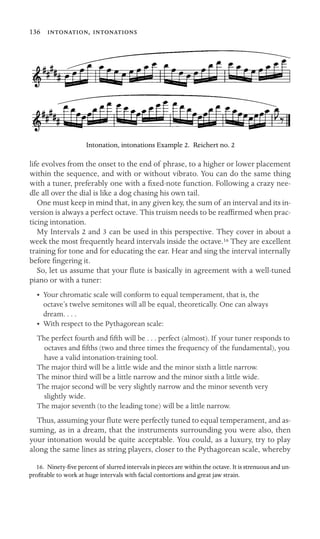
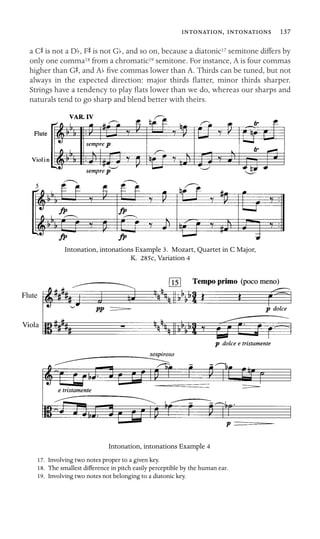
From A to Z

Michel Debost
Illustrated by Jeanne Debost-Roth
1

2002
3

Oxford New York
Athens Auckland Bangkok Bogotá Buenos Aires Cape Town
Chennai Dar es Salaam Delhi Florence Hong Kong Istanbul Karachi
Kolkata Kuala Lumpur Madrid Melbourne Mexico City Mumbai Nairobi
Paris São Paulo Shanghai Singapore Taipei Tokyo Toronto Warsaw
and associated companies in
Berlin Ibadan
Copyright © 2002 by Oxford University Press
Published by Oxford University Press, Inc.

198 Madison Avenue, New York, New York 10016

Oxford is a registered trademark of Oxford University Press.

All rights reserved. No part of this publication may be reproduced, 

stored in a retrieval system, or transmitted, in any form or by any means, 

electronic, mechanical, photocopying, recording, or otherwise, 

without the prior permission of Oxford University Press.

Library of Congress Cataloging-in-Publication Data

Debost, Michel.

[Simple flûte. English]

The simple flute : from A to Z / Michel Debost.

p. cm.

Translated from French.

Includes bibliographical references.

ISBN 0-19-514521-6

1. Flute—Instruction and study. I. Title.

MT340 .D4313 2002

788.3'2193—dc21 2001033831

1 3 5 7 9 8 6 4 2
Printed in the United States of America
on acid-free paper


Isometrics 140
A to Z in Form of Introduction 3

Accompaniment 5

Acoustics 11

Agogic 12

Air Column 14

Air Speed 17

Alignment 18

Appoggiatura 21

Appoggio 23

Arpeggio 25

Articulation 26

Attacks 30

Beginners 34

Blowing Long Phrases 38

Breathing 1: Generalities 43

Breathing 2: Mechanics 46

Breathing 3: Where Not to 

Breathe 48

Breathing 4: Where to Breathe 50

Bridge 52

Center of Gravity 54

Circular Blowing 57

Concentration, Relaxation 59

Diaphragm 61

Dynamics 63

Embouchure 68

Études 71

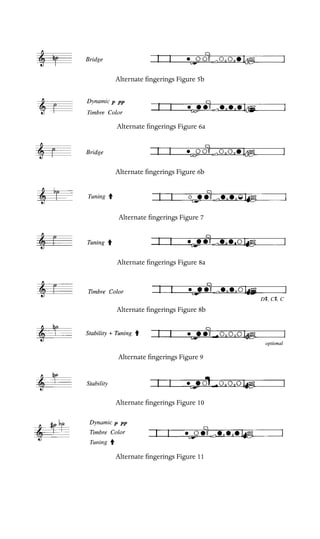
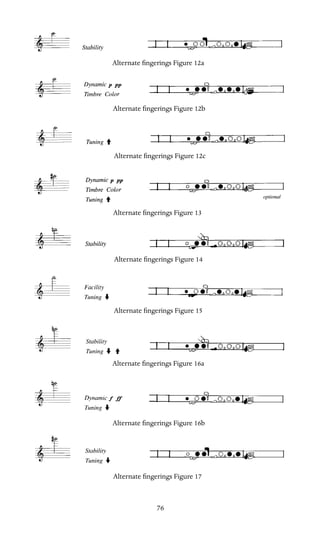
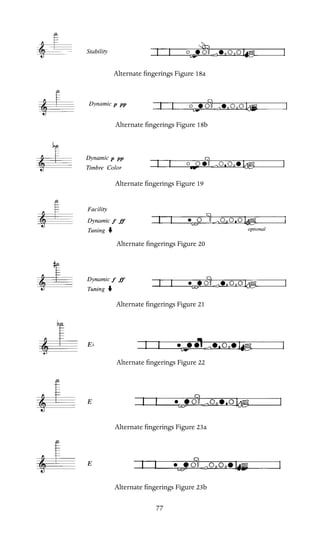
Fingerings 72

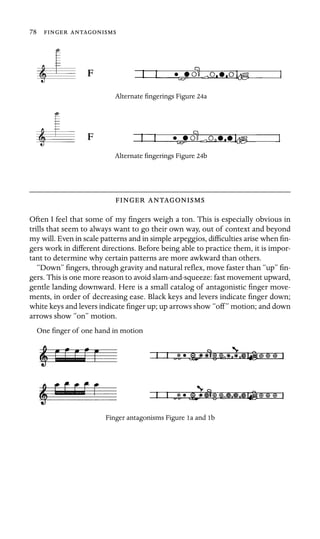
Finger Antagonisms 78

Finger Phrasing 80

Flutes 82

Focus 88

Freedom 90

Grace Notes 97

Hands 101

Hierarchy of Beats 109

Images 111

Interpretation 113

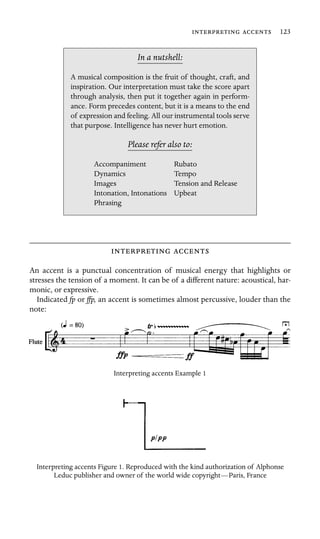
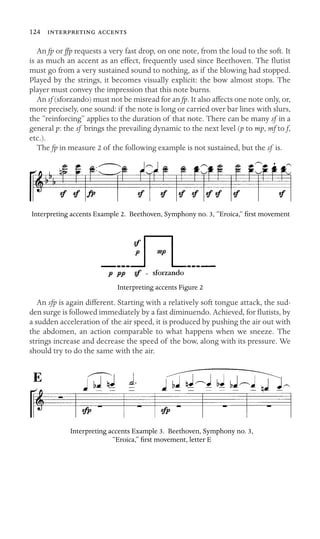
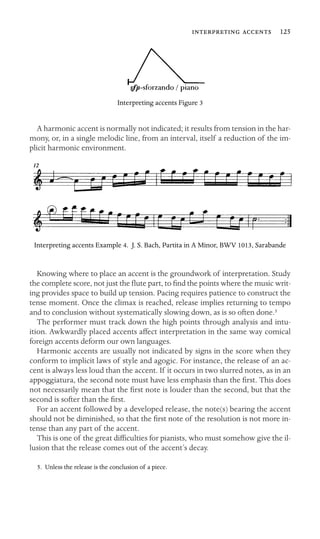
Interpreting Accents 123

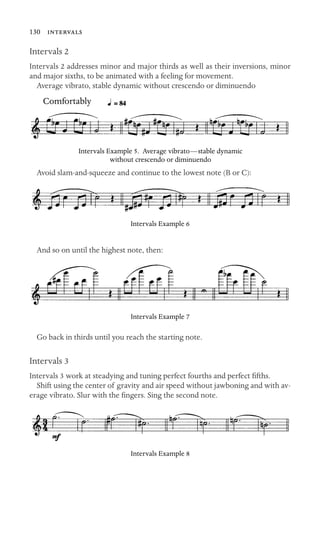
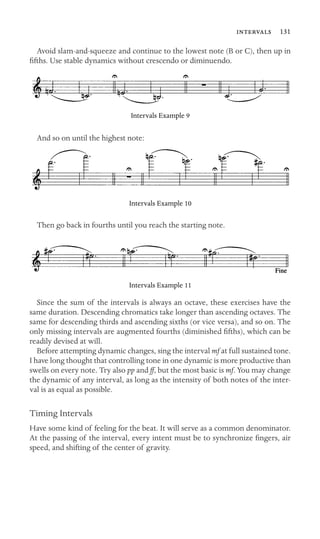
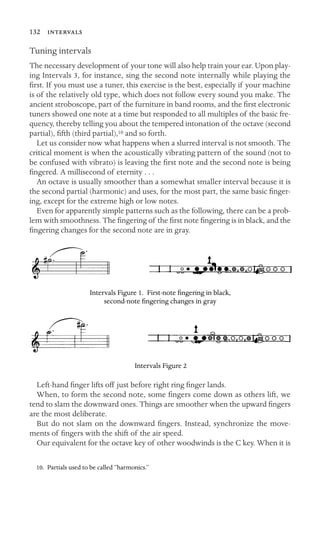
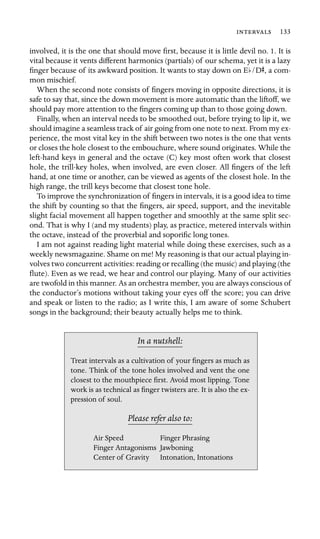
Intervals 128

Intonation, Intonations 134

Jawboning 143

Keys 148

Lips 154

Little Devils 156

Memory 160

Muscle Groups 163

Muscles, Strong and Weak 166

Notes 168

Pain and Pleasure 169

Paris Conservatoire and French

School 173

Phrasing 176

Posture 184

Practicing 187

Programs 191

Quodlibet 195

Repertoire 201

Resonance 204

Rituals 207

Rest 210

Rubato 211

Scale Game 215

Silence 219

Stability 222

Stepping-Stones 224

Stress 230

Style 237

Technique 241

Tempo 243

Tonguing 248

Trills 255

Tuning 256

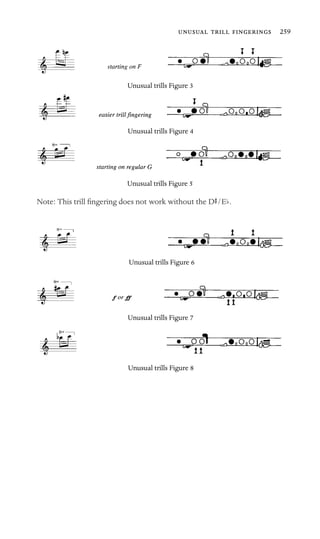
Unusual Trill Fingerings 258

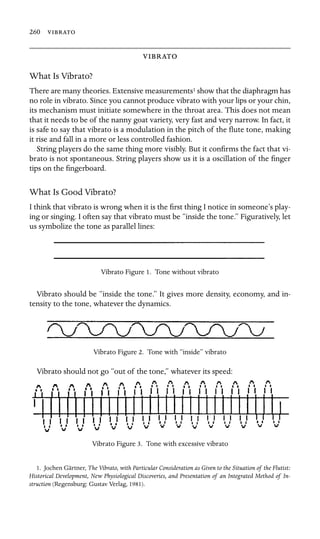
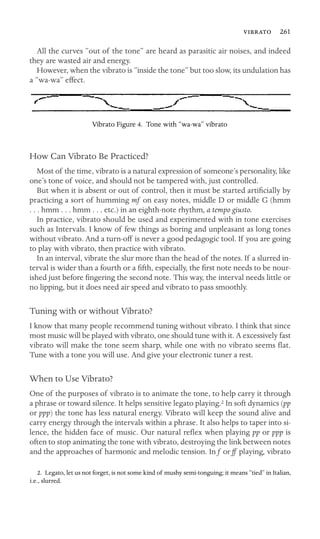
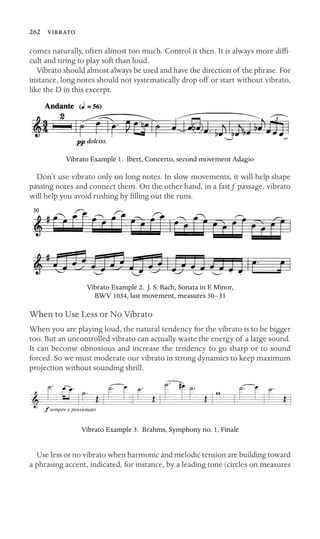
Vibrato 260

Warm-Ups 264

Yawning 265

Zeal in Form of Conclusion 266

Bibliography 269

Index 271
This page intentionally left blank
  
This page intentionally left blank
      

Alphabetical order for entries in this book has been chosen for various reasons.
The main one is that such a book is not meant to be read like a novel, drink in
hand under the lamp. It is a book for lovers of the divine pipe, for those fascinated
by actual contact with the flute, with instrumental playing as well as musical
function in mind, for its poetic mysteries as well as for its technical secrets.
I have been playing the flute for close to sixty years. Yet nothing is indifferent to
me that involves the flute. Hopefully it will be so as long as I have a breath, or a
tooth, left. I take nothing for granted either, and each day brings new questions
and renewed pleasures.
Separating into “logical” compartments different aspects of musical art (tech-
nique, tone, articulation, interpretation, etc.) seems to me arbitrary. I cannot see
the border between questions. The art of the flute is not a chest of isolated little
drawers with one aspect of playing locked in each one. Musicality does not start
where technique stops, if it ever stops.
There is no possible practice of articulation without a cultivated tone, any
more than there can be a valid reflection on tone without a living consciousness
of the breath. There is no significant instrumental work without a musical proj-
ect, and there can be no meaningful interpretation without valid instrumental
playing.
“Art is but feeling. Yet, without the science of volumes, of proportions, of col-
ors, without the ability of the hand, the liveliest feeling is paralyzed. What would
become of the greatest poet in a foreign land, whose tongue he knew nothing
about?”1
Alphabetical organization, therefore, seemed to me more practical for a “flute
in hand” reading.
Another reason relates to the attention span of your average flutist. Mine does
not go much beyond a thousand words, or about two typewritten pages. Such is
the size of most of my subjects, to which are added a few illustrations, musical
examples, and sketches by Jeanne Debost-Roth. She has the necessary know-how
and patience, being the daughter and wife of flute players.
If interest is aroused by an entry, the implied subjects are indexed, again in al-
phabetical order, at the end of each entry, so that a curious reader may easily find
them in cross-reference. Some ideas will be repeated for the same reason, some-
times word for word: cross-reference. The repetitions are not unintended. Teach-
ing is, like conducting, glorified redundancy. After the teacher has repeated the
same axiom a hundred times, the student will need to hear it for the hundred and
first time.
Music is whole, and to serve it one must explore the secret paths that link aes-
1. Auguste Rodin (1840–1917) in L’Art (Paris: Bernard Grasset: 1911).
3
4       

thetics and technique, content and form, matter and spirit. Instrumental playing,
in my own terminology, is precisely all that. To work on “technique” without
thinking about tone, vibrato without bothering with intonation, phrasing with-
out articulation? A false consideration for logic presides over the serialization of
practice. Logic is not always common sense.
Certain words or phrases will seem idiosyncratic and unclear. They do relate to
concepts that I hope will become clear.
Air brush: The stream of air between the lips’ aperture and the striking edge of
the embouchure plate, as compared to the artist’s brush.
Air column: One continuous unit from the inner part of the body to the tip of
the foot joint.
Air management: The economy and control of blown air according to length of
phrases and need of dynamics.
Air speed: The rate of airflow, in direct ratio to pressure and in inverse ratio to
volume.
Apnea: Holding the breath after inhalation.
Appoggio: A technique used by singers to create balance between support and
air control.
Bridge: The connection between the low and middle ranges (B–D, C–D) where
fingerings go from one or two fingers (B, C) to all fingers (D–DS).
Cough point (or sneeze point): The point in the abdomen, lower than the navel,
felt during coughing (or sneezing).
Finger phrasing: Making music with the fingers as much as with the sound. The
opposite of slam-and-squeeze.
Finger tonguing: A procedure whereby the airflow is set in motion without the
tongue. The key closest to the desired note is snapped lightly (without any
tonguing).
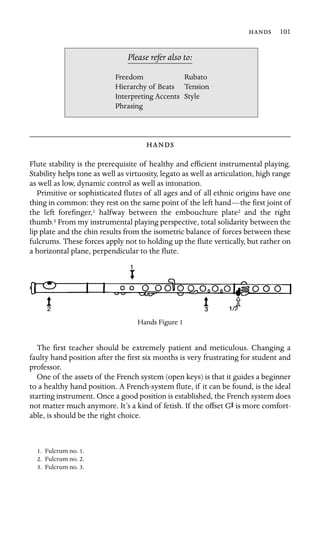
Fulcrums: Three points vital to the stability of the flute:
1. The first joint of the left index finger.
2. The tip of the right thumb.
3. The point of contact of the chin to the lip plate. None of the three fulcrums
contribute to fingering notes.
Gas-leak sound: Thin, wheezy sound. Produced with pinched lips and air pres-
sure.
Jawboning: Constant use of the jaw during flute playing.
“Hhaah” sound: Sound produced when the throat is open upon inhaling. It also
implies that abdominal support, not the chest, powers the breathing,
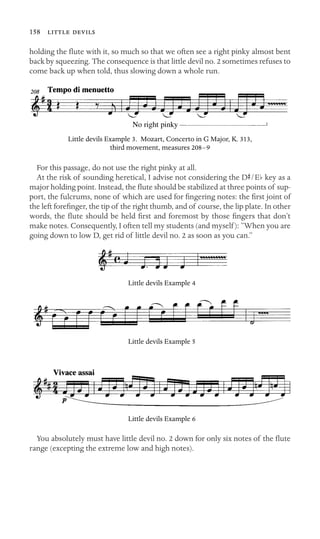
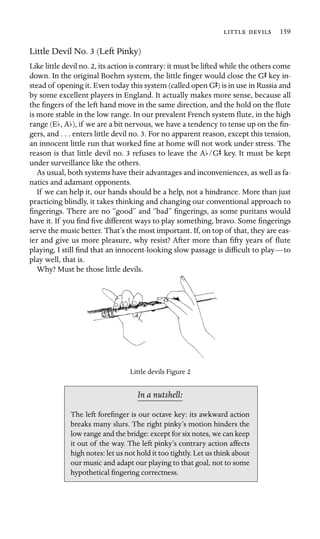
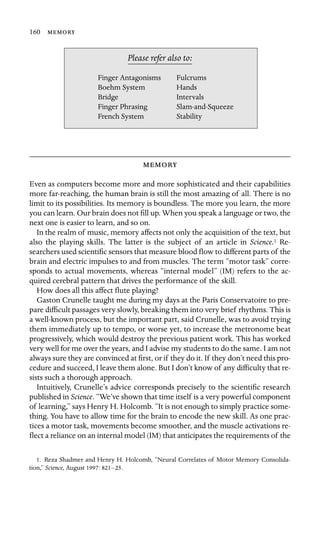
Little devils: Three critical fingers whose action is often contrary to that of the
other fingers:
1. The left index finger (octave key).
2. The right pinky.
3. The left pinky.
5
Middle breath: Something less than a full inhalation. A partial inhalation involv-
ing the abdomen but not the upper respiratory agents (chest and shoulders). A
breath proportionate to the amount of air needed for the phrase being started.
“If you don’t need a big breath, don’t take one.”
Shifting: A slight movement in the center of gravity that causes the air to change
speed naturally.
Silent key: A non–tone producing key used for balance or fingering anticipation.
Slam-and-squeeze: The action of bringing down the fingers forcefully on the
flute (generating unwanted noise) and pressing them tightly (slowing down
the fingers’ lift).
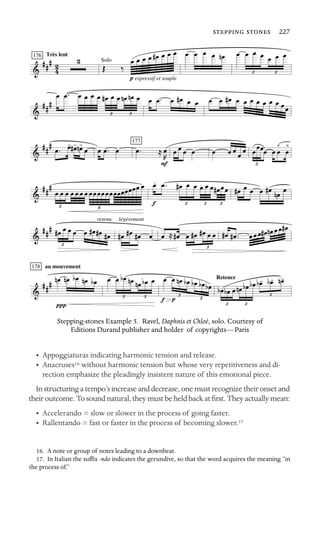
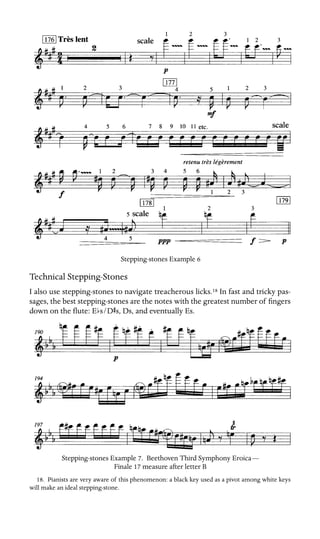
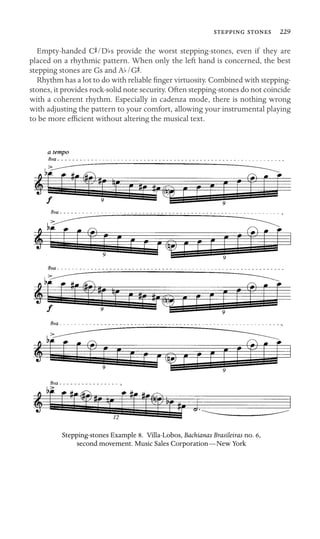
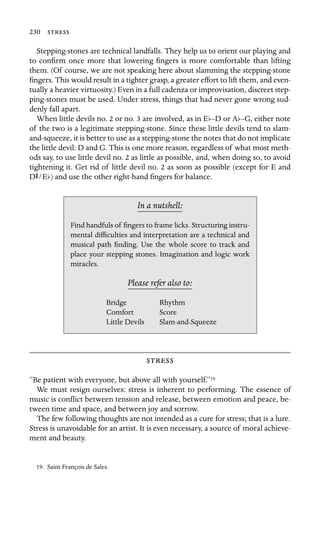
Stepping-stones: Hinge notes or fragments helping to deal with technical difficul-
ties, usually a note where downward fingers and rhythm coincide. In the con-
struction of interpretation, harmonic or structural landmarks that help pacing
in variations in dynamic level (crescendo, diminuendo) or in tempo (rallen-
tando, accelerando) or harmonic progression.
Tenuto, Sostenuto, Ritenuto: A process related to appoggio:
• Tenuto: Stability on the chin through the left hand.
• Sostenuto: Support by the abdominal muscles.
• Ritenuto: Resistance to the collapse of the rib cage.
Timbre: The coloring of the sound. Like the voice, it is totally personal. It varies
according to the number of partials (harmonics) in the sound.
Turbo-sound: The result of blowing a large volume of air without focus.
A flutomaniac bibliography will be included at the end, incomplete by nature,
since every year sees a new crop. I will not fail to mention the sources, old and re-
cent, from which I have drunk, even if some have served as repellent. Thus, it will
be possible to know all and the contrary of all.
Finally, I do not aim at universality, even if it existed in any area. This research
concerns my own findings, but it is not the Bible.

The phrase “collaborative playing” has a politically correct ring that gives ac-
companiment the stigma of menial labor. Likewise, the plumbing at your school
is no longer in the care of the traditional janitor; it is kept in condition by a main-
tenance technician.
But let us call a cat a cat. Accompaniment is not a dirty word. If I accompany
you to the movies or to a concert, it is not to carry your books or your popcorn,
it is to share a moment and an experience. Our best reward, as musicians, is shar-
ing great works with others—in the orchestra, in the band, in a small group or
with a keyboard. When we look forward to a performance, we have to be ready
6 

with our part, obviously, but that is not enough. We have to know what our part-
ners are doing and try to resurrect what the composer had in mind.
The secret is in the score. Before you even try to perform with others, look at
the score; write in your own part who will lead this passage; who starts first; who
cuts off this chord; who is likely to need time to breathe; who has a tendency to
rush (it’s the flute!); how the harmony evolves and how it affects the tuning of
chords; and so on. A score is like a beautiful landscape: you can see it under dif-
ferent kinds of light, and there is always something to discover.
Then try to listen to a recording—not to copy tempos or breaths, but to get a
general view, as if you were not a player, but a listener. Play the recording with
the flute part as you have annotated it. Then listen to it again with the score. If
it is a piano score, keep your eyes on the keyboard staves since you know the flute
line, don’t you? If it is a group score, listen for everything but the flute, although
it is, I agree with you, the center of the world. . . .
When you play duets, which is a fun way to practice reading and ensemble
playing, train yourself to read your part while listening to the other line. You
might make a few more mistakes in your part at first, but you will be amazed, in
the long run, at how you can restabilize near-disasters and balance the music. Am
I leader? Am I accompanist? Listen, look, feel. . . . After all, the best teacher (and
cheapest) you will ever have is you.
In ensemble playing, there is no winner or loser, no master or slave: “I played
my part well, so my conscience is clear.” Fine, but all must share the score for the
music to be served. A chain is only as strong as its weakest link.
When we are accompanied by keyboard (mostly piano or harpsichord), as well
as by harp and guitar, awareness of that score is also crucial. One of my favorite
traps, as my students well know, is to play a line and ask them to identify it. They
soon suspect that it is something in the piano score of the piece they are cur-
rently studying.
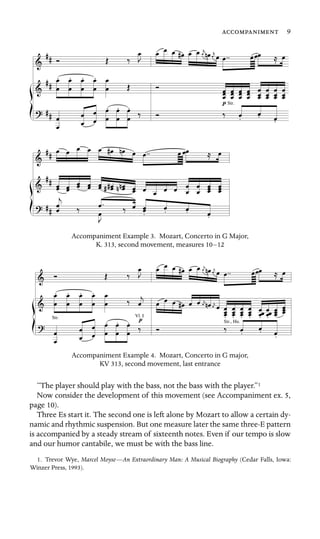
Or, “What is the piano playing during this passage?” Is it purely rhythmic, is it
contrapuntal, or is it . . . silence? Each accompanying texture shows you what the
composer wants or allows you.
Looking at the piano (orchestra) score, we see different patterns:
Here the flute is accompanied by repeated eighth notes: the tempo is steady.
Elsewhere, the piano is playing quarters: the passage is more cantabile and flexi-
ble. There the flute is alone: a certain freedom is in order.
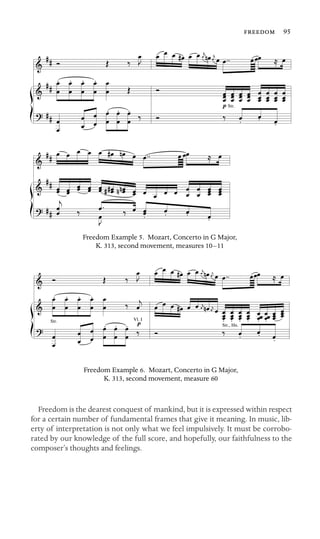
Consider a piece we all love, the Mozart Concerto in G Major, K. 313. Whether
in the orchestra score or in the piano part, we find a mine of information. It will
have great impact on our interpretation and on our efficiency (see Accompani-
ment ex. 1, page 7).
First the flute is alone; you have a bit of leeway for the scale pattern in thirds.
Then the repeated eighth notes show that you cannot waver. You have become
the accompanist, because there is no way that fourteen violinists (or even one pi-
anist) will follow you if the rhythm is not firm.
Even more so (see Accompaniment ex. 2, page 8).
The scale pattern in thirds with grace notes is written in a way suggesting hes-
7

Accompaniment Example 1. Mozart, Concerto in G Major, K. 313,
first movement, measures 60–66
itancy, but the second measure, once again, has a dominant rhythmic beat that
must be followed by the solo instrument.
In measure 72, the flute is totally alone, allowing you to make a dynamic pro-
gression on the five Ds. In measure 73, the accompaniment is in flexible slurred
eighth notes, as in measure 75. The reappearance of steady eighths in the next
measure indicates a return to strict rhythmic tempo (see Accompaniment exx. 3
and 4, page 9).
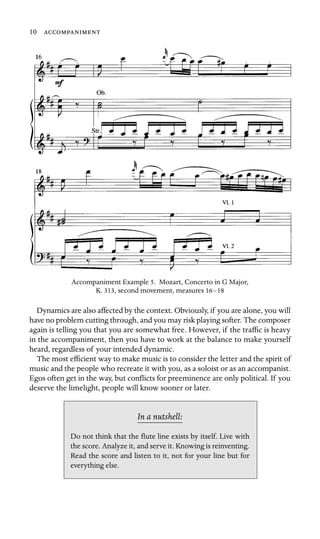
Mozart intended the flute to be alone on its first phrase, indicating that it has
8
75


Accompaniment Example 2. Mozart, Concerto in G Major, K. 313,
first movement, measures 70–76
a tentative character. Each time it appears it is up to us to play it in as many dif-
ferent moods as our inspiration desires: soft or loud, lyrical or subdued. . . . But
as soon as the strings enter in sixteenth notes, they indicate a pace that will sound
natural if the flute does not try to play slower than the orchestra or the piano.
Wise are flutists who accept compromise with a dozen orchestra players (or a pi-
anist) instead of trying to inflict themselves upon them.
It is interesting to see also how for the last appearance of this phrase, the flute
is no longer alone. This indicates that the solo instrument should follow the vi-
olins (or the conductor, or both). Ensemble will be more efficient.
For the flute, it’s the same music. However, it is shadowed by the accompani-
ment that underlines the flute line and that somewhat restricts the freedom of
the two previous identical patterns.
9

Str.
Accompaniment Example 3. Mozart, Concerto in G Major,
K. 313, second movement, measures 10–12
Vl. I
Str., Hn.
Str.
Accompaniment Example 4. Mozart, Concerto in G major,
KV 313, second movement, last entrance
“The player should play with the bass, not the bass with the player.”1
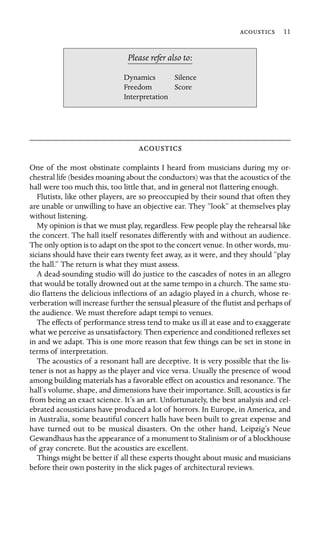
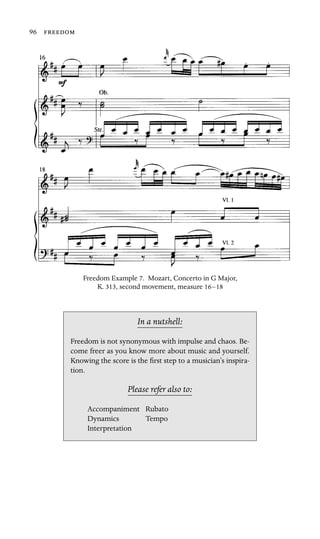
Now consider the development of this movement (see Accompaniment ex. 5,
page 10).
Three Es start it. The second one is left alone by Mozart to allow a certain dy-
namic and rhythmic suspension. But one measure later the same three-E pattern
is accompanied by a steady stream of sixteenth notes. Even if our tempo is slow
and our humor cantabile, we must be with the bass line.
1. Trevor Wye, Marcel Moyse—An Extraordinary Man: A Musical Biography (Cedar Falls, Iowa:
Winzer Press, 1993).
10 

Accompaniment Example 5. Mozart, Concerto in G Major,
K. 313, second movement, measures 16–18
Dynamics are also affected by the context. Obviously, if you are alone, you will
have no problem cutting through, and you may risk playing softer. The composer
again is telling you that you are somewhat free. However, if the traffic is heavy
in the accompaniment, then you have to work at the balance to make yourself
heard, regardless of your intended dynamic.
The most efficient way to make music is to consider the letter and the spirit of
music and the people who recreate it with you, as a soloist or as an accompanist.
Egos often get in the way, but conflicts for preeminence are only political. If you
deserve the limelight, people will know sooner or later.
In a nutshell:
Do not think that the flute line exists by itself. Live with
the score. Analyze it, and serve it. Knowing is reinventing.
Read the score and listen to it, not for your line but for
everything else.
 11

Dynamics Silence
Please refer also to:
Freedom Score
Interpretation

One of the most obstinate complaints I heard from musicians during my or-
chestral life (besides moaning about the conductors) was that the acoustics of the
hall were too much this, too little that, and in general not flattering enough.
Flutists, like other players, are so preoccupied by their sound that often they
are unable or unwilling to have an objective ear. They “look” at themselves play
without listening.
My opinion is that we must play, regardless. Few people play the rehearsal like
the concert. The hall itself resonates differently with and without an audience.
The only option is to adapt on the spot to the concert venue. In other words, mu-
sicians should have their ears twenty feet away, as it were, and they should “play
the hall.” The return is what they must assess.
A dead-sounding studio will do justice to the cascades of notes in an allegro
that would be totally drowned out at the same tempo in a church. The same stu-
dio flattens the delicious inflections of an adagio played in a church, whose re-
verberation will increase further the sensual pleasure of the flutist and perhaps of
the audience. We must therefore adapt tempi to venues.
The effects of performance stress tend to make us ill at ease and to exaggerate
what we perceive as unsatisfactory. Then experience and conditioned reflexes set
in and we adapt. This is one more reason that few things can be set in stone in
terms of interpretation.
The acoustics of a resonant hall are deceptive. It is very possible that the lis-
tener is not as happy as the player and vice versa. Usually the presence of wood
among building materials has a favorable effect on acoustics and resonance. The
hall’s volume, shape, and dimensions have their importance. Still, acoustics is far
from being an exact science. It’s an art. Unfortunately, the best analysis and cel-
ebrated acousticians have produced a lot of horrors. In Europe, in America, and
in Australia, some beautiful concert halls have been built to great expense and
have turned out to be musical disasters. On the other hand, Leipzig’s Neue
Gewandhaus has the appearance of a monument to Stalinism or of a blockhouse
of gray concrete. But the acoustics are excellent.
Things might be better if all these experts thought about music and musicians
before their own posterity in the slick pages of architectural reviews.
12 

In a nutshell:
Dynamics
Listen to the return from the hall. Don’t judge only from
the way you think you play. Be your own listener. Adapt.
Please refer also to:
Interpretation
Tempo

Slight changes occur during a human instrumental2 execution. Agogic3 is the
combination of the natural tendency of dynamics to affect tempo and rhythm,
and vice versa.
It concerns, for a great part, these natural phenomena:
•	 An accelerando invites a crescendo, whereas a diminuendo tends to drag.
•	 A stretched tempo increases the effect of a harmonic progression toward an
accent.
•	 Upbeats are characterized by a more animated and lighter dynamic (weak
beat) than downbeats (strong beats), which are by nature heavier and more
stretched.
•	 Short values (sixteenths) in a fast tempo invite an even quicker pace, but the
same values, in a slow movement, tend to drag.
•	 Long notes decay naturally if they are not sustained.
•	 Rubato allows phrasing to “speak” the music by imperceptibly stealing here
the time that will be returned there.
•	 Silence attracts sound just as gravity affects mass.
It is important to know about agogic, either to go along with it to enhance per-
formance or to control it when it threatens to disfigure the musical discourse. In-
struments have their own agogic. Cellos and bassoons thrive in their lower range,
whereas flutes and violins find their best singing voice in their middle and upper-
middle registers. These natural characteristics help to color and pace music ef-
fectively.
However, the composer sometimes uses deliberate awkwardness in extreme
2. As opposed to mechanic or electronic.
3. Used and defined for the first time by Hugo Riemann (1849–1919), the music theoretician and
philosopher, in Musikalische Dynamik und Agogik (Hamburg: Rahter, 1884).
 13
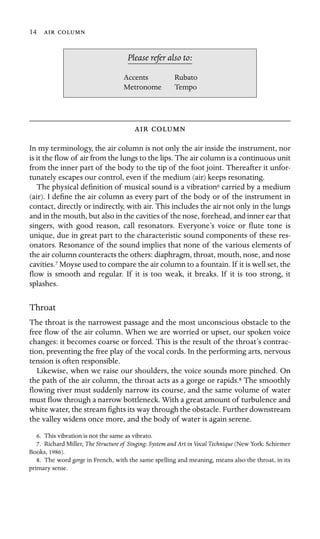
ranges to imply strain, or to enhance a nostalgic mood. A famous example is the
opening of The Rite of Spring.4 This haunting wail puts the listener (and the bas-
soonist) in an eerie and mysterious mood. The same notes scored for the flute or
the clarinet instead would have a soothing color. Difficulty is here part of music.
Agogic Example 1. Stravinsky, Le sacre du printemps
The perils of altitude also create an excitement that explains the way opera au-
diences respond to great tenors as they soar into heroic high notes. The trumpet
has the same effect.
It is tempting for young players to search for the loudest flute, so they can em-
ulate CDs. Cooper5 says that of ten head joints he offers, the loudest are the most
popular. Sometimes power is achieved at the expense of flexibility and beauty.
From the point of view of interpretation, a flutist must recognize the inher-
ent characteristics of his instrument. He may use them by going along with the
agogic of the flute: using staccato as an echo for legato, allowing the sound to di-
minish or increase naturally, changing colors on identical patterns, enhancing the
innately poetic character of the flute—in short, implementing everything that
serves music.
On the other hand, knowing the agogic of the instrument will help the flutist
find solutions that do not come naturally: delicate attacks, playing loud in the low
range and soft in the ledger lines, preventing the premature increase of a pro-
gression, keeping long notes alive, controlling a tendency to rush—in short,
mastering instrumental playing while keeping in mind the aesthetic goal of
music.
In a nutshell
Agogic: Quasi-innate circumstances of music, instruments,
and performers. You must recognize it to control it and
use it to enhance interpretation.
4. Igor Stravinsky (1882–1971), composer.
5. Albert Cooper (1926– ), flute maker.
14  

Accents
Metronome
Please refer also to:
Rubato
Tempo
 
In my terminology, the air column is not only the air inside the instrument, nor
is it the flow of air from the lungs to the lips. The air column is a continuous unit
from the inner part of the body to the tip of the foot joint. Thereafter it unfor-
tunately escapes our control, even if the medium (air) keeps resonating.
The physical definition of musical sound is a vibration6 carried by a medium
(air). I define the air column as every part of the body or of the instrument in
contact, directly or indirectly, with air. This includes the air not only in the lungs
and in the mouth, but also in the cavities of the nose, forehead, and inner ear that
singers, with good reason, call resonators. Everyone’s voice or flute tone is
unique, due in great part to the characteristic sound components of these res-
onators. Resonance of the sound implies that none of the various elements of
the air column counteracts the others: diaphragm, throat, mouth, nose, and nose
cavities.7 Moyse used to compare the air column to a fountain. If it is well set, the
flow is smooth and regular. If it is too weak, it breaks. If it is too strong, it
splashes.
Throat
The throat is the narrowest passage and the most unconscious obstacle to the
free flow of the air column. When we are worried or upset, our spoken voice
changes: it becomes coarse or forced. This is the result of the throat’s contrac-
tion, preventing the free play of the vocal cords. In the performing arts, nervous
tension is often responsible.
Likewise, when we raise our shoulders, the voice sounds more pinched. On
the path of the air column, the throat acts as a gorge or rapids.8 The smoothly
flowing river must suddenly narrow its course, and the same volume of water
must flow through a narrow bottleneck. With a great amount of turbulence and
white water, the stream fights its way through the obstacle. Further downstream
the valley widens once more, and the body of water is again serene.
6. This vibration is not the same as vibrato.
7. Richard Miller, The Structure of Singing: System and Art in Vocal Technique (New York: Schirmer
Books, 1986).
8. The word gorge in French, with the same spelling and meaning, means also the throat, in its
primary sense.
  15

At the slightest nervous tension, the throat tightens and squeezes the air col-
umn, producing a choked sound. The same phenomenon occurs when we lift
our shoulders in an instinctive defensive gesture or because of poor posture.
How can we alleviate this problem? By emulating the process of yawning upon
breathing as well as upon blowing.
Everything is connected back there. Our ears pop when we change altitudes
in a plane because pressure differs on either side of the eardrums. Blowing our
nose, swallowing, or yawning corrects this imbalance from the inside.
Yawning
When we yawn, our body tells us to relax, to forget our problems, to sleep, to feel
good: the shoulders fall, the throat opens, the ears pop, and the abdomen’s move-
ments no longer restrict the lungs’ inflation. Yawning reproduces naturally a cor-
rect breathing procedure and a sensation of comfort.
Nose
When we suffer from a respiratory problem such as a cold, we have the impres-
sion that our tone is as stuffy as our nose. Our perception is altered because the
inner ear, the sinuses, and the pharynx9 cannot resonate.
To avoid cracking a difficult note—one played piano in the high register or forte
in the low register—the “explosion” of air hitting the edge of the embouchure
can be blunted by releasing a small amount of air through the nose just before
the attack. This precaution sets the air column in motion. It does not prevent a
precise attack—quite the contrary. Compare this to the violin bow: it moves
slightly before the note speaks, unless a very strong attack is required. In this
case, the bow hits and bites the string.
To open the sound, try to open your nose. You can even try to stretch your ears
from the inside. Spread out your nostrils: you feel your throat also opening up,
and all the hollow cavities of the head start to resonate. It is the same process as
yawning: it feels good and contributes to the opening of the sound.
Another use of nasal air release: while playing, just before a breath, you may
want to empty your lungs to get fresh oxygen.
Control of your blowing, and inhaling through the nose is the first step toward
continuous blowing, commonly known as circular breathing.
Mouth
Some are of the opinion that the shape we give to the mouth cavity affects the
sound. Inflating or vibrating the cheeks would provide more resonance. I do not
9. The cavity situated at the back of the mouth that connects the nose, the throat, and the inner
ear.
16  

share this theory for more than one reason: flapping cheeks affect focus and take
some of the direction out of the air column. Fast register changes (arpeggios) do
not permit this without danger, especially under stress. Still, if it really works for
you, why not?
Diaphragm
The diaphragm is often considered a conscious element of the air column that
we could, at will, command to do what we tell it. That is a well-meaning mis-
conception. The diaphragm goes down when we inhale and up when we exhale,
in a completely automatic fashion that ends with our life. When we hold our
breath, we stop its movement, for little more than a minute, by the action not of
the diaphragm itself, but of the muscles around it, mainly the abdominal and
chest muscles. These respiratory muscles can hinder the automatic play of the di-
aphragm. To inhale, all tension in the abdomen must be let go by “dropping” it.
Upon exhaling (blowing) the chest muscles must keep the rib cage expanded to
counteract their own elasticity and weight, as well as the pressure generated by
the abdominal muscles. For this reason, after a big breath, the first concern
should be not to blow until the initial third of the breath has been spent through
natural resilience and gravity working on the rib cage.
This is an important point in teaching beginners, and even some advanced
players: they always complain they don’t have enough breath, when, in fact, their
blowing needs to be better managed. My concept of air management is symbol-
ized by Tenuto (stability of the flute on the chin), Sostenuto (support from the ab-
domen), Ritenuto (counteracting the collapse of the thorax with the chest mus-
cles). Think more of the way you blow than about how you breathe. Breathing is
the most natural activity. Open your mouth and let the air in. Blowing is where
art is. Air management is what produces music and expression, whereas breath-
ing is often a dirty noise.
In a nutshell:
Think of air as the vehicle of your sound. Put every mol-
ecule of air in resonance with your sound by opening all
parts of the respiratory system, especially throat and nose.
Don’t think that tone starts at the embouchure and dies at
the foot joint.
Use muscle control not to force volume, but to open all
the resonators. Releasing air through the nose helps diffi-
cult attacks. Open your nose to open your sound. Release
air pressure for special effects and circular blowing, also
for emptying the lungs while playing.
  17

Air Management
Air Speed Lips
, Sostenuto, Ritenuto
Please refer also to:
Air, Hot and Cold Circular Blowing
Focus
Appoggio Resonance
Attacks Tenuto
Blowing Turbo-Sound
Breathing
 
When we play a wide interval, say, wider than a fourth, our first reflex is to move
the chin or the lips to shift the angle of attack of the air brush. If it works for you,
even when you are out of shape or nervous, of course, do it. My problem with
that process is its relative unreliability at the wrong moment, under stress. No
doubt the lips provide guidance, but the energy comes from the strong air-
column muscles. We need to give more or less speed to the air, and to involve the
whole body in the playing process.
When we rise in the range of the flute, instead of messing with the em-
bouchure only, we should, as it were, sink into the ground. We feel very heavy,
the shoulders are low, and the abdominal belt is firm thanks to the strong leg
muscles. The higher you play, the lower your center of gravity should be.
When you want to descend with an equivalent interval, you relax the abdom-
inal belt before lipping and jawboning.
Hot Air, Cold Air
A strange thing happens when we change the air speed. Nobody has been able to
explain to me why our air brush is cold when we blow fast, as if to cool a cup of
coffee, whereas, when frost bites our hands, we slowly exhale some hot air into
them to warm them up.
Try these experiments:
•	 When you are cold, blow into your cupped hands. Your throat and mouth
are wide open, and the air is hot, almost at body temperature. If you aim at
a cold surface (a window or someone’s glasses), it fogs up.
•	 A game we used to play as children: blow the same way through someone’s
woolen sweater. The air really seems even hotter.
When your cocoa or coffee is too hot, you blow to cool it off. You pinch your
lips to make an air brush similar to the one we use for our flute playing.
18 

My question is: why is slow, open-throat air hot and fast, closed-lip air cold? Is
it the difference in speed? But why? It’s the same air; it must start from the lungs
at the same temperature. Has it something to do with panting, like a dog?
Whatever the answer, it helps us:
• Fast air — cold air — descending center of gravity — intervals ascending —
high notes.
• Slow air — hot air — relaxed belt — open throat — intervals descending —
low notes.
This simple demonstration will help you to feel the relationship between air
speed, support, and resistance at the level of the embouchure. It is also very use-
ful for young flutists.
On wide slurs, up or down, one must change the air speed to compensate for
the possible break in the air column and in the sound wave.
In a nutshell:
Air Column Lips
Air Management
Play from the ground up. Use your feet more than your
lips for tone production. The energy of your tone starts
low in the abdomen. Leg muscles contribute to that effort.
The air column contributes at each level to air speed. Its
last step is at the air brush, where the lips act as an inter-
mediary, not as a force.
Please refer also to:
Muscles, Strong and Weak
Appoggio Tenuto, Sostenuto, Ritenuto
Center of Gravity Turbo-Sound
Intervals

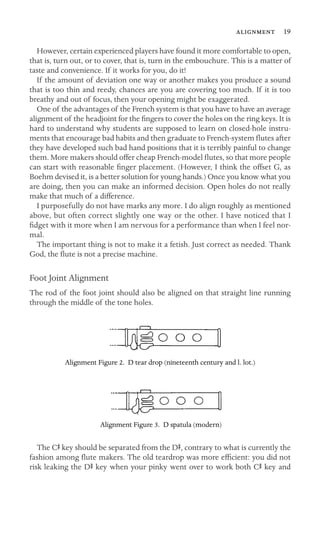
The outer edge of the embouchure hole, the leading edge on which we blow,
should be roughly on a straight line running through the middle of the tone
holes. It is advisable for people who are unsure of their position to mark this with
a drop of nail polish on the head joint and on the brand-mark ring.
Alignment Figure 1
 19

However, certain experienced players have found it more comfortable to open,
that is, turn out, or to cover, that is, turn in the embouchure. This is a matter of
taste and convenience. If it works for you, do it!
If the amount of deviation one way or another makes you produce a sound
that is too thin and reedy, chances are you are covering too much. If it is too
breathy and out of focus, then your opening might be exaggerated.
One of the advantages of the French system is that you have to have an average
alignment of the headjoint for the fingers to cover the holes on the ring keys. It is
hard to understand why students are supposed to learn on closed-hole instru-
ments that encourage bad habits and then graduate to French-system flutes after
they have developed such bad hand positions that it is terribly painful to change
them. More makers should offer cheap French-model flutes, so that more people
can start with reasonable finger placement. (However, I think the offset G, as
Boehm devised it, is a better solution for young hands.) Once you know what you
are doing, then you can make an informed decision. Open holes do not really
make that much of a difference.
I purposefully do not have marks any more. I do align roughly as mentioned
above, but often correct slightly one way or the other. I have noticed that I
fidget with it more when I am nervous for a performance than when I feel nor-
mal.
The important thing is not to make it a fetish. Just correct as needed. Thank
God, the flute is not a precise machine.
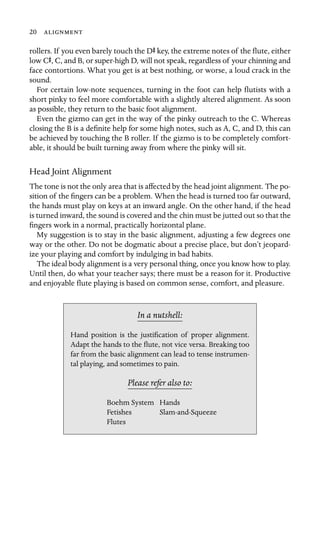
Foot Joint Alignment
The rod of the foot joint should also be aligned on that straight line running
through the middle of the tone holes.
Alignment Figure 2. D tear drop (nineteenth century and l. lot.)
Alignment Figure 3. D spatula (modern)
The CS key should be separated from the DS, contrary to what is currently the

fashion among flute makers. The old teardrop was more efficient: you did not

risk leaking the DS key when your pinky went over to work both CS key and
20 
rollers. If you even barely touch the DS key, the extreme notes of the flute, either
low CS, C, and B, or super-high D, will not speak, regardless of your chinning and
face contortions. What you get is at best nothing, or worse, a loud crack in the
sound.
For certain low-note sequences, turning in the foot can help flutists with a
short pinky to feel more comfortable with a slightly altered alignment. As soon
as possible, they return to the basic foot alignment.
Even the gizmo can get in the way of the pinky outreach to the C. Whereas
closing the B is a definite help for some high notes, such as A, C, and D, this can
be achieved by touching the B roller. If the gizmo is to be completely comfort-
able, it should be built turning away from where the pinky will sit.
Head Joint Alignment
The tone is not the only area that is affected by the head joint alignment. The po-
sition of the fingers can be a problem. When the head is turned too far outward,
the hands must play on keys at an inward angle. On the other hand, if the head
is turned inward, the sound is covered and the chin must be jutted out so that the
fingers work in a normal, practically horizontal plane.
My suggestion is to stay in the basic alignment, adjusting a few degrees one
way or the other. Do not be dogmatic about a precise place, but don’t jeopard-
ize your playing and comfort by indulging in bad habits.
The ideal body alignment is a very personal thing, once you know how to play.
Until then, do what your teacher says; there must be a reason for it. Productive
and enjoyable flute playing is based on common sense, comfort, and pleasure.
In a nutshell:
Boehm System Hands
Hand position is the justification of proper alignment.
Adapt the hands to the flute, not vice versa. Breaking too
far from the basic alignment can lead to tense instrumen-
tal playing, and sometimes to pain.
Please refer also to:
Fetishes Slam-and-Squeeze
Flutes
 21

 

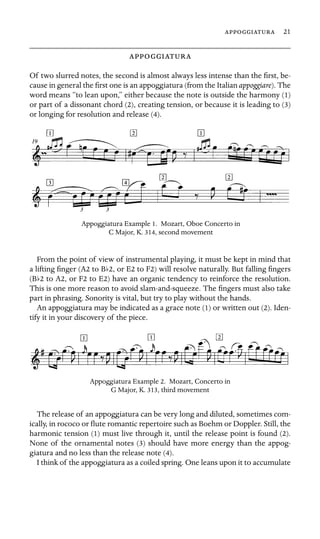
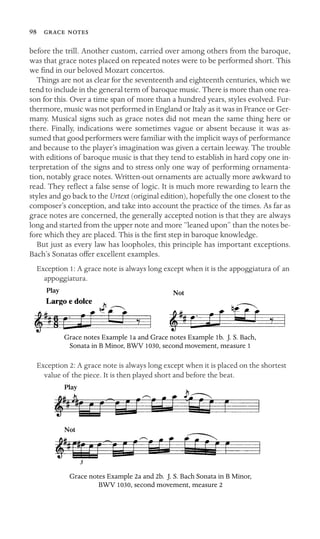
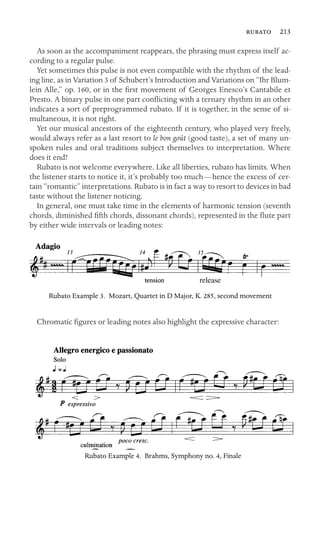
Of two slurred notes, the second is almost always less intense than the first, be-
cause in general the first one is an appoggiatura (from the Italian appoggiare). The
word means “to lean upon,” either because the note is outside the harmony (1)
or part of a dissonant chord (2), creating tension, or because it is leading to (3)
or longing for resolution and release (4).
Appoggiatura Example 1. Mozart, Oboe Concerto in
C Major, K. 314, second movement
From the point of view of instrumental playing, it must be kept in mind that
a lifting finger (A2 to Bb2, or E2 to F2) will resolve naturally. But falling fingers
(Bb2 to A2, or F2 to E2) have an organic tendency to reinforce the resolution.
This is one more reason to avoid slam-and-squeeze. The fingers must also take
part in phrasing. Sonority is vital, but try to play without the hands.
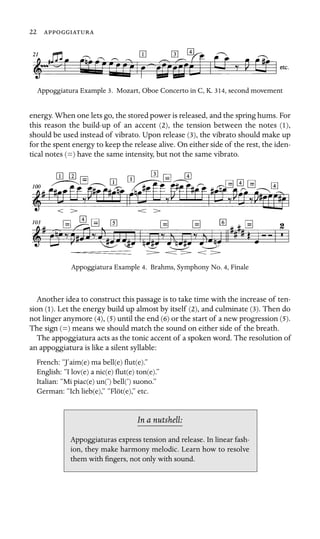
An appoggiatura may be indicated as a grace note (1) or written out (2). Iden-
tify it in your discovery of the piece.
Appoggiatura Example 2. Mozart, Concerto in
G Major, K. 313, third movement
The release of an appoggiatura can be very long and diluted, sometimes com-
ically, in rococo or flute romantic repertoire such as Boehm or Doppler. Still, the
harmonic tension (1) must live through it, until the release point is found (2).
None of the ornamental notes (3) should have more energy than the appog-
giatura and no less than the release note (4).
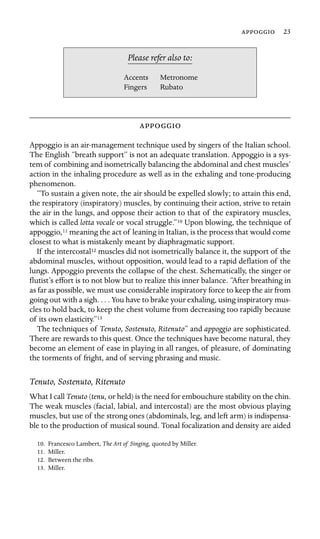
I think of the appoggiatura as a coiled spring. One leans upon it to accumulate
22 

Appoggiatura Example 3. Mozart, Oboe Concerto in C, K. 314, second movement
energy. When one lets go, the stored power is released, and the spring hums. For
this reason the build-up of an accent (2), the tension between the notes (1),
should be used instead of vibrato. Upon release (3), the vibrato should make up
for the spent energy to keep the release alive. On either side of the rest, the iden-
tical notes (=) have the same intensity, but not the same vibrato.
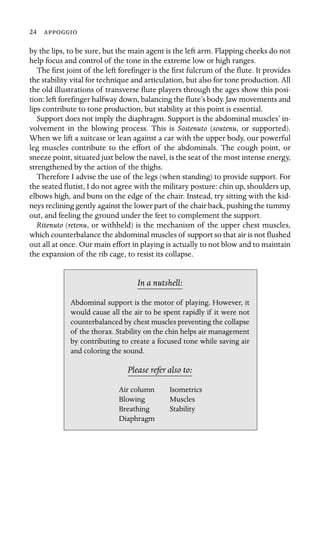
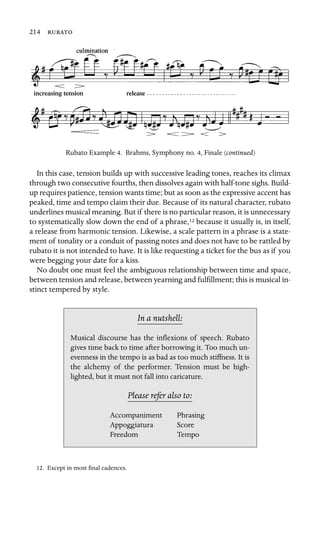
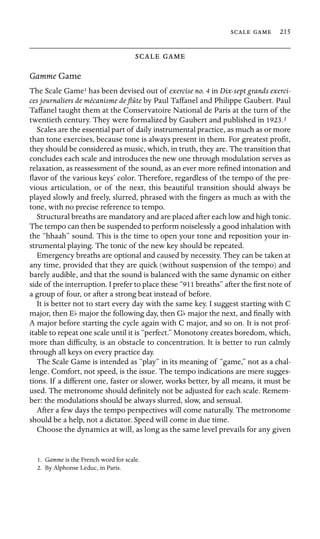
Appoggiatura Example 4. Brahms, Symphony No. 4, Finale
Another idea to construct this passage is to take time with the increase of ten-
sion (1). Let the energy build up almost by itself (2), and culminate (3). Then do
not linger anymore (4), (5) until the end (6) or the start of a new progression (5).
The sign (=) means we should match the sound on either side of the breath.
The appoggiatura acts as the tonic accent of a spoken word. The resolution of
an appoggiatura is like a silent syllable:
French: “J’aim(e) ma bell(e) flut(e).”
English: “I lov(e) a nic(e) flut(e) ton(e).”
Italian: “Mi piac(e) un(’) bell(’) suono.”
German: “Ich lieb(e),” “Flöt(e),” etc.
In a nutshell:
Appoggiaturas express tension and release. In linear fash-
ion, they make harmony melodic. Learn how to resolve
them with fingers, not only with sound.
 23

Accents Metronome
Please refer also to:
Fingers Rubato

Appoggio is an air-management technique used by singers of the Italian school.
The English “breath support” is not an adequate translation. Appoggio is a sys-
tem of combining and isometrically balancing the abdominal and chest muscles’
action in the inhaling procedure as well as in the exhaling and tone-producing
phenomenon.
“To sustain a given note, the air should be expelled slowly; to attain this end,
the respiratory (inspiratory) muscles, by continuing their action, strive to retain
the air in the lungs, and oppose their action to that of the expiratory muscles,
which is called lotta vocale or vocal struggle.”10 Upon blowing, the technique of
appoggio,11 meaning the act of leaning in Italian, is the process that would come
closest to what is mistakenly meant by diaphragmatic support.
If the intercostal12 muscles did not isometrically balance it, the support of the
abdominal muscles, without opposition, would lead to a rapid deflation of the
lungs. Appoggio prevents the collapse of the chest. Schematically, the singer or
flutist’s effort is to not blow but to realize this inner balance. “After breathing in
as far as possible, we must use considerable inspiratory force to keep the air from
going out with a sigh. . . . You have to brake your exhaling, using inspiratory mus-
cles to hold back, to keep the chest volume from decreasing too rapidly because
of its own elasticity.”13
The techniques of Tenuto, Sostenuto, Ritenuto” and appoggio are sophisticated.
There are rewards to this quest. Once the techniques have become natural, they
become an element of ease in playing in all ranges, of pleasure, of dominating
the torments of fright, and of serving phrasing and music.
Tenuto, Sostenuto, Ritenuto
What I call Tenuto (tenu, or held) is the need for embouchure stability on the chin.
The weak muscles (facial, labial, and intercostal) are the most obvious playing
muscles, but use of the strong ones (abdominals, leg, and left arm) is indispensa-
ble to the production of musical sound. Tonal focalization and density are aided
10. Francesco Lambert, The Art of Singing, quoted by Miller.
11. Miller.
12. Between the ribs.
13. Miller.
24 

by the lips, to be sure, but the main agent is the left arm. Flapping cheeks do not
help focus and control of the tone in the extreme low or high ranges.
The first joint of the left forefinger is the first fulcrum of the flute. It provides
the stability vital for technique and articulation, but also for tone production. All
the old illustrations of transverse flute players through the ages show this posi-
tion: left forefinger halfway down, balancing the flute’s body. Jaw movements and
lips contribute to tone production, but stability at this point is essential.
Support does not imply the diaphragm. Support is the abdominal muscles’ in-
volvement in the blowing process. This is Sostenuto (soutenu, or supported).
When we lift a suitcase or lean against a car with the upper body, our powerful
leg muscles contribute to the effort of the abdominals. The cough point, or
sneeze point, situated just below the navel, is the seat of the most intense energy,
strengthened by the action of the thighs.
Therefore I advise the use of the legs (when standing) to provide support. For
the seated flutist, I do not agree with the military posture: chin up, shoulders up,
elbows high, and buns on the edge of the chair. Instead, try sitting with the kid-
neys reclining gently against the lower part of the chair back, pushing the tummy
out, and feeling the ground under the feet to complement the support.
Ritenuto (retenu, or withheld) is the mechanism of the upper chest muscles,
which counterbalance the abdominal muscles of support so that air is not flushed
out all at once. Our main effort in playing is actually to not blow and to maintain
the expansion of the rib cage, to resist its collapse.
In a nutshell:
and coloring the sound.
Air column Isometrics
Muscles
Stability
Abdominal support is the motor of playing. However, it
would cause all the air to be spent rapidly if it were not
counterbalanced by chest muscles preventing the collapse
of the thorax. Stability on the chin helps air management
by contributing to create a focused tone while saving air
Please refer also to:
Blowing
Breathing
Diaphragm
 25



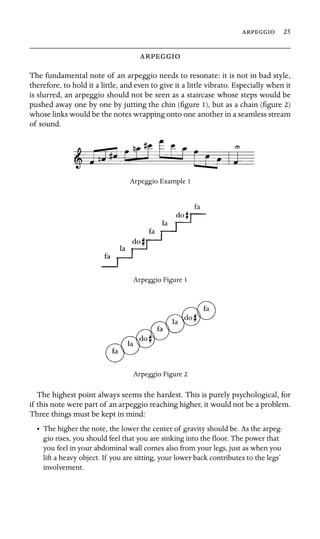
The fundamental note of an arpeggio needs to resonate: it is not in bad style,
therefore, to hold it a little, and even to give it a little vibrato. Especially when it
is slurred, an arpeggio should not be seen as a staircase whose steps would be
pushed away one by one by jutting the chin (figure 1), but as a chain (figure 2)
whose links would be the notes wrapping onto one another in a seamless stream
of sound.
Arpeggio Example 1
Arpeggio Figure 1
Arpeggio Figure 2
The highest point always seems the hardest. This is purely psychological, for
if this note were part of an arpeggio reaching higher, it would not be a problem.
Three things must be kept in mind:
•	 The higher the note, the lower the center of gravity should be. As the arpeg-
gio rises, you should feel that you are sinking into the floor. The power that
you feel in your abdominal wall comes also from your legs, just as when you
lift a heavy object. If you are sitting, your lower back contributes to the legs’
involvement.
26 

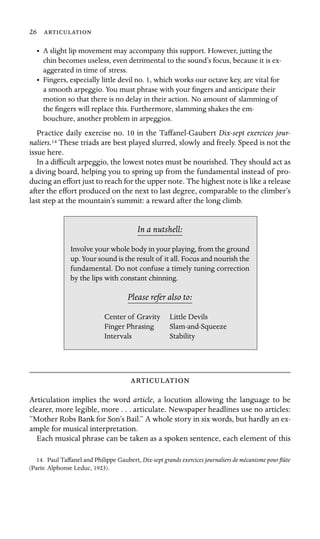
•	 A slight lip movement may accompany this support. However, jutting the
chin becomes useless, even detrimental to the sound’s focus, because it is ex-
aggerated in time of stress.
•	 Fingers, especially little devil no. 1, which works our octave key, are vital for
a smooth arpeggio. You must phrase with your fingers and anticipate their
motion so that there is no delay in their action. No amount of slamming of
the fingers will replace this. Furthermore, slamming shakes the em-
bouchure, another problem in arpeggios.
Practice daily exercise no. 10 in the Taffanel-Gaubert Dix-sept exercices jour-
naliers.14 These triads are best played slurred, slowly and freely. Speed is not the
issue here.
In a difficult arpeggio, the lowest notes must be nourished. They should act as
a diving board, helping you to spring up from the fundamental instead of pro-
ducing an effort just to reach for the upper note. The highest note is like a release
after the effort produced on the next to last degree, comparable to the climber’s
last step at the mountain’s summit: a reward after the long climb.
In a nutshell:
Stability
Involve your whole body in your playing, from the ground
up. Your sound is the result of it all. Focus and nourish the
fundamental. Do not confuse a timely tuning correction
by the lips with constant chinning.
Please refer also to:
Center of Gravity Little Devils
Finger Phrasing Slam-and-Squeeze
Intervals

Articulation implies the word article, a locution allowing the language to be
clearer, more legible, more . . . articulate. Newspaper headlines use no articles:
“Mother Robs Bank for Son’s Bail.” A whole story in six words, but hardly an ex-
ample for musical interpretation.
Each musical phrase can be taken as a spoken sentence, each element of this
14. Paul Taffanel and Philippe Gaubert, Dix-sept grands exercices journaliers de mécanisme pour flûte
(Paris: Alphonse Leduc, 1923).
 27

phrase as a word, and each note as a syllable. This, in turn, consists of consonants
and vowels.
The sound equivalent of any syllable is unique to each language. Consider the
imaginary words tude and ture (for example, in latitude and miniature): it is diffi-
cult to compare the dryness of the French u, the guttural German ü¸ or y, the vel-
vet of the Italian and Spanish ou, the wet English you. The wonder of sounds!
The consonant t is more or less dental; in the r, we hear all the different flavors:
the rasp of the German and French and the roll of bel canto in Italian, Spanish,
and the ancient French that can still be heard in some French-speaking provinces
and lands (such as Canada and Lebanon). The brogues of Ireland and Scotland
and the local tongues of England roll around like a mouthful of pearls. The r
seems to be the stumbling block of Japan, where r and l are pronounced almost
identically. Modern English speakers find it hard to deal with either the rolled or
the guttural r. Learning a foreign tongue or two opens one’s mental scope; for a
musician, and particularly for a flutist, it is a charming and helpful tool for artic-
ulation and for a natural phrasing.
In sung prosody (words and music) the consonant has the articulating func-
tion, colored by the sustained sound of the vowel. Solfège (do, ré, mi) is none
other than a syllabic codification to help singing.
To achieve ensemble in the attack, a group of varied instruments (strings,
woodwinds, brass) must get rid, as it were, of the consonant to let the common
sound blossom on the vowel.
What syllables can be used to conceptualize flute articulation?
The consonant can be t in all forms of single tonguing; k for short double
tonguing; d for louré (sometimes called legato in North America); g for mellow
double tonguing; and d for composite single tonguing. The possible consonants
are numerous. Even p is useful for a soft articulation without the tongue. The
only issues are comfort, efficacy, and clarity, not dogma.
Choices for the vowel are more limited: a, as in bar, sings well in the long notes
but can be sluggish for fast runs; e, short as in pet or long as in where, is more nim-
ble for staccato passages in single, double, and triple tonguing.
The i of bid or kiss is probably the most commonly used sound in any lan-
guage. Certain theories contend that Latin tongues lend themselves better to a
clear articulation. However, there is no special trick or magic wand: I know some
English-speaking flutists who have no problem with tonguing. Ransom Wilson,
for example, is one of the fastest tongues in the west.
Whatever one’s native tongue, nothing replaces or resists intelligent study and
regular practice. One must have an idea of the musical goal. Then articulation
must be practiced to become natural; for instance, in groups of four or six notes,
or repeated notes, two or three at a time, on the Taffanel-Gaubert scales.15
Subdivision of staccato passages into these groups helps to synchronize tongue
15. Taffanel-Gaubert, daily exercise no. 4.
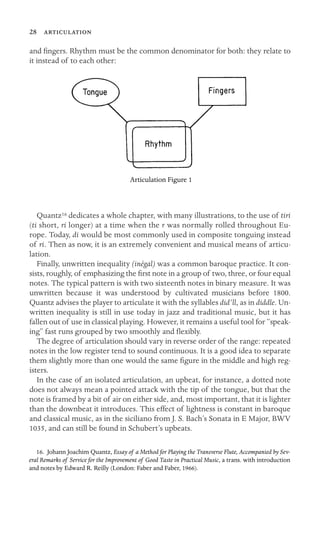
28 

and fingers. Rhythm must be the common denominator for both: they relate to
it instead of to each other:
Articulation Figure 1
Quantz16 dedicates a whole chapter, with many illustrations, to the use of tiri
(ti short, ri longer) at a time when the r was normally rolled throughout Eu-
rope. Today, di would be most commonly used in composite tonguing instead
of ri. Then as now, it is an extremely convenient and musical means of articu-
lation.
Finally, unwritten inequality (inégal) was a common baroque practice. It con-
sists, roughly, of emphasizing the first note in a group of two, three, or four equal
notes. The typical pattern is with two sixteenth notes in binary measure. It was
unwritten because it was understood by cultivated musicians before 1800.
Quantz advises the player to articulate it with the syllables did’ll, as in diddle. Un-
written inequality is still in use today in jazz and traditional music, but it has
fallen out of use in classical playing. However, it remains a useful tool for “speak-
ing” fast runs grouped by two smoothly and flexibly.
The degree of articulation should vary in reverse order of the range: repeated
notes in the low register tend to sound continuous. It is a good idea to separate
them slightly more than one would the same figure in the middle and high reg-
isters.
In the case of an isolated articulation, an upbeat, for instance, a dotted note
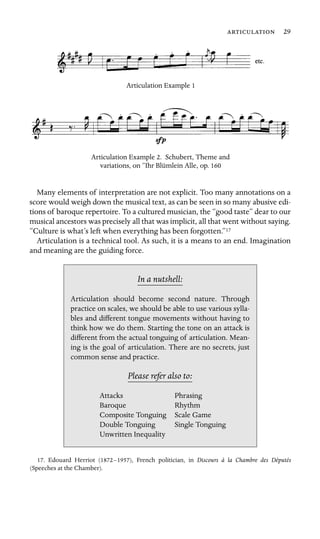
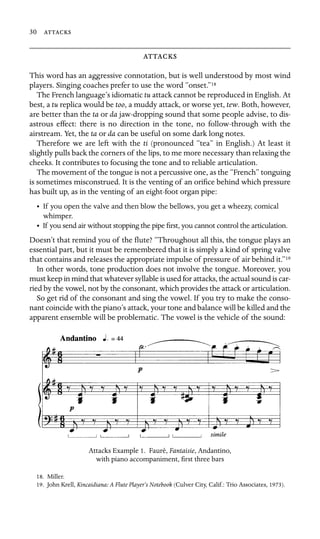
does not always mean a pointed attack with the tip of the tongue, but that the
note is framed by a bit of air on either side, and, most important, that it is lighter
than the downbeat it introduces. This effect of lightness is constant in baroque
and classical music, as in the siciliano from J. S. Bach’s Sonata in E Major, BWV
1035, and can still be found in Schubert’s upbeats.
16. Johann Joachim Quantz, Essay of a Method for Playing the Transverse Flute, Accompanied by Sev-
eral Remarks of Service for the Improvement of Good Taste in Practical Music, a trans. with introduction
and notes by Edward R. Reilly (London: Faber and Faber, 1966).
 29

Articulation Example 1
Articulation Example 2. Schubert, Theme and
variations, on “Ihr Blümlein Alle, op. 160
Many elements of interpretation are not explicit. Too many annotations on a
score would weigh down the musical text, as can be seen in so many abusive edi-
tions of baroque repertoire. To a cultured musician, the “good taste” dear to our
musical ancestors was precisely all that was implicit, all that went without saying.
“Culture is what’s left when everything has been forgotten.”17
Articulation is a technical tool. As such, it is a means to an end. Imagination
and meaning are the guiding force.
In a nutshell:
Baroque
Scale Game
Articulation should become second nature. Through
practice on scales, we should be able to use various sylla-
bles and different tongue movements without having to
think how we do them. Starting the tone on an attack is
different from the actual tonguing of articulation. Mean-
ing is the goal of articulation. There are no secrets, just
common sense and practice.
Please refer also to:
Attacks Phrasing
Rhythm
Composite Tonguing
Double Tonguing Single Tonguing
Unwritten Inequality
17. Edouard Herriot (1872–1957), French politician, in Discours à la Chambre des Députés
(Speeches at the Chamber).
30 

 

This word has an aggressive connotation, but is well understood by most wind
players. Singing coaches prefer to use the word “onset.”18
The French language’s idiomatic tu attack cannot be reproduced in English. At
best, a tu replica would be too, a muddy attack, or worse yet, tew. Both, however,
are better than the ta or da jaw-dropping sound that some people advise, to dis-
astrous effect: there is no direction in the tone, no follow-through with the
airstream. Yet, the ta or da can be useful on some dark long notes.
Therefore we are left with the ti (pronounced “tea” in English.) At least it
slightly pulls back the corners of the lips, to me more necessary than relaxing the
cheeks. It contributes to focusing the tone and to reliable articulation.
The movement of the tongue is not a percussive one, as the “French” tonguing
is sometimes misconstrued. It is the venting of an orifice behind which pressure
has built up, as in the venting of an eight-foot organ pipe:
•	 If you open the valve and then blow the bellows, you get a wheezy, comical
whimper.
• If you send air without stopping the pipe first, you cannot control the articulation.
Doesn’t that remind you of the flute? “Throughout all this, the tongue plays an
essential part, but it must be remembered that it is simply a kind of spring valve
that contains and releases the appropriate impulse of pressure of air behind it.”19
In other words, tone production does not involve the tongue. Moreover, you
must keep in mind that whatever syllable is used for attacks, the actual sound is car-
ried by the vowel, not by the consonant, which provides the attack or articulation.
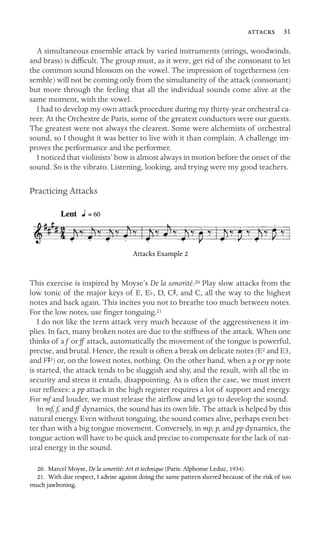
So get rid of the consonant and sing the vowel. If you try to make the conso-
nant coincide with the piano’s attack, your tone and balance will be killed and the
apparent ensemble will be problematic. The vowel is the vehicle of the sound:
Attacks Example 1. Fauré, Fantaisie, Andantino,
with piano accompaniment, first three bars
18. Miller.
19. John Krell, Kincaidiana: A Flute Player’s Notebook (Culver City, Calif.: Trio Associates, 1973).
 31

A simultaneous ensemble attack by varied instruments (strings, woodwinds,
and brass) is difficult. The group must, as it were, get rid of the consonant to let
the common sound blossom on the vowel. The impression of togetherness (en-
semble) will not be coming only from the simultaneity of the attack (consonant)
but more through the feeling that all the individual sounds come alive at the
same moment, with the vowel.
I had to develop my own attack procedure during my thirty-year orchestral ca-
reer. At the Orchestre de Paris, some of the greatest conductors were our guests.
The greatest were not always the clearest. Some were alchemists of orchestral
sound, so I thought it was better to live with it than complain. A challenge im-
proves the performance and the performer.
I noticed that violinists’ bow is almost always in motion before the onset of the
sound. So is the vibrato. Listening, looking, and trying were my good teachers.
Practicing Attacks
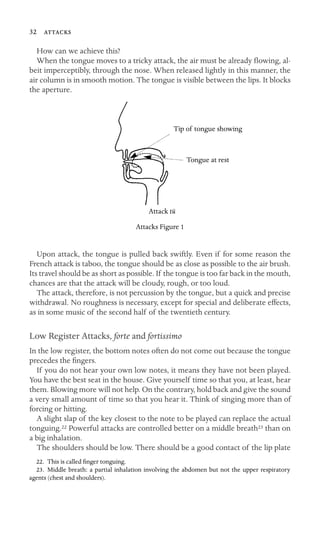
Attacks Example 2
This exercise is inspired by Moyse’s De la sonorité.20 Play slow attacks from the
low tonic of the major keys of E, Eb, D, CS, and C, all the way to the highest
notes and back again. This incites you not to breathe too much between notes.
For the low notes, use finger tonguing.21
I do not like the term attack very much because of the aggressiveness it im-
plies. In fact, many broken notes are due to the stiffness of the attack. When one
thinks of a f or ff attack, automatically the movement of the tongue is powerful,
precise, and brutal. Hence, the result is often a break on delicate notes (E2 and E3,
and FS3) or, on the lowest notes, nothing. On the other hand, when a p or pp note
is started, the attack tends to be sluggish and shy, and the result, with all the in-
security and stress it entails, disappointing. As is often the case, we must invert
our reflexes: a pp attack in the high register requires a lot of support and energy.
For mf and louder, we must release the airflow and let go to develop the sound.
In mf, f, and ff dynamics, the sound has its own life. The attack is helped by this
natural energy. Even without tonguing, the sound comes alive, perhaps even bet-
ter than with a big tongue movement. Conversely, in mp, p, and pp dynamics, the
tongue action will have to be quick and precise to compensate for the lack of nat-
ural energy in the sound.
20. Marcel Moyse, De la sonorité: Art et technique (Paris: Alphonse Leduc, 1934).
21. With due respect, I advise against doing the same pattern slurred because of the risk of too
much jawboning.
32 
How can we achieve this?
When the tongue moves to a tricky attack, the air must be already flowing, al-
beit imperceptibly, through the nose. When released lightly in this manner, the
air column is in smooth motion. The tongue is visible between the lips. It blocks
the aperture.
Tip of tongue showing
Tongue at rest
Attack tü
Attacks Figure 1
Upon attack, the tongue is pulled back swiftly. Even if for some reason the
French attack is taboo, the tongue should be as close as possible to the air brush.
Its travel should be as short as possible. If the tongue is too far back in the mouth,
chances are that the attack will be cloudy, rough, or too loud.
The attack, therefore, is not percussion by the tongue, but a quick and precise
withdrawal. No roughness is necessary, except for special and deliberate effects,
as in some music of the second half of the twentieth century.
Low Register Attacks, forte and fortissimo
In the low register, the bottom notes often do not come out because the tongue
precedes the fingers.
If you do not hear your own low notes, it means they have not been played.
You have the best seat in the house. Give yourself time so that you, at least, hear
them. Blowing more will not help. On the contrary, hold back and give the sound
a very small amount of time so that you hear it. Think of singing more than of
forcing or hitting.
A slight slap of the key closest to the note to be played can replace the actual
tonguing.22 Powerful attacks are controlled better on a middle breath23 than on
a big inhalation.
The shoulders should be low. There should be a good contact of the lip plate
22. This is called finger tonguing.
23. Middle breath: a partial inhalation involving the abdomen but not the upper respiratory
agents (chest and shoulders).
 33

with the chin fulcrum. Tone production comes more from abdominal support
than from the lips. Precision of attack owes more to air speed than to the tongue.
In the standing position, one’s weight should be firmly on the feet. In the sitting
position, it would rest on the lower back.
When we start a low passage after a rest, the lowest notes tend to “resist” on
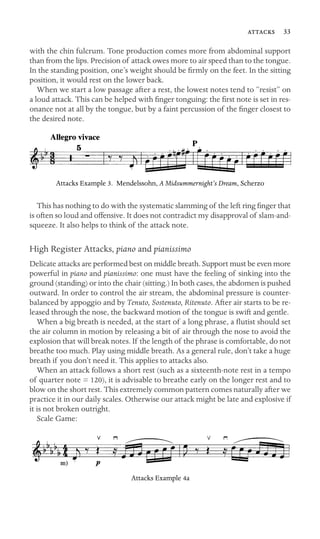
a loud attack. This can be helped with finger tonguing: the first note is set in res-
onance not at all by the tongue, but by a faint percussion of the finger closest to
the desired note.
Attacks Example 3. Mendelssohn, A Midsummernight’s Dream, Scherzo
This has nothing to do with the systematic slamming of the left ring finger that
is often so loud and offensive. It does not contradict my disapproval of slam-and-
squeeze. It also helps to think of the attack note.
High Register Attacks, piano and pianissimo
Delicate attacks are performed best on middle breath. Support must be even more
powerful in piano and pianissimo: one must have the feeling of sinking into the
ground (standing) or into the chair (sitting.) In both cases, the abdomen is pushed
outward. In order to control the air stream, the abdominal pressure is counter-
balanced by appoggio and by Tenuto, Sostenuto, Ritenuto. After air starts to be re-
leased through the nose, the backward motion of the tongue is swift and gentle.
When a big breath is needed, at the start of a long phrase, a flutist should set
the air column in motion by releasing a bit of air through the nose to avoid the
explosion that will break notes. If the length of the phrase is comfortable, do not
breathe too much. Play using middle breath. As a general rule, don’t take a huge
breath if you don’t need it. This applies to attacks also.
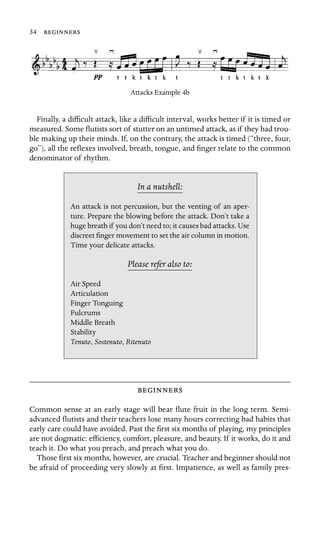
When an attack follows a short rest (such as a sixteenth-note rest in a tempo
of quarter note = 120), it is advisable to breathe early on the longer rest and to
blow on the short rest. This extremely common pattern comes naturally after we
practice it in our daily scales. Otherwise our attack might be late and explosive if
it is not broken outright.
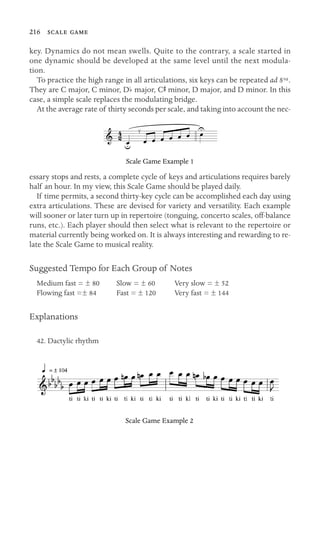
Scale Game:
Attacks Example 4a
34 

Attacks Example 4b
Finally, a difficult attack, like a difficult interval, works better if it is timed or
measured. Some flutists sort of stutter on an untimed attack, as if they had trou-
ble making up their minds. If, on the contrary, the attack is timed (“three, four,
go”), all the reflexes involved, breath, tongue, and finger relate to the common
denominator of rhythm.
In a nutshell:
Air Speed
Stability
, Sostenuto, Ritenuto
An attack is not percussion, but the venting of an aper-
ture. Prepare the blowing before the attack. Don’t take a
huge breath if you don’t need to; it causes bad attacks. Use
discreet finger movement to set the air column in motion.
Time your delicate attacks.
Please refer also to:
Articulation
Finger Tonguing
Fulcrums
Middle Breath
Tenuto

Common sense at an early stage will bear flute fruit in the long term. Semi-
advanced flutists and their teachers lose many hours correcting bad habits that
early care could have avoided. Past the first six months of playing, my principles
are not dogmatic: efficiency, comfort, pleasure, and beauty. If it works, do it and
teach it. Do what you preach, and preach what you do.
Those first six months, however, are crucial. Teacher and beginner should not
be afraid of proceeding very slowly at first. Impatience, as well as family pres-
 35
sure, wants to jump ahead and hear results. But the future can be jeopardized by
haste. Look how slowly and carefully young violinists start out. The method cho-
sen should reflect this concern. My preference goes to the most progressive, not
to the fastest.1
The typical beginner has had no musical training. It is important that she or he
be taught notation and rudiments of theory right along with the first instru-
mental discoveries. A method book is not enough. Often it prints what to do, but
rarely does it show how to do it. The teacher is the essential example. Since
young people learn mostly from imitation, the teacher should be constantly
demonstrating and playing along.
Producing a Tone
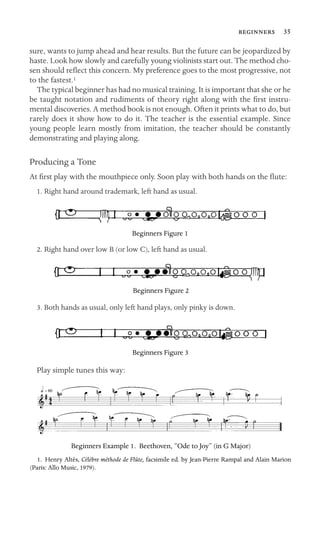
At first play with the mouthpiece only. Soon play with both hands on the flute:
1. Right hand around trademark, left hand as usual.
Beginners Figure 1
2. Right hand over low B (or low C), left hand as usual.
Beginners Figure 2
3. Both hands as usual, only left hand plays, only pinky is down.
Beginners Figure 3
Play simple tunes this way:
Beginners Example 1. Beethoven, “Ode to Joy” (in G Major)
1. Henry Altès, Célèbre méthode de Flûte, facsimile ed. by Jean-Pierre Rampal and Alain Marion
(Paris: Allo Music, 1979).
36 

Beginners Example 2. Saint-Saëns, Danse macabre
Beginners Example 3. Chabrier, España
Don’t try to play long tones yet. Instead, play sounds one second long (quar-
ter note = 60) neither loud nor soft, but with a clear attack right away. The tip of
the tongue shows before the air is blown, then is pulled back as if to spit out a
seed. This vents the small aperture that directs the air brush, and it helps to form
the half-smile necessary for a proper direction. I still don’t understand why this
tonguing is anathema in certain circles. It should not be always used for a series
of repeated notes, but to form the first tone, it works.
The frown is sometimes advised, but it does not come naturally. The half-smile
is a better way. The flute airflow is comparable to cooling a hot spoonful or blow-
ing out the last candle of a birthday cake. Who does not like to do that?
Breathing
Blowing is, at first, more important than breathing. Don’t take in more breath
than you need to play tones of one second. To feel the short breaths that you
need at first, lie down on your back; in this position you cannot breathe using
your shoulders. Your tummy goes up and down—that’s good.
Posture
The most logical way, again, is your natural posture when you read a bulletin
board or wait for the bus: no raised shoulders or elbows.
 37

Instruments
It is hard to understand why students are supposed to learn on instruments that
encourage bad habits, such as covered-key flutes. By the time they graduate to
the French system they have developed bad hand positions that are terribly frus-
trating to change. More makers should offer cheap French-model flutes (with
open keys) so that more people can start with reasonable finger placement. One
excellent feature of the cheaper flutes, however, is the offset G sharp. It is much
easier on small hands.
Hand Position
The teacher should adopt the most natural position. I do not like to see cocked
wrists: they lead to tendinitis. As much as possible, the tendons of both arms
should stay aligned with the fingers.
Left Hand
Pinch your right ear with your left hand. Your wrist is aligned: play the flute the
same way.
Right Hand
Try picking up a book lying flat on a high shelf. Your wrist is aligned with your
right arm and with your fingers. These are almost flat, and the thumb is posi-
tioned somewhere opposite the forefinger and the middle finger. They are more
or less flat, and that is good. If they were too rounded out, as is sometimes
taught, you would be squeezing the instrument with the right hand. Lifting
squeezing fingers requires more effort than flat ones. This in turn could, in the
long run, create stress on the tendons all the way up the right arm.
Stability
It will be a blessing if, early on, the beginner feels the stability of the lip plate on
the chin. The lips should be relaxed, not loose. The chin should not jut forward
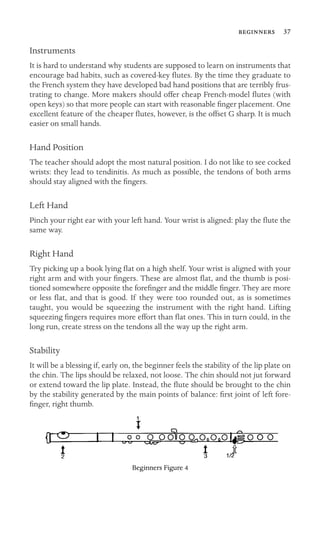
or extend toward the lip plate. Instead, the flute should be brought to the chin
by the stability generated by the main points of balance: first joint of left fore-
finger, right thumb.
Beginners Figure 4
38   
The First Pieces
It is most important for a beginner to hear the teacher play the same things, or
accompany them. The teacher should not hesitate to stay a long time on simple
tunes such as “Three Blind Mice” or “Frère Jacques” or the ones given earlier.
Repetitiousness is not usually a problem for the first six months. Full pieces
will come much later. At first, love starts with playing the flute, not so much with
playing the music. At a young age, the aesthetic reward of great music comes
after the exquisite pleasure of playing the beloved flute. Some fifty years later, my
own delight survives and flourishes.
In a nutshell:
Hands Stability
Lips
Proceed slowly with beautiful tunes that have movement.
Long tones are difficult and tedious. Breathe just enough
to play a few notes. Big breaths are hard to control. Always
give a tonguing on the first note.
Once the fingers are placed logically, comfort and sta-
bility are the issue. A good stability with the fulcrums does
not mean tightness. Do not “slam-and-squeeze.”
Please refer also to:
Blowing Position
Comfort Posture
Fulcrums Slam-and-Squeeze
  
There is no answer to the sophistic question, “Which came first, the chicken or
the egg?” For us it translates to: “Which is first: blowing or breathing?” Breathing,
of course, and yet it is the blowing that creates a sound. If you don’t know how
to blow, your breathing will be just an organic act, a vital but musically void ne-
cessity. Still, it seems that most of us are worried more by the intake of air than
with the management of its release.
Examples of breath management problems abound in our solo repertoire: the
first three movements of Bach’s Partita in A Minor, BWV 1013; the opening solo
in Mozart’s Concerto in D Major, K. 314; and in Poulenc’s Sonata, the opening
phrase of the Cantilena.
   39

We find it in the orchestral repertoire also: among other places, in Ravel’s
Bolero and the beginning of Beethoven’s Fourth Symphony. The latter is never
mentioned, but it was my personal nightmare: one single Bb held for what seems
like hours by one flute (no second to help out), two clarinets, and two bassoons
over three octaves. The more famous the conductor, the slower the tempo. . . .
Pitch problems, breath management problems, attack problems. I preferred
some of the technically “difficult” excerpts.
Most often required for auditions are the Scherzo from Mendelssohn’s Mid-
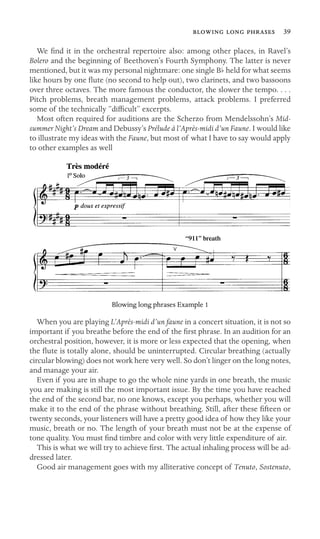
summer Night’s Dream and Debussy’s Prélude à l’Après-midi d’un Faune. I would like
to illustrate my ideas with the Faune, but most of what I have to say would apply
to other examples as well
“911” breath
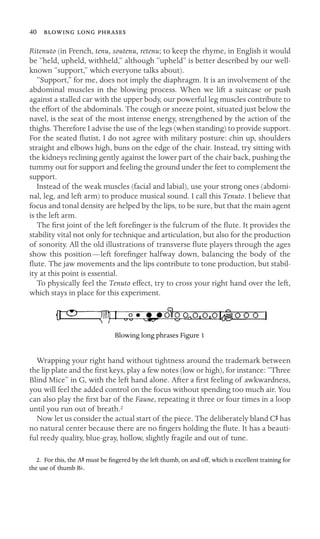
Blowing long phrases Example 1
When you are playing L’Après-midi d’un faune in a concert situation, it is not so
important if you breathe before the end of the first phrase. In an audition for an
orchestral position, however, it is more or less expected that the opening, when
the flute is totally alone, should be uninterrupted. Circular breathing (actually
circular blowing) does not work here very well. So don’t linger on the long notes,
and manage your air.
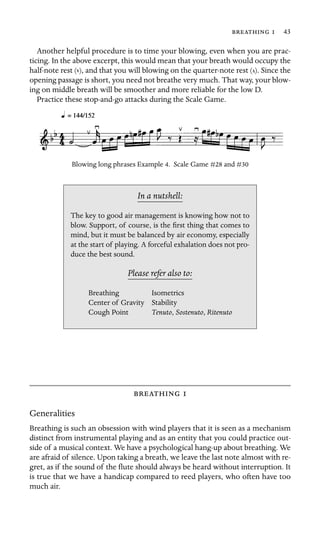
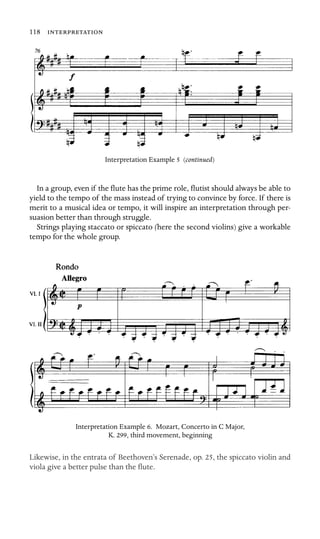
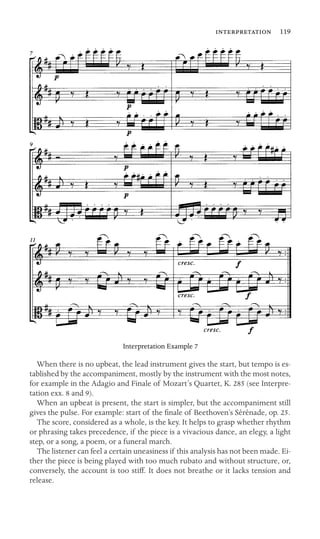
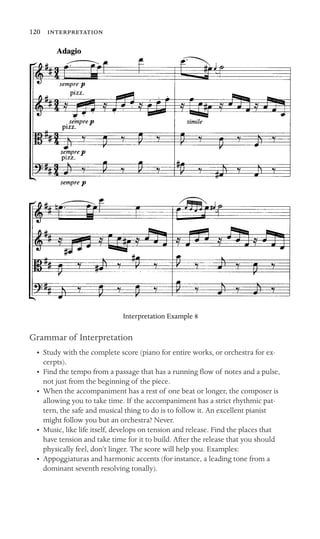
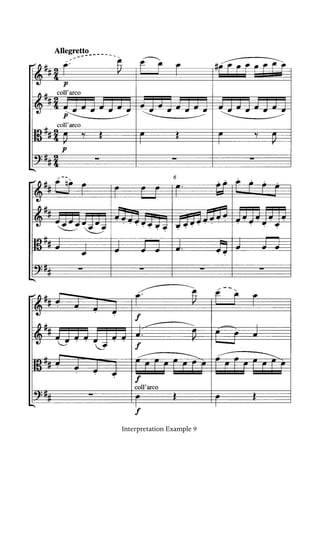
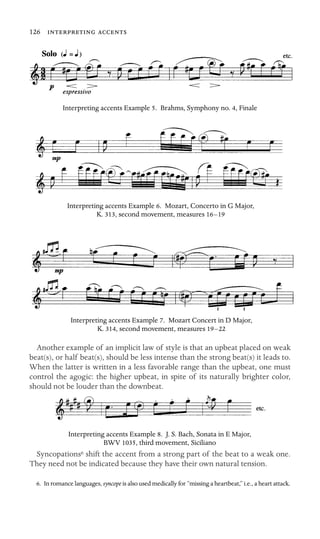
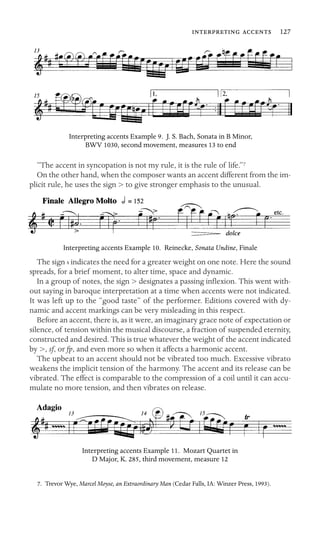
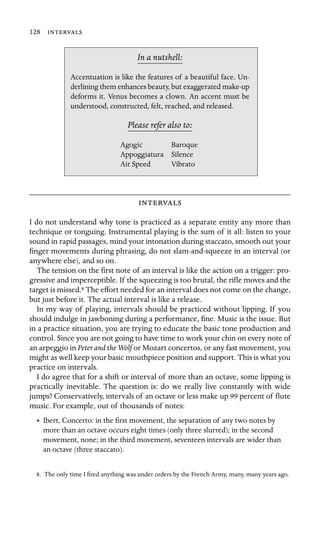
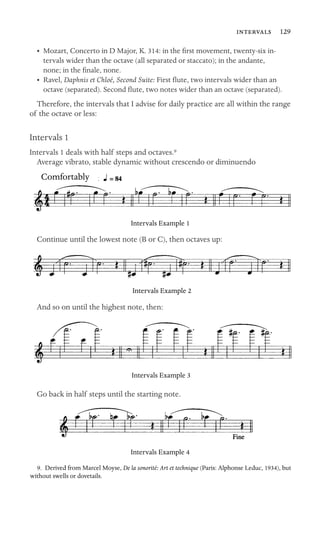
Even if you are in shape to go the whole nine yards in one breath, the music
you are making is still the most important issue. By the time you have reached
the end of the second bar, no one knows, except you perhaps, whether you will
make it to the end of the phrase without breathing. Still, after these fifteen or
twenty seconds, your listeners will have a pretty good idea of how they like your
music, breath or no. The length of your breath must not be at the expense of
tone quality. You must find timbre and color with very little expenditure of air.
This is what we will try to achieve first. The actual inhaling process will be ad-
dressed later.
Good air management goes with my alliterative concept of Tenuto, Sostenuto,
40   
Ritenuto (in French, tenu, soutenu, retenu; to keep the rhyme, in English it would
be “held, upheld, withheld,” although “upheld” is better described by our well-
known “support,” which everyone talks about).
“Support,” for me, does not imply the diaphragm. It is an involvement of the
abdominal muscles in the blowing process. When we lift a suitcase or push
against a stalled car with the upper body, our powerful leg muscles contribute to
the effort of the abdominals. The cough or sneeze point, situated just below the
navel, is the seat of the most intense energy, strengthened by the action of the
thighs. Therefore I advise the use of the legs (when standing) to provide support.
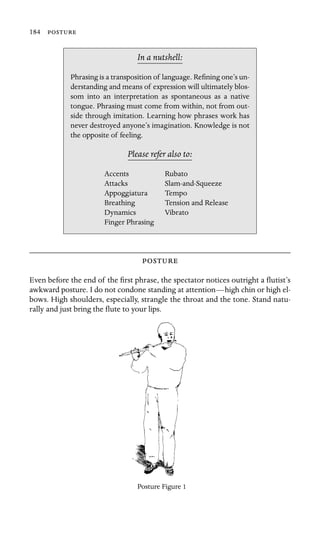
For the seated flutist, I do not agree with military posture: chin up, shoulders
straight and elbows high, buns on the edge of the chair. Instead, try sitting with
the kidneys reclining gently against the lower part of the chair back, pushing the
tummy out for support and feeling the ground under the feet to complement the
support.
Instead of the weak muscles (facial and labial), use your strong ones (abdomi-
nal, leg, and left arm) to produce musical sound. I call this Tenuto. I believe that
focus and tonal density are helped by the lips, to be sure, but that the main agent
is the left arm.
The first joint of the left forefinger is the fulcrum of the flute. It provides the
stability vital not only for technique and articulation, but also for the production
of sonority. All the old illustrations of transverse flute players through the ages
show this position—left forefinger halfway down, balancing the body of the
flute. The jaw movements and the lips contribute to tone production, but stabil-
ity at this point is essential.
To physically feel the Tenuto effect, try to cross your right hand over the left,
which stays in place for this experiment.
Blowing long phrases Figure 1
Wrapping your right hand without tightness around the trademark between
the lip plate and the first keys, play a few notes (low or high), for instance: “Three
Blind Mice” in G, with the left hand alone. After a first feeling of awkwardness,
you will feel the added control on the focus without spending too much air. You
can also play the first bar of the Faune, repeating it three or four times in a loop
until you run out of breath.2
Now let us consider the actual start of the piece. The deliberately bland CS has
no natural center because there are no fingers holding the flute. It has a beauti-
ful reedy quality, blue-gray, hollow, slightly fragile and out of tune.
2. For this, the AS must be fingered by the left thumb, on and off, which is excellent training for
the use of thumb Bb.
   41

Let’s assume that the inhaling process, which we will discuss elsewhere, is
complete. As soon as possible after you have filled up with air, you should start
playing. To hold a huge quantity of air, you must block your breath, which tends
to make your attack explosive upon release. When you are in an audition, no
problem: you are the boss. In concert, if the conductor knows his stuff (it hap-
pens!) he should give a small sign for you to fire at will instead of the usual down-
beat, which interferes with your inhaling sequence. You can always talk it over
with the conductor (but not in the rehearsal: it might look as if you were teach-
ing him his job, or worse yet, that you are having a problem). This piece is often
placed right after intermission; it cannot start the concert, nor can it end the first
half, nor can it be the last work at the finish (not noisy enough). So it is difficult to
concentrate because of movements and conversations in the audience as well as
in the orchestra.
So you have started to play. Now comes the withholding (Ritenuto). Your main
effort now is to not blow and to maintain the expansion of your rib cage to re-
sist its collapse. By sheer elasticity of the cartilage in your chest and the natural
weight of the bone in your shoulders, some air will be let out. The withholding
is actually an effort to maintain the air cavity open, to counteract the support
muscles in the lower body. With support and no withholding, the chest empties
quickly and the phrase cannot be held to its end.
Do not blow at first: this is the secret. Until the end of the second measure, re-
lease the chest air sparingly. Do not spend it, save it. When you realize you are
short of air, it is usually too late. It is how you manage your airflow at the very
start of the phrase that makes the difference.3
Then for the second and third measures, “normal” blowing is in order, sup-
porting with the abdomen. For the final notes, you can think of making a
crescendo because air is running out, and this ultimate support helps keep the
sound in tune.4 Finally, if you are on good terms, ask the first oboe to connect his
AS with yours preferably sooner than later, and to play it not too sharp, to match
yours, because you might have a tendency to go flat at the end of your apnea.
Now we must retrace our steps to the inhaling procedure. I say inhaling be-
cause it is a deliberate process as opposed to the natural breathing function.
First, as stress control and as a way to reoxygenate your blood, ventilate by tak-
ing a few deep inhalations,5 producing the “hhaah” sound and cooling your deep
throat. When we are making a physical effort, we are out of breath for the same
reason: our blood needs more oxygen for our red blood cells to bring repair to
the muscle cells.
Second, expel every ounce of air possible, with an audible (to you) “sschss . . .
3. Air management reminds me of personal finance management: it is wiser to save your salary
when you get it than be reduced to poverty before the next paycheck.
4. If you realize at the end of the third measure that you might come out short, the most musi-
cal breath to take is in the fourth measure between the two Bs.
5. Dogs, who do not sweat, must pant to eliminate excess body heat. Panting is also taught in so-
called painless childbirth.
42   

tchhh,” ending with collapsed chest, low shoulders, and abdomen totally pushed
in.
Third, start inhaling slowly through the nose, filling the chest cavity and every
little nook and cranny in the upper torso. I advise doing this upper process first
because the chest muscles work more slowly than the abdominals and because
intake through the nose corresponds to upper breathing.
Fourth, open the mouth and throat, expanding the belt area, inhale to produce
the “hhaah” sound, then play right away.
Preparation: 1. ventilate c. 5”—2. expel all air—3. upper breathing c. 5”—4.
abdominal breathing c. 3”—start immediately
Très modéré
play and save (by resisting collapse play and save (by resisting collapse 

of chest) of chest)

normal playing mental crescendo
Blowing long phrases Example 2. Debussy, Prélude à l’après-midi d’un faune
As I have said, you should not use this lengthy process every time you breathe,
but only when you need to conduct a long phrase, such as in L’Après-midi d’un
Faune.6 It does not take more than a few seconds when you master this technique.
Blowing on an Attack
For a low attack forte or a high one piano, a late onset of the air might jeopardize
the quality of the first note and the ensemble of the whole passage. If you have
time, it is always a good idea to breathe early and to be already blowing when the
first note is articulated.
Blowing long phrases Example 3. Beethoven, Leonore Overture no. 3
6. Historical note: Prélude à l’Après-midi d’un Faune was premiered on 23 December 1894. The
flutist was Georges Barrère, then eighteen years old! The record does not show whether he breathed
in the first phrase, but the piece’s success was immediate and enormous: it had to be encored.
  43

Another helpful procedure is to time your blowing, even when you are prac-
ticing. In the above excerpt, this would mean that your breath would occupy the
half-note rest ( ), and that you will blowing on the quarter-note rest ( ). Since the
opening passage is short, you need not breathe very much. That way, your blow-
ing on middle breath will be smoother and more reliable for the low D.
Practice these stop-and-go attacks during the Scale Game.
Blowing long phrases Example 4. Scale Game #28 and #30
In a nutshell:
duce the best sound.
Isometrics
Stability
, Sostenuto, Ritenuto
The key to good air management is knowing how not to
blow. Support, of course, is the first thing that comes to
mind, but it must be balanced by air economy, especially
at the start of playing. A forceful exhalation does not pro-
Please refer also to:
Breathing
Center of Gravity
Cough Point Tenuto
 
Generalities
Breathing is such an obsession with wind players that it is seen as a mechanism
distinct from instrumental playing and as an entity that you could practice out-
side of a musical context. We have a psychological hang-up about breathing. We
are afraid of silence. Upon taking a breath, we leave the last note almost with re-
gret, as if the sound of the flute should always be heard without interruption. It
is true that we have a handicap compared to reed players, who often have too
much air.
44  

I have trouble believing that one can buy machines to improve breathing. It is
as if exercise machines advertised with beautiful models were the secret of eter-
nal health.
Breathe as you would without a flute on your lips. Go back to simplicity. When
you read a bulletin board, do you lift your shoulders? Do you stand at attention?
Breathe as you would when you wait for the bus.
Middle Breath
Do not systematically take a full breath if the length of the phrase you have to
play does not require it. Use what I call “middle breath.” Your air will be more
manageable, your rib cage will not extend fully, and your shoulders will not rise.
Listen to your tone: even if the focus is good from the start, it improves after a
second or two in middle breath, because the airflow is smoother, the mouth cav-
ity and the throat more relaxed. Place little breaths (gasps), unmarked, unheard,
wherever you can, like a fish opening its mouth as it moves along.
Sometimes, the mechanics of breathing seem more important than blowing.
For instance, “circular breathing” is actually uninterrupted blowing. You may feel
comfortable with your breathing, but what is the use of good breathing if you
don’t know how to blow? My approach is that if you produce a good tone, you
are on the right track for breathing. The contrary, however, is not always true:
you may be breathing well and still produce an ugly noise.
The basic act of breathing is simple enough: drop your shoulders, open the
throat with the “hhaah” sound, relax the abdominal wall, and emulate the me-
chanics of yawning. When we are reading a bulletin board instead of music, our
breath is “normal,” noiseless and comfortable. As soon as we begin to play, our
air intake becomes noisy, contrived, and stressful. We don’t take our time, we
don’t make the “hhaah” sound to feel cold air in our deep throat, we leave the
tongue in the way, and we try to go beyond our capacity. My purpose here is not
only “how” to breathe, but “where” and “how much.” What happens to the
music before, during, and after the breath?
It seems that most flutists think the air intake must always be huge, and that the
musical thing to do is to do hold the breath forever. While it might sometimes be
vital to do so, one should not systematically fill up. Let us compare music to the
spoken language. When asked if he has a breathing secret, Rampal replied: “No,
I just open my mouth. Do you have a breathing secret when you speak? No, you
open your mouth, you breathe. When you’re talking, you naturally breathe be-
tween phrases, as you need it. In music, it’s the same.”7 Are you going to take the
same breath to recite: “Now is the time for all good men to come to the aid of
their country” as to say “Ciao!” or to whisper “Good night” to a sleepy infant?
A middle breath is easier to manage than a huge one in the extreme ranges (p,
pp in the high register, f, ff in the low notes). For staccato low attacks, don’t
7. “J. P. Rampal on Making Music,” Flute Talk, vol. 10, no. 9, 7 (May/June 1991): 8–13.
  45
breathe too much. Take a middle breath, play middle breath, and take short gasps
between articulations. Your attacks and staccato will break less. These gasping
breaths are very helpful in rhythmic passages. They are barely audible, they add to
the articulation, and they allow us to fill up before a long uninterrupted segment:
Breathing Example 1. Bach, Sonata in E Minor,
BWV 1034, second movement, beginning
Take little gasps after the first and fifth note of each measure. “Gasp” twice per
measure at first, then at measure 16 you will be able to play the whole passage
without breathing.
There are almost as many ways to breathe as there are musical examples, but
let us consider certain logical axioms: where to breathe, and where not to
breathe. Once you have understood the breathing process, the way is paved
to the musical goal. Breathing is only one of the means, albeit an essential one, to
that end. “Having a clear musical image rather than thinking of the physical
means is the best way to produce music. This entails breathing naturally.”8
In a nutshell
Air Management Scale Game
Staccato
Gasps
“Hhaah” Sound Synchronization
Breathe to play as you breathe to speak. Good blowing
leads to good breathing, but not always vice versa. Musical
breathing is like punctuation. Breathe more often like a
fish than like a whale. A middle breath is more manage-
able than a huge one. Balance your tone on either side of
the breath and keep a smooth musical line. Use small
breaths to enhance shaping.
Please refer also to:
Attacks
Stress
Intervals
8. Kathleen Goll Wilson, “Concepts of Phrase Breathings,” Flute Talk, vol. 10, no. 6 (February
1991): 10–12.
46  

 
Mechanics of Breathing
Pulling in the tummy during inhalation is the result of education and of attitude
control that a screaming infant cares nothing about. This look is fine for fashion
models, but for breathing it is hopeless. Standing at attention, tummy tucked in,
chin up, and eyes to the horizon is superb for a Marine on the parade ground but
is not a good idea while playing the flute.
Here is a simple exercise to feel a true abdominal inhalation: sit with knees and
feet joined; bring your elbows to your knees while exhaling. When you inhale,
your torso cannot move and your breathing is really abdominal. Of course, it is
not advisable to play in this position!
Now lie on your back. In this position, you cannot raise your shoulders upon
inhalation. However, you can raise your tummy freely. This is the most natural
and the best breathing procedure. Duplicate it while standing.
Try to avoid the impression of inflating your lung cavity. Atmospheric pressure
does that by a bellows effect when you create a void inside your lungs. Nothing
should stand in the way of fresh air. The bellows effect explains why our breath
is shorter at high altitudes. Because of the lower atmospheric pressure, the same
chest movement gives us less air.
Short panting breaths are very helpful in rhythmic passages: they are barely au-
dible, they add to the articulation, and they allow us to fill up before a long un-
interrupted segment. This implies that you use the abdominal belt to huff-huff
little gasps. Start panting between eighth notes early in the piece, before you start
running out, because the longer you postpone your inevitable breathing, the
noisier it will be.
The “Hhaah” Sound
If you breathed with clenched teeth, you would do a very poor inhalation. You
would be breathing with high shoulders. You would produce a strong hissing
noise, perceptible from a distance and your teeth would feel cold. If you opened
your jaws but left your tongue in the path of incoming air, you would get a
slightly better inhalation (although it would still be placed in the upper part of
your chest). You would feel the cool air inside your mouth, but you would still
make this unpleasant sucking noise that flutists often produce. A sucking noise at
air intake shows that your mouth and your throat are closed and that your
tongue is in the way.
Now if you feel cold air on your Adam’s apple, and if you hear the sound
“hhaah,” you are breathing fully. The abdominal belt is released and you take in
a maximum of air with a minimum of noise.
Good breathing is what you do when you yawn (open throat, low shoulders).
Proper blowing is what you do when you cough or sneeze (support with the ab-
  47
dominal muscles). Don’t worry about your diaphragm. It goes up, it goes down;
it goes down, it goes up. Like Timothy Tim’s ten pink toes, it goes wherever the
air goes. Only a contrary action of the abdominal muscles or stiff raised shoul-
ders can hinder it.
Yet we must sometimes be able to play a long phrase such as the first phrase
of Prélude à l’Après-midi d’un Faune9 in one breath. Many conductors see it as an
important test. After thirty years in an orchestra, I consider the Faune (nicknamed
L’après-midi in English-speaking orchestras) the most difficult of orchestral solos.
Flutists capable of sustaining the longest phrase are not always those with the
biggest chest cavity, but those who manage their air most efficiently. The answer
is not in circular blowing,10 which I confess to not mastering perfectly. If the
sound is out of focus and mismanaged, “circular breathing” will not hide the fact
that air economy is not mastered.
A good idea for oxygenating quickly, before a demanding passage and during
the course of a piece, is panting. It is repeated gasping, comparable to what dogs
have to do on a hot day. They cannot sweat, so they use this method to eliminate
water to lower their body temperature, even if they are not running.
1. Before inhaling, empty your chest cavity completely.11
2. Then, through the nose, slowly fill the upper part of your chest cavity, keep-
ing the abdomen flat.
3. When you are about to play, drop (release) your abdominal belt, and inhale
with the “hhaah” sound. You feel the cold air deep in your throat, indicating
that your throat is open.
4. Start playing right away to avoid blocking the sound.
This process seems long, but does not take more than a couple of seconds.
Imagine you were not using your mouth. It would seem as though air would
pass through the skin of the neck at the lowest point where the cold is felt.
Some wind instrumentalists perform the abdominal breathing first and the
upper (or thoracic) breathing last. This conforms to the yoga doctrine.12 I advise
the opposite because upper breathing is a relatively slow process, whereas ab-
dominal (or low) breathing is fast. It can be placed at the last fraction of a second,
avoiding blocking the air and risking a broken attack.
Nerves do not affect only fingers and saliva secretion. As far as I am concerned,
short breath is the main syndrome. Don’t be too optimistic. Even during prac-
tice, breathe more often than you hope you will need. Your listeners might not
notice an extra breath. They might notice if you faint.
9. Claude Debussy (1862–1918).
10. Improperly called “circular breathing.”
11. A small part called residual or remnant air cannot be evacuated.
12. A Hindu school of thought involved with control of the body to achieve communion with
the spirit of the universe. Inhalation is one of its central concepts.
48  

In a nutshell:
Gasps
Inhale as you yawn waiting for the bus: low shoulders,
open throat. Make up for an insufficient air volume by
placing your intake as low as possible, where you feel the
cold air. If your breathing is noisy, you are not breathing as
well as with the “hhaah” sound.
Please refer also to:
Abdominal muscles
Attacks Support
Blowing Throat
Breathing
 
Where Not to Breathe
My basic philosophy about breathing is simple: if you don’t need a big breath,
don’t take one. When you say: “Cool!” you only need a sip of air. But when you
tell someone, “I just did not have time to open my flute case since my last lesson,”
you need a lot of air, and a lot of nerve.
Don’t breathe in the following places:
•	 Before a resolution or during harmonic tension (appoggiaturas, seventh

chords, and dissonances).

Breathing (Where not to breathe) Example 1. Mozart,
Oboe Concerto in C Major, K. 314, second movement
Do not breathe after the CS before the triplets.
  49

•	 Before a perfect cadence, except in certain baroque endings, when a slight

wait before the last note emphasizes the conclusion.

•	 Breathing on bar lines is usually not good: it creates a rupture in the line, a
sort of hiccup. But there are exceptions, as when the harmony progresses in
whole or half measures or in arpeggios.
•	 On a short rest: if you can, do not breathe just before a fast run or scale.

There are a million examples of this.

•	 If you have relatively long rests (quarter or eighth) followed by sixteenth

rests, you should not breathe on the short rest. If you do, you are going to

be late on ensemble and clumsy on synchronization of tongue and fingers.

A good way to train for this is to integrate it into your daily practice on
scales.
Breathe on the previous quarter rest and blow on the sixteenth rest.
breathe blow	 breathe blow
Breathing (Where not to breathe) Example 2
(The sign indicates breathing; the one above the short rest indicates
blowing.)
Breathe more than you need in practice. In actual performance, it will be easy
to stretch your air if you feel good. But if you stretch it too thin, you might be
forced to make catastrophic breaks. I learned long ago from my own experience
that stage fright affects the breath first. Something technical is often easier.
In a nutshell:
Interrupt the phrase as little as possible. It is not a matter
of holding a line forever as much as matching color and
sound. Good blowing leads to good breathing, but not al-
ways vice versa. The issue is music, not Olympic records.
Use the haahh sound if you have time. Elsewhere, little
sniffs and gasps will help you and and the music’s clarity.
50  

Scale Game
Color Staccato
“Hhaah” Sound
Synchronization
Please refer also to:
Attacks
Stress
Middle Breath
Phrasing
 
Where to Breathe
There is of course the obvious musical punctuation:
• After a tonal resolution.
• After a perfect cadence.
• Between two staccato notes.
• Between two notes of the same name. It will also help to articulate them.
• On a syncopation:
Breathing (Where to breathe) Example 1. Bach, Sonata in B Minor,
BWV 1030, second movement, measure 13 to end
The gasps reinforce the tension build-up or release of the syncopations. You
can almost breathe on each syncopation. It helps you and the music too. In other
words, the rhythmic character of a piece lends itself to many little breaths. Ram-
pal gave magnificent examples of this in many of his recordings (the Bolling suite
and post-baroque concertos by Stamitz and Benda, among others). It is said that
Gaubert was also a master at stealing gasps here and there without being heard.
The problem is compounded when the passage is slurred or fast. If it must be
interrupted for a biological reason, here are a few ideas:
  51

•	 Chose a place where the music is not offended too much and match the tone
on either side of the breath, for instance in the Sarabande of Bach’s Partita
in A Minor, BWV 1013, or in the opening bars of the second movement of
the Martinu Sonata.
•	 Breathe with your ears. If you must interrupt the line, your ears should tell
you how to deal with the sound and the phrase just before and just after the
breath, especially if is not a musically obvious place. Do not systematically
taper off on the release before the breath. Think of matching the dynamics
in the very recent past and in the very near future.
•	 Do not to hit the following note just because you filled up and are no longer
threatened by immediate asphyxiation.
In other words, always breathe in the direction of the phrase, whether it is as-
cending or descending. I am not trying to say that you can breathe anywhere.
The line must continue through the silence of the breath, just like a cloud or a
tree can hide the trajectory of a bird in flight from your view for a moment.
In the Allemande from the Bach Partita, do not sit on the notes following the
breaths. In this very difficult work, one hears too often a diminuendo followed by
a sucking noise and then an accent. Here, again, match the notes on either side of
the breath.
To practice this, play a few notes beyond your intended breath, then repeat the
last notes you have just heard yourself play, this time with a breath. Try to musi-
cally balance the tone on either side of the break as if there had been no inter-
ruption. If the line is increasing, the previous note should not taper off before
you breathe, and the note following should be in direct progression with the con-
text. Conversely, when the line decreases, don’t let the perspective of your breath
affect the remaining energy of your tone. The note following should not be sud-
denly louder than the previous phrase.
Integrate small gasps into your daily practice on scales. Breathe after the first
note in a group of four or eight notes and, again, match the tone on either side of
the breath.
Breathe comfortably when you are alone and the accompaniment is sus-
pended. This implies that you can slightly shorten the note before the break with-
out tapering it. When your breath is, by necessity, not in the best musical place,
using the accompaniment as a shield can hide it. On an accompaniment chord,
your gasp is lost in the resonance of the piano. For this reason as well as many
others, you must have studied the whole score, not only the flute part.
When you have no choice but to breathe or die, it is better to speed up just be-
fore the breath than to come to a full stop and slow down after. A slight rush on
the three notes preceding the break will give you just that little bit more time to
stay on course.
In an avalanche of notes, it is preferable to contract a few notes than to take
some out. A good example of this is Variation 5 of Schubert’s Introduction and
Variations on “Ihr Blümlein Alle,” op. 160.
52 
These little cheats give you a split second to breathe. They are barely notice-
able, and 911 need not be called.
In a nutshell:
Scale Game
Staccato
“Hhaah” Sound
Language Synchronization
Breathe to play as you breathe to speak. Good blowing
leads to good breathing, but not always vice versa. Musical
breathing is like punctuation. Breathe more often like a
fish than like a whale. A middle breath is more manage-
able than a huge one. Balance your tone on either side of
the breath, and keep a smooth musical line. Use small
breaths (gasps) to enhance shaping.
Please refer also to:
Attacks
Circular Blowing
Stress
Middle Breath

In the course of twenty-four hours in the life of a flutist, the break between low
and medium ranges is breached hundreds of times. Yet it is still one of the criti-
cal points of instrumental playing, especially when it must be slurred slowly. It
shows once more how deceptive is the assumption that “only fast is difficult.”
After more than half a century of playing the flute, I still have to think ahead and
work at making the bridge smooth and musical, but it brings rewards.
The problem lies in the fact that we have to go from two handfuls of fingers
(D2) to only one or two (C2) and back. To make matters worse, these happen to
be our dear little devils no. 1 and no. 2. “The second octave C–D, for instance, re-
quires an extremely complex coordination of seven fingers and a thumb (an ex-
change that can be simplified by anticipating the D with the second and third fin-
gers of the right hand while playing the C and vice versa).”13 And, I may add, not
using the right pinky.
The bridge question does not arise only for the C2–D2 break. It is also implicit
in the following:
13. Krell.
 53

Bridge Example 1
For all these combinations, a better smoothness in the passage of the bridge
will be achieved at no expense of tone quality—quite to the contrary—by using
the balance provided by the right ring finger:
Bridge Figure 1. Right hand for these notes
In the case of most intervals involving D2—namely the Bridge—the right
pinky (little devil no. 2) can be left unused, because it is usually more of a nui-
sance than a necessity. Of course, if DS or Eb are played, the right pinky comes
down, but it is still the right ring finger that provides the comfortable balance. Ac-
tually, a stiff right pinky pressed hard on the DS key is no longer the element of
stability that it is intended to be, but a painful liability. Remember, an open DS
key is absolutely vital on only six notes:
Bridge Example 2
Many purists will object that preparing finger combinations is a cop out, and
that leaving a finger on a “silent key”14 (such as the right ring finger) is an offense
to purity. Strangely enough, it is often the same people, invoking the same cor-
rectness, who insist on forbidding the use of the Briccialdi thumb Bb key or the
side lever for a smoother Bb and on always using the “real” Bb fingering. Yet, in
this instance, the right forefinger is closing two “silent keys” for no other purpose
than to activate the Bb tone hole. By preparing the bridge, you are not putting
more “ silent keys” down than in the “real” Bb fingering.
This is not just a technical detail: smooth phrasing is a musical necessity. There
is no good instrumental playing without a musical perspective, and vice versa.
Furthermore, one can readily see that the stability of the embouchure is often
shaken upon the passing of the bridge and that the improved steadiness of the lip
plate at this point is a definite musical asset.
14. “Silent” or “dead” key: a non–tone producing key.
54   

In a nutshell:
Finger Antagonisms
Be inventive with your fingerings. The smoothness of the
break from low to middle ranges and the stability of the
embouchure depend on you.
Please refer also to:
Finger Phrasing
Little Devils Silent Keys
  
A flute player’s center of gravity is neither the diaphragm nor the plexus, but a
point below the navel that you feel when you sneeze or cough. When we sneeze
or cough, a considerable amount of energy is concentrated at this point in a
short time, since we are trying to expel something. This energy is similar to what
we call support, except for the fact that it must be sustained to conduct tone.
When you shift slightly this center of gravity, even by imperceptibly moving your
balance from one foot to another or feeling your weight on the floor, the air
speed becomes faster or slower and provides the basic means of tone production
in all ranges. Only then should the lips intervene to guide the air brush.
Air support can be compared to the sensation we have in our abdominal mus-
cles while moving a heavy object: the tummy juts forward (and not backward, as
is sometimes prescribed.) We have the impression that very strong muscles are
producing the essential force, as in tone production. The center of gravity is ever
lower. There is no energy in the upper body, and the shoulders must be low. Air
support has its origin at this center of gravity, which is also the cough or sneeze
point. Consciousness of its localization is vital. The famous diaphragm that
everyone talks about, rightly or wrongly, is much higher, and no one has control
over it. “The center of gravity must be found as close as possible to the ground,
i.e. in the lower abdomen.”1
The Chastain Maneuver
While sitting comfortably with both feet flat on the ground, play a lower note mf
with an average vibrato until you are happy with your tone. Then start the exer-
cise. At the count of three, stand up. After a few tries, you feel that the shift in
1. Michel Ricquier, Traité méthodique de pédagogie instrumentale, pref. Maurice André (Paris:
Gérard Billaudot, 1982).
   55
your center of gravity has made the octave smooth, even, and in tune without
your having had to mess with the embouchure. If the two notes of the interval
are fingered differently, the shift must synchronize the thrust of the legs, the fin-
gers, and the beat.
While the Chastain maneuver obviously cannot be used in public, it is de-
signed to make one feel the work of the strong lower muscles instead of relying
on the lips and the jaw. It also helps to realize that low shoulders come naturally
and are vital for comfort and control.
The same effect can be obtained, while standing, by imperceptibly flexing the
knees during the first note of the interval, then, in time, “pushing the ground
away.” The higher the range of the interval, the more one must “sink into the
ground.” Likewise to play softly—p/pp—and in tune in the ledger lines.
While sitting, the belt or abdominal muscles are pushed out, and one can use
the leg muscles to accompany this thrust. While playing in the sitting position,
the center of gravity’s placement is similar, if less obvious. In my opinion, it is
not bad to have the lower back resting against the lower part of the chair’s back,
feet flat on the floor, feeling that the cough or sneeze point is close to the chair’s
seat and feeling that the tummy is pushed out. Low shoulders, of course, and sta-
bility of the embouchure on the chin are necessary under all circumstances.
A low center of gravity helps to control intonation in playing f/ff; lowering
one’s center of gravity, “sinking into the ground (or chair),” playing with low
shoulders, opening one’s throat, and, as a last resort, directing the air brush into
the flute all contribute to controlling sharpness.
On the other hand, in playing p/pp, relative lack of energy in the air column
tends to result in a flattening of the pitch, in every range, particularly in decreas-
ing or tapering long terminal notes. A low center of gravity will improve this. We
should have the impression that we are “pushing the ground away” and keeping
up the air speed. Controlled vibrato helps to animate the airflow.
I have noticed that a shift to a lower center of gravity occurs when a certain
amount of weight is added, as in the last three months of a pregnancy.2 The
sound tends to become wider, fatter. This is due in my opinion to a modification
in the stance and posture to compensate for the added weight. It is possible to
emulate this, whatever your gender. Take a large shopping bag in which you put
between five and ten pounds of phone books or dictionaries. Run a large belt
through the handles and hang it around your neck. I agree it is awkward at first,
but try to play anyway: your tone focuses differently, and, in my opinion, broad-
ens, because you are playing with a lower center of gravity.
My students are familiar with my leaning against their sternum3 to encourage
them to involve their whole body behind their playing. Their immediate reflex
is to resist with their legs, thereby lowering their center of gravity.
2. I do not advise this for a purely experimental purpose.
3. Breastbone.
56   
Hara
This Japanese word means belly, as in hara-kiri.4 Japanese martial arts have long
fascinated Western culture. Judo,5 jiu-jitsu,6 and Karate,7 as well as aikido, archery,
and fencing, have been exported from Japan into Europe and America. They
were adapted for spiritual evolution and for commercial use. Some Japanese are
quietly amused about Westerners’ infatuation with Asian disciplines. To hear
their advocates, they are a cure for your aches and pains, and for the wounds of
the soul. Like snake oil, they are good for what you got. After all, why not, if it
does not hurt. Such claims also come from flute professors (no one excluded),
Alexander technicians, Feldenkrais practitioners, yoga instructors, and exercise
machine salesmen, to name a few.
The practice of hara, like yoga, has the merit of relating directly to the every-
day practice of a wind instrument. We will leave aside the spiritual and philo-
sophical aspects of hara to focus on its postural and blowing implications.
“It is impossible to find internal equilibrium—the psychic center of gravity—
without having found the center of gravity of the body.” It is placed at the cough
or sneeze point, a couple of inches below the navel and about halfway into the
abdomen. “Many people position themselves at the chest level. The ‘chest for-
ward/shoulders back/tummy in’ is not a natural posture. It is the typical attitude
of someone who wants to assume a personality, a demeanor that is not his own.
. . . This attitude will entail further chest breathing that has a negative influence
on the psyche.”8
Hara can be practiced quite easily. While standing on the full soles of both feet,
you must let all your weight hang down vertically, shoulders low and heavy with-
out constraint, abdomen relaxed. As you breathe comfortably, there are no chest
or shoulder movements. You really feel the pull of gravity throughout your body.
Now place one of your hands below the navel and cough. The point where you
feel the energy is your hara. When we are “in our hara,” we breathe better, blow
better, and tire less, because the hara and our center of gravity are an inex-
haustible source of power and pleasure.
4. Hara (bowels)-kiri (cutting); The Concise Oxford Dictionary (New York: Oxford University Press,
1990).
5. Ju (gentle)-do (way).
6. Ju (gentle)-jitsu (skill).
7. Kara (empty)-te (hand).
8. Riquier.
  57

In a nutshell:
Stability
Dynamics
Intonation , Sostenuto, Ritenuto
Feel the power concentrated below the navel as you cough.
Think of the way you produce the sound from this point
instead of somewhere in the upper body. The wider an in-
terval, the more you must use the center of gravity and the
shifting of the air speed before doing facial movements. A
phrase conducted with this awareness and smooth fingers
involves you fully.
Please refer also to:
Cough Point Shoulders
Diaphragm
Stress Control
Tenuto
Posture
 
This is also called, somewhat improperly, circular breathing. Labeled a “contem-
porary” technique, it is probably as ancient as wind instrument playing itself. Its
use can be witnessed at all latitudes—Africa and Asia, for instance. In its princi-
ple, it is comparable to the bagpipes of the British Isles, to the biniou of Celtic
French Brittany, and to the various similar instruments of the European conti-
nent. Here, air is periodically stocked by mouth into a sheepskin or goatskin bag
compressed by the player’s arm.
One of the circular blowing techniques reproduces this principle. The air bag
is the blown-out cheeks. A reed independent of the mouth replaces the em-
bouchure. The Muslim world’s rajta9 players use this technique, recommended
also by some present flutists.10 I have never been able to use this blown-out cheek
process without considerably altering the sound. I recommend another way. It
calls for the mouth cavity’s air projection through a quick forward movement of
the tongue without cheek inflation.
To get used to this technique, it is necessary, first, to educate the respiratory re-
flexes without the flute through the steps described in the following diagram. It
9. A sort of oboe with a leather reed.
10. Robert Dick, The Other Flute: A Performance Manual of Contemporary Techniques (New York:
Oxford University Press, 1975), and Circular Breathing for the Flutist (New York: Multiple Breath Music
Co., 1987).
58  
must be kept in mind that circular blowing will be constituted by short periods of
normal blowing (approximately five seconds) between very short (one-half sec-
ond) nasal intakes. During the latter, the tongue’s forward thrust, pronounced
ffffoot, makes up for the normal blowing’s interruption.
It must be added that circular blowing is not a panacea. Even when well per-
formed, it is scarcely efficient during long held notes or piano passages. As far as
I am concerned, it only works during multiple note patterns above the staff.
Finally, musical punctuation brought about by well-lived breathing is a ne-
cessity. It might seem interesting to play the Allemande in the Bach Partita,
BWV1013, without breathing audibly, but it is the listener who might risk
asphyxiation.
Normal
Normal playing 5 sec.
breathing 10 sec.
Nasal inhalation 1 sec.
Simultaneous inhalation and
lingual (tongue) blowing Nasal blowing 5 sec.
ffffoot 0.5 sec, Simultaneous nasal and
simultaneous nasal
intake
Oral blowing oral blowing
Circular blowing Figure 1
,  59

In a nutshell:
Circular blowing is more appropriate than circular breath-
ing. It represents an assist and a good education of respi-
ratory reflexes.
Please refer also to:
Air Brush Breathing
Blowing Cheeks
, 
Flute players have so many times been told that they must relax that they forgo
all stability of the instrument-holding posture and end up doing lip acrobatics,
straining the weak facial muscles. These muscles are not meant for that. Playing
with a loose flute and slapping fingers and not calling into action the strong leg
muscles, the abdominals, and the arm muscles (biceps) is not logical and efficient
instrumental playing. These have been called the energy muscles; they enable
standing, walking, running, pushing, and lifting. They are well within their
power when we play the flute and for this reason do not generate tension and the
problems of overuse.
One of the goals of practice is to achieve the greatest relaxation with total con-
centration.
Ask an unsuspecting person to relax: the shoulders fall, the hands hang by the
side, the body goes into a slouch, the eyes lose their spark, sleep is close at hand.
The personality is all but snuffed out. Now tell another one to concentrate: every
muscle tightens, the forehead wrinkles, the neck stiffens, the eyes glow, the body
stands at attention. The person is awake and ready for action, but nervous ten-
sion threatens to hinder performance. The ideal would be a combination of
both: a sharp mind in a calm body. We cannot relax everything at once. If we did,
instrumental playing would fall apart; the flute would float out of control.
Relaxation, to be productive, must come with concentration. You can relax
only after you know what muscles, what actions, and what thoughts actually hin-
der your playing. You can only fix what you know does not work. It is a sort of
journey toward the inside, a survey of one’s physical and nervous capabilities, a
selective use of our muscles. To understand relaxation, first work at something
that does not require force or induce stress—for instance, intervals. At the point
of passage, hold down the fingers that do not have to move, but relieve the pres-
sure on the one(s) that will give you the interval, usually the key closest to the
embouchure. Never slam the fingers on the way down: this will make you tenser
60 , 

and will make the lifting of the fingers harder. Lifting is harder than slamming, so
concentrate on not applying more pressure on the way down. Use more finger
speed on the way up, while the immobile fingers hold the flute.
When a difficulty arises, nervous tension builds up, causing contraction of the
throat, an attempt to produce the tone with the lips, using the tongue as percus-
sion and grasping the keys with the fingers. Concentration helps to know which
areas need stability so that other obstacles can loosen up.
Practicing Concentration
Start with a passage a few seconds long. Put your thoughts together for the same
amount of time. Release the tension built up by your focusing by playing in a
short burst. Scales in stop-and-go mode are good training.
Technical difficulties are of two sorts. One is pure reading. The other is finger
antagonism, when two fingers or sets of fingers work in opposite directions.
Concentration is identifying at a glance the problem and knowing how to fix it.
Sight-reading is also excellent concentration training. Decide that you are not
going to stop. Force yourself to look ahead instead of reminiscing about the mis-
takes you just made. Keep your mind on the road ahead, not on the rear view
mirror.
Difficulty in a flute lick is usually confined to two or three awkward notes.
Practice this passage slowly, but even when you are up to tempo, feel those notes
come and go under your fingers, sing them, and live with them for a fleeting
moment.
In a nutshell:
Stability
The thought process of relaxation starts with conscious-
ness of every aspect of playing. Then a conscious loosen-
ing of the obstacles to a free flow of air: tight throat, un-
steady chin, pinched lips, grasping fingers.
Please refer also to:
Appoggio Posture
Fulcrums Sight-Reading
Muscles, Strong and Weak
 61



Navel Cough point
Diaphragm Figure 1
First rib
Lung
Tenth rib
Diaphragm Figure 2. The diaphragm is placed quite high relative to the cough point
(x). A sketch of the thorax shows diaphragmatic contraction (inhalation—unshaded
down) and relaxation (exhalation—shaded up).1
The term “diaphragm” is often used as a catchall for the mechanisms of
breathing and playing. Who has not heard, or even said: “Support with your di-
aphragm” or “Breathe with your diaphragm” or “Position yourself on your di-
aphragm” or even “Vibrate with your diaphragm?”
1. From Cunningham’s Manual of Practical Anatomy, qtd. in Richard Miller, The Structure of
Singing: System and Art in Vocal Techniques (New York: Schirmer Books, 1986).
62 

The diaphragm is a reflex muscle. It does not respond to willpower, try as we
may. Its cycles, like those of most of the vital organs that operate when we sleep,
dream, or play the flute, are beyond our control. Basically, it goes down upon
breathing (inhaling) and up while blowing (exhaling). Should it do otherwise,
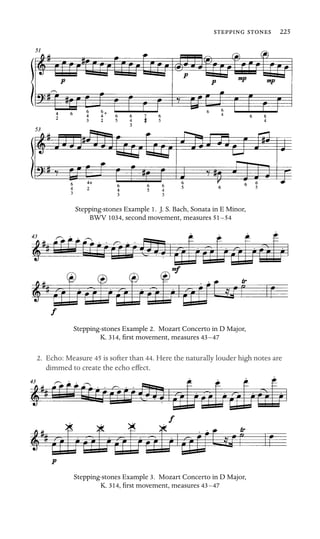
flute playing and all other activities would just stop: death would ensue in short
order.
Since there is no sensory perception of the movements or position of the di-
aphragm, at any time, there is no way that we can control them. I remember
very well feeling dumb and insensitive, as a student almost as much as now, when
I could neither feel nor respond to professors’ commands regarding my friend
the diaphragm. Only when studying medicine, a project quickly aborted by my
acceptance to the Paris Conservatory, did I understand that the playing concept
of diaphragmatic technique was scientifically incorrect. It was a well-meaning
approach to the phenomena of breathing and blowing.
Involuntary, the movements of the diaphragm are conditioned, freed, or hin-
dered by all the muscles, lower or upper, surrounding it. Inhalation on a tucked-
in tummy has the abdominal muscles compressing the viscera. They will pre-
vent the diaphragm from its full normal downward movement. Efficient
breathing should actually imply the release of all tension in the abdomen. A
purely thoracic inhalation will result in high shoulders and constricted throat
and airway. An overly extended rib cage will tend to collapse under its own grav-
ity and elasticity. The act of yawning gives a good feeling for correct breathing
procedure: wide-open throat, abdominal relaxation, fullness of air, and a per-
ception of pleasure.
Upon blowing, the technique of appoggio,2 meaning “the act of leaning” in
Italian, is the process that would come closest to the common meaning of di-
aphragm. Appoggio is a technique for breath management used by singers of the
Italian school. It is not accurately translated in English by the words “breath sup-
port.” It is a system of combining and balancing the action of the abdominal and
chest muscles in the inhaling procedure as well as the dual phenomena of exhal-
ing and sound production. The support of the abdominal muscles, without op-
position, would lead to a rapid deflation of the lungs. The intercostal muscles
(between the ribs) must counterbalance it. They actually prevent the collapse of
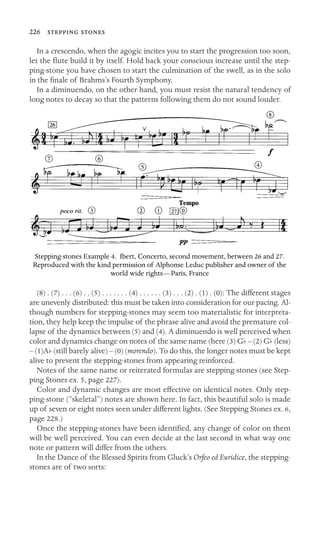
the chest. Schematically, the singer or flutist’s effort is to not exhale, in order to
achieve this inner balance. Once mastered, this equilibrium opens new horizons
to the sound and a feeling of bliss.
Appoggio implies conscious muscular actions, as opposed to the unconscious
play of the diaphragm.
2. Miller, The Structure of Singing.
 63

In a nutshell:
, Sostenuto, Ritenuto
Do not mistake the diaphragm for the muscles that help
or hinder it. You can act on the latter, not on the former.
Yawning is not polite, but it feels so good!
Please refer also to:
Appoggio Tenuto
Blowing Yawning
Breathing

Do not judge your dynamics by your efforts but by what you are hearing. You
might think you are playing pianissimo because you’ve stopped supporting, but
you hear an approximate sound with a doubtful intonation. Or you are blowing
like mad but your sound is narrow and forced.
Teachers rarely explain their request to play louder or softer. Hence flutists
have a tendency to do what is evident: push to play loud and disintegrate to play
soft. For once, our natural reflexes are totally deceptive.
The problem with dynamics is that they never exist by themselves. They are
like the painter’s palette. They are useless if they don’t relate to the musical con-
tent as much as to objective conditions of instrumental playing. What to make of
an orchestral instrumentalist who plays so softly that we can’t hear him or her?
Or of another who blasts so loud (acoustically or electronically) that he or she
drowns out all the rest?
When a crooner whispers a tender ballad to a crowd, ten thousand listeners
perceive him as sweet and intimate. His amplifiers are anything but that. In con-
trast, in the middle of a hundred-strong orchestra, a lonely nonamplified flute
plays the first phrase of Ravel’s Bolero. As the first step of a seemingly endless
crescendo, it must start very, very softly and still be heard at the back of the hall.
The listener’s impression should be: “How can the flutist play pp so mysteri-
ously and magically and still project?” The listener’s reaction should not be: “I
can’t hear the flute. The flutist must be playing pp!”
Soft dynamics cannot project and stay in tune if a half-inflated carnival balloon,
without support or energy, plays them. On the contrary, a forced tone and an air
volume big enough to bend a tree will not always produce a “big sound.” What
I call “turbo-sound” is precisely that: an enormous quantity of air without timbre
or focus.
Our concern here is not to determine where to place the dynamics. This is the
64 

domain of interpretation. What we are seeking is the way to control dynamics
and perform them spontaneously.
Forte and fortissimo
Playing loud requires little effort because the sound is carried by its own energy.
However, we must remove all the obstacles to the air column. A tight throat is
like rapids in a mountain stream—we will “yawn” the sound and open wide the
throat. Shoulders held high strangle even our spoken voice—we will play with
low shoulders. Lack of support restricts the airflow—we will blow from the low-
est possible point, the cough or sneeze point.
Projection requires a low center of gravity—we will place ourselves low on
our chair or “heavy” on our feet and play from the ground up.
Uncontrolled vibrato wastes air, timbre, and focus—in playing f, we will mod-
erate the vibrato by trying to keep it inside the tone.
Pinched lips choke the sound—we will leave them relaxed while stabilizing the
embouchure with fulcrum no. 1, the first joint of the left index finger.
For intonation in playing f/ff, lowering one’s center of gravity, playing with
low shoulders, opening one’s throat, and as a last resort, rolling in the flute, all
contribute to controlling sharpness.
Piano and pianissimo
To play p and especially pp requires a lot of concentration and, yes, effort. We
must compensate for the lack of natural energy in the sound.
When a flutist plays f/ff, the sound is animated by its own natural energy.
However, as soon as the intensity of the tone diminishes, this almost sponta-
neous energy tends to vanish. It is in the nature of things and the agogic of the
flute: soft sound becomes difficult to control, most of all in the ledger-line notes,
in the attacks and in the held notes where intonation falters. This lack of natural
energy in p, pp playing must be remedied in an almost artificial way by providing
the sound with an internal and hidden energy. It is one of the greatest difficul-
ties of flute playing.
The throat must not close—we will try to open all the cavities of the ears and
sinuses to enhance resonance but not loudness. The last thing we want to lessen
is support but we must counteract it to avoid the collapse of the chest and the
“free exhaust” of air.
Phrasing with the lips does not make a small airflow easy to manage—we will
keep a stable embouchure and phrase with the fingers close to the keys.
The agogic of soft flute sound tends to kill vibrato—we will animate the soft
dynamics with relatively more vibrato in p/pp than in f/ff playing.
Ask flutists to play p or pp. Often you will notice that their very demeanor
shows that support is no longer present. This reflex must be inverted; it takes
more effort to play p than f.
 65

Crescendo, Diminuendo
Management of crescendos and diminuendos should take into consideration the
following:
As intensity increases, we will gradually leave the soft-playing mode. We might
feel that by pushing and forcing we are playing louder. There is a certain measure
of truth here, but the most obvious consequence is the raising of the pitch.
We also have a tendency to culminate our dynamic progressions too soon. The
word “crescendo”3 implies that we are at a lesser level of intensity and that we
must preserve enough space to reach a climax. We should let the flute do the first
part of the crescendo naturally. Then gradually we can relax and open the tone
as we reach the goal.
“Diminuendo” is actually an indication that intensity is still relatively strong;
we can keep it at this level for part of the diminuendo. Once more the agogic ten-
dency is to diminish too soon after a climax or a loud dynamic. We must play
with mental binoculars in order to guess where our playing will reach its mini-
mum, as a bird lands after a graceful flight. As we diminish, the elements of soft
playing come back into action gradually: more support, more Tenuto, Ritenuto,
Sostenuto, less volume, but more air speed and more vibrato to animate the tone.
Tenuto, Ritenuto, Sostenuto
Support is even more important in p than in f. We have to play Sostenuto. How-
ever, support is not enough: if some withholding mechanism does not counter-
balance support, the lungs empty too quickly, producing an airy, unfocused tone.
We also need Ritenuto.
Control of p or pp requires also a steady embouchure. Obviously a floating lip
plate will make insecurity even worse—the left arm will provide Tenuto.
The blowing procedure will be the same as in appoggio: a balance of forces
between abdominal muscles providing support and pectoral muscles preventing
the collapse of the chest. By using appoggio the air speed can be sustained; thus
pitch can be better controlled without having to change the embouchure all the
time.
As far as fingers are concerned, if the dynamic is p or pp, the natural reflex is
to have weaker and less precise movements. On the contrary, I think that the
softer one plays, the more swiftly and precisely the fingers must move. This is not
intended to mean that the fingers must slam and squeeze.
In a wide interval played p, smoothness often does not depend upon the obvi-
ous “down” fingers, but on one “up” finger, usually the one venting the hole clos-
est to the embouchure. This is the finger that must work lightly and fast.
The same idea holds for attacks: the tongue’s movement must be all the more
precise and faster as the dynamic is softer. This is particularly true for woodwind
3. The suffix –ndo, called the gerundive, means “in the process of” in Italian.
66 

chords in classical and romantic symphonies. The conductor’s beat is less vigor-
ous when he wants a round, soft ensemble sound. If his gesture is strong, for pre-
cision, he will naturally get a sort of percussive attack unless the woodwinds are
able to release the sound precisely but softly.
On a delicate ensemble attack, I start to blow gently through the nose to start
the airflow. My tongue is slightly apparent between my lips, closing the aper-
ture where the air brush passes. At the moment the chord starts to form, a
quick movement of the tongue toward the back releases the already flowing
air. The tongue works as a valve releasing a fluid more than as percussion. This
way, I avoid the explosion consequent to blocked air being released suddenly by
tonguing.
I find it useful, for the coordination of my reflexes for a p attack, to tap lightly,
without tonguing, the key closest to the note I want to play. This slight tap sets
the air column in vibration inside the tube. It serves as a common denominator
for my attack process and as a trigger for the movement of my tongue backward.
In staccato passages, the shorter span of each note results in naturally lower
dynamics. It is therefore a good idea to play the desired soft passages4 more stac-
cato than the loud ones.
Vibrato helps to animate the sound in soft phrases, preventing breaks in the
slurs. It seems to give an imaginary speed and life to the air.
Warm Air, Cold Air
Warm air corresponds to a large volume of air associated with lack of direction
and low air speed. Fast air speed and sense of direction, on the contrary, carry
cold air. These concepts are extremely useful for the success of dynamics. With
practice, they will soon become second nature.
Release
Many long notes don’t have a printed diminuendo, but we are tempted to do one
anyway. Don’t press your luck. If it’s not written, don’t do it. If I were to die for
lack of breath at the end of a long note, that would be the perfect taper, the ideal
organic diminuendo.
For one thing, the tone should not be throttled on a diminuendo. On the con-
trary, the speed of air must be maintained, and one should support even more,
keep the vibrato going, hold the flute steady, and in fact think crescendo to keep
the intonation from falling. At the end of a long note, especially a high one p, pp,
the release is especially delicate.
Even if a diminuendo is not indicated, the note will eventually decrease any-
way. Running out of breath will be the perfect release provided the air is sup-
4. For instance, in a baroque reiteration, imitation, or echo.
 67
ported until silence. If we just try to diminish the air speed, two things are bound
to happen:
•	 The tone falls uncontrollably to the nearest harmonic, a sad noise to com
-
plete a poetic ending. 

•	 Even if it does not, the intonation can suffer dire consequences that lip and
jaw movements will control with difficulty.
My advice:
• If the composer did not write a diminuendo, don’t do one.
•	 If there is one, don’t start that final note in the softest dynamic you want to
reach on release.
•	 Be sure that stability from the abdominal muscles and the left arm is still

present after the note has reached silence.

• If at all possible, stabilize with “silent keys” (for instance, the Bb lever or side
key on G3 and D3), so that the fingers of both hands are on the flute.
•	 Don’t move. “It ain’t over ‘till it’s over.”5 The slightest physical movement
may destroy the fragile suspension. Furthermore, the fraction of silence fol-
lowing the release of a final note creates some of the most moving moments
of music.
Even if you have time, don’t breathe just before the last few notes. Sometimes
this does not feel comfortable or natural, but it will force you to support to get
the last ounces of air out, thereby preventing the fall or intonation problems de-
scribed earlier. If you are definitely out of air, stop playing. Breathe silently with-
out moving to give the visual impression that you haven’t stopped. Then call 911.
The relationship between music and dynamics is not only the fruit of inspira-
tion. It can be practiced. I must admit it is very tempting to use repertoire for this
purpose in spite of the many stylistic implications and sheer length of the pieces.
Short phrases such as those in Moyse’s Vingt-quatre petites études mélodiques6 are
extremely valuable for the study of dynamics alongside phrasing and intonation.
Dynamics are not mere entities. They must be coherent with interpretation
and meaning. For each work, we should try to match dynamics and demands
such as distance, range, and context with the inner character of the music.
Images of relative dynamics:
fff Calling someone across a crowded street
ff Calling someone over two stair landings
f Addressing a classroom without amplification
mf A group conversation around a table
mp A one-on-one conversation
p A telephone conversation
5. Yogi Berra (active late twentieth century). Well-known American philosopher.
6. Paris: Alphonse Leduc, 1932.
68 
pp A love conversation, a confidence
ppp A stage whisper with enough energy to fill the hall
Your imagination is as good as mine.
In a nutshell:
, Sostenuto, Ritenuto
Air Speed
Dynamics
Playing soft requires more effort than playing loud. Soft
tone and phrases need stability. Vibrato helps the soft in-
tervals. There need not be change at the level of the lips
and embouchure. Control of blowing is essential. Take
into consideration that staccato results in softer dynamics.
Please refer also to:
Agogic Tenuto
Vibrato
Warm Air, Cold Air
Slam-and-squeeze

A good, stable, and flexible embouchure position should be the same for all
registers.
Embouchure Figure 1. Drawing Jeanie Mellersh
 69

Chin and lip gymnastics are counterproductive, especially under stress.
Flute sound is created by the air brush hitting the outside wall of the em-
bouchure hole. Turbulence is created as part of the air brush’s energy is trans-
formed into vibration,1 which resonates according to the length of the tube. The
rest of the air stream escapes out of the embouchure hole.
Embouchure Figure 2
Below the outside rim of that hole is the wall, whose height is critical. Its mea-
surements and the shape of the head-joint tube constitute the art of head-joint
making. The material2 of the chimney, also referred to as the riser, and the un-
dercutting of the lip plate are flute makers’ trade secrets and the object of endless
speculation among flutists.
A thorough discussion of all embouchure-making matters is beyond the scope
of this work. There are some acoustically objective elements, and, to be sure, as
many preferences as there are flute players.
Embouchure Position
Who says that your embouchure has to be dead center, at right angles with the
flute? Pythagoras? Archimedes? If your position works (be it as crooked as mine),
keep it there. Don’t confuse logic and symmetry with ease and comfort; they are
not necessarily roommates.
During that first lesson, Kincaid noticed that my embouchure was not exactly
centered. In fact, it was quite crooked. He told me to look in a mirror while I
practiced and to center the embouchure. When I returned the following week,
I had the embouchure in the proper place, but had very little control over it.
He thought for a while, and then had me play many things (loud, soft, high,
low) with my embouchure in its original position. Finally, he told me to do it
my way. Many years later . . . he called me over to where he was talking with
1. Not to be mistaken with vibrato.
2. Gold or gold alloys, for instance, on silver head joints.
70 

some concertgoers. They had been asking him about correct embouchure,
and Kincaid asked me to face the people and play for them. My guess is that
his answer to them was “whatever works.”3
Angle of Attack
As soon as the air brush clears the lips, it tends to disperse, to lose its direction and
focus. This is the reason why, for each flutist, there is one ideal angle of attack, ac-
cording to preference, lip configuration, and dental implantation. If the distance
between the lip aperture and the embouchure’s outer edge is too great, one pro-
duces what I call “turbo sound”: large air flow, a need to breathe often, lack of tim-
bre in the low register, ill-defined articulation, difficulty in controlling intonation,4
and a hollow sound in general. Conversely, if the angle of attack is too closed and
the lips too close to the tone edge, one gets the “gas leak” effect: shrill sound, sat-
urated with foreign noises, brittle attacks, lack of flexibility in intonation and
color, and narrow dynamic range. Therefore, each player must find by trial and
error an average angle of attack on comfortable notes, such as D2 or G2.
However, once this average position has been found, it is not necessary, in my
view, to change it constantly. It is possible to go step by step though the whole range
of the flute without jawboning or facial gymnastics. The sound’s modulation, in in-
tervals as well as in arpeggios, can be achieved by shifting the air speed and the cen-
ter of gravity, jawboning and lipping coming into play only to refine intonation.
In a nutshell:
Air Speed
Intonation, Intonations
Dynamics
Embouchure position is only one of the parameters of
flute playing. Do not be obsessed with it and your head
joint. If an offset position works for you, keep it. Your ears
are more important than your lips. An average angle of at-
tack allows you to modulate your sound in range and in
color without jeopardizing reliability.
Please refer also to:
Air Brush Flutes
Intervals
Arpeggios
Center of Gravity Jawboning
3. Robert Cole, in his recollections about William Kincaid, “William Kincaid,” Flutist Quarterly
(Fall 1995): 44–48.
4. Sharp in loud dynamics and flat in soft.
 71



At every stage of our development, whether amateur or professional, we want,
or we are requested, to play studies (or études). The range is wide: from Berbigu-
ier to Jeanjean, by way of the Boehm caprices, all the Andersen études (ten
books!), de Lorenzo, the Bach studies, the Donjon études de Salon, the Fürstenau
Bouquet des tons, the Paganini violin caprices transcribed for flute, and the
Karg-Elert caprices. All different, they all have something in common: they are
supposed to make us play better, but they are not designed to be performed in
public.
Études are different from basic exercises such as scales or tone work. Daily in-
strumental work hones our playing skills, day in and day out, regardless of our
level. Études are temporary fodder, changing every week or at every lesson.
Kincaid always requested Berbiguier’s Dix-huit exercices; Moyse used Ander-
sen’s op. 15. Tom Nyfenger insisted adamantly on “perfection.” This is something
that I confess having never accomplished: perfection in an étude (or in anything,
for that matter).
What is perfection anyway? Playing all the notes? Running through them with
a metronome?
At the risk of once more swimming against the current, I have to say that the
benefits of studies are elsewhere: perfection is not the issue for me, unless we had
études by Chopin and Debussy like the ones pianists play on their recitals.
I think that flute études are super for sight-reading, for training in concen-
tration, in will power and in the art of approximation. For real sight-reading, a
methodical approach is in order, albeit in a very short time:
• What is the key (and its changes)?
• What are the meter and tempo?
• What are the fastest runs and slowest notes?
• What is the basic rhythmic unit (quarter, eighth, etc.)?
This strategy applies when tackling an étude. It is amazing to see how many
people start practicing even before looking. For an étude, this preliminary survey
must be refined, pencil in hand. Indicate the chromatic passages: you won’t even
have to read them. When a line is in two voices, see which one is melodic and
which is accompaniment: usually you have to read only one of the two. Indicate
facilitating fingerings, on and off, such as thumb Bb. Breaths should be thought
out, even if you change them later. Be wise in this respect; there is no reward for
breaking breath records in an étude. Write in a few accidentals, the most annoy-
ing ones. Finally, double-check the key of each passage; you will avoid many
wrong notes.
Do a run-through when you start that day’s practice. Decide: “I won’t stop, re-
peat, I won’t stop.” Read ahead. The old sailing ships had a saying: “One hand for
the ship, one for the sailor.” For musicians, it would be: “One eye for the reading,
one for the playing.”
72 
At the end of the read-through, circle the “bad” passages in pencil.
When you do work on this étude, start your practice from the end, line by line.
It is common to know the first six lines of a study quite well, but come the reca-
pitulation and its changes, we run out of concentration and start thinking of any-
thing but the matter at hand. I speak from experience.
Concentration is the most difficult thing to acquire and to teach. Three or four
minutes of intense mental focus are more important than the repetition needed
to bring a study to “perfection.”
Developing this skill is one of the rewards of sight-reading (prima vista) and of
a weekly étude, where the purpose is an improvement of the brain, not the im-
mediate result of a study.
In a nutshell:
Notes
More important than momentary perfection in an étude
are the skill to read and prepare a piece in a short time and
the willpower to keep going.
Please refer also to:
Breathing
Concentration Sight-Reading

Facilitating Fingerings for High Passing Notes
Only finger-activated keys for the second note of each triplet are shown. The
first note of each group is not indicated and is always “normal” fingering. The
facilitating principle is that fingers move in the same direction, not antagonis-
tically.
Facilitating fingerings for high passing notes Figure 1
 73

Facilitating fingerings for high passing notes Figure 2

Facilitating fingerings for high passing notes Figure 3

Facilitating fingerings for high passing notes Figure 4

Facilitating fingerings for high passing notes Figure 5

Facilitating fingerings for high passing notes Figure 6

Facilitating fingerings for highpassing notes Figure 7

Facilitating fingerings for high passing notes Figure 8a and 8b
This fingering shows both notes because both fingerings are alternate.
74 
“Harmonic” Fingerings
These scales, where only the left hand is active, can be played in the normal po-
sition or with hands crossed to demonstrate stability, as illustrated in the chapters
on beginners and stability.
Harmonic fingerings Example 1
Some Alternate Fingerings for Stability, Tuning,
Facility, Color, and Timbre
Only fingered keys are shown. Black means finger down, white means finger up,
and gray means the key is optional. Half black, half white key: finger is either on
the rim of the key or pulled back to show the open ring, the key being depressed
(French-system flutes).
Alternate fingerings Figure 1
Alternate fingerings Figure 2
Alternate fingerings Figure 3
Alternate fingerings Figure 4
Alternate fingerings Figure 5a
Ds, Cs, C
Alternate fingerings Figure 9
Alternate fingerings Figure 10
Alternate fingerings Figure 11
Alternate fingerings Figure 5b
Alternate fingerings Figure 6a
Alternate fingerings Figure 6b
Alternate fingerings Figure 7
Alternate fingerings Figure 8a
Alternate fingerings Figure 8b
Alternate fingerings Figure 12a
Alternate fingerings Figure 12b
Alternate fingerings Figure 12c
Alternate fingerings Figure 13
Alternate fingerings Figure 14
Alternate fingerings Figure 15
Alternate fingerings Figure 16a
Alternate fingerings Figure 16b
Alternate fingerings Figure 17
76
Alternate fingerings Figure 18a
Alternate fingerings Figure 18b
Alternate fingerings Figure 19

Alternate fingerings Figure 20

Alternate fingerings Figure 21

Eb
Alternate fingerings Figure 22

E
Alternate fingerings Figure 23a
E
Alternate fingerings Figure 23b
77
78  
F
Alternate fingerings Figure 24a
F
Alternate fingerings Figure 24b
 
Often I feel that some of my fingers weigh a ton. This is especially obvious in
trills that seem to always want to go their own way, out of context and beyond
my will. Even in scale patterns and in simple arpeggios, difficulties arise when fin-
gers work in different directions. Before being able to practice them, it is impor-
tant to determine why certain patterns are more awkward than others.
“Down” fingers, through gravity and natural reflex, move faster than “up” fin-
gers. This is one more reason to avoid slam-and-squeeze: fast movement upward,
gentle landing downward. Here is a small catalog of antagonistic finger move-
ments, in order of decreasing ease. Black keys and levers indicate finger down;
white keys and levers indicate finger up; up arrows show “off” motion; and down
arrows show “on” motion.
One finger of one hand in motion
Finger antagonisms Figure 1a and 1b
  79

Two fingers of one hand in motion in the same direction

Finger antagonisms Figure 2a and 2b
Two fingers of one hand in motion in opposite directions
Finger antagonisms Figure 3
Two fingers of one hand in motion in opposite directions, with displacement of
right pinky (little devil no. 2)
Finger antagonisms Figure 4
Two fingers of one hand in motion in one direction, one finger of the other in
the opposite direction
Finger antagonisms Figure 5
Two fingers of one hand in motion in one direction, one finger of the other in
motion
Finger antagonisms Figure 6
80  
Two or three fingers of each hand in motion in opposite directions
Finger antagonisms Figure 7
A number of fingers of each hand in opposite directions
Finger antagonisms Figure 8
Repetition of these movements further increases the difficulties.
This is the reason trill fingerings aim to offer the movement of one finger, or
rarely two, of one hand in one direction.
In a nutshell:
Stability
When many fingers are moving in contrary motion, the
venting fingers (up) must work fast, whereas closing fin-
gers (down) should not be falling hard and slam the keys.
Do not hold the flute with note-producing fingers.
Please refer also to:
Little Devils Trills
Slam-and-Squeeze Facilitating High Passing Notes
Unusual Trill Fingerings
 
All too often we tend to identify phrasing with sound and technique with fingers,
articulation being somewhere in between. Our practice to emphasize sound as
an entity to itself, relevant to the domain of musicality, whereas fingers are the at-
tributes of virtuosity, an unavoidable and cumbersome necessity.
Yet many difficult passages are lost to poor control of the tone, because we are
preoccupied only with the rapid succession of notes. On the other hand, faulty
phrasing of slow lines can often be attributed to uncoordinated fingerings.
  81

It is impossible for me to separate music from the instrumental means. Instru-
mental playing includes all the aspects of our dear flute: tone, fingers, articulation,
slurring, pitch, vibrato, breath. . . . One may feel weaker in one area or another, but
working on one without thinking about the others leads nowhere. Not even inter-
pretation is instinctual: it responds to thought and practical solutions. There is a
technique of phrasing just as there is a musical approach to instrumental problems.
I call “instrumental playing” what many people call “technique.” The latter
puts too much emphasis on sheer speed, the number of sixteenth notes per
square foot. I think of intervals and phrases, particularly slow ones, as instru-
mental problems. They are a means to an end, the expression of musical feeling.
Often a slow interval is approached mainly from the point of view of sound
manipulation. In a slurred phrase, the distortion of the face or of the em-
bouchure should come as an assist only after the smoothness of the fingers has
been coordinated.
How can one phrase with one’s hands? I can already hear the objections.
Slapping fingers, at any speed, are an indication that instrumental playing is
rough. A noisy technique is not a sophisticated one. Noise never comes from fin-
gers lifting off the keys, but from their slapping on their way down. They make
noise and rivet themselves on the keys; lifting them is then silent but difficult,
sometimes painful. The first axiom for phrasing smoothly with the hands is:
“Don’t hold the flute with the fingers that form notes. Instead, stabilize with the
three fulcrums of flute playing.1 This way, the fingers actually playing the notes
have an easier time lifting off the flute.
Of two slurred notes, the second is almost always less intense than the first, be-
cause, in general, the first one is an appoggiatura, from the Italian appoggiare. The
word means “to lean upon,” either because the note is outside of the harmony or
part of a dissonant chord, or because it is leading to a release.
When, to form the second note, fingers come down, we tend to slap the down-
ward ones. Things are smoother and more musical when the upward fingers are
the most deliberate.
In the following example, the famous solo in Brahms’s Fourth Symphony, it is
easy to see how the plaintive second note resolves naturally when a lifting finger,
indicated (1) and (3), forms it. In the passages where a finger comes down (2),
however, the second note could sound stronger, if we are not careful, because of
the tendency for descending fingers to slam down.
Finger phrasing Example 1
1. The first joint of the left hand, the right thumb, and of course the embouchure plate on the chin.
82 

Even in a succession of descending intervals, as in the first movement, Adagio
ma non tanto, of the Bach Sonata in E Minor, BWV 1034, we should be careful
not to let the sheer weight of the falling fingers reinforce the second note.
Finally, when an interval needs to be smoothed out, before trying to lip it, we
should visualize a seamless track of air going from one note to the next. A perfect
slur is one where the sound wave between the two notes is not interrupted. This
is achieved not by slamming fingers, but by smoothly synchronizing the connec-
tion between lifting and lowering fingers.
Venting or closing the hole closest to the embouchure, where the sound orig-
inates, interrupts the sound wave. While the octave key (C key and little devil no.
1) most often works that closest hole, the trill keyholes are even closer when in-
volved. All fingers of the left hand, at one time or another, can be viewed as the
agent of that closest hole, especially in the third octave.
One must learn how to phrase with the fingers. Phrasing achieved without any
slapping of finger or key is always more beautiful. A loud finger technique results
in rough phrasing. A well-practiced technique is not always the fastest, but the
smoothest. Let us learn how to make music with our hands, as any modest
craftsman should. The tone and the head joint are vital, no doubt, but how
would you phrase without the hands?
In a nutshell:
Fingerings
Instrumental playing that sounds like an old typewriter
cannot help your musicality. Think of your fingers as mu-
sical tools, not as wrestling enemies. Slow is just as hard as
fast.
Please refer also to:
Slam-and-Squeeze
Fulcrums Tempo
Rubato

You never hear it said that a great flutist plays a bad flute. It seems that a well-
played flute improves with age. I know that when I lend one of mine, it returns
with some of the defects (rarely the good qualities) of the borrower.
Physicists and acousticians will object that this is black magic. They say that
only the shape and measurements of the flute, as well as the resonant medium,2
2. In our case, air.
 83
matter. The effect of the tube’s material would be negligible, according to them.
But we flute players know there is a world of difference between metals and
woods, and it is not only a matter of cost.
Antique violins improve with time. Wood is a living material and it evolves
even after centuries; no doubt, the generous sound of great violinists contributes
to this miracle. What about flutes?
It is true that time itself will not improve the acoustical qualities of a flute
made either of German silver3 or of sterling silver. Yet, so many old flutes pos-
sess a resonant quality of sound that seems unobtainable in newer instruments
of the same make and model. One is inclined to say: “They don’t make them
like they used to.”
To explain this, one must accept the fact that the tone quality of such a flute
is the result of a hardened metal body tubing. . . . The point is that the tubing
in old flutes made of non-ferrous4 metals has hardened not with age, but with
use. This is a process known as “work-hardening.” As an example of the
“work-hardening” phenomenon in non-ferrous metals, consider the copper
tubing in our homes these days. It is very pliable when new, but whether it is
used for the transport of water, oil or gas, it becomes almost brittle after a few
years of use. It has become “work-hardened.”5
Assuming they have been well made in the first place and well played, there is
every reason to think that new flutes will get better as time goes on.
I am often asked: “Why are most high-quality flutes called French system?” I
have to answer that no French-system flutes are made any more in France. This
qualification began there 150 years ago, but sadly there are today no more French
flute makers of note. Americans and Japanese are now the makers of French-
system flutes. (Then again, French toast, French dressing, French fries, French let-
ter, French vanilla, and French leave are called something else in France.)
For centuries, even millennia, flutes were a simple hollow tube pierced with
holes covered by the fingers. The basic key or mode dictated the holes’ position.
This is the reason that non-European flutes are based on notes that seem very ex-
otic to us.
Up to the beginning of the 1800s, European flutes were tuned to a major scale,
usually D major, called a diatonic scale. The basic principle was one hole—one
finger—one degree of the basic diatonic scale. This accounts for the fact that,
prior to 1800, the majority of the flute repertoire was in D or G major and their
relative minors. When modulations strayed too far from these, fingerings be-
came a major problem, not unlike those of today’s recorder. Deceptively simple
as it may seem at first, it takes a consummate artist to play it well.
As the 1700s unfolded, flutists started adding keys to facilitate and expand the
flute’s technique. The first was the DS key used by Quantz and French players.
3. An alloy of nickel and silver.
4. Without iron content.
5. E. L. DeFord, in DeFord Digest.
84 
Little by little, there were four keys, then eight, then more and more. These in-
novations, however, were all based on the old diatonic D scale. Flutes started
looking like submachine guns, especially some of the English models, developed
by Nicholson,6 and the Gordon flute,7 which had practically one accessory key
for each accidental. The large-bore tone holes were developed as an experiment
in England by Nicholson and the key mechanisms by Gordon, a dilettante flutist
who served in the Gardes Suisses at the French court.
The Boehm System
Gimmicks were invented everyday. During the 1830s, a German genius appeared.
Theobald Boehm, an excellent German flutist and an accomplished craftsman,
designed and built the first flute, as we know it, between 1830 and 1840.
No doubt, in his time, Boehm’s system was viewed as a gimmick by flutists of
the old school. In fact, there was fanatic opposition to it. Imagine: a flute made
not only of wood, but also of silver or German silver, capable of playing in tune,
with a big tone? It was unthinkable. Yet he had a comprehensive approach, and
he reinvented the mechanics of the flute.
Boehm’s breakthrough was to conceive a flute based not on the diatonic but on
the chromatic scale: one hole—one half-tone—one degree of the chromatic
scale. Logical as he was, he theorized that his system would close or open every
tone hole in sequence. The Bb would be placed lower than the B, where our left
thumb is now. The GS was higher than the G, hence the open GS.
The Bb thumb and B keys were eventually switched by Briccialdi.8 This was the
only major improvement to Boehm’s system.
The French System
The French flute makers Godefroy, Louis Lot, and, later, Bonneville were the first
to purchase Boehm’s patents and to commercialize metal flutes. In spite of the
inventor’s objections, they applied their own ideas:
• Since five- and eight-keyed flutes already offered the closed GS, they kept this
feature, which made switching to the “pure” Boehm system a little easier.
•	 Since some of the experimental flutes already had rings, they developed

open keyholes, the most visible characteristic of the French system.

•	 They adopted the Briccialdi key (thumb Bb) and built a few flutes with a low
B.
Whereas Boehm’s G and GS were set slightly off-center and activated by an in-
dependent rod, the French makers streamlined all of the large keys of the cen-
6. Charles Nicholson (1795–1837), a colorful British virtuoso.
7. William Gordon (1791–1839).
8. Giulio Briccialdi (1818–1881), Italian flute virtuoso.
 85
ter joint into one line. My personal preference in this respect goes to the offset
G/GS, because it is mechanically better and does not require stretching the left
ring finger. I have experimented with the open GS.9 It has great advantages but I
must confess that I went back to closed GS, finding the third-octave fingerings dif-
ficult to change at my advanced age.
The mechanics of the flute have changed very little since Boehm’s system, and
only the valid ones have survived: the Briccialdi key, the low B and its gizmo, the
E mechanic (split E), the CS trill key, the closed GS, the Brögger Mekanik.10 But
orthopedic contraptions like the Couesnon-Moyse model,11 finger rests and
crutches, the “high FS facilitator,” the Dorus12 GS key, and others have fallen by
the wayside.
The Cooper Scale
The Cooper scale, devised by Albert Cooper, is the most theoretically founded
improvement with respect to tuning. It is based on the Boehm schema, which de-
scribes the mathematical progression of tone-hole placement relative to basic
pitch (A = 435 to A = 445). On the practical side, both the Boehm schema and the
Cooper scale are at best approximations to accommodate the acoustical discrep-
ancies between the tempered scale and the just scale.13 The problem is that you
can tamper only so much with the placement of the tone holes. Soon the whole
tuning balance can be jeopardized.
Albert Cooper believes that he has gone as far as he could with respect to tun-
ing. He has turned his attention to head joints and embouchure plates. Cooper is
one of the cornerstones of modern flute making. Modest and pleasant, he is al-
ways open to new ideas and people. Ever curious and universally plagiarized, he
9. Lowering the left pinky closes the GS key.
10. Used as an option on Brannen-Cooper flutes. A modern development of an old idea, it ap-
plies to the center joint the double-rod mechanism of the foot joint.
11. A large-bore, covered-hole French flute (produced 1930–1960). Right-hand finger keys are
compensated (thicker on the forward side than on the palm side). Left-hand finger keys are extended
beyond the alignment of the body to allow the rotation of the left hand to an improved position.
Aurèle Nicolet (Berlin Philharmonic), Gaston Crunelle (Paris Opéra-Comique), and a number of
European flutists played this instrument. Today a similar system is used by Jeanne Baxtresser, former
principal flutist of the New York Philharmonic, as a remedy for hand pain.
12. Louis Dorus (1813–1896) was the first professor to teach the Boehm System at the Paris Con-
servatoire (1860–1868). He devised a mechanism combining the advantages of the Boehm GS with
the French-system closed GS. Taffanel’s portrait in the Dix-sept grands exercices journaliers shows such
a flute. It was discontinued in part because it required a very strong spring, worked by a very weak
finger, the left pinky.
13. A complicated topic. For all practical purposes, let us say that natural resonance and partials
of a fundamental are not tempered. They are multiples of the fundamental’s frequency. For this rea-
son, a Bbb is flatter than an A, a Bb is flatter than an AS, etc. Likewise for G, D, and all notes. The tem-
pered scale is a compromise to the effect that all the degrees of the chromatic scale are supposed to
be equal.
86 
actually advises his imitators. “Common sense is genius dressed in its working
clothes.”14
Embouchure plates have been built in every shape and form. Their shapes are
not the only issue. Some head joints are louder, some boom in the low register;
others give wings to your articulation. Most of the trade secrets lie in the hidden
curvature of the head-joint tube and in the undercutting of the embouchure
hole.
I have experienced many flutes: the traverso, the recorder, the metal flute as we
know it, and the Boehm wooden flute that has been making sort of a comeback
recently. I have a problem with this revival. I believe that you cannot make any in-
strument do things it was not intended for. If you are trying to make a wooden
flute emulate a metal one, you risk losing the character associated with either.
The only reasonable approach is to come to terms with the instrument you are
playing. When the time comes to change, then love that new one. But don’t try
to find a flute that can do things for you by itself (huge sound, big low notes, nim-
ble staccato). That is your problem.
To speak crudely, a flute is after all just a piece of very expensive plumbing. “In
the candle, the essential is not the wax, but the light.”15
At the risk of alienating my friends of the flute industry, I would not advise you
to purchase a new flute until you know what you really need. Instead buy a sec-
ond-hand one that has been played by someone, young or old, who you know
plays the way you like. A well-worn flute is a good sign. Lemons usually stay in
the case. I was caught once. From an antique dealer in Paris, I bought a Louis
Lot, similar to the one I was playing at the time. During the late twentieth cen-
tury, British “flautists” would have killed for this kind of instrument.16 I thought
I had really found a gem. It was in mint condition, as if it had not been made in
1870, but just for me a century later: no sign of wear, and sparkling. I soon dis-
covered why: it was the proverbial lemon, probably an experimental instrument
with a different scale and new embouchure design. I was lucky to unload it (at
great profit) on a London dealer in such instruments.
A “previously owned” (doesn’t that sound better than “used”?) flute has advan-
tages. The price is usually more negotiable. You do not have to wait five years to try
it. You may normally play it in your familiar surroundings. The binds have been
played out of the mechanism. Even if it needs some pad work and is not spotlessly
clean, that can easily be fixed. Besides, germ-free does not mean bug-free.
Repair
“If it ain’t broke, don’t fix it.” Repair technicians often want every detail to look
in top shape. If everything but one element works, fix that and leave the rest.
14. Ralph Waldo Emerson (1803–1882), in Essays.
15. Antoine de Saint-Exupéry (1900–1944), in Citadelle (Paris: Gallimard, 1951).
16. In the United States, around 1970, the fad was vintage Powells.
 87

If one pad is leaking, change it. If all the pads are replaced, the result is often
worse (and more costly). A newly padded flute rarely feels comfortable until after
a few weeks. When an important audition or concert approaches, we become ex-
cessively sensitive to any flaw, imagined or real. Our perceptions turn cata-
strophic. Have the repairman adjust it, but don’t overhaul it before an event. Wait
until the storm is over.
My friends Étienne Vatelot and Jean-Jacques Rampal17 look after the instru-
ments of some of the world’s great violinists. When the artists come with a
worry and there is nothing wrong with the instrument, they are not contra-
dicted. The violin is kept in the safe for a few days and returned to the virtuoso
untouched, but with a technical explanation. The artist usually feels much bet-
ter about himself and the violin. This is called the placebo18 effect.
Slam-and-Squeeze
The most effective way to prevent damage to the mechanism of the flute is to
avoid slam-and-squeeze. A noisy finger technique is a sure sign that an instru-
ment is being brutalized. A flute will avenge itself. Since the music is also affected
by rough treatment, working at a smooth finger technique will pay off both in
quality and in musicality.
Cleaning
It has been a surprise to me that in America, one is advised to never leave a rag
or a swab inside the flute. The old French flutes had a rod with an upholsterer’s
tassel on it. It was left inside the center joint, preferably not while playing. Jean-
Pierre Rampal, among others, always did it, and so have I. Perhaps we were
lucky, but we seldom have had sticky pads or needed an overhaul. After wiping
most of the water out, a certain degree of humidity is maintained, and a few
germs. If you feel that squeaky clean plays better, wash your headjoint in the
sink.
A little moisture does not hurt. The pads and corks are still mostly natural19
and need some humidity, as violins do. In dry environments, stringed instru-
ments use a “dampit,” a flexible green wormlike tube that releases moisture. The
desirable ambient readings for good flutes, as for good cigars, are at 70 degrees
temperature (20 degrees Celsius) and 70 percent humidity.
17. Jean-Pierre Rampal’s son.
18. A medical term for a blank treatment administered to a test group.
19. Animal gut skin and cork made of oak bark.
88 

In a nutshell:
Intonation, Intonations
Don’t overlook second-hand flutes. Live with a flute be-
fore buying or rejecting it. Most of the playing comes
from you, not the flute. Loudest does not mean best.
Please refer also to:
Embouchure
Finger Phrasing Slam-and-Squeeze

I remember my childhood days when I started the flute. I loved to blow into it
and the sound it made, but, however much I tried, I was always short of breath.
It still happens sometimes. Then, teaching young players, I realized that the prob-
lem was not so much taking air in as managing its focus while blowing.
The purpose of inhaling is to produce sound. “Play well (blow well) and you
will breathe well.” The other way around is not always true. What is the use of
breathing if the air is not focused and managed efficiently?
I have seen many articles, even books, about breathing and its mechanics, poor
guys with electrodes on their chest, their throat, their abdomen. Very few words
about air management or rapid breathing. Even less about music.
We are preoccupied by the mechanics of breathing and by the opinion of our
flute colleagues. But the audience at large and other instrumentalists only listen
to the music. Have you noticed how string players are always working on new
bowings? We don’t even notice whether a phrase is upbow or downbow. The
same applies to our breaths. If it is well placed and executed, a breath actually
contributes to the music. Don’t think that an audience listens to you the way
other flutists do. Don’t think, while you play: “What will they say if I breathe
here or there?” They are going to be critical, whatever you do.
By the time you have played the first bar, nobody knows whether you are going
to breathe or not, yet everybody has a pretty good idea of what you are doing
with the tone and the music. Their opinion is based on focus and musicality, not
on deep-sea diving capabilities.
Our psychology deceives us: blowing a lot does not always mean producing
more tone. Try playing a passage f, then mf: often mf sounds louder and better
than f because we are more relaxed and more focused. Now try a short slow pas-
sage twice mf without breathing or change of dynamics: the sound is always bet-
ter the second time.20 Even if you feel out of air, the very fact that you have
played a few seconds makes you focus better and support.
20. This is the reason why, in my Intervals 1, the same pattern is repeated twice.
 89

The volume of your blowing is also deceptive: a huge breath is hard to manage
and to focus at the onset. Therefore, if the passage you want to play loudly is
short, don’t breathe very much but focus the tone. Conversely, the fact that we
blow little does not mean that we are playing softly. One of my charming stu-
dents, when I say, “Please play pp,” invariably retorts, “But I am barely blowing.”
That is the problem: pp requires little volume but more support than mf or f.
When playing pp, you actually should think ff in terms of focus and support.
We sometimes feel that the more air comes out of our mouth, the bigger the
sound. That is not quite true in spite of its apparent logic: the air inside the flute
does not move, it just resonates and modulates the turbulence produced by the
air stream hitting the strike edge of the lip plate. All particles of air in contact
with that sound resonate, including inside our lungs and sinuses. Every flute
sound is different for this reason, not because of the head joint itself. The air
moves only at the strike edge. Some of it is lost in the process and moves away.
It becomes that breathy part of the sound that many people resent. With a good
focus, the rest of the air, hopefully the better part is transformed into vibrations.
I am not the inventor of this technique: “When the airstream strikes the sharp
edge of the hole, it is broken, or rather divided, so that one part goes over and be-
yond the hole, while the greater part, especially with a good embouchure, pro-
duces tone and acts upon the column of air enclosed by the tube, setting it into
vibration.”21
Focus Figure 1
The same principle applies to all winds, like the trumpet, where there is a lot of
sound, but little air movement: a candle placed in front of the bell will not flicker.
By focus, I mean firm stability of the lip plate on the chin, and blowing inside
the embouchure with a imaginary feeling that the air stream is not aimed across
the embouchure hole and out, but through the diameter of the tube toward the
crook of the left arm.22
If the distance between the air brush and the strike edge is too short, you get
21. Theobald Boehm, The Flute and Flute-Playing in Acoustical, Technical, and Artistic Aspects, trans.
and annotated Dayton C. Miller (Cleveland: Savage Press, 1908).
22. Of course I do not mean covering or “turning in” the head joint.
90 

a “tight” covered tone. If the gap between the lips and the strike edge is too wide,
you have the “big” tone, breathy and unfocused, the “turbo sound” that seems to
have some fans on these shores. If, furthermore, your cheeks are flapping
about,23 you are suffering from “loose embouchure syndrome,” and you are in
for trouble in the extreme registers, low and high, and on tricky attacks, ff and pp.
Breathing is the most natural act. Breathing for the flute is like breathing for
life. But focusing and air management are the art of flute playing.
In a nutshell:
Air Speed
Intonation, Intonations
Dynamics
Focus is essential for tone color and air management. It al-
lows you to make the best use in terms of breath control.
Don’t think a strong embouchure will provide you with a
strong focus. It helps, but the greatest responsibility is
yours. Don’t forget that the air inside your flute barely
moves. There is a transport of vibration but very little
transport of air.
Please refer also to:
Air Brush Flutes
Intervals 1
Center of Gravity
Jawboning
Embouchure

It has been said that the worst enemy of liberty is not despotism, but anarchy. In
music, an interpretation that has the appearance of freedom is sometimes
chaotic because of lack of structure in the big picture and imprecision in the de-
tails of execution. I remember a few instances of Marcel Moyse’s wrath, one at
my expense, when a student wanted his or her personal ideas about Syrinx to
take preeminence over the letter of Debussy’s text, especially concerning the
rhythm.
When you dominate your instrumental playing in every aspect of tone, vi-
brato, intonation, breath control, articulation, dynamics, color, finger speed, and
23. They cannot vibrate—the air does!
 91

control, you become a freer musician, instead of remaining a slave to your in-
strumental shortcomings.
When you discipline your practice at home (or in your studio), it is not for the
sake of discipline, but to improve your own music among your peers. Play scales
and exercises, play slow intervals to refine your tone and your control, hone your
instrumental tools, tune your own sensibility and reliability when you are alone
with yourself. Alone, you have no excuse for not playing perfectly and for not
mastering the notes.
The art of interpretation, however, is precisely to go beyond the signs on the
paper to the emotional content. If the music we are making is not the expression
of thoughts, emotions, and feelings, it is but an empty shell.
The musical vocabulary is replete with invitations to freedom: a piacere (at your
pleasure), ad libitum (at will), col canto (with the voice), rubato (literally, stolen
here, given back there), seguire (follow), colla parte (with the leading line), and, of
course, liberamente (which says it all). The concerto cadenza is supposed to be im-
provised, in a sort of institutional freedom. This is true also of traditional jazz
improvisation: it seems wonderfully free and was the spontaneous cry for liberty
of an oppressed people, yet it progresses according to predictable rhythmic cells
(4, 8, 16) and preset chord progressions. It is actually these codes that gave flight
to the improvisers.
The more sophisticated music becomes, the more it moves away from the con-
straints of form and frame. The score reveals, however, how the composer shows
us where to be at ease and where the rhythm must be exact, where relative soli-
tude allows liberty, and where ensemble necessities require us to adhere to the
rules of the mass.
In our orchestral repertoire, many solos give us a certain amount of freedom:
Brahms’s Fourth Symphony, Strauss’s Salome, Stravinsky’s Petrouchka, Bartók’s
Concerto for Orchestra (fourth movement), Ravel’s Daphnis et Chloé, Debussy’s
Prélude à l’Après-midi d’un Faune, and more. But others are fanatically in tempo:
the scherzo from Mendelssohn’s Midsummer Night’s Dream, Beethoven’s Leonore
no. 3 overture and Third Symphony (“Eroica”), Stravinsky’s L’oiseau de feu (Fire-
bird), Ravel’s Bolero, Schumann’s First Symphony, and many others. There are
many elements of music which are too difficult, and perhaps too dangerous, to
reduce to words.
But I would like to try with one of our masterpieces: Mozart’s Concerto in G
Major, K. 313. We are all familiar with it, mostly with piano accompaniment,
which is a reduction of the orchestra.
When a steady pattern of eighth notes appears, played by the strings it is a
clear indication that Mozart wants a strict rhythm. The piano would have trouble
being uneven, but think of twenty strings, and one conductor, trying to keep up
here with an irregular flutist.
As soon as the printed notes’ visual shape changes, so does the character of the
music.
The two first measures with repeated notes in the accompaniment are in strict
92 

Freedom Example 1. Mozart, Concert in G Major,
K. 313, first movement, measures 31, 32, 33
Freedom Example 2
tempo, but already the third measure is imperceptibly more flexible, having rests
and slurred patterns in the orchestra.
Consider the subsequent development (see Freedom ex. 3, page 93).
In measures 60, 62, and 64, Mozart leaves the flute alone. It is relatively free to
take a bit of time, to project the sound without having to fight the accompani-
ment. But measures 61, 63, and 66 bring us to our basic strict eighth notes.
The following passage is interesting; we often don’t know what to do with it
(see Freedom ex. 4, page 94).
Again the score gives the solution: the solo grace notes in measure 70 incite us
to some cute hesitation, until the eighth note pattern in measure 71 calls us back
to a strict pulse. The unaccompanied measures 72 and 74 allow for some freedom
to do a progression, or a regression (why not?) on the five repeated notes,
whereas the slur design in measures 73 and 75 invites a certain abandon in the
resolution of the half note to the quarter. But this glimpse of freedom goes back
to the strict tempo in measure 76.
The slow movement’s score is also evident in this respect (see Freedom exx. 5
and 6, page 95).
The introductory flute line is left alone. It can be played in more than one char-
acter: Sweet? Lyrical? Piano? Forte? Quizzical? Interrogative? It is up to us to invent
 93

Freedom Example 3
its mood, or our own. But in the final entry, our freedom is limited by the iden-
tical violin line.
However, the piano, or strings, come in on the second half of measure 11, and
their regular rhythmic beat indicates that structure is back. The flutist is wise to
work with the two dozen orchestra members, or even with one pianist, instead
of the other way around: look at the last appearance of this motif.
It is the same music for the flute, but the presence of the accompaniment
gives a frame to our freedom. In this case, it is better to follow six desks of vio-
lins, and maybe the conductor, than to have to explain and rehearse a little faster
here, a little wait there. It is not realistic. Take liberty when you are alone. In a
typical concert rehearsal, the conductor thinks only of “his” symphony, and the
94 

75
Freedom Example 4
orchestra members of the end of the rehearsal. Their last concern is the con-
certo, especially the flute concerto, which is always the last item on the rehearsal
agenda. So, “if you can’t beat ’em, join ’em.” This applies also to many of our
pianists.
A new development starts at measures 16–18.
It is set up by three Es. One of them, the second, is left alone by Mozart, giving
us a certain leeway for dynamic and rhythmic suspension. But one measure later,
the same pattern of three Es is underlined by an uninterrupted flow of sixteenth
notes in the accompaniment. Even though the tempo is slow and the mood
cantabile, we cannot be as free as we were the first time.
The control you have over instrumental playing allows you to play with more
freedom, with a rubato that you can conduct and speak with.
 95

Str.
Freedom Example 5. Mozart, Concerto in G Major,
K. 313, second movement, measures 10–11
Vl. I
Str., Hn.
Str.
Freedom Example 6. Mozart, Concerto in G Major,
K. 313, second movement, measure 60
Freedom is the dearest conquest of mankind, but it is expressed within respect
for a certain number of fundamental frames that give it meaning. In music, lib-
erty of interpretation is not only what we feel impulsively. It must be corrobo-
rated by our knowledge of the full score, and hopefully, our faithfulness to the
composer’s thoughts and feelings.
96 

Freedom Example 7. Mozart, Concerto in G Major,
K. 313, second movement, measure 16–18
In a nutshell:
tion.
Accompaniment
Dynamics
Freedom is not synonymous with impulse and chaos. Be-
come freer as you know more about music and yourself.
Knowing the score is the first step to a musician’s inspira-
Please refer also to:
Rubato
Tempo
Interpretation
  97

 

In different cultures using a common tongue, such as English, some identical
things are called by different names; the British use lorry for truck, lift for eleva-
tor, bonnet for trunk, hire for rent, and so on. They practise and labour when we
practice and labor; it is their honour and our honor.
Musical notation is like all languages: the same sign does not always mean the
same thing. Such is the case of grace notes, about which many treatises have
been written, a real sunken treasure for doctoral divers.
Lawyers make their living by the interpretation of the Law. The interpretation
of music starts with understanding the signs.
It is not my purpose to write the definitive treatise on grace notes, assuming
it were possible, but to try to share what I know in a practical and musically ap-
plicable way. In the contemporary idiom, grace notes, in various numbers, “must
be executed, preferably, as fast as possible.”1 This implies that they must be played
at the extreme end of the allotted space, but before the next note.
The first part of the twentieth century followed the previous one’s desire to
make musical notation clearer and more universal so that regional and national
peculiarities would not prevent publishers from selling internationally. Thus, sin-
gle, double, or triple grace notes were to be played fast as an enhancement of the
main note, comparable to a sigh or a surge of expression. All other passing notes
are rhythmically written, implying that the composer wishes them played in
time. The romantics, especially the flute romantics, had an addiction to cadenzas,
embellishments, chirpings and warblings, but the grace notes were always short.
Cadenzas were written in grace notes of different values, indicating that they
were to be played freely, with a vague reference to duration, but not systemati-
cally fast—for example, Doppler’s Fantaisie pastorale hongroise, measures 27 and
28. On the other hand, for the same reason, when the notes are not grace notes,
the implication is that they do refer to rhythm, however perfunctory the accom-
paniment—for example, Fantaisie pastorale hongroise, measures 11–13.
The classical era was the first to normalize the use of grace notes. The baroque
practice of using grace notes to indicate an expressive accent or appoggiatura2
was rarely used by the Mannheim school, whose innovative style inspired
Mozart, Haydn, and many lesser composers. Appoggiaturas were more and
more written out as the composer wanted them. Grace notes little by little came
to be used to embellish or emphasize this or that note but not in the ubiquitous
manner of the seventeenth and eighteenth centuries.
In keeping with the baroque tradition, a grace note was implicit just before a
trill, which almost always started with the upper note, except in the case of a
chromatic progression or when the upper note was already present immediately
1. “Le piccole note, di preferenza, devono essere eseguite il più rapidamente possibile.” Per-
forming notes for Sequenza, by Luciano Berio (Milan: Zerboni, 1958).
2. From the Italian appoggiare, meaning “to lean,” hence, to emphasize.
97
98  
before the trill. Another custom, carried over among others from the baroque,
was that grace notes placed on repeated notes were to be performed short. This
we find in our beloved Mozart concertos.
Things are not as clear for the seventeenth and eighteenth centuries, which we
tend to include in the general term of baroque music. There is more than one rea-
son for this. Over a time span of more than a hundred years, styles evolved. Fur-
thermore, music was not performed in England or Italy as it was in France or Ger-
many. Musical signs such as grace notes did not mean the same thing here or
there. Finally, indications were sometimes vague or absent because it was as-
sumed that good performers were familiar with the implicit ways of performance
and because to the player’s imagination was given a certain leeway. The trouble
with editions of baroque music is that they tend to establish in hard copy one in-
terpretation of the signs and to stress only one way of performing ornamenta-
tion, notably grace notes. Written-out ornaments are actually more awkward to
read. They reflect a false sense of logic. It is much more rewarding to learn the
styles and go back to the Urtext (original edition), hopefully the one closest to the
composer’s conception, and take into account the practice of the times. As far as
grace notes are concerned, the generally accepted notion is that they are always
long and started from the upper note and more “leaned upon” than the notes be-
fore which they are placed. This is the first step in baroque knowledge.
But just as every law has loopholes, this principle has important exceptions.
Bach’s Sonatas offer excellent examples.
Exception 1: A grace note is always long except when it is the appoggiatura of an
appoggiatura.
Play Not
Grace notes Example 1a and Grace notes Example 1b. J. S. Bach,
Sonata in B Minor, BWV 1030, second movement, measure 1
Exception 2: A grace note is always long except when it is placed on the shortest
value of the piece. It is then played short and before the beat.
Play
Not
Grace notes Example 2a and 2b. J. S. Bach Sonata in B Minor,
BWV 1030, second movement, measure 2
Play
Not
Grace notes Example 3a and 3b. J. S. Bach Sonata in E Major,
BWV 1035, first movement, measure 3
Play
Not
Grace notes Example 4a and 4b. J. S. Bach, Sonata in E Major,
BWV 1035, second movement, measure 1
Exception 3: A grace note is always long except when it is comprises an interval
of a third or more. It is then played short or “filled in” by a coulé or port-de-voix
in the case of an interval of a third.
Play
or
Not
Grace notes Example 5a, 5b and 5c. J. S. Bach, Sonata in E Major,
BWV 1035, third movement, measure 1
Play
Not
Grace notes Example 6a and 6b. J. S. Bach, Sonata in E Major,
BWV 1035, third movement, measures 4–5
100  

Exception 4: A grace note is always long except when it is placed on repeated
notes of the same name. It is then played short and before.
Play
But not
Grace notes Example 7a and 7b. Mozart Concerto in
G Major, K. 313, first movement
There is also a curiosity in baroque keyboard music: the acciaccatura3 meaning
“crush” or “squeeze” in Italian. Not only was the grace note short or very short,
the two concerned notes were crushed together to create acute dissonance. Such
an effect is beyond the possibilities of the flute, but it shows that not all grace
notes were long.
Often the flexibility and imaginative character of baroque music were over-
looked. For a long time (approximately 1850 to 1950) baroque grace notes were
considered a purely decorative, if somewhat dry, embellishment. Then, as the
baroque revival gained momentum, ornaments in general and grace notes in
particular became the issue, to the extent that they sometimes appeared to be the
tree hiding the forest. Always light and dry, or always long and loaded with his-
torically correct baroque pathos? The truth, as usual, lies somewhere in between.
In a nutshell:
Grace notes are not always graceful. An appoggiatura re-
inforces harmonic tension. Sometimes ornaments serve as
decoration of the line, but excesses in embellishment are
the sign of decadence, as in flute romantics. Good taste is
knowing how far ornamentation can go.
3. Acciaccatura: 1. A short accented appoggiatura. 2. A note on second above, and struck with the
principal note, and instantly released (Pocket Manual of Musical Terms [New York: Schirmer,1905]).
 101

Please refer also to:
Freedom Rubato
Hierarchy of Beats Tension
Interpreting Accents Style
Phrasing

Flute stability is the prerequisite of healthy and efficient instrumental playing.
Stability helps tone as well as virtuosity, legato as well as articulation, high range
as well as low, dynamic control as well as intonation.
Primitive or sophisticated flutes of all ages and of all ethnic origins have one
thing in common: they rest on the same point of the left hand—the first joint of
the left forefinger,1 halfway between the embouchure plate2 and the right
thumb.3 From my instrumental playing perspective, total solidarity between the
lip plate and the chin results from the isometric balance of forces between these
fulcrums. These forces apply not to holding up the flute vertically, but rather on
a horizontal plane, perpendicular to the flute.
Hands Figure 1
The first teacher should be extremely patient and meticulous. Changing a
faulty hand position after the first six months is very frustrating for student and
professor.
One of the assets of the French system (open keys) is that it guides a beginner
to a healthy hand position. A French-system flute, if it can be found, is the ideal
starting instrument. Once a good position is established, the French system does
not matter much anymore. It’s a kind of fetish. If the offset GS is more comfort-
able, is should be the right choice.
1. Fulcrum no. 1.
2. Fulcrum no. 2.
3. Fulcrum no. 3.
102 

Hands Figure 2
Left Hand
Up to a point, it could be said that the left hand is more indispensable than the
right. It is possible to play half of the whole range of the flute with the left hand
alone, using harmonic fingerings:
Hands Example 1
The right hand improves the intonation and the color of these notes, but they
are already there, in some form, with the left hand. Whole passages can be played
this way.
White notes are played as fingered; AS/Bb is fingered with the thumb Bb key.
 103

Hands Example 2. Ravel, Daphnis et Chloé, solo, beginning.
White notes as fingered. A#/Bb fingered with thumb Bb key
No amount of slamming with the right hand would help if the left-hand fin-
gerings were not precise.
Another example of the usefulness of this stability for tone production: Attack
ff a low G or GS: it may be a bit unsure. Now try the same thing while crossing
over your right hand to hold the head-to-body joint bearing the brand name: se-
curity is much improved. For these notes also, if there is time, extra stability is
welcome.
Hands Figure 3. (left pinky under G#)
The same idea applies in the high notes pp: solidarity between lip plate and
chin provides an extra margin of control.
I have often wondered why so many teachers and methods require that the left
wrist be “broken.” It does not really help anything, but it can lead to pain in the
hand or higher up the arm. The rationale is that it allows the left ring finger to
reach the G key easily. If that were the case, an offset G (as in the original Boehm
system and most beginner flutes) would do better than the in-line or French sys-
tem.
I believe that one must be as comfortable as possible, without any tightness:
therefore, morphology permitting, fingers should be flat and in alignment with
the forearm. This implies that the left elbow should not be lifted far off the chest.
A simple idea for a good left hand and wrist position: stand as if you were wait-
ing for the bus, arms alongside the body, flute in your right hand. Now, gently
pinch your right earlobe between your left thumb and forefinger.
104 

Hands Figure 4
Hands Figure 5
This gesture makes you bring up your arm, turn your head to the left a few de-
grees, and raise your elbow no more than necessary. Finally, bring your flute to
your left hand: this is a natural position.
When you raise a small bottle to your lips with the left hand, your movement
is totally natural. If your playing position is comparable, there is nothing to add.
When the wrist is at an excessive angle, the left thumb finds itself pushed up
 105

Hands Figure 6
beyond the rods. Its lever is shorter, hence less efficient. With a relatively straight
wrist, the fleshy part of the thumb operates the B and Bb (Briccialdi) keys. The
position is better and the action more flexible.
Hands Figure 7
Right Hand
The strong muscles of the left arm provide the main stabilizing effort. It is coun-
terbalanced in great part by the transversal force of the right arm focused at the
contact point of the right thumb.4
4. The only finger that is never involved in producing a note.
b
106 
The right thumb, steady by nature, must not uphold the flute’s weight verti-
cally. This aggravates grasping as well as slam-and-squeeze. Instead, it should
maintain the flute’s position on a horizontal plane to allow the freest action of
the right-hand fingers. These fingers should, for the same reason, be as flat as is
comfortable. When a book or a flat object is picked up for a high shelf, fingers are
not pinching it, nor are they rounded out.
The right wrist is in alignment with the fingers, which are almost flat. The
thumb’s position is roughly opposite the space between the right forefinger and
the middle finger (depending on individual hand conformation.)The teacher
should not allow the thumb to stray under the B lever. Sometimes the middle
finger must be slightly less flat than the others to compensate for its length. In
general, however, straight or flat fingers are preferable. If they were really
rounded out, as is often taught, they would pinch the flute. A greater effort is
necessary to lift a pinched finger than one lying flat. Pinching (or slam-and-
Hands Figure 8
Hands Figure 9
 107
squeeze) slows down finger action. It can impose extra stress on the tendons and
create tension all the way up the arm.
Sometimes young players actually hold the flute with the first joint of the right
forefinger resting on the rod. While this does contribute to stability, it should be
discouraged early on as an impairment of the hand’s action in fast passages.
Even when they are not at work, these fingers should stay flat and close to the
keys. The next drawing shows a negligent right hand (mine!). The fingers are too
far from the keys. The thumb is too far forward. These fingers are going to slam-
and-squeeze. The result will be less equality in finger phrasing and a noisier tech-
nique.
Hands Figure 10
This is one of the reasons that, providing there is no double jointing at the
thumb level, the right thumb should be in alignment with the forearm. The right
wrist should not be at an angle: force of any kind is better carried by a vector5
than by a resultant.6
Hands Figure 11
5. A straight line animated by direction.
6. A force equal to two or more forces applied to the same point from different directions.
108 

Today as yesterday, tradition teaches that the right pinky7 should always be on
the down position8 except for D1 and D2.9 The result is that we may see the
whole right hand in an awkward position, with the pinky almost bent out of
shape by enormous pressure. While it is at times a partial asset to stability, it
would benefit many young players to get used to the fact that stability depends
on fingers that do not make notes. My view is that the right pinky should not
hold the flute, that one should “get rid of it” as often as possible because its block-
age is an extremely common obstacle to right-hand dexterity.
Hands Example 3
A valid objection: “What if too much pressure is applied by either hand (or
arm)?” This can happen indeed. However, we are talking about balance of both
hands, as in carrying a bowl of hot soup: our innate reflexes regulate the mu-
tual forces so that the liquid stays level. Spills happen, in flute playing too. Sta-
bility does not mean rigidity. The learning process starts with awareness of
problems. Then comes education of our reflexes, so that strength applied at
naturally stable places10 cannot hamper the action of note-producing fingers,
most notably the right pinky. In this sense, one can say that there cannot be too
much stability.
In a nutshell:
Logic and comfort must be taught early. Bad habits are dif-
ficult to correct. They can hurt. They can stymie the de-
velopment of young flutists, even hurt them. Use the
strong arm muscles and fulcrums to avoid forceful and
noisy finger movements.
7. Little devil no. 2.
8. I.e., venting the DS/Eb hole.
9. As well as some optional fingerings in the high range.
10. I.e., fulcrums.
   109

Muscles
Stability
Please refer also to:
Beginners
Fulcrums Slam-and-Squeeze
Little Devils
  
In 4/4 time, the first beat (downbeat) is usually the strongest. Then, in order of
emphasis, comes the third beat, which is weaker than the first. The intermediate
weak beat is the fourth, which serves as upbeat to the next phrase. The weakest
is the second beat: it serves as release for the often-accentuated downbeat.
Hierarchy of beats Example 1. Schubert, Introduction and
Variations on “Ihr Blümlein Alle,” op. 7
Letters in the hierarchy of beats examples represent the following: DB =
downbeat; RB = release (weakest) beat; SB = secondary beat; uB = upbeat
(weak); dDB = displaced downbeat.
Hierarchy of beats Example 2. Mozart, Concerto in G Major,
K. 313, first movement, beginning
In 3/4 time, it is more stylistically natural to erase somewhat the second beat
instead of reinforcing the first:
Hierarchy of beats Example 3. Schubert-Bœhm,
Theme and Variations on Le désir, op. 21
—
copation:
110
dDB = displaced downbeat
Likewise, in 6/8, to ease up on the second eighth note of each beat:
There are of course exceptions for instance, when the emphasis is intended
by the composer on a normally weak beat, creating a deliberate accent or syn-
  
Hierarchy of beats Example 4. J. S. Bach, Sonata no. 2 in Eb
Major, BWV 1031, second movement, Sicilienne
Hierarchy of beats Example 5. J. S. Bach, Sonata in E Major,
BWV 1035, third movement, Siciliano
Hierarchy of beats Example 6. Beethoven, Trio in G Major for piano, flute,
and bassoon, first movement, beginning
Hierarchy of beats Example 7. Marin Marais, Les folies d’Espagne
 111

In a nutshell:
Style
Upbeat
The rhythm of a phrase is not only a uniform beat. Like a
spoken sentence, it has articles, verbs, and objects, as well
as emphasis and release.
Please refer also to:
Interpretation
Phrasing

There is a technique of interpretation. Interpretation is not something that
comes to your instincts and hormones out of a clear blue sky. It takes study and
thought, but it should feel natural to you and to your listeners.
Interpretation should sound simple, because like culture, “It is what’s left when
you have forgotten everything.”1 But too often culture (and knowledge of inter-
pretation) is like jam: the less one has, the more one spreads it around.
Music is sometimes descriptive. Titles are bestowed upon masterpieces after
they have been composed. The “Moonlight” Sonata made Liberace very rich, but
it can be listened to in broad daylight. The “New World” Symphony flatters
America’s idea of itself, but it is, first of all, a beautiful symphony. Debussy him-
self titled La mer, but it goes beyond the imitation of wind and seagulls.
A work of art should not represent anything but itself. The greatness of a
painting is not in the likeness it gives of a landscape or of a face. Any good pho-
tograph can do that. Rather, it is a vision of the world through the mind, the
heart and the hands of the artist. It is better than a faithful representation.
“The mission of art is not to copy nature, but to express it! . . . We have to seize
the spirit, the soul, the face of things and beings.”2
Did Vincent van Gogh just paint twisted Provençal landscapes under a mad
sun, or does he move us by the scorch of his tormented soul? Does Claude
Monet want us to see an endless series of water lilies, haystacks, and cathedrals
at different times of day, or do they simply model his abstract search for the vi-
brations of light and color? The enigmatic half-smiles of Leonardo da Vinci are
not just portraits of ladies and Madonnas. They are also a reflection of his own
ambiguity and mysterious genius. Edward Hopper seems meticulously to paint
everyday America, but his bland scenes are actually commentaries on the banal-
ity of daily life. Even abstract contemporary art, so criticized for not representing
1. Herriot.
2. Honoré de Balzac (1799–1850), in The Unknown Masterpiece.
112 

or meaning anything, at least represents itself, as the expression and thoughts of
the artist, who is always recognizable.
One can paint only what one feels. To be convincing, an interpretation needs
to be sincere and heartfelt. How does this apply to music in general and flute per-
formance in particular?
Interpretation can be analyzed and studied, but it must not be copied. The
temptation to imitate the recordings and mannerisms of great players is great.
Now comes the inspiration offered by nature or art. If your imagination seems
to have dried up, instead of listening to the CD for the tenth time, go outside and
smell the air. Ask yourself if the music you are working on recalls feelings, even
timeless images. Is it morning, is it night, is it calm, is it light or pompous, is it
stormy, is it aloof or burning with passion, is it summer or winter, is it tormented
or serene, does it have the freshness of spring or the flamboyant melancholy of
autumn, is it a manicured classical garden, or the jungle, and so on?
Or look at paintings, and trace their moods as images for your interpretation:
the light of Vermeer, the sensuality of Caravaggio, the opulence of Renoir, the
cool elegance of Ingres, the homely charm of Pieter de Hooch, the fanatic sym-
metry of Mondrian, the deliberate ugliness of Picasso, the obsessive clutter of
Jackson Pollock, the violence of Goya, and so on. All moods are ideas for us to
put into our music.
Texts—poems or fiction—are also an inspiration, either because they are con-
temporary with the music we are playing or because they illustrate certain
moods—mystery, heroism, love, compassion, and religious feeling—that are the
source of our emotions. These can be expressed by our interpretation of music
using technical means such as vibrato, virtuosity, dynamics, articulation, and so
on. But if music is not a reflection of our thoughts and feelings, it is but an empty
shell.
In the interpretation of a piece, we are the vehicle of someone else’s mind and
emotions. And yet, the same music does not ring the same way every time. A
symphony can be molded differently, according to the meaning it has for differ-
ent conductors. Even our familiar flute repertoire of Bach, Mozart, Debussy, and
Prokofiev can feel different at different moments.
Technical solutions aside, most important is the quest for the author’s intent
and for what we ourselves intend to convey through it.
In a nutshell:
Examples are good. But don’t just copy the latest CD,
which is simply a moment in time. Developing your play-
ing skills has a goal: interpreting the music of the com-
poser and through it expressing your imagination, your
thoughts, and your emotions.
 113

Dynamics
Please refer also to:
Articulation Interpretation
Vibrato
Freedom Virtuosity

Music is the mirror of our soul, itself the reflecting pool of our emotions that are
fired up by music, and vice versa, ad infinitum. The more we are able to dwell
on our emotions, the deeper will be our comprehension of music and of our-
selves. Total grasp of music’s secrets is an infinitely inaccessible goal, just like—
as in Alice in Wonderland—the image on the other side of the mirror.
The question we have to ask ourselves is: What does this passage mean to me?
Music is made of many moods. Is it peaceful, violent, mystic, tormented, happy,
lazy, sad, passionate, patient, mysterious, urgent, inquisitive, positive? Does it
speak of morning, of night, of fate, of hope? Does it smell like a spring rain or
like the subway? Does it have the colors of autumn or the grays of dusk? Do I
love it, like it, or loathe it, and what can I do to communicate my emotions?
In a way, our interpretation is similar to the painter’s art: the subject is the
same, Rembrandt’s self-portraits or Monet’s water lilies and cathedrals, but every
picture is different. We must not be afraid of a certain spontaneity, as long as the
basic musical grammar is understood.
I am constantly telling myself and my students to work at instrumental skills
in scales and exercises, and to look every day at our reflection in the mirror of in-
strumental playing. Is that contradictory to imagination and emotion? Certainly
not. There is music in the simplest of exercising patterns.
Practice as an artist: that is a constant. Neither the conquest of good instru-
mental playing nor the knowledge of certain interpretative ideas will make an
artist out of a tree stump, but certainly lack of them makes the most gifted an in-
valid.
Literally speaking, the word interpretation has the meaning of translation, the
performer or interpreter being the vehicle between the silent signs on the page
and their coming alive as sound and music. Interpretation is also a personal and
variable experience, an image of the composer’s soul as seen through the prism
of the interpreter’s thoughts and emotions. Still, lest it be incongruous or in-
comprehensible, such a poetic endeavor must fall into certain objective patterns
and tacit rules. They constitute style, just as grammar underlies languages, re-
gardless of the aesthetic content.
For us musicians, the wrong approach to interpretation is to go right to the
emotional content without pausing to assess stylistic and compositional ele-
114 
ments implicit in the complete score of a work. A superficial practice of the flute
part alone can alter or reduce music’s meaning. Study of a sonata is incomplete
without knowledge of the piano score.
Your chamber music part must be ready before the rehearsal, and you should
have a good idea of what the others are playing, Working on the well-known ex-
cerpts is excellent, but they deserve to be studied in the orchestral context.
The following thoughts on interpretation are not meant to establish rigid
rules, as would some of the editions of Mozart or J. S. Bach. Editors’ metronome
tempos, dynamics, and articulations are inflicted on the trusting student as if
they were always the composer’s wish. These reflections will try to lead the
reader to personal re-creations stemming from the inner logic of the composi-
tion and to tap the imagination of the performer.
Interpretation comes from within the head and the heart of the performer, not
from copying, affectation, and imitation.
What are the parameters? Character, tempo, mode and key, structure, per-
spective, and content.
Consider the character of the piece as much as the tempo indication (allegro,
allegretto, andante, adagio, etc.).
Pride, joy, tenderness, torment, serenity, mystery, passion? You have the whole
rainbow of human emotions at your fingertips.
If you are not sure, look up the meaning of the musical terms. Most of them
are in Italian, and they are often poetic and picturesque: capo = head, coda = tail,
scherzo = game, aperto = open, assai = very, and so on. German, French, and Eng-
lish are less common, but also evocative. Any indication by the composer is
worth understanding.
Look at the time signature: 3/4, 4/4, 6/8, and so on. More importantly, find
the pulse or tempo: do you feel it in one, in half notes, or subdivided?
Will you be able to play the fastest passages cleanly in this tempo?
Interpretation Example 1. Schubert, Theme and Variations on
“Ihr Blümlein Alle,” op. 160 Variation 1, second part, measure 17
All these parameters change with each subject.
Speed means nothing per se. The most brilliant allegro is not always the fastest.
One must have experience and a lot to say to play an adagio very slowly. Slower
does not mean more expressive—usually the opposite!
In an accompanied solo or sonata with keyboard, the “soloist” can often be
seen gesturing and stomping to mark his tempo and his dominance over the ac-
companiment. Yet, in many cases, a natural perception of the pulse can be found
41
47
 115
in the accompaniment, either in a seemingly unimportant pattern (for example,
in the bass line of Bach’s Sonata in E Minor, BWV 1034, second movement, Al-
legro, measures 40–47)
39
6
4 64
6
6
6
 6
4

6
4

6
4
6
47
43
6
47
6
4
45
7
6
4
6
4
7

Interpretation Example 2

or in a simple rhythmic formula which pervades the piece (for example: the bass
line in the introduction of Schubert’s Introduction and Variations on “Ihr
Blümlein Alle,” op. 160: one long, two short, constant, through the first seven
measures.
116 

Interpretation Example 3
Another example is the first five measures of the accompaniment of Fauré’s
Fantaisie:3
Interpretation Example 4
3. This type of formula is still called in France mesures de café au lait in orchestra jargon. In the
cafés of old-time Paris, there was a small orchestra. Since the union break did not exist, the pianist
would fill time while his colleagues would have their coffee-and-milk; the café au lait measures, re-
peated as many times as necessary for them to finish, would be the signal to go back to work.
 117

Interpretation Example 4 (continued)
or a passage whose configuration shows that it cannot go over a certain speed
(for example, variation 6 of Schubert’s Introduction and Variations, op. 160; in this
case, because of the piano’s left-hand octaves, the 3/8 cannot be played in one
beat).
Interpretation Example 5
118 

Interpretation Example 5 (continued)
In a group, even if the flute has the prime role, flutist should always be able to
yield to the tempo of the mass instead of trying to convince by force. If there is
merit to a musical idea or tempo, it will inspire an interpretation through per-
suasion better than through struggle.
Strings playing staccato or spiccato (here the second violins) give a workable
tempo for the whole group.
Interpretation Example 6. Mozart, Concerto in C Major,
K. 299, third movement, beginning
Likewise, in the entrata of Beethoven’s Serenade, op. 25, the spiccato violin and
viola give a better pulse than the flute.
 119

Interpretation Example 7
When there is no upbeat, the lead instrument gives the start, but tempo is es-
tablished by the accompaniment, mostly by the instrument with the most notes,
for example in the Adagio and Finale of Mozart’s Quartet, K. 285 (see Interpre-
tation exx. 8 and 9).
When an upbeat is present, the start is simpler, but the accompaniment still
gives the pulse. For example: start of the finale of Beethoven’s Sérénade, op. 25.
The score, considered as a whole, is the key. It helps to grasp whether rhythm
or phrasing takes precedence, if the piece is a vivacious dance, an elegy, a light
step, or a song, a poem, or a funeral march.
The listener can feel a certain uneasiness if this analysis has not been made. Ei-
ther the piece is being played with too much rubato and without structure, or,
conversely, the account is too stiff. It does not breathe or it lacks tension and
release.
120 

Interpretation Example 8
Grammar of Interpretation
•	 Study with the complete score (piano for entire works, or orchestra for ex-
cerpts).
•	 Find the tempo from a passage that has a running flow of notes and a pulse,
not just from the beginning of the piece.
•	 When the accompaniment has a rest of one beat or longer, the composer is
allowing you to take time. If the accompaniment has a strict rhythmic pat-
tern, the safe and musical thing to do is to follow it. An excellent pianist
might follow you but an orchestra? Never.
•	 Music, like life itself, develops on tension and release. Find the places that
have tension and take time for it to build. After the release that you should
physically feel, don’t linger. The score will help you. Examples:
•	 Appoggiaturas and harmonic accents (for instance, a leading tone from a
dominant seventh resolving tonally).
Interpretation Example 9
122 
Wide intervals (especially if they are dissonant).
A dynamic progression.
A written accent (sfz, sfp).
•	 A slow or fast passage in an even scale pattern is not usually loaded with in-
tention. Some passages are purely ornamental. Even in Mozart, virtuosity
plays a major part; one should not make an emotional issue out of every
note.
•	 When two notes are slurred, it can generally be assumed that the second
one is a release of the first. This means not that the first note is louder than
the second, but that the second one is softer than the first. Technically, you
can help this by not slapping the keys on the release and by keeping fingers
close to the keys for phrasing.
•	 A wide interval is somewhat comparable. Consider the second note as the

release, while playing the first one with tension. 

•	 In Italian the suffix -ndo means “in the process of.” Read “accelerando” as
slow in the process of speeding up, “crescendo” as still soft in the process of
growing louder, “diminuendo” as loud in the process of getting softer, and
so on. Therefore, play your dynamics in the direction of the phrases—that is
to say, do not systematically diminish long notes if you are in a crescendo
line, for instance, or do not be already soft at the open end of a decrescendo
line. A change in dynamics or tempo is most effective when held back and
then executed with conviction.
•	 Be conscious of silence, before you start and at the end, when sound dissi
-
pates, but also in the course of the piece. Silence by Mozart is louder than

many ff’s.

•	 Use colors.
•	 On repeated notes or patterns, change dynamics, vibrato, timbre. Here is
where your imagination and knowledge come together. Don’t always use a
“big tone.”
• Feel and taste the difference between major and minor, between DS and

Eb.

•	 Do not play tempered:4 play the tonality, the key, the mode, the happy D

major, the somber E minor, the tragic C minor, the triumphant C major, 

the quizzical F minor, and so on. Scales and arpeggios will help you 

with that. Give them the color you like, as you will apply it in your 

interpretation. 

Music speaks without words, changes our view of the world without
graphic representation, disturbs without physical aggression, and seduces
without caresses. But through immediate perception, it is the symbol of evi-
dence unsaid.
4. Tempered: a scale where all the half steps of the chromatic scale are equal—i.e., they are all
a little bit out of tune.
  123

In a nutshell:
Accompaniment
Dynamics
Images
Intonation, Intonations Upbeat
A musical composition is the fruit of thought, craft, and
inspiration. Our interpretation must take the score apart
through analysis, then put it together again in perform-
ance. Form precedes content, but it is a means to the end
of expression and feeling. All our instrumental tools serve
that purpose. Intelligence has never hurt emotion.
Please refer also to:
Rubato
Tempo
Tension and Release
Phrasing
 
An accent is a punctual concentration of musical energy that highlights or
stresses the tension of a moment. It can be of a different nature: acoustical, har-
monic, or expressive.
Indicated fp or ffp, an accent is sometimes almost percussive, louder than the
note:
Interpreting accents Example 1
Interpreting accents Figure 1. Reproduced with the kind authorization of Alphonse
Leduc publisher and owner of the world wide copyright—Paris, France
124  

An fp or ffp requests a very fast drop, on one note, from the loud to the soft. It
is as much an accent as an effect, frequently used since Beethoven. The flutist
must go from a very sustained sound to nothing, as if the blowing had stopped.
Played by the strings, it becomes visually explicit: the bow almost stops. The
player must convey the impression that this note burns.
An sf (sforzando) must not be misread for an fp. It also affects one note only, or,
more precisely, one sound: if the note is long or carried over bar lines with slurs,
the “reinforcing” applies to the duration of that note. There can be many sf in a
general p: the sf brings the prevailing dynamic to the next level (p to mp, mf to f,
etc.).
The fp in measure 2 of the following example is not sustained, but the sf is.
Interpreting accents Example 2. Beethoven, Symphony no. 3, “Eroica,” first movement
Interpreting accents Figure 2
An sfp is again different. Starting with a relatively soft tongue attack, the sud-
den surge is followed immediately by a fast diminuendo. Achieved, for flutists, by
a sudden acceleration of the air speed, it is produced by pushing the air out with
the abdomen, an action comparable to what happens when we sneeze. The
strings increase and decrease the speed of the bow, along with its pressure. We
should try to do the same with the air.
Interpreting accents Example 3. Beethoven, Symphony no. 3,
“Eroica,” first movement, letter E
  125

Interpreting accents Figure 3
A harmonic accent is normally not indicated; it results from tension in the har-
mony, or, in a single melodic line, from an interval, itself a reduction of the im-
plicit harmonic environment.
Interpreting accents Example 4. J. S. Bach, Partita in A Minor, BWV 1013, Sarabande
Knowing where to place an accent is the groundwork of interpretation. Study
the complete score, not just the flute part, to find the points where the music writ-
ing provides space to build up tension. Pacing requires patience to construct the
tense moment. Once the climax is reached, release implies returning to tempo
and to conclusion without systematically slowing down, as is so often done.5
The performer must track down the high points through analysis and intu-
ition. Awkwardly placed accents affect interpretation in the same way comical
foreign accents deform our own languages.
Harmonic accents are usually not indicated by signs in the score when they
conform to implicit laws of style and agogic. For instance, the release of an ac-
cent is always less loud than the accent. If it occurs in two slurred notes, as in an
appoggiatura, the second note must have less emphasis than the first. This does
not necessarily mean that the first note is louder than the second, but that the
second is softer than the first.
For an accent followed by a developed release, the note(s) bearing the accent
should not be diminished, so that the first note of the resolution is not more in-
tense than any part of the accent.
This is one of the great difficulties for pianists, who must somehow give the il-
lusion that the release comes out of the accent’s decay.
5. Unless the release is the conclusion of a piece.
126  

Interpreting accents Example 5. Brahms, Symphony no. 4, Finale
Interpreting accents Example 6. Mozart, Concerto in G Major,
K. 313, second movement, measures 16–19
Interpreting accents Example 7. Mozart Concert in D Major,
K. 314, second movement, measures 19–22
Another example of an implicit law of style is that an upbeat placed on weak
beat(s), or half beat(s), should be less intense than the strong beat(s) it leads to.
When the latter is written in a less favorable range than the upbeat, one must
control the agogic: the higher upbeat, in spite of its naturally brighter color,
should not be louder than the downbeat.
Interpreting accents Example 8. J. S. Bach, Sonata in E Major,
BWV 1035, third movement, Siciliano
Syncopations6 shift the accent from a strong part of the beat to a weak one.
They need not be indicated because they have their own natural tension.
6. In romance languages, syncope is also used medically for “missing a heartbeat,” i.e., a heart attack.
  127

Interpreting accents Example 9. J. S. Bach, Sonata in B Minor,
BWV 1030, second movement, measures 13 to end
“The accent in syncopation is not my rule, it is the rule of life.”7
On the other hand, when the composer wants an accent different from the im-
plicit rule, he uses the sign > to give stronger emphasis to the unusual.
Interpreting accents Example 10. Reinecke, Sonata Undine, Finale
The sign indicates the need for a greater weight on one note. Here the sound
spreads, for a brief moment, to alter time, space and dynamic.
In a group of notes, the sign > designates a passing inflexion. This went with-
out saying in baroque interpretation at a time when accents were not indicated.
It was left up to the “good taste” of the performer. Editions covered with dy-
namic and accent markings can be very misleading in this respect.
Before an accent, there is, as it were, an imaginary grace note of expectation or
silence, of tension within the musical discourse, a fraction of suspended eternity,
constructed and desired. This is true whatever the weight of the accent indicated
by >, sf, or fp, and even more so when it affects a harmonic accent.
The upbeat to an accent should not be vibrated too much. Excessive vibrato
weakens the implicit tension of the harmony. The accent and its release can be
vibrated. The effect is comparable to the compression of a coil until it can accu-
mulate no more tension, and then vibrates on release.
Interpreting accents Example 11. Mozart Quartet in
D Major, K. 285, third movement, measure 12
7. Trevor Wye, Marcel Moyse, an Extraordinary Man (Cedar Falls, IA: Winzer Press, 1993).
128 

In a nutshell:
Baroque
Silence
Air Speed
Accentuation is like the features of a beautiful face. Un-
derlining them enhances beauty, but exaggerated make-up
deforms it. Venus becomes a clown. An accent must be
understood, constructed, felt, reached, and released.
Please refer also to:
Agogic
Appoggiatura
Vibrato

I do not understand why tone is practiced as a separate entity any more than
technique or tonguing. Instrumental playing is the sum of it all: listen to your
sound in rapid passages, mind your intonation during staccato, smooth out your
finger movements during phrasing, do not slam-and-squeeze in an interval (or
anywhere else), and so on.
The tension on the first note of an interval is like the action on a trigger: pro-
gressive and imperceptible. If the squeezing is too brutal, the rifle moves and the
target is missed.8 The effort needed for an interval does not come on the change,
but just before it. The actual interval is like a release.
In my way of playing, intervals should be practiced without lipping. If you
should indulge in jawboning during a performance, fine. Music is the issue. But
in a practice situation, you are trying to educate the basic tone production and
control. Since you are not going to have time to work your chin on every note of
an arpeggio in Peter and the Wolf or Mozart concertos, or any fast movement, you
might as well keep your basic mouthpiece position and support. This is what you
practice on intervals.
I do agree that for a shift or interval of more than an octave, some lipping is
practically inevitable. The question is: do we really live constantly with wide
jumps? Conservatively, intervals of an octave or less make up 99 percent of flute
music. For example, out of thousands of notes:
•	 Ibert, Concerto: in the first movement, the separation of any two notes by
more than an octave occurs eight times (only three slurred); in the second
movement, none; in the third movement, seventeen intervals are wider than
an octave (three staccato).
8. The only time I fired anything was under orders by the French Army, many, many years ago.
 129

•	 Mozart, Concerto in D Major, K. 314: in the first movement, twenty-six in
-
tervals wider than the octave (all separated or staccato); in the andante,

none; in the finale, none.

•	 Ravel, Daphnis et Chloé, Second Suite: First flute, two intervals wider than an
octave (separated). Second flute, two notes wider than an octave (separated).
Therefore, the intervals that I advise for daily practice are all within the range
of the octave or less:
Intervals 1
Intervals 1 deals with half steps and octaves.9
Average vibrato, stable dynamic without crescendo or diminuendo
Comfortably
Intervals Example 1
Continue until the lowest note (B or C), then octaves up:
Intervals Example 2
And so on until the highest note, then:
Intervals Example 3
Go back in half steps until the starting note.
Intervals Example 4
9. Derived from Marcel Moyse, De la sonorité: Art et technique (Paris: Alphonse Leduc, 1934), but
without swells or dovetails.
130 
Intervals 2
Intervals 2 addresses minor and major thirds as well as their inversions, minor
and major sixths, to be animated with a feeling for movement.
Average vibrato, stable dynamic without crescendo or diminuendo
Comfortably
Intervals Example 5. Average vibrato—stable dynamic
without crescendo or diminuendo
Avoid slam-and-squeeze and continue to the lowest note (B or C):
Intervals Example 6
And so on until the highest note, then:
Intervals Example 7
Go back in thirds until you reach the starting note.
Intervals 3
Intervals 3 work at steadying and tuning perfect fourths and perfect fifths.
Shift using the center of gravity and air speed without jawboning and with av-
erage vibrato. Slur with the fingers. Sing the second note.
Intervals Example 8
 131

Avoid slam-and-squeeze and continue to the lowest note (B or C), then up in
fifths. Use stable dynamics without crescendo or diminuendo.
Intervals Example 9
And so on until the highest note:
Intervals Example 10
Then go back in fourths until you reach the starting note.
Intervals Example 11
Since the sum of the intervals is always an octave, these exercises have the
same duration. Descending chromatics take longer than ascending octaves. The
same for descending thirds and ascending sixths (or vice versa), and so on. The
only missing intervals are augmented fourths (diminished fifths), which can be
readily devised at will.
Before attempting dynamic changes, sing the interval mf at full sustained tone.
I have long thought that controlling tone in one dynamic is more productive than
swells on every note. Try also pp and ff, but the most basic is mf. You may change
the dynamic of any interval, as long as the intensity of both notes of the inter-
val is as equal as possible.
Timing Intervals
Have some kind of feeling for the beat. It will serve as a common denominator.
At the passing of the interval, every intent must be to synchronize fingers, air
speed, and shifting of the center of gravity.
132 
Tuning intervals
The necessary development of your tone will also help train your ear. Upon play-
ing Intervals 3, for instance, sing the second note internally while playing the
first. If you must use a tuner, this exercise is the best, especially if your machine
is of the relatively old type, which does not follow every sound you make. The
ancient stroboscope, part of the furniture in band rooms, and the first electronic
tuners showed one note at a time but responded to all multiples of the basic fre-
quency, thereby telling you about the tempered intonation of the octave (second
partial), fifth (third partial),10 and so forth.
Let us consider now what happens when a slurred interval is not smooth. The
critical moment is when the acoustically vibrating pattern of the sound (not to
be confused with vibrato) is leaving the first note and the second note is being
fingered. A millisecond of eternity . . .
An octave is usually smoother than a somewhat smaller interval because it is
the second partial (harmonic) and uses, for the most part, the same basic finger-
ing, except for the extreme high or low notes.
Even for apparently simple patterns such as the following, there can be a prob-
lem with smoothness. The fingering of the first note fingering is in black, and the
fingering changes for the second note are in gray.
Intervals Figure 1. First-note fingering in black,
second-note fingering changes in gray
Intervals Figure 2
Left-hand finger lifts off just before right ring finger lands.
When, to form the second note, some fingers come down as others lift, we
tend to slam the downward ones. Things are smoother when the upward fingers
are the most deliberate.
But do not slam on the downward fingers. Instead, synchronize the move-
ments of fingers with the shift of the air speed.
Our equivalent for the octave key of other woodwinds is the C key. When it is
10. Partials used to be called “harmonics.”
 133

involved, it is the one that should move first, because it is little devil no. 1. It is
vital because it vents different harmonics (partials) of our schema, yet it is a lazy
finger because of its awkward position. It wants to stay down on Eb/DS, a com-
mon mischief.
When the second note consists of fingers moving in opposite directions, it is
safe to say that, since the down movement is more automatic than the liftoff, we
should pay more attention to the fingers coming up than to those going down.
Finally, when an interval needs to be smoothed out, before trying to lip it, we
should imagine a seamless track of air going from one note to next. From my ex-
perience, the most vital key in the shift between two notes is the one that vents
or closes the hole closest to the embouchure, where sound originates. While the
left-hand keys in general and the octave (C) key most often work that closest
hole, the trill-key holes, when involved, are even closer. All fingers of the left
hand, at one time or another, can be viewed as agents of the closest hole. In the
high range, the trill keys become that closest tone hole.
To improve the synchronization of fingers in intervals, it is a good idea to time
the shift by counting so that the fingers, air speed, support, and the inevitable
slight facial movement all happen together and smoothly at the same split sec-
ond. That is why I (and my students) play, as practice, metered intervals within
the octave, instead of the proverbial and soporific long tones.
I am not against reading light material while doing these exercises, such as a
weekly newsmagazine. Shame on me! My reasoning is that our actual playing in-
volves two concurrent activities: reading or recalling (the music) and playing (the
flute). Even as we read, we hear and control our playing. Many of our activities
are twofold in this manner. As an orchestra member, you are always conscious of
the conductor’s motions without taking your eyes off the score; you can drive
and speak or listen to the radio; as I write this, I am aware of some Schubert
songs in the background; their beauty actually helps me to think.
In a nutshell:
Air Speed
Intonation, Intonations
Treat intervals as a cultivation of your fingers as much as
tone. Think of the tone holes involved and vent the one
closest to the mouthpiece first. Avoid most lipping. Tone
work is as technical as finger twisters are. It is also the ex-
pression of soul.
Please refer also to:
Finger Phrasing
Finger Antagonisms Jawboning
Center of Gravity
134 , 

,  

It is an inexhaustible subject. Many people have certitudes about it; they are dan-
gerous, be they flutists, conductors, or instrument makers. Tom Nyfenger, with
his sardonic humor, used the term “outonation.”11 Concern for intonation is the
first of civilities toward partners with whom music is performed.
Tonal beauty, of course! Bright tone, clear tone, dark tone, ethereal tone,
bravo! But often, the flutist, in his rapture about tone, gives it priority over into-
nation. One gets used to everything, including playing out of tune.
Intonation concerns act as a negative: it seems natural and beyond comment
that an instrumentalist or a group play in tune. The listener does not even think
of it. But if the intonation is defective, it is the first thing that is noticed, even by
nonmusicians. A feeling of aural discomfort negates any perception of an ex-
pressive nature. Listen to the greatest pianist playing on an out-of-tune piano: the
first thing you hear is the honky-tonk sound.
I have always regretted not having perfect pitch, and I succeed (hopefully) at
playing somewhat in tune by referring to other pitches. Yet I am always ready to
modify my playing to match other musicians, to the constantly changing har-
monic environment, or to playing modes incompatible with our modern con-
cepts.
Thus, when we say: “ The modern flute is more perfect than the pre-Boehm
traverso,” we commit the sin of arrogance as well as a mistake, which often go
hand in hand. Our modern criterion is equality in all ranges and on all the de-
grees of the chromatic scale. It is also what I try to teach in order to achieve in-
strumental playing as reliable as possible. However, for the flute players of yes-
teryear, it was not the main concern. “Intonation is a bourgeois luxury.”12 Colors
changing with the keys, uneven timbre, even defects in intonation were elements
of instrumental playing. They contributed to expression and to the character of
their music. Boehm was criticized more for the “insensitivity” of his flute than
for the imperfection of its mechanism. The lover’s eyes change into virtues the
beloved’s defects.
Still, today, thank Heaven, each flute has its shortcomings, its own color, and
each flutist has his own personal tastes and preferences.
In spite of what the experts (who are often salespersons) say, perfection is not
of this world. Only the angels play in tune. Trouble is, nobody has ever heard
them.
How’s the weather among the gentle souls of the hereafter?
Have the musicians at last found the A?13
11. Music and the Flute (published by the author, 1986). Nyfenger was a well-known flutist in New
York until his tragic death in 1990. He taught at Yale and Oberlin.
12. Pierre Séchet, current professor of baroque flute at the Paris Conservatory.
13. Georges Brassens (1921–1981), French minstrel in “Mon vieux Léon,” a song about a de-
ceased musician friend.
,  135

Since there is no absolute truth, the other instruments being what they are and
styles being so personal, there can be no ensemble playing, and ultimately no
music, without everyone being willing to adapt and to bow to the common
good.
Relative Intonation
Intonation should be practiced in a harmonic context, or at least a tonal one.
Even atonal and serial music must sound in tune. The traditional Western major
scale derives from the Pythagorean14 scale (also called the just scale).
One can strive to play with a well-tuned piano. That is a first approximation.
One can purchase an electronic tuner. This should be used in homeopathic
doses because tuning isolated notes is only part of the answer. That is the second
approximation.
During daily practice, play very tonal and melodic arpeggios such as no. 2 and
no. 4 in Sept exercices journaliers, by M. A. Reichert,15 slurred and free in a phrased
sort of way, insisting sometimes on the widest intervals, sometimes on the lead-
ing notes and semitones. By all means disregard the ridiculous tempo markings,
which try to make these musical exercises a mere test of speed. Reichert’s exer-
cise no. 4 is based on the perfect major and minor chords and their inversions.
Intonation, intonations Example 1. Reichert no. 4
Reichert’s exercise no. 2 uses the same plus their connections with dominant
seventh chords.
They are music and should be treated as such. For intonation practice, select
one note and listen to it throughout the current exercise to understand how its
14. Pythagoras (572–497 ), a Greek mathematician who first described the phenomenon of
sound: a string (or a tube) resonates first in a fundamental frequency, then in overtones (harmon-
ics) that have a frequency of n times the fundamental. Reduced to the fundamental, the first four
partials form a perfect major chord. Take C1 as fundamental: the first harmonic is C2, the second
G2, the third C3, and the fourth E4. Brought back to the fundamental, they form C–E–G, the basis
of Western tonal music. Note: more and more the term “partial” replaces the term “harmonic.” The
fundamental is the first partial, the second harmonic is the second partial, and so on.
15. Mainz: Schott Editions, 1873; Paris: Alphonse Leduc, 1950.
136 , 

Intonation, intonations Example 2. Reichert no. 2
life evolves from the onset to the end of phrase, to a higher or lower placement
within the sequence, and with or without vibrato. You can do the same thing
with a tuner, preferably one with a fixed-note function. Following a crazy nee-
dle all over the dial is like a dog chasing his own tail.
One must keep in mind that, in any given key, the sum of an interval and its in-
version is always a perfect octave. This truism needs to be reaffirmed when prac-
ticing intonation.
My Intervals 2 and 3 can be used in this perspective. They cover in about a
week the most frequently heard intervals inside the octave.16 They are excellent
training for tone and for educating the ear. Hear and sing the interval internally
before fingering it.
So, let us assume that your flute is basically in agreement with a well-tuned
piano or with a tuner:
•	 Your chromatic scale will conform to equal temperament, that is, the

octave’s twelve semitones will all be equal, theoretically. One can always

dream. . . .
• With respect to the Pythagorean scale:
The perfect fourth and fifth will be . . . perfect (almost). If your tuner responds to
octaves and fifths (two and three times the frequency of the fundamental), you
have a valid intonation-training tool.

The major third will be a little wide and the minor sixth a little narrow.

The minor third will be a little narrow and the minor sixth a little wide.
The major second will be very slightly narrow and the minor seventh very
slightly wide.

The major seventh (to the leading tone) will be a little narrow.

Thus, assuming your flute were perfectly tuned to equal temperament, and as-
suming, as in a dream, that the instruments surrounding you were also, then
your intonation would be quite acceptable. You could, as a luxury, try to play
along the same lines as string players, closer to the Pythagorean scale, whereby
16. Ninety-five percent of slurred intervals in pieces are within the octave. It is strenuous and un-
profitable to work at huge intervals with facial contortions and great jaw strain.
,  137

a CS is not a Db, FS is not Gb, and so on, because a diatonic17 semitone differs by
only one comma18 from a chromatic19 semitone. For instance, A is four commas
higher than GS, and Ab five commas lower than A. Thirds can be tuned, but not
always in the expected direction: major thirds flatter, minor thirds sharper.
Strings have a tendency to play flats lower than we do, whereas our sharps and
naturals tend to go sharp and blend better with theirs.
Intonation, intonations Example 3. Mozart, Quartet in C Major,
K. 285c, Variation 4
Flute
Viola
Intonation, intonations Example 4
17. Involving two notes proper to a given key.
18. The smallest difference in pitch easily perceptible by the human ear.
19. Involving two notes not belonging to a diatonic key.
138 , 

Our Gb, in unison with the viola, is always sharp because violists “feel” it flat.
From a sensual point of view, this narrow minor third has a very poetic color.
Usually, however, a compromise is welcome: “String player, my friend, don’t
‘Pythagorize’ too much, and I will try to go in your direction. Let’s meet some-
where in between. . . . But what pleasure when we do meet.”
In the orchestra, the first flute often plays one octave above the first oboe.
Flute
Oboe
Intonation, intonations Example 5. Beethoven, Symphony no. 7,
end of first movement, Introduction
To sound in tune here, the flutist must play a little flatter than he or she would
alone. In fact, when they do come out alone from a chord, flutists should raise
their pitch slightly to avoid sounding flat. Perhaps this is due to the fact that other
instruments’ timbre masks certain of the flute partials. I am not sure of the exact
reason, but I have often noticed this phenomenon.
Ghost Tones
“What is more out of tune than a flute? Two flutes playing together.”20 This un-
fortunate statement has been widely quoted. No musical reviewer can resist this
teenager’s jest. And since music writers find their inspiration in each other’s
books, we are always taken to task.
Yet Mozart was right, as usual. When flutes hold an interval or a chord “in the
open,” a strange interference occurs. It sounds as if an extra flutist were in the
room. These ghost tones21 amplify the uncertainty of the intonation, especially
20. Mozart in a letter to his father.
21. Also known as difference tones.
,  139

in the ledger notes. We have often experienced this in duets or flute ensembles. It
happens also in the orchestra.
Intonation, intonations Example 6. Richard Strauss, Ein Heldenleben, final chords
The truth of the intonation is affected by the faint presence of a tone whose
frequency is equal to the difference between the frequencies of the two notes ac-
tually being played.
Often this uninvited guest is welcome. It results in a sort of fundamental, one
or two octaves below.
Intonation, intonations Example 7
Unfortunately, this ghost tone is not always compatible either with the har-
monic environment or with the interval desired: you hear beats. It needs to be
tuned by altering the pitch of one of the two “real” notes. Sometimes one pitch
has to be lowered in an unexpected direction to raise the ghost, and vice versa. By
making the played interval narrower or wider, the difference (ghost) tone can be
brought into “just intonation,” and the interval is tuned naturally. Remember
that the smaller the interval (major and minor thirds), the lower the ghost tone,
because its frequency is the difference between that of the two “real” notes. Tun-
ing difference tones in an unexpected direction is an excellent exercise for the ear:
“Learning to play intervals in tune by listening to the placement of the difference
tone trains the ear to hear and adjust for very subtle pitch differences. This aural
technique contrasts with the primarily visual aid of the tuner and is very benefi-
140 
cial to ensemble playing where one has to adjust quickly by ear to another
player’s pitch.”22
It must be added that this phenomenon does not occur as noticeably with
other wind instruments. The flute sound is poor in overtones, which is not the
case with the other woodwinds.
In a nutshell:
Intonation is a matter of being flexible, of listening and
working with others. No machine can replace that. No-
body is right or wrong if the music suffers. Use your ears
more than the tuner.
Please refer also to:
Tuning Intervals 2
Intervals 1 Intervals 3

Flute playing involves a great deal of “muscle action developing tension while the
muscle is prevented from contracting.”23 This is simpler than it seems: equilib-
rium is achieved when forces involved in a system are evenly distributed and bal-
ance each other. Weightlessness, for instance, is an isometric24 state in which the
centrifugal force generated by the speed of a space object is exactly equal to grav-
itation.25
How does this affect flute playing?
Comfortable posture is a case in point. When we wait for the bus or read a bul-
letin board, we are not conscious of any effort. The leg and foot muscles instinc-
tively correct any imbalance. Yet if we were to lean one way or another, an in-
stinctive reflex would come into play, as isometrics would be affected. While
playing, there is no reason why we should produce any effort just to stand or sit.
22. Frances Lapp Averitt, professor at Shenandoah College, Winchester, W.Va., in “Tuning with
Difference Tones,” Flute Talk (April 1986). Averitt’s article is more detailed than the passage here. She
has also written a treatise, “An Intonation Method for Flutists Based on the Use of Difference Tones”
(available from the author).
23. The Concise Oxford Dictionary (New York: Oxford University Press, 1990).
24. From the Greek iso- (same) -metric (measure).
25. The National Flute Association’s Flutist Quarterly (Summer 1993) showed astronaut Ellen
Ochoa playing her flute in outer space during her flight on the shuttle Discovery.
 141

The contact between the chin and the lip plate is also an isometric point of sta-
bility. The directional force sustained by the left arm balances with the resistance
of the mandibles. Exaggerate one, and the other must compensate.
Holding the flute as stably as possible reflects tridirectional isometric forces.
One comes from the first joint of the left hand on one vector (1), counterbal-
anced by the tip of the right thumb and the chin on two parallel vectors (2, 3). It
is important to remember that these forces act on a transversal plane and not on
a vertical one. To be stable the flute should be held not “up,” but “across,” as it
were.
Isometrics Figure 1
When the flute is isometrically balanced in this manner, the fingers need not
squeeze the keys, especially in the right hand.
Isometrics Figure 2
Breath Control
Breath control is also an area where conflicting forces must find equilibrium:
breath support by the abdominal belt is vital, but without the ability to control
the air flow, the chest would deflate unchecked like a child’s balloon.
Appoggio is isometrics in action. The chest muscles, acting as if to negate the
collapse of the chest, contain the energy generated from the cough point. This
state of controlled balance is the isometrics of air management.
Head Posture
In a relaxed and effortless position, such as reading at eye level, the head is subject
to opposing directional forces meeting at an isometric resting point (Figure 3),
142 

which is the head’s center of gravity, roughly at the cervical vertebrae.26 But if
the chin is jutted (Figure 4) or dropped for any length of time, the equilibrium is
displaced, with consequent fatigue, pain, and eventual injury.
Isometrics Figure 3
Isometrics Figure 4
In a nutshell:
Muscles
Isometrics are an essential part of comfort and efficiency
in flute playing. They affect balance between vertical forces
in posture, between lateral fulcrums in the flute’s position,
and between muscle pressure in the air column.
Please refer also to:
Appoggio
Cough Point, Sneeze Point Posture
Fulcrums Tenuto, Sostenuto, Ritenuto
26. Atlas-axis. Atlas: the first cervical vertebra, named after the mythological Titan, whose curse
was to bear the weight of the world. Axis: the second cervical vertebra, providing lateral movements
of the head.
 143

 

There has always been more than one school of tone production, in any instru-
ment. However great the difference in the level of noise, we have more affinity
with brass than with reed instruments. For one, neither a horn nor a flute can
blame their problems on the reed.
I remember an illuminating discussion with my schoolmate Maurice André,
one of the rare trumpeters of our generation to have had a dazzling solo career.
He told me that he used very little lip or chin movement. He relied almost ex-
clusively on the abdominal belt and a low center of gravity.
Must flutists believe facial gymnastics and systematic jawboning help consti-
tute a productive and reliable way of playing?
By jawboning, I mean constant change in the angle of the airflow into the em-
bouchure. Playing intervals of more than a third (for example, changing from the
lower to the middle range), they seem to need a different thrust of the chin
and/or an alteration of the shape of the lip aperture.1 My contention is that this
practice is neither logical nor totally reliable. If we slur a slow chromatic scale
down from, say, middle FS (the exact middle point of the flute’s entire range) to
low FS, there is no perceptible lip or chin movement.
Jawboning Example 1
Likewise, if we were to go chromatically the other way, but in an identical
manner, from the same FS, we would arrive at D above the staff without any no-
ticeable jaw or lip change.
Jawboning Example 2
The movement is smooth; there is no need for adjustment. On a bad day, if we
have only one good note in the middle range of the flute, by proximity and with-
out messing around with the embouchure, we should be able to extend this qual-
1. The air brush.
144 

ity over at least an octave. Our ears are our best (and cheapest) professors. Boehm
advises starting on a different note, C2.2 “While sounding the C with a beautiful,
clear and pure tone, close the C key3 by a quick motion [of the thumb], yet with-
out altering the embouchure or the force of the wind. The B thus obtained
should remain unaltered in quality and purity of tone. Then sound the B alone,
and, after breathing again, proceed to Bb. Continuing in this way and with the
least possible alteration of the embouchure, gradually, certainly and without ex-
ertion proceed to the lower tones and in similar manner, practice the tones from
C2 upward to the highest. Since each tone is always developed out of the pre-
ceding tone, which is as perfect as possible, all of the tones will remain perfect in
quality, strength and purity.”4 The only slight correction we might be led to make
is for intonation, not for the actual tone production of each note.
Why then is it necessary to use these facial movements to go from the high
note to the low or vice versa? Granted, intervals wider than an octave must often
be helped, but 99 percent of the intervals we have to play in actual music are
within the octave. The octaves, for the most part, can be played without jaw-
boning, in a manner that I will describe below.
Jawboning Example 3. Prokofiev, Peter and the Wolf, beginning
On the other hand, let us play a rapid succession of intervals, an arpeggio over
two octaves:
Remember: the tempo is indicated as quarter = 176!
Or attempt the end of “Lux Aeterna” in Verdi’s Requiem:
There is just no time (and no need) for jawboning. What is necessary is:
• Support as low as possible.
• Smooth phrasing with the fingers.
• Great stability of the lip plate on the chin.
2. Which he calls c4.
3. Actually the B thumb key.
4. Theobald Boehm in The Flute and Flute-Playing in Acoustical, Technical, and Artistic Aspects, trans.
and annotated Dayton C. Miller (Cleveland: Savage Press, 1908).
 145

Jawboning Example 4. Verdi, Requiem, Lux Æterna
It is almost like a scientific equation: lip pressure + left arm support (stability)
+ air speed = tone. Change any parameter, and you must compensate with an-
other parameter.
To create an isometric point of focus at the lip aperture or air brush, you could
use more lip pressure and less left arm support; or you could leave the lips alone
and compensate with the stability generated by the left arm. If you produce a lot
of effort with the lips, you risk fatigue and imprecision under stress. If you use
less facial action, then you must rely on the left arm to bring in the flute.
Therefore, my way of playing emphasizes the action of strong muscles (arms,
especially the left arm, abdominals, even leg muscles) for support, leaving control
to weaker ones (lip, finger and intercostal [chest] muscles).
Comfortable and efficient playing is impossible without flexibility (souplesse in
French). But souplesse requires that fragile muscles work as freely as possible.
Don’t produce the sound or the phrase with the lips. Don’t systematically play in-
tervals with the chin. Don’t balance the flute by holding it with the fingers that
form notes.
You could try pulling a semi trailer with a garden tractor. It might be possible,
but under great strain and with drastic consequences for the motor. Souplesse is
getting the same result with a powerful and smooth engine, never working at
more than half its possibilities.
Constant jawboning and forcefulness in technique, like slamming the keys,
contribute to pain in playing. They are not recommended in cases of RSI,5 carpal
tunnel syndrome, TMJ6 syndrome, writer’s cramp, focal dystonia, tennis elbow7,
and many other horrors. I have been fortunate enough to avoid them, by luck no
doubt. I have always avoided playing with pain. I have tried to use the simplest
means, thinking about the physical as well as the aesthetic aspects of music mak-
ing and listening to my body as much as to my soul.
5. Repetitive strain injury.
6. Temporomandibular joint.
7. Epicondylitis.
146 

“Very well,” say the jawboning advocates. “But how do you get the shift in air
speed and angle that generates a wide interval?”
First, obsessed as we are with our tone and embouchure, we fail to see that
often fingers, even one finger, are responsible for many a broken interval. For ex-
ample:
Jawboning Example 5. Mozart, Concerto in D Major, K. 314, second movement
Jawboning Example 6
Good technique does not only imply playing fast and loud. Smooth phrasing
with the hands is also an effect of good playing. Rough fingers affect musicality
and efficiency.
The shifting of the air speed for wide intervals must be generated by the ab-
dominal belt (support), at the cough or sneeze point, below the navel. The leg
muscles, in the standing position, or the lower back muscles, when sitting,
contribute to a low center of gravity, as do low shoulders that help open the
throat.
To reach for a high note while in the middle range, think first of lifting left
hand fingers instead of slamming the right-hand ones. Then lower your shoul-
ders, push on your legs, feel as if you are sinking into the ground, and jut your
belt out (not your chin!). After a while, you will see this is more reliable and
smoother than a mandibular movement and a big slap of the right-hand fin-
gers.
The Chastain Maneuver
Now let’s try the Chastain maneuver, playing octaves in the pattern described in
Intervals 1 (quarter note = 60). Starting from a sitting position, count two or
three beats and stand up at the bar line. This action brings the center of gravity
into play almost without your being conscious of your lips. It shows that jaw-
boning is most of the time unnecessary.
 147

Jawboning is still necessary to correct intonation, especially to taper off a long
note. There are two elements that are sometimes overlooked in this matter:
If the flute is held too loosely, intonation control must rely exclusively on lip-
ping and jawboning, with varied results. The more stability is achieved, the more
intonation can be corrected with the hands. For instance, the Bb lever can help,
without affecting the “real” fingering, by providing that extra little balance to
turn the flute in or out.8
Jawboning Example 7
Most long notes don’t have a printed diminuendo, but we are tempted to do
one anyway. The tone should not be throttled on a diminuendo. The air speed
must be maintained to keep the intonation from falling. Bringing up the chin is
also helpful for this, but not as the only means.
For intonation in f or ff, lowering one’s center of gravity, playing with low
shoulders, opening one’s throat, and, as a last resort, rolling in the flute all con-
tribute to controlling sharpness.
In conclusion, I do think that jawboning can be helpful, but it should be one
of many options. I am convinced by any style of playing if it works under stress
and does not threaten flutists’ health. If it works, do it. But do not block out any
experiment or any new idea. There should be no taboos, only the great joy of
making music.
In a nutshell:
chin.
Jawboning does not have only advantages. It is useful for
correcting intonation. It quickly becomes a mannerism if
used constantly. Ninety-five percent of intervals in our
repertoire are under the octave. They require the in-
volvement of the whole body, not just the mouth and
8. All these notes can be played with the right forefinger on the Bb lever for balance. There are
other combinations.
148 

Dynamics
Please refer also to:
Center of Gravity Little Devils
Finger Phrasing
Fulcrums Silent Keys
Intervals

Silent Keys
I rarely mention the word technique. I am not naturally inclined to technical
things, and I am afraid, if not resentful, of machines. We are expected to blindly
respect CDs, edited to so-called perfection, tape recorders that sound either too
awful or too good, breathing contraptions that simulate life, tuners to have per-
fect ears, metronomes to have perfect rhythm. . . . It’s all for sale.
Having said this, I must admit that I am writing on a word processor. The
ASPCA no longer tolerates plucking geese to make quills, and my fountain pen
is reserved for checks and love letters.
Instrumental playing includes all the aspects of our dear flute: tone, fingers, ar-
ticulation, slurring, pitch, vibrato, breath. . . . One may feel weaker in one area or
another, but working on one without thinking about the others leads nowhere.
Not even interpretation is instinctual. It involves thought and practical solutions.
There is a technique of phrasing just as there is a musical approach to instru-
mental problems.
Even when the tone is beautiful in one area, shifts in range or articulation,
clumsy attacks, and faulty slurs can ruin a perfectly good musical intention. Let
us use as an example the first part, the andantino, of the Fauré Fantaisie. There
are many more illustrations, but this piece is well known to flutists of all levels.
Besides, it is one of those things that look deceptively simple. The allegro is scary,
with its runs and rapid tonguing. But after two lines of the andantino, everyone
has a good idea of how you play, and this innocent-looking phrase is not as easy
as you thought.
A flexible embouchure depends on the flute’s stability, and stability is achieved
by the way the flute is held. The more fingers are on the instrument at any given
time, the more reliability will be felt at the embouchure. The easiest notes are
middle D or DS: both hands are on the flute. Outside the extremely high and low
ranges, the most difficult attacks are on notes with few fingers holding the in-
strument: C, CS, and B above the staff.
There is a solution: using one of the right hand fingers as stabilizer. This is
what I mean by “silent” keys.
 149

Silent keys Example 1
Silent keys Figure1
The bridge between the low and middle registers is always problematic, espe-
cially in slow movements, for the same reason: between C and D, we switch from
very few to all fingers, and back.
Silent keys Example 2
Silent keys Figure 2a
Silent keys Figure 2b
Silent keys Figure 2c
A note held only with the left hand, such as the A in measure 5, is more com-
fortable and focused if one finger of the right hand serves as a silent key
(non–note forming stabilizer). Again, the passing of the bridge is smoother be-
tween D and C (and vice versa) when the right pinky is not used on the C, and
the flute is stabilized instead with the right ring finger.
150 

Silent keys Example 3
Silent keys Figure 3
The temptation is great, for a big jump such as that at the end of measure 18,
to force it out with considerable facial movements, when in fact it needs a stable
preparation for the low DS. This is achieved by putting down the right ring fin-
ger as a silent key. Since DS follows, the right pinky stays.
Silent keys Example 4
The same fingering stabilizes the octave at measure 25:
Silent keys Example 5
Silent keys Figure 4
Low notes are often in desperate need of focus and stability. If time permits, as
in measure19, the left pinky (little devil no. 3) can be placed directly on the tube
and immediately below the GS key, without touching it, of course. This is not
strictly a silent key. Let us compare it to that and call it a silent finger:
Note: For all the notes of this passage, you can keep the left pinky resting on
the tube, under the GS key.
This recreates to some extent the left-hand position of the original Boehm sys-
tem (open GS), where all left-hand fingers including the pinky were on the flute
 151

Silent keys Example 6
Silent keys Figure 5
Silent keys Figure 6
for the low notes. It provided an extra sense of stability and reliability for the
sound in attacks and staccato and for the focus in general.
Preparing the fingers and getting rid of little devil no. 2 does not hamper the
playing of the low C mechanism. It will help this difficult note at little expense.
Once again, it is not an embouchure problem; it is a stability issue, where tone
meets technique.
Silent keys Example 7
Silent keys Figure 7
152 

When you work at your phrasing, plan your silent keys until they become sec-
ond nature. Your sound control needs your hands as much as your technique
needs your tone.
Small Keys
The Bb lever—also called the Bb side key—is a mechanism that long puzzled me.
Were three fingerings for Bb necessary? Why not use the “real” fingering (i.e., the
right forefinger) and forget the others?
I currently use five or six fingerings for low and middle Bb, plus three for top
Bb. I was taught that there were “good” and “bad” fingerings. I soon realized that
bourgeois morality and ethics had nothing to do with fingerings and that musi-
cality was the issue, because “good” can be unmusical and “bad” more fun.
(Flutists of the world, unite!) “Good” applies to rules laid down by books, teach-
ers, and parents and is deemed indisputable. But if a certain way to play the flute
feels easier, gives you more pleasure, and stems from the imagination, chances
are the books, teachers, and so on will tell you it’s “bad.”
Coming back to our Bb fingerings, I use the “real” one (right forefinger) very
little, because after sixty-odd (sometimes very odd) years of practicing the flute,
it still flaps about, especially between G (or FS) and Bb (or AS). Examples abound:
you will find them in anything in flats or in five or more sharps.
The reason for this is the difficulty of simultaneous action between fingers of
the two hands working in opposite directions.
Most pros and teachers use mainly the so-called Briccialdi key,1 one of the very
few keys invented over 150 years to improve the Boehm design. It is the most
practical, although they sometimes forbid their students to use it (do as I say, but
don’t do as I do). It allows free-flowing patterns for the four first keys in flats on
the first two octaves. But then, as anybody knows, the high Gb cannot be played
with the thumb down, because it is a natural harmonic of the Cb (or Bn).
For the keys in sharps containing AS–B patterns, the Bb lever comes in handy,
because you can hold it down between GS and AS.
It does require a bit of practice (that’s “good”!) to pass freely from thumb Bb to
Bn and some mental work (that’s even better!) not to hold the thumb too tightly
on the Briccialdi2 key. If bassoonists commonly work from six to ten adjoining
keys with the same finger (the left thumb), why can’t we juggle two?
Some passages will work better with the Bb side key.
It takes cares of the G–Bb flap and releases smoothly for the Bn.
Use your imagination for fingerings: color, ease, pitch, reliability, dynamics,
comfort, pleasure; they are “alternate,” perhaps, but “good” or “bad”? The issue
is music, not morality.
1. Left thumb Bb.
2. Guilio Briccialdi (1818–1881), Italian flute virtuoso, who invented the Bb thumb key. Boehm’s
system had the B above the Bb.
 153

*Bb side key
*Bb side key
Silent keys Example 8
Key Clicks
In general, a noisy technique is a bad technique. However, contemporary com-
posers sometimes require key clicks or key percussions for special effect. One key
is snapped to set the air-column in motion without actual tone production. The
best key for that purpose is the G, activated by the left ring finger.
Finger Tonguing
This is the opposite of snapping. The key closest to a difficult note is impercep-
tibly hit on an attack without using the tongue. For the lowest notes, this facili-
tates the onset of the vibration within the tube.
In a nutshell:
b b
Boehm System
Bridge
Finger Antagonisms Stability
Go for the best musical configuration. Don’t worry about
the moral aspect of fingerings. Use silent keys and silent fin-
gers, B side key, B thumb key, and right hand ring finger
for the bridge. Anticipate your fingerings. As soon as possi-
ble, get rid of the right pinky. It’s vital for only six notes.
Please refer also to:
Little Devils
Low Register
Finger Tonguing Trills
154 



Lips are too often considered the most important part of flute playing, because it
is at their level that air becomes musical sound. The lips are not the only element
to produce the tone. It is the air brought by the air column breaking upon the
outer edge of the embouchure hole that creates a sound.
Many players think about their lips (their “chops,” in musicians’ jargon) and
only that: they are forever touching them, looking at them, trying new head
joints and warming up with long tones. They are like drivers who consider the
steering wheel the most important part of an automobile. Actually, it provides
essential direction, but no effort. The air column produces the energy of playing;
the lips provide control and direction, but not force.
There is no ideal lip position. Teachers who constantly try to change their stu-
dents’ lip formation are actually doing them a disfavor. Symmetry has nothing to
do with it, since the flute is played in an asymmetric position. Each lip morphol-
ogy is unique in shape, thickness, size, and firmness. More important is the way
the lips are used, as a guide. Comfort is the issue, within reasonable proportions.
If it works, do it!
The character of anybody’s tone is in what they hear and how the air column
resonates inside and out of the flute player. “You can only reproduce the tone
that you hear inside of yourself. Embouchure technique comes from what you
want to hear, not the other way around.”1
By striving to constantly shape tone with the lips, weak muscles become over-
worked and fatigued. A dead end is reached, even, in the worst cases, a form of
paralyzing psychosis. Actually, the lips should not produce any effort. Their mis-
sion is to lead the air brush to the breaking edge,2 but the energy of the air (speed
and pressure) comes from many factors, but not from the lips. Air inside the
lungs, the mouth cavity and the sinuses resonates, as does the acoustical envi-
ronment, but not the lips.
A lip technique that works in practice, without stress, but is unreliable under
stress is counterproductive. What is expected of a technique is that it respond to
the needs of music under unfavorable circumstances, not that it conform to a
laboratory theory.
The lips should stay practically still and flexible, in the same general position,
whatever may be the range, the dynamics, and the intonation or delivery prob-
lem. In the old French methods,3 it was taught that the lips should have the po-
sition they have when trying to evacuate (spit) a fig seed or a tea leaf from the tip
1. Adolph Herseth, principal trumpet of the Chicago Symphony Orchestra, in Jim Doherty,
Smithsonian Magazine, September 1994, “For All Who Crave a Horn That Thrills, this Bud’s for You”:
94–103.
2. The outer rim of the embouchure plate hole.
3. Henry Altès, Célèbre méthode de flûte, facsimile ed. by Jean-Pierre Rampal and Alain Marion
(Paris: Allo Music Editions).
 155
of the tongue. It is simple, and it is still valid: the lips should be moderately
pinched in a half smile to conduct the air brush effectively and effortlessly. The
sound’s energy comes from elsewhere. The fashion of a completely loose em-
bouchure, with mouth corners drooping, gives a false impression of relaxation:
it does not help control, it produces “turbo-sound” and, through its instability, it
increases stress. Conversely, pinching the lips for high notes and wide intervals
leads to fatigue and a “gas-leak” sound. In the presence of stress, the throttling of
the tone cause more stress: a vicious circle.
Even though I might run against prevailing ideas, I believe:
• That lip gymnastics are harmful,
• That a comfortable lip position in the medium range applies to all registers.
•	 That sound is not generated by the lips, but by fulcrum no. 14 and support

from the cough point.

To be sure, slight lip movements are almost inevitable when changing regis-
ters, especially in conditions of stress during public performance and auditions.
In this case, anything is permissible: give free rein to music and to your creative
imagination. However, during daily practice away from stress, arpeggios, inter-
vals, thorough study of repertoire, even problems of articulation and virtuosity
should be dealt with through instrumental stability and lip flexibility. No facial
movements to fish out this low note, no pursing to reach this high note.
Lips Example 1. Prokofiev, Sonata in D Major, op. 94, third movement, end
For this passage and for a thousand others, don’t think of your lips. Sink into
the ground. Use your center of gravity on your feet (if you stand) and on your
kidneys (if you sit).
4. The first joint of the left forefinger.
156  

In a nutshell:
Air Column
Air Speed
Stability
The lips should not produce any effort. They act as guide
and control. Without any stress, and with very little
movement, one can play the whole range of the flute
chromatically without moving the lips. Why should it be
different in arpeggios and intervals? Since we cannot move
the lips on every note during fast passages, there is no rea-
son to do so in slow phrases.
Please refer also to:
Jawboning
Muscles, Strong and Weak
Arpeggio
Center of Gravity Warm-Ups
Fulcrums
 
The three little devils are:
• the left forefinger (little devil no. 1), which operates our octave key.
• the right little finger or right pinky (little devil no. 2).
• the left little finger or left pinky (little devil no. 3).
For various reasons that we shall explore, they are responsible for many of our
troubles.
Little Devil No. 1 (Left Forefinger)
This is our octave key. It comes into play to connect middle D and Eb to practi-
cally all the notes from G inside the staff to D in the ledger lines. It is also the cen-
ter of balance of the flute, almost exactly halfway down the tube. Closed and un-
obtrusive in most of the lower range, it starts acting up for middle D and Eb: how
many flute students have had trouble with closed Eb, especially in descending
scales? Flutists and teachers must nip this little devil in the bud, for it is very hard
to get rid of this habit later.
Our little devil no. 1 really becomes a nuisance in the medium and upper
ranges. Many broken slurs come from it. Examples:
The quality of the wide slur depends on little devil no. 1.
Little devil no. 2 is useless here, but watch little devil no. 1.
  157

Little devils Figure 1
Little devils Example 1. Poulenc, Sonata, first movement
Copyright Chester Music, London
Little devils Example 2. Mozart, Concerto in G Major,
K. 313, second movement, last measure
These passages, among many more, show the perfidy of little devil no. 1. They
seem simple, but we must dominate their actions before resorting to jawboning.
If you often miss slurs or intervals above the staff that you thought were easy,
instead of jawboning them, think of our little devil no. 1. Strangely enough, its
crooked position makes it harder to close, contrary to other fingers that are
harder to lift than to put down. In fact, the left forefinger is essential as an octave
key, for finger stability as well as for focus of the sound. It is the fulcrum of tech-
nique and articulation.
Little Devil No. 2 (Right Pinky)
Its evil spells are due mainly to the fact that it must rise as the others come down.
We have been taught to keep it open at all times except for Ds. We are used to
158  

holding the flute with it, so much so that we often see a right pinky almost bent
back by squeezing. The consequence is that little devil no. 2 sometimes refuses to
come back up when told, thus slowing down a whole run.
No right pinky
Little devils Example 3. Mozart, Concerto in G Major, K. 313,
third movement, measures 208–9
For this passage, do not use the right pinky at all.
At the risk of sounding heretical, I advise not considering the DS/Eb key as a
major holding point. Instead, the flute should be stabilized at three points of sup-
port, the fulcrums, none of which are used for fingering notes: the first joint of
the left forefinger, the tip of the right thumb, and of course, the lip plate. In other
words, the flute should be held first and foremost by those fingers that don’t
make notes. Consequently, I often tell my students (and myself): “When you are
going down to low D, get rid of little devil no. 2 as soon as you can.”
Little devils Example 4
Little devils Example 5
Little devils Example 6
You absolutely must have little devil no. 2 down for only six notes of the flute
range (excepting the extreme low and high notes).
  159

Little Devil No. 3 (Left Pinky)
Like little devil no. 2, its action is contrary: it must be lifted while the others come
down. In the original Boehm system, the little finger would close the GS key in-
stead of opening it. Even today this system (called open GS) is in use in Russia and
by some excellent players in England. It actually makes more sense, because all
the fingers of the left hand move in the same direction, and the hold on the flute
is more stable in the low range. In our prevalent French system flute, in the high
range (Eb, Ab), if we are a bit nervous, we have a tendency to tense up on the fin-
gers, and . . . enters little devil no. 3. For no apparent reason, except this tension,
an innocent little run that worked fine at home will not work under stress. The
reason is that little devil no. 3 refuses to leave the Ab/GS key. It must be kept
under surveillance like the others.
As usual, both systems have their advantages and inconveniences, as well as fa-
natics and adamant opponents.
If we can help it, our hands should be a help, not a hindrance. More than just
practicing blindly, it takes thinking and changing our conventional approach to
fingerings. There are no “good” and “bad” fingerings, as some puritans would
have it. If you find five different ways to play something, bravo. Some fingerings
serve the music better. That’s the most important. If, on top of that, they are eas-
ier and give us more pleasure, why resist? After more than fifty years of flute
playing, I still find that an innocent-looking slow passage is difficult to play—to
play well, that is.
Why? Must be those little devils.
Little devils Figure 2
In a nutshell:
The left forefinger is our octave key: its awkward action
breaks many slurs. The right pinky’s motion hinders the
low range and the bridge: except for six notes, we can keep
it out of the way. The left pinky’s contrary action affects
high notes: let us not hold it too tightly. Let us think about
our music and adapt our playing to that goal, not to some
hypothetical fingering correctness.
160 

Finger Antagonisms
Boehm System Hands
Bridge
Stability
Please refer also to:
Fulcrums
Intervals
Finger Phrasing Slam-and-Squeeze
French System

Even as computers become more and more sophisticated and their capabilities
more far-reaching, the human brain is still the most amazing of all. There is no
limit to its possibilities. Its memory is boundless. The more you learn, the more
you can learn. Our brain does not fill up. When you speak a language or two, the
next one is easier to learn, and so on.
In the realm of music, memory affects not only the acquisition of the text, but
also the playing skills. The latter is the subject of an article in Science.1 Re-
searchers used scientific sensors that measure blood flow to different parts of the
brain and electric impulses to and from muscles. The term “motor task” corre-
sponds to actual movements, whereas “internal model” (IM) refers to the ac-
quired cerebral pattern that drives the performance of the skill.
How does all this affect flute playing?
Gaston Crunelle taught me during my days at the Paris Conservatoire to pre-
pare difficult passages very slowly, breaking them into very brief rhythms. This is
a well-known process, but the important part, said Crunelle, was to avoid trying
them immediately up to tempo, or worse yet, to increase the metronome beat
progressively, which would destroy the previous patient work. This has worked
very well for me over the years, and I advise my students to do the same. I am not
always sure they are convinced at first, or if they do it. If they don’t need this pro-
cedure and succeed, I leave them alone. But I don’t know of any difficulty that re-
sists such a thorough approach.
Intuitively, Crunelle’s advice corresponds precisely to the scientific research
published in Science. “We’ve shown that time itself is a very powerful component
of learning,” says Henry H. Holcomb. “It is not enough to simply practice some-
thing. You have to allow time for the brain to encode the new skill. As one prac-
tices a motor task, movements become smoother, and the muscle activations re-
flect a reliance on an internal model (IM) that anticipates the requirements of the
1. Reza Shadmer and Henry H. Holcomb, “Neural Correlates of Motor Memory Consolida-
tion,” Science, August 1997: 821–25.
 161

task. A single session of practice with a novel mechanical system may lead to
long-term storage of an IM in the brain. However, when practice ends, a func-
tional property of the IM continues to develop. Within five/six hours, the re-
cently acquired IM gradually becomes resistant to behavioral interference, that
is, it consolidates.” This explains why certain skills are acquired forever, illness
and trauma notwithstanding: riding a bicycle, swimming, manual activity. En-
durance and efficiency need to be developed anew, but the basic skill is there.
This is also true of flute playing. Let me speak of a personal experience. Just
after graduation, I was called to Algeria by the French Army, a duty not unlike
Vietnam for American boys. I spent more than two years without touching my
flute. When I was finally discharged safe and sound, I thought my musical life
was ruined. An old friend told me: “You don’t forget that. . . . It’s like riding a bi-
cycle!” He was right. Within a month I was back in shape to where I was before,
or even better, because such events have a deeply maturing effect.
The researchers in Science concluded that it takes five to six hours for the mem-
ory of a new skill to move from a temporary storage site in the front of the brain
to a permanent storage site at the back, in the cortex.2 “Results on learning con-
trol of novel mechanical systems suggest that the representation of an IM in hu-
mans is most fragile soon after it has been acquired.”
Once a difficult passage has been practiced slowly, don’t try it right away. Just as
with academic homework, sleep on it. Practice something different or engage in
another activity. The next day, try to play the passage at tempo. If it still resists,
practice it slowly again, in the same manner.
Other interesting conclusions stem from this study.
If your brain stores a good IM, unfortunately it equally remembers a bad habit
that, as everyone knows, takes more time to eradicate and relearn.
The earlier you prepare for a lesson or a performance, the more solid your
instrumental knowledge will be. Conversely, last-minute preparation is totally
counterproductive: what you hastily prepare at the last minute will actually in-
terfere with your performance. I have noticed that sometimes the first reading
works better than repetitions because hang-ups have not set in.
When I hear, “I need one more day for my lesson,” I usually say nothing, but
I think, “Too early to play, too late to practice.”
Memorizing
Memorizing is a technique like tone, scales, or breathing. It must be studied and
practiced a half hour per day in the bus, on the plane, or in the bathroom. It does
not matter where, and it does not make noise.
Don’t forget that the human mind never fills up. The more you learn, the more
you can learn. Knowledge of music has no limits. Don’t forget that another ex-
pression for memorizing is learning by heart.
2. Gray matter.
162 
Melodic Memory
This is a very repetitive and time-consuming practice. It has to be maintained
constantly. Any distraction in the hall, in your accompaniment, or in your head
can throw you off. It is therefore unreliable for competitions and high stress per-
formances. Worse, it relies on sequences of right notes and melodic patterns. If a
wrong note happens, you can be misled.
Photographic Memory
Photographic memory3 is not as vulnerable to stress as is melodic memory. It
stays with you practically for life. And it leads to note perfection, which worries
us so much.
Of course, these two methods are not mutually exclusive. An intimate knowl-
edge of the music, both of the flute part and of the full score, is essential. The
ideal is to mix all of your mental idiosyncrasies to produce a good performance.
1. Look at the music, at its layout, at its graphism.
2. Analyze it, phrase it, build it, take it apart, and build it again.
3. Take two bars, or ten, or whatever, starting with the beginning even if you
know it.
4. Look at this passage as long as you like, and read it like a difficult and fascinat-
ing book that you want to understand thoroughly.
5. Look up and “see” this passage. Speak the notes out loud. “Paint” them in the
air. Everything must be there:
All dynamics.

All articulations.

All notes to perfection.

All tempo markings.

All bar lines.

Even the place on the page needs to be memorized.

6. Repeat this process until you can paint this phrase in the air without the flute.
Remember: Any mistake now will also be memorized.
7. Write it out. No mistakes. Paint it again! Check. Compare. If it is perfect, go
have a drink! If not, repeat the previous procedure. Don’t just correct the mis-
take!
8. Next phrase or passage, and so on.
When the piece is finished phrase by phrase, start again with two phrases to-
gether, then sections, then movements, finally all the way through. Always apply
the same process. Never move on until it is completed. During the “painting”
process, don’t play this piece; only play through when the memorizing is com-
3. Uwe Grodd, professor of flute, developed this method with great success at the University of
Auckland, New Zealand. All his students play from memory and feel safe.
  163

pleted. While playing, “see” all the elements. If you can’t or have to stop, you
have gone too fast.
The speed of the process is not important, since once you have conquered it,
the piece will be there for life just like 2 + 2 = 4.
At first it will take about one hour for a short passage of a few bars. But three
months later, a passage of the same length will take ten minutes. And the next
year, no problem at all. After two or three years you will be so secure that you
will be able to play anywhere because, if you make a mistake, you will know im-
mediately where you are on the page and in the development of the piece. You
will be able to continue easily, whatever happens.
In a nutshell:
Finger Antagonisms
Études
You cannot wear out your memory. The more you know,
the more you learn. The brain needs time to process skills
and knowledge. If you play a practiced or a memorized
piece right away, you destroy the temporary memory. It
needs until the next day to be stored.
Please refer also to:
Reichert
Arpeggio Sight-Reading
Warm-Ups
Practicing
 
The human hand is an amazing machine. There are an incredible number of
muscles of all shapes and sizes, interwoven, working at times in the same direc-
tion, sometimes in contrary or antagonistic motion.
The muscles that activate the fingers involved in playing the flute are mostly in
the forearm. Without intending to be exhaustive or competing with the medical
experts, we can have a direct perspective of these muscles’ action.
Wear a short-sleeved shirt or a T-shirt so that you can glance at your left fore-
arm while playing. Pick up your flute and play a simple pattern:
Muscle groups Example 1
164  

The action is basically the same for the right arm, in spite of a different posi-
tion, but it is difficult for you to see it yourself out of the corner of your eye. You
may instead look at yourself in the mirror while you play, which is always a good
idea.
On the outside of your left arm, you can see muscles rippling under the skin
surface. These are the extensors. They lift the fingers upward and allow them to
release whatever they were holding.
If you could look at the underside of your forearm, you would see similar
movements. Here are located the flexors. They activate the downward or seizing
motion of the fingers.4
Although oversimplified and fragmentary, given the complexity of the hands’
anatomy, this describes the process from a flute player’s point of view.
The most restful position for the hands is when, with the wrist resting on a flat
surface like a table, the fingers are also in contact with the surface, without press-
ing down. The arm muscles are inactive. As soon as we try to lift a finger, a slight
effort is perceptible, increased with each lifting finger: the extensors are at work.
Imagine now that we are really pressing down hard on the surface with all our
fingertips and that we try to lift one or two of them: the effort of both the flexors
and extensors is huge. It generates tension up and down our hands and arms.
When we transpose this experience onto the flute, we find the main reason for
cramped playing, painful shoulders, tendinitis, and many ailments that plague
flute players. Add to that constant jawboning, and you have a catalog of miseries.
One can hardly say that the flute position is ideal: the neck is slightly bent to
the right and turned to the left. Compared to the violin, however, it seems quite
natural.
Shoulders and elbows held high are not the best position for the neck. The pre-
vailing opinion is that tension initiates in the neck area5 and affects nerves, ten-
dons and muscles all the way down the arm to the wrist and hand. The theory is
that by working to relax the neck and shoulders through excellent disciplines
such as Alexander, Feldenkrais, or yoga, we can find the panacea for all our aches
and pains.
I believe the process works in the opposite direction. Tension start at our fin-
gertips. When we slam-and-squeeze on the keys, as if to conquer a problem by
force, and when our finger technique is noisy, it is a sign that we are using too
much pressure. We are brutalizing the flute. In turn, the extensors must fight to
counteract the force of the flexors to lift the fingers, thus producing tension that
radiates back up through the tendons, arms, and shoulders. It is like pedaling up-
hill with the brakes on.
Flute players have been told to relax so many times that they forgo all the sta-
bility of the instrument-holding posture and end up doing lip acrobatics and
straining the weak facial muscles. Facial muscles are not meant to do that. When
4. Anatomical explanation courtesy of Paul Matus, M.D., Lorain county coroner.
5. Atlas-axis vertebrae.
  165

playing with a loose flute and slapping fingers, we are not calling into action the
strong leg muscles or the abdominal and arm muscles (biceps.) These have been
called the energy muscles. We use them without thinking to stand, walk, run,
push, lift, and so on. They are well within their power when we play the flute,
and for this reason they do not generate tension and problems of overuse.
On a practical level, what can be done to play more easily and efficiently?
There is no overnight cure, but here are a few solutions:
•	 Do not slam-and-squeeze, that is, do not use force on the downward move-
ments on the keys. Avoiding slam-and-squeeze improves many problems:
less key noise, less mechanical harm to the padding, better slurring, musical
connection in phrasing, and more reliable attacks and articulation.
• Use your energy to lift the fingers instead of bearing down on the keys.
•	 Stay close to the keys. The solution is in scales played smoothly at a comfort-
able tempo, and in intervals.
•	 Remember that if your mechanics are noisy, you must be slamming your fin-
gers down too hard from too high.
•	 Above all, do not hold the flute with fingers that form notes. The more

stable you are with the fulcrums, the less force you will need to hold the

flute.

•	 Little devil no. 2, especially, should not be bearing down. It should be an ad-
junct to stability, not a hindrance to virtuosity. The fulcrums, acting on a
horizontal plane, can exercise a certain stabilizing force precisely for the
reason that they are working in one direction only, activated by the strong
arm muscles.
Consider an engine lacking in power: it has no flexibility. When too much is
demanded of it, it wears out fast, because it has to operate at full potential. When
used sparingly, our muscles’ strength is a source of flexibility and ease, not of
struggle and stress.
In a nutshell:
ger ease.
Play lightly with the strong arm muscles instead of vio-
lently with the weak finger muscles. A noisy technique is
an unsophisticated and unmusical way of playing the
flute. Stabilize the flute with non-note-producing fingers.
Strength equals flexibility. Brutality equals weakness. The
way you use your muscles influences tone as much as fin-
166 ,   

Finger Antagonisms Scales
Stability
Hands
Please refer also to:
Fulcrums
Stress Control
Intervals Warm-Ups
Phrasing
,   
A weak motor has no flexibility; under constant stress, it tires quickly. To pull a
load, it must always work at maximum output. It will soon end up in the repair
shop.
There is an analogy with every facet of flute playing: if there exists a choice be-
tween weak and strong muscles, the latter must in general be called into action;
they are more flexible because they do not operate at full power and therefore
tire less. Let us take a few examples.
Breathing (Inhalation)
The strong abdominal muscles provide the most important action by releasing
the belt and creating a vacuum in the chest cavity. The pectoral and intercostal
muscles also come into play. They are weaker, but most of all, their action is in
a flat direction and for that reason slower. They must heave the chest and shoul-
ders, which is necessary for a full apnea6 but inefficient and tiresome for normal
breathing, as well as constricting for the throat.
Blowing (Exhalation)
This too calls the abdominal muscles into action to push air out. If the pectoral
and intercostal muscles were generating pressure at this time, it would be very
strenuous and inefficient. Instead, they counteract the energy generated in the
abdomen through isometrics.7 In apnea, they actually prevent the collapse of the
shoulders and chest that would empty the lungs under the pressure of abdomi-
nal support. It is a sort of passive resistance that they provide (appoggio), much
more suited to their nature and essential for air management.
6. Apnea: a full blocked inhalation as performed by a deep-sea diver.
7. Isometrics: action of muscles working against others.
,    167

Support
The powerful thigh muscles enhance support. When we push a stalled car or try
to lift a heavy load, most of our vertical force comes from the legs. The auto-
matic tightening of the legs contributes to air support. The strongest muscles are
used for standing, walking, running . . . and flute playing. Play from the ground
up, or, according to my metaphor: “Play with your feet!” This also applies when
sitting: support comes from abdominal muscles and the lower back.8 Even then
pushing on your feet will give you added support.
Tonguing
It is often the case of misused effort. It is of little consequence to me where the
tongue is placed. There is not one fixed position. Our ears should tell us. If it
works for you, do it! Misunderstanding comes from the fact that if we are play-
ing a loud staccato, we tend to use the tongue more than in soft passages. It must
be remembered that a loud staccato needs no more movement than if it is played
piano. Quite to the contrary: a soft staccato lacks the natural energy of the loud
tone and a more precise tonguing would be in order. Regardless of dynamics, the
tongue action is about equivalent.
The tongue is a strong muscle, but articulation is not its primary function. It
is merely a valve that opens and closes an opening, just as in our internal com-
bustion engine. The tongue does not produce tone. If it produces noise, it’s cer-
tainly bad.
Tone Production
This requires a lot of stability. If we rely only on the embouchure (sphincter or
orbicular muscles), we have the very example of putting stress on weak muscles.
Most of the energy for producing tone comes from support—everyone agrees to
that. But the fulcrums, especially the powerful muscles of the left arm, counter-
balancing the right thumb and chin, allow us to travel the different ranges of the
flute smoothly. To use our automotive comparison, the leg and abdominal mus-
cles are the motor, the arm muscles the chassis. The lips are the gearbox or the
steering wheel, only transmitting power or providing direction without effort.
When the tone is visibly produced with the face, danger looms. Warm-ups are a
good way to loosen up. However, they should concern not only the lips, but the
total playing apparatus, from head to toe.
8. Which can recline against a low seatback.
168 

In a nutshell:
Air Management
Lips
Stability
Economy of effort is not laziness. Put to use your strong
muscles (abdomen, arms, legs) in every area, and give
your weak muscles (lips, chest, even fingers) a rest. Do not
mistake the effort you make for the finished product. You
need more strength to speak softly than to bellow. Give
your heart musically, but don’t hurt yourself physically.
Please refer also to:
Tenuto, Sostenuto, Ritenuto
Fulcrums Throat
Intervals Tonguing
Warm-Ups

One of our obsessions is playing the notes, or rather not missing too many of
them. It even seems to be the only concern among some teachers and orchestra
personnel managers. It is hard to disagree, of course. Yet it would be interesting
if all the parameters of flute playing had the same importance. Sound comes in
conjunction with notes. The notes are not an entity in themselves; rather, the
musical content is spoken through the notes.
We should practice instrumental playing as a whole. Style, phrasing, articula-
tion, intonation, and notes must all be seen as a total experience.
Solfège
Germanic musicians use the alphabetical system to name notes, with the pecu-
liarity that B is sometimes called H.1 English musicians and those of the British
sphere (e.g., Australia and New Zealand) use the “pure” alphabetical system.
Americans, due to the variety of their musical influences, use both systems,
mostly the alphabetical system, but also solfège in areas where musical institu-
tions were influenced by the Italian, French, and Spanish cultures.
An Italian monk, Guido d’Arezzo, initiated solfège in the tenth century. For the
1. E.g., J. S. Bach, Messe H-moll in German, B Minor Mass in English; Suite in H moll in German,
Suite in B Minor in English.
   169

purpose of using syllables compatible with singing, he chose the first syllable of
the verses of a hymn: ut, re, mi, fa, sol, la, si. In the seventeenth century, do, which
is a little more melodic, replaced ut, which is still used in theoretical works.2
This system is in fact practical for singing because it enhances the voice. The
consonant provides the onset, and the vowel carries the sound.
I was taught at the Paris Conservatoire to ripple off all the notes of a piece in
solfège at top speed. I do find it useful for sight-reading, articulating, and mem-
orizing. But pushed to the extreme it becomes a technical exercise with no mu-
sical meaning.
In a nutshell:
The notes are very important. I am ready to forgive an oc-
casional slip but less the constant disregard for instrumen-
tal playing and phrasing.
Please refer also to:
Articulation Practicing
Instrumental Playing Sight-Reading
  
If you hurt when you play (lips, jaws, arms, back, or heaven knows what), it is
likely that you have not cultivated a good and comfortable relationship with in-
strumental playing. Sooner or later, the cause of these problems must be con-
fronted.
Flute playing is, or should be, a source of pleasure—for the listener, no doubt,
but first of all for the flutist. “Charity well rendered starts with oneself.”1
It is not as selfish as it sounds. How can you help others when you cannot help
yourself? How can you bring enjoyment to your listeners when you hurt and suf-
fer? How can you love anything when you hate yourself?
Practice is not so much a way to deal with our guilt feelings as a path to hap-
piness and pleasure. This hedonistic philosophy might not be popular in the Pu-
ritan work ethic of “no pain, no gain.” However, pleasure in its deepest meaning
requires sensitivity, patience, kindness, and self-knowledge, rather than greed,
2. Clef d’ut = tenor clef.
1. “Charité bien ordonnée commence par soi-même” (French proverb).
170   
gluttony, or lust. Hours face to face with my flute brings me pleasure, musical
fulfillment, and happiness.
Comfortable and efficient playing is impossible without flexibility. Flexibility
requires that fragile muscles work with as little strain as possible: don’t produce
the sound and phrase with the lips, don’t systematically play intervals with the
chin, and don’t balance the flute by holding it with the fingers creating the notes.
Constant jawboning and forcefulness in technique, like slamming the keys, con-
tribute to pain in playing. Shoulders and elbows held high are not the best posi-
tion for the neck.
From my experience on the flute, I find the reason for many ailments that
plague flute players is cramped playing: painful shoulders and spine, tendinitis
and RSI (repetitive strain injury, also known as overuse syndrome), although this
is not the only cause of RSI.2
Listen to yourself. Taste your sound like a savory dish. Enjoy the fluidity of
your fingers. Feel the balance of your body. Play well just as you would speak
well. Draw lines in space, always new and always repeated; give color to the
ephemeral notes that stop time; find rest after tension. All that is the flutist’s
drug.
It is thought and said that instrumental playing is the labor of the material do-
main, while music and interpretation soar to the lofty summits of the spiritual
realm. Many teachers will not stoop to offer instrumental solutions, and many
college-age students find it beneath them to approach anything instrumental. “I
did not come to college to play exercises,” I was told a few times.
The pleasure of instrumental playing and the joy of recreating music do not
conflict. Serving music is the ultimate goal, of course. However, I am no longer
ashamed to confess that the pleasure of playing the flute, before anything else,
is the motive of my life’s dedication to music.
I have always tried to think of working on the flute as “playful playing plea-
sure.” It is the best way for me to foil time and its hourglass, those old spoilsports.
Why make flute playing complicated when you can make it simple? Why not
play a simple tune with simplicity, instead of loading it with pathos and buzz?
Musical quality is my first concern, but my mottos are:
•	 If it does not hurt the music and it works for you, do it!
•	 If there is an easier solution to a problem and if it does not hurt the music,
do it!
•	 If it does not hurt the music and it feels better, indulge, enjoy, and do it!
But if your playing does not work and gives you no physical pleasure or leads
to pain, you must think about yourself. Never play with pain. Don’t force your-
self to practice if you hurt. It will only intensify your problems, sometimes ir-
reparably.
2. Richard Wolkomir, “When Work You Do Ends Up Costing You an Arm and a Leg,” Smithso-
nian, 1994: 90–101.
   171

This quest concerns all aspects of flute playing:
1.	 Breathing. Three-fourths of our breathings are perfectly normal. Breathe as
you would do for a simple spoken phrase. You don’t have to breathe like a
whale if you are a goldfish on the shelf; just open your mouth and breathe
enough to tell your flute, “I love you, most of the time.”
If you want to take a deep breath, try something pleasant: the next time
you yawn, watch how wide open your throat is and how relaxed your shoul-
ders and tummy are.
2.	 Embouchure position. Who says that your embouchure has to be dead center, at
right angles with the flute? Pythagoras? Archimedes? If your position works
(even if it’s as crooked as mine), keep it there. Don’t confuse logic and sym-
metry with ease and comfort; they are not necessarily roommates.
3.	 Vibrato. It does not come from the diaphragm, wherever that is, or from the
lips, so it must be from somewhere in between. How about from your heart?
Listen to what moves you and just do it.
4.	 Dynamics. The natural tendency of flute dynamics, called agogic, is to increase
with the rise of the musical design (ascending scale or arpeggio) and diminish
with the fall in range (descending pattern.) Of course, you have to learn how
to play loudly in the lower register and softly in the high octave. I will address
this elsewhere in this book. But your interpretation feels and sounds more nat-
ural if you follow the agogic than if you fight it.
Likewise, articulation has an impact on dynamics: logically, the shorter the
note, the less sound it has; so you are helping yourself (and the music) if you
use a bowed style of tonguing to play louder and a more pointed staccato to
play softer:
When you want to play softly or freely, go to the score and check the musi-
cal environment. If it’s crowded, don’t fight it. Wait until the composer has
left you alone: he is extending an invitation to be free and play with imagina-
tion.
As soon as the accompaniment occupies the terrain again, the easiest and
most efficient way to play is to adapt instead of fighting. This implies that you
practice your interpretation with a good pattern of the score in your head.
5.	 Tonguing. On one side of the Atlantic, young flutists are taught, “Never
tongue between your lips”; on the other side, “Always tongue between your
lips.” Why make a religion out of it? In any given situation, try everything,
and if one way works better for you, do it!
6.	 Finger position. Why demand of young flute players that their fingers be
rounded out like “little hammers”? That is a very uncomfortable way of hold-
ing anything. When you pick something off a shelf, the most natural way is
the best: flat fingers and no pinching, even with the so-called French system
(open hole), because it is the least cramped position.
7.	 Diaphragm. Forget about it; it is not an entity in itself. Like Timothy Tim’s ten
pink toes, they go with him wherever he goes, up and down, down and up.
172   

The best way to breathe is the most natural: when you read a poster, you
don’t raise your shoulders or tighten your belly, do you? Stand the same way
in front of your music, raise you arms, breathe normally, and do it!
8.	 Fingerings. There is a kind of puritanical taboo about doing the “right” finger-
ing (i.e., the hardest)—good against evil, that sort of thing you know. . . . But
if your final execution is musically better with a “different” fingering because
it is easier and you are happier in spite of your guilt, then, do it!
The old method from which I learned3 started giving fingerings around lesson
five, calling them sensible, which in French means “sensitive.” Among others:
• Bb thumb key. Most pros do it, because it is easier, even if they teach you
otherwise. Learn to slip your thumb on and off. Bassoons have a handful4 of
huge keys under the left thumb. Why can’t we deal with two?
• FS played with middle finger in all three registers. You don’t have to be sys
-
tematic. It is an option in fast scales and runs. In a slow phrase, the “good”

fingering is better (and not more difficult.)

• Getting rid of the right pinky (except for E and Eb) if it improves a slur, a

run, or low register staccato. 

•	 Trill or harmonic fingerings in the third octave played with the left hand only
contribute to making things smoother and, therefore, the music better.
•	 Try finding your own “intonation” fingerings that help to tune certain notes.
They are extremely useful for orchestral playing, especially for the piccolo.
All the pros do it, but some don’t like to share their trade secrets.
Playing with facilitating ideas does not imply cutting corners. Practicing in a
less mechanical way and thinking about different solutions increases your own
pleasure. Enjoy as much as possible instead of banging your head against “cor-
rect” patterns and finger twisters.
Supreme ease and comfort are results of good instrumental playing. They
bring pleasure and freedom, but they require love and thought. They mean two
hours of practice a day and as much time using your ears, your head, and your
heart. Mastering a hard piece takes hours. Knowing yourself takes years.
In a nutshell:
Always play for pleasure: it is the reward of thoughtful prac-
tice. The simplest patterns, exercises, deserve to be as beau-
tiful as repertoire. Ease and comfort come with good in-
strumental playing. Interpretation is impossible without it.
3. Henry Altès, Célèbre méthode de flûte, facsimile ed. by Jean-Pierre Rampal and Alain Marion
(Paris: Allo Music, 1977).
4. Up to nine, even eleven on the Heckel bassoon.
     173

Stability
Please refer also to:
Comfort Slam-and-Squeeze
Instrumental Playing
Practicing Yawning
    
Although in the 1970s the French republic created another Conservatoire Na-
tional Supérieur de Musique in Lyon, on an equal standing with Paris, the model
for most musical institutions of Europe was the Paris Conservatoire. Founded in
1784 as École Royale de Musique, in 1795 it assumed its present title.
Past directors include Luigi Cherubini, Ambroise Thomas, Theodore Dubois,
Gabriel Fauré, and Marcel Dupré. Among its professors were Hector Berlioz,
Anton Reicha, Paul Dukas, Jules Massenet, Charles-Marie Widor, Charles Tour-
nemire, Marcel Dupré, Olivier Messiaen, and Nadia Boulanger. Until 1977, there
was only one flute class. Paul Taffanel, Philippe Gaubert, Marcel Moyse, and
Jean-Pierre Rampal were some of its professors. Adolphe Hennebains and Cru-
nelle, although not as highly profiled or as well known, also left their mark, as did
William Kincaid, Joseph Mariano, and Julius Baker in the United States. There are
no private lessons with the professor. All teaching is done in front of the whole
class, who must in theory attend twelve hours of master classes a week. Private
lessons are the responsibility of the associate professor.5
Like most education in France, the Conservatoire has free tuition, even for
non-French applicants. This explains why the entrance exam is extremely com-
petitive. The auditions are live,6 held during a three-day first round in the spring,
where about 150 candidates choose two pieces from a list of six. One out of ten
qualifies for the last round. Its program is announced three weeks before. It is the
same for all, and performed with piano. Usually five to ten flutists are admitted,
depending on the year.
The curriculum is strictly musical, lasting a minimum of three years. It used to
be possible to compete for a prize after only one year. Rampal and Maxence Lar-
rieu, among others, successfully did just that in their time. The minimum re-
quirement was then moved to two years, then three. It is no longer possible to
compete at the Concours des Prix without having completed a certain level of
solfège and theory.
Once one is in the Conservatoire, nonmusical matters are set aside in favor of
intense practice, music, more practice, theory, sight-reading, orchestra, and en-
5. Raymond Guiot during Alain Marion’s professorship, Kathleen Chastain during mine.
6. Which implies that applicants from far away may be deterred from appearing in person.
174     

semble music. Students’ schedules are not cluttered with nonmusical topics—
endless papers to write and so forth. The philosophy is that if you want to de-
velop your mind and your culture, you will do that anyway once you have made
your choices and found your place in the world. But the discipline of learning
music as a real professional will not present itself again. As in sports, there are
skills that will be learned only with great difficulty after the age of twenty. Some
researchers claim that the best “window” for learning music is before ten years of
age. Maturity comes later. It needs time, like good wine. But for playing skills, it’s
later than you think.
Furthermore, the French grading system is based on achievement in auditions
and not on progress or seniority.
The advantage of a liberal arts system is that you know a little bit about many
things. You can shop around for your education. But you have to be very gifted
(and lucky) to excel in two or three fields simultaneously.
The quality of a school is reflected in the talent of its best students, but also in
the fact that everybody has a certain level, a certain professionalism guaranteed
by the Premier Prix or Second Prix. There is more than one of each every year, be-
cause they are awarded when the jury judges that they are deserved, not by
strictly competitive ranking.
I used to think that this purely musical curriculum was not making enough
room for academic education. I changed my mind when I became part of the
American college scene. There are so many topics required or available that stu-
dents just do not spend enough time working on their playing. I always feel that
in a curious mind, culture can be deepened almost at any age if the desire exists.
The main reason, in my mind, for the excellence of the Paris Conservatoire is
the quality of the students: even second-rate professors produce first-rate stu-
dents, and second-rate students are taught by first-rate professors.
A wide network of specialized provincial conservatoires supports the Paris
Conservatoire. They prepare aspiring musicians for Paris. Thus there is a certain
common root in musical education. In the case of the flute, the French school is
little else than a discipline of musical education and dedicated practice. There are
as many French schools as there are French flutists. Their affinity is not in some
secret of tone color or virtuosity, but simply in a basic way of practicing and play-
ing. Tradition does not die (but people do, and as my father used to say, “Ceme-
teries are full of irreplaceable flutists”).
A tradition that does not evolve is not alive. We live in our time, and we learn
from tradition as much as from innovation, which will be the next tradition. A
“school” of playing is the transmitted expression of imagination and novelty, not
some kind of deep-frozen scripture. Art, and music, are in constant mutation,
and not always for the worse.
No one flutist can confiscate the French school, or any school, and claim rights
to its tradition. “Tradition is innovation that has succeeded.”7
7. Jean d’Ormesson, contemporary French writer and essayist.
     175

Yet it is obvious than the professor of the Conservatoire has a great influence
on a generation. There used to be only one class for each wind instrument.8 The
Concours des Prix is the big event, at the end of the academic year in June. It is
a sort of sporting event where all flute aficionados gather. It is open to the public,
and the jury is made up of famous flutists from all over the world. The tradition,
for the past hundred years, was that a new work would be commissioned just for
this purpose, published in great secret one month before the Concours, pre-
miered and played from memory by the contestants. Thus were born many well-
known works of the flute repertoire9 during the first half of the 1900s. More re-
cently Ibert, Dutilleux, Messiaen, and Jolivet contributed important pieces
without which our repertoire would not be what it is. Inevitably, some lemons
fell through the cracks and gave credence to the saying that “they were not worth
the paper they were printed on.”10
Many non-French attend the Conservatoire de Paris, under the same free and
competitive conditions—in the past, American,11 Canadian, Spanish, Italian,
German, Japanese, Korean, Scandinavian, and of course British. One of them,
who became very famous, was constantly disagreeing and bickering with
Crunelle. He later complained that Crunelle would read the paper during the les-
son. I asked my old professor why. He said that since his advice was not being fol-
lowed, he did not see the point in arguing. What the student disliked, in fact, was
that Crunelle had found the right attitude: the student wanted to be listened to.
Some people are wounded more by indifference than by antagonism.
In a sense, the sign of a good teacher or school is when even the less gifted stu-
dents play well. String students of the Galamian or Gingold or DeLay violin
schools or the Parisot or Starker cello schools might not all be new Heifetzes, but
they have a common methodology, one that is evident in American orchestras.
Crunelle had that persistence: everybody came to the end of the year playing the
best they would ever be able to do. Concours pieces were performed from mem-
ory, and nobody said it was impossible.
For me, the secret of the French School is a methodical approach to playing
and practicing. It is different from warm-ups. When an element of your playing
is giving you trouble, take it apart and practice it; then put it back together. Too
often people want ready-made solutions. “How is fast tonguing done?” “How
can my speed be increased?” “How is vibrato produced?” A few perfunctory long
tones or casual warm-ups won’t do it. It is simple: one has to work at it, not on
pieces but on exercises. For every musical problem, there is a technical solution;
for every technical problem, musical ones.
The Société des Concerts du Conservatoire,12 founded in 1828, was originally
8. Owing to the popularity of the flute, there are now two: Sophie Cherrier and Pierre-Yves Ar-
taud.
9. Flute Music by French Composers, edited L. Moyse (New York: Schirmers).
10. Robert Dick.
11. Recently Linda Chesis and Dionne Hansen (winner of the 1991 Flute Talk Competition).
12. Now Orchestre de Paris.
176 
staffed with the professors and best students of the Conservatoire. For a century,
it was associated with the school only in name. To this day, the Paris Conserva-
toire has very high standards, but the history of French orchestras, unfortunately,
has not, for many reasons, lived up to the reputation of one of the world’s best
music schools.
In a nutshell:
Tradition is not the opposite of innovation. Styles of play-
ing evolve under the tutelage of great musical institutions
and eminent professors.
Please refer also to:
Instrumental Playing Repertoire
Practicing Warm-Ups

A musical phrase is similar to a spoken sentence. It is an attempt to organize
sounds and syllables to give them a direction, a meaning that will make their in-
tellectual, spiritual, and emotional content intelligible. Phrasing is a relationship
between freedom and constraint, tension and release, intensity and repose—be-
tween time and space, and between sound and silence.
It is impossible to load every single syllable of a speech with drama: it becomes
quickly emphatic and boring. “The pursuit of the extraordinary is the character
of mediocrity. When one despairs of doing a beautiful, simple, and natural thing,
he attempts a weird one.”13 Likewise in music. If all the notes of a passage are
highlighted, it becomes a hysterical interpretation that often disfigures master-
pieces. Somehow, it reminds me of a sandwich advertised “with everything on
it: five meats, three cheeses, lettuce, tomato, mayonnaise, mustard. . . .” The
works!14
A musical phrase or motif exists in itself. Harmony, however, is implicit. To
simplify matters, let us say that when the harmony is consonant (major or minor
triads and their inversions), the phrasing flows without tension. On the other
hand, dissonant harmony denotes tension and build-up. A line containing sev-
enths or augmented fourths (called tritones) or diminished fifths (which are in
fact part of seventh chords) requires more tension.
13. Denis Diderot (1713–1784), philosopher and encyclopedist in Salons.
14. Subway Restaurants.
 177

The science of phrasing resides in the expression of harmonic tension and re-
lease and on grammatical familiarity with the various elements:
• the beginning (upbeats).
• the development.
• the progression.
• the appoggiaturas.
• the culmination.
• the resolution and end of the phrase.
This quickly becomes second nature. It is like speaking a language from child-
hood and deepening its knowledge through study and love.
Upbeats
An upbeat15 is like an article or a pronoun in a spoken sentence: rarely is it rein-
forced except to purposefully emphasize: I will, we want, my flute, and so on. No
part of an upbeat (1) should be louder than the downbeat (2) following it.
Phrasing Example 1. Poulenc, Sonata, first movement
Even if the upbeat is short, it should in general be lighter than the phrase it an-
nounces. Crunelle taught us that our upbeat symbolized, for the phrase it intro-
duced, its tempo, its character, even its key.
Some upbeats are so famous that hearing the first notes is enough to recognize
the national tunes.
Phrasing Example 2
15. Also called “anacrusis” or “pickup.”
178 
Even if the attack is difficult, the music requires enough control to avoid forc-
ing the upbeat.
Oboe
upbeat
Phrasing Example 3. Beethoven, Symphony no. 3, “Eroica,” second movement
An upbeat can be drawn out (1) and lead to a climax (2), but there again, it
should not culminate too soon, lest it lose energy prematurely.
Phrasing Example 4. Gluck, Orfeo ed Euridice, Dance of the Blessed Spirits
An anacrusis (1), unless otherwise requested by the composer (or the conduc-
tor), should be in the same color and character as the line to which it leads (2);
when it follows a long note (3) it should take up its dynamic and feeling. Your
ears tell you that. This procedure allows you to hide your breath better (4) by bal-
ancing your tone on either side of the breathing break (5).
Phrasing Example 5. Verdi, La forza del destino
 179

Pacing
The physical shape of a musical phrase gives an indication of the harmonic ten-
sion: scale patterns are usually tonal, even if they modulate, and need not be
overly expressive. Wait until the intervals widen (1), which is an indication of ten-
sion, as is the presence of a leading note (2).
1
2
12
14
Phrasing Example 6. J. S. Bach, Partita in A Minor for Flute,
BWV 1013, Sarabande, end of first part
Tension can come from rhythm:
Phrasing Example 7. Beethoven Symphony no. 7, Marche funèbre
The insistence on the dactylic rhythm (one long, two short) contributes to a
fateful feeling. We have the same effect, symbolizing a beating heart in the in-
troduction of Schubert’s op. 160, the Introduction and Variations on “Ihr Blum-
lein alle.”
More often the flow of a phrase wants to escape the prison bars of the
metronome: no two notes have exactly the same value in an expressive phrase.
They are in the same basic tempo, but they are leading us somewhere, toward (1)
the accents (2) or away (3) from them. They are parlando (“spoken”) or rubato.
Even as we strive to sound spontaneous in our interpretations, the development
of phrases follows certain patterns. Long notes should reflect the direction of the
phrase. Work on agogic,17 either to moderate or to make use of it. Don’t system-
16. “Stolen”: take some here, give it back there.
17. The natural tendency of performance, either musical (long notes decay, fast runs rush . . .)
or instrumental (higher is brighter, staccato is softer . . .).
16
180 

Phrasing Example 8. Tchaikovsky, Symphonie no. 6, “Pathétique”
atically decay long notes. In a phrase whose intensity is ascending through a sim-
ple incremental progression (1) or a harmonic march (2), the part of a long note
(3) that has the most energy18 is the moment immediately preceding the next note
(4); the long note should not decay below the level of the notes following it.
Phrasing Example 9. Mozart, Clarinet Concerto in A Major, K. 622, second movement
Conversely, in a descending phrase, each new note should be less intense than
the previous one, regardless of its natural color or the location of breaths. One
should play these phrases with mental binoculars to see where they must land.
18. Not necessarily the loudest dynamic.
 181

Phrasing Example 10. Mozart, Concerto in C Major, K. 299, second movement
This motif (1) (indicated f by Mozart) will have a natural tendency to diminish.
In order to keep it alive, conserve energy until the temporary resolution (4). The
sixteenth notes (1') are scale patterns leading to an appogiatura (2), where the
second note is less intense than the first and prepares for the next group. The last
appoggiatura (3) must still have energy so that the last note of this sequence (4')
is the least active in this context.
When an identical pattern is repeated19 more than once, it is a good idea, in
general, to vary the intensity:
Progressive 1. Least 2. More 3. Most
Regressive 1. Most 2. Less 3. Least
Echo 1. Most 2. Least 3. Most
Mirror 1. Dynamic A 2. Dynamic Z 3. Dynamic A
Or 1. Dynamic Z 2. Dynamic A 3. Dynamic Z
Changes in dynamic level have to be deliberate, almost exaggerated to be well
perceived. Do not be literal about dynamics. They are an indication of relative
strength more than an untouchable and frozen command. (See Phrasing ex. 11,
page 182.)
Let us use dynamic indications without being their blind slaves. In the build-up
of an accent, the crescendo (4) actually means p, the softest part of that progres-
sion, whereas diminuendo (5) means mf. It is an indication of a louder motif in
the process of being dampened. (See Phrasing ex. 12, page 183.)
Shaping a musical phrase before playing means finding its structure and gram-
mar. Where are the appoggiaturas (1), the reiterations (repeats) (2), the upbeats
(3), the culmination of a crescendo (4), the length of a diminuendo (5), the ques-
tions (6), the answers (7), the suspension marks (8), the silences (9)?
I compare the line of a phrase to a bird’s flight. I do not mean the flight of a
group, during migration. Then the flight is linear; the goal is far; nothing can dis-
tract it from its trajectory. These great autumn moves are magical. I am thinking
instead of a swallow’s flight, on a summer evening. The line is never straight, but
19. Iterated; reiterated.
182 

Phrasing Example 11. Mendelssohn, Violin Concerto, second movement
one guesses it, anticipates it, and follows it. Our brief breathing is the bird that
closes its wings as we bat an eyelid. Musical punctuation is the tree that hides the
bird for an instant. We know where the line will start again; the flight is not bro-
ken. A rest is the cloud that suspends the trajectory for a moment. But we find it
soon, at once similar and different.
Without being too precisely descriptive, a phrase can reflect the stages of life,
or the minutes of a day. To each day its path, its joy, its pain, its labor: daybreak
(an introduction), sunrise (a crescendo), an intense moment, midday upon the
sea (a climax), the emotion of the dying sun (a diminuendo), the appeasement
of twilight (a held note), night, a storm, torments, peace. . . . There are points of
tension, moments of rest, meditation, calls, shrieks, and chatter. Imagination
guides us.
Once grammatical analysis is done, it allows us to “speak” the music, as much
as to speak with music. The hidden sense and poetic content become more ap-
parent. It is then up to our imagination and sensitivity to infuse meaning and life
into our universal language, to give our art “the inflections of dear silenced
voices.”20
20. Paul Verlaine (1844–1896), in “Le rêve familier” (The Familiar Dream).
Phrasing Example 12. Gluck, Orfeo ed Euridice, Dance of the Blessed Spirits
184 

In a nutshell:
Accents
Dynamics
Phrasing is a transposition of language. Refining one’s un-
derstanding and means of expression will ultimately blos-
som into an interpretation as spontaneous as a native
tongue. Phrasing must come from within, not from out-
side through imitation. Learning how phrases work has
never destroyed anyone’s imagination. Knowledge is not
the opposite of feeling.
Please refer also to:
Rubato
Attacks Slam-and-Squeeze
Appoggiatura Tempo
Breathing Tension and Release
Vibrato
Finger Phrasing

Even before the end of the first phrase, the spectator notices outright a flutist’s
awkward posture. I do not condone standing at attention—high chin or high el-
bows. High shoulders, especially, strangle the throat and the tone. Stand natu-
rally and just bring the flute to your lips.
Posture Figure 1
 185

Posture Figure 2
Shoulders should stay aligned with elbows and vice versa. The head will be
turned thirty degrees to the left, but this is better than pulling the right elbow out
of alignment with the right shoulder.
I advise the use of the legs to activate support. When we lift a large weight, we
feel strongly the action of the leg muscles. Less evident is the contraction of the
abdominal muscles that we use for support. In actual playing posture, it is good
to stand or sit with feet firmly in contact with the ground, to feel our own weight
and to have the impression that we are pushing the ground away, as it were. A bit
of hip swinging and graceful footwork can highlight a performance and ease
some nervous tension. We must, however, try to be always conscious of gravity,
even in animated passages.
Likewise for the sitting position: low elbows, low shoulders. Knees should be
spread about ten to twelve inches. Ladies who find this ungraceful should not
wear a short skirt. Ask cellists or harpists—trousers can be elegant.
The correct attire is simple, especially for a public presentation. A concert is
not a fashion show. For whatever gender, nothing we wear should distract the lis-
tener from the music. Extravagance is just as out of place as sloppiness.
Sitting in an ensemble, the chair should not be at a right angle to the stand but
slightly oriented to the right so that the head is turned toward the left elbow. This
way the right elbow is also comfortable. It is the flute that must face the audi-
ence, not the buns or the chair. Slouching is of course wrong, but supporting the
lower spine on the back of the chair is more comfortable and saves your energy.
However, not every chair is appropriate.
No movement of the head should try to fetch the embouchure as if it were an
object foreign to the body. It is the instrument that comes to the lips without our
having to change the bearing of the head. The chin is the resting place; there
must be firm contact at all times, provided by the left forearm muscles via the
186 

first joint of the left forefinger. Optimistically, our comfort and efficiency of play-
ing has, for its essential foundation, our own body equilibrium.21
Posture Figure 3
Posture Figure 4
“The position of singing must remain throughout the act of singing. ‘Sing in
the position of breathing—breathe in the position of singing’ expresses the pos-
tural attitude. Posture need not be altered for the renewal of the breath.”22 Re-
place the word “singing” with “playing the flute” and you will have a good ap-
proximation. Think of how you blow more than of how you breathe. Breathe
noiselessly as you would lying down or reading a poster or just waiting for the bus.
21. “A state in which the energy in a system is evenly distributed, and forces balance each other”;
The Concise Oxford Dictionary (New York: Oxford University Press, 1990).
22. Richard Miller, The Structure of Singing: System and Art in Vocal Technique (New York: Schirmer
Books, 1986).
 187

In a nutshell:
out
Stability
Muscles
Use the legs when standing to provide support. When sit-
ting, try reclining the kidneys gently against the lower part
of the chair back, pushing the tummy for support. Al-
ways have a sense of gravity. Avoid jutting the chin to
fetch notes; use that for correcting pitch.
Please refer also to:
Comfort Practicing
Fulcrums
Support

When I was a child, my mother laid down the law. There were two vital things I
had to do before turning in for the night: brush my teeth and say my prayers. To
this day, I have not figured out which was the most important. I still have my own
teeth, and I hope I am not yet on my way to a flutist’s hell.
Practicing has some of that ambiguity. Some feel guilty if they have not done
their “long tooones.” Others have a thing about warm-ups. I confess that I am
partial to the Scale Game.
Most musicians feel that insufficient practice time is an explanation or an ex-
cuse for not performing up to standards. Some say: “I practice four or five [or
more] hours a day,” and yet the result leaves something to be desired. The quality
of the work is more important than the time spent. The clock gives us an alibi
with which to pacify our guilt machine.
“It worked perfectly during practice.” Actually, in practice you are not so con-
scious of your flaws, because you are not under stress, whereas on stage or at
your lesson, you blow the slightest imperfection out of proportion. For example,
listen to friends and colleagues: with or without stress, they sound to you about
the same as they always do. Hence, the same with you; it is the nervous percep-
tion that, in your mind, exacerbates your shortcomings.
My symbolic practice schedule is an attempt to make the best use of time. But
first, a few common-sense principles:
•	 Be realistic about what you can do, regardless of your level; don’t assign
yourself goals that you are quite sure you will not pursue reasonably—for
instance, two études a week plus finger twisters. These make you upset and
angry with yourself. Pretty soon you drop them altogether.
188 

•	 For daily practice, choose instead things you can play relatively easily, but
play them perfectly. There is no excuse for playing something easy imper-
fectly in practice; you progress better on easy perfection than on inevitable
disaster.
•	 Always play musically: scales, arpeggios, and études are all music; they are
boring if we consider and make them so.
•	 Practice what is most useful for instrumental playing. A disproportionate
amount of our repertoire is made up of scales and arpeggio passages. “The
Taffanel-Gaubert Daily Exercises calisthenics catalog these basic formulas
very well and constitute a Bible of technique for the conscientious flutist.”23
•	 Don’t practice speed without a feeling for line, or tone without comfortable
posture and fingers.
•	 Much of our practice time for études and pieces is wasted on things we have
not even read properly.
•	 Do not practice with your metronome clicking all the time. I am going to
sound heretical, but I think it counterproductive to practice “difficult” pas-
sages with a slow beat and then to increase the speed one notch at a time. In-
stead, break up the difficulty. Use very short and snappy rhythms, always
staccato, at a slow tempo to isolate your finger reflexes, “stop-and-go.” The
“stop” part can be long, but the “go” is like a trigger releasing an interval:
Practicing Example 1a. Ibert, Concerto, beginning. 

Reproduced with the kind permission of Alphonse Leduc publisher 

and owner of the worldwide rights—Paris-France

Practicing Example 1b

Practicing Example 1c

23. John Krell, Kincaidiana: A Flute Player’s Notebook (Culver City, Calif.: Trio Associates, 1973).
 189

Practicing Example 2a. Ibert, Concerto, Finale. Reproduced with the kind permission
of Alphonse Leduc publisher and owner of the world rights—Paris-France
Practicing Example 2b
•	 Then leave it alone. Don’t try to get it up to speed, or you will destroy all
your patient work. Scientific studies have shown that motor skills need five
or six hours to be stored in the brain.24
•	 Sleep on it, and when you next pick up your flute the following day, check it
out without warming up.
•	 Instead of warming up, get yourself used to play what you are working on
at the drop of a hat, in the worst conditions: play the week’s program
through and through at tempo, after running around the block or up a flight
of stairs. This emulates the effect of stress on your breath and your nerves.
Shortness of breath is for me the most noticeable effect of stage fright or stress:
all my wonderful resolutions about long phrases are shot.
Sight-Reading
Learn to read and sight-read: apply your concentration immediately, see at a
glance tonalities, time, subdivisions, rhythms, and patterns and their changes. All
this you do before looking at the runs and licks.
There is almost no secret for good sight-reading besides doing it. Find a flutist
friend of your strength, or preferably stronger, fish out a duet, look at it for one
minute, and away you go.
Do not stop. This is the only secret for sight-reading. If you do, it means that
your head is in the past, however recent, whereas your eyes and thoughts should
turn forward. Silence your guilt machine: everybody makes mistakes. The only
sin is to stop.
24. Science, August 1997.
190 
A Practice Schedule
1. Inventory (5–10 percent of practice time.)
When you start, without preparation other than mental, without warming
up, play everything you are practicing that week except daily exercises (scales,
tone exercises, and arpeggios): étude, orchestral excepts, and repertoire. Do
not stop; do not look back; do not replay. For the time being, just remember
what went wrong. Circle it on your part as soon as the movement is over. It
might not be what you expected. Remember: difficult is what does not work
in performance.
2. Review (5 percent of practice time)

Think and write down what went wrong, and why.

3. Basics: Scales, Arpeggios (10–20 percent of practice time)
My preferred basics are Taffanel-Gaubert daily exercise no. 4; Debost’s
Scale-Game, as it is called—flutistic daily jogging with the beauty but without
the pain, on some thirty to sixty different articulations; and for arpeggios,
Reichert daily exercises no. 2 and no. 4, played slowly and freely.
4. Tone Exercises and Intervals (5–10 percent of practice time)
Do whatever your teacher says, with an emphasis on posture, breathing,
vibrato, stability, smooth fingers, and the least possible jawboning.
5. Rest and Enjoy (5 percent of practice time)
6. Mending the Disasters (20–30 percent of practice time)

Fix what went wrong in 1 Inventory. Work with slow, broken rhythms.

7. Repertoire, Excerpts, and Étude (20–30 percent of practice time)

As necessity and enjoyment command.

8. Sight-Reading as Much as Possible.
The only place where you cannot tolerate your imperfections is in your prac-
tice room. On the stage, in performance, at the audition, your thorough work
will pay off. You will pull out all the stops and think about music and expression
first. Worry about the wrong notes ahead, not the ones you did back there. Ca-
sualties are counted after the battle. Remember, the most important elements of
your playing are not your lips, or your fingers, but your head and heart. Using
them will work wonders.
The will to win is not nearly as important as the will to prepare to win.
In a nutshell:
The purpose of daily practice is to improve you for the
long term. Don’t reduce it to long tones and pieces.
Choose easy basics, but play them perfectly. There is no
stress so there is no excuse for poor practice. Leave finger
twisters and huge intervals aside. Daily practice is for
working on yourself as much as on repertoire. Today’s
practice is next year’s warm-ups.
 191

Finger Antagonisms Scale Game
Études
Please refer also to:
Arpeggios Sight-Reading
Stress Control
Intervals Warm-Ups
Memory

Choosing a program for our recitals is often agonizing. To this day, it is a problem
for me. The following ideas need not be always followed (I am sure they won’t
be), but they are the fruit of my experience as a player, as a professor, and as a
listener.
Most Flute Recitals Are Too Long
A “professional” program of an hour and a half, including intermission, often
stretches to two hours. A senior recital (normally one hour) goes to an hour and
a half, or more. A junior recital that should be a half-hour concert drags on to an
hour. This is due to the five-minute late start, moving on and off stage between
pieces, and the huge round of applause that will no doubt salute our perform-
ances. A good idea is to time ourselves to 10 percent short of the allotted time.
When we start thinking about a concert, we have, first of all, to set our prior-
ities.
The last thing we want is to have the audience yearn to leave. They should be
thinking that we did not play enough. If our program is too short, they will
rarely blame us for laziness. But if they are bored. . . .
We want to be liked, loved, and adored, and not sound academic or snobbish.
We want to please more than convince. We want to show our qualities, not our
political correctness. We want to be beautiful but not at the expense of comfort.
We want to be compatible with our musical partners.
Most Flute Recitals Are Drawn Up with Other
Flute Players in Mind
We have in our head a super performance on CD by one of the great flute play-
ers of the time. But no live performance can duplicate that. Technicians take care
of balance and mistakes. Dynamics and projection of the flute sound are tailored
without stress. That is why so many of our young colleagues are disappointed
with the live concerts of the great.
192 

We are playing for the other flutists in the audience. We are afraid of the beady
ears of our professor (in my case, of my students) wondering: “Gosh, what will
they think?” Chances are, whatever we do, they won’t like it anyway. So why
worry? For all this, Barry Green’s Inner Game of Music25 makes very good reading.
Besides, your audience is made mostly of people who have the good fortune
not to be addicted to flute playing. They know nothing about the fake fingering
you used on that FS and do not hold it against you for messing up a little. So play
for them, and for yourself.
Most Flute Programs Want to Prove Too Much
You will not be able to play all the great pieces in a hundred minutes. It would
be very trying physically. It would not be a good idea musically either. They
would destroy each other and you with them. Even Poulenc asked me not to play
his Sonata and Prokofiev’s back to back.
Accept the fact that your interpretation might not be as interesting as you
think. Play pieces that fit you, even if they are not always the most meaningful
to you. Remember that flashy romantic and modern pieces show off your qual-
ities, whereas the well-known classics show off your defects. Everyone complains
about one’s own technique; almost no one worries about one’s own interpreta-
tion.
Don’t think that a piece with many notes is harder than a slow movement. For
me, difficult is what does not work in concert. Upon starting a recital, unexpected
problems of breath, intonation, and attack are more often the issue than fingers.
In a professional audition, give preference to an experienced and older pianist
over a person in your age group, even though the pro might not be able to afford
a lot of time. When performance time comes, your friend the inexperienced ac-
companist, who was unconcerned at rehearsal, suddenly becomes just as scared
as you.
Most Flute Concerts Are Not Varied Enough
The flute repertoire sometimes lacks depth, but most periods are represented:
Baroque (Bach, Vivaldi, Telemann)
Classical (Mozart, Gluck, Beethoven, Haydn)
Early romantic (Kuhlau, Weber, Hummel, Schubert)
Late romantic (Saint-Saëns, Widor, Fauré, Reinecke)
Corny romantic (Boehm, Demerssemann, Genin, Doppler)
Sweet romantic (Chaminade, Godard, Borne, Griffes)
Art Nouveau (Debussy, “French music,” Conservatoire pieces)
Twentieth-century modern (Hindemith, Jolivet, Martinu, Schuloff, Poulenc,
Martin, Prokofiev, Ibert, Roussel)
25. Barry Green, The Inner Game of Music (Garden City, N.Y.: Anchor Press, 1986).
 193

American twentieth century (Copland, Muczynski, Burton, Foss, Bernstein)

Twentieth-century contemporary (Dutilleux, Sancan, Berio, Dick, Messiaen,

Boulez)

In my view, there should not be more than one piece from each period unless
it is a group of short pieces gathered in a set. Playing Martinu and Hindemith or
Fantaisie Pastorale Hongrivise and Carmen back to back is not a good idea. If a
harpsichord cannot be procured, a set of unaccompanied pieces will create vari-
ety.
In general, unless it is compulsory, orchestra reductions should be avoided. If
all the tuttis are played, it’s interminable and hard for the pianist; if they are cut,
the proportions of the concerto are disfigured. There are exceptions—for ex-
ample, the Frank Martin Ballade, the Griffes Poem, the Chaminade Concertino,
the Mozart Andante, and so on.
Most Flute Concerts Are Not Well Paced
Let us consider a recital of ninety minutes: a maximum of sixty minutes of music
including a late start of five minutes plus an intermission of fifteen to twenty
minutes.
The first piece should be relatively short (five to ten minutes), not slow and not
problematic for breath (this is where nerves hit first!)—for example, baroque
(Telemann, Handel, Hasse, C. P. E. Bach, and Blavet, but not J. S. Bach, since he
is always difficult for air, among other things), or a Conservatoire piece (the
Georges Hue Fantaisie, Ganne, the Gaubert Fantaisie, the Perilhou Ballade, etc.).
The second piece should find you less stressed out and ready to tackle an im-
portant work, because your fright is almost gone and your endurance is still in-
tact—for example, J. S. Bach, Hindemith, Muczynski, Reinecke, Widor, Du-
tilleux, and so on.
Just before intermission comes your flashy piece, your pièce de resistance. On it
depends whether your friends (and competitors) and critics will come back after
the break! You are hot and enjoying this, so go for it—for example, the Prokofiev
Sonata, the Schubert Variations, the Martin Ballade, Demerssemann, the Widor
Suite, the Copland Duo, the Jolivet Chant de Linos, and so on.
The first half should be slightly more substantial than the second. The inter-
mission has had everyone buzzing about your “awesome” performance. Now is
the time to play something for yourself. It’s the blue moment. Or maybe you
want to make a statement, modern or political—for example, the Schuman
Three Romances, the Gluck Dance of the Blessed Spirits, Debussy’s Syrinx, the
Griffes Poem, Joplin’s Rags, Fukushima’s Mëi, Varese’s Density 21.5, Messiaen’s Le
merle noir, Berio’s Sequenza, Robert Dick’s Flying Lessons, the Boulez Sonatine, the
Liebermann Sonata, the Schulhoff Sonata, and so on.
Another idea for this slot is transcriptions of favorite songs or opera arias, or a
group by special-interest composers, such as women composers, American com-
194 

posers, Jewish composers, minority composers, French composers, Art Nouveau
composers, flute music by organist composers, and so on.
The last of the program would be well-known crowd pleasers—for example,
the Poulenc Sonata, Borne’s Carmen Fantaisie, the Martinu Sonata, Bartók’s Hun-
garian Peasant Suite, or the Hindemith Sonata.
For encores, if need be, short and cute nothings. Or why don’t you whip out
your tin whistle or your bagpipe?
In any culture, a festive meal is a ceremony. And a concert is a festive occasion.
Even if it sounds trivial, maybe your program could be constructed like a menu.
It does not have to be in an expensive restaurant, but it can be a place that serves
what you like or what is good for you (not always the same thing!). It could also
be different from your regular fare, exotic or ethnic.
Hors d’oeuvres
Fish or fowl, with rice
Salads or raw vegetables
Roast and stews, with potatoes
Desserts
After-dinner sweets or cheeses
Because it actually helps to build a program, let me use, half in jest, an old Eng-
lish wedding tradition to ensure good luck for the couple:
Something old: Baroque or romantic
Something new: Twentieth century or contemporary
Something borrowed: A transcription from voice, violin, or folk
Something blue: Your “soul piece”
In a nutshell:
Style
Don’t throw all your favorite pieces into one program.
Don’t start with the slowest; don’t finish with the hardest.
Enjoy yourself and avoid being boring.
Please refer also to:
Blowing Memory
Breathing
 195



A certain number of edicts prevailing in the flute playing world have been trans-
mitted and deformed through oral tradition, much like tribal taboos. My pur-
pose is to poke fun at them, with no desire to offend anyone. Most of these ax-
ioms refer, like many canons of morality, to deceased prophets who cannot
disagree: the gospel according to Gaubert, to Taffanel, to Kincaid, to Barrère, to
Moyse, or to Tabuteau (for oboists). Modern-day gurus such as Rampal, Nicolet,
Baker, Jaunet, Kujala, Gilbert, and others would be very amused by the final mis-
interpretations of their teachings.
Anybody is entitled to say today the opposite of what they stated yesterday.
Politicians, conductors, and students do it, so why should professors be exempt?
Nobody is infallible, especially not the writer of these lines.
I dedicate this to the memory of my predecessor at Oberlin, Tom Nyfenger,
whose book1 made fun of flutistic mannerisms2 and whose fundamental self-
doubts brought about his own tragic end, ten years ago.
Questions and . . . Answers
Posture and Position
A flute player must stand at attention, elbows and
shoulders high, chin up?
What is this? A Marine honor guard? Don’t slouch, but stand like a civilized
human being. Do you raise your shoulders when you read a bulletin board?
A flute player must practice standing, not sitting?
This belongs in the category of: “Do it the hard way, it’s good for the soul.” And
“no pain, no gain.” The Puritan ethic does not always apply. Do what feels the
most comfortable. If you are lucky enough to play in an orchestra, you will have
to sit, so don’t be ashamed to try. You might notice that your tone sounds differ-
ent, even better, sometimes.
A flute-player must sit with a straight back at the
edge of the chair, knees closed, elbows raised, like a
bird on a branch ready to take off?
There is nothing wrong with resting the lower part of your spine and feeling the
back of the seat when your feet are flat on the floor. Imagine that you are con-
versing socially on a chair, not pigging out on the sofa.
1. Music and the Flute (published by the author, 1986). This book is now out of print.
2. Such as “Twenty-Five Perversions of Syrinx.”
196 
A flute player must stand with feet apart like a fencer
or a sumo champion?
Why not stand normally, as when you wait for the bus?
The flute embouchure must be exactly centered
under the nose and at a right angle to the vertical
plain of the face?
The flute is asymmetrical in essence, and the right angle does not exist in nature.
If your embouchure feels good and works for you, don’t change it. You will be
in the same boat as many of your excellent peers of all ages. Your sound is not
created by angles, but by your ears and heart.
Fingers
Fingers must be rounded?
The last thing you want for your finger speed is to pinch the flute like a lobster
claws its prey. The flatter your fingers are, the more easily you can lift them.
The left wrist must be bent?
This is a source of many cramps and pains. Tendons and muscles work best when
pulling in a straight line. Try pinching your right earlobe with your left hand. Are
you bending your wrist?
Slapping the keys makes notes come out better?
Except for some contemporary pieces, the keys should not make any noise. Hold
the flute mostly with the points that don’t produce notes.3 Don’t bear down on
the right pinky. The secret of a smooth technique is lifting fingers smoothly and
not slapping or pinching the flute when they come down.
Jawboning
You must have a different chin position for practically
every note?
With nerves and stress, those precise movements risk being for the birds. Besides,
if you have a beautiful tone on middle G, you can do a slow chromatic scale
down to low C or up to high C with no embouchure change. On the other hand,
when you play a fast arpeggio, you are not going to have time to do all the gym-
3. The first joint of the forefinger of the left hand, and the right thumb.
 197

nastics that some people think will correct intonation even before the note is
played. Try and make as little chin movement as possible. Play with your ears,
not your jaws.
Vibrato
Your cheeks have to flap about with your vibrato?
It might give you the impression that you are relaxed, but once you have lost
power in the low range, control in the high notes, and all precision in articula-
tion, how relaxed will you be?
Practice
You don’t need to practice scales and exercises,
because you find them in your solos?
This is like saying, “I don’t train for my sport because I will work out during the
game.”
You had never made this mistake during practice?
Most probably you had ignored it, hoping it would go away in performance, like
a bad dream.
Your practice is a mess, but you will concentrate
during your lesson (concert, performance, exam,
audition)?
The only place where playing badly is inexcusable is during practice: there is no
stress, you are comfortable, and you are your only public.
You practiced four (five, six) hours?
That is three, or four, or five too many if you did not think, listen, and concen-
trate. Clock time is just an alibi you use to deal with guilt, like running to offset
guilty calories.
You don’t like “difficult” exercises?
Nobody does: they are frustrating and stressful. It is more fruitful to play “easy”
patterns perfectly than finger twisters with hate in your heart. “No pain, no gain”
is Puritan rubbish. Love and pleasure go further.
198 
A great technique means playing fast?
You cannot separate AT&T (see following) from tone and interpretation. Fingers
must be musical; sloppy phrasing comes as much from fingers as from tone.
A slow movement in a Bach Sonata is easier than the
Ibert Concerto?
Ibert takes weeks; Bach takes years. “Difficult” is what does not work in concert
or under stress: breathing, staccato, high notes pp, and low notes ff.
Breathing and Blowing
Always breathe to the fullest?
If you want to say “Good morning,” don’t breathe for a Shakespearean mono-
logue. Breathe like a fish in a bowl, without stopping, instead of like a whale.
A huge breath and a big volume of blown air will
produce an enormous tone?
It will give you turbo tone: a lot of air in the sound, shortness of breath, and no
control over dynamics or articulation, which only work with good focus.
Breathe and blow with the diaphragm?
If you did not do that, flute or no flute, you would have choked long ago. The
poor thing just goes up and down without our control. Still, the abdominal mus-
cles can help.
“Circular” breathing?
Instead, try circular blowing , which does not stop, and breathing in short gasps.
Intonation
The scale of your new flute guarantees that you will
play in tune?
In spite of manufacturers’ claims, only your ears and mind (and luck) will help
you play reasonably in tune.
 199

Never tune with vibrato?
What’s wrong with tuning the way you are going to play?
Tuners are the answer to intonation problems?
If that were true, oboists and band conductors would always be right. An AS and
a Bb are not the same note: one is the leading note of B major, the other the
mode generator of G minor. The poor stupid tuner does not know any different.
Fix the intonation of each note separately and you
will be in tune?
Fine, your music will sound as poetic as computerized messages. Feel intonation
melodically and harmonically, with your senses, not with a machine.
Metronome
You’ve spent your practice time with the metronome?
Wonderful, but machines like it (tuners, tape recorders, CD players, etc.) cannot
replace the human mind, heart, and ears, lest humans want to become machines
too. (Some people actually do.)
Rhythm
Rhythm and tempo are the same thing?
They are different by nature: rhythm comes from within; it relates to your pulse
and to your emotions. On the other hand, tempo stems from a machine, be it a
clock or a metronome. Check your tempo with the machine, but cultivate and
live with your rhythm.
Dynamics
To get a “big tone” you have to blow a lot? To play
soft, very little?
This is a vast subject. The bases of the two are totally different: it is twice as tir-
ing to play soft as loud. Why? Because to project your sound loudly you have to
relax everything, lower your shoulders, and open all your air cavities, whereas
soft playing requires you to be more stable, to support for control of intonation,
to withhold for air control, and to vibrate more so that the tone stays animated.
Remember Tenuto (stable embouchure), Sostenuto (support), Ritenuto (withheld).
200 
AT&T (Articulation, Tonguing, and Technique)
There must be a trick for AT&T?
There is: play Taffanel-Gaubert daily exercise no. 4 with the Debost Scale Game
for a few years.
MCI (Musicality, Charm, Interpretation)
You are unhappy with your AT&T, but satisfied with
your MCI?
People always complain about their money, never about their personality.
Interpretation
Every note in a piece must be loaded and
“meaningful?”
It sounds like the fast food down the road: “Five meats, three cheeses, and every-
thing on it.” Simplicity is the issue, not pathos.
Phrasing
You want to play espressivo?
Allow harmonic tension to build up through the dissonant chords, appoggia-
turas, wide intervals. Without rushing and once a high point is reached, release
and let the tension ease without slowing down. But don’t try to do too much.
All long notes at the end of a phrase or before a
breath should be tapered?
This makes for such predictable phrasing. If the long note is in ascending-phrase
mode, it should ascend also. The tone on either side of the breath should be
matched to give the feeling of an uninterrupted line. If the last note does not
have a decrescendo, let it diminish naturally with support. Don’t risk having to do
embouchure gymnastics to keep it in tune.
Challenge established truths. Do it for yourself and by yourself, especially if
they are hand-me downs three or four times removed: “Gaubert or Kincaid told
my great-uncle. . . .” However, when a conductor or a professor asks you to do
something, give it a try instead of discarding it offhand. Everybody will feel bet-
ter. There won’t be any fights, and you will have acquired something: the ability
to do what does not come naturally to you. Your ability to grow comes from
your ability to reassess what you believe, as well as the ways and means to do so.
 201



“Why practice the basics (scales and daily exercises) when pieces contain patterns
that can serve as practice? Since flute repertoire and orchestral works are the only
things people will listen to us play, why bother with anything but that, aside from
some perfunctory warm-ups?”
There is quite a lot to say about this often-heard opinion. But let us look at
repertoire as a practice issue.
The flute repertoire has an important list of works, but we must acknowledge
the fact that only about twenty possess a high status through the fame of their
composers. To avoid hurting anybody’s taste or feelings, we will stop the roll call
at Mozart, Bach, Schubert and Debussy. Does that mean that we should only play
these and a few others, and disregard everything else? Quite to the contrary.
There are some wonderful works by lesser-known composers that are excellent
material and do not dwarf the student.
No piece resists being played over and over again. The danger, though, is
burnout. Constant repetition only aggravates and solidifies defects that are diffi-
cult to shed. I remember struggling through Handel’s Sonata in G; it was fifty-
odd years ago, but to this day I cannot play the second movement without stut-
tering the staccato.
The choice of repertoire is also crucial. A piece from Flute Music by French Com-
posers1 displays more notes but requires fewer basic qualities and less maturity
than a Bach adagio. Yet it is hard to convince young flutists of this. One young
lady auditioned one day at Oberlin with her own choice of repertoire: Bach.
When I asked for something less lofty, she replied: “I like Bach; he has always
served me well.” Her sight-reading and basic skills, need I say, did not serve her so
well.
If you must practice Bach, why not use the best études of all, the Bach cantata
obbligatos?2 They are not transcriptions, and they will provide you with a wealth
of beautiful music and ideas you can apply to any repertoire, including the poor,
overused Bach sonatas.
More often than not, technically challenging twentieth-century works turn out
better in performance. I believe that the major works of the flute repertoire
should not be assigned too early on. As with many things in life, there is only one
first time, and spontaneity is a great part of our joy.
“Gaubert takes weeks, but Mozart takes years.”3 Years of what? This is what I
would like to try to explain.
At any given time, a properly rehearsed performance of any given repertoire
will be a photograph of the accomplishments of the student or artist at that mo-
ment in time. Outside of correcting a few wrong notes, it will not be much bet-
1. Louis Moyse (New York: Schirmer, 1967).
2. Bach Cantata Obbligatos Assembled in the original text, Franz Vester (London: Universal, 1972).
3. Gaston Crunelle (1898–1991), in his lessons at the Paris Conservatoire.
202 

ter the next day or week. Instead of rehashing a piece until it is “nailed” or “per-
fect,” whatever that means, general playing ability must be improved first, or at
least simultaneously.
A great element of worry in repertoire and études is not always an intrinsic dif-
ficulty. It is often a reading problem, even in works we know, a psychological
block on an amount of flats or sharps (Cb or B, Fb or E, key of Db or CS major;
the same fingerings, but one comes easier than the other), or thirty-second notes
looking more fierce than eighth notes at double time.
Here is the practice schedule I followed at the Paris Conservatoire, as Crunelle
advised. However, students will and should alter it to fit their own needs.
The proportions may seem unusual:
Scales ½ hour
Tone and intervals ½ hour
Sight-reading ½ hour
Daily exercises 1 hour
Étude and repertoire 1 hour
Total 3 ½ hours
(Actual practice time; indispensable rest periods not included)4
Some professors, and certainly most students, would feel that the repertoire
part is disproportionately small. After all, repertoire—pieces and orchestral ex-
cerpts—is the most public and obvious part of our activity. It is the tip of the ice-
berg, and the works are the most beautiful, gleaming (we hope) moments of our
lives. True, but they would not exist without the hidden part, the practice, the
self-doubts, the maturing, the hopes and failures. We have all had them.
Let us say before we go further that being a musician is a means to an end:
serving music and composers. Mindless technical practice is a dead-end street.
The ultimate goal is performance and content, meaning and beauty. But what is
a beautiful idea expressed in a clumsy fashion, a lofty thought worded in an in-
comprehensible tongue, a feeling conveyed in the vocabulary of the gutter?
For us, that means applying musicality to instrumental playing, creating the
tools that will help us express our own hearts and minds while serving music and
beauty.
Likewise, we can work at our finger virtuosity without losing a feeling for
tonal quality. We must think about our sound without disregarding the role of
fingers in phrasing. We should worry about articulation without sacrificing the
sense of the phrase.
“Mr. Kincaid did not spend much time on solo repertoire (at least with me) be-
cause he believed that if you learned the essentials of musicianship and learned
to control the instrument, you would know how to approach the repertoire on
your own.”5 So we must develop, as much as our poor overworked repertoire and
excerpts, our instrumental playing: sight-reading and basics.
4. This time spread should be reduced or augmented accordingly for workdays of ninety minutes
or six hours.
5. Robert Cole, “William M. Kincaid,” in Flutist Quarterly (Fall 1995): 44–48.
 203

Sight-Reading
As much as possible, sight-reading must be developed, alone or not.
Take one movement at a time, about two pages. Give yourself one minute be-
fore playing to survey the task at hand, and decide that you are not going to stop.
The act of stopping shows that your head is in the recent past, whereas, whatever
happens, you must be thinking about the very near future. Don’t be ashamed,
don’t apologize, and don’t use audible foul language. Nobody’s perfect; just keep
going.
Here are four or five principles to systematize sight-reading, which I like to call
prima vista (first sight). They may seem obvious, but try them.
Rapidly, before trying the fast passages, check:
1. The key and its changes
2. The beat and its changes
3. The slowest notes and the fastest run
4. The tempo of the beat and its changes
5. How it starts and if there are suspensions, fermatas or cadenzas
Only now can you look at all the little black monsters. Remember, accidents
don’t always happen in the “difficult” passages, but often in the least obvious
places like slow counting. Never mind; don’t look back, and keep going.
Étude and Repertoire
Études are a kind of super sight-reading. Their aim is to cultivate, for about a
week each, the ability to read ahead, willpower, and concentration. I have never
been able to play a perfect étude, so I don’t demand it from my students. Once a
day, preferably upon starting your daily practice, try out your étude and your
repertoire at full tempo, without stopping. Make a mental or written note of
what was not satisfactory, but don’t practice it right away. After working at the
basics, you can come back and rework the deficient parts of both étude and
repertoire.
Before practicing repertoire, read everything well, accompaniment included. It
seems evident, but many mistakes come from lack of careful reading.
To study a difficult run—for example, the opening of the Ibert concerto—iso-
late it according to broken rhythms.
Very snappy slow rhythms will educate your reflexes, if you stay slow and
don’t try them at an accelerated tempo. If you must practice with the metro-
nome, do not speed it up. Yielding to this temptation destroys all the reflexes you
have just patiently built in. Instead, put off the trial run until your next practice
session, preferably the next day.
Being methodical does not mean being boring. A Roman poet said: “Mens
sana in corpore sano.”6 A spontaneous heart expresses itself through “a sound
mind in a sound body.”
6. Juvenal, c. 60 ..‒c.140 .. in Satires.
204 

In a nutshell:
Scale Game
Metronome
Practice instrumental playing while thinking about reper-
toire, not the other way around. Sight-read as much as
you can. Hone your skills humbly as a good craftsman
would, and keep your interpretations out of the freezer.
Please refer also to:
Instrumental Playing
Sight-Reading
Practicing Warm-Ups

Resonance is the acoustical essence of sound.
Flute tone, like all sound phenomena, is a vibration implemented into a
medium, usually air. It is called a sound wave.
Sound is a vibration of the medium, but it is not vibrato. Sound cannot be pro-
duced in a vacuum. It needs a medium—in most cases air, but it can be lighter
than air (such as helium), making the pitch sharper, or heavier (such as carbon
dioxide), turning the pitch flatter.
You can experiment with this phenomenon if you play right after having a car-
bonated drink. Should an accidental return of the gas occur, your tone suddenly
goes very flat, for a second, then comes back up to pitch. The greater density of
carbon dioxide (CO2)is the reason.
The temperature inside the flute also influences resonance. Cold air is denser
than hot; therefore, it resonates at a lower frequency.
There can be no sound in a vacuum. Correlatively, any air particle in contact
with the sound source enters into vibration with it.
The volume of air where you are playing resonates, but so do all the cavities in-
side your body: chest, mouth, throat, sinuses, even bones. They contribute to
give each of us a distinctive sound. A cold is unpleasant because the head cavi-
ties do not resonate.
Our tone of voice is a direct result of the component resonance of our facial
spaces. It is the constant emphasis of good voice teachers, and it is mine, for I
think the voice is the best example of tone production for flutists.
If no respiratory problem affects you, open your throat, breathe and blow as in
a yawn. Your tone opens up too.
Try to open your nostrils. The pharynx opens even more, and the head’s hol-
low cavities enter into sympathetic resonance, amplifying your tone and giving it
 205

timbre. Singers, our models, are well aware of this phenomenon: they call res-
onators the internal volumes of the face (mask).
The acoustical return of the space where you are playing, even if is acoustically
dead, gives you a different, more objective view of your sound. Listen to the res-
onance of your flute. “Another idea is to practice facing a corner of the room so
that the sound is equally deflected into each ear.”7
In other words, play the room as much as you do your flute. Analyze the tone
you produce as if you were listening to yourself from a few feet away, not only
according to what you are doing: “I am blowing hard, therefore my tone is loud,”
or “I am barely blowing, but the conductor asks me to play softer.” (Another in-
teresting one is: “I must be in tune, because my tuner shows that my pitch is
right.”)
Also try the following experiment: since you cannot cup your ears (you will
need your hands to play!), have someone hold up a piece of cardboard in front
of each ear while you play. Your perception of your own sound will be noticeably
altered.
Practice your tone on intervals, especially on Intervals 3. When you play oc-
taves and ascending fifths, whose frequencies are multiples of the fundamental,
you perceive an enhancement of the resonance—if your intonation is true, that
is. You may find thus a pleasant way of improving tone, resonance, and intona-
tion.
If one plays a sound into the lid of an open grand piano, all the harmonics of
that note respond. They hum for a long time after the source has stopped, pro-
viding the dampers are off the strings. It creates a magical effect, somewhat like
the iridescence of the rainbow after the rain.
The space in which we play, however large, also resonates with our music. I al-
ways suggest playing not only your flute but also the room, all the more if you
don’t like its acoustics. Don’t complain constantly about it or boast about your
latest miracle embouchure by Sears and Wal-Mart. Play and listen to what comes
back to you from the room to your ears, which are, after all, your best (and
cheapest!) teachers.
There is no such thing as a perfect instrument, any more than there are per-
fect jobs or perfect couples. Providing you have found a reasonably manageable
head joint, live with it for a year or two. Then see if a new mate will be better
than the former one, or better yet, if you are more livable-with yourself.
When someone tells you, “Your flute has a great sound!” you have to take that
as the greatest compliment: it is the result of your own resonance. All the great
flutists I admire have great flutes, but strangely enough, not all great flutes I
know have great flutists.
Scientists say that only the shape and length of the tube influence the reso-
nance of the flute. Never mind about wood, plastic, pewter, or platinum—
7. John Krell, Kincaidiana: A Flute Player’s Notebook (Culver City, Calif.: Trio Publications, 1973).
206 

science says it is all the same. But acoustics is not an exact science. We can be
grateful that, in the last resort, human invention has the last word.
Here is a totally unscientific opinion: a flute that is made to resonate by its
owner becomes better with age. On the other hand, I have loaned my flutes to
colleagues or students, and when the instrument was returned after a month or
so, it had, on certain notes, the characteristics of the borrower: this Db is sharper
than before, this Eb deader, or it has a more wide-open upper range or a stuffier
low register. Pure paranoia on my part, no doubt. But why should I not be enti-
tled to my neuroses like anybody else? If there is any truth to this opinion, reso-
nance must have something to do with the response of the tube’s material.
Sympathetic resonance is the vibration of a medium or a space in affinity to
sound, but it should not be mistaken for vibrato.
There is often confusion in flute players’ minds: some tell me that having their
cheeks flap about gives them a better vibrato and a heightened resonance. If it
works for them, fine, but I don’t advise it because it seems to me that it reduces
the focus and control of the air stream. As far as articulation and tonguing are
concerned, forget it.
Don’t complain about the acoustics—you cannot change them—or about
your embouchure—you are stuck with it for a while. Play and listen to what
comes back to your ears, your best teachers.
Open your throat and your nose, relax your embouchure, drop your shoulders,
and don’t try to produce all of the tone with your lips.
In a nutshell:
Acoustics
Use the resonance of the flute and of the space. Do not
judge your playing only by what you are doing, but also by
what you are hearing. Play the room. Listen to your sound
as if from a distance.
Please refer also to:
Intervals
Flutes Vibrato
 207



“The worst deafness is refusing to hear.”8 When a habit is well ingrained, it is like
a neurosis. The first step toward a cure is accepting the fact that there is a prob-
lem, a dependency, on alcohol, on tobacco, on pills, or on flute mannerisms. I am
not addicted to most of them, but concerning the latter, I am not so sure.
After playing the flute for more than fifty years, I should not be enjoying it so
much anymore, but the urge still tickles me. That’s my neurosis and I love it.
Let us look at a few flutisms, just for fun.
Starting and Playing Rituals
We all have our rituals. This one blows hard through the tube as if to flush the
cobwebs that have accumulated since the last time she practiced. The other aims
from the head joint down as through the sight of a shotgun. This other wipes the
lip plate three times with a cloth. This powerful fellow takes the stance of a
Japanese wrestler. That one cannot start a piece without a sweep of the flute even
if he is alone, and so on.
Once under way, the gyrations start. Passion pervades the most innocent line.
Even a held note deserves wiggling and tossing. We genuflect or rise on our toes.
One foot affirms character with a stomp, the other beats time.
If it helps, let’s do it, without forgetting that the most important is still the
playing and that our neurotic movements can actually hinder our performance.
The Sacrosanct Long Tones
“I always start with my long toooones.” They are often a way to assume we are
practicing without using our brain or ears. They don’t require concentration, we
think, and anything where we don’t have to move the fingers is considered easy.
Why don’t we play something that involves tone, fingers, intonation, breathing,
tone (again,) tonality, articulation, and tone (always?) Yes, you got it: scales. In-
strumental playing is not a dresser with one drawer for technique, one for tone,
one for tonguing, one for pitch control, and so on. They all work together hope-
fully, to serve music.
Who has ever heard of a flute or head joint maker who did not claim that out
of his shop comes the final flute marvel of the century? That’s normal; business
is business. The strange thing is that we believe it; we are constantly searching for
the magical instrument. We are not alone: Adolph Herseth, the legendary prin-
cipal trumpet of the Chicago Symphony Orchestra, confessed to having “hun-
dreds of mouthpieces.”9 He alone knows which one he is playing, but we hear
Herseth.
8. “Il n’y a pas plus sourd que celui qui ne veut pas entendre” (old French saying).
9. Smithsonian, September 1994.
208 

We must have brand new flutes, with the latest scale, perfectly in tune, of
course. Julius Baker played on many flutes, but it is he who has set the standard
so high. Conversely, we might be holding on for dear life to our old head joint as
to our alter ego.10 I played for twenty-five years on a Louis Lot flute made in 1862.
I thought I could not live without it. It was out of tune, like most flutes, or, shall
we say, all flutists, but not more. I sold it to Michie and William Bennett. In En-
gland, the fashion is Louis Lot; they would not think of blowing one of these
spanking new yellow American or Japanese flutes.
Our flute is our fetish, an extension of our being. And so be it, if we feel hap-
pier for it. Still, the flute is but a piece of sophisticated plumbing, and until ma-
chines take over, the flute player and his art are the ultimate answer.
Machines
Tuners, metronomes, and CD players are our servants, not our masters. Even
after tuning, let us listen to ourselves and to others and find a common ground.
The machine gives a starting measurement of pitch, nothing more.
Metronome
Let us feel the pulse and the throb of life before the inhuman beat of the
metronome. The metronome is so dry and rigid that it has no reality. If only we
still had the old pyramid with the visible pendulum. It was invented by Johann
Nepomuk Maelzel11 and used profusely by Beethoven. The problem is that the
tempi indicated by Beethoven (and by others after him) are a source of great puz-
zlement to present-day conductors. Even composers I know who are alive today
disagree with the metronome markings they wrote themselves. When perform-
ers try to follow the metronome markings, their interpretation is far from con-
vincing. The critics love it but the public, which has little regard for this mania-
cal concern, is usually annoyed or turned off.
I still like the old pyramid. Most of the time it has a limp to it. I have to listen
and adapt to it. I prefer the nostalgic click-clack to the mindless accuracy of elec-
tronic ticking.
Some modern metronomes have a one-in-two or one-in-three function that is
useful for people who have a problem with rhythm. The hierarchy of beats is im-
plicit in music and is in itself a slight alteration of the steady beat.
If the machine nonetheless helps to verify the tempo and control our slowing
or rushing, let us use it. Let us not play with the metronome but against it. Phras-
ing and pacing are a way to bend and stretch the predictability of the hourglass.
In music as in life, there are seconds that are longer than hours and stay with us
forever.
10. The other self.
11. 1772–1838.
 209

Let us look at the score to decipher the magic of a composition before rush-
ing to recording and metronomes. CDs and tapes are designed primarily to bring
music to the nonmusician, not to fabricate intelligence and feeling for the musi-
cian.
Of course, all these inventions are an asset. However, we do not toil for them;
they work with us.
Big Tone and Air
I am blowing like crazy, so I must be playing ff. A well-placed, focused sound car-
ries better while requiring less air. Focus is created by an uncramped smile and a
stable position on the chin.
Vibrato and Tuning
Should one use vibrato while tuning?
We might be in accordance with the tuner, that ghastly machine. But chances
are our beautiful tuning will not be right in actual playing. Tuning is always an
approximation and involves an eagerness to adapt to others.
If we are to play with vibrato, then let us tune with vibrato. Is it better to be
slightly off with the machine and true in actual playing, or the other way
around?
Fingerings
If an alternate fingering easily produces the same or a better quality of music,
let’s do it. The road to hell is paved with good intentions. I don’t think that no
pain is no gain; more comfort is more pleasure.
Tradition
Are teachers and elders always right?
We wish. Even if they are wrong, our effort to execute what they ask gives us
the knowledge and character to do our own thing. The best conductors are those
who are capable of making us do things we do not agree with or that we think
we are incapable of doing. Dead conductors and professors of the past are the
best: at least they can’t protest when their interpretations and ideas are twisted
around.
210 

In a nutshell:
Air Machines
Scale Game
Intonation, Intonations
Do not take any habits for granted, especially your own.
Experiment with new concepts and question the old rules.
Make up you own mind. A valid idea will prevail even
when challenged. When the time comes, new options will
have to be explored with an open mind. Don’t blindly
trust seemingly infallible machines. Respect for elders
stems from persuasion, not rules.
Please refer also to:
Blowing
Flutes Tuning
Instrumental Playing Vibrato
Warm-Ups

Bicycle racers know how to rest “in the pack”: they eat, converse, play pranks,
relax, even relieve themselves, all the while going at speeds unthinkable to layper-
sons.
It is possible for us to rest while playing a piece. There is almost always a pas-
sage where “the flute plays by itself,” where the music speaks effortlessly. With-
out losing concentration, one can rest a bit, come to terms with stress, and repair
one’s health to a certain extent.
Tension(s) can be alleviated by different kinds of rest:
•	 Nervous tension, when there is no special problem of fingers or tone pro
-
duction.

•	 Respiratory fatigue, when rests and articulation of the musical discourse

allow many small pauses for breathing.

•	 Musical tension, when the character and content of the music require nei
-
ther toil nor torment.

One misunderstanding about interpretation would tend to make every note
meaningful. Good idea, but meaningful does not mean overbearing. On the con-
trary, for my taste in interpretation, less is more.
Actually, as a listener and an orchestral player, I often feel that some conductors
tend to do too much. Places where the orchestra plays loud and straight, for in-
stance, need not be conducted. Loudness expresses superficial passion, but pas-
 211

sion is more often release than tension. Sweat and histrionics do not mean depth
and artistic expression. Conductors show their worth when tension grows out of
the implications in the musical text, harmony, pacing, and imagination.
Flutists, on the other hand, should not have to highlight every phrase. Pre-
dictable points like perfect cadences need not be overstated; they can be rest areas
for listener and player.
Scale and arpeggio patterns come naturally to flutists who are on top of their
instrumental playing. Dynamic levels of f and ff require no effort for us. We can
actually let go while playing loud, but we cannot rest during soft dynamics.
Learn from the score where tension (musical and instrumental) builds; live
with it, feel it, taste it. Then, when the music reaches release, rest both physically
and emotionally. This happens many times in the course of one movement.
At times a half rest is enough to pause and restore one’s health. It reminds me
of a pit stop in a Formula 1 Grand Prix, where, in a flash, a racecar has a full tank
and four new tires.
In a nutshell:
Scale Game
Expressive playing is an alternation of tension and release.
Constant passion is tiring for everyone: the musician, the
listener, and the music. Learn how to rest for musical and
physical reasons. Rest and silence are inseparable from
music.
Please refer also to:
Concentration Score
Instrumental Playing Stress Control
Tension and Release

Rubato means what it says: stolen. But in music, it implies stolen . . . and re-
turned. Tempo remains steady within a given measure so that the musical deliv-
ery may be more or less early or late with respect to the basic pulse. One steals
time from time. This creates a certain tension comparable to the inflections of a
spoken phrase, whose release is never completely regular, unlike those in so
many soporific speeches.
The metronome cannot discipline rubato, except in that it symbolizes the
pulse of the fatal clock, whose bondage we, poor humans, try to defeat by
212 
stretching and compressing musical space. This conflict between tension and re-
lease is the essence of rubato, of phrasing, and of musical expression in general.
Thanks to freedom and rubato, music can become ageless. Minutes seem eter-
nal, time suspends its flight, the moment is almost sacred: “Du holde Kunst, ich
danke dir” (Thou tender Art, I thank thee; Schober, set to music by Schubert).
In fact, if you use the metronome systematically, you should consider yourself
its equal, not its slave. Practice with the metronome, by all means; but most of all
play against the metronome.
The accompaniment of a phrase serves this same principle. Often the flutist is
trying to tell his accompanist or his partners in chamber music, the time he or
she wants to take here, this breath there, this spoken effect, that suspension to-
ward an accent, and so on. Yet the accompaniment plays the role of a counter-
weight to rubato in the melodic line, in such a way that liberties taken by the
leading line are structured and framed.
The great conductor Carlo-Maria Giulini said in a rehearsal of a Mozart opera
in Aix-en-Provence that the foundation of the classical orchestra was to be found
in the second violins and violas, which represent the pulse and to which the
whole edifice should refer.
Rubato is almost an order given to us by the composer when he leaves us
alone. For example:
Rubato Example 1. Mozart, Concerto in G Major, K. 313, second movement
Rubato Example 2. J. S. Bach, Sonata in E Minor, BWV 1034, third movement
 213

As soon as the accompaniment reappears, the phrasing must express itself ac-
cording to a regular pulse.
Yet sometimes this pulse is not even compatible with the rhythm of the lead-
ing line, as in Variation 3 of Schubert’s Introduction and Variations on “Ihr Blum-
lein Alle,” op. 160, or in the first movement of Georges Enesco’s Cantabile et
Presto. A binary pulse in one part conflicting with a ternary rhythm in an other
indicates a sort of preprogrammed rubato. If it is together, in the sense of si-
multaneous, it is not right.
Yet our musical ancestors of the eighteenth century, who played very freely,
would always refer as a last resort to le bon goût (good taste), a set of many un-
spoken rules and oral traditions subject themselves to interpretation. Where
does it end?
Rubato is not welcome everywhere. Like all liberties, rubato has limits. When
the listener starts to notice it, it’s probably too much—hence the excess of cer-
tain “romantic” interpretations. Rubato is in fact a way to resort to devices in bad
taste without the listener noticing.
In general, one must take time in the elements of harmonic tension (seventh
chords, diminished fifth chords, dissonant chords), represented in the flute part
by either wide intervals or leading notes:
release
Rubato Example 3. Mozart, Quartet in D Major, K. 285, second movement
Chromatic figures or leading notes also highlight the expressive character:
Rubato Example 4. Brahms, Symphony no. 4, Finale
214 

increasing tension release
Rubato Example 4. Brahms, Symphony no. 4, Finale (continued)
In this case, tension builds up with successive leading tones, reaches its climax
through two consecutive fourths, then dissolves again with half-tone sighs. Build-
up requires patience, tension wants time; but as soon as the expressive accent has
peaked, time and tempo claim their due. Because of its natural character, rubato
underlines musical meaning. But if there is no particular reason, it is unnecessary
to systematically slow down the end of a phrase,12 because it usually is, in itself,
a release from harmonic tension. Likewise, a scale pattern in a phrase is a state-
ment of tonality or a conduit of passing notes and does not have to be rattled by
rubato it is not intended to have. It is like requesting a ticket for the bus as if you
were begging your date for a kiss.
No doubt one must feel the ambiguous relationship between time and space,
between tension and release, between yearning and fulfillment; this is musical in-
stinct tempered by style.
In a nutshell:
Accompaniment
Musical discourse has the inflexions of speech. Rubato
gives time back to time after borrowing it. Too much un-
evenness in the tempo is as bad as too much stiffness. It is
the alchemy of the performer. Tension must be high-
lighted, but it must not fall into caricature.
Please refer also to:
Phrasing
Appoggiatura Score
Freedom Tempo
12. Except in most final cadences.
  215

 
Gamme Game
The Scale Game1 has been devised out of exercise no. 4 in Dix-sept grands exerci-
ces journaliers de mécanisme de flûte by Paul Taffanel and Philippe Gaubert. Paul
Taffanel taught them at the Conservatoire National de Paris at the turn of the
twentieth century. They were formalized by Gaubert and published in 1923.2
Scales are the essential part of daily instrumental practice, as much as or more
than tone exercises, because tone is always present in them. For greatest profit,
they should be considered as music, which, in truth, they are. The transition that
concludes each scale and introduces the new one through modulation serves as
relaxation, as reassessment of the sound, as an ever more refined intonation and
flavor of the various keys’ color. Therefore, regardless of the tempo of the pre-
vious articulation, or of the next, this beautiful transition should always be
played slowly and freely, slurred, phrased with the fingers as much as with the
tone, with no precise reference to tempo.
Structural breaths are mandatory and are placed after each low and high tonic.
The tempo can then be suspended to perform noiselessly a good inhalation with
the “hhaah” sound. This is the time to open your tone and reposition your in-
strumental playing. The tonic of the new key should be repeated.
Emergency breaths are optional and caused by necessity. They can be taken at
any time, provided that they are quick (without suspension of the tempo) and
barely audible, and that the sound is balanced with the same dynamic on either
side of the interruption. I prefer to place these “911 breaths” after the first note of
a group of four, or after a strong beat instead of before.
It is better not to start every day with the same key. I suggest starting with C
major, then Eb major the following day, then Gb major the next, and finally with
A major before starting the cycle again with C major, and so on. It is not prof-
itable to repeat one scale until it is “perfect.” Monotony creates boredom, which,
more than difficulty, is an obstacle to concentration. It is better to run calmly
through all keys on every practice day.
The Scale Game is intended as “play” in its meaning of “game,” not as a chal-
lenge. Comfort, not speed, is the issue. The tempo indications are mere sugges-
tions. If a different one, faster or slower, works better, by all means, it must be
used. The metronome should definitely not be adjusted for each scale. Remem-
ber: the modulations should be always slurred, slow, and sensual.
After a few days the tempo perspectives will come naturally. The metronome
should be a help, not a dictator. Speed will come in due time.
Choose the dynamics at will, as long as the same level prevails for any given
1. Gamme is the French word for scale.
2. By Alphonse Leduc, in Paris.
216  

key. Dynamics do not mean swells. Quite to the contrary, a scale started in
one dynamic should be developed at the same level until the next modula-
tion.
To practice the high range in all articulations, six keys can be repeated ad 8va.
They are C major, C minor, Db major, CS minor, D major, and D minor. In this
case, a simple scale replaces the modulating bridge.
At the average rate of thirty seconds per scale, and taking into account the nec-
4
2
Scale Game Example 1
essary stops and rests, a complete cycle of keys and articulations requires barely
half an hour. In my view, this Scale Game should be played daily.
If time permits, a second thirty-key cycle can be accomplished each day using
extra articulations. These are devised for variety and versatility. Each example
will sooner or later turn up in repertoire (tonguing, concerto scales, off-balance
runs, etc.). Each player should then select what is relevant to the repertoire or
material currently being worked on. It is always interesting and rewarding to re-
late the Scale Game to musical reality.
Suggested Tempo for Each Group of Notes
Medium fast = ± 80 Slow = ± 60 Very slow = ± 52
Flowing fast =± 84 Fast = ± 120 Very fast = ± 144
Explanations
42. Dactylic rhythm
Scale Game Example 2
  217

43. Anapestic rhythm
Scale Game Example 3
44. Trumpet-style rhythm
Scale Game Example 4
45. Trumpet-style rhythm
Scale Game Example 5
50. Concerto scale, slurred and staccato
Scale Game Example 6
218  
51. Concerto scale, slurred and staccato
= 172
Scale Game Example 7
Scale Game Grid
Scale Game: Articulation, Speed, Dynamic
1. Slurred, flowing, medium fast, mf
2. Slurred, fast, mf
3. Slurred, medium fast, p
4. Single tongue, medium fast, mf
5. Ha ha ha, no tongue, medium fast, mf
6. Single tongue, fast, mf
7. Double tongue, same tempo as no. 6, mf
8. Double tongue, very fast, mf
9. Ki ki ki ki, slow, mf
10. 1 single, 3 slurred, medium fast,
f
13. Tripling each note, slow mf
staccato mf
mf
Scale Game: Articulation, Speed, Dynamic
11. 3 slurred, 1 , flowing,,
12. Doubling each note, slow,
14. Slurred by 2, fast, mf
15. Slurred by 4, accented, very fast,
ff
16. 2 slurred, 2 single, medium fast, mf
17. 2 slurred, 2 double, fast, mf
18. 2 slurred, 6 double, fast, mf
19. 1 staccato, then slurred by 2, fast,
mp
20. 2 slow, 6 fast, flowing, mf
21. 2 slow, 6 fast, single, mf
22. 2 slow, 6 fast, double, mf
23. 2 slow, 6 fast, triple, mf
24. 2 slow, 6 double/triple, mf
25. 8 slurred +1, rest, very fast, f
26. 8 staccato +1, rest, very fast,
f
27. 1 long, 7 slurred, fast, f
28. 1 long, 7 staccato, fast, f
29. 1 short + rest, 7 slurred, fast,
f
30. 1 short + rest, 7 staccato, fast,
f
31. “American legato” (da da da da)
32. Single tongue, fast, pp
 219
Scale Game: Articulation, Speed, Dynamic	 Scale Game: Articulation, Speed, Dynamic
33. Single tongue, very staccato,very slow, ff	 50. Concerto scale, slurred, start slowly,
34. Ti di ti di or ti ri ti ri (baroque inégal) mf mf
35. Ki ti ki ti, inverted double, medium fast,	 51. Concerto scale, staccato, start slowly,
mf	 mf
52. Concerto scale, slurred, start fast,36. Quintuplets slurred, slow, mf
37. Quintuplets staccato, slow, mf mf
38. Septuplets slurred, slow, mf 53. Concerto scale, staccato, start fast,
39. Septuplets staccato, slow, mf mf
40. 1 single, 3 double, fast, mf 54. Chromatic scale, low C to high C,
slurred by 6, medium fast, f,
mf	
41. 3 double, 1 staccato flowing,
55. Chromatic scale, low C to high C, dou-
42. Dactylic: 1 eighth, 2 sixteenths or ble staccato by 6, medium fast, f
anapestic: 2 sixteenths, 1 eighth, f 56. Chromatic scale, low C to high C, triple
43. Trumpet style: 1 eighth, 3 sixteenths in staccato by 6, medium fast, f
triplets or 3 sixteenths in triplets, 1 eighth, f 57. Chromatic scale, low C to high C,
44. Slurred by measures, very slow, f	 slurred by 4 or 6, medium fast, f
45. 4 slurred, 4 staccato, or vice versa, mf	 58. Chromatic scale, low C to high C, dou-
46. 2 single, 2 slurred, medium, mf	 ble staccato by 4 or 6, medium fast, f
47. 2 double, 2 slurred, medium, mf	 59. Whole-tone scale, slurred, low C to high
48. 3 slurred, 5 double, fast, mf C, medium fast, f
49. 1 staccato, 2 slurred, 2 staccato, etc., fast,	 60. Whole-tone scale, slurred, low CS to
high CS, medium fast, fmf

Just as mass is subject to gravity, music is attracted by silence.
“The vase gives its shape to vacuum, and music to silence,” wrote Georges
Braque,3 the great French painter who initiated Cubism and modern art with
Pablo Picasso4 in the early 1900s. Although still misunderstood and disliked by
many, their art illustrates tension between volumes and lines, colors and forms,
and order and chaos, sometimes to the point of deliberate ugliness.
In this sense, music is also an abstract art, meant to depict not anecdotal vi-
gnettes, but conflict between tension and release, passion and serenity, form and
content, sound and silence. If our music does not express thoughts and feelings,
however down-to-earth or intellectual they may be, then it is merely a bland
background or an expensive noise. Composers express themselves and their
inner conflicts through construction, harmony, movement and silence.
3. 1882–1963 in Album Fondation Maeght, Saint-Paul-de-Vence: Fondation Maeght, 1979.
4. 1881–1973.
220 

Silence, in outer space, is total but empty,5 whereas the silence of a rest,6 in a
musical context, is loaded. We should “play” it.
•	 It emphasizes a moment of tension.
•	 It is like a question mark (?) or an exclamation point (!).
•	 It is like an ellipsis ( . . . ).
•	 With a fermata, it is a fragment of suspended eternity.
In his memoir7 Daniel Barenboim, the music director of the Chicago Sym-
phony Orchestra,8 and my boss for fifteen years9 in the Orchestre de Paris, says:
“The strongest element of sound, to me, is the silence before it, and the silence
afterward.”
•	 The pregnant silence before sound, when we should concentrate and medi-
tate instead of moving frivolously. I used to find it very difficult to start
Prélude à l’Après-midi d’un Faune or Bolero among coughs and chair move-
ments.
•	 The moment when sound vanishes into silence, that infinite margin where
everyone holds his breath, when time is suspended, when any gesture
would break the charm, but where musicians turn pages loudly, suck on
their reeds, or tune their violins, or when applause comes too soon and
breaks the spell.
Musical sound should be set as a jewel between two intense moments of si-
lence, before and after.
Take this passage of Beethoven’s Violin Concerto (bars 28 ff.), tutti ff.
Silence Example 1
One can say that the rests are also ff. Shame on the musicians who do not re-
spect their full value. The silence is also by Beethoven. Great composers’ silence
has more music than most verbose virtuosity.
There are also many examples in our flute repertoire. Let us take just two by
Mozart:
5. Sound needs a medium (such as air) for its propagation.
6. In French, silence and rest are translated by the same term (silence). Soupir and demi-soupir (sigh
and half sigh) are more evocative than “rest” and “half rest.”
7. Daniel Barenboim, A Life in Music, edited by Michael Lewin (London: Weidenfeld & Nicolson,
1991).
8. Since 1989.
9. 1974–1989.
 221

Silence Example 2. Andante in C Major, K. 315, measures 12–13
The asterisk (*) indicates total silence and stillness. Do not move bodily, and do
not breathe perceptibly or “pump” a flute start. Time is suspended.
Silence Example 3. Mozart, Concerto in D Major,
K. 314, second movement, measure 72
Savor this suspense! Don’t move! Then play the turn following the fermata, still
without moving, before the beat, to signal the resolution of that rest. Here there
is music even when no one plays.
In a nutshell:
Silence is a vital element of
with it.
music; listen to it and live
Please refer also to:
Concentration Tension and Release
222 



Stability is the foundation of flute playing. There is no possible flexibility without
a sound foundation. The stronger a muscle is, the less tension it needs for its ac-
tion. “Give me a fulcrum and I will lift the earth.”10
Stability, for the flutist, implies:
•	 A flexible but “heavy”station on the feet, or a well-centered seat with the

posterior resting on its entire surface, not on the edge of the chair.

•	 The center of gravity placed as low as possible and slightly forward, shoul
-
ders and elbows low. No standing at attention (except in military bands).

•	 Solidarity of the flute with the chin, which facilitates flexibility of the lips. If
the embouchure plate is not stable, there can be no reliability in articulation.
A rapid note sequence can threaten the balance of the embouchure, making
slurring uncertain and staccato problematic.
•	 Predictable intonation. There is no totally in-tune flute; even Albert Cooper
says so. But with a flute built on a reasonable scale and an ear trained by
daily practice, it is possible, with flexible stability, to adapt in this respect.
One should play in tune with a key more than with a tuner. A Bb is not an
AS, nor an Eb a DS, nor a Db a CS.
A flutist will be happy if he or she understands early the concept of chin sta-
bility. Lips should be relaxed but not loose. The chin is not jutted toward the em-
bouchure plate. Instead it is the flute that is maintained to the chin by the ful-
crums.
Fulcrums
The flute, in various forms, has been present in most civilizations, from the Stone
Age11 to the Computer Age.12 The long shinbone became the tibia.13 Thousands
of images show the transverse flute: Greek vases, Hindu bas-reliefs, Khmer tem-
ples, Japanese etchings, Egyptian tomb walls, Renaissance ladies, African medi-
cine men, powdered-wig gentlemen, Revolutionary fife bands, kings and court
jesters, right up to the space odyssey.
Regardless of their degree of sophistication, these flutes all have something in
common. They are held in the same manner:
1. By the first joint of the left forefinger.
2. By resting on the chin.
3. By the right thumb.
10. Archimedes (c. 310–250 ..).
11. 40,000 .., give or take 10,000 years.
12. 2,000 .. and beyond.
13. Latin name for both the bone and the instrument.
 223

These three points I call fulcrums. They are the pivots of flute playing and the
foundations of stability.
Stability Figure 1
From this diagram, one can see that the principal agent of stability is the first
joint of the left index finger (fulcrum 1). It works in one direction (bringing the
flute “in”). The right thumb (fulcrum 3) counterbalances it, going “out” to create
an isometric point of balance at the lip plate (fulcrum 2).
The right pinky, in my view, counts for very little in stability and actually gets
in the way of things except on six notes: three DSs, 2 Es, and high A.
Two things must also be noted:
• The three fulcrums do not finger notes.
•	 Their action is generated on a horizontal or transversal plane, not in a verti-
cal direction.
If you don’t create stability with the points that do not make notes, you will
have to compensate by holding more with the fingers that do make notes,
thereby slowing down your technique.
Stability is very important. But stable does not mean tight. There is sometimes
a misconception about my emphasis on stability. Some people fear that they
might become cramped or tight. Quite to the contrary, I believe that loose ful-
crums create instability and angst. Eventually tightness appears in the wrong
places. The moving fingers grip the flute. The embouchure cramps up on stac-
cato and wide intervals.
It is possible to vary the stability of fulcrum no. 1. This point is vital for pro-
duction of low notes f–ff staccato, for slurred intervals p–pp in the third octave,
and generally for tricky attacks. In the medium range, no tension is necessary.
Stability actually helps to relax the face, the lips and the fingers, and provides
a sense of security under stress. Adepts of stability sometimes experience a sort
of numbness at fulcrum no. 1 after considerable playing time. This is a serious
problem. It might come from a nerve being compressed at the point of contact.
It might result from a sudden change in the time allotted for practice, such as
anxiously cramming in ten hours in two days, instead of playing five days for two
hours a day. If the skin does not have time to secrete slowly its own protection,14
14. A callus.
224  

then a finger rest made of foam or rubber, in the style of the Bopep, can be
tested. I am in general not in favor of contraptions and gimmicks, but if they
work, use them, especially if they prevent to play with pain. Effort, yes; pain,
never.
If numbness or pain affects you, definitely go back to a looser hold on the flute,
even if it means less stability. But a passing inconvenience in your left index is a
small price to pay for the efficiency, reliability, and freedom afforded by the prin-
ciple of stability.
In a nutshell:
Hands
Flexibility cannot be mistaken for instability, or stability
for tightness. A lever needs a fulcrum that is by definition
firmly fixed. Hold your flute with the points that do not
finger notes.
Please refer also to:
Finger Phrasing Little Devils
Pain and Pleasure
Instrumental Playing
-
Creators of Japanese gardens put a great amount of beauty into a small space.
Their use of space and understatement is a model for musical interpretation. I
love their stepping-stones: flat rocks symbolizing various stages of our existence
or an imaginary river made of fine white gravel. Whatever they stand for, they
are poetic images of suspended time.
There are helpful stepping-stones in interpretation also: pacing a dynamic pro-
gression and tracking a change in tempo. (See Stepping Stones ex. 1, page 225.)
The initial bar is p throughout. In the second bar, the primary notes are high-
lighted while the secondary patterns remain p. In the last bar, all the elements
come forward. The figured-bass harmonic progression follows the same ascend-
ing dynamic progression.
In the following example, since no harmonic progression exists in the accom-
paniment, the performer has two possibilities:
1. Reiteration:15 Measure 45 is louder than 44. In this case, the low notes should
be enhanced first, and then the already very apparent high notes complete the
progression. (See Stepping Stones ex. 2, page 225.)
15. Reiterate: repeat with insistence.
  225

Stepping-stones Example 1. J. S. Bach, Sonata in E Minor,
BWV 1034, second movement, measures 51–54
Stepping-stones Example 2. Mozart Concerto in D Major,
K. 314, first movement, measures 43–47
2. Echo: Measure 45 is softer than 44. Here the naturally louder high notes are
dimmed to create the echo effect.
Stepping-stones Example 3. Mozart Concerto in D Major,
K. 314, first movement, measures 43–47
226  

In a crescendo, when the agogic incites you to start the progression too soon,
let the flute build it by itself. Hold back your conscious increase until the step-
ping-stone you have chosen to start the culmination of the swell, as in the solo
in the finale of Brahms’s Fourth Symphony.
In a diminuendo, on the other hand, you must resist the natural tendency of
long notes to decay so that the patterns following them do not sound louder.
Stepping-stones Example 4. Ibert, Concerto, second movement, between 26 and 27.
Reproduced with the kind permission of Alphonse Leduc publisher and owner of the
world wide rights—Paris, France
(8) . (7) . . . (6) . . (5) . . . . . . . (4) . . . . . . (3) . . . (2) . (1) . (0): The different stages
are unevenly distributed: this must be taken into consideration for our pacing. Al-
though numbers for stepping-stones may seem too materialistic for interpreta-
tion, they help keep the impulse of the phrase alive and avoid the premature col-
lapse of the dynamics between (5) and (4). A diminuendo is well perceived when
color and dynamics change on notes of the same name (here (3) Gb – (2) Gb (less)
– (1)Ab (still barely alive) – (0) (morendo). To do this, the longer notes must be kept
alive to prevent the stepping-stones from appearing reinforced.
Notes of the same name or reiterated formulas are stepping-stones (see Step-
ping Stones ex. 5, page 227).
Color and dynamic changes are most effective on identical notes. Only step-
ping-stone (“skeletal”) notes are shown here. In fact, this beautiful solo is made
up of seven or eight notes seen under different lights. (See Stepping Stones ex. 6,
page 228.)
Once the stepping-stones have been identified, any change of color on them
will be well perceived. You can even decide at the last second in what way one
note or pattern will differ from the others.
In the Dance of the Blessed Spirits from Gluck’s Orfeo ed Euridice, the stepping-
stones are of two sorts:
  227

2
4
Très lent176
2 Solo
expressif et souple
177
retenu
178 au mouvement
Retenez
légèrement
Stepping-stones Example 5. Ravel, Daphnis et Chloé, solo. Courtesy of
Editions Durand publisher and holder of copyrights—Paris
• Appoggiaturas indicating harmonic tension and release.
•	 Anacruses16 without harmonic tension but whose very repetitiveness and di-
rection emphasize the pleadingly insistent nature of this emotional piece.
In structuring a tempo’s increase and decrease, one must recognize their onset and
theiroutcome.Tosoundnatural,theymustbeheldbackatfirst.Theyactuallymean:
•	 Accelerando = slow or slower in the process of going faster.
•	 Rallentando = fast or faster in the process of becoming slower.17
16. A note or group of notes leading to a downbeat.
17. In Italian the suffix -ndo indicates the gerundive, so that the word acquires the meaning “in
the process of.”
Stepping-stones Example 6
Technical Stepping-Stones
I also use stepping-stones to navigate treacherous licks.18 In fast and tricky pas-
sages, the best stepping-stones are the notes with the greatest number of fingers
down on the flute: Ebs/DSs, Ds, and eventually Es.
Stepping-stones Example 7. Beethoven Third Symphony Eroica—
Finale 17 measure after letter B
18. Pianists are very aware of this phenomenon: a black key used as a pivot among white keys
will make an ideal stepping-stone.
  229

Empty-handed CS/Dbs provide the worst stepping-stones, even if they are
placed on a rhythmic pattern. When only the left hand is concerned, the best
stepping stones are Gs and Ab/GS.
Rhythm has a lot to do with reliable finger virtuosity. Combined with stepping-
stones, it provides rock-solid note security. Often stepping-stones do not coincide
with a coherent rhythm. Especially in cadenza mode, there is nothing wrong
with adjusting the pattern to your comfort, allowing your instrumental playing
to be more efficient without altering the musical text.
Stepping-stones Example 8. Villa-Lobos, Bachianas Brasileiras no. 6,
second movement. Music Sales Corporation—New York
230 

Stepping-stones are technical landfalls. They help us to orient our playing and
to confirm once more that lowering fingers is more comfortable than lifting
them. (Of course, we are not speaking here about slamming the stepping-stone
fingers. This would result in a tighter grasp, a greater effort to lift them, and even-
tually a heavier virtuosity.) Even in a full cadenza or improvisation, discreet step-
ping-stones must be used. Under stress, things that had never gone wrong sud-
denly fall apart.
When little devils no. 2 or no. 3 are involved, as in Eb–D or Ab–G, either note
of the two is a legitimate stepping-stone. Since these little devils tend to slam-
and-squeeze, it is better to use as a stepping-stone the notes that do not implicate
the little devil: D and G. This is one more reason, regardless of what most meth-
ods say, to use little devil no. 2 as little as possible, and, when doing so, to avoid
tightening it. Get rid of little devil no. 2 as soon as possible (except for E and
DS/Eb) and use the other right-hand fingers for balance.
In a nutshell:
Bridge
Find handfuls of fingers to frame licks. Structuring instru-
mental difficulties and interpretation are a technical and
musical path finding. Use the whole score to track and
place your stepping stones. Imagination and logic work
miracles.
Please refer also to:
Rhythm
Comfort Score
Little Devils Slam-and-Squeeze

“Be patient with everyone, but above all with yourself.”19
We must resign ourselves: stress is inherent to performing. The essence of
music is conflict between tension and release, between emotion and peace, be-
tween time and space, and between joy and sorrow.
The few following thoughts are not intended as a cure for stress; that is a lure.
Stress is unavoidable for an artist. It is even necessary, a source of moral achieve-
ment and beauty.
19. Saint François de Sales.
 231

Let us look at stress as we flutists feel it. What person are we in its presence?
How can we live with it?
Take two hypothetical flute friends, Julie and Bob. We know them. We have a
pretty good notion of their playing and music making. Julie is a sensitive young
lady, never quite satisfied with her qualities, but a poet at heart. Bob, on the other
hand, likes to think of himself as a strong player: strong tone, strong fingers.
Speeding through music, he conveys confidence and reliability. We have heard
them in orchestra, in band or during master classes. One day, they each have to
play their senior recital or some important competition. We hear the same Julie
and the same Bob. There are a few mistakes, a certain feeling of excitement, but
we recognize them. They have not changed. What has changed is their percep-
tion of themselves. When they tell us, “I played at 50 percent of my capabilities,”
it would be cruel for us to tell them that they were the same, or perhaps better.
When it’s our turn, we will be the same musician. If one is a born performer,
stress improves the performance.
When we tune in on the radio during a flute solo, we recognize the performer,
if we have heard him or her before. If not, our verdict is quick. Within seconds,
“I like it or I hate it.” The younger the listener, the stiffer the sentence. Adoration
or rejection. Yet we do not know if the performance was live or edited note by
note, or if stress was in the player’s soul. But we do know that we are not at-
tracted only by literal perfection.
Making a recording or a CD is not the same as performing, since you know
you can do it again. It is an agony of a different sort to decide which take to
choose. It is wiser to leave that decision to someone you trust. For example, at
the studio you selected takes X, Y, and Z. Three days later the tape sounds com-
pletely different to you. Now you like takes B, C, and D. Again, it is your percep-
tion that is different.
It is hard not to be judgmental about one’s performance. That wrong note at
letter F makes us cringe in retrospect. But the audience at large is still listening
to the big picture.
One way to deal with stress is to be modest: “I am doing the best I can.” When
people congratulate you, don’t give them a catalog of your shortcomings. Don’t
think you can ever be perfect; there will always be problems. Think about them
after the performance. The only place where there is no excuse for mistakes is the
practice room. In performance, the musical message is the issue. It’s too late to
correct anything.
My own constant worry is not the notes only. It is to be boring.
Come prepared and practiced—that is still the best remedy for stage fright.
Hone your basics. The purpose of reliable instrumental playing, among other
things, is to reassure us that we can operate well at less than full potential.
Once on stage, do not acknowledge your mistakes with faces and impatient be-
havior. When you do that, it shows your mind is still at the point of trouble, in-
stead of thinking ahead to avoid the next one.
Tell yourself: “Here I am, about as prepared as I can be at this time. To be sure,
232 
unexpected things will be happening. Here is what I can do; I am willing to sub-
mit myself to my listeners with humility and simplicity.”
When you think back about your faults while playing, you are trying to relive
the past. You can learn from the past, but it is gone. The sky above your head is
full of billions of wrong notes no one will ever catch up with.
Think ahead. If your mind stays a line back, you are headed for a worse disas-
ter shortly. Lack of concentration is the plague of stress. Humbly and simply,
again, play your piece one chunk at a time. If it has been thought out and prac-
ticed, you will not lose the sense of the whole, but you will better secure most
of the isolated problems.
I applied for the first time to the Paris Conservatoire with the Hüe Fantaisie. I
wanted so much to impress that the first two notes, played ff, came out like a big
explosion (you see, to this day, I am ashamed). The jury could not help but laugh.
I did not succeed. Afterward they told me that I ruined my chances not by my
cracked opening, but because I thought about it during the whole piece, losing all
concentration because of it.
It seems that playing wrong notes is the primary source of stress. Most people
do not question their interpretation or their tone. They are very conscious of
their literal inaccuracies. “Everyone complains about his luck, and no one com-
plains about his head.”20
One of the reasons why technical passages that went well without stress sud-
denly fall apart is a reflex well known to pediatricians and parents of infants:
grasping. When we started to walk, Mommy and Daddy were close by, hands
outstretched. When balance proved problematic, we grasped the first available
finger. The drowning person does the same, grabbing at anything within reach.
That ancient reflex affects us when performing under stress: the fingers grasp the
instrument.
The natural position of fingers is not raised, but resting on a surface. Put your
open hand on a table: you will be comfortable with the fingertips just relaxing on
the tabletop. Lifting them requires a small effort.
Imagine the muscular tension necessary to do this while we are actually press-
ing down or grasping, doing what I call “slam-and-squeeze.” I am convinced that
this forceful and antagonistic muscle action plays an important part in tendinitis,
carpal tunnel syndrome, tennis elbow (epicondylitis), writer’s cramp—all these
plagues of performing artists. The slam-and-squeeze tension has its source at the
fingertips. It moves all the way up the arms to the neck and shoulders. This is
where tension ends up, but it is not where it originates for a flutist. Having neck
therapy21 is excellent, but it treats the effect and not the cause.
The solution is to avoid slam-and-squeeze when you work at instrumental
playing, without stress.
We need stability to avoid grasping the flute. If the baby is stable and secure,
20. La Rochefoucauld, Maximes.
21. Alexander technique, Feldenkrais, and others.
 233

it does not need to hang on. For us, stability can be achieved by securing the flute
with the fulcrums, elements that do not create notes:
•	 The first phalanx of the left forefinger, pushing toward the chest in a hori
-
zontal direction, counterbalanced by

• The tip of the right thumb, pushing out and not up.
• The chin, which should be firm.
These three points are the fulcrums of flute playing. We should think of them
when stress does not affect us. If stress makes us tense up a little more on the ful-
crums, it will not affect us as much as our grasping the note-creating fingers.
The right pinky (little devil no. 2) is a source of great tension if it is pressed
tightly. It is weak, and its action is contrary to the movement of the other fingers
of the right hand. It should not contribute to stability, in spite of what most fin-
gering charts indicate. It is mandatory for six notes only. It cramps up easily, es-
pecially under stress, when it is sometimes impossible to lift.
The necessary stability is provided by the transversal force of both arms (strong
muscles) instead of the vertical “slam-and-squeeze” of the fingers (weaker mus-
cles).
Another effect of stress is the imprecision of an embouchure that is constantly
in motion, or jawboning. Movements attempted under stress tend to be erratic.
If you need a particular position of the lips and the chin for every note you play,
stress will make you do too much or too little and your playing will lose some of
its reliability at the wrong moment. If your embouchure is stable in general, and
you don’t constantly move it except for tuning and color, you will not exagger-
ate or minimize chin and lip movements because of stage fright.
Dry Mouth
What to do when our mouth is dry? Biting our tongue during a rest can help. It is
a very personal thing. Citrus juices might induce too much salivation. Drinking
ice-cold water just before we play or during a performance might not be such a
good idea. Washing the mouth out feels good on the spot, but wiping out natu-
ral mucus might actually increase the dryness later on.
My ritual used to be to take a small mouthful of warm milk sweetened with
honey. The organic quality of both worked well for my mucus and me, or maybe
it was just my head. We all have our rituals about preparing to play. By all means,
keep yours. Don’t change your normal routine. Avoid irritating foods and drinks
but eat normally. An empty stomach is just as bad as stuffing yourself. Nerves af-
fect saliva secretion. A moderate food intake triggers the digestive processes, one
of which is salivation.
Brushing your teeth might contribute to stopping saliva flow, depending on the
brand of toothpaste. Do what works for you, but oral hygiene, in this case, takes
a back seat to performance efficiency and comfort. After all, the matter at hand is
not an intimate date.
234 

The foul taste of tap water and of the ghastly chemicals added to it are an of-
fense to the mouth. Sip a little uncarbonated spring water, but use it at room
temperature. Ice has a constricting effect. Acidity might help, but soft drinks are
also chemical and bubbly.
Preparation
In the days preceding a performance, do not take any special medication (tran-
quilizers, beta-blockers, and such). But if you are on some kind of treatment,
don’t interrupt it either.
When we are worried or upset our spoken voice changes: it becomes coarse or
forced. At the slightest nervous tension, the throat tightens and squeezes the air
column, producing a choked sound. The same phenomenon occurs when we lift
our shoulders, in an instinctive defensive gesture or because of poor posture.
Don’t try to sleep longer than usual the night before. Insomnia might make
you even more anguished. Live normally.
I am not a fanatic of warm-ups. Today’s practice will not pay off tonight but six
months hence. When somebody is panicked for a concert or cancels a lesson,
warm-ups are usually not the reason, but lack of timely preparation is.
We should be striving to use very little actual force in the weak muscles.22
Strong muscles23 do need a few movements to loosen up, but that can be done
even without flute in hand.
My concern about playing close to performance is twofold. First, it gives you
a false sense of security and of duty accomplished. Second, the material, hope-
fully, should have been thoroughly prepared way ahead of time. Played and
played again at the last minute, it could lose some of its freshness and spontane-
ity. Rediscovering the music on the stage after a few hours’ break might not be
such a bad idea. Besides, performance events are unpredictable. Prepare yourself
mentally for the unexpected instead of rehashing once more. Accidents happen
where you least expect them. What crashes in concert is difficult to predict, and
in fact the dreaded passages often work better because they have been practiced
more.
In spite of all the admonitions above, the prime rule is to do what makes you
comfortable. It does not mean that your routine cannot evolve with your expe-
rience.
On the day of the concert, go out and see the world. A walk in the woods, the
smell of rain, a movie, or a museum—these are all good soul pacifiers. The
music is constantly with you anyway, so watching interesting or beautiful things
might add input to your interpretation. I try to avoid television; it numbs the
mind. But all of this is personal preference. Discover your own.
Be yourself, use what you have learned about the flute, about music, and about
22. Lip, finger and intercostal muscles.
23. Abdominal, thigh, and left arm muscles.
 235
yourself (which all comes to the same thing), don’t worry about a wrong note
(it’s too late), have fun, be emotional and . . . go for it.
If you have a tendency to slam-and-squeeze, stress will only aggravate the
problem. Like the drowning person or the teetering infant, you will grab at any-
thing within reach. Unfortunately, it’s the flute. But if your normal practice has
taught you to balance the instrument with the non-note-producing fulcrums,
you probably will increase that stability instead of fighting to lift the slammed
note-producing fingers off the keys.
Shaking
Stress can actually make us shake:
•	 The sound can develop a nasty goat quiver. Knowing one’s own vibrato

helps control that. If you can, definitely use a conscious vibrato instead of

trying to stop the sound from shaking by playing without any tone anima
-
tion.

•	 Fingers experience shaking, often in so-called easy passages, long notes, and
slow movements. It is usually possible to use a silent key as a rest so that at
least one finger of each hand is on the flute.
Short Breath
In my case, shortness of breath is a definite aspect of performance stress. If it is
also your problem and if you have the choice, start your recital with something
that has some motion instead of supposedly easy long phrases. In your practice,
plan for an extra breath instead of going for the world-record apnea. In spite of
our temptation to breathe like a whale, a huge breath is hard to control. If the
music permits, it is better to take small gasps more often—the fishbowl breath.
When drawing up your program for a recital or an audition, avoid starting
with a slow movement, even if you feel it is easier. First play something that has
some movement to it and allows for short phrases so that your breaths are eas-
ily placed.
Wet Hands
What about wet hands? Quantz24 advises us to stick our fingers into our pow-
dered wig. The closest we can get to that is using some talcum powder, the same
that dries a baby’s bum. But experiment with it before the actual need arises.
24. Johann Joachim Quantz, Essay of a Method for Playing the Transverse Flute, Accompanied by Sev-
eral Remarks of Service for the Improvement of Good Taste in Practical Music, trans. and with introduction
and notes by Edward R. Reilly (London: Faber and Faber, 1966).
236 
Concentration and Relaxation
One of the goals of practice is to achieve the greatest concentration with total re-
laxation. Ask an unsuspecting person to relax: the shoulders fall, the hands hang
by the side, the body goes into a slouch, the eyes lose their spark, sleep is close
at hand. The personality is all but snuffed out. Now tell the same person to con-
centrate: every muscle tightens, the forehead wrinkles, the neck stiffens, the eyes
glow, the body stands at attention. The person is awake and ready for action, but
nervous tension threatens to hinder performance.
We cannot relax everything at once. If we did, our instrumental playing would
fall apart; the flute would float out of control.
Relaxation, to be productive, must come with concentration. You can relax
only after you know what muscles, what actions and thoughts actually hinder
your playing. You can fix only what you know does not work. It is a sort of jour-
ney toward the inside, a survey of one’s physical and nervous capabilities, a se-
lective use of our muscles.
To understand relaxation, first work on something that does not require force
or induce stress: slow arpeggios or intervals. At the points of passage, hold down
the fingers that do not move, but relieve the pressure on the one(s) that will give
you the interval, usually the key closest to the embouchure. Never slam the fin-
gers on the way down: this will make you tenser and will make the lifting of the
fingers harder. Lifting is harder than slamming, so concentrate on applying less
pressure on the way down and more speed on the way up, while the inactive fin-
gers hold the flute.
Mental concentration helps us to know which areas need stability, so that other
obstacles can relax. Feeling your center of gravity brings tension away from the
obvious places. We breathe better, blow better, and tire less, because the center
of gravity is an inexhaustible source of power and pleasure.
When difficulty arises, nervous tension builds up, causing constriction of the
throat, and you try to produce the tone with too much or too little air and to con-
trol tone with excessive jaw or lip action. Observe your own process of yawning
and its effect upon breathing as well as upon blowing. Concentrate on inducing
your own yawning: the ensuing feeling of comfort is the essence of relaxation.
In a nutshell:
stacles in the air column (tight throat, unsteady chin,
Practice is the best remedy for stress. The thought process
of stress control and relaxation starts with awareness of
every aspect of playing. A conscious loosening of the ob-
pinched lips) leads to a freer flow of air. Stability of the ful-
crums takes the pressure off grasping fingers. Don’t warm
up too long. Do what makes you comfortable. Before
playing, look at beauty: a face, a painting, a film.
 237

Air column
Please refer also to:
Posture
Blowing Practice
Breathing Silent keys
Center of Gravity Slam-and-Squeeze
Fulcrums Yawning
Muscles, Strong and Weak

Once instrumental playing has received some answers to its problems, once the
grammar of phrasing and interpretation has matured, there remains an elusive
question: What is style?
Some people’s idea of lifestyle is to go for the richest and most ostentatious.
The same thing happens in music, in fashion, and in cooking. The more stuff you
add, the more the neighbors and the colleagues will be impressed.
Beware of musical editions and improved foodstuffs. It is hard these days to
find anything that has not been improved. Improved milk, improved bread, im-
proved soap, improved sugar; and, of course, improved music. Mahler reorches-
trated Schumann, and even Beethoven, did he not? Why then cannot editors do
likewise with our most cherished repertoire?
How would anyone think of improving a classical painting? Yet some nudes
were painted over by order of the church, supposedly to preserve a sick kind of
morality.
Everybody claims that simple and fresh food is the best. Yet a fast-food chain
advertises its sandwich as having “five meats and three cheeses, everything on it.”
You get more for your money. But in the process, you lose contact with the es-
sential: the taste of individual content.
On a recent flight, I was served a salad with a small container of dressing. I had
always thought that salad dressing was simple, made from basic ingredients ac-
cording to one’s preference, a bit more of this, a bit less of that. This one must
have been “improved.” The label indicated: “Ingredients: soybean oil, sour cream
(cream, milk, locust bean gum, carageenan, enzymes), water, vinegar, eggs,
lemon juice from concentrate, egg yolks, cucumbers, corn syrup solids, salt,
sugar, herbs and spices, onion, mustard flour, natural flavor,25 xanthan gum (food
fiber), and garlic.”
Phew! All that for one ounce (twenty-eight grams) of “Naturally Fresh.”
Flute style is sometimes like that: the ingredients are added to the basic mix to
25. No mention of what kind.
238 
“improve” it: stuff the low notes here, put in a good buzz there, you must cut
through at any cost. As a listener, I do not like the flute to reach my ears with the
sound of a trombone. I have nothing against the trombone, may I add, but I pre-
fer the flute to sound like itself, poetic and fragile, instead of this bazooka that
some recent mouthpieces are trying to turn it into. Let your flute play its own
color. Dark and soft in the low notes, brilliant and lyrical in the third octave,
warm and human in the middle range.
The works of the seventeenth and eighteenth centuries, under the very gen-
eral phrase “baroque music,” are an example of how styles can vary. With the
best of intentions, J. S. Bach was edited with metronome tempos and dynamics
of the romantic era, then performed by full Wagnerian orchestras and huge
organs.
Before 1800, performance styles varied from one province to the next. The
Hanover A was not the Coethen A. Harpsichord tuning26 was a personal prefer-
ence until J. S. Bach laid the groundwork for equal temperament.27 Some histor-
ical organs of the same period are tuned to a very high pitch, some to a very low
one.
The Rothenburg flute did not prevail in France or Italy. Hotteterre called his in-
strument a flûte allemande,28 but it came from La Couture-Bousset, in Normandy.
How can anyone claim absolute authenticity? And is it so absolutely desirable?
For my taste, in matters of style, less is more. Don’t try to say too much. “Style
is a very simple way of saying very complicated things.”29 In musical interpreta-
tion, good style is doing as little as possible.
Simplicity is not easy: “For vain and cold souls, complication and difficulty are
beauty.”30
We cannot express what we have not felt. Once we have learned and studied
the basic elements of style (rhythm, tempo, and form), analyzed the historic el-
ements (instrument characteristics and pitch) and understood compositional pa-
rameters (structure and harmony), we must go back to simplicity. Most of the
musicians I admire, conductors, soloists, singers, have a quality of inimitable sim-
plicity. In their care, music becomes evident.
The concert as we know it is a relatively recent historical event. There was a
time when the church considered musical instruments pagan and their presence
near the altar sacrilegious. Only the voice was holy. Plainchant31 was not accom-
panied; in fact, to this day, “a cappella”32 means without instrumental support. In
medieval Europe, the church was the center of popular life: it towered over the
26. Sometimes called tablature.
27. Roughly speaking, a tuning system where the octave is divided into twelve semitones.
28. German flute, i.e., transverse flute.
29. Jean Cocteau (1889–1963), poet and playwright.
30. Henri Beyle, alias Stendhal (1783–1842), French writer, in Le rouge et le noir (The Red and the
Black).
31. An unmeasured unison line of musical support for liturgical text.
32. Literally, “in chapel style.”
 239
market place, surrounded by shops, trades, taverns and places of pleasure. Even
today, the market is the heart of the European city. Instruments were the realm
of the street, never crossing the threshold of the place of worship. On the steps
leading to the church, drums, tambourines, and cymbals marked the beat, and in-
struments, especially winds, carried the tunes. These were essentially dances,
slow or fast, whose names described their geographical origin or rhythmic char-
acter (siciliano, gavotte, sarabande, polonaise, bourrée, passacaille, rigaudon,
etc.). Religious pageants and chansons de geste33 told the stories of saints and he-
roes. Court music was, meanwhile, the art of the troubadour,34 who told leg-
ends, tales of love, and poems, accompanied by a lute or a harp, among the inner
circle of the nobility.
The great artistic upheaval of the Renaissance was bound to break down these
barriers. Migrations brought foreign influence, and merchants became rich
burghers competing with the lords of the land for the musicians’ services. Slowly,
the church’s austerity gave way to worldly and lavish services, where instrumen-
tal music found its place.
This description is, of course, schematic. What it attempts to show is how me-
dieval music evolved into baroque and classical forms and eventually into ro-
manticism and modern concepts of composition. Music cannot be arbitrarily
compartmentalized. The rhythms and characters of the last two centuries’ music
relate to baroque music, which has its roots in medieval sacred singing and dance
forms. Even if they have lost their dance names or religious implications along
the way to metronome indications, it is vital to know, as a general rule, that
phrasing relates to the voice and rhythm to instrumental dance.
The great merit of the baroque revival is more than the pro forma “authentic-
ity” of period instruments. It is the quest for these stylistic roots. For our appre-
ciation of style, we must rely not only on the sacrosanct metronome. In many
cases, it is only an indication. More important are the inner character of the pulse
and the hierarchy of beats.
Grace Notes
After 1800, roughly speaking, grace notes are consistently indicated and played
short. Appoggiaturas are written out.
Things are not quite as clear before 1800. The general rule was that grace notes
were to be played on the beat and leaned upon35 for at least half of the written
duration of the note following. Thus, the grace note or appoggiatura should
have more emphasis than the resolution.
33. Epic and heroic poems of the European Middle Ages that narrated in the form of plays the
achievements of historical or legendary characters.
34. Lyrical poet.
35. Appoggiatura, from the Italian Appoggiare, “to lean.”
240 

However, there were notable exceptions to this as to every rule. These are
often ignored today, giving rise to confusion disguised as correctness.
Ornamentation
Many things have been written about baroque ornamentation, so much so that it
becomes synonymous with baroque style. As early as 1750, Quantz warned
against drowning out the music’s structure with excessive ornamentation. He
cites as example a movement by Tartini. It is so florid as to be a meaningless suc-
cession of scales, frills, and trills obscuring the substance, if there was any.
The fact that Tartini36 was an “authentic” baroque artist and that he gave de
facto “historical performances” does not mean that they should be imitated. In
any case, the tree should not hide the forest.
For a detailed description of embellishments (or agréments, as ornaments are
also called), there are manuals by Geoffroy-Dechaume,37 Jean-Claude Veilhan,38
Saint-Aroman, and others, and modern versions of Quantz,39 Hottetterre, C. P. E.
Bach, Couperin, Leopold Mozart, and still others. More complete and “authen-
tic” than I could ever be in this small book, they still differ on many issues.
One of the few bits of common advice they give is the elusive “good taste,” le bon
goût. It is, in fact, what we call style, that combination of refinement devoid of osten-
tatiousness, of simplicity deprived of arrogance, of sincerity divested of pomposity.
In a nutshell:
Accents
Upbeat
Treat music with respect and simplicity. Good style is
never emphatic or redundant. Every period has its ex-
cesses. Indulgence in pomposity and decoration is a har-
binger of decadence.
Please refer also to:
Hierarchy of Beats
Appoggiatura
Grace Notes
36. Giuseppe Tartini (1692–1770).
37. Antoine Geoffroy-Dechaume, Les “secrets” de la musique ancienne: Recherches sur l’interprétation,
XVIe, XVIIe, XVIIIe siècles (Paris: Fasquelle, 1964).
38. Jean-Claude Veilhan, The Rules of Musical Interpretation in the Baroque Era (17th–18th Centuries)
Common to All Instruments (Paris: Alphonse Leduc, 1979).
39. Johann Joachim Quantz, Essay of a Method for Playing the Transverse Flute, Accompanied by Sev-
eral Remarks of Service for the Improvement of Good Taste in Practical Music, trans. with introduction and
notes by Edward R. Reilly (London: Faber and Faber, 1966).
 241


“Everyone complains about technique, and no one about musicality.”
Technique is like money: it creates problems mostly when you don’t have any.
Usually technique implies mere finger speed. When you hear someone say,
“Miss X has fantastic technique,” you immediately infer that her fingers move
very fast but that her music making is altogether a bore. This confusion between
technique and superficial velocity is very common. When the comment is, “Mr.
Z is very musical,” the implication is that he cannot move fast.
My teaching ideas stress instrumental playing as much as if not more than
repertoire. I tell my students that before they can revolutionize interpretation,
they owe music good instrumental playing. Thinking and studying both simul-
taneously is even better.
In fact, finger velocity is only one aspect of instrumental playing, a phrase that
I use more readily than technique. There are as many techniques as there are
facets of flute playing: blowing and breathing techniques, technique of articula-
tion and attacks, tone technique, phrasing technique, even technique of expres-
sion. The border is thin: Where does music start? Where does instrumental play-
ing end?
There is no relevant instrumental playing without a musical project.
There is no credible interpretation without reliable instrumental playing.
Instrumental playing’s various elements cannot be disconnected: finger prac-
tice this morning, staccato next, tone tonight (without vibrato until tomorrow.)
Unfortunately, technique is seen as playing all the notes, at any price, as fast as
possible, without any other concern.
How can instrumental playing be improved? The basis of the French flute
school has always been the simultaneous practice of scales, articulation, and tone
equality. From the gospels of flute playing1 is derived my own Scale Game.
Sound, along with intonation, vibrato, and finger smoothness can be worked out
together on my intervals, derived in part from De la sonorité.2 Each arpeggio, in-
terval, and scale is only a few seconds long. This timing is deliberate—fifteen sec-
onds of concentration are more profitable than fifteen minutes of senseless rep-
etition. The exercises should be studied easily and comfortably, without stress or
nervousness.
Pleasure, Patience, and Perfection should replace Speed, Stress, and Sloppiness.
1. Henry Altès, Célèbre méthode de flûte, facsimile ed. by Jean-Pierre Rampal and Alain Marion
(Paris: Allo Music, 1977); and Paul Taffanel and Philippe Gaubert, Dix-sept exercices journaliers de mé-
canisme de flûte (Paris: Alphonse Leduc, 1923).
2. Marcel Moyse, De la sonorité: Art et Technique (Paris: Alphonse Leduc, 1931).
242 
Scale Game
Speed will eventually come, but first I demand clean attacks, a beautiful tone at
all tempos, no breaks in the slurring or cracks in the staccato, stability of the em-
bouchure on the chin, a wide range of dynamics, and more.
The modulating bridge between keys, like everything else, should be musi-
cal—always very slow, legato, and phrased so that timbre is controlled and mod-
ulating notes are in tune.
Reichert
Play arpeggios in all keys.3 Again, speed in not the first consideration. Rather,
play legato (slurred) slowly, take time on the harmonic tensions, and always refer
intonation to tonality.
I don’t like to assign “finger-twisters” in long repetitious series. They are the
opposite of comfort, and they contribute to stress and frustration in practice.
One must be a saint or a masochist to persist day after day on painful and tedious
exercises. I am neither.
Often one hears the matter-of-fact statement, “So-and-so is a natural,” or “So-
and-so sings or plays naturally.” It might be natural to sing in the shower or blow
into a noisy toy, but there is nothing more unnatural than singing opera or play-
ing an instrument. It is the fruit of mature thought and experience. The greatest
compliment, for a musician, is about the apparent ease and simplicity of his per-
formance. Artists know they are the result of polished and sophisticated instru-
mental playing.
In a nutshell:
Intonation, Intonations
Scale Game
Technique is more than finger speed. It is the domination
of every aspect of instrumental playing. Slow pieces need
fingers as much as difficult passages require tone control.
Play simple patterns, but play them perfectly.
Please refer also to:
Articulation
Instrumental Playing Practicing
Intervals
3. Mathieu-André Reichert (1830–c.1875), Sept exercices journaliers (Mainz: Schott, ), no. 2 and no.
4.
 243



Are you sometimes uncomfortable listening or playing, without being able to de-
fine why? Often it is because the pulse of the music, the tempo, does not feel
right. Tempo, like politics, has its ideologues and its terrorists. Verdicts and vic-
tims fall upon the altars of Truth and Beauty as decreed by a few.
In ensemble playing, some (conductors as well as musicians) are inflexible. The
wisest are those who know how to convince, or how to bend, or both. “If you
can’t lick ’em, join ’em!” An imposed tempo may work, but what pleasure, what
swing when it is lived with together!
A good conductor or group leader feels the general response, the instrumental
mass, and the acoustics. He should deal with the tempo accordingly, without
putting a number on it once and for all. When one is a participant in a group, one
must strive to accommodate the general pulse even if it does not feel right. In the
last resort, “the boss is always right.”
I do not think there is only one valid tempo marking. The tempo corresponds
to a number of parameters, of which adrenalin and a fast heartbeat are not the
least.
Don’t hide behind the umbrella of a metronome marking. Take it for what it
is: an indication, an idea. I have worked enough with great composers (Poulenc,
Rivier, Ibert, Messiaen, Jolivet, and Boulez, among others) to know that they
never conduct or play their works at the fixed tempi they wrote themselves. And
these are alive or were until recently. So don’t let yourselves be imposed upon for
the tempi of the past masters! Don’t take editions for granted. They are re-
spectable as a good player’s opinion, but not as the gospel. Use your own judg-
ment. Use your head. Use your heart and your heartbeat.
Before setting up your beloved metronome, look at the music, and consider
the character of the piece (allegro, andante, andantino, etc.) more than the
metronome indication: is it rigorous, light, austere, proud, martial, tender, stark,
ornate, sensuous, serene, passionate, religious, farcical, idyllic, ironic, or what?
“Speed is an objective element, tempo a subjective notion; tempo is not equiv-
alent to speed.”4 Most of the following explanations will use examples taken from
Mozart, because Mozart is forever relevant and actual.
In a letter to his father, Mozart speaks of playing in time (“auf dem Takt”) as
the first order of priority. From there can be achieved “the most important, the
hardest, and the main thing in music . . . , namely the tempo” (das notwendigste
und härteste und die Hauptsache in der Musik . . . , nämlich das Tempo).5 “It is
the interpreter’s first responsibility to establish an order strict enough that all the
liberties he will take in its framework will be felt by the listener as manifestations
of the very essence of the musical art, the transmutation into sounds of all which
in life is spontaneous, unrational, unpredictable.”6
4. Jean-Pierre Marty, The Tempo Indications of Mozart (New-Haven: Yale University Press, 1988).
5. Mozart, letter dated Augsburg, October 24, 1777, quoted in Marty.
6. Marty.
244 

When a passage (or a movement) feels awkward, the right tempo might be
found by changing the basic pulse.7 Sometimes this common denominator might
seem far from the apparent character of the piece. This is, however, just an ex-
perimental procedure.
A clue to the character is sometimes given by the composer’s qualifications,
say, of an adagio or allegro, for instance: Mozart, K. 313, maestoso (solemn), ma
non troppo (but not too much), K 314, aperto (open); and so on.
The first approach to a work should, therefore, be to understand the meaning
of these markings before jumping to the metronome. Most common locutions are
in Italian. Sometimes they are in German, but they are seldom in French.8 The next
step is to figure out the spirit of the pulse. Do not always assess it on the basis of the
opening solo. The metronome marking is sometimes misleading. Try to find the
structure and the rhythmic pulse of a passage without worrying about the written
measure. In other words, in a fast movement in 4/4, think of the music in 2/2, with
a slow and flexible half note, then in 8/8, with bouncing and crisp eighth notes:
Think in cut time
Tempo Example 1. Mozart, Concerto in D Major, K. 314, first movement
A tempo that comfortably accommodates this passage has a good chance of
feeling right, for you at least, from the top. It is already very important. You will
eventually have to yield to the tyranny of a metronome marking or to a beat im-
posed by someone else, usually a conductor. Unfortunately, you will have to fol-
low him as a last resort. When we are playing under someone’s lead, our raison
d’être is to be able to follow that beat without afterthoughts.
Sometimes, a 2/4 felt in one beat per measure will fly better:
7. From C to 2/2, from 4/4 to 12/16, etc.
8. A helpful tool is the Pocket Dictionary of Musical Terms (New York: Schirmer, 1905).
9
 245
Allegro
2
4
5
Tempo Example 2. Mozart, Concerto in D Major, K. 314, third movement
The comical character and pulse come from the fact that if there is any rhyth-
mic emphasis, it comes in the middle of the measure, as if suspended in midair,
not on the downbeat. Compare it to the aria “Welche Wonne, welche Lust,”
from Abduction from the Seraglio.
Tempo Example 3. Mozart, Abduction from the Seraglio
Likewise for the Rondeau in Mozart’s Flute Quartet, K. 298:
Mozart indicates playfully: “Allegretto grazioso, mà non troppo presto, però
non troppo adagio. Così-così con molto garbo ed espressione” (Graceful alle-
gretto but not too fast, however not too slow. Just so-so with a lot of charm and
expression). Try to put a metronome marking on that!
In slow movements in 3/4, for instance, think a steady sixteenth-note pulse and
then a quarter or an eighth note:
This tranquil flow of time should bring us closer to the right tempo. The sign
of a good tempo is our pleasure and our comfort.
Tempo Example 4

Tempo Example 5. Mozart Concerto in D Major, K. 314, second movement Andante
Tempo Example 6. Mozart Quartet in D Major, K. 285, second movement
 247

When thirty-second notes are present, they must flow without too much em-
phasis, so that the other values (sixteenths, eighths, and quarters) do not lose di-
rection. Imitate the pulse of the accompaniment.
Often the “good tempo” is found upon the first reading of a piece, or upon re-
turning to a familiar work months after setting it aside. Old friends and well-
worn clothes feel like that also. It is because candor is intact. The natural measure
finds its pulse spontaneously. Yet once study is undertaken again, tempo comfort
is not felt as well. Once again we must try to find a flow of the tempo other than
the literal measure.
“One never really learns anything until one can forget it.”9 Repertoire should
be studied a long time ahead, so that we can forget it a little and then discover it
again.
How can we find or build a tempo when we are the one responsible?
In a fast movement, the maximum speed is one that can integrate the fastest
flurries of notes. One cannot shift down, as with a gearbox, just to make things
easier.
This is the purpose of concerto scales in the Debost Scale Game.
In a largo or an adagio, where breath is one of the prevailing problems, tempo
will be the difference between success and failure. Slower does not mean more
expressive, any more than faster is a proof of virtuosity. Speed is not in itself a de-
termining element of interpretation, since obviously different people have dif-
ferent tastes and response. That is one of the reasons why I am generally op-
posed to basing everything on the metronome.
In everything we play, we think about the beginning as emblematic of the
whole piece. Yet it does not always give us a tempo that feels right. There is al-
ways a passage, however insignificant it might be, that feels good and fits all the
other musical ideas.
Dance forms of the baroque period and before do not carry specific tempo
markings, for the excellent reason that the metronome had not yet been in-
vented. But the tempo was implicit from tradition and from the very steps of
each dance. The name of the dance (menuetto, bourrée, gavotte, etc.) corre-
sponded to precise dance steps (that were sometimes put into law by monar-
chy).10 There was a small window of tempo that could accommodate them. A
slow, pompous minuet or a subdivided sicilienne was just as inappropriate as a
funny funeral march or a jumpy pavane.
Most of the classic and romantic instrumental music for orchestral and cham-
ber ensembles derives from these dance forms, without actually naming them.
Their study helps greatly to find our own tempo.
9. John Krell, Kincaidiana: A Flute Player’s Notebook (Culver City, Calif.: Trio Publications, 1973).
10. The Paris Opéra, formerly Théatre Royal, still has detailed instructions for the minuet bear-
ing the royal seal of Louis XIV: “Dance as I say, or else!” Today it would be “Play my metronome
tempo, or else!”
248 

In a nutshell:
Languages
Metronome
Tempo is a reflection of the character of music. Find the
tempo of a piece not only with a metronome, but by
working from a passage whose beat flows naturally and
accommodates all the musical elements, fast and slow.
Please refer also to:
Character
Comfort
Hierarchy of Beats Rhythm

There is almost a holy war over showing the tip of the tongue. Some say never,
never. Others say ever, ever.
According to learned opinions, French tonguing is faster (better?) because the
language is dryer and more glib than English. There might be some truth to that.
The best tonguing comes to those who practice. There is no gimmick. If your
work is productive and satisfactory, who cares if you put your tongue between
your lips or in your backpack?
Nevertheless, a few logical points must be addressed:
• Cracking notes. Why does it happen?
• Tone quality. Tonguing, whatever the speed, is a brief interruption of tone.
• Dynamics. Tonguing should have no effect on loudness.
• Tempo. Tonguing must not alter the tempo.
• Variety. There is no single tonguing for everything.
Tonguing covers many distinct actions: the onset of the tone (attack), and sin-
gle, composite single, double, triple, and composite triple tonguing.
Confusion often exists between the onset of the sound (attack) and the action
of the tongue in repeated staccato.11 First, a simple principle: air hitting the
breaking edge of the embouchure hole creates turbulence, which is the physical
source of the flute sound. Second, air has a natural tendency to scatter as soon
as it is not channeled. And third, focus is the best angle of attack, neither too tight
nor too open.
For these reasons, the breaking edge must12 receive a narrow air brush that will
11. “Staccato” means detached or untied, as opposed to “legato,” meaning tied or slurred.
12. Except for special effects.
 249

disperse the smallest possible volume of air at the optimal pressure. Too much
volume will create an unfocused, breathy sound,13 an excessive expenditure of
air, and fuzzy tonguing. Too much air pressure will produce a thin, pinched, hiss-
ing sound14 and explosive attacks at the octave or beyond.
At the onset of long notes or at the initial note of a slurred passage, the tongue
does not act as percussion. It works as a valve that stops the air until it is pulled
back. Its movement is from front to back, not as a hammer from the back to the
teeth or lips. On delicate attacks, pressure is built up behind the tongue, and re-
lease of the airflow starts with the nose so there is no explosion. This is some-
times called “French tonguing.” It is the source of misunderstanding. If the tip
of the tongue does not show, then it is back in the mouth, and the air brush is not
stopped. The air must then be held back instead of flowing slightly through the
nose, just as a violin bow would be in motion just before touching the string.
tongue at rest
attack, tongue showing
Tonguing Figure 1
For staccato (repeated tonguing), however, the action of the tongue is not the
same. It would be ridiculous for the tongue to show on every backward and for-
ward movement, traveling a great distance from the mouth cavity to the outside
of the lips. This is not what “French” tonguing is about.
tongue on base of front teeth
tongue at rest
Tonguing Figure 2
13. “Turbo-sound.”
14. “Gas-leak sound.”
250 

It must be remembered that loud staccato does not require more movement
than soft. The tone is loud or soft, but the tongue movements are about the same
for all dynamics. Only a psychological ambiguity equates soft tongue movement
with playing p. Quite the contrary: when the note is short, less time is spent on it,
and therefore it is perceived as softer. Strangely, tonguing works better when we
are almost out of breath because we have to support more to compensate.
We must not forget also that the sound is interrupted at each note. Dynamics
are brought down to the lower level: f becomes mf, p falls to pp. We must judge
by what we hear, not by what we think we’re doing.
Single Tonguing
In single tonguing, we must make sure that all the notes have the same quality
as the attack. Try to avoid holes between notes, and even though they are stac-
cato, think of the continuity of the sound. Practice Scale Game no. 4 in single
tonguing, making sure than no note is broken. It does not have to be fast, but
each note must be perfectly emitted. You can have in mind a work with single
tonguing that you are working on that as that moment.
From the moment the tempo becomes too fast for comfort in single tonguing,
you should be able to switch to double or composite tonguing without anybody
(not even yourself) noticing. It’s nobody’s business what happens inside your
mouth.
Tummy Tonguing
Support is vital. Practice it with air impulses but without the tongue, as in Scale
Game no. 5. Of course, it is not really tonguing, but it helps you to feel how the
abdominal muscles work in the production of single tonguing.
Double Tonguing
The previous remarks apply to double tonguing as well: the position of the
tongue is the same for the ti part. For the ki or gui, you should use the syllable
that brings the tongue closest to the front teeth. It is logical to assume that the
shorter the distance traveled by the tongue, the less the dispersion of air and the
greater the reliability of the result. The choice of gui or ki is each flutist’s prefer-
ence according to mouth cavity, tooth shape, and taste. But there is no gimmick:
tonguing must be practiced patiently on the Scale Game (no. 8, no. 9, no. 12,
etc.).
At first, one must not seek speed but above all clarity. Breaths, very defined,
should be placed after the upper tonic, after the lower tonic (preceding the mod-
ulating link), and after the arrival note (first note of the following scale).
 251

The weak part of double tonguing (the ki in tikitiki) can be practiced by play-
ing a scale using only the ki, as in Scale Game no. 9.
Once you are ready to increase the speed of tonguing, practice the scales in
short bursts separated by rests, as in Scale Game no. 26 and no. 28.
Doubling (Repeating Each Note)
This is the most effective way to place one’s double tonguing. Practice on Scale
Game no. 12 and no. 42. First the rhythm must be physically established.15 It will
provide the common denominator for tongue and fingers.
Tonguing Figure 3
Be careful to avoid emphasizing notes “in slices of two.” Insert once in a while
one measure in single tonguing to recall the even succession of attacks. (This rec-
ommendation actually applies to the different modes of execution of the scales.)
Tempo must be felt every four notes, that is, eight times per bar. Since speed is
not required, breathings are left up to the possibilities of the subject; the second
of the two notes can be omitted to breathe.
Tripling (Three Times on the Same Note)
The same remarks apply as for doubling. Practice Scale Game no. 13 and no. 43.
Composite Tonguing
One form of composite tonguing consists of using different syllables in a running
flow of staccato.
15. For example, by bouncing on tiptoe or relating to a march tempo. The metronome is often
advised here. I think that rhythm comes from within, as a living thing, not through a machine.
252 

Baroque composite tonguing seems out of fashion today. It was in current use
in the old treatises, Quantz16 and Hotteterre,17 and it is among the first lessons
in the Altès Méthode.18
Tonguing Example 1. Altès, Methode, tidi tidi
It is a very simple procedure, consisting of using two or more different sylla-
bles to articulate, even if the tempo does not require fast tonguing. The rhythmic
placement comes naturally. Do you remember skipping when you were a child?
Well, composite tonguing has some of that: you find your natural rhythm, one
foot (syllable) doing the short rhythm, the other the long.
Tonguing Example 2. Mozart, Concerto in G Major, K. 313, first movement, ti ti tidi
Tonguing Example 3. Stamitz, Concerto in G Major, op. 29, first movement
Tonguing Example 4. Sonata in E Minor, BWV 1034,
second movement, tigidi tigidi
16. Johann Joachim Quantz, Versuch einer Anweisung die Flöte traversiere zu spielen; mit verschiedenen,
zur Beförderung des guten Geschmackes im der praktischen Musik dienlichen Anmerkungen begleitet, und mit
Exempeln erläutert (Berlin: Johann Friedrich Voss, 1752).
17. Jacques Hotteterre dit Le Romain, L’Art de préluder sur la flûte allemande et autres instruments
(The Art of Prelude on the transverse flute and other instruments) (Paris, 1719).
18. Henry Altès, Célèbre méthode de flûte (Paris: Alphonse Leduc and Paris: Allo Music, 1977).
 253

Tonguing Example 5. J. S. Bach Suite no. 2 in B Minor, last movement
Tonguing Example 6. Prokofiev, Sonata in D Major, op. 94, first movement,
after double bar, titigidi titigidi
Flutter Tonguing
What is flutter tonguing? A very rapid repetition of the same note, creating a
tremolo effect. It is perceived by the listener as a shivering sound, regardless of
the way it is produced, whether from the actual tongue or from another area,
such as the throat. There are people who do this effect without thinking about it,
whereas most do not produce it easily.
There are as many names for flutter tonguing as there are musical languages:
Flatterzung (German), frullato (Italian; literally, whipped), and tremolo dental or
tremolo guttural (French). The French terms imply that there are two kinds of
tremolo: one with the tongue fluttering just behind the teeth, the other produced
somewhere further back in the throat area (soft palate) and uvula, that little
hanging piece of flesh that always seems to be flapping in the wind.
To be honest, I don’t use flutter tonguing per se. I am one of those people who
have had to find an alternate way to flutter tongue: if I do it by rolling my
tongue, I get a very weak sound. I also lose it totally when I try to go below low
G. I am not sure that flutter tongue can be taught. Personal experiments will
probably be just as good as my suggestions.
Coming back to national tongues, many languages have a natural guttural con-
sonant: The German ch (Bach, leicht), the Spanish jota ( jóven, navaja), the Russian
kh (Tchekhov, Khatchaturian), the Hebrew kh (khalil19), the Arabic kh (khalifa), and
so on. The ability to pronounce and produce these sounds helped me for flutter
tongue. That is where I started.
19. Meaning “flute”!
254 

French is a mostly dental language, but it uses a semi-guttural r (Paris, rue) that
is quite useful, although not so much so as the previous examples. Unfortunately,
English does not use the throat sound. As far as I know, English speakers need to
have a working knowledge of the guttural consonant to find an alternative for
flutter tongue. Worst of all, the Japanese have trouble distinguishing between Rs
and Ls. Where else would you hear, “Jean-Piel Lampar was a glate fruit prayer?”
Whereas the “real” flutter tongue is an added action of the tongue to a normal
flute sound, the throat version requires more air, as if one were trying to clear
one’s throat to get rid of something stuck in it. The same applies to harmonics
and double (sometimes triple) notes commonly required in music of the twen-
tieth century. The issue here is to produce not a fine sound, but a deliberately dif-
ferent or even ugly one. The notes are basically failed ones that are kept going by
a lot of air speed and little focus. Because of this increased quantity of spent air,
throat flutter cannot be sustained for very long and it must be supported and ac-
celerated by the abdominal belt.
The simplest exercise I know is to try to master this technique is to emulate
gargling. When I had a sore throat, as a child, I was given medicine (usually foul
tasting) that I had to gargle, tilting my head back slightly. To avoid swallowing it,
I had to produce a kind of grumble in my vocal cords. It had to be supported by
air, like speaking with the voice.
After gargling with a liquid, try to do it with a dry throat but still uttering and
sustaining a vocal noise like “aarrr” or “aach.” When you are comfortable with
that, try producing the same effect without the vocal cords. The flute sound
should be relatively efficient because the inside of the mouth is not affected as
when the tongue flaps about in there.
Throat flutter has definite qualities. In my case, at least, it will work equally
throughout the range of the flute, even in the low notes. I can use more dynam-
ics, even playing softly. I can even slow it down. It works also with the alto flute
in G, a problem with real flutter tonguing.
Since every flutist and every language have their own peculiarities, there might
be other ways. But don’t get bogged down with the words flutter tongue. If you
can produce the effect by different means, by all means try it!
In a nutshell:
The tongue does not produce sound. It shapes articulation
just as a valve closes or vents a fluid. Practice your tongu-
ing on scales with many syllables. Adapt it to the music
you are playing.
 255

Scale Game
Dynamics
Please refer also to:
Articulation
Attacks
Low Register

Even when a trill is performed with one finger, there are still three problems:
how to make it smooth, how to start it, and how to terminate it.
One clue for smoothing the trill itself is to focus one’s energy not on the shak-
ing finger, but on the stability of the flute. If force is used in the trilling finger,
that is, if it comes down hard on the instrument, it is all the more difficult to lift
it. This slows the trill and makes it bumpy.
How can this be helped? Since the trill is performed by one hand, it is the non-
trilling hand that should provide stability:
•	 If you are playing a trill with a finger of the right hand, the left can anchor
the stability without risk through some energy applied by the first joint of
the left index against the embouchure plate and all of the left fingers resting
on the flute.
•	 When the left hand is the triller, it might seem more difficult to stabilize
with the right, which is mostly off the flute. One solution is to use one right
finger in a “silent” position, that is, on a non–tone producing key. The Bb
lever helps to stabilize for G–A, GS–A, or D–Eb trills. Using the right ring
finger as a “silent” balance for A–B or B–C trills helps release the tension in
the trilling finger.
• Lever trills such as G–Ab, D–Eb, and CS–D are activated by the left or
right pinky, both notoriously weak little devils. My suggestion is to stabilize
the flute with the stationary fingers while working the pinky as far away
from the rod as possible, because, the lever being longer, its action is softer
and smoother. The last thing you want to do is cramp up on the moving
finger.
The start of a trill is a matter of style. Roughly speaking, music composed be-
fore 1800 almost always requires that the upper note start the trills. When this is
indicated by a grace note, it is often an appoggiatura, meaning that it is leaned
upon with more or less insistence to create harmonic tension and expression. Per-
sonal taste plays an important part here. There are exceptions to this rule, since,
obviously, styles are not unified by decree. Trills belong to the family of orna-
ments, or agréments in French, which implies that they must not interfere with the
line or phrase and become an entity unto themselves. Granted, this is a bit vague,
256 

but François Couperin-le-Grand,20 the king’s composer in the first half of the
eighteenth century, indicates that ornaments should follow le bon goût—good
taste, whatever that is. Johann Joachim Quantz21 gives an example by Tartini of
how not to ornament: a deluge of runs and trills drowning out a simple melody.
However, to each his own bad taste. Herr Professor Quantz was a serious Prus-
sian, rigorous even in ornamentation. At the conclusion of most baroque episodes,
a cadential trill (started from the upper note) is implied, even if it is not indicated.
I do not require trills to be metered in practice. Rather, they should be free fly-
ing, in the manner described above, while the non-trilling fingers provide static
balance. Metered or free, be careful to stay close to the keys and to avoid slam-
and-squeeze.
Even if the trill is free, it is a good idea to count its duration, so that its termina-
tion is neither early nor hesitant. Actually, this counting is necessary. Because of
nerves during performance, we have a tendency to shorten their duration. Besides,
it is almost as difficult to stop a trill as to keep from cramping on it. Therefore, it is
best to let a trill run almost on its own without stopping it, but counting it. The first
note of the termination very naturally interrupts the movement of the trilling fin-
ger. Sometimes the terminations are written out. In classical concertos such as
those by Mozart, the terminations of cadential trills, indicated by grace notes, can
be played at the latest possible moment, almost on the following beat.
In a nutshell:
Stability
Hands
Trills are ornaments. They must not be more important
than the main musical discourse. Loosen the trilling finger
and balance with the fulcrums and the silent keys.
Please refer also to:
Appoggiatura Silent Keys
Fulcrums

This vital activity is often a pretense even in major orchestras. First, a few sober-
ing principles: There is no such thing as an in-tune flute. The last fashionable in-
strument, the X schema, the Z scale, are at best a workable approximation of
20. 1668–1733; in the foreword to Concerts Royaux (Paris: Editions Musicales Transatlantiques,
1963).
21. Quantz.
 257

perfect tuning that actually does not exist. Nobody holds the final truth. There
are also fanatics in this respect.
Beware of the usual excuses: “I have not played yet (or I have played too
much)”; or: “It’s too cold (or too hot).” You might get the obvious answer: “It’s
your ears that are cold.” It is not always “the others’ fault,” nor always your own.
So what can be done? Generally, knowing yourself, be ready to adapt, and
never think that you are right compared to everyone else.
Findaninstrumentwhosesoundyoulove,thentakeotherpointsintoconsideration:
• It must be built to the prevailing pitch of your musical environment.22
•	 The relationship between the notes should be reasonably balanced. Some
flutes whose low notes have been raised play CS2 and D2 uncontrollably sharp.
•	 The tone hole placement on the tube always results from a compromise, so
tuning must take into consideration the characteristic of each instrument.
•	 Know your playing tendencies—which notes you tend to play sharp or flat
under varying dynamics.
•	 Some instruments tune sharp and play flat, and vice versa. The simple act of
matching one pitch is no guarantee.
“Know thyself,” says the moralist . . . and know thy flute.
Cold air is also heavier than our lung air. That is why we warm our flutes in a
cold environment. Hot air, of which we are full, is lighter and helps to raise the
pitch. This has more influence on intonation than the length of the tube.
The length of the tube is important, of course, and pulling out or pushing in the
head joint helps. However, the ambient temperature inside the tube affects the
height of the pitch, because cold air is denser than hot, resulting in a flatter pitch.
Fatigue or stress make some play sharper because of nerves, and some flatter
because of less support.
Often, when the “tuning A” is in tune, the A above the staff is flat.
Here are some practical suggestions:
•	 For the actual tuning with the oboe or piano, in general, listen to the note
before matching it by playing with the pitch giver. As soon as you play, you
do hear some beats, but your tone hides the reference tone. Listen first.
•	 Tune mf and p on A1 and its octave, then on D2 and D1.
• Also check CS (above the staff) f and pp. This note’s pitch can go sharp and
flat in short order.
•	 Since you are going to use vibrato in actual playing, use a moderate vibrato
for tuning. I know that some people advise against this. My rationale is that
vibrato, which is a modulation in the pitch, affects our sound in different
ways. A straight tone will feel flat and lifeless, resulting in a sharper tuning.
Some players’ vibrato may dip more than rise above the reference pitch, and
vice versa. Our individual tone has its own center. A well-focused tone
always sounds more in tune. Sometimes we perceive ourselves as playing
22. In the United States and Canada, A = 440–442 cycles per second; in France, Italy, and Switzer-
land, A = 442–444; in Germany, A = 444–448; and in the United Kingdom, A = 438–440.
258   

sharp or flat because our tone’s center has a brighter or darker timbre, which
affects our compatibility with other instruments in actual playing.
•	 In the course of music making, verify your tuning as often as possible by
comparison.
•	 The influence of dynamics cannot be ignored. Everyone knows that f will
raise the pitch and p will pull it lower, which does not always work the same
way with oboes, clarinets, and bassoons, your immediate neighbors. Learn
how to keep up your air speed in p and to lower your center of gravity in f. It
takes more energy to play soft than loud. So if you must jut your chin, it
should not be to play louder, but to keep the pitch from dropping on soft
notes and releases. When you play loud, lower your shoulders and your jaw
while opening the throat, and let the flute play out.
In a nutshell:
Air speed Dynamics
Acoustics
Intonation, Intonations
Tuning is a constant quest. Taking an A on a tuner is not
enough. Never feel you are always right, or always wrong.
Parameters of tuning: temperature, range, the musical en-
vironment, and you.
Please refer also to:
Angle of Attack
  
All trills are assumed to be slurred. Only fingered keys are shown. The first note
is the basic fingering. Arrows show the trilling finger(s).
Unusual trills Figure 1
Unusual trills Figure 2
   259

Unusual trills Figure 3

Unusual trills Figure 4
Unusual trills Figure 5

Note: This trill fingering does not work without the DS/Eb.
Unusual trills Figure 6

Unusual trills Figure 7

Unusual trills Figure 8
260 


What Is Vibrato?
There are many theories. Extensive measurements1 show that the diaphragm has
no role in vibrato. Since you cannot produce vibrato with your lips or your chin,
its mechanism must initiate somewhere in the throat area. This does not mean
that it needs to be of the nanny goat variety, very fast and very narrow. In fact, it
is safe to say that vibrato is a modulation in the pitch of the flute tone, making
it rise and fall in a more or less controlled fashion.
String players do the same thing more visibly. But it confirms the fact that vi-
brato is not spontaneous. String players show us it is a oscillation of the finger
tips on the fingerboard.
What Is Good Vibrato?
I think that vibrato is wrong when it is the first thing I notice in someone’s play-
ing or singing. I often say that vibrato must be “inside the tone.” Figuratively, let
us symbolize the tone as parallel lines:
Vibrato Figure 1. Tone without vibrato
Vibrato should be “inside the tone.” It gives more density, economy, and in-
tensity to the tone, whatever the dynamics.
Vibrato Figure 2. Tone with “inside” vibrato
Vibrato should not go “out of the tone,” whatever its speed:
Vibrato Figure 3. Tone with excessive vibrato
1. Jochen Gärtner, The Vibrato, with Particular Consideration as Given to the Situation of the Flutist:
Historical Development, New Physiological Discoveries, and Presentation of an Integrated Method of In-
struction (Regensburg: Gustav Verlag, 1981).
 261

All the curves “out of the tone” are heard as parasitic air noises, and indeed
they are wasted air and energy.
However, when the vibrato is “inside the tone” but too slow, its undulation has
a “wa-wa” effect.
Vibrato Figure 4. Tone with “wa-wa” vibrato
How Can Vibrato Be Practiced?
Most of the time, vibrato is a natural expression of someone’s personality, like
one’s tone of voice, and should not be tampered with, just controlled.
But when it is absent or out of control, then it must be started artificially by
practicing a sort of humming mf on easy notes, middle D or middle G (hmm
. . . hmm . . . hmm . . . etc.) in an eighth-note rhythm, a tempo giusto.
In practice, vibrato should be used and experimented with in tone exercises
such as Intervals. I know of few things as boring and unpleasant as long tones
without vibrato. And a turn-off is never a good pedagogic tool. If you are going
to play with vibrato, then practice with vibrato.
In an interval, vibrate the slur more than the head of the notes. If a slurred in-
terval is wider than a fourth or a fifth, especially, the first note needs to be nour-
ished just before fingering the second note. This way, the interval needs little or
no lipping, but it does need air speed and vibrato to pass smoothly.
Tuning with or without Vibrato?
I know that many people recommend tuning without vibrato. I think that since
most music will be played with vibrato, one should tune with it. A excessively fast
vibrato will make the tone seem sharp, while one with no vibrato seems flat.
Tune with a tone you will use. And give your electronic tuner a rest.
When to Use Vibrato?
One of the purposes of vibrato is to animate the tone, to help carry it through
a phrase or toward silence. It helps sensitive legato playing.2 In soft dynamics (pp
or ppp) the tone has less natural energy. Vibrato will keep the sound alive and
carry energy through the intervals within a phrase. It also helps to taper into si-
lence, the hidden face of music. Our natural reflex when playing pp or ppp is
often to stop animating the tone with vibrato, destroying the link between notes
and the approaches of harmonic and melodic tension. In f or ff playing, vibrato
2. Legato, let us not forget, is not some kind of mushy semi-tonguing; it means “tied” in Italian,
i.e., slurred.
262 
comes naturally, often almost too much. Control it then. It is always more diffi-
cult and tiring to play soft than loud.
Vibrato should almost always be used and have the direction of the phrase. For
instance, long notes should not systematically drop off or start without vibrato,
like the D in this excerpt.
Vibrato Example 1. Ibert, Concerto, second movement Adagio
Don’t use vibrato only on long notes. In slow movements, it will help shape
passing notes and connect them. On the other hand, in a fast f passage, vibrato
will help you avoid rushing by filling out the runs.
Vibrato Example 2. J. S. Bach, Sonata in E Minor,
BWV 1034, last movement, measures 30–31
When to Use Less or No Vibrato
When you are playing loud, the natural tendency for the vibrato is to be bigger
too. But an uncontrolled vibrato can actually waste the energy of a large sound.
It can become obnoxious and increase the tendency to go sharp or to sound
forced. So we must moderate our vibrato in strong dynamics to keep maximum
projection without sounding shrill.
Vibrato Example 3. Brahms, Symphony no. 1, Finale
Use less or no vibrato when harmonic and melodic tension are building toward
a phrasing accent, indicated, for instance, by a leading tone (circles on measures
 263
10 and 12) or a wide dissonant interval from a diminished seventh chord built on
a leading tone (circle on measure 14). These tension points (circled) would be
weakened by excessive vibrato up to the accent. Thereafter, vibrato is welcome
like sunshine after a passing cloud. Vibrato should be present on the release of
harmonic tension, but not always on its build-up. It acts like the compression of
a coil spring. Energy is stored during build-up and is let go upon release, where
it oscillates, giving an image of vibrato. In other instances, the sign > is an indi-
cation that one note should be highlighted, if for only a fleeting moment. Vi-
brato will convey that flash of color, giving it a slightly longer duration and the
fugitive impression of life.
Vibrato Example 4. Mozart, Quartet in D Major, K. 285, second movement
The release of a long high note poses at least three problems: intonation,
breath management, and the risk of falling to a lower level for lack of support.
Such is the case for the last note at the end of Enesco’s Cantabile, a long high G
held pp for two measures. Vibrato is going to help us in this endeavor. It will keep
the sound alive while we use Tenuto, Sostenuto, Ritenuto. Air speed combined with
vibrato will sustain the intonation. At the very end of the taper, where sound
meets silence and when we are about to run out of breath, the sound will still be
animated by a mental crescendo and vibrato. Otherwise, the perfect diminuendo
would be morendo (dying), before the note has collapsed to the lower octave.
In a nutshell:
Resonance goes to the head, vibrato comes from the
heart. Don’t vibrate with the diaphragm. Keep vibrato in-
side the tone and keep it alive even more in soft than in
loud dynamics. Carry notes and intervals through phrases
by using vibrato.
264 -

Please refer also to:
Appoggiatura Resonance
Intervals Tension
Phrasing Tenuto, Sostenuto, Ritenuto
-
I take issue, with all due respect, with the term “warm-up.” I do agree that if this
activity makes one feel good, then, by all means, do it. Yet warm-ups are more an
affair of nerves than of muscles. If flute playing were a muscular activity like run-
ning or weight lifting, I would be the first to recommend stretching and aerobics.
But it is my opinion that long-term practice and short-term mental concentra-
tion are a better tool to dominate our nerves. You should be able to play at short
notice without warm-ups. Practice is a long-term investment.
The hours preceding the performance are for thinking about the meaning of
the music, its character, and its content. It is too late to correct instrumental
flaws. It works just as well to read the score without playing it, or go over the
memorizing mentally, and to save one’s energy and concentration. Better still,
read a book, look at pictures for an hour in a museum, or even go to a movie. In
a word, reflect.
Another practical reason for not being dependent on warm-ups: at school, the
time slot for band or orchestra rehearsal might be between classes. Your private
lesson may be right after you get home. When you enter professional life, you
have to drive from one gig to the next and play. The day you have to play is often
the one you have the least time to warm-up. When I hear that you should do
warm-ups for thirty or forty-five minutes before playing, I find that totally unre-
alistic. We have to develop our playing in order to function at the drop of a clean-
ing rod regardless of the size of our shoes or what we have eaten. The public
(and the conductor) are not interested in the fact that you barely made it on time
and did not go through your rituals.
Another flaw of the sacrosanct warm-ups: they consist mostly of slow long
tones played in such a way that they do not require any concentration, because
they are “easy,” one thinks. Psychologically, we feel that we have done something
worthwhile, when all we have done is deal with our guilt machine, which is al-
ready something. Nonetheless, when we have “stored” bad habits or self-defeat-
ing actions such as wrong posture, sloppy scale patterns, cramped embouchure,
slamming fingers, loud breaths (the list goes on), it’s too late to do anything
about them the day of the performance.
Have you noticed that every player has his own flourish or gestures before
starting? Warm-ups are a ritual, a fetish, an amulet that we hope will conjure up
 265

a good omen and reward the good boys and girls we wish we were. So be it. If it
helps our morale and nerves, at least it’s useful. My motto is, “If it works, do it.”
Let us not forget, however, that our long-term construction of instrumental play-
ing is the most important: the education of precise reflexes in the movement of
tongue and fingers as much as in the production and development of sound.
If you must do warm-ups, play the Taffanel-Gaubert daily exercise no. 4 (the
Debost Scale Game) with your best tone, in an unchallenging tempo, listening
and thinking. Or play intervals with a concentration on finger perfection. Do not
isolate instrumental playing from music. Do not separate fingers from sound,
slurring from articulation, and the voice of the heart from the calculations of the
mind.
What you have stored away by careful and patient work stays with you, even
after many years, ready to be called back. No amount of short-term, on-the-spot
warm-ups can make that possible. This week’s practice is next year’s warm-ups.
Today’s warm-ups won’t pay off tonight.
In a nutshell:
Finger Antagonisms Scale Game
The purpose of practicing is the long-term benefit: to be
in reasonable shape all the time, not just tonight. Playing
basics consistently pays off in the long run. Thoughtless
and last-minute warm-ups are useless. Today’s practice is
next year’s warm-ups.
Please refer also to:
Intervals Tonguing
Posture Tuning
Practicing

We have all experienced the feeling. Under nervous tension, the throat tightens,
producing a choked sound. Poor posture, such as high shoulders, has the same ef-
fect.
How can we remedy this situation? Let’s observe the process of yawning.
Through an involuntary motion, the shoulders drop, the throat opens, the ears
pop. A sense of well-being sets in, and the abdomen’s movement allows the lungs
to fill up completely upon inhaling.
Yawning is the language of the body telling us to relax, to forget about our
266     

problems, to feel good and to go to sleep. We can hardly do that just before going
on stage. I experience this yawning just before performing. It’s the only good
thing about stage fright.
Everything is connected back in the throat area. Our ears pop when we change
altitudes in order to balance the pressure on either side of the eardrums. We can
also do this by blowing our nose, swallowing, or yawning.
Once we have observed the involuntary pleasures of inhaling as we yawn, we
can try to emulate it consciously when we blow. If we are able to open the throat
as we play, our sound is likely to broaden also. When you are working on tone,
try to open your nostrils and have the impression that you are pulling your ears
outward.
In a nutshell:
Air Column
Nose
Enjoy yawning. It helps you understand the mechanics of
breathing. Apply your pleasure to playing also. Open your
throat, your nose, and your ears.
Please refer also to:
Posture
Shoulders
    
“Earnestness or fervor in advancing a cause or rendering service. Hearty or per-
sistent endeavor.”1
For one who dedicates his love to music, as an amateur in the best sense of the
word,2 or his life as a professional, the challenge is in self-improvement for the
sake of art.
My advice to aspiring professionals would be for them to put themselves to the
test as often as possible. Do not wait until you are completely ready to undertake
the goals of ambition. There is no such thing as being completely ready. No artist
can stop growing—not until he dies. Competitions are a case in point. The im-
portant part of a contest, outside of the eventual prize, is self-improvement. It is
the reward of the also-ran. Trial and failure demand as much as trial and success.
Competitions help you learn more about yourself than anything else. The day
1. The Concise Oxford Dictionary (New York: Oxford University Press, 1990).
2. From the Italian amare, to love.
     267
after you have won, or failed, you are the same person. This is true of prizes,
diplomas, distinctions, and decorations.
It is just as difficult to aspire to a lesser position as to a lofty one. Go for the top,
which you will never reach: “Be realistic, demand the impossible.”3
Always try to perform and compete with musicians who you think are better
than you are. As in tennis or chess, you play better and learn more with the best.
If you lose the contest, instead of complaining about politics or preferential
treatment, congratulate the winner and move on. If you felt you were very good,
then, somehow, he or she must have been even better.
Have a sense of humor: “The only perfectly honest competitions I know are
those I won.” Never mourn the past. Prepare for the future.
Don’t have contempt for any form of music. You might think that only the
greatest masterpieces deserve your care, but they will cut you down to size more
than repertoire you look down upon. Beethoven thought he was a dwarf next to
Bach.
Technically difficult works take hours, but masterpieces take years.
Enjoy playing the flute for itself as much as serving music. There is reward in
not limiting oneself to Bach and Mozart. “Instrumental pieces are designed to
show your qualities. Bach and Mozart show your defects.”4
Some of the advice in this book may seem foreign to musical art in its purest
form. The advancement of instrumental playing is only a means to an end:
music. Many of my students have thought, at one time or another, that my em-
phasis on the flute-playing craft was limiting their artistic development. As
should be obvious by now, I think one cannot separate skill from imagination,
nor skillful playing from interpretation.
I will go even further. The reason most of us started the flute was the simple
pleasure of playing it and playing with it. As we became adults, music grew into
our raison d’être, and we saw instrumental problems as just an obstacle to be over-
come on the path of our “tender Art.”5 But what if, in the process, we had lost the
ancient delight that brought us to the flute in the first place and the zeal to play
an instrument for its own sake?
I hope that the thoughts and advice in this book will help some to rekindle the
pleasure of flute playing and renew the old candor.
Paris 1996
Munich 2000
Oberlin 2001
3. Graffitti on Paris wall, May 1968.
4. Crunelle.
5. “Du, holde Kunst, Ich danke dir” (Thou, tender Art, I thank thee): a poem by Schober, set to
music by Franz Schubert.
This page intentionally left blank


Anthology, A Pedagogy, The flutist’s handbook assembled by Martha Rearick with articles by
Frances Blaisdell, Michel Debost, Angeleita Floyd, Katherine Borst Jones and Christo-
pher Weait, Jeffrey Khaner, Alexander Murray, Carol Kniebush Noe, Donald Peck, Fen-
wick Smith, Albert Tipton, Ransom Wilson, Bradley Garner, Roger Mather, Toshio
Takahashi, Carol Wincenz, Jeanne Baxtresser, Leone Buyse, Robert Dick, Walfrid Ku-
jala, Anita Miller Rieder, Mark Thomas, Jim Walker, John Wion, Trevor Wye, Sarah
Baird Fouse, and Mary Stolper. Santa Barbara, CA: National Flute Association, 1998.
Artaud, Pierre-Yves, and Gérard Geay. Present Day Flutes: Treatise on Contemporary Tech-
niques of Transverse Flutes for the Use of Composers and Performers. Introduced by Olivier
Messiaen (in French and English). Paris: Editions Jobert/Editions Musicales Transat-
lantiques, 1980.
Auer, Leopold. Violin Playing as I Teach It. New York: Dover, 1921.
Averitt, Frances Lapp. An Intonation Method for Flutists Based on the Use of Difference Tones.
Winchester, WV: Shenandoah College (available from the author), 1983.
Bach, Carl Philip Emmanuel. Essay on the True Art of Playing Keyboard Instruments. Trans-
lated by William Mitchell. New York: 1949.
Bartolozzi, Bruno. New Sounds for Woodwinds. Translated and edited by Reginald S.
Brindle. Oxford University Press, 1967.
Beethoven, Ludwig van. Edition encyclopédique des neuf symphonies. Edited by Igor Marke-
vitch. Paris: Editions van de Velde, 1982–85.
Boehm, Theobald. The Flute and Flute-Playing in Acoustical, Technical, and Artistic Aspects.
Translated and annotated by Dayton C. Miller. Cleveland: Savage Press, 1908.
Castellani, Marcello, and Elio Durante. Del portar della lingua negli instrumenti di fiato, per
una corretta interpretazione delle sollabe articolarie nella trattatistica dei sec. XVI–XVIII.
Firenze: Studio per Edizioni Scelte, 1979.
The Concise Oxford Dictionary. 8th ed. New York: Oxford University Press, 1990.
Coltman, John W. “Mouth Resonance Effects in the Flute.” Journal of the Acoustical Soci-
ety of America 54, no. 2 (1973): 417–20.
Cooper, Albert. The Flute. 2d enlarged ed. London: 1984.
Dorgeuille, Claude. L’ecole Française de flûte. Paris: Collection Euterpe, 1994.
Gärtner, Jochen. The Vibrato: With Particular Consideration Given to the Situation of the
Flutist: Historical Development, New Physiological Discoveries, and Presentation of an Inte-
grated Method of Instruction. Regensburg: Gustav Verlag, 1981.
Geoffroy-Dechaume, Antoine. Les “secrets” de la musique ancienne: Recherches sur l’interpré-
tation (XVIe, XVIIe, XVIIIe siècles). Paris: Fasquelle, 1964.
Girard, Adrien. Histoire et richesses de la flûte. Paris: Librairie Gründ, 1953.
Hoppenot, Dominique. Le Violon Intérieur. Paris: Editions van de Velde, 1981.
Krell, John. Kincaidiana: A Flute Player’s Notebook. Culver City, Calif.: Trio Associates, 1973.
Kujala, Walfrid. The Flutist’s Progress. Vols. 1 and 2. Winnetka, Ill.: Progress pp Press, 1970.
———. The Flutist’s Vade Mecum: Of Scales, Arpeggios, Trills, and Fingering Technique. Win-
netka, Ill.: Progress pp Press, 1994.
Lorenzo, Leonardo de. My Complete Story of the Flute: The Instrument, the Performer, the
Music. Rev. and expanded ed. Lubbock: Texas Tech University Press, 1992.
269
270 

Le Roy, René, with Claude Dorgeuille. Traité de la Flûte: Historique, technique et pédagogique.
Paris: Éditions Musicales Transatlantiques, 1966.
McCutchan, Ann. Marcel Moyse: Voice of the Flute. Portland, Ore.: Amadeus Press, 1994.
Margolis, Simeon. Johns Hopkins Symptoms and Remedies. New York: Rebus, 1995.
Marty, Jean-Pierre. The Tempo Indications of Mozart. New Haven: Yale University Press,
1986.
Michel, François et al. Encyclopédie de la Musique. Paris: Éditions Fasquelle, 1958.
Miller, Richard. The Structure of Singing: System and Art in Vocal Technique. New York:
Schirmer Books, 1986.
Moyse, Marcel. De la sonorité: Art et Technique. Paris: Alphonse Leduc, 1934.
Nyfenger, Thomas. Music and the Flute. Published by the Author, 1986.
Ory, Isabelle. La flûte traversière (in French and English). Paris: Éditions van de Velde, 1992.
Quantz, Johann Joachim. Essay of a Method for Playing the Transverse Flute, Accompanied by
Several Remarks of Service for the Improvement of Good Taste in Practical Music. Translated
with introduction and notes by Edward R. Reilly. London: Faber and Faber, 1966.
Reichert, Matheus André. Sept Exercices Journaliers, op. 5. Mainz: Schott, 1873; Paris:
Alphonse Leduc, 1950.
Riemann, Hugo. Musikalische Dynamik und Agogik (1884). Hamburg: D. Rahter, 1884.
Ricquier, Michel. Traité méthodique de pédagogie instrumentale. Preface by Maurice André.
Paris: Gérard Billaudot, 1982.
Rockstro, Richard S. A Treatise on the Construction, the History, and the Practice of the Flute.
London: Rudall, Carte, 1890.
Stravinsky, Igor. Poetics of Music in the Form of Six Lessons. Trans. Arthur Knodel and Ingolf
Dahl. Cambridge, Mass.: Harvard University Press, 1970.
Toff, Nancy. The Book of the Flute. New York: Oxford University Press, 1996.
———. The Development of the Modern Flute. Bloomington: University of Illinois Press,
1986.
Travell, Janet G., and David G. Simons. Myofascial Pain and Dysfunction. Philadelphia:
Williams and Wilkins, 1982.
Veilhan, Jean-Claude. The Rules of Musical Interpretation in the Baroque Era (17th–18th Cen-
turies) Common to All Instruments. Paris: Alphonse Leduc, 1979.
Welch, Christopher. History of the Boehm Flute. With von Schafhäutl, Life of Boehm, and an
appendix containing the attack originally made on Boehm and other papers relating to
the Boehm-Gordon controversy. London: Rudall, Carte, 1882.
Wood, Alexander. The Physics of Music. Revised by J. M. Bowsher. London: Methuen,
1961.
Wye, Trevor. Marcel Moyse, An Extraordinary Man: A Musical Biography. Cedar Falls, Iowa:
Winzer Press, 1993.
Wysham, Henry Clay. The Evolution of the Boehm Flute: An Essay on the Development of the
“Reed Primeval” to the Perfect System of Theobald Boehm. S.I.: S.n., [189– ].
Af key, as stepping stone, 229–230

abdominal muscles

during breathing, 15–18, 46–47, 61–62

for correct posture, 54–55, 185, 187
isometrics of, 141, 165–166

playing applications of, 23–25, 40, 42, 59
in tone production, 33, 59, 167
accelerando, as stepping stone, 227
accents

as agogic component, 12, 14
appoggiatura expression of, 21–23

breathing strategies for, 51–52

hierarchy of, 109–110

interpretation of, 120, 123–128

release of, 125, 263
sf and sfp vs., 124–125, 127
in syncopation, 126–127

vibrato with, 262–263

accompaniment

breathing strategies for, 41, 51–52

freedom in, 5–11, 91–94, 212
interpretation in, 8, 11, 114–119, 120, 171
acoustics, 10, 83, 205–206

adagio, 120, 178, 180
agogic, 12–13, 171
accents and, 125–126

air bag, for circular blowing, 57
air brush, 4, 54, 66
air speed and, 17–18

embouchure relation to, 69–70

focus and, 89–90

air column, 4, 14–18, 32–33

air management, 4. See also breathing

focus during, 88–90

isometrics of, 16–17, 141, 166
for long phrases, 38–43, 47
tonguing and, 248–250

air speed, 4
control factors of, 17–18, 54, 64–66

focus for, 89–90

for intervals, 130–131, 146
jawboning and, 17, 143, 146–147

air temperature

air speed and, 17–18

for flute maintenance, 87
influence of, 66, 204, 257
alignment

with embouchure, 18–19


of foot joint, 19–20

hand position and, 19–20, 37, 101
of head joint, 20, 69, 86

of wrists (See specific hand)

allegretto, interpretation of, 121, 179, 245–246

allegro

hierarchy of beats for, 109–110

interpretation of, 115, 118–119, 245
alphabetical system, for notes, 168–169

altitude, as agogic variable, 13
American music, composers of, 193
anacruses, 178, 227
anapestic rhythm, in Scale Game, 217
anarchy, freedom vs., 90

andante

hierarchy of beats for, 109–110

phrasing of, 116, 178, 180, 182
andantino, interpretation of, 116–117, 181
annotations, articulation of, 29
anxiety. See stress

apnea, 4, 47
causes of, 41, 166, 235
appoggiatura

energy expression in, 21–22

graces notes in, 97–98, 100
interpretation of, 21, 81, 120, 227
appoggio, 4, 23, 141
diaphragm role in, 62–63

in dynamic control, 64–65

arm muscles. See also left arm

maximizing use of, 163–165

playing applications of, 40, 59, 145
arpeggios, 211, 242
air column and, 16–17

as practice strategy, 188, 190, 211
art, mission of, 111–112, 267
Art Nouveau music, composers of, 192
articulation, 28–29, 198, 200
breathing strategies for, 42, 50–51

left forefinger role in, 24, 40
linguistical perspectives of, 26–27

practice strategies for, 27–29, 218–219

tonguing of, 27–29, 167, 252, 254
ascending intervals, air speed and, 17–18

ascending notes, 25–26, 31
atmospheric pressure, in breathing, 46
AT&T (articulation, tonguing, technique), 198,
200

271
272 
attack angle, for embouchure, 70
attacks

articulation vs., 28–29
breathing and, 15, 32–33, 42–45
dynamic control of, 65–66
linguistical perspectives of, 30–31
per register, 32–34
practice strategies for, 31–32
timed, 34
tonguing and, 30–33, 248–249

attention span, 3
attire, correct guidelines for, 185

audience, perspectives of, 88, 191–195, 213
auditions

long phrases during, 39, 41
for Paris Conservatoire, 173–174
proving too much in, 192, 267
B key. See Briccialdi key

Bf side key, fingerings for, 152–153, 172
balance

beginners sense of, 37–38
isometrics of, 101, 140–142

bar lines, breathing strategies for, 49

baroque music

composers of, 192
grace notes and, 97–98, 100
style variations of, 28–29, 238–240, 247
beats, hierarchy of, 109–110

beginners, 34–38

breathing by, 36, 38
critical first six months, 34–35
first pieces for, 35–36, 38
hand alignment for, 37, 101

instruments for, 37, 101

posture of, 36
stability and balance by, 36–38
tone production by, 35–36, 38
bellows effect, in breathing, 46
blocking, of sounds, during breathing, 47, 66

blowing, 198
air column impact of, 15–16
circular (see circular blowing)
diaphragm during, 61–63
dynamic control of 65–66, 42–43
focus during, 88–90
mechanics of, 46–47, 166
with middle breath, 44–45, 49
playing applications of, 23–24, 38–43
body alignment. See alignment; specific body part
Boehm system, of flutes
alignment in, 19–20, 84–85
fingerings with, 150, 152
breaking edge, tonguing and, 248–249

breathing, 198. See also air management

by beginners, 36, 38

blowing role of, 15, 41–42

circular (see circular blowing)

focus during, 88–90

mechanics of, 16, 46–48, 61–63, 141, 166
middle breath strategies, 44–45

for phrases, 38–42, 47–49

playing applications of, 23–24, 32–33,

42–43, 71
pleasurable vs. painful, 171–172

posture for, 44, 46, 186

stress impact on, 48–49, 189, 235
where not to breathe, 48–49, 67
where to breathe, 50–52, 67
Briccialdi key, 84–85

positions for, 102, 105, 152

bridge, 4, 149
smooth phrasing strategies for, 52–53, 75
C key

in intervals, 132–133

silent keys and, 148–149, 151
Cs key, 85, 257

in foot joint alignment, 19–20

cadence, breathing strategies for, 49–50, 211
cadenzas, grace notes and, 97
CDs

recording of, 231
use of, 6, 13, 198–199, 208
center of gravity

air speed and, 17–18

Chastain maneuver for, 54–55, 146–147

jawboning and, 143, 146–147

location of, 54, 56, 142, 185, 222
playing applications of, 25–26, 130–131

character, tempo as, 243–245, 248
charm, traditions of, 200
Chastain maneuver, 54–55, 146–147

cheeks

in air column, 15–16

in circular blowing, 57–58

playing applications of, 24, 30, 197
chest muscles

during breathing, 16, 46–47, 61–62, 166
playing applications of, 23–24, 41–42, 141
chimney, design of, 69

chin

in correct posture, 185–187, 195
jawboning and, 143–146, 196–197

playing applications of, 23–26, 33
stability role of, 37, 101, 141–142, 222–223
 273

chromatic scale

grace notes in, 97–98

for intonation, 84, 136–137

jawboning and, 143
circular blowing, 58
applications of, 15–17, 44, 198
with long phrases, 39, 47
classical music

composers of, 192
style variations of, 28–29, 97, 239
cleaning, of flutes, 87
cold air, impact of, 66, 257
collaborative playing, 5

color, 39, 122, 226
alternate fingerings for, 74–77

comfort, importance of, 215, 234, 242
compartmentalization, of musical art, 3–4

competitions, mental approach to, 266–267

composers, per musical periods, 192–193

composite tonguing, 248, 251–253

concentration

importance of, 59, 72, 236
relaxation element of, 59–60, 236
concert halls, acoustics in, 10
concerto scales, in Scale Game, 217–218

concerts

history of, 238–239

pacing strategies for, 39, 41, 193–194

varied programs for, 192–193

Concours des Prix, 174–175

conductors, clarification strategies with, 41

consonants, musical applications of, 27, 30–31,

169

constraints, on freedom, 91, 95–96, 176
contemporary music, composers of, 193
Cooper scale, for flutes, 85–86

corks, care of, 87

cough point, 4
blowing and, 46–47

as center of gravity, 54–57

playing applications of, 24, 40, 141
crescendo

in intervals, 129–131

techniques for, 65, 122, 226, 263

D key
fingerings for, 148–149, 156–158
as stepping stone, 228, 229–230
for vibrato practice, 261–262
Ds key
evolutionary design of, 83–84
in foot joint alignment, 19–20
silent keys and, 148–151
as stepping stone, 228, 230
in unusual trill fingerings, 259
dactylic rhythm, in Scale Game, 216
dance music, of baroque period, 247

decoration, variations of, 98, 100, 240, 255
decrescendo, interpretation of, 122
demonstration, learning from, 35
descending intervals, air speed and, 17–18

descending notes, for attack practice, 32–33

descending phrase, pacing of, 180
diaphragm

breathing role of, 16, 47, 54, 171–172, 198
playing applications of, 23–24, 40, 260
diatonic scale, for intonation, 83–84, 137
diminuendo

in intervals, 129–131

techniques for, 65–67, 226, 263
discipline, as practice goal, 91
dissonance, grace notes for, 100

double tonguing, 250–251

doubling, in tonguing, 216–217, 248, 251
downbeats, articulation of, 28
drinks, for dry mouth, 233–234

dry mouth, from stress, 233–234

dynamics, 63–68, 171, 199
in accompaniment, 7, 10–11

acoustics and, 11–12

alternate fingerings for, 74–78

impact on tempo and rhythm, 12–14

interpretation element of, 64, 67–68, 122
in intervals, 129–131

in phrasing, 181–182

playing applications of, 31, 64–66, 260, 263
release element of, 66–68

in Scale Game, 215–216, 218–219

stepping stones for, 224, 226

tonguing and, 65–66, 250
tuning and, 258
Ef key

fingerings for, 156–159

as stepping stone, 228, 230
in unusual trill fingerings, 258–259

ears, popping of, 266

echo, as stepping stone, 225
ego, in accompaniment, 10

elbow position

guidelines for, 103–104, 185, 195
muscle performance and, 164, 166, 170
embellishments, variations of, 98, 100, 240, 255
embouchure

air speed and, 17–18

design secrets of, 68–69, 86
274 
embouchure (continued)

focus and, 89–90

position of, 18–19, 69–70, 171, 196
silent keys and, 148, 151
emotions. See phrases and phrasing

emphasis. See accents

energy muscles, 59, 165

ensemble playing, strategies for, 5, 8, 27, 30–31

études, as practice, 71–72, 188, 190, 202–203

Europe, flute origin in, 83–84

exhalation. See blowing

expression. See phrases and phrasing

extensor muscles, 164
Fs key, sensible fingerings for, 172

face muscles

center of gravity and, 54–55, 57
in circular blowing, 57–58

as compensatory, 164–165

jawboning and, 143–145

for long phrases, 36
with middle breath, 44
facilitating principle, of fingerings, 72, 77, 172
fast passages
breathing strategies for, 50–51
tempo interpretation for, 247–248
fatigue, during playing, 145, 257
of lips, 154–155

of muscles, 164–166

rest strategies for, 210–211

feelings. See phrases and phrasing
ffp. See accents
finger muscles, maximizing use of, 163–165
finger phrasing, 4, 80–81
key techniques for, 148–153, 172
playing applications of, 21–23, 26, 52–53,

81–82

finger speed, technique vs., 241–242

finger tonguing, 4, 31, 33, 153
fingerings

alternate, 74–78

antagonisms of, 78–80, 172
in arpeggio, 26
in articulation, 27–28

for bridge, 52–53, 75
concentration strategies for, 59–60

for dynamics, 74–78

facilitating principle of, 72, 77, 172
hand position impact on, 102–103, 106–108

harmonic, 74
for high passing notes, 72–73

hindrances to, 156–159

in intervals practice, 130–133

rituals regarding, 209
sensible, 172
silent keys and, 148–152

small keys and, 152–153

for stability, 74–77

for timbre, 74–77

for trills, 255, 258–259

for tuning, 74–78, 172
fingers

beginner placement of, 37–38

critical positions of, 4, 24, 171, 196
down vs. up, 78–80

left vs. right (see specific fingers)

stepping stones and, 228, 230
stress impact on, 232–233, 235
flexibility

importance of, 145, 165, 170, 222
of lips, 154–155

flexor muscles, 164
flutes, 82–88

agogic properties of, 12–13

for beginners, 37

Boehm system, 84–85

Cooper scale for, 85–86

French system, 19, 37, 83–85

maintenance of, 86–87

resonance specifics of, 205–206

second-hand, 86, 88
tuning of, 256–258, 261
wood vs. metal, 82–83, 86
flutter tonguing, 253–254

focus, as art of flute playing, 24, 88–90

foot joint, alignment of, 19–20

force, biomechanics of, 107, 141–142

forefinger positions. See specific forefinger

forte, 32–33, 64
fortissimo, 32–33, 64
fp. See accents

freedom

in accompaniment, 8, 10–11, 91–94

constraints on, 91, 95–96

in instrumental playing, 90–96, 176
musical terms for, 90–91

French school, in Paris Conservatoire,
174–175
French system, of flutes

alignment in, 19, 83–85

for beginners, 37, 101

French tonguing, 248–249
fulcrums, 4, 158, 167
isometric balance with, 101, 140–142, 165
stability role of, 222–224, 233
tonal focalization with, 24, 33
 275

G key

evolutionary design of, 84–85

playing applications of, 153, 259
as stepping stone, 229–230

for vibrato practice, 261, 263
Gs key

evolutionary design of, 84–85, 150
hand position for, 101, 103, 159

Gamme Game. See Scale Game

gas-leak sound, 4
gasping, as breathing strategy, 45–47, 49–52

ghost tones, 138–140

gizmo, in foot joint alignment, 20
good taste, elusiveness of, 237, 240
grace notes

cadenzas and, 97
evolution of, 97–98, 239–240

as long and leaned upon, 98, 239
as short and crushed, 100, 240
trills and, 97–98, 255–256

grammatical analysis, of phrasing, 177, 182,

184

gravity. See center of gravity

guitar, in accompaniment, 6
habits, flutistic. See rituals

hand muscles, maximizing use of, 163–164

hand positions

alignment and, 19–20, 37
for long phrases, 40
muscle groups and, 141, 164–165

for stability, 101–109

harmonic (as in harmony)

accents, 123, 125, 127
context for intonation practice, 135, 139
progression, in stepping stones, 224, 226
tension in phrasing, 176–177, 179–180,

261–263

vibrato during tension, 261, 263
harmonics (a.k.a. partials), 74, 102–103

harp, in accompaniment, 6

head joint, alignment of, 20, 69, 86
head posture, isometrics of, 141–142

hhaah sound, 4, 41–48

hierarchy, of beats, 109–110

high passing notes, 72, 263
high register attacks, 33–34

hissing noise, during breathing, 46
humidity, for flute maintenance, 87
imagination

in artistic interpretation, 111–113, 122, 267
as dynamic element, 67–68

imitation, results of, 35, 111–112, 114
improvisation, freedom vs., 91

inequality, unwritten, in articulation, 28
inhalation, 4–5. See also breathing

during yawning, 265–266

innovation, in music education, 173–176,

209–210

inspiration, in artistic interpretation, 67–68,

112, 123
instrumental playing

components of, 128, 134, 148, 168, 241
finger phrasing role in, 21–23, 81
interpretation in, 3, 90–96, 113, 170, 172
pleasure strategies for, 169–172, 266–267

stress impact on, 231–233

intensity. See dynamics

intercostal muscles, in air management, 166
intermissions, in programs, 191, 193
internal model (IM), of skill development,

160–161

interpretation, 13, 200
of accents, 120, 122, 123–128

in accompaniment, 8, 11, 114–119, 120
of acoustics, 11–12

as artistic expression, 111–114, 122, 267
as dynamic element, 64, 67–68

freedom of, 90–91, 95–96

grammar of, 120–122

imitation vs., 111–112, 114
instrumental playing and, 3, 113, 170, 172
of musical terms, 114–119, 122
parameters for scores, 114–119, 123, 125
rubato and, 213–214

stepping stones for, 224–230

as technique, 29, 111, 113
intervals

in finger phrasing, 81–82

interpretation of, 120, 122, 131
intonation and, 128, 131–133, 135–136, 139,
146

jawboning during, 128, 130, 143–146

practice strategies for, 128–129, 131–132

vibrato during, 261–263

intervals 1, practice for, 129, 146

intervals 2, practice for, 130, 136

intervals 3, practice for, 130–131, 136, 205
intonation, 134–140

anatomical factors of, 30, 33, 54–55,

167–168

in appoggio, 23–24

by beginners, 35–36, 38
embouchure mechanics of, 69–70

ghost tones, 138–140
139
276 
intonation (continued)
intervals and, 128–129, 132–133, 135–136,
jawboning for, 40, 143–144, 146–147
with middle breath, 44–45
modulation of (see vibrato)
with nervous tension, 60
octaves and, 136, 138–139
in orchestra, 136–138
parameters of, 134–135, 145
practice strategies for, 135–138, 172, 202
relative, 135–138
scales for, 83–84, 135–138
stability for, 24, 40, 167, 222

traditions regarding, 198–199, 208–209
isometrics
of balance, 101, 140–142
of breath control, 141, 166

of head posture, 141–142
of muscle action, 140–141
jaw movements, during breathing, 46–47
jawboning, 4, 143, 196–197
air speed and, 17, 143, 146–147

alternatives for, 145–147
chin position with, 143–146, 196–197
in intervals, 128, 130, 143–146

left forefinger vs., 101, 156–157
pain with, 145, 164
stress impact on, 233
in tone production, 40, 143–144, 146–147

just scale, for intonation practice, 135–136, 138
key(s)
percussion with, 153
for Scale Game, 215–216
silent, 148–152
small, 152–153

key clicks, 153

keyboard, in accompaniment, 5–6, 8, 257
knee position, in correct posture, 185, 195
last-minute preparation, 161
left arm

isometrics of, 141, 185–186
playing applications of, 24, 40
left fingers

phrasing techniques with, 150–151, 153, 172
in trills, 255
left forefinger

as fulcrum, 101, 156–158, 222–223
playing applications of, 24, 40
left hand alignment

tone production and, 40, 102–103

wrist position in, 37, 101, 103–105, 141,
196

left pinky, role of, 159, 230
left thumb, position guidelines for, 101–105

leg muscles

air speed and, 17–18

in correct posture, 54–55, 140, 185, 187
maximizing use of, 59, 165, 167
playing applications of, 23–24, 40, 59
liberal arts, in music education, 174
lightness, in articulation, 28
linguistics

in articulation, 26–27

in attacks, 30–31

of musical notation, 27, 30–31, 97, 168–169

in phrasing, 177, 182, 184
of tonguing, 253–254

lip plate

bridge passing and, 53
as fulcrum, 69, 101, 158
jawboning and, 143–146

stability role of, 37, 101, 141–142, 222–223

lips and lipping, 154–155

air speed and, 17–18, 154
center of gravity and, 54–55

embouchure relation to, 69–70, 154–155

in intervals, 128, 130, 133
playing applications of, 24, 26, 30, 33
in tone production, 40, 54, 154
listening, during intonation practice, 135–140

little devil No.1. See left forefinger

little devil No.2. See right pinky

little devil No.3, 159, 230
little devils, 4, 159. See also fingers

logic, false consideration of, 4

long phrases

air management for, 38–42, 47, 50–51

pacing of, 179–180

long tones

playing of, 200, 226, 263
as starting ritual, 207–208

loose embouchure syndrome, 90
loud playing

dynamic techniques for, 63–68, 88, 199
interpretation of, 122–124, 209
rest during, 210–211

low register attacks, 32–33, 223
lung cavity, inflation of, 46
maintenance, of flutes, 86–87

mannerisms, flutistic. See traditions

MCI (musicality, charm, interpretation), 200
 277

medication, stress and, 234
medieval music, style variations of, 238–239

melodic memory, durability of, 162

memorizing, 161
memory

skill development and, 160–161

types of, 162–163

metal flutes, wood vs., 82–83, 86
metronome

in discipline of rubato, 211–212

limitations of, 179, 188, 215, 247
for tempo marking, 243–245, 247–248

traditions regarding, 199, 203, 208–209, 239
middle breath

strategies for, 5, 44–45, 52
modern music, composers of, 192
mood, as agogic effect, 12–13

mouth

in air column, 15–16

during breathing, 46–47

in circular blowing, 57–58

muscle groups. See specific group

muscle strength

air management and, 15–18

in appoggio, 23–24

importance of, 145, 147
for intonation, 166–168

isometrics of, 140–142

maximizing use of, 166–168

stress and, 233–234

music theory, teaching of, 35, 173–176,

209–210

musical art

compartmentalization of, 3–4

zeal for, 266–267

musical notation. See notes and notation

musical periods

composers of, 192–193

in concert programs, 193–194

musical sound

resonance of (see resonance)

as vibration, 14, 153, 204
musical terms

for dynamics, 64–66

interpretation of, 91, 114–119, 122
musicality

finger phrasing as, 81–82, 87
traditions regarding, 88, 200, 241
natural energy, in piano, 64

neck tension, 164, 170
nervous tension. See stress

noisy finger technique. See slam-and-squeeze

nose

in air column, 15, 58
resonance and, 204, 206
notes and notation

for beginners, 35

naming systems for, 27, 30–31, 97, 168–169

as stepping stones, 228–230

tempo interpretation for, 243–248

numbness, with stability of flute, 223–224

oboe

breathing strategies and, 41, 57
orchestral relationship with, 138
tuning to, 257–258

octaves

intervals and, 128–132, 136
intonation and, 136, 138–139

offset G alignment, advantages of, 19
onset, 30–31. See also attacks

oral hygiene, dry mouth and, 233
orchestra

concert programs for, 192–194

freedom in, 91–94, 172
instrumental tuning in, 136–138

interpretation in, 31, 114–122

ornamentation

grace notes for, 98, 100

as style, 240, 255
overuse syndrome, causes of, 145, 170
pacing

of concerts, 193–194

of phrases, 179–183, 226
stepping stones for, 224, 226

pads, care of, 87
pain

causes during playing, 145, 164, 169–171

with stability of flute, 223–224

panting, as breathing strategy, 46–47

Paris Conservatoire, 173–176

pectoral muscles, in air management, 166
percussion

with keys, 153
with tonguing, 30, 249
performance anxiety. See stress

performance preparation, 234–235

pharynx, resonance and, 204
photographic memory, durability of, 162–163

phrases and phrasing, 176–184, 200
in accompaniment, 6–8, 212
in articulation, 27
in artistic interpretation, 111–114, 122–123

breathing strategies for, 38–42, 47–51
278 
phrases and phrasing (continued)

components of, 176–177, 182
finger role in (see finger phrasing)

freedom for, 91–92, 95–96, 182
grammatical analysis of, 177, 182, 184
harmonics in, 176–177, 179–180

key technique for, 148–153

linguistics of, 177, 182, 184
pacing of, 179–183, 226
posture and muscle control for, 36, 40–43

release in, 176–177

rubato and, 213–214

smoothing: with bridge, 52–53, 75; in inter-
vals, 81–82, 132–133, 146; with trills, 255

upbeats as beginning of, 177–178

vibrato during, 261–262

pianissimo, 33–34, 64
piano. See keyboard

piano, 33–34, 64
piccolo, fingerings for, 172

pinky position. See specific pinky

pitch. See also intonation

adjusting to subtle differences of, 55,
139–140

concerns about perfect, 134–135

modulation of (see vibrato)

tuning and, 257–258

placebo effect, 87
pleasure, playing strategies for, 169–172,

266–267
positioning. See posture; specific body part
posture, 195–196
for breathing, 44, 46, 186
correct guidelines for, 36, 184–187, 222
isometrics of, 54–56, 140–142

for phrasing, 36, 40–43

powder, for wet hands, 235
practice and practice strategies

for articulation, 27–29

for attacks, 31–32

for beginners, 35–36, 38, 74
for blowing, 42–43

for breathing, 48–49, 51, 189
common-sense principles for, 91, 187–189

for concentration, 60
études as, 71–72, 188, 190
for intervals, 128–133

memory disciplines for, 160–163

pleasurable vs. painful, 169–172

purpose of, 236, 264–265

for relative intonation, 135–138

repertoire as, 201–203

scales as (see scales)

schedule for, 190, 202–203, 215–216

sight-reading as, 189–190

as stress reduction, 234, 236, 264–265

for tonguing, 250–251

traditions regarding, 91, 197–198

professors, of Paris Conservatoire, 173–176
programs

for concerts, 192–194

proving too much in, 192
for recitals, 191–192, 235
progression, as agogic variable, 12–13, 65
projection, techniques for, 64

Pythagorean scale, for intonation, 135–136,

138

rallentando, as stepping stone, 227
range, impact on articulation, 28
reading, as practice strategy, 60, 71–72, 133
recitals, programs for, 191–192, 235
recording(s)

of CDs, 231

use of, 6, 13, 198–199, 208
redundancy, as teaching component, 3

reed instruments

breathing for, 41, 43, 57

tuning to, 257–258

reflexes

in attacks, 31, 34

breathing, 57–59, 61–62

control of, 108
reiteration, as stepping stone, 224–226
relaxation

antagonism of, 59–60, 164, 232, 235
of lips, 154–155

of muscle groups, 164–165

for stress reduction, 59–60, 236
with yawning, 236, 265–266

release

as dynamic element, 66–68

interpretation of, 119–120, 122, 200
in phrasing, 176–177, 226–227

playing applications of, 21–22, 125, 128,
212–214, 222
rest during, 211
repair, of flutes, 86–87

repertoire, as practice strategy, 201–202, 216,
247

repetitive strain injury (RSI), 145, 170, 232

resolution

of appoggiatura, 21–22

breathing strategies for, 39, 48, 50–52
 279

during intervals, 132–133

techniques for (see dynamics)

with wood vs. metal flutes, 83
resonance, 11, 25, 204
acoustics of, 205–206

air column factors of, 14–16, 204–205

embouchure mechanics of, 69–70

resonators, 14, 16

respiratory muscles
as air column factor, 15–16
in appoggio, 23–24
diaphragm relation to, 61–62
respiratory reflexes
in circular blowing, 57–59
diaphragm element of, 61–62
rest, during playing, 33, 49, 210–211, 220–221

rhythm(s)

applications of, 34, 199, 229
in articulation, 27–28

dynamics impact on, 12–14

in Scale Game, 216–218

rib cage
during breathing, 46–47, 61–62
during long phrases, 41–42
right fingers

silent keys and, 148–150

in trills, 255
right forefinger, stability role of, 106–107, 148,
152

right hand alignment

stability role of, 37, 105–108

tone production and, 40, 102
right pinky

fingering vs. stability with, 157–158, 165, 172
as fulcrum, 108, 222–223

silent keys and, 149–151

stepping stones and, 230
in trills, 255
right thumb

position guidelines for, 105–107, 158
stability role of, 222–223

riser, design of, 69
ritenuto, 5

in air management, 16–17

techniques for, 24, 41, 65–66

rituals

with fingerings, 209
metronome as, 208–209

starting and playing, 207
for tones, 207–209

of traditional education, 209

for tuning, 208–209

romantic music, 97, 192
room, resonance relation to, 205
rubato, 12, 14, 211–214

Scale Game

dynamics in, 215–216, 218–219

grid for, 218–219

keys for, 215–216

objectives of, 190, 200, 215–216, 247
rhythm explanations for, 216–218

stop-and-go attacks in, 43
for technique, 241–242

tempo of, 215–216, 218–219

for tonguing, 250–251

scales

accompaniment patterns of, 6–9

breathing strategies for, 49, 51

études vs., 71

for flute tuning, 83–86

as practice strategy, 188, 190, 200, 202;
articulation, 27, 29; attacks, 33–34; 

concentration, 60; intonation, 135–138

rest during, 211
for warm-up, 265
schedule, for practice, 190, 202
daily strategies, 202–203, 215–216

score

as accompaniment secret, 5–10, 171
freedom in, 91–92, 95–96

interpretation grammar for, 120–122

interpretation parameters of, 114–119, 123,
125

self-improvement, zeal for, 266–267

sense of humor, for competitions, 192, 267

sf, accent vs., 124, 127
sfp, accent vs., 123–125

shaking, from stress, 235
shifting, 5
shortness of breath. See apnea

shoulder position

during breathing, 44, 46–48

in correct posture, 54–56, 185, 195
muscle performance and, 164, 166, 170
playing applications of, 40–41, 59, 146
siciliano, hierarchy of beats for, 110

sight-reading

for concentration practice, 60, 72
of études, 71–72

as practice strategy, 189–190, 202–203

silence

in accompaniment, 6, 11
interpretation of, 122, 127
280 
silence (continued)
as musical art, 219–220
in phrasing, 176, 182
rest and, 211, 220–221
vibrato during, 261, 263
silent keys, 5, 148
fingering techniques for, 148–152
simplicity, style vs., 237–238, 240
singing, 32, 186
in intervals practice, 130–132, 136
single tonguing, 248, 250
sitting position, 185, 195
skill development
memory encoding of, 160–161

zeal for, 266–267

slam-and-squeeze, 4–5, 232
in finger phrasing, 81–82
finger speed slowing with, 106–107
flute damage from, 87, 164
in intervals practice, 130–131
reasons to avoid, 21, 33, 65, 78, 165
as relaxation antagonist, 59–60, 164, 232,
235
strategies to avoid, 232–233
slapping, in finger phrasing, 81–82, 196
sleep, stress and, 234
slow passages, tempo interpretation for,
247–248
slurring
breathing strategies for, 50–51
in finger phrasing, 81–82
left forefinger and, 156–157, 159
in playing, 25–26, 122, 124, 130, 132
in Scale Game, 217–218
small keys, fingerings for, 152–153
smooth phrasing
during bridge passage, 52–53
of intervals, 132–133, 146
of trills, 255
snapping, 153
sneeze point, 4. See also cough point
soft playing, 89, 124, 211
dynamic techniques for, 63–68, 199
solfège system, for notes, 168–169
solo instrument
in accompaniment, 7–8, 10
interpretation dominance of, 114, 118
sonority, left forefinger for, 40
sostenuto, 5
in air management, 16–17
techniques for, 24, 65–66
sound. See musical sound
sound wave, flute tone as, 204
space, resonance relation to, 204–205
spatula alignment, of foot joint, 19
speaking, breathing as, 44–45
speed
of fingers, technique vs., 241–242

of music, 26, 114, 243 (see also tempo)

in Scale Game, 215–216, 218–219

stability, of flute
alternate fingerings for, 74–77
bridge passing and, 53
chin and lip plate for, 37, 101, 141–142,
222–224
as dynamic element, 64, 67
isometrics of, 140–142
left forefinger role in, 40, 101, 222–223
numbness and pain with, 223–224
right hand role in, 105–108, 222–223
stress impact on, 232–233
for tone production, 24, 40, 167
vital points of, 4, 37, 89, 165, 222
staccato passages
in articulation, 27–28
interpretation of, 116–118
middle breath in, 44–45
practice strategies for, 50, 188, 217–218
tonguing of, 167, 248–250, 251
standing position, 184–185, 195–196
starting to play
rituals for, 207
for trills, 255–256
stepping stones, 5, 224, 226
applications of, 224–227
technical, 228–230
stress
dry mouth from, 233–234
flutist perspectives of, 230–232
impact on: air column, 14–16; breathing,
48–49, 189, 235; fingers, 232–233, 235;
instrumental playing, 231–233; lips,
154–155; memory, 161–162; perception,
11
preparation for performance, 234–235
remedy strategies for, 59–60, 231–236,
264–265

shaking from, 235
tuning and, 257
wet hands from, 235
strike edge, focus and, 89–90
students. See also beginners
of Paris Conservatoire, 173–176
studies, as practice strategies, 71–72
studios, acoustics in, 10
stuttering, in attacks, 34
 281

style

elements of, 237–238, 240
of grace notes, 239–240

historical variations of, 238–239

simplicity vs., 237–238, 240
of trills, 255

sucking noise, during breathing, 46, 51
support

during breathing, 46–47

center of gravity as, 54, 167, 185

as dynamic element, 63–65, 89
for long phrases, 40–41, 43
syllables, musical application of, 27–28, 30–31

sympathetic resonance, 204, 206
synchronization, in intervals, 131, 133
syncopation, 50, 126–127

Taffanel-Gaubert exercises, 26–27, 188, 190, 200
tear drop alignment, of foot joint, 19

technique, 198, 200, 241
finger phrasing as, 80–82, 148–153, 172
left forefinger role in, 24, 40
noisy (see slam-and-squeeze)

practice strategies for, 241–242

temperature

of air (see air temperature)

inside flute, resonance and, 204
tempered, interpretation of, 122
tempo

as agogic effect, 12, 14
changes in, stepping stones for, 224, 228

as character, 243–245, 248
finding composer’s intended, 243–245, 247
interpretation of, 26, 114–119, 120, 122
playing applications of, 26, 213–214

rhythm vs., 199

in Scale Game, 215–216, 218–219

tension

accent of, 123, 126
appoggiatura expression of, 21–22

interpretation of, 119–120, 122
in intervals, 128
in phrasing, 176–177, 179–180, 182
during playing, 145, 164–165, 200
rest strategies for, 210–211

rubato conflict of, 212–214

vibrato during, 261–263

tenuto, 5

in air management, 16–17

techniques for, 23–24, 40, 65–66

throat

during breathing, 14–15, 46–48

nervous tension impact on, 60, 236, 266
thumb positions

guidelines for, 101–107, 141, 158
with small keys, 152, 172
tightness

with stability of flute, 223–224

stepping stones and, 230
from stress, 232–234, 236
timbre, 5, 39
alternate fingerings for, 74–77

timing, importance of, 34, 131
tone production. See intonation

tone resolution. See resolution

tongue and tonguing, 167, 198, 200, 248
See also finger tonguing

in articulation, 27–29, 167, 252, 254
in attacks, 30–33, 248–249

breaking edge and, 248–249

during breathing, 46, 57–58

composite, 248, 251–253

double, 250–251

doubling in, 248, 251
in dynamic control, 65–66, 250
flutter, 253–254

French, 248–249

linguistics of, 253–254

as percussion, 30, 249
practice strategies for, 250–251

principles of, 171, 248–251

single, 248, 250
in staccato passages, 248–250, 251
tripling in, 248, 251
tummy, 250
traditions

in breathing and blowing, 198, 209
in dynamics, 199
for fingers, 196, 209

in interpretation, 200
in intonation, 198–199, 208–209

of jawboning, 196–197

of metronome, 199, 208–209

in music education, 173–176, 209–210

personal rituals as, 207–209

in phrasing, 200
of posture and positions, 195–196

in practice, 197–198

of rhythm, 199

of techniques, 198, 200, 241

of vibrato, 197, 199, 209

translation, 113, 132
trills

finger antagonism in, 78, 80, 172
grace notes and, 97–98, 255–256

smoothing of, 255
282 
trills (continued)

starting of, 255–256

termination of, 255–256

unusual fingerings for, 258–259

tripling, in tonguing, 217, 248, 251
trumpet-style rhythm, in Scale Game, 217
tummy tonguing, 250
tuners

for intonation practice, 135–136, 138, 140
traditions regarding, 198–199, 208–209

tuning. See also intonation

alternate fingerings for, 74–78, 172
during intervals, 131–133

in orchestra, 136–138

parameters of, 222, 256–258

practical strategies for, 209, 257–258, 261
scales for, 83–86, 136–138

turbo-sound, 5
twentieth century music, composers of,

192–193

upbeats

accents on, 126–127

interpretation of, 28, 117
in phrasing, 177–178

upper body

in appogio, 23–24

in breathing, 46–47

center of gravity and, 54–56

vectors, in force, 107

isometrics of, 141–142

venting, in finger phrasing, 82
vibration

focus and, 89–90

in intervals, 132
musical sound as, 14, 153, 204
vibrato, 197, 199, 209, 260–261

in dynamic control, 64–66, 260, 263
playing applications of, 21–22, 25, 31
practice for, 171, 261

tuning to, 257, 261
when not to use, 262–263

when to use, 261–262

voice tone, resonance of, 204
vowels, musical application of, 27, 30–31, 169
warm air, impact of, 66, 257

warm-ups

dependency flaw of, 264–265

for performances, 234
in practice strategy, 189, 264
scales for, 265

weight, impact on center of gravity, 55

wet hands, from stress, 235
wood flutes, metal vs., 82–83, 86
work-hardening, of flutes, 83
wrist alignment. See specific hand

yawning

as inhalation strategy, 44, 46–48, 204
process of, 15, 62–63, 265
relaxation with, 236, 265–266

yoga, breathing strategies for, 47

zeal, for musical art, 266–267

The simple flute from a to z

  • 1.
    The Simple Flute: FromA to Z Michel Debost OXFORD UNIVERSITY PRESS
  • 2.
  • 3.
  • 4.
       From Ato Z Michel Debost Illustrated by Jeanne Debost-Roth 1 2002
  • 5.
    3 Oxford New York AthensAuckland Bangkok Bogotá Buenos Aires Cape Town Chennai Dar es Salaam Delhi Florence Hong Kong Istanbul Karachi Kolkata Kuala Lumpur Madrid Melbourne Mexico City Mumbai Nairobi Paris São Paulo Shanghai Singapore Taipei Tokyo Toronto Warsaw and associated companies in Berlin Ibadan Copyright © 2002 by Oxford University Press Published by Oxford University Press, Inc. 198 Madison Avenue, New York, New York 10016 Oxford is a registered trademark of Oxford University Press. All rights reserved. No part of this publication may be reproduced, stored in a retrieval system, or transmitted, in any form or by any means, electronic, mechanical, photocopying, recording, or otherwise, without the prior permission of Oxford University Press. Library of Congress Cataloging-in-Publication Data Debost, Michel. [Simple flûte. English] The simple flute : from A to Z / Michel Debost. p. cm. Translated from French. Includes bibliographical references. ISBN 0-19-514521-6 1. Flute—Instruction and study. I. Title. MT340 .D4313 2002 788.3'2193—dc21 2001033831 1 3 5 7 9 8 6 4 2 Printed in the United States of America on acid-free paper
  • 6.
     Isometrics 140 A toZ in Form of Introduction 3 Accompaniment 5 Acoustics 11 Agogic 12 Air Column 14 Air Speed 17 Alignment 18 Appoggiatura 21 Appoggio 23 Arpeggio 25 Articulation 26 Attacks 30 Beginners 34 Blowing Long Phrases 38 Breathing 1: Generalities 43 Breathing 2: Mechanics 46 Breathing 3: Where Not to Breathe 48 Breathing 4: Where to Breathe 50 Bridge 52 Center of Gravity 54 Circular Blowing 57 Concentration, Relaxation 59 Diaphragm 61 Dynamics 63 Embouchure 68 Études 71 Fingerings 72 Finger Antagonisms 78 Finger Phrasing 80 Flutes 82 Focus 88 Freedom 90 Grace Notes 97 Hands 101 Hierarchy of Beats 109 Images 111 Interpretation 113 Interpreting Accents 123 Intervals 128 Intonation, Intonations 134 Jawboning 143 Keys 148 Lips 154 Little Devils 156 Memory 160 Muscle Groups 163 Muscles, Strong and Weak 166 Notes 168 Pain and Pleasure 169 Paris Conservatoire and French School 173 Phrasing 176 Posture 184 Practicing 187 Programs 191 Quodlibet 195 Repertoire 201 Resonance 204 Rituals 207 Rest 210 Rubato 211 Scale Game 215 Silence 219 Stability 222 Stepping-Stones 224 Stress 230 Style 237 Technique 241 Tempo 243 Tonguing 248 Trills 255 Tuning 256 Unusual Trill Fingerings 258 Vibrato 260 Warm-Ups 264 Yawning 265 Zeal in Form of Conclusion 266 Bibliography 269 Index 271
  • 7.
  • 8.
  • 9.
  • 10.
          Alphabetical order for entries in this book has been chosen for various reasons. The main one is that such a book is not meant to be read like a novel, drink in hand under the lamp. It is a book for lovers of the divine pipe, for those fascinated by actual contact with the flute, with instrumental playing as well as musical function in mind, for its poetic mysteries as well as for its technical secrets. I have been playing the flute for close to sixty years. Yet nothing is indifferent to me that involves the flute. Hopefully it will be so as long as I have a breath, or a tooth, left. I take nothing for granted either, and each day brings new questions and renewed pleasures. Separating into “logical” compartments different aspects of musical art (tech- nique, tone, articulation, interpretation, etc.) seems to me arbitrary. I cannot see the border between questions. The art of the flute is not a chest of isolated little drawers with one aspect of playing locked in each one. Musicality does not start where technique stops, if it ever stops. There is no possible practice of articulation without a cultivated tone, any more than there can be a valid reflection on tone without a living consciousness of the breath. There is no significant instrumental work without a musical proj- ect, and there can be no meaningful interpretation without valid instrumental playing. “Art is but feeling. Yet, without the science of volumes, of proportions, of col- ors, without the ability of the hand, the liveliest feeling is paralyzed. What would become of the greatest poet in a foreign land, whose tongue he knew nothing about?”1 Alphabetical organization, therefore, seemed to me more practical for a “flute in hand” reading. Another reason relates to the attention span of your average flutist. Mine does not go much beyond a thousand words, or about two typewritten pages. Such is the size of most of my subjects, to which are added a few illustrations, musical examples, and sketches by Jeanne Debost-Roth. She has the necessary know-how and patience, being the daughter and wife of flute players. If interest is aroused by an entry, the implied subjects are indexed, again in al- phabetical order, at the end of each entry, so that a curious reader may easily find them in cross-reference. Some ideas will be repeated for the same reason, some- times word for word: cross-reference. The repetitions are not unintended. Teach- ing is, like conducting, glorified redundancy. After the teacher has repeated the same axiom a hundred times, the student will need to hear it for the hundred and first time. Music is whole, and to serve it one must explore the secret paths that link aes- 1. Auguste Rodin (1840–1917) in L’Art (Paris: Bernard Grasset: 1911). 3
  • 11.
    4       thetics and technique, content and form, matter and spirit. Instrumental playing, in my own terminology, is precisely all that. To work on “technique” without thinking about tone, vibrato without bothering with intonation, phrasing with- out articulation? A false consideration for logic presides over the serialization of practice. Logic is not always common sense. Certain words or phrases will seem idiosyncratic and unclear. They do relate to concepts that I hope will become clear. Air brush: The stream of air between the lips’ aperture and the striking edge of the embouchure plate, as compared to the artist’s brush. Air column: One continuous unit from the inner part of the body to the tip of the foot joint. Air management: The economy and control of blown air according to length of phrases and need of dynamics. Air speed: The rate of airflow, in direct ratio to pressure and in inverse ratio to volume. Apnea: Holding the breath after inhalation. Appoggio: A technique used by singers to create balance between support and air control. Bridge: The connection between the low and middle ranges (B–D, C–D) where fingerings go from one or two fingers (B, C) to all fingers (D–DS). Cough point (or sneeze point): The point in the abdomen, lower than the navel, felt during coughing (or sneezing). Finger phrasing: Making music with the fingers as much as with the sound. The opposite of slam-and-squeeze. Finger tonguing: A procedure whereby the airflow is set in motion without the tongue. The key closest to the desired note is snapped lightly (without any tonguing). Fulcrums: Three points vital to the stability of the flute: 1. The first joint of the left index finger. 2. The tip of the right thumb. 3. The point of contact of the chin to the lip plate. None of the three fulcrums contribute to fingering notes. Gas-leak sound: Thin, wheezy sound. Produced with pinched lips and air pres- sure. Jawboning: Constant use of the jaw during flute playing. “Hhaah” sound: Sound produced when the throat is open upon inhaling. It also implies that abdominal support, not the chest, powers the breathing, Little devils: Three critical fingers whose action is often contrary to that of the other fingers: 1. The left index finger (octave key). 2. The right pinky. 3. The left pinky.
  • 12.
    5 Middle breath: Somethingless than a full inhalation. A partial inhalation involv- ing the abdomen but not the upper respiratory agents (chest and shoulders). A breath proportionate to the amount of air needed for the phrase being started. “If you don’t need a big breath, don’t take one.” Shifting: A slight movement in the center of gravity that causes the air to change speed naturally. Silent key: A non–tone producing key used for balance or fingering anticipation. Slam-and-squeeze: The action of bringing down the fingers forcefully on the flute (generating unwanted noise) and pressing them tightly (slowing down the fingers’ lift). Stepping-stones: Hinge notes or fragments helping to deal with technical difficul- ties, usually a note where downward fingers and rhythm coincide. In the con- struction of interpretation, harmonic or structural landmarks that help pacing in variations in dynamic level (crescendo, diminuendo) or in tempo (rallen- tando, accelerando) or harmonic progression. Tenuto, Sostenuto, Ritenuto: A process related to appoggio: • Tenuto: Stability on the chin through the left hand. • Sostenuto: Support by the abdominal muscles. • Ritenuto: Resistance to the collapse of the rib cage. Timbre: The coloring of the sound. Like the voice, it is totally personal. It varies according to the number of partials (harmonics) in the sound. Turbo-sound: The result of blowing a large volume of air without focus. A flutomaniac bibliography will be included at the end, incomplete by nature, since every year sees a new crop. I will not fail to mention the sources, old and re- cent, from which I have drunk, even if some have served as repellent. Thus, it will be possible to know all and the contrary of all. Finally, I do not aim at universality, even if it existed in any area. This research concerns my own findings, but it is not the Bible.  The phrase “collaborative playing” has a politically correct ring that gives ac- companiment the stigma of menial labor. Likewise, the plumbing at your school is no longer in the care of the traditional janitor; it is kept in condition by a main- tenance technician. But let us call a cat a cat. Accompaniment is not a dirty word. If I accompany you to the movies or to a concert, it is not to carry your books or your popcorn, it is to share a moment and an experience. Our best reward, as musicians, is shar- ing great works with others—in the orchestra, in the band, in a small group or with a keyboard. When we look forward to a performance, we have to be ready
  • 13.
    6  with ourpart, obviously, but that is not enough. We have to know what our part- ners are doing and try to resurrect what the composer had in mind. The secret is in the score. Before you even try to perform with others, look at the score; write in your own part who will lead this passage; who starts first; who cuts off this chord; who is likely to need time to breathe; who has a tendency to rush (it’s the flute!); how the harmony evolves and how it affects the tuning of chords; and so on. A score is like a beautiful landscape: you can see it under dif- ferent kinds of light, and there is always something to discover. Then try to listen to a recording—not to copy tempos or breaths, but to get a general view, as if you were not a player, but a listener. Play the recording with the flute part as you have annotated it. Then listen to it again with the score. If it is a piano score, keep your eyes on the keyboard staves since you know the flute line, don’t you? If it is a group score, listen for everything but the flute, although it is, I agree with you, the center of the world. . . . When you play duets, which is a fun way to practice reading and ensemble playing, train yourself to read your part while listening to the other line. You might make a few more mistakes in your part at first, but you will be amazed, in the long run, at how you can restabilize near-disasters and balance the music. Am I leader? Am I accompanist? Listen, look, feel. . . . After all, the best teacher (and cheapest) you will ever have is you. In ensemble playing, there is no winner or loser, no master or slave: “I played my part well, so my conscience is clear.” Fine, but all must share the score for the music to be served. A chain is only as strong as its weakest link. When we are accompanied by keyboard (mostly piano or harpsichord), as well as by harp and guitar, awareness of that score is also crucial. One of my favorite traps, as my students well know, is to play a line and ask them to identify it. They soon suspect that it is something in the piano score of the piece they are cur- rently studying. Or, “What is the piano playing during this passage?” Is it purely rhythmic, is it contrapuntal, or is it . . . silence? Each accompanying texture shows you what the composer wants or allows you. Looking at the piano (orchestra) score, we see different patterns: Here the flute is accompanied by repeated eighth notes: the tempo is steady. Elsewhere, the piano is playing quarters: the passage is more cantabile and flexi- ble. There the flute is alone: a certain freedom is in order. Consider a piece we all love, the Mozart Concerto in G Major, K. 313. Whether in the orchestra score or in the piano part, we find a mine of information. It will have great impact on our interpretation and on our efficiency (see Accompani- ment ex. 1, page 7). First the flute is alone; you have a bit of leeway for the scale pattern in thirds. Then the repeated eighth notes show that you cannot waver. You have become the accompanist, because there is no way that fourteen violinists (or even one pi- anist) will follow you if the rhythm is not firm. Even more so (see Accompaniment ex. 2, page 8). The scale pattern in thirds with grace notes is written in a way suggesting hes-
  • 14.
    7 Accompaniment Example 1.Mozart, Concerto in G Major, K. 313, first movement, measures 60–66 itancy, but the second measure, once again, has a dominant rhythmic beat that must be followed by the solo instrument. In measure 72, the flute is totally alone, allowing you to make a dynamic pro- gression on the five Ds. In measure 73, the accompaniment is in flexible slurred eighth notes, as in measure 75. The reappearance of steady eighths in the next measure indicates a return to strict rhythmic tempo (see Accompaniment exx. 3 and 4, page 9). Mozart intended the flute to be alone on its first phrase, indicating that it has
  • 15.
    8 75  Accompaniment Example 2.Mozart, Concerto in G Major, K. 313, first movement, measures 70–76 a tentative character. Each time it appears it is up to us to play it in as many dif- ferent moods as our inspiration desires: soft or loud, lyrical or subdued. . . . But as soon as the strings enter in sixteenth notes, they indicate a pace that will sound natural if the flute does not try to play slower than the orchestra or the piano. Wise are flutists who accept compromise with a dozen orchestra players (or a pi- anist) instead of trying to inflict themselves upon them. It is interesting to see also how for the last appearance of this phrase, the flute is no longer alone. This indicates that the solo instrument should follow the vi- olins (or the conductor, or both). Ensemble will be more efficient. For the flute, it’s the same music. However, it is shadowed by the accompani- ment that underlines the flute line and that somewhat restricts the freedom of the two previous identical patterns.
  • 16.
    9 Str. Accompaniment Example 3.Mozart, Concerto in G Major, K. 313, second movement, measures 10–12 Vl. I Str., Hn. Str. Accompaniment Example 4. Mozart, Concerto in G major, KV 313, second movement, last entrance “The player should play with the bass, not the bass with the player.”1 Now consider the development of this movement (see Accompaniment ex. 5, page 10). Three Es start it. The second one is left alone by Mozart to allow a certain dy- namic and rhythmic suspension. But one measure later the same three-E pattern is accompanied by a steady stream of sixteenth notes. Even if our tempo is slow and our humor cantabile, we must be with the bass line. 1. Trevor Wye, Marcel Moyse—An Extraordinary Man: A Musical Biography (Cedar Falls, Iowa: Winzer Press, 1993).
  • 17.
    10  Accompaniment Example5. Mozart, Concerto in G Major, K. 313, second movement, measures 16–18 Dynamics are also affected by the context. Obviously, if you are alone, you will have no problem cutting through, and you may risk playing softer. The composer again is telling you that you are somewhat free. However, if the traffic is heavy in the accompaniment, then you have to work at the balance to make yourself heard, regardless of your intended dynamic. The most efficient way to make music is to consider the letter and the spirit of music and the people who recreate it with you, as a soloist or as an accompanist. Egos often get in the way, but conflicts for preeminence are only political. If you deserve the limelight, people will know sooner or later. In a nutshell: Do not think that the flute line exists by itself. Live with the score. Analyze it, and serve it. Knowing is reinventing. Read the score and listen to it, not for your line but for everything else.
  • 18.
     11 Dynamics Silence Pleaserefer also to: Freedom Score Interpretation  One of the most obstinate complaints I heard from musicians during my or- chestral life (besides moaning about the conductors) was that the acoustics of the hall were too much this, too little that, and in general not flattering enough. Flutists, like other players, are so preoccupied by their sound that often they are unable or unwilling to have an objective ear. They “look” at themselves play without listening. My opinion is that we must play, regardless. Few people play the rehearsal like the concert. The hall itself resonates differently with and without an audience. The only option is to adapt on the spot to the concert venue. In other words, mu- sicians should have their ears twenty feet away, as it were, and they should “play the hall.” The return is what they must assess. A dead-sounding studio will do justice to the cascades of notes in an allegro that would be totally drowned out at the same tempo in a church. The same stu- dio flattens the delicious inflections of an adagio played in a church, whose re- verberation will increase further the sensual pleasure of the flutist and perhaps of the audience. We must therefore adapt tempi to venues. The effects of performance stress tend to make us ill at ease and to exaggerate what we perceive as unsatisfactory. Then experience and conditioned reflexes set in and we adapt. This is one more reason that few things can be set in stone in terms of interpretation. The acoustics of a resonant hall are deceptive. It is very possible that the lis- tener is not as happy as the player and vice versa. Usually the presence of wood among building materials has a favorable effect on acoustics and resonance. The hall’s volume, shape, and dimensions have their importance. Still, acoustics is far from being an exact science. It’s an art. Unfortunately, the best analysis and cel- ebrated acousticians have produced a lot of horrors. In Europe, in America, and in Australia, some beautiful concert halls have been built to great expense and have turned out to be musical disasters. On the other hand, Leipzig’s Neue Gewandhaus has the appearance of a monument to Stalinism or of a blockhouse of gray concrete. But the acoustics are excellent. Things might be better if all these experts thought about music and musicians before their own posterity in the slick pages of architectural reviews.
  • 19.
    12  In anutshell: Dynamics Listen to the return from the hall. Don’t judge only from the way you think you play. Be your own listener. Adapt. Please refer also to: Interpretation Tempo  Slight changes occur during a human instrumental2 execution. Agogic3 is the combination of the natural tendency of dynamics to affect tempo and rhythm, and vice versa. It concerns, for a great part, these natural phenomena: • An accelerando invites a crescendo, whereas a diminuendo tends to drag. • A stretched tempo increases the effect of a harmonic progression toward an accent. • Upbeats are characterized by a more animated and lighter dynamic (weak beat) than downbeats (strong beats), which are by nature heavier and more stretched. • Short values (sixteenths) in a fast tempo invite an even quicker pace, but the same values, in a slow movement, tend to drag. • Long notes decay naturally if they are not sustained. • Rubato allows phrasing to “speak” the music by imperceptibly stealing here the time that will be returned there. • Silence attracts sound just as gravity affects mass. It is important to know about agogic, either to go along with it to enhance per- formance or to control it when it threatens to disfigure the musical discourse. In- struments have their own agogic. Cellos and bassoons thrive in their lower range, whereas flutes and violins find their best singing voice in their middle and upper- middle registers. These natural characteristics help to color and pace music ef- fectively. However, the composer sometimes uses deliberate awkwardness in extreme 2. As opposed to mechanic or electronic. 3. Used and defined for the first time by Hugo Riemann (1849–1919), the music theoretician and philosopher, in Musikalische Dynamik und Agogik (Hamburg: Rahter, 1884).
  • 20.
     13 ranges toimply strain, or to enhance a nostalgic mood. A famous example is the opening of The Rite of Spring.4 This haunting wail puts the listener (and the bas- soonist) in an eerie and mysterious mood. The same notes scored for the flute or the clarinet instead would have a soothing color. Difficulty is here part of music. Agogic Example 1. Stravinsky, Le sacre du printemps The perils of altitude also create an excitement that explains the way opera au- diences respond to great tenors as they soar into heroic high notes. The trumpet has the same effect. It is tempting for young players to search for the loudest flute, so they can em- ulate CDs. Cooper5 says that of ten head joints he offers, the loudest are the most popular. Sometimes power is achieved at the expense of flexibility and beauty. From the point of view of interpretation, a flutist must recognize the inher- ent characteristics of his instrument. He may use them by going along with the agogic of the flute: using staccato as an echo for legato, allowing the sound to di- minish or increase naturally, changing colors on identical patterns, enhancing the innately poetic character of the flute—in short, implementing everything that serves music. On the other hand, knowing the agogic of the instrument will help the flutist find solutions that do not come naturally: delicate attacks, playing loud in the low range and soft in the ledger lines, preventing the premature increase of a pro- gression, keeping long notes alive, controlling a tendency to rush—in short, mastering instrumental playing while keeping in mind the aesthetic goal of music. In a nutshell Agogic: Quasi-innate circumstances of music, instruments, and performers. You must recognize it to control it and use it to enhance interpretation. 4. Igor Stravinsky (1882–1971), composer. 5. Albert Cooper (1926– ), flute maker.
  • 21.
    14   Accents Metronome Pleaserefer also to: Rubato Tempo   In my terminology, the air column is not only the air inside the instrument, nor is it the flow of air from the lungs to the lips. The air column is a continuous unit from the inner part of the body to the tip of the foot joint. Thereafter it unfor- tunately escapes our control, even if the medium (air) keeps resonating. The physical definition of musical sound is a vibration6 carried by a medium (air). I define the air column as every part of the body or of the instrument in contact, directly or indirectly, with air. This includes the air not only in the lungs and in the mouth, but also in the cavities of the nose, forehead, and inner ear that singers, with good reason, call resonators. Everyone’s voice or flute tone is unique, due in great part to the characteristic sound components of these res- onators. Resonance of the sound implies that none of the various elements of the air column counteracts the others: diaphragm, throat, mouth, nose, and nose cavities.7 Moyse used to compare the air column to a fountain. If it is well set, the flow is smooth and regular. If it is too weak, it breaks. If it is too strong, it splashes. Throat The throat is the narrowest passage and the most unconscious obstacle to the free flow of the air column. When we are worried or upset, our spoken voice changes: it becomes coarse or forced. This is the result of the throat’s contrac- tion, preventing the free play of the vocal cords. In the performing arts, nervous tension is often responsible. Likewise, when we raise our shoulders, the voice sounds more pinched. On the path of the air column, the throat acts as a gorge or rapids.8 The smoothly flowing river must suddenly narrow its course, and the same volume of water must flow through a narrow bottleneck. With a great amount of turbulence and white water, the stream fights its way through the obstacle. Further downstream the valley widens once more, and the body of water is again serene. 6. This vibration is not the same as vibrato. 7. Richard Miller, The Structure of Singing: System and Art in Vocal Technique (New York: Schirmer Books, 1986). 8. The word gorge in French, with the same spelling and meaning, means also the throat, in its primary sense.
  • 22.
      15 Atthe slightest nervous tension, the throat tightens and squeezes the air col- umn, producing a choked sound. The same phenomenon occurs when we lift our shoulders in an instinctive defensive gesture or because of poor posture. How can we alleviate this problem? By emulating the process of yawning upon breathing as well as upon blowing. Everything is connected back there. Our ears pop when we change altitudes in a plane because pressure differs on either side of the eardrums. Blowing our nose, swallowing, or yawning corrects this imbalance from the inside. Yawning When we yawn, our body tells us to relax, to forget our problems, to sleep, to feel good: the shoulders fall, the throat opens, the ears pop, and the abdomen’s move- ments no longer restrict the lungs’ inflation. Yawning reproduces naturally a cor- rect breathing procedure and a sensation of comfort. Nose When we suffer from a respiratory problem such as a cold, we have the impres- sion that our tone is as stuffy as our nose. Our perception is altered because the inner ear, the sinuses, and the pharynx9 cannot resonate. To avoid cracking a difficult note—one played piano in the high register or forte in the low register—the “explosion” of air hitting the edge of the embouchure can be blunted by releasing a small amount of air through the nose just before the attack. This precaution sets the air column in motion. It does not prevent a precise attack—quite the contrary. Compare this to the violin bow: it moves slightly before the note speaks, unless a very strong attack is required. In this case, the bow hits and bites the string. To open the sound, try to open your nose. You can even try to stretch your ears from the inside. Spread out your nostrils: you feel your throat also opening up, and all the hollow cavities of the head start to resonate. It is the same process as yawning: it feels good and contributes to the opening of the sound. Another use of nasal air release: while playing, just before a breath, you may want to empty your lungs to get fresh oxygen. Control of your blowing, and inhaling through the nose is the first step toward continuous blowing, commonly known as circular breathing. Mouth Some are of the opinion that the shape we give to the mouth cavity affects the sound. Inflating or vibrating the cheeks would provide more resonance. I do not 9. The cavity situated at the back of the mouth that connects the nose, the throat, and the inner ear.
  • 23.
    16   sharethis theory for more than one reason: flapping cheeks affect focus and take some of the direction out of the air column. Fast register changes (arpeggios) do not permit this without danger, especially under stress. Still, if it really works for you, why not? Diaphragm The diaphragm is often considered a conscious element of the air column that we could, at will, command to do what we tell it. That is a well-meaning mis- conception. The diaphragm goes down when we inhale and up when we exhale, in a completely automatic fashion that ends with our life. When we hold our breath, we stop its movement, for little more than a minute, by the action not of the diaphragm itself, but of the muscles around it, mainly the abdominal and chest muscles. These respiratory muscles can hinder the automatic play of the di- aphragm. To inhale, all tension in the abdomen must be let go by “dropping” it. Upon exhaling (blowing) the chest muscles must keep the rib cage expanded to counteract their own elasticity and weight, as well as the pressure generated by the abdominal muscles. For this reason, after a big breath, the first concern should be not to blow until the initial third of the breath has been spent through natural resilience and gravity working on the rib cage. This is an important point in teaching beginners, and even some advanced players: they always complain they don’t have enough breath, when, in fact, their blowing needs to be better managed. My concept of air management is symbol- ized by Tenuto (stability of the flute on the chin), Sostenuto (support from the ab- domen), Ritenuto (counteracting the collapse of the thorax with the chest mus- cles). Think more of the way you blow than about how you breathe. Breathing is the most natural activity. Open your mouth and let the air in. Blowing is where art is. Air management is what produces music and expression, whereas breath- ing is often a dirty noise. In a nutshell: Think of air as the vehicle of your sound. Put every mol- ecule of air in resonance with your sound by opening all parts of the respiratory system, especially throat and nose. Don’t think that tone starts at the embouchure and dies at the foot joint. Use muscle control not to force volume, but to open all the resonators. Releasing air through the nose helps diffi- cult attacks. Open your nose to open your sound. Release air pressure for special effects and circular blowing, also for emptying the lungs while playing.
  • 24.
      17 AirManagement Air Speed Lips , Sostenuto, Ritenuto Please refer also to: Air, Hot and Cold Circular Blowing Focus Appoggio Resonance Attacks Tenuto Blowing Turbo-Sound Breathing   When we play a wide interval, say, wider than a fourth, our first reflex is to move the chin or the lips to shift the angle of attack of the air brush. If it works for you, even when you are out of shape or nervous, of course, do it. My problem with that process is its relative unreliability at the wrong moment, under stress. No doubt the lips provide guidance, but the energy comes from the strong air- column muscles. We need to give more or less speed to the air, and to involve the whole body in the playing process. When we rise in the range of the flute, instead of messing with the em- bouchure only, we should, as it were, sink into the ground. We feel very heavy, the shoulders are low, and the abdominal belt is firm thanks to the strong leg muscles. The higher you play, the lower your center of gravity should be. When you want to descend with an equivalent interval, you relax the abdom- inal belt before lipping and jawboning. Hot Air, Cold Air A strange thing happens when we change the air speed. Nobody has been able to explain to me why our air brush is cold when we blow fast, as if to cool a cup of coffee, whereas, when frost bites our hands, we slowly exhale some hot air into them to warm them up. Try these experiments: • When you are cold, blow into your cupped hands. Your throat and mouth are wide open, and the air is hot, almost at body temperature. If you aim at a cold surface (a window or someone’s glasses), it fogs up. • A game we used to play as children: blow the same way through someone’s woolen sweater. The air really seems even hotter. When your cocoa or coffee is too hot, you blow to cool it off. You pinch your lips to make an air brush similar to the one we use for our flute playing.
  • 25.
    18  My questionis: why is slow, open-throat air hot and fast, closed-lip air cold? Is it the difference in speed? But why? It’s the same air; it must start from the lungs at the same temperature. Has it something to do with panting, like a dog? Whatever the answer, it helps us: • Fast air — cold air — descending center of gravity — intervals ascending — high notes. • Slow air — hot air — relaxed belt — open throat — intervals descending — low notes. This simple demonstration will help you to feel the relationship between air speed, support, and resistance at the level of the embouchure. It is also very use- ful for young flutists. On wide slurs, up or down, one must change the air speed to compensate for the possible break in the air column and in the sound wave. In a nutshell: Air Column Lips Air Management Play from the ground up. Use your feet more than your lips for tone production. The energy of your tone starts low in the abdomen. Leg muscles contribute to that effort. The air column contributes at each level to air speed. Its last step is at the air brush, where the lips act as an inter- mediary, not as a force. Please refer also to: Muscles, Strong and Weak Appoggio Tenuto, Sostenuto, Ritenuto Center of Gravity Turbo-Sound Intervals  The outer edge of the embouchure hole, the leading edge on which we blow, should be roughly on a straight line running through the middle of the tone holes. It is advisable for people who are unsure of their position to mark this with a drop of nail polish on the head joint and on the brand-mark ring. Alignment Figure 1
  • 26.
     19 However, certainexperienced players have found it more comfortable to open, that is, turn out, or to cover, that is, turn in the embouchure. This is a matter of taste and convenience. If it works for you, do it! If the amount of deviation one way or another makes you produce a sound that is too thin and reedy, chances are you are covering too much. If it is too breathy and out of focus, then your opening might be exaggerated. One of the advantages of the French system is that you have to have an average alignment of the headjoint for the fingers to cover the holes on the ring keys. It is hard to understand why students are supposed to learn on closed-hole instru- ments that encourage bad habits and then graduate to French-system flutes after they have developed such bad hand positions that it is terribly painful to change them. More makers should offer cheap French-model flutes, so that more people can start with reasonable finger placement. (However, I think the offset G, as Boehm devised it, is a better solution for young hands.) Once you know what you are doing, then you can make an informed decision. Open holes do not really make that much of a difference. I purposefully do not have marks any more. I do align roughly as mentioned above, but often correct slightly one way or the other. I have noticed that I fidget with it more when I am nervous for a performance than when I feel nor- mal. The important thing is not to make it a fetish. Just correct as needed. Thank God, the flute is not a precise machine. Foot Joint Alignment The rod of the foot joint should also be aligned on that straight line running through the middle of the tone holes. Alignment Figure 2. D tear drop (nineteenth century and l. lot.) Alignment Figure 3. D spatula (modern) The CS key should be separated from the DS, contrary to what is currently the fashion among flute makers. The old teardrop was more efficient: you did not risk leaking the DS key when your pinky went over to work both CS key and
  • 27.
    20  rollers. Ifyou even barely touch the DS key, the extreme notes of the flute, either low CS, C, and B, or super-high D, will not speak, regardless of your chinning and face contortions. What you get is at best nothing, or worse, a loud crack in the sound. For certain low-note sequences, turning in the foot can help flutists with a short pinky to feel more comfortable with a slightly altered alignment. As soon as possible, they return to the basic foot alignment. Even the gizmo can get in the way of the pinky outreach to the C. Whereas closing the B is a definite help for some high notes, such as A, C, and D, this can be achieved by touching the B roller. If the gizmo is to be completely comfort- able, it should be built turning away from where the pinky will sit. Head Joint Alignment The tone is not the only area that is affected by the head joint alignment. The po- sition of the fingers can be a problem. When the head is turned too far outward, the hands must play on keys at an inward angle. On the other hand, if the head is turned inward, the sound is covered and the chin must be jutted out so that the fingers work in a normal, practically horizontal plane. My suggestion is to stay in the basic alignment, adjusting a few degrees one way or the other. Do not be dogmatic about a precise place, but don’t jeopard- ize your playing and comfort by indulging in bad habits. The ideal body alignment is a very personal thing, once you know how to play. Until then, do what your teacher says; there must be a reason for it. Productive and enjoyable flute playing is based on common sense, comfort, and pleasure. In a nutshell: Boehm System Hands Hand position is the justification of proper alignment. Adapt the hands to the flute, not vice versa. Breaking too far from the basic alignment can lead to tense instrumen- tal playing, and sometimes to pain. Please refer also to: Fetishes Slam-and-Squeeze Flutes
  • 28.
     21  Oftwo slurred notes, the second is almost always less intense than the first, be- cause in general the first one is an appoggiatura (from the Italian appoggiare). The word means “to lean upon,” either because the note is outside the harmony (1) or part of a dissonant chord (2), creating tension, or because it is leading to (3) or longing for resolution and release (4). Appoggiatura Example 1. Mozart, Oboe Concerto in C Major, K. 314, second movement From the point of view of instrumental playing, it must be kept in mind that a lifting finger (A2 to Bb2, or E2 to F2) will resolve naturally. But falling fingers (Bb2 to A2, or F2 to E2) have an organic tendency to reinforce the resolution. This is one more reason to avoid slam-and-squeeze. The fingers must also take part in phrasing. Sonority is vital, but try to play without the hands. An appoggiatura may be indicated as a grace note (1) or written out (2). Iden- tify it in your discovery of the piece. Appoggiatura Example 2. Mozart, Concerto in G Major, K. 313, third movement The release of an appoggiatura can be very long and diluted, sometimes com- ically, in rococo or flute romantic repertoire such as Boehm or Doppler. Still, the harmonic tension (1) must live through it, until the release point is found (2). None of the ornamental notes (3) should have more energy than the appog- giatura and no less than the release note (4). I think of the appoggiatura as a coiled spring. One leans upon it to accumulate
  • 29.
    22  Appoggiatura Example3. Mozart, Oboe Concerto in C, K. 314, second movement energy. When one lets go, the stored power is released, and the spring hums. For this reason the build-up of an accent (2), the tension between the notes (1), should be used instead of vibrato. Upon release (3), the vibrato should make up for the spent energy to keep the release alive. On either side of the rest, the iden- tical notes (=) have the same intensity, but not the same vibrato. Appoggiatura Example 4. Brahms, Symphony No. 4, Finale Another idea to construct this passage is to take time with the increase of ten- sion (1). Let the energy build up almost by itself (2), and culminate (3). Then do not linger anymore (4), (5) until the end (6) or the start of a new progression (5). The sign (=) means we should match the sound on either side of the breath. The appoggiatura acts as the tonic accent of a spoken word. The resolution of an appoggiatura is like a silent syllable: French: “J’aim(e) ma bell(e) flut(e).” English: “I lov(e) a nic(e) flut(e) ton(e).” Italian: “Mi piac(e) un(’) bell(’) suono.” German: “Ich lieb(e),” “Flöt(e),” etc. In a nutshell: Appoggiaturas express tension and release. In linear fash- ion, they make harmony melodic. Learn how to resolve them with fingers, not only with sound.
  • 30.
     23 Accents Metronome Pleaserefer also to: Fingers Rubato  Appoggio is an air-management technique used by singers of the Italian school. The English “breath support” is not an adequate translation. Appoggio is a sys- tem of combining and isometrically balancing the abdominal and chest muscles’ action in the inhaling procedure as well as in the exhaling and tone-producing phenomenon. “To sustain a given note, the air should be expelled slowly; to attain this end, the respiratory (inspiratory) muscles, by continuing their action, strive to retain the air in the lungs, and oppose their action to that of the expiratory muscles, which is called lotta vocale or vocal struggle.”10 Upon blowing, the technique of appoggio,11 meaning the act of leaning in Italian, is the process that would come closest to what is mistakenly meant by diaphragmatic support. If the intercostal12 muscles did not isometrically balance it, the support of the abdominal muscles, without opposition, would lead to a rapid deflation of the lungs. Appoggio prevents the collapse of the chest. Schematically, the singer or flutist’s effort is to not blow but to realize this inner balance. “After breathing in as far as possible, we must use considerable inspiratory force to keep the air from going out with a sigh. . . . You have to brake your exhaling, using inspiratory mus- cles to hold back, to keep the chest volume from decreasing too rapidly because of its own elasticity.”13 The techniques of Tenuto, Sostenuto, Ritenuto” and appoggio are sophisticated. There are rewards to this quest. Once the techniques have become natural, they become an element of ease in playing in all ranges, of pleasure, of dominating the torments of fright, and of serving phrasing and music. Tenuto, Sostenuto, Ritenuto What I call Tenuto (tenu, or held) is the need for embouchure stability on the chin. The weak muscles (facial, labial, and intercostal) are the most obvious playing muscles, but use of the strong ones (abdominals, leg, and left arm) is indispensa- ble to the production of musical sound. Tonal focalization and density are aided 10. Francesco Lambert, The Art of Singing, quoted by Miller. 11. Miller. 12. Between the ribs. 13. Miller.
  • 31.
    24  by thelips, to be sure, but the main agent is the left arm. Flapping cheeks do not help focus and control of the tone in the extreme low or high ranges. The first joint of the left forefinger is the first fulcrum of the flute. It provides the stability vital for technique and articulation, but also for tone production. All the old illustrations of transverse flute players through the ages show this posi- tion: left forefinger halfway down, balancing the flute’s body. Jaw movements and lips contribute to tone production, but stability at this point is essential. Support does not imply the diaphragm. Support is the abdominal muscles’ in- volvement in the blowing process. This is Sostenuto (soutenu, or supported). When we lift a suitcase or lean against a car with the upper body, our powerful leg muscles contribute to the effort of the abdominals. The cough point, or sneeze point, situated just below the navel, is the seat of the most intense energy, strengthened by the action of the thighs. Therefore I advise the use of the legs (when standing) to provide support. For the seated flutist, I do not agree with the military posture: chin up, shoulders up, elbows high, and buns on the edge of the chair. Instead, try sitting with the kid- neys reclining gently against the lower part of the chair back, pushing the tummy out, and feeling the ground under the feet to complement the support. Ritenuto (retenu, or withheld) is the mechanism of the upper chest muscles, which counterbalance the abdominal muscles of support so that air is not flushed out all at once. Our main effort in playing is actually to not blow and to maintain the expansion of the rib cage, to resist its collapse. In a nutshell: and coloring the sound. Air column Isometrics Muscles Stability Abdominal support is the motor of playing. However, it would cause all the air to be spent rapidly if it were not counterbalanced by chest muscles preventing the collapse of the thorax. Stability on the chin helps air management by contributing to create a focused tone while saving air Please refer also to: Blowing Breathing Diaphragm
  • 32.
     25  The fundamentalnote of an arpeggio needs to resonate: it is not in bad style, therefore, to hold it a little, and even to give it a little vibrato. Especially when it is slurred, an arpeggio should not be seen as a staircase whose steps would be pushed away one by one by jutting the chin (figure 1), but as a chain (figure 2) whose links would be the notes wrapping onto one another in a seamless stream of sound. Arpeggio Example 1 Arpeggio Figure 1 Arpeggio Figure 2 The highest point always seems the hardest. This is purely psychological, for if this note were part of an arpeggio reaching higher, it would not be a problem. Three things must be kept in mind: • The higher the note, the lower the center of gravity should be. As the arpeg- gio rises, you should feel that you are sinking into the floor. The power that you feel in your abdominal wall comes also from your legs, just as when you lift a heavy object. If you are sitting, your lower back contributes to the legs’ involvement.
  • 33.
    26  • Aslight lip movement may accompany this support. However, jutting the chin becomes useless, even detrimental to the sound’s focus, because it is ex- aggerated in time of stress. • Fingers, especially little devil no. 1, which works our octave key, are vital for a smooth arpeggio. You must phrase with your fingers and anticipate their motion so that there is no delay in their action. No amount of slamming of the fingers will replace this. Furthermore, slamming shakes the em- bouchure, another problem in arpeggios. Practice daily exercise no. 10 in the Taffanel-Gaubert Dix-sept exercices jour- naliers.14 These triads are best played slurred, slowly and freely. Speed is not the issue here. In a difficult arpeggio, the lowest notes must be nourished. They should act as a diving board, helping you to spring up from the fundamental instead of pro- ducing an effort just to reach for the upper note. The highest note is like a release after the effort produced on the next to last degree, comparable to the climber’s last step at the mountain’s summit: a reward after the long climb. In a nutshell: Stability Involve your whole body in your playing, from the ground up. Your sound is the result of it all. Focus and nourish the fundamental. Do not confuse a timely tuning correction by the lips with constant chinning. Please refer also to: Center of Gravity Little Devils Finger Phrasing Slam-and-Squeeze Intervals  Articulation implies the word article, a locution allowing the language to be clearer, more legible, more . . . articulate. Newspaper headlines use no articles: “Mother Robs Bank for Son’s Bail.” A whole story in six words, but hardly an ex- ample for musical interpretation. Each musical phrase can be taken as a spoken sentence, each element of this 14. Paul Taffanel and Philippe Gaubert, Dix-sept grands exercices journaliers de mécanisme pour flûte (Paris: Alphonse Leduc, 1923).
  • 34.
     27 phrase asa word, and each note as a syllable. This, in turn, consists of consonants and vowels. The sound equivalent of any syllable is unique to each language. Consider the imaginary words tude and ture (for example, in latitude and miniature): it is diffi- cult to compare the dryness of the French u, the guttural German ü¸ or y, the vel- vet of the Italian and Spanish ou, the wet English you. The wonder of sounds! The consonant t is more or less dental; in the r, we hear all the different flavors: the rasp of the German and French and the roll of bel canto in Italian, Spanish, and the ancient French that can still be heard in some French-speaking provinces and lands (such as Canada and Lebanon). The brogues of Ireland and Scotland and the local tongues of England roll around like a mouthful of pearls. The r seems to be the stumbling block of Japan, where r and l are pronounced almost identically. Modern English speakers find it hard to deal with either the rolled or the guttural r. Learning a foreign tongue or two opens one’s mental scope; for a musician, and particularly for a flutist, it is a charming and helpful tool for artic- ulation and for a natural phrasing. In sung prosody (words and music) the consonant has the articulating func- tion, colored by the sustained sound of the vowel. Solfège (do, ré, mi) is none other than a syllabic codification to help singing. To achieve ensemble in the attack, a group of varied instruments (strings, woodwinds, brass) must get rid, as it were, of the consonant to let the common sound blossom on the vowel. What syllables can be used to conceptualize flute articulation? The consonant can be t in all forms of single tonguing; k for short double tonguing; d for louré (sometimes called legato in North America); g for mellow double tonguing; and d for composite single tonguing. The possible consonants are numerous. Even p is useful for a soft articulation without the tongue. The only issues are comfort, efficacy, and clarity, not dogma. Choices for the vowel are more limited: a, as in bar, sings well in the long notes but can be sluggish for fast runs; e, short as in pet or long as in where, is more nim- ble for staccato passages in single, double, and triple tonguing. The i of bid or kiss is probably the most commonly used sound in any lan- guage. Certain theories contend that Latin tongues lend themselves better to a clear articulation. However, there is no special trick or magic wand: I know some English-speaking flutists who have no problem with tonguing. Ransom Wilson, for example, is one of the fastest tongues in the west. Whatever one’s native tongue, nothing replaces or resists intelligent study and regular practice. One must have an idea of the musical goal. Then articulation must be practiced to become natural; for instance, in groups of four or six notes, or repeated notes, two or three at a time, on the Taffanel-Gaubert scales.15 Subdivision of staccato passages into these groups helps to synchronize tongue 15. Taffanel-Gaubert, daily exercise no. 4.
  • 35.
    28  and fingers.Rhythm must be the common denominator for both: they relate to it instead of to each other: Articulation Figure 1 Quantz16 dedicates a whole chapter, with many illustrations, to the use of tiri (ti short, ri longer) at a time when the r was normally rolled throughout Eu- rope. Today, di would be most commonly used in composite tonguing instead of ri. Then as now, it is an extremely convenient and musical means of articu- lation. Finally, unwritten inequality (inégal) was a common baroque practice. It con- sists, roughly, of emphasizing the first note in a group of two, three, or four equal notes. The typical pattern is with two sixteenth notes in binary measure. It was unwritten because it was understood by cultivated musicians before 1800. Quantz advises the player to articulate it with the syllables did’ll, as in diddle. Un- written inequality is still in use today in jazz and traditional music, but it has fallen out of use in classical playing. However, it remains a useful tool for “speak- ing” fast runs grouped by two smoothly and flexibly. The degree of articulation should vary in reverse order of the range: repeated notes in the low register tend to sound continuous. It is a good idea to separate them slightly more than one would the same figure in the middle and high reg- isters. In the case of an isolated articulation, an upbeat, for instance, a dotted note does not always mean a pointed attack with the tip of the tongue, but that the note is framed by a bit of air on either side, and, most important, that it is lighter than the downbeat it introduces. This effect of lightness is constant in baroque and classical music, as in the siciliano from J. S. Bach’s Sonata in E Major, BWV 1035, and can still be found in Schubert’s upbeats. 16. Johann Joachim Quantz, Essay of a Method for Playing the Transverse Flute, Accompanied by Sev- eral Remarks of Service for the Improvement of Good Taste in Practical Music, a trans. with introduction and notes by Edward R. Reilly (London: Faber and Faber, 1966).
  • 36.
     29 Articulation Example1 Articulation Example 2. Schubert, Theme and variations, on “Ihr Blümlein Alle, op. 160 Many elements of interpretation are not explicit. Too many annotations on a score would weigh down the musical text, as can be seen in so many abusive edi- tions of baroque repertoire. To a cultured musician, the “good taste” dear to our musical ancestors was precisely all that was implicit, all that went without saying. “Culture is what’s left when everything has been forgotten.”17 Articulation is a technical tool. As such, it is a means to an end. Imagination and meaning are the guiding force. In a nutshell: Baroque Scale Game Articulation should become second nature. Through practice on scales, we should be able to use various sylla- bles and different tongue movements without having to think how we do them. Starting the tone on an attack is different from the actual tonguing of articulation. Mean- ing is the goal of articulation. There are no secrets, just common sense and practice. Please refer also to: Attacks Phrasing Rhythm Composite Tonguing Double Tonguing Single Tonguing Unwritten Inequality 17. Edouard Herriot (1872–1957), French politician, in Discours à la Chambre des Députés (Speeches at the Chamber).
  • 37.
    30   Thisword has an aggressive connotation, but is well understood by most wind players. Singing coaches prefer to use the word “onset.”18 The French language’s idiomatic tu attack cannot be reproduced in English. At best, a tu replica would be too, a muddy attack, or worse yet, tew. Both, however, are better than the ta or da jaw-dropping sound that some people advise, to dis- astrous effect: there is no direction in the tone, no follow-through with the airstream. Yet, the ta or da can be useful on some dark long notes. Therefore we are left with the ti (pronounced “tea” in English.) At least it slightly pulls back the corners of the lips, to me more necessary than relaxing the cheeks. It contributes to focusing the tone and to reliable articulation. The movement of the tongue is not a percussive one, as the “French” tonguing is sometimes misconstrued. It is the venting of an orifice behind which pressure has built up, as in the venting of an eight-foot organ pipe: • If you open the valve and then blow the bellows, you get a wheezy, comical whimper. • If you send air without stopping the pipe first, you cannot control the articulation. Doesn’t that remind you of the flute? “Throughout all this, the tongue plays an essential part, but it must be remembered that it is simply a kind of spring valve that contains and releases the appropriate impulse of pressure of air behind it.”19 In other words, tone production does not involve the tongue. Moreover, you must keep in mind that whatever syllable is used for attacks, the actual sound is car- ried by the vowel, not by the consonant, which provides the attack or articulation. So get rid of the consonant and sing the vowel. If you try to make the conso- nant coincide with the piano’s attack, your tone and balance will be killed and the apparent ensemble will be problematic. The vowel is the vehicle of the sound: Attacks Example 1. Fauré, Fantaisie, Andantino, with piano accompaniment, first three bars 18. Miller. 19. John Krell, Kincaidiana: A Flute Player’s Notebook (Culver City, Calif.: Trio Associates, 1973).
  • 38.
     31 A simultaneousensemble attack by varied instruments (strings, woodwinds, and brass) is difficult. The group must, as it were, get rid of the consonant to let the common sound blossom on the vowel. The impression of togetherness (en- semble) will not be coming only from the simultaneity of the attack (consonant) but more through the feeling that all the individual sounds come alive at the same moment, with the vowel. I had to develop my own attack procedure during my thirty-year orchestral ca- reer. At the Orchestre de Paris, some of the greatest conductors were our guests. The greatest were not always the clearest. Some were alchemists of orchestral sound, so I thought it was better to live with it than complain. A challenge im- proves the performance and the performer. I noticed that violinists’ bow is almost always in motion before the onset of the sound. So is the vibrato. Listening, looking, and trying were my good teachers. Practicing Attacks Attacks Example 2 This exercise is inspired by Moyse’s De la sonorité.20 Play slow attacks from the low tonic of the major keys of E, Eb, D, CS, and C, all the way to the highest notes and back again. This incites you not to breathe too much between notes. For the low notes, use finger tonguing.21 I do not like the term attack very much because of the aggressiveness it im- plies. In fact, many broken notes are due to the stiffness of the attack. When one thinks of a f or ff attack, automatically the movement of the tongue is powerful, precise, and brutal. Hence, the result is often a break on delicate notes (E2 and E3, and FS3) or, on the lowest notes, nothing. On the other hand, when a p or pp note is started, the attack tends to be sluggish and shy, and the result, with all the in- security and stress it entails, disappointing. As is often the case, we must invert our reflexes: a pp attack in the high register requires a lot of support and energy. For mf and louder, we must release the airflow and let go to develop the sound. In mf, f, and ff dynamics, the sound has its own life. The attack is helped by this natural energy. Even without tonguing, the sound comes alive, perhaps even bet- ter than with a big tongue movement. Conversely, in mp, p, and pp dynamics, the tongue action will have to be quick and precise to compensate for the lack of nat- ural energy in the sound. 20. Marcel Moyse, De la sonorité: Art et technique (Paris: Alphonse Leduc, 1934). 21. With due respect, I advise against doing the same pattern slurred because of the risk of too much jawboning.
  • 39.
    32  How canwe achieve this? When the tongue moves to a tricky attack, the air must be already flowing, al- beit imperceptibly, through the nose. When released lightly in this manner, the air column is in smooth motion. The tongue is visible between the lips. It blocks the aperture. Tip of tongue showing Tongue at rest Attack tü Attacks Figure 1 Upon attack, the tongue is pulled back swiftly. Even if for some reason the French attack is taboo, the tongue should be as close as possible to the air brush. Its travel should be as short as possible. If the tongue is too far back in the mouth, chances are that the attack will be cloudy, rough, or too loud. The attack, therefore, is not percussion by the tongue, but a quick and precise withdrawal. No roughness is necessary, except for special and deliberate effects, as in some music of the second half of the twentieth century. Low Register Attacks, forte and fortissimo In the low register, the bottom notes often do not come out because the tongue precedes the fingers. If you do not hear your own low notes, it means they have not been played. You have the best seat in the house. Give yourself time so that you, at least, hear them. Blowing more will not help. On the contrary, hold back and give the sound a very small amount of time so that you hear it. Think of singing more than of forcing or hitting. A slight slap of the key closest to the note to be played can replace the actual tonguing.22 Powerful attacks are controlled better on a middle breath23 than on a big inhalation. The shoulders should be low. There should be a good contact of the lip plate 22. This is called finger tonguing. 23. Middle breath: a partial inhalation involving the abdomen but not the upper respiratory agents (chest and shoulders).
  • 40.
     33 with thechin fulcrum. Tone production comes more from abdominal support than from the lips. Precision of attack owes more to air speed than to the tongue. In the standing position, one’s weight should be firmly on the feet. In the sitting position, it would rest on the lower back. When we start a low passage after a rest, the lowest notes tend to “resist” on a loud attack. This can be helped with finger tonguing: the first note is set in res- onance not at all by the tongue, but by a faint percussion of the finger closest to the desired note. Attacks Example 3. Mendelssohn, A Midsummernight’s Dream, Scherzo This has nothing to do with the systematic slamming of the left ring finger that is often so loud and offensive. It does not contradict my disapproval of slam-and- squeeze. It also helps to think of the attack note. High Register Attacks, piano and pianissimo Delicate attacks are performed best on middle breath. Support must be even more powerful in piano and pianissimo: one must have the feeling of sinking into the ground (standing) or into the chair (sitting.) In both cases, the abdomen is pushed outward. In order to control the air stream, the abdominal pressure is counter- balanced by appoggio and by Tenuto, Sostenuto, Ritenuto. After air starts to be re- leased through the nose, the backward motion of the tongue is swift and gentle. When a big breath is needed, at the start of a long phrase, a flutist should set the air column in motion by releasing a bit of air through the nose to avoid the explosion that will break notes. If the length of the phrase is comfortable, do not breathe too much. Play using middle breath. As a general rule, don’t take a huge breath if you don’t need it. This applies to attacks also. When an attack follows a short rest (such as a sixteenth-note rest in a tempo of quarter note = 120), it is advisable to breathe early on the longer rest and to blow on the short rest. This extremely common pattern comes naturally after we practice it in our daily scales. Otherwise our attack might be late and explosive if it is not broken outright. Scale Game: Attacks Example 4a
  • 41.
    34  Attacks Example4b Finally, a difficult attack, like a difficult interval, works better if it is timed or measured. Some flutists sort of stutter on an untimed attack, as if they had trou- ble making up their minds. If, on the contrary, the attack is timed (“three, four, go”), all the reflexes involved, breath, tongue, and finger relate to the common denominator of rhythm. In a nutshell: Air Speed Stability , Sostenuto, Ritenuto An attack is not percussion, but the venting of an aper- ture. Prepare the blowing before the attack. Don’t take a huge breath if you don’t need to; it causes bad attacks. Use discreet finger movement to set the air column in motion. Time your delicate attacks. Please refer also to: Articulation Finger Tonguing Fulcrums Middle Breath Tenuto  Common sense at an early stage will bear flute fruit in the long term. Semi- advanced flutists and their teachers lose many hours correcting bad habits that early care could have avoided. Past the first six months of playing, my principles are not dogmatic: efficiency, comfort, pleasure, and beauty. If it works, do it and teach it. Do what you preach, and preach what you do. Those first six months, however, are crucial. Teacher and beginner should not be afraid of proceeding very slowly at first. Impatience, as well as family pres-
  • 42.
     35 sure, wantsto jump ahead and hear results. But the future can be jeopardized by haste. Look how slowly and carefully young violinists start out. The method cho- sen should reflect this concern. My preference goes to the most progressive, not to the fastest.1 The typical beginner has had no musical training. It is important that she or he be taught notation and rudiments of theory right along with the first instru- mental discoveries. A method book is not enough. Often it prints what to do, but rarely does it show how to do it. The teacher is the essential example. Since young people learn mostly from imitation, the teacher should be constantly demonstrating and playing along. Producing a Tone At first play with the mouthpiece only. Soon play with both hands on the flute: 1. Right hand around trademark, left hand as usual. Beginners Figure 1 2. Right hand over low B (or low C), left hand as usual. Beginners Figure 2 3. Both hands as usual, only left hand plays, only pinky is down. Beginners Figure 3 Play simple tunes this way: Beginners Example 1. Beethoven, “Ode to Joy” (in G Major) 1. Henry Altès, Célèbre méthode de Flûte, facsimile ed. by Jean-Pierre Rampal and Alain Marion (Paris: Allo Music, 1979).
  • 43.
    36  Beginners Example2. Saint-Saëns, Danse macabre Beginners Example 3. Chabrier, España Don’t try to play long tones yet. Instead, play sounds one second long (quar- ter note = 60) neither loud nor soft, but with a clear attack right away. The tip of the tongue shows before the air is blown, then is pulled back as if to spit out a seed. This vents the small aperture that directs the air brush, and it helps to form the half-smile necessary for a proper direction. I still don’t understand why this tonguing is anathema in certain circles. It should not be always used for a series of repeated notes, but to form the first tone, it works. The frown is sometimes advised, but it does not come naturally. The half-smile is a better way. The flute airflow is comparable to cooling a hot spoonful or blow- ing out the last candle of a birthday cake. Who does not like to do that? Breathing Blowing is, at first, more important than breathing. Don’t take in more breath than you need to play tones of one second. To feel the short breaths that you need at first, lie down on your back; in this position you cannot breathe using your shoulders. Your tummy goes up and down—that’s good. Posture The most logical way, again, is your natural posture when you read a bulletin board or wait for the bus: no raised shoulders or elbows.
  • 44.
     37 Instruments It ishard to understand why students are supposed to learn on instruments that encourage bad habits, such as covered-key flutes. By the time they graduate to the French system they have developed bad hand positions that are terribly frus- trating to change. More makers should offer cheap French-model flutes (with open keys) so that more people can start with reasonable finger placement. One excellent feature of the cheaper flutes, however, is the offset G sharp. It is much easier on small hands. Hand Position The teacher should adopt the most natural position. I do not like to see cocked wrists: they lead to tendinitis. As much as possible, the tendons of both arms should stay aligned with the fingers. Left Hand Pinch your right ear with your left hand. Your wrist is aligned: play the flute the same way. Right Hand Try picking up a book lying flat on a high shelf. Your wrist is aligned with your right arm and with your fingers. These are almost flat, and the thumb is posi- tioned somewhere opposite the forefinger and the middle finger. They are more or less flat, and that is good. If they were too rounded out, as is sometimes taught, you would be squeezing the instrument with the right hand. Lifting squeezing fingers requires more effort than flat ones. This in turn could, in the long run, create stress on the tendons all the way up the right arm. Stability It will be a blessing if, early on, the beginner feels the stability of the lip plate on the chin. The lips should be relaxed, not loose. The chin should not jut forward or extend toward the lip plate. Instead, the flute should be brought to the chin by the stability generated by the main points of balance: first joint of left fore- finger, right thumb. Beginners Figure 4
  • 45.
    38   The First Pieces It is most important for a beginner to hear the teacher play the same things, or accompany them. The teacher should not hesitate to stay a long time on simple tunes such as “Three Blind Mice” or “Frère Jacques” or the ones given earlier. Repetitiousness is not usually a problem for the first six months. Full pieces will come much later. At first, love starts with playing the flute, not so much with playing the music. At a young age, the aesthetic reward of great music comes after the exquisite pleasure of playing the beloved flute. Some fifty years later, my own delight survives and flourishes. In a nutshell: Hands Stability Lips Proceed slowly with beautiful tunes that have movement. Long tones are difficult and tedious. Breathe just enough to play a few notes. Big breaths are hard to control. Always give a tonguing on the first note. Once the fingers are placed logically, comfort and sta- bility are the issue. A good stability with the fulcrums does not mean tightness. Do not “slam-and-squeeze.” Please refer also to: Blowing Position Comfort Posture Fulcrums Slam-and-Squeeze    There is no answer to the sophistic question, “Which came first, the chicken or the egg?” For us it translates to: “Which is first: blowing or breathing?” Breathing, of course, and yet it is the blowing that creates a sound. If you don’t know how to blow, your breathing will be just an organic act, a vital but musically void ne- cessity. Still, it seems that most of us are worried more by the intake of air than with the management of its release. Examples of breath management problems abound in our solo repertoire: the first three movements of Bach’s Partita in A Minor, BWV 1013; the opening solo in Mozart’s Concerto in D Major, K. 314; and in Poulenc’s Sonata, the opening phrase of the Cantilena.
  • 46.
      39 We find it in the orchestral repertoire also: among other places, in Ravel’s Bolero and the beginning of Beethoven’s Fourth Symphony. The latter is never mentioned, but it was my personal nightmare: one single Bb held for what seems like hours by one flute (no second to help out), two clarinets, and two bassoons over three octaves. The more famous the conductor, the slower the tempo. . . . Pitch problems, breath management problems, attack problems. I preferred some of the technically “difficult” excerpts. Most often required for auditions are the Scherzo from Mendelssohn’s Mid- summer Night’s Dream and Debussy’s Prélude à l’Après-midi d’un Faune. I would like to illustrate my ideas with the Faune, but most of what I have to say would apply to other examples as well “911” breath Blowing long phrases Example 1 When you are playing L’Après-midi d’un faune in a concert situation, it is not so important if you breathe before the end of the first phrase. In an audition for an orchestral position, however, it is more or less expected that the opening, when the flute is totally alone, should be uninterrupted. Circular breathing (actually circular blowing) does not work here very well. So don’t linger on the long notes, and manage your air. Even if you are in shape to go the whole nine yards in one breath, the music you are making is still the most important issue. By the time you have reached the end of the second bar, no one knows, except you perhaps, whether you will make it to the end of the phrase without breathing. Still, after these fifteen or twenty seconds, your listeners will have a pretty good idea of how they like your music, breath or no. The length of your breath must not be at the expense of tone quality. You must find timbre and color with very little expenditure of air. This is what we will try to achieve first. The actual inhaling process will be ad- dressed later. Good air management goes with my alliterative concept of Tenuto, Sostenuto,
  • 47.
    40   Ritenuto (in French, tenu, soutenu, retenu; to keep the rhyme, in English it would be “held, upheld, withheld,” although “upheld” is better described by our well- known “support,” which everyone talks about). “Support,” for me, does not imply the diaphragm. It is an involvement of the abdominal muscles in the blowing process. When we lift a suitcase or push against a stalled car with the upper body, our powerful leg muscles contribute to the effort of the abdominals. The cough or sneeze point, situated just below the navel, is the seat of the most intense energy, strengthened by the action of the thighs. Therefore I advise the use of the legs (when standing) to provide support. For the seated flutist, I do not agree with military posture: chin up, shoulders straight and elbows high, buns on the edge of the chair. Instead, try sitting with the kidneys reclining gently against the lower part of the chair back, pushing the tummy out for support and feeling the ground under the feet to complement the support. Instead of the weak muscles (facial and labial), use your strong ones (abdomi- nal, leg, and left arm) to produce musical sound. I call this Tenuto. I believe that focus and tonal density are helped by the lips, to be sure, but that the main agent is the left arm. The first joint of the left forefinger is the fulcrum of the flute. It provides the stability vital not only for technique and articulation, but also for the production of sonority. All the old illustrations of transverse flute players through the ages show this position—left forefinger halfway down, balancing the body of the flute. The jaw movements and the lips contribute to tone production, but stabil- ity at this point is essential. To physically feel the Tenuto effect, try to cross your right hand over the left, which stays in place for this experiment. Blowing long phrases Figure 1 Wrapping your right hand without tightness around the trademark between the lip plate and the first keys, play a few notes (low or high), for instance: “Three Blind Mice” in G, with the left hand alone. After a first feeling of awkwardness, you will feel the added control on the focus without spending too much air. You can also play the first bar of the Faune, repeating it three or four times in a loop until you run out of breath.2 Now let us consider the actual start of the piece. The deliberately bland CS has no natural center because there are no fingers holding the flute. It has a beauti- ful reedy quality, blue-gray, hollow, slightly fragile and out of tune. 2. For this, the AS must be fingered by the left thumb, on and off, which is excellent training for the use of thumb Bb.
  • 48.
      41 Let’s assume that the inhaling process, which we will discuss elsewhere, is complete. As soon as possible after you have filled up with air, you should start playing. To hold a huge quantity of air, you must block your breath, which tends to make your attack explosive upon release. When you are in an audition, no problem: you are the boss. In concert, if the conductor knows his stuff (it hap- pens!) he should give a small sign for you to fire at will instead of the usual down- beat, which interferes with your inhaling sequence. You can always talk it over with the conductor (but not in the rehearsal: it might look as if you were teach- ing him his job, or worse yet, that you are having a problem). This piece is often placed right after intermission; it cannot start the concert, nor can it end the first half, nor can it be the last work at the finish (not noisy enough). So it is difficult to concentrate because of movements and conversations in the audience as well as in the orchestra. So you have started to play. Now comes the withholding (Ritenuto). Your main effort now is to not blow and to maintain the expansion of your rib cage to re- sist its collapse. By sheer elasticity of the cartilage in your chest and the natural weight of the bone in your shoulders, some air will be let out. The withholding is actually an effort to maintain the air cavity open, to counteract the support muscles in the lower body. With support and no withholding, the chest empties quickly and the phrase cannot be held to its end. Do not blow at first: this is the secret. Until the end of the second measure, re- lease the chest air sparingly. Do not spend it, save it. When you realize you are short of air, it is usually too late. It is how you manage your airflow at the very start of the phrase that makes the difference.3 Then for the second and third measures, “normal” blowing is in order, sup- porting with the abdomen. For the final notes, you can think of making a crescendo because air is running out, and this ultimate support helps keep the sound in tune.4 Finally, if you are on good terms, ask the first oboe to connect his AS with yours preferably sooner than later, and to play it not too sharp, to match yours, because you might have a tendency to go flat at the end of your apnea. Now we must retrace our steps to the inhaling procedure. I say inhaling be- cause it is a deliberate process as opposed to the natural breathing function. First, as stress control and as a way to reoxygenate your blood, ventilate by tak- ing a few deep inhalations,5 producing the “hhaah” sound and cooling your deep throat. When we are making a physical effort, we are out of breath for the same reason: our blood needs more oxygen for our red blood cells to bring repair to the muscle cells. Second, expel every ounce of air possible, with an audible (to you) “sschss . . . 3. Air management reminds me of personal finance management: it is wiser to save your salary when you get it than be reduced to poverty before the next paycheck. 4. If you realize at the end of the third measure that you might come out short, the most musi- cal breath to take is in the fourth measure between the two Bs. 5. Dogs, who do not sweat, must pant to eliminate excess body heat. Panting is also taught in so- called painless childbirth.
  • 49.
    42   tchhh,” ending with collapsed chest, low shoulders, and abdomen totally pushed in. Third, start inhaling slowly through the nose, filling the chest cavity and every little nook and cranny in the upper torso. I advise doing this upper process first because the chest muscles work more slowly than the abdominals and because intake through the nose corresponds to upper breathing. Fourth, open the mouth and throat, expanding the belt area, inhale to produce the “hhaah” sound, then play right away. Preparation: 1. ventilate c. 5”—2. expel all air—3. upper breathing c. 5”—4. abdominal breathing c. 3”—start immediately Très modéré play and save (by resisting collapse play and save (by resisting collapse of chest) of chest) normal playing mental crescendo Blowing long phrases Example 2. Debussy, Prélude à l’après-midi d’un faune As I have said, you should not use this lengthy process every time you breathe, but only when you need to conduct a long phrase, such as in L’Après-midi d’un Faune.6 It does not take more than a few seconds when you master this technique. Blowing on an Attack For a low attack forte or a high one piano, a late onset of the air might jeopardize the quality of the first note and the ensemble of the whole passage. If you have time, it is always a good idea to breathe early and to be already blowing when the first note is articulated. Blowing long phrases Example 3. Beethoven, Leonore Overture no. 3 6. Historical note: Prélude à l’Après-midi d’un Faune was premiered on 23 December 1894. The flutist was Georges Barrère, then eighteen years old! The record does not show whether he breathed in the first phrase, but the piece’s success was immediate and enormous: it had to be encored.
  • 50.
      43 Anotherhelpful procedure is to time your blowing, even when you are prac- ticing. In the above excerpt, this would mean that your breath would occupy the half-note rest ( ), and that you will blowing on the quarter-note rest ( ). Since the opening passage is short, you need not breathe very much. That way, your blow- ing on middle breath will be smoother and more reliable for the low D. Practice these stop-and-go attacks during the Scale Game. Blowing long phrases Example 4. Scale Game #28 and #30 In a nutshell: duce the best sound. Isometrics Stability , Sostenuto, Ritenuto The key to good air management is knowing how not to blow. Support, of course, is the first thing that comes to mind, but it must be balanced by air economy, especially at the start of playing. A forceful exhalation does not pro- Please refer also to: Breathing Center of Gravity Cough Point Tenuto   Generalities Breathing is such an obsession with wind players that it is seen as a mechanism distinct from instrumental playing and as an entity that you could practice out- side of a musical context. We have a psychological hang-up about breathing. We are afraid of silence. Upon taking a breath, we leave the last note almost with re- gret, as if the sound of the flute should always be heard without interruption. It is true that we have a handicap compared to reed players, who often have too much air.
  • 51.
    44   Ihave trouble believing that one can buy machines to improve breathing. It is as if exercise machines advertised with beautiful models were the secret of eter- nal health. Breathe as you would without a flute on your lips. Go back to simplicity. When you read a bulletin board, do you lift your shoulders? Do you stand at attention? Breathe as you would when you wait for the bus. Middle Breath Do not systematically take a full breath if the length of the phrase you have to play does not require it. Use what I call “middle breath.” Your air will be more manageable, your rib cage will not extend fully, and your shoulders will not rise. Listen to your tone: even if the focus is good from the start, it improves after a second or two in middle breath, because the airflow is smoother, the mouth cav- ity and the throat more relaxed. Place little breaths (gasps), unmarked, unheard, wherever you can, like a fish opening its mouth as it moves along. Sometimes, the mechanics of breathing seem more important than blowing. For instance, “circular breathing” is actually uninterrupted blowing. You may feel comfortable with your breathing, but what is the use of good breathing if you don’t know how to blow? My approach is that if you produce a good tone, you are on the right track for breathing. The contrary, however, is not always true: you may be breathing well and still produce an ugly noise. The basic act of breathing is simple enough: drop your shoulders, open the throat with the “hhaah” sound, relax the abdominal wall, and emulate the me- chanics of yawning. When we are reading a bulletin board instead of music, our breath is “normal,” noiseless and comfortable. As soon as we begin to play, our air intake becomes noisy, contrived, and stressful. We don’t take our time, we don’t make the “hhaah” sound to feel cold air in our deep throat, we leave the tongue in the way, and we try to go beyond our capacity. My purpose here is not only “how” to breathe, but “where” and “how much.” What happens to the music before, during, and after the breath? It seems that most flutists think the air intake must always be huge, and that the musical thing to do is to do hold the breath forever. While it might sometimes be vital to do so, one should not systematically fill up. Let us compare music to the spoken language. When asked if he has a breathing secret, Rampal replied: “No, I just open my mouth. Do you have a breathing secret when you speak? No, you open your mouth, you breathe. When you’re talking, you naturally breathe be- tween phrases, as you need it. In music, it’s the same.”7 Are you going to take the same breath to recite: “Now is the time for all good men to come to the aid of their country” as to say “Ciao!” or to whisper “Good night” to a sleepy infant? A middle breath is easier to manage than a huge one in the extreme ranges (p, pp in the high register, f, ff in the low notes). For staccato low attacks, don’t 7. “J. P. Rampal on Making Music,” Flute Talk, vol. 10, no. 9, 7 (May/June 1991): 8–13.
  • 52.
      45 breathetoo much. Take a middle breath, play middle breath, and take short gasps between articulations. Your attacks and staccato will break less. These gasping breaths are very helpful in rhythmic passages. They are barely audible, they add to the articulation, and they allow us to fill up before a long uninterrupted segment: Breathing Example 1. Bach, Sonata in E Minor, BWV 1034, second movement, beginning Take little gasps after the first and fifth note of each measure. “Gasp” twice per measure at first, then at measure 16 you will be able to play the whole passage without breathing. There are almost as many ways to breathe as there are musical examples, but let us consider certain logical axioms: where to breathe, and where not to breathe. Once you have understood the breathing process, the way is paved to the musical goal. Breathing is only one of the means, albeit an essential one, to that end. “Having a clear musical image rather than thinking of the physical means is the best way to produce music. This entails breathing naturally.”8 In a nutshell Air Management Scale Game Staccato Gasps “Hhaah” Sound Synchronization Breathe to play as you breathe to speak. Good blowing leads to good breathing, but not always vice versa. Musical breathing is like punctuation. Breathe more often like a fish than like a whale. A middle breath is more manage- able than a huge one. Balance your tone on either side of the breath and keep a smooth musical line. Use small breaths to enhance shaping. Please refer also to: Attacks Stress Intervals 8. Kathleen Goll Wilson, “Concepts of Phrase Breathings,” Flute Talk, vol. 10, no. 6 (February 1991): 10–12.
  • 53.
    46    Mechanics of Breathing Pulling in the tummy during inhalation is the result of education and of attitude control that a screaming infant cares nothing about. This look is fine for fashion models, but for breathing it is hopeless. Standing at attention, tummy tucked in, chin up, and eyes to the horizon is superb for a Marine on the parade ground but is not a good idea while playing the flute. Here is a simple exercise to feel a true abdominal inhalation: sit with knees and feet joined; bring your elbows to your knees while exhaling. When you inhale, your torso cannot move and your breathing is really abdominal. Of course, it is not advisable to play in this position! Now lie on your back. In this position, you cannot raise your shoulders upon inhalation. However, you can raise your tummy freely. This is the most natural and the best breathing procedure. Duplicate it while standing. Try to avoid the impression of inflating your lung cavity. Atmospheric pressure does that by a bellows effect when you create a void inside your lungs. Nothing should stand in the way of fresh air. The bellows effect explains why our breath is shorter at high altitudes. Because of the lower atmospheric pressure, the same chest movement gives us less air. Short panting breaths are very helpful in rhythmic passages: they are barely au- dible, they add to the articulation, and they allow us to fill up before a long un- interrupted segment. This implies that you use the abdominal belt to huff-huff little gasps. Start panting between eighth notes early in the piece, before you start running out, because the longer you postpone your inevitable breathing, the noisier it will be. The “Hhaah” Sound If you breathed with clenched teeth, you would do a very poor inhalation. You would be breathing with high shoulders. You would produce a strong hissing noise, perceptible from a distance and your teeth would feel cold. If you opened your jaws but left your tongue in the path of incoming air, you would get a slightly better inhalation (although it would still be placed in the upper part of your chest). You would feel the cool air inside your mouth, but you would still make this unpleasant sucking noise that flutists often produce. A sucking noise at air intake shows that your mouth and your throat are closed and that your tongue is in the way. Now if you feel cold air on your Adam’s apple, and if you hear the sound “hhaah,” you are breathing fully. The abdominal belt is released and you take in a maximum of air with a minimum of noise. Good breathing is what you do when you yawn (open throat, low shoulders). Proper blowing is what you do when you cough or sneeze (support with the ab-
  • 54.
      47 dominalmuscles). Don’t worry about your diaphragm. It goes up, it goes down; it goes down, it goes up. Like Timothy Tim’s ten pink toes, it goes wherever the air goes. Only a contrary action of the abdominal muscles or stiff raised shoul- ders can hinder it. Yet we must sometimes be able to play a long phrase such as the first phrase of Prélude à l’Après-midi d’un Faune9 in one breath. Many conductors see it as an important test. After thirty years in an orchestra, I consider the Faune (nicknamed L’après-midi in English-speaking orchestras) the most difficult of orchestral solos. Flutists capable of sustaining the longest phrase are not always those with the biggest chest cavity, but those who manage their air most efficiently. The answer is not in circular blowing,10 which I confess to not mastering perfectly. If the sound is out of focus and mismanaged, “circular breathing” will not hide the fact that air economy is not mastered. A good idea for oxygenating quickly, before a demanding passage and during the course of a piece, is panting. It is repeated gasping, comparable to what dogs have to do on a hot day. They cannot sweat, so they use this method to eliminate water to lower their body temperature, even if they are not running. 1. Before inhaling, empty your chest cavity completely.11 2. Then, through the nose, slowly fill the upper part of your chest cavity, keep- ing the abdomen flat. 3. When you are about to play, drop (release) your abdominal belt, and inhale with the “hhaah” sound. You feel the cold air deep in your throat, indicating that your throat is open. 4. Start playing right away to avoid blocking the sound. This process seems long, but does not take more than a couple of seconds. Imagine you were not using your mouth. It would seem as though air would pass through the skin of the neck at the lowest point where the cold is felt. Some wind instrumentalists perform the abdominal breathing first and the upper (or thoracic) breathing last. This conforms to the yoga doctrine.12 I advise the opposite because upper breathing is a relatively slow process, whereas ab- dominal (or low) breathing is fast. It can be placed at the last fraction of a second, avoiding blocking the air and risking a broken attack. Nerves do not affect only fingers and saliva secretion. As far as I am concerned, short breath is the main syndrome. Don’t be too optimistic. Even during prac- tice, breathe more often than you hope you will need. Your listeners might not notice an extra breath. They might notice if you faint. 9. Claude Debussy (1862–1918). 10. Improperly called “circular breathing.” 11. A small part called residual or remnant air cannot be evacuated. 12. A Hindu school of thought involved with control of the body to achieve communion with the spirit of the universe. Inhalation is one of its central concepts.
  • 55.
    48   Ina nutshell: Gasps Inhale as you yawn waiting for the bus: low shoulders, open throat. Make up for an insufficient air volume by placing your intake as low as possible, where you feel the cold air. If your breathing is noisy, you are not breathing as well as with the “hhaah” sound. Please refer also to: Abdominal muscles Attacks Support Blowing Throat Breathing   Where Not to Breathe My basic philosophy about breathing is simple: if you don’t need a big breath, don’t take one. When you say: “Cool!” you only need a sip of air. But when you tell someone, “I just did not have time to open my flute case since my last lesson,” you need a lot of air, and a lot of nerve. Don’t breathe in the following places: • Before a resolution or during harmonic tension (appoggiaturas, seventh chords, and dissonances). Breathing (Where not to breathe) Example 1. Mozart, Oboe Concerto in C Major, K. 314, second movement Do not breathe after the CS before the triplets.
  • 56.
      49 • Before a perfect cadence, except in certain baroque endings, when a slight wait before the last note emphasizes the conclusion. • Breathing on bar lines is usually not good: it creates a rupture in the line, a sort of hiccup. But there are exceptions, as when the harmony progresses in whole or half measures or in arpeggios. • On a short rest: if you can, do not breathe just before a fast run or scale. There are a million examples of this. • If you have relatively long rests (quarter or eighth) followed by sixteenth rests, you should not breathe on the short rest. If you do, you are going to be late on ensemble and clumsy on synchronization of tongue and fingers. A good way to train for this is to integrate it into your daily practice on scales. Breathe on the previous quarter rest and blow on the sixteenth rest. breathe blow breathe blow breathe blow breathe blow Breathing (Where not to breathe) Example 2 (The sign indicates breathing; the one above the short rest indicates blowing.) Breathe more than you need in practice. In actual performance, it will be easy to stretch your air if you feel good. But if you stretch it too thin, you might be forced to make catastrophic breaks. I learned long ago from my own experience that stage fright affects the breath first. Something technical is often easier. In a nutshell: Interrupt the phrase as little as possible. It is not a matter of holding a line forever as much as matching color and sound. Good blowing leads to good breathing, but not al- ways vice versa. The issue is music, not Olympic records. Use the haahh sound if you have time. Elsewhere, little sniffs and gasps will help you and and the music’s clarity.
  • 57.
    50   ScaleGame Color Staccato “Hhaah” Sound Synchronization Please refer also to: Attacks Stress Middle Breath Phrasing   Where to Breathe There is of course the obvious musical punctuation: • After a tonal resolution. • After a perfect cadence. • Between two staccato notes. • Between two notes of the same name. It will also help to articulate them. • On a syncopation: Breathing (Where to breathe) Example 1. Bach, Sonata in B Minor, BWV 1030, second movement, measure 13 to end The gasps reinforce the tension build-up or release of the syncopations. You can almost breathe on each syncopation. It helps you and the music too. In other words, the rhythmic character of a piece lends itself to many little breaths. Ram- pal gave magnificent examples of this in many of his recordings (the Bolling suite and post-baroque concertos by Stamitz and Benda, among others). It is said that Gaubert was also a master at stealing gasps here and there without being heard. The problem is compounded when the passage is slurred or fast. If it must be interrupted for a biological reason, here are a few ideas:
  • 58.
      51 • Chose a place where the music is not offended too much and match the tone on either side of the breath, for instance in the Sarabande of Bach’s Partita in A Minor, BWV 1013, or in the opening bars of the second movement of the Martinu Sonata. • Breathe with your ears. If you must interrupt the line, your ears should tell you how to deal with the sound and the phrase just before and just after the breath, especially if is not a musically obvious place. Do not systematically taper off on the release before the breath. Think of matching the dynamics in the very recent past and in the very near future. • Do not to hit the following note just because you filled up and are no longer threatened by immediate asphyxiation. In other words, always breathe in the direction of the phrase, whether it is as- cending or descending. I am not trying to say that you can breathe anywhere. The line must continue through the silence of the breath, just like a cloud or a tree can hide the trajectory of a bird in flight from your view for a moment. In the Allemande from the Bach Partita, do not sit on the notes following the breaths. In this very difficult work, one hears too often a diminuendo followed by a sucking noise and then an accent. Here, again, match the notes on either side of the breath. To practice this, play a few notes beyond your intended breath, then repeat the last notes you have just heard yourself play, this time with a breath. Try to musi- cally balance the tone on either side of the break as if there had been no inter- ruption. If the line is increasing, the previous note should not taper off before you breathe, and the note following should be in direct progression with the con- text. Conversely, when the line decreases, don’t let the perspective of your breath affect the remaining energy of your tone. The note following should not be sud- denly louder than the previous phrase. Integrate small gasps into your daily practice on scales. Breathe after the first note in a group of four or eight notes and, again, match the tone on either side of the breath. Breathe comfortably when you are alone and the accompaniment is sus- pended. This implies that you can slightly shorten the note before the break with- out tapering it. When your breath is, by necessity, not in the best musical place, using the accompaniment as a shield can hide it. On an accompaniment chord, your gasp is lost in the resonance of the piano. For this reason as well as many others, you must have studied the whole score, not only the flute part. When you have no choice but to breathe or die, it is better to speed up just be- fore the breath than to come to a full stop and slow down after. A slight rush on the three notes preceding the break will give you just that little bit more time to stay on course. In an avalanche of notes, it is preferable to contract a few notes than to take some out. A good example of this is Variation 5 of Schubert’s Introduction and Variations on “Ihr Blümlein Alle,” op. 160.
  • 59.
    52  These littlecheats give you a split second to breathe. They are barely notice- able, and 911 need not be called. In a nutshell: Scale Game Staccato “Hhaah” Sound Language Synchronization Breathe to play as you breathe to speak. Good blowing leads to good breathing, but not always vice versa. Musical breathing is like punctuation. Breathe more often like a fish than like a whale. A middle breath is more manage- able than a huge one. Balance your tone on either side of the breath, and keep a smooth musical line. Use small breaths (gasps) to enhance shaping. Please refer also to: Attacks Circular Blowing Stress Middle Breath  In the course of twenty-four hours in the life of a flutist, the break between low and medium ranges is breached hundreds of times. Yet it is still one of the criti- cal points of instrumental playing, especially when it must be slurred slowly. It shows once more how deceptive is the assumption that “only fast is difficult.” After more than half a century of playing the flute, I still have to think ahead and work at making the bridge smooth and musical, but it brings rewards. The problem lies in the fact that we have to go from two handfuls of fingers (D2) to only one or two (C2) and back. To make matters worse, these happen to be our dear little devils no. 1 and no. 2. “The second octave C–D, for instance, re- quires an extremely complex coordination of seven fingers and a thumb (an ex- change that can be simplified by anticipating the D with the second and third fin- gers of the right hand while playing the C and vice versa).”13 And, I may add, not using the right pinky. The bridge question does not arise only for the C2–D2 break. It is also implicit in the following: 13. Krell.
  • 60.
     53 Bridge Example1 For all these combinations, a better smoothness in the passage of the bridge will be achieved at no expense of tone quality—quite to the contrary—by using the balance provided by the right ring finger: Bridge Figure 1. Right hand for these notes In the case of most intervals involving D2—namely the Bridge—the right pinky (little devil no. 2) can be left unused, because it is usually more of a nui- sance than a necessity. Of course, if DS or Eb are played, the right pinky comes down, but it is still the right ring finger that provides the comfortable balance. Ac- tually, a stiff right pinky pressed hard on the DS key is no longer the element of stability that it is intended to be, but a painful liability. Remember, an open DS key is absolutely vital on only six notes: Bridge Example 2 Many purists will object that preparing finger combinations is a cop out, and that leaving a finger on a “silent key”14 (such as the right ring finger) is an offense to purity. Strangely enough, it is often the same people, invoking the same cor- rectness, who insist on forbidding the use of the Briccialdi thumb Bb key or the side lever for a smoother Bb and on always using the “real” Bb fingering. Yet, in this instance, the right forefinger is closing two “silent keys” for no other purpose than to activate the Bb tone hole. By preparing the bridge, you are not putting more “ silent keys” down than in the “real” Bb fingering. This is not just a technical detail: smooth phrasing is a musical necessity. There is no good instrumental playing without a musical perspective, and vice versa. Furthermore, one can readily see that the stability of the embouchure is often shaken upon the passing of the bridge and that the improved steadiness of the lip plate at this point is a definite musical asset. 14. “Silent” or “dead” key: a non–tone producing key.
  • 61.
    54   In a nutshell: Finger Antagonisms Be inventive with your fingerings. The smoothness of the break from low to middle ranges and the stability of the embouchure depend on you. Please refer also to: Finger Phrasing Little Devils Silent Keys    A flute player’s center of gravity is neither the diaphragm nor the plexus, but a point below the navel that you feel when you sneeze or cough. When we sneeze or cough, a considerable amount of energy is concentrated at this point in a short time, since we are trying to expel something. This energy is similar to what we call support, except for the fact that it must be sustained to conduct tone. When you shift slightly this center of gravity, even by imperceptibly moving your balance from one foot to another or feeling your weight on the floor, the air speed becomes faster or slower and provides the basic means of tone production in all ranges. Only then should the lips intervene to guide the air brush. Air support can be compared to the sensation we have in our abdominal mus- cles while moving a heavy object: the tummy juts forward (and not backward, as is sometimes prescribed.) We have the impression that very strong muscles are producing the essential force, as in tone production. The center of gravity is ever lower. There is no energy in the upper body, and the shoulders must be low. Air support has its origin at this center of gravity, which is also the cough or sneeze point. Consciousness of its localization is vital. The famous diaphragm that everyone talks about, rightly or wrongly, is much higher, and no one has control over it. “The center of gravity must be found as close as possible to the ground, i.e. in the lower abdomen.”1 The Chastain Maneuver While sitting comfortably with both feet flat on the ground, play a lower note mf with an average vibrato until you are happy with your tone. Then start the exer- cise. At the count of three, stand up. After a few tries, you feel that the shift in 1. Michel Ricquier, Traité méthodique de pédagogie instrumentale, pref. Maurice André (Paris: Gérard Billaudot, 1982).
  • 62.
      55 your center of gravity has made the octave smooth, even, and in tune without your having had to mess with the embouchure. If the two notes of the interval are fingered differently, the shift must synchronize the thrust of the legs, the fin- gers, and the beat. While the Chastain maneuver obviously cannot be used in public, it is de- signed to make one feel the work of the strong lower muscles instead of relying on the lips and the jaw. It also helps to realize that low shoulders come naturally and are vital for comfort and control. The same effect can be obtained, while standing, by imperceptibly flexing the knees during the first note of the interval, then, in time, “pushing the ground away.” The higher the range of the interval, the more one must “sink into the ground.” Likewise to play softly—p/pp—and in tune in the ledger lines. While sitting, the belt or abdominal muscles are pushed out, and one can use the leg muscles to accompany this thrust. While playing in the sitting position, the center of gravity’s placement is similar, if less obvious. In my opinion, it is not bad to have the lower back resting against the lower part of the chair’s back, feet flat on the floor, feeling that the cough or sneeze point is close to the chair’s seat and feeling that the tummy is pushed out. Low shoulders, of course, and sta- bility of the embouchure on the chin are necessary under all circumstances. A low center of gravity helps to control intonation in playing f/ff; lowering one’s center of gravity, “sinking into the ground (or chair),” playing with low shoulders, opening one’s throat, and, as a last resort, directing the air brush into the flute all contribute to controlling sharpness. On the other hand, in playing p/pp, relative lack of energy in the air column tends to result in a flattening of the pitch, in every range, particularly in decreas- ing or tapering long terminal notes. A low center of gravity will improve this. We should have the impression that we are “pushing the ground away” and keeping up the air speed. Controlled vibrato helps to animate the airflow. I have noticed that a shift to a lower center of gravity occurs when a certain amount of weight is added, as in the last three months of a pregnancy.2 The sound tends to become wider, fatter. This is due in my opinion to a modification in the stance and posture to compensate for the added weight. It is possible to emulate this, whatever your gender. Take a large shopping bag in which you put between five and ten pounds of phone books or dictionaries. Run a large belt through the handles and hang it around your neck. I agree it is awkward at first, but try to play anyway: your tone focuses differently, and, in my opinion, broad- ens, because you are playing with a lower center of gravity. My students are familiar with my leaning against their sternum3 to encourage them to involve their whole body behind their playing. Their immediate reflex is to resist with their legs, thereby lowering their center of gravity. 2. I do not advise this for a purely experimental purpose. 3. Breastbone.
  • 63.
    56   Hara This Japanese word means belly, as in hara-kiri.4 Japanese martial arts have long fascinated Western culture. Judo,5 jiu-jitsu,6 and Karate,7 as well as aikido, archery, and fencing, have been exported from Japan into Europe and America. They were adapted for spiritual evolution and for commercial use. Some Japanese are quietly amused about Westerners’ infatuation with Asian disciplines. To hear their advocates, they are a cure for your aches and pains, and for the wounds of the soul. Like snake oil, they are good for what you got. After all, why not, if it does not hurt. Such claims also come from flute professors (no one excluded), Alexander technicians, Feldenkrais practitioners, yoga instructors, and exercise machine salesmen, to name a few. The practice of hara, like yoga, has the merit of relating directly to the every- day practice of a wind instrument. We will leave aside the spiritual and philo- sophical aspects of hara to focus on its postural and blowing implications. “It is impossible to find internal equilibrium—the psychic center of gravity— without having found the center of gravity of the body.” It is placed at the cough or sneeze point, a couple of inches below the navel and about halfway into the abdomen. “Many people position themselves at the chest level. The ‘chest for- ward/shoulders back/tummy in’ is not a natural posture. It is the typical attitude of someone who wants to assume a personality, a demeanor that is not his own. . . . This attitude will entail further chest breathing that has a negative influence on the psyche.”8 Hara can be practiced quite easily. While standing on the full soles of both feet, you must let all your weight hang down vertically, shoulders low and heavy with- out constraint, abdomen relaxed. As you breathe comfortably, there are no chest or shoulder movements. You really feel the pull of gravity throughout your body. Now place one of your hands below the navel and cough. The point where you feel the energy is your hara. When we are “in our hara,” we breathe better, blow better, and tire less, because the hara and our center of gravity are an inex- haustible source of power and pleasure. 4. Hara (bowels)-kiri (cutting); The Concise Oxford Dictionary (New York: Oxford University Press, 1990). 5. Ju (gentle)-do (way). 6. Ju (gentle)-jitsu (skill). 7. Kara (empty)-te (hand). 8. Riquier.
  • 64.
      57 Ina nutshell: Stability Dynamics Intonation , Sostenuto, Ritenuto Feel the power concentrated below the navel as you cough. Think of the way you produce the sound from this point instead of somewhere in the upper body. The wider an in- terval, the more you must use the center of gravity and the shifting of the air speed before doing facial movements. A phrase conducted with this awareness and smooth fingers involves you fully. Please refer also to: Cough Point Shoulders Diaphragm Stress Control Tenuto Posture   This is also called, somewhat improperly, circular breathing. Labeled a “contem- porary” technique, it is probably as ancient as wind instrument playing itself. Its use can be witnessed at all latitudes—Africa and Asia, for instance. In its princi- ple, it is comparable to the bagpipes of the British Isles, to the biniou of Celtic French Brittany, and to the various similar instruments of the European conti- nent. Here, air is periodically stocked by mouth into a sheepskin or goatskin bag compressed by the player’s arm. One of the circular blowing techniques reproduces this principle. The air bag is the blown-out cheeks. A reed independent of the mouth replaces the em- bouchure. The Muslim world’s rajta9 players use this technique, recommended also by some present flutists.10 I have never been able to use this blown-out cheek process without considerably altering the sound. I recommend another way. It calls for the mouth cavity’s air projection through a quick forward movement of the tongue without cheek inflation. To get used to this technique, it is necessary, first, to educate the respiratory re- flexes without the flute through the steps described in the following diagram. It 9. A sort of oboe with a leather reed. 10. Robert Dick, The Other Flute: A Performance Manual of Contemporary Techniques (New York: Oxford University Press, 1975), and Circular Breathing for the Flutist (New York: Multiple Breath Music Co., 1987).
  • 65.
    58   mustbe kept in mind that circular blowing will be constituted by short periods of normal blowing (approximately five seconds) between very short (one-half sec- ond) nasal intakes. During the latter, the tongue’s forward thrust, pronounced ffffoot, makes up for the normal blowing’s interruption. It must be added that circular blowing is not a panacea. Even when well per- formed, it is scarcely efficient during long held notes or piano passages. As far as I am concerned, it only works during multiple note patterns above the staff. Finally, musical punctuation brought about by well-lived breathing is a ne- cessity. It might seem interesting to play the Allemande in the Bach Partita, BWV1013, without breathing audibly, but it is the listener who might risk asphyxiation. Normal Normal playing 5 sec. breathing 10 sec. Nasal inhalation 1 sec. Simultaneous inhalation and lingual (tongue) blowing Nasal blowing 5 sec. ffffoot 0.5 sec, Simultaneous nasal and simultaneous nasal intake Oral blowing oral blowing Circular blowing Figure 1
  • 66.
    ,  59 Ina nutshell: Circular blowing is more appropriate than circular breath- ing. It represents an assist and a good education of respi- ratory reflexes. Please refer also to: Air Brush Breathing Blowing Cheeks ,  Flute players have so many times been told that they must relax that they forgo all stability of the instrument-holding posture and end up doing lip acrobatics, straining the weak facial muscles. These muscles are not meant for that. Playing with a loose flute and slapping fingers and not calling into action the strong leg muscles, the abdominals, and the arm muscles (biceps) is not logical and efficient instrumental playing. These have been called the energy muscles; they enable standing, walking, running, pushing, and lifting. They are well within their power when we play the flute and for this reason do not generate tension and the problems of overuse. One of the goals of practice is to achieve the greatest relaxation with total con- centration. Ask an unsuspecting person to relax: the shoulders fall, the hands hang by the side, the body goes into a slouch, the eyes lose their spark, sleep is close at hand. The personality is all but snuffed out. Now tell another one to concentrate: every muscle tightens, the forehead wrinkles, the neck stiffens, the eyes glow, the body stands at attention. The person is awake and ready for action, but nervous ten- sion threatens to hinder performance. The ideal would be a combination of both: a sharp mind in a calm body. We cannot relax everything at once. If we did, instrumental playing would fall apart; the flute would float out of control. Relaxation, to be productive, must come with concentration. You can relax only after you know what muscles, what actions, and what thoughts actually hin- der your playing. You can only fix what you know does not work. It is a sort of journey toward the inside, a survey of one’s physical and nervous capabilities, a selective use of our muscles. To understand relaxation, first work at something that does not require force or induce stress—for instance, intervals. At the point of passage, hold down the fingers that do not have to move, but relieve the pres- sure on the one(s) that will give you the interval, usually the key closest to the embouchure. Never slam the fingers on the way down: this will make you tenser
  • 67.
    60 ,  andwill make the lifting of the fingers harder. Lifting is harder than slamming, so concentrate on not applying more pressure on the way down. Use more finger speed on the way up, while the immobile fingers hold the flute. When a difficulty arises, nervous tension builds up, causing contraction of the throat, an attempt to produce the tone with the lips, using the tongue as percus- sion and grasping the keys with the fingers. Concentration helps to know which areas need stability so that other obstacles can loosen up. Practicing Concentration Start with a passage a few seconds long. Put your thoughts together for the same amount of time. Release the tension built up by your focusing by playing in a short burst. Scales in stop-and-go mode are good training. Technical difficulties are of two sorts. One is pure reading. The other is finger antagonism, when two fingers or sets of fingers work in opposite directions. Concentration is identifying at a glance the problem and knowing how to fix it. Sight-reading is also excellent concentration training. Decide that you are not going to stop. Force yourself to look ahead instead of reminiscing about the mis- takes you just made. Keep your mind on the road ahead, not on the rear view mirror. Difficulty in a flute lick is usually confined to two or three awkward notes. Practice this passage slowly, but even when you are up to tempo, feel those notes come and go under your fingers, sing them, and live with them for a fleeting moment. In a nutshell: Stability The thought process of relaxation starts with conscious- ness of every aspect of playing. Then a conscious loosen- ing of the obstacles to a free flow of air: tight throat, un- steady chin, pinched lips, grasping fingers. Please refer also to: Appoggio Posture Fulcrums Sight-Reading Muscles, Strong and Weak
  • 68.
     61  Navel Coughpoint Diaphragm Figure 1 First rib Lung Tenth rib Diaphragm Figure 2. The diaphragm is placed quite high relative to the cough point (x). A sketch of the thorax shows diaphragmatic contraction (inhalation—unshaded down) and relaxation (exhalation—shaded up).1 The term “diaphragm” is often used as a catchall for the mechanisms of breathing and playing. Who has not heard, or even said: “Support with your di- aphragm” or “Breathe with your diaphragm” or “Position yourself on your di- aphragm” or even “Vibrate with your diaphragm?” 1. From Cunningham’s Manual of Practical Anatomy, qtd. in Richard Miller, The Structure of Singing: System and Art in Vocal Techniques (New York: Schirmer Books, 1986).
  • 69.
    62  The diaphragmis a reflex muscle. It does not respond to willpower, try as we may. Its cycles, like those of most of the vital organs that operate when we sleep, dream, or play the flute, are beyond our control. Basically, it goes down upon breathing (inhaling) and up while blowing (exhaling). Should it do otherwise, flute playing and all other activities would just stop: death would ensue in short order. Since there is no sensory perception of the movements or position of the di- aphragm, at any time, there is no way that we can control them. I remember very well feeling dumb and insensitive, as a student almost as much as now, when I could neither feel nor respond to professors’ commands regarding my friend the diaphragm. Only when studying medicine, a project quickly aborted by my acceptance to the Paris Conservatory, did I understand that the playing concept of diaphragmatic technique was scientifically incorrect. It was a well-meaning approach to the phenomena of breathing and blowing. Involuntary, the movements of the diaphragm are conditioned, freed, or hin- dered by all the muscles, lower or upper, surrounding it. Inhalation on a tucked- in tummy has the abdominal muscles compressing the viscera. They will pre- vent the diaphragm from its full normal downward movement. Efficient breathing should actually imply the release of all tension in the abdomen. A purely thoracic inhalation will result in high shoulders and constricted throat and airway. An overly extended rib cage will tend to collapse under its own grav- ity and elasticity. The act of yawning gives a good feeling for correct breathing procedure: wide-open throat, abdominal relaxation, fullness of air, and a per- ception of pleasure. Upon blowing, the technique of appoggio,2 meaning “the act of leaning” in Italian, is the process that would come closest to the common meaning of di- aphragm. Appoggio is a technique for breath management used by singers of the Italian school. It is not accurately translated in English by the words “breath sup- port.” It is a system of combining and balancing the action of the abdominal and chest muscles in the inhaling procedure as well as the dual phenomena of exhal- ing and sound production. The support of the abdominal muscles, without op- position, would lead to a rapid deflation of the lungs. The intercostal muscles (between the ribs) must counterbalance it. They actually prevent the collapse of the chest. Schematically, the singer or flutist’s effort is to not exhale, in order to achieve this inner balance. Once mastered, this equilibrium opens new horizons to the sound and a feeling of bliss. Appoggio implies conscious muscular actions, as opposed to the unconscious play of the diaphragm. 2. Miller, The Structure of Singing.
  • 70.
     63 In anutshell: , Sostenuto, Ritenuto Do not mistake the diaphragm for the muscles that help or hinder it. You can act on the latter, not on the former. Yawning is not polite, but it feels so good! Please refer also to: Appoggio Tenuto Blowing Yawning Breathing  Do not judge your dynamics by your efforts but by what you are hearing. You might think you are playing pianissimo because you’ve stopped supporting, but you hear an approximate sound with a doubtful intonation. Or you are blowing like mad but your sound is narrow and forced. Teachers rarely explain their request to play louder or softer. Hence flutists have a tendency to do what is evident: push to play loud and disintegrate to play soft. For once, our natural reflexes are totally deceptive. The problem with dynamics is that they never exist by themselves. They are like the painter’s palette. They are useless if they don’t relate to the musical con- tent as much as to objective conditions of instrumental playing. What to make of an orchestral instrumentalist who plays so softly that we can’t hear him or her? Or of another who blasts so loud (acoustically or electronically) that he or she drowns out all the rest? When a crooner whispers a tender ballad to a crowd, ten thousand listeners perceive him as sweet and intimate. His amplifiers are anything but that. In con- trast, in the middle of a hundred-strong orchestra, a lonely nonamplified flute plays the first phrase of Ravel’s Bolero. As the first step of a seemingly endless crescendo, it must start very, very softly and still be heard at the back of the hall. The listener’s impression should be: “How can the flutist play pp so mysteri- ously and magically and still project?” The listener’s reaction should not be: “I can’t hear the flute. The flutist must be playing pp!” Soft dynamics cannot project and stay in tune if a half-inflated carnival balloon, without support or energy, plays them. On the contrary, a forced tone and an air volume big enough to bend a tree will not always produce a “big sound.” What I call “turbo-sound” is precisely that: an enormous quantity of air without timbre or focus. Our concern here is not to determine where to place the dynamics. This is the
  • 71.
    64  domain ofinterpretation. What we are seeking is the way to control dynamics and perform them spontaneously. Forte and fortissimo Playing loud requires little effort because the sound is carried by its own energy. However, we must remove all the obstacles to the air column. A tight throat is like rapids in a mountain stream—we will “yawn” the sound and open wide the throat. Shoulders held high strangle even our spoken voice—we will play with low shoulders. Lack of support restricts the airflow—we will blow from the low- est possible point, the cough or sneeze point. Projection requires a low center of gravity—we will place ourselves low on our chair or “heavy” on our feet and play from the ground up. Uncontrolled vibrato wastes air, timbre, and focus—in playing f, we will mod- erate the vibrato by trying to keep it inside the tone. Pinched lips choke the sound—we will leave them relaxed while stabilizing the embouchure with fulcrum no. 1, the first joint of the left index finger. For intonation in playing f/ff, lowering one’s center of gravity, playing with low shoulders, opening one’s throat, and as a last resort, rolling in the flute, all contribute to controlling sharpness. Piano and pianissimo To play p and especially pp requires a lot of concentration and, yes, effort. We must compensate for the lack of natural energy in the sound. When a flutist plays f/ff, the sound is animated by its own natural energy. However, as soon as the intensity of the tone diminishes, this almost sponta- neous energy tends to vanish. It is in the nature of things and the agogic of the flute: soft sound becomes difficult to control, most of all in the ledger-line notes, in the attacks and in the held notes where intonation falters. This lack of natural energy in p, pp playing must be remedied in an almost artificial way by providing the sound with an internal and hidden energy. It is one of the greatest difficul- ties of flute playing. The throat must not close—we will try to open all the cavities of the ears and sinuses to enhance resonance but not loudness. The last thing we want to lessen is support but we must counteract it to avoid the collapse of the chest and the “free exhaust” of air. Phrasing with the lips does not make a small airflow easy to manage—we will keep a stable embouchure and phrase with the fingers close to the keys. The agogic of soft flute sound tends to kill vibrato—we will animate the soft dynamics with relatively more vibrato in p/pp than in f/ff playing. Ask flutists to play p or pp. Often you will notice that their very demeanor shows that support is no longer present. This reflex must be inverted; it takes more effort to play p than f.
  • 72.
     65 Crescendo, Diminuendo Managementof crescendos and diminuendos should take into consideration the following: As intensity increases, we will gradually leave the soft-playing mode. We might feel that by pushing and forcing we are playing louder. There is a certain measure of truth here, but the most obvious consequence is the raising of the pitch. We also have a tendency to culminate our dynamic progressions too soon. The word “crescendo”3 implies that we are at a lesser level of intensity and that we must preserve enough space to reach a climax. We should let the flute do the first part of the crescendo naturally. Then gradually we can relax and open the tone as we reach the goal. “Diminuendo” is actually an indication that intensity is still relatively strong; we can keep it at this level for part of the diminuendo. Once more the agogic ten- dency is to diminish too soon after a climax or a loud dynamic. We must play with mental binoculars in order to guess where our playing will reach its mini- mum, as a bird lands after a graceful flight. As we diminish, the elements of soft playing come back into action gradually: more support, more Tenuto, Ritenuto, Sostenuto, less volume, but more air speed and more vibrato to animate the tone. Tenuto, Ritenuto, Sostenuto Support is even more important in p than in f. We have to play Sostenuto. How- ever, support is not enough: if some withholding mechanism does not counter- balance support, the lungs empty too quickly, producing an airy, unfocused tone. We also need Ritenuto. Control of p or pp requires also a steady embouchure. Obviously a floating lip plate will make insecurity even worse—the left arm will provide Tenuto. The blowing procedure will be the same as in appoggio: a balance of forces between abdominal muscles providing support and pectoral muscles preventing the collapse of the chest. By using appoggio the air speed can be sustained; thus pitch can be better controlled without having to change the embouchure all the time. As far as fingers are concerned, if the dynamic is p or pp, the natural reflex is to have weaker and less precise movements. On the contrary, I think that the softer one plays, the more swiftly and precisely the fingers must move. This is not intended to mean that the fingers must slam and squeeze. In a wide interval played p, smoothness often does not depend upon the obvi- ous “down” fingers, but on one “up” finger, usually the one venting the hole clos- est to the embouchure. This is the finger that must work lightly and fast. The same idea holds for attacks: the tongue’s movement must be all the more precise and faster as the dynamic is softer. This is particularly true for woodwind 3. The suffix –ndo, called the gerundive, means “in the process of” in Italian.
  • 73.
    66  chords inclassical and romantic symphonies. The conductor’s beat is less vigor- ous when he wants a round, soft ensemble sound. If his gesture is strong, for pre- cision, he will naturally get a sort of percussive attack unless the woodwinds are able to release the sound precisely but softly. On a delicate ensemble attack, I start to blow gently through the nose to start the airflow. My tongue is slightly apparent between my lips, closing the aper- ture where the air brush passes. At the moment the chord starts to form, a quick movement of the tongue toward the back releases the already flowing air. The tongue works as a valve releasing a fluid more than as percussion. This way, I avoid the explosion consequent to blocked air being released suddenly by tonguing. I find it useful, for the coordination of my reflexes for a p attack, to tap lightly, without tonguing, the key closest to the note I want to play. This slight tap sets the air column in vibration inside the tube. It serves as a common denominator for my attack process and as a trigger for the movement of my tongue backward. In staccato passages, the shorter span of each note results in naturally lower dynamics. It is therefore a good idea to play the desired soft passages4 more stac- cato than the loud ones. Vibrato helps to animate the sound in soft phrases, preventing breaks in the slurs. It seems to give an imaginary speed and life to the air. Warm Air, Cold Air Warm air corresponds to a large volume of air associated with lack of direction and low air speed. Fast air speed and sense of direction, on the contrary, carry cold air. These concepts are extremely useful for the success of dynamics. With practice, they will soon become second nature. Release Many long notes don’t have a printed diminuendo, but we are tempted to do one anyway. Don’t press your luck. If it’s not written, don’t do it. If I were to die for lack of breath at the end of a long note, that would be the perfect taper, the ideal organic diminuendo. For one thing, the tone should not be throttled on a diminuendo. On the con- trary, the speed of air must be maintained, and one should support even more, keep the vibrato going, hold the flute steady, and in fact think crescendo to keep the intonation from falling. At the end of a long note, especially a high one p, pp, the release is especially delicate. Even if a diminuendo is not indicated, the note will eventually decrease any- way. Running out of breath will be the perfect release provided the air is sup- 4. For instance, in a baroque reiteration, imitation, or echo.
  • 74.
     67 ported untilsilence. If we just try to diminish the air speed, two things are bound to happen: • The tone falls uncontrollably to the nearest harmonic, a sad noise to com - plete a poetic ending. • Even if it does not, the intonation can suffer dire consequences that lip and jaw movements will control with difficulty. My advice: • If the composer did not write a diminuendo, don’t do one. • If there is one, don’t start that final note in the softest dynamic you want to reach on release. • Be sure that stability from the abdominal muscles and the left arm is still present after the note has reached silence. • If at all possible, stabilize with “silent keys” (for instance, the Bb lever or side key on G3 and D3), so that the fingers of both hands are on the flute. • Don’t move. “It ain’t over ‘till it’s over.”5 The slightest physical movement may destroy the fragile suspension. Furthermore, the fraction of silence fol- lowing the release of a final note creates some of the most moving moments of music. Even if you have time, don’t breathe just before the last few notes. Sometimes this does not feel comfortable or natural, but it will force you to support to get the last ounces of air out, thereby preventing the fall or intonation problems de- scribed earlier. If you are definitely out of air, stop playing. Breathe silently with- out moving to give the visual impression that you haven’t stopped. Then call 911. The relationship between music and dynamics is not only the fruit of inspira- tion. It can be practiced. I must admit it is very tempting to use repertoire for this purpose in spite of the many stylistic implications and sheer length of the pieces. Short phrases such as those in Moyse’s Vingt-quatre petites études mélodiques6 are extremely valuable for the study of dynamics alongside phrasing and intonation. Dynamics are not mere entities. They must be coherent with interpretation and meaning. For each work, we should try to match dynamics and demands such as distance, range, and context with the inner character of the music. Images of relative dynamics: fff Calling someone across a crowded street ff Calling someone over two stair landings f Addressing a classroom without amplification mf A group conversation around a table mp A one-on-one conversation p A telephone conversation 5. Yogi Berra (active late twentieth century). Well-known American philosopher. 6. Paris: Alphonse Leduc, 1932.
  • 75.
    68  pp Alove conversation, a confidence ppp A stage whisper with enough energy to fill the hall Your imagination is as good as mine. In a nutshell: , Sostenuto, Ritenuto Air Speed Dynamics Playing soft requires more effort than playing loud. Soft tone and phrases need stability. Vibrato helps the soft in- tervals. There need not be change at the level of the lips and embouchure. Control of blowing is essential. Take into consideration that staccato results in softer dynamics. Please refer also to: Agogic Tenuto Vibrato Warm Air, Cold Air Slam-and-squeeze  A good, stable, and flexible embouchure position should be the same for all registers. Embouchure Figure 1. Drawing Jeanie Mellersh
  • 76.
     69 Chin andlip gymnastics are counterproductive, especially under stress. Flute sound is created by the air brush hitting the outside wall of the em- bouchure hole. Turbulence is created as part of the air brush’s energy is trans- formed into vibration,1 which resonates according to the length of the tube. The rest of the air stream escapes out of the embouchure hole. Embouchure Figure 2 Below the outside rim of that hole is the wall, whose height is critical. Its mea- surements and the shape of the head-joint tube constitute the art of head-joint making. The material2 of the chimney, also referred to as the riser, and the un- dercutting of the lip plate are flute makers’ trade secrets and the object of endless speculation among flutists. A thorough discussion of all embouchure-making matters is beyond the scope of this work. There are some acoustically objective elements, and, to be sure, as many preferences as there are flute players. Embouchure Position Who says that your embouchure has to be dead center, at right angles with the flute? Pythagoras? Archimedes? If your position works (be it as crooked as mine), keep it there. Don’t confuse logic and symmetry with ease and comfort; they are not necessarily roommates. During that first lesson, Kincaid noticed that my embouchure was not exactly centered. In fact, it was quite crooked. He told me to look in a mirror while I practiced and to center the embouchure. When I returned the following week, I had the embouchure in the proper place, but had very little control over it. He thought for a while, and then had me play many things (loud, soft, high, low) with my embouchure in its original position. Finally, he told me to do it my way. Many years later . . . he called me over to where he was talking with 1. Not to be mistaken with vibrato. 2. Gold or gold alloys, for instance, on silver head joints.
  • 77.
    70  some concertgoers.They had been asking him about correct embouchure, and Kincaid asked me to face the people and play for them. My guess is that his answer to them was “whatever works.”3 Angle of Attack As soon as the air brush clears the lips, it tends to disperse, to lose its direction and focus. This is the reason why, for each flutist, there is one ideal angle of attack, ac- cording to preference, lip configuration, and dental implantation. If the distance between the lip aperture and the embouchure’s outer edge is too great, one pro- duces what I call “turbo sound”: large air flow, a need to breathe often, lack of tim- bre in the low register, ill-defined articulation, difficulty in controlling intonation,4 and a hollow sound in general. Conversely, if the angle of attack is too closed and the lips too close to the tone edge, one gets the “gas leak” effect: shrill sound, sat- urated with foreign noises, brittle attacks, lack of flexibility in intonation and color, and narrow dynamic range. Therefore, each player must find by trial and error an average angle of attack on comfortable notes, such as D2 or G2. However, once this average position has been found, it is not necessary, in my view, to change it constantly. It is possible to go step by step though the whole range of the flute without jawboning or facial gymnastics. The sound’s modulation, in in- tervals as well as in arpeggios, can be achieved by shifting the air speed and the cen- ter of gravity, jawboning and lipping coming into play only to refine intonation. In a nutshell: Air Speed Intonation, Intonations Dynamics Embouchure position is only one of the parameters of flute playing. Do not be obsessed with it and your head joint. If an offset position works for you, keep it. Your ears are more important than your lips. An average angle of at- tack allows you to modulate your sound in range and in color without jeopardizing reliability. Please refer also to: Air Brush Flutes Intervals Arpeggios Center of Gravity Jawboning 3. Robert Cole, in his recollections about William Kincaid, “William Kincaid,” Flutist Quarterly (Fall 1995): 44–48. 4. Sharp in loud dynamics and flat in soft.
  • 78.
     71  At everystage of our development, whether amateur or professional, we want, or we are requested, to play studies (or études). The range is wide: from Berbigu- ier to Jeanjean, by way of the Boehm caprices, all the Andersen études (ten books!), de Lorenzo, the Bach studies, the Donjon études de Salon, the Fürstenau Bouquet des tons, the Paganini violin caprices transcribed for flute, and the Karg-Elert caprices. All different, they all have something in common: they are supposed to make us play better, but they are not designed to be performed in public. Études are different from basic exercises such as scales or tone work. Daily in- strumental work hones our playing skills, day in and day out, regardless of our level. Études are temporary fodder, changing every week or at every lesson. Kincaid always requested Berbiguier’s Dix-huit exercices; Moyse used Ander- sen’s op. 15. Tom Nyfenger insisted adamantly on “perfection.” This is something that I confess having never accomplished: perfection in an étude (or in anything, for that matter). What is perfection anyway? Playing all the notes? Running through them with a metronome? At the risk of once more swimming against the current, I have to say that the benefits of studies are elsewhere: perfection is not the issue for me, unless we had études by Chopin and Debussy like the ones pianists play on their recitals. I think that flute études are super for sight-reading, for training in concen- tration, in will power and in the art of approximation. For real sight-reading, a methodical approach is in order, albeit in a very short time: • What is the key (and its changes)? • What are the meter and tempo? • What are the fastest runs and slowest notes? • What is the basic rhythmic unit (quarter, eighth, etc.)? This strategy applies when tackling an étude. It is amazing to see how many people start practicing even before looking. For an étude, this preliminary survey must be refined, pencil in hand. Indicate the chromatic passages: you won’t even have to read them. When a line is in two voices, see which one is melodic and which is accompaniment: usually you have to read only one of the two. Indicate facilitating fingerings, on and off, such as thumb Bb. Breaths should be thought out, even if you change them later. Be wise in this respect; there is no reward for breaking breath records in an étude. Write in a few accidentals, the most annoy- ing ones. Finally, double-check the key of each passage; you will avoid many wrong notes. Do a run-through when you start that day’s practice. Decide: “I won’t stop, re- peat, I won’t stop.” Read ahead. The old sailing ships had a saying: “One hand for the ship, one for the sailor.” For musicians, it would be: “One eye for the reading, one for the playing.”
  • 79.
    72  At theend of the read-through, circle the “bad” passages in pencil. When you do work on this étude, start your practice from the end, line by line. It is common to know the first six lines of a study quite well, but come the reca- pitulation and its changes, we run out of concentration and start thinking of any- thing but the matter at hand. I speak from experience. Concentration is the most difficult thing to acquire and to teach. Three or four minutes of intense mental focus are more important than the repetition needed to bring a study to “perfection.” Developing this skill is one of the rewards of sight-reading (prima vista) and of a weekly étude, where the purpose is an improvement of the brain, not the im- mediate result of a study. In a nutshell: Notes More important than momentary perfection in an étude are the skill to read and prepare a piece in a short time and the willpower to keep going. Please refer also to: Breathing Concentration Sight-Reading  Facilitating Fingerings for High Passing Notes Only finger-activated keys for the second note of each triplet are shown. The first note of each group is not indicated and is always “normal” fingering. The facilitating principle is that fingers move in the same direction, not antagonis- tically. Facilitating fingerings for high passing notes Figure 1
  • 80.
     73 Facilitating fingeringsfor high passing notes Figure 2 Facilitating fingerings for high passing notes Figure 3 Facilitating fingerings for high passing notes Figure 4 Facilitating fingerings for high passing notes Figure 5 Facilitating fingerings for high passing notes Figure 6 Facilitating fingerings for highpassing notes Figure 7 Facilitating fingerings for high passing notes Figure 8a and 8b This fingering shows both notes because both fingerings are alternate.
  • 81.
    74  “Harmonic” Fingerings Thesescales, where only the left hand is active, can be played in the normal po- sition or with hands crossed to demonstrate stability, as illustrated in the chapters on beginners and stability. Harmonic fingerings Example 1 Some Alternate Fingerings for Stability, Tuning, Facility, Color, and Timbre Only fingered keys are shown. Black means finger down, white means finger up, and gray means the key is optional. Half black, half white key: finger is either on the rim of the key or pulled back to show the open ring, the key being depressed (French-system flutes). Alternate fingerings Figure 1 Alternate fingerings Figure 2 Alternate fingerings Figure 3 Alternate fingerings Figure 4 Alternate fingerings Figure 5a
  • 82.
    Ds, Cs, C Alternatefingerings Figure 9 Alternate fingerings Figure 10 Alternate fingerings Figure 11 Alternate fingerings Figure 5b Alternate fingerings Figure 6a Alternate fingerings Figure 6b Alternate fingerings Figure 7 Alternate fingerings Figure 8a Alternate fingerings Figure 8b
  • 83.
    Alternate fingerings Figure12a Alternate fingerings Figure 12b Alternate fingerings Figure 12c Alternate fingerings Figure 13 Alternate fingerings Figure 14 Alternate fingerings Figure 15 Alternate fingerings Figure 16a Alternate fingerings Figure 16b Alternate fingerings Figure 17 76
  • 84.
    Alternate fingerings Figure18a Alternate fingerings Figure 18b Alternate fingerings Figure 19 Alternate fingerings Figure 20 Alternate fingerings Figure 21 Eb Alternate fingerings Figure 22 E Alternate fingerings Figure 23a E Alternate fingerings Figure 23b 77
  • 85.
    78   F Alternatefingerings Figure 24a F Alternate fingerings Figure 24b   Often I feel that some of my fingers weigh a ton. This is especially obvious in trills that seem to always want to go their own way, out of context and beyond my will. Even in scale patterns and in simple arpeggios, difficulties arise when fin- gers work in different directions. Before being able to practice them, it is impor- tant to determine why certain patterns are more awkward than others. “Down” fingers, through gravity and natural reflex, move faster than “up” fin- gers. This is one more reason to avoid slam-and-squeeze: fast movement upward, gentle landing downward. Here is a small catalog of antagonistic finger move- ments, in order of decreasing ease. Black keys and levers indicate finger down; white keys and levers indicate finger up; up arrows show “off” motion; and down arrows show “on” motion. One finger of one hand in motion Finger antagonisms Figure 1a and 1b
  • 86.
      79 Twofingers of one hand in motion in the same direction Finger antagonisms Figure 2a and 2b Two fingers of one hand in motion in opposite directions Finger antagonisms Figure 3 Two fingers of one hand in motion in opposite directions, with displacement of right pinky (little devil no. 2) Finger antagonisms Figure 4 Two fingers of one hand in motion in one direction, one finger of the other in the opposite direction Finger antagonisms Figure 5 Two fingers of one hand in motion in one direction, one finger of the other in motion Finger antagonisms Figure 6
  • 87.
    80   Twoor three fingers of each hand in motion in opposite directions Finger antagonisms Figure 7 A number of fingers of each hand in opposite directions Finger antagonisms Figure 8 Repetition of these movements further increases the difficulties. This is the reason trill fingerings aim to offer the movement of one finger, or rarely two, of one hand in one direction. In a nutshell: Stability When many fingers are moving in contrary motion, the venting fingers (up) must work fast, whereas closing fin- gers (down) should not be falling hard and slam the keys. Do not hold the flute with note-producing fingers. Please refer also to: Little Devils Trills Slam-and-Squeeze Facilitating High Passing Notes Unusual Trill Fingerings   All too often we tend to identify phrasing with sound and technique with fingers, articulation being somewhere in between. Our practice to emphasize sound as an entity to itself, relevant to the domain of musicality, whereas fingers are the at- tributes of virtuosity, an unavoidable and cumbersome necessity. Yet many difficult passages are lost to poor control of the tone, because we are preoccupied only with the rapid succession of notes. On the other hand, faulty phrasing of slow lines can often be attributed to uncoordinated fingerings.
  • 88.
      81 Itis impossible for me to separate music from the instrumental means. Instru- mental playing includes all the aspects of our dear flute: tone, fingers, articulation, slurring, pitch, vibrato, breath. . . . One may feel weaker in one area or another, but working on one without thinking about the others leads nowhere. Not even inter- pretation is instinctual: it responds to thought and practical solutions. There is a technique of phrasing just as there is a musical approach to instrumental problems. I call “instrumental playing” what many people call “technique.” The latter puts too much emphasis on sheer speed, the number of sixteenth notes per square foot. I think of intervals and phrases, particularly slow ones, as instru- mental problems. They are a means to an end, the expression of musical feeling. Often a slow interval is approached mainly from the point of view of sound manipulation. In a slurred phrase, the distortion of the face or of the em- bouchure should come as an assist only after the smoothness of the fingers has been coordinated. How can one phrase with one’s hands? I can already hear the objections. Slapping fingers, at any speed, are an indication that instrumental playing is rough. A noisy technique is not a sophisticated one. Noise never comes from fin- gers lifting off the keys, but from their slapping on their way down. They make noise and rivet themselves on the keys; lifting them is then silent but difficult, sometimes painful. The first axiom for phrasing smoothly with the hands is: “Don’t hold the flute with the fingers that form notes. Instead, stabilize with the three fulcrums of flute playing.1 This way, the fingers actually playing the notes have an easier time lifting off the flute. Of two slurred notes, the second is almost always less intense than the first, be- cause, in general, the first one is an appoggiatura, from the Italian appoggiare. The word means “to lean upon,” either because the note is outside of the harmony or part of a dissonant chord, or because it is leading to a release. When, to form the second note, fingers come down, we tend to slap the down- ward ones. Things are smoother and more musical when the upward fingers are the most deliberate. In the following example, the famous solo in Brahms’s Fourth Symphony, it is easy to see how the plaintive second note resolves naturally when a lifting finger, indicated (1) and (3), forms it. In the passages where a finger comes down (2), however, the second note could sound stronger, if we are not careful, because of the tendency for descending fingers to slam down. Finger phrasing Example 1 1. The first joint of the left hand, the right thumb, and of course the embouchure plate on the chin.
  • 89.
    82  Even ina succession of descending intervals, as in the first movement, Adagio ma non tanto, of the Bach Sonata in E Minor, BWV 1034, we should be careful not to let the sheer weight of the falling fingers reinforce the second note. Finally, when an interval needs to be smoothed out, before trying to lip it, we should visualize a seamless track of air going from one note to the next. A perfect slur is one where the sound wave between the two notes is not interrupted. This is achieved not by slamming fingers, but by smoothly synchronizing the connec- tion between lifting and lowering fingers. Venting or closing the hole closest to the embouchure, where the sound orig- inates, interrupts the sound wave. While the octave key (C key and little devil no. 1) most often works that closest hole, the trill keyholes are even closer when in- volved. All fingers of the left hand, at one time or another, can be viewed as the agent of that closest hole, especially in the third octave. One must learn how to phrase with the fingers. Phrasing achieved without any slapping of finger or key is always more beautiful. A loud finger technique results in rough phrasing. A well-practiced technique is not always the fastest, but the smoothest. Let us learn how to make music with our hands, as any modest craftsman should. The tone and the head joint are vital, no doubt, but how would you phrase without the hands? In a nutshell: Fingerings Instrumental playing that sounds like an old typewriter cannot help your musicality. Think of your fingers as mu- sical tools, not as wrestling enemies. Slow is just as hard as fast. Please refer also to: Slam-and-Squeeze Fulcrums Tempo Rubato  You never hear it said that a great flutist plays a bad flute. It seems that a well- played flute improves with age. I know that when I lend one of mine, it returns with some of the defects (rarely the good qualities) of the borrower. Physicists and acousticians will object that this is black magic. They say that only the shape and measurements of the flute, as well as the resonant medium,2 2. In our case, air.
  • 90.
     83 matter. Theeffect of the tube’s material would be negligible, according to them. But we flute players know there is a world of difference between metals and woods, and it is not only a matter of cost. Antique violins improve with time. Wood is a living material and it evolves even after centuries; no doubt, the generous sound of great violinists contributes to this miracle. What about flutes? It is true that time itself will not improve the acoustical qualities of a flute made either of German silver3 or of sterling silver. Yet, so many old flutes pos- sess a resonant quality of sound that seems unobtainable in newer instruments of the same make and model. One is inclined to say: “They don’t make them like they used to.” To explain this, one must accept the fact that the tone quality of such a flute is the result of a hardened metal body tubing. . . . The point is that the tubing in old flutes made of non-ferrous4 metals has hardened not with age, but with use. This is a process known as “work-hardening.” As an example of the “work-hardening” phenomenon in non-ferrous metals, consider the copper tubing in our homes these days. It is very pliable when new, but whether it is used for the transport of water, oil or gas, it becomes almost brittle after a few years of use. It has become “work-hardened.”5 Assuming they have been well made in the first place and well played, there is every reason to think that new flutes will get better as time goes on. I am often asked: “Why are most high-quality flutes called French system?” I have to answer that no French-system flutes are made any more in France. This qualification began there 150 years ago, but sadly there are today no more French flute makers of note. Americans and Japanese are now the makers of French- system flutes. (Then again, French toast, French dressing, French fries, French let- ter, French vanilla, and French leave are called something else in France.) For centuries, even millennia, flutes were a simple hollow tube pierced with holes covered by the fingers. The basic key or mode dictated the holes’ position. This is the reason that non-European flutes are based on notes that seem very ex- otic to us. Up to the beginning of the 1800s, European flutes were tuned to a major scale, usually D major, called a diatonic scale. The basic principle was one hole—one finger—one degree of the basic diatonic scale. This accounts for the fact that, prior to 1800, the majority of the flute repertoire was in D or G major and their relative minors. When modulations strayed too far from these, fingerings be- came a major problem, not unlike those of today’s recorder. Deceptively simple as it may seem at first, it takes a consummate artist to play it well. As the 1700s unfolded, flutists started adding keys to facilitate and expand the flute’s technique. The first was the DS key used by Quantz and French players. 3. An alloy of nickel and silver. 4. Without iron content. 5. E. L. DeFord, in DeFord Digest.
  • 91.
    84  Little bylittle, there were four keys, then eight, then more and more. These in- novations, however, were all based on the old diatonic D scale. Flutes started looking like submachine guns, especially some of the English models, developed by Nicholson,6 and the Gordon flute,7 which had practically one accessory key for each accidental. The large-bore tone holes were developed as an experiment in England by Nicholson and the key mechanisms by Gordon, a dilettante flutist who served in the Gardes Suisses at the French court. The Boehm System Gimmicks were invented everyday. During the 1830s, a German genius appeared. Theobald Boehm, an excellent German flutist and an accomplished craftsman, designed and built the first flute, as we know it, between 1830 and 1840. No doubt, in his time, Boehm’s system was viewed as a gimmick by flutists of the old school. In fact, there was fanatic opposition to it. Imagine: a flute made not only of wood, but also of silver or German silver, capable of playing in tune, with a big tone? It was unthinkable. Yet he had a comprehensive approach, and he reinvented the mechanics of the flute. Boehm’s breakthrough was to conceive a flute based not on the diatonic but on the chromatic scale: one hole—one half-tone—one degree of the chromatic scale. Logical as he was, he theorized that his system would close or open every tone hole in sequence. The Bb would be placed lower than the B, where our left thumb is now. The GS was higher than the G, hence the open GS. The Bb thumb and B keys were eventually switched by Briccialdi.8 This was the only major improvement to Boehm’s system. The French System The French flute makers Godefroy, Louis Lot, and, later, Bonneville were the first to purchase Boehm’s patents and to commercialize metal flutes. In spite of the inventor’s objections, they applied their own ideas: • Since five- and eight-keyed flutes already offered the closed GS, they kept this feature, which made switching to the “pure” Boehm system a little easier. • Since some of the experimental flutes already had rings, they developed open keyholes, the most visible characteristic of the French system. • They adopted the Briccialdi key (thumb Bb) and built a few flutes with a low B. Whereas Boehm’s G and GS were set slightly off-center and activated by an in- dependent rod, the French makers streamlined all of the large keys of the cen- 6. Charles Nicholson (1795–1837), a colorful British virtuoso. 7. William Gordon (1791–1839). 8. Giulio Briccialdi (1818–1881), Italian flute virtuoso.
  • 92.
     85 ter jointinto one line. My personal preference in this respect goes to the offset G/GS, because it is mechanically better and does not require stretching the left ring finger. I have experimented with the open GS.9 It has great advantages but I must confess that I went back to closed GS, finding the third-octave fingerings dif- ficult to change at my advanced age. The mechanics of the flute have changed very little since Boehm’s system, and only the valid ones have survived: the Briccialdi key, the low B and its gizmo, the E mechanic (split E), the CS trill key, the closed GS, the Brögger Mekanik.10 But orthopedic contraptions like the Couesnon-Moyse model,11 finger rests and crutches, the “high FS facilitator,” the Dorus12 GS key, and others have fallen by the wayside. The Cooper Scale The Cooper scale, devised by Albert Cooper, is the most theoretically founded improvement with respect to tuning. It is based on the Boehm schema, which de- scribes the mathematical progression of tone-hole placement relative to basic pitch (A = 435 to A = 445). On the practical side, both the Boehm schema and the Cooper scale are at best approximations to accommodate the acoustical discrep- ancies between the tempered scale and the just scale.13 The problem is that you can tamper only so much with the placement of the tone holes. Soon the whole tuning balance can be jeopardized. Albert Cooper believes that he has gone as far as he could with respect to tun- ing. He has turned his attention to head joints and embouchure plates. Cooper is one of the cornerstones of modern flute making. Modest and pleasant, he is al- ways open to new ideas and people. Ever curious and universally plagiarized, he 9. Lowering the left pinky closes the GS key. 10. Used as an option on Brannen-Cooper flutes. A modern development of an old idea, it ap- plies to the center joint the double-rod mechanism of the foot joint. 11. A large-bore, covered-hole French flute (produced 1930–1960). Right-hand finger keys are compensated (thicker on the forward side than on the palm side). Left-hand finger keys are extended beyond the alignment of the body to allow the rotation of the left hand to an improved position. Aurèle Nicolet (Berlin Philharmonic), Gaston Crunelle (Paris Opéra-Comique), and a number of European flutists played this instrument. Today a similar system is used by Jeanne Baxtresser, former principal flutist of the New York Philharmonic, as a remedy for hand pain. 12. Louis Dorus (1813–1896) was the first professor to teach the Boehm System at the Paris Con- servatoire (1860–1868). He devised a mechanism combining the advantages of the Boehm GS with the French-system closed GS. Taffanel’s portrait in the Dix-sept grands exercices journaliers shows such a flute. It was discontinued in part because it required a very strong spring, worked by a very weak finger, the left pinky. 13. A complicated topic. For all practical purposes, let us say that natural resonance and partials of a fundamental are not tempered. They are multiples of the fundamental’s frequency. For this rea- son, a Bbb is flatter than an A, a Bb is flatter than an AS, etc. Likewise for G, D, and all notes. The tem- pered scale is a compromise to the effect that all the degrees of the chromatic scale are supposed to be equal.
  • 93.
    86  actually adviseshis imitators. “Common sense is genius dressed in its working clothes.”14 Embouchure plates have been built in every shape and form. Their shapes are not the only issue. Some head joints are louder, some boom in the low register; others give wings to your articulation. Most of the trade secrets lie in the hidden curvature of the head-joint tube and in the undercutting of the embouchure hole. I have experienced many flutes: the traverso, the recorder, the metal flute as we know it, and the Boehm wooden flute that has been making sort of a comeback recently. I have a problem with this revival. I believe that you cannot make any in- strument do things it was not intended for. If you are trying to make a wooden flute emulate a metal one, you risk losing the character associated with either. The only reasonable approach is to come to terms with the instrument you are playing. When the time comes to change, then love that new one. But don’t try to find a flute that can do things for you by itself (huge sound, big low notes, nim- ble staccato). That is your problem. To speak crudely, a flute is after all just a piece of very expensive plumbing. “In the candle, the essential is not the wax, but the light.”15 At the risk of alienating my friends of the flute industry, I would not advise you to purchase a new flute until you know what you really need. Instead buy a sec- ond-hand one that has been played by someone, young or old, who you know plays the way you like. A well-worn flute is a good sign. Lemons usually stay in the case. I was caught once. From an antique dealer in Paris, I bought a Louis Lot, similar to the one I was playing at the time. During the late twentieth cen- tury, British “flautists” would have killed for this kind of instrument.16 I thought I had really found a gem. It was in mint condition, as if it had not been made in 1870, but just for me a century later: no sign of wear, and sparkling. I soon dis- covered why: it was the proverbial lemon, probably an experimental instrument with a different scale and new embouchure design. I was lucky to unload it (at great profit) on a London dealer in such instruments. A “previously owned” (doesn’t that sound better than “used”?) flute has advan- tages. The price is usually more negotiable. You do not have to wait five years to try it. You may normally play it in your familiar surroundings. The binds have been played out of the mechanism. Even if it needs some pad work and is not spotlessly clean, that can easily be fixed. Besides, germ-free does not mean bug-free. Repair “If it ain’t broke, don’t fix it.” Repair technicians often want every detail to look in top shape. If everything but one element works, fix that and leave the rest. 14. Ralph Waldo Emerson (1803–1882), in Essays. 15. Antoine de Saint-Exupéry (1900–1944), in Citadelle (Paris: Gallimard, 1951). 16. In the United States, around 1970, the fad was vintage Powells.
  • 94.
     87 If onepad is leaking, change it. If all the pads are replaced, the result is often worse (and more costly). A newly padded flute rarely feels comfortable until after a few weeks. When an important audition or concert approaches, we become ex- cessively sensitive to any flaw, imagined or real. Our perceptions turn cata- strophic. Have the repairman adjust it, but don’t overhaul it before an event. Wait until the storm is over. My friends Étienne Vatelot and Jean-Jacques Rampal17 look after the instru- ments of some of the world’s great violinists. When the artists come with a worry and there is nothing wrong with the instrument, they are not contra- dicted. The violin is kept in the safe for a few days and returned to the virtuoso untouched, but with a technical explanation. The artist usually feels much bet- ter about himself and the violin. This is called the placebo18 effect. Slam-and-Squeeze The most effective way to prevent damage to the mechanism of the flute is to avoid slam-and-squeeze. A noisy finger technique is a sure sign that an instru- ment is being brutalized. A flute will avenge itself. Since the music is also affected by rough treatment, working at a smooth finger technique will pay off both in quality and in musicality. Cleaning It has been a surprise to me that in America, one is advised to never leave a rag or a swab inside the flute. The old French flutes had a rod with an upholsterer’s tassel on it. It was left inside the center joint, preferably not while playing. Jean- Pierre Rampal, among others, always did it, and so have I. Perhaps we were lucky, but we seldom have had sticky pads or needed an overhaul. After wiping most of the water out, a certain degree of humidity is maintained, and a few germs. If you feel that squeaky clean plays better, wash your headjoint in the sink. A little moisture does not hurt. The pads and corks are still mostly natural19 and need some humidity, as violins do. In dry environments, stringed instru- ments use a “dampit,” a flexible green wormlike tube that releases moisture. The desirable ambient readings for good flutes, as for good cigars, are at 70 degrees temperature (20 degrees Celsius) and 70 percent humidity. 17. Jean-Pierre Rampal’s son. 18. A medical term for a blank treatment administered to a test group. 19. Animal gut skin and cork made of oak bark.
  • 95.
    88  In anutshell: Intonation, Intonations Don’t overlook second-hand flutes. Live with a flute be- fore buying or rejecting it. Most of the playing comes from you, not the flute. Loudest does not mean best. Please refer also to: Embouchure Finger Phrasing Slam-and-Squeeze  I remember my childhood days when I started the flute. I loved to blow into it and the sound it made, but, however much I tried, I was always short of breath. It still happens sometimes. Then, teaching young players, I realized that the prob- lem was not so much taking air in as managing its focus while blowing. The purpose of inhaling is to produce sound. “Play well (blow well) and you will breathe well.” The other way around is not always true. What is the use of breathing if the air is not focused and managed efficiently? I have seen many articles, even books, about breathing and its mechanics, poor guys with electrodes on their chest, their throat, their abdomen. Very few words about air management or rapid breathing. Even less about music. We are preoccupied by the mechanics of breathing and by the opinion of our flute colleagues. But the audience at large and other instrumentalists only listen to the music. Have you noticed how string players are always working on new bowings? We don’t even notice whether a phrase is upbow or downbow. The same applies to our breaths. If it is well placed and executed, a breath actually contributes to the music. Don’t think that an audience listens to you the way other flutists do. Don’t think, while you play: “What will they say if I breathe here or there?” They are going to be critical, whatever you do. By the time you have played the first bar, nobody knows whether you are going to breathe or not, yet everybody has a pretty good idea of what you are doing with the tone and the music. Their opinion is based on focus and musicality, not on deep-sea diving capabilities. Our psychology deceives us: blowing a lot does not always mean producing more tone. Try playing a passage f, then mf: often mf sounds louder and better than f because we are more relaxed and more focused. Now try a short slow pas- sage twice mf without breathing or change of dynamics: the sound is always bet- ter the second time.20 Even if you feel out of air, the very fact that you have played a few seconds makes you focus better and support. 20. This is the reason why, in my Intervals 1, the same pattern is repeated twice.
  • 96.
     89 The volumeof your blowing is also deceptive: a huge breath is hard to manage and to focus at the onset. Therefore, if the passage you want to play loudly is short, don’t breathe very much but focus the tone. Conversely, the fact that we blow little does not mean that we are playing softly. One of my charming stu- dents, when I say, “Please play pp,” invariably retorts, “But I am barely blowing.” That is the problem: pp requires little volume but more support than mf or f. When playing pp, you actually should think ff in terms of focus and support. We sometimes feel that the more air comes out of our mouth, the bigger the sound. That is not quite true in spite of its apparent logic: the air inside the flute does not move, it just resonates and modulates the turbulence produced by the air stream hitting the strike edge of the lip plate. All particles of air in contact with that sound resonate, including inside our lungs and sinuses. Every flute sound is different for this reason, not because of the head joint itself. The air moves only at the strike edge. Some of it is lost in the process and moves away. It becomes that breathy part of the sound that many people resent. With a good focus, the rest of the air, hopefully the better part is transformed into vibrations. I am not the inventor of this technique: “When the airstream strikes the sharp edge of the hole, it is broken, or rather divided, so that one part goes over and be- yond the hole, while the greater part, especially with a good embouchure, pro- duces tone and acts upon the column of air enclosed by the tube, setting it into vibration.”21 Focus Figure 1 The same principle applies to all winds, like the trumpet, where there is a lot of sound, but little air movement: a candle placed in front of the bell will not flicker. By focus, I mean firm stability of the lip plate on the chin, and blowing inside the embouchure with a imaginary feeling that the air stream is not aimed across the embouchure hole and out, but through the diameter of the tube toward the crook of the left arm.22 If the distance between the air brush and the strike edge is too short, you get 21. Theobald Boehm, The Flute and Flute-Playing in Acoustical, Technical, and Artistic Aspects, trans. and annotated Dayton C. Miller (Cleveland: Savage Press, 1908). 22. Of course I do not mean covering or “turning in” the head joint.
  • 97.
    90  a “tight”covered tone. If the gap between the lips and the strike edge is too wide, you have the “big” tone, breathy and unfocused, the “turbo sound” that seems to have some fans on these shores. If, furthermore, your cheeks are flapping about,23 you are suffering from “loose embouchure syndrome,” and you are in for trouble in the extreme registers, low and high, and on tricky attacks, ff and pp. Breathing is the most natural act. Breathing for the flute is like breathing for life. But focusing and air management are the art of flute playing. In a nutshell: Air Speed Intonation, Intonations Dynamics Focus is essential for tone color and air management. It al- lows you to make the best use in terms of breath control. Don’t think a strong embouchure will provide you with a strong focus. It helps, but the greatest responsibility is yours. Don’t forget that the air inside your flute barely moves. There is a transport of vibration but very little transport of air. Please refer also to: Air Brush Flutes Intervals 1 Center of Gravity Jawboning Embouchure  It has been said that the worst enemy of liberty is not despotism, but anarchy. In music, an interpretation that has the appearance of freedom is sometimes chaotic because of lack of structure in the big picture and imprecision in the de- tails of execution. I remember a few instances of Marcel Moyse’s wrath, one at my expense, when a student wanted his or her personal ideas about Syrinx to take preeminence over the letter of Debussy’s text, especially concerning the rhythm. When you dominate your instrumental playing in every aspect of tone, vi- brato, intonation, breath control, articulation, dynamics, color, finger speed, and 23. They cannot vibrate—the air does!
  • 98.
     91 control, youbecome a freer musician, instead of remaining a slave to your in- strumental shortcomings. When you discipline your practice at home (or in your studio), it is not for the sake of discipline, but to improve your own music among your peers. Play scales and exercises, play slow intervals to refine your tone and your control, hone your instrumental tools, tune your own sensibility and reliability when you are alone with yourself. Alone, you have no excuse for not playing perfectly and for not mastering the notes. The art of interpretation, however, is precisely to go beyond the signs on the paper to the emotional content. If the music we are making is not the expression of thoughts, emotions, and feelings, it is but an empty shell. The musical vocabulary is replete with invitations to freedom: a piacere (at your pleasure), ad libitum (at will), col canto (with the voice), rubato (literally, stolen here, given back there), seguire (follow), colla parte (with the leading line), and, of course, liberamente (which says it all). The concerto cadenza is supposed to be im- provised, in a sort of institutional freedom. This is true also of traditional jazz improvisation: it seems wonderfully free and was the spontaneous cry for liberty of an oppressed people, yet it progresses according to predictable rhythmic cells (4, 8, 16) and preset chord progressions. It is actually these codes that gave flight to the improvisers. The more sophisticated music becomes, the more it moves away from the con- straints of form and frame. The score reveals, however, how the composer shows us where to be at ease and where the rhythm must be exact, where relative soli- tude allows liberty, and where ensemble necessities require us to adhere to the rules of the mass. In our orchestral repertoire, many solos give us a certain amount of freedom: Brahms’s Fourth Symphony, Strauss’s Salome, Stravinsky’s Petrouchka, Bartók’s Concerto for Orchestra (fourth movement), Ravel’s Daphnis et Chloé, Debussy’s Prélude à l’Après-midi d’un Faune, and more. But others are fanatically in tempo: the scherzo from Mendelssohn’s Midsummer Night’s Dream, Beethoven’s Leonore no. 3 overture and Third Symphony (“Eroica”), Stravinsky’s L’oiseau de feu (Fire- bird), Ravel’s Bolero, Schumann’s First Symphony, and many others. There are many elements of music which are too difficult, and perhaps too dangerous, to reduce to words. But I would like to try with one of our masterpieces: Mozart’s Concerto in G Major, K. 313. We are all familiar with it, mostly with piano accompaniment, which is a reduction of the orchestra. When a steady pattern of eighth notes appears, played by the strings it is a clear indication that Mozart wants a strict rhythm. The piano would have trouble being uneven, but think of twenty strings, and one conductor, trying to keep up here with an irregular flutist. As soon as the printed notes’ visual shape changes, so does the character of the music. The two first measures with repeated notes in the accompaniment are in strict
  • 99.
    92  Freedom Example1. Mozart, Concert in G Major, K. 313, first movement, measures 31, 32, 33 Freedom Example 2 tempo, but already the third measure is imperceptibly more flexible, having rests and slurred patterns in the orchestra. Consider the subsequent development (see Freedom ex. 3, page 93). In measures 60, 62, and 64, Mozart leaves the flute alone. It is relatively free to take a bit of time, to project the sound without having to fight the accompani- ment. But measures 61, 63, and 66 bring us to our basic strict eighth notes. The following passage is interesting; we often don’t know what to do with it (see Freedom ex. 4, page 94). Again the score gives the solution: the solo grace notes in measure 70 incite us to some cute hesitation, until the eighth note pattern in measure 71 calls us back to a strict pulse. The unaccompanied measures 72 and 74 allow for some freedom to do a progression, or a regression (why not?) on the five repeated notes, whereas the slur design in measures 73 and 75 invites a certain abandon in the resolution of the half note to the quarter. But this glimpse of freedom goes back to the strict tempo in measure 76. The slow movement’s score is also evident in this respect (see Freedom exx. 5 and 6, page 95). The introductory flute line is left alone. It can be played in more than one char- acter: Sweet? Lyrical? Piano? Forte? Quizzical? Interrogative? It is up to us to invent
  • 100.
     93 Freedom Example3 its mood, or our own. But in the final entry, our freedom is limited by the iden- tical violin line. However, the piano, or strings, come in on the second half of measure 11, and their regular rhythmic beat indicates that structure is back. The flutist is wise to work with the two dozen orchestra members, or even with one pianist, instead of the other way around: look at the last appearance of this motif. It is the same music for the flute, but the presence of the accompaniment gives a frame to our freedom. In this case, it is better to follow six desks of vio- lins, and maybe the conductor, than to have to explain and rehearse a little faster here, a little wait there. It is not realistic. Take liberty when you are alone. In a typical concert rehearsal, the conductor thinks only of “his” symphony, and the
  • 101.
    94  75 Freedom Example4 orchestra members of the end of the rehearsal. Their last concern is the con- certo, especially the flute concerto, which is always the last item on the rehearsal agenda. So, “if you can’t beat ’em, join ’em.” This applies also to many of our pianists. A new development starts at measures 16–18. It is set up by three Es. One of them, the second, is left alone by Mozart, giving us a certain leeway for dynamic and rhythmic suspension. But one measure later, the same pattern of three Es is underlined by an uninterrupted flow of sixteenth notes in the accompaniment. Even though the tempo is slow and the mood cantabile, we cannot be as free as we were the first time. The control you have over instrumental playing allows you to play with more freedom, with a rubato that you can conduct and speak with.
  • 102.
     95 Str. Freedom Example5. Mozart, Concerto in G Major, K. 313, second movement, measures 10–11 Vl. I Str., Hn. Str. Freedom Example 6. Mozart, Concerto in G Major, K. 313, second movement, measure 60 Freedom is the dearest conquest of mankind, but it is expressed within respect for a certain number of fundamental frames that give it meaning. In music, lib- erty of interpretation is not only what we feel impulsively. It must be corrobo- rated by our knowledge of the full score, and hopefully, our faithfulness to the composer’s thoughts and feelings.
  • 103.
    96  Freedom Example7. Mozart, Concerto in G Major, K. 313, second movement, measure 16–18 In a nutshell: tion. Accompaniment Dynamics Freedom is not synonymous with impulse and chaos. Be- come freer as you know more about music and yourself. Knowing the score is the first step to a musician’s inspira- Please refer also to: Rubato Tempo Interpretation
  • 104.
      97  In different cultures using a common tongue, such as English, some identical things are called by different names; the British use lorry for truck, lift for eleva- tor, bonnet for trunk, hire for rent, and so on. They practise and labour when we practice and labor; it is their honour and our honor. Musical notation is like all languages: the same sign does not always mean the same thing. Such is the case of grace notes, about which many treatises have been written, a real sunken treasure for doctoral divers. Lawyers make their living by the interpretation of the Law. The interpretation of music starts with understanding the signs. It is not my purpose to write the definitive treatise on grace notes, assuming it were possible, but to try to share what I know in a practical and musically ap- plicable way. In the contemporary idiom, grace notes, in various numbers, “must be executed, preferably, as fast as possible.”1 This implies that they must be played at the extreme end of the allotted space, but before the next note. The first part of the twentieth century followed the previous one’s desire to make musical notation clearer and more universal so that regional and national peculiarities would not prevent publishers from selling internationally. Thus, sin- gle, double, or triple grace notes were to be played fast as an enhancement of the main note, comparable to a sigh or a surge of expression. All other passing notes are rhythmically written, implying that the composer wishes them played in time. The romantics, especially the flute romantics, had an addiction to cadenzas, embellishments, chirpings and warblings, but the grace notes were always short. Cadenzas were written in grace notes of different values, indicating that they were to be played freely, with a vague reference to duration, but not systemati- cally fast—for example, Doppler’s Fantaisie pastorale hongroise, measures 27 and 28. On the other hand, for the same reason, when the notes are not grace notes, the implication is that they do refer to rhythm, however perfunctory the accom- paniment—for example, Fantaisie pastorale hongroise, measures 11–13. The classical era was the first to normalize the use of grace notes. The baroque practice of using grace notes to indicate an expressive accent or appoggiatura2 was rarely used by the Mannheim school, whose innovative style inspired Mozart, Haydn, and many lesser composers. Appoggiaturas were more and more written out as the composer wanted them. Grace notes little by little came to be used to embellish or emphasize this or that note but not in the ubiquitous manner of the seventeenth and eighteenth centuries. In keeping with the baroque tradition, a grace note was implicit just before a trill, which almost always started with the upper note, except in the case of a chromatic progression or when the upper note was already present immediately 1. “Le piccole note, di preferenza, devono essere eseguite il più rapidamente possibile.” Per- forming notes for Sequenza, by Luciano Berio (Milan: Zerboni, 1958). 2. From the Italian appoggiare, meaning “to lean,” hence, to emphasize. 97
  • 105.
    98   beforethe trill. Another custom, carried over among others from the baroque, was that grace notes placed on repeated notes were to be performed short. This we find in our beloved Mozart concertos. Things are not as clear for the seventeenth and eighteenth centuries, which we tend to include in the general term of baroque music. There is more than one rea- son for this. Over a time span of more than a hundred years, styles evolved. Fur- thermore, music was not performed in England or Italy as it was in France or Ger- many. Musical signs such as grace notes did not mean the same thing here or there. Finally, indications were sometimes vague or absent because it was as- sumed that good performers were familiar with the implicit ways of performance and because to the player’s imagination was given a certain leeway. The trouble with editions of baroque music is that they tend to establish in hard copy one in- terpretation of the signs and to stress only one way of performing ornamenta- tion, notably grace notes. Written-out ornaments are actually more awkward to read. They reflect a false sense of logic. It is much more rewarding to learn the styles and go back to the Urtext (original edition), hopefully the one closest to the composer’s conception, and take into account the practice of the times. As far as grace notes are concerned, the generally accepted notion is that they are always long and started from the upper note and more “leaned upon” than the notes be- fore which they are placed. This is the first step in baroque knowledge. But just as every law has loopholes, this principle has important exceptions. Bach’s Sonatas offer excellent examples. Exception 1: A grace note is always long except when it is the appoggiatura of an appoggiatura. Play Not Grace notes Example 1a and Grace notes Example 1b. J. S. Bach, Sonata in B Minor, BWV 1030, second movement, measure 1 Exception 2: A grace note is always long except when it is placed on the shortest value of the piece. It is then played short and before the beat. Play Not Grace notes Example 2a and 2b. J. S. Bach Sonata in B Minor, BWV 1030, second movement, measure 2
  • 106.
    Play Not Grace notes Example3a and 3b. J. S. Bach Sonata in E Major, BWV 1035, first movement, measure 3 Play Not Grace notes Example 4a and 4b. J. S. Bach, Sonata in E Major, BWV 1035, second movement, measure 1 Exception 3: A grace note is always long except when it is comprises an interval of a third or more. It is then played short or “filled in” by a coulé or port-de-voix in the case of an interval of a third. Play or Not Grace notes Example 5a, 5b and 5c. J. S. Bach, Sonata in E Major, BWV 1035, third movement, measure 1 Play Not Grace notes Example 6a and 6b. J. S. Bach, Sonata in E Major, BWV 1035, third movement, measures 4–5
  • 107.
    100   Exception4: A grace note is always long except when it is placed on repeated notes of the same name. It is then played short and before. Play But not Grace notes Example 7a and 7b. Mozart Concerto in G Major, K. 313, first movement There is also a curiosity in baroque keyboard music: the acciaccatura3 meaning “crush” or “squeeze” in Italian. Not only was the grace note short or very short, the two concerned notes were crushed together to create acute dissonance. Such an effect is beyond the possibilities of the flute, but it shows that not all grace notes were long. Often the flexibility and imaginative character of baroque music were over- looked. For a long time (approximately 1850 to 1950) baroque grace notes were considered a purely decorative, if somewhat dry, embellishment. Then, as the baroque revival gained momentum, ornaments in general and grace notes in particular became the issue, to the extent that they sometimes appeared to be the tree hiding the forest. Always light and dry, or always long and loaded with his- torically correct baroque pathos? The truth, as usual, lies somewhere in between. In a nutshell: Grace notes are not always graceful. An appoggiatura re- inforces harmonic tension. Sometimes ornaments serve as decoration of the line, but excesses in embellishment are the sign of decadence, as in flute romantics. Good taste is knowing how far ornamentation can go. 3. Acciaccatura: 1. A short accented appoggiatura. 2. A note on second above, and struck with the principal note, and instantly released (Pocket Manual of Musical Terms [New York: Schirmer,1905]).
  • 108.
     101 Please referalso to: Freedom Rubato Hierarchy of Beats Tension Interpreting Accents Style Phrasing  Flute stability is the prerequisite of healthy and efficient instrumental playing. Stability helps tone as well as virtuosity, legato as well as articulation, high range as well as low, dynamic control as well as intonation. Primitive or sophisticated flutes of all ages and of all ethnic origins have one thing in common: they rest on the same point of the left hand—the first joint of the left forefinger,1 halfway between the embouchure plate2 and the right thumb.3 From my instrumental playing perspective, total solidarity between the lip plate and the chin results from the isometric balance of forces between these fulcrums. These forces apply not to holding up the flute vertically, but rather on a horizontal plane, perpendicular to the flute. Hands Figure 1 The first teacher should be extremely patient and meticulous. Changing a faulty hand position after the first six months is very frustrating for student and professor. One of the assets of the French system (open keys) is that it guides a beginner to a healthy hand position. A French-system flute, if it can be found, is the ideal starting instrument. Once a good position is established, the French system does not matter much anymore. It’s a kind of fetish. If the offset GS is more comfort- able, is should be the right choice. 1. Fulcrum no. 1. 2. Fulcrum no. 2. 3. Fulcrum no. 3.
  • 109.
    102  Hands Figure2 Left Hand Up to a point, it could be said that the left hand is more indispensable than the right. It is possible to play half of the whole range of the flute with the left hand alone, using harmonic fingerings: Hands Example 1 The right hand improves the intonation and the color of these notes, but they are already there, in some form, with the left hand. Whole passages can be played this way. White notes are played as fingered; AS/Bb is fingered with the thumb Bb key.
  • 110.
     103 Hands Example2. Ravel, Daphnis et Chloé, solo, beginning. White notes as fingered. A#/Bb fingered with thumb Bb key No amount of slamming with the right hand would help if the left-hand fin- gerings were not precise. Another example of the usefulness of this stability for tone production: Attack ff a low G or GS: it may be a bit unsure. Now try the same thing while crossing over your right hand to hold the head-to-body joint bearing the brand name: se- curity is much improved. For these notes also, if there is time, extra stability is welcome. Hands Figure 3. (left pinky under G#) The same idea applies in the high notes pp: solidarity between lip plate and chin provides an extra margin of control. I have often wondered why so many teachers and methods require that the left wrist be “broken.” It does not really help anything, but it can lead to pain in the hand or higher up the arm. The rationale is that it allows the left ring finger to reach the G key easily. If that were the case, an offset G (as in the original Boehm system and most beginner flutes) would do better than the in-line or French sys- tem. I believe that one must be as comfortable as possible, without any tightness: therefore, morphology permitting, fingers should be flat and in alignment with the forearm. This implies that the left elbow should not be lifted far off the chest. A simple idea for a good left hand and wrist position: stand as if you were wait- ing for the bus, arms alongside the body, flute in your right hand. Now, gently pinch your right earlobe between your left thumb and forefinger.
  • 111.
    104  Hands Figure4 Hands Figure 5 This gesture makes you bring up your arm, turn your head to the left a few de- grees, and raise your elbow no more than necessary. Finally, bring your flute to your left hand: this is a natural position. When you raise a small bottle to your lips with the left hand, your movement is totally natural. If your playing position is comparable, there is nothing to add. When the wrist is at an excessive angle, the left thumb finds itself pushed up
  • 112.
     105 Hands Figure6 beyond the rods. Its lever is shorter, hence less efficient. With a relatively straight wrist, the fleshy part of the thumb operates the B and Bb (Briccialdi) keys. The position is better and the action more flexible. Hands Figure 7 Right Hand The strong muscles of the left arm provide the main stabilizing effort. It is coun- terbalanced in great part by the transversal force of the right arm focused at the contact point of the right thumb.4 4. The only finger that is never involved in producing a note.
  • 113.
    b 106  The rightthumb, steady by nature, must not uphold the flute’s weight verti- cally. This aggravates grasping as well as slam-and-squeeze. Instead, it should maintain the flute’s position on a horizontal plane to allow the freest action of the right-hand fingers. These fingers should, for the same reason, be as flat as is comfortable. When a book or a flat object is picked up for a high shelf, fingers are not pinching it, nor are they rounded out. The right wrist is in alignment with the fingers, which are almost flat. The thumb’s position is roughly opposite the space between the right forefinger and the middle finger (depending on individual hand conformation.)The teacher should not allow the thumb to stray under the B lever. Sometimes the middle finger must be slightly less flat than the others to compensate for its length. In general, however, straight or flat fingers are preferable. If they were really rounded out, as is often taught, they would pinch the flute. A greater effort is necessary to lift a pinched finger than one lying flat. Pinching (or slam-and- Hands Figure 8 Hands Figure 9
  • 114.
     107 squeeze) slowsdown finger action. It can impose extra stress on the tendons and create tension all the way up the arm. Sometimes young players actually hold the flute with the first joint of the right forefinger resting on the rod. While this does contribute to stability, it should be discouraged early on as an impairment of the hand’s action in fast passages. Even when they are not at work, these fingers should stay flat and close to the keys. The next drawing shows a negligent right hand (mine!). The fingers are too far from the keys. The thumb is too far forward. These fingers are going to slam- and-squeeze. The result will be less equality in finger phrasing and a noisier tech- nique. Hands Figure 10 This is one of the reasons that, providing there is no double jointing at the thumb level, the right thumb should be in alignment with the forearm. The right wrist should not be at an angle: force of any kind is better carried by a vector5 than by a resultant.6 Hands Figure 11 5. A straight line animated by direction. 6. A force equal to two or more forces applied to the same point from different directions.
  • 115.
    108  Today asyesterday, tradition teaches that the right pinky7 should always be on the down position8 except for D1 and D2.9 The result is that we may see the whole right hand in an awkward position, with the pinky almost bent out of shape by enormous pressure. While it is at times a partial asset to stability, it would benefit many young players to get used to the fact that stability depends on fingers that do not make notes. My view is that the right pinky should not hold the flute, that one should “get rid of it” as often as possible because its block- age is an extremely common obstacle to right-hand dexterity. Hands Example 3 A valid objection: “What if too much pressure is applied by either hand (or arm)?” This can happen indeed. However, we are talking about balance of both hands, as in carrying a bowl of hot soup: our innate reflexes regulate the mu- tual forces so that the liquid stays level. Spills happen, in flute playing too. Sta- bility does not mean rigidity. The learning process starts with awareness of problems. Then comes education of our reflexes, so that strength applied at naturally stable places10 cannot hamper the action of note-producing fingers, most notably the right pinky. In this sense, one can say that there cannot be too much stability. In a nutshell: Logic and comfort must be taught early. Bad habits are dif- ficult to correct. They can hurt. They can stymie the de- velopment of young flutists, even hurt them. Use the strong arm muscles and fulcrums to avoid forceful and noisy finger movements. 7. Little devil no. 2. 8. I.e., venting the DS/Eb hole. 9. As well as some optional fingerings in the high range. 10. I.e., fulcrums.
  • 116.
      109 Muscles Stability Please refer also to: Beginners Fulcrums Slam-and-Squeeze Little Devils    In 4/4 time, the first beat (downbeat) is usually the strongest. Then, in order of emphasis, comes the third beat, which is weaker than the first. The intermediate weak beat is the fourth, which serves as upbeat to the next phrase. The weakest is the second beat: it serves as release for the often-accentuated downbeat. Hierarchy of beats Example 1. Schubert, Introduction and Variations on “Ihr Blümlein Alle,” op. 7 Letters in the hierarchy of beats examples represent the following: DB = downbeat; RB = release (weakest) beat; SB = secondary beat; uB = upbeat (weak); dDB = displaced downbeat. Hierarchy of beats Example 2. Mozart, Concerto in G Major, K. 313, first movement, beginning In 3/4 time, it is more stylistically natural to erase somewhat the second beat instead of reinforcing the first: Hierarchy of beats Example 3. Schubert-Bœhm, Theme and Variations on Le désir, op. 21
  • 117.
    — copation: 110 dDB = displaceddownbeat Likewise, in 6/8, to ease up on the second eighth note of each beat: There are of course exceptions for instance, when the emphasis is intended by the composer on a normally weak beat, creating a deliberate accent or syn-    Hierarchy of beats Example 4. J. S. Bach, Sonata no. 2 in Eb Major, BWV 1031, second movement, Sicilienne Hierarchy of beats Example 5. J. S. Bach, Sonata in E Major, BWV 1035, third movement, Siciliano Hierarchy of beats Example 6. Beethoven, Trio in G Major for piano, flute, and bassoon, first movement, beginning Hierarchy of beats Example 7. Marin Marais, Les folies d’Espagne
  • 118.
     111 In anutshell: Style Upbeat The rhythm of a phrase is not only a uniform beat. Like a spoken sentence, it has articles, verbs, and objects, as well as emphasis and release. Please refer also to: Interpretation Phrasing  There is a technique of interpretation. Interpretation is not something that comes to your instincts and hormones out of a clear blue sky. It takes study and thought, but it should feel natural to you and to your listeners. Interpretation should sound simple, because like culture, “It is what’s left when you have forgotten everything.”1 But too often culture (and knowledge of inter- pretation) is like jam: the less one has, the more one spreads it around. Music is sometimes descriptive. Titles are bestowed upon masterpieces after they have been composed. The “Moonlight” Sonata made Liberace very rich, but it can be listened to in broad daylight. The “New World” Symphony flatters America’s idea of itself, but it is, first of all, a beautiful symphony. Debussy him- self titled La mer, but it goes beyond the imitation of wind and seagulls. A work of art should not represent anything but itself. The greatness of a painting is not in the likeness it gives of a landscape or of a face. Any good pho- tograph can do that. Rather, it is a vision of the world through the mind, the heart and the hands of the artist. It is better than a faithful representation. “The mission of art is not to copy nature, but to express it! . . . We have to seize the spirit, the soul, the face of things and beings.”2 Did Vincent van Gogh just paint twisted Provençal landscapes under a mad sun, or does he move us by the scorch of his tormented soul? Does Claude Monet want us to see an endless series of water lilies, haystacks, and cathedrals at different times of day, or do they simply model his abstract search for the vi- brations of light and color? The enigmatic half-smiles of Leonardo da Vinci are not just portraits of ladies and Madonnas. They are also a reflection of his own ambiguity and mysterious genius. Edward Hopper seems meticulously to paint everyday America, but his bland scenes are actually commentaries on the banal- ity of daily life. Even abstract contemporary art, so criticized for not representing 1. Herriot. 2. Honoré de Balzac (1799–1850), in The Unknown Masterpiece.
  • 119.
    112  or meaninganything, at least represents itself, as the expression and thoughts of the artist, who is always recognizable. One can paint only what one feels. To be convincing, an interpretation needs to be sincere and heartfelt. How does this apply to music in general and flute per- formance in particular? Interpretation can be analyzed and studied, but it must not be copied. The temptation to imitate the recordings and mannerisms of great players is great. Now comes the inspiration offered by nature or art. If your imagination seems to have dried up, instead of listening to the CD for the tenth time, go outside and smell the air. Ask yourself if the music you are working on recalls feelings, even timeless images. Is it morning, is it night, is it calm, is it light or pompous, is it stormy, is it aloof or burning with passion, is it summer or winter, is it tormented or serene, does it have the freshness of spring or the flamboyant melancholy of autumn, is it a manicured classical garden, or the jungle, and so on? Or look at paintings, and trace their moods as images for your interpretation: the light of Vermeer, the sensuality of Caravaggio, the opulence of Renoir, the cool elegance of Ingres, the homely charm of Pieter de Hooch, the fanatic sym- metry of Mondrian, the deliberate ugliness of Picasso, the obsessive clutter of Jackson Pollock, the violence of Goya, and so on. All moods are ideas for us to put into our music. Texts—poems or fiction—are also an inspiration, either because they are con- temporary with the music we are playing or because they illustrate certain moods—mystery, heroism, love, compassion, and religious feeling—that are the source of our emotions. These can be expressed by our interpretation of music using technical means such as vibrato, virtuosity, dynamics, articulation, and so on. But if music is not a reflection of our thoughts and feelings, it is but an empty shell. In the interpretation of a piece, we are the vehicle of someone else’s mind and emotions. And yet, the same music does not ring the same way every time. A symphony can be molded differently, according to the meaning it has for differ- ent conductors. Even our familiar flute repertoire of Bach, Mozart, Debussy, and Prokofiev can feel different at different moments. Technical solutions aside, most important is the quest for the author’s intent and for what we ourselves intend to convey through it. In a nutshell: Examples are good. But don’t just copy the latest CD, which is simply a moment in time. Developing your play- ing skills has a goal: interpreting the music of the com- poser and through it expressing your imagination, your thoughts, and your emotions.
  • 120.
     113 Dynamics Please referalso to: Articulation Interpretation Vibrato Freedom Virtuosity  Music is the mirror of our soul, itself the reflecting pool of our emotions that are fired up by music, and vice versa, ad infinitum. The more we are able to dwell on our emotions, the deeper will be our comprehension of music and of our- selves. Total grasp of music’s secrets is an infinitely inaccessible goal, just like— as in Alice in Wonderland—the image on the other side of the mirror. The question we have to ask ourselves is: What does this passage mean to me? Music is made of many moods. Is it peaceful, violent, mystic, tormented, happy, lazy, sad, passionate, patient, mysterious, urgent, inquisitive, positive? Does it speak of morning, of night, of fate, of hope? Does it smell like a spring rain or like the subway? Does it have the colors of autumn or the grays of dusk? Do I love it, like it, or loathe it, and what can I do to communicate my emotions? In a way, our interpretation is similar to the painter’s art: the subject is the same, Rembrandt’s self-portraits or Monet’s water lilies and cathedrals, but every picture is different. We must not be afraid of a certain spontaneity, as long as the basic musical grammar is understood. I am constantly telling myself and my students to work at instrumental skills in scales and exercises, and to look every day at our reflection in the mirror of in- strumental playing. Is that contradictory to imagination and emotion? Certainly not. There is music in the simplest of exercising patterns. Practice as an artist: that is a constant. Neither the conquest of good instru- mental playing nor the knowledge of certain interpretative ideas will make an artist out of a tree stump, but certainly lack of them makes the most gifted an in- valid. Literally speaking, the word interpretation has the meaning of translation, the performer or interpreter being the vehicle between the silent signs on the page and their coming alive as sound and music. Interpretation is also a personal and variable experience, an image of the composer’s soul as seen through the prism of the interpreter’s thoughts and emotions. Still, lest it be incongruous or in- comprehensible, such a poetic endeavor must fall into certain objective patterns and tacit rules. They constitute style, just as grammar underlies languages, re- gardless of the aesthetic content. For us musicians, the wrong approach to interpretation is to go right to the emotional content without pausing to assess stylistic and compositional ele-
  • 121.
    114  ments implicitin the complete score of a work. A superficial practice of the flute part alone can alter or reduce music’s meaning. Study of a sonata is incomplete without knowledge of the piano score. Your chamber music part must be ready before the rehearsal, and you should have a good idea of what the others are playing, Working on the well-known ex- cerpts is excellent, but they deserve to be studied in the orchestral context. The following thoughts on interpretation are not meant to establish rigid rules, as would some of the editions of Mozart or J. S. Bach. Editors’ metronome tempos, dynamics, and articulations are inflicted on the trusting student as if they were always the composer’s wish. These reflections will try to lead the reader to personal re-creations stemming from the inner logic of the composi- tion and to tap the imagination of the performer. Interpretation comes from within the head and the heart of the performer, not from copying, affectation, and imitation. What are the parameters? Character, tempo, mode and key, structure, per- spective, and content. Consider the character of the piece as much as the tempo indication (allegro, allegretto, andante, adagio, etc.). Pride, joy, tenderness, torment, serenity, mystery, passion? You have the whole rainbow of human emotions at your fingertips. If you are not sure, look up the meaning of the musical terms. Most of them are in Italian, and they are often poetic and picturesque: capo = head, coda = tail, scherzo = game, aperto = open, assai = very, and so on. German, French, and Eng- lish are less common, but also evocative. Any indication by the composer is worth understanding. Look at the time signature: 3/4, 4/4, 6/8, and so on. More importantly, find the pulse or tempo: do you feel it in one, in half notes, or subdivided? Will you be able to play the fastest passages cleanly in this tempo? Interpretation Example 1. Schubert, Theme and Variations on “Ihr Blümlein Alle,” op. 160 Variation 1, second part, measure 17 All these parameters change with each subject. Speed means nothing per se. The most brilliant allegro is not always the fastest. One must have experience and a lot to say to play an adagio very slowly. Slower does not mean more expressive—usually the opposite! In an accompanied solo or sonata with keyboard, the “soloist” can often be seen gesturing and stomping to mark his tempo and his dominance over the ac- companiment. Yet, in many cases, a natural perception of the pulse can be found
  • 122.
    41 47  115 in theaccompaniment, either in a seemingly unimportant pattern (for example, in the bass line of Bach’s Sonata in E Minor, BWV 1034, second movement, Al- legro, measures 40–47) 39 6 4 64 6 6 6 6 4 6 4 6 4 6 47 43 6 47 6 4 45 7 6 4 6 4 7 Interpretation Example 2 or in a simple rhythmic formula which pervades the piece (for example: the bass line in the introduction of Schubert’s Introduction and Variations on “Ihr Blümlein Alle,” op. 160: one long, two short, constant, through the first seven measures.
  • 123.
    116  Interpretation Example3 Another example is the first five measures of the accompaniment of Fauré’s Fantaisie:3 Interpretation Example 4 3. This type of formula is still called in France mesures de café au lait in orchestra jargon. In the cafés of old-time Paris, there was a small orchestra. Since the union break did not exist, the pianist would fill time while his colleagues would have their coffee-and-milk; the café au lait measures, re- peated as many times as necessary for them to finish, would be the signal to go back to work.
  • 124.
     117 Interpretation Example4 (continued) or a passage whose configuration shows that it cannot go over a certain speed (for example, variation 6 of Schubert’s Introduction and Variations, op. 160; in this case, because of the piano’s left-hand octaves, the 3/8 cannot be played in one beat). Interpretation Example 5
  • 125.
    118  Interpretation Example5 (continued) In a group, even if the flute has the prime role, flutist should always be able to yield to the tempo of the mass instead of trying to convince by force. If there is merit to a musical idea or tempo, it will inspire an interpretation through per- suasion better than through struggle. Strings playing staccato or spiccato (here the second violins) give a workable tempo for the whole group. Interpretation Example 6. Mozart, Concerto in C Major, K. 299, third movement, beginning Likewise, in the entrata of Beethoven’s Serenade, op. 25, the spiccato violin and viola give a better pulse than the flute.
  • 126.
     119 Interpretation Example7 When there is no upbeat, the lead instrument gives the start, but tempo is es- tablished by the accompaniment, mostly by the instrument with the most notes, for example in the Adagio and Finale of Mozart’s Quartet, K. 285 (see Interpre- tation exx. 8 and 9). When an upbeat is present, the start is simpler, but the accompaniment still gives the pulse. For example: start of the finale of Beethoven’s Sérénade, op. 25. The score, considered as a whole, is the key. It helps to grasp whether rhythm or phrasing takes precedence, if the piece is a vivacious dance, an elegy, a light step, or a song, a poem, or a funeral march. The listener can feel a certain uneasiness if this analysis has not been made. Ei- ther the piece is being played with too much rubato and without structure, or, conversely, the account is too stiff. It does not breathe or it lacks tension and release.
  • 127.
    120  Interpretation Example8 Grammar of Interpretation • Study with the complete score (piano for entire works, or orchestra for ex- cerpts). • Find the tempo from a passage that has a running flow of notes and a pulse, not just from the beginning of the piece. • When the accompaniment has a rest of one beat or longer, the composer is allowing you to take time. If the accompaniment has a strict rhythmic pat- tern, the safe and musical thing to do is to follow it. An excellent pianist might follow you but an orchestra? Never. • Music, like life itself, develops on tension and release. Find the places that have tension and take time for it to build. After the release that you should physically feel, don’t linger. The score will help you. Examples: • Appoggiaturas and harmonic accents (for instance, a leading tone from a dominant seventh resolving tonally).
  • 128.
  • 129.
    122  Wide intervals(especially if they are dissonant). A dynamic progression. A written accent (sfz, sfp). • A slow or fast passage in an even scale pattern is not usually loaded with in- tention. Some passages are purely ornamental. Even in Mozart, virtuosity plays a major part; one should not make an emotional issue out of every note. • When two notes are slurred, it can generally be assumed that the second one is a release of the first. This means not that the first note is louder than the second, but that the second one is softer than the first. Technically, you can help this by not slapping the keys on the release and by keeping fingers close to the keys for phrasing. • A wide interval is somewhat comparable. Consider the second note as the release, while playing the first one with tension. • In Italian the suffix -ndo means “in the process of.” Read “accelerando” as slow in the process of speeding up, “crescendo” as still soft in the process of growing louder, “diminuendo” as loud in the process of getting softer, and so on. Therefore, play your dynamics in the direction of the phrases—that is to say, do not systematically diminish long notes if you are in a crescendo line, for instance, or do not be already soft at the open end of a decrescendo line. A change in dynamics or tempo is most effective when held back and then executed with conviction. • Be conscious of silence, before you start and at the end, when sound dissi - pates, but also in the course of the piece. Silence by Mozart is louder than many ff’s. • Use colors. • On repeated notes or patterns, change dynamics, vibrato, timbre. Here is where your imagination and knowledge come together. Don’t always use a “big tone.” • Feel and taste the difference between major and minor, between DS and Eb. • Do not play tempered:4 play the tonality, the key, the mode, the happy D major, the somber E minor, the tragic C minor, the triumphant C major, the quizzical F minor, and so on. Scales and arpeggios will help you with that. Give them the color you like, as you will apply it in your interpretation. Music speaks without words, changes our view of the world without graphic representation, disturbs without physical aggression, and seduces without caresses. But through immediate perception, it is the symbol of evi- dence unsaid. 4. Tempered: a scale where all the half steps of the chromatic scale are equal—i.e., they are all a little bit out of tune.
  • 130.
      123 Ina nutshell: Accompaniment Dynamics Images Intonation, Intonations Upbeat A musical composition is the fruit of thought, craft, and inspiration. Our interpretation must take the score apart through analysis, then put it together again in perform- ance. Form precedes content, but it is a means to the end of expression and feeling. All our instrumental tools serve that purpose. Intelligence has never hurt emotion. Please refer also to: Rubato Tempo Tension and Release Phrasing   An accent is a punctual concentration of musical energy that highlights or stresses the tension of a moment. It can be of a different nature: acoustical, har- monic, or expressive. Indicated fp or ffp, an accent is sometimes almost percussive, louder than the note: Interpreting accents Example 1 Interpreting accents Figure 1. Reproduced with the kind authorization of Alphonse Leduc publisher and owner of the world wide copyright—Paris, France
  • 131.
    124   Anfp or ffp requests a very fast drop, on one note, from the loud to the soft. It is as much an accent as an effect, frequently used since Beethoven. The flutist must go from a very sustained sound to nothing, as if the blowing had stopped. Played by the strings, it becomes visually explicit: the bow almost stops. The player must convey the impression that this note burns. An sf (sforzando) must not be misread for an fp. It also affects one note only, or, more precisely, one sound: if the note is long or carried over bar lines with slurs, the “reinforcing” applies to the duration of that note. There can be many sf in a general p: the sf brings the prevailing dynamic to the next level (p to mp, mf to f, etc.). The fp in measure 2 of the following example is not sustained, but the sf is. Interpreting accents Example 2. Beethoven, Symphony no. 3, “Eroica,” first movement Interpreting accents Figure 2 An sfp is again different. Starting with a relatively soft tongue attack, the sud- den surge is followed immediately by a fast diminuendo. Achieved, for flutists, by a sudden acceleration of the air speed, it is produced by pushing the air out with the abdomen, an action comparable to what happens when we sneeze. The strings increase and decrease the speed of the bow, along with its pressure. We should try to do the same with the air. Interpreting accents Example 3. Beethoven, Symphony no. 3, “Eroica,” first movement, letter E
  • 132.
      125 Interpretingaccents Figure 3 A harmonic accent is normally not indicated; it results from tension in the har- mony, or, in a single melodic line, from an interval, itself a reduction of the im- plicit harmonic environment. Interpreting accents Example 4. J. S. Bach, Partita in A Minor, BWV 1013, Sarabande Knowing where to place an accent is the groundwork of interpretation. Study the complete score, not just the flute part, to find the points where the music writ- ing provides space to build up tension. Pacing requires patience to construct the tense moment. Once the climax is reached, release implies returning to tempo and to conclusion without systematically slowing down, as is so often done.5 The performer must track down the high points through analysis and intu- ition. Awkwardly placed accents affect interpretation in the same way comical foreign accents deform our own languages. Harmonic accents are usually not indicated by signs in the score when they conform to implicit laws of style and agogic. For instance, the release of an ac- cent is always less loud than the accent. If it occurs in two slurred notes, as in an appoggiatura, the second note must have less emphasis than the first. This does not necessarily mean that the first note is louder than the second, but that the second is softer than the first. For an accent followed by a developed release, the note(s) bearing the accent should not be diminished, so that the first note of the resolution is not more in- tense than any part of the accent. This is one of the great difficulties for pianists, who must somehow give the il- lusion that the release comes out of the accent’s decay. 5. Unless the release is the conclusion of a piece.
  • 133.
    126   Interpretingaccents Example 5. Brahms, Symphony no. 4, Finale Interpreting accents Example 6. Mozart, Concerto in G Major, K. 313, second movement, measures 16–19 Interpreting accents Example 7. Mozart Concert in D Major, K. 314, second movement, measures 19–22 Another example of an implicit law of style is that an upbeat placed on weak beat(s), or half beat(s), should be less intense than the strong beat(s) it leads to. When the latter is written in a less favorable range than the upbeat, one must control the agogic: the higher upbeat, in spite of its naturally brighter color, should not be louder than the downbeat. Interpreting accents Example 8. J. S. Bach, Sonata in E Major, BWV 1035, third movement, Siciliano Syncopations6 shift the accent from a strong part of the beat to a weak one. They need not be indicated because they have their own natural tension. 6. In romance languages, syncope is also used medically for “missing a heartbeat,” i.e., a heart attack.
  • 134.
      127 Interpretingaccents Example 9. J. S. Bach, Sonata in B Minor, BWV 1030, second movement, measures 13 to end “The accent in syncopation is not my rule, it is the rule of life.”7 On the other hand, when the composer wants an accent different from the im- plicit rule, he uses the sign > to give stronger emphasis to the unusual. Interpreting accents Example 10. Reinecke, Sonata Undine, Finale The sign indicates the need for a greater weight on one note. Here the sound spreads, for a brief moment, to alter time, space and dynamic. In a group of notes, the sign > designates a passing inflexion. This went with- out saying in baroque interpretation at a time when accents were not indicated. It was left up to the “good taste” of the performer. Editions covered with dy- namic and accent markings can be very misleading in this respect. Before an accent, there is, as it were, an imaginary grace note of expectation or silence, of tension within the musical discourse, a fraction of suspended eternity, constructed and desired. This is true whatever the weight of the accent indicated by >, sf, or fp, and even more so when it affects a harmonic accent. The upbeat to an accent should not be vibrated too much. Excessive vibrato weakens the implicit tension of the harmony. The accent and its release can be vibrated. The effect is comparable to the compression of a coil until it can accu- mulate no more tension, and then vibrates on release. Interpreting accents Example 11. Mozart Quartet in D Major, K. 285, third movement, measure 12 7. Trevor Wye, Marcel Moyse, an Extraordinary Man (Cedar Falls, IA: Winzer Press, 1993).
  • 135.
    128  In anutshell: Baroque Silence Air Speed Accentuation is like the features of a beautiful face. Un- derlining them enhances beauty, but exaggerated make-up deforms it. Venus becomes a clown. An accent must be understood, constructed, felt, reached, and released. Please refer also to: Agogic Appoggiatura Vibrato  I do not understand why tone is practiced as a separate entity any more than technique or tonguing. Instrumental playing is the sum of it all: listen to your sound in rapid passages, mind your intonation during staccato, smooth out your finger movements during phrasing, do not slam-and-squeeze in an interval (or anywhere else), and so on. The tension on the first note of an interval is like the action on a trigger: pro- gressive and imperceptible. If the squeezing is too brutal, the rifle moves and the target is missed.8 The effort needed for an interval does not come on the change, but just before it. The actual interval is like a release. In my way of playing, intervals should be practiced without lipping. If you should indulge in jawboning during a performance, fine. Music is the issue. But in a practice situation, you are trying to educate the basic tone production and control. Since you are not going to have time to work your chin on every note of an arpeggio in Peter and the Wolf or Mozart concertos, or any fast movement, you might as well keep your basic mouthpiece position and support. This is what you practice on intervals. I do agree that for a shift or interval of more than an octave, some lipping is practically inevitable. The question is: do we really live constantly with wide jumps? Conservatively, intervals of an octave or less make up 99 percent of flute music. For example, out of thousands of notes: • Ibert, Concerto: in the first movement, the separation of any two notes by more than an octave occurs eight times (only three slurred); in the second movement, none; in the third movement, seventeen intervals are wider than an octave (three staccato). 8. The only time I fired anything was under orders by the French Army, many, many years ago.
  • 136.
     129 • Mozart,Concerto in D Major, K. 314: in the first movement, twenty-six in - tervals wider than the octave (all separated or staccato); in the andante, none; in the finale, none. • Ravel, Daphnis et Chloé, Second Suite: First flute, two intervals wider than an octave (separated). Second flute, two notes wider than an octave (separated). Therefore, the intervals that I advise for daily practice are all within the range of the octave or less: Intervals 1 Intervals 1 deals with half steps and octaves.9 Average vibrato, stable dynamic without crescendo or diminuendo Comfortably Intervals Example 1 Continue until the lowest note (B or C), then octaves up: Intervals Example 2 And so on until the highest note, then: Intervals Example 3 Go back in half steps until the starting note. Intervals Example 4 9. Derived from Marcel Moyse, De la sonorité: Art et technique (Paris: Alphonse Leduc, 1934), but without swells or dovetails.
  • 137.
    130  Intervals 2 Intervals2 addresses minor and major thirds as well as their inversions, minor and major sixths, to be animated with a feeling for movement. Average vibrato, stable dynamic without crescendo or diminuendo Comfortably Intervals Example 5. Average vibrato—stable dynamic without crescendo or diminuendo Avoid slam-and-squeeze and continue to the lowest note (B or C): Intervals Example 6 And so on until the highest note, then: Intervals Example 7 Go back in thirds until you reach the starting note. Intervals 3 Intervals 3 work at steadying and tuning perfect fourths and perfect fifths. Shift using the center of gravity and air speed without jawboning and with av- erage vibrato. Slur with the fingers. Sing the second note. Intervals Example 8
  • 138.
     131 Avoid slam-and-squeezeand continue to the lowest note (B or C), then up in fifths. Use stable dynamics without crescendo or diminuendo. Intervals Example 9 And so on until the highest note: Intervals Example 10 Then go back in fourths until you reach the starting note. Intervals Example 11 Since the sum of the intervals is always an octave, these exercises have the same duration. Descending chromatics take longer than ascending octaves. The same for descending thirds and ascending sixths (or vice versa), and so on. The only missing intervals are augmented fourths (diminished fifths), which can be readily devised at will. Before attempting dynamic changes, sing the interval mf at full sustained tone. I have long thought that controlling tone in one dynamic is more productive than swells on every note. Try also pp and ff, but the most basic is mf. You may change the dynamic of any interval, as long as the intensity of both notes of the inter- val is as equal as possible. Timing Intervals Have some kind of feeling for the beat. It will serve as a common denominator. At the passing of the interval, every intent must be to synchronize fingers, air speed, and shifting of the center of gravity.
  • 139.
    132  Tuning intervals Thenecessary development of your tone will also help train your ear. Upon play- ing Intervals 3, for instance, sing the second note internally while playing the first. If you must use a tuner, this exercise is the best, especially if your machine is of the relatively old type, which does not follow every sound you make. The ancient stroboscope, part of the furniture in band rooms, and the first electronic tuners showed one note at a time but responded to all multiples of the basic fre- quency, thereby telling you about the tempered intonation of the octave (second partial), fifth (third partial),10 and so forth. Let us consider now what happens when a slurred interval is not smooth. The critical moment is when the acoustically vibrating pattern of the sound (not to be confused with vibrato) is leaving the first note and the second note is being fingered. A millisecond of eternity . . . An octave is usually smoother than a somewhat smaller interval because it is the second partial (harmonic) and uses, for the most part, the same basic finger- ing, except for the extreme high or low notes. Even for apparently simple patterns such as the following, there can be a prob- lem with smoothness. The fingering of the first note fingering is in black, and the fingering changes for the second note are in gray. Intervals Figure 1. First-note fingering in black, second-note fingering changes in gray Intervals Figure 2 Left-hand finger lifts off just before right ring finger lands. When, to form the second note, some fingers come down as others lift, we tend to slam the downward ones. Things are smoother when the upward fingers are the most deliberate. But do not slam on the downward fingers. Instead, synchronize the move- ments of fingers with the shift of the air speed. Our equivalent for the octave key of other woodwinds is the C key. When it is 10. Partials used to be called “harmonics.”
  • 140.
     133 involved, itis the one that should move first, because it is little devil no. 1. It is vital because it vents different harmonics (partials) of our schema, yet it is a lazy finger because of its awkward position. It wants to stay down on Eb/DS, a com- mon mischief. When the second note consists of fingers moving in opposite directions, it is safe to say that, since the down movement is more automatic than the liftoff, we should pay more attention to the fingers coming up than to those going down. Finally, when an interval needs to be smoothed out, before trying to lip it, we should imagine a seamless track of air going from one note to next. From my ex- perience, the most vital key in the shift between two notes is the one that vents or closes the hole closest to the embouchure, where sound originates. While the left-hand keys in general and the octave (C) key most often work that closest hole, the trill-key holes, when involved, are even closer. All fingers of the left hand, at one time or another, can be viewed as agents of the closest hole. In the high range, the trill keys become that closest tone hole. To improve the synchronization of fingers in intervals, it is a good idea to time the shift by counting so that the fingers, air speed, support, and the inevitable slight facial movement all happen together and smoothly at the same split sec- ond. That is why I (and my students) play, as practice, metered intervals within the octave, instead of the proverbial and soporific long tones. I am not against reading light material while doing these exercises, such as a weekly newsmagazine. Shame on me! My reasoning is that our actual playing in- volves two concurrent activities: reading or recalling (the music) and playing (the flute). Even as we read, we hear and control our playing. Many of our activities are twofold in this manner. As an orchestra member, you are always conscious of the conductor’s motions without taking your eyes off the score; you can drive and speak or listen to the radio; as I write this, I am aware of some Schubert songs in the background; their beauty actually helps me to think. In a nutshell: Air Speed Intonation, Intonations Treat intervals as a cultivation of your fingers as much as tone. Think of the tone holes involved and vent the one closest to the mouthpiece first. Avoid most lipping. Tone work is as technical as finger twisters are. It is also the ex- pression of soul. Please refer also to: Finger Phrasing Finger Antagonisms Jawboning Center of Gravity
  • 141.
    134 ,  , It is an inexhaustible subject. Many people have certitudes about it; they are dan- gerous, be they flutists, conductors, or instrument makers. Tom Nyfenger, with his sardonic humor, used the term “outonation.”11 Concern for intonation is the first of civilities toward partners with whom music is performed. Tonal beauty, of course! Bright tone, clear tone, dark tone, ethereal tone, bravo! But often, the flutist, in his rapture about tone, gives it priority over into- nation. One gets used to everything, including playing out of tune. Intonation concerns act as a negative: it seems natural and beyond comment that an instrumentalist or a group play in tune. The listener does not even think of it. But if the intonation is defective, it is the first thing that is noticed, even by nonmusicians. A feeling of aural discomfort negates any perception of an ex- pressive nature. Listen to the greatest pianist playing on an out-of-tune piano: the first thing you hear is the honky-tonk sound. I have always regretted not having perfect pitch, and I succeed (hopefully) at playing somewhat in tune by referring to other pitches. Yet I am always ready to modify my playing to match other musicians, to the constantly changing har- monic environment, or to playing modes incompatible with our modern con- cepts. Thus, when we say: “ The modern flute is more perfect than the pre-Boehm traverso,” we commit the sin of arrogance as well as a mistake, which often go hand in hand. Our modern criterion is equality in all ranges and on all the de- grees of the chromatic scale. It is also what I try to teach in order to achieve in- strumental playing as reliable as possible. However, for the flute players of yes- teryear, it was not the main concern. “Intonation is a bourgeois luxury.”12 Colors changing with the keys, uneven timbre, even defects in intonation were elements of instrumental playing. They contributed to expression and to the character of their music. Boehm was criticized more for the “insensitivity” of his flute than for the imperfection of its mechanism. The lover’s eyes change into virtues the beloved’s defects. Still, today, thank Heaven, each flute has its shortcomings, its own color, and each flutist has his own personal tastes and preferences. In spite of what the experts (who are often salespersons) say, perfection is not of this world. Only the angels play in tune. Trouble is, nobody has ever heard them. How’s the weather among the gentle souls of the hereafter? Have the musicians at last found the A?13 11. Music and the Flute (published by the author, 1986). Nyfenger was a well-known flutist in New York until his tragic death in 1990. He taught at Yale and Oberlin. 12. Pierre Séchet, current professor of baroque flute at the Paris Conservatory. 13. Georges Brassens (1921–1981), French minstrel in “Mon vieux Léon,” a song about a de- ceased musician friend.
  • 142.
    ,  135 Sincethere is no absolute truth, the other instruments being what they are and styles being so personal, there can be no ensemble playing, and ultimately no music, without everyone being willing to adapt and to bow to the common good. Relative Intonation Intonation should be practiced in a harmonic context, or at least a tonal one. Even atonal and serial music must sound in tune. The traditional Western major scale derives from the Pythagorean14 scale (also called the just scale). One can strive to play with a well-tuned piano. That is a first approximation. One can purchase an electronic tuner. This should be used in homeopathic doses because tuning isolated notes is only part of the answer. That is the second approximation. During daily practice, play very tonal and melodic arpeggios such as no. 2 and no. 4 in Sept exercices journaliers, by M. A. Reichert,15 slurred and free in a phrased sort of way, insisting sometimes on the widest intervals, sometimes on the lead- ing notes and semitones. By all means disregard the ridiculous tempo markings, which try to make these musical exercises a mere test of speed. Reichert’s exer- cise no. 4 is based on the perfect major and minor chords and their inversions. Intonation, intonations Example 1. Reichert no. 4 Reichert’s exercise no. 2 uses the same plus their connections with dominant seventh chords. They are music and should be treated as such. For intonation practice, select one note and listen to it throughout the current exercise to understand how its 14. Pythagoras (572–497 ), a Greek mathematician who first described the phenomenon of sound: a string (or a tube) resonates first in a fundamental frequency, then in overtones (harmon- ics) that have a frequency of n times the fundamental. Reduced to the fundamental, the first four partials form a perfect major chord. Take C1 as fundamental: the first harmonic is C2, the second G2, the third C3, and the fourth E4. Brought back to the fundamental, they form C–E–G, the basis of Western tonal music. Note: more and more the term “partial” replaces the term “harmonic.” The fundamental is the first partial, the second harmonic is the second partial, and so on. 15. Mainz: Schott Editions, 1873; Paris: Alphonse Leduc, 1950.
  • 143.
    136 ,  Intonation,intonations Example 2. Reichert no. 2 life evolves from the onset to the end of phrase, to a higher or lower placement within the sequence, and with or without vibrato. You can do the same thing with a tuner, preferably one with a fixed-note function. Following a crazy nee- dle all over the dial is like a dog chasing his own tail. One must keep in mind that, in any given key, the sum of an interval and its in- version is always a perfect octave. This truism needs to be reaffirmed when prac- ticing intonation. My Intervals 2 and 3 can be used in this perspective. They cover in about a week the most frequently heard intervals inside the octave.16 They are excellent training for tone and for educating the ear. Hear and sing the interval internally before fingering it. So, let us assume that your flute is basically in agreement with a well-tuned piano or with a tuner: • Your chromatic scale will conform to equal temperament, that is, the octave’s twelve semitones will all be equal, theoretically. One can always dream. . . . • With respect to the Pythagorean scale: The perfect fourth and fifth will be . . . perfect (almost). If your tuner responds to octaves and fifths (two and three times the frequency of the fundamental), you have a valid intonation-training tool. The major third will be a little wide and the minor sixth a little narrow. The minor third will be a little narrow and the minor sixth a little wide. The major second will be very slightly narrow and the minor seventh very slightly wide. The major seventh (to the leading tone) will be a little narrow. Thus, assuming your flute were perfectly tuned to equal temperament, and as- suming, as in a dream, that the instruments surrounding you were also, then your intonation would be quite acceptable. You could, as a luxury, try to play along the same lines as string players, closer to the Pythagorean scale, whereby 16. Ninety-five percent of slurred intervals in pieces are within the octave. It is strenuous and un- profitable to work at huge intervals with facial contortions and great jaw strain.
  • 144.
    ,  137 aCS is not a Db, FS is not Gb, and so on, because a diatonic17 semitone differs by only one comma18 from a chromatic19 semitone. For instance, A is four commas higher than GS, and Ab five commas lower than A. Thirds can be tuned, but not always in the expected direction: major thirds flatter, minor thirds sharper. Strings have a tendency to play flats lower than we do, whereas our sharps and naturals tend to go sharp and blend better with theirs. Intonation, intonations Example 3. Mozart, Quartet in C Major, K. 285c, Variation 4 Flute Viola Intonation, intonations Example 4 17. Involving two notes proper to a given key. 18. The smallest difference in pitch easily perceptible by the human ear. 19. Involving two notes not belonging to a diatonic key.
  • 145.
    138 ,  OurGb, in unison with the viola, is always sharp because violists “feel” it flat. From a sensual point of view, this narrow minor third has a very poetic color. Usually, however, a compromise is welcome: “String player, my friend, don’t ‘Pythagorize’ too much, and I will try to go in your direction. Let’s meet some- where in between. . . . But what pleasure when we do meet.” In the orchestra, the first flute often plays one octave above the first oboe. Flute Oboe Intonation, intonations Example 5. Beethoven, Symphony no. 7, end of first movement, Introduction To sound in tune here, the flutist must play a little flatter than he or she would alone. In fact, when they do come out alone from a chord, flutists should raise their pitch slightly to avoid sounding flat. Perhaps this is due to the fact that other instruments’ timbre masks certain of the flute partials. I am not sure of the exact reason, but I have often noticed this phenomenon. Ghost Tones “What is more out of tune than a flute? Two flutes playing together.”20 This un- fortunate statement has been widely quoted. No musical reviewer can resist this teenager’s jest. And since music writers find their inspiration in each other’s books, we are always taken to task. Yet Mozart was right, as usual. When flutes hold an interval or a chord “in the open,” a strange interference occurs. It sounds as if an extra flutist were in the room. These ghost tones21 amplify the uncertainty of the intonation, especially 20. Mozart in a letter to his father. 21. Also known as difference tones.
  • 146.
    ,  139 inthe ledger notes. We have often experienced this in duets or flute ensembles. It happens also in the orchestra. Intonation, intonations Example 6. Richard Strauss, Ein Heldenleben, final chords The truth of the intonation is affected by the faint presence of a tone whose frequency is equal to the difference between the frequencies of the two notes ac- tually being played. Often this uninvited guest is welcome. It results in a sort of fundamental, one or two octaves below. Intonation, intonations Example 7 Unfortunately, this ghost tone is not always compatible either with the har- monic environment or with the interval desired: you hear beats. It needs to be tuned by altering the pitch of one of the two “real” notes. Sometimes one pitch has to be lowered in an unexpected direction to raise the ghost, and vice versa. By making the played interval narrower or wider, the difference (ghost) tone can be brought into “just intonation,” and the interval is tuned naturally. Remember that the smaller the interval (major and minor thirds), the lower the ghost tone, because its frequency is the difference between that of the two “real” notes. Tun- ing difference tones in an unexpected direction is an excellent exercise for the ear: “Learning to play intervals in tune by listening to the placement of the difference tone trains the ear to hear and adjust for very subtle pitch differences. This aural technique contrasts with the primarily visual aid of the tuner and is very benefi-
  • 147.
    140  cial toensemble playing where one has to adjust quickly by ear to another player’s pitch.”22 It must be added that this phenomenon does not occur as noticeably with other wind instruments. The flute sound is poor in overtones, which is not the case with the other woodwinds. In a nutshell: Intonation is a matter of being flexible, of listening and working with others. No machine can replace that. No- body is right or wrong if the music suffers. Use your ears more than the tuner. Please refer also to: Tuning Intervals 2 Intervals 1 Intervals 3  Flute playing involves a great deal of “muscle action developing tension while the muscle is prevented from contracting.”23 This is simpler than it seems: equilib- rium is achieved when forces involved in a system are evenly distributed and bal- ance each other. Weightlessness, for instance, is an isometric24 state in which the centrifugal force generated by the speed of a space object is exactly equal to grav- itation.25 How does this affect flute playing? Comfortable posture is a case in point. When we wait for the bus or read a bul- letin board, we are not conscious of any effort. The leg and foot muscles instinc- tively correct any imbalance. Yet if we were to lean one way or another, an in- stinctive reflex would come into play, as isometrics would be affected. While playing, there is no reason why we should produce any effort just to stand or sit. 22. Frances Lapp Averitt, professor at Shenandoah College, Winchester, W.Va., in “Tuning with Difference Tones,” Flute Talk (April 1986). Averitt’s article is more detailed than the passage here. She has also written a treatise, “An Intonation Method for Flutists Based on the Use of Difference Tones” (available from the author). 23. The Concise Oxford Dictionary (New York: Oxford University Press, 1990). 24. From the Greek iso- (same) -metric (measure). 25. The National Flute Association’s Flutist Quarterly (Summer 1993) showed astronaut Ellen Ochoa playing her flute in outer space during her flight on the shuttle Discovery.
  • 148.
     141 The contactbetween the chin and the lip plate is also an isometric point of sta- bility. The directional force sustained by the left arm balances with the resistance of the mandibles. Exaggerate one, and the other must compensate. Holding the flute as stably as possible reflects tridirectional isometric forces. One comes from the first joint of the left hand on one vector (1), counterbal- anced by the tip of the right thumb and the chin on two parallel vectors (2, 3). It is important to remember that these forces act on a transversal plane and not on a vertical one. To be stable the flute should be held not “up,” but “across,” as it were. Isometrics Figure 1 When the flute is isometrically balanced in this manner, the fingers need not squeeze the keys, especially in the right hand. Isometrics Figure 2 Breath Control Breath control is also an area where conflicting forces must find equilibrium: breath support by the abdominal belt is vital, but without the ability to control the air flow, the chest would deflate unchecked like a child’s balloon. Appoggio is isometrics in action. The chest muscles, acting as if to negate the collapse of the chest, contain the energy generated from the cough point. This state of controlled balance is the isometrics of air management. Head Posture In a relaxed and effortless position, such as reading at eye level, the head is subject to opposing directional forces meeting at an isometric resting point (Figure 3),
  • 149.
    142  which isthe head’s center of gravity, roughly at the cervical vertebrae.26 But if the chin is jutted (Figure 4) or dropped for any length of time, the equilibrium is displaced, with consequent fatigue, pain, and eventual injury. Isometrics Figure 3 Isometrics Figure 4 In a nutshell: Muscles Isometrics are an essential part of comfort and efficiency in flute playing. They affect balance between vertical forces in posture, between lateral fulcrums in the flute’s position, and between muscle pressure in the air column. Please refer also to: Appoggio Cough Point, Sneeze Point Posture Fulcrums Tenuto, Sostenuto, Ritenuto 26. Atlas-axis. Atlas: the first cervical vertebra, named after the mythological Titan, whose curse was to bear the weight of the world. Axis: the second cervical vertebra, providing lateral movements of the head.
  • 150.
     143  Therehas always been more than one school of tone production, in any instru- ment. However great the difference in the level of noise, we have more affinity with brass than with reed instruments. For one, neither a horn nor a flute can blame their problems on the reed. I remember an illuminating discussion with my schoolmate Maurice André, one of the rare trumpeters of our generation to have had a dazzling solo career. He told me that he used very little lip or chin movement. He relied almost ex- clusively on the abdominal belt and a low center of gravity. Must flutists believe facial gymnastics and systematic jawboning help consti- tute a productive and reliable way of playing? By jawboning, I mean constant change in the angle of the airflow into the em- bouchure. Playing intervals of more than a third (for example, changing from the lower to the middle range), they seem to need a different thrust of the chin and/or an alteration of the shape of the lip aperture.1 My contention is that this practice is neither logical nor totally reliable. If we slur a slow chromatic scale down from, say, middle FS (the exact middle point of the flute’s entire range) to low FS, there is no perceptible lip or chin movement. Jawboning Example 1 Likewise, if we were to go chromatically the other way, but in an identical manner, from the same FS, we would arrive at D above the staff without any no- ticeable jaw or lip change. Jawboning Example 2 The movement is smooth; there is no need for adjustment. On a bad day, if we have only one good note in the middle range of the flute, by proximity and with- out messing around with the embouchure, we should be able to extend this qual- 1. The air brush.
  • 151.
    144  ity overat least an octave. Our ears are our best (and cheapest) professors. Boehm advises starting on a different note, C2.2 “While sounding the C with a beautiful, clear and pure tone, close the C key3 by a quick motion [of the thumb], yet with- out altering the embouchure or the force of the wind. The B thus obtained should remain unaltered in quality and purity of tone. Then sound the B alone, and, after breathing again, proceed to Bb. Continuing in this way and with the least possible alteration of the embouchure, gradually, certainly and without ex- ertion proceed to the lower tones and in similar manner, practice the tones from C2 upward to the highest. Since each tone is always developed out of the pre- ceding tone, which is as perfect as possible, all of the tones will remain perfect in quality, strength and purity.”4 The only slight correction we might be led to make is for intonation, not for the actual tone production of each note. Why then is it necessary to use these facial movements to go from the high note to the low or vice versa? Granted, intervals wider than an octave must often be helped, but 99 percent of the intervals we have to play in actual music are within the octave. The octaves, for the most part, can be played without jaw- boning, in a manner that I will describe below. Jawboning Example 3. Prokofiev, Peter and the Wolf, beginning On the other hand, let us play a rapid succession of intervals, an arpeggio over two octaves: Remember: the tempo is indicated as quarter = 176! Or attempt the end of “Lux Aeterna” in Verdi’s Requiem: There is just no time (and no need) for jawboning. What is necessary is: • Support as low as possible. • Smooth phrasing with the fingers. • Great stability of the lip plate on the chin. 2. Which he calls c4. 3. Actually the B thumb key. 4. Theobald Boehm in The Flute and Flute-Playing in Acoustical, Technical, and Artistic Aspects, trans. and annotated Dayton C. Miller (Cleveland: Savage Press, 1908).
  • 152.
     145 Jawboning Example4. Verdi, Requiem, Lux Æterna It is almost like a scientific equation: lip pressure + left arm support (stability) + air speed = tone. Change any parameter, and you must compensate with an- other parameter. To create an isometric point of focus at the lip aperture or air brush, you could use more lip pressure and less left arm support; or you could leave the lips alone and compensate with the stability generated by the left arm. If you produce a lot of effort with the lips, you risk fatigue and imprecision under stress. If you use less facial action, then you must rely on the left arm to bring in the flute. Therefore, my way of playing emphasizes the action of strong muscles (arms, especially the left arm, abdominals, even leg muscles) for support, leaving control to weaker ones (lip, finger and intercostal [chest] muscles). Comfortable and efficient playing is impossible without flexibility (souplesse in French). But souplesse requires that fragile muscles work as freely as possible. Don’t produce the sound or the phrase with the lips. Don’t systematically play in- tervals with the chin. Don’t balance the flute by holding it with the fingers that form notes. You could try pulling a semi trailer with a garden tractor. It might be possible, but under great strain and with drastic consequences for the motor. Souplesse is getting the same result with a powerful and smooth engine, never working at more than half its possibilities. Constant jawboning and forcefulness in technique, like slamming the keys, contribute to pain in playing. They are not recommended in cases of RSI,5 carpal tunnel syndrome, TMJ6 syndrome, writer’s cramp, focal dystonia, tennis elbow7, and many other horrors. I have been fortunate enough to avoid them, by luck no doubt. I have always avoided playing with pain. I have tried to use the simplest means, thinking about the physical as well as the aesthetic aspects of music mak- ing and listening to my body as much as to my soul. 5. Repetitive strain injury. 6. Temporomandibular joint. 7. Epicondylitis.
  • 153.
    146  “Very well,”say the jawboning advocates. “But how do you get the shift in air speed and angle that generates a wide interval?” First, obsessed as we are with our tone and embouchure, we fail to see that often fingers, even one finger, are responsible for many a broken interval. For ex- ample: Jawboning Example 5. Mozart, Concerto in D Major, K. 314, second movement Jawboning Example 6 Good technique does not only imply playing fast and loud. Smooth phrasing with the hands is also an effect of good playing. Rough fingers affect musicality and efficiency. The shifting of the air speed for wide intervals must be generated by the ab- dominal belt (support), at the cough or sneeze point, below the navel. The leg muscles, in the standing position, or the lower back muscles, when sitting, contribute to a low center of gravity, as do low shoulders that help open the throat. To reach for a high note while in the middle range, think first of lifting left hand fingers instead of slamming the right-hand ones. Then lower your shoul- ders, push on your legs, feel as if you are sinking into the ground, and jut your belt out (not your chin!). After a while, you will see this is more reliable and smoother than a mandibular movement and a big slap of the right-hand fin- gers. The Chastain Maneuver Now let’s try the Chastain maneuver, playing octaves in the pattern described in Intervals 1 (quarter note = 60). Starting from a sitting position, count two or three beats and stand up at the bar line. This action brings the center of gravity into play almost without your being conscious of your lips. It shows that jaw- boning is most of the time unnecessary.
  • 154.
     147 Jawboning isstill necessary to correct intonation, especially to taper off a long note. There are two elements that are sometimes overlooked in this matter: If the flute is held too loosely, intonation control must rely exclusively on lip- ping and jawboning, with varied results. The more stability is achieved, the more intonation can be corrected with the hands. For instance, the Bb lever can help, without affecting the “real” fingering, by providing that extra little balance to turn the flute in or out.8 Jawboning Example 7 Most long notes don’t have a printed diminuendo, but we are tempted to do one anyway. The tone should not be throttled on a diminuendo. The air speed must be maintained to keep the intonation from falling. Bringing up the chin is also helpful for this, but not as the only means. For intonation in f or ff, lowering one’s center of gravity, playing with low shoulders, opening one’s throat, and, as a last resort, rolling in the flute all con- tribute to controlling sharpness. In conclusion, I do think that jawboning can be helpful, but it should be one of many options. I am convinced by any style of playing if it works under stress and does not threaten flutists’ health. If it works, do it. But do not block out any experiment or any new idea. There should be no taboos, only the great joy of making music. In a nutshell: chin. Jawboning does not have only advantages. It is useful for correcting intonation. It quickly becomes a mannerism if used constantly. Ninety-five percent of intervals in our repertoire are under the octave. They require the in- volvement of the whole body, not just the mouth and 8. All these notes can be played with the right forefinger on the Bb lever for balance. There are other combinations.
  • 155.
    148  Dynamics Please referalso to: Center of Gravity Little Devils Finger Phrasing Fulcrums Silent Keys Intervals  Silent Keys I rarely mention the word technique. I am not naturally inclined to technical things, and I am afraid, if not resentful, of machines. We are expected to blindly respect CDs, edited to so-called perfection, tape recorders that sound either too awful or too good, breathing contraptions that simulate life, tuners to have per- fect ears, metronomes to have perfect rhythm. . . . It’s all for sale. Having said this, I must admit that I am writing on a word processor. The ASPCA no longer tolerates plucking geese to make quills, and my fountain pen is reserved for checks and love letters. Instrumental playing includes all the aspects of our dear flute: tone, fingers, ar- ticulation, slurring, pitch, vibrato, breath. . . . One may feel weaker in one area or another, but working on one without thinking about the others leads nowhere. Not even interpretation is instinctual. It involves thought and practical solutions. There is a technique of phrasing just as there is a musical approach to instru- mental problems. Even when the tone is beautiful in one area, shifts in range or articulation, clumsy attacks, and faulty slurs can ruin a perfectly good musical intention. Let us use as an example the first part, the andantino, of the Fauré Fantaisie. There are many more illustrations, but this piece is well known to flutists of all levels. Besides, it is one of those things that look deceptively simple. The allegro is scary, with its runs and rapid tonguing. But after two lines of the andantino, everyone has a good idea of how you play, and this innocent-looking phrase is not as easy as you thought. A flexible embouchure depends on the flute’s stability, and stability is achieved by the way the flute is held. The more fingers are on the instrument at any given time, the more reliability will be felt at the embouchure. The easiest notes are middle D or DS: both hands are on the flute. Outside the extremely high and low ranges, the most difficult attacks are on notes with few fingers holding the in- strument: C, CS, and B above the staff. There is a solution: using one of the right hand fingers as stabilizer. This is what I mean by “silent” keys.
  • 156.
     149 Silent keysExample 1 Silent keys Figure1 The bridge between the low and middle registers is always problematic, espe- cially in slow movements, for the same reason: between C and D, we switch from very few to all fingers, and back. Silent keys Example 2 Silent keys Figure 2a Silent keys Figure 2b Silent keys Figure 2c A note held only with the left hand, such as the A in measure 5, is more com- fortable and focused if one finger of the right hand serves as a silent key (non–note forming stabilizer). Again, the passing of the bridge is smoother be- tween D and C (and vice versa) when the right pinky is not used on the C, and the flute is stabilized instead with the right ring finger.
  • 157.
    150  Silent keysExample 3 Silent keys Figure 3 The temptation is great, for a big jump such as that at the end of measure 18, to force it out with considerable facial movements, when in fact it needs a stable preparation for the low DS. This is achieved by putting down the right ring fin- ger as a silent key. Since DS follows, the right pinky stays. Silent keys Example 4 The same fingering stabilizes the octave at measure 25: Silent keys Example 5 Silent keys Figure 4 Low notes are often in desperate need of focus and stability. If time permits, as in measure19, the left pinky (little devil no. 3) can be placed directly on the tube and immediately below the GS key, without touching it, of course. This is not strictly a silent key. Let us compare it to that and call it a silent finger: Note: For all the notes of this passage, you can keep the left pinky resting on the tube, under the GS key. This recreates to some extent the left-hand position of the original Boehm sys- tem (open GS), where all left-hand fingers including the pinky were on the flute
  • 158.
     151 Silent keysExample 6 Silent keys Figure 5 Silent keys Figure 6 for the low notes. It provided an extra sense of stability and reliability for the sound in attacks and staccato and for the focus in general. Preparing the fingers and getting rid of little devil no. 2 does not hamper the playing of the low C mechanism. It will help this difficult note at little expense. Once again, it is not an embouchure problem; it is a stability issue, where tone meets technique. Silent keys Example 7 Silent keys Figure 7
  • 159.
    152  When youwork at your phrasing, plan your silent keys until they become sec- ond nature. Your sound control needs your hands as much as your technique needs your tone. Small Keys The Bb lever—also called the Bb side key—is a mechanism that long puzzled me. Were three fingerings for Bb necessary? Why not use the “real” fingering (i.e., the right forefinger) and forget the others? I currently use five or six fingerings for low and middle Bb, plus three for top Bb. I was taught that there were “good” and “bad” fingerings. I soon realized that bourgeois morality and ethics had nothing to do with fingerings and that musi- cality was the issue, because “good” can be unmusical and “bad” more fun. (Flutists of the world, unite!) “Good” applies to rules laid down by books, teach- ers, and parents and is deemed indisputable. But if a certain way to play the flute feels easier, gives you more pleasure, and stems from the imagination, chances are the books, teachers, and so on will tell you it’s “bad.” Coming back to our Bb fingerings, I use the “real” one (right forefinger) very little, because after sixty-odd (sometimes very odd) years of practicing the flute, it still flaps about, especially between G (or FS) and Bb (or AS). Examples abound: you will find them in anything in flats or in five or more sharps. The reason for this is the difficulty of simultaneous action between fingers of the two hands working in opposite directions. Most pros and teachers use mainly the so-called Briccialdi key,1 one of the very few keys invented over 150 years to improve the Boehm design. It is the most practical, although they sometimes forbid their students to use it (do as I say, but don’t do as I do). It allows free-flowing patterns for the four first keys in flats on the first two octaves. But then, as anybody knows, the high Gb cannot be played with the thumb down, because it is a natural harmonic of the Cb (or Bn). For the keys in sharps containing AS–B patterns, the Bb lever comes in handy, because you can hold it down between GS and AS. It does require a bit of practice (that’s “good”!) to pass freely from thumb Bb to Bn and some mental work (that’s even better!) not to hold the thumb too tightly on the Briccialdi2 key. If bassoonists commonly work from six to ten adjoining keys with the same finger (the left thumb), why can’t we juggle two? Some passages will work better with the Bb side key. It takes cares of the G–Bb flap and releases smoothly for the Bn. Use your imagination for fingerings: color, ease, pitch, reliability, dynamics, comfort, pleasure; they are “alternate,” perhaps, but “good” or “bad”? The issue is music, not morality. 1. Left thumb Bb. 2. Guilio Briccialdi (1818–1881), Italian flute virtuoso, who invented the Bb thumb key. Boehm’s system had the B above the Bb.
  • 160.
     153 *Bb sidekey *Bb side key Silent keys Example 8 Key Clicks In general, a noisy technique is a bad technique. However, contemporary com- posers sometimes require key clicks or key percussions for special effect. One key is snapped to set the air-column in motion without actual tone production. The best key for that purpose is the G, activated by the left ring finger. Finger Tonguing This is the opposite of snapping. The key closest to a difficult note is impercep- tibly hit on an attack without using the tongue. For the lowest notes, this facili- tates the onset of the vibration within the tube. In a nutshell: b b Boehm System Bridge Finger Antagonisms Stability Go for the best musical configuration. Don’t worry about the moral aspect of fingerings. Use silent keys and silent fin- gers, B side key, B thumb key, and right hand ring finger for the bridge. Anticipate your fingerings. As soon as possi- ble, get rid of the right pinky. It’s vital for only six notes. Please refer also to: Little Devils Low Register Finger Tonguing Trills
  • 161.
    154   Lips aretoo often considered the most important part of flute playing, because it is at their level that air becomes musical sound. The lips are not the only element to produce the tone. It is the air brought by the air column breaking upon the outer edge of the embouchure hole that creates a sound. Many players think about their lips (their “chops,” in musicians’ jargon) and only that: they are forever touching them, looking at them, trying new head joints and warming up with long tones. They are like drivers who consider the steering wheel the most important part of an automobile. Actually, it provides essential direction, but no effort. The air column produces the energy of playing; the lips provide control and direction, but not force. There is no ideal lip position. Teachers who constantly try to change their stu- dents’ lip formation are actually doing them a disfavor. Symmetry has nothing to do with it, since the flute is played in an asymmetric position. Each lip morphol- ogy is unique in shape, thickness, size, and firmness. More important is the way the lips are used, as a guide. Comfort is the issue, within reasonable proportions. If it works, do it! The character of anybody’s tone is in what they hear and how the air column resonates inside and out of the flute player. “You can only reproduce the tone that you hear inside of yourself. Embouchure technique comes from what you want to hear, not the other way around.”1 By striving to constantly shape tone with the lips, weak muscles become over- worked and fatigued. A dead end is reached, even, in the worst cases, a form of paralyzing psychosis. Actually, the lips should not produce any effort. Their mis- sion is to lead the air brush to the breaking edge,2 but the energy of the air (speed and pressure) comes from many factors, but not from the lips. Air inside the lungs, the mouth cavity and the sinuses resonates, as does the acoustical envi- ronment, but not the lips. A lip technique that works in practice, without stress, but is unreliable under stress is counterproductive. What is expected of a technique is that it respond to the needs of music under unfavorable circumstances, not that it conform to a laboratory theory. The lips should stay practically still and flexible, in the same general position, whatever may be the range, the dynamics, and the intonation or delivery prob- lem. In the old French methods,3 it was taught that the lips should have the po- sition they have when trying to evacuate (spit) a fig seed or a tea leaf from the tip 1. Adolph Herseth, principal trumpet of the Chicago Symphony Orchestra, in Jim Doherty, Smithsonian Magazine, September 1994, “For All Who Crave a Horn That Thrills, this Bud’s for You”: 94–103. 2. The outer rim of the embouchure plate hole. 3. Henry Altès, Célèbre méthode de flûte, facsimile ed. by Jean-Pierre Rampal and Alain Marion (Paris: Allo Music Editions).
  • 162.
     155 of thetongue. It is simple, and it is still valid: the lips should be moderately pinched in a half smile to conduct the air brush effectively and effortlessly. The sound’s energy comes from elsewhere. The fashion of a completely loose em- bouchure, with mouth corners drooping, gives a false impression of relaxation: it does not help control, it produces “turbo-sound” and, through its instability, it increases stress. Conversely, pinching the lips for high notes and wide intervals leads to fatigue and a “gas-leak” sound. In the presence of stress, the throttling of the tone cause more stress: a vicious circle. Even though I might run against prevailing ideas, I believe: • That lip gymnastics are harmful, • That a comfortable lip position in the medium range applies to all registers. • That sound is not generated by the lips, but by fulcrum no. 14 and support from the cough point. To be sure, slight lip movements are almost inevitable when changing regis- ters, especially in conditions of stress during public performance and auditions. In this case, anything is permissible: give free rein to music and to your creative imagination. However, during daily practice away from stress, arpeggios, inter- vals, thorough study of repertoire, even problems of articulation and virtuosity should be dealt with through instrumental stability and lip flexibility. No facial movements to fish out this low note, no pursing to reach this high note. Lips Example 1. Prokofiev, Sonata in D Major, op. 94, third movement, end For this passage and for a thousand others, don’t think of your lips. Sink into the ground. Use your center of gravity on your feet (if you stand) and on your kidneys (if you sit). 4. The first joint of the left forefinger.
  • 163.
    156   Ina nutshell: Air Column Air Speed Stability The lips should not produce any effort. They act as guide and control. Without any stress, and with very little movement, one can play the whole range of the flute chromatically without moving the lips. Why should it be different in arpeggios and intervals? Since we cannot move the lips on every note during fast passages, there is no rea- son to do so in slow phrases. Please refer also to: Jawboning Muscles, Strong and Weak Arpeggio Center of Gravity Warm-Ups Fulcrums   The three little devils are: • the left forefinger (little devil no. 1), which operates our octave key. • the right little finger or right pinky (little devil no. 2). • the left little finger or left pinky (little devil no. 3). For various reasons that we shall explore, they are responsible for many of our troubles. Little Devil No. 1 (Left Forefinger) This is our octave key. It comes into play to connect middle D and Eb to practi- cally all the notes from G inside the staff to D in the ledger lines. It is also the cen- ter of balance of the flute, almost exactly halfway down the tube. Closed and un- obtrusive in most of the lower range, it starts acting up for middle D and Eb: how many flute students have had trouble with closed Eb, especially in descending scales? Flutists and teachers must nip this little devil in the bud, for it is very hard to get rid of this habit later. Our little devil no. 1 really becomes a nuisance in the medium and upper ranges. Many broken slurs come from it. Examples: The quality of the wide slur depends on little devil no. 1. Little devil no. 2 is useless here, but watch little devil no. 1.
  • 164.
      157 Littledevils Figure 1 Little devils Example 1. Poulenc, Sonata, first movement Copyright Chester Music, London Little devils Example 2. Mozart, Concerto in G Major, K. 313, second movement, last measure These passages, among many more, show the perfidy of little devil no. 1. They seem simple, but we must dominate their actions before resorting to jawboning. If you often miss slurs or intervals above the staff that you thought were easy, instead of jawboning them, think of our little devil no. 1. Strangely enough, its crooked position makes it harder to close, contrary to other fingers that are harder to lift than to put down. In fact, the left forefinger is essential as an octave key, for finger stability as well as for focus of the sound. It is the fulcrum of tech- nique and articulation. Little Devil No. 2 (Right Pinky) Its evil spells are due mainly to the fact that it must rise as the others come down. We have been taught to keep it open at all times except for Ds. We are used to
  • 165.
    158   holdingthe flute with it, so much so that we often see a right pinky almost bent back by squeezing. The consequence is that little devil no. 2 sometimes refuses to come back up when told, thus slowing down a whole run. No right pinky Little devils Example 3. Mozart, Concerto in G Major, K. 313, third movement, measures 208–9 For this passage, do not use the right pinky at all. At the risk of sounding heretical, I advise not considering the DS/Eb key as a major holding point. Instead, the flute should be stabilized at three points of sup- port, the fulcrums, none of which are used for fingering notes: the first joint of the left forefinger, the tip of the right thumb, and of course, the lip plate. In other words, the flute should be held first and foremost by those fingers that don’t make notes. Consequently, I often tell my students (and myself): “When you are going down to low D, get rid of little devil no. 2 as soon as you can.” Little devils Example 4 Little devils Example 5 Little devils Example 6 You absolutely must have little devil no. 2 down for only six notes of the flute range (excepting the extreme low and high notes).
  • 166.
      159 LittleDevil No. 3 (Left Pinky) Like little devil no. 2, its action is contrary: it must be lifted while the others come down. In the original Boehm system, the little finger would close the GS key in- stead of opening it. Even today this system (called open GS) is in use in Russia and by some excellent players in England. It actually makes more sense, because all the fingers of the left hand move in the same direction, and the hold on the flute is more stable in the low range. In our prevalent French system flute, in the high range (Eb, Ab), if we are a bit nervous, we have a tendency to tense up on the fin- gers, and . . . enters little devil no. 3. For no apparent reason, except this tension, an innocent little run that worked fine at home will not work under stress. The reason is that little devil no. 3 refuses to leave the Ab/GS key. It must be kept under surveillance like the others. As usual, both systems have their advantages and inconveniences, as well as fa- natics and adamant opponents. If we can help it, our hands should be a help, not a hindrance. More than just practicing blindly, it takes thinking and changing our conventional approach to fingerings. There are no “good” and “bad” fingerings, as some puritans would have it. If you find five different ways to play something, bravo. Some fingerings serve the music better. That’s the most important. If, on top of that, they are eas- ier and give us more pleasure, why resist? After more than fifty years of flute playing, I still find that an innocent-looking slow passage is difficult to play—to play well, that is. Why? Must be those little devils. Little devils Figure 2 In a nutshell: The left forefinger is our octave key: its awkward action breaks many slurs. The right pinky’s motion hinders the low range and the bridge: except for six notes, we can keep it out of the way. The left pinky’s contrary action affects high notes: let us not hold it too tightly. Let us think about our music and adapt our playing to that goal, not to some hypothetical fingering correctness.
  • 167.
    160  Finger Antagonisms BoehmSystem Hands Bridge Stability Please refer also to: Fulcrums Intervals Finger Phrasing Slam-and-Squeeze French System  Even as computers become more and more sophisticated and their capabilities more far-reaching, the human brain is still the most amazing of all. There is no limit to its possibilities. Its memory is boundless. The more you learn, the more you can learn. Our brain does not fill up. When you speak a language or two, the next one is easier to learn, and so on. In the realm of music, memory affects not only the acquisition of the text, but also the playing skills. The latter is the subject of an article in Science.1 Re- searchers used scientific sensors that measure blood flow to different parts of the brain and electric impulses to and from muscles. The term “motor task” corre- sponds to actual movements, whereas “internal model” (IM) refers to the ac- quired cerebral pattern that drives the performance of the skill. How does all this affect flute playing? Gaston Crunelle taught me during my days at the Paris Conservatoire to pre- pare difficult passages very slowly, breaking them into very brief rhythms. This is a well-known process, but the important part, said Crunelle, was to avoid trying them immediately up to tempo, or worse yet, to increase the metronome beat progressively, which would destroy the previous patient work. This has worked very well for me over the years, and I advise my students to do the same. I am not always sure they are convinced at first, or if they do it. If they don’t need this pro- cedure and succeed, I leave them alone. But I don’t know of any difficulty that re- sists such a thorough approach. Intuitively, Crunelle’s advice corresponds precisely to the scientific research published in Science. “We’ve shown that time itself is a very powerful component of learning,” says Henry H. Holcomb. “It is not enough to simply practice some- thing. You have to allow time for the brain to encode the new skill. As one prac- tices a motor task, movements become smoother, and the muscle activations re- flect a reliance on an internal model (IM) that anticipates the requirements of the 1. Reza Shadmer and Henry H. Holcomb, “Neural Correlates of Motor Memory Consolida- tion,” Science, August 1997: 821–25.
  • 168.
     161 task. Asingle session of practice with a novel mechanical system may lead to long-term storage of an IM in the brain. However, when practice ends, a func- tional property of the IM continues to develop. Within five/six hours, the re- cently acquired IM gradually becomes resistant to behavioral interference, that is, it consolidates.” This explains why certain skills are acquired forever, illness and trauma notwithstanding: riding a bicycle, swimming, manual activity. En- durance and efficiency need to be developed anew, but the basic skill is there. This is also true of flute playing. Let me speak of a personal experience. Just after graduation, I was called to Algeria by the French Army, a duty not unlike Vietnam for American boys. I spent more than two years without touching my flute. When I was finally discharged safe and sound, I thought my musical life was ruined. An old friend told me: “You don’t forget that. . . . It’s like riding a bi- cycle!” He was right. Within a month I was back in shape to where I was before, or even better, because such events have a deeply maturing effect. The researchers in Science concluded that it takes five to six hours for the mem- ory of a new skill to move from a temporary storage site in the front of the brain to a permanent storage site at the back, in the cortex.2 “Results on learning con- trol of novel mechanical systems suggest that the representation of an IM in hu- mans is most fragile soon after it has been acquired.” Once a difficult passage has been practiced slowly, don’t try it right away. Just as with academic homework, sleep on it. Practice something different or engage in another activity. The next day, try to play the passage at tempo. If it still resists, practice it slowly again, in the same manner. Other interesting conclusions stem from this study. If your brain stores a good IM, unfortunately it equally remembers a bad habit that, as everyone knows, takes more time to eradicate and relearn. The earlier you prepare for a lesson or a performance, the more solid your instrumental knowledge will be. Conversely, last-minute preparation is totally counterproductive: what you hastily prepare at the last minute will actually in- terfere with your performance. I have noticed that sometimes the first reading works better than repetitions because hang-ups have not set in. When I hear, “I need one more day for my lesson,” I usually say nothing, but I think, “Too early to play, too late to practice.” Memorizing Memorizing is a technique like tone, scales, or breathing. It must be studied and practiced a half hour per day in the bus, on the plane, or in the bathroom. It does not matter where, and it does not make noise. Don’t forget that the human mind never fills up. The more you learn, the more you can learn. Knowledge of music has no limits. Don’t forget that another ex- pression for memorizing is learning by heart. 2. Gray matter.
  • 169.
    162  Melodic Memory Thisis a very repetitive and time-consuming practice. It has to be maintained constantly. Any distraction in the hall, in your accompaniment, or in your head can throw you off. It is therefore unreliable for competitions and high stress per- formances. Worse, it relies on sequences of right notes and melodic patterns. If a wrong note happens, you can be misled. Photographic Memory Photographic memory3 is not as vulnerable to stress as is melodic memory. It stays with you practically for life. And it leads to note perfection, which worries us so much. Of course, these two methods are not mutually exclusive. An intimate knowl- edge of the music, both of the flute part and of the full score, is essential. The ideal is to mix all of your mental idiosyncrasies to produce a good performance. 1. Look at the music, at its layout, at its graphism. 2. Analyze it, phrase it, build it, take it apart, and build it again. 3. Take two bars, or ten, or whatever, starting with the beginning even if you know it. 4. Look at this passage as long as you like, and read it like a difficult and fascinat- ing book that you want to understand thoroughly. 5. Look up and “see” this passage. Speak the notes out loud. “Paint” them in the air. Everything must be there: All dynamics. All articulations. All notes to perfection. All tempo markings. All bar lines. Even the place on the page needs to be memorized. 6. Repeat this process until you can paint this phrase in the air without the flute. Remember: Any mistake now will also be memorized. 7. Write it out. No mistakes. Paint it again! Check. Compare. If it is perfect, go have a drink! If not, repeat the previous procedure. Don’t just correct the mis- take! 8. Next phrase or passage, and so on. When the piece is finished phrase by phrase, start again with two phrases to- gether, then sections, then movements, finally all the way through. Always apply the same process. Never move on until it is completed. During the “painting” process, don’t play this piece; only play through when the memorizing is com- 3. Uwe Grodd, professor of flute, developed this method with great success at the University of Auckland, New Zealand. All his students play from memory and feel safe.
  • 170.
      163 pleted.While playing, “see” all the elements. If you can’t or have to stop, you have gone too fast. The speed of the process is not important, since once you have conquered it, the piece will be there for life just like 2 + 2 = 4. At first it will take about one hour for a short passage of a few bars. But three months later, a passage of the same length will take ten minutes. And the next year, no problem at all. After two or three years you will be so secure that you will be able to play anywhere because, if you make a mistake, you will know im- mediately where you are on the page and in the development of the piece. You will be able to continue easily, whatever happens. In a nutshell: Finger Antagonisms Études You cannot wear out your memory. The more you know, the more you learn. The brain needs time to process skills and knowledge. If you play a practiced or a memorized piece right away, you destroy the temporary memory. It needs until the next day to be stored. Please refer also to: Reichert Arpeggio Sight-Reading Warm-Ups Practicing   The human hand is an amazing machine. There are an incredible number of muscles of all shapes and sizes, interwoven, working at times in the same direc- tion, sometimes in contrary or antagonistic motion. The muscles that activate the fingers involved in playing the flute are mostly in the forearm. Without intending to be exhaustive or competing with the medical experts, we can have a direct perspective of these muscles’ action. Wear a short-sleeved shirt or a T-shirt so that you can glance at your left fore- arm while playing. Pick up your flute and play a simple pattern: Muscle groups Example 1
  • 171.
    164   Theaction is basically the same for the right arm, in spite of a different posi- tion, but it is difficult for you to see it yourself out of the corner of your eye. You may instead look at yourself in the mirror while you play, which is always a good idea. On the outside of your left arm, you can see muscles rippling under the skin surface. These are the extensors. They lift the fingers upward and allow them to release whatever they were holding. If you could look at the underside of your forearm, you would see similar movements. Here are located the flexors. They activate the downward or seizing motion of the fingers.4 Although oversimplified and fragmentary, given the complexity of the hands’ anatomy, this describes the process from a flute player’s point of view. The most restful position for the hands is when, with the wrist resting on a flat surface like a table, the fingers are also in contact with the surface, without press- ing down. The arm muscles are inactive. As soon as we try to lift a finger, a slight effort is perceptible, increased with each lifting finger: the extensors are at work. Imagine now that we are really pressing down hard on the surface with all our fingertips and that we try to lift one or two of them: the effort of both the flexors and extensors is huge. It generates tension up and down our hands and arms. When we transpose this experience onto the flute, we find the main reason for cramped playing, painful shoulders, tendinitis, and many ailments that plague flute players. Add to that constant jawboning, and you have a catalog of miseries. One can hardly say that the flute position is ideal: the neck is slightly bent to the right and turned to the left. Compared to the violin, however, it seems quite natural. Shoulders and elbows held high are not the best position for the neck. The pre- vailing opinion is that tension initiates in the neck area5 and affects nerves, ten- dons and muscles all the way down the arm to the wrist and hand. The theory is that by working to relax the neck and shoulders through excellent disciplines such as Alexander, Feldenkrais, or yoga, we can find the panacea for all our aches and pains. I believe the process works in the opposite direction. Tension start at our fin- gertips. When we slam-and-squeeze on the keys, as if to conquer a problem by force, and when our finger technique is noisy, it is a sign that we are using too much pressure. We are brutalizing the flute. In turn, the extensors must fight to counteract the force of the flexors to lift the fingers, thus producing tension that radiates back up through the tendons, arms, and shoulders. It is like pedaling up- hill with the brakes on. Flute players have been told to relax so many times that they forgo all the sta- bility of the instrument-holding posture and end up doing lip acrobatics and straining the weak facial muscles. Facial muscles are not meant to do that. When 4. Anatomical explanation courtesy of Paul Matus, M.D., Lorain county coroner. 5. Atlas-axis vertebrae.
  • 172.
      165 playingwith a loose flute and slapping fingers, we are not calling into action the strong leg muscles or the abdominal and arm muscles (biceps.) These have been called the energy muscles. We use them without thinking to stand, walk, run, push, lift, and so on. They are well within their power when we play the flute, and for this reason they do not generate tension and problems of overuse. On a practical level, what can be done to play more easily and efficiently? There is no overnight cure, but here are a few solutions: • Do not slam-and-squeeze, that is, do not use force on the downward move- ments on the keys. Avoiding slam-and-squeeze improves many problems: less key noise, less mechanical harm to the padding, better slurring, musical connection in phrasing, and more reliable attacks and articulation. • Use your energy to lift the fingers instead of bearing down on the keys. • Stay close to the keys. The solution is in scales played smoothly at a comfort- able tempo, and in intervals. • Remember that if your mechanics are noisy, you must be slamming your fin- gers down too hard from too high. • Above all, do not hold the flute with fingers that form notes. The more stable you are with the fulcrums, the less force you will need to hold the flute. • Little devil no. 2, especially, should not be bearing down. It should be an ad- junct to stability, not a hindrance to virtuosity. The fulcrums, acting on a horizontal plane, can exercise a certain stabilizing force precisely for the reason that they are working in one direction only, activated by the strong arm muscles. Consider an engine lacking in power: it has no flexibility. When too much is demanded of it, it wears out fast, because it has to operate at full potential. When used sparingly, our muscles’ strength is a source of flexibility and ease, not of struggle and stress. In a nutshell: ger ease. Play lightly with the strong arm muscles instead of vio- lently with the weak finger muscles. A noisy technique is an unsophisticated and unmusical way of playing the flute. Stabilize the flute with non-note-producing fingers. Strength equals flexibility. Brutality equals weakness. The way you use your muscles influences tone as much as fin-
  • 173.
    166 ,   Finger Antagonisms Scales Stability Hands Please refer also to: Fulcrums Stress Control Intervals Warm-Ups Phrasing ,    A weak motor has no flexibility; under constant stress, it tires quickly. To pull a load, it must always work at maximum output. It will soon end up in the repair shop. There is an analogy with every facet of flute playing: if there exists a choice be- tween weak and strong muscles, the latter must in general be called into action; they are more flexible because they do not operate at full power and therefore tire less. Let us take a few examples. Breathing (Inhalation) The strong abdominal muscles provide the most important action by releasing the belt and creating a vacuum in the chest cavity. The pectoral and intercostal muscles also come into play. They are weaker, but most of all, their action is in a flat direction and for that reason slower. They must heave the chest and shoul- ders, which is necessary for a full apnea6 but inefficient and tiresome for normal breathing, as well as constricting for the throat. Blowing (Exhalation) This too calls the abdominal muscles into action to push air out. If the pectoral and intercostal muscles were generating pressure at this time, it would be very strenuous and inefficient. Instead, they counteract the energy generated in the abdomen through isometrics.7 In apnea, they actually prevent the collapse of the shoulders and chest that would empty the lungs under the pressure of abdomi- nal support. It is a sort of passive resistance that they provide (appoggio), much more suited to their nature and essential for air management. 6. Apnea: a full blocked inhalation as performed by a deep-sea diver. 7. Isometrics: action of muscles working against others.
  • 174.
    ,   167 Support The powerful thigh muscles enhance support. When we push a stalled car or try to lift a heavy load, most of our vertical force comes from the legs. The auto- matic tightening of the legs contributes to air support. The strongest muscles are used for standing, walking, running . . . and flute playing. Play from the ground up, or, according to my metaphor: “Play with your feet!” This also applies when sitting: support comes from abdominal muscles and the lower back.8 Even then pushing on your feet will give you added support. Tonguing It is often the case of misused effort. It is of little consequence to me where the tongue is placed. There is not one fixed position. Our ears should tell us. If it works for you, do it! Misunderstanding comes from the fact that if we are play- ing a loud staccato, we tend to use the tongue more than in soft passages. It must be remembered that a loud staccato needs no more movement than if it is played piano. Quite to the contrary: a soft staccato lacks the natural energy of the loud tone and a more precise tonguing would be in order. Regardless of dynamics, the tongue action is about equivalent. The tongue is a strong muscle, but articulation is not its primary function. It is merely a valve that opens and closes an opening, just as in our internal com- bustion engine. The tongue does not produce tone. If it produces noise, it’s cer- tainly bad. Tone Production This requires a lot of stability. If we rely only on the embouchure (sphincter or orbicular muscles), we have the very example of putting stress on weak muscles. Most of the energy for producing tone comes from support—everyone agrees to that. But the fulcrums, especially the powerful muscles of the left arm, counter- balancing the right thumb and chin, allow us to travel the different ranges of the flute smoothly. To use our automotive comparison, the leg and abdominal mus- cles are the motor, the arm muscles the chassis. The lips are the gearbox or the steering wheel, only transmitting power or providing direction without effort. When the tone is visibly produced with the face, danger looms. Warm-ups are a good way to loosen up. However, they should concern not only the lips, but the total playing apparatus, from head to toe. 8. Which can recline against a low seatback.
  • 175.
    168  In anutshell: Air Management Lips Stability Economy of effort is not laziness. Put to use your strong muscles (abdomen, arms, legs) in every area, and give your weak muscles (lips, chest, even fingers) a rest. Do not mistake the effort you make for the finished product. You need more strength to speak softly than to bellow. Give your heart musically, but don’t hurt yourself physically. Please refer also to: Tenuto, Sostenuto, Ritenuto Fulcrums Throat Intervals Tonguing Warm-Ups  One of our obsessions is playing the notes, or rather not missing too many of them. It even seems to be the only concern among some teachers and orchestra personnel managers. It is hard to disagree, of course. Yet it would be interesting if all the parameters of flute playing had the same importance. Sound comes in conjunction with notes. The notes are not an entity in themselves; rather, the musical content is spoken through the notes. We should practice instrumental playing as a whole. Style, phrasing, articula- tion, intonation, and notes must all be seen as a total experience. Solfège Germanic musicians use the alphabetical system to name notes, with the pecu- liarity that B is sometimes called H.1 English musicians and those of the British sphere (e.g., Australia and New Zealand) use the “pure” alphabetical system. Americans, due to the variety of their musical influences, use both systems, mostly the alphabetical system, but also solfège in areas where musical institu- tions were influenced by the Italian, French, and Spanish cultures. An Italian monk, Guido d’Arezzo, initiated solfège in the tenth century. For the 1. E.g., J. S. Bach, Messe H-moll in German, B Minor Mass in English; Suite in H moll in German, Suite in B Minor in English.
  • 176.
      169 purpose of using syllables compatible with singing, he chose the first syllable of the verses of a hymn: ut, re, mi, fa, sol, la, si. In the seventeenth century, do, which is a little more melodic, replaced ut, which is still used in theoretical works.2 This system is in fact practical for singing because it enhances the voice. The consonant provides the onset, and the vowel carries the sound. I was taught at the Paris Conservatoire to ripple off all the notes of a piece in solfège at top speed. I do find it useful for sight-reading, articulating, and mem- orizing. But pushed to the extreme it becomes a technical exercise with no mu- sical meaning. In a nutshell: The notes are very important. I am ready to forgive an oc- casional slip but less the constant disregard for instrumen- tal playing and phrasing. Please refer also to: Articulation Practicing Instrumental Playing Sight-Reading    If you hurt when you play (lips, jaws, arms, back, or heaven knows what), it is likely that you have not cultivated a good and comfortable relationship with in- strumental playing. Sooner or later, the cause of these problems must be con- fronted. Flute playing is, or should be, a source of pleasure—for the listener, no doubt, but first of all for the flutist. “Charity well rendered starts with oneself.”1 It is not as selfish as it sounds. How can you help others when you cannot help yourself? How can you bring enjoyment to your listeners when you hurt and suf- fer? How can you love anything when you hate yourself? Practice is not so much a way to deal with our guilt feelings as a path to hap- piness and pleasure. This hedonistic philosophy might not be popular in the Pu- ritan work ethic of “no pain, no gain.” However, pleasure in its deepest meaning requires sensitivity, patience, kindness, and self-knowledge, rather than greed, 2. Clef d’ut = tenor clef. 1. “Charité bien ordonnée commence par soi-même” (French proverb).
  • 177.
    170   gluttony, or lust. Hours face to face with my flute brings me pleasure, musical fulfillment, and happiness. Comfortable and efficient playing is impossible without flexibility. Flexibility requires that fragile muscles work with as little strain as possible: don’t produce the sound and phrase with the lips, don’t systematically play intervals with the chin, and don’t balance the flute by holding it with the fingers creating the notes. Constant jawboning and forcefulness in technique, like slamming the keys, con- tribute to pain in playing. Shoulders and elbows held high are not the best posi- tion for the neck. From my experience on the flute, I find the reason for many ailments that plague flute players is cramped playing: painful shoulders and spine, tendinitis and RSI (repetitive strain injury, also known as overuse syndrome), although this is not the only cause of RSI.2 Listen to yourself. Taste your sound like a savory dish. Enjoy the fluidity of your fingers. Feel the balance of your body. Play well just as you would speak well. Draw lines in space, always new and always repeated; give color to the ephemeral notes that stop time; find rest after tension. All that is the flutist’s drug. It is thought and said that instrumental playing is the labor of the material do- main, while music and interpretation soar to the lofty summits of the spiritual realm. Many teachers will not stoop to offer instrumental solutions, and many college-age students find it beneath them to approach anything instrumental. “I did not come to college to play exercises,” I was told a few times. The pleasure of instrumental playing and the joy of recreating music do not conflict. Serving music is the ultimate goal, of course. However, I am no longer ashamed to confess that the pleasure of playing the flute, before anything else, is the motive of my life’s dedication to music. I have always tried to think of working on the flute as “playful playing plea- sure.” It is the best way for me to foil time and its hourglass, those old spoilsports. Why make flute playing complicated when you can make it simple? Why not play a simple tune with simplicity, instead of loading it with pathos and buzz? Musical quality is my first concern, but my mottos are: • If it does not hurt the music and it works for you, do it! • If there is an easier solution to a problem and if it does not hurt the music, do it! • If it does not hurt the music and it feels better, indulge, enjoy, and do it! But if your playing does not work and gives you no physical pleasure or leads to pain, you must think about yourself. Never play with pain. Don’t force your- self to practice if you hurt. It will only intensify your problems, sometimes ir- reparably. 2. Richard Wolkomir, “When Work You Do Ends Up Costing You an Arm and a Leg,” Smithso- nian, 1994: 90–101.
  • 178.
      171 This quest concerns all aspects of flute playing: 1. Breathing. Three-fourths of our breathings are perfectly normal. Breathe as you would do for a simple spoken phrase. You don’t have to breathe like a whale if you are a goldfish on the shelf; just open your mouth and breathe enough to tell your flute, “I love you, most of the time.” If you want to take a deep breath, try something pleasant: the next time you yawn, watch how wide open your throat is and how relaxed your shoul- ders and tummy are. 2. Embouchure position. Who says that your embouchure has to be dead center, at right angles with the flute? Pythagoras? Archimedes? If your position works (even if it’s as crooked as mine), keep it there. Don’t confuse logic and sym- metry with ease and comfort; they are not necessarily roommates. 3. Vibrato. It does not come from the diaphragm, wherever that is, or from the lips, so it must be from somewhere in between. How about from your heart? Listen to what moves you and just do it. 4. Dynamics. The natural tendency of flute dynamics, called agogic, is to increase with the rise of the musical design (ascending scale or arpeggio) and diminish with the fall in range (descending pattern.) Of course, you have to learn how to play loudly in the lower register and softly in the high octave. I will address this elsewhere in this book. But your interpretation feels and sounds more nat- ural if you follow the agogic than if you fight it. Likewise, articulation has an impact on dynamics: logically, the shorter the note, the less sound it has; so you are helping yourself (and the music) if you use a bowed style of tonguing to play louder and a more pointed staccato to play softer: When you want to play softly or freely, go to the score and check the musi- cal environment. If it’s crowded, don’t fight it. Wait until the composer has left you alone: he is extending an invitation to be free and play with imagina- tion. As soon as the accompaniment occupies the terrain again, the easiest and most efficient way to play is to adapt instead of fighting. This implies that you practice your interpretation with a good pattern of the score in your head. 5. Tonguing. On one side of the Atlantic, young flutists are taught, “Never tongue between your lips”; on the other side, “Always tongue between your lips.” Why make a religion out of it? In any given situation, try everything, and if one way works better for you, do it! 6. Finger position. Why demand of young flute players that their fingers be rounded out like “little hammers”? That is a very uncomfortable way of hold- ing anything. When you pick something off a shelf, the most natural way is the best: flat fingers and no pinching, even with the so-called French system (open hole), because it is the least cramped position. 7. Diaphragm. Forget about it; it is not an entity in itself. Like Timothy Tim’s ten pink toes, they go with him wherever he goes, up and down, down and up.
  • 179.
    172   The best way to breathe is the most natural: when you read a poster, you don’t raise your shoulders or tighten your belly, do you? Stand the same way in front of your music, raise you arms, breathe normally, and do it! 8. Fingerings. There is a kind of puritanical taboo about doing the “right” finger- ing (i.e., the hardest)—good against evil, that sort of thing you know. . . . But if your final execution is musically better with a “different” fingering because it is easier and you are happier in spite of your guilt, then, do it! The old method from which I learned3 started giving fingerings around lesson five, calling them sensible, which in French means “sensitive.” Among others: • Bb thumb key. Most pros do it, because it is easier, even if they teach you otherwise. Learn to slip your thumb on and off. Bassoons have a handful4 of huge keys under the left thumb. Why can’t we deal with two? • FS played with middle finger in all three registers. You don’t have to be sys - tematic. It is an option in fast scales and runs. In a slow phrase, the “good” fingering is better (and not more difficult.) • Getting rid of the right pinky (except for E and Eb) if it improves a slur, a run, or low register staccato. • Trill or harmonic fingerings in the third octave played with the left hand only contribute to making things smoother and, therefore, the music better. • Try finding your own “intonation” fingerings that help to tune certain notes. They are extremely useful for orchestral playing, especially for the piccolo. All the pros do it, but some don’t like to share their trade secrets. Playing with facilitating ideas does not imply cutting corners. Practicing in a less mechanical way and thinking about different solutions increases your own pleasure. Enjoy as much as possible instead of banging your head against “cor- rect” patterns and finger twisters. Supreme ease and comfort are results of good instrumental playing. They bring pleasure and freedom, but they require love and thought. They mean two hours of practice a day and as much time using your ears, your head, and your heart. Mastering a hard piece takes hours. Knowing yourself takes years. In a nutshell: Always play for pleasure: it is the reward of thoughtful prac- tice. The simplest patterns, exercises, deserve to be as beau- tiful as repertoire. Ease and comfort come with good in- strumental playing. Interpretation is impossible without it. 3. Henry Altès, Célèbre méthode de flûte, facsimile ed. by Jean-Pierre Rampal and Alain Marion (Paris: Allo Music, 1977). 4. Up to nine, even eleven on the Heckel bassoon.
  • 180.
        173 Stability Please refer also to: Comfort Slam-and-Squeeze Instrumental Playing Practicing Yawning      Although in the 1970s the French republic created another Conservatoire Na- tional Supérieur de Musique in Lyon, on an equal standing with Paris, the model for most musical institutions of Europe was the Paris Conservatoire. Founded in 1784 as École Royale de Musique, in 1795 it assumed its present title. Past directors include Luigi Cherubini, Ambroise Thomas, Theodore Dubois, Gabriel Fauré, and Marcel Dupré. Among its professors were Hector Berlioz, Anton Reicha, Paul Dukas, Jules Massenet, Charles-Marie Widor, Charles Tour- nemire, Marcel Dupré, Olivier Messiaen, and Nadia Boulanger. Until 1977, there was only one flute class. Paul Taffanel, Philippe Gaubert, Marcel Moyse, and Jean-Pierre Rampal were some of its professors. Adolphe Hennebains and Cru- nelle, although not as highly profiled or as well known, also left their mark, as did William Kincaid, Joseph Mariano, and Julius Baker in the United States. There are no private lessons with the professor. All teaching is done in front of the whole class, who must in theory attend twelve hours of master classes a week. Private lessons are the responsibility of the associate professor.5 Like most education in France, the Conservatoire has free tuition, even for non-French applicants. This explains why the entrance exam is extremely com- petitive. The auditions are live,6 held during a three-day first round in the spring, where about 150 candidates choose two pieces from a list of six. One out of ten qualifies for the last round. Its program is announced three weeks before. It is the same for all, and performed with piano. Usually five to ten flutists are admitted, depending on the year. The curriculum is strictly musical, lasting a minimum of three years. It used to be possible to compete for a prize after only one year. Rampal and Maxence Lar- rieu, among others, successfully did just that in their time. The minimum re- quirement was then moved to two years, then three. It is no longer possible to compete at the Concours des Prix without having completed a certain level of solfège and theory. Once one is in the Conservatoire, nonmusical matters are set aside in favor of intense practice, music, more practice, theory, sight-reading, orchestra, and en- 5. Raymond Guiot during Alain Marion’s professorship, Kathleen Chastain during mine. 6. Which implies that applicants from far away may be deterred from appearing in person.
  • 181.
    174     semble music. Students’ schedules are not cluttered with nonmusical topics— endless papers to write and so forth. The philosophy is that if you want to de- velop your mind and your culture, you will do that anyway once you have made your choices and found your place in the world. But the discipline of learning music as a real professional will not present itself again. As in sports, there are skills that will be learned only with great difficulty after the age of twenty. Some researchers claim that the best “window” for learning music is before ten years of age. Maturity comes later. It needs time, like good wine. But for playing skills, it’s later than you think. Furthermore, the French grading system is based on achievement in auditions and not on progress or seniority. The advantage of a liberal arts system is that you know a little bit about many things. You can shop around for your education. But you have to be very gifted (and lucky) to excel in two or three fields simultaneously. The quality of a school is reflected in the talent of its best students, but also in the fact that everybody has a certain level, a certain professionalism guaranteed by the Premier Prix or Second Prix. There is more than one of each every year, be- cause they are awarded when the jury judges that they are deserved, not by strictly competitive ranking. I used to think that this purely musical curriculum was not making enough room for academic education. I changed my mind when I became part of the American college scene. There are so many topics required or available that stu- dents just do not spend enough time working on their playing. I always feel that in a curious mind, culture can be deepened almost at any age if the desire exists. The main reason, in my mind, for the excellence of the Paris Conservatoire is the quality of the students: even second-rate professors produce first-rate stu- dents, and second-rate students are taught by first-rate professors. A wide network of specialized provincial conservatoires supports the Paris Conservatoire. They prepare aspiring musicians for Paris. Thus there is a certain common root in musical education. In the case of the flute, the French school is little else than a discipline of musical education and dedicated practice. There are as many French schools as there are French flutists. Their affinity is not in some secret of tone color or virtuosity, but simply in a basic way of practicing and play- ing. Tradition does not die (but people do, and as my father used to say, “Ceme- teries are full of irreplaceable flutists”). A tradition that does not evolve is not alive. We live in our time, and we learn from tradition as much as from innovation, which will be the next tradition. A “school” of playing is the transmitted expression of imagination and novelty, not some kind of deep-frozen scripture. Art, and music, are in constant mutation, and not always for the worse. No one flutist can confiscate the French school, or any school, and claim rights to its tradition. “Tradition is innovation that has succeeded.”7 7. Jean d’Ormesson, contemporary French writer and essayist.
  • 182.
        175 Yet it is obvious than the professor of the Conservatoire has a great influence on a generation. There used to be only one class for each wind instrument.8 The Concours des Prix is the big event, at the end of the academic year in June. It is a sort of sporting event where all flute aficionados gather. It is open to the public, and the jury is made up of famous flutists from all over the world. The tradition, for the past hundred years, was that a new work would be commissioned just for this purpose, published in great secret one month before the Concours, pre- miered and played from memory by the contestants. Thus were born many well- known works of the flute repertoire9 during the first half of the 1900s. More re- cently Ibert, Dutilleux, Messiaen, and Jolivet contributed important pieces without which our repertoire would not be what it is. Inevitably, some lemons fell through the cracks and gave credence to the saying that “they were not worth the paper they were printed on.”10 Many non-French attend the Conservatoire de Paris, under the same free and competitive conditions—in the past, American,11 Canadian, Spanish, Italian, German, Japanese, Korean, Scandinavian, and of course British. One of them, who became very famous, was constantly disagreeing and bickering with Crunelle. He later complained that Crunelle would read the paper during the les- son. I asked my old professor why. He said that since his advice was not being fol- lowed, he did not see the point in arguing. What the student disliked, in fact, was that Crunelle had found the right attitude: the student wanted to be listened to. Some people are wounded more by indifference than by antagonism. In a sense, the sign of a good teacher or school is when even the less gifted stu- dents play well. String students of the Galamian or Gingold or DeLay violin schools or the Parisot or Starker cello schools might not all be new Heifetzes, but they have a common methodology, one that is evident in American orchestras. Crunelle had that persistence: everybody came to the end of the year playing the best they would ever be able to do. Concours pieces were performed from mem- ory, and nobody said it was impossible. For me, the secret of the French School is a methodical approach to playing and practicing. It is different from warm-ups. When an element of your playing is giving you trouble, take it apart and practice it; then put it back together. Too often people want ready-made solutions. “How is fast tonguing done?” “How can my speed be increased?” “How is vibrato produced?” A few perfunctory long tones or casual warm-ups won’t do it. It is simple: one has to work at it, not on pieces but on exercises. For every musical problem, there is a technical solution; for every technical problem, musical ones. The Société des Concerts du Conservatoire,12 founded in 1828, was originally 8. Owing to the popularity of the flute, there are now two: Sophie Cherrier and Pierre-Yves Ar- taud. 9. Flute Music by French Composers, edited L. Moyse (New York: Schirmers). 10. Robert Dick. 11. Recently Linda Chesis and Dionne Hansen (winner of the 1991 Flute Talk Competition). 12. Now Orchestre de Paris.
  • 183.
    176  staffed withthe professors and best students of the Conservatoire. For a century, it was associated with the school only in name. To this day, the Paris Conserva- toire has very high standards, but the history of French orchestras, unfortunately, has not, for many reasons, lived up to the reputation of one of the world’s best music schools. In a nutshell: Tradition is not the opposite of innovation. Styles of play- ing evolve under the tutelage of great musical institutions and eminent professors. Please refer also to: Instrumental Playing Repertoire Practicing Warm-Ups  A musical phrase is similar to a spoken sentence. It is an attempt to organize sounds and syllables to give them a direction, a meaning that will make their in- tellectual, spiritual, and emotional content intelligible. Phrasing is a relationship between freedom and constraint, tension and release, intensity and repose—be- tween time and space, and between sound and silence. It is impossible to load every single syllable of a speech with drama: it becomes quickly emphatic and boring. “The pursuit of the extraordinary is the character of mediocrity. When one despairs of doing a beautiful, simple, and natural thing, he attempts a weird one.”13 Likewise in music. If all the notes of a passage are highlighted, it becomes a hysterical interpretation that often disfigures master- pieces. Somehow, it reminds me of a sandwich advertised “with everything on it: five meats, three cheeses, lettuce, tomato, mayonnaise, mustard. . . .” The works!14 A musical phrase or motif exists in itself. Harmony, however, is implicit. To simplify matters, let us say that when the harmony is consonant (major or minor triads and their inversions), the phrasing flows without tension. On the other hand, dissonant harmony denotes tension and build-up. A line containing sev- enths or augmented fourths (called tritones) or diminished fifths (which are in fact part of seventh chords) requires more tension. 13. Denis Diderot (1713–1784), philosopher and encyclopedist in Salons. 14. Subway Restaurants.
  • 184.
     177 The scienceof phrasing resides in the expression of harmonic tension and re- lease and on grammatical familiarity with the various elements: • the beginning (upbeats). • the development. • the progression. • the appoggiaturas. • the culmination. • the resolution and end of the phrase. This quickly becomes second nature. It is like speaking a language from child- hood and deepening its knowledge through study and love. Upbeats An upbeat15 is like an article or a pronoun in a spoken sentence: rarely is it rein- forced except to purposefully emphasize: I will, we want, my flute, and so on. No part of an upbeat (1) should be louder than the downbeat (2) following it. Phrasing Example 1. Poulenc, Sonata, first movement Even if the upbeat is short, it should in general be lighter than the phrase it an- nounces. Crunelle taught us that our upbeat symbolized, for the phrase it intro- duced, its tempo, its character, even its key. Some upbeats are so famous that hearing the first notes is enough to recognize the national tunes. Phrasing Example 2 15. Also called “anacrusis” or “pickup.”
  • 185.
    178  Even ifthe attack is difficult, the music requires enough control to avoid forc- ing the upbeat. Oboe upbeat Phrasing Example 3. Beethoven, Symphony no. 3, “Eroica,” second movement An upbeat can be drawn out (1) and lead to a climax (2), but there again, it should not culminate too soon, lest it lose energy prematurely. Phrasing Example 4. Gluck, Orfeo ed Euridice, Dance of the Blessed Spirits An anacrusis (1), unless otherwise requested by the composer (or the conduc- tor), should be in the same color and character as the line to which it leads (2); when it follows a long note (3) it should take up its dynamic and feeling. Your ears tell you that. This procedure allows you to hide your breath better (4) by bal- ancing your tone on either side of the breathing break (5). Phrasing Example 5. Verdi, La forza del destino
  • 186.
     179 Pacing The physicalshape of a musical phrase gives an indication of the harmonic ten- sion: scale patterns are usually tonal, even if they modulate, and need not be overly expressive. Wait until the intervals widen (1), which is an indication of ten- sion, as is the presence of a leading note (2). 1 2 12 14 Phrasing Example 6. J. S. Bach, Partita in A Minor for Flute, BWV 1013, Sarabande, end of first part Tension can come from rhythm: Phrasing Example 7. Beethoven Symphony no. 7, Marche funèbre The insistence on the dactylic rhythm (one long, two short) contributes to a fateful feeling. We have the same effect, symbolizing a beating heart in the in- troduction of Schubert’s op. 160, the Introduction and Variations on “Ihr Blum- lein alle.” More often the flow of a phrase wants to escape the prison bars of the metronome: no two notes have exactly the same value in an expressive phrase. They are in the same basic tempo, but they are leading us somewhere, toward (1) the accents (2) or away (3) from them. They are parlando (“spoken”) or rubato. Even as we strive to sound spontaneous in our interpretations, the development of phrases follows certain patterns. Long notes should reflect the direction of the phrase. Work on agogic,17 either to moderate or to make use of it. Don’t system- 16. “Stolen”: take some here, give it back there. 17. The natural tendency of performance, either musical (long notes decay, fast runs rush . . .) or instrumental (higher is brighter, staccato is softer . . .). 16
  • 187.
    180  Phrasing Example8. Tchaikovsky, Symphonie no. 6, “Pathétique” atically decay long notes. In a phrase whose intensity is ascending through a sim- ple incremental progression (1) or a harmonic march (2), the part of a long note (3) that has the most energy18 is the moment immediately preceding the next note (4); the long note should not decay below the level of the notes following it. Phrasing Example 9. Mozart, Clarinet Concerto in A Major, K. 622, second movement Conversely, in a descending phrase, each new note should be less intense than the previous one, regardless of its natural color or the location of breaths. One should play these phrases with mental binoculars to see where they must land. 18. Not necessarily the loudest dynamic.
  • 188.
     181 Phrasing Example10. Mozart, Concerto in C Major, K. 299, second movement This motif (1) (indicated f by Mozart) will have a natural tendency to diminish. In order to keep it alive, conserve energy until the temporary resolution (4). The sixteenth notes (1') are scale patterns leading to an appogiatura (2), where the second note is less intense than the first and prepares for the next group. The last appoggiatura (3) must still have energy so that the last note of this sequence (4') is the least active in this context. When an identical pattern is repeated19 more than once, it is a good idea, in general, to vary the intensity: Progressive 1. Least 2. More 3. Most Regressive 1. Most 2. Less 3. Least Echo 1. Most 2. Least 3. Most Mirror 1. Dynamic A 2. Dynamic Z 3. Dynamic A Or 1. Dynamic Z 2. Dynamic A 3. Dynamic Z Changes in dynamic level have to be deliberate, almost exaggerated to be well perceived. Do not be literal about dynamics. They are an indication of relative strength more than an untouchable and frozen command. (See Phrasing ex. 11, page 182.) Let us use dynamic indications without being their blind slaves. In the build-up of an accent, the crescendo (4) actually means p, the softest part of that progres- sion, whereas diminuendo (5) means mf. It is an indication of a louder motif in the process of being dampened. (See Phrasing ex. 12, page 183.) Shaping a musical phrase before playing means finding its structure and gram- mar. Where are the appoggiaturas (1), the reiterations (repeats) (2), the upbeats (3), the culmination of a crescendo (4), the length of a diminuendo (5), the ques- tions (6), the answers (7), the suspension marks (8), the silences (9)? I compare the line of a phrase to a bird’s flight. I do not mean the flight of a group, during migration. Then the flight is linear; the goal is far; nothing can dis- tract it from its trajectory. These great autumn moves are magical. I am thinking instead of a swallow’s flight, on a summer evening. The line is never straight, but 19. Iterated; reiterated.
  • 189.
    182  Phrasing Example11. Mendelssohn, Violin Concerto, second movement one guesses it, anticipates it, and follows it. Our brief breathing is the bird that closes its wings as we bat an eyelid. Musical punctuation is the tree that hides the bird for an instant. We know where the line will start again; the flight is not bro- ken. A rest is the cloud that suspends the trajectory for a moment. But we find it soon, at once similar and different. Without being too precisely descriptive, a phrase can reflect the stages of life, or the minutes of a day. To each day its path, its joy, its pain, its labor: daybreak (an introduction), sunrise (a crescendo), an intense moment, midday upon the sea (a climax), the emotion of the dying sun (a diminuendo), the appeasement of twilight (a held note), night, a storm, torments, peace. . . . There are points of tension, moments of rest, meditation, calls, shrieks, and chatter. Imagination guides us. Once grammatical analysis is done, it allows us to “speak” the music, as much as to speak with music. The hidden sense and poetic content become more ap- parent. It is then up to our imagination and sensitivity to infuse meaning and life into our universal language, to give our art “the inflections of dear silenced voices.”20 20. Paul Verlaine (1844–1896), in “Le rêve familier” (The Familiar Dream).
  • 190.
    Phrasing Example 12.Gluck, Orfeo ed Euridice, Dance of the Blessed Spirits
  • 191.
    184  In anutshell: Accents Dynamics Phrasing is a transposition of language. Refining one’s un- derstanding and means of expression will ultimately blos- som into an interpretation as spontaneous as a native tongue. Phrasing must come from within, not from out- side through imitation. Learning how phrases work has never destroyed anyone’s imagination. Knowledge is not the opposite of feeling. Please refer also to: Rubato Attacks Slam-and-Squeeze Appoggiatura Tempo Breathing Tension and Release Vibrato Finger Phrasing  Even before the end of the first phrase, the spectator notices outright a flutist’s awkward posture. I do not condone standing at attention—high chin or high el- bows. High shoulders, especially, strangle the throat and the tone. Stand natu- rally and just bring the flute to your lips. Posture Figure 1
  • 192.
     185 Posture Figure2 Shoulders should stay aligned with elbows and vice versa. The head will be turned thirty degrees to the left, but this is better than pulling the right elbow out of alignment with the right shoulder. I advise the use of the legs to activate support. When we lift a large weight, we feel strongly the action of the leg muscles. Less evident is the contraction of the abdominal muscles that we use for support. In actual playing posture, it is good to stand or sit with feet firmly in contact with the ground, to feel our own weight and to have the impression that we are pushing the ground away, as it were. A bit of hip swinging and graceful footwork can highlight a performance and ease some nervous tension. We must, however, try to be always conscious of gravity, even in animated passages. Likewise for the sitting position: low elbows, low shoulders. Knees should be spread about ten to twelve inches. Ladies who find this ungraceful should not wear a short skirt. Ask cellists or harpists—trousers can be elegant. The correct attire is simple, especially for a public presentation. A concert is not a fashion show. For whatever gender, nothing we wear should distract the lis- tener from the music. Extravagance is just as out of place as sloppiness. Sitting in an ensemble, the chair should not be at a right angle to the stand but slightly oriented to the right so that the head is turned toward the left elbow. This way the right elbow is also comfortable. It is the flute that must face the audi- ence, not the buns or the chair. Slouching is of course wrong, but supporting the lower spine on the back of the chair is more comfortable and saves your energy. However, not every chair is appropriate. No movement of the head should try to fetch the embouchure as if it were an object foreign to the body. It is the instrument that comes to the lips without our having to change the bearing of the head. The chin is the resting place; there must be firm contact at all times, provided by the left forearm muscles via the
  • 193.
    186  first jointof the left forefinger. Optimistically, our comfort and efficiency of play- ing has, for its essential foundation, our own body equilibrium.21 Posture Figure 3 Posture Figure 4 “The position of singing must remain throughout the act of singing. ‘Sing in the position of breathing—breathe in the position of singing’ expresses the pos- tural attitude. Posture need not be altered for the renewal of the breath.”22 Re- place the word “singing” with “playing the flute” and you will have a good ap- proximation. Think of how you blow more than of how you breathe. Breathe noiselessly as you would lying down or reading a poster or just waiting for the bus. 21. “A state in which the energy in a system is evenly distributed, and forces balance each other”; The Concise Oxford Dictionary (New York: Oxford University Press, 1990). 22. Richard Miller, The Structure of Singing: System and Art in Vocal Technique (New York: Schirmer Books, 1986).
  • 194.
     187 In anutshell: out Stability Muscles Use the legs when standing to provide support. When sit- ting, try reclining the kidneys gently against the lower part of the chair back, pushing the tummy for support. Al- ways have a sense of gravity. Avoid jutting the chin to fetch notes; use that for correcting pitch. Please refer also to: Comfort Practicing Fulcrums Support  When I was a child, my mother laid down the law. There were two vital things I had to do before turning in for the night: brush my teeth and say my prayers. To this day, I have not figured out which was the most important. I still have my own teeth, and I hope I am not yet on my way to a flutist’s hell. Practicing has some of that ambiguity. Some feel guilty if they have not done their “long tooones.” Others have a thing about warm-ups. I confess that I am partial to the Scale Game. Most musicians feel that insufficient practice time is an explanation or an ex- cuse for not performing up to standards. Some say: “I practice four or five [or more] hours a day,” and yet the result leaves something to be desired. The quality of the work is more important than the time spent. The clock gives us an alibi with which to pacify our guilt machine. “It worked perfectly during practice.” Actually, in practice you are not so con- scious of your flaws, because you are not under stress, whereas on stage or at your lesson, you blow the slightest imperfection out of proportion. For example, listen to friends and colleagues: with or without stress, they sound to you about the same as they always do. Hence, the same with you; it is the nervous percep- tion that, in your mind, exacerbates your shortcomings. My symbolic practice schedule is an attempt to make the best use of time. But first, a few common-sense principles: • Be realistic about what you can do, regardless of your level; don’t assign yourself goals that you are quite sure you will not pursue reasonably—for instance, two études a week plus finger twisters. These make you upset and angry with yourself. Pretty soon you drop them altogether.
  • 195.
    188  • Fordaily practice, choose instead things you can play relatively easily, but play them perfectly. There is no excuse for playing something easy imper- fectly in practice; you progress better on easy perfection than on inevitable disaster. • Always play musically: scales, arpeggios, and études are all music; they are boring if we consider and make them so. • Practice what is most useful for instrumental playing. A disproportionate amount of our repertoire is made up of scales and arpeggio passages. “The Taffanel-Gaubert Daily Exercises calisthenics catalog these basic formulas very well and constitute a Bible of technique for the conscientious flutist.”23 • Don’t practice speed without a feeling for line, or tone without comfortable posture and fingers. • Much of our practice time for études and pieces is wasted on things we have not even read properly. • Do not practice with your metronome clicking all the time. I am going to sound heretical, but I think it counterproductive to practice “difficult” pas- sages with a slow beat and then to increase the speed one notch at a time. In- stead, break up the difficulty. Use very short and snappy rhythms, always staccato, at a slow tempo to isolate your finger reflexes, “stop-and-go.” The “stop” part can be long, but the “go” is like a trigger releasing an interval: Practicing Example 1a. Ibert, Concerto, beginning. Reproduced with the kind permission of Alphonse Leduc publisher and owner of the worldwide rights—Paris-France Practicing Example 1b Practicing Example 1c 23. John Krell, Kincaidiana: A Flute Player’s Notebook (Culver City, Calif.: Trio Associates, 1973).
  • 196.
     189 Practicing Example2a. Ibert, Concerto, Finale. Reproduced with the kind permission of Alphonse Leduc publisher and owner of the world rights—Paris-France Practicing Example 2b • Then leave it alone. Don’t try to get it up to speed, or you will destroy all your patient work. Scientific studies have shown that motor skills need five or six hours to be stored in the brain.24 • Sleep on it, and when you next pick up your flute the following day, check it out without warming up. • Instead of warming up, get yourself used to play what you are working on at the drop of a hat, in the worst conditions: play the week’s program through and through at tempo, after running around the block or up a flight of stairs. This emulates the effect of stress on your breath and your nerves. Shortness of breath is for me the most noticeable effect of stage fright or stress: all my wonderful resolutions about long phrases are shot. Sight-Reading Learn to read and sight-read: apply your concentration immediately, see at a glance tonalities, time, subdivisions, rhythms, and patterns and their changes. All this you do before looking at the runs and licks. There is almost no secret for good sight-reading besides doing it. Find a flutist friend of your strength, or preferably stronger, fish out a duet, look at it for one minute, and away you go. Do not stop. This is the only secret for sight-reading. If you do, it means that your head is in the past, however recent, whereas your eyes and thoughts should turn forward. Silence your guilt machine: everybody makes mistakes. The only sin is to stop. 24. Science, August 1997.
  • 197.
    190  A PracticeSchedule 1. Inventory (5–10 percent of practice time.) When you start, without preparation other than mental, without warming up, play everything you are practicing that week except daily exercises (scales, tone exercises, and arpeggios): étude, orchestral excepts, and repertoire. Do not stop; do not look back; do not replay. For the time being, just remember what went wrong. Circle it on your part as soon as the movement is over. It might not be what you expected. Remember: difficult is what does not work in performance. 2. Review (5 percent of practice time) Think and write down what went wrong, and why. 3. Basics: Scales, Arpeggios (10–20 percent of practice time) My preferred basics are Taffanel-Gaubert daily exercise no. 4; Debost’s Scale-Game, as it is called—flutistic daily jogging with the beauty but without the pain, on some thirty to sixty different articulations; and for arpeggios, Reichert daily exercises no. 2 and no. 4, played slowly and freely. 4. Tone Exercises and Intervals (5–10 percent of practice time) Do whatever your teacher says, with an emphasis on posture, breathing, vibrato, stability, smooth fingers, and the least possible jawboning. 5. Rest and Enjoy (5 percent of practice time) 6. Mending the Disasters (20–30 percent of practice time) Fix what went wrong in 1 Inventory. Work with slow, broken rhythms. 7. Repertoire, Excerpts, and Étude (20–30 percent of practice time) As necessity and enjoyment command. 8. Sight-Reading as Much as Possible. The only place where you cannot tolerate your imperfections is in your prac- tice room. On the stage, in performance, at the audition, your thorough work will pay off. You will pull out all the stops and think about music and expression first. Worry about the wrong notes ahead, not the ones you did back there. Ca- sualties are counted after the battle. Remember, the most important elements of your playing are not your lips, or your fingers, but your head and heart. Using them will work wonders. The will to win is not nearly as important as the will to prepare to win. In a nutshell: The purpose of daily practice is to improve you for the long term. Don’t reduce it to long tones and pieces. Choose easy basics, but play them perfectly. There is no stress so there is no excuse for poor practice. Leave finger twisters and huge intervals aside. Daily practice is for working on yourself as much as on repertoire. Today’s practice is next year’s warm-ups.
  • 198.
     191 Finger AntagonismsScale Game Études Please refer also to: Arpeggios Sight-Reading Stress Control Intervals Warm-Ups Memory  Choosing a program for our recitals is often agonizing. To this day, it is a problem for me. The following ideas need not be always followed (I am sure they won’t be), but they are the fruit of my experience as a player, as a professor, and as a listener. Most Flute Recitals Are Too Long A “professional” program of an hour and a half, including intermission, often stretches to two hours. A senior recital (normally one hour) goes to an hour and a half, or more. A junior recital that should be a half-hour concert drags on to an hour. This is due to the five-minute late start, moving on and off stage between pieces, and the huge round of applause that will no doubt salute our perform- ances. A good idea is to time ourselves to 10 percent short of the allotted time. When we start thinking about a concert, we have, first of all, to set our prior- ities. The last thing we want is to have the audience yearn to leave. They should be thinking that we did not play enough. If our program is too short, they will rarely blame us for laziness. But if they are bored. . . . We want to be liked, loved, and adored, and not sound academic or snobbish. We want to please more than convince. We want to show our qualities, not our political correctness. We want to be beautiful but not at the expense of comfort. We want to be compatible with our musical partners. Most Flute Recitals Are Drawn Up with Other Flute Players in Mind We have in our head a super performance on CD by one of the great flute play- ers of the time. But no live performance can duplicate that. Technicians take care of balance and mistakes. Dynamics and projection of the flute sound are tailored without stress. That is why so many of our young colleagues are disappointed with the live concerts of the great.
  • 199.
    192  We areplaying for the other flutists in the audience. We are afraid of the beady ears of our professor (in my case, of my students) wondering: “Gosh, what will they think?” Chances are, whatever we do, they won’t like it anyway. So why worry? For all this, Barry Green’s Inner Game of Music25 makes very good reading. Besides, your audience is made mostly of people who have the good fortune not to be addicted to flute playing. They know nothing about the fake fingering you used on that FS and do not hold it against you for messing up a little. So play for them, and for yourself. Most Flute Programs Want to Prove Too Much You will not be able to play all the great pieces in a hundred minutes. It would be very trying physically. It would not be a good idea musically either. They would destroy each other and you with them. Even Poulenc asked me not to play his Sonata and Prokofiev’s back to back. Accept the fact that your interpretation might not be as interesting as you think. Play pieces that fit you, even if they are not always the most meaningful to you. Remember that flashy romantic and modern pieces show off your qual- ities, whereas the well-known classics show off your defects. Everyone complains about one’s own technique; almost no one worries about one’s own interpreta- tion. Don’t think that a piece with many notes is harder than a slow movement. For me, difficult is what does not work in concert. Upon starting a recital, unexpected problems of breath, intonation, and attack are more often the issue than fingers. In a professional audition, give preference to an experienced and older pianist over a person in your age group, even though the pro might not be able to afford a lot of time. When performance time comes, your friend the inexperienced ac- companist, who was unconcerned at rehearsal, suddenly becomes just as scared as you. Most Flute Concerts Are Not Varied Enough The flute repertoire sometimes lacks depth, but most periods are represented: Baroque (Bach, Vivaldi, Telemann) Classical (Mozart, Gluck, Beethoven, Haydn) Early romantic (Kuhlau, Weber, Hummel, Schubert) Late romantic (Saint-Saëns, Widor, Fauré, Reinecke) Corny romantic (Boehm, Demerssemann, Genin, Doppler) Sweet romantic (Chaminade, Godard, Borne, Griffes) Art Nouveau (Debussy, “French music,” Conservatoire pieces) Twentieth-century modern (Hindemith, Jolivet, Martinu, Schuloff, Poulenc, Martin, Prokofiev, Ibert, Roussel) 25. Barry Green, The Inner Game of Music (Garden City, N.Y.: Anchor Press, 1986).
  • 200.
     193 American twentiethcentury (Copland, Muczynski, Burton, Foss, Bernstein) Twentieth-century contemporary (Dutilleux, Sancan, Berio, Dick, Messiaen, Boulez) In my view, there should not be more than one piece from each period unless it is a group of short pieces gathered in a set. Playing Martinu and Hindemith or Fantaisie Pastorale Hongrivise and Carmen back to back is not a good idea. If a harpsichord cannot be procured, a set of unaccompanied pieces will create vari- ety. In general, unless it is compulsory, orchestra reductions should be avoided. If all the tuttis are played, it’s interminable and hard for the pianist; if they are cut, the proportions of the concerto are disfigured. There are exceptions—for ex- ample, the Frank Martin Ballade, the Griffes Poem, the Chaminade Concertino, the Mozart Andante, and so on. Most Flute Concerts Are Not Well Paced Let us consider a recital of ninety minutes: a maximum of sixty minutes of music including a late start of five minutes plus an intermission of fifteen to twenty minutes. The first piece should be relatively short (five to ten minutes), not slow and not problematic for breath (this is where nerves hit first!)—for example, baroque (Telemann, Handel, Hasse, C. P. E. Bach, and Blavet, but not J. S. Bach, since he is always difficult for air, among other things), or a Conservatoire piece (the Georges Hue Fantaisie, Ganne, the Gaubert Fantaisie, the Perilhou Ballade, etc.). The second piece should find you less stressed out and ready to tackle an im- portant work, because your fright is almost gone and your endurance is still in- tact—for example, J. S. Bach, Hindemith, Muczynski, Reinecke, Widor, Du- tilleux, and so on. Just before intermission comes your flashy piece, your pièce de resistance. On it depends whether your friends (and competitors) and critics will come back after the break! You are hot and enjoying this, so go for it—for example, the Prokofiev Sonata, the Schubert Variations, the Martin Ballade, Demerssemann, the Widor Suite, the Copland Duo, the Jolivet Chant de Linos, and so on. The first half should be slightly more substantial than the second. The inter- mission has had everyone buzzing about your “awesome” performance. Now is the time to play something for yourself. It’s the blue moment. Or maybe you want to make a statement, modern or political—for example, the Schuman Three Romances, the Gluck Dance of the Blessed Spirits, Debussy’s Syrinx, the Griffes Poem, Joplin’s Rags, Fukushima’s Mëi, Varese’s Density 21.5, Messiaen’s Le merle noir, Berio’s Sequenza, Robert Dick’s Flying Lessons, the Boulez Sonatine, the Liebermann Sonata, the Schulhoff Sonata, and so on. Another idea for this slot is transcriptions of favorite songs or opera arias, or a group by special-interest composers, such as women composers, American com-
  • 201.
    194  posers, Jewishcomposers, minority composers, French composers, Art Nouveau composers, flute music by organist composers, and so on. The last of the program would be well-known crowd pleasers—for example, the Poulenc Sonata, Borne’s Carmen Fantaisie, the Martinu Sonata, Bartók’s Hun- garian Peasant Suite, or the Hindemith Sonata. For encores, if need be, short and cute nothings. Or why don’t you whip out your tin whistle or your bagpipe? In any culture, a festive meal is a ceremony. And a concert is a festive occasion. Even if it sounds trivial, maybe your program could be constructed like a menu. It does not have to be in an expensive restaurant, but it can be a place that serves what you like or what is good for you (not always the same thing!). It could also be different from your regular fare, exotic or ethnic. Hors d’oeuvres Fish or fowl, with rice Salads or raw vegetables Roast and stews, with potatoes Desserts After-dinner sweets or cheeses Because it actually helps to build a program, let me use, half in jest, an old Eng- lish wedding tradition to ensure good luck for the couple: Something old: Baroque or romantic Something new: Twentieth century or contemporary Something borrowed: A transcription from voice, violin, or folk Something blue: Your “soul piece” In a nutshell: Style Don’t throw all your favorite pieces into one program. Don’t start with the slowest; don’t finish with the hardest. Enjoy yourself and avoid being boring. Please refer also to: Blowing Memory Breathing
  • 202.
     195  A certainnumber of edicts prevailing in the flute playing world have been trans- mitted and deformed through oral tradition, much like tribal taboos. My pur- pose is to poke fun at them, with no desire to offend anyone. Most of these ax- ioms refer, like many canons of morality, to deceased prophets who cannot disagree: the gospel according to Gaubert, to Taffanel, to Kincaid, to Barrère, to Moyse, or to Tabuteau (for oboists). Modern-day gurus such as Rampal, Nicolet, Baker, Jaunet, Kujala, Gilbert, and others would be very amused by the final mis- interpretations of their teachings. Anybody is entitled to say today the opposite of what they stated yesterday. Politicians, conductors, and students do it, so why should professors be exempt? Nobody is infallible, especially not the writer of these lines. I dedicate this to the memory of my predecessor at Oberlin, Tom Nyfenger, whose book1 made fun of flutistic mannerisms2 and whose fundamental self- doubts brought about his own tragic end, ten years ago. Questions and . . . Answers Posture and Position A flute player must stand at attention, elbows and shoulders high, chin up? What is this? A Marine honor guard? Don’t slouch, but stand like a civilized human being. Do you raise your shoulders when you read a bulletin board? A flute player must practice standing, not sitting? This belongs in the category of: “Do it the hard way, it’s good for the soul.” And “no pain, no gain.” The Puritan ethic does not always apply. Do what feels the most comfortable. If you are lucky enough to play in an orchestra, you will have to sit, so don’t be ashamed to try. You might notice that your tone sounds differ- ent, even better, sometimes. A flute-player must sit with a straight back at the edge of the chair, knees closed, elbows raised, like a bird on a branch ready to take off? There is nothing wrong with resting the lower part of your spine and feeling the back of the seat when your feet are flat on the floor. Imagine that you are con- versing socially on a chair, not pigging out on the sofa. 1. Music and the Flute (published by the author, 1986). This book is now out of print. 2. Such as “Twenty-Five Perversions of Syrinx.”
  • 203.
    196  A fluteplayer must stand with feet apart like a fencer or a sumo champion? Why not stand normally, as when you wait for the bus? The flute embouchure must be exactly centered under the nose and at a right angle to the vertical plain of the face? The flute is asymmetrical in essence, and the right angle does not exist in nature. If your embouchure feels good and works for you, don’t change it. You will be in the same boat as many of your excellent peers of all ages. Your sound is not created by angles, but by your ears and heart. Fingers Fingers must be rounded? The last thing you want for your finger speed is to pinch the flute like a lobster claws its prey. The flatter your fingers are, the more easily you can lift them. The left wrist must be bent? This is a source of many cramps and pains. Tendons and muscles work best when pulling in a straight line. Try pinching your right earlobe with your left hand. Are you bending your wrist? Slapping the keys makes notes come out better? Except for some contemporary pieces, the keys should not make any noise. Hold the flute mostly with the points that don’t produce notes.3 Don’t bear down on the right pinky. The secret of a smooth technique is lifting fingers smoothly and not slapping or pinching the flute when they come down. Jawboning You must have a different chin position for practically every note? With nerves and stress, those precise movements risk being for the birds. Besides, if you have a beautiful tone on middle G, you can do a slow chromatic scale down to low C or up to high C with no embouchure change. On the other hand, when you play a fast arpeggio, you are not going to have time to do all the gym- 3. The first joint of the forefinger of the left hand, and the right thumb.
  • 204.
     197 nastics thatsome people think will correct intonation even before the note is played. Try and make as little chin movement as possible. Play with your ears, not your jaws. Vibrato Your cheeks have to flap about with your vibrato? It might give you the impression that you are relaxed, but once you have lost power in the low range, control in the high notes, and all precision in articula- tion, how relaxed will you be? Practice You don’t need to practice scales and exercises, because you find them in your solos? This is like saying, “I don’t train for my sport because I will work out during the game.” You had never made this mistake during practice? Most probably you had ignored it, hoping it would go away in performance, like a bad dream. Your practice is a mess, but you will concentrate during your lesson (concert, performance, exam, audition)? The only place where playing badly is inexcusable is during practice: there is no stress, you are comfortable, and you are your only public. You practiced four (five, six) hours? That is three, or four, or five too many if you did not think, listen, and concen- trate. Clock time is just an alibi you use to deal with guilt, like running to offset guilty calories. You don’t like “difficult” exercises? Nobody does: they are frustrating and stressful. It is more fruitful to play “easy” patterns perfectly than finger twisters with hate in your heart. “No pain, no gain” is Puritan rubbish. Love and pleasure go further.
  • 205.
    198  A greattechnique means playing fast? You cannot separate AT&T (see following) from tone and interpretation. Fingers must be musical; sloppy phrasing comes as much from fingers as from tone. A slow movement in a Bach Sonata is easier than the Ibert Concerto? Ibert takes weeks; Bach takes years. “Difficult” is what does not work in concert or under stress: breathing, staccato, high notes pp, and low notes ff. Breathing and Blowing Always breathe to the fullest? If you want to say “Good morning,” don’t breathe for a Shakespearean mono- logue. Breathe like a fish in a bowl, without stopping, instead of like a whale. A huge breath and a big volume of blown air will produce an enormous tone? It will give you turbo tone: a lot of air in the sound, shortness of breath, and no control over dynamics or articulation, which only work with good focus. Breathe and blow with the diaphragm? If you did not do that, flute or no flute, you would have choked long ago. The poor thing just goes up and down without our control. Still, the abdominal mus- cles can help. “Circular” breathing? Instead, try circular blowing , which does not stop, and breathing in short gasps. Intonation The scale of your new flute guarantees that you will play in tune? In spite of manufacturers’ claims, only your ears and mind (and luck) will help you play reasonably in tune.
  • 206.
     199 Never tunewith vibrato? What’s wrong with tuning the way you are going to play? Tuners are the answer to intonation problems? If that were true, oboists and band conductors would always be right. An AS and a Bb are not the same note: one is the leading note of B major, the other the mode generator of G minor. The poor stupid tuner does not know any different. Fix the intonation of each note separately and you will be in tune? Fine, your music will sound as poetic as computerized messages. Feel intonation melodically and harmonically, with your senses, not with a machine. Metronome You’ve spent your practice time with the metronome? Wonderful, but machines like it (tuners, tape recorders, CD players, etc.) cannot replace the human mind, heart, and ears, lest humans want to become machines too. (Some people actually do.) Rhythm Rhythm and tempo are the same thing? They are different by nature: rhythm comes from within; it relates to your pulse and to your emotions. On the other hand, tempo stems from a machine, be it a clock or a metronome. Check your tempo with the machine, but cultivate and live with your rhythm. Dynamics To get a “big tone” you have to blow a lot? To play soft, very little? This is a vast subject. The bases of the two are totally different: it is twice as tir- ing to play soft as loud. Why? Because to project your sound loudly you have to relax everything, lower your shoulders, and open all your air cavities, whereas soft playing requires you to be more stable, to support for control of intonation, to withhold for air control, and to vibrate more so that the tone stays animated. Remember Tenuto (stable embouchure), Sostenuto (support), Ritenuto (withheld).
  • 207.
    200  AT&T (Articulation,Tonguing, and Technique) There must be a trick for AT&T? There is: play Taffanel-Gaubert daily exercise no. 4 with the Debost Scale Game for a few years. MCI (Musicality, Charm, Interpretation) You are unhappy with your AT&T, but satisfied with your MCI? People always complain about their money, never about their personality. Interpretation Every note in a piece must be loaded and “meaningful?” It sounds like the fast food down the road: “Five meats, three cheeses, and every- thing on it.” Simplicity is the issue, not pathos. Phrasing You want to play espressivo? Allow harmonic tension to build up through the dissonant chords, appoggia- turas, wide intervals. Without rushing and once a high point is reached, release and let the tension ease without slowing down. But don’t try to do too much. All long notes at the end of a phrase or before a breath should be tapered? This makes for such predictable phrasing. If the long note is in ascending-phrase mode, it should ascend also. The tone on either side of the breath should be matched to give the feeling of an uninterrupted line. If the last note does not have a decrescendo, let it diminish naturally with support. Don’t risk having to do embouchure gymnastics to keep it in tune. Challenge established truths. Do it for yourself and by yourself, especially if they are hand-me downs three or four times removed: “Gaubert or Kincaid told my great-uncle. . . .” However, when a conductor or a professor asks you to do something, give it a try instead of discarding it offhand. Everybody will feel bet- ter. There won’t be any fights, and you will have acquired something: the ability to do what does not come naturally to you. Your ability to grow comes from your ability to reassess what you believe, as well as the ways and means to do so.
  • 208.
     201  “Why practicethe basics (scales and daily exercises) when pieces contain patterns that can serve as practice? Since flute repertoire and orchestral works are the only things people will listen to us play, why bother with anything but that, aside from some perfunctory warm-ups?” There is quite a lot to say about this often-heard opinion. But let us look at repertoire as a practice issue. The flute repertoire has an important list of works, but we must acknowledge the fact that only about twenty possess a high status through the fame of their composers. To avoid hurting anybody’s taste or feelings, we will stop the roll call at Mozart, Bach, Schubert and Debussy. Does that mean that we should only play these and a few others, and disregard everything else? Quite to the contrary. There are some wonderful works by lesser-known composers that are excellent material and do not dwarf the student. No piece resists being played over and over again. The danger, though, is burnout. Constant repetition only aggravates and solidifies defects that are diffi- cult to shed. I remember struggling through Handel’s Sonata in G; it was fifty- odd years ago, but to this day I cannot play the second movement without stut- tering the staccato. The choice of repertoire is also crucial. A piece from Flute Music by French Com- posers1 displays more notes but requires fewer basic qualities and less maturity than a Bach adagio. Yet it is hard to convince young flutists of this. One young lady auditioned one day at Oberlin with her own choice of repertoire: Bach. When I asked for something less lofty, she replied: “I like Bach; he has always served me well.” Her sight-reading and basic skills, need I say, did not serve her so well. If you must practice Bach, why not use the best études of all, the Bach cantata obbligatos?2 They are not transcriptions, and they will provide you with a wealth of beautiful music and ideas you can apply to any repertoire, including the poor, overused Bach sonatas. More often than not, technically challenging twentieth-century works turn out better in performance. I believe that the major works of the flute repertoire should not be assigned too early on. As with many things in life, there is only one first time, and spontaneity is a great part of our joy. “Gaubert takes weeks, but Mozart takes years.”3 Years of what? This is what I would like to try to explain. At any given time, a properly rehearsed performance of any given repertoire will be a photograph of the accomplishments of the student or artist at that mo- ment in time. Outside of correcting a few wrong notes, it will not be much bet- 1. Louis Moyse (New York: Schirmer, 1967). 2. Bach Cantata Obbligatos Assembled in the original text, Franz Vester (London: Universal, 1972). 3. Gaston Crunelle (1898–1991), in his lessons at the Paris Conservatoire.
  • 209.
    202  ter thenext day or week. Instead of rehashing a piece until it is “nailed” or “per- fect,” whatever that means, general playing ability must be improved first, or at least simultaneously. A great element of worry in repertoire and études is not always an intrinsic dif- ficulty. It is often a reading problem, even in works we know, a psychological block on an amount of flats or sharps (Cb or B, Fb or E, key of Db or CS major; the same fingerings, but one comes easier than the other), or thirty-second notes looking more fierce than eighth notes at double time. Here is the practice schedule I followed at the Paris Conservatoire, as Crunelle advised. However, students will and should alter it to fit their own needs. The proportions may seem unusual: Scales ½ hour Tone and intervals ½ hour Sight-reading ½ hour Daily exercises 1 hour Étude and repertoire 1 hour Total 3 ½ hours (Actual practice time; indispensable rest periods not included)4 Some professors, and certainly most students, would feel that the repertoire part is disproportionately small. After all, repertoire—pieces and orchestral ex- cerpts—is the most public and obvious part of our activity. It is the tip of the ice- berg, and the works are the most beautiful, gleaming (we hope) moments of our lives. True, but they would not exist without the hidden part, the practice, the self-doubts, the maturing, the hopes and failures. We have all had them. Let us say before we go further that being a musician is a means to an end: serving music and composers. Mindless technical practice is a dead-end street. The ultimate goal is performance and content, meaning and beauty. But what is a beautiful idea expressed in a clumsy fashion, a lofty thought worded in an in- comprehensible tongue, a feeling conveyed in the vocabulary of the gutter? For us, that means applying musicality to instrumental playing, creating the tools that will help us express our own hearts and minds while serving music and beauty. Likewise, we can work at our finger virtuosity without losing a feeling for tonal quality. We must think about our sound without disregarding the role of fingers in phrasing. We should worry about articulation without sacrificing the sense of the phrase. “Mr. Kincaid did not spend much time on solo repertoire (at least with me) be- cause he believed that if you learned the essentials of musicianship and learned to control the instrument, you would know how to approach the repertoire on your own.”5 So we must develop, as much as our poor overworked repertoire and excerpts, our instrumental playing: sight-reading and basics. 4. This time spread should be reduced or augmented accordingly for workdays of ninety minutes or six hours. 5. Robert Cole, “William M. Kincaid,” in Flutist Quarterly (Fall 1995): 44–48.
  • 210.
     203 Sight-Reading As muchas possible, sight-reading must be developed, alone or not. Take one movement at a time, about two pages. Give yourself one minute be- fore playing to survey the task at hand, and decide that you are not going to stop. The act of stopping shows that your head is in the recent past, whereas, whatever happens, you must be thinking about the very near future. Don’t be ashamed, don’t apologize, and don’t use audible foul language. Nobody’s perfect; just keep going. Here are four or five principles to systematize sight-reading, which I like to call prima vista (first sight). They may seem obvious, but try them. Rapidly, before trying the fast passages, check: 1. The key and its changes 2. The beat and its changes 3. The slowest notes and the fastest run 4. The tempo of the beat and its changes 5. How it starts and if there are suspensions, fermatas or cadenzas Only now can you look at all the little black monsters. Remember, accidents don’t always happen in the “difficult” passages, but often in the least obvious places like slow counting. Never mind; don’t look back, and keep going. Étude and Repertoire Études are a kind of super sight-reading. Their aim is to cultivate, for about a week each, the ability to read ahead, willpower, and concentration. I have never been able to play a perfect étude, so I don’t demand it from my students. Once a day, preferably upon starting your daily practice, try out your étude and your repertoire at full tempo, without stopping. Make a mental or written note of what was not satisfactory, but don’t practice it right away. After working at the basics, you can come back and rework the deficient parts of both étude and repertoire. Before practicing repertoire, read everything well, accompaniment included. It seems evident, but many mistakes come from lack of careful reading. To study a difficult run—for example, the opening of the Ibert concerto—iso- late it according to broken rhythms. Very snappy slow rhythms will educate your reflexes, if you stay slow and don’t try them at an accelerated tempo. If you must practice with the metro- nome, do not speed it up. Yielding to this temptation destroys all the reflexes you have just patiently built in. Instead, put off the trial run until your next practice session, preferably the next day. Being methodical does not mean being boring. A Roman poet said: “Mens sana in corpore sano.”6 A spontaneous heart expresses itself through “a sound mind in a sound body.” 6. Juvenal, c. 60 ..‒c.140 .. in Satires.
  • 211.
    204  In anutshell: Scale Game Metronome Practice instrumental playing while thinking about reper- toire, not the other way around. Sight-read as much as you can. Hone your skills humbly as a good craftsman would, and keep your interpretations out of the freezer. Please refer also to: Instrumental Playing Sight-Reading Practicing Warm-Ups  Resonance is the acoustical essence of sound. Flute tone, like all sound phenomena, is a vibration implemented into a medium, usually air. It is called a sound wave. Sound is a vibration of the medium, but it is not vibrato. Sound cannot be pro- duced in a vacuum. It needs a medium—in most cases air, but it can be lighter than air (such as helium), making the pitch sharper, or heavier (such as carbon dioxide), turning the pitch flatter. You can experiment with this phenomenon if you play right after having a car- bonated drink. Should an accidental return of the gas occur, your tone suddenly goes very flat, for a second, then comes back up to pitch. The greater density of carbon dioxide (CO2)is the reason. The temperature inside the flute also influences resonance. Cold air is denser than hot; therefore, it resonates at a lower frequency. There can be no sound in a vacuum. Correlatively, any air particle in contact with the sound source enters into vibration with it. The volume of air where you are playing resonates, but so do all the cavities in- side your body: chest, mouth, throat, sinuses, even bones. They contribute to give each of us a distinctive sound. A cold is unpleasant because the head cavi- ties do not resonate. Our tone of voice is a direct result of the component resonance of our facial spaces. It is the constant emphasis of good voice teachers, and it is mine, for I think the voice is the best example of tone production for flutists. If no respiratory problem affects you, open your throat, breathe and blow as in a yawn. Your tone opens up too. Try to open your nostrils. The pharynx opens even more, and the head’s hol- low cavities enter into sympathetic resonance, amplifying your tone and giving it
  • 212.
     205 timbre. Singers,our models, are well aware of this phenomenon: they call res- onators the internal volumes of the face (mask). The acoustical return of the space where you are playing, even if is acoustically dead, gives you a different, more objective view of your sound. Listen to the res- onance of your flute. “Another idea is to practice facing a corner of the room so that the sound is equally deflected into each ear.”7 In other words, play the room as much as you do your flute. Analyze the tone you produce as if you were listening to yourself from a few feet away, not only according to what you are doing: “I am blowing hard, therefore my tone is loud,” or “I am barely blowing, but the conductor asks me to play softer.” (Another in- teresting one is: “I must be in tune, because my tuner shows that my pitch is right.”) Also try the following experiment: since you cannot cup your ears (you will need your hands to play!), have someone hold up a piece of cardboard in front of each ear while you play. Your perception of your own sound will be noticeably altered. Practice your tone on intervals, especially on Intervals 3. When you play oc- taves and ascending fifths, whose frequencies are multiples of the fundamental, you perceive an enhancement of the resonance—if your intonation is true, that is. You may find thus a pleasant way of improving tone, resonance, and intona- tion. If one plays a sound into the lid of an open grand piano, all the harmonics of that note respond. They hum for a long time after the source has stopped, pro- viding the dampers are off the strings. It creates a magical effect, somewhat like the iridescence of the rainbow after the rain. The space in which we play, however large, also resonates with our music. I al- ways suggest playing not only your flute but also the room, all the more if you don’t like its acoustics. Don’t complain constantly about it or boast about your latest miracle embouchure by Sears and Wal-Mart. Play and listen to what comes back to you from the room to your ears, which are, after all, your best (and cheapest!) teachers. There is no such thing as a perfect instrument, any more than there are per- fect jobs or perfect couples. Providing you have found a reasonably manageable head joint, live with it for a year or two. Then see if a new mate will be better than the former one, or better yet, if you are more livable-with yourself. When someone tells you, “Your flute has a great sound!” you have to take that as the greatest compliment: it is the result of your own resonance. All the great flutists I admire have great flutes, but strangely enough, not all great flutes I know have great flutists. Scientists say that only the shape and length of the tube influence the reso- nance of the flute. Never mind about wood, plastic, pewter, or platinum— 7. John Krell, Kincaidiana: A Flute Player’s Notebook (Culver City, Calif.: Trio Publications, 1973).
  • 213.
    206  science saysit is all the same. But acoustics is not an exact science. We can be grateful that, in the last resort, human invention has the last word. Here is a totally unscientific opinion: a flute that is made to resonate by its owner becomes better with age. On the other hand, I have loaned my flutes to colleagues or students, and when the instrument was returned after a month or so, it had, on certain notes, the characteristics of the borrower: this Db is sharper than before, this Eb deader, or it has a more wide-open upper range or a stuffier low register. Pure paranoia on my part, no doubt. But why should I not be enti- tled to my neuroses like anybody else? If there is any truth to this opinion, reso- nance must have something to do with the response of the tube’s material. Sympathetic resonance is the vibration of a medium or a space in affinity to sound, but it should not be mistaken for vibrato. There is often confusion in flute players’ minds: some tell me that having their cheeks flap about gives them a better vibrato and a heightened resonance. If it works for them, fine, but I don’t advise it because it seems to me that it reduces the focus and control of the air stream. As far as articulation and tonguing are concerned, forget it. Don’t complain about the acoustics—you cannot change them—or about your embouchure—you are stuck with it for a while. Play and listen to what comes back to your ears, your best teachers. Open your throat and your nose, relax your embouchure, drop your shoulders, and don’t try to produce all of the tone with your lips. In a nutshell: Acoustics Use the resonance of the flute and of the space. Do not judge your playing only by what you are doing, but also by what you are hearing. Play the room. Listen to your sound as if from a distance. Please refer also to: Intervals Flutes Vibrato
  • 214.
     207  “The worstdeafness is refusing to hear.”8 When a habit is well ingrained, it is like a neurosis. The first step toward a cure is accepting the fact that there is a prob- lem, a dependency, on alcohol, on tobacco, on pills, or on flute mannerisms. I am not addicted to most of them, but concerning the latter, I am not so sure. After playing the flute for more than fifty years, I should not be enjoying it so much anymore, but the urge still tickles me. That’s my neurosis and I love it. Let us look at a few flutisms, just for fun. Starting and Playing Rituals We all have our rituals. This one blows hard through the tube as if to flush the cobwebs that have accumulated since the last time she practiced. The other aims from the head joint down as through the sight of a shotgun. This other wipes the lip plate three times with a cloth. This powerful fellow takes the stance of a Japanese wrestler. That one cannot start a piece without a sweep of the flute even if he is alone, and so on. Once under way, the gyrations start. Passion pervades the most innocent line. Even a held note deserves wiggling and tossing. We genuflect or rise on our toes. One foot affirms character with a stomp, the other beats time. If it helps, let’s do it, without forgetting that the most important is still the playing and that our neurotic movements can actually hinder our performance. The Sacrosanct Long Tones “I always start with my long toooones.” They are often a way to assume we are practicing without using our brain or ears. They don’t require concentration, we think, and anything where we don’t have to move the fingers is considered easy. Why don’t we play something that involves tone, fingers, intonation, breathing, tone (again,) tonality, articulation, and tone (always?) Yes, you got it: scales. In- strumental playing is not a dresser with one drawer for technique, one for tone, one for tonguing, one for pitch control, and so on. They all work together hope- fully, to serve music. Who has ever heard of a flute or head joint maker who did not claim that out of his shop comes the final flute marvel of the century? That’s normal; business is business. The strange thing is that we believe it; we are constantly searching for the magical instrument. We are not alone: Adolph Herseth, the legendary prin- cipal trumpet of the Chicago Symphony Orchestra, confessed to having “hun- dreds of mouthpieces.”9 He alone knows which one he is playing, but we hear Herseth. 8. “Il n’y a pas plus sourd que celui qui ne veut pas entendre” (old French saying). 9. Smithsonian, September 1994.
  • 215.
    208  We musthave brand new flutes, with the latest scale, perfectly in tune, of course. Julius Baker played on many flutes, but it is he who has set the standard so high. Conversely, we might be holding on for dear life to our old head joint as to our alter ego.10 I played for twenty-five years on a Louis Lot flute made in 1862. I thought I could not live without it. It was out of tune, like most flutes, or, shall we say, all flutists, but not more. I sold it to Michie and William Bennett. In En- gland, the fashion is Louis Lot; they would not think of blowing one of these spanking new yellow American or Japanese flutes. Our flute is our fetish, an extension of our being. And so be it, if we feel hap- pier for it. Still, the flute is but a piece of sophisticated plumbing, and until ma- chines take over, the flute player and his art are the ultimate answer. Machines Tuners, metronomes, and CD players are our servants, not our masters. Even after tuning, let us listen to ourselves and to others and find a common ground. The machine gives a starting measurement of pitch, nothing more. Metronome Let us feel the pulse and the throb of life before the inhuman beat of the metronome. The metronome is so dry and rigid that it has no reality. If only we still had the old pyramid with the visible pendulum. It was invented by Johann Nepomuk Maelzel11 and used profusely by Beethoven. The problem is that the tempi indicated by Beethoven (and by others after him) are a source of great puz- zlement to present-day conductors. Even composers I know who are alive today disagree with the metronome markings they wrote themselves. When perform- ers try to follow the metronome markings, their interpretation is far from con- vincing. The critics love it but the public, which has little regard for this mania- cal concern, is usually annoyed or turned off. I still like the old pyramid. Most of the time it has a limp to it. I have to listen and adapt to it. I prefer the nostalgic click-clack to the mindless accuracy of elec- tronic ticking. Some modern metronomes have a one-in-two or one-in-three function that is useful for people who have a problem with rhythm. The hierarchy of beats is im- plicit in music and is in itself a slight alteration of the steady beat. If the machine nonetheless helps to verify the tempo and control our slowing or rushing, let us use it. Let us not play with the metronome but against it. Phras- ing and pacing are a way to bend and stretch the predictability of the hourglass. In music as in life, there are seconds that are longer than hours and stay with us forever. 10. The other self. 11. 1772–1838.
  • 216.
     209 Let uslook at the score to decipher the magic of a composition before rush- ing to recording and metronomes. CDs and tapes are designed primarily to bring music to the nonmusician, not to fabricate intelligence and feeling for the musi- cian. Of course, all these inventions are an asset. However, we do not toil for them; they work with us. Big Tone and Air I am blowing like crazy, so I must be playing ff. A well-placed, focused sound car- ries better while requiring less air. Focus is created by an uncramped smile and a stable position on the chin. Vibrato and Tuning Should one use vibrato while tuning? We might be in accordance with the tuner, that ghastly machine. But chances are our beautiful tuning will not be right in actual playing. Tuning is always an approximation and involves an eagerness to adapt to others. If we are to play with vibrato, then let us tune with vibrato. Is it better to be slightly off with the machine and true in actual playing, or the other way around? Fingerings If an alternate fingering easily produces the same or a better quality of music, let’s do it. The road to hell is paved with good intentions. I don’t think that no pain is no gain; more comfort is more pleasure. Tradition Are teachers and elders always right? We wish. Even if they are wrong, our effort to execute what they ask gives us the knowledge and character to do our own thing. The best conductors are those who are capable of making us do things we do not agree with or that we think we are incapable of doing. Dead conductors and professors of the past are the best: at least they can’t protest when their interpretations and ideas are twisted around.
  • 217.
    210  In anutshell: Air Machines Scale Game Intonation, Intonations Do not take any habits for granted, especially your own. Experiment with new concepts and question the old rules. Make up you own mind. A valid idea will prevail even when challenged. When the time comes, new options will have to be explored with an open mind. Don’t blindly trust seemingly infallible machines. Respect for elders stems from persuasion, not rules. Please refer also to: Blowing Flutes Tuning Instrumental Playing Vibrato Warm-Ups  Bicycle racers know how to rest “in the pack”: they eat, converse, play pranks, relax, even relieve themselves, all the while going at speeds unthinkable to layper- sons. It is possible for us to rest while playing a piece. There is almost always a pas- sage where “the flute plays by itself,” where the music speaks effortlessly. With- out losing concentration, one can rest a bit, come to terms with stress, and repair one’s health to a certain extent. Tension(s) can be alleviated by different kinds of rest: • Nervous tension, when there is no special problem of fingers or tone pro - duction. • Respiratory fatigue, when rests and articulation of the musical discourse allow many small pauses for breathing. • Musical tension, when the character and content of the music require nei - ther toil nor torment. One misunderstanding about interpretation would tend to make every note meaningful. Good idea, but meaningful does not mean overbearing. On the con- trary, for my taste in interpretation, less is more. Actually, as a listener and an orchestral player, I often feel that some conductors tend to do too much. Places where the orchestra plays loud and straight, for in- stance, need not be conducted. Loudness expresses superficial passion, but pas-
  • 218.
     211 sion ismore often release than tension. Sweat and histrionics do not mean depth and artistic expression. Conductors show their worth when tension grows out of the implications in the musical text, harmony, pacing, and imagination. Flutists, on the other hand, should not have to highlight every phrase. Pre- dictable points like perfect cadences need not be overstated; they can be rest areas for listener and player. Scale and arpeggio patterns come naturally to flutists who are on top of their instrumental playing. Dynamic levels of f and ff require no effort for us. We can actually let go while playing loud, but we cannot rest during soft dynamics. Learn from the score where tension (musical and instrumental) builds; live with it, feel it, taste it. Then, when the music reaches release, rest both physically and emotionally. This happens many times in the course of one movement. At times a half rest is enough to pause and restore one’s health. It reminds me of a pit stop in a Formula 1 Grand Prix, where, in a flash, a racecar has a full tank and four new tires. In a nutshell: Scale Game Expressive playing is an alternation of tension and release. Constant passion is tiring for everyone: the musician, the listener, and the music. Learn how to rest for musical and physical reasons. Rest and silence are inseparable from music. Please refer also to: Concentration Score Instrumental Playing Stress Control Tension and Release  Rubato means what it says: stolen. But in music, it implies stolen . . . and re- turned. Tempo remains steady within a given measure so that the musical deliv- ery may be more or less early or late with respect to the basic pulse. One steals time from time. This creates a certain tension comparable to the inflections of a spoken phrase, whose release is never completely regular, unlike those in so many soporific speeches. The metronome cannot discipline rubato, except in that it symbolizes the pulse of the fatal clock, whose bondage we, poor humans, try to defeat by
  • 219.
    212  stretching andcompressing musical space. This conflict between tension and re- lease is the essence of rubato, of phrasing, and of musical expression in general. Thanks to freedom and rubato, music can become ageless. Minutes seem eter- nal, time suspends its flight, the moment is almost sacred: “Du holde Kunst, ich danke dir” (Thou tender Art, I thank thee; Schober, set to music by Schubert). In fact, if you use the metronome systematically, you should consider yourself its equal, not its slave. Practice with the metronome, by all means; but most of all play against the metronome. The accompaniment of a phrase serves this same principle. Often the flutist is trying to tell his accompanist or his partners in chamber music, the time he or she wants to take here, this breath there, this spoken effect, that suspension to- ward an accent, and so on. Yet the accompaniment plays the role of a counter- weight to rubato in the melodic line, in such a way that liberties taken by the leading line are structured and framed. The great conductor Carlo-Maria Giulini said in a rehearsal of a Mozart opera in Aix-en-Provence that the foundation of the classical orchestra was to be found in the second violins and violas, which represent the pulse and to which the whole edifice should refer. Rubato is almost an order given to us by the composer when he leaves us alone. For example: Rubato Example 1. Mozart, Concerto in G Major, K. 313, second movement Rubato Example 2. J. S. Bach, Sonata in E Minor, BWV 1034, third movement
  • 220.
     213 As soonas the accompaniment reappears, the phrasing must express itself ac- cording to a regular pulse. Yet sometimes this pulse is not even compatible with the rhythm of the lead- ing line, as in Variation 3 of Schubert’s Introduction and Variations on “Ihr Blum- lein Alle,” op. 160, or in the first movement of Georges Enesco’s Cantabile et Presto. A binary pulse in one part conflicting with a ternary rhythm in an other indicates a sort of preprogrammed rubato. If it is together, in the sense of si- multaneous, it is not right. Yet our musical ancestors of the eighteenth century, who played very freely, would always refer as a last resort to le bon goût (good taste), a set of many un- spoken rules and oral traditions subject themselves to interpretation. Where does it end? Rubato is not welcome everywhere. Like all liberties, rubato has limits. When the listener starts to notice it, it’s probably too much—hence the excess of cer- tain “romantic” interpretations. Rubato is in fact a way to resort to devices in bad taste without the listener noticing. In general, one must take time in the elements of harmonic tension (seventh chords, diminished fifth chords, dissonant chords), represented in the flute part by either wide intervals or leading notes: release Rubato Example 3. Mozart, Quartet in D Major, K. 285, second movement Chromatic figures or leading notes also highlight the expressive character: Rubato Example 4. Brahms, Symphony no. 4, Finale
  • 221.
    214  increasing tensionrelease Rubato Example 4. Brahms, Symphony no. 4, Finale (continued) In this case, tension builds up with successive leading tones, reaches its climax through two consecutive fourths, then dissolves again with half-tone sighs. Build- up requires patience, tension wants time; but as soon as the expressive accent has peaked, time and tempo claim their due. Because of its natural character, rubato underlines musical meaning. But if there is no particular reason, it is unnecessary to systematically slow down the end of a phrase,12 because it usually is, in itself, a release from harmonic tension. Likewise, a scale pattern in a phrase is a state- ment of tonality or a conduit of passing notes and does not have to be rattled by rubato it is not intended to have. It is like requesting a ticket for the bus as if you were begging your date for a kiss. No doubt one must feel the ambiguous relationship between time and space, between tension and release, between yearning and fulfillment; this is musical in- stinct tempered by style. In a nutshell: Accompaniment Musical discourse has the inflexions of speech. Rubato gives time back to time after borrowing it. Too much un- evenness in the tempo is as bad as too much stiffness. It is the alchemy of the performer. Tension must be high- lighted, but it must not fall into caricature. Please refer also to: Phrasing Appoggiatura Score Freedom Tempo 12. Except in most final cadences.
  • 222.
      215  Gamme Game The Scale Game1 has been devised out of exercise no. 4 in Dix-sept grands exerci- ces journaliers de mécanisme de flûte by Paul Taffanel and Philippe Gaubert. Paul Taffanel taught them at the Conservatoire National de Paris at the turn of the twentieth century. They were formalized by Gaubert and published in 1923.2 Scales are the essential part of daily instrumental practice, as much as or more than tone exercises, because tone is always present in them. For greatest profit, they should be considered as music, which, in truth, they are. The transition that concludes each scale and introduces the new one through modulation serves as relaxation, as reassessment of the sound, as an ever more refined intonation and flavor of the various keys’ color. Therefore, regardless of the tempo of the pre- vious articulation, or of the next, this beautiful transition should always be played slowly and freely, slurred, phrased with the fingers as much as with the tone, with no precise reference to tempo. Structural breaths are mandatory and are placed after each low and high tonic. The tempo can then be suspended to perform noiselessly a good inhalation with the “hhaah” sound. This is the time to open your tone and reposition your in- strumental playing. The tonic of the new key should be repeated. Emergency breaths are optional and caused by necessity. They can be taken at any time, provided that they are quick (without suspension of the tempo) and barely audible, and that the sound is balanced with the same dynamic on either side of the interruption. I prefer to place these “911 breaths” after the first note of a group of four, or after a strong beat instead of before. It is better not to start every day with the same key. I suggest starting with C major, then Eb major the following day, then Gb major the next, and finally with A major before starting the cycle again with C major, and so on. It is not prof- itable to repeat one scale until it is “perfect.” Monotony creates boredom, which, more than difficulty, is an obstacle to concentration. It is better to run calmly through all keys on every practice day. The Scale Game is intended as “play” in its meaning of “game,” not as a chal- lenge. Comfort, not speed, is the issue. The tempo indications are mere sugges- tions. If a different one, faster or slower, works better, by all means, it must be used. The metronome should definitely not be adjusted for each scale. Remem- ber: the modulations should be always slurred, slow, and sensual. After a few days the tempo perspectives will come naturally. The metronome should be a help, not a dictator. Speed will come in due time. Choose the dynamics at will, as long as the same level prevails for any given 1. Gamme is the French word for scale. 2. By Alphonse Leduc, in Paris.
  • 223.
    216   key.Dynamics do not mean swells. Quite to the contrary, a scale started in one dynamic should be developed at the same level until the next modula- tion. To practice the high range in all articulations, six keys can be repeated ad 8va. They are C major, C minor, Db major, CS minor, D major, and D minor. In this case, a simple scale replaces the modulating bridge. At the average rate of thirty seconds per scale, and taking into account the nec- 4 2 Scale Game Example 1 essary stops and rests, a complete cycle of keys and articulations requires barely half an hour. In my view, this Scale Game should be played daily. If time permits, a second thirty-key cycle can be accomplished each day using extra articulations. These are devised for variety and versatility. Each example will sooner or later turn up in repertoire (tonguing, concerto scales, off-balance runs, etc.). Each player should then select what is relevant to the repertoire or material currently being worked on. It is always interesting and rewarding to re- late the Scale Game to musical reality. Suggested Tempo for Each Group of Notes Medium fast = ± 80 Slow = ± 60 Very slow = ± 52 Flowing fast =± 84 Fast = ± 120 Very fast = ± 144 Explanations 42. Dactylic rhythm Scale Game Example 2
  • 224.
      217 43.Anapestic rhythm Scale Game Example 3 44. Trumpet-style rhythm Scale Game Example 4 45. Trumpet-style rhythm Scale Game Example 5 50. Concerto scale, slurred and staccato Scale Game Example 6
  • 225.
    218   51.Concerto scale, slurred and staccato = 172 Scale Game Example 7 Scale Game Grid Scale Game: Articulation, Speed, Dynamic 1. Slurred, flowing, medium fast, mf 2. Slurred, fast, mf 3. Slurred, medium fast, p 4. Single tongue, medium fast, mf 5. Ha ha ha, no tongue, medium fast, mf 6. Single tongue, fast, mf 7. Double tongue, same tempo as no. 6, mf 8. Double tongue, very fast, mf 9. Ki ki ki ki, slow, mf 10. 1 single, 3 slurred, medium fast, f 13. Tripling each note, slow mf staccato mf mf Scale Game: Articulation, Speed, Dynamic 11. 3 slurred, 1 , flowing,, 12. Doubling each note, slow, 14. Slurred by 2, fast, mf 15. Slurred by 4, accented, very fast, ff 16. 2 slurred, 2 single, medium fast, mf 17. 2 slurred, 2 double, fast, mf 18. 2 slurred, 6 double, fast, mf 19. 1 staccato, then slurred by 2, fast, mp 20. 2 slow, 6 fast, flowing, mf 21. 2 slow, 6 fast, single, mf 22. 2 slow, 6 fast, double, mf 23. 2 slow, 6 fast, triple, mf 24. 2 slow, 6 double/triple, mf 25. 8 slurred +1, rest, very fast, f 26. 8 staccato +1, rest, very fast, f 27. 1 long, 7 slurred, fast, f 28. 1 long, 7 staccato, fast, f 29. 1 short + rest, 7 slurred, fast, f 30. 1 short + rest, 7 staccato, fast, f 31. “American legato” (da da da da) 32. Single tongue, fast, pp
  • 226.
     219 Scale Game:Articulation, Speed, Dynamic Scale Game: Articulation, Speed, Dynamic 33. Single tongue, very staccato,very slow, ff 50. Concerto scale, slurred, start slowly, 34. Ti di ti di or ti ri ti ri (baroque inégal) mf mf 35. Ki ti ki ti, inverted double, medium fast, 51. Concerto scale, staccato, start slowly, mf mf 52. Concerto scale, slurred, start fast,36. Quintuplets slurred, slow, mf 37. Quintuplets staccato, slow, mf mf 38. Septuplets slurred, slow, mf 53. Concerto scale, staccato, start fast, 39. Septuplets staccato, slow, mf mf 40. 1 single, 3 double, fast, mf 54. Chromatic scale, low C to high C, slurred by 6, medium fast, f, mf 41. 3 double, 1 staccato flowing, 55. Chromatic scale, low C to high C, dou- 42. Dactylic: 1 eighth, 2 sixteenths or ble staccato by 6, medium fast, f anapestic: 2 sixteenths, 1 eighth, f 56. Chromatic scale, low C to high C, triple 43. Trumpet style: 1 eighth, 3 sixteenths in staccato by 6, medium fast, f triplets or 3 sixteenths in triplets, 1 eighth, f 57. Chromatic scale, low C to high C, 44. Slurred by measures, very slow, f slurred by 4 or 6, medium fast, f 45. 4 slurred, 4 staccato, or vice versa, mf 58. Chromatic scale, low C to high C, dou- 46. 2 single, 2 slurred, medium, mf ble staccato by 4 or 6, medium fast, f 47. 2 double, 2 slurred, medium, mf 59. Whole-tone scale, slurred, low C to high 48. 3 slurred, 5 double, fast, mf C, medium fast, f 49. 1 staccato, 2 slurred, 2 staccato, etc., fast, 60. Whole-tone scale, slurred, low CS to high CS, medium fast, fmf  Just as mass is subject to gravity, music is attracted by silence. “The vase gives its shape to vacuum, and music to silence,” wrote Georges Braque,3 the great French painter who initiated Cubism and modern art with Pablo Picasso4 in the early 1900s. Although still misunderstood and disliked by many, their art illustrates tension between volumes and lines, colors and forms, and order and chaos, sometimes to the point of deliberate ugliness. In this sense, music is also an abstract art, meant to depict not anecdotal vi- gnettes, but conflict between tension and release, passion and serenity, form and content, sound and silence. If our music does not express thoughts and feelings, however down-to-earth or intellectual they may be, then it is merely a bland background or an expensive noise. Composers express themselves and their inner conflicts through construction, harmony, movement and silence. 3. 1882–1963 in Album Fondation Maeght, Saint-Paul-de-Vence: Fondation Maeght, 1979. 4. 1881–1973.
  • 227.
    220  Silence, inouter space, is total but empty,5 whereas the silence of a rest,6 in a musical context, is loaded. We should “play” it. • It emphasizes a moment of tension. • It is like a question mark (?) or an exclamation point (!). • It is like an ellipsis ( . . . ). • With a fermata, it is a fragment of suspended eternity. In his memoir7 Daniel Barenboim, the music director of the Chicago Sym- phony Orchestra,8 and my boss for fifteen years9 in the Orchestre de Paris, says: “The strongest element of sound, to me, is the silence before it, and the silence afterward.” • The pregnant silence before sound, when we should concentrate and medi- tate instead of moving frivolously. I used to find it very difficult to start Prélude à l’Après-midi d’un Faune or Bolero among coughs and chair move- ments. • The moment when sound vanishes into silence, that infinite margin where everyone holds his breath, when time is suspended, when any gesture would break the charm, but where musicians turn pages loudly, suck on their reeds, or tune their violins, or when applause comes too soon and breaks the spell. Musical sound should be set as a jewel between two intense moments of si- lence, before and after. Take this passage of Beethoven’s Violin Concerto (bars 28 ff.), tutti ff. Silence Example 1 One can say that the rests are also ff. Shame on the musicians who do not re- spect their full value. The silence is also by Beethoven. Great composers’ silence has more music than most verbose virtuosity. There are also many examples in our flute repertoire. Let us take just two by Mozart: 5. Sound needs a medium (such as air) for its propagation. 6. In French, silence and rest are translated by the same term (silence). Soupir and demi-soupir (sigh and half sigh) are more evocative than “rest” and “half rest.” 7. Daniel Barenboim, A Life in Music, edited by Michael Lewin (London: Weidenfeld & Nicolson, 1991). 8. Since 1989. 9. 1974–1989.
  • 228.
     221 Silence Example2. Andante in C Major, K. 315, measures 12–13 The asterisk (*) indicates total silence and stillness. Do not move bodily, and do not breathe perceptibly or “pump” a flute start. Time is suspended. Silence Example 3. Mozart, Concerto in D Major, K. 314, second movement, measure 72 Savor this suspense! Don’t move! Then play the turn following the fermata, still without moving, before the beat, to signal the resolution of that rest. Here there is music even when no one plays. In a nutshell: Silence is a vital element of with it. music; listen to it and live Please refer also to: Concentration Tension and Release
  • 229.
    222   Stability isthe foundation of flute playing. There is no possible flexibility without a sound foundation. The stronger a muscle is, the less tension it needs for its ac- tion. “Give me a fulcrum and I will lift the earth.”10 Stability, for the flutist, implies: • A flexible but “heavy”station on the feet, or a well-centered seat with the posterior resting on its entire surface, not on the edge of the chair. • The center of gravity placed as low as possible and slightly forward, shoul - ders and elbows low. No standing at attention (except in military bands). • Solidarity of the flute with the chin, which facilitates flexibility of the lips. If the embouchure plate is not stable, there can be no reliability in articulation. A rapid note sequence can threaten the balance of the embouchure, making slurring uncertain and staccato problematic. • Predictable intonation. There is no totally in-tune flute; even Albert Cooper says so. But with a flute built on a reasonable scale and an ear trained by daily practice, it is possible, with flexible stability, to adapt in this respect. One should play in tune with a key more than with a tuner. A Bb is not an AS, nor an Eb a DS, nor a Db a CS. A flutist will be happy if he or she understands early the concept of chin sta- bility. Lips should be relaxed but not loose. The chin is not jutted toward the em- bouchure plate. Instead it is the flute that is maintained to the chin by the ful- crums. Fulcrums The flute, in various forms, has been present in most civilizations, from the Stone Age11 to the Computer Age.12 The long shinbone became the tibia.13 Thousands of images show the transverse flute: Greek vases, Hindu bas-reliefs, Khmer tem- ples, Japanese etchings, Egyptian tomb walls, Renaissance ladies, African medi- cine men, powdered-wig gentlemen, Revolutionary fife bands, kings and court jesters, right up to the space odyssey. Regardless of their degree of sophistication, these flutes all have something in common. They are held in the same manner: 1. By the first joint of the left forefinger. 2. By resting on the chin. 3. By the right thumb. 10. Archimedes (c. 310–250 ..). 11. 40,000 .., give or take 10,000 years. 12. 2,000 .. and beyond. 13. Latin name for both the bone and the instrument.
  • 230.
     223 These threepoints I call fulcrums. They are the pivots of flute playing and the foundations of stability. Stability Figure 1 From this diagram, one can see that the principal agent of stability is the first joint of the left index finger (fulcrum 1). It works in one direction (bringing the flute “in”). The right thumb (fulcrum 3) counterbalances it, going “out” to create an isometric point of balance at the lip plate (fulcrum 2). The right pinky, in my view, counts for very little in stability and actually gets in the way of things except on six notes: three DSs, 2 Es, and high A. Two things must also be noted: • The three fulcrums do not finger notes. • Their action is generated on a horizontal or transversal plane, not in a verti- cal direction. If you don’t create stability with the points that do not make notes, you will have to compensate by holding more with the fingers that do make notes, thereby slowing down your technique. Stability is very important. But stable does not mean tight. There is sometimes a misconception about my emphasis on stability. Some people fear that they might become cramped or tight. Quite to the contrary, I believe that loose ful- crums create instability and angst. Eventually tightness appears in the wrong places. The moving fingers grip the flute. The embouchure cramps up on stac- cato and wide intervals. It is possible to vary the stability of fulcrum no. 1. This point is vital for pro- duction of low notes f–ff staccato, for slurred intervals p–pp in the third octave, and generally for tricky attacks. In the medium range, no tension is necessary. Stability actually helps to relax the face, the lips and the fingers, and provides a sense of security under stress. Adepts of stability sometimes experience a sort of numbness at fulcrum no. 1 after considerable playing time. This is a serious problem. It might come from a nerve being compressed at the point of contact. It might result from a sudden change in the time allotted for practice, such as anxiously cramming in ten hours in two days, instead of playing five days for two hours a day. If the skin does not have time to secrete slowly its own protection,14 14. A callus.
  • 231.
    224   thena finger rest made of foam or rubber, in the style of the Bopep, can be tested. I am in general not in favor of contraptions and gimmicks, but if they work, use them, especially if they prevent to play with pain. Effort, yes; pain, never. If numbness or pain affects you, definitely go back to a looser hold on the flute, even if it means less stability. But a passing inconvenience in your left index is a small price to pay for the efficiency, reliability, and freedom afforded by the prin- ciple of stability. In a nutshell: Hands Flexibility cannot be mistaken for instability, or stability for tightness. A lever needs a fulcrum that is by definition firmly fixed. Hold your flute with the points that do not finger notes. Please refer also to: Finger Phrasing Little Devils Pain and Pleasure Instrumental Playing - Creators of Japanese gardens put a great amount of beauty into a small space. Their use of space and understatement is a model for musical interpretation. I love their stepping-stones: flat rocks symbolizing various stages of our existence or an imaginary river made of fine white gravel. Whatever they stand for, they are poetic images of suspended time. There are helpful stepping-stones in interpretation also: pacing a dynamic pro- gression and tracking a change in tempo. (See Stepping Stones ex. 1, page 225.) The initial bar is p throughout. In the second bar, the primary notes are high- lighted while the secondary patterns remain p. In the last bar, all the elements come forward. The figured-bass harmonic progression follows the same ascend- ing dynamic progression. In the following example, since no harmonic progression exists in the accom- paniment, the performer has two possibilities: 1. Reiteration:15 Measure 45 is louder than 44. In this case, the low notes should be enhanced first, and then the already very apparent high notes complete the progression. (See Stepping Stones ex. 2, page 225.) 15. Reiterate: repeat with insistence.
  • 232.
      225 Stepping-stonesExample 1. J. S. Bach, Sonata in E Minor, BWV 1034, second movement, measures 51–54 Stepping-stones Example 2. Mozart Concerto in D Major, K. 314, first movement, measures 43–47 2. Echo: Measure 45 is softer than 44. Here the naturally louder high notes are dimmed to create the echo effect. Stepping-stones Example 3. Mozart Concerto in D Major, K. 314, first movement, measures 43–47
  • 233.
    226   Ina crescendo, when the agogic incites you to start the progression too soon, let the flute build it by itself. Hold back your conscious increase until the step- ping-stone you have chosen to start the culmination of the swell, as in the solo in the finale of Brahms’s Fourth Symphony. In a diminuendo, on the other hand, you must resist the natural tendency of long notes to decay so that the patterns following them do not sound louder. Stepping-stones Example 4. Ibert, Concerto, second movement, between 26 and 27. Reproduced with the kind permission of Alphonse Leduc publisher and owner of the world wide rights—Paris, France (8) . (7) . . . (6) . . (5) . . . . . . . (4) . . . . . . (3) . . . (2) . (1) . (0): The different stages are unevenly distributed: this must be taken into consideration for our pacing. Al- though numbers for stepping-stones may seem too materialistic for interpreta- tion, they help keep the impulse of the phrase alive and avoid the premature col- lapse of the dynamics between (5) and (4). A diminuendo is well perceived when color and dynamics change on notes of the same name (here (3) Gb – (2) Gb (less) – (1)Ab (still barely alive) – (0) (morendo). To do this, the longer notes must be kept alive to prevent the stepping-stones from appearing reinforced. Notes of the same name or reiterated formulas are stepping-stones (see Step- ping Stones ex. 5, page 227). Color and dynamic changes are most effective on identical notes. Only step- ping-stone (“skeletal”) notes are shown here. In fact, this beautiful solo is made up of seven or eight notes seen under different lights. (See Stepping Stones ex. 6, page 228.) Once the stepping-stones have been identified, any change of color on them will be well perceived. You can even decide at the last second in what way one note or pattern will differ from the others. In the Dance of the Blessed Spirits from Gluck’s Orfeo ed Euridice, the stepping- stones are of two sorts:
  • 234.
      227 2 4 Trèslent176 2 Solo expressif et souple 177 retenu 178 au mouvement Retenez légèrement Stepping-stones Example 5. Ravel, Daphnis et Chloé, solo. Courtesy of Editions Durand publisher and holder of copyrights—Paris • Appoggiaturas indicating harmonic tension and release. • Anacruses16 without harmonic tension but whose very repetitiveness and di- rection emphasize the pleadingly insistent nature of this emotional piece. In structuring a tempo’s increase and decrease, one must recognize their onset and theiroutcome.Tosoundnatural,theymustbeheldbackatfirst.Theyactuallymean: • Accelerando = slow or slower in the process of going faster. • Rallentando = fast or faster in the process of becoming slower.17 16. A note or group of notes leading to a downbeat. 17. In Italian the suffix -ndo indicates the gerundive, so that the word acquires the meaning “in the process of.”
  • 235.
    Stepping-stones Example 6 TechnicalStepping-Stones I also use stepping-stones to navigate treacherous licks.18 In fast and tricky pas- sages, the best stepping-stones are the notes with the greatest number of fingers down on the flute: Ebs/DSs, Ds, and eventually Es. Stepping-stones Example 7. Beethoven Third Symphony Eroica— Finale 17 measure after letter B 18. Pianists are very aware of this phenomenon: a black key used as a pivot among white keys will make an ideal stepping-stone.
  • 236.
      229 Empty-handedCS/Dbs provide the worst stepping-stones, even if they are placed on a rhythmic pattern. When only the left hand is concerned, the best stepping stones are Gs and Ab/GS. Rhythm has a lot to do with reliable finger virtuosity. Combined with stepping- stones, it provides rock-solid note security. Often stepping-stones do not coincide with a coherent rhythm. Especially in cadenza mode, there is nothing wrong with adjusting the pattern to your comfort, allowing your instrumental playing to be more efficient without altering the musical text. Stepping-stones Example 8. Villa-Lobos, Bachianas Brasileiras no. 6, second movement. Music Sales Corporation—New York
  • 237.
    230  Stepping-stones aretechnical landfalls. They help us to orient our playing and to confirm once more that lowering fingers is more comfortable than lifting them. (Of course, we are not speaking here about slamming the stepping-stone fingers. This would result in a tighter grasp, a greater effort to lift them, and even- tually a heavier virtuosity.) Even in a full cadenza or improvisation, discreet step- ping-stones must be used. Under stress, things that had never gone wrong sud- denly fall apart. When little devils no. 2 or no. 3 are involved, as in Eb–D or Ab–G, either note of the two is a legitimate stepping-stone. Since these little devils tend to slam- and-squeeze, it is better to use as a stepping-stone the notes that do not implicate the little devil: D and G. This is one more reason, regardless of what most meth- ods say, to use little devil no. 2 as little as possible, and, when doing so, to avoid tightening it. Get rid of little devil no. 2 as soon as possible (except for E and DS/Eb) and use the other right-hand fingers for balance. In a nutshell: Bridge Find handfuls of fingers to frame licks. Structuring instru- mental difficulties and interpretation are a technical and musical path finding. Use the whole score to track and place your stepping stones. Imagination and logic work miracles. Please refer also to: Rhythm Comfort Score Little Devils Slam-and-Squeeze  “Be patient with everyone, but above all with yourself.”19 We must resign ourselves: stress is inherent to performing. The essence of music is conflict between tension and release, between emotion and peace, be- tween time and space, and between joy and sorrow. The few following thoughts are not intended as a cure for stress; that is a lure. Stress is unavoidable for an artist. It is even necessary, a source of moral achieve- ment and beauty. 19. Saint François de Sales.
  • 238.
     231 Let uslook at stress as we flutists feel it. What person are we in its presence? How can we live with it? Take two hypothetical flute friends, Julie and Bob. We know them. We have a pretty good notion of their playing and music making. Julie is a sensitive young lady, never quite satisfied with her qualities, but a poet at heart. Bob, on the other hand, likes to think of himself as a strong player: strong tone, strong fingers. Speeding through music, he conveys confidence and reliability. We have heard them in orchestra, in band or during master classes. One day, they each have to play their senior recital or some important competition. We hear the same Julie and the same Bob. There are a few mistakes, a certain feeling of excitement, but we recognize them. They have not changed. What has changed is their percep- tion of themselves. When they tell us, “I played at 50 percent of my capabilities,” it would be cruel for us to tell them that they were the same, or perhaps better. When it’s our turn, we will be the same musician. If one is a born performer, stress improves the performance. When we tune in on the radio during a flute solo, we recognize the performer, if we have heard him or her before. If not, our verdict is quick. Within seconds, “I like it or I hate it.” The younger the listener, the stiffer the sentence. Adoration or rejection. Yet we do not know if the performance was live or edited note by note, or if stress was in the player’s soul. But we do know that we are not at- tracted only by literal perfection. Making a recording or a CD is not the same as performing, since you know you can do it again. It is an agony of a different sort to decide which take to choose. It is wiser to leave that decision to someone you trust. For example, at the studio you selected takes X, Y, and Z. Three days later the tape sounds com- pletely different to you. Now you like takes B, C, and D. Again, it is your percep- tion that is different. It is hard not to be judgmental about one’s performance. That wrong note at letter F makes us cringe in retrospect. But the audience at large is still listening to the big picture. One way to deal with stress is to be modest: “I am doing the best I can.” When people congratulate you, don’t give them a catalog of your shortcomings. Don’t think you can ever be perfect; there will always be problems. Think about them after the performance. The only place where there is no excuse for mistakes is the practice room. In performance, the musical message is the issue. It’s too late to correct anything. My own constant worry is not the notes only. It is to be boring. Come prepared and practiced—that is still the best remedy for stage fright. Hone your basics. The purpose of reliable instrumental playing, among other things, is to reassure us that we can operate well at less than full potential. Once on stage, do not acknowledge your mistakes with faces and impatient be- havior. When you do that, it shows your mind is still at the point of trouble, in- stead of thinking ahead to avoid the next one. Tell yourself: “Here I am, about as prepared as I can be at this time. To be sure,
  • 239.
    232  unexpected thingswill be happening. Here is what I can do; I am willing to sub- mit myself to my listeners with humility and simplicity.” When you think back about your faults while playing, you are trying to relive the past. You can learn from the past, but it is gone. The sky above your head is full of billions of wrong notes no one will ever catch up with. Think ahead. If your mind stays a line back, you are headed for a worse disas- ter shortly. Lack of concentration is the plague of stress. Humbly and simply, again, play your piece one chunk at a time. If it has been thought out and prac- ticed, you will not lose the sense of the whole, but you will better secure most of the isolated problems. I applied for the first time to the Paris Conservatoire with the Hüe Fantaisie. I wanted so much to impress that the first two notes, played ff, came out like a big explosion (you see, to this day, I am ashamed). The jury could not help but laugh. I did not succeed. Afterward they told me that I ruined my chances not by my cracked opening, but because I thought about it during the whole piece, losing all concentration because of it. It seems that playing wrong notes is the primary source of stress. Most people do not question their interpretation or their tone. They are very conscious of their literal inaccuracies. “Everyone complains about his luck, and no one com- plains about his head.”20 One of the reasons why technical passages that went well without stress sud- denly fall apart is a reflex well known to pediatricians and parents of infants: grasping. When we started to walk, Mommy and Daddy were close by, hands outstretched. When balance proved problematic, we grasped the first available finger. The drowning person does the same, grabbing at anything within reach. That ancient reflex affects us when performing under stress: the fingers grasp the instrument. The natural position of fingers is not raised, but resting on a surface. Put your open hand on a table: you will be comfortable with the fingertips just relaxing on the tabletop. Lifting them requires a small effort. Imagine the muscular tension necessary to do this while we are actually press- ing down or grasping, doing what I call “slam-and-squeeze.” I am convinced that this forceful and antagonistic muscle action plays an important part in tendinitis, carpal tunnel syndrome, tennis elbow (epicondylitis), writer’s cramp—all these plagues of performing artists. The slam-and-squeeze tension has its source at the fingertips. It moves all the way up the arms to the neck and shoulders. This is where tension ends up, but it is not where it originates for a flutist. Having neck therapy21 is excellent, but it treats the effect and not the cause. The solution is to avoid slam-and-squeeze when you work at instrumental playing, without stress. We need stability to avoid grasping the flute. If the baby is stable and secure, 20. La Rochefoucauld, Maximes. 21. Alexander technique, Feldenkrais, and others.
  • 240.
     233 it doesnot need to hang on. For us, stability can be achieved by securing the flute with the fulcrums, elements that do not create notes: • The first phalanx of the left forefinger, pushing toward the chest in a hori - zontal direction, counterbalanced by • The tip of the right thumb, pushing out and not up. • The chin, which should be firm. These three points are the fulcrums of flute playing. We should think of them when stress does not affect us. If stress makes us tense up a little more on the ful- crums, it will not affect us as much as our grasping the note-creating fingers. The right pinky (little devil no. 2) is a source of great tension if it is pressed tightly. It is weak, and its action is contrary to the movement of the other fingers of the right hand. It should not contribute to stability, in spite of what most fin- gering charts indicate. It is mandatory for six notes only. It cramps up easily, es- pecially under stress, when it is sometimes impossible to lift. The necessary stability is provided by the transversal force of both arms (strong muscles) instead of the vertical “slam-and-squeeze” of the fingers (weaker mus- cles). Another effect of stress is the imprecision of an embouchure that is constantly in motion, or jawboning. Movements attempted under stress tend to be erratic. If you need a particular position of the lips and the chin for every note you play, stress will make you do too much or too little and your playing will lose some of its reliability at the wrong moment. If your embouchure is stable in general, and you don’t constantly move it except for tuning and color, you will not exagger- ate or minimize chin and lip movements because of stage fright. Dry Mouth What to do when our mouth is dry? Biting our tongue during a rest can help. It is a very personal thing. Citrus juices might induce too much salivation. Drinking ice-cold water just before we play or during a performance might not be such a good idea. Washing the mouth out feels good on the spot, but wiping out natu- ral mucus might actually increase the dryness later on. My ritual used to be to take a small mouthful of warm milk sweetened with honey. The organic quality of both worked well for my mucus and me, or maybe it was just my head. We all have our rituals about preparing to play. By all means, keep yours. Don’t change your normal routine. Avoid irritating foods and drinks but eat normally. An empty stomach is just as bad as stuffing yourself. Nerves af- fect saliva secretion. A moderate food intake triggers the digestive processes, one of which is salivation. Brushing your teeth might contribute to stopping saliva flow, depending on the brand of toothpaste. Do what works for you, but oral hygiene, in this case, takes a back seat to performance efficiency and comfort. After all, the matter at hand is not an intimate date.
  • 241.
    234  The foultaste of tap water and of the ghastly chemicals added to it are an of- fense to the mouth. Sip a little uncarbonated spring water, but use it at room temperature. Ice has a constricting effect. Acidity might help, but soft drinks are also chemical and bubbly. Preparation In the days preceding a performance, do not take any special medication (tran- quilizers, beta-blockers, and such). But if you are on some kind of treatment, don’t interrupt it either. When we are worried or upset our spoken voice changes: it becomes coarse or forced. At the slightest nervous tension, the throat tightens and squeezes the air column, producing a choked sound. The same phenomenon occurs when we lift our shoulders, in an instinctive defensive gesture or because of poor posture. Don’t try to sleep longer than usual the night before. Insomnia might make you even more anguished. Live normally. I am not a fanatic of warm-ups. Today’s practice will not pay off tonight but six months hence. When somebody is panicked for a concert or cancels a lesson, warm-ups are usually not the reason, but lack of timely preparation is. We should be striving to use very little actual force in the weak muscles.22 Strong muscles23 do need a few movements to loosen up, but that can be done even without flute in hand. My concern about playing close to performance is twofold. First, it gives you a false sense of security and of duty accomplished. Second, the material, hope- fully, should have been thoroughly prepared way ahead of time. Played and played again at the last minute, it could lose some of its freshness and spontane- ity. Rediscovering the music on the stage after a few hours’ break might not be such a bad idea. Besides, performance events are unpredictable. Prepare yourself mentally for the unexpected instead of rehashing once more. Accidents happen where you least expect them. What crashes in concert is difficult to predict, and in fact the dreaded passages often work better because they have been practiced more. In spite of all the admonitions above, the prime rule is to do what makes you comfortable. It does not mean that your routine cannot evolve with your expe- rience. On the day of the concert, go out and see the world. A walk in the woods, the smell of rain, a movie, or a museum—these are all good soul pacifiers. The music is constantly with you anyway, so watching interesting or beautiful things might add input to your interpretation. I try to avoid television; it numbs the mind. But all of this is personal preference. Discover your own. Be yourself, use what you have learned about the flute, about music, and about 22. Lip, finger and intercostal muscles. 23. Abdominal, thigh, and left arm muscles.
  • 242.
     235 yourself (whichall comes to the same thing), don’t worry about a wrong note (it’s too late), have fun, be emotional and . . . go for it. If you have a tendency to slam-and-squeeze, stress will only aggravate the problem. Like the drowning person or the teetering infant, you will grab at any- thing within reach. Unfortunately, it’s the flute. But if your normal practice has taught you to balance the instrument with the non-note-producing fulcrums, you probably will increase that stability instead of fighting to lift the slammed note-producing fingers off the keys. Shaking Stress can actually make us shake: • The sound can develop a nasty goat quiver. Knowing one’s own vibrato helps control that. If you can, definitely use a conscious vibrato instead of trying to stop the sound from shaking by playing without any tone anima - tion. • Fingers experience shaking, often in so-called easy passages, long notes, and slow movements. It is usually possible to use a silent key as a rest so that at least one finger of each hand is on the flute. Short Breath In my case, shortness of breath is a definite aspect of performance stress. If it is also your problem and if you have the choice, start your recital with something that has some motion instead of supposedly easy long phrases. In your practice, plan for an extra breath instead of going for the world-record apnea. In spite of our temptation to breathe like a whale, a huge breath is hard to control. If the music permits, it is better to take small gasps more often—the fishbowl breath. When drawing up your program for a recital or an audition, avoid starting with a slow movement, even if you feel it is easier. First play something that has some movement to it and allows for short phrases so that your breaths are eas- ily placed. Wet Hands What about wet hands? Quantz24 advises us to stick our fingers into our pow- dered wig. The closest we can get to that is using some talcum powder, the same that dries a baby’s bum. But experiment with it before the actual need arises. 24. Johann Joachim Quantz, Essay of a Method for Playing the Transverse Flute, Accompanied by Sev- eral Remarks of Service for the Improvement of Good Taste in Practical Music, trans. and with introduction and notes by Edward R. Reilly (London: Faber and Faber, 1966).
  • 243.
    236  Concentration andRelaxation One of the goals of practice is to achieve the greatest concentration with total re- laxation. Ask an unsuspecting person to relax: the shoulders fall, the hands hang by the side, the body goes into a slouch, the eyes lose their spark, sleep is close at hand. The personality is all but snuffed out. Now tell the same person to con- centrate: every muscle tightens, the forehead wrinkles, the neck stiffens, the eyes glow, the body stands at attention. The person is awake and ready for action, but nervous tension threatens to hinder performance. We cannot relax everything at once. If we did, our instrumental playing would fall apart; the flute would float out of control. Relaxation, to be productive, must come with concentration. You can relax only after you know what muscles, what actions and thoughts actually hinder your playing. You can fix only what you know does not work. It is a sort of jour- ney toward the inside, a survey of one’s physical and nervous capabilities, a se- lective use of our muscles. To understand relaxation, first work on something that does not require force or induce stress: slow arpeggios or intervals. At the points of passage, hold down the fingers that do not move, but relieve the pressure on the one(s) that will give you the interval, usually the key closest to the embouchure. Never slam the fin- gers on the way down: this will make you tenser and will make the lifting of the fingers harder. Lifting is harder than slamming, so concentrate on applying less pressure on the way down and more speed on the way up, while the inactive fin- gers hold the flute. Mental concentration helps us to know which areas need stability, so that other obstacles can relax. Feeling your center of gravity brings tension away from the obvious places. We breathe better, blow better, and tire less, because the center of gravity is an inexhaustible source of power and pleasure. When difficulty arises, nervous tension builds up, causing constriction of the throat, and you try to produce the tone with too much or too little air and to con- trol tone with excessive jaw or lip action. Observe your own process of yawning and its effect upon breathing as well as upon blowing. Concentrate on inducing your own yawning: the ensuing feeling of comfort is the essence of relaxation. In a nutshell: stacles in the air column (tight throat, unsteady chin, Practice is the best remedy for stress. The thought process of stress control and relaxation starts with awareness of every aspect of playing. A conscious loosening of the ob- pinched lips) leads to a freer flow of air. Stability of the ful- crums takes the pressure off grasping fingers. Don’t warm up too long. Do what makes you comfortable. Before playing, look at beauty: a face, a painting, a film.
  • 244.
     237 Air column Pleaserefer also to: Posture Blowing Practice Breathing Silent keys Center of Gravity Slam-and-Squeeze Fulcrums Yawning Muscles, Strong and Weak  Once instrumental playing has received some answers to its problems, once the grammar of phrasing and interpretation has matured, there remains an elusive question: What is style? Some people’s idea of lifestyle is to go for the richest and most ostentatious. The same thing happens in music, in fashion, and in cooking. The more stuff you add, the more the neighbors and the colleagues will be impressed. Beware of musical editions and improved foodstuffs. It is hard these days to find anything that has not been improved. Improved milk, improved bread, im- proved soap, improved sugar; and, of course, improved music. Mahler reorches- trated Schumann, and even Beethoven, did he not? Why then cannot editors do likewise with our most cherished repertoire? How would anyone think of improving a classical painting? Yet some nudes were painted over by order of the church, supposedly to preserve a sick kind of morality. Everybody claims that simple and fresh food is the best. Yet a fast-food chain advertises its sandwich as having “five meats and three cheeses, everything on it.” You get more for your money. But in the process, you lose contact with the es- sential: the taste of individual content. On a recent flight, I was served a salad with a small container of dressing. I had always thought that salad dressing was simple, made from basic ingredients ac- cording to one’s preference, a bit more of this, a bit less of that. This one must have been “improved.” The label indicated: “Ingredients: soybean oil, sour cream (cream, milk, locust bean gum, carageenan, enzymes), water, vinegar, eggs, lemon juice from concentrate, egg yolks, cucumbers, corn syrup solids, salt, sugar, herbs and spices, onion, mustard flour, natural flavor,25 xanthan gum (food fiber), and garlic.” Phew! All that for one ounce (twenty-eight grams) of “Naturally Fresh.” Flute style is sometimes like that: the ingredients are added to the basic mix to 25. No mention of what kind.
  • 245.
    238  “improve” it:stuff the low notes here, put in a good buzz there, you must cut through at any cost. As a listener, I do not like the flute to reach my ears with the sound of a trombone. I have nothing against the trombone, may I add, but I pre- fer the flute to sound like itself, poetic and fragile, instead of this bazooka that some recent mouthpieces are trying to turn it into. Let your flute play its own color. Dark and soft in the low notes, brilliant and lyrical in the third octave, warm and human in the middle range. The works of the seventeenth and eighteenth centuries, under the very gen- eral phrase “baroque music,” are an example of how styles can vary. With the best of intentions, J. S. Bach was edited with metronome tempos and dynamics of the romantic era, then performed by full Wagnerian orchestras and huge organs. Before 1800, performance styles varied from one province to the next. The Hanover A was not the Coethen A. Harpsichord tuning26 was a personal prefer- ence until J. S. Bach laid the groundwork for equal temperament.27 Some histor- ical organs of the same period are tuned to a very high pitch, some to a very low one. The Rothenburg flute did not prevail in France or Italy. Hotteterre called his in- strument a flûte allemande,28 but it came from La Couture-Bousset, in Normandy. How can anyone claim absolute authenticity? And is it so absolutely desirable? For my taste, in matters of style, less is more. Don’t try to say too much. “Style is a very simple way of saying very complicated things.”29 In musical interpreta- tion, good style is doing as little as possible. Simplicity is not easy: “For vain and cold souls, complication and difficulty are beauty.”30 We cannot express what we have not felt. Once we have learned and studied the basic elements of style (rhythm, tempo, and form), analyzed the historic el- ements (instrument characteristics and pitch) and understood compositional pa- rameters (structure and harmony), we must go back to simplicity. Most of the musicians I admire, conductors, soloists, singers, have a quality of inimitable sim- plicity. In their care, music becomes evident. The concert as we know it is a relatively recent historical event. There was a time when the church considered musical instruments pagan and their presence near the altar sacrilegious. Only the voice was holy. Plainchant31 was not accom- panied; in fact, to this day, “a cappella”32 means without instrumental support. In medieval Europe, the church was the center of popular life: it towered over the 26. Sometimes called tablature. 27. Roughly speaking, a tuning system where the octave is divided into twelve semitones. 28. German flute, i.e., transverse flute. 29. Jean Cocteau (1889–1963), poet and playwright. 30. Henri Beyle, alias Stendhal (1783–1842), French writer, in Le rouge et le noir (The Red and the Black). 31. An unmeasured unison line of musical support for liturgical text. 32. Literally, “in chapel style.”
  • 246.
     239 market place,surrounded by shops, trades, taverns and places of pleasure. Even today, the market is the heart of the European city. Instruments were the realm of the street, never crossing the threshold of the place of worship. On the steps leading to the church, drums, tambourines, and cymbals marked the beat, and in- struments, especially winds, carried the tunes. These were essentially dances, slow or fast, whose names described their geographical origin or rhythmic char- acter (siciliano, gavotte, sarabande, polonaise, bourrée, passacaille, rigaudon, etc.). Religious pageants and chansons de geste33 told the stories of saints and he- roes. Court music was, meanwhile, the art of the troubadour,34 who told leg- ends, tales of love, and poems, accompanied by a lute or a harp, among the inner circle of the nobility. The great artistic upheaval of the Renaissance was bound to break down these barriers. Migrations brought foreign influence, and merchants became rich burghers competing with the lords of the land for the musicians’ services. Slowly, the church’s austerity gave way to worldly and lavish services, where instrumen- tal music found its place. This description is, of course, schematic. What it attempts to show is how me- dieval music evolved into baroque and classical forms and eventually into ro- manticism and modern concepts of composition. Music cannot be arbitrarily compartmentalized. The rhythms and characters of the last two centuries’ music relate to baroque music, which has its roots in medieval sacred singing and dance forms. Even if they have lost their dance names or religious implications along the way to metronome indications, it is vital to know, as a general rule, that phrasing relates to the voice and rhythm to instrumental dance. The great merit of the baroque revival is more than the pro forma “authentic- ity” of period instruments. It is the quest for these stylistic roots. For our appre- ciation of style, we must rely not only on the sacrosanct metronome. In many cases, it is only an indication. More important are the inner character of the pulse and the hierarchy of beats. Grace Notes After 1800, roughly speaking, grace notes are consistently indicated and played short. Appoggiaturas are written out. Things are not quite as clear before 1800. The general rule was that grace notes were to be played on the beat and leaned upon35 for at least half of the written duration of the note following. Thus, the grace note or appoggiatura should have more emphasis than the resolution. 33. Epic and heroic poems of the European Middle Ages that narrated in the form of plays the achievements of historical or legendary characters. 34. Lyrical poet. 35. Appoggiatura, from the Italian Appoggiare, “to lean.”
  • 247.
    240  However, therewere notable exceptions to this as to every rule. These are often ignored today, giving rise to confusion disguised as correctness. Ornamentation Many things have been written about baroque ornamentation, so much so that it becomes synonymous with baroque style. As early as 1750, Quantz warned against drowning out the music’s structure with excessive ornamentation. He cites as example a movement by Tartini. It is so florid as to be a meaningless suc- cession of scales, frills, and trills obscuring the substance, if there was any. The fact that Tartini36 was an “authentic” baroque artist and that he gave de facto “historical performances” does not mean that they should be imitated. In any case, the tree should not hide the forest. For a detailed description of embellishments (or agréments, as ornaments are also called), there are manuals by Geoffroy-Dechaume,37 Jean-Claude Veilhan,38 Saint-Aroman, and others, and modern versions of Quantz,39 Hottetterre, C. P. E. Bach, Couperin, Leopold Mozart, and still others. More complete and “authen- tic” than I could ever be in this small book, they still differ on many issues. One of the few bits of common advice they give is the elusive “good taste,” le bon goût. It is, in fact, what we call style, that combination of refinement devoid of osten- tatiousness, of simplicity deprived of arrogance, of sincerity divested of pomposity. In a nutshell: Accents Upbeat Treat music with respect and simplicity. Good style is never emphatic or redundant. Every period has its ex- cesses. Indulgence in pomposity and decoration is a har- binger of decadence. Please refer also to: Hierarchy of Beats Appoggiatura Grace Notes 36. Giuseppe Tartini (1692–1770). 37. Antoine Geoffroy-Dechaume, Les “secrets” de la musique ancienne: Recherches sur l’interprétation, XVIe, XVIIe, XVIIIe siècles (Paris: Fasquelle, 1964). 38. Jean-Claude Veilhan, The Rules of Musical Interpretation in the Baroque Era (17th–18th Centuries) Common to All Instruments (Paris: Alphonse Leduc, 1979). 39. Johann Joachim Quantz, Essay of a Method for Playing the Transverse Flute, Accompanied by Sev- eral Remarks of Service for the Improvement of Good Taste in Practical Music, trans. with introduction and notes by Edward R. Reilly (London: Faber and Faber, 1966).
  • 248.
     241  “Everyone complainsabout technique, and no one about musicality.” Technique is like money: it creates problems mostly when you don’t have any. Usually technique implies mere finger speed. When you hear someone say, “Miss X has fantastic technique,” you immediately infer that her fingers move very fast but that her music making is altogether a bore. This confusion between technique and superficial velocity is very common. When the comment is, “Mr. Z is very musical,” the implication is that he cannot move fast. My teaching ideas stress instrumental playing as much as if not more than repertoire. I tell my students that before they can revolutionize interpretation, they owe music good instrumental playing. Thinking and studying both simul- taneously is even better. In fact, finger velocity is only one aspect of instrumental playing, a phrase that I use more readily than technique. There are as many techniques as there are facets of flute playing: blowing and breathing techniques, technique of articula- tion and attacks, tone technique, phrasing technique, even technique of expres- sion. The border is thin: Where does music start? Where does instrumental play- ing end? There is no relevant instrumental playing without a musical project. There is no credible interpretation without reliable instrumental playing. Instrumental playing’s various elements cannot be disconnected: finger prac- tice this morning, staccato next, tone tonight (without vibrato until tomorrow.) Unfortunately, technique is seen as playing all the notes, at any price, as fast as possible, without any other concern. How can instrumental playing be improved? The basis of the French flute school has always been the simultaneous practice of scales, articulation, and tone equality. From the gospels of flute playing1 is derived my own Scale Game. Sound, along with intonation, vibrato, and finger smoothness can be worked out together on my intervals, derived in part from De la sonorité.2 Each arpeggio, in- terval, and scale is only a few seconds long. This timing is deliberate—fifteen sec- onds of concentration are more profitable than fifteen minutes of senseless rep- etition. The exercises should be studied easily and comfortably, without stress or nervousness. Pleasure, Patience, and Perfection should replace Speed, Stress, and Sloppiness. 1. Henry Altès, Célèbre méthode de flûte, facsimile ed. by Jean-Pierre Rampal and Alain Marion (Paris: Allo Music, 1977); and Paul Taffanel and Philippe Gaubert, Dix-sept exercices journaliers de mé- canisme de flûte (Paris: Alphonse Leduc, 1923). 2. Marcel Moyse, De la sonorité: Art et Technique (Paris: Alphonse Leduc, 1931).
  • 249.
    242  Scale Game Speedwill eventually come, but first I demand clean attacks, a beautiful tone at all tempos, no breaks in the slurring or cracks in the staccato, stability of the em- bouchure on the chin, a wide range of dynamics, and more. The modulating bridge between keys, like everything else, should be musi- cal—always very slow, legato, and phrased so that timbre is controlled and mod- ulating notes are in tune. Reichert Play arpeggios in all keys.3 Again, speed in not the first consideration. Rather, play legato (slurred) slowly, take time on the harmonic tensions, and always refer intonation to tonality. I don’t like to assign “finger-twisters” in long repetitious series. They are the opposite of comfort, and they contribute to stress and frustration in practice. One must be a saint or a masochist to persist day after day on painful and tedious exercises. I am neither. Often one hears the matter-of-fact statement, “So-and-so is a natural,” or “So- and-so sings or plays naturally.” It might be natural to sing in the shower or blow into a noisy toy, but there is nothing more unnatural than singing opera or play- ing an instrument. It is the fruit of mature thought and experience. The greatest compliment, for a musician, is about the apparent ease and simplicity of his per- formance. Artists know they are the result of polished and sophisticated instru- mental playing. In a nutshell: Intonation, Intonations Scale Game Technique is more than finger speed. It is the domination of every aspect of instrumental playing. Slow pieces need fingers as much as difficult passages require tone control. Play simple patterns, but play them perfectly. Please refer also to: Articulation Instrumental Playing Practicing Intervals 3. Mathieu-André Reichert (1830–c.1875), Sept exercices journaliers (Mainz: Schott, ), no. 2 and no. 4.
  • 250.
     243  Are yousometimes uncomfortable listening or playing, without being able to de- fine why? Often it is because the pulse of the music, the tempo, does not feel right. Tempo, like politics, has its ideologues and its terrorists. Verdicts and vic- tims fall upon the altars of Truth and Beauty as decreed by a few. In ensemble playing, some (conductors as well as musicians) are inflexible. The wisest are those who know how to convince, or how to bend, or both. “If you can’t lick ’em, join ’em!” An imposed tempo may work, but what pleasure, what swing when it is lived with together! A good conductor or group leader feels the general response, the instrumental mass, and the acoustics. He should deal with the tempo accordingly, without putting a number on it once and for all. When one is a participant in a group, one must strive to accommodate the general pulse even if it does not feel right. In the last resort, “the boss is always right.” I do not think there is only one valid tempo marking. The tempo corresponds to a number of parameters, of which adrenalin and a fast heartbeat are not the least. Don’t hide behind the umbrella of a metronome marking. Take it for what it is: an indication, an idea. I have worked enough with great composers (Poulenc, Rivier, Ibert, Messiaen, Jolivet, and Boulez, among others) to know that they never conduct or play their works at the fixed tempi they wrote themselves. And these are alive or were until recently. So don’t let yourselves be imposed upon for the tempi of the past masters! Don’t take editions for granted. They are re- spectable as a good player’s opinion, but not as the gospel. Use your own judg- ment. Use your head. Use your heart and your heartbeat. Before setting up your beloved metronome, look at the music, and consider the character of the piece (allegro, andante, andantino, etc.) more than the metronome indication: is it rigorous, light, austere, proud, martial, tender, stark, ornate, sensuous, serene, passionate, religious, farcical, idyllic, ironic, or what? “Speed is an objective element, tempo a subjective notion; tempo is not equiv- alent to speed.”4 Most of the following explanations will use examples taken from Mozart, because Mozart is forever relevant and actual. In a letter to his father, Mozart speaks of playing in time (“auf dem Takt”) as the first order of priority. From there can be achieved “the most important, the hardest, and the main thing in music . . . , namely the tempo” (das notwendigste und härteste und die Hauptsache in der Musik . . . , nämlich das Tempo).5 “It is the interpreter’s first responsibility to establish an order strict enough that all the liberties he will take in its framework will be felt by the listener as manifestations of the very essence of the musical art, the transmutation into sounds of all which in life is spontaneous, unrational, unpredictable.”6 4. Jean-Pierre Marty, The Tempo Indications of Mozart (New-Haven: Yale University Press, 1988). 5. Mozart, letter dated Augsburg, October 24, 1777, quoted in Marty. 6. Marty.
  • 251.
    244  When apassage (or a movement) feels awkward, the right tempo might be found by changing the basic pulse.7 Sometimes this common denominator might seem far from the apparent character of the piece. This is, however, just an ex- perimental procedure. A clue to the character is sometimes given by the composer’s qualifications, say, of an adagio or allegro, for instance: Mozart, K. 313, maestoso (solemn), ma non troppo (but not too much), K 314, aperto (open); and so on. The first approach to a work should, therefore, be to understand the meaning of these markings before jumping to the metronome. Most common locutions are in Italian. Sometimes they are in German, but they are seldom in French.8 The next step is to figure out the spirit of the pulse. Do not always assess it on the basis of the opening solo. The metronome marking is sometimes misleading. Try to find the structure and the rhythmic pulse of a passage without worrying about the written measure. In other words, in a fast movement in 4/4, think of the music in 2/2, with a slow and flexible half note, then in 8/8, with bouncing and crisp eighth notes: Think in cut time Tempo Example 1. Mozart, Concerto in D Major, K. 314, first movement A tempo that comfortably accommodates this passage has a good chance of feeling right, for you at least, from the top. It is already very important. You will eventually have to yield to the tyranny of a metronome marking or to a beat im- posed by someone else, usually a conductor. Unfortunately, you will have to fol- low him as a last resort. When we are playing under someone’s lead, our raison d’être is to be able to follow that beat without afterthoughts. Sometimes, a 2/4 felt in one beat per measure will fly better: 7. From C to 2/2, from 4/4 to 12/16, etc. 8. A helpful tool is the Pocket Dictionary of Musical Terms (New York: Schirmer, 1905).
  • 252.
    9  245 Allegro 2 4 5 Tempo Example2. Mozart, Concerto in D Major, K. 314, third movement The comical character and pulse come from the fact that if there is any rhyth- mic emphasis, it comes in the middle of the measure, as if suspended in midair, not on the downbeat. Compare it to the aria “Welche Wonne, welche Lust,” from Abduction from the Seraglio. Tempo Example 3. Mozart, Abduction from the Seraglio Likewise for the Rondeau in Mozart’s Flute Quartet, K. 298: Mozart indicates playfully: “Allegretto grazioso, mà non troppo presto, però non troppo adagio. Così-così con molto garbo ed espressione” (Graceful alle- gretto but not too fast, however not too slow. Just so-so with a lot of charm and expression). Try to put a metronome marking on that! In slow movements in 3/4, for instance, think a steady sixteenth-note pulse and then a quarter or an eighth note: This tranquil flow of time should bring us closer to the right tempo. The sign of a good tempo is our pleasure and our comfort.
  • 253.
    Tempo Example 4 TempoExample 5. Mozart Concerto in D Major, K. 314, second movement Andante Tempo Example 6. Mozart Quartet in D Major, K. 285, second movement
  • 254.
     247 When thirty-secondnotes are present, they must flow without too much em- phasis, so that the other values (sixteenths, eighths, and quarters) do not lose di- rection. Imitate the pulse of the accompaniment. Often the “good tempo” is found upon the first reading of a piece, or upon re- turning to a familiar work months after setting it aside. Old friends and well- worn clothes feel like that also. It is because candor is intact. The natural measure finds its pulse spontaneously. Yet once study is undertaken again, tempo comfort is not felt as well. Once again we must try to find a flow of the tempo other than the literal measure. “One never really learns anything until one can forget it.”9 Repertoire should be studied a long time ahead, so that we can forget it a little and then discover it again. How can we find or build a tempo when we are the one responsible? In a fast movement, the maximum speed is one that can integrate the fastest flurries of notes. One cannot shift down, as with a gearbox, just to make things easier. This is the purpose of concerto scales in the Debost Scale Game. In a largo or an adagio, where breath is one of the prevailing problems, tempo will be the difference between success and failure. Slower does not mean more expressive, any more than faster is a proof of virtuosity. Speed is not in itself a de- termining element of interpretation, since obviously different people have dif- ferent tastes and response. That is one of the reasons why I am generally op- posed to basing everything on the metronome. In everything we play, we think about the beginning as emblematic of the whole piece. Yet it does not always give us a tempo that feels right. There is al- ways a passage, however insignificant it might be, that feels good and fits all the other musical ideas. Dance forms of the baroque period and before do not carry specific tempo markings, for the excellent reason that the metronome had not yet been in- vented. But the tempo was implicit from tradition and from the very steps of each dance. The name of the dance (menuetto, bourrée, gavotte, etc.) corre- sponded to precise dance steps (that were sometimes put into law by monar- chy).10 There was a small window of tempo that could accommodate them. A slow, pompous minuet or a subdivided sicilienne was just as inappropriate as a funny funeral march or a jumpy pavane. Most of the classic and romantic instrumental music for orchestral and cham- ber ensembles derives from these dance forms, without actually naming them. Their study helps greatly to find our own tempo. 9. John Krell, Kincaidiana: A Flute Player’s Notebook (Culver City, Calif.: Trio Publications, 1973). 10. The Paris Opéra, formerly Théatre Royal, still has detailed instructions for the minuet bear- ing the royal seal of Louis XIV: “Dance as I say, or else!” Today it would be “Play my metronome tempo, or else!”
  • 255.
    248  In anutshell: Languages Metronome Tempo is a reflection of the character of music. Find the tempo of a piece not only with a metronome, but by working from a passage whose beat flows naturally and accommodates all the musical elements, fast and slow. Please refer also to: Character Comfort Hierarchy of Beats Rhythm  There is almost a holy war over showing the tip of the tongue. Some say never, never. Others say ever, ever. According to learned opinions, French tonguing is faster (better?) because the language is dryer and more glib than English. There might be some truth to that. The best tonguing comes to those who practice. There is no gimmick. If your work is productive and satisfactory, who cares if you put your tongue between your lips or in your backpack? Nevertheless, a few logical points must be addressed: • Cracking notes. Why does it happen? • Tone quality. Tonguing, whatever the speed, is a brief interruption of tone. • Dynamics. Tonguing should have no effect on loudness. • Tempo. Tonguing must not alter the tempo. • Variety. There is no single tonguing for everything. Tonguing covers many distinct actions: the onset of the tone (attack), and sin- gle, composite single, double, triple, and composite triple tonguing. Confusion often exists between the onset of the sound (attack) and the action of the tongue in repeated staccato.11 First, a simple principle: air hitting the breaking edge of the embouchure hole creates turbulence, which is the physical source of the flute sound. Second, air has a natural tendency to scatter as soon as it is not channeled. And third, focus is the best angle of attack, neither too tight nor too open. For these reasons, the breaking edge must12 receive a narrow air brush that will 11. “Staccato” means detached or untied, as opposed to “legato,” meaning tied or slurred. 12. Except for special effects.
  • 256.
     249 disperse thesmallest possible volume of air at the optimal pressure. Too much volume will create an unfocused, breathy sound,13 an excessive expenditure of air, and fuzzy tonguing. Too much air pressure will produce a thin, pinched, hiss- ing sound14 and explosive attacks at the octave or beyond. At the onset of long notes or at the initial note of a slurred passage, the tongue does not act as percussion. It works as a valve that stops the air until it is pulled back. Its movement is from front to back, not as a hammer from the back to the teeth or lips. On delicate attacks, pressure is built up behind the tongue, and re- lease of the airflow starts with the nose so there is no explosion. This is some- times called “French tonguing.” It is the source of misunderstanding. If the tip of the tongue does not show, then it is back in the mouth, and the air brush is not stopped. The air must then be held back instead of flowing slightly through the nose, just as a violin bow would be in motion just before touching the string. tongue at rest attack, tongue showing Tonguing Figure 1 For staccato (repeated tonguing), however, the action of the tongue is not the same. It would be ridiculous for the tongue to show on every backward and for- ward movement, traveling a great distance from the mouth cavity to the outside of the lips. This is not what “French” tonguing is about. tongue on base of front teeth tongue at rest Tonguing Figure 2 13. “Turbo-sound.” 14. “Gas-leak sound.”
  • 257.
    250  It mustbe remembered that loud staccato does not require more movement than soft. The tone is loud or soft, but the tongue movements are about the same for all dynamics. Only a psychological ambiguity equates soft tongue movement with playing p. Quite the contrary: when the note is short, less time is spent on it, and therefore it is perceived as softer. Strangely, tonguing works better when we are almost out of breath because we have to support more to compensate. We must not forget also that the sound is interrupted at each note. Dynamics are brought down to the lower level: f becomes mf, p falls to pp. We must judge by what we hear, not by what we think we’re doing. Single Tonguing In single tonguing, we must make sure that all the notes have the same quality as the attack. Try to avoid holes between notes, and even though they are stac- cato, think of the continuity of the sound. Practice Scale Game no. 4 in single tonguing, making sure than no note is broken. It does not have to be fast, but each note must be perfectly emitted. You can have in mind a work with single tonguing that you are working on that as that moment. From the moment the tempo becomes too fast for comfort in single tonguing, you should be able to switch to double or composite tonguing without anybody (not even yourself) noticing. It’s nobody’s business what happens inside your mouth. Tummy Tonguing Support is vital. Practice it with air impulses but without the tongue, as in Scale Game no. 5. Of course, it is not really tonguing, but it helps you to feel how the abdominal muscles work in the production of single tonguing. Double Tonguing The previous remarks apply to double tonguing as well: the position of the tongue is the same for the ti part. For the ki or gui, you should use the syllable that brings the tongue closest to the front teeth. It is logical to assume that the shorter the distance traveled by the tongue, the less the dispersion of air and the greater the reliability of the result. The choice of gui or ki is each flutist’s prefer- ence according to mouth cavity, tooth shape, and taste. But there is no gimmick: tonguing must be practiced patiently on the Scale Game (no. 8, no. 9, no. 12, etc.). At first, one must not seek speed but above all clarity. Breaths, very defined, should be placed after the upper tonic, after the lower tonic (preceding the mod- ulating link), and after the arrival note (first note of the following scale).
  • 258.
     251 The weakpart of double tonguing (the ki in tikitiki) can be practiced by play- ing a scale using only the ki, as in Scale Game no. 9. Once you are ready to increase the speed of tonguing, practice the scales in short bursts separated by rests, as in Scale Game no. 26 and no. 28. Doubling (Repeating Each Note) This is the most effective way to place one’s double tonguing. Practice on Scale Game no. 12 and no. 42. First the rhythm must be physically established.15 It will provide the common denominator for tongue and fingers. Tonguing Figure 3 Be careful to avoid emphasizing notes “in slices of two.” Insert once in a while one measure in single tonguing to recall the even succession of attacks. (This rec- ommendation actually applies to the different modes of execution of the scales.) Tempo must be felt every four notes, that is, eight times per bar. Since speed is not required, breathings are left up to the possibilities of the subject; the second of the two notes can be omitted to breathe. Tripling (Three Times on the Same Note) The same remarks apply as for doubling. Practice Scale Game no. 13 and no. 43. Composite Tonguing One form of composite tonguing consists of using different syllables in a running flow of staccato. 15. For example, by bouncing on tiptoe or relating to a march tempo. The metronome is often advised here. I think that rhythm comes from within, as a living thing, not through a machine.
  • 259.
    252  Baroque compositetonguing seems out of fashion today. It was in current use in the old treatises, Quantz16 and Hotteterre,17 and it is among the first lessons in the Altès Méthode.18 Tonguing Example 1. Altès, Methode, tidi tidi It is a very simple procedure, consisting of using two or more different sylla- bles to articulate, even if the tempo does not require fast tonguing. The rhythmic placement comes naturally. Do you remember skipping when you were a child? Well, composite tonguing has some of that: you find your natural rhythm, one foot (syllable) doing the short rhythm, the other the long. Tonguing Example 2. Mozart, Concerto in G Major, K. 313, first movement, ti ti tidi Tonguing Example 3. Stamitz, Concerto in G Major, op. 29, first movement Tonguing Example 4. Sonata in E Minor, BWV 1034, second movement, tigidi tigidi 16. Johann Joachim Quantz, Versuch einer Anweisung die Flöte traversiere zu spielen; mit verschiedenen, zur Beförderung des guten Geschmackes im der praktischen Musik dienlichen Anmerkungen begleitet, und mit Exempeln erläutert (Berlin: Johann Friedrich Voss, 1752). 17. Jacques Hotteterre dit Le Romain, L’Art de préluder sur la flûte allemande et autres instruments (The Art of Prelude on the transverse flute and other instruments) (Paris, 1719). 18. Henry Altès, Célèbre méthode de flûte (Paris: Alphonse Leduc and Paris: Allo Music, 1977).
  • 260.
     253 Tonguing Example5. J. S. Bach Suite no. 2 in B Minor, last movement Tonguing Example 6. Prokofiev, Sonata in D Major, op. 94, first movement, after double bar, titigidi titigidi Flutter Tonguing What is flutter tonguing? A very rapid repetition of the same note, creating a tremolo effect. It is perceived by the listener as a shivering sound, regardless of the way it is produced, whether from the actual tongue or from another area, such as the throat. There are people who do this effect without thinking about it, whereas most do not produce it easily. There are as many names for flutter tonguing as there are musical languages: Flatterzung (German), frullato (Italian; literally, whipped), and tremolo dental or tremolo guttural (French). The French terms imply that there are two kinds of tremolo: one with the tongue fluttering just behind the teeth, the other produced somewhere further back in the throat area (soft palate) and uvula, that little hanging piece of flesh that always seems to be flapping in the wind. To be honest, I don’t use flutter tonguing per se. I am one of those people who have had to find an alternate way to flutter tongue: if I do it by rolling my tongue, I get a very weak sound. I also lose it totally when I try to go below low G. I am not sure that flutter tongue can be taught. Personal experiments will probably be just as good as my suggestions. Coming back to national tongues, many languages have a natural guttural con- sonant: The German ch (Bach, leicht), the Spanish jota ( jóven, navaja), the Russian kh (Tchekhov, Khatchaturian), the Hebrew kh (khalil19), the Arabic kh (khalifa), and so on. The ability to pronounce and produce these sounds helped me for flutter tongue. That is where I started. 19. Meaning “flute”!
  • 261.
    254  French isa mostly dental language, but it uses a semi-guttural r (Paris, rue) that is quite useful, although not so much so as the previous examples. Unfortunately, English does not use the throat sound. As far as I know, English speakers need to have a working knowledge of the guttural consonant to find an alternative for flutter tongue. Worst of all, the Japanese have trouble distinguishing between Rs and Ls. Where else would you hear, “Jean-Piel Lampar was a glate fruit prayer?” Whereas the “real” flutter tongue is an added action of the tongue to a normal flute sound, the throat version requires more air, as if one were trying to clear one’s throat to get rid of something stuck in it. The same applies to harmonics and double (sometimes triple) notes commonly required in music of the twen- tieth century. The issue here is to produce not a fine sound, but a deliberately dif- ferent or even ugly one. The notes are basically failed ones that are kept going by a lot of air speed and little focus. Because of this increased quantity of spent air, throat flutter cannot be sustained for very long and it must be supported and ac- celerated by the abdominal belt. The simplest exercise I know is to try to master this technique is to emulate gargling. When I had a sore throat, as a child, I was given medicine (usually foul tasting) that I had to gargle, tilting my head back slightly. To avoid swallowing it, I had to produce a kind of grumble in my vocal cords. It had to be supported by air, like speaking with the voice. After gargling with a liquid, try to do it with a dry throat but still uttering and sustaining a vocal noise like “aarrr” or “aach.” When you are comfortable with that, try producing the same effect without the vocal cords. The flute sound should be relatively efficient because the inside of the mouth is not affected as when the tongue flaps about in there. Throat flutter has definite qualities. In my case, at least, it will work equally throughout the range of the flute, even in the low notes. I can use more dynam- ics, even playing softly. I can even slow it down. It works also with the alto flute in G, a problem with real flutter tonguing. Since every flutist and every language have their own peculiarities, there might be other ways. But don’t get bogged down with the words flutter tongue. If you can produce the effect by different means, by all means try it! In a nutshell: The tongue does not produce sound. It shapes articulation just as a valve closes or vents a fluid. Practice your tongu- ing on scales with many syllables. Adapt it to the music you are playing.
  • 262.
     255 Scale Game Dynamics Pleaserefer also to: Articulation Attacks Low Register  Even when a trill is performed with one finger, there are still three problems: how to make it smooth, how to start it, and how to terminate it. One clue for smoothing the trill itself is to focus one’s energy not on the shak- ing finger, but on the stability of the flute. If force is used in the trilling finger, that is, if it comes down hard on the instrument, it is all the more difficult to lift it. This slows the trill and makes it bumpy. How can this be helped? Since the trill is performed by one hand, it is the non- trilling hand that should provide stability: • If you are playing a trill with a finger of the right hand, the left can anchor the stability without risk through some energy applied by the first joint of the left index against the embouchure plate and all of the left fingers resting on the flute. • When the left hand is the triller, it might seem more difficult to stabilize with the right, which is mostly off the flute. One solution is to use one right finger in a “silent” position, that is, on a non–tone producing key. The Bb lever helps to stabilize for G–A, GS–A, or D–Eb trills. Using the right ring finger as a “silent” balance for A–B or B–C trills helps release the tension in the trilling finger. • Lever trills such as G–Ab, D–Eb, and CS–D are activated by the left or right pinky, both notoriously weak little devils. My suggestion is to stabilize the flute with the stationary fingers while working the pinky as far away from the rod as possible, because, the lever being longer, its action is softer and smoother. The last thing you want to do is cramp up on the moving finger. The start of a trill is a matter of style. Roughly speaking, music composed be- fore 1800 almost always requires that the upper note start the trills. When this is indicated by a grace note, it is often an appoggiatura, meaning that it is leaned upon with more or less insistence to create harmonic tension and expression. Per- sonal taste plays an important part here. There are exceptions to this rule, since, obviously, styles are not unified by decree. Trills belong to the family of orna- ments, or agréments in French, which implies that they must not interfere with the line or phrase and become an entity unto themselves. Granted, this is a bit vague,
  • 263.
    256  but FrançoisCouperin-le-Grand,20 the king’s composer in the first half of the eighteenth century, indicates that ornaments should follow le bon goût—good taste, whatever that is. Johann Joachim Quantz21 gives an example by Tartini of how not to ornament: a deluge of runs and trills drowning out a simple melody. However, to each his own bad taste. Herr Professor Quantz was a serious Prus- sian, rigorous even in ornamentation. At the conclusion of most baroque episodes, a cadential trill (started from the upper note) is implied, even if it is not indicated. I do not require trills to be metered in practice. Rather, they should be free fly- ing, in the manner described above, while the non-trilling fingers provide static balance. Metered or free, be careful to stay close to the keys and to avoid slam- and-squeeze. Even if the trill is free, it is a good idea to count its duration, so that its termina- tion is neither early nor hesitant. Actually, this counting is necessary. Because of nerves during performance, we have a tendency to shorten their duration. Besides, it is almost as difficult to stop a trill as to keep from cramping on it. Therefore, it is best to let a trill run almost on its own without stopping it, but counting it. The first note of the termination very naturally interrupts the movement of the trilling fin- ger. Sometimes the terminations are written out. In classical concertos such as those by Mozart, the terminations of cadential trills, indicated by grace notes, can be played at the latest possible moment, almost on the following beat. In a nutshell: Stability Hands Trills are ornaments. They must not be more important than the main musical discourse. Loosen the trilling finger and balance with the fulcrums and the silent keys. Please refer also to: Appoggiatura Silent Keys Fulcrums  This vital activity is often a pretense even in major orchestras. First, a few sober- ing principles: There is no such thing as an in-tune flute. The last fashionable in- strument, the X schema, the Z scale, are at best a workable approximation of 20. 1668–1733; in the foreword to Concerts Royaux (Paris: Editions Musicales Transatlantiques, 1963). 21. Quantz.
  • 264.
     257 perfect tuningthat actually does not exist. Nobody holds the final truth. There are also fanatics in this respect. Beware of the usual excuses: “I have not played yet (or I have played too much)”; or: “It’s too cold (or too hot).” You might get the obvious answer: “It’s your ears that are cold.” It is not always “the others’ fault,” nor always your own. So what can be done? Generally, knowing yourself, be ready to adapt, and never think that you are right compared to everyone else. Findaninstrumentwhosesoundyoulove,thentakeotherpointsintoconsideration: • It must be built to the prevailing pitch of your musical environment.22 • The relationship between the notes should be reasonably balanced. Some flutes whose low notes have been raised play CS2 and D2 uncontrollably sharp. • The tone hole placement on the tube always results from a compromise, so tuning must take into consideration the characteristic of each instrument. • Know your playing tendencies—which notes you tend to play sharp or flat under varying dynamics. • Some instruments tune sharp and play flat, and vice versa. The simple act of matching one pitch is no guarantee. “Know thyself,” says the moralist . . . and know thy flute. Cold air is also heavier than our lung air. That is why we warm our flutes in a cold environment. Hot air, of which we are full, is lighter and helps to raise the pitch. This has more influence on intonation than the length of the tube. The length of the tube is important, of course, and pulling out or pushing in the head joint helps. However, the ambient temperature inside the tube affects the height of the pitch, because cold air is denser than hot, resulting in a flatter pitch. Fatigue or stress make some play sharper because of nerves, and some flatter because of less support. Often, when the “tuning A” is in tune, the A above the staff is flat. Here are some practical suggestions: • For the actual tuning with the oboe or piano, in general, listen to the note before matching it by playing with the pitch giver. As soon as you play, you do hear some beats, but your tone hides the reference tone. Listen first. • Tune mf and p on A1 and its octave, then on D2 and D1. • Also check CS (above the staff) f and pp. This note’s pitch can go sharp and flat in short order. • Since you are going to use vibrato in actual playing, use a moderate vibrato for tuning. I know that some people advise against this. My rationale is that vibrato, which is a modulation in the pitch, affects our sound in different ways. A straight tone will feel flat and lifeless, resulting in a sharper tuning. Some players’ vibrato may dip more than rise above the reference pitch, and vice versa. Our individual tone has its own center. A well-focused tone always sounds more in tune. Sometimes we perceive ourselves as playing 22. In the United States and Canada, A = 440–442 cycles per second; in France, Italy, and Switzer- land, A = 442–444; in Germany, A = 444–448; and in the United Kingdom, A = 438–440.
  • 265.
    258   sharp or flat because our tone’s center has a brighter or darker timbre, which affects our compatibility with other instruments in actual playing. • In the course of music making, verify your tuning as often as possible by comparison. • The influence of dynamics cannot be ignored. Everyone knows that f will raise the pitch and p will pull it lower, which does not always work the same way with oboes, clarinets, and bassoons, your immediate neighbors. Learn how to keep up your air speed in p and to lower your center of gravity in f. It takes more energy to play soft than loud. So if you must jut your chin, it should not be to play louder, but to keep the pitch from dropping on soft notes and releases. When you play loud, lower your shoulders and your jaw while opening the throat, and let the flute play out. In a nutshell: Air speed Dynamics Acoustics Intonation, Intonations Tuning is a constant quest. Taking an A on a tuner is not enough. Never feel you are always right, or always wrong. Parameters of tuning: temperature, range, the musical en- vironment, and you. Please refer also to: Angle of Attack    All trills are assumed to be slurred. Only fingered keys are shown. The first note is the basic fingering. Arrows show the trilling finger(s). Unusual trills Figure 1 Unusual trills Figure 2
  • 266.
      259 Unusual trills Figure 3 Unusual trills Figure 4 Unusual trills Figure 5 Note: This trill fingering does not work without the DS/Eb. Unusual trills Figure 6 Unusual trills Figure 7 Unusual trills Figure 8
  • 267.
    260   What IsVibrato? There are many theories. Extensive measurements1 show that the diaphragm has no role in vibrato. Since you cannot produce vibrato with your lips or your chin, its mechanism must initiate somewhere in the throat area. This does not mean that it needs to be of the nanny goat variety, very fast and very narrow. In fact, it is safe to say that vibrato is a modulation in the pitch of the flute tone, making it rise and fall in a more or less controlled fashion. String players do the same thing more visibly. But it confirms the fact that vi- brato is not spontaneous. String players show us it is a oscillation of the finger tips on the fingerboard. What Is Good Vibrato? I think that vibrato is wrong when it is the first thing I notice in someone’s play- ing or singing. I often say that vibrato must be “inside the tone.” Figuratively, let us symbolize the tone as parallel lines: Vibrato Figure 1. Tone without vibrato Vibrato should be “inside the tone.” It gives more density, economy, and in- tensity to the tone, whatever the dynamics. Vibrato Figure 2. Tone with “inside” vibrato Vibrato should not go “out of the tone,” whatever its speed: Vibrato Figure 3. Tone with excessive vibrato 1. Jochen Gärtner, The Vibrato, with Particular Consideration as Given to the Situation of the Flutist: Historical Development, New Physiological Discoveries, and Presentation of an Integrated Method of In- struction (Regensburg: Gustav Verlag, 1981).
  • 268.
     261 All thecurves “out of the tone” are heard as parasitic air noises, and indeed they are wasted air and energy. However, when the vibrato is “inside the tone” but too slow, its undulation has a “wa-wa” effect. Vibrato Figure 4. Tone with “wa-wa” vibrato How Can Vibrato Be Practiced? Most of the time, vibrato is a natural expression of someone’s personality, like one’s tone of voice, and should not be tampered with, just controlled. But when it is absent or out of control, then it must be started artificially by practicing a sort of humming mf on easy notes, middle D or middle G (hmm . . . hmm . . . hmm . . . etc.) in an eighth-note rhythm, a tempo giusto. In practice, vibrato should be used and experimented with in tone exercises such as Intervals. I know of few things as boring and unpleasant as long tones without vibrato. And a turn-off is never a good pedagogic tool. If you are going to play with vibrato, then practice with vibrato. In an interval, vibrate the slur more than the head of the notes. If a slurred in- terval is wider than a fourth or a fifth, especially, the first note needs to be nour- ished just before fingering the second note. This way, the interval needs little or no lipping, but it does need air speed and vibrato to pass smoothly. Tuning with or without Vibrato? I know that many people recommend tuning without vibrato. I think that since most music will be played with vibrato, one should tune with it. A excessively fast vibrato will make the tone seem sharp, while one with no vibrato seems flat. Tune with a tone you will use. And give your electronic tuner a rest. When to Use Vibrato? One of the purposes of vibrato is to animate the tone, to help carry it through a phrase or toward silence. It helps sensitive legato playing.2 In soft dynamics (pp or ppp) the tone has less natural energy. Vibrato will keep the sound alive and carry energy through the intervals within a phrase. It also helps to taper into si- lence, the hidden face of music. Our natural reflex when playing pp or ppp is often to stop animating the tone with vibrato, destroying the link between notes and the approaches of harmonic and melodic tension. In f or ff playing, vibrato 2. Legato, let us not forget, is not some kind of mushy semi-tonguing; it means “tied” in Italian, i.e., slurred.
  • 269.
    262  comes naturally,often almost too much. Control it then. It is always more diffi- cult and tiring to play soft than loud. Vibrato should almost always be used and have the direction of the phrase. For instance, long notes should not systematically drop off or start without vibrato, like the D in this excerpt. Vibrato Example 1. Ibert, Concerto, second movement Adagio Don’t use vibrato only on long notes. In slow movements, it will help shape passing notes and connect them. On the other hand, in a fast f passage, vibrato will help you avoid rushing by filling out the runs. Vibrato Example 2. J. S. Bach, Sonata in E Minor, BWV 1034, last movement, measures 30–31 When to Use Less or No Vibrato When you are playing loud, the natural tendency for the vibrato is to be bigger too. But an uncontrolled vibrato can actually waste the energy of a large sound. It can become obnoxious and increase the tendency to go sharp or to sound forced. So we must moderate our vibrato in strong dynamics to keep maximum projection without sounding shrill. Vibrato Example 3. Brahms, Symphony no. 1, Finale Use less or no vibrato when harmonic and melodic tension are building toward a phrasing accent, indicated, for instance, by a leading tone (circles on measures
  • 270.
     263 10 and12) or a wide dissonant interval from a diminished seventh chord built on a leading tone (circle on measure 14). These tension points (circled) would be weakened by excessive vibrato up to the accent. Thereafter, vibrato is welcome like sunshine after a passing cloud. Vibrato should be present on the release of harmonic tension, but not always on its build-up. It acts like the compression of a coil spring. Energy is stored during build-up and is let go upon release, where it oscillates, giving an image of vibrato. In other instances, the sign > is an indi- cation that one note should be highlighted, if for only a fleeting moment. Vi- brato will convey that flash of color, giving it a slightly longer duration and the fugitive impression of life. Vibrato Example 4. Mozart, Quartet in D Major, K. 285, second movement The release of a long high note poses at least three problems: intonation, breath management, and the risk of falling to a lower level for lack of support. Such is the case for the last note at the end of Enesco’s Cantabile, a long high G held pp for two measures. Vibrato is going to help us in this endeavor. It will keep the sound alive while we use Tenuto, Sostenuto, Ritenuto. Air speed combined with vibrato will sustain the intonation. At the very end of the taper, where sound meets silence and when we are about to run out of breath, the sound will still be animated by a mental crescendo and vibrato. Otherwise, the perfect diminuendo would be morendo (dying), before the note has collapsed to the lower octave. In a nutshell: Resonance goes to the head, vibrato comes from the heart. Don’t vibrate with the diaphragm. Keep vibrato in- side the tone and keep it alive even more in soft than in loud dynamics. Carry notes and intervals through phrases by using vibrato.
  • 271.
    264 - Please referalso to: Appoggiatura Resonance Intervals Tension Phrasing Tenuto, Sostenuto, Ritenuto - I take issue, with all due respect, with the term “warm-up.” I do agree that if this activity makes one feel good, then, by all means, do it. Yet warm-ups are more an affair of nerves than of muscles. If flute playing were a muscular activity like run- ning or weight lifting, I would be the first to recommend stretching and aerobics. But it is my opinion that long-term practice and short-term mental concentra- tion are a better tool to dominate our nerves. You should be able to play at short notice without warm-ups. Practice is a long-term investment. The hours preceding the performance are for thinking about the meaning of the music, its character, and its content. It is too late to correct instrumental flaws. It works just as well to read the score without playing it, or go over the memorizing mentally, and to save one’s energy and concentration. Better still, read a book, look at pictures for an hour in a museum, or even go to a movie. In a word, reflect. Another practical reason for not being dependent on warm-ups: at school, the time slot for band or orchestra rehearsal might be between classes. Your private lesson may be right after you get home. When you enter professional life, you have to drive from one gig to the next and play. The day you have to play is often the one you have the least time to warm-up. When I hear that you should do warm-ups for thirty or forty-five minutes before playing, I find that totally unre- alistic. We have to develop our playing in order to function at the drop of a clean- ing rod regardless of the size of our shoes or what we have eaten. The public (and the conductor) are not interested in the fact that you barely made it on time and did not go through your rituals. Another flaw of the sacrosanct warm-ups: they consist mostly of slow long tones played in such a way that they do not require any concentration, because they are “easy,” one thinks. Psychologically, we feel that we have done something worthwhile, when all we have done is deal with our guilt machine, which is al- ready something. Nonetheless, when we have “stored” bad habits or self-defeat- ing actions such as wrong posture, sloppy scale patterns, cramped embouchure, slamming fingers, loud breaths (the list goes on), it’s too late to do anything about them the day of the performance. Have you noticed that every player has his own flourish or gestures before starting? Warm-ups are a ritual, a fetish, an amulet that we hope will conjure up
  • 272.
     265 a goodomen and reward the good boys and girls we wish we were. So be it. If it helps our morale and nerves, at least it’s useful. My motto is, “If it works, do it.” Let us not forget, however, that our long-term construction of instrumental play- ing is the most important: the education of precise reflexes in the movement of tongue and fingers as much as in the production and development of sound. If you must do warm-ups, play the Taffanel-Gaubert daily exercise no. 4 (the Debost Scale Game) with your best tone, in an unchallenging tempo, listening and thinking. Or play intervals with a concentration on finger perfection. Do not isolate instrumental playing from music. Do not separate fingers from sound, slurring from articulation, and the voice of the heart from the calculations of the mind. What you have stored away by careful and patient work stays with you, even after many years, ready to be called back. No amount of short-term, on-the-spot warm-ups can make that possible. This week’s practice is next year’s warm-ups. Today’s warm-ups won’t pay off tonight. In a nutshell: Finger Antagonisms Scale Game The purpose of practicing is the long-term benefit: to be in reasonable shape all the time, not just tonight. Playing basics consistently pays off in the long run. Thoughtless and last-minute warm-ups are useless. Today’s practice is next year’s warm-ups. Please refer also to: Intervals Tonguing Posture Tuning Practicing  We have all experienced the feeling. Under nervous tension, the throat tightens, producing a choked sound. Poor posture, such as high shoulders, has the same ef- fect. How can we remedy this situation? Let’s observe the process of yawning. Through an involuntary motion, the shoulders drop, the throat opens, the ears pop. A sense of well-being sets in, and the abdomen’s movement allows the lungs to fill up completely upon inhaling. Yawning is the language of the body telling us to relax, to forget about our
  • 273.
    266     problems, to feel good and to go to sleep. We can hardly do that just before going on stage. I experience this yawning just before performing. It’s the only good thing about stage fright. Everything is connected back in the throat area. Our ears pop when we change altitudes in order to balance the pressure on either side of the eardrums. We can also do this by blowing our nose, swallowing, or yawning. Once we have observed the involuntary pleasures of inhaling as we yawn, we can try to emulate it consciously when we blow. If we are able to open the throat as we play, our sound is likely to broaden also. When you are working on tone, try to open your nostrils and have the impression that you are pulling your ears outward. In a nutshell: Air Column Nose Enjoy yawning. It helps you understand the mechanics of breathing. Apply your pleasure to playing also. Open your throat, your nose, and your ears. Please refer also to: Posture Shoulders      “Earnestness or fervor in advancing a cause or rendering service. Hearty or per- sistent endeavor.”1 For one who dedicates his love to music, as an amateur in the best sense of the word,2 or his life as a professional, the challenge is in self-improvement for the sake of art. My advice to aspiring professionals would be for them to put themselves to the test as often as possible. Do not wait until you are completely ready to undertake the goals of ambition. There is no such thing as being completely ready. No artist can stop growing—not until he dies. Competitions are a case in point. The im- portant part of a contest, outside of the eventual prize, is self-improvement. It is the reward of the also-ran. Trial and failure demand as much as trial and success. Competitions help you learn more about yourself than anything else. The day 1. The Concise Oxford Dictionary (New York: Oxford University Press, 1990). 2. From the Italian amare, to love.
  • 274.
        267 after you have won, or failed, you are the same person. This is true of prizes, diplomas, distinctions, and decorations. It is just as difficult to aspire to a lesser position as to a lofty one. Go for the top, which you will never reach: “Be realistic, demand the impossible.”3 Always try to perform and compete with musicians who you think are better than you are. As in tennis or chess, you play better and learn more with the best. If you lose the contest, instead of complaining about politics or preferential treatment, congratulate the winner and move on. If you felt you were very good, then, somehow, he or she must have been even better. Have a sense of humor: “The only perfectly honest competitions I know are those I won.” Never mourn the past. Prepare for the future. Don’t have contempt for any form of music. You might think that only the greatest masterpieces deserve your care, but they will cut you down to size more than repertoire you look down upon. Beethoven thought he was a dwarf next to Bach. Technically difficult works take hours, but masterpieces take years. Enjoy playing the flute for itself as much as serving music. There is reward in not limiting oneself to Bach and Mozart. “Instrumental pieces are designed to show your qualities. Bach and Mozart show your defects.”4 Some of the advice in this book may seem foreign to musical art in its purest form. The advancement of instrumental playing is only a means to an end: music. Many of my students have thought, at one time or another, that my em- phasis on the flute-playing craft was limiting their artistic development. As should be obvious by now, I think one cannot separate skill from imagination, nor skillful playing from interpretation. I will go even further. The reason most of us started the flute was the simple pleasure of playing it and playing with it. As we became adults, music grew into our raison d’être, and we saw instrumental problems as just an obstacle to be over- come on the path of our “tender Art.”5 But what if, in the process, we had lost the ancient delight that brought us to the flute in the first place and the zeal to play an instrument for its own sake? I hope that the thoughts and advice in this book will help some to rekindle the pleasure of flute playing and renew the old candor. Paris 1996 Munich 2000 Oberlin 2001 3. Graffitti on Paris wall, May 1968. 4. Crunelle. 5. “Du, holde Kunst, Ich danke dir” (Thou, tender Art, I thank thee): a poem by Schober, set to music by Franz Schubert.
  • 275.
  • 276.
     Anthology, A Pedagogy,The flutist’s handbook assembled by Martha Rearick with articles by Frances Blaisdell, Michel Debost, Angeleita Floyd, Katherine Borst Jones and Christo- pher Weait, Jeffrey Khaner, Alexander Murray, Carol Kniebush Noe, Donald Peck, Fen- wick Smith, Albert Tipton, Ransom Wilson, Bradley Garner, Roger Mather, Toshio Takahashi, Carol Wincenz, Jeanne Baxtresser, Leone Buyse, Robert Dick, Walfrid Ku- jala, Anita Miller Rieder, Mark Thomas, Jim Walker, John Wion, Trevor Wye, Sarah Baird Fouse, and Mary Stolper. Santa Barbara, CA: National Flute Association, 1998. Artaud, Pierre-Yves, and Gérard Geay. Present Day Flutes: Treatise on Contemporary Tech- niques of Transverse Flutes for the Use of Composers and Performers. Introduced by Olivier Messiaen (in French and English). Paris: Editions Jobert/Editions Musicales Transat- lantiques, 1980. Auer, Leopold. Violin Playing as I Teach It. New York: Dover, 1921. Averitt, Frances Lapp. An Intonation Method for Flutists Based on the Use of Difference Tones. Winchester, WV: Shenandoah College (available from the author), 1983. Bach, Carl Philip Emmanuel. Essay on the True Art of Playing Keyboard Instruments. Trans- lated by William Mitchell. New York: 1949. Bartolozzi, Bruno. New Sounds for Woodwinds. Translated and edited by Reginald S. Brindle. Oxford University Press, 1967. Beethoven, Ludwig van. Edition encyclopédique des neuf symphonies. Edited by Igor Marke- vitch. Paris: Editions van de Velde, 1982–85. Boehm, Theobald. The Flute and Flute-Playing in Acoustical, Technical, and Artistic Aspects. Translated and annotated by Dayton C. Miller. Cleveland: Savage Press, 1908. Castellani, Marcello, and Elio Durante. Del portar della lingua negli instrumenti di fiato, per una corretta interpretazione delle sollabe articolarie nella trattatistica dei sec. XVI–XVIII. Firenze: Studio per Edizioni Scelte, 1979. The Concise Oxford Dictionary. 8th ed. New York: Oxford University Press, 1990. Coltman, John W. “Mouth Resonance Effects in the Flute.” Journal of the Acoustical Soci- ety of America 54, no. 2 (1973): 417–20. Cooper, Albert. The Flute. 2d enlarged ed. London: 1984. Dorgeuille, Claude. L’ecole Française de flûte. Paris: Collection Euterpe, 1994. Gärtner, Jochen. The Vibrato: With Particular Consideration Given to the Situation of the Flutist: Historical Development, New Physiological Discoveries, and Presentation of an Inte- grated Method of Instruction. Regensburg: Gustav Verlag, 1981. Geoffroy-Dechaume, Antoine. Les “secrets” de la musique ancienne: Recherches sur l’interpré- tation (XVIe, XVIIe, XVIIIe siècles). Paris: Fasquelle, 1964. Girard, Adrien. Histoire et richesses de la flûte. Paris: Librairie Gründ, 1953. Hoppenot, Dominique. Le Violon Intérieur. Paris: Editions van de Velde, 1981. Krell, John. Kincaidiana: A Flute Player’s Notebook. Culver City, Calif.: Trio Associates, 1973. Kujala, Walfrid. The Flutist’s Progress. Vols. 1 and 2. Winnetka, Ill.: Progress pp Press, 1970. ———. The Flutist’s Vade Mecum: Of Scales, Arpeggios, Trills, and Fingering Technique. Win- netka, Ill.: Progress pp Press, 1994. Lorenzo, Leonardo de. My Complete Story of the Flute: The Instrument, the Performer, the Music. Rev. and expanded ed. Lubbock: Texas Tech University Press, 1992. 269
  • 277.
    270  Le Roy,René, with Claude Dorgeuille. Traité de la Flûte: Historique, technique et pédagogique. Paris: Éditions Musicales Transatlantiques, 1966. McCutchan, Ann. Marcel Moyse: Voice of the Flute. Portland, Ore.: Amadeus Press, 1994. Margolis, Simeon. Johns Hopkins Symptoms and Remedies. New York: Rebus, 1995. Marty, Jean-Pierre. The Tempo Indications of Mozart. New Haven: Yale University Press, 1986. Michel, François et al. Encyclopédie de la Musique. Paris: Éditions Fasquelle, 1958. Miller, Richard. The Structure of Singing: System and Art in Vocal Technique. New York: Schirmer Books, 1986. Moyse, Marcel. De la sonorité: Art et Technique. Paris: Alphonse Leduc, 1934. Nyfenger, Thomas. Music and the Flute. Published by the Author, 1986. Ory, Isabelle. La flûte traversière (in French and English). Paris: Éditions van de Velde, 1992. Quantz, Johann Joachim. Essay of a Method for Playing the Transverse Flute, Accompanied by Several Remarks of Service for the Improvement of Good Taste in Practical Music. Translated with introduction and notes by Edward R. Reilly. London: Faber and Faber, 1966. Reichert, Matheus André. Sept Exercices Journaliers, op. 5. Mainz: Schott, 1873; Paris: Alphonse Leduc, 1950. Riemann, Hugo. Musikalische Dynamik und Agogik (1884). Hamburg: D. Rahter, 1884. Ricquier, Michel. Traité méthodique de pédagogie instrumentale. Preface by Maurice André. Paris: Gérard Billaudot, 1982. Rockstro, Richard S. A Treatise on the Construction, the History, and the Practice of the Flute. London: Rudall, Carte, 1890. Stravinsky, Igor. Poetics of Music in the Form of Six Lessons. Trans. Arthur Knodel and Ingolf Dahl. Cambridge, Mass.: Harvard University Press, 1970. Toff, Nancy. The Book of the Flute. New York: Oxford University Press, 1996. ———. The Development of the Modern Flute. Bloomington: University of Illinois Press, 1986. Travell, Janet G., and David G. Simons. Myofascial Pain and Dysfunction. Philadelphia: Williams and Wilkins, 1982. Veilhan, Jean-Claude. The Rules of Musical Interpretation in the Baroque Era (17th–18th Cen- turies) Common to All Instruments. Paris: Alphonse Leduc, 1979. Welch, Christopher. History of the Boehm Flute. With von Schafhäutl, Life of Boehm, and an appendix containing the attack originally made on Boehm and other papers relating to the Boehm-Gordon controversy. London: Rudall, Carte, 1882. Wood, Alexander. The Physics of Music. Revised by J. M. Bowsher. London: Methuen, 1961. Wye, Trevor. Marcel Moyse, An Extraordinary Man: A Musical Biography. Cedar Falls, Iowa: Winzer Press, 1993. Wysham, Henry Clay. The Evolution of the Boehm Flute: An Essay on the Development of the “Reed Primeval” to the Perfect System of Theobald Boehm. S.I.: S.n., [189– ].
  • 278.
    Af key, asstepping stone, 229–230 abdominal muscles during breathing, 15–18, 46–47, 61–62 for correct posture, 54–55, 185, 187 isometrics of, 141, 165–166 playing applications of, 23–25, 40, 42, 59 in tone production, 33, 59, 167 accelerando, as stepping stone, 227 accents as agogic component, 12, 14 appoggiatura expression of, 21–23 breathing strategies for, 51–52 hierarchy of, 109–110 interpretation of, 120, 123–128 release of, 125, 263 sf and sfp vs., 124–125, 127 in syncopation, 126–127 vibrato with, 262–263 accompaniment breathing strategies for, 41, 51–52 freedom in, 5–11, 91–94, 212 interpretation in, 8, 11, 114–119, 120, 171 acoustics, 10, 83, 205–206 adagio, 120, 178, 180 agogic, 12–13, 171 accents and, 125–126 air bag, for circular blowing, 57 air brush, 4, 54, 66 air speed and, 17–18 embouchure relation to, 69–70 focus and, 89–90 air column, 4, 14–18, 32–33 air management, 4. See also breathing focus during, 88–90 isometrics of, 16–17, 141, 166 for long phrases, 38–43, 47 tonguing and, 248–250 air speed, 4 control factors of, 17–18, 54, 64–66 focus for, 89–90 for intervals, 130–131, 146 jawboning and, 17, 143, 146–147 air temperature air speed and, 17–18 for flute maintenance, 87 influence of, 66, 204, 257 alignment with embouchure, 18–19  of foot joint, 19–20 hand position and, 19–20, 37, 101 of head joint, 20, 69, 86 of wrists (See specific hand) allegretto, interpretation of, 121, 179, 245–246 allegro hierarchy of beats for, 109–110 interpretation of, 115, 118–119, 245 alphabetical system, for notes, 168–169 altitude, as agogic variable, 13 American music, composers of, 193 anacruses, 178, 227 anapestic rhythm, in Scale Game, 217 anarchy, freedom vs., 90 andante hierarchy of beats for, 109–110 phrasing of, 116, 178, 180, 182 andantino, interpretation of, 116–117, 181 annotations, articulation of, 29 anxiety. See stress apnea, 4, 47 causes of, 41, 166, 235 appoggiatura energy expression in, 21–22 graces notes in, 97–98, 100 interpretation of, 21, 81, 120, 227 appoggio, 4, 23, 141 diaphragm role in, 62–63 in dynamic control, 64–65 arm muscles. See also left arm maximizing use of, 163–165 playing applications of, 40, 59, 145 arpeggios, 211, 242 air column and, 16–17 as practice strategy, 188, 190, 211 art, mission of, 111–112, 267 Art Nouveau music, composers of, 192 articulation, 28–29, 198, 200 breathing strategies for, 42, 50–51 left forefinger role in, 24, 40 linguistical perspectives of, 26–27 practice strategies for, 27–29, 218–219 tonguing of, 27–29, 167, 252, 254 ascending intervals, air speed and, 17–18 ascending notes, 25–26, 31 atmospheric pressure, in breathing, 46 AT&T (articulation, tonguing, technique), 198, 200 271
  • 279.
    272  attack angle,for embouchure, 70 attacks articulation vs., 28–29 breathing and, 15, 32–33, 42–45 dynamic control of, 65–66 linguistical perspectives of, 30–31 per register, 32–34 practice strategies for, 31–32 timed, 34 tonguing and, 30–33, 248–249 attention span, 3 attire, correct guidelines for, 185 audience, perspectives of, 88, 191–195, 213 auditions long phrases during, 39, 41 for Paris Conservatoire, 173–174 proving too much in, 192, 267 B key. See Briccialdi key Bf side key, fingerings for, 152–153, 172 balance beginners sense of, 37–38 isometrics of, 101, 140–142 bar lines, breathing strategies for, 49 baroque music composers of, 192 grace notes and, 97–98, 100 style variations of, 28–29, 238–240, 247 beats, hierarchy of, 109–110 beginners, 34–38 breathing by, 36, 38 critical first six months, 34–35 first pieces for, 35–36, 38 hand alignment for, 37, 101 instruments for, 37, 101 posture of, 36 stability and balance by, 36–38 tone production by, 35–36, 38 bellows effect, in breathing, 46 blocking, of sounds, during breathing, 47, 66 blowing, 198 air column impact of, 15–16 circular (see circular blowing) diaphragm during, 61–63 dynamic control of 65–66, 42–43 focus during, 88–90 mechanics of, 46–47, 166 with middle breath, 44–45, 49 playing applications of, 23–24, 38–43 body alignment. See alignment; specific body part Boehm system, of flutes alignment in, 19–20, 84–85 fingerings with, 150, 152 breaking edge, tonguing and, 248–249 breathing, 198. See also air management by beginners, 36, 38 blowing role of, 15, 41–42 circular (see circular blowing) focus during, 88–90 mechanics of, 16, 46–48, 61–63, 141, 166 middle breath strategies, 44–45 for phrases, 38–42, 47–49 playing applications of, 23–24, 32–33, 42–43, 71 pleasurable vs. painful, 171–172 posture for, 44, 46, 186 stress impact on, 48–49, 189, 235 where not to breathe, 48–49, 67 where to breathe, 50–52, 67 Briccialdi key, 84–85 positions for, 102, 105, 152 bridge, 4, 149 smooth phrasing strategies for, 52–53, 75 C key in intervals, 132–133 silent keys and, 148–149, 151 Cs key, 85, 257 in foot joint alignment, 19–20 cadence, breathing strategies for, 49–50, 211 cadenzas, grace notes and, 97 CDs recording of, 231 use of, 6, 13, 198–199, 208 center of gravity air speed and, 17–18 Chastain maneuver for, 54–55, 146–147 jawboning and, 143, 146–147 location of, 54, 56, 142, 185, 222 playing applications of, 25–26, 130–131 character, tempo as, 243–245, 248 charm, traditions of, 200 Chastain maneuver, 54–55, 146–147 cheeks in air column, 15–16 in circular blowing, 57–58 playing applications of, 24, 30, 197 chest muscles during breathing, 16, 46–47, 61–62, 166 playing applications of, 23–24, 41–42, 141 chimney, design of, 69 chin in correct posture, 185–187, 195 jawboning and, 143–146, 196–197 playing applications of, 23–26, 33 stability role of, 37, 101, 141–142, 222–223
  • 280.
     273 chromatic scale gracenotes in, 97–98 for intonation, 84, 136–137 jawboning and, 143 circular blowing, 58 applications of, 15–17, 44, 198 with long phrases, 39, 47 classical music composers of, 192 style variations of, 28–29, 97, 239 cleaning, of flutes, 87 cold air, impact of, 66, 257 collaborative playing, 5 color, 39, 122, 226 alternate fingerings for, 74–77 comfort, importance of, 215, 234, 242 compartmentalization, of musical art, 3–4 competitions, mental approach to, 266–267 composers, per musical periods, 192–193 composite tonguing, 248, 251–253 concentration importance of, 59, 72, 236 relaxation element of, 59–60, 236 concert halls, acoustics in, 10 concerto scales, in Scale Game, 217–218 concerts history of, 238–239 pacing strategies for, 39, 41, 193–194 varied programs for, 192–193 Concours des Prix, 174–175 conductors, clarification strategies with, 41 consonants, musical applications of, 27, 30–31, 169 constraints, on freedom, 91, 95–96, 176 contemporary music, composers of, 193 Cooper scale, for flutes, 85–86 corks, care of, 87 cough point, 4 blowing and, 46–47 as center of gravity, 54–57 playing applications of, 24, 40, 141 crescendo in intervals, 129–131 techniques for, 65, 122, 226, 263 D key fingerings for, 148–149, 156–158 as stepping stone, 228, 229–230 for vibrato practice, 261–262 Ds key evolutionary design of, 83–84 in foot joint alignment, 19–20 silent keys and, 148–151 as stepping stone, 228, 230 in unusual trill fingerings, 259 dactylic rhythm, in Scale Game, 216 dance music, of baroque period, 247 decoration, variations of, 98, 100, 240, 255 decrescendo, interpretation of, 122 demonstration, learning from, 35 descending intervals, air speed and, 17–18 descending notes, for attack practice, 32–33 descending phrase, pacing of, 180 diaphragm breathing role of, 16, 47, 54, 171–172, 198 playing applications of, 23–24, 40, 260 diatonic scale, for intonation, 83–84, 137 diminuendo in intervals, 129–131 techniques for, 65–67, 226, 263 discipline, as practice goal, 91 dissonance, grace notes for, 100 double tonguing, 250–251 doubling, in tonguing, 216–217, 248, 251 downbeats, articulation of, 28 drinks, for dry mouth, 233–234 dry mouth, from stress, 233–234 dynamics, 63–68, 171, 199 in accompaniment, 7, 10–11 acoustics and, 11–12 alternate fingerings for, 74–78 impact on tempo and rhythm, 12–14 interpretation element of, 64, 67–68, 122 in intervals, 129–131 in phrasing, 181–182 playing applications of, 31, 64–66, 260, 263 release element of, 66–68 in Scale Game, 215–216, 218–219 stepping stones for, 224, 226 tonguing and, 65–66, 250 tuning and, 258 Ef key fingerings for, 156–159 as stepping stone, 228, 230 in unusual trill fingerings, 258–259 ears, popping of, 266 echo, as stepping stone, 225 ego, in accompaniment, 10 elbow position guidelines for, 103–104, 185, 195 muscle performance and, 164, 166, 170 embellishments, variations of, 98, 100, 240, 255 embouchure air speed and, 17–18 design secrets of, 68–69, 86
  • 281.
    274  embouchure (continued) focusand, 89–90 position of, 18–19, 69–70, 171, 196 silent keys and, 148, 151 emotions. See phrases and phrasing emphasis. See accents energy muscles, 59, 165 ensemble playing, strategies for, 5, 8, 27, 30–31 études, as practice, 71–72, 188, 190, 202–203 Europe, flute origin in, 83–84 exhalation. See blowing expression. See phrases and phrasing extensor muscles, 164 Fs key, sensible fingerings for, 172 face muscles center of gravity and, 54–55, 57 in circular blowing, 57–58 as compensatory, 164–165 jawboning and, 143–145 for long phrases, 36 with middle breath, 44 facilitating principle, of fingerings, 72, 77, 172 fast passages breathing strategies for, 50–51 tempo interpretation for, 247–248 fatigue, during playing, 145, 257 of lips, 154–155 of muscles, 164–166 rest strategies for, 210–211 feelings. See phrases and phrasing ffp. See accents finger muscles, maximizing use of, 163–165 finger phrasing, 4, 80–81 key techniques for, 148–153, 172 playing applications of, 21–23, 26, 52–53, 81–82 finger speed, technique vs., 241–242 finger tonguing, 4, 31, 33, 153 fingerings alternate, 74–78 antagonisms of, 78–80, 172 in arpeggio, 26 in articulation, 27–28 for bridge, 52–53, 75 concentration strategies for, 59–60 for dynamics, 74–78 facilitating principle of, 72, 77, 172 hand position impact on, 102–103, 106–108 harmonic, 74 for high passing notes, 72–73 hindrances to, 156–159 in intervals practice, 130–133 rituals regarding, 209 sensible, 172 silent keys and, 148–152 small keys and, 152–153 for stability, 74–77 for timbre, 74–77 for trills, 255, 258–259 for tuning, 74–78, 172 fingers beginner placement of, 37–38 critical positions of, 4, 24, 171, 196 down vs. up, 78–80 left vs. right (see specific fingers) stepping stones and, 228, 230 stress impact on, 232–233, 235 flexibility importance of, 145, 165, 170, 222 of lips, 154–155 flexor muscles, 164 flutes, 82–88 agogic properties of, 12–13 for beginners, 37 Boehm system, 84–85 Cooper scale for, 85–86 French system, 19, 37, 83–85 maintenance of, 86–87 resonance specifics of, 205–206 second-hand, 86, 88 tuning of, 256–258, 261 wood vs. metal, 82–83, 86 flutter tonguing, 253–254 focus, as art of flute playing, 24, 88–90 foot joint, alignment of, 19–20 force, biomechanics of, 107, 141–142 forefinger positions. See specific forefinger forte, 32–33, 64 fortissimo, 32–33, 64 fp. See accents freedom in accompaniment, 8, 10–11, 91–94 constraints on, 91, 95–96 in instrumental playing, 90–96, 176 musical terms for, 90–91 French school, in Paris Conservatoire, 174–175 French system, of flutes alignment in, 19, 83–85 for beginners, 37, 101 French tonguing, 248–249 fulcrums, 4, 158, 167 isometric balance with, 101, 140–142, 165 stability role of, 222–224, 233 tonal focalization with, 24, 33
  • 282.
     275 G key evolutionarydesign of, 84–85 playing applications of, 153, 259 as stepping stone, 229–230 for vibrato practice, 261, 263 Gs key evolutionary design of, 84–85, 150 hand position for, 101, 103, 159 Gamme Game. See Scale Game gas-leak sound, 4 gasping, as breathing strategy, 45–47, 49–52 ghost tones, 138–140 gizmo, in foot joint alignment, 20 good taste, elusiveness of, 237, 240 grace notes cadenzas and, 97 evolution of, 97–98, 239–240 as long and leaned upon, 98, 239 as short and crushed, 100, 240 trills and, 97–98, 255–256 grammatical analysis, of phrasing, 177, 182, 184 gravity. See center of gravity guitar, in accompaniment, 6 habits, flutistic. See rituals hand muscles, maximizing use of, 163–164 hand positions alignment and, 19–20, 37 for long phrases, 40 muscle groups and, 141, 164–165 for stability, 101–109 harmonic (as in harmony) accents, 123, 125, 127 context for intonation practice, 135, 139 progression, in stepping stones, 224, 226 tension in phrasing, 176–177, 179–180, 261–263 vibrato during tension, 261, 263 harmonics (a.k.a. partials), 74, 102–103 harp, in accompaniment, 6 head joint, alignment of, 20, 69, 86 head posture, isometrics of, 141–142 hhaah sound, 4, 41–48 hierarchy, of beats, 109–110 high passing notes, 72, 263 high register attacks, 33–34 hissing noise, during breathing, 46 humidity, for flute maintenance, 87 imagination in artistic interpretation, 111–113, 122, 267 as dynamic element, 67–68 imitation, results of, 35, 111–112, 114 improvisation, freedom vs., 91 inequality, unwritten, in articulation, 28 inhalation, 4–5. See also breathing during yawning, 265–266 innovation, in music education, 173–176, 209–210 inspiration, in artistic interpretation, 67–68, 112, 123 instrumental playing components of, 128, 134, 148, 168, 241 finger phrasing role in, 21–23, 81 interpretation in, 3, 90–96, 113, 170, 172 pleasure strategies for, 169–172, 266–267 stress impact on, 231–233 intensity. See dynamics intercostal muscles, in air management, 166 intermissions, in programs, 191, 193 internal model (IM), of skill development, 160–161 interpretation, 13, 200 of accents, 120, 122, 123–128 in accompaniment, 8, 11, 114–119, 120 of acoustics, 11–12 as artistic expression, 111–114, 122, 267 as dynamic element, 64, 67–68 freedom of, 90–91, 95–96 grammar of, 120–122 imitation vs., 111–112, 114 instrumental playing and, 3, 113, 170, 172 of musical terms, 114–119, 122 parameters for scores, 114–119, 123, 125 rubato and, 213–214 stepping stones for, 224–230 as technique, 29, 111, 113 intervals in finger phrasing, 81–82 interpretation of, 120, 122, 131 intonation and, 128, 131–133, 135–136, 139, 146 jawboning during, 128, 130, 143–146 practice strategies for, 128–129, 131–132 vibrato during, 261–263 intervals 1, practice for, 129, 146 intervals 2, practice for, 130, 136 intervals 3, practice for, 130–131, 136, 205 intonation, 134–140 anatomical factors of, 30, 33, 54–55, 167–168 in appoggio, 23–24 by beginners, 35–36, 38 embouchure mechanics of, 69–70 ghost tones, 138–140
  • 283.
    139 276  intonation (continued) intervalsand, 128–129, 132–133, 135–136, jawboning for, 40, 143–144, 146–147 with middle breath, 44–45 modulation of (see vibrato) with nervous tension, 60 octaves and, 136, 138–139 in orchestra, 136–138 parameters of, 134–135, 145 practice strategies for, 135–138, 172, 202 relative, 135–138 scales for, 83–84, 135–138 stability for, 24, 40, 167, 222 traditions regarding, 198–199, 208–209 isometrics of balance, 101, 140–142 of breath control, 141, 166 of head posture, 141–142 of muscle action, 140–141 jaw movements, during breathing, 46–47 jawboning, 4, 143, 196–197 air speed and, 17, 143, 146–147 alternatives for, 145–147 chin position with, 143–146, 196–197 in intervals, 128, 130, 143–146 left forefinger vs., 101, 156–157 pain with, 145, 164 stress impact on, 233 in tone production, 40, 143–144, 146–147 just scale, for intonation practice, 135–136, 138 key(s) percussion with, 153 for Scale Game, 215–216 silent, 148–152 small, 152–153 key clicks, 153 keyboard, in accompaniment, 5–6, 8, 257 knee position, in correct posture, 185, 195 last-minute preparation, 161 left arm isometrics of, 141, 185–186 playing applications of, 24, 40 left fingers phrasing techniques with, 150–151, 153, 172 in trills, 255 left forefinger as fulcrum, 101, 156–158, 222–223 playing applications of, 24, 40 left hand alignment tone production and, 40, 102–103 wrist position in, 37, 101, 103–105, 141, 196 left pinky, role of, 159, 230 left thumb, position guidelines for, 101–105 leg muscles air speed and, 17–18 in correct posture, 54–55, 140, 185, 187 maximizing use of, 59, 165, 167 playing applications of, 23–24, 40, 59 liberal arts, in music education, 174 lightness, in articulation, 28 linguistics in articulation, 26–27 in attacks, 30–31 of musical notation, 27, 30–31, 97, 168–169 in phrasing, 177, 182, 184 of tonguing, 253–254 lip plate bridge passing and, 53 as fulcrum, 69, 101, 158 jawboning and, 143–146 stability role of, 37, 101, 141–142, 222–223 lips and lipping, 154–155 air speed and, 17–18, 154 center of gravity and, 54–55 embouchure relation to, 69–70, 154–155 in intervals, 128, 130, 133 playing applications of, 24, 26, 30, 33 in tone production, 40, 54, 154 listening, during intonation practice, 135–140 little devil No.1. See left forefinger little devil No.2. See right pinky little devil No.3, 159, 230 little devils, 4, 159. See also fingers logic, false consideration of, 4 long phrases air management for, 38–42, 47, 50–51 pacing of, 179–180 long tones playing of, 200, 226, 263 as starting ritual, 207–208 loose embouchure syndrome, 90 loud playing dynamic techniques for, 63–68, 88, 199 interpretation of, 122–124, 209 rest during, 210–211 low register attacks, 32–33, 223 lung cavity, inflation of, 46 maintenance, of flutes, 86–87 mannerisms, flutistic. See traditions MCI (musicality, charm, interpretation), 200
  • 284.
     277 medication, stressand, 234 medieval music, style variations of, 238–239 melodic memory, durability of, 162 memorizing, 161 memory skill development and, 160–161 types of, 162–163 metal flutes, wood vs., 82–83, 86 metronome in discipline of rubato, 211–212 limitations of, 179, 188, 215, 247 for tempo marking, 243–245, 247–248 traditions regarding, 199, 203, 208–209, 239 middle breath strategies for, 5, 44–45, 52 modern music, composers of, 192 mood, as agogic effect, 12–13 mouth in air column, 15–16 during breathing, 46–47 in circular blowing, 57–58 muscle groups. See specific group muscle strength air management and, 15–18 in appoggio, 23–24 importance of, 145, 147 for intonation, 166–168 isometrics of, 140–142 maximizing use of, 166–168 stress and, 233–234 music theory, teaching of, 35, 173–176, 209–210 musical art compartmentalization of, 3–4 zeal for, 266–267 musical notation. See notes and notation musical periods composers of, 192–193 in concert programs, 193–194 musical sound resonance of (see resonance) as vibration, 14, 153, 204 musical terms for dynamics, 64–66 interpretation of, 91, 114–119, 122 musicality finger phrasing as, 81–82, 87 traditions regarding, 88, 200, 241 natural energy, in piano, 64 neck tension, 164, 170 nervous tension. See stress noisy finger technique. See slam-and-squeeze nose in air column, 15, 58 resonance and, 204, 206 notes and notation for beginners, 35 naming systems for, 27, 30–31, 97, 168–169 as stepping stones, 228–230 tempo interpretation for, 243–248 numbness, with stability of flute, 223–224 oboe breathing strategies and, 41, 57 orchestral relationship with, 138 tuning to, 257–258 octaves intervals and, 128–132, 136 intonation and, 136, 138–139 offset G alignment, advantages of, 19 onset, 30–31. See also attacks oral hygiene, dry mouth and, 233 orchestra concert programs for, 192–194 freedom in, 91–94, 172 instrumental tuning in, 136–138 interpretation in, 31, 114–122 ornamentation grace notes for, 98, 100 as style, 240, 255 overuse syndrome, causes of, 145, 170 pacing of concerts, 193–194 of phrases, 179–183, 226 stepping stones for, 224, 226 pads, care of, 87 pain causes during playing, 145, 164, 169–171 with stability of flute, 223–224 panting, as breathing strategy, 46–47 Paris Conservatoire, 173–176 pectoral muscles, in air management, 166 percussion with keys, 153 with tonguing, 30, 249 performance anxiety. See stress performance preparation, 234–235 pharynx, resonance and, 204 photographic memory, durability of, 162–163 phrases and phrasing, 176–184, 200 in accompaniment, 6–8, 212 in articulation, 27 in artistic interpretation, 111–114, 122–123 breathing strategies for, 38–42, 47–51
  • 285.
    278  phrases andphrasing (continued) components of, 176–177, 182 finger role in (see finger phrasing) freedom for, 91–92, 95–96, 182 grammatical analysis of, 177, 182, 184 harmonics in, 176–177, 179–180 key technique for, 148–153 linguistics of, 177, 182, 184 pacing of, 179–183, 226 posture and muscle control for, 36, 40–43 release in, 176–177 rubato and, 213–214 smoothing: with bridge, 52–53, 75; in inter- vals, 81–82, 132–133, 146; with trills, 255 upbeats as beginning of, 177–178 vibrato during, 261–262 pianissimo, 33–34, 64 piano. See keyboard piano, 33–34, 64 piccolo, fingerings for, 172 pinky position. See specific pinky pitch. See also intonation adjusting to subtle differences of, 55, 139–140 concerns about perfect, 134–135 modulation of (see vibrato) tuning and, 257–258 placebo effect, 87 pleasure, playing strategies for, 169–172, 266–267 positioning. See posture; specific body part posture, 195–196 for breathing, 44, 46, 186 correct guidelines for, 36, 184–187, 222 isometrics of, 54–56, 140–142 for phrasing, 36, 40–43 powder, for wet hands, 235 practice and practice strategies for articulation, 27–29 for attacks, 31–32 for beginners, 35–36, 38, 74 for blowing, 42–43 for breathing, 48–49, 51, 189 common-sense principles for, 91, 187–189 for concentration, 60 études as, 71–72, 188, 190 for intervals, 128–133 memory disciplines for, 160–163 pleasurable vs. painful, 169–172 purpose of, 236, 264–265 for relative intonation, 135–138 repertoire as, 201–203 scales as (see scales) schedule for, 190, 202–203, 215–216 sight-reading as, 189–190 as stress reduction, 234, 236, 264–265 for tonguing, 250–251 traditions regarding, 91, 197–198 professors, of Paris Conservatoire, 173–176 programs for concerts, 192–194 proving too much in, 192 for recitals, 191–192, 235 progression, as agogic variable, 12–13, 65 projection, techniques for, 64 Pythagorean scale, for intonation, 135–136, 138 rallentando, as stepping stone, 227 range, impact on articulation, 28 reading, as practice strategy, 60, 71–72, 133 recitals, programs for, 191–192, 235 recording(s) of CDs, 231 use of, 6, 13, 198–199, 208 redundancy, as teaching component, 3 reed instruments breathing for, 41, 43, 57 tuning to, 257–258 reflexes in attacks, 31, 34 breathing, 57–59, 61–62 control of, 108 reiteration, as stepping stone, 224–226 relaxation antagonism of, 59–60, 164, 232, 235 of lips, 154–155 of muscle groups, 164–165 for stress reduction, 59–60, 236 with yawning, 236, 265–266 release as dynamic element, 66–68 interpretation of, 119–120, 122, 200 in phrasing, 176–177, 226–227 playing applications of, 21–22, 125, 128, 212–214, 222 rest during, 211 repair, of flutes, 86–87 repertoire, as practice strategy, 201–202, 216, 247 repetitive strain injury (RSI), 145, 170, 232 resolution of appoggiatura, 21–22 breathing strategies for, 39, 48, 50–52
  • 286.
     279 during intervals,132–133 techniques for (see dynamics) with wood vs. metal flutes, 83 resonance, 11, 25, 204 acoustics of, 205–206 air column factors of, 14–16, 204–205 embouchure mechanics of, 69–70 resonators, 14, 16 respiratory muscles as air column factor, 15–16 in appoggio, 23–24 diaphragm relation to, 61–62 respiratory reflexes in circular blowing, 57–59 diaphragm element of, 61–62 rest, during playing, 33, 49, 210–211, 220–221 rhythm(s) applications of, 34, 199, 229 in articulation, 27–28 dynamics impact on, 12–14 in Scale Game, 216–218 rib cage during breathing, 46–47, 61–62 during long phrases, 41–42 right fingers silent keys and, 148–150 in trills, 255 right forefinger, stability role of, 106–107, 148, 152 right hand alignment stability role of, 37, 105–108 tone production and, 40, 102 right pinky fingering vs. stability with, 157–158, 165, 172 as fulcrum, 108, 222–223 silent keys and, 149–151 stepping stones and, 230 in trills, 255 right thumb position guidelines for, 105–107, 158 stability role of, 222–223 riser, design of, 69 ritenuto, 5 in air management, 16–17 techniques for, 24, 41, 65–66 rituals with fingerings, 209 metronome as, 208–209 starting and playing, 207 for tones, 207–209 of traditional education, 209 for tuning, 208–209 romantic music, 97, 192 room, resonance relation to, 205 rubato, 12, 14, 211–214 Scale Game dynamics in, 215–216, 218–219 grid for, 218–219 keys for, 215–216 objectives of, 190, 200, 215–216, 247 rhythm explanations for, 216–218 stop-and-go attacks in, 43 for technique, 241–242 tempo of, 215–216, 218–219 for tonguing, 250–251 scales accompaniment patterns of, 6–9 breathing strategies for, 49, 51 études vs., 71 for flute tuning, 83–86 as practice strategy, 188, 190, 200, 202; articulation, 27, 29; attacks, 33–34; concentration, 60; intonation, 135–138 rest during, 211 for warm-up, 265 schedule, for practice, 190, 202 daily strategies, 202–203, 215–216 score as accompaniment secret, 5–10, 171 freedom in, 91–92, 95–96 interpretation grammar for, 120–122 interpretation parameters of, 114–119, 123, 125 self-improvement, zeal for, 266–267 sense of humor, for competitions, 192, 267 sf, accent vs., 124, 127 sfp, accent vs., 123–125 shaking, from stress, 235 shifting, 5 shortness of breath. See apnea shoulder position during breathing, 44, 46–48 in correct posture, 54–56, 185, 195 muscle performance and, 164, 166, 170 playing applications of, 40–41, 59, 146 siciliano, hierarchy of beats for, 110 sight-reading for concentration practice, 60, 72 of études, 71–72 as practice strategy, 189–190, 202–203 silence in accompaniment, 6, 11 interpretation of, 122, 127
  • 287.
    280  silence (continued) asmusical art, 219–220 in phrasing, 176, 182 rest and, 211, 220–221 vibrato during, 261, 263 silent keys, 5, 148 fingering techniques for, 148–152 simplicity, style vs., 237–238, 240 singing, 32, 186 in intervals practice, 130–132, 136 single tonguing, 248, 250 sitting position, 185, 195 skill development memory encoding of, 160–161 zeal for, 266–267 slam-and-squeeze, 4–5, 232 in finger phrasing, 81–82 finger speed slowing with, 106–107 flute damage from, 87, 164 in intervals practice, 130–131 reasons to avoid, 21, 33, 65, 78, 165 as relaxation antagonist, 59–60, 164, 232, 235 strategies to avoid, 232–233 slapping, in finger phrasing, 81–82, 196 sleep, stress and, 234 slow passages, tempo interpretation for, 247–248 slurring breathing strategies for, 50–51 in finger phrasing, 81–82 left forefinger and, 156–157, 159 in playing, 25–26, 122, 124, 130, 132 in Scale Game, 217–218 small keys, fingerings for, 152–153 smooth phrasing during bridge passage, 52–53 of intervals, 132–133, 146 of trills, 255 snapping, 153 sneeze point, 4. See also cough point soft playing, 89, 124, 211 dynamic techniques for, 63–68, 199 solfège system, for notes, 168–169 solo instrument in accompaniment, 7–8, 10 interpretation dominance of, 114, 118 sonority, left forefinger for, 40 sostenuto, 5 in air management, 16–17 techniques for, 24, 65–66 sound. See musical sound sound wave, flute tone as, 204 space, resonance relation to, 204–205 spatula alignment, of foot joint, 19 speaking, breathing as, 44–45 speed of fingers, technique vs., 241–242 of music, 26, 114, 243 (see also tempo) in Scale Game, 215–216, 218–219 stability, of flute alternate fingerings for, 74–77 bridge passing and, 53 chin and lip plate for, 37, 101, 141–142, 222–224 as dynamic element, 64, 67 isometrics of, 140–142 left forefinger role in, 40, 101, 222–223 numbness and pain with, 223–224 right hand role in, 105–108, 222–223 stress impact on, 232–233 for tone production, 24, 40, 167 vital points of, 4, 37, 89, 165, 222 staccato passages in articulation, 27–28 interpretation of, 116–118 middle breath in, 44–45 practice strategies for, 50, 188, 217–218 tonguing of, 167, 248–250, 251 standing position, 184–185, 195–196 starting to play rituals for, 207 for trills, 255–256 stepping stones, 5, 224, 226 applications of, 224–227 technical, 228–230 stress dry mouth from, 233–234 flutist perspectives of, 230–232 impact on: air column, 14–16; breathing, 48–49, 189, 235; fingers, 232–233, 235; instrumental playing, 231–233; lips, 154–155; memory, 161–162; perception, 11 preparation for performance, 234–235 remedy strategies for, 59–60, 231–236, 264–265 shaking from, 235 tuning and, 257 wet hands from, 235 strike edge, focus and, 89–90 students. See also beginners of Paris Conservatoire, 173–176 studies, as practice strategies, 71–72 studios, acoustics in, 10 stuttering, in attacks, 34
  • 288.
     281 style elements of,237–238, 240 of grace notes, 239–240 historical variations of, 238–239 simplicity vs., 237–238, 240 of trills, 255 sucking noise, during breathing, 46, 51 support during breathing, 46–47 center of gravity as, 54, 167, 185 as dynamic element, 63–65, 89 for long phrases, 40–41, 43 syllables, musical application of, 27–28, 30–31 sympathetic resonance, 204, 206 synchronization, in intervals, 131, 133 syncopation, 50, 126–127 Taffanel-Gaubert exercises, 26–27, 188, 190, 200 tear drop alignment, of foot joint, 19 technique, 198, 200, 241 finger phrasing as, 80–82, 148–153, 172 left forefinger role in, 24, 40 noisy (see slam-and-squeeze) practice strategies for, 241–242 temperature of air (see air temperature) inside flute, resonance and, 204 tempered, interpretation of, 122 tempo as agogic effect, 12, 14 changes in, stepping stones for, 224, 228 as character, 243–245, 248 finding composer’s intended, 243–245, 247 interpretation of, 26, 114–119, 120, 122 playing applications of, 26, 213–214 rhythm vs., 199 in Scale Game, 215–216, 218–219 tension accent of, 123, 126 appoggiatura expression of, 21–22 interpretation of, 119–120, 122 in intervals, 128 in phrasing, 176–177, 179–180, 182 during playing, 145, 164–165, 200 rest strategies for, 210–211 rubato conflict of, 212–214 vibrato during, 261–263 tenuto, 5 in air management, 16–17 techniques for, 23–24, 40, 65–66 throat during breathing, 14–15, 46–48 nervous tension impact on, 60, 236, 266 thumb positions guidelines for, 101–107, 141, 158 with small keys, 152, 172 tightness with stability of flute, 223–224 stepping stones and, 230 from stress, 232–234, 236 timbre, 5, 39 alternate fingerings for, 74–77 timing, importance of, 34, 131 tone production. See intonation tone resolution. See resolution tongue and tonguing, 167, 198, 200, 248 See also finger tonguing in articulation, 27–29, 167, 252, 254 in attacks, 30–33, 248–249 breaking edge and, 248–249 during breathing, 46, 57–58 composite, 248, 251–253 double, 250–251 doubling in, 248, 251 in dynamic control, 65–66, 250 flutter, 253–254 French, 248–249 linguistics of, 253–254 as percussion, 30, 249 practice strategies for, 250–251 principles of, 171, 248–251 single, 248, 250 in staccato passages, 248–250, 251 tripling in, 248, 251 tummy, 250 traditions in breathing and blowing, 198, 209 in dynamics, 199 for fingers, 196, 209 in interpretation, 200 in intonation, 198–199, 208–209 of jawboning, 196–197 of metronome, 199, 208–209 in music education, 173–176, 209–210 personal rituals as, 207–209 in phrasing, 200 of posture and positions, 195–196 in practice, 197–198 of rhythm, 199 of techniques, 198, 200, 241 of vibrato, 197, 199, 209 translation, 113, 132 trills finger antagonism in, 78, 80, 172 grace notes and, 97–98, 255–256 smoothing of, 255
  • 289.
    282  trills (continued) startingof, 255–256 termination of, 255–256 unusual fingerings for, 258–259 tripling, in tonguing, 217, 248, 251 trumpet-style rhythm, in Scale Game, 217 tummy tonguing, 250 tuners for intonation practice, 135–136, 138, 140 traditions regarding, 198–199, 208–209 tuning. See also intonation alternate fingerings for, 74–78, 172 during intervals, 131–133 in orchestra, 136–138 parameters of, 222, 256–258 practical strategies for, 209, 257–258, 261 scales for, 83–86, 136–138 turbo-sound, 5 twentieth century music, composers of, 192–193 upbeats accents on, 126–127 interpretation of, 28, 117 in phrasing, 177–178 upper body in appogio, 23–24 in breathing, 46–47 center of gravity and, 54–56 vectors, in force, 107 isometrics of, 141–142 venting, in finger phrasing, 82 vibration focus and, 89–90 in intervals, 132 musical sound as, 14, 153, 204 vibrato, 197, 199, 209, 260–261 in dynamic control, 64–66, 260, 263 playing applications of, 21–22, 25, 31 practice for, 171, 261 tuning to, 257, 261 when not to use, 262–263 when to use, 261–262 voice tone, resonance of, 204 vowels, musical application of, 27, 30–31, 169 warm air, impact of, 66, 257 warm-ups dependency flaw of, 264–265 for performances, 234 in practice strategy, 189, 264 scales for, 265 weight, impact on center of gravity, 55 wet hands, from stress, 235 wood flutes, metal vs., 82–83, 86 work-hardening, of flutes, 83 wrist alignment. See specific hand yawning as inhalation strategy, 44, 46–48, 204 process of, 15, 62–63, 265 relaxation with, 236, 265–266 yoga, breathing strategies for, 47 zeal, for musical art, 266–267