Introduction to Poetry
“In a poem the words should be as
pleasing to the ear as the meaning is
to the mind.” -- Marianne Moore
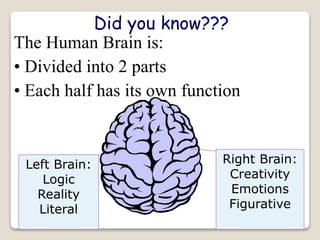
Right Brain:
Creativity
Emotions
Figurative
Left Brain:
Logic
Reality
Literal
Did you know???
The Human Brain is:
• Divided into 2 parts
• Each half has its own function
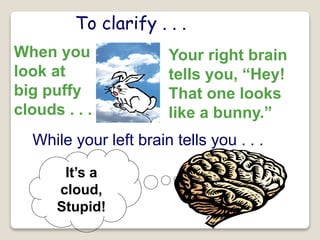
To clarify . . .
When you
look at
big puffy
clouds . . .
Your right brain
tells you, “Hey!
That one looks
like a bunny.”
While your left brain tells you . . .
It’s a
cloud,
Stupid!
So, which half do you use when
studying poetry?
Here are a few hints:
 Poetry requires creativity
 Poetry requires emotion
 Poetry requires artistic quality
 Poetry requires logic
Poet VS. Speaker
Poet
Writer of
the poem
Speaker
Narrator
of the
poem
Usually not the same person
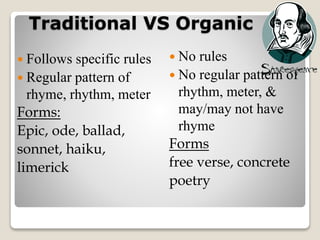
Traditional VS Organic
 Follows specific rules
 Regular pattern of
rhyme, rhythm, meter
Forms:
Epic, ode, ballad,
sonnet, haiku,
limerick
 No rules
 No regular pattern of
rhythm, meter, &
may/may not have
rhyme
Forms
free verse, concrete
poetry
Elements of Poetry
Rhythm
Sound
Imagery
Form
Recognizing devices in
a poem keeps the left
brain busy.
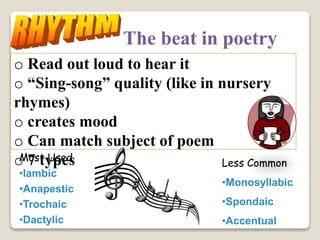
The beat in poetry
o Read out loud to hear it
o “Sing-song” quality (like in nursery
rhymes)
o creates mood
o Can match subject of poem
o 7 types
Most Used
•Iambic
•Anapestic
•Trochaic
•Dactylic
Less Common
•Monosyllabic
•Spondaic
•Accentual
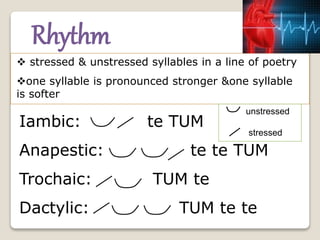
Rhythm
 stressed & unstressed syllables in a line of poetry
one syllable is pronounced stronger &one syllable
is softer
Iambic: te TUM
Anapestic: te te TUM
Trochaic: TUM te
Dactylic: TUM te te
unstressed
stressed
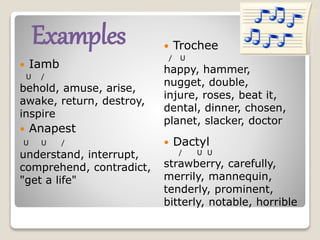
Examples
 Iamb
U /
behold, amuse, arise,
awake, return, destroy,
inspire
 Anapest
U U /
understand, interrupt,
comprehend, contradict,
"get a life"
 Trochee
/ U
happy, hammer,
nugget, double,
injure, roses, beat it,
dental, dinner, chosen,
planet, slacker, doctor
 Dactyl
/ U U
strawberry, carefully,
merrily, mannequin,
tenderly, prominent,
bitterly, notable, horrible
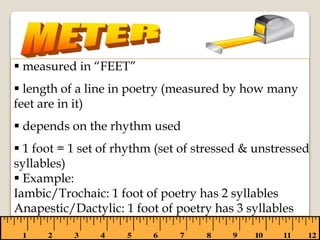
 measured in “FEET”
 length of a line in poetry (measured by how many
feet are in it)
 depends on the rhythm used
 1 foot = 1 set of rhythm (set of stressed & unstressed
syllables)
 Example:
Iambic/Trochaic: 1 foot of poetry has 2 syllables
Anapestic/Dactylic: 1 foot of poetry has 3 syllables
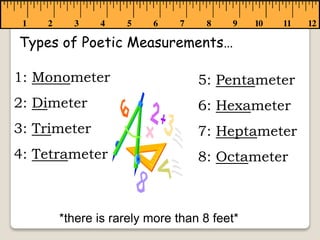
Types of Poetic Measurements…
*there is rarely more than 8 feet*
1: Monometer
2: Dimeter
3: Trimeter
4: Tetrameter
5: Pentameter
6: Hexameter
7: Heptameter
8: Octameter
II.
One shade the more, one ray the less,
Had half impaired the nameless grace
Which waves in every raven tress,
Or softly lightens o’er her face;
Where thoughts serenely sweet express,
How pure, how dear their dwelling-place.
She Walks in Beauty
I.
She walks in beauty, like the night
Of cloudless climes and starry skies;
And all that’s best of dark and bright
Meet in her aspect and her eyes:
Thus mellowed to that tender light
Which Heaven to gaudy day denies.
III.
And on that cheek, and o’er that brow,
So soft, so calm, yet eloquent,
The smiles that win, the tints that glow,
But tell of days in goodness spent,
A mind at peace with all below,
A heart whose love is innocent!
Reading this poem
out loud makes the
rhythm evident.
Which syllables are
more pronounced?
Which are naturally
softer?
Count the syllables in
each line to
determine the meter.
Examination of this poem
reveals that it would be
considered iambic tetrameter.
˘ ΄ ˘ ΄ ˘ ΄ ˘ ΄
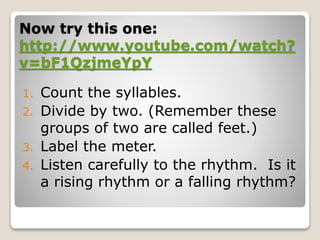
Now try this one:
http://www.youtube.com/watch?
v=bF1QzjmeYpY
1. Count the syllables.
2. Divide by two. (Remember these
groups of two are called feet.)
3. Label the meter.
4. Listen carefully to the rhythm. Is it
a rising rhythm or a falling rhythm?
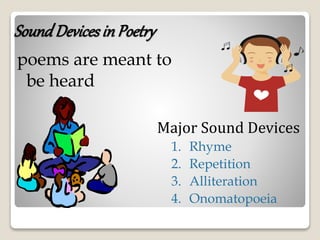
poems are meant to
be heard
Major Sound Devices
1. Rhyme
2. Repetition
3. Alliteration
4. Onomatopoeia
SoundDevicesinPoetry
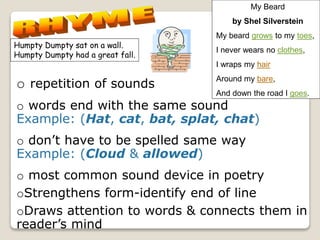
o repetition of sounds
o words end with the same sound
Example: (Hat, cat, bat, splat, chat)
o don’t have to be spelled same way
Example: (Cloud & allowed)
o most common sound device in poetry
oStrengthens form-identify end of line
oDraws attention to words & connects them in
reader’s mind
My Beard
by Shel Silverstein
My beard grows to my toes,
I never wears no clothes,
I wraps my hair
Around my bare,
And down the road I goes.
Humpty Dumpty sat on a wall.
Humpty Dumpty had a great fall.
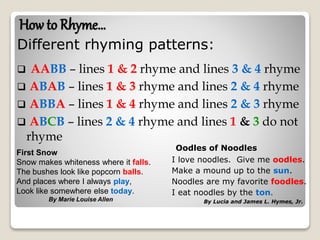
How to Rhyme…
Different rhyming patterns:
 AABB – lines 1 & 2 rhyme and lines 3 & 4 rhyme
 ABAB – lines 1 & 3 rhyme and lines 2 & 4 rhyme
 ABBA – lines 1 & 4 rhyme and lines 2 & 3 rhyme
 ABCB – lines 2 & 4 rhyme and lines 1 & 3 do not
rhyme
First Snow
Snow makes whiteness where it falls.
The bushes look like popcorn balls.
And places where I always play,
Look like somewhere else today.
By Marie Louise Allen
Oodles of Noodles
I love noodles. Give me oodles.
Make a mound up to the sun.
Noodles are my favorite foodles.
I eat noodles by the ton.
By Lucia and James L. Hymes, Jr.
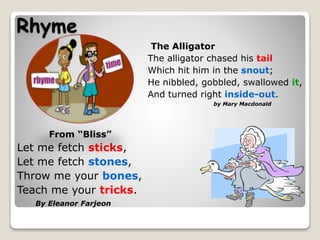
Rhyme
From “Bliss”
Let me fetch sticks,
Let me fetch stones,
Throw me your bones,
Teach me your tricks.
By Eleanor Farjeon
The Alligator
The alligator chased his tail
Which hit him in the snout;
He nibbled, gobbled, swallowed it,
And turned right inside-out.
by Mary Macdonald
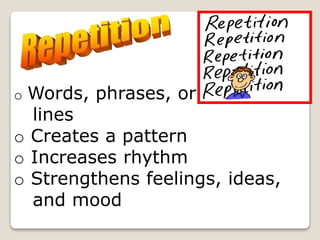
o Words, phrases, or
lines
o Creates a pattern
o Increases rhythm
o Strengthens feelings, ideas,
and mood
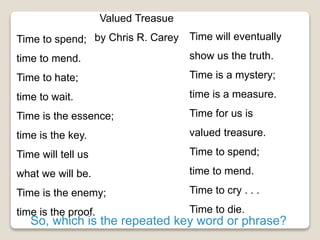
Time to spend;
time to mend.
Time to hate;
time to wait.
Time is the essence;
time is the key.
Time will tell us
what we will be.
Time is the enemy;
time is the proof.
Time will eventually
show us the truth.
Time is a mystery;
time is a measure.
Time for us is
valued treasure.
Time to spend;
time to mend.
Time to cry . . .
Time to die.
Valued Treasue
by Chris R. Carey
So, which is the repeated key word or phrase?
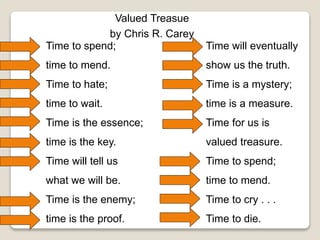
Time to spend;
time to mend.
Time to hate;
time to wait.
Time is the essence;
time is the key.
Time will tell us
what we will be.
Time is the enemy;
time is the proof.
Time will eventually
show us the truth.
Time is a mystery;
time is a measure.
Time for us is
valued treasure.
Time to spend;
time to mend.
Time to cry . . .
Time to die.
Valued Treasue
by Chris R. Carey
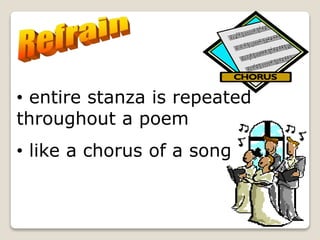
The repetition of one or more
phrases or lines at the end of a
stanza.
• entire stanza is repeated
throughout a poem
• like a chorus of a song
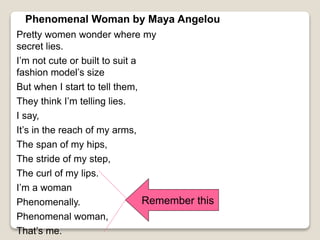
Phenomenal Woman by Maya Angelou
Pretty women wonder where my
secret lies.
I’m not cute or built to suit a
fashion model’s size
But when I start to tell them,
They think I’m telling lies.
I say,
It’s in the reach of my arms,
The span of my hips,
The stride of my step,
The curl of my lips.
I’m a woman
Phenomenally.
Phenomenal woman,
That’s me.
Remember this
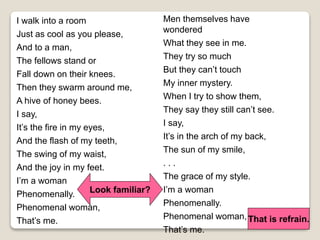
I walk into a room
Just as cool as you please,
And to a man,
The fellows stand or
Fall down on their knees.
Then they swarm around me,
A hive of honey bees.
I say,
It’s the fire in my eyes,
And the flash of my teeth,
The swing of my waist,
And the joy in my feet.
I’m a woman
Phenomenally.
Phenomenal woman,
That’s me.
Men themselves have
wondered
What they see in me.
They try so much
But they can’t touch
My inner mystery.
When I try to show them,
They say they still can’t see.
I say,
It’s in the arch of my back,
The sun of my smile,
. . .
The grace of my style.
I’m a woman
Phenomenally.
Phenomenal woman,
That’s me.

Look familiar?
That is refrain.
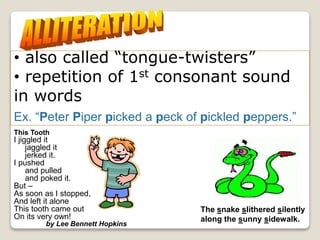
The repetition of the initial
letter or sound in two or
more words in a line.
• also called “tongue-twisters”
• repetition of 1st consonant sound
in words
Ex. “Peter Piper picked a peck of pickled peppers.”
The snake slithered silently
along the sunny sidewalk.
This Tooth
I jiggled it
jaggled it
jerked it.
I pushed
and pulled
and poked it.
But –
As soon as I stopped,
And left it alone
This tooth came out
On its very own!
by Lee Bennett Hopkins
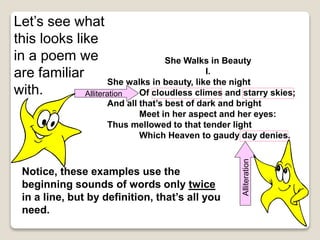
She Walks in Beauty
I.
She walks in beauty, like the night
Of cloudless climes and starry skies;
And all that’s best of dark and bright
Meet in her aspect and her eyes:
Thus mellowed to that tender light
Which Heaven to gaudy day denies.
Let’s see what
this looks like
in a poem we
are familiar
with. Alliteration
Alliteration
Notice, these examples use the
beginning sounds of words only twice
in a line, but by definition, that’s all you
need.
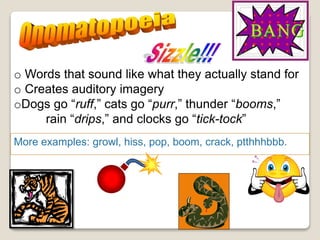
Words that spell out sounds;
words that sound like what
they mean.
More examples: growl, hiss, pop, boom, crack, ptthhhbbb.
o Words that sound like what they actually stand for
o Creates auditory imagery
oDogs go “ruff,” cats go “purr,” thunder “booms,”
rain “drips,” and clocks go “tick-tock”
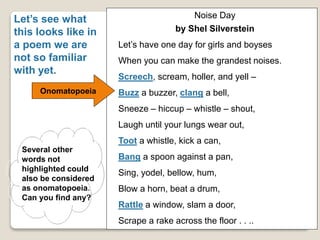
Let’s see what
this looks like in
a poem we are
not so familiar
with yet.
Noise Day
by Shel Silverstein
Let’s have one day for girls and boyses
When you can make the grandest noises.
Screech, scream, holler, and yell –
Buzz a buzzer, clang a bell,
Sneeze – hiccup – whistle – shout,
Laugh until your lungs wear out,
Toot a whistle, kick a can,
Bang a spoon against a pan,
Sing, yodel, bellow, hum,
Blow a horn, beat a drum,
Rattle a window, slam a door,
Scrape a rake across the floor . . ..
Onomatopoeia
Several other
words not
highlighted could
also be considered
as onomatopoeia.
Can you find any?
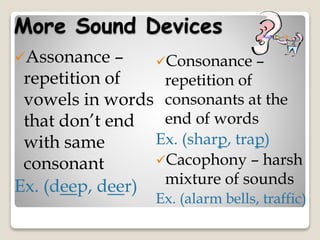
More Sound Devices
Consonance –
repetition of
consonants at the
end of words
Ex. (sharp, trap)
Cacophony – harsh
mixture of sounds
Ex. (alarm bells, traffic)
Assonance –
repetition of
vowels in words
that don’t end
with same
consonant
Ex. (deep, deer)
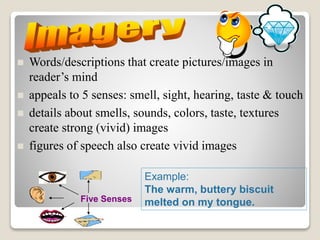
 Words/descriptions that create pictures/images in
reader’s mind
 appeals to 5 senses: smell, sight, hearing, taste & touch
 details about smells, sounds, colors, taste, textures
create strong (vivid) images
 figures of speech also create vivid images
Five Senses
Example:
The warm, buttery biscuit
melted on my tongue.
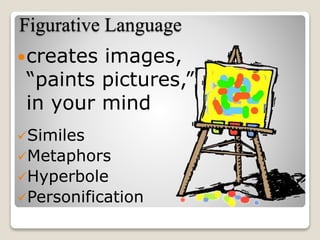
Figurative Language
creates images,
“paints pictures,”
in your mind
Similes
Metaphors
Hyperbole
Personification
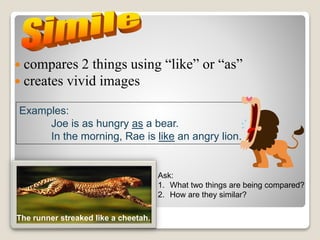
 compares 2 things using “like” or “as”
 creates vivid images
Examples:
Joe is as hungry as a bear.
In the morning, Rae is like an angry lion.
The runner streaked like a cheetah.
Ask:
1. What two things are being compared?
2. How are they similar?
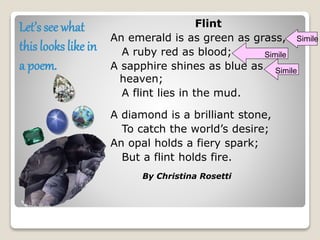
Let’s see what
this looks like in
a poem.
Simile
Simile
Simile
Flint
An emerald is as green as grass,
A ruby red as blood;
A sapphire shines as blue as
heaven;
A flint lies in the mud.
A diamond is a brilliant stone,
To catch the world’s desire;
An opal holds a fiery spark;
But a flint holds fire.
By Christina Rosetti
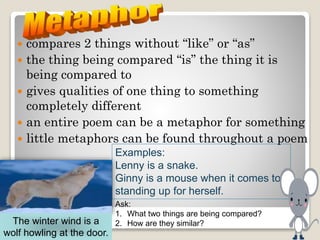
 compares 2 things without “like” or “as”
 the thing being compared “is” the thing it is
being compared to
 gives qualities of one thing to something
completely different
 an entire poem can be a metaphor for something
 little metaphors can be found throughout a poem
Examples:
Lenny is a snake.
Ginny is a mouse when it comes to
standing up for herself.
The winter wind is a
wolf howling at the door.
Ask:
1. What two things are being compared?
2. How are they similar?
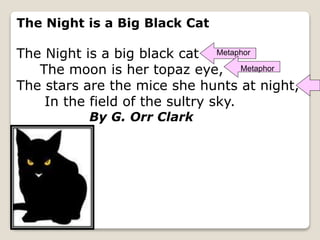
The Night is a Big Black Cat
The Night is a big black cat
The moon is her topaz eye,
The stars are the mice she hunts at night,
In the field of the sultry sky.
By G. Orr Clark
Metaphor
Metaphor
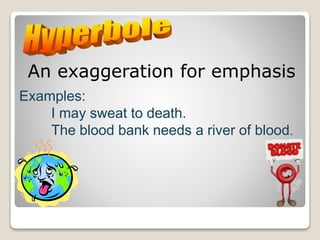
An exaggeration for emphasis
Examples:
I may sweat to death.
The blood bank needs a river of blood.
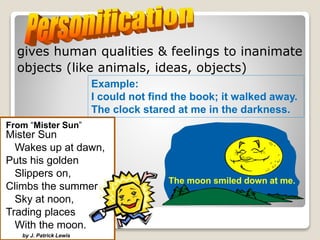
gives human qualities & feelings to inanimate
objects (like animals, ideas, objects)
The moon smiled down at me.
From “Mister Sun”
Mister Sun
Wakes up at dawn,
Puts his golden
Slippers on,
Climbs the summer
Sky at noon,
Trading places
With the moon.
by J. Patrick Lewis
Example:
I could not find the book; it walked away.
The clock stared at me in the darkness.
Word, image, or color representing
something other than what is literally
shown
Examples:
Dark/black images often symbolize death.
Light/white images often symbolize life.
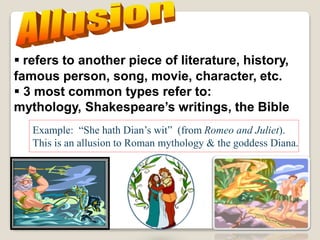
 refers to another piece of literature, history,
famous person, song, movie, character, etc.
 3 most common types refer to:
mythology, Shakespeare’s writings, the Bible
Example: “She hath Dian’s wit” (from Romeo and Juliet).
This is an allusion to Roman mythology & the goddess Diana.
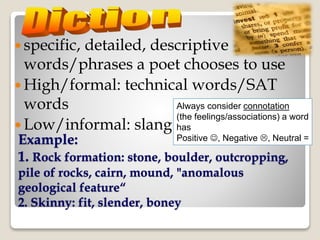
Example:
1. Rock formation: stone, boulder, outcropping,
pile of rocks, cairn, mound, "anomalous
geological feature“
2. Skinny: fit, slender, boney
 specific, detailed, descriptive
words/phrases a poet chooses to use
 High/formal: technical words/SAT
words
 Low/informal: slang
Always consider connotation
(the feelings/associations) a word
has
Positive , Negative , Neutral =
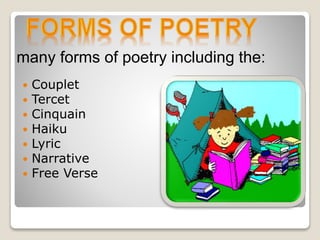
 Couplet
 Tercet
 Cinquain
 Haiku
 Lyric
 Narrative
 Free Verse
many forms of poetry including the:
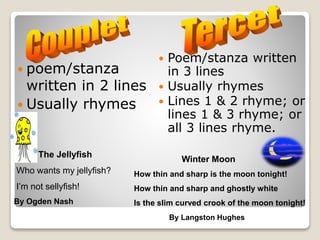
 poem/stanza
written in 2 lines
 Usually rhymes
The Jellyfish
Who wants my jellyfish?
I’m not sellyfish!
By Ogden Nash
 Poem/stanza written
in 3 lines
 Usually rhymes
 Lines 1 & 2 rhyme; or
lines 1 & 3 rhyme; or
all 3 lines rhyme.
Winter Moon
How thin and sharp is the moon tonight!
How thin and sharp and ghostly white
Is the slim curved crook of the moon tonight!
By Langston Hughes
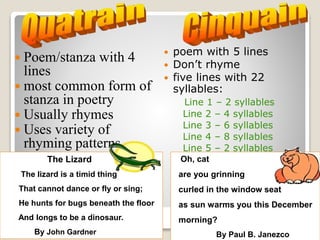
 Poem/stanza with 4
lines
 most common form of
stanza in poetry
 Usually rhymes
 Uses variety of
rhyming patterns
The Lizard
The lizard is a timid thing
That cannot dance or fly or sing;
He hunts for bugs beneath the floor
And longs to be a dinosaur.
By John Gardner
 poem with 5 lines
 Don’t rhyme
 five lines with 22
syllables:
Line 1 – 2 syllables
Line 2 – 4 syllables
Line 3 – 6 syllables
Line 4 – 8 syllables
Line 5 – 2 syllables
Oh, cat
are you grinning
curled in the window seat
as sun warms you this December
morning?
By Paul B. Janezco
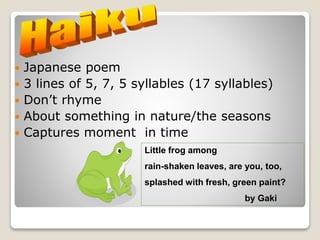
 Japanese poem
 3 lines of 5, 7, 5 syllables (17 syllables)
 Don’t rhyme
 About something in nature/the seasons
 Captures moment in time
Little frog among
rain-shaken leaves, are you, too,
splashed with fresh, green paint?
by Gaki
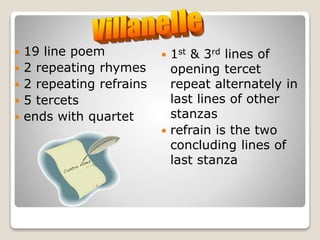
 19 line poem
 2 repeating rhymes
 2 repeating refrains
 5 tercets
 ends with quartet
 1st & 3rd lines of
opening tercet
repeat alternately in
last lines of other
stanzas
 refrain is the two
concluding lines of
last stanza
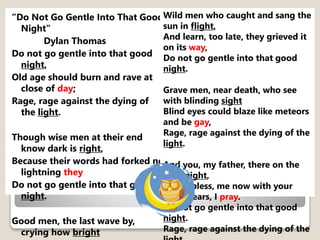
“Do Not Go Gentle Into That Good
Night”
Dylan Thomas
Do not go gentle into that good
night,
Old age should burn and rave at
close of day;
Rage, rage against the dying of
the light.
Though wise men at their end
know dark is right,
Because their words had forked no
lightning they
Do not go gentle into that good
night.
Good men, the last wave by,
crying how bright
Wild men who caught and sang the
sun in flight,
And learn, too late, they grieved it
on its way,
Do not go gentle into that good
night.
Grave men, near death, who see
with blinding sight
Blind eyes could blaze like meteors
and be gay,
Rage, rage against the dying of the
light.
And you, my father, there on the
sad height,
Curse, bless, me now with your
fierce tears, I pray.
Do not go gentle into that good
night.
Rage, rage against the dying of the
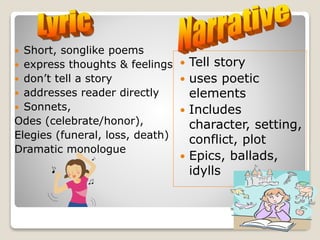
 Short, songlike poems
 express thoughts & feelings
 don’t tell a story
 addresses reader directly
 Sonnets,
Odes (celebrate/honor),
Elegies (funeral, loss, death)
Dramatic monologue
 Tell story
 uses poetic
elements
 Includes
character, setting,
conflict, plot
 Epics, ballads,
idylls
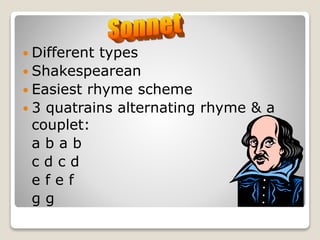
 Different types
 Shakespearean
 Easiest rhyme scheme
 3 quatrains alternating rhyme & a
couplet:
a b a b
c d c d
e f e f
g g
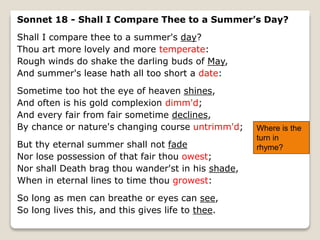
Sonnet 18 - Shall I Compare Thee to a Summer’s Day?
Shall I compare thee to a summer's day?
Thou art more lovely and more temperate:
Rough winds do shake the darling buds of May,
And summer's lease hath all too short a date:
Sometime too hot the eye of heaven shines,
And often is his gold complexion dimm'd;
And every fair from fair sometime declines,
By chance or nature's changing course untrimm'd;
But thy eternal summer shall not fade
Nor lose possession of that fair thou owest;
Nor shall Death brag thou wander'st in his shade,
When in eternal lines to time thou growest:
So long as men can breathe or eyes can see,
So long lives this, and this gives life to thee.
Where is the
turn in
rhyme?
"The Broken-Legg'd Man" by John Mackey Shaw
I saw the other day when I went shopping in the store
A man I hadn't ever, ever seen in there before,
A man whose leg was broken and who leaned upon a crutch-
I asked him very kindly if it hurt him very much.
"Not at all!" said the broken-legg'd man.
I ran around behind him for I thought that I would see
The broken leg all bandaged up and bent back at the knee;
But I didn't see the leg at all, there wasn't any there,
So I asked him very kindly if he had it hid somewhere.
"Not at all!" said the broken-legg'd man.
"Then where," I asked him, "is it? Did a tiger bite it off?
Or did you get your foot wet when you had a nasty cough?
Did someone jump down on your leg when it was very new?
Or did you simply cut it off because you wanted to?"
"Not at all!" said the broken-legg'd man.
"What was it then?" I asked him, and this is what he said:
"I crossed a busy crossing when the traffic light was red;
A big black car came whizzing by and knocked me off my feet."
"Of course you looked both ways," I said, "before you crossed the street."
"Not at all!" said the broken-legg'd man.
"They rushed me to the hospital right quickly, "he went on,
"And when I woke in nice white sheets I saw my leg was gone;
That's why you see me walking now on nothing but a crutch."
"I'm glad," said I, "you told me, and I thank you very much!"
"Not at all!" said the broken-legg'd man.
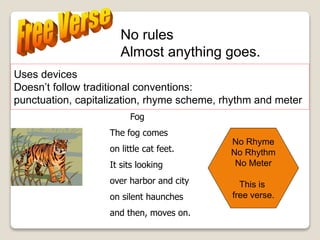
No rules
Almost anything goes.
Uses devices
Doesn’t follow traditional conventions:
punctuation, capitalization, rhyme scheme, rhythm and meter
Fog
The fog comes
on little cat feet.
It sits looking
over harbor and city
on silent haunches
and then, moves on.
No Rhyme
No Rhythm
No Meter
This is
free verse.
Poetry should be read aloud!
 Poetry Outloud National Champion 2009
http://www.youtube.com/watch?v=6SJeGjAzvs8
 An Evening of Poetry, Music and the Written
Word at the White House, President and First
Lady Obama
http://www.youtube.com/watch?v=cUfekqAJHeI
 James Earl Jones reciting from Othello by
Shakespeare
http://www.youtube.com/watch?v=DJybA1emr_
g&feature=SeriesPlayList&p=1ECEA36D759093A
1
 Billy Collins, “The Dead” with animation
http://www.youtube.com/watch?v=iuTNdHadwbk

intropoetry2015.ppt

  • 1.
    Introduction to Poetry “Ina poem the words should be as pleasing to the ear as the meaning is to the mind.” -- Marianne Moore
  • 2.
    Right Brain: Creativity Emotions Figurative Left Brain: Logic Reality Literal Didyou know??? The Human Brain is: • Divided into 2 parts • Each half has its own function
  • 3.
    To clarify .. . When you look at big puffy clouds . . . Your right brain tells you, “Hey! That one looks like a bunny.” While your left brain tells you . . . It’s a cloud, Stupid!
  • 4.
    So, which halfdo you use when studying poetry? Here are a few hints:  Poetry requires creativity  Poetry requires emotion  Poetry requires artistic quality  Poetry requires logic
  • 5.
    Poet VS. Speaker Poet Writerof the poem Speaker Narrator of the poem Usually not the same person
  • 6.
    Traditional VS Organic Follows specific rules  Regular pattern of rhyme, rhythm, meter Forms: Epic, ode, ballad, sonnet, haiku, limerick  No rules  No regular pattern of rhythm, meter, & may/may not have rhyme Forms free verse, concrete poetry
  • 7.
  • 8.
    The beat inpoetry o Read out loud to hear it o “Sing-song” quality (like in nursery rhymes) o creates mood o Can match subject of poem o 7 types Most Used •Iambic •Anapestic •Trochaic •Dactylic Less Common •Monosyllabic •Spondaic •Accentual
  • 9.
    Rhythm  stressed &unstressed syllables in a line of poetry one syllable is pronounced stronger &one syllable is softer Iambic: te TUM Anapestic: te te TUM Trochaic: TUM te Dactylic: TUM te te unstressed stressed
  • 10.
    Examples  Iamb U / behold,amuse, arise, awake, return, destroy, inspire  Anapest U U / understand, interrupt, comprehend, contradict, "get a life"  Trochee / U happy, hammer, nugget, double, injure, roses, beat it, dental, dinner, chosen, planet, slacker, doctor  Dactyl / U U strawberry, carefully, merrily, mannequin, tenderly, prominent, bitterly, notable, horrible
  • 11.
     measured in“FEET”  length of a line in poetry (measured by how many feet are in it)  depends on the rhythm used  1 foot = 1 set of rhythm (set of stressed & unstressed syllables)  Example: Iambic/Trochaic: 1 foot of poetry has 2 syllables Anapestic/Dactylic: 1 foot of poetry has 3 syllables
  • 12.
    Types of PoeticMeasurements… *there is rarely more than 8 feet* 1: Monometer 2: Dimeter 3: Trimeter 4: Tetrameter 5: Pentameter 6: Hexameter 7: Heptameter 8: Octameter
  • 13.
    II. One shade themore, one ray the less, Had half impaired the nameless grace Which waves in every raven tress, Or softly lightens o’er her face; Where thoughts serenely sweet express, How pure, how dear their dwelling-place. She Walks in Beauty I. She walks in beauty, like the night Of cloudless climes and starry skies; And all that’s best of dark and bright Meet in her aspect and her eyes: Thus mellowed to that tender light Which Heaven to gaudy day denies. III. And on that cheek, and o’er that brow, So soft, so calm, yet eloquent, The smiles that win, the tints that glow, But tell of days in goodness spent, A mind at peace with all below, A heart whose love is innocent! Reading this poem out loud makes the rhythm evident. Which syllables are more pronounced? Which are naturally softer? Count the syllables in each line to determine the meter. Examination of this poem reveals that it would be considered iambic tetrameter. ˘ ΄ ˘ ΄ ˘ ΄ ˘ ΄
  • 14.
    Now try thisone: http://www.youtube.com/watch? v=bF1QzjmeYpY 1. Count the syllables. 2. Divide by two. (Remember these groups of two are called feet.) 3. Label the meter. 4. Listen carefully to the rhythm. Is it a rising rhythm or a falling rhythm?
  • 15.
    poems are meantto be heard Major Sound Devices 1. Rhyme 2. Repetition 3. Alliteration 4. Onomatopoeia SoundDevicesinPoetry
  • 16.
    o repetition ofsounds o words end with the same sound Example: (Hat, cat, bat, splat, chat) o don’t have to be spelled same way Example: (Cloud & allowed) o most common sound device in poetry oStrengthens form-identify end of line oDraws attention to words & connects them in reader’s mind My Beard by Shel Silverstein My beard grows to my toes, I never wears no clothes, I wraps my hair Around my bare, And down the road I goes. Humpty Dumpty sat on a wall. Humpty Dumpty had a great fall.
  • 17.
    How to Rhyme… Differentrhyming patterns:  AABB – lines 1 & 2 rhyme and lines 3 & 4 rhyme  ABAB – lines 1 & 3 rhyme and lines 2 & 4 rhyme  ABBA – lines 1 & 4 rhyme and lines 2 & 3 rhyme  ABCB – lines 2 & 4 rhyme and lines 1 & 3 do not rhyme First Snow Snow makes whiteness where it falls. The bushes look like popcorn balls. And places where I always play, Look like somewhere else today. By Marie Louise Allen Oodles of Noodles I love noodles. Give me oodles. Make a mound up to the sun. Noodles are my favorite foodles. I eat noodles by the ton. By Lucia and James L. Hymes, Jr.
  • 18.
    Rhyme From “Bliss” Let mefetch sticks, Let me fetch stones, Throw me your bones, Teach me your tricks. By Eleanor Farjeon The Alligator The alligator chased his tail Which hit him in the snout; He nibbled, gobbled, swallowed it, And turned right inside-out. by Mary Macdonald
  • 19.
    o Words, phrases,or lines o Creates a pattern o Increases rhythm o Strengthens feelings, ideas, and mood
  • 20.
    Time to spend; timeto mend. Time to hate; time to wait. Time is the essence; time is the key. Time will tell us what we will be. Time is the enemy; time is the proof. Time will eventually show us the truth. Time is a mystery; time is a measure. Time for us is valued treasure. Time to spend; time to mend. Time to cry . . . Time to die. Valued Treasue by Chris R. Carey So, which is the repeated key word or phrase?
  • 21.
    Time to spend; timeto mend. Time to hate; time to wait. Time is the essence; time is the key. Time will tell us what we will be. Time is the enemy; time is the proof. Time will eventually show us the truth. Time is a mystery; time is a measure. Time for us is valued treasure. Time to spend; time to mend. Time to cry . . . Time to die. Valued Treasue by Chris R. Carey
  • 22.
    The repetition ofone or more phrases or lines at the end of a stanza. • entire stanza is repeated throughout a poem • like a chorus of a song
  • 23.
    Phenomenal Woman byMaya Angelou Pretty women wonder where my secret lies. I’m not cute or built to suit a fashion model’s size But when I start to tell them, They think I’m telling lies. I say, It’s in the reach of my arms, The span of my hips, The stride of my step, The curl of my lips. I’m a woman Phenomenally. Phenomenal woman, That’s me. Remember this
  • 24.
    I walk intoa room Just as cool as you please, And to a man, The fellows stand or Fall down on their knees. Then they swarm around me, A hive of honey bees. I say, It’s the fire in my eyes, And the flash of my teeth, The swing of my waist, And the joy in my feet. I’m a woman Phenomenally. Phenomenal woman, That’s me. Men themselves have wondered What they see in me. They try so much But they can’t touch My inner mystery. When I try to show them, They say they still can’t see. I say, It’s in the arch of my back, The sun of my smile, . . . The grace of my style. I’m a woman Phenomenally. Phenomenal woman, That’s me. Look familiar? That is refrain.
  • 25.
    The repetition ofthe initial letter or sound in two or more words in a line. • also called “tongue-twisters” • repetition of 1st consonant sound in words Ex. “Peter Piper picked a peck of pickled peppers.” The snake slithered silently along the sunny sidewalk. This Tooth I jiggled it jaggled it jerked it. I pushed and pulled and poked it. But – As soon as I stopped, And left it alone This tooth came out On its very own! by Lee Bennett Hopkins
  • 26.
    She Walks inBeauty I. She walks in beauty, like the night Of cloudless climes and starry skies; And all that’s best of dark and bright Meet in her aspect and her eyes: Thus mellowed to that tender light Which Heaven to gaudy day denies. Let’s see what this looks like in a poem we are familiar with. Alliteration Alliteration Notice, these examples use the beginning sounds of words only twice in a line, but by definition, that’s all you need.
  • 27.
    Words that spellout sounds; words that sound like what they mean. More examples: growl, hiss, pop, boom, crack, ptthhhbbb. o Words that sound like what they actually stand for o Creates auditory imagery oDogs go “ruff,” cats go “purr,” thunder “booms,” rain “drips,” and clocks go “tick-tock”
  • 28.
    Let’s see what thislooks like in a poem we are not so familiar with yet. Noise Day by Shel Silverstein Let’s have one day for girls and boyses When you can make the grandest noises. Screech, scream, holler, and yell – Buzz a buzzer, clang a bell, Sneeze – hiccup – whistle – shout, Laugh until your lungs wear out, Toot a whistle, kick a can, Bang a spoon against a pan, Sing, yodel, bellow, hum, Blow a horn, beat a drum, Rattle a window, slam a door, Scrape a rake across the floor . . .. Onomatopoeia Several other words not highlighted could also be considered as onomatopoeia. Can you find any?
  • 29.
    More Sound Devices Consonance– repetition of consonants at the end of words Ex. (sharp, trap) Cacophony – harsh mixture of sounds Ex. (alarm bells, traffic) Assonance – repetition of vowels in words that don’t end with same consonant Ex. (deep, deer)
  • 30.
     Words/descriptions thatcreate pictures/images in reader’s mind  appeals to 5 senses: smell, sight, hearing, taste & touch  details about smells, sounds, colors, taste, textures create strong (vivid) images  figures of speech also create vivid images Five Senses Example: The warm, buttery biscuit melted on my tongue.
  • 31.
    Figurative Language creates images, “paintspictures,” in your mind Similes Metaphors Hyperbole Personification
  • 32.
     compares 2things using “like” or “as”  creates vivid images Examples: Joe is as hungry as a bear. In the morning, Rae is like an angry lion. The runner streaked like a cheetah. Ask: 1. What two things are being compared? 2. How are they similar?
  • 33.
    Let’s see what thislooks like in a poem. Simile Simile Simile Flint An emerald is as green as grass, A ruby red as blood; A sapphire shines as blue as heaven; A flint lies in the mud. A diamond is a brilliant stone, To catch the world’s desire; An opal holds a fiery spark; But a flint holds fire. By Christina Rosetti
  • 34.
     compares 2things without “like” or “as”  the thing being compared “is” the thing it is being compared to  gives qualities of one thing to something completely different  an entire poem can be a metaphor for something  little metaphors can be found throughout a poem Examples: Lenny is a snake. Ginny is a mouse when it comes to standing up for herself. The winter wind is a wolf howling at the door. Ask: 1. What two things are being compared? 2. How are they similar?
  • 35.
    The Night isa Big Black Cat The Night is a big black cat The moon is her topaz eye, The stars are the mice she hunts at night, In the field of the sultry sky. By G. Orr Clark Metaphor Metaphor
  • 36.
    An exaggeration foremphasis Examples: I may sweat to death. The blood bank needs a river of blood.
  • 37.
    gives human qualities& feelings to inanimate objects (like animals, ideas, objects) The moon smiled down at me. From “Mister Sun” Mister Sun Wakes up at dawn, Puts his golden Slippers on, Climbs the summer Sky at noon, Trading places With the moon. by J. Patrick Lewis Example: I could not find the book; it walked away. The clock stared at me in the darkness.
  • 38.
    Word, image, orcolor representing something other than what is literally shown Examples: Dark/black images often symbolize death. Light/white images often symbolize life.
  • 39.
     refers toanother piece of literature, history, famous person, song, movie, character, etc.  3 most common types refer to: mythology, Shakespeare’s writings, the Bible Example: “She hath Dian’s wit” (from Romeo and Juliet). This is an allusion to Roman mythology & the goddess Diana.
  • 40.
    Example: 1. Rock formation:stone, boulder, outcropping, pile of rocks, cairn, mound, "anomalous geological feature“ 2. Skinny: fit, slender, boney  specific, detailed, descriptive words/phrases a poet chooses to use  High/formal: technical words/SAT words  Low/informal: slang Always consider connotation (the feelings/associations) a word has Positive , Negative , Neutral =
  • 41.
     Couplet  Tercet Cinquain  Haiku  Lyric  Narrative  Free Verse many forms of poetry including the:
  • 42.
     poem/stanza written in2 lines  Usually rhymes The Jellyfish Who wants my jellyfish? I’m not sellyfish! By Ogden Nash  Poem/stanza written in 3 lines  Usually rhymes  Lines 1 & 2 rhyme; or lines 1 & 3 rhyme; or all 3 lines rhyme. Winter Moon How thin and sharp is the moon tonight! How thin and sharp and ghostly white Is the slim curved crook of the moon tonight! By Langston Hughes
  • 43.
     Poem/stanza with4 lines  most common form of stanza in poetry  Usually rhymes  Uses variety of rhyming patterns The Lizard The lizard is a timid thing That cannot dance or fly or sing; He hunts for bugs beneath the floor And longs to be a dinosaur. By John Gardner  poem with 5 lines  Don’t rhyme  five lines with 22 syllables: Line 1 – 2 syllables Line 2 – 4 syllables Line 3 – 6 syllables Line 4 – 8 syllables Line 5 – 2 syllables Oh, cat are you grinning curled in the window seat as sun warms you this December morning? By Paul B. Janezco
  • 44.
     Japanese poem 3 lines of 5, 7, 5 syllables (17 syllables)  Don’t rhyme  About something in nature/the seasons  Captures moment in time Little frog among rain-shaken leaves, are you, too, splashed with fresh, green paint? by Gaki
  • 45.
     19 linepoem  2 repeating rhymes  2 repeating refrains  5 tercets  ends with quartet  1st & 3rd lines of opening tercet repeat alternately in last lines of other stanzas  refrain is the two concluding lines of last stanza
  • 46.
    “Do Not GoGentle Into That Good Night” Dylan Thomas Do not go gentle into that good night, Old age should burn and rave at close of day; Rage, rage against the dying of the light. Though wise men at their end know dark is right, Because their words had forked no lightning they Do not go gentle into that good night. Good men, the last wave by, crying how bright Wild men who caught and sang the sun in flight, And learn, too late, they grieved it on its way, Do not go gentle into that good night. Grave men, near death, who see with blinding sight Blind eyes could blaze like meteors and be gay, Rage, rage against the dying of the light. And you, my father, there on the sad height, Curse, bless, me now with your fierce tears, I pray. Do not go gentle into that good night. Rage, rage against the dying of the
  • 47.
     Short, songlikepoems  express thoughts & feelings  don’t tell a story  addresses reader directly  Sonnets, Odes (celebrate/honor), Elegies (funeral, loss, death) Dramatic monologue  Tell story  uses poetic elements  Includes character, setting, conflict, plot  Epics, ballads, idylls
  • 48.
     Different types Shakespearean  Easiest rhyme scheme  3 quatrains alternating rhyme & a couplet: a b a b c d c d e f e f g g
  • 49.
    Sonnet 18 -Shall I Compare Thee to a Summer’s Day? Shall I compare thee to a summer's day? Thou art more lovely and more temperate: Rough winds do shake the darling buds of May, And summer's lease hath all too short a date: Sometime too hot the eye of heaven shines, And often is his gold complexion dimm'd; And every fair from fair sometime declines, By chance or nature's changing course untrimm'd; But thy eternal summer shall not fade Nor lose possession of that fair thou owest; Nor shall Death brag thou wander'st in his shade, When in eternal lines to time thou growest: So long as men can breathe or eyes can see, So long lives this, and this gives life to thee. Where is the turn in rhyme?
  • 50.
    "The Broken-Legg'd Man"by John Mackey Shaw I saw the other day when I went shopping in the store A man I hadn't ever, ever seen in there before, A man whose leg was broken and who leaned upon a crutch- I asked him very kindly if it hurt him very much. "Not at all!" said the broken-legg'd man. I ran around behind him for I thought that I would see The broken leg all bandaged up and bent back at the knee; But I didn't see the leg at all, there wasn't any there, So I asked him very kindly if he had it hid somewhere. "Not at all!" said the broken-legg'd man. "Then where," I asked him, "is it? Did a tiger bite it off? Or did you get your foot wet when you had a nasty cough? Did someone jump down on your leg when it was very new? Or did you simply cut it off because you wanted to?" "Not at all!" said the broken-legg'd man. "What was it then?" I asked him, and this is what he said: "I crossed a busy crossing when the traffic light was red; A big black car came whizzing by and knocked me off my feet." "Of course you looked both ways," I said, "before you crossed the street." "Not at all!" said the broken-legg'd man. "They rushed me to the hospital right quickly, "he went on, "And when I woke in nice white sheets I saw my leg was gone; That's why you see me walking now on nothing but a crutch." "I'm glad," said I, "you told me, and I thank you very much!" "Not at all!" said the broken-legg'd man.
  • 51.
    No rules Almost anythinggoes. Uses devices Doesn’t follow traditional conventions: punctuation, capitalization, rhyme scheme, rhythm and meter Fog The fog comes on little cat feet. It sits looking over harbor and city on silent haunches and then, moves on. No Rhyme No Rhythm No Meter This is free verse.
  • 52.
    Poetry should beread aloud!  Poetry Outloud National Champion 2009 http://www.youtube.com/watch?v=6SJeGjAzvs8  An Evening of Poetry, Music and the Written Word at the White House, President and First Lady Obama http://www.youtube.com/watch?v=cUfekqAJHeI  James Earl Jones reciting from Othello by Shakespeare http://www.youtube.com/watch?v=DJybA1emr_ g&feature=SeriesPlayList&p=1ECEA36D759093A 1  Billy Collins, “The Dead” with animation http://www.youtube.com/watch?v=iuTNdHadwbk