The Scramble for Africa
By: Nicolas Catelli, Rodrigo Garza and Armando Mar
Imperialism
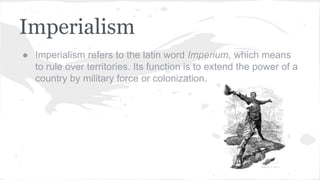
● Imperialism refers to the latin word Imperium, which means
to rule over territories. Its function is to extend the power of a
country by military force or colonization.
The Berlin Conference
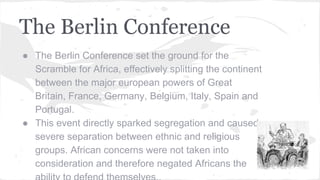
● The Berlin Conference set the ground for the
Scramble for Africa, effectively splitting the continent
between the major european powers of Great
Britain, France, Germany, Belgium, Italy, Spain and
Portugal.
● This event directly sparked segregation and caused
severe separation between ethnic and religious
groups. African concerns were not taken into
consideration and therefore negated Africans the
Massacre at Congo
● King Leopold the Second of Belgium was responsible for
what is considered one of the bloodiest massacres in history.
Approximately 10 million congolese were killed by Belgian
troops, which were after the riches of Congo.
● Leopold’s Policy of violent enforcement for brutal work
remains in modern day Congo, where militias rape, kill and
pillage as they like.
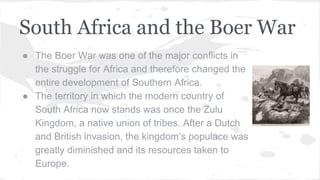
South Africa and the Boer War
● The Boer War was one of the major conflicts in
the struggle for Africa and therefore changed the
entire development of Southern Africa.
● The territory in which the modern country of
South Africa now stands was once the Zulu
Kingdom, a native union of tribes. After a Dutch
and British invasion, the kingdom’s populace was
greatly diminished and its resources taken to
Europe.
Cultural Split
● Africa was divided without any prior knowledge of ethnic,
religious or cultural clustering. Africans were not notified, and
in some cases, villages were divided and fell into different
zones of influence. This led to families being separated,
innocents killed in border skirmishes and others.
● To better ascertain their control over the local people, many
Europeans divided the population to better control them. This
further divided the African people.
Lasting Effects
● Africa is modernly an underdeveloped continent, civil wars
are fought daily throughout many countries (Congo, Nigeria,
Libya), disease spreads without control (Ebola, AIDS). This is
mainly because of the take it and leave it mentality that the
europeans had in regards to Africa.
The Rwandan Genocide
● In 1994, the Rwandan population was divided into 3 groups:
Hutu, Tutsi and Twa. The Tutsi were placed on the
government by Europeans, even though they were a minority.
When the Europeans left, Hutus rose to power.
● Extremists within the Hutu Government blamed the Tutsis
for the country’s problems. Tutsis were murdered in their
homes and while attempting to flee. About a million people
died.
Modern Africa
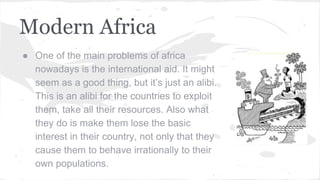
● One of the main problems of africa
nowadays is the international aid. It might
seem as a good thing, but it’s just an alibi.
This is an alibi for the countries to exploit
them, take all their resources. Also what
they do is make them lose the basic
interest in their country, not only that they
cause them to behave irrationally to their
own populations.
Bibliography
● http://www.siliconafrica.com/africa-top-10-problems-not-the-
ones-you-were-thinking-about/
● Hotel Rwanda, Movie
● History Class Lectures
● http://en.wikipedia.org/wiki/Imperialism

The Scramble for Africa PBL

  • 1.
    The Scramble forAfrica By: Nicolas Catelli, Rodrigo Garza and Armando Mar
  • 2.
    Imperialism ● Imperialism refersto the latin word Imperium, which means to rule over territories. Its function is to extend the power of a country by military force or colonization.
  • 3.
    The Berlin Conference ●The Berlin Conference set the ground for the Scramble for Africa, effectively splitting the continent between the major european powers of Great Britain, France, Germany, Belgium, Italy, Spain and Portugal. ● This event directly sparked segregation and caused severe separation between ethnic and religious groups. African concerns were not taken into consideration and therefore negated Africans the
  • 4.
    Massacre at Congo ●King Leopold the Second of Belgium was responsible for what is considered one of the bloodiest massacres in history. Approximately 10 million congolese were killed by Belgian troops, which were after the riches of Congo. ● Leopold’s Policy of violent enforcement for brutal work remains in modern day Congo, where militias rape, kill and pillage as they like.
  • 5.
    South Africa andthe Boer War ● The Boer War was one of the major conflicts in the struggle for Africa and therefore changed the entire development of Southern Africa. ● The territory in which the modern country of South Africa now stands was once the Zulu Kingdom, a native union of tribes. After a Dutch and British invasion, the kingdom’s populace was greatly diminished and its resources taken to Europe.
  • 6.
    Cultural Split ● Africawas divided without any prior knowledge of ethnic, religious or cultural clustering. Africans were not notified, and in some cases, villages were divided and fell into different zones of influence. This led to families being separated, innocents killed in border skirmishes and others. ● To better ascertain their control over the local people, many Europeans divided the population to better control them. This further divided the African people.
  • 7.
    Lasting Effects ● Africais modernly an underdeveloped continent, civil wars are fought daily throughout many countries (Congo, Nigeria, Libya), disease spreads without control (Ebola, AIDS). This is mainly because of the take it and leave it mentality that the europeans had in regards to Africa.
  • 8.
    The Rwandan Genocide ●In 1994, the Rwandan population was divided into 3 groups: Hutu, Tutsi and Twa. The Tutsi were placed on the government by Europeans, even though they were a minority. When the Europeans left, Hutus rose to power. ● Extremists within the Hutu Government blamed the Tutsis for the country’s problems. Tutsis were murdered in their homes and while attempting to flee. About a million people died.
  • 9.
    Modern Africa ● Oneof the main problems of africa nowadays is the international aid. It might seem as a good thing, but it’s just an alibi. This is an alibi for the countries to exploit them, take all their resources. Also what they do is make them lose the basic interest in their country, not only that they cause them to behave irrationally to their own populations.
  • 10.
    Bibliography ● http://www.siliconafrica.com/africa-top-10-problems-not-the- ones-you-were-thinking-about/ ● HotelRwanda, Movie ● History Class Lectures ● http://en.wikipedia.org/wiki/Imperialism