The Risk Management Of Safety And Dependability
W Wong download
https://ebookbell.com/product/the-risk-management-of-safety-and-
dependability-w-wong-2455886
Explore and download more ebooks at ebookbell.com
Here are some recommended products that we believe you will be
interested in. You can click the link to download.
The Risk Management Of Safety And Dependability 1st Edition W Wong
https://ebookbell.com/product/the-risk-management-of-safety-and-
dependability-1st-edition-w-wong-2403478
Management Of Uncertainty In Safety Cases And The Role Of Risk
Workshop Proceedings Stockholm Sweden 2 4 February 2004 Workshop On
The Management Of Uncertainty In Safety Cases And The Role Of Risk
Oecd
https://ebookbell.com/product/management-of-uncertainty-in-safety-
cases-and-the-role-of-risk-workshop-proceedings-stockholm-
sweden-2-4-february-2004-workshop-on-the-management-of-uncertainty-in-
safety-cases-and-the-role-of-risk-oecd-6779782
Probabilistic Safety Assessment Of Wwer440 Reactors Prediction
Quantification And Management Of The Risk 1st Edition Zoltan Kovacs
Auth
https://ebookbell.com/product/probabilistic-safety-assessment-of-
wwer440-reactors-prediction-quantification-and-management-of-the-
risk-1st-edition-zoltan-kovacs-auth-4931740
Digital Human Modeling And Applications In Health Safety Ergonomics
And Risk Management Healthcare And Safety Of The Environment And
Transport 4th International Conference Dhm 2013 Held As Part Of Hci
International 2013 Las Vegas Nv Usa July 21 1st Edition Vincent G
Duffy
https://ebookbell.com/product/digital-human-modeling-and-applications-
in-health-safety-ergonomics-and-risk-management-healthcare-and-safety-
of-the-environment-and-transport-4th-international-conference-
dhm-2013-held-as-part-of-hci-international-2013-las-vegas-nv-usa-
july-21-1st-edition-vincent-g-duffy-4241956
The Design Implementation And Audit Of Occupational Health And Safety
Management Systems Workplace Safety Risk Management And Industrial
Hygiene 1st Edition Ron C Mckinnon
https://ebookbell.com/product/the-design-implementation-and-audit-of-
occupational-health-and-safety-management-systems-workplace-safety-
risk-management-and-industrial-hygiene-1st-edition-ron-c-
mckinnon-11911426
Digital Human Modeling And Applications In Health Safety Ergonomics
And Risk Management Human Body And Motion 10th International
Conference Dhm 2019 Held As Part Of The 21st Hci International
Conference Hcii 2019 Orlando Fl Usa July 2631 2019 1st Ed Vincent G
Duffy
https://ebookbell.com/product/digital-human-modeling-and-applications-
in-health-safety-ergonomics-and-risk-management-human-body-and-
motion-10th-international-conference-dhm-2019-held-as-part-of-
the-21st-hci-international-conference-hcii-2019-orlando-fl-usa-
july-2631-2019-1st-ed-vincent-g-duffy-10488806
Digital Human Modeling And Applications In Health Safety Ergonomics
And Risk Management Healthcare Applications 10th International
Conference Dhm 2019 Held As Part Of The 21st Hci International
Conference Hcii 2019 Orlando Fl Usa July 2631 20 1st Ed Vincent G
Duffy
https://ebookbell.com/product/digital-human-modeling-and-applications-
in-health-safety-ergonomics-and-risk-management-healthcare-
applications-10th-international-conference-dhm-2019-held-as-part-of-
the-21st-hci-international-conference-hcii-2019-orlando-fl-usa-
july-2631-20-1st-ed-vincent-g-duffy-10488808
Digital Human Modeling And Applications In Health Safety Ergonomics
And Risk Management Posture Motion And Health 11th International
Conference Dhm 2020 Held As Part Of The 22nd Hci International
Conference Hcii 2020 Copenhagen Denmark July 19 1st Ed Vincent G Duffy
https://ebookbell.com/product/digital-human-modeling-and-applications-
in-health-safety-ergonomics-and-risk-management-posture-motion-and-
health-11th-international-conference-dhm-2020-held-as-part-of-
the-22nd-hci-international-conference-hcii-2020-copenhagen-denmark-
july-19-1st-ed-vincent-g-duffy-22503328
Digital Human Modeling And Applications In Health Safety Ergonomics
And Risk Management Human Communication Organization And Work 11th
International Conference Dhm 2020 Held As Part Of The 22nd Hci
International Conference Hcii 2020 Copenhagen D 1st Ed Vincent G Duffy
https://ebookbell.com/product/digital-human-modeling-and-applications-
in-health-safety-ergonomics-and-risk-management-human-communication-
organization-and-work-11th-international-conference-dhm-2020-held-as-
part-of-the-22nd-hci-international-conference-
hcii-2020-copenhagen-d-1st-ed-vincent-g-duffy-22503330
© Woodhead Publishing Limited, 2010
The risk management of safety and dependability
© Woodhead Publishing Limited, 2010
The risk
management of
safety and
dependability
A guide for directors,
managers and engineers
W. Wong
Oxford Cambridge New Delhi
© Woodhead Publishing Limited, 2010
Published by Woodhead Publishing Limited, Abington Hall, Granta Park,
Great Abington, Cambridge CB21 6AH, UK
www.woodheadpublishing.com
Woodhead Publishing India Private Limited, G-2, Vardaan House, 7/28 Ansari
Road, Daryaganj, New Delhi – 110002, India
www.woodheadpublishingindia.com
Published in North America by CRC Press LLC, 6000 Broken Sound Parkway, NW,
Suite 300, Boca Raton, FL 33487, USA
First published 2010, Woodhead Publishing Limited and CRC Press LLC
© Woodhead Publishing Limited, 2010
The author has asserted his moral rights.
This book contains information obtained from authentic and highly regarded
sources. Reprinted material is quoted with permission, and sources are indicated.
Reasonable efforts have been made to publish reliable data and information, but
the author and the publishers cannot assume responsibility for the validity of all
materials. Neither the author nor the publishers, nor anyone else associated with
this publication, shall be liable for any loss, damage or liability directly or
indirectly caused or alleged to be caused by this book.
Neither this book nor any part may be reproduced or transmitted in any form
or by any means, electronic or mechanical, including photocopying, microfilming
and recording, or by any information storage or retrieval system, without
permission in writing from Woodhead Publishing Limited.
The consent of Woodhead Publishing Limited does not extend to copying for
general distribution, for promotion, for creating new works, or for resale. Specific
permission must be obtained in writing from Woodhead Publishing Limited for
such copying.
Trademark notice: Product or corporate names may be trademarks or registered
trademarks, and are used only for identification and explanation, without intent
to infringe.
British Library Cataloguing in Publication Data
A catalogue record for this book is available from the British Library.
Library of Congress Cataloging in Publication Data
A catalog record for this book is available from the Library of Congress.
Woodhead Publishing ISBN 978-1-84569-712-9 (book)
Woodhead Publishing ISBN 978-1-84569-938-3 (e-book)
CRC Press ISBN 978-1-4398-2992-9
CRC Press order number: N10174
The publishers’ policy is to use permanent paper from mills that operate a
sustainable forestry policy, and which has been manufactured from pulp which is
processed using acid-free and elemental chlorine-free practices. Furthermore, the
publishers ensure that the text paper and cover board used have met acceptable
environmental accreditation standards.
Typeset by Toppan Best-set Premedia Limited, Hong Kong
Printed by TJ International Limited, Padstow, Cornwall, UK
© Woodhead Publishing Limited, 2010
Contents
About the author xi
Acknowledgements xii
Preface xiii
1 Ever-present danger: an introduction to the principles
of risk management 1
1.1 Introduction 1
1.2 The principles of risk assessment 2
1.3 The risk assessment matrix 3
1.4 Risk evaluation and control 4
1.5 Dependability 5
1.6 The risk management process 5
1.7 Examples of risk management failures 5
1.8 General precepts 16
1.9 Summary 18
1.10 References 18
2 Ignorance is no defence: legislation and the corporate
role in managing risk 19
2.1 Introduction: management failures 19
2.2 An overview of the law in the UK 21
2.3 The Health and Safety at Work etc. Act 1974 24
2.4 The Management of Health and Safety at Work
Regulations 1999 (MHSWR) 25
2.5 The Provision and Use of Work Equipment Regulations
1998 (PUWER) 26
2.6 The Reporting of Injuries, Diseases and Dangerous
Occurrences Regulations 1995 (RIDDOR) 26
2.7 The Control of Substances Hazardous to Health
Regulations 1994 (COSHH) 27
v
vi Contents
© Woodhead Publishing Limited, 2010
2.8 The Supply of Machinery Safety Regulations 2008
(Machinery Directive 2006/42/EC) 27
2.9 The Electromagnetic Compatibility (Amendment)
Regulations 2006 30
2.10 The Control of Major Accident Hazards Regulations 1999
(COMAH) Amended 2005 31
2.11 The Construction (Design and Management) (CDM)
Regulations 2007 32
2.12 The Dangerous Substances and Explosive Atmospheres
Regulations 2002 (DSEAR) 35
2.13 The Equipment and Protective Systems Intended for Use
in Potentially Explosive Atmospheres Regulations 1996
(SI 1996/192) (ATEX Directive 94/9/EC, as amended 2001) 40
2.14 The Pressure Equipment Directive 1999 (PED) 42
2.15 The Pressure Systems Safety Regulations 2000 43
2.16 The Lifting Operations and Lifting Equipment Regulations
1998 (LOLER) 43
2.17 Other regulations and standards 44
2.18 International health and safety 44
2.19 Summary 45
2.20 References 45
3 How to recognise hazards: learning about generic
industrial hazards 47
3.1 Introduction 47
3.2 Human vulnerability 48
3.3 Hazards from waste emissions 48
3.4 Hazards from heat emissions and hot surfaces 56
3.5 Hazards from noise emissions 56
3.6 Hazards from radiation 62
3.7 Hazards from latent energy 63
3.8 Hazards from other sources 64
3.9 Hazards from design error 69
3.10 Complacency 70
3.11 Summary 71
3.12 References 71
4 Human factors in risk management: understanding
why humans fail and are unreliable 72
4.1 Introduction 72
4.2 Ergonomics 74
4.3 Anthropometrics 85
4.4 Physiology 85
Contents vii
© Woodhead Publishing Limited, 2010
4.5 Psychology 87
4.6 Case histories 89
4.7 Summary 96
4.8 References 96
5 Exposing hazards: techniques to find possible risks
of unacceptable failures in procedures, machines
and systems 98
5.1 Introduction 98
5.2 ‘What if’ procedure 98
5.3 Block flow diagrams 101
5.4 Failure mode and effects analysis (FMEA) 105
5.5 Hazard and operability studies (HAZOP) 110
5.6 A cautionary example 117
5.7 Summary 117
5.8 References 118
6 Safe enough? Methods and procedures for
evaluating and reducing risk in the design of
processes, plant and machinery 119
6.1 Introduction 119
6.2 Bow Tie analysis 122
6.3 Human error 124
6.4 Redundancy 128
6.5 Series systems 131
6.6 Reliability 132
6.7 Component failure 132
6.8 Fault tree analysis (FTA) 136
6.9 Pressure control system 136
6.10 Safety integrity level (SIL) 143
6.11 Summary 143
6.12 References 144
7 Inherently unsafe: safety issues in planning
a new facility 145
7.1 Introduction 145
7.2 Site location 145
7.3 Scope considerations 147
7.4 Design for safety 149
7.5 Hazardous area classification 149
7.6 Fire prevention 150
7.7 Design to ensure safety 157
7.8 Design for reliability 160
viii Contents
© Woodhead Publishing Limited, 2010
7.9 Summary 163
7.10 References 164
8 Product risk: managing risk in the design and
development process 165
8.1 Introduction 165
8.2 Product risk assessment 166
8.3 Reliability testing 169
8.4 Life characteristics 169
8.5 Reliability target 173
8.6 Statistical data 176
8.7 Data enhancement 177
8.8 Test data processing 180
8.9 Test data analysis 183
8.10 Warranty analysis 185
8.11 Summary 186
8.12 References 187
9 Asset integrity: learning about the cause and
symptoms of age and decay and the need for
maintenance to avoid catastrophic failures 188
9.1 Introduction 188
9.2 Maintenance strategies 190
9.3 Failure due to service deterioration 194
9.4 Failures due to corrosion 205
9.5 Pressure systems failures 210
9.6 Risk-based inspection (RBI) 213
9.7 Maintenance resources 221
9.8 Summary 222
9.9 References 225
10 Coping with risk: how to ensure the health and
safety of people at work 226
10.1 Introduction 226
10.2 The cost of safety and reliability 227
10.3 The occupational safety and health
management system 228
10.4 Education and training 232
10.5 Supervision 233
10.6 Control 234
10.7 Monitoring performance 239
10.8 Emergency planning and management 240
10.9 Plant modification: change procedures 245
Contents ix
© Woodhead Publishing Limited, 2010
10.10 Auditing safety 248
10.11 Security 251
10.12 Summary 251
10.13 References 252
11 Management disasters: the lessons to be learnt
from three major disasters 253
11.1 Introduction 253
11.2 Bhopal 254
11.3 Piper Alpha 258
11.4 Nimrod 268
11.5 Summary 272
11.6 References 273
Appendix 1: List of abbreviations and acronyms 275
Appendix 2: Bibliography 279
Appendix 3: Directory of bodies associated with risk
management and safety 281
Index 287
© Woodhead Publishing Limited, 2010
About the author
William Wong was a visiting lecturer on safety and reliability at University
College London from 1994 to 2008. He retired after 25 years at Bechtel in
1999 and has held many positions in industry, up to management level,
fulfilling many different roles as a professional engineer for over half a
century. He has worked on a wide range of projects: in the design and
construction of North Sea platforms, a floating production vessel, petro-
chemical plants, LNG plants, power stations, gas and oil transmission pipe-
lines, air separation cryogenic plants and a wind tunnel. In his early years
he worked in manufacturing. He worked in the aerospace industry on
engine development, and then in the oil industry on the design, manufactur-
ing and testing of gas turbines and process gas compressors.
xi
© Woodhead Publishing Limited, 2010
Acknowledgements
This book has originated from the book How did that happen? published
in 2002. It has mostly been rewritten to reflect the developments and
changes in the EU regulations since that time. It could not have been
written without experience gained from teaching the subject at University
College London to students from a modern generation that is ignorant of
engineering concepts, emphasising the need to make the subject easy to
understand.
I would like to acknowledge the help from:
Bechtel Ltd for part-time secondment to UCL as a visiting lecturer up until
my retirement.
Members of the present IMechE Safety and Reliability Group for their
helpful comments: R. Denning, N. Stewart, J. Lewis, R. May, C. Vaughan.
Philip Highe for updating the notes on radiation.
Liz Brueck of Health and Safety Laboratories for help in updating the notes
on noise.
Mike McCarthy of Reliasoft for help with Weibull analysis and data
processing.
Dr Jian-Zong Zhang for his help on metallurgy.
Reliasoft Corporation for the use of software for producing the life char-
acteristic graphs.
Professor Strutt for his advice on extending the contents of the book.
Professors R. Bea and J. Bray for permission to use material from their
report on the New Orleans Flood disaster.
Smit International for the photo of the Herald of Free Enterprise.
Hertfordshire Fire & Rescue Service for the photo of Buncefield.
Professor S. Richardson, Imperial College, for the photos (copyright
unknown) and his notes on Piper Alpha.
Roland Pruessner, GE Power Systems, Essen, Germany for providing
examples of computer control screens.
R. Flood and J. Wilkinson for proof reading and comments.
HMSO for the picture of the Nimrod XV230 (Charles Haddon-Cave QC
(2009), The Nimrod Report, HMSO, London. ISBN 978010296265. Crown
Copyright).
xii
© Woodhead Publishing Limited, 2010
Preface
In this modern world people live and work in a man-made jungle sur-
rounded by dangers unseen and unheard. The complexity of this world is
ever increasing as man builds more and more facilities to counter the effects
of global warming, increasing and ageing populations and the need for
sustainability. Once in a while disaster strikes and people wonder, how did
that happen? So often it happens because a number of seemingly unimport-
ant events happen to coincide. It may appear that it is because of someone’s
mistake. However when all the facts are known, ignorance, bad manage-
ment and poor engineering are also to blame.
Unlike Little Red Riding Hood, people need to be made aware of and
kept alert to the dangers that may face them. Laws and regulations are
enacted to protect the health and safety of people with measures to mini-
mise the risks to life and limb.These matters are the responsibility of direc-
tors, managers, engineers and safety practitioners, but everyone has a role
to play.
It is important to understand the relationship between reliability, avail-
ability, maintainability and safety; that nothing is perfect, and that age and
decay must be recognised so that ill effects can be prevented before they
occur. Because of this, people, engineered systems and devices need man-
agement attention to ensure their dependability.
This book has been written for the benefit of all as a guide to these
matters. It provides a comprehensive introduction to all the basic principles
that can be applied across all industries. It is intended to assist the mission
of the Health and Safety Executive, and to further that of the Safety and
Reliability Group of the IMechE, in ensuring a safer world. It exceeds the
recommended syllabus on the subject by the Hazards Forum (the inter
institutional group on health and safety established by the Institutions of:
Civil Engineers, Mechanical Engineers, Engineering Technology, and
Chemical Engineers) and follows the guidelines issued by The Engineering
Council.
William Wong
xiii
© Woodhead Publishing Limited, 2010
1
1
Ever-present danger: an introduction to the
principles of risk management
Abstract: People live with a constant risk of disaster. This chapter
explains how risks are managed by risk assessment, risk evaluation and
taking measures to control risk. These measures have to be dependable
to be effective, as measured by their reliability, maintainability and
availability. All these matters are part of the process of managing
risk and these concepts are explained in simple terms with easy to
understand examples from real life disasters. Some guidance on general
precepts is given to underline the principles involved.
Key words: risk, assessment, evaluation, control, process, management
failures, New Orleans, space shuttle, Railtrack, Buncefield, air collision,
general precepts.
1.1 Introduction
In the 21st century more and more people live and work in a man-made
environment. They depend on engineering and the application of science
and technology for housing, electrical and gas supplies, water supplies, the
processing of sewage and refuse, transport, communications, the produc-
tion of raw materials, and even the way food is produced. The effects of
global warming, the need to reduce carbon dioxide (CO2) emissions and
the rising world population will intensify this situation.They already under-
stand the impact on the environment due to the use of hydrocarbon fuels
for transportation and the generation of electricity. People need to under-
stand the risks to their health and safety.
The dependability of public services is usually taken for granted, and that
all needs will be fulfilled as and when required. However, the ever-present
dangers that people live under are mostly unseen and unheard until disaster
strikes. But, once in a while, the public are shocked out of their compla-
cency with industrial disasters that affect whole towns and communities.
For example the railway accidents that occurred in the United Kingdom
(UK) during the years 1998–2008, with many dead and injured, had an
immediate effect and resulted in a complete reorganisation of the railway
infrastructure and management.
2 The risk management of safety and dependability
© Woodhead Publishing Limited, 2010
Concern over industrial accidents and the pollution from its waste and
emissions has resulted in legal requirements that have now extended to every
situation to protect the health and safety of workers and the general public.
Over the years it has become recognised that the duty of care has to be a
team effort that extends up to senior management. In recognition of this, the
UK in 2007 established the criminal offence of corporate manslaughter and
corporate homicide to deal with failings in risk management. In risk manage-
ment the initiating action required is that of risk assessment.
1.2 The principles of risk assessment
An approach suitable for assessing risk in the work place is a five-step
procedure:1
• Identify the hazards.
• Decide who might be harmed and how.
• Evaluate the risks and decide on precautions.
• Record the findings and implement them.
• Review the assessment and update as necessary.
However, the general principle of risk assessment in industry2
is based on
the key elements as follows:
• Identifying hazards, which have a potential for harm.
• Risk is defined as the probability that a hazardous event could occur.
• Consequence is the harm resulting from a hazardous event occurring.
• Risk assessment is the consideration of risk and the consequences of a
hazardous event in order to decide if any action is necessary to avoid or
to reduce the risk.
• Record the results of the risk assessment and the action taken.
These are very simple concepts to put in place and yet a doctor was heard
to say that if she were to worry about risk nothing would ever be done. A
headmaster thought that risks should be avoided by cancelling all school
excursions. These attitudes, which are all too prevalent, completely miss the
point. People need to stop, and think of what could go wrong, and think of
measures that will help to prevent those that are unacceptable from
happening.
Every time someone crosses a busy road they make a risk assessment. If
they are elderly and cannot move very fast they wait until there is no traffic.
Younger people will assess the speed and distance of the oncoming traffic,
to judge if they can safely cross. Once in a while a young man jogging across
a common, runs out across a major road without stopping to make a risk
assessment and gets killed by oncoming traffic; people need to stop and
think.
An introduction to the principles of risk management 3
© Woodhead Publishing Limited, 2010
In industry there are many complex situations that need to be managed,
for these a risk matrix is useful as a qualitative method for conducting a risk
assessment to determine its acceptability. Typically this risk assessment
process is carried out by a team of multi-discipline engineers and can also
involve specialist engineers for more complex situations. The views of each
team member and the collective judgement in reaching decisions are essen-
tial to ensure all risks are fully understood and recognised.
1.3 The risk assessment matrix
The risk assessment matrix is carried out by formulating a severity level table
and a likelihood table so that the selection of the value from the two then
provides the risk ranking, which gives an indication of its acceptability.
1.3.1 Severity level
The severity level table can be used for many different situations and the
level criteria formulated to suit. For example if it is to do with physical
danger to a person it could be based on the level of injury. Table 1.1 shows
a typical severity level table.
1.3.2 Likelihood
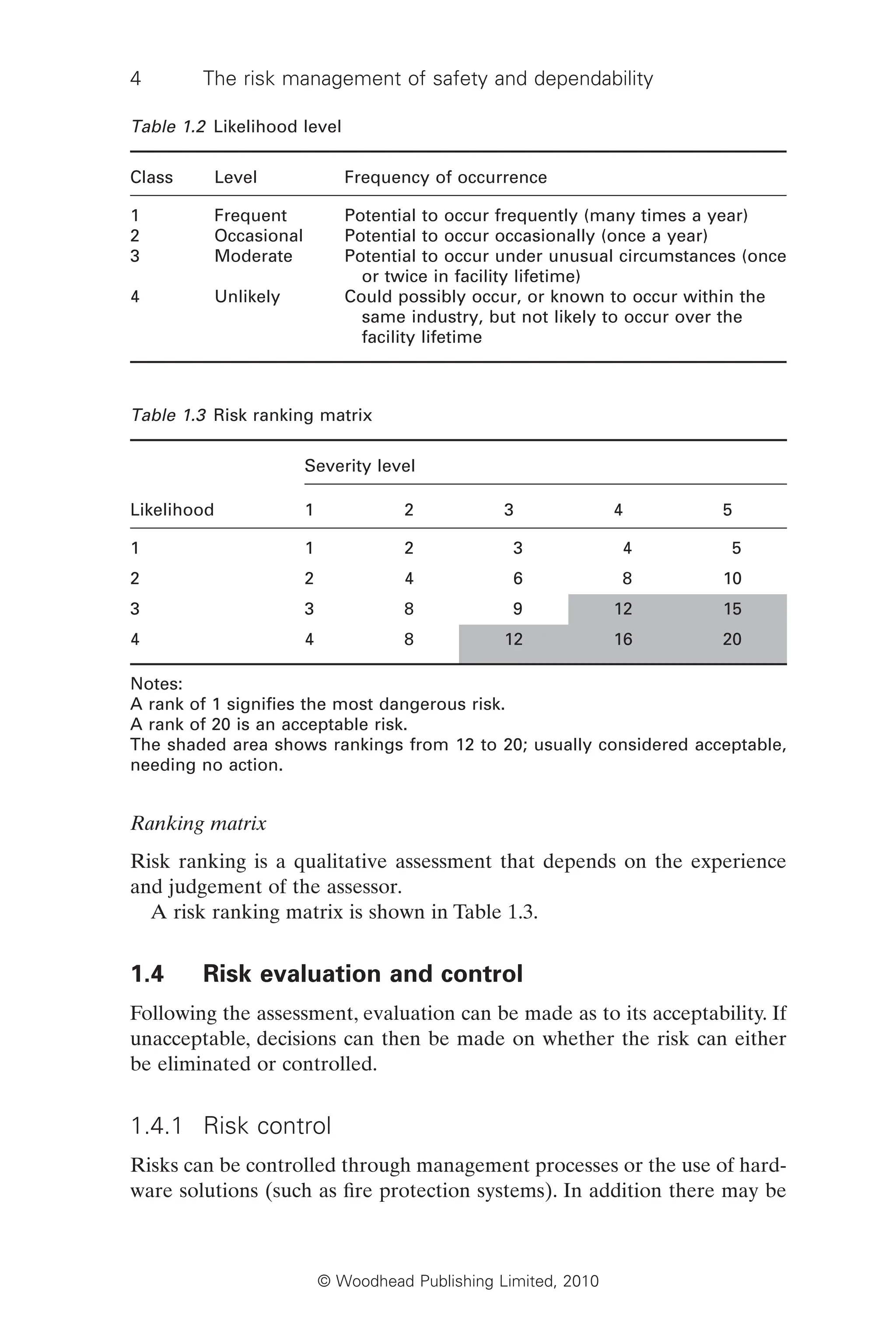
Table 1.2 shows a typical likelihood table. This shows four levels but
sometimes using five may be more appropriate depending on the
circumstances.
Table 1.1 Severity level
Class Level Definition (any one or more)
1 Serious In-plant fatality; public fatalities; extensive property
damage; serious and long-term environmental
damage; 2 or more days extended downtime
2 High Lost time injury; public injuries or impact; significant
property damage; environmental impact exceeding
regulation standards; downtime of 1–2 days
3 Medium Minor injury; moderate property damage; minimum
short-term environmental damage; 4–24 hours
downtime; disruption of product quality
4 Low No worker injuries; minor property damage; no
environmental impact; downtime less than 4 hours
5 Minor No worker injuries, property damage or environmental
impact; recoverable operational problem
4 The risk management of safety and dependability
© Woodhead Publishing Limited, 2010
Ranking matrix
Risk ranking is a qualitative assessment that depends on the experience
and judgement of the assessor.
A risk ranking matrix is shown in Table 1.3.
1.4 Risk evaluation and control
Following the assessment, evaluation can be made as to its acceptability. If
unacceptable, decisions can then be made on whether the risk can either
be eliminated or controlled.
1.4.1 Risk control
Risks can be controlled through management processes or the use of hard-
ware solutions (such as fire protection systems). In addition there may be
Table 1.2 Likelihood level
Class Level Frequency of occurrence
1 Frequent Potential to occur frequently (many times a year)
2 Occasional Potential to occur occasionally (once a year)
3 Moderate Potential to occur under unusual circumstances (once
or twice in facility lifetime)
4 Unlikely Could possibly occur, or known to occur within the
same industry, but not likely to occur over the
facility lifetime
Table 1.3 Risk ranking matrix
Likelihood
Severity level
1 2 3 4 5
1 1 2 3 4 5
2 2 4 6 8 10
3 3 8 9 12 15
4 4 8 12 16 20
Notes:
A rank of 1 signifies the most dangerous risk.
A rank of 20 is an acceptable risk.
The shaded area shows rankings from 12 to 20; usually considered acceptable,
needing no action.
An introduction to the principles of risk management 5
© Woodhead Publishing Limited, 2010
applicable codes, standards or established industrial practices available.
There are also Health and Safety Executive (HSE) guidelines that target
specific industries and safety critical operations.The European Union (EU)
has produced a raft of regulations enacted by the UK parliament that
address the need to ensure safety in the design of products and the design,
construction and operation of plant, equipment and machinery. There is a
legal duty for corporate management to comply with these regulations, with
the HSE and the Environment Agency available to provide guidance when
required. It is also important to ensure that any measures taken to reduce
any risk are dependable.
1.5 Dependability
Dependability is defined as the ability to meet success criteria, under given
conditions of use and maintenance. It is affected by the attributes of reli-
ability, maintainability and availability. For example the risk to life and limb
as a result of an accident or emergency can be reduced by the speed it
takes for the victims to be rushed to a hospital. People depend on the
emergency ambulance service to fulfil this function. If an ambulance breaks
down, the availability of the service is reduced by the period it takes for
the maintenance work needed to return the ambulance into service.
However, if a backup is there to take the place of the failed ambulance,
then the availability of an ambulance is unaffected and the service is
dependable. The backup or spare ambulance is kept idle until an ambu-
lance breaks down and so it is said to be redundant. This is costly but is
needed to ensure a reliable service; a point often overlooked by manage-
ment when they want to cut costs.
1.6 The risk management process
Risk management is a continuous process where measures to control risk
are regularly audited to ensure that they are in place, and functioning as
prescribed. Circumstances may change and result in the emergence of new
hazards, or existing risks may be affected. If so, they must be subjected to
a risk assessment and evaluated for further action as necessary. If things
remain unchanged, strong leadership is required to avoid any onset of
complacency. Effective risk management depends on constant vigilance.
This is illustrated by Fig. 1.1.
1.7 Examples of risk management failures
The following examples serve to highlight some different aspects of risk
management failure, which illustrate the foregoing issues.
6 The risk management of safety and dependability
© Woodhead Publishing Limited, 2010
1.7.1 The New Orleans disaster
On 25 August 2005 a hurricane developed over the Atlantic and a warning
was given to New Orleans of its coming. With increasing force it made
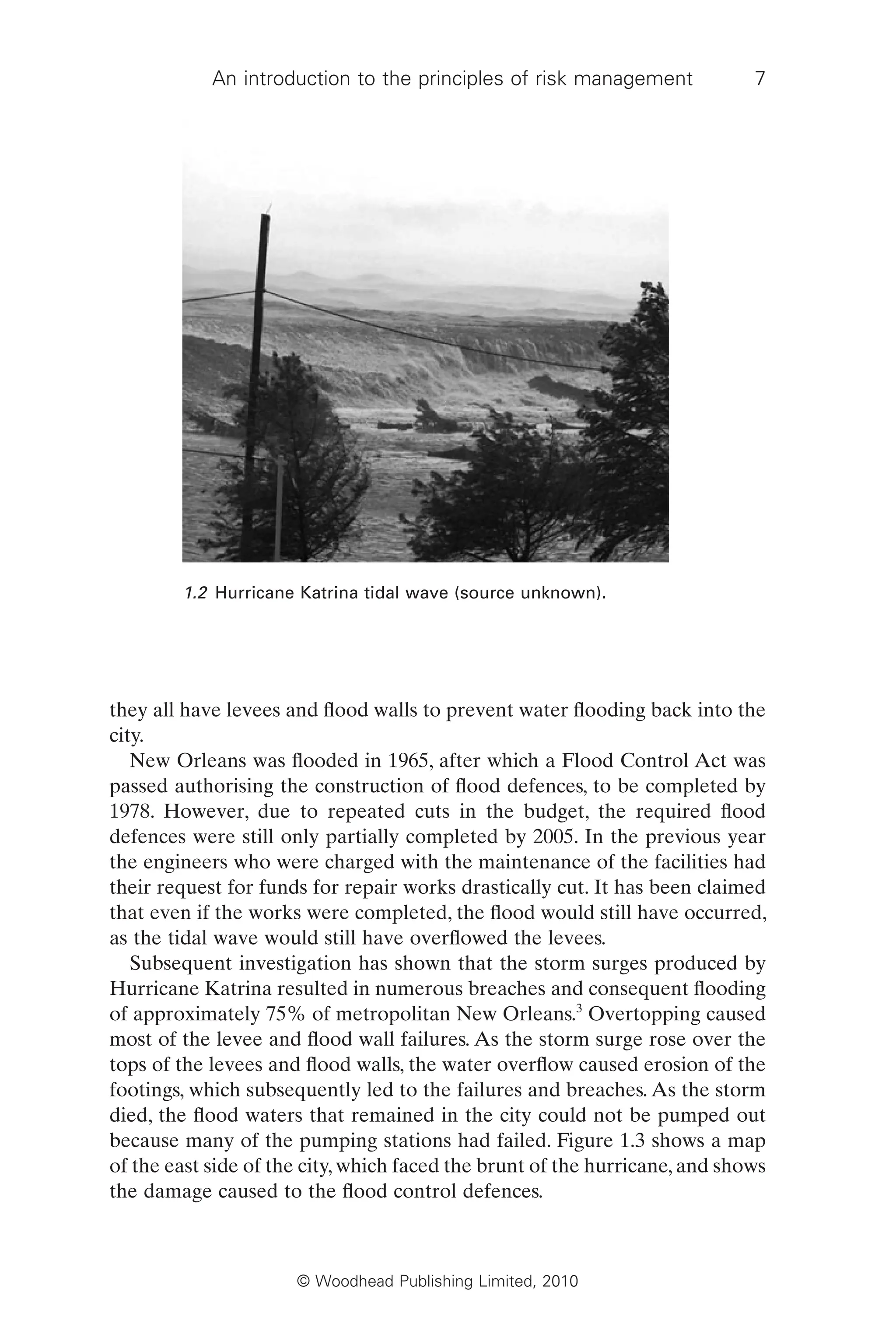
landfall by 29August. It hit New Orleans with a storm surge (see Fig. 1.2)
and by 31 August a major disaster had occurred. Most of the city was under
flood water and hundreds were feared to have died. The final official death
toll for New Orleans and Southern Louisiana was 1293, with 300 missing
and unaccounted for so the true figure may never be known. The financial
loss was expected to be between US$100 and 200 billion. New Orleans has
been described as a walled city surrounded by water; most of it is below
sea level and a complex drainage system with 20 pumping stations is needed
to keep it dry. The city is sandwiched by the Mississippi River on one side
and by Lake Pontchartrain on the other side. Channels passing through the
city to enable navigation and discharge of drainage waters connect the river
and the lake. The river and the drainage channels are above sea level, so
Review codes and
standards / industrial
practices
Amend as required
Monitor and audit
Dependability and
safety integrity level
requirements
Risk management
process
Identify hazards
Risk assessment
Risk evaluation
Consider options
Implement selected
option
Operations
Report
1.1 Risk management process.
An introduction to the principles of risk management 7
© Woodhead Publishing Limited, 2010
they all have levees and flood walls to prevent water flooding back into the
city.
New Orleans was flooded in 1965, after which a Flood Control Act was
passed authorising the construction of flood defences, to be completed by
1978. However, due to repeated cuts in the budget, the required flood
defences were still only partially completed by 2005. In the previous year
the engineers who were charged with the maintenance of the facilities had
their request for funds for repair works drastically cut. It has been claimed
that even if the works were completed, the flood would still have occurred,
as the tidal wave would still have overflowed the levees.
Subsequent investigation has shown that the storm surges produced by
Hurricane Katrina resulted in numerous breaches and consequent flooding
of approximately 75% of metropolitan New Orleans.3
Overtopping caused
most of the levee and flood wall failures. As the storm surge rose over the
tops of the levees and flood walls, the water overflow caused erosion of the
footings, which subsequently led to the failures and breaches. As the storm
died, the flood waters that remained in the city could not be pumped out
because many of the pumping stations had failed. Figure 1.3 shows a map
of the east side of the city, which faced the brunt of the hurricane, and shows
the damage caused to the flood control defences.
1.2 Hurricane Katrina tidal wave (source unknown).
8 The risk management of safety and dependability
© Woodhead Publishing Limited, 2010
The root cause of the disaster
The disaster was due to the failure to manage the risk of disaster to the
city. The hazard of possible flooding was known, as the city is below sea
level. The probability that flooding would reoccur can be assessed based
on:
• The city had been flooded in 1915, 1940, 1947, 1965 and 1969.
• The risk to communities along the Gulf Coast from a hurricane is recog-
nised and a national agency is charged with tracking all hurricanes that
develop over the Atlantic. They are required to give an early warning
to a community to evacuate should there be a threat of an approaching
hurricane.
• The Gulf of Mexico suffers from hurricanes every 10 years and records
show that about every 40 years they make landfall at New Orleans, and
are strong enough to cause flooding.
Levee Breaches
Pumping Stations
Flood Status
Storm Induced
Deliberate
Closed
Greater Than 90% Capacity
40% to 90% Capacity
Less Then 40% Capacity
Under Assessment
Dry
Not Dry
Lake Pontchartrain
Lake Borgne
N
e
w
O
r
l
e
a
n
s
E
a
s
t
New Orleans East
St. Bernard Parish
Belle Chasse #2
Belle Chasse #1
Scarsdale
Braithwaite
Belair
Bellevue
W - 3b
W - 4b
W - 3a
W - 4a
1.3 Map showing where Hurricane Katrina hit New Orleans and the
damage to the flood defences (source: Report No UCB/CITRIS – 05/01
17 November 2005; ref 1.3).
An introduction to the principles of risk management 9
© Woodhead Publishing Limited, 2010
• The sea level is increasing due to global warming, and hurricanes are
likely to be more prevalent and destructive.
• The city is subsiding.
An assessment was made after the last flood and flood defences were autho-
rised. However, regular reassessments are required for changing circum-
stances in order to be able to update the evaluation of the consequences
should flooding occur, especially as the city has grown over the years since
1965. Changing circumstances will also change the nature of the defences
needed. In addition, structures age and deteriorate over time and need
regular inspection and maintenance. The disaster occurred because the
flood defences were not dependable; they were breached at 50 locations
and failed due to inadequate maintenance and enhancement to meet chang-
ing circumstances. Many failed due to the use of erodible materials of
construction. This, together with the large sections of uncompleted levees,
resulted in the disaster.4
Conclusion
Over the years the authorities consistently cut the budget for the building
of flood defences.They even cut the budget on maintenance.The engineers
asked for US$62 million for maintenance works in 2005 but this was cut to
US$10 million. Furthermore the design standard of the levee system as
established originally was that suitable for land protection.As the city grew,
a risk assessment of the adequacy of the design standard was never under-
taken. The final report recommended that the whole organisation for the
risk management of the New Orleans flood defences should be changed. A
new management structure with new design standards and regulations, and
adequate funding was needed to avoid a further disaster.This demonstrates
that in any organisation the management of risk is a critical function to
ensure that the appropriate measures are taken to avoid them. When
nothing adverse happens year after year management become complacent
and decide to spend their money on what they consider to be more pressing
matters. Complacency has been the cause of many disasters.
1.7.2 The space shuttle disaster
Following the success of the United States (US) lunar missions, the technol-
ogy was then used to build and place objects in orbit around the earth for
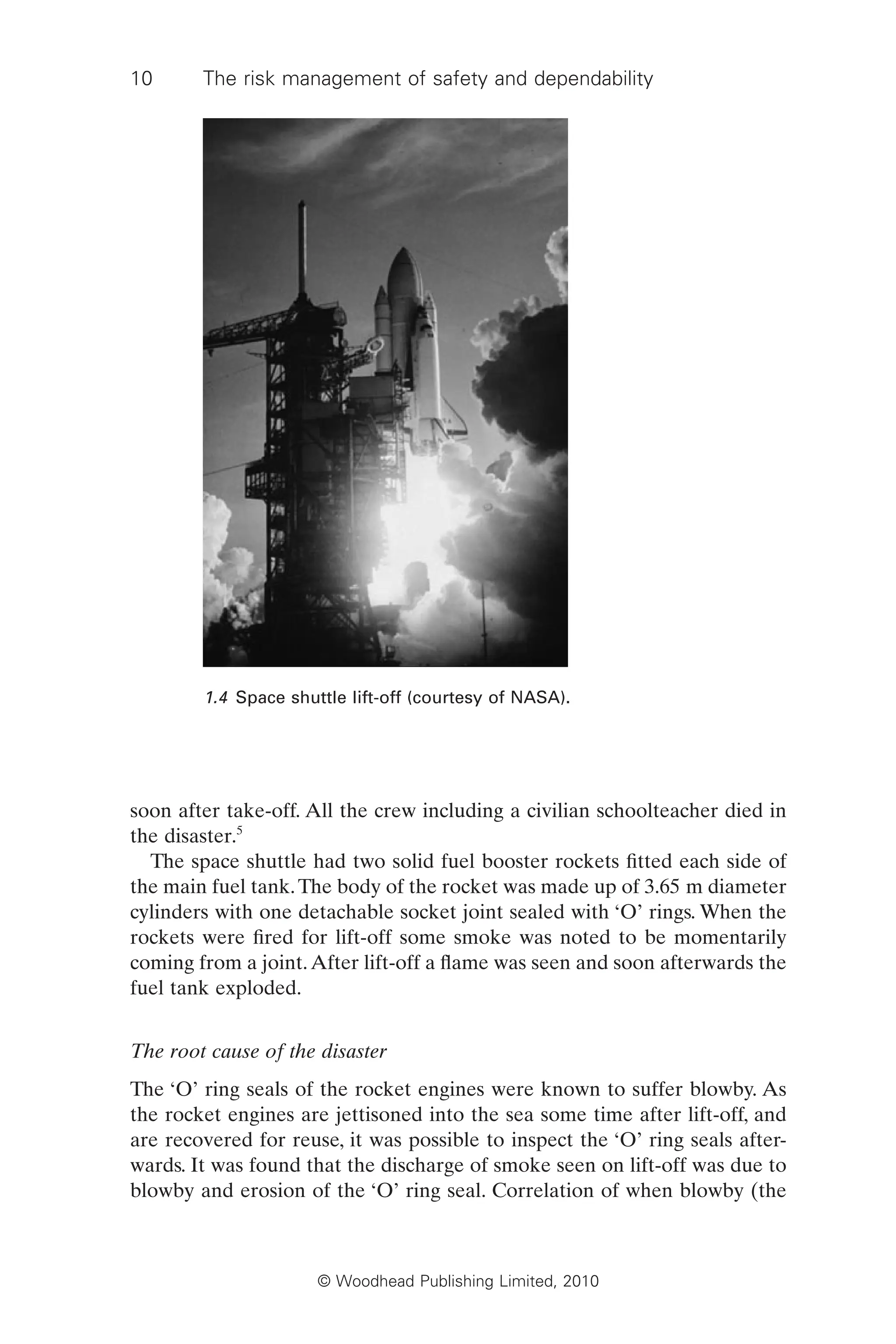
commercial and scientific use. Figure 1.4 shows a space shuttle lift-off. In
spite of the success of the lunar programme, and after 14 successful mis-
sions, on Tuesday 28 January 1986 the Challenger II space shuttle exploded
10 The risk management of safety and dependability
© Woodhead Publishing Limited, 2010
soon after take-off. All the crew including a civilian schoolteacher died in
the disaster.5
The space shuttle had two solid fuel booster rockets fitted each side of
the main fuel tank.The body of the rocket was made up of 3.65 m diameter
cylinders with one detachable socket joint sealed with ‘O’ rings. When the
rockets were fired for lift-off some smoke was noted to be momentarily
coming from a joint.After lift-off a flame was seen and soon afterwards the
fuel tank exploded.
The root cause of the disaster
The ‘O’ ring seals of the rocket engines were known to suffer blowby. As
the rocket engines are jettisoned into the sea some time after lift-off, and
are recovered for reuse, it was possible to inspect the ‘O’ ring seals after-
wards. It was found that the discharge of smoke seen on lift-off was due to
blowby and erosion of the ‘O’ ring seal. Correlation of when blowby (the
1.4 Space shuttle lift-off (courtesy of NASA).
An introduction to the principles of risk management 11
© Woodhead Publishing Limited, 2010
discharge of smoke) was found and the ambient conditions on lift-off
showed that they occurred every time at temperatures below 18°C. Those
above 18°C were mostly trouble free. The lowest temperature recorded at
the time was a lift-off at a temperature of 12°C. Based on this the rocket
engineers informed the National Aeronautics and Space Administration
(NASA) management that lift-off should not take place at ambient tem-
peratures below 12°C. Management rejected this restriction.Their decision
was based on the fact that nothing had ever gone wrong. Blowby had hap-
pened many times without ill effect so why should they worry?
The political demands on its schedule, together with financial concerns,
led to the risk of failure being ignored. Challenger II lifted off when
the ambient temperature was below freezing and disaster was the result.
It transpired that the NASA management somehow thought that the
shuttle was so reliable that there was only one in a hundred thousand
chance of a mishap. The engineers involved, however, put it at one in a
few hundred. There was a lack of rapport between the engineers and the
management.
Conclusion
The management lived in a world dominated by politics and the need to
obtain public support for the funding of their operations. They lost contact
with engineering and the need for safety and reliability. It is quite common
for people to think things are safe before disaster happens; whereas in
reality nothing is safe until it is proven to be safe. The engineers knew that
the discharge of smoke indicated incipient failure of the ‘O’ ring and that
this was affected by temperature. As blowby was increasingly experienced
down towards 12°C, they feared a catastrophic seal failure would occur at
some lower temperature. Maybe they were loath to voice the worst; if the
managers were more responsive, perhaps they would have done. Funds
could have been authorised to test the effects of lower temperatures on seal
performance. Investigation into the cause of the disaster concluded that the
management structure of NASA had to be overhauled so that adequate
systems were in place to ensure the safety and dependability of their
operations.
Comment
Engineers are rightly concerned about the consequences of failure and like
to measure the probability of its occurrence. It is too common for manage-
ment to think everything is safe because nothing has gone wrong. Unfor-
tunately it is the low cost, easy option that they so often prefer.
12 The risk management of safety and dependability
© Woodhead Publishing Limited, 2010
1.7.3 The Railtrack disasters (UK)
Perhaps the worst extreme of ignoring the input of engineering was the case
of Railtrack in the UK.The board of management decided that all engineer-
ing and maintenance work should be outsourced to contractors.This meant
that the company was left without any engineering strategic direction in a
high-risk engineering business. It was high risk as trains were running faster
and more frequently on an ageing infrastructure. This led to the crop of
railway disasters mentioned earlier. These were caused as discussed in the
following sections.
Train collisions
Train collisions resulted in many deaths and injuries and occurred in 1996,
1997 and two in 1999.The last in 1999 was at Ladbroke Grove. It was caused
by a signal passed at danger (SPAD) that resulted in 31 deaths and many
hundreds injured. Railtrack had a persistent problem with SPADs but
nothing was ever done to improve matters due to inadequate procedures.
The SPAD at signal SN109, at Ladbroke Grove, had been known to be a
problem for many years with a record of SPADs having occurred eight
times since August 1993. They were known to be poorly sighted (not easy
to see) and even misleading. It was estimated that the driver had sight of
the signal for only eight seconds at the time of the SPAD.
If a signal sighting committee had viewed SN109 they would have found
it was not compliant with Railway Group Standards in a number of respects,
and that the sighting was of borderline quality and the signage unusual and
inconsistent.There was also a persistent failure to carry out risk assessment
by whatever method was available. The signallers at the Integrated Elec-
tronic Control Centre noted that it had been passed and by the time they
reacted it was too late. The management did not correct their attitude
concerning SPADs.6
Train derailments
On 17 October 2000 a high-speed train was derailed at Hatfield, Hertford-
shire, with four deaths and 35 injured. A broken rail was found to be the
‘substantial’ cause of the accident. On 10 May 2002 at least seven people
died and over 70 were injured after the train service from London to King’s
Lynn crashed at Potters Bar in Hertfordshire. Three of the four carriages
derailed and one ploughed along the platform and smashed into a bridge.
Defective points as a result of poor maintenance caused the derailment.An
effective management system for safety critical equipment such as points
was not evident in Railtrack.7
As a result of the public outcry and loss of
An introduction to the principles of risk management 13
© Woodhead Publishing Limited, 2010
confidence in their operations, the running of the railway infrastructure was
taken away from Railtrack and passed to Network Rail in 2004.
The root cause of the disasters
The root cause of the disasters was due to the policy adopted by Railtrack
to outsource their engineering and maintenance activities without adequate
management and supervision of their subcontractors. Soon after taking
over, Network Rail announced that they would rebuild an engineering and
maintenance organisation to manage their own operations, except for major
projects.
Comment
While it is possible to outsource services, it is not possible to outsource
responsibility.Another example is the results found by the National Health
Service (NHS) in outsourcing cleaning services when they thought that they
did not need to supervise them.
1.7.4 The Buncefield explosion and fire
On 11 December 2005 an explosion and fire occurred at the Buncefield fuel
storage depot. Twenty-one storage tanks were destroyed with some ten
million tonnes of petrol and aviation kerosene. The explosion caused wide-
spread damage up to 2 km from the site. Several homes were severely
damaged and hundreds received minor, non-structural damage. Twenty
businesses employing 500 people were destroyed and the premises of 60
businesses employing 3500 people were badly damaged. Forty-three people
were injured, typically from flying debris. There were no fatalities. Large
quantities of black smoke were emitted from the resultant fire, which dis-
persed at a high level over southern England and beyond. It took five days
before the fire could be extinguished.8
Figure 1.5 shows an aerial view of
the fire.
The root cause of the disaster
Buncefield is a tank farm and a staging post for storing fuel to supply
Heathrow and Gatwick airports by pipelines and a road tanker loading
facility to serve other users. Three separate pipes from refineries located at
Thames Coryton, Lindsey Humberside and Merseyside supply the tank
farm. On the day, Tank 912 was being filled with unleaded petrol by pipe-
line from Thames Coryton. This was being done while serving another
depot en route.The tank had a level transmitter with a high-level shutdown.
14 The risk management of safety and dependability
© Woodhead Publishing Limited, 2010
It was also fitted with an independent high/high alarm and shutdown as a
backup. The sequence of events was recorded as follows:
10 December 2005, 1900 start Tank 912 filling operations.
11 December 2005:
• 0300 filling continues but transmitted level reading becomes static.
• 0520 based on the fill rate the tank was estimated to be full. The auto-
matic shutdown system fails and the filling operation continues with no
one in the area to notice and take action.
• 0538 petrol floods bund area with a metre-deep vapour cloud above its
surface.
• 0546 the low vapour cloud becomes two metres high spreading across
the site in all directions.
• 0550 the other tank at a depot located elsewhere, becomes full, shuts
down and the fill rate into the tank at Buncefield almost doubles.
• 0601 the vapour cloud explodes with resulting fires and other
explosions.
Conclusion
The possibility of a vapour cloud being formed that could result in an explo-
sion of such intensity as experienced at Buncefield was unknown at the
1.5 Buncefield fire (courtesy of Chilton Air Support Unit and
Hertfordshire County Council).
An introduction to the principles of risk management 15
© Woodhead Publishing Limited, 2010
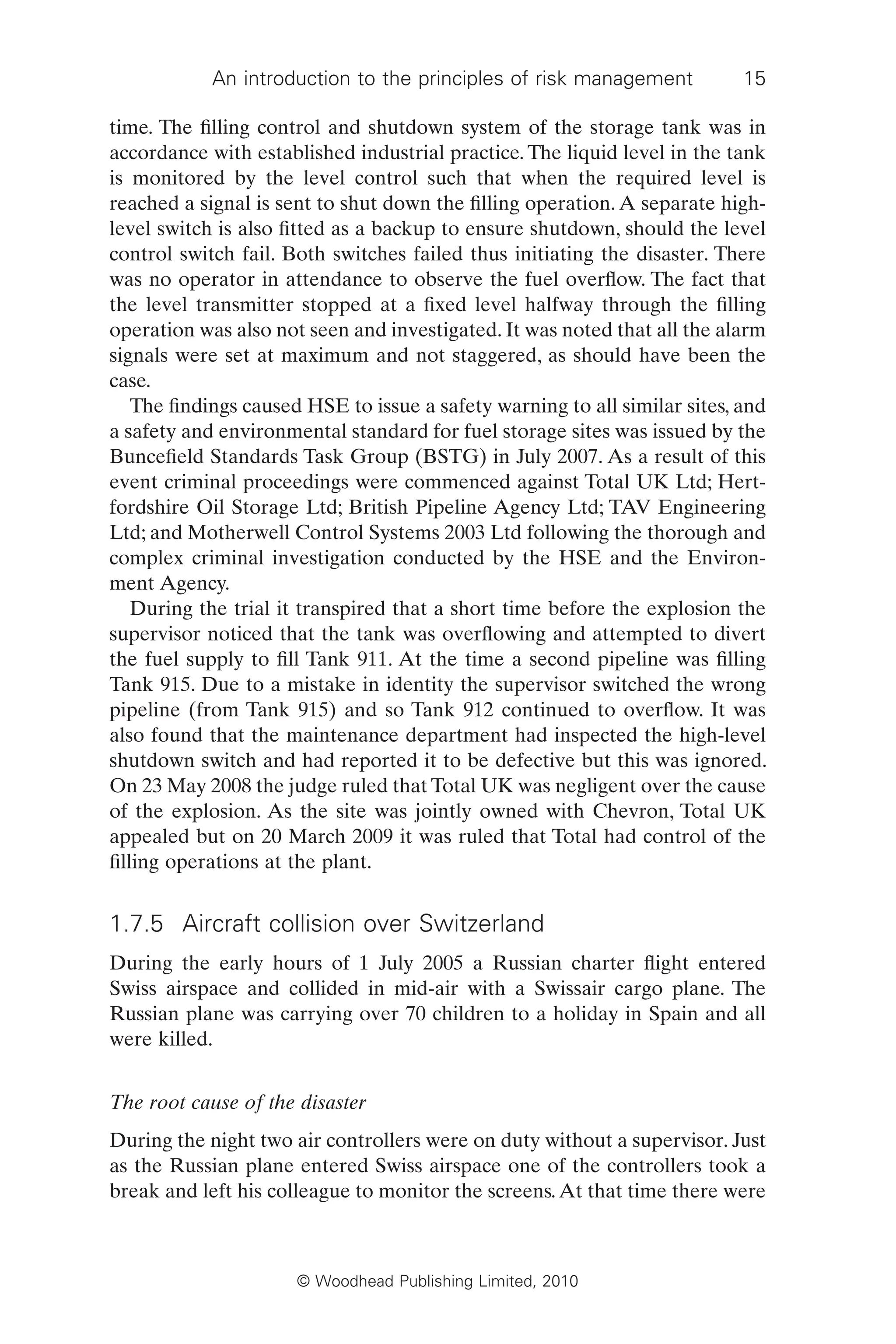
time. The filling control and shutdown system of the storage tank was in
accordance with established industrial practice. The liquid level in the tank
is monitored by the level control such that when the required level is
reached a signal is sent to shut down the filling operation. A separate high-
level switch is also fitted as a backup to ensure shutdown, should the level
control switch fail. Both switches failed thus initiating the disaster. There
was no operator in attendance to observe the fuel overflow. The fact that
the level transmitter stopped at a fixed level halfway through the filling
operation was also not seen and investigated. It was noted that all the alarm
signals were set at maximum and not staggered, as should have been the
case.
The findings caused HSE to issue a safety warning to all similar sites, and
a safety and environmental standard for fuel storage sites was issued by the
Buncefield Standards Task Group (BSTG) in July 2007. As a result of this
event criminal proceedings were commenced against Total UK Ltd; Hert-
fordshire Oil Storage Ltd; British Pipeline Agency Ltd; TAV Engineering
Ltd; and Motherwell Control Systems 2003 Ltd following the thorough and
complex criminal investigation conducted by the HSE and the Environ-
ment Agency.
During the trial it transpired that a short time before the explosion the
supervisor noticed that the tank was overflowing and attempted to divert
the fuel supply to fill Tank 911. At the time a second pipeline was filling
Tank 915. Due to a mistake in identity the supervisor switched the wrong
pipeline (from Tank 915) and so Tank 912 continued to overflow. It was
also found that the maintenance department had inspected the high-level
shutdown switch and had reported it to be defective but this was ignored.
On 23 May 2008 the judge ruled that Total UK was negligent over the cause
of the explosion. As the site was jointly owned with Chevron, Total UK
appealed but on 20 March 2009 it was ruled that Total had control of the
filling operations at the plant.
1.7.5 Aircraft collision over Switzerland
During the early hours of 1 July 2005 a Russian charter flight entered
Swiss airspace and collided in mid-air with a Swissair cargo plane. The
Russian plane was carrying over 70 children to a holiday in Spain and all
were killed.
The root cause of the disaster
During the night two air controllers were on duty without a supervisor. Just
as the Russian plane entered Swiss airspace one of the controllers took a
break and left his colleague to monitor the screens.At that time there were
16 The risk management of safety and dependability
© Woodhead Publishing Limited, 2010
five planes to be monitored with one about to land. The air controller’s
attention was on the plane landing and he did not notice the Russian flight
path was on a collision course and his warning to the pilot was given only
44 seconds before the collision. A repeat warning was given 30 seconds
before impact but unfortunately both planes, due to some error, descended,
instead of one climbing and one descending. In any event the warning was
too short as the minimum time needed is 90 seconds. As a backup to the
air controllers there was also a ground-based collision warning system. The
system was switched off for routine maintenance.
The court of enquiry exonerated the air traffic controllers. The one on
duty at the time was grossly overloaded and could not cope with the situ-
ation. The four managers in charge of the air traffic control centre were
convicted of manslaughter caused by a culture of negligence. Unfortu-
nately, one irate father who had lost two children took his revenge by
murdering the air traffic controller that was on duty at the time.9
Conclusion
The air traffic control centre should have been manned with three people.
The supervisor is needed to help in an emergency or to stand in if one of
the controllers needs a break. The ground-based collision warning system
is a further backup system in case of an oversight by the controllers. On
most nights there was little activity and the management took advantage
of this and thought that only one controller was needed. The Russian
plane, being a chartered flight, was not a routine occurrence therefore not
expected. With both backups out of action the disaster was more likely
to occur. To ensure dependable operations backups are commonly pro-
vided. Unfortunately, management do not always make other provisions
if a backup is shut down. With the ground-based collision warning system
switched off the management should have provided a third traffic control-
ler, with a monitor, to take its place. However, the presence of a supervi-
sor or the collision warning system could have been enough to avoid the
disaster. In the first instance, the operator is often blamed and in this case
the poor exonerated traffic controller was murdered. In any accident
investigation the operator is only the starting point into the circumstances
as to how the mistake occurred, as shown in the result of the Ladbroke
rail crash enquiry.
1.8 General precepts
The general precepts to be learnt concerning the management of risk are
listed here:
An introduction to the principles of risk management 17
© Woodhead Publishing Limited, 2010
• Nothing can be 100% reliable and safe.
• Reliability cannot be predicted without statistical data; when no data is
available the odds are unknown.
• Statistics based on testing or people’s experience can only give guidance
on the probability of failure.
• The odds against failure can only be improved by adding redundancy
and diversity. The use of two different methods to hold up trousers –
belt and braces for example, provides a most reliable solution.
• Making things safe and reliable costs money. It will always be necessary
to cost the price of failure for comparison.
• A safe and healthy working environment can only be achieved if the
factors that affect safety and health are understood.
• When everything runs like clockwork, operators and management may
be lulled into a false sense of security and may do something dangerous.
Risks must be managed, which requires constant vigilance.
• Human beings, one day, will make a mistake.
• Operators may bypass a safety system for some reason and think that
the hazard will not occur. One day it will and disaster will strike. Even
if an alternative safeguard is used, this could result in an increased risk.
Any such manoeuvre requires a full risk assessment with an appropriate
level of approval.
• A modification or a change in use of a system, or existing design, can
lead to a higher risk of failure and a complete reassessment must be
carried out. For example the use of high-speed trains on existing tracks,
and signalling systems designed for slower trains, will result in increased
risk of collision due to signals being passed, and derailment due to
excessive speed.
• On deciding to undertake any operation or measure that has an impact
on health and safety it is important to check on any relevant codes and
standards or established industrial practices that can be used instead of
trying to reinvent the wheel.
1.8.1 Post script
Caribbean Petroleum Refinery Tank Explosion and Fire, 23 October 2009
As a result of the overfilling of a storage tank, a large vapour cloud was
produced which was ignited and caused a large explosion and fire.The blast
damaged homes and businesses over a mile away.The tank was being filled
from a tanker in the harbour with the tank filling monitoring and control
systems being inoperative.
It appears to be a disaster similar to Buncefield.
This underlines the need for management to be alert to disasters any-
where in the world and to learn from them.10
18 The risk management of safety and dependability
© Woodhead Publishing Limited, 2010
1.9 Summary
The need for management and engineers to focus on the risks to safety in
their work has been explored, and some fundamental ideas on why acci-
dents happen have been given.The general precepts should serve to provide
a basic understanding of the issues of safety and the need for dependability,
which the following chapters will develop.
First, however, people need to know the laws and regulations that have
been enacted as a result of public concern for safety. These lay down regu-
lations to improve safety on all aspects of engineering and management
activities.
1.10 References
1 hse publication, Five Steps to Risk Assessment, indg 163
2 iec 60300-3-9, Application Guide, Risk Analysis of Technological systems
3 seed r. b. and others, Report No UCB/CITRIS – 05/01 17 November 2005,
Preliminary Report on the Performance of the New Orleans Levee Systems in the
Hurricane Katrina on August 29, 2005
4 seed r.b.and others,Report No UCB/CITRIS – 05/01 31 July 2006,Final Report
on the Performance of the New Orleans Levee Systems in the Hurricane Katrina
on August 29, 2005
5 feynman r. p. (1988) What do you Care What Other People Think? Harper/
Collins, ISBN 0 586 21855 6
6 lord cullen (2001) The Ladbroke Grove Rail Inquiry, HSE books, ISBN,
0 7176 2056 5
7 hse report, Potters Bar Investigation
8 The Buncefield Investigation Final Report, December 2008
9 bbc newscasts, Swiss air collision, and other reports on the web
10 US Chemical Safety and Hazard Investigating Board, www.csb.gov
© Woodhead Publishing Limited, 2010
19
2
Ignorance is no defence: legislation and
the corporate role in managing risk
Abstract: In the event of a death or injury, non-compliance with the
Health and Safety at Work Act and the Health and Safety Regulations
can result in charges of homicide or manslaughter. As this extends up to
corporate level everyone needs to be aware of all the regulations and
the basic requirement for a risk assessment. Two examples of past
corporate failures are given. The regulations focus on the fact that safety
needs to be considered and integrated from the inception of any product
or project. This means that it must start at corporate level. An outline of
the requirements to comply with the act and some of the regulations and
statutory duties imposed are summarised.
Key words: management failures, manslaughter, Herald of Free
Enterprise, Texas City, the law, enforcement, authorities, penalties,
health and safety, regulations, MHSWR, PUWER, RIDDOR, COSHH,
CHIP, EHSR, COMAH, CDM, DSEAR, ATEX, PED, PSSR, LOLER,
other regulations, standards, international regulations.
2.1 Introduction: management failures
The managing director (MD) of a manufacturing company was sentenced
to 12 months in prison for manslaughter due to the death of an employee
caught in unguarded machinery. The MD not being aware of the situation
was no defence. In 1972, Lord Robens in the UK issued a report on health
and safety at work.1
At the time he concluded:‘Apathy is the greatest single
obstacle to progressive improvement: it can only be countered by an accu-
mulation of deliberate pressures to stimulate more sustained attention to
health and safety at work.’ In spite of the UK Health and Safety at Work
Act 1974, and the ever-increasing EU laws and regulations, disasters con-
tinued to occur.The Corporate Manslaughter and Corporate Homicide Act
2007 is intended to end any apathy to the risks to people’s health and safety
on the part of business owners and corporate management. In the past
corporate management have mostly been concerned with the profitability
of their business, focusing on improving the efficiency of their operations
and providing value to their shareholders. More recently they have been
concerned with financial risks and the need to manage them. Now it will
20 The risk management of safety and dependability
© Woodhead Publishing Limited, 2010
also be necessary for them to manage and invest in the control of risk to
health and safety that could exist in their business. Historically the health
and safety of operations have been left to the line managers. However, line
managers cannot deal effectively with managing risks to health and safety
without resources being authorised and led by corporate management. As
a result of our increasingly changing world, corporate management needs
to be alert to any risk to their business.They need to adopt a proactive role
in order to provide the leadership necessary to produce a safety culture
within the workforce.
The Herald of Free Enterprise car ferry disaster (1982) is a typical example
of management failure. The ship’s captains were required to operate to
such a strict timetable that they were forced to leave the quayside as soon
as they had finished loading with the bow doors still open.They had to rely
on a man to close the doors in time before reaching the open sea. The
captains were unhappy with this and asked for some indication to be dis-
played at the bridge to verify that the doors had been closed. The manage-
ment rejected this as being an unnecessary expense. One day the man
responsible forgot to close the doors.Water entered through the bow doors
and the ship capsized with the loss of 188 lives. The cost of complying with
the captains’ request would have been insignificant compared to the con-
sequential loss.2
Figure 2.1 shows the capsized ship being salvaged. The
company was reorganised with a new board of directors and the disaster
was thought to be a salutary lesson to be learnt.
However, more recently, on 23 March 2005, 15 people were killed and
over 170 harmed as the result of a fire and explosion on the Isomerisation
2.1 Herald of Free Enterprise (courtesy of Smit International).
Legislation and the corporate role in managing risk 21
© Woodhead Publishing Limited, 2010
plant (ISOM) at the BP Products North America owned and operated
refinery in Texas City, Texas, USA. The incident was caused by heavier-
than-air hydrocarbon vapours combusting after coming into contact with
an ignition source. The hydrocarbons originated from liquid overflow
caused by overfilling and overheating as a result of operator mistakes
during the start-up of the process unit. It was noted that, contrary to
procedures, the operators were not drilled in the start-up process prior
to the start-up operation and that supervisors left to attend to other busi-
ness during this time. Failure to take corrective action resulted in the
discharge of fluids at a blowdown area. This was designated as a hazard-
ous area, but a construction crew was using the site in contravention of
safety regulations and provided the ignition source from their activities
at the time.
Being old the refinery was designed to standards prevalent at that time
but was in need of updating to meet modern environmental and safety
standards. If they had been implemented no doubt they would have had a
mitigating influence. Even so, the root cause of the disaster was the lack of
management supervision to enforce the required safety training, operating
procedures and ensure adequate supervision of start-up operations.3
The US Chemical Safety and Hazard Investigation board concluded that
the disaster was caused by organisational and safety deficiencies at all levels
of BP Corporation. BP was fined US$21m (£11m) for 301 ‘egregious, wilful
violations’ of safety rules by the Occupational Safety and Health Adminis-
tration – the biggest penalty in the body’s 35-year history. A further fine of
US$50 million was imposed for environmental violations and 155 lawsuits
from injured persons were settled at a cost of some US$2 million. As a
result the chief executive, Lord Browne, had to take early retirement, and
management in the US had to be reorganised.
As shown, corporations continue to make the same mistakes and it is
hoped that the threat of being charged with corporate manslaughter will
help them to face up to their responsibilities.The above examples also serve
to underline the loss of business assets that could have been avoided. This
means that they will need engineering input as well as financial guidance
in all their decisions. Furthermore it will be necessary for them to identify
all the health and safety regulations that are applicable to their business
and to exercise reasonable care in ensuring the health and safety of their
workers and the public who may be affected by them.
2.2 An overview of the law in the UK
In general employers are required to identify hazards, carry out a risk
assessment, and have a duty of care for the health and safety of their
workers and anyone else who could be affected. To be effective risks have
22 The risk management of safety and dependability
© Woodhead Publishing Limited, 2010
to be managed and where possible eliminated. This applies to all industrial
operations from the design and sale of products to the design, construction,
operation and maintenance of machinery plant and buildings. Under the
law there is a raft of regulations that cover the various hazards that may be
applicable for most industries and situations. These regulations specify the
actions and measures needed to safeguard health and safety. Most are self-
regulating.A technical file as evidence of compliance has to be made avail-
able for examination when required. For other certain situations a notified
body is required to verify compliance with design codes and quality control
standards. In the case of special equipment, such as for use in flammable
atmospheres, certification is required from a certifying authority. For the
most hazardous situations permission to operate has to be obtained from
HSE as required by the Control of Major Accident Hazards (COMAH)
Regulations and the Nuclear Installations Act.
2.2.1 Regulatory authorities
Notified bodies are insurance companies such as Bureau Veritas, Det Norsk
Veritas (DNV), Lloyd’s Register and Royal and Sun Alliance, to name a
few. They are responsible for carrying out conformity assessment of the
design. Product verification (routine auditing), inspection and testing of
subsequent manufacture or alternatively production quality assurance
(QA) (auditing of the manufacturer’s ISO 9002 quality control system) is
carried out as applicable. The British Approvals Service (BASEEFA), also
known as Electrical Equipment Certification Service (EECS), certify elec-
trical and mechanical equipment and protective systems for use in flam-
mable atmospheres and other safety critical requirements. The Secretary
of State via the Department of Business Enterprise and Regulatory Reform
(formerly the Department of Trade and Industry) and the UK Accredita-
tion Service (UKAS) accredit notified bodies.
2.2.2 Enforcement of the law
HSE is responsible for promoting the objective of the act and putting
forward to government proposals for regulations under the act, and for
enforcing the law via HSE inspectors stationed at area offices located
throughout the UK. Deciding what is reasonable and practicable is subject
to the discretion of the HSE. Inspectors will, as necessary:
• Offer information, advice and support.
• Issue formal improvement notices.
• Issue prohibition notices where there is serious risk of injury.
• Make variations of licences or conditions or exemptions.
Legislation and the corporate role in managing risk 23
© Woodhead Publishing Limited, 2010
• Initiate criminal prosecutions of individuals, including company direc-
tors and managers.Where a death is involved, a charge of manslaughter,
or corporate manslaughter, will be considered.
Enforcement under the act may also be carried out by: local authorities,
agency authorities or chief officers of the police, depending on the work
activity concerned. A case then has to be prepared for prosecution and
judgement by the courts. If convicted, the costs of prosecution can be recov-
ered and penalties imposed.
It should be noted that many industries deal with materials that if released
inadvertently will have an impact on the environment. In many other cases
the waste products that are produced cause environmental pollution. Any
industrial disaster even if only a fire will cause pollution.All those can have
a long-term effect on people’s health and safety due to their impact on the
food chain.The EnvironmentAgency and the Scottish Environment Protec-
tion Agency work in collaboration with the HSE in enforcing the UK
environmental regulations.
2.2.3 Penalties
Lower courts can impose the following penalties:
• For failure to comply with formal HSE notices, or court remedy order:
a fine of up to £20000, or six months’ imprisonment, or both.
• For breaches of Sections 2 to 6 of the Health and Safety at Work Act:
a fine of up to £20000.
• For other breaches: a fine of up to £5000.
Higher courts can impose the following penalties:
• For failure to comply with formal HSE notices, or court remedy order:
an unlimited fine, or up to two years’ imprisonment, or both.
• For contravening licence requirements, or provisions relating to explo-
sives: an unlimited fine, or up to two years’ imprisonment, or both.
• For breaches of the Health and Safety at Work (HSW) Act, or of rel-
evant statutory provisions under the Act: an unlimited fine.
Section 47 of the HSW Act provided that breach of the act will not give
rise to a civil action, but breach of any regulation made under the act is
actionable unless the regulations say otherwise as, for example, the Man-
agement of Health and Safety at Work Regulations.
Recovery of damages
For workers and other parties to recover damages as a result of an accident
requires considerable cost. Much ingenuity must be expended in the inves-
24 The risk management of safety and dependability
© Woodhead Publishing Limited, 2010
tigation, developing the pleadings, and the outcome of the trial can be
uncertain. In general, successful actions have been based on the tort of
negligence and/or the tort of breach of statutory duty.
Other responsible authorities
Authorities such as the HSE Nuclear Directorate, the Office of Rail Regu-
lation, the International Maritime Organization (IMO) and the Civil Avia-
tion Authority regulate specific industry sectors. The Environment Agency
is involved with every type of industry.
2.3 The Health and Safety at Work etc. Act 1974
Below is a summary and paraphrase of the law and some of its regulations.
They should not be taken to be a substitute for a study of the act and its
regulations. Part I of the act will be of major concern, especially Sections 1
to 9 as given below.
Section 1
An outline of the aims and intentions of the act, which is based on the
fundamental point: ‘The primary responsibility for doing something about
the present levels of occupational accidents and disease lies with those who
create the risks and those who work with them.’
Section 2
This concerns the obligations of employers to their employees.The require-
ments are:
2.1 To ensure, so far as reasonably practicable, the health, safety and
welfare at work of all their employees.
2.2 To provide and maintain safe plant and equipment and ensure the safe
handling and use of substances.
2.3 To provide a health and safety policy statement.
2.4 and 2.5 To appoint employee safety representatives.
2.6 To ensure consultation with safety representatives.
2.7 To appoint a safety committee.
Section 3
Obligation of employers to ensure the health and safety of employees,
outside contractors, visitors and the general public.
Section 4
Obligation to provide safe premises, without risk to health.
Section 5
Obligation to control emissions by the best practical means.
Legislation and the corporate role in managing risk 25
© Woodhead Publishing Limited, 2010
Section 6
Obligation of manufacturers, designers, importers and suppliers to provide
products that will not affect the health and safety of users when used for
the purpose intended.
Sections 7 and 8
The duty of employees, and others, to co-operate with the employer in
ensuring health and safety. (There is a clear and very important duty placed
on employees to take action to correct and report any unsafe practices they
are aware of whether it is themselves or others that are involved in the
activity.)
Section 9
The responsibility of the employer to supply free any required safety equip-
ment for use by employees or others.
2.3.1 Some examples
To comply with the law, a tin of household paint will have: instructions on
its use; instructions on the health and safety precautions required; what it
should not be used for, e.g. not for consumption; and what has to be done
if consumed, i.e. go to see a doctor immediately. A bus will need regular
maintenance and inspection to ensure that the essential systems are in good
working order. The driver has to be trained in the emergency procedures
to be followed in the event of a fire or crash.The bus itself must have clearly
marked escape routes, and facilities to open emergency exits and isolate
fuel supplies.
2.4 The Management of Health and Safety at
Work Regulations 1999 (MHSWR)
A selection of the regulations, with their reference number, giving the
general duties required of the employer is given below:
3. Carry out a risk assessment.
4. Principles of prevention (Schedule 1 below).
5. Health and safety arrangements.
6. Health surveillance.
7. Health and safety assistance (the need to appoint a competent person
to ensure compliance with fire regulations).
8. Procedures for serious imminent danger and danger areas.
9. Contact with external services (for first aid, emergency medical care
and rescue work).
10. Provide information to all workers.
11. The need to co-ordinate and co-operate with other employers on the
same site with regard to fire regulations.
26 The risk management of safety and dependability
© Woodhead Publishing Limited, 2010
There are many other regulations that deal with the welfare and safety of
different categories of workers, their duties and the employer’s responsibili-
ties, etc. The one dealing with risk is given in Regulation 4, Principles of
prevention Schedule 1:
a) avoid risk;
b) evaluate risk that cannot be avoided;
c) combat risk at source;
d) adapt the work to the individual with regard to the workplace, work
equipment, choice of working methods... so as to minimise their effects
on health;
e) adapt to technical progress;
f) replace the dangerous by the non-dangerous or the less dangerous;
g) develop a coherent overall prevention policy, which covers technology,
organisation of work, work conditions, social relationships and the
influence of factors relating to the working environment;
h) give appropriate instruction to employees.
2.5 The Provision and Use of Work Equipment
Regulations 1998 (PUWER)
In summary the regulations require that equipment provided for use in the
workplace be:
• selected to be both safe and suitable for the task;
• maintained in a safe condition;
• inspected to ensure safety, with quality assurance records;
• only used by, and accessible to, qualified persons who have received
adequate information, instruction and training;
• equipped with suitable safety measures such as controls, protective
devices, markings and warnings signs, etc.;
• in conformance with any other related health and safety regulations that
are applicable to the place of work.
There are also specific requirements that concern mobile work equipment,
power presses and miscellaneous other equipment. A conformity assess-
ment may also be required.
2.6 The Reporting of Injuries, Diseases and Dangerous
Occurrences Regulations 1995 (RIDDOR)
There is a legal duty to:
1. Notify the HSE area office in the case of industrial accidents of an injury
or a notifiable dangerous occurrence, or NDO as it gets called. This is
Legislation and the corporate role in managing risk 27
© Woodhead Publishing Limited, 2010
where there has been a ‘near miss’ that by good luck did not become a
lot more serious.
2. Provide a written report on an accident report form within ten days.
2.7 The Control of Substances Hazardous to Health
Regulations 1994 (COSHH)
The steps required are listed below:
1. Identify the hazardous substances; assess the risks and who might be
exposed to them.
2. Decide what precautions are needed to minimise the risk (and ensure
that users are informed of these precautions).
3. Prevent or adequately control the exposure of people who might be at
risk.
4. Monitor control measures and ensure that they are used and
maintained.
5. Monitor the exposure of people to dangerous substances if exposure
limits are required to be enforced.
6. Carry out the health surveillance of anyone who is exposed to any sub-
stance that can be linked to any particular disease or adverse health
effect.
7. Inform, train and supervise. (This applies to everyone who might
become involved.)
Hazardous substances are listed in the Chemicals (Hazard, Information and
Packaging for Supply) Regulations 1994 (CHIP). Under the regulations
they must be labelled as such and must be accompanied by safety data
sheets that identify hazards, preventative measures, and emergency and
first aid measures.
2.8 The Supply of Machinery Safety Regulations 2008
(Machinery Directive 2006/42/EC)
These regulations replace the Supply of Machinery Safety Regulations 1992
(Directive 98/37/EC) and its amendments. It also amends 95/16/EC, the EU
Lifts Directive.
Machines placed on the market prior to 29 December 2009 may remain
as being in accordance with the old regulations, but all new machinery
placed on the market thereafter must comply with the new regulations. All
new machinery, either a one-off or for series production, must comply with
the regulations. The regulations also apply to any machinery imported into
the EU, new or second-hand, and also to refurbished or modified machin-
28 The risk management of safety and dependability
© Woodhead Publishing Limited, 2010
ery where used for a different purpose, or where the performance is
improved from its original level. The directive is to apply to the following
products:
• machinery;
• interchangeable equipment;
• safety components;
• lifting accessories;
• chains, ropes and webbing;
• removable mechanical transmission devices;
• partly completed machinery.
2.8.1 Definitions
Machinery is defined as:
An assembly, fitted with or intended to be fitted with a drive system other
than directly applied human or animal effort, consisting of linked parts or
components, at least one of which moves, and which are joined together for
a specific application.
Other alternative definitions are given in the regulations in recognition that
machines can be made up of different sub-assemblies from different sources
assembled by one supplier, for example a steam turbine assembled with a
gearbox, pump and couplings. It also takes into account that such an assem-
bly is not complete until it has been installed at some facility and connected
to steam supplies and to some process. Furthermore to include manual
lifting devices it also includes the definition: ‘an assembly of linked parts
or components, at least one of which moves and which are joined together,
intended for lifting loads and whose only power source is directly applied
human effort’.The definition of all the other listed related machinery prod-
ucts will be found in the directive.
2.8.2 The intent of the regulations
The intent of the directive is to ensure that any product supplied, installed
and put into use is safe and that all the different parties involved have
complied with the applicable essential health and safety requirements
(EHSR) and that they each contribute a technical file with a declaration of
incorporation. The supplier of the completed machine must then compile
the final technical file including the data from the sub-suppliers. He is
responsible for their suitability and compliance with the applicable EHSRs
and to make a declaration of compliance. Finally the user is required to
ensure that the machine supplied is suitable for its intended use and that
its installation meets all applicable EHSRs.
Legislation and the corporate role in managing risk 29
© Woodhead Publishing Limited, 2010
In effect the machinery regulations ensure an overlap with both the
Management of Health and Safety at Work Regulations and the Provision
and Use of Work Equipment Regulations. Part 2 of the regulations lays
down the general prohibitions and obligations such as the routes for the
assessment of conformity and the need for a technical file and what it must
contain. The most important is the need to comply with the EHSRs.
2.8.3 Essential health and safety requirements (EHSR)
A risk assessment must be carried out to determine the health and safety
requirements that apply to the machinery. The underlying principle is the
need for safety integration. This means identifying and assessing the risks
posed by the machine and eliminating or reducing them by good design
rather than tacking on a proliferation of guards and safety devices. This
may not always be possible but the designer will have to demonstrate that
all reasonable and practical measures were taken. The EHSRs are given in
Annex 1 of the regulations. The general principles and the basic features
to be considered in any designs are given as point 1 in the annex and addi-
tional requirements are listed for special applications. The points given in
the annex are listed below:
1. Machines in general.
2. Machines for making foodstuffs, cosmetics and pharmaceuticals.
3. Woodworking and working with other similar materials.
4. Machines designed to have mobility.
5. Machinery involved in lifting operations.
6. Machinery intended for underground operations.
7. Machines designed to move or lift people.
The EHSR are far ranging and cover health and safety issues, with due
regard to any operator interfaces, on all aspects of the design, assembly,
installation, operation, use, any resulting radiations or emissions, mainte-
nance and the supply of installation, operation and maintenance instruc-
tions. They are intended to cover the complete life cycle of the machine.
Part 6 of the regulation provides powers of surveillance and enforcement.
Machines found to be unsafe can be made to be withdrawn from the
market. If a serious accident is caused then the responsible entity can be
brought to trial, and if convicted, be imprisoned or fined. The actions
required by the regulations can be summarised as follows:
• A risk assessment must be carried out and the essential health and
safety requirements met by good design and the provision of guards and
safety devices.
• Operating and maintenance instructions must be produced, listing
required safety precautions.
30 The risk management of safety and dependability
© Woodhead Publishing Limited, 2010
• A responsible person must issue a declaration of conformity or incor-
poration as the case may be.
• A ‘CE’ identification mark must be affixed.
• The machine must be safe.
• A technical file must be drawn up and retained for ten years.
2.8.4 Technical file
A technical file needs to include:
• The name and the address of the manufacturer and the identification of
the product.
• An overall drawing of the machine or safety component, and drawings
of control circuits.
• Fully detailed drawings, calculations and test results, etc. that will enable
the conformity with the EHSRs to be checked.
• A list of:
i) the EHSRs, and the actions taken in compliance;
ii) transposed harmonised standards (such as British Standards
Institution (BSI));
iii) Standards and other technical specifications used when the machin-
ery or safety component was designed.
• A description of the methods adopted to eliminate hazards.
• As applicable, any technical report certificate obtained from a compe-
tent body or laboratory per EN45000 or BS 75000.
• A declaration of incorporation or conformity.
• A copy of the user instructions.
• In the case of series manufacture, the quality control measures to ensure
that the machinery remains in compliance.
• The results of tests by the manufacturer to prove that the machinery or
safety component is capable of being erected and put into service safely.
2.9 The Electromagnetic Compatibility (Amendment)
Regulations 2006
With the increasing use of electronic control systems and the use of comput-
ers, their possible malfunction due to transmitted noise (radio) represents a
safety hazard. The essential requirement of the regulation is that equipment
shall be designed and manufactured, having regard to the state of the art,
so as to ensure that:
• the electromagnetic disturbance it generates does not exceed a level
above which radio and telecommunications equipment and other rele-
vant apparatus cannot operate as intended and
Legislation and the corporate role in managing risk 31
© Woodhead Publishing Limited, 2010
• it has a level of immunity to the electromagnetic disturbance to be
expected in its intended use that allows it to operate without unaccept-
able degradation of its intended use.
As an example, a programmable control system must not be affected, or
prevented from operating as intended, because of electro magnetic interfer-
ence from, say, a fluorescent light. Neither must its use cause any equipment
to be affected by the emission of electromagnetic radiation.
The regulation covers both apparatus and fixed installations other than
those, such as radio and telecommunications etc., covered by other directives.
A technical file is required together with CE marking of the equipment. The
regulation requires either self-certification to a recognised code or standard,
or external certification via a notified body such as BASEEFA/EECS. The
enforcement of these regulations is by the Office of Communications
(OFCOM) in the UK.They have the same powers as HSE:powers of search,
issuing of compliance or suspension notices, detention of apparatus and the
instigation of criminal proceedings that can result in imprisonment and fines.
2.10 The Control of Major Accident Hazards
Regulations 1999 (COMAH) Amended 2005
The COMAH Regulations are applicable to situations where there is a
potential for a major accident as indicated by the presence of toxic or flam-
mable substances as listed in the regulations. For each substance a lower
and an upper threshold quantity is given that determines the actions as
required by the regulations. For the lower threshold quantity the action
required is to:
• notify basic details to the ‘competent authority’ under the regulations;
• take all measures necessary to prevent major accidents and limit their
consequences to people and the environment;
• prepare a major accident prevention policy.
The major accident prevention policy is a statement of the measures that
are to be put in place to manage the risk to health and safety posed by the
substances on the site. The policy should include:
• organisation and personnel;
• identification and evaluation of major hazards;
• operational control;
• planning for emergencies;
• monitoring, audit and review.
For the upper threshold quantity the action required in addition to the
above is to:
32 The risk management of safety and dependability
© Woodhead Publishing Limited, 2010
• prepare and update a safety report;
• prepare and test an on-site emergency plan;
• supply information to local authorities for off-site planning purposes;
• provide certain information to the public about their activities.
The competent authority consists of HSE and the Environment Agency in
partnership, and the start-up and operation of a site with upper threshold
quantities of listed substances will be restricted subject to their approval
of the safety report. The safety report or safety case is a more detailed
document than the major accident prevention policy as required for
lower threshold sites. The safety case will have stated the actions taken
by management to minimise the risk from the hazards; for example adopted
design standards, installed safety facilities, training, supervision, and insti-
tution of controls and procedures to ensure safe operation and mainte-
nance. The major elements of the emergency plan will stipulate the action
needed to:
• raise the alarm and inform internal and external emergency services;
• manage the emergency;
• save life;
• contain the incident and prevent its escalation;
• marshal the external emergency services: police, fire brigade, etc.;
• ensure adequate training of individuals in all procedures by the staging
of simulated emergencies.
The intent of the regulations is to ensure that the risk of a major incident
has been reduced as low as reasonably practical (ALARP) and that should
an incident occur measures are in place to contain and manage the emer-
gency effectively. Operating companies will need to demonstrate safe oper-
ation via various HSE selected ‘scenarios’. Based around the results from
these scenarios an improvement plan may need to be developed.
2.11 The Construction (Design and Management)
(CDM) Regulations 2007
The new regulations revise and bring together the CDM Regulations
1994 and the Construction (Health Safety and Welfare) Regulations 1996
into a single regulatory package. The new regulations are divided into five
parts:
• Part 1 deals with the application of the regulations and definitions.
• Part 2 covers general management duties that apply to all construction
projects.
Legislation and the corporate role in managing risk 33
© Woodhead Publishing Limited, 2010
• Part 3 contains additional duties that only apply to notifiable construc-
tion projects, i.e. those lasting more than 30 days or involving more than
500 person days of construction work.
• Part 4 lists duties relating to health and safety that apply to all construc-
tion sites.
• Part 5 lists civil liabilities, enforcement in respect of fire transitional
arrangements and revocations.
Part 1 of the regulations apply to the installation, commissioning, mainte-
nance, repair or removal of mechanical, electrical, gas, compressed air,
hydraulic, telecommunication, computer or similar services that are nor-
mally part of a structure.A structure is defined to include fixed manufactur-
ing plant that involves construction work over two metres in height (i.e.
process plant). Part 2 places duties on all those who can contribute to the
health and safety of a construction project. In particular the client has a
duty to ascertain and only to appoint those who are competent, and duty
holders have a corresponding duty only to accept an appointment if they
are competent.A competent person is defined as one who is able to perform
any requirement without contravening any safety regulation. The other
duty holders are defined as the designer and the principal contractor. In
the past the designer was judged in common law to be only responsible
for the design as a finished product. The safety of temporary structures
and how the design was built was the responsibility of the building contrac-
tor. There was a clear-cut demarcation. The regulations abolished this
demarcation as defined in the responsibilities of the designer. Part 3 for
notifiable construction introduce a new duty holder: the CDM co-ordinator
(CDM-C) (previously the planning supervisor). This is to make clear that
the client is responsible for the work of the CDM-C whose duty is to advise
and assist the client. The duties of the duty holders are listed in the follow-
ing sections:
2.11.1 The client (on initiation of a project)
Under Part 1, the client is required to:
• Ensure that financial provision is made and time is allowed for safety
requirements in the initial planning of a project.
• Establish the site development requirements identifying any applicable
hazards.
• Appoint a designer and a principal contractor who are competent.
• Provide designers and contractors with all information in the client’s
possession.
• Ensure that there are suitable project management arrangements in
place for health and safety.
34 The risk management of safety and dependability
© Woodhead Publishing Limited, 2010
Under Part 2 in the case of a notifiable project, the client is required to:
• Appoint a CDM-C to assist and advise the client.
• Advise the designer and the principal contractor of the appointment of
the CDM-C, as regulations do not allow them to start work until this
has been done.
• Ensure that the construction phase does not start unless the principal
contractor has prepared a construction phase plan, which is sufficient
to enable the construction work to start without risk to health or
safety.
• Ensure that the contractor has been notified of the minimum notice they
will be given for the commencement of the works.
2.11.2 The CDM-C
The CDM-C has to assist and advise the client on all his duties and is
responsible for notifying HSE of his appointment and of the project as soon
as practicable after initial design work and/or preparations for construction
has begun. He has to co-ordinate and facilitate co-operation between all
parties so that information on all matters concerning risks to health and
safety are freely exchanged at all stages of the project. He has to ensure
that this enables the designer to incorporate safety measures with regard
to the construction, operation and maintenance of the project. Furthermore
he has to arrange co-operation between the designer and the principal
contractor to allow safety measures to be incorporated into the construction
phase planning before the start of construction. The principal contractor
must in turn arrange for this to be extended to subcontractors. Should the
design need to be amended due to construction problems co-operation
between the principal contractor and the designer has to be arranged so
that an acceptable change in design can be agreed and recorded.
To this end the CDM-C has a duty to maintain a health and safety file
as a record of compliance, which has to be handed to the client on comple-
tion of the project. This is a record of the risk assessments carried out and
the resulting built design features, including all the information on risks to
health and safety that could arise from operations and maintenance, the
measures to be taken, and the maintenance tasks needed for safe operation.
Likewise the CDM-C must co-ordinate the work of the principal contractor
in co-operation with the designer to agree design changes found necessary
during construction so that any risks to health and safety are addressed and
recorded. The construction phase plan and the measures to ensure health
and safety during construction including the work of subcontractors must
also be recorded. The fully updated file must be handed to the client on
completion of the project.
Legislation and the corporate role in managing risk 35
© Woodhead Publishing Limited, 2010
2.11.3 The designer
The designer is required to identify any risks to health and safety in the
design that could arise during construction, operation or maintenance
either from the materials used or the facilities provided. The design must
include all reasonable and practical features to avoid these risks in accor-
dance with the principle of safety integration. The designer must:
• make clients aware of their duties under the regulations;
• give due regard, in the design, to health and safety;
• provide adequate information, to those who need it, about the risks to
health and safety of the design;
• in the case of a notifiable project, not to start work until a CDM-C has
been appointed;
• co-operate with the CDM-C and, where appropriate, other designers
involved in the project;
• co-operate with the CDM-C and the principal contractor in resolving
design/construction issues;
• assist the CDM-C in compiling the health and safety file.
Design is taken to mean all necessary drawings and documentation.
2.11.4 The principal contractor
The regulations clearly define the duties of the principal contractor: he must
ensure the health and safety of the workforce, including the subcontractors.
In general the regulations reinforce the requirements of the Health and
Safety at Work Act, The Management of Health and Safety at Work
Regulations and The Reporting of Injuries, Diseases and Dangerous
Occurrences Regulations etc. They must:
• make clients aware of their duties under the regulations;
• not start work until the HSE has been notified and a CDM-C has been
appointed in the case of a notifiable project;
• co-operate with the CDM-C and the designers involved in the project;
• assist the CDM-C in compiling the health and safety file.
2.12 The Dangerous Substances and Explosive
Atmospheres Regulations 2002 (DSEAR)
DSEAR is the implementation of Directive 98/24/EC on the protection of
workers from chemical agents, CAD (Chemical Agents Directive) and
Directive 99/92/EC concerning the ATEX (Explosive Atmospheres) 137
Directive. It overlaps with the CAD and COSHH regulations, which are
36 The risk management of safety and dependability
© Woodhead Publishing Limited, 2010
concerned with health, even though DSEAR is concerned with safety. The
regulations cover safety and the reduction of risk of fires, explosions and
exothermic chemical reactions. Substances covered include petrol, liquefied
petroleum gas, paints, varnishes and types of combustible and explosive
dusts that may be produced by work processes. The regulations are appli-
cable to all industrial and commercial premises ranging from petrochemical
plant to school laboratories.
2.12.1 Main requirements
Employers and plant designers are required to:
• Identify the location of any hazardous substance or the processing of
any hazardous substances.
• Carry out a risk assessment of the processing or handling of the
substance.
• Provide measures to eliminate or reduce the risk as much as possible.
• Provide measures to deal with accidents and emergencies.
• Provide information and training.
2.12.2 Hazardous area classification
There are many types of plant and equipment that process or use dangerous
substances.To prevent fire and explosion, it is necessary to prevent ignition
of the substance in the event of a release. At the design stage, it is usual to
identify where these can occur as hazardous areas.Apart from ensuring that
any naked flames are not in these areas, it will also be necessary to ensure
that no electrical arcing can take place. These are defined in Table 2.1.
The two major internationally recognised codes of practice are API RP
500 issued by the American Petroleum Institute and the IP code Part 15
issued by the Energy Institute (formally the Institute of Petroleum). The
definitions of IP code Part 15 would appear to be adopted by the EEC ATEX
99/92 Directive and extended to include other industries that are subject to
explosive dust clouds. See Table 2.1. There is no reason to believe that the
rules that are so well established for determining the extent of hazardous zones
for refineries are inappropriate. In some cases these rules could be considered
to be overcautious. The DSEAR, however, is intended to be a catch-all to
include many situations other than refineries.Therefore the DSEAR requires
a risk assessment type of approach so that the extent of a hazardous zone is
required to be based on the consideration of:
• release rate (the greater the rate, the larger the zone);
• lower explosion limit (LEL) (the higher the LEL, the less dilution is
required);
Other documents randomly have
different content
'It would have been surprising if she hadn't.'
'You've hit it--it would. Mr. FitzHoward, you're a level-headed man,
and always have been, so that when you talked to me in the way
you did do, it was beyond me altogether. But now I understand what
you were driving at; and I find I have to thank you for affording me
an opportunity to throw light upon a matter which, had it remained
wrapped in mystery, might have been against me all my life--and
poisoned it, FitzHoward--poisoned it.'
'I'm sure, Mr. Babbacombe, you're welcome to anything I may
have done, and it's very handsome of you to put it in that way.'
'Don't mention it, Fitz, my dear old boy; don't mention it.'
Putting out his hand, Mr. Merrett squeezed Mr. FitzHoward's arm
in a way which was eloquent of what he felt. Presently he added
another remark:
'I wonder what he was saying to that priest?'
For the first time, perhaps, he spoke the truth. He really did
wonder. The twinkle which had been in the father's eyes he did not
understand.
CHAPTER XXXIV
THE PENITENT
That the Marquis of Twickenham lives a religious life is a matter of
public notoriety. His benefactions to the Church whose faith he had
adopted are in the mouths of every one. By far the larger portion of
his income must, in some form or other, go into priestly hands. His
family seat at Cressland is ordered almost as if it were a house of
the religious. Priests are everywhere. Both a convent and a
monastery have been established in the grounds. His days are
ordered as if he himself were one of the brotherhood. Prayer and
fasting are his rules of life. Strange stories are told of self-inflicted
penances.
Thus he seeks, it would seem, to atone for the sins of his early
life. In the opinion of certain persons the penitential spirit came on
him with altogether unexpected suddenness. Mr. Stephen Foster,
who had charge of the family finances till they were transferred to
the custody of Roman Catholic administrators, to this day cannot
understand how the alteration came about. He declares that when
the truant peer first returned from his prolonged absence, his
lordship struck him as being very much more of a scoffer than a
bigot. Yet all at once he was in sackcloth and ashes. Mr. Foster
cannot make it out at all. He is persuaded that there is something
curious somewhere.
Lord Reginald Sherrington keeps a keen eye upon his brother's
proceedings. His lordship's generosity has enabled him to marry
Lady Violet Howarth, and it is understood that the match is, on the
whole, a happy one; but he cannot rid himself of a feeling that the
priestly element which rules at Cressland requires attention and
constant observation. In which respect he is not impossibly correct.
Miss Desmond is still unmarried. Douglas Howarth is dead. The
Marquis seemed by his return to have signed his death warrant. He
was never again the man he used to be.
Mr. Merrett flourishes exceedingly. His wife is happy as the day is
long. She declares that since her James came home 'for good' she
has never known a shadowed hour. May the sunset for her be
indefinitely postponed!
Mr. Augustus FitzHoward, whose name is familiar to many of us as
the manager of one of our most popular London theatres, when
speaking of his friend James Merrett, still proudly proclaims him to
be 'the marvel of the age.'
Mr. Merrett sometimes assures Mr. FitzHoward, with a dry little
smile, that he has no notion how exact his definition is.
THE END
Printed by T. and A. Constable, (late) Printers to Her late Majesty
at the Edinburgh University Press
*** END OF THE PROJECT GUTENBERG EBOOK THE TWICKENHAM
PEERAGE ***
Updated editions will replace the previous one—the old editions will
be renamed.
Creating the works from print editions not protected by U.S.
copyright law means that no one owns a United States copyright in
these works, so the Foundation (and you!) can copy and distribute it
in the United States without permission and without paying
copyright royalties. Special rules, set forth in the General Terms of
Use part of this license, apply to copying and distributing Project
Gutenberg™ electronic works to protect the PROJECT GUTENBERG™
concept and trademark. Project Gutenberg is a registered trademark,
and may not be used if you charge for an eBook, except by following
the terms of the trademark license, including paying royalties for use
of the Project Gutenberg trademark. If you do not charge anything
for copies of this eBook, complying with the trademark license is
very easy. You may use this eBook for nearly any purpose such as
creation of derivative works, reports, performances and research.
Project Gutenberg eBooks may be modified and printed and given
away—you may do practically ANYTHING in the United States with
eBooks not protected by U.S. copyright law. Redistribution is subject
to the trademark license, especially commercial redistribution.
START: FULL LICENSE
THE FULL PROJECT GUTENBERG LICENSE
PLEASE READ THIS BEFORE YOU DISTRIBUTE OR USE THIS WORK
To protect the Project Gutenberg™ mission of promoting the free
distribution of electronic works, by using or distributing this work (or
any other work associated in any way with the phrase “Project
Gutenberg”), you agree to comply with all the terms of the Full
Project Gutenberg™ License available with this file or online at
www.gutenberg.org/license.
Section 1. General Terms of Use and
Redistributing Project Gutenberg™
electronic works
1.A. By reading or using any part of this Project Gutenberg™
electronic work, you indicate that you have read, understand, agree
to and accept all the terms of this license and intellectual property
(trademark/copyright) agreement. If you do not agree to abide by all
the terms of this agreement, you must cease using and return or
destroy all copies of Project Gutenberg™ electronic works in your
possession. If you paid a fee for obtaining a copy of or access to a
Project Gutenberg™ electronic work and you do not agree to be
bound by the terms of this agreement, you may obtain a refund
from the person or entity to whom you paid the fee as set forth in
paragraph 1.E.8.
1.B. “Project Gutenberg” is a registered trademark. It may only be
used on or associated in any way with an electronic work by people
who agree to be bound by the terms of this agreement. There are a
few things that you can do with most Project Gutenberg™ electronic
works even without complying with the full terms of this agreement.
See paragraph 1.C below. There are a lot of things you can do with
Project Gutenberg™ electronic works if you follow the terms of this
agreement and help preserve free future access to Project
Gutenberg™ electronic works. See paragraph 1.E below.
1.C. The Project Gutenberg Literary Archive Foundation (“the
Foundation” or PGLAF), owns a compilation copyright in the
collection of Project Gutenberg™ electronic works. Nearly all the
individual works in the collection are in the public domain in the
United States. If an individual work is unprotected by copyright law
in the United States and you are located in the United States, we do
not claim a right to prevent you from copying, distributing,
performing, displaying or creating derivative works based on the
work as long as all references to Project Gutenberg are removed. Of
course, we hope that you will support the Project Gutenberg™
mission of promoting free access to electronic works by freely
sharing Project Gutenberg™ works in compliance with the terms of
this agreement for keeping the Project Gutenberg™ name associated
with the work. You can easily comply with the terms of this
agreement by keeping this work in the same format with its attached
full Project Gutenberg™ License when you share it without charge
with others.
1.D. The copyright laws of the place where you are located also
govern what you can do with this work. Copyright laws in most
countries are in a constant state of change. If you are outside the
United States, check the laws of your country in addition to the
terms of this agreement before downloading, copying, displaying,
performing, distributing or creating derivative works based on this
work or any other Project Gutenberg™ work. The Foundation makes
no representations concerning the copyright status of any work in
any country other than the United States.
1.E. Unless you have removed all references to Project Gutenberg:
1.E.1. The following sentence, with active links to, or other
immediate access to, the full Project Gutenberg™ License must
appear prominently whenever any copy of a Project Gutenberg™
work (any work on which the phrase “Project Gutenberg” appears,
or with which the phrase “Project Gutenberg” is associated) is
accessed, displayed, performed, viewed, copied or distributed:
This eBook is for the use of anyone anywhere in the United
States and most other parts of the world at no cost and with
almost no restrictions whatsoever. You may copy it, give it away
or re-use it under the terms of the Project Gutenberg License
included with this eBook or online at www.gutenberg.org. If you
are not located in the United States, you will have to check the
laws of the country where you are located before using this
eBook.
1.E.2. If an individual Project Gutenberg™ electronic work is derived
from texts not protected by U.S. copyright law (does not contain a
notice indicating that it is posted with permission of the copyright
holder), the work can be copied and distributed to anyone in the
United States without paying any fees or charges. If you are
redistributing or providing access to a work with the phrase “Project
Gutenberg” associated with or appearing on the work, you must
comply either with the requirements of paragraphs 1.E.1 through
1.E.7 or obtain permission for the use of the work and the Project
Gutenberg™ trademark as set forth in paragraphs 1.E.8 or 1.E.9.
1.E.3. If an individual Project Gutenberg™ electronic work is posted
with the permission of the copyright holder, your use and distribution
must comply with both paragraphs 1.E.1 through 1.E.7 and any
additional terms imposed by the copyright holder. Additional terms
will be linked to the Project Gutenberg™ License for all works posted
with the permission of the copyright holder found at the beginning
of this work.
1.E.4. Do not unlink or detach or remove the full Project
Gutenberg™ License terms from this work, or any files containing a
part of this work or any other work associated with Project
Gutenberg™.
1.E.5. Do not copy, display, perform, distribute or redistribute this
electronic work, or any part of this electronic work, without
prominently displaying the sentence set forth in paragraph 1.E.1
with active links or immediate access to the full terms of the Project
Gutenberg™ License.
1.E.6. You may convert to and distribute this work in any binary,
compressed, marked up, nonproprietary or proprietary form,
including any word processing or hypertext form. However, if you
provide access to or distribute copies of a Project Gutenberg™ work
in a format other than “Plain Vanilla ASCII” or other format used in
the official version posted on the official Project Gutenberg™ website
(www.gutenberg.org), you must, at no additional cost, fee or
expense to the user, provide a copy, a means of exporting a copy, or
a means of obtaining a copy upon request, of the work in its original
“Plain Vanilla ASCII” or other form. Any alternate format must
include the full Project Gutenberg™ License as specified in
paragraph 1.E.1.
1.E.7. Do not charge a fee for access to, viewing, displaying,
performing, copying or distributing any Project Gutenberg™ works
unless you comply with paragraph 1.E.8 or 1.E.9.
1.E.8. You may charge a reasonable fee for copies of or providing
access to or distributing Project Gutenberg™ electronic works
provided that:
• You pay a royalty fee of 20% of the gross profits you derive
from the use of Project Gutenberg™ works calculated using the
method you already use to calculate your applicable taxes. The
fee is owed to the owner of the Project Gutenberg™ trademark,
but he has agreed to donate royalties under this paragraph to
the Project Gutenberg Literary Archive Foundation. Royalty
payments must be paid within 60 days following each date on
which you prepare (or are legally required to prepare) your
periodic tax returns. Royalty payments should be clearly marked
as such and sent to the Project Gutenberg Literary Archive
Foundation at the address specified in Section 4, “Information
about donations to the Project Gutenberg Literary Archive
Foundation.”
• You provide a full refund of any money paid by a user who
notifies you in writing (or by e-mail) within 30 days of receipt
that s/he does not agree to the terms of the full Project
Gutenberg™ License. You must require such a user to return or
destroy all copies of the works possessed in a physical medium
and discontinue all use of and all access to other copies of
Project Gutenberg™ works.
• You provide, in accordance with paragraph 1.F.3, a full refund of
any money paid for a work or a replacement copy, if a defect in
the electronic work is discovered and reported to you within 90
days of receipt of the work.
• You comply with all other terms of this agreement for free
distribution of Project Gutenberg™ works.
1.E.9. If you wish to charge a fee or distribute a Project Gutenberg™
electronic work or group of works on different terms than are set
forth in this agreement, you must obtain permission in writing from
the Project Gutenberg Literary Archive Foundation, the manager of
the Project Gutenberg™ trademark. Contact the Foundation as set
forth in Section 3 below.
1.F.
1.F.1. Project Gutenberg volunteers and employees expend
considerable effort to identify, do copyright research on, transcribe
and proofread works not protected by U.S. copyright law in creating
the Project Gutenberg™ collection. Despite these efforts, Project
Gutenberg™ electronic works, and the medium on which they may
be stored, may contain “Defects,” such as, but not limited to,
incomplete, inaccurate or corrupt data, transcription errors, a
copyright or other intellectual property infringement, a defective or
damaged disk or other medium, a computer virus, or computer
codes that damage or cannot be read by your equipment.
1.F.2. LIMITED WARRANTY, DISCLAIMER OF DAMAGES - Except for
the “Right of Replacement or Refund” described in paragraph 1.F.3,
the Project Gutenberg Literary Archive Foundation, the owner of the
Project Gutenberg™ trademark, and any other party distributing a
Project Gutenberg™ electronic work under this agreement, disclaim
all liability to you for damages, costs and expenses, including legal
fees. YOU AGREE THAT YOU HAVE NO REMEDIES FOR
NEGLIGENCE, STRICT LIABILITY, BREACH OF WARRANTY OR
BREACH OF CONTRACT EXCEPT THOSE PROVIDED IN PARAGRAPH
1.F.3. YOU AGREE THAT THE FOUNDATION, THE TRADEMARK
OWNER, AND ANY DISTRIBUTOR UNDER THIS AGREEMENT WILL
NOT BE LIABLE TO YOU FOR ACTUAL, DIRECT, INDIRECT,
CONSEQUENTIAL, PUNITIVE OR INCIDENTAL DAMAGES EVEN IF
YOU GIVE NOTICE OF THE POSSIBILITY OF SUCH DAMAGE.
1.F.3. LIMITED RIGHT OF REPLACEMENT OR REFUND - If you
discover a defect in this electronic work within 90 days of receiving
it, you can receive a refund of the money (if any) you paid for it by
sending a written explanation to the person you received the work
from. If you received the work on a physical medium, you must
return the medium with your written explanation. The person or
entity that provided you with the defective work may elect to provide
a replacement copy in lieu of a refund. If you received the work
electronically, the person or entity providing it to you may choose to
give you a second opportunity to receive the work electronically in
lieu of a refund. If the second copy is also defective, you may
demand a refund in writing without further opportunities to fix the
problem.
1.F.4. Except for the limited right of replacement or refund set forth
in paragraph 1.F.3, this work is provided to you ‘AS-IS’, WITH NO
OTHER WARRANTIES OF ANY KIND, EXPRESS OR IMPLIED,
INCLUDING BUT NOT LIMITED TO WARRANTIES OF
MERCHANTABILITY OR FITNESS FOR ANY PURPOSE.
1.F.5. Some states do not allow disclaimers of certain implied
warranties or the exclusion or limitation of certain types of damages.
If any disclaimer or limitation set forth in this agreement violates the
law of the state applicable to this agreement, the agreement shall be
interpreted to make the maximum disclaimer or limitation permitted
by the applicable state law. The invalidity or unenforceability of any
provision of this agreement shall not void the remaining provisions.
1.F.6. INDEMNITY - You agree to indemnify and hold the Foundation,
the trademark owner, any agent or employee of the Foundation,
anyone providing copies of Project Gutenberg™ electronic works in
accordance with this agreement, and any volunteers associated with
the production, promotion and distribution of Project Gutenberg™
electronic works, harmless from all liability, costs and expenses,
including legal fees, that arise directly or indirectly from any of the
following which you do or cause to occur: (a) distribution of this or
any Project Gutenberg™ work, (b) alteration, modification, or
additions or deletions to any Project Gutenberg™ work, and (c) any
Defect you cause.
Section 2. Information about the Mission
of Project Gutenberg™
Project Gutenberg™ is synonymous with the free distribution of
electronic works in formats readable by the widest variety of
computers including obsolete, old, middle-aged and new computers.
It exists because of the efforts of hundreds of volunteers and
donations from people in all walks of life.
Volunteers and financial support to provide volunteers with the
assistance they need are critical to reaching Project Gutenberg™’s
goals and ensuring that the Project Gutenberg™ collection will
remain freely available for generations to come. In 2001, the Project
Gutenberg Literary Archive Foundation was created to provide a
secure and permanent future for Project Gutenberg™ and future
generations. To learn more about the Project Gutenberg Literary
Archive Foundation and how your efforts and donations can help,
see Sections 3 and 4 and the Foundation information page at
www.gutenberg.org.
Section 3. Information about the Project
Gutenberg Literary Archive Foundation
The Project Gutenberg Literary Archive Foundation is a non-profit
501(c)(3) educational corporation organized under the laws of the
state of Mississippi and granted tax exempt status by the Internal
Revenue Service. The Foundation’s EIN or federal tax identification
number is 64-6221541. Contributions to the Project Gutenberg
Literary Archive Foundation are tax deductible to the full extent
permitted by U.S. federal laws and your state’s laws.
The Foundation’s business office is located at 809 North 1500 West,
Salt Lake City, UT 84116, (801) 596-1887. Email contact links and up
to date contact information can be found at the Foundation’s website
and official page at www.gutenberg.org/contact
Section 4. Information about Donations to
the Project Gutenberg Literary Archive
Foundation
Project Gutenberg™ depends upon and cannot survive without
widespread public support and donations to carry out its mission of
increasing the number of public domain and licensed works that can
be freely distributed in machine-readable form accessible by the
widest array of equipment including outdated equipment. Many
small donations ($1 to $5,000) are particularly important to
maintaining tax exempt status with the IRS.
The Foundation is committed to complying with the laws regulating
charities and charitable donations in all 50 states of the United
States. Compliance requirements are not uniform and it takes a
considerable effort, much paperwork and many fees to meet and
keep up with these requirements. We do not solicit donations in
locations where we have not received written confirmation of
compliance. To SEND DONATIONS or determine the status of
compliance for any particular state visit www.gutenberg.org/donate.
While we cannot and do not solicit contributions from states where
we have not met the solicitation requirements, we know of no
prohibition against accepting unsolicited donations from donors in
such states who approach us with offers to donate.
International donations are gratefully accepted, but we cannot make
any statements concerning tax treatment of donations received from
outside the United States. U.S. laws alone swamp our small staff.
Please check the Project Gutenberg web pages for current donation
methods and addresses. Donations are accepted in a number of
other ways including checks, online payments and credit card
donations. To donate, please visit: www.gutenberg.org/donate.
Section 5. General Information About
Project Gutenberg™ electronic works
Professor Michael S. Hart was the originator of the Project
Gutenberg™ concept of a library of electronic works that could be
freely shared with anyone. For forty years, he produced and
distributed Project Gutenberg™ eBooks with only a loose network of
volunteer support.
Project Gutenberg™ eBooks are often created from several printed
editions, all of which are confirmed as not protected by copyright in
the U.S. unless a copyright notice is included. Thus, we do not
necessarily keep eBooks in compliance with any particular paper
edition.
Most people start at our website which has the main PG search
facility: www.gutenberg.org.
This website includes information about Project Gutenberg™,
including how to make donations to the Project Gutenberg Literary
Archive Foundation, how to help produce our new eBooks, and how
to subscribe to our email newsletter to hear about new eBooks.
Welcome to our website – the perfect destination for book lovers and
knowledge seekers. We believe that every book holds a new world,
offering opportunities for learning, discovery, and personal growth.
That’s why we are dedicated to bringing you a diverse collection of
books, ranging from classic literature and specialized publications to
self-development guides and children's books.
More than just a book-buying platform, we strive to be a bridge
connecting you with timeless cultural and intellectual values. With an
elegant, user-friendly interface and a smart search system, you can
quickly find the books that best suit your interests. Additionally,
our special promotions and home delivery services help you save time
and fully enjoy the joy of reading.
Join us on a journey of knowledge exploration, passion nurturing, and
personal growth every day!
ebookbell.com

The Risk Management Of Safety And Dependability W Wong

  • 1.
    The Risk ManagementOf Safety And Dependability W Wong download https://ebookbell.com/product/the-risk-management-of-safety-and- dependability-w-wong-2455886 Explore and download more ebooks at ebookbell.com
  • 2.
    Here are somerecommended products that we believe you will be interested in. You can click the link to download. The Risk Management Of Safety And Dependability 1st Edition W Wong https://ebookbell.com/product/the-risk-management-of-safety-and- dependability-1st-edition-w-wong-2403478 Management Of Uncertainty In Safety Cases And The Role Of Risk Workshop Proceedings Stockholm Sweden 2 4 February 2004 Workshop On The Management Of Uncertainty In Safety Cases And The Role Of Risk Oecd https://ebookbell.com/product/management-of-uncertainty-in-safety- cases-and-the-role-of-risk-workshop-proceedings-stockholm- sweden-2-4-february-2004-workshop-on-the-management-of-uncertainty-in- safety-cases-and-the-role-of-risk-oecd-6779782 Probabilistic Safety Assessment Of Wwer440 Reactors Prediction Quantification And Management Of The Risk 1st Edition Zoltan Kovacs Auth https://ebookbell.com/product/probabilistic-safety-assessment-of- wwer440-reactors-prediction-quantification-and-management-of-the- risk-1st-edition-zoltan-kovacs-auth-4931740 Digital Human Modeling And Applications In Health Safety Ergonomics And Risk Management Healthcare And Safety Of The Environment And Transport 4th International Conference Dhm 2013 Held As Part Of Hci International 2013 Las Vegas Nv Usa July 21 1st Edition Vincent G Duffy https://ebookbell.com/product/digital-human-modeling-and-applications- in-health-safety-ergonomics-and-risk-management-healthcare-and-safety- of-the-environment-and-transport-4th-international-conference- dhm-2013-held-as-part-of-hci-international-2013-las-vegas-nv-usa- july-21-1st-edition-vincent-g-duffy-4241956
  • 3.
    The Design ImplementationAnd Audit Of Occupational Health And Safety Management Systems Workplace Safety Risk Management And Industrial Hygiene 1st Edition Ron C Mckinnon https://ebookbell.com/product/the-design-implementation-and-audit-of- occupational-health-and-safety-management-systems-workplace-safety- risk-management-and-industrial-hygiene-1st-edition-ron-c- mckinnon-11911426 Digital Human Modeling And Applications In Health Safety Ergonomics And Risk Management Human Body And Motion 10th International Conference Dhm 2019 Held As Part Of The 21st Hci International Conference Hcii 2019 Orlando Fl Usa July 2631 2019 1st Ed Vincent G Duffy https://ebookbell.com/product/digital-human-modeling-and-applications- in-health-safety-ergonomics-and-risk-management-human-body-and- motion-10th-international-conference-dhm-2019-held-as-part-of- the-21st-hci-international-conference-hcii-2019-orlando-fl-usa- july-2631-2019-1st-ed-vincent-g-duffy-10488806 Digital Human Modeling And Applications In Health Safety Ergonomics And Risk Management Healthcare Applications 10th International Conference Dhm 2019 Held As Part Of The 21st Hci International Conference Hcii 2019 Orlando Fl Usa July 2631 20 1st Ed Vincent G Duffy https://ebookbell.com/product/digital-human-modeling-and-applications- in-health-safety-ergonomics-and-risk-management-healthcare- applications-10th-international-conference-dhm-2019-held-as-part-of- the-21st-hci-international-conference-hcii-2019-orlando-fl-usa- july-2631-20-1st-ed-vincent-g-duffy-10488808 Digital Human Modeling And Applications In Health Safety Ergonomics And Risk Management Posture Motion And Health 11th International Conference Dhm 2020 Held As Part Of The 22nd Hci International Conference Hcii 2020 Copenhagen Denmark July 19 1st Ed Vincent G Duffy https://ebookbell.com/product/digital-human-modeling-and-applications- in-health-safety-ergonomics-and-risk-management-posture-motion-and- health-11th-international-conference-dhm-2020-held-as-part-of- the-22nd-hci-international-conference-hcii-2020-copenhagen-denmark- july-19-1st-ed-vincent-g-duffy-22503328 Digital Human Modeling And Applications In Health Safety Ergonomics And Risk Management Human Communication Organization And Work 11th International Conference Dhm 2020 Held As Part Of The 22nd Hci International Conference Hcii 2020 Copenhagen D 1st Ed Vincent G Duffy https://ebookbell.com/product/digital-human-modeling-and-applications- in-health-safety-ergonomics-and-risk-management-human-communication- organization-and-work-11th-international-conference-dhm-2020-held-as- part-of-the-22nd-hci-international-conference- hcii-2020-copenhagen-d-1st-ed-vincent-g-duffy-22503330
  • 6.
    © Woodhead PublishingLimited, 2010 The risk management of safety and dependability
  • 8.
    © Woodhead PublishingLimited, 2010 The risk management of safety and dependability A guide for directors, managers and engineers W. Wong Oxford Cambridge New Delhi
  • 9.
    © Woodhead PublishingLimited, 2010 Published by Woodhead Publishing Limited, Abington Hall, Granta Park, Great Abington, Cambridge CB21 6AH, UK www.woodheadpublishing.com Woodhead Publishing India Private Limited, G-2, Vardaan House, 7/28 Ansari Road, Daryaganj, New Delhi – 110002, India www.woodheadpublishingindia.com Published in North America by CRC Press LLC, 6000 Broken Sound Parkway, NW, Suite 300, Boca Raton, FL 33487, USA First published 2010, Woodhead Publishing Limited and CRC Press LLC © Woodhead Publishing Limited, 2010 The author has asserted his moral rights. This book contains information obtained from authentic and highly regarded sources. Reprinted material is quoted with permission, and sources are indicated. Reasonable efforts have been made to publish reliable data and information, but the author and the publishers cannot assume responsibility for the validity of all materials. Neither the author nor the publishers, nor anyone else associated with this publication, shall be liable for any loss, damage or liability directly or indirectly caused or alleged to be caused by this book. Neither this book nor any part may be reproduced or transmitted in any form or by any means, electronic or mechanical, including photocopying, microfilming and recording, or by any information storage or retrieval system, without permission in writing from Woodhead Publishing Limited. The consent of Woodhead Publishing Limited does not extend to copying for general distribution, for promotion, for creating new works, or for resale. Specific permission must be obtained in writing from Woodhead Publishing Limited for such copying. Trademark notice: Product or corporate names may be trademarks or registered trademarks, and are used only for identification and explanation, without intent to infringe. British Library Cataloguing in Publication Data A catalogue record for this book is available from the British Library. Library of Congress Cataloging in Publication Data A catalog record for this book is available from the Library of Congress. Woodhead Publishing ISBN 978-1-84569-712-9 (book) Woodhead Publishing ISBN 978-1-84569-938-3 (e-book) CRC Press ISBN 978-1-4398-2992-9 CRC Press order number: N10174 The publishers’ policy is to use permanent paper from mills that operate a sustainable forestry policy, and which has been manufactured from pulp which is processed using acid-free and elemental chlorine-free practices. Furthermore, the publishers ensure that the text paper and cover board used have met acceptable environmental accreditation standards. Typeset by Toppan Best-set Premedia Limited, Hong Kong Printed by TJ International Limited, Padstow, Cornwall, UK
  • 10.
    © Woodhead PublishingLimited, 2010 Contents About the author xi Acknowledgements xii Preface xiii 1 Ever-present danger: an introduction to the principles of risk management 1 1.1 Introduction 1 1.2 The principles of risk assessment 2 1.3 The risk assessment matrix 3 1.4 Risk evaluation and control 4 1.5 Dependability 5 1.6 The risk management process 5 1.7 Examples of risk management failures 5 1.8 General precepts 16 1.9 Summary 18 1.10 References 18 2 Ignorance is no defence: legislation and the corporate role in managing risk 19 2.1 Introduction: management failures 19 2.2 An overview of the law in the UK 21 2.3 The Health and Safety at Work etc. Act 1974 24 2.4 The Management of Health and Safety at Work Regulations 1999 (MHSWR) 25 2.5 The Provision and Use of Work Equipment Regulations 1998 (PUWER) 26 2.6 The Reporting of Injuries, Diseases and Dangerous Occurrences Regulations 1995 (RIDDOR) 26 2.7 The Control of Substances Hazardous to Health Regulations 1994 (COSHH) 27 v
  • 11.
    vi Contents © WoodheadPublishing Limited, 2010 2.8 The Supply of Machinery Safety Regulations 2008 (Machinery Directive 2006/42/EC) 27 2.9 The Electromagnetic Compatibility (Amendment) Regulations 2006 30 2.10 The Control of Major Accident Hazards Regulations 1999 (COMAH) Amended 2005 31 2.11 The Construction (Design and Management) (CDM) Regulations 2007 32 2.12 The Dangerous Substances and Explosive Atmospheres Regulations 2002 (DSEAR) 35 2.13 The Equipment and Protective Systems Intended for Use in Potentially Explosive Atmospheres Regulations 1996 (SI 1996/192) (ATEX Directive 94/9/EC, as amended 2001) 40 2.14 The Pressure Equipment Directive 1999 (PED) 42 2.15 The Pressure Systems Safety Regulations 2000 43 2.16 The Lifting Operations and Lifting Equipment Regulations 1998 (LOLER) 43 2.17 Other regulations and standards 44 2.18 International health and safety 44 2.19 Summary 45 2.20 References 45 3 How to recognise hazards: learning about generic industrial hazards 47 3.1 Introduction 47 3.2 Human vulnerability 48 3.3 Hazards from waste emissions 48 3.4 Hazards from heat emissions and hot surfaces 56 3.5 Hazards from noise emissions 56 3.6 Hazards from radiation 62 3.7 Hazards from latent energy 63 3.8 Hazards from other sources 64 3.9 Hazards from design error 69 3.10 Complacency 70 3.11 Summary 71 3.12 References 71 4 Human factors in risk management: understanding why humans fail and are unreliable 72 4.1 Introduction 72 4.2 Ergonomics 74 4.3 Anthropometrics 85 4.4 Physiology 85
  • 12.
    Contents vii © WoodheadPublishing Limited, 2010 4.5 Psychology 87 4.6 Case histories 89 4.7 Summary 96 4.8 References 96 5 Exposing hazards: techniques to find possible risks of unacceptable failures in procedures, machines and systems 98 5.1 Introduction 98 5.2 ‘What if’ procedure 98 5.3 Block flow diagrams 101 5.4 Failure mode and effects analysis (FMEA) 105 5.5 Hazard and operability studies (HAZOP) 110 5.6 A cautionary example 117 5.7 Summary 117 5.8 References 118 6 Safe enough? Methods and procedures for evaluating and reducing risk in the design of processes, plant and machinery 119 6.1 Introduction 119 6.2 Bow Tie analysis 122 6.3 Human error 124 6.4 Redundancy 128 6.5 Series systems 131 6.6 Reliability 132 6.7 Component failure 132 6.8 Fault tree analysis (FTA) 136 6.9 Pressure control system 136 6.10 Safety integrity level (SIL) 143 6.11 Summary 143 6.12 References 144 7 Inherently unsafe: safety issues in planning a new facility 145 7.1 Introduction 145 7.2 Site location 145 7.3 Scope considerations 147 7.4 Design for safety 149 7.5 Hazardous area classification 149 7.6 Fire prevention 150 7.7 Design to ensure safety 157 7.8 Design for reliability 160
  • 13.
    viii Contents © WoodheadPublishing Limited, 2010 7.9 Summary 163 7.10 References 164 8 Product risk: managing risk in the design and development process 165 8.1 Introduction 165 8.2 Product risk assessment 166 8.3 Reliability testing 169 8.4 Life characteristics 169 8.5 Reliability target 173 8.6 Statistical data 176 8.7 Data enhancement 177 8.8 Test data processing 180 8.9 Test data analysis 183 8.10 Warranty analysis 185 8.11 Summary 186 8.12 References 187 9 Asset integrity: learning about the cause and symptoms of age and decay and the need for maintenance to avoid catastrophic failures 188 9.1 Introduction 188 9.2 Maintenance strategies 190 9.3 Failure due to service deterioration 194 9.4 Failures due to corrosion 205 9.5 Pressure systems failures 210 9.6 Risk-based inspection (RBI) 213 9.7 Maintenance resources 221 9.8 Summary 222 9.9 References 225 10 Coping with risk: how to ensure the health and safety of people at work 226 10.1 Introduction 226 10.2 The cost of safety and reliability 227 10.3 The occupational safety and health management system 228 10.4 Education and training 232 10.5 Supervision 233 10.6 Control 234 10.7 Monitoring performance 239 10.8 Emergency planning and management 240 10.9 Plant modification: change procedures 245
  • 14.
    Contents ix © WoodheadPublishing Limited, 2010 10.10 Auditing safety 248 10.11 Security 251 10.12 Summary 251 10.13 References 252 11 Management disasters: the lessons to be learnt from three major disasters 253 11.1 Introduction 253 11.2 Bhopal 254 11.3 Piper Alpha 258 11.4 Nimrod 268 11.5 Summary 272 11.6 References 273 Appendix 1: List of abbreviations and acronyms 275 Appendix 2: Bibliography 279 Appendix 3: Directory of bodies associated with risk management and safety 281 Index 287
  • 16.
    © Woodhead PublishingLimited, 2010 About the author William Wong was a visiting lecturer on safety and reliability at University College London from 1994 to 2008. He retired after 25 years at Bechtel in 1999 and has held many positions in industry, up to management level, fulfilling many different roles as a professional engineer for over half a century. He has worked on a wide range of projects: in the design and construction of North Sea platforms, a floating production vessel, petro- chemical plants, LNG plants, power stations, gas and oil transmission pipe- lines, air separation cryogenic plants and a wind tunnel. In his early years he worked in manufacturing. He worked in the aerospace industry on engine development, and then in the oil industry on the design, manufactur- ing and testing of gas turbines and process gas compressors. xi
  • 17.
    © Woodhead PublishingLimited, 2010 Acknowledgements This book has originated from the book How did that happen? published in 2002. It has mostly been rewritten to reflect the developments and changes in the EU regulations since that time. It could not have been written without experience gained from teaching the subject at University College London to students from a modern generation that is ignorant of engineering concepts, emphasising the need to make the subject easy to understand. I would like to acknowledge the help from: Bechtel Ltd for part-time secondment to UCL as a visiting lecturer up until my retirement. Members of the present IMechE Safety and Reliability Group for their helpful comments: R. Denning, N. Stewart, J. Lewis, R. May, C. Vaughan. Philip Highe for updating the notes on radiation. Liz Brueck of Health and Safety Laboratories for help in updating the notes on noise. Mike McCarthy of Reliasoft for help with Weibull analysis and data processing. Dr Jian-Zong Zhang for his help on metallurgy. Reliasoft Corporation for the use of software for producing the life char- acteristic graphs. Professor Strutt for his advice on extending the contents of the book. Professors R. Bea and J. Bray for permission to use material from their report on the New Orleans Flood disaster. Smit International for the photo of the Herald of Free Enterprise. Hertfordshire Fire & Rescue Service for the photo of Buncefield. Professor S. Richardson, Imperial College, for the photos (copyright unknown) and his notes on Piper Alpha. Roland Pruessner, GE Power Systems, Essen, Germany for providing examples of computer control screens. R. Flood and J. Wilkinson for proof reading and comments. HMSO for the picture of the Nimrod XV230 (Charles Haddon-Cave QC (2009), The Nimrod Report, HMSO, London. ISBN 978010296265. Crown Copyright). xii
  • 18.
    © Woodhead PublishingLimited, 2010 Preface In this modern world people live and work in a man-made jungle sur- rounded by dangers unseen and unheard. The complexity of this world is ever increasing as man builds more and more facilities to counter the effects of global warming, increasing and ageing populations and the need for sustainability. Once in a while disaster strikes and people wonder, how did that happen? So often it happens because a number of seemingly unimport- ant events happen to coincide. It may appear that it is because of someone’s mistake. However when all the facts are known, ignorance, bad manage- ment and poor engineering are also to blame. Unlike Little Red Riding Hood, people need to be made aware of and kept alert to the dangers that may face them. Laws and regulations are enacted to protect the health and safety of people with measures to mini- mise the risks to life and limb.These matters are the responsibility of direc- tors, managers, engineers and safety practitioners, but everyone has a role to play. It is important to understand the relationship between reliability, avail- ability, maintainability and safety; that nothing is perfect, and that age and decay must be recognised so that ill effects can be prevented before they occur. Because of this, people, engineered systems and devices need man- agement attention to ensure their dependability. This book has been written for the benefit of all as a guide to these matters. It provides a comprehensive introduction to all the basic principles that can be applied across all industries. It is intended to assist the mission of the Health and Safety Executive, and to further that of the Safety and Reliability Group of the IMechE, in ensuring a safer world. It exceeds the recommended syllabus on the subject by the Hazards Forum (the inter institutional group on health and safety established by the Institutions of: Civil Engineers, Mechanical Engineers, Engineering Technology, and Chemical Engineers) and follows the guidelines issued by The Engineering Council. William Wong xiii
  • 19.
    © Woodhead PublishingLimited, 2010 1 1 Ever-present danger: an introduction to the principles of risk management Abstract: People live with a constant risk of disaster. This chapter explains how risks are managed by risk assessment, risk evaluation and taking measures to control risk. These measures have to be dependable to be effective, as measured by their reliability, maintainability and availability. All these matters are part of the process of managing risk and these concepts are explained in simple terms with easy to understand examples from real life disasters. Some guidance on general precepts is given to underline the principles involved. Key words: risk, assessment, evaluation, control, process, management failures, New Orleans, space shuttle, Railtrack, Buncefield, air collision, general precepts. 1.1 Introduction In the 21st century more and more people live and work in a man-made environment. They depend on engineering and the application of science and technology for housing, electrical and gas supplies, water supplies, the processing of sewage and refuse, transport, communications, the produc- tion of raw materials, and even the way food is produced. The effects of global warming, the need to reduce carbon dioxide (CO2) emissions and the rising world population will intensify this situation.They already under- stand the impact on the environment due to the use of hydrocarbon fuels for transportation and the generation of electricity. People need to under- stand the risks to their health and safety. The dependability of public services is usually taken for granted, and that all needs will be fulfilled as and when required. However, the ever-present dangers that people live under are mostly unseen and unheard until disaster strikes. But, once in a while, the public are shocked out of their compla- cency with industrial disasters that affect whole towns and communities. For example the railway accidents that occurred in the United Kingdom (UK) during the years 1998–2008, with many dead and injured, had an immediate effect and resulted in a complete reorganisation of the railway infrastructure and management.
  • 20.
    2 The riskmanagement of safety and dependability © Woodhead Publishing Limited, 2010 Concern over industrial accidents and the pollution from its waste and emissions has resulted in legal requirements that have now extended to every situation to protect the health and safety of workers and the general public. Over the years it has become recognised that the duty of care has to be a team effort that extends up to senior management. In recognition of this, the UK in 2007 established the criminal offence of corporate manslaughter and corporate homicide to deal with failings in risk management. In risk manage- ment the initiating action required is that of risk assessment. 1.2 The principles of risk assessment An approach suitable for assessing risk in the work place is a five-step procedure:1 • Identify the hazards. • Decide who might be harmed and how. • Evaluate the risks and decide on precautions. • Record the findings and implement them. • Review the assessment and update as necessary. However, the general principle of risk assessment in industry2 is based on the key elements as follows: • Identifying hazards, which have a potential for harm. • Risk is defined as the probability that a hazardous event could occur. • Consequence is the harm resulting from a hazardous event occurring. • Risk assessment is the consideration of risk and the consequences of a hazardous event in order to decide if any action is necessary to avoid or to reduce the risk. • Record the results of the risk assessment and the action taken. These are very simple concepts to put in place and yet a doctor was heard to say that if she were to worry about risk nothing would ever be done. A headmaster thought that risks should be avoided by cancelling all school excursions. These attitudes, which are all too prevalent, completely miss the point. People need to stop, and think of what could go wrong, and think of measures that will help to prevent those that are unacceptable from happening. Every time someone crosses a busy road they make a risk assessment. If they are elderly and cannot move very fast they wait until there is no traffic. Younger people will assess the speed and distance of the oncoming traffic, to judge if they can safely cross. Once in a while a young man jogging across a common, runs out across a major road without stopping to make a risk assessment and gets killed by oncoming traffic; people need to stop and think.
  • 21.
    An introduction tothe principles of risk management 3 © Woodhead Publishing Limited, 2010 In industry there are many complex situations that need to be managed, for these a risk matrix is useful as a qualitative method for conducting a risk assessment to determine its acceptability. Typically this risk assessment process is carried out by a team of multi-discipline engineers and can also involve specialist engineers for more complex situations. The views of each team member and the collective judgement in reaching decisions are essen- tial to ensure all risks are fully understood and recognised. 1.3 The risk assessment matrix The risk assessment matrix is carried out by formulating a severity level table and a likelihood table so that the selection of the value from the two then provides the risk ranking, which gives an indication of its acceptability. 1.3.1 Severity level The severity level table can be used for many different situations and the level criteria formulated to suit. For example if it is to do with physical danger to a person it could be based on the level of injury. Table 1.1 shows a typical severity level table. 1.3.2 Likelihood Table 1.2 shows a typical likelihood table. This shows four levels but sometimes using five may be more appropriate depending on the circumstances. Table 1.1 Severity level Class Level Definition (any one or more) 1 Serious In-plant fatality; public fatalities; extensive property damage; serious and long-term environmental damage; 2 or more days extended downtime 2 High Lost time injury; public injuries or impact; significant property damage; environmental impact exceeding regulation standards; downtime of 1–2 days 3 Medium Minor injury; moderate property damage; minimum short-term environmental damage; 4–24 hours downtime; disruption of product quality 4 Low No worker injuries; minor property damage; no environmental impact; downtime less than 4 hours 5 Minor No worker injuries, property damage or environmental impact; recoverable operational problem
  • 22.
    4 The riskmanagement of safety and dependability © Woodhead Publishing Limited, 2010 Ranking matrix Risk ranking is a qualitative assessment that depends on the experience and judgement of the assessor. A risk ranking matrix is shown in Table 1.3. 1.4 Risk evaluation and control Following the assessment, evaluation can be made as to its acceptability. If unacceptable, decisions can then be made on whether the risk can either be eliminated or controlled. 1.4.1 Risk control Risks can be controlled through management processes or the use of hard- ware solutions (such as fire protection systems). In addition there may be Table 1.2 Likelihood level Class Level Frequency of occurrence 1 Frequent Potential to occur frequently (many times a year) 2 Occasional Potential to occur occasionally (once a year) 3 Moderate Potential to occur under unusual circumstances (once or twice in facility lifetime) 4 Unlikely Could possibly occur, or known to occur within the same industry, but not likely to occur over the facility lifetime Table 1.3 Risk ranking matrix Likelihood Severity level 1 2 3 4 5 1 1 2 3 4 5 2 2 4 6 8 10 3 3 8 9 12 15 4 4 8 12 16 20 Notes: A rank of 1 signifies the most dangerous risk. A rank of 20 is an acceptable risk. The shaded area shows rankings from 12 to 20; usually considered acceptable, needing no action.
  • 23.
    An introduction tothe principles of risk management 5 © Woodhead Publishing Limited, 2010 applicable codes, standards or established industrial practices available. There are also Health and Safety Executive (HSE) guidelines that target specific industries and safety critical operations.The European Union (EU) has produced a raft of regulations enacted by the UK parliament that address the need to ensure safety in the design of products and the design, construction and operation of plant, equipment and machinery. There is a legal duty for corporate management to comply with these regulations, with the HSE and the Environment Agency available to provide guidance when required. It is also important to ensure that any measures taken to reduce any risk are dependable. 1.5 Dependability Dependability is defined as the ability to meet success criteria, under given conditions of use and maintenance. It is affected by the attributes of reli- ability, maintainability and availability. For example the risk to life and limb as a result of an accident or emergency can be reduced by the speed it takes for the victims to be rushed to a hospital. People depend on the emergency ambulance service to fulfil this function. If an ambulance breaks down, the availability of the service is reduced by the period it takes for the maintenance work needed to return the ambulance into service. However, if a backup is there to take the place of the failed ambulance, then the availability of an ambulance is unaffected and the service is dependable. The backup or spare ambulance is kept idle until an ambu- lance breaks down and so it is said to be redundant. This is costly but is needed to ensure a reliable service; a point often overlooked by manage- ment when they want to cut costs. 1.6 The risk management process Risk management is a continuous process where measures to control risk are regularly audited to ensure that they are in place, and functioning as prescribed. Circumstances may change and result in the emergence of new hazards, or existing risks may be affected. If so, they must be subjected to a risk assessment and evaluated for further action as necessary. If things remain unchanged, strong leadership is required to avoid any onset of complacency. Effective risk management depends on constant vigilance. This is illustrated by Fig. 1.1. 1.7 Examples of risk management failures The following examples serve to highlight some different aspects of risk management failure, which illustrate the foregoing issues.
  • 24.
    6 The riskmanagement of safety and dependability © Woodhead Publishing Limited, 2010 1.7.1 The New Orleans disaster On 25 August 2005 a hurricane developed over the Atlantic and a warning was given to New Orleans of its coming. With increasing force it made landfall by 29August. It hit New Orleans with a storm surge (see Fig. 1.2) and by 31 August a major disaster had occurred. Most of the city was under flood water and hundreds were feared to have died. The final official death toll for New Orleans and Southern Louisiana was 1293, with 300 missing and unaccounted for so the true figure may never be known. The financial loss was expected to be between US$100 and 200 billion. New Orleans has been described as a walled city surrounded by water; most of it is below sea level and a complex drainage system with 20 pumping stations is needed to keep it dry. The city is sandwiched by the Mississippi River on one side and by Lake Pontchartrain on the other side. Channels passing through the city to enable navigation and discharge of drainage waters connect the river and the lake. The river and the drainage channels are above sea level, so Review codes and standards / industrial practices Amend as required Monitor and audit Dependability and safety integrity level requirements Risk management process Identify hazards Risk assessment Risk evaluation Consider options Implement selected option Operations Report 1.1 Risk management process.
  • 25.
    An introduction tothe principles of risk management 7 © Woodhead Publishing Limited, 2010 they all have levees and flood walls to prevent water flooding back into the city. New Orleans was flooded in 1965, after which a Flood Control Act was passed authorising the construction of flood defences, to be completed by 1978. However, due to repeated cuts in the budget, the required flood defences were still only partially completed by 2005. In the previous year the engineers who were charged with the maintenance of the facilities had their request for funds for repair works drastically cut. It has been claimed that even if the works were completed, the flood would still have occurred, as the tidal wave would still have overflowed the levees. Subsequent investigation has shown that the storm surges produced by Hurricane Katrina resulted in numerous breaches and consequent flooding of approximately 75% of metropolitan New Orleans.3 Overtopping caused most of the levee and flood wall failures. As the storm surge rose over the tops of the levees and flood walls, the water overflow caused erosion of the footings, which subsequently led to the failures and breaches. As the storm died, the flood waters that remained in the city could not be pumped out because many of the pumping stations had failed. Figure 1.3 shows a map of the east side of the city, which faced the brunt of the hurricane, and shows the damage caused to the flood control defences. 1.2 Hurricane Katrina tidal wave (source unknown).
  • 26.
    8 The riskmanagement of safety and dependability © Woodhead Publishing Limited, 2010 The root cause of the disaster The disaster was due to the failure to manage the risk of disaster to the city. The hazard of possible flooding was known, as the city is below sea level. The probability that flooding would reoccur can be assessed based on: • The city had been flooded in 1915, 1940, 1947, 1965 and 1969. • The risk to communities along the Gulf Coast from a hurricane is recog- nised and a national agency is charged with tracking all hurricanes that develop over the Atlantic. They are required to give an early warning to a community to evacuate should there be a threat of an approaching hurricane. • The Gulf of Mexico suffers from hurricanes every 10 years and records show that about every 40 years they make landfall at New Orleans, and are strong enough to cause flooding. Levee Breaches Pumping Stations Flood Status Storm Induced Deliberate Closed Greater Than 90% Capacity 40% to 90% Capacity Less Then 40% Capacity Under Assessment Dry Not Dry Lake Pontchartrain Lake Borgne N e w O r l e a n s E a s t New Orleans East St. Bernard Parish Belle Chasse #2 Belle Chasse #1 Scarsdale Braithwaite Belair Bellevue W - 3b W - 4b W - 3a W - 4a 1.3 Map showing where Hurricane Katrina hit New Orleans and the damage to the flood defences (source: Report No UCB/CITRIS – 05/01 17 November 2005; ref 1.3).
  • 27.
    An introduction tothe principles of risk management 9 © Woodhead Publishing Limited, 2010 • The sea level is increasing due to global warming, and hurricanes are likely to be more prevalent and destructive. • The city is subsiding. An assessment was made after the last flood and flood defences were autho- rised. However, regular reassessments are required for changing circum- stances in order to be able to update the evaluation of the consequences should flooding occur, especially as the city has grown over the years since 1965. Changing circumstances will also change the nature of the defences needed. In addition, structures age and deteriorate over time and need regular inspection and maintenance. The disaster occurred because the flood defences were not dependable; they were breached at 50 locations and failed due to inadequate maintenance and enhancement to meet chang- ing circumstances. Many failed due to the use of erodible materials of construction. This, together with the large sections of uncompleted levees, resulted in the disaster.4 Conclusion Over the years the authorities consistently cut the budget for the building of flood defences.They even cut the budget on maintenance.The engineers asked for US$62 million for maintenance works in 2005 but this was cut to US$10 million. Furthermore the design standard of the levee system as established originally was that suitable for land protection.As the city grew, a risk assessment of the adequacy of the design standard was never under- taken. The final report recommended that the whole organisation for the risk management of the New Orleans flood defences should be changed. A new management structure with new design standards and regulations, and adequate funding was needed to avoid a further disaster.This demonstrates that in any organisation the management of risk is a critical function to ensure that the appropriate measures are taken to avoid them. When nothing adverse happens year after year management become complacent and decide to spend their money on what they consider to be more pressing matters. Complacency has been the cause of many disasters. 1.7.2 The space shuttle disaster Following the success of the United States (US) lunar missions, the technol- ogy was then used to build and place objects in orbit around the earth for commercial and scientific use. Figure 1.4 shows a space shuttle lift-off. In spite of the success of the lunar programme, and after 14 successful mis- sions, on Tuesday 28 January 1986 the Challenger II space shuttle exploded
  • 28.
    10 The riskmanagement of safety and dependability © Woodhead Publishing Limited, 2010 soon after take-off. All the crew including a civilian schoolteacher died in the disaster.5 The space shuttle had two solid fuel booster rockets fitted each side of the main fuel tank.The body of the rocket was made up of 3.65 m diameter cylinders with one detachable socket joint sealed with ‘O’ rings. When the rockets were fired for lift-off some smoke was noted to be momentarily coming from a joint.After lift-off a flame was seen and soon afterwards the fuel tank exploded. The root cause of the disaster The ‘O’ ring seals of the rocket engines were known to suffer blowby. As the rocket engines are jettisoned into the sea some time after lift-off, and are recovered for reuse, it was possible to inspect the ‘O’ ring seals after- wards. It was found that the discharge of smoke seen on lift-off was due to blowby and erosion of the ‘O’ ring seal. Correlation of when blowby (the 1.4 Space shuttle lift-off (courtesy of NASA).
  • 29.
    An introduction tothe principles of risk management 11 © Woodhead Publishing Limited, 2010 discharge of smoke) was found and the ambient conditions on lift-off showed that they occurred every time at temperatures below 18°C. Those above 18°C were mostly trouble free. The lowest temperature recorded at the time was a lift-off at a temperature of 12°C. Based on this the rocket engineers informed the National Aeronautics and Space Administration (NASA) management that lift-off should not take place at ambient tem- peratures below 12°C. Management rejected this restriction.Their decision was based on the fact that nothing had ever gone wrong. Blowby had hap- pened many times without ill effect so why should they worry? The political demands on its schedule, together with financial concerns, led to the risk of failure being ignored. Challenger II lifted off when the ambient temperature was below freezing and disaster was the result. It transpired that the NASA management somehow thought that the shuttle was so reliable that there was only one in a hundred thousand chance of a mishap. The engineers involved, however, put it at one in a few hundred. There was a lack of rapport between the engineers and the management. Conclusion The management lived in a world dominated by politics and the need to obtain public support for the funding of their operations. They lost contact with engineering and the need for safety and reliability. It is quite common for people to think things are safe before disaster happens; whereas in reality nothing is safe until it is proven to be safe. The engineers knew that the discharge of smoke indicated incipient failure of the ‘O’ ring and that this was affected by temperature. As blowby was increasingly experienced down towards 12°C, they feared a catastrophic seal failure would occur at some lower temperature. Maybe they were loath to voice the worst; if the managers were more responsive, perhaps they would have done. Funds could have been authorised to test the effects of lower temperatures on seal performance. Investigation into the cause of the disaster concluded that the management structure of NASA had to be overhauled so that adequate systems were in place to ensure the safety and dependability of their operations. Comment Engineers are rightly concerned about the consequences of failure and like to measure the probability of its occurrence. It is too common for manage- ment to think everything is safe because nothing has gone wrong. Unfor- tunately it is the low cost, easy option that they so often prefer.
  • 30.
    12 The riskmanagement of safety and dependability © Woodhead Publishing Limited, 2010 1.7.3 The Railtrack disasters (UK) Perhaps the worst extreme of ignoring the input of engineering was the case of Railtrack in the UK.The board of management decided that all engineer- ing and maintenance work should be outsourced to contractors.This meant that the company was left without any engineering strategic direction in a high-risk engineering business. It was high risk as trains were running faster and more frequently on an ageing infrastructure. This led to the crop of railway disasters mentioned earlier. These were caused as discussed in the following sections. Train collisions Train collisions resulted in many deaths and injuries and occurred in 1996, 1997 and two in 1999.The last in 1999 was at Ladbroke Grove. It was caused by a signal passed at danger (SPAD) that resulted in 31 deaths and many hundreds injured. Railtrack had a persistent problem with SPADs but nothing was ever done to improve matters due to inadequate procedures. The SPAD at signal SN109, at Ladbroke Grove, had been known to be a problem for many years with a record of SPADs having occurred eight times since August 1993. They were known to be poorly sighted (not easy to see) and even misleading. It was estimated that the driver had sight of the signal for only eight seconds at the time of the SPAD. If a signal sighting committee had viewed SN109 they would have found it was not compliant with Railway Group Standards in a number of respects, and that the sighting was of borderline quality and the signage unusual and inconsistent.There was also a persistent failure to carry out risk assessment by whatever method was available. The signallers at the Integrated Elec- tronic Control Centre noted that it had been passed and by the time they reacted it was too late. The management did not correct their attitude concerning SPADs.6 Train derailments On 17 October 2000 a high-speed train was derailed at Hatfield, Hertford- shire, with four deaths and 35 injured. A broken rail was found to be the ‘substantial’ cause of the accident. On 10 May 2002 at least seven people died and over 70 were injured after the train service from London to King’s Lynn crashed at Potters Bar in Hertfordshire. Three of the four carriages derailed and one ploughed along the platform and smashed into a bridge. Defective points as a result of poor maintenance caused the derailment.An effective management system for safety critical equipment such as points was not evident in Railtrack.7 As a result of the public outcry and loss of
  • 31.
    An introduction tothe principles of risk management 13 © Woodhead Publishing Limited, 2010 confidence in their operations, the running of the railway infrastructure was taken away from Railtrack and passed to Network Rail in 2004. The root cause of the disasters The root cause of the disasters was due to the policy adopted by Railtrack to outsource their engineering and maintenance activities without adequate management and supervision of their subcontractors. Soon after taking over, Network Rail announced that they would rebuild an engineering and maintenance organisation to manage their own operations, except for major projects. Comment While it is possible to outsource services, it is not possible to outsource responsibility.Another example is the results found by the National Health Service (NHS) in outsourcing cleaning services when they thought that they did not need to supervise them. 1.7.4 The Buncefield explosion and fire On 11 December 2005 an explosion and fire occurred at the Buncefield fuel storage depot. Twenty-one storage tanks were destroyed with some ten million tonnes of petrol and aviation kerosene. The explosion caused wide- spread damage up to 2 km from the site. Several homes were severely damaged and hundreds received minor, non-structural damage. Twenty businesses employing 500 people were destroyed and the premises of 60 businesses employing 3500 people were badly damaged. Forty-three people were injured, typically from flying debris. There were no fatalities. Large quantities of black smoke were emitted from the resultant fire, which dis- persed at a high level over southern England and beyond. It took five days before the fire could be extinguished.8 Figure 1.5 shows an aerial view of the fire. The root cause of the disaster Buncefield is a tank farm and a staging post for storing fuel to supply Heathrow and Gatwick airports by pipelines and a road tanker loading facility to serve other users. Three separate pipes from refineries located at Thames Coryton, Lindsey Humberside and Merseyside supply the tank farm. On the day, Tank 912 was being filled with unleaded petrol by pipe- line from Thames Coryton. This was being done while serving another depot en route.The tank had a level transmitter with a high-level shutdown.
  • 32.
    14 The riskmanagement of safety and dependability © Woodhead Publishing Limited, 2010 It was also fitted with an independent high/high alarm and shutdown as a backup. The sequence of events was recorded as follows: 10 December 2005, 1900 start Tank 912 filling operations. 11 December 2005: • 0300 filling continues but transmitted level reading becomes static. • 0520 based on the fill rate the tank was estimated to be full. The auto- matic shutdown system fails and the filling operation continues with no one in the area to notice and take action. • 0538 petrol floods bund area with a metre-deep vapour cloud above its surface. • 0546 the low vapour cloud becomes two metres high spreading across the site in all directions. • 0550 the other tank at a depot located elsewhere, becomes full, shuts down and the fill rate into the tank at Buncefield almost doubles. • 0601 the vapour cloud explodes with resulting fires and other explosions. Conclusion The possibility of a vapour cloud being formed that could result in an explo- sion of such intensity as experienced at Buncefield was unknown at the 1.5 Buncefield fire (courtesy of Chilton Air Support Unit and Hertfordshire County Council).
  • 33.
    An introduction tothe principles of risk management 15 © Woodhead Publishing Limited, 2010 time. The filling control and shutdown system of the storage tank was in accordance with established industrial practice. The liquid level in the tank is monitored by the level control such that when the required level is reached a signal is sent to shut down the filling operation. A separate high- level switch is also fitted as a backup to ensure shutdown, should the level control switch fail. Both switches failed thus initiating the disaster. There was no operator in attendance to observe the fuel overflow. The fact that the level transmitter stopped at a fixed level halfway through the filling operation was also not seen and investigated. It was noted that all the alarm signals were set at maximum and not staggered, as should have been the case. The findings caused HSE to issue a safety warning to all similar sites, and a safety and environmental standard for fuel storage sites was issued by the Buncefield Standards Task Group (BSTG) in July 2007. As a result of this event criminal proceedings were commenced against Total UK Ltd; Hert- fordshire Oil Storage Ltd; British Pipeline Agency Ltd; TAV Engineering Ltd; and Motherwell Control Systems 2003 Ltd following the thorough and complex criminal investigation conducted by the HSE and the Environ- ment Agency. During the trial it transpired that a short time before the explosion the supervisor noticed that the tank was overflowing and attempted to divert the fuel supply to fill Tank 911. At the time a second pipeline was filling Tank 915. Due to a mistake in identity the supervisor switched the wrong pipeline (from Tank 915) and so Tank 912 continued to overflow. It was also found that the maintenance department had inspected the high-level shutdown switch and had reported it to be defective but this was ignored. On 23 May 2008 the judge ruled that Total UK was negligent over the cause of the explosion. As the site was jointly owned with Chevron, Total UK appealed but on 20 March 2009 it was ruled that Total had control of the filling operations at the plant. 1.7.5 Aircraft collision over Switzerland During the early hours of 1 July 2005 a Russian charter flight entered Swiss airspace and collided in mid-air with a Swissair cargo plane. The Russian plane was carrying over 70 children to a holiday in Spain and all were killed. The root cause of the disaster During the night two air controllers were on duty without a supervisor. Just as the Russian plane entered Swiss airspace one of the controllers took a break and left his colleague to monitor the screens.At that time there were
  • 34.
    16 The riskmanagement of safety and dependability © Woodhead Publishing Limited, 2010 five planes to be monitored with one about to land. The air controller’s attention was on the plane landing and he did not notice the Russian flight path was on a collision course and his warning to the pilot was given only 44 seconds before the collision. A repeat warning was given 30 seconds before impact but unfortunately both planes, due to some error, descended, instead of one climbing and one descending. In any event the warning was too short as the minimum time needed is 90 seconds. As a backup to the air controllers there was also a ground-based collision warning system. The system was switched off for routine maintenance. The court of enquiry exonerated the air traffic controllers. The one on duty at the time was grossly overloaded and could not cope with the situ- ation. The four managers in charge of the air traffic control centre were convicted of manslaughter caused by a culture of negligence. Unfortu- nately, one irate father who had lost two children took his revenge by murdering the air traffic controller that was on duty at the time.9 Conclusion The air traffic control centre should have been manned with three people. The supervisor is needed to help in an emergency or to stand in if one of the controllers needs a break. The ground-based collision warning system is a further backup system in case of an oversight by the controllers. On most nights there was little activity and the management took advantage of this and thought that only one controller was needed. The Russian plane, being a chartered flight, was not a routine occurrence therefore not expected. With both backups out of action the disaster was more likely to occur. To ensure dependable operations backups are commonly pro- vided. Unfortunately, management do not always make other provisions if a backup is shut down. With the ground-based collision warning system switched off the management should have provided a third traffic control- ler, with a monitor, to take its place. However, the presence of a supervi- sor or the collision warning system could have been enough to avoid the disaster. In the first instance, the operator is often blamed and in this case the poor exonerated traffic controller was murdered. In any accident investigation the operator is only the starting point into the circumstances as to how the mistake occurred, as shown in the result of the Ladbroke rail crash enquiry. 1.8 General precepts The general precepts to be learnt concerning the management of risk are listed here:
  • 35.
    An introduction tothe principles of risk management 17 © Woodhead Publishing Limited, 2010 • Nothing can be 100% reliable and safe. • Reliability cannot be predicted without statistical data; when no data is available the odds are unknown. • Statistics based on testing or people’s experience can only give guidance on the probability of failure. • The odds against failure can only be improved by adding redundancy and diversity. The use of two different methods to hold up trousers – belt and braces for example, provides a most reliable solution. • Making things safe and reliable costs money. It will always be necessary to cost the price of failure for comparison. • A safe and healthy working environment can only be achieved if the factors that affect safety and health are understood. • When everything runs like clockwork, operators and management may be lulled into a false sense of security and may do something dangerous. Risks must be managed, which requires constant vigilance. • Human beings, one day, will make a mistake. • Operators may bypass a safety system for some reason and think that the hazard will not occur. One day it will and disaster will strike. Even if an alternative safeguard is used, this could result in an increased risk. Any such manoeuvre requires a full risk assessment with an appropriate level of approval. • A modification or a change in use of a system, or existing design, can lead to a higher risk of failure and a complete reassessment must be carried out. For example the use of high-speed trains on existing tracks, and signalling systems designed for slower trains, will result in increased risk of collision due to signals being passed, and derailment due to excessive speed. • On deciding to undertake any operation or measure that has an impact on health and safety it is important to check on any relevant codes and standards or established industrial practices that can be used instead of trying to reinvent the wheel. 1.8.1 Post script Caribbean Petroleum Refinery Tank Explosion and Fire, 23 October 2009 As a result of the overfilling of a storage tank, a large vapour cloud was produced which was ignited and caused a large explosion and fire.The blast damaged homes and businesses over a mile away.The tank was being filled from a tanker in the harbour with the tank filling monitoring and control systems being inoperative. It appears to be a disaster similar to Buncefield. This underlines the need for management to be alert to disasters any- where in the world and to learn from them.10
  • 36.
    18 The riskmanagement of safety and dependability © Woodhead Publishing Limited, 2010 1.9 Summary The need for management and engineers to focus on the risks to safety in their work has been explored, and some fundamental ideas on why acci- dents happen have been given.The general precepts should serve to provide a basic understanding of the issues of safety and the need for dependability, which the following chapters will develop. First, however, people need to know the laws and regulations that have been enacted as a result of public concern for safety. These lay down regu- lations to improve safety on all aspects of engineering and management activities. 1.10 References 1 hse publication, Five Steps to Risk Assessment, indg 163 2 iec 60300-3-9, Application Guide, Risk Analysis of Technological systems 3 seed r. b. and others, Report No UCB/CITRIS – 05/01 17 November 2005, Preliminary Report on the Performance of the New Orleans Levee Systems in the Hurricane Katrina on August 29, 2005 4 seed r.b.and others,Report No UCB/CITRIS – 05/01 31 July 2006,Final Report on the Performance of the New Orleans Levee Systems in the Hurricane Katrina on August 29, 2005 5 feynman r. p. (1988) What do you Care What Other People Think? Harper/ Collins, ISBN 0 586 21855 6 6 lord cullen (2001) The Ladbroke Grove Rail Inquiry, HSE books, ISBN, 0 7176 2056 5 7 hse report, Potters Bar Investigation 8 The Buncefield Investigation Final Report, December 2008 9 bbc newscasts, Swiss air collision, and other reports on the web 10 US Chemical Safety and Hazard Investigating Board, www.csb.gov
  • 37.
    © Woodhead PublishingLimited, 2010 19 2 Ignorance is no defence: legislation and the corporate role in managing risk Abstract: In the event of a death or injury, non-compliance with the Health and Safety at Work Act and the Health and Safety Regulations can result in charges of homicide or manslaughter. As this extends up to corporate level everyone needs to be aware of all the regulations and the basic requirement for a risk assessment. Two examples of past corporate failures are given. The regulations focus on the fact that safety needs to be considered and integrated from the inception of any product or project. This means that it must start at corporate level. An outline of the requirements to comply with the act and some of the regulations and statutory duties imposed are summarised. Key words: management failures, manslaughter, Herald of Free Enterprise, Texas City, the law, enforcement, authorities, penalties, health and safety, regulations, MHSWR, PUWER, RIDDOR, COSHH, CHIP, EHSR, COMAH, CDM, DSEAR, ATEX, PED, PSSR, LOLER, other regulations, standards, international regulations. 2.1 Introduction: management failures The managing director (MD) of a manufacturing company was sentenced to 12 months in prison for manslaughter due to the death of an employee caught in unguarded machinery. The MD not being aware of the situation was no defence. In 1972, Lord Robens in the UK issued a report on health and safety at work.1 At the time he concluded:‘Apathy is the greatest single obstacle to progressive improvement: it can only be countered by an accu- mulation of deliberate pressures to stimulate more sustained attention to health and safety at work.’ In spite of the UK Health and Safety at Work Act 1974, and the ever-increasing EU laws and regulations, disasters con- tinued to occur.The Corporate Manslaughter and Corporate Homicide Act 2007 is intended to end any apathy to the risks to people’s health and safety on the part of business owners and corporate management. In the past corporate management have mostly been concerned with the profitability of their business, focusing on improving the efficiency of their operations and providing value to their shareholders. More recently they have been concerned with financial risks and the need to manage them. Now it will
  • 38.
    20 The riskmanagement of safety and dependability © Woodhead Publishing Limited, 2010 also be necessary for them to manage and invest in the control of risk to health and safety that could exist in their business. Historically the health and safety of operations have been left to the line managers. However, line managers cannot deal effectively with managing risks to health and safety without resources being authorised and led by corporate management. As a result of our increasingly changing world, corporate management needs to be alert to any risk to their business.They need to adopt a proactive role in order to provide the leadership necessary to produce a safety culture within the workforce. The Herald of Free Enterprise car ferry disaster (1982) is a typical example of management failure. The ship’s captains were required to operate to such a strict timetable that they were forced to leave the quayside as soon as they had finished loading with the bow doors still open.They had to rely on a man to close the doors in time before reaching the open sea. The captains were unhappy with this and asked for some indication to be dis- played at the bridge to verify that the doors had been closed. The manage- ment rejected this as being an unnecessary expense. One day the man responsible forgot to close the doors.Water entered through the bow doors and the ship capsized with the loss of 188 lives. The cost of complying with the captains’ request would have been insignificant compared to the con- sequential loss.2 Figure 2.1 shows the capsized ship being salvaged. The company was reorganised with a new board of directors and the disaster was thought to be a salutary lesson to be learnt. However, more recently, on 23 March 2005, 15 people were killed and over 170 harmed as the result of a fire and explosion on the Isomerisation 2.1 Herald of Free Enterprise (courtesy of Smit International).
  • 39.
    Legislation and thecorporate role in managing risk 21 © Woodhead Publishing Limited, 2010 plant (ISOM) at the BP Products North America owned and operated refinery in Texas City, Texas, USA. The incident was caused by heavier- than-air hydrocarbon vapours combusting after coming into contact with an ignition source. The hydrocarbons originated from liquid overflow caused by overfilling and overheating as a result of operator mistakes during the start-up of the process unit. It was noted that, contrary to procedures, the operators were not drilled in the start-up process prior to the start-up operation and that supervisors left to attend to other busi- ness during this time. Failure to take corrective action resulted in the discharge of fluids at a blowdown area. This was designated as a hazard- ous area, but a construction crew was using the site in contravention of safety regulations and provided the ignition source from their activities at the time. Being old the refinery was designed to standards prevalent at that time but was in need of updating to meet modern environmental and safety standards. If they had been implemented no doubt they would have had a mitigating influence. Even so, the root cause of the disaster was the lack of management supervision to enforce the required safety training, operating procedures and ensure adequate supervision of start-up operations.3 The US Chemical Safety and Hazard Investigation board concluded that the disaster was caused by organisational and safety deficiencies at all levels of BP Corporation. BP was fined US$21m (£11m) for 301 ‘egregious, wilful violations’ of safety rules by the Occupational Safety and Health Adminis- tration – the biggest penalty in the body’s 35-year history. A further fine of US$50 million was imposed for environmental violations and 155 lawsuits from injured persons were settled at a cost of some US$2 million. As a result the chief executive, Lord Browne, had to take early retirement, and management in the US had to be reorganised. As shown, corporations continue to make the same mistakes and it is hoped that the threat of being charged with corporate manslaughter will help them to face up to their responsibilities.The above examples also serve to underline the loss of business assets that could have been avoided. This means that they will need engineering input as well as financial guidance in all their decisions. Furthermore it will be necessary for them to identify all the health and safety regulations that are applicable to their business and to exercise reasonable care in ensuring the health and safety of their workers and the public who may be affected by them. 2.2 An overview of the law in the UK In general employers are required to identify hazards, carry out a risk assessment, and have a duty of care for the health and safety of their workers and anyone else who could be affected. To be effective risks have
  • 40.
    22 The riskmanagement of safety and dependability © Woodhead Publishing Limited, 2010 to be managed and where possible eliminated. This applies to all industrial operations from the design and sale of products to the design, construction, operation and maintenance of machinery plant and buildings. Under the law there is a raft of regulations that cover the various hazards that may be applicable for most industries and situations. These regulations specify the actions and measures needed to safeguard health and safety. Most are self- regulating.A technical file as evidence of compliance has to be made avail- able for examination when required. For other certain situations a notified body is required to verify compliance with design codes and quality control standards. In the case of special equipment, such as for use in flammable atmospheres, certification is required from a certifying authority. For the most hazardous situations permission to operate has to be obtained from HSE as required by the Control of Major Accident Hazards (COMAH) Regulations and the Nuclear Installations Act. 2.2.1 Regulatory authorities Notified bodies are insurance companies such as Bureau Veritas, Det Norsk Veritas (DNV), Lloyd’s Register and Royal and Sun Alliance, to name a few. They are responsible for carrying out conformity assessment of the design. Product verification (routine auditing), inspection and testing of subsequent manufacture or alternatively production quality assurance (QA) (auditing of the manufacturer’s ISO 9002 quality control system) is carried out as applicable. The British Approvals Service (BASEEFA), also known as Electrical Equipment Certification Service (EECS), certify elec- trical and mechanical equipment and protective systems for use in flam- mable atmospheres and other safety critical requirements. The Secretary of State via the Department of Business Enterprise and Regulatory Reform (formerly the Department of Trade and Industry) and the UK Accredita- tion Service (UKAS) accredit notified bodies. 2.2.2 Enforcement of the law HSE is responsible for promoting the objective of the act and putting forward to government proposals for regulations under the act, and for enforcing the law via HSE inspectors stationed at area offices located throughout the UK. Deciding what is reasonable and practicable is subject to the discretion of the HSE. Inspectors will, as necessary: • Offer information, advice and support. • Issue formal improvement notices. • Issue prohibition notices where there is serious risk of injury. • Make variations of licences or conditions or exemptions.
  • 41.
    Legislation and thecorporate role in managing risk 23 © Woodhead Publishing Limited, 2010 • Initiate criminal prosecutions of individuals, including company direc- tors and managers.Where a death is involved, a charge of manslaughter, or corporate manslaughter, will be considered. Enforcement under the act may also be carried out by: local authorities, agency authorities or chief officers of the police, depending on the work activity concerned. A case then has to be prepared for prosecution and judgement by the courts. If convicted, the costs of prosecution can be recov- ered and penalties imposed. It should be noted that many industries deal with materials that if released inadvertently will have an impact on the environment. In many other cases the waste products that are produced cause environmental pollution. Any industrial disaster even if only a fire will cause pollution.All those can have a long-term effect on people’s health and safety due to their impact on the food chain.The EnvironmentAgency and the Scottish Environment Protec- tion Agency work in collaboration with the HSE in enforcing the UK environmental regulations. 2.2.3 Penalties Lower courts can impose the following penalties: • For failure to comply with formal HSE notices, or court remedy order: a fine of up to £20000, or six months’ imprisonment, or both. • For breaches of Sections 2 to 6 of the Health and Safety at Work Act: a fine of up to £20000. • For other breaches: a fine of up to £5000. Higher courts can impose the following penalties: • For failure to comply with formal HSE notices, or court remedy order: an unlimited fine, or up to two years’ imprisonment, or both. • For contravening licence requirements, or provisions relating to explo- sives: an unlimited fine, or up to two years’ imprisonment, or both. • For breaches of the Health and Safety at Work (HSW) Act, or of rel- evant statutory provisions under the Act: an unlimited fine. Section 47 of the HSW Act provided that breach of the act will not give rise to a civil action, but breach of any regulation made under the act is actionable unless the regulations say otherwise as, for example, the Man- agement of Health and Safety at Work Regulations. Recovery of damages For workers and other parties to recover damages as a result of an accident requires considerable cost. Much ingenuity must be expended in the inves-
  • 42.
    24 The riskmanagement of safety and dependability © Woodhead Publishing Limited, 2010 tigation, developing the pleadings, and the outcome of the trial can be uncertain. In general, successful actions have been based on the tort of negligence and/or the tort of breach of statutory duty. Other responsible authorities Authorities such as the HSE Nuclear Directorate, the Office of Rail Regu- lation, the International Maritime Organization (IMO) and the Civil Avia- tion Authority regulate specific industry sectors. The Environment Agency is involved with every type of industry. 2.3 The Health and Safety at Work etc. Act 1974 Below is a summary and paraphrase of the law and some of its regulations. They should not be taken to be a substitute for a study of the act and its regulations. Part I of the act will be of major concern, especially Sections 1 to 9 as given below. Section 1 An outline of the aims and intentions of the act, which is based on the fundamental point: ‘The primary responsibility for doing something about the present levels of occupational accidents and disease lies with those who create the risks and those who work with them.’ Section 2 This concerns the obligations of employers to their employees.The require- ments are: 2.1 To ensure, so far as reasonably practicable, the health, safety and welfare at work of all their employees. 2.2 To provide and maintain safe plant and equipment and ensure the safe handling and use of substances. 2.3 To provide a health and safety policy statement. 2.4 and 2.5 To appoint employee safety representatives. 2.6 To ensure consultation with safety representatives. 2.7 To appoint a safety committee. Section 3 Obligation of employers to ensure the health and safety of employees, outside contractors, visitors and the general public. Section 4 Obligation to provide safe premises, without risk to health. Section 5 Obligation to control emissions by the best practical means.
  • 43.
    Legislation and thecorporate role in managing risk 25 © Woodhead Publishing Limited, 2010 Section 6 Obligation of manufacturers, designers, importers and suppliers to provide products that will not affect the health and safety of users when used for the purpose intended. Sections 7 and 8 The duty of employees, and others, to co-operate with the employer in ensuring health and safety. (There is a clear and very important duty placed on employees to take action to correct and report any unsafe practices they are aware of whether it is themselves or others that are involved in the activity.) Section 9 The responsibility of the employer to supply free any required safety equip- ment for use by employees or others. 2.3.1 Some examples To comply with the law, a tin of household paint will have: instructions on its use; instructions on the health and safety precautions required; what it should not be used for, e.g. not for consumption; and what has to be done if consumed, i.e. go to see a doctor immediately. A bus will need regular maintenance and inspection to ensure that the essential systems are in good working order. The driver has to be trained in the emergency procedures to be followed in the event of a fire or crash.The bus itself must have clearly marked escape routes, and facilities to open emergency exits and isolate fuel supplies. 2.4 The Management of Health and Safety at Work Regulations 1999 (MHSWR) A selection of the regulations, with their reference number, giving the general duties required of the employer is given below: 3. Carry out a risk assessment. 4. Principles of prevention (Schedule 1 below). 5. Health and safety arrangements. 6. Health surveillance. 7. Health and safety assistance (the need to appoint a competent person to ensure compliance with fire regulations). 8. Procedures for serious imminent danger and danger areas. 9. Contact with external services (for first aid, emergency medical care and rescue work). 10. Provide information to all workers. 11. The need to co-ordinate and co-operate with other employers on the same site with regard to fire regulations.
  • 44.
    26 The riskmanagement of safety and dependability © Woodhead Publishing Limited, 2010 There are many other regulations that deal with the welfare and safety of different categories of workers, their duties and the employer’s responsibili- ties, etc. The one dealing with risk is given in Regulation 4, Principles of prevention Schedule 1: a) avoid risk; b) evaluate risk that cannot be avoided; c) combat risk at source; d) adapt the work to the individual with regard to the workplace, work equipment, choice of working methods... so as to minimise their effects on health; e) adapt to technical progress; f) replace the dangerous by the non-dangerous or the less dangerous; g) develop a coherent overall prevention policy, which covers technology, organisation of work, work conditions, social relationships and the influence of factors relating to the working environment; h) give appropriate instruction to employees. 2.5 The Provision and Use of Work Equipment Regulations 1998 (PUWER) In summary the regulations require that equipment provided for use in the workplace be: • selected to be both safe and suitable for the task; • maintained in a safe condition; • inspected to ensure safety, with quality assurance records; • only used by, and accessible to, qualified persons who have received adequate information, instruction and training; • equipped with suitable safety measures such as controls, protective devices, markings and warnings signs, etc.; • in conformance with any other related health and safety regulations that are applicable to the place of work. There are also specific requirements that concern mobile work equipment, power presses and miscellaneous other equipment. A conformity assess- ment may also be required. 2.6 The Reporting of Injuries, Diseases and Dangerous Occurrences Regulations 1995 (RIDDOR) There is a legal duty to: 1. Notify the HSE area office in the case of industrial accidents of an injury or a notifiable dangerous occurrence, or NDO as it gets called. This is
  • 45.
    Legislation and thecorporate role in managing risk 27 © Woodhead Publishing Limited, 2010 where there has been a ‘near miss’ that by good luck did not become a lot more serious. 2. Provide a written report on an accident report form within ten days. 2.7 The Control of Substances Hazardous to Health Regulations 1994 (COSHH) The steps required are listed below: 1. Identify the hazardous substances; assess the risks and who might be exposed to them. 2. Decide what precautions are needed to minimise the risk (and ensure that users are informed of these precautions). 3. Prevent or adequately control the exposure of people who might be at risk. 4. Monitor control measures and ensure that they are used and maintained. 5. Monitor the exposure of people to dangerous substances if exposure limits are required to be enforced. 6. Carry out the health surveillance of anyone who is exposed to any sub- stance that can be linked to any particular disease or adverse health effect. 7. Inform, train and supervise. (This applies to everyone who might become involved.) Hazardous substances are listed in the Chemicals (Hazard, Information and Packaging for Supply) Regulations 1994 (CHIP). Under the regulations they must be labelled as such and must be accompanied by safety data sheets that identify hazards, preventative measures, and emergency and first aid measures. 2.8 The Supply of Machinery Safety Regulations 2008 (Machinery Directive 2006/42/EC) These regulations replace the Supply of Machinery Safety Regulations 1992 (Directive 98/37/EC) and its amendments. It also amends 95/16/EC, the EU Lifts Directive. Machines placed on the market prior to 29 December 2009 may remain as being in accordance with the old regulations, but all new machinery placed on the market thereafter must comply with the new regulations. All new machinery, either a one-off or for series production, must comply with the regulations. The regulations also apply to any machinery imported into the EU, new or second-hand, and also to refurbished or modified machin-
  • 46.
    28 The riskmanagement of safety and dependability © Woodhead Publishing Limited, 2010 ery where used for a different purpose, or where the performance is improved from its original level. The directive is to apply to the following products: • machinery; • interchangeable equipment; • safety components; • lifting accessories; • chains, ropes and webbing; • removable mechanical transmission devices; • partly completed machinery. 2.8.1 Definitions Machinery is defined as: An assembly, fitted with or intended to be fitted with a drive system other than directly applied human or animal effort, consisting of linked parts or components, at least one of which moves, and which are joined together for a specific application. Other alternative definitions are given in the regulations in recognition that machines can be made up of different sub-assemblies from different sources assembled by one supplier, for example a steam turbine assembled with a gearbox, pump and couplings. It also takes into account that such an assem- bly is not complete until it has been installed at some facility and connected to steam supplies and to some process. Furthermore to include manual lifting devices it also includes the definition: ‘an assembly of linked parts or components, at least one of which moves and which are joined together, intended for lifting loads and whose only power source is directly applied human effort’.The definition of all the other listed related machinery prod- ucts will be found in the directive. 2.8.2 The intent of the regulations The intent of the directive is to ensure that any product supplied, installed and put into use is safe and that all the different parties involved have complied with the applicable essential health and safety requirements (EHSR) and that they each contribute a technical file with a declaration of incorporation. The supplier of the completed machine must then compile the final technical file including the data from the sub-suppliers. He is responsible for their suitability and compliance with the applicable EHSRs and to make a declaration of compliance. Finally the user is required to ensure that the machine supplied is suitable for its intended use and that its installation meets all applicable EHSRs.
  • 47.
    Legislation and thecorporate role in managing risk 29 © Woodhead Publishing Limited, 2010 In effect the machinery regulations ensure an overlap with both the Management of Health and Safety at Work Regulations and the Provision and Use of Work Equipment Regulations. Part 2 of the regulations lays down the general prohibitions and obligations such as the routes for the assessment of conformity and the need for a technical file and what it must contain. The most important is the need to comply with the EHSRs. 2.8.3 Essential health and safety requirements (EHSR) A risk assessment must be carried out to determine the health and safety requirements that apply to the machinery. The underlying principle is the need for safety integration. This means identifying and assessing the risks posed by the machine and eliminating or reducing them by good design rather than tacking on a proliferation of guards and safety devices. This may not always be possible but the designer will have to demonstrate that all reasonable and practical measures were taken. The EHSRs are given in Annex 1 of the regulations. The general principles and the basic features to be considered in any designs are given as point 1 in the annex and addi- tional requirements are listed for special applications. The points given in the annex are listed below: 1. Machines in general. 2. Machines for making foodstuffs, cosmetics and pharmaceuticals. 3. Woodworking and working with other similar materials. 4. Machines designed to have mobility. 5. Machinery involved in lifting operations. 6. Machinery intended for underground operations. 7. Machines designed to move or lift people. The EHSR are far ranging and cover health and safety issues, with due regard to any operator interfaces, on all aspects of the design, assembly, installation, operation, use, any resulting radiations or emissions, mainte- nance and the supply of installation, operation and maintenance instruc- tions. They are intended to cover the complete life cycle of the machine. Part 6 of the regulation provides powers of surveillance and enforcement. Machines found to be unsafe can be made to be withdrawn from the market. If a serious accident is caused then the responsible entity can be brought to trial, and if convicted, be imprisoned or fined. The actions required by the regulations can be summarised as follows: • A risk assessment must be carried out and the essential health and safety requirements met by good design and the provision of guards and safety devices. • Operating and maintenance instructions must be produced, listing required safety precautions.
  • 48.
    30 The riskmanagement of safety and dependability © Woodhead Publishing Limited, 2010 • A responsible person must issue a declaration of conformity or incor- poration as the case may be. • A ‘CE’ identification mark must be affixed. • The machine must be safe. • A technical file must be drawn up and retained for ten years. 2.8.4 Technical file A technical file needs to include: • The name and the address of the manufacturer and the identification of the product. • An overall drawing of the machine or safety component, and drawings of control circuits. • Fully detailed drawings, calculations and test results, etc. that will enable the conformity with the EHSRs to be checked. • A list of: i) the EHSRs, and the actions taken in compliance; ii) transposed harmonised standards (such as British Standards Institution (BSI)); iii) Standards and other technical specifications used when the machin- ery or safety component was designed. • A description of the methods adopted to eliminate hazards. • As applicable, any technical report certificate obtained from a compe- tent body or laboratory per EN45000 or BS 75000. • A declaration of incorporation or conformity. • A copy of the user instructions. • In the case of series manufacture, the quality control measures to ensure that the machinery remains in compliance. • The results of tests by the manufacturer to prove that the machinery or safety component is capable of being erected and put into service safely. 2.9 The Electromagnetic Compatibility (Amendment) Regulations 2006 With the increasing use of electronic control systems and the use of comput- ers, their possible malfunction due to transmitted noise (radio) represents a safety hazard. The essential requirement of the regulation is that equipment shall be designed and manufactured, having regard to the state of the art, so as to ensure that: • the electromagnetic disturbance it generates does not exceed a level above which radio and telecommunications equipment and other rele- vant apparatus cannot operate as intended and
  • 49.
    Legislation and thecorporate role in managing risk 31 © Woodhead Publishing Limited, 2010 • it has a level of immunity to the electromagnetic disturbance to be expected in its intended use that allows it to operate without unaccept- able degradation of its intended use. As an example, a programmable control system must not be affected, or prevented from operating as intended, because of electro magnetic interfer- ence from, say, a fluorescent light. Neither must its use cause any equipment to be affected by the emission of electromagnetic radiation. The regulation covers both apparatus and fixed installations other than those, such as radio and telecommunications etc., covered by other directives. A technical file is required together with CE marking of the equipment. The regulation requires either self-certification to a recognised code or standard, or external certification via a notified body such as BASEEFA/EECS. The enforcement of these regulations is by the Office of Communications (OFCOM) in the UK.They have the same powers as HSE:powers of search, issuing of compliance or suspension notices, detention of apparatus and the instigation of criminal proceedings that can result in imprisonment and fines. 2.10 The Control of Major Accident Hazards Regulations 1999 (COMAH) Amended 2005 The COMAH Regulations are applicable to situations where there is a potential for a major accident as indicated by the presence of toxic or flam- mable substances as listed in the regulations. For each substance a lower and an upper threshold quantity is given that determines the actions as required by the regulations. For the lower threshold quantity the action required is to: • notify basic details to the ‘competent authority’ under the regulations; • take all measures necessary to prevent major accidents and limit their consequences to people and the environment; • prepare a major accident prevention policy. The major accident prevention policy is a statement of the measures that are to be put in place to manage the risk to health and safety posed by the substances on the site. The policy should include: • organisation and personnel; • identification and evaluation of major hazards; • operational control; • planning for emergencies; • monitoring, audit and review. For the upper threshold quantity the action required in addition to the above is to:
  • 50.
    32 The riskmanagement of safety and dependability © Woodhead Publishing Limited, 2010 • prepare and update a safety report; • prepare and test an on-site emergency plan; • supply information to local authorities for off-site planning purposes; • provide certain information to the public about their activities. The competent authority consists of HSE and the Environment Agency in partnership, and the start-up and operation of a site with upper threshold quantities of listed substances will be restricted subject to their approval of the safety report. The safety report or safety case is a more detailed document than the major accident prevention policy as required for lower threshold sites. The safety case will have stated the actions taken by management to minimise the risk from the hazards; for example adopted design standards, installed safety facilities, training, supervision, and insti- tution of controls and procedures to ensure safe operation and mainte- nance. The major elements of the emergency plan will stipulate the action needed to: • raise the alarm and inform internal and external emergency services; • manage the emergency; • save life; • contain the incident and prevent its escalation; • marshal the external emergency services: police, fire brigade, etc.; • ensure adequate training of individuals in all procedures by the staging of simulated emergencies. The intent of the regulations is to ensure that the risk of a major incident has been reduced as low as reasonably practical (ALARP) and that should an incident occur measures are in place to contain and manage the emer- gency effectively. Operating companies will need to demonstrate safe oper- ation via various HSE selected ‘scenarios’. Based around the results from these scenarios an improvement plan may need to be developed. 2.11 The Construction (Design and Management) (CDM) Regulations 2007 The new regulations revise and bring together the CDM Regulations 1994 and the Construction (Health Safety and Welfare) Regulations 1996 into a single regulatory package. The new regulations are divided into five parts: • Part 1 deals with the application of the regulations and definitions. • Part 2 covers general management duties that apply to all construction projects.
  • 51.
    Legislation and thecorporate role in managing risk 33 © Woodhead Publishing Limited, 2010 • Part 3 contains additional duties that only apply to notifiable construc- tion projects, i.e. those lasting more than 30 days or involving more than 500 person days of construction work. • Part 4 lists duties relating to health and safety that apply to all construc- tion sites. • Part 5 lists civil liabilities, enforcement in respect of fire transitional arrangements and revocations. Part 1 of the regulations apply to the installation, commissioning, mainte- nance, repair or removal of mechanical, electrical, gas, compressed air, hydraulic, telecommunication, computer or similar services that are nor- mally part of a structure.A structure is defined to include fixed manufactur- ing plant that involves construction work over two metres in height (i.e. process plant). Part 2 places duties on all those who can contribute to the health and safety of a construction project. In particular the client has a duty to ascertain and only to appoint those who are competent, and duty holders have a corresponding duty only to accept an appointment if they are competent.A competent person is defined as one who is able to perform any requirement without contravening any safety regulation. The other duty holders are defined as the designer and the principal contractor. In the past the designer was judged in common law to be only responsible for the design as a finished product. The safety of temporary structures and how the design was built was the responsibility of the building contrac- tor. There was a clear-cut demarcation. The regulations abolished this demarcation as defined in the responsibilities of the designer. Part 3 for notifiable construction introduce a new duty holder: the CDM co-ordinator (CDM-C) (previously the planning supervisor). This is to make clear that the client is responsible for the work of the CDM-C whose duty is to advise and assist the client. The duties of the duty holders are listed in the follow- ing sections: 2.11.1 The client (on initiation of a project) Under Part 1, the client is required to: • Ensure that financial provision is made and time is allowed for safety requirements in the initial planning of a project. • Establish the site development requirements identifying any applicable hazards. • Appoint a designer and a principal contractor who are competent. • Provide designers and contractors with all information in the client’s possession. • Ensure that there are suitable project management arrangements in place for health and safety.
  • 52.
    34 The riskmanagement of safety and dependability © Woodhead Publishing Limited, 2010 Under Part 2 in the case of a notifiable project, the client is required to: • Appoint a CDM-C to assist and advise the client. • Advise the designer and the principal contractor of the appointment of the CDM-C, as regulations do not allow them to start work until this has been done. • Ensure that the construction phase does not start unless the principal contractor has prepared a construction phase plan, which is sufficient to enable the construction work to start without risk to health or safety. • Ensure that the contractor has been notified of the minimum notice they will be given for the commencement of the works. 2.11.2 The CDM-C The CDM-C has to assist and advise the client on all his duties and is responsible for notifying HSE of his appointment and of the project as soon as practicable after initial design work and/or preparations for construction has begun. He has to co-ordinate and facilitate co-operation between all parties so that information on all matters concerning risks to health and safety are freely exchanged at all stages of the project. He has to ensure that this enables the designer to incorporate safety measures with regard to the construction, operation and maintenance of the project. Furthermore he has to arrange co-operation between the designer and the principal contractor to allow safety measures to be incorporated into the construction phase planning before the start of construction. The principal contractor must in turn arrange for this to be extended to subcontractors. Should the design need to be amended due to construction problems co-operation between the principal contractor and the designer has to be arranged so that an acceptable change in design can be agreed and recorded. To this end the CDM-C has a duty to maintain a health and safety file as a record of compliance, which has to be handed to the client on comple- tion of the project. This is a record of the risk assessments carried out and the resulting built design features, including all the information on risks to health and safety that could arise from operations and maintenance, the measures to be taken, and the maintenance tasks needed for safe operation. Likewise the CDM-C must co-ordinate the work of the principal contractor in co-operation with the designer to agree design changes found necessary during construction so that any risks to health and safety are addressed and recorded. The construction phase plan and the measures to ensure health and safety during construction including the work of subcontractors must also be recorded. The fully updated file must be handed to the client on completion of the project.
  • 53.
    Legislation and thecorporate role in managing risk 35 © Woodhead Publishing Limited, 2010 2.11.3 The designer The designer is required to identify any risks to health and safety in the design that could arise during construction, operation or maintenance either from the materials used or the facilities provided. The design must include all reasonable and practical features to avoid these risks in accor- dance with the principle of safety integration. The designer must: • make clients aware of their duties under the regulations; • give due regard, in the design, to health and safety; • provide adequate information, to those who need it, about the risks to health and safety of the design; • in the case of a notifiable project, not to start work until a CDM-C has been appointed; • co-operate with the CDM-C and, where appropriate, other designers involved in the project; • co-operate with the CDM-C and the principal contractor in resolving design/construction issues; • assist the CDM-C in compiling the health and safety file. Design is taken to mean all necessary drawings and documentation. 2.11.4 The principal contractor The regulations clearly define the duties of the principal contractor: he must ensure the health and safety of the workforce, including the subcontractors. In general the regulations reinforce the requirements of the Health and Safety at Work Act, The Management of Health and Safety at Work Regulations and The Reporting of Injuries, Diseases and Dangerous Occurrences Regulations etc. They must: • make clients aware of their duties under the regulations; • not start work until the HSE has been notified and a CDM-C has been appointed in the case of a notifiable project; • co-operate with the CDM-C and the designers involved in the project; • assist the CDM-C in compiling the health and safety file. 2.12 The Dangerous Substances and Explosive Atmospheres Regulations 2002 (DSEAR) DSEAR is the implementation of Directive 98/24/EC on the protection of workers from chemical agents, CAD (Chemical Agents Directive) and Directive 99/92/EC concerning the ATEX (Explosive Atmospheres) 137 Directive. It overlaps with the CAD and COSHH regulations, which are
  • 54.
    36 The riskmanagement of safety and dependability © Woodhead Publishing Limited, 2010 concerned with health, even though DSEAR is concerned with safety. The regulations cover safety and the reduction of risk of fires, explosions and exothermic chemical reactions. Substances covered include petrol, liquefied petroleum gas, paints, varnishes and types of combustible and explosive dusts that may be produced by work processes. The regulations are appli- cable to all industrial and commercial premises ranging from petrochemical plant to school laboratories. 2.12.1 Main requirements Employers and plant designers are required to: • Identify the location of any hazardous substance or the processing of any hazardous substances. • Carry out a risk assessment of the processing or handling of the substance. • Provide measures to eliminate or reduce the risk as much as possible. • Provide measures to deal with accidents and emergencies. • Provide information and training. 2.12.2 Hazardous area classification There are many types of plant and equipment that process or use dangerous substances.To prevent fire and explosion, it is necessary to prevent ignition of the substance in the event of a release. At the design stage, it is usual to identify where these can occur as hazardous areas.Apart from ensuring that any naked flames are not in these areas, it will also be necessary to ensure that no electrical arcing can take place. These are defined in Table 2.1. The two major internationally recognised codes of practice are API RP 500 issued by the American Petroleum Institute and the IP code Part 15 issued by the Energy Institute (formally the Institute of Petroleum). The definitions of IP code Part 15 would appear to be adopted by the EEC ATEX 99/92 Directive and extended to include other industries that are subject to explosive dust clouds. See Table 2.1. There is no reason to believe that the rules that are so well established for determining the extent of hazardous zones for refineries are inappropriate. In some cases these rules could be considered to be overcautious. The DSEAR, however, is intended to be a catch-all to include many situations other than refineries.Therefore the DSEAR requires a risk assessment type of approach so that the extent of a hazardous zone is required to be based on the consideration of: • release rate (the greater the rate, the larger the zone); • lower explosion limit (LEL) (the higher the LEL, the less dilution is required);
  • 55.
    Other documents randomlyhave different content
  • 56.
    'It would havebeen surprising if she hadn't.' 'You've hit it--it would. Mr. FitzHoward, you're a level-headed man, and always have been, so that when you talked to me in the way you did do, it was beyond me altogether. But now I understand what you were driving at; and I find I have to thank you for affording me an opportunity to throw light upon a matter which, had it remained wrapped in mystery, might have been against me all my life--and poisoned it, FitzHoward--poisoned it.' 'I'm sure, Mr. Babbacombe, you're welcome to anything I may have done, and it's very handsome of you to put it in that way.' 'Don't mention it, Fitz, my dear old boy; don't mention it.' Putting out his hand, Mr. Merrett squeezed Mr. FitzHoward's arm in a way which was eloquent of what he felt. Presently he added another remark: 'I wonder what he was saying to that priest?' For the first time, perhaps, he spoke the truth. He really did wonder. The twinkle which had been in the father's eyes he did not understand.
  • 57.
    CHAPTER XXXIV THE PENITENT Thatthe Marquis of Twickenham lives a religious life is a matter of public notoriety. His benefactions to the Church whose faith he had adopted are in the mouths of every one. By far the larger portion of his income must, in some form or other, go into priestly hands. His family seat at Cressland is ordered almost as if it were a house of the religious. Priests are everywhere. Both a convent and a monastery have been established in the grounds. His days are ordered as if he himself were one of the brotherhood. Prayer and fasting are his rules of life. Strange stories are told of self-inflicted penances. Thus he seeks, it would seem, to atone for the sins of his early life. In the opinion of certain persons the penitential spirit came on him with altogether unexpected suddenness. Mr. Stephen Foster, who had charge of the family finances till they were transferred to the custody of Roman Catholic administrators, to this day cannot understand how the alteration came about. He declares that when the truant peer first returned from his prolonged absence, his lordship struck him as being very much more of a scoffer than a bigot. Yet all at once he was in sackcloth and ashes. Mr. Foster cannot make it out at all. He is persuaded that there is something curious somewhere. Lord Reginald Sherrington keeps a keen eye upon his brother's proceedings. His lordship's generosity has enabled him to marry Lady Violet Howarth, and it is understood that the match is, on the
  • 58.
    whole, a happyone; but he cannot rid himself of a feeling that the priestly element which rules at Cressland requires attention and constant observation. In which respect he is not impossibly correct. Miss Desmond is still unmarried. Douglas Howarth is dead. The Marquis seemed by his return to have signed his death warrant. He was never again the man he used to be. Mr. Merrett flourishes exceedingly. His wife is happy as the day is long. She declares that since her James came home 'for good' she has never known a shadowed hour. May the sunset for her be indefinitely postponed! Mr. Augustus FitzHoward, whose name is familiar to many of us as the manager of one of our most popular London theatres, when speaking of his friend James Merrett, still proudly proclaims him to be 'the marvel of the age.' Mr. Merrett sometimes assures Mr. FitzHoward, with a dry little smile, that he has no notion how exact his definition is. THE END Printed by T. and A. Constable, (late) Printers to Her late Majesty at the Edinburgh University Press
  • 60.
    *** END OFTHE PROJECT GUTENBERG EBOOK THE TWICKENHAM PEERAGE *** Updated editions will replace the previous one—the old editions will be renamed. Creating the works from print editions not protected by U.S. copyright law means that no one owns a United States copyright in these works, so the Foundation (and you!) can copy and distribute it in the United States without permission and without paying copyright royalties. Special rules, set forth in the General Terms of Use part of this license, apply to copying and distributing Project Gutenberg™ electronic works to protect the PROJECT GUTENBERG™ concept and trademark. Project Gutenberg is a registered trademark, and may not be used if you charge for an eBook, except by following the terms of the trademark license, including paying royalties for use of the Project Gutenberg trademark. If you do not charge anything for copies of this eBook, complying with the trademark license is very easy. You may use this eBook for nearly any purpose such as creation of derivative works, reports, performances and research. Project Gutenberg eBooks may be modified and printed and given away—you may do practically ANYTHING in the United States with eBooks not protected by U.S. copyright law. Redistribution is subject to the trademark license, especially commercial redistribution. START: FULL LICENSE
  • 61.
    THE FULL PROJECTGUTENBERG LICENSE
  • 62.
    PLEASE READ THISBEFORE YOU DISTRIBUTE OR USE THIS WORK To protect the Project Gutenberg™ mission of promoting the free distribution of electronic works, by using or distributing this work (or any other work associated in any way with the phrase “Project Gutenberg”), you agree to comply with all the terms of the Full Project Gutenberg™ License available with this file or online at www.gutenberg.org/license. Section 1. General Terms of Use and Redistributing Project Gutenberg™ electronic works 1.A. By reading or using any part of this Project Gutenberg™ electronic work, you indicate that you have read, understand, agree to and accept all the terms of this license and intellectual property (trademark/copyright) agreement. If you do not agree to abide by all the terms of this agreement, you must cease using and return or destroy all copies of Project Gutenberg™ electronic works in your possession. If you paid a fee for obtaining a copy of or access to a Project Gutenberg™ electronic work and you do not agree to be bound by the terms of this agreement, you may obtain a refund from the person or entity to whom you paid the fee as set forth in paragraph 1.E.8. 1.B. “Project Gutenberg” is a registered trademark. It may only be used on or associated in any way with an electronic work by people who agree to be bound by the terms of this agreement. There are a few things that you can do with most Project Gutenberg™ electronic works even without complying with the full terms of this agreement. See paragraph 1.C below. There are a lot of things you can do with Project Gutenberg™ electronic works if you follow the terms of this agreement and help preserve free future access to Project Gutenberg™ electronic works. See paragraph 1.E below.
  • 63.
    1.C. The ProjectGutenberg Literary Archive Foundation (“the Foundation” or PGLAF), owns a compilation copyright in the collection of Project Gutenberg™ electronic works. Nearly all the individual works in the collection are in the public domain in the United States. If an individual work is unprotected by copyright law in the United States and you are located in the United States, we do not claim a right to prevent you from copying, distributing, performing, displaying or creating derivative works based on the work as long as all references to Project Gutenberg are removed. Of course, we hope that you will support the Project Gutenberg™ mission of promoting free access to electronic works by freely sharing Project Gutenberg™ works in compliance with the terms of this agreement for keeping the Project Gutenberg™ name associated with the work. You can easily comply with the terms of this agreement by keeping this work in the same format with its attached full Project Gutenberg™ License when you share it without charge with others. 1.D. The copyright laws of the place where you are located also govern what you can do with this work. Copyright laws in most countries are in a constant state of change. If you are outside the United States, check the laws of your country in addition to the terms of this agreement before downloading, copying, displaying, performing, distributing or creating derivative works based on this work or any other Project Gutenberg™ work. The Foundation makes no representations concerning the copyright status of any work in any country other than the United States. 1.E. Unless you have removed all references to Project Gutenberg: 1.E.1. The following sentence, with active links to, or other immediate access to, the full Project Gutenberg™ License must appear prominently whenever any copy of a Project Gutenberg™ work (any work on which the phrase “Project Gutenberg” appears, or with which the phrase “Project Gutenberg” is associated) is accessed, displayed, performed, viewed, copied or distributed:
  • 64.
    This eBook isfor the use of anyone anywhere in the United States and most other parts of the world at no cost and with almost no restrictions whatsoever. You may copy it, give it away or re-use it under the terms of the Project Gutenberg License included with this eBook or online at www.gutenberg.org. If you are not located in the United States, you will have to check the laws of the country where you are located before using this eBook. 1.E.2. If an individual Project Gutenberg™ electronic work is derived from texts not protected by U.S. copyright law (does not contain a notice indicating that it is posted with permission of the copyright holder), the work can be copied and distributed to anyone in the United States without paying any fees or charges. If you are redistributing or providing access to a work with the phrase “Project Gutenberg” associated with or appearing on the work, you must comply either with the requirements of paragraphs 1.E.1 through 1.E.7 or obtain permission for the use of the work and the Project Gutenberg™ trademark as set forth in paragraphs 1.E.8 or 1.E.9. 1.E.3. If an individual Project Gutenberg™ electronic work is posted with the permission of the copyright holder, your use and distribution must comply with both paragraphs 1.E.1 through 1.E.7 and any additional terms imposed by the copyright holder. Additional terms will be linked to the Project Gutenberg™ License for all works posted with the permission of the copyright holder found at the beginning of this work. 1.E.4. Do not unlink or detach or remove the full Project Gutenberg™ License terms from this work, or any files containing a part of this work or any other work associated with Project Gutenberg™. 1.E.5. Do not copy, display, perform, distribute or redistribute this electronic work, or any part of this electronic work, without prominently displaying the sentence set forth in paragraph 1.E.1
  • 65.
    with active linksor immediate access to the full terms of the Project Gutenberg™ License. 1.E.6. You may convert to and distribute this work in any binary, compressed, marked up, nonproprietary or proprietary form, including any word processing or hypertext form. However, if you provide access to or distribute copies of a Project Gutenberg™ work in a format other than “Plain Vanilla ASCII” or other format used in the official version posted on the official Project Gutenberg™ website (www.gutenberg.org), you must, at no additional cost, fee or expense to the user, provide a copy, a means of exporting a copy, or a means of obtaining a copy upon request, of the work in its original “Plain Vanilla ASCII” or other form. Any alternate format must include the full Project Gutenberg™ License as specified in paragraph 1.E.1. 1.E.7. Do not charge a fee for access to, viewing, displaying, performing, copying or distributing any Project Gutenberg™ works unless you comply with paragraph 1.E.8 or 1.E.9. 1.E.8. You may charge a reasonable fee for copies of or providing access to or distributing Project Gutenberg™ electronic works provided that: • You pay a royalty fee of 20% of the gross profits you derive from the use of Project Gutenberg™ works calculated using the method you already use to calculate your applicable taxes. The fee is owed to the owner of the Project Gutenberg™ trademark, but he has agreed to donate royalties under this paragraph to the Project Gutenberg Literary Archive Foundation. Royalty payments must be paid within 60 days following each date on which you prepare (or are legally required to prepare) your periodic tax returns. Royalty payments should be clearly marked as such and sent to the Project Gutenberg Literary Archive Foundation at the address specified in Section 4, “Information
  • 66.
    about donations tothe Project Gutenberg Literary Archive Foundation.” • You provide a full refund of any money paid by a user who notifies you in writing (or by e-mail) within 30 days of receipt that s/he does not agree to the terms of the full Project Gutenberg™ License. You must require such a user to return or destroy all copies of the works possessed in a physical medium and discontinue all use of and all access to other copies of Project Gutenberg™ works. • You provide, in accordance with paragraph 1.F.3, a full refund of any money paid for a work or a replacement copy, if a defect in the electronic work is discovered and reported to you within 90 days of receipt of the work. • You comply with all other terms of this agreement for free distribution of Project Gutenberg™ works. 1.E.9. If you wish to charge a fee or distribute a Project Gutenberg™ electronic work or group of works on different terms than are set forth in this agreement, you must obtain permission in writing from the Project Gutenberg Literary Archive Foundation, the manager of the Project Gutenberg™ trademark. Contact the Foundation as set forth in Section 3 below. 1.F. 1.F.1. Project Gutenberg volunteers and employees expend considerable effort to identify, do copyright research on, transcribe and proofread works not protected by U.S. copyright law in creating the Project Gutenberg™ collection. Despite these efforts, Project Gutenberg™ electronic works, and the medium on which they may be stored, may contain “Defects,” such as, but not limited to, incomplete, inaccurate or corrupt data, transcription errors, a copyright or other intellectual property infringement, a defective or
  • 67.
    damaged disk orother medium, a computer virus, or computer codes that damage or cannot be read by your equipment. 1.F.2. LIMITED WARRANTY, DISCLAIMER OF DAMAGES - Except for the “Right of Replacement or Refund” described in paragraph 1.F.3, the Project Gutenberg Literary Archive Foundation, the owner of the Project Gutenberg™ trademark, and any other party distributing a Project Gutenberg™ electronic work under this agreement, disclaim all liability to you for damages, costs and expenses, including legal fees. YOU AGREE THAT YOU HAVE NO REMEDIES FOR NEGLIGENCE, STRICT LIABILITY, BREACH OF WARRANTY OR BREACH OF CONTRACT EXCEPT THOSE PROVIDED IN PARAGRAPH 1.F.3. YOU AGREE THAT THE FOUNDATION, THE TRADEMARK OWNER, AND ANY DISTRIBUTOR UNDER THIS AGREEMENT WILL NOT BE LIABLE TO YOU FOR ACTUAL, DIRECT, INDIRECT, CONSEQUENTIAL, PUNITIVE OR INCIDENTAL DAMAGES EVEN IF YOU GIVE NOTICE OF THE POSSIBILITY OF SUCH DAMAGE. 1.F.3. LIMITED RIGHT OF REPLACEMENT OR REFUND - If you discover a defect in this electronic work within 90 days of receiving it, you can receive a refund of the money (if any) you paid for it by sending a written explanation to the person you received the work from. If you received the work on a physical medium, you must return the medium with your written explanation. The person or entity that provided you with the defective work may elect to provide a replacement copy in lieu of a refund. If you received the work electronically, the person or entity providing it to you may choose to give you a second opportunity to receive the work electronically in lieu of a refund. If the second copy is also defective, you may demand a refund in writing without further opportunities to fix the problem. 1.F.4. Except for the limited right of replacement or refund set forth in paragraph 1.F.3, this work is provided to you ‘AS-IS’, WITH NO OTHER WARRANTIES OF ANY KIND, EXPRESS OR IMPLIED,
  • 68.
    INCLUDING BUT NOTLIMITED TO WARRANTIES OF MERCHANTABILITY OR FITNESS FOR ANY PURPOSE. 1.F.5. Some states do not allow disclaimers of certain implied warranties or the exclusion or limitation of certain types of damages. If any disclaimer or limitation set forth in this agreement violates the law of the state applicable to this agreement, the agreement shall be interpreted to make the maximum disclaimer or limitation permitted by the applicable state law. The invalidity or unenforceability of any provision of this agreement shall not void the remaining provisions. 1.F.6. INDEMNITY - You agree to indemnify and hold the Foundation, the trademark owner, any agent or employee of the Foundation, anyone providing copies of Project Gutenberg™ electronic works in accordance with this agreement, and any volunteers associated with the production, promotion and distribution of Project Gutenberg™ electronic works, harmless from all liability, costs and expenses, including legal fees, that arise directly or indirectly from any of the following which you do or cause to occur: (a) distribution of this or any Project Gutenberg™ work, (b) alteration, modification, or additions or deletions to any Project Gutenberg™ work, and (c) any Defect you cause. Section 2. Information about the Mission of Project Gutenberg™ Project Gutenberg™ is synonymous with the free distribution of electronic works in formats readable by the widest variety of computers including obsolete, old, middle-aged and new computers. It exists because of the efforts of hundreds of volunteers and donations from people in all walks of life. Volunteers and financial support to provide volunteers with the assistance they need are critical to reaching Project Gutenberg™’s goals and ensuring that the Project Gutenberg™ collection will
  • 69.
    remain freely availablefor generations to come. In 2001, the Project Gutenberg Literary Archive Foundation was created to provide a secure and permanent future for Project Gutenberg™ and future generations. To learn more about the Project Gutenberg Literary Archive Foundation and how your efforts and donations can help, see Sections 3 and 4 and the Foundation information page at www.gutenberg.org. Section 3. Information about the Project Gutenberg Literary Archive Foundation The Project Gutenberg Literary Archive Foundation is a non-profit 501(c)(3) educational corporation organized under the laws of the state of Mississippi and granted tax exempt status by the Internal Revenue Service. The Foundation’s EIN or federal tax identification number is 64-6221541. Contributions to the Project Gutenberg Literary Archive Foundation are tax deductible to the full extent permitted by U.S. federal laws and your state’s laws. The Foundation’s business office is located at 809 North 1500 West, Salt Lake City, UT 84116, (801) 596-1887. Email contact links and up to date contact information can be found at the Foundation’s website and official page at www.gutenberg.org/contact Section 4. Information about Donations to the Project Gutenberg Literary Archive Foundation Project Gutenberg™ depends upon and cannot survive without widespread public support and donations to carry out its mission of increasing the number of public domain and licensed works that can be freely distributed in machine-readable form accessible by the widest array of equipment including outdated equipment. Many
  • 70.
    small donations ($1to $5,000) are particularly important to maintaining tax exempt status with the IRS. The Foundation is committed to complying with the laws regulating charities and charitable donations in all 50 states of the United States. Compliance requirements are not uniform and it takes a considerable effort, much paperwork and many fees to meet and keep up with these requirements. We do not solicit donations in locations where we have not received written confirmation of compliance. To SEND DONATIONS or determine the status of compliance for any particular state visit www.gutenberg.org/donate. While we cannot and do not solicit contributions from states where we have not met the solicitation requirements, we know of no prohibition against accepting unsolicited donations from donors in such states who approach us with offers to donate. International donations are gratefully accepted, but we cannot make any statements concerning tax treatment of donations received from outside the United States. U.S. laws alone swamp our small staff. Please check the Project Gutenberg web pages for current donation methods and addresses. Donations are accepted in a number of other ways including checks, online payments and credit card donations. To donate, please visit: www.gutenberg.org/donate. Section 5. General Information About Project Gutenberg™ electronic works Professor Michael S. Hart was the originator of the Project Gutenberg™ concept of a library of electronic works that could be freely shared with anyone. For forty years, he produced and distributed Project Gutenberg™ eBooks with only a loose network of volunteer support.
  • 71.
    Project Gutenberg™ eBooksare often created from several printed editions, all of which are confirmed as not protected by copyright in the U.S. unless a copyright notice is included. Thus, we do not necessarily keep eBooks in compliance with any particular paper edition. Most people start at our website which has the main PG search facility: www.gutenberg.org. This website includes information about Project Gutenberg™, including how to make donations to the Project Gutenberg Literary Archive Foundation, how to help produce our new eBooks, and how to subscribe to our email newsletter to hear about new eBooks.
  • 72.
    Welcome to ourwebsite – the perfect destination for book lovers and knowledge seekers. We believe that every book holds a new world, offering opportunities for learning, discovery, and personal growth. That’s why we are dedicated to bringing you a diverse collection of books, ranging from classic literature and specialized publications to self-development guides and children's books. More than just a book-buying platform, we strive to be a bridge connecting you with timeless cultural and intellectual values. With an elegant, user-friendly interface and a smart search system, you can quickly find the books that best suit your interests. Additionally, our special promotions and home delivery services help you save time and fully enjoy the joy of reading. Join us on a journey of knowledge exploration, passion nurturing, and personal growth every day! ebookbell.com