DIGITAL PHOTOGRAPHY SERIESthe right camera for youyour instructorMike Clendenen
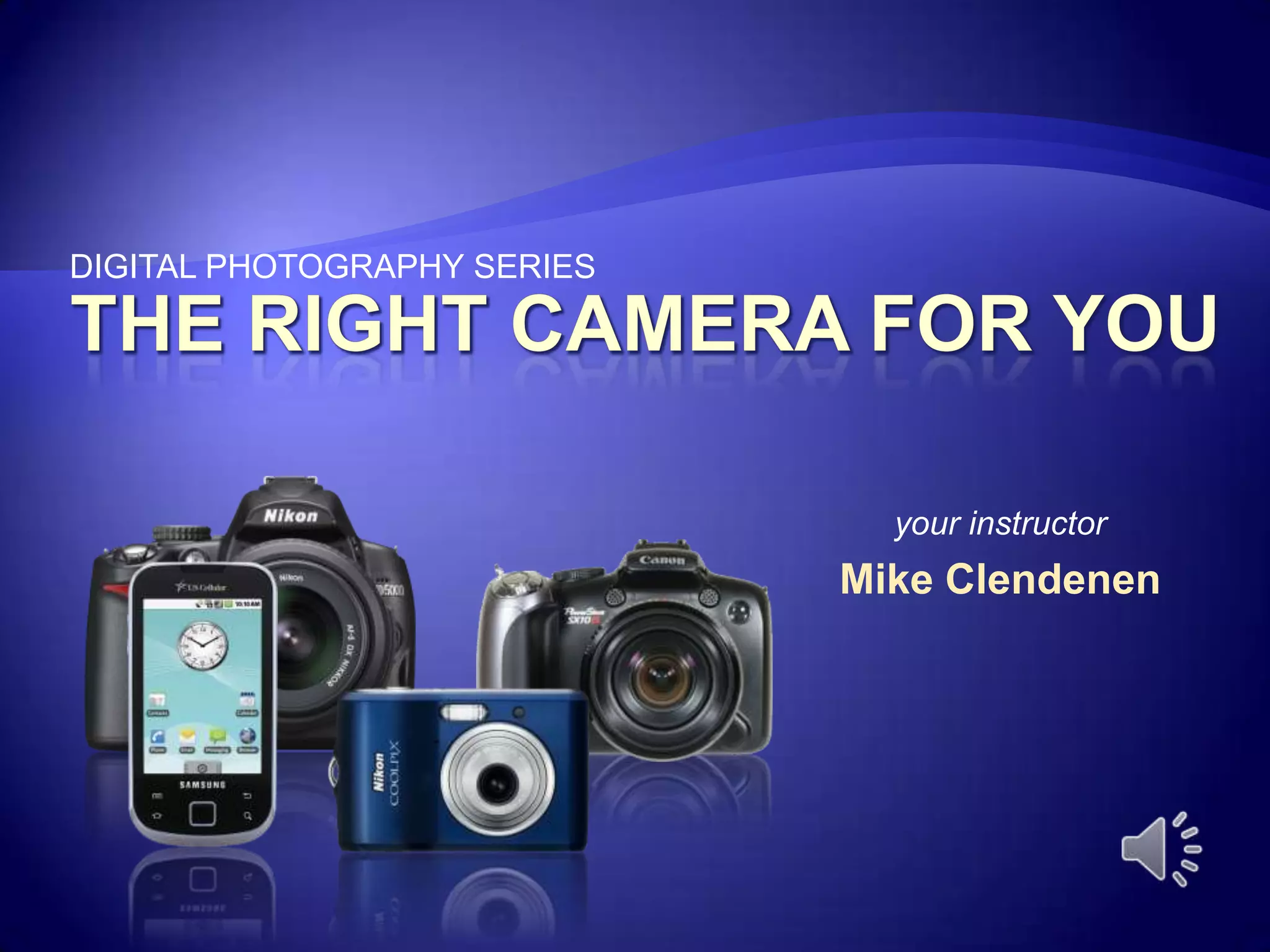
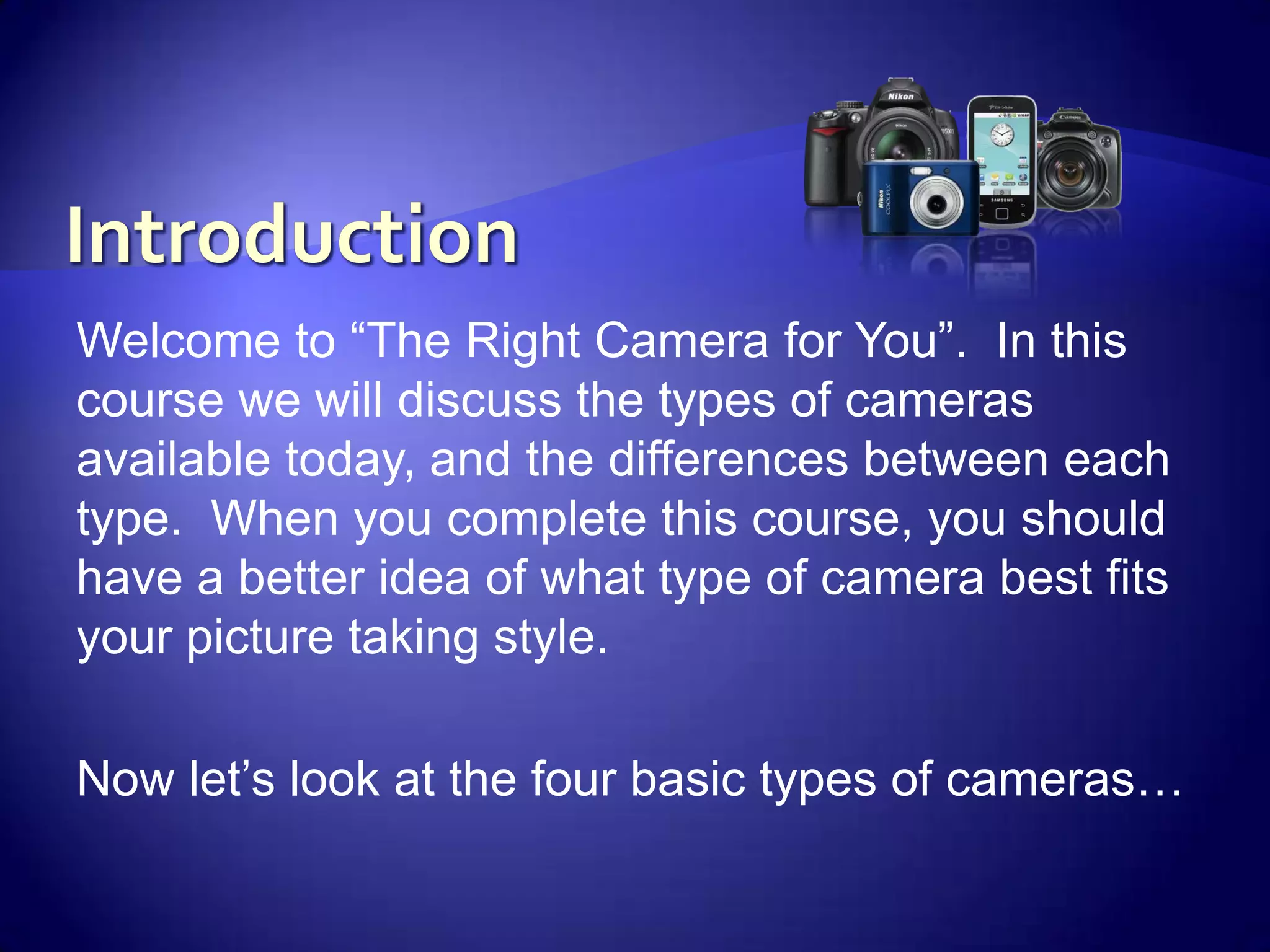
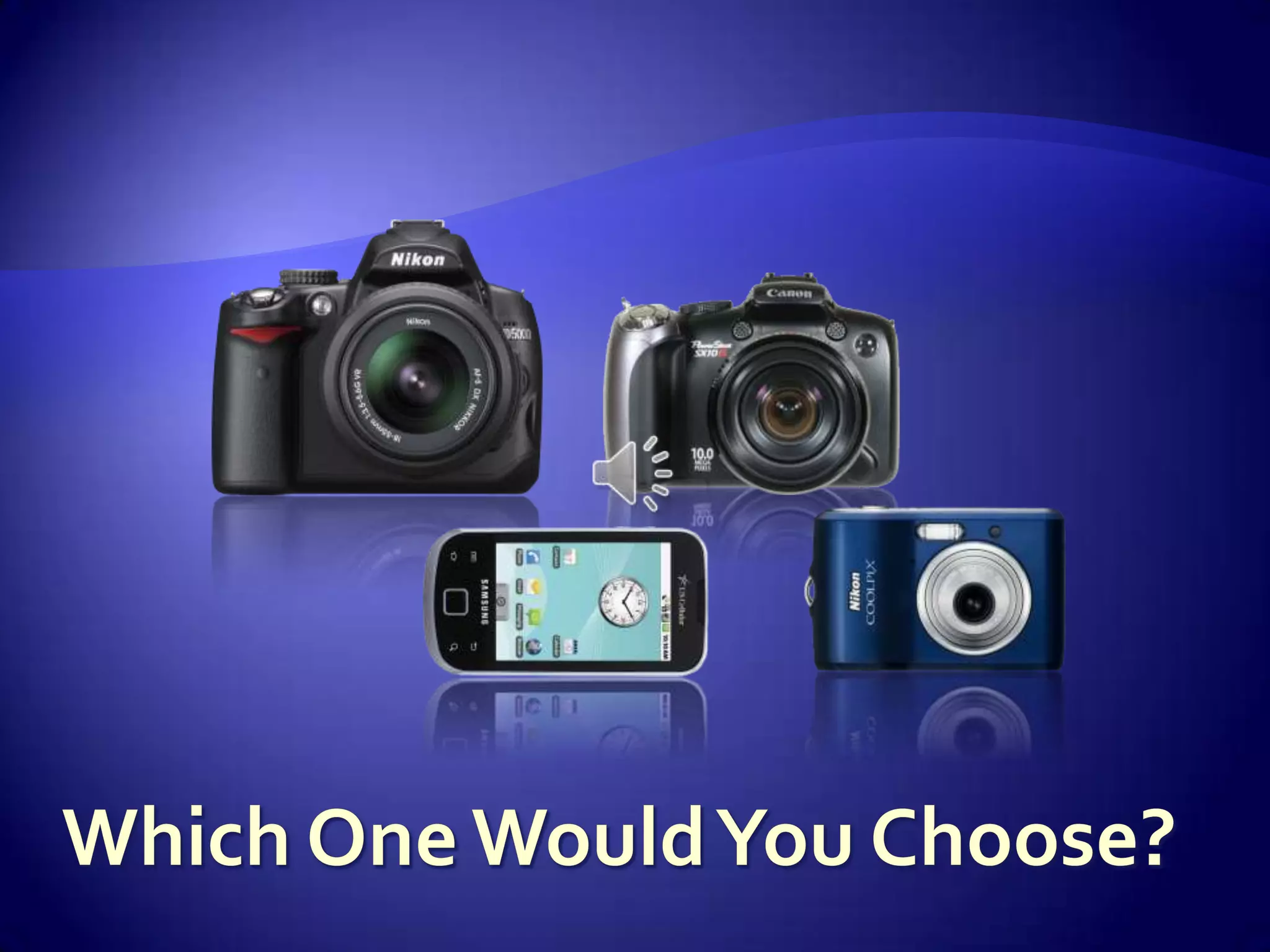
IntroductionWelcome to “The Right Camera for You”.  In this course we will discuss the types of cameras available today, and the differences between each type.  When you complete this course, you should have a better idea of what type of camera best fits your picture taking style.Now let’s look at the four basic types of cameras…
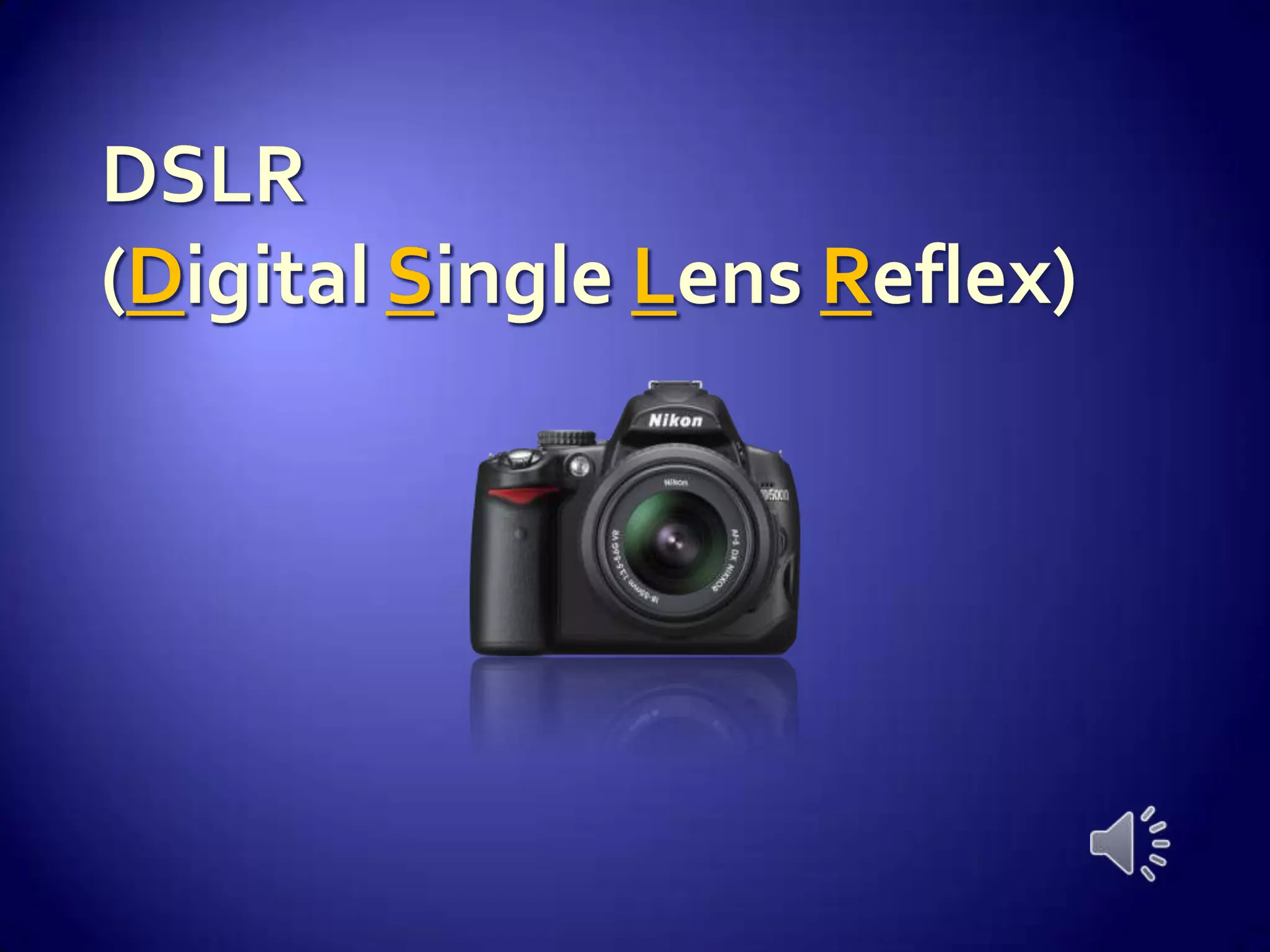
DSLR (Digital Single Lens Reflex)
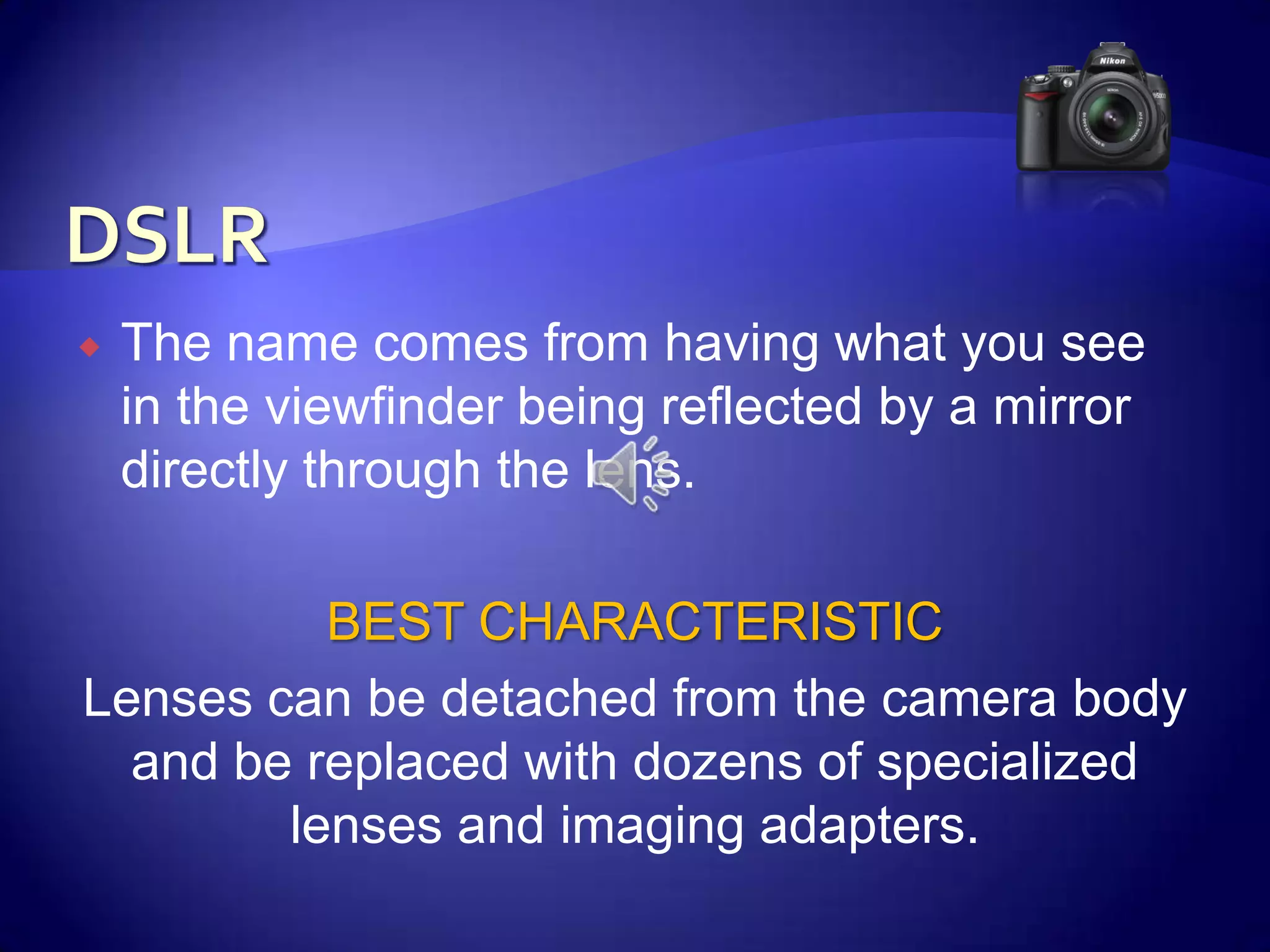
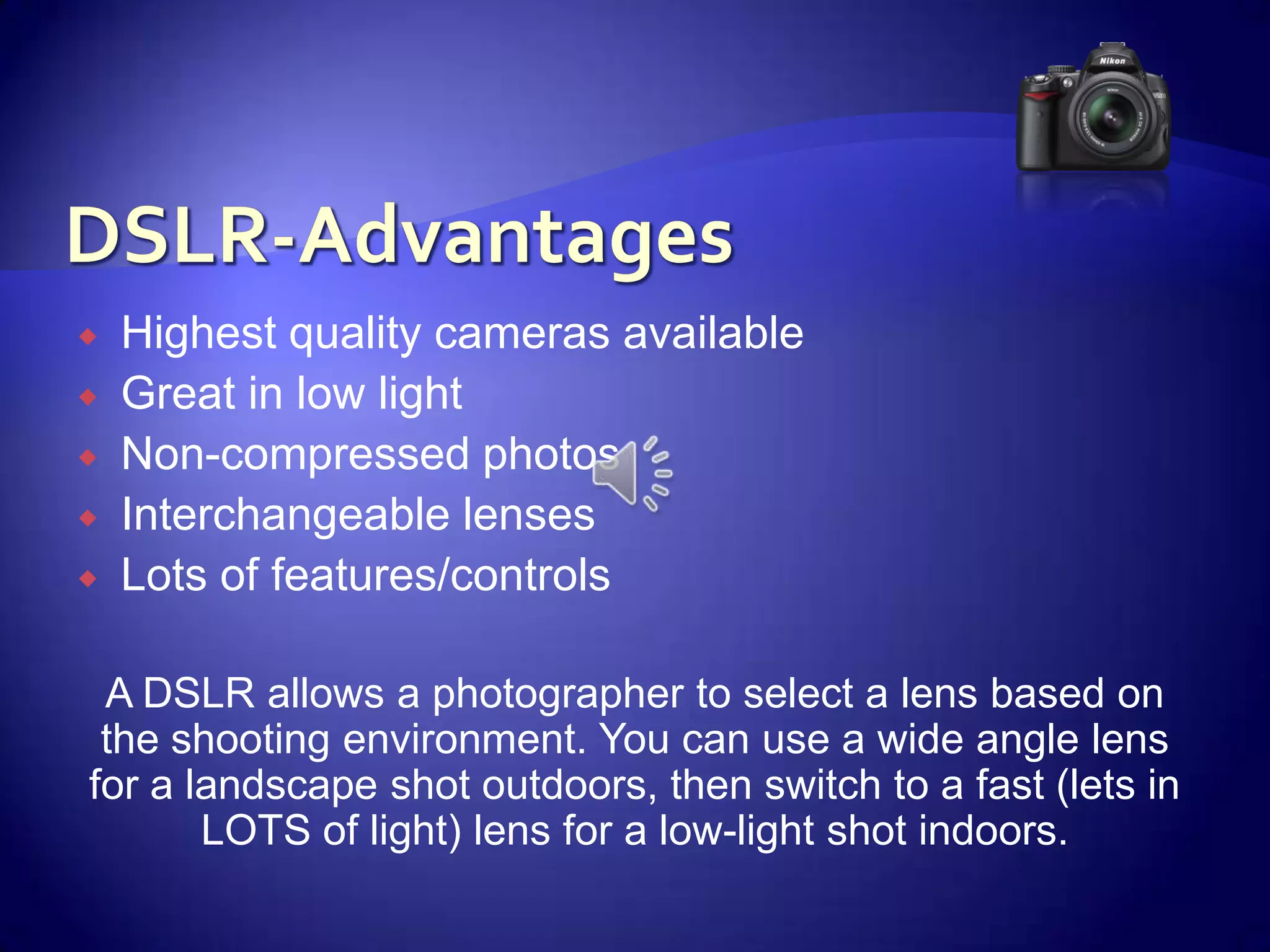
DSLRThe name comes from having what you see in the viewfinder being reflected by a mirror directly through the lens.BEST CHARACTERISTICLenses can be detached from the camera body and be replaced with dozens of specialized lenses and imaging adapters.
DSLR-AdvantagesHighest quality cameras availableGreat in low lightNon-compressed photosInterchangeable lensesLots of features/controlsA DSLR allows a photographer to select a lens based on the shooting environment. You can use a wide angle lens for a landscape shot outdoors, then switch to a fast (lets in LOTS of light) lens for a low-light shot indoors.
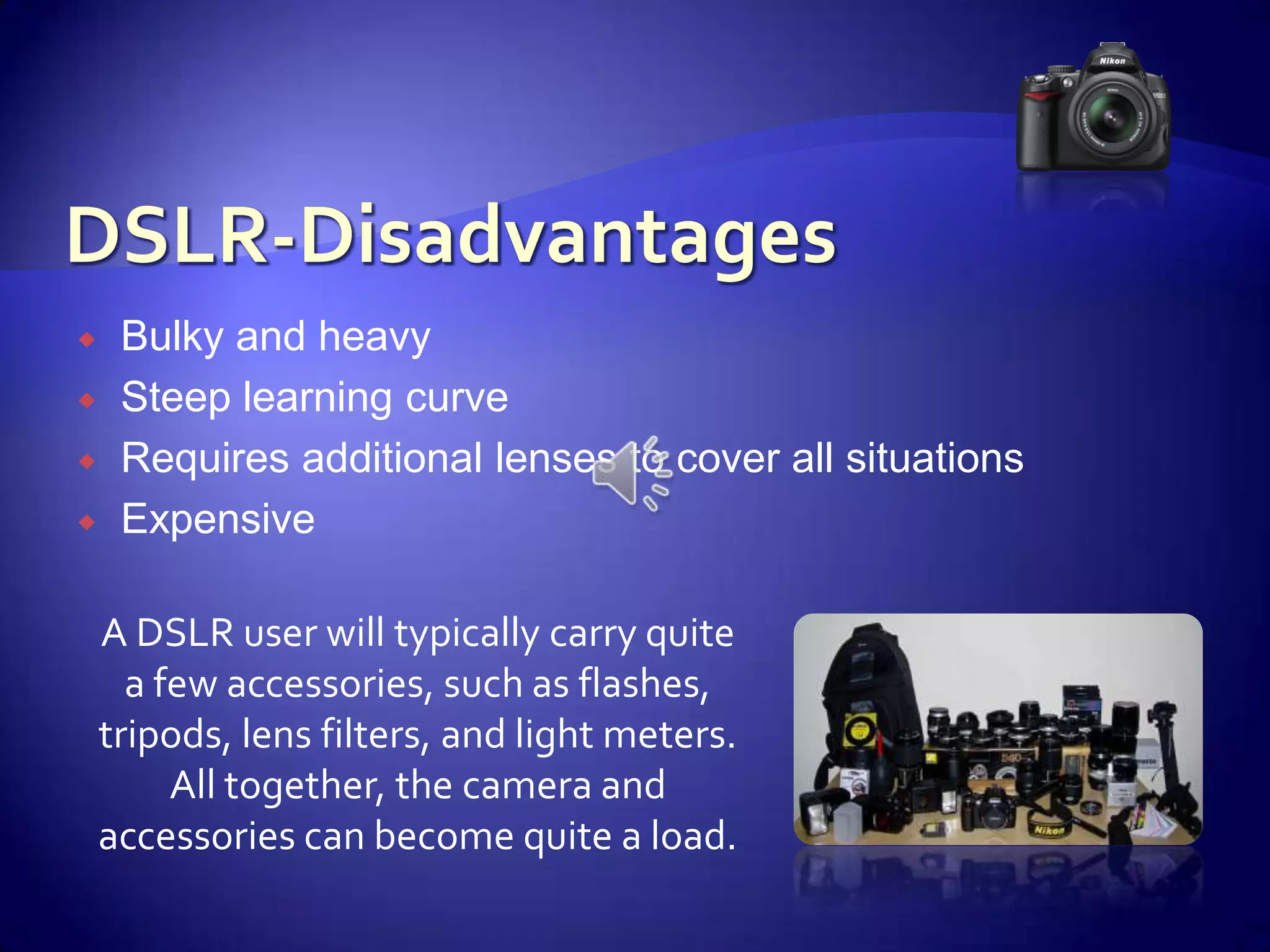
DSLR-DisadvantagesBulky and heavySteep learning curveRequires additional lenses to cover all situationsExpensiveA DSLR user will typically carry quite a few accessories, such as flashes, tripods, lens filters, and light meters.  All together, the camera and accessories can become quite a load.
DSLR-Why Own One?For QUALITY over everything else Yes, you may have a lot of extra equipment associated with a DSLR, but for the ultimate ability to get the shot you want, nothing can beat a DSLR.
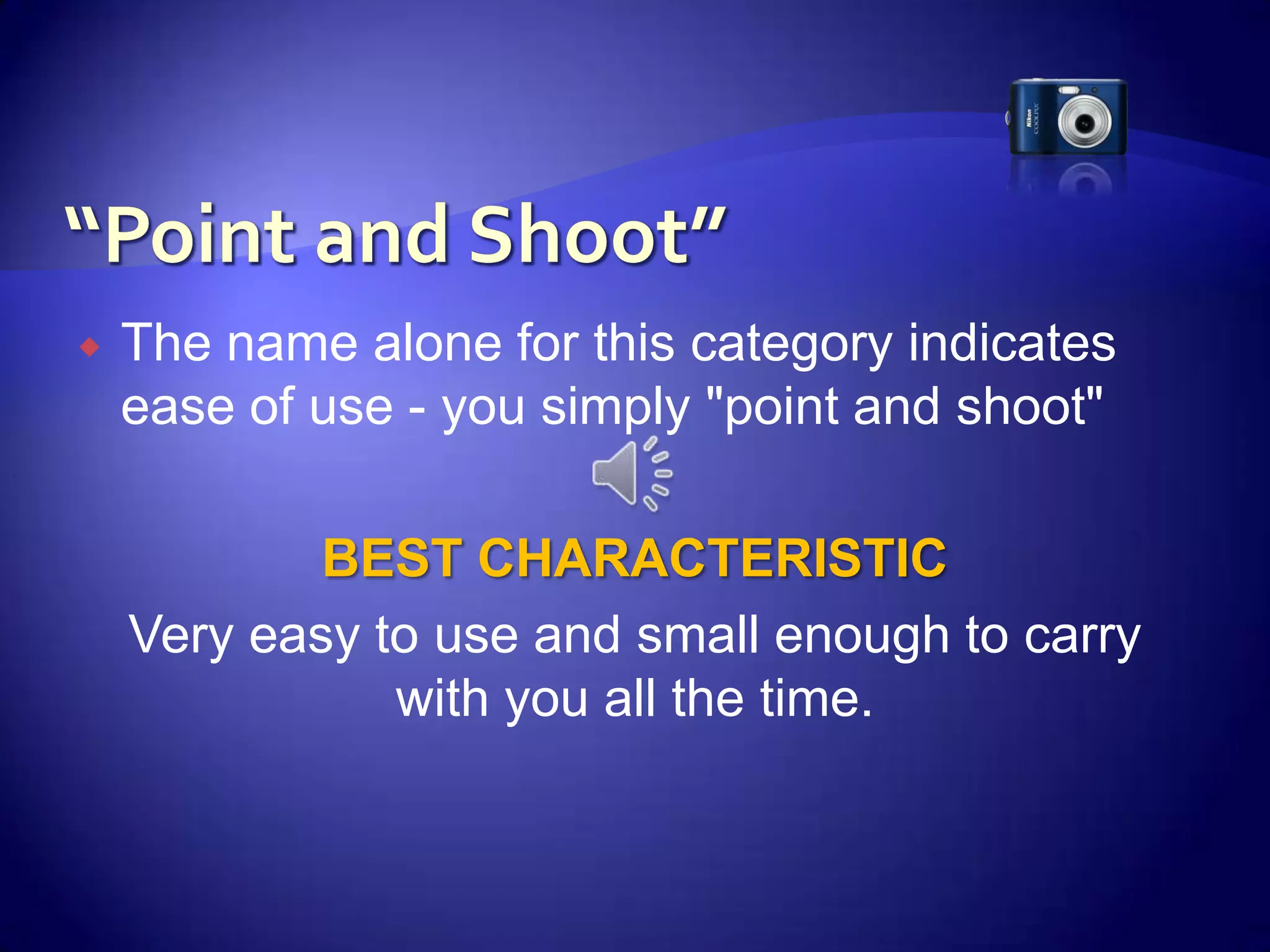
“Point and Shoot”
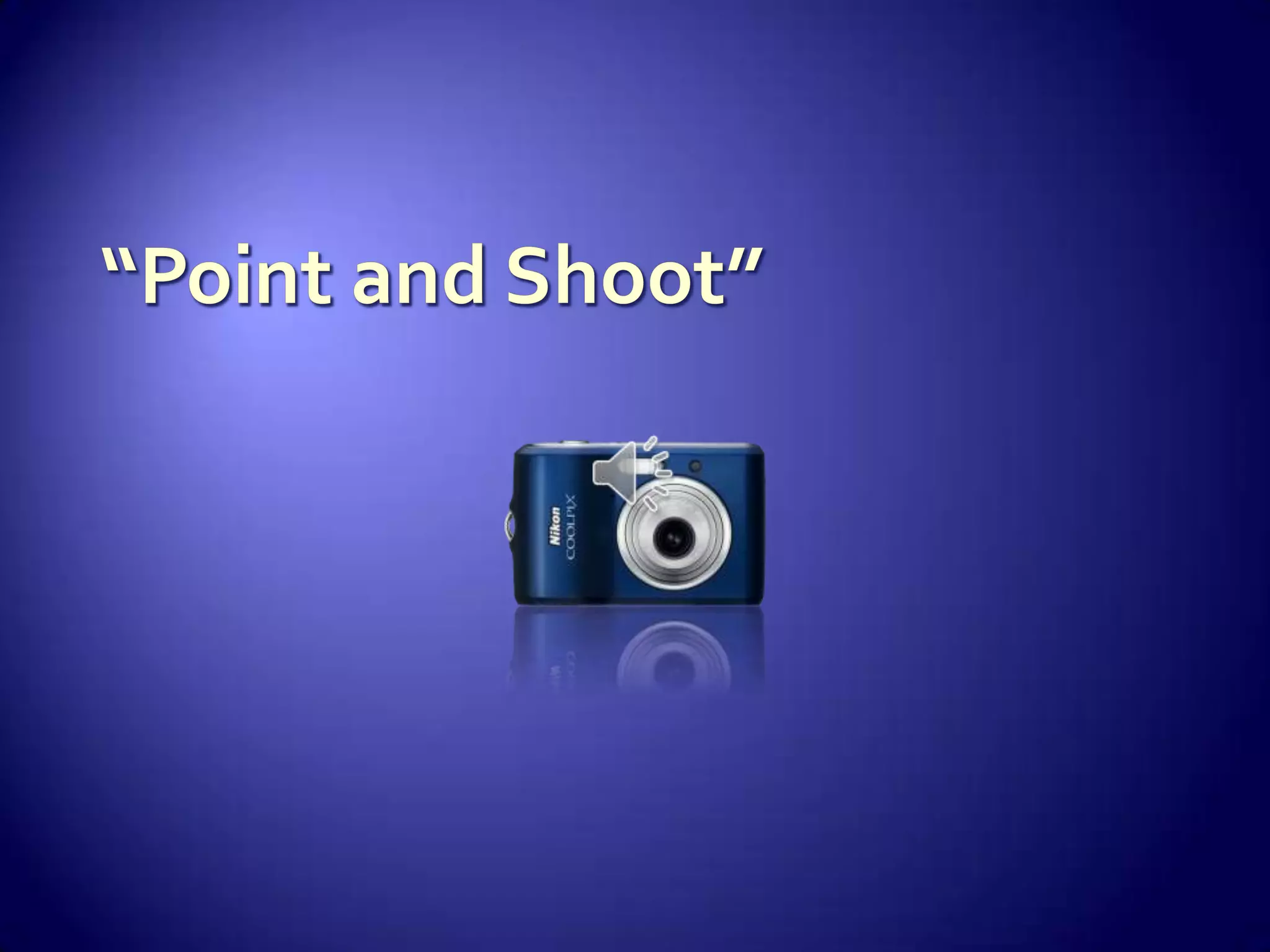
“Point and Shoot”The name alone for this category indicates ease of use - you simply "point and shoot" BEST CHARACTERISTICVery easy to use and small enough to carry with you all the time.
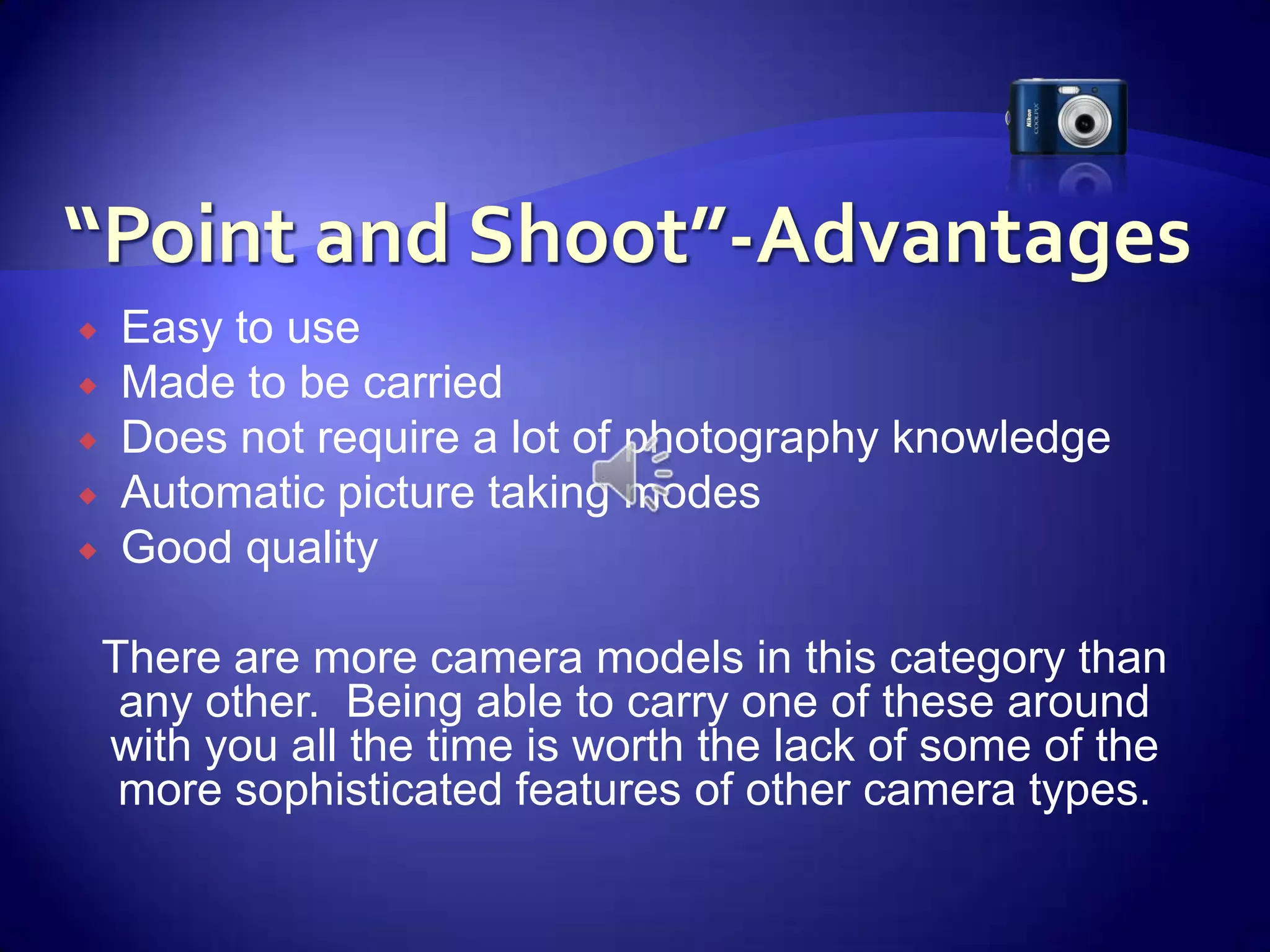
“Point and Shoot”-AdvantagesEasy to useMade to be carriedDoes not require a lot of photography knowledgeAutomatic picture taking modesGood qualityThere are more camera models in this category than any other.  Being able to carry one of these around with you all the time is worth the lack of some of the more sophisticated features of other camera types.
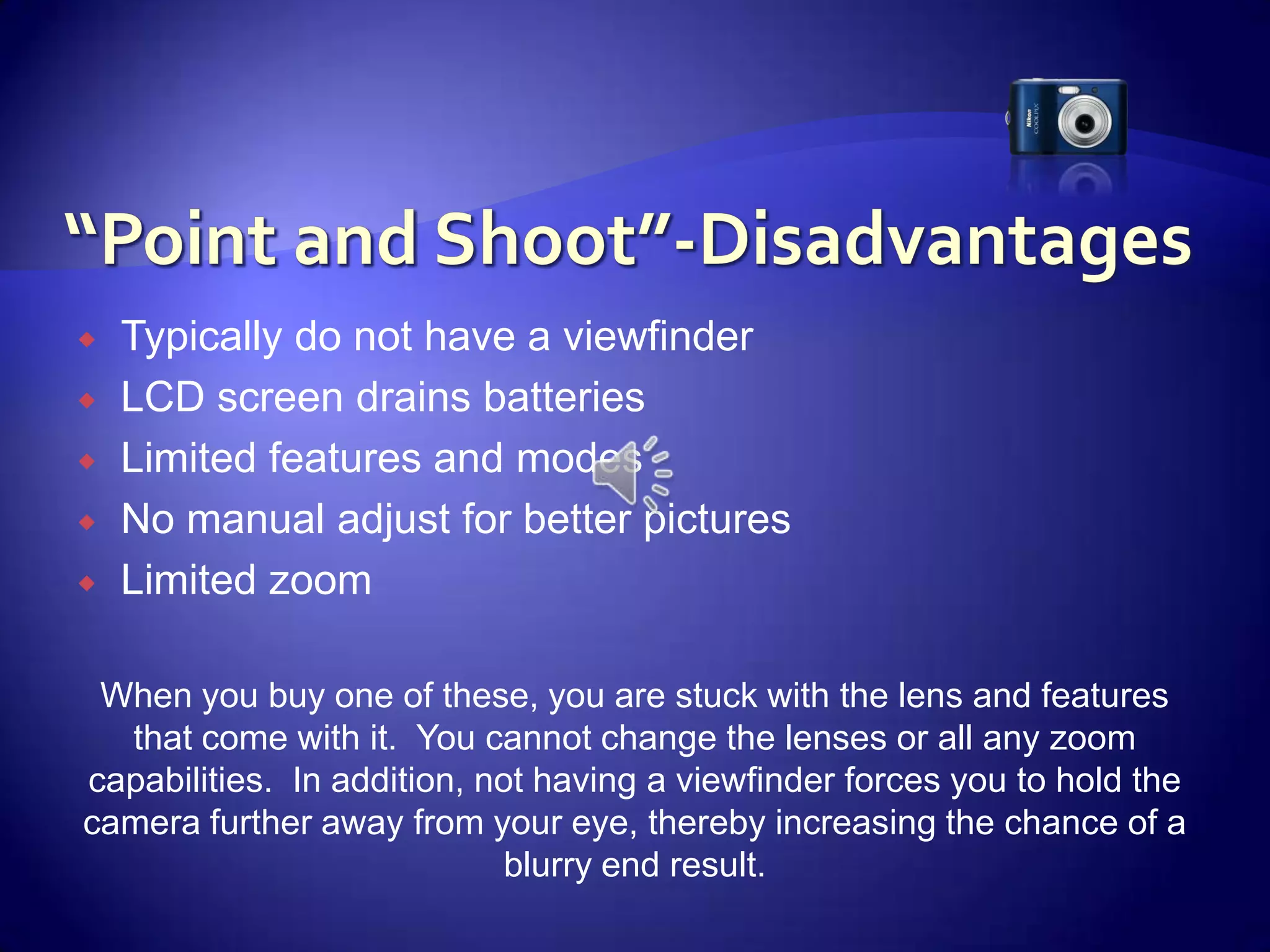
“Point and Shoot”-DisadvantagesTypically do not have a viewfinderLCD screen drains batteriesLimited features and modesNo manual adjust for better picturesLimited zoom When you buy one of these, you are stuck with the lens and features that come with it.  You cannot change the lenses or all any zoom capabilities.  In addition, not having a viewfinder forces you to hold the camera further away from your eye, thereby increasing the chance of a blurry end result.
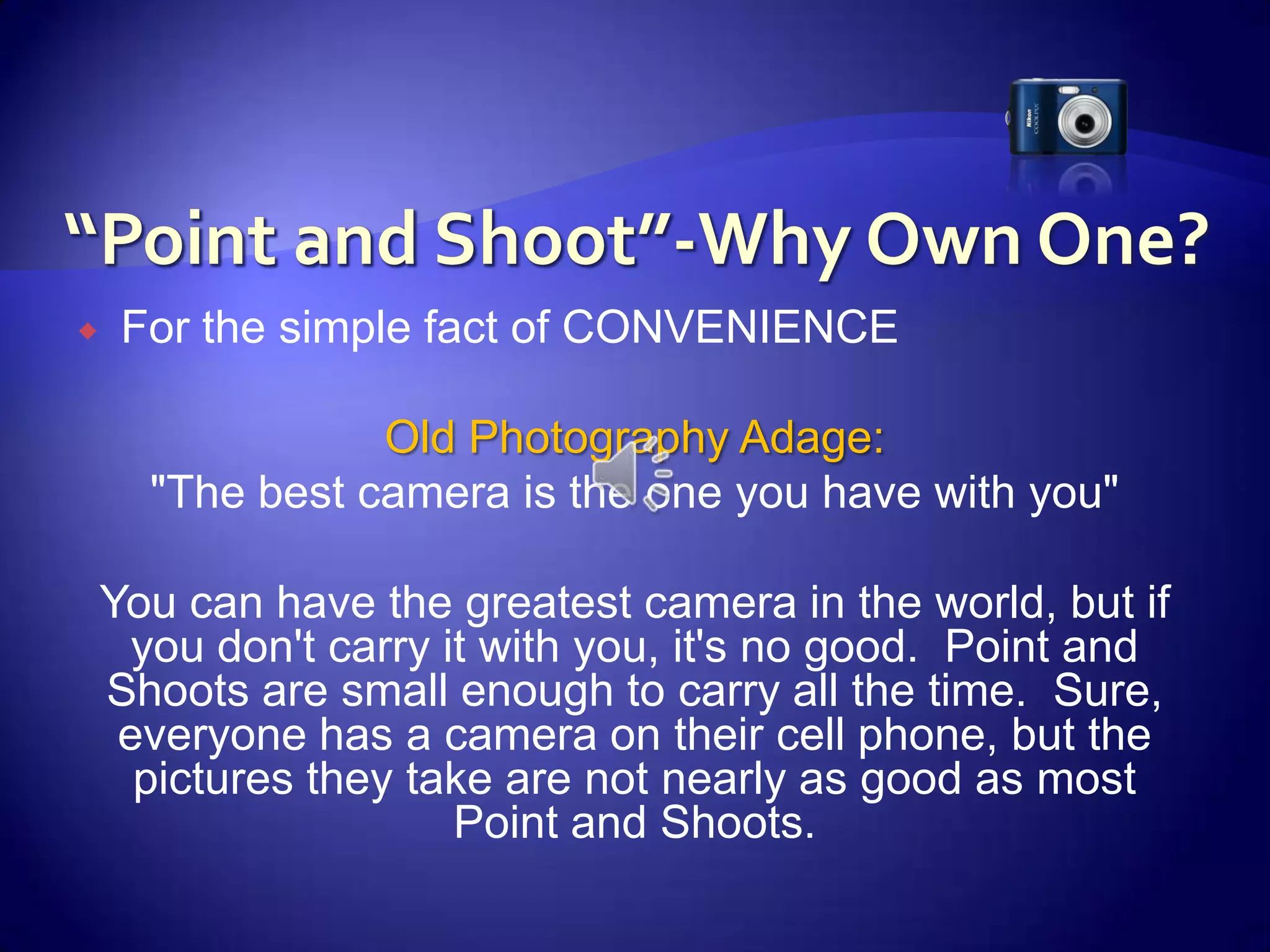
“Point and Shoot”-Why Own One?For the simple fact of CONVENIENCE Old Photography Adage:  "The best camera is the one you have with you" You can have the greatest camera in the world, but if you don't carry it with you, it's no good.  Point and Shoots are small enough to carry all the time.  Sure, everyone has a camera on their cell phone, but the pictures they take are not nearly as good as most Point and Shoots.
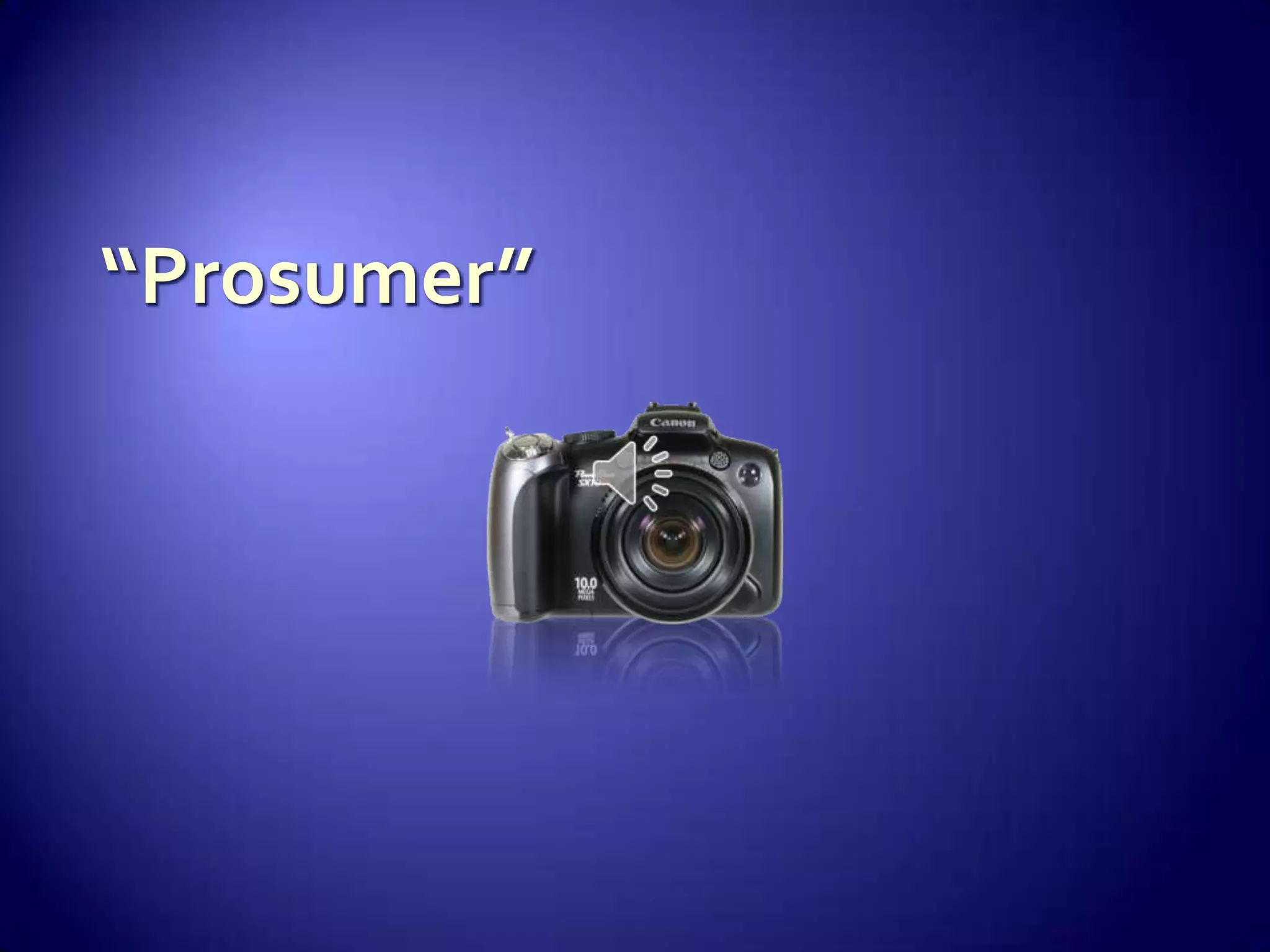
“Prosumer”
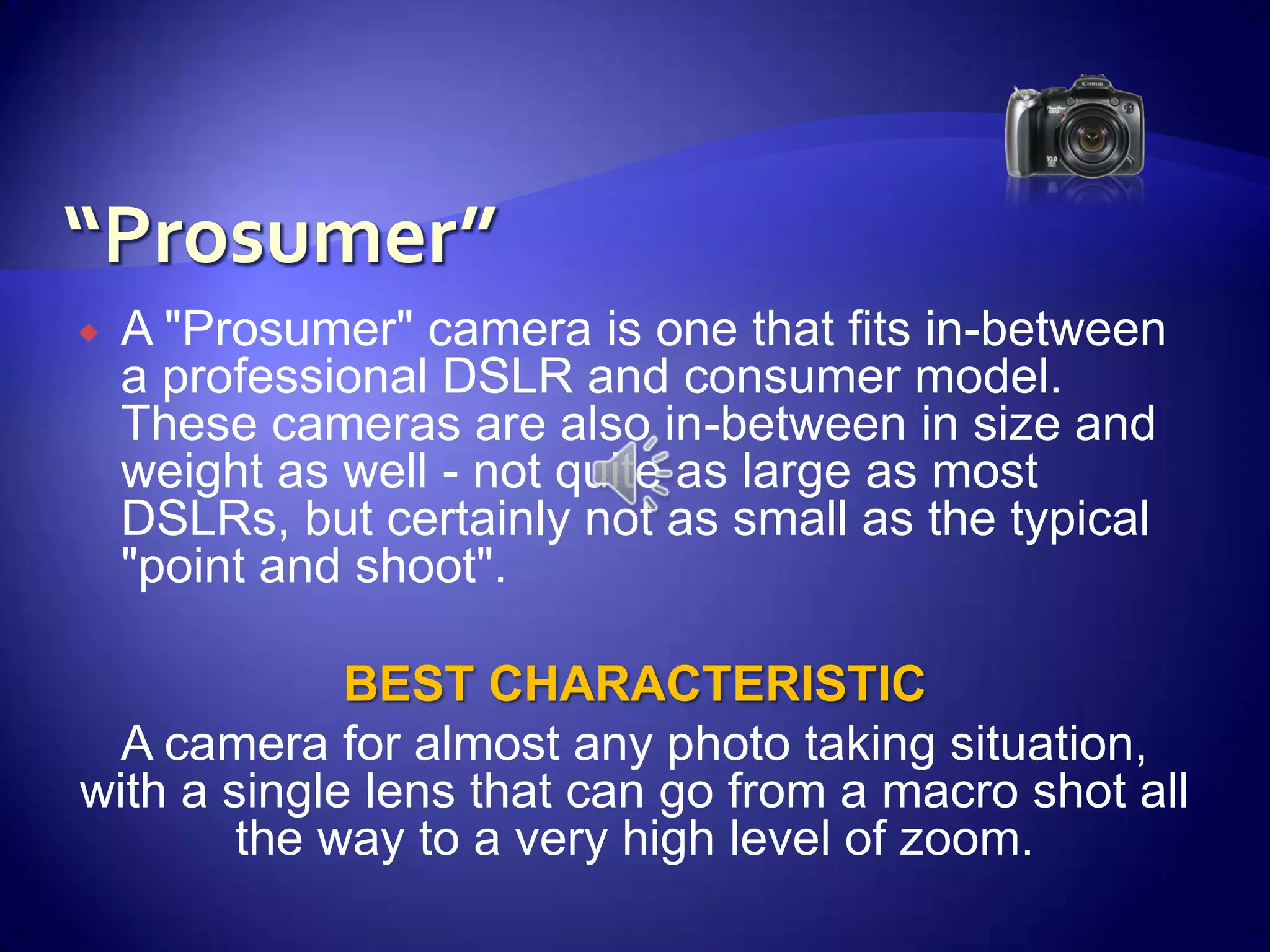
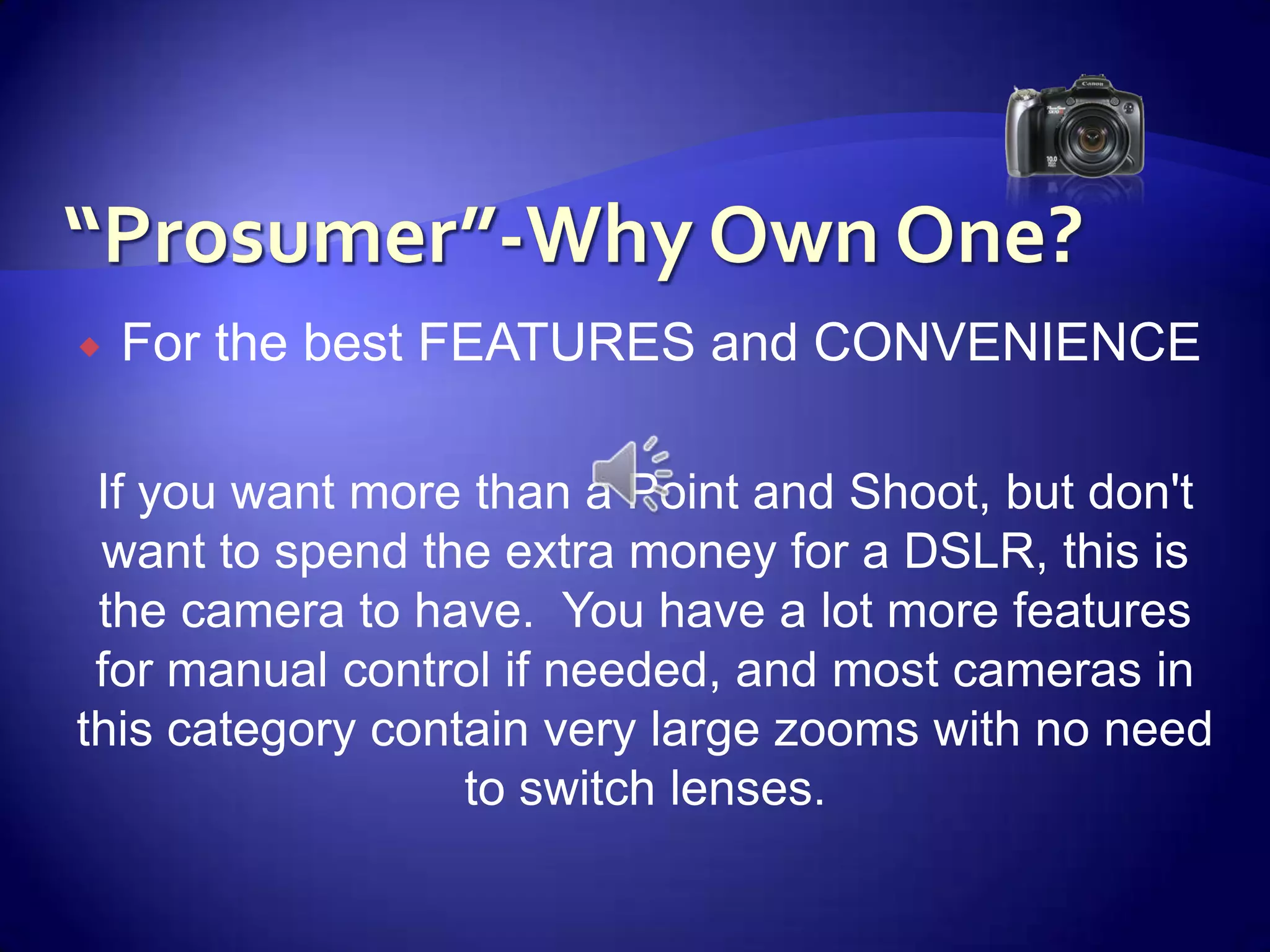
“Prosumer”A "Prosumer" camera is one that fits in-between a professional DSLR and consumer model.  These cameras are also in-between in size and weight as well - not quite as large as most DSLRs, but certainly not as small as the typical "point and shoot". BEST CHARACTERISTICA camera for almost any photo taking situation, with a single lens that can go from a macro shot all the way to a very high level of zoom.
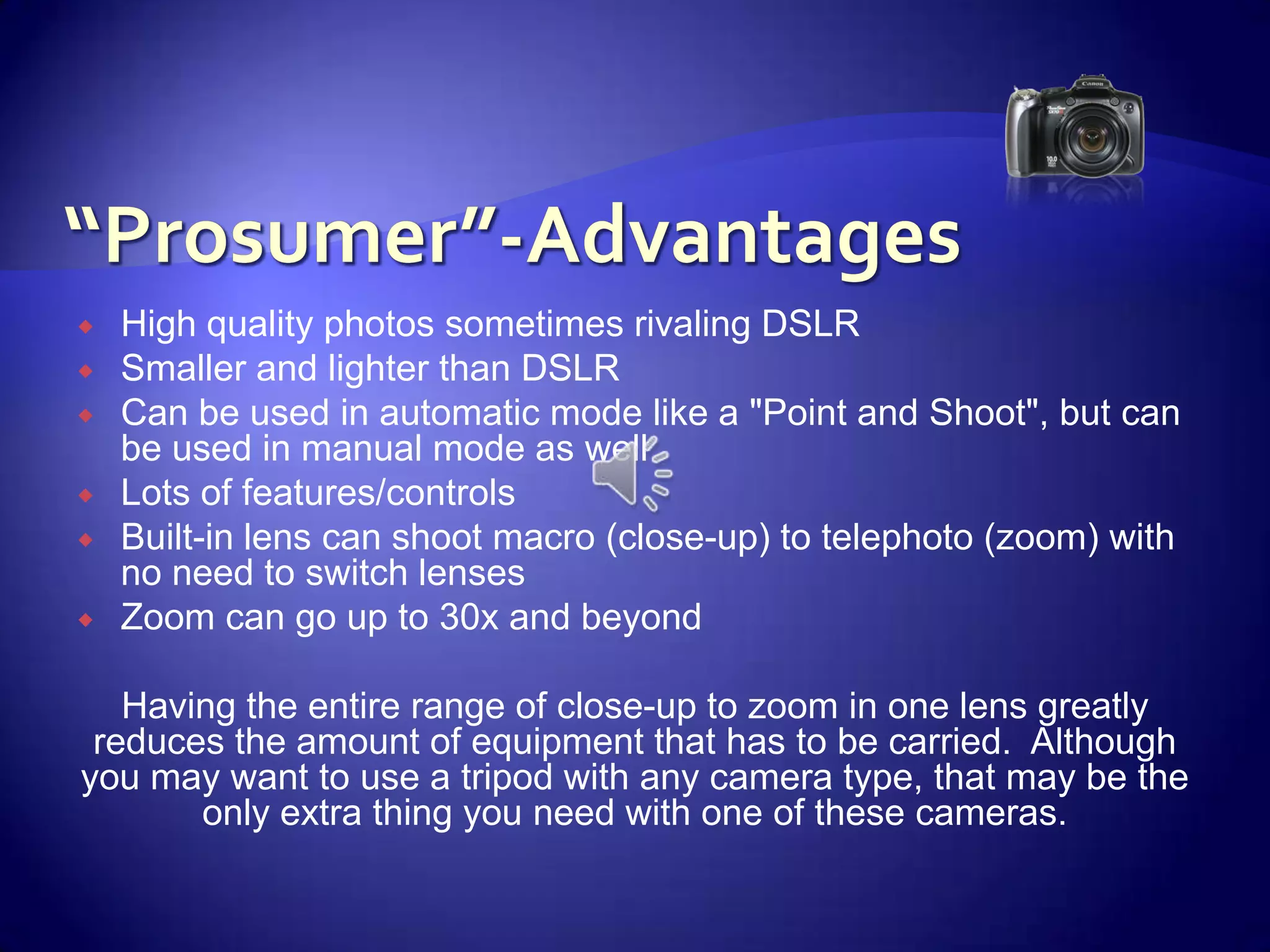
“Prosumer”-AdvantagesHigh quality photos sometimes rivaling DSLRSmaller and lighter than DSLRCan be used in automatic mode like a "Point and Shoot", but can be used in manual mode as wellLots of features/controlsBuilt-in lens can shoot macro (close-up) to telephoto (zoom) with no need to switch lensesZoom can go up to 30x and beyond Having the entire range of close-up to zoom in one lens greatly reduces the amount of equipment that has to be carried.  Although you may want to use a tripod with any camera type, that may be the only extra thing you need with one of these cameras.
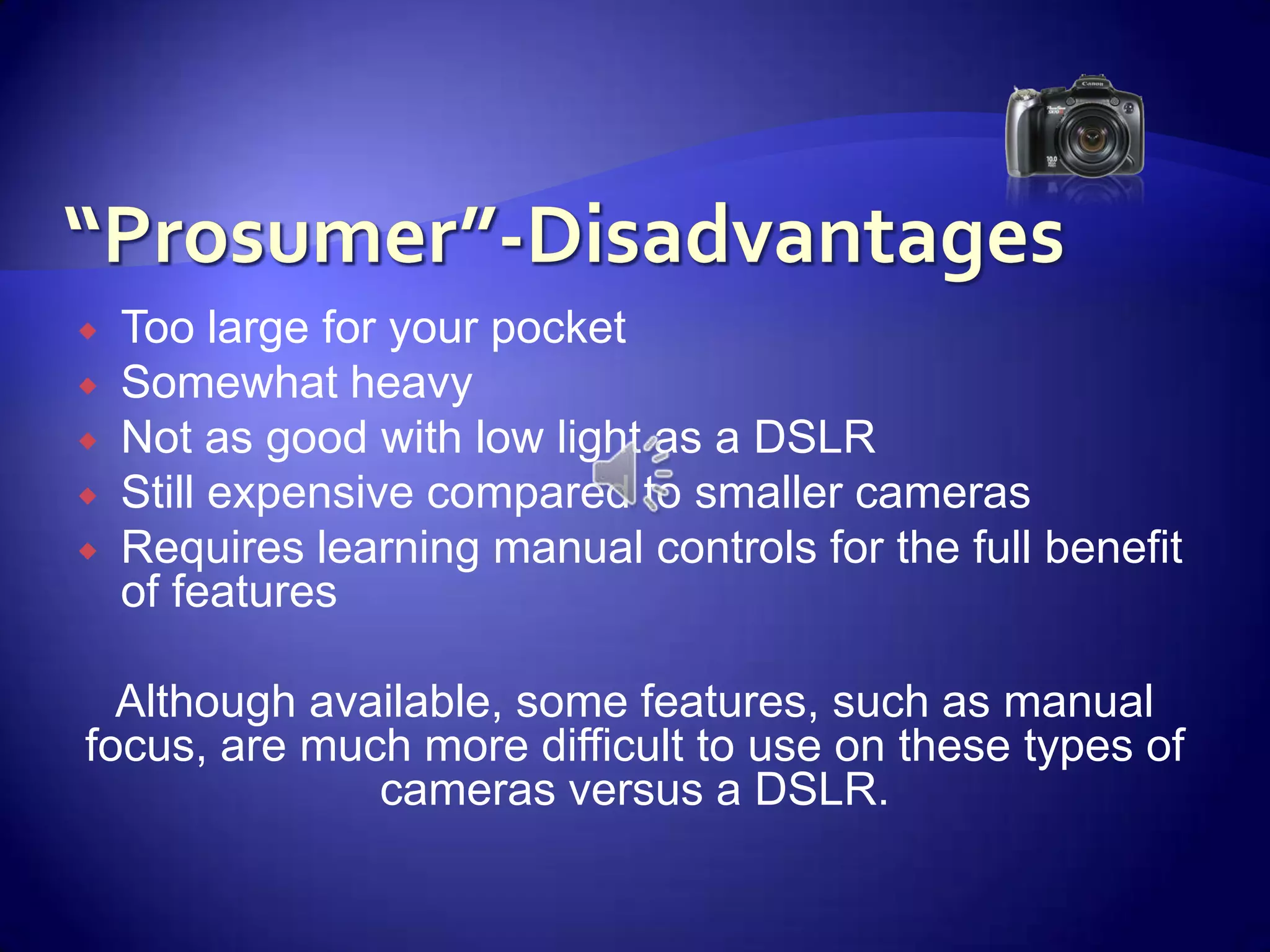
“Prosumer”-DisadvantagesToo large for your pocketSomewhat heavyNot as good with low light as a DSLRStill expensive compared to smaller camerasRequires learning manual controls for the full benefit of features Although available, some features, such as manual focus, are much more difficult to use on these types of cameras versus a DSLR.
“Prosumer”-Why Own One?For the best FEATURES and CONVENIENCE If you want more than a Point and Shoot, but don't want to spend the extra money for a DSLR, this is the camera to have.  You have a lot more features for manual control if needed, and most cameras in this category contain very large zooms with no need to switch lenses.
Cell Phone
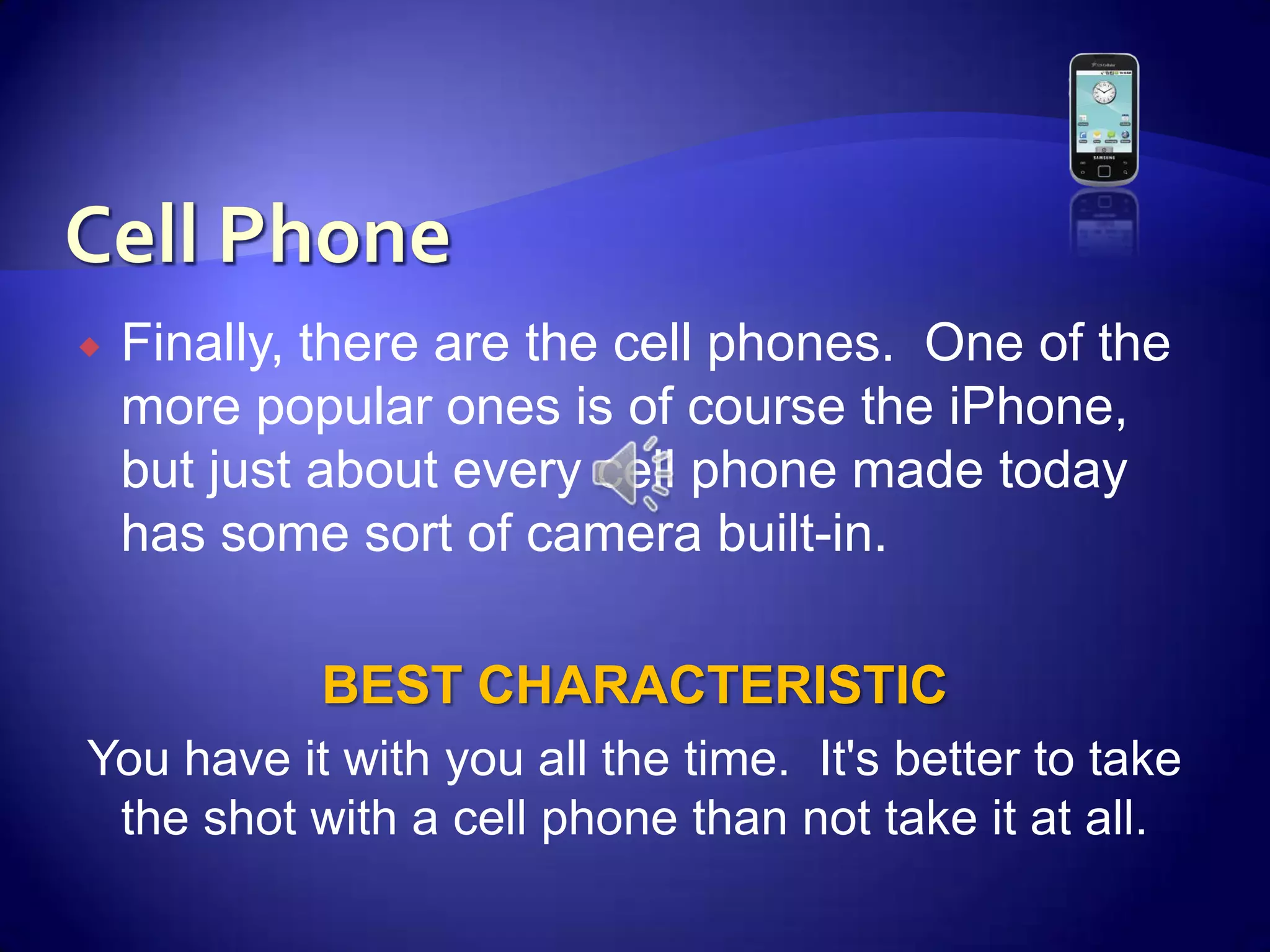
Cell PhoneFinally, there are the cell phones.  One of the more popular ones is of course the iPhone, but just about every cell phone made today has some sort of camera built-in. BEST CHARACTERISTICYou have it with you all the time.  It's better to take the shot with a cell phone than not take it at all.
Cell Phone-AdvantagesYou have it with you all the timeConvenient and easy to useEasy to send photos to othersEasy to upload to social web sites Cell phone photos (and videos) have become almost the norm for the way we take pictures.
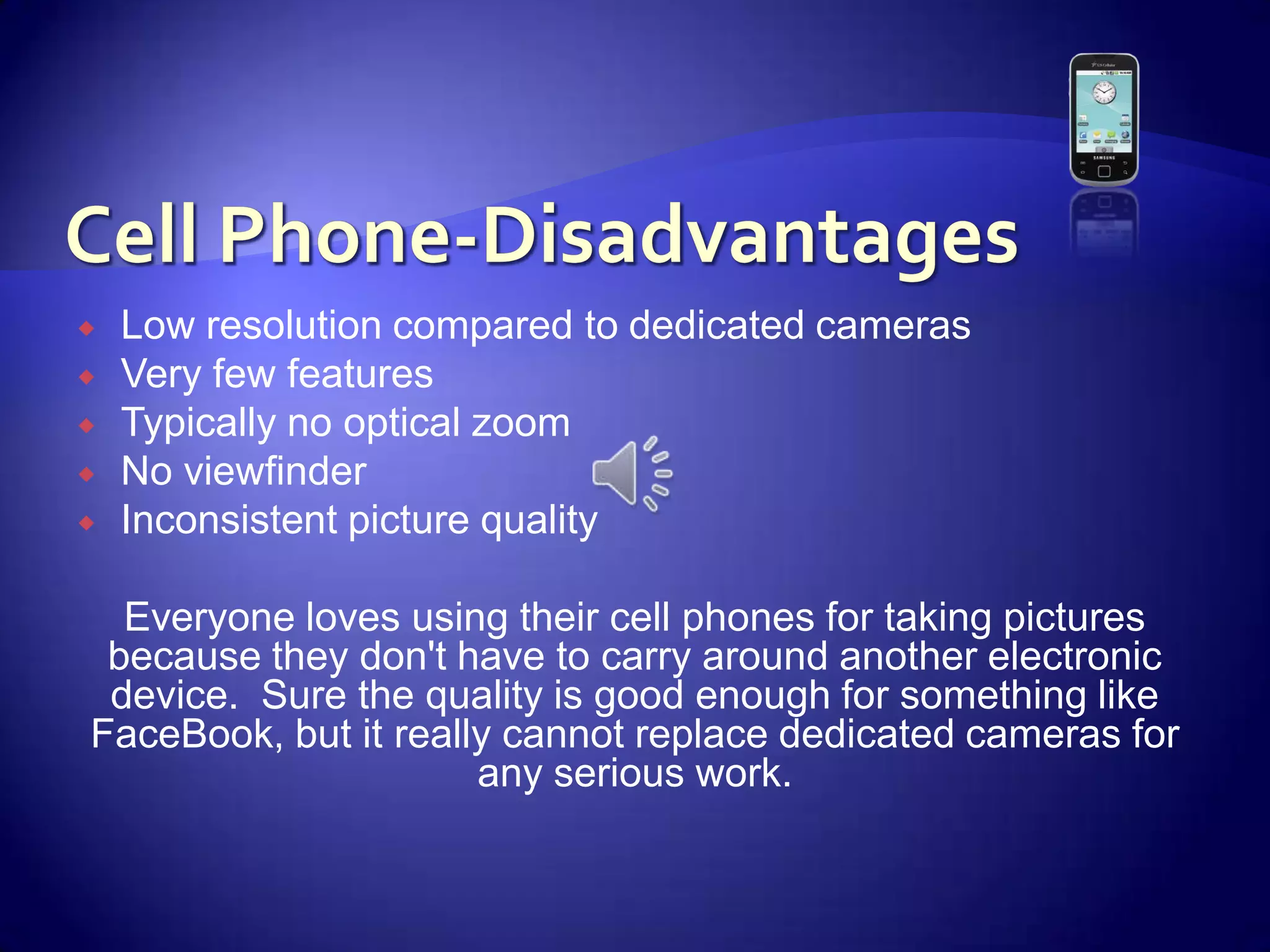
Cell Phone-DisadvantagesLow resolution compared to dedicated camerasVery few featuresTypically no optical zoomNo viewfinderInconsistent picture quality Everyone loves using their cell phones for taking pictures because they don't have to carry around another electronic device.  Sure the quality is good enough for something like FaceBook, but it really cannot replace dedicated cameras for any serious work.
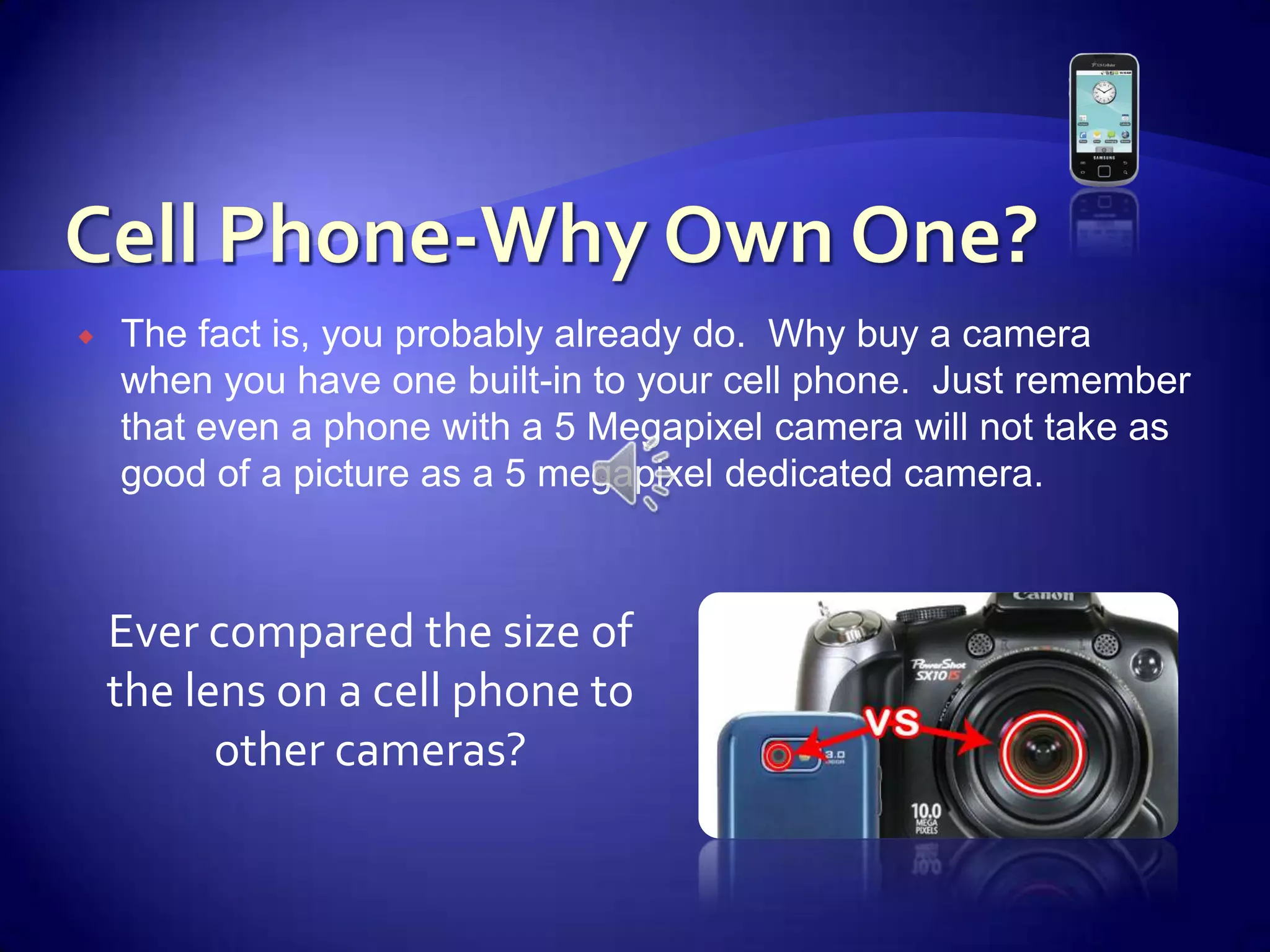
Cell Phone-Why Own One?The fact is, you probably already do.  Why buy a camera when you have one built-in to your cell phone.  Just remember that even a phone with a 5 Megapixel camera will not take as good of a picture as a 5 megapixel dedicated camera.  Ever compared the size of the lens on a cell phone to other cameras?
Which One Would You Choose?

The Right Camera 2010

  • 1.
    DIGITAL PHOTOGRAPHY SERIEStheright camera for youyour instructorMike Clendenen
  • 2.
    IntroductionWelcome to “TheRight Camera for You”. In this course we will discuss the types of cameras available today, and the differences between each type. When you complete this course, you should have a better idea of what type of camera best fits your picture taking style.Now let’s look at the four basic types of cameras…
  • 3.
  • 4.
    DSLRThe name comesfrom having what you see in the viewfinder being reflected by a mirror directly through the lens.BEST CHARACTERISTICLenses can be detached from the camera body and be replaced with dozens of specialized lenses and imaging adapters.
  • 5.
    DSLR-AdvantagesHighest quality camerasavailableGreat in low lightNon-compressed photosInterchangeable lensesLots of features/controlsA DSLR allows a photographer to select a lens based on the shooting environment. You can use a wide angle lens for a landscape shot outdoors, then switch to a fast (lets in LOTS of light) lens for a low-light shot indoors.
  • 6.
    DSLR-DisadvantagesBulky and heavySteeplearning curveRequires additional lenses to cover all situationsExpensiveA DSLR user will typically carry quite a few accessories, such as flashes, tripods, lens filters, and light meters. All together, the camera and accessories can become quite a load.
  • 7.
    DSLR-Why Own One?ForQUALITY over everything else Yes, you may have a lot of extra equipment associated with a DSLR, but for the ultimate ability to get the shot you want, nothing can beat a DSLR.
  • 8.
  • 9.
    “Point and Shoot”Thename alone for this category indicates ease of use - you simply "point and shoot" BEST CHARACTERISTICVery easy to use and small enough to carry with you all the time.
  • 10.
    “Point and Shoot”-AdvantagesEasyto useMade to be carriedDoes not require a lot of photography knowledgeAutomatic picture taking modesGood qualityThere are more camera models in this category than any other. Being able to carry one of these around with you all the time is worth the lack of some of the more sophisticated features of other camera types.
  • 11.
    “Point and Shoot”-DisadvantagesTypicallydo not have a viewfinderLCD screen drains batteriesLimited features and modesNo manual adjust for better picturesLimited zoom When you buy one of these, you are stuck with the lens and features that come with it. You cannot change the lenses or all any zoom capabilities. In addition, not having a viewfinder forces you to hold the camera further away from your eye, thereby increasing the chance of a blurry end result.
  • 12.
    “Point and Shoot”-WhyOwn One?For the simple fact of CONVENIENCE Old Photography Adage: "The best camera is the one you have with you" You can have the greatest camera in the world, but if you don't carry it with you, it's no good. Point and Shoots are small enough to carry all the time. Sure, everyone has a camera on their cell phone, but the pictures they take are not nearly as good as most Point and Shoots.
  • 13.
  • 14.
    “Prosumer”A "Prosumer" camerais one that fits in-between a professional DSLR and consumer model. These cameras are also in-between in size and weight as well - not quite as large as most DSLRs, but certainly not as small as the typical "point and shoot". BEST CHARACTERISTICA camera for almost any photo taking situation, with a single lens that can go from a macro shot all the way to a very high level of zoom.
  • 15.
    “Prosumer”-AdvantagesHigh quality photossometimes rivaling DSLRSmaller and lighter than DSLRCan be used in automatic mode like a "Point and Shoot", but can be used in manual mode as wellLots of features/controlsBuilt-in lens can shoot macro (close-up) to telephoto (zoom) with no need to switch lensesZoom can go up to 30x and beyond Having the entire range of close-up to zoom in one lens greatly reduces the amount of equipment that has to be carried. Although you may want to use a tripod with any camera type, that may be the only extra thing you need with one of these cameras.
  • 16.
    “Prosumer”-DisadvantagesToo large foryour pocketSomewhat heavyNot as good with low light as a DSLRStill expensive compared to smaller camerasRequires learning manual controls for the full benefit of features Although available, some features, such as manual focus, are much more difficult to use on these types of cameras versus a DSLR.
  • 17.
    “Prosumer”-Why Own One?Forthe best FEATURES and CONVENIENCE If you want more than a Point and Shoot, but don't want to spend the extra money for a DSLR, this is the camera to have. You have a lot more features for manual control if needed, and most cameras in this category contain very large zooms with no need to switch lenses.
  • 18.
  • 19.
    Cell PhoneFinally, thereare the cell phones. One of the more popular ones is of course the iPhone, but just about every cell phone made today has some sort of camera built-in. BEST CHARACTERISTICYou have it with you all the time. It's better to take the shot with a cell phone than not take it at all.
  • 20.
    Cell Phone-AdvantagesYou haveit with you all the timeConvenient and easy to useEasy to send photos to othersEasy to upload to social web sites Cell phone photos (and videos) have become almost the norm for the way we take pictures.
  • 21.
    Cell Phone-DisadvantagesLow resolutioncompared to dedicated camerasVery few featuresTypically no optical zoomNo viewfinderInconsistent picture quality Everyone loves using their cell phones for taking pictures because they don't have to carry around another electronic device. Sure the quality is good enough for something like FaceBook, but it really cannot replace dedicated cameras for any serious work.
  • 22.
    Cell Phone-Why OwnOne?The fact is, you probably already do. Why buy a camera when you have one built-in to your cell phone. Just remember that even a phone with a 5 Megapixel camera will not take as good of a picture as a 5 megapixel dedicated camera.  Ever compared the size of the lens on a cell phone to other cameras?
  • 23.
    Which One WouldYou Choose?