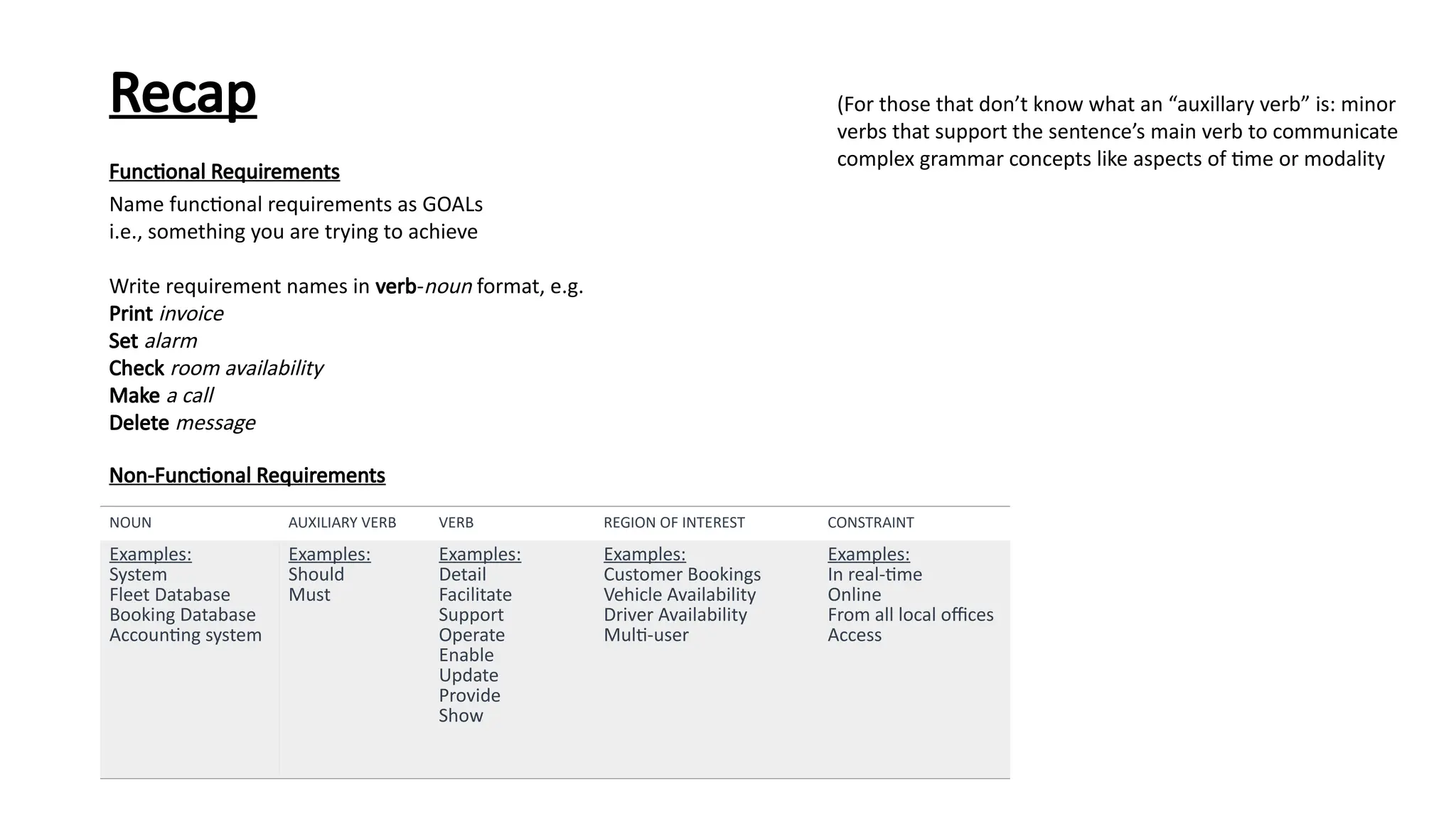
Name functional requirementsas GOALs
i.e., something you are trying to achieve
Write requirement names in verb-noun format, e.g.
Print invoice
Set alarm
Check room availability
Make a call
Delete message
NOUN AUXILIARY VERB VERB REGION OF INTEREST CONSTRAINT
Examples:
System
Fleet Database
Booking Database
Accounting system
Examples:
Should
Must
Examples:
Detail
Facilitate
Support
Operate
Enable
Update
Provide
Show
Examples:
Customer Bookings
Vehicle Availability
Driver Availability
Multi-user
Examples:
In real-time
Online
From all local offices
Access
Recap
Functional Requirements
Non-Functional Requirements
(For those that don’t know what an “auxillary verb” is: minor
verbs that support the sentence’s main verb to communicate
complex grammar concepts like aspects of time or modality
3.
The Rapid Application
DevelopmentModel
Looking for an agile and accelerated development process that can
drive product innovation? Look no further than the RAD model!
4.
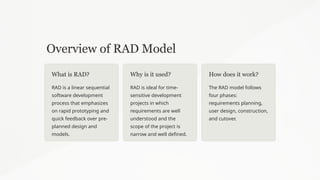
Overview of RADModel
What is RAD?
RAD is a linear sequential
software development
process that emphasizes
on rapid prototyping and
quick feedback over pre-
planned design and
models.
Why is it used?
RAD is ideal for time-
sensitive development
projects in which
requirements are well
understood and the
scope of the project is
narrow and well defined.
How does it work?
The RAD model follows
four phases:
requirements planning,
user design, construction,
and cutover.
5.
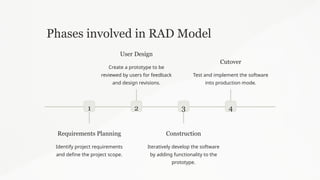
Phases involved inRAD Model
1
Requirements Planning
Identify project requirements
and define the project scope.
2
User Design
Create a prototype to be
reviewed by users for feedback
and design revisions.
3
Construction
Iteratively develop the software
by adding functionality to the
prototype.
4
Cutover
Test and implement the software
into production mode.
6.
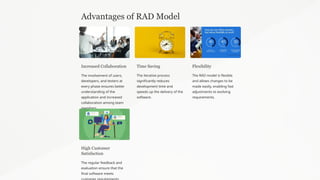
Advantages of RADModel
Increased Collaboration
The involvement of users,
developers, and testers at
every phase ensures better
understanding of the
application and increased
collaboration among team
members.
Time Saving
The iterative process
significantly reduces
development time and
speeds up the delivery of the
software.
Flexibility
The RAD model is flexible
and allows changes to be
made easily, enabling fast
adjustments to evolving
requirements.
High Customer
Satisfaction
The regular feedback and
evaluation ensure that the
final software meets
7.
Disadvantages of RADModel
1 Unclear Requirements
As RAD emphasizes less
on analysis and more on
the rapid creation of
prototypes, there is a risk
that requirements may
lack clarity or fail to
address the big picture.
2 Unrealistic Timeframes
The time-boxed approach
may result in unrealistic
project timeframes,
leading to an increased
risk of developing a
product that is not
market-ready.
3 Costly Implementation
RAD requires significant resources, in terms of manpower and
budget, which may make it inaccessible for smaller
organizations or projects with limited resources.
8.
Comparison with OtherDevelopment
Models
Waterfall Model
The Waterfall model is a linear sequential
development process that follows a pre-
determined and pre-planned staged
approach.
V-Model
The V-model follows a sequential process for
software development with an emphasis on
testing at each stage.
9.
Examples of RADModel Implementation
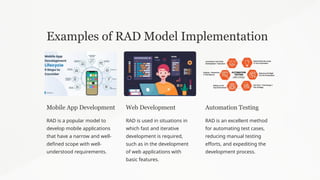
Mobile App Development
RAD is a popular model to
develop mobile applications
that have a narrow and well-
defined scope with well-
understood requirements.
Web Development
RAD is used in situations in
which fast and iterative
development is required,
such as in the development
of web applications with
basic features.
Automation Testing
RAD is an excellent method
for automating test cases,
reducing manual testing
efforts, and expediting the
development process.
10.
Conclusion and Recommendations
Conclusion
RADis an excellent approach to software
development in certain scenarios that
require quick delivery and iterative
processes.
Recommendations
When considering the RAD model, it's
important to evaluate the project scope,
resources, and urgency to determine if it is
the right fit for the situation.