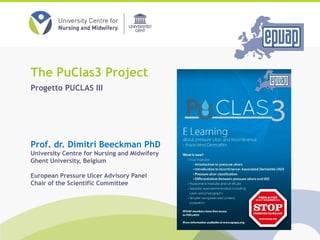
Prof. dr. Dimitri Beeckman PhD
University Centre for Nursing and Midwifery
Ghent University, Belgium
European Pressure Ulcer Advisory Panel
Chair of the Scientific Committee
The PuClas3 Project
Progetto PUCLAS III
PUCLAS 3 – PROF. D. BEECKMAN, 2014
Category I : Non- blanchable erythema
Category II : Partial thickness skin loss
Category III : Full thickness skin loss
Category IV : Full thickness tissue loss
Cat. 1
Cat. 2
Cat. 3
Cat. 4
INTRODUCTION
PUCLAS 3 – PROF. D. BEECKMAN, 2014
T.Defloor - Verplegingswetenschap - Universiteit Gent
3
1
2
3
PUCLAS 3 – PROF. D. BEECKMAN, 2014
Definition
 A reactive response of the skin to chronic exposure to urine and
faecal material which could be observed as an inflammation and
erythema with or without erosion or denudation
INTRODUCTION
PUCLAS 3 – PROF. D. BEECKMAN, 2014
Size of the problem:
 Survey (1911 caregivers)
o 90.4% observed IAD in daily practice
o Confusion about prevention
• IAD is not a pressure ulcer (73.5%)
• … but should be prevented as a
pressure ulcer (61.5%)
INTRODUCTION
PUCLAS 3 – PROF. D. BEECKMAN, 2014
Moisture
Urine Faeces Urine/faeces Washing
Ureum/amonium
pH
Bacterial load
Enzym. activity
pH
Bacterial load
Enzym. activity
Ureum/amonium
pH
Bacterial load
Chemical irritation
Physical irritation
+
Skin permeability
pH
Bacterial growth Cutaneous infections
Friction IAD+Weakened skin
ETIOLOGY
Beeckman et al. 2009
PUCLAS 3 – PROF. D. BEECKMAN, 2014
o Skin barrier
 Stratum corneum: enucleate corneocytes with a basket-
weave appearance
 Patterned lipid lamellae in the extracellular spaces
between the corneocytes
 Effective barrier to water loss , however, there is some
NORMAL movement of water through the stratum corneum
into the surrounding atmosphere (TEWL)
 Normal skin: low levels of TEWL
ETIOLOGY
PUCLAS 3 – PROF. D. BEECKMAN, 2014
o Skin barrier
ETIOLOGY
PUCLAS 3 – PROF. D. BEECKMAN, 2014
CLINICAL CHARACTERISTICS
PUCLAS 3 – PROF. D. BEECKMAN, 2014
CLINICAL CHARACTERISTICS
PUCLAS 3 – PROF. D. BEECKMAN, 2014
IAD Pressure ulcer
1. Cause Moisture (+ friction) Pressure/Shear
2. Location Peri- anal (anal cleft) Bony prominence
3. Shape Diffuse – Kissing ulcer 1 spot
4. Depth Superficial Superfical - deep
5. Necrosis - Possible
6. Edges Diffuse - irregular Distinct edges
7. Colour Redness is not equal Redness is equal
CLINICAL CHARACTERISTICS
PUCLAS 3 – PROF. D. BEECKMAN, 2014
o How to improve skin
inspection?
 Education to improve visual
inspection skills (PuClas3)
 Develop instruments to guide
nurses/clinicians through
differential diagnosis
 Develop and incorporate
technology to aid with
differentiation
DIAGNOSIS: SKIN INSPECTION
PUCLAS 3 – PROF. D. BEECKMAN, 2014
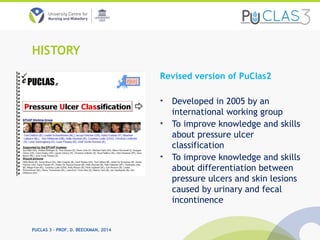
HISTORY
Revised version of PuClas2
• Developed in 2005 by an
international working group
• To improve knowledge and skills
about pressure ulcer
classification
• To improve knowledge and skills
about differentiation between
pressure ulcers and skin lesions
caused by urinary and fecal
incontinence
PUCLAS 3 – PROF. D. BEECKMAN, 2014
HISTORY
Reliability of
classification
PUCLAS 1
(Defloor & Schoonhoven
2004, Defloor et al. 2006,
Beeckman et al. 2007)
o The identification of the different affected tissue layers is a
complex skill that requires training and time
o Moisture lesions (IAD) and pressure ulcers are often confused
o More training is needed
o Clinical relevant guidelines should be developed
PUCLAS 3 – PROF. D. BEECKMAN, 2014
HISTORY
Reliability of
classification
PUCLAS 1
(Defloor & Schoonhoven
2004, Defloor et al. 2006,
Beeckman et al. 2007)
PUCLAS
classification
guideline
o 15 experts
o Identification of the wound
characteristics used by experts
when classifying wounds using
the thinking aloud method
o Causes, Location, Shape,
Depth, Necrosis, Edges, Colour
PUCLAS 3 – PROF. D. BEECKMAN, 2014
HISTORY
Reliability of
classification
PUCLAS 1
(Defloor & Schoonhoven
2004, Defloor et al. 2006,
Beeckman et al. 2007)
PUCLAS
classification
guideline
Effect on
classification
skills
(Beeckman et al. 2008
Beeckman et al. 2010)
PUCLAS 2
PUCLAS 3 – PROF. D. BEECKMAN, 2014
Gold standard
Normal Skin
Blanchable
Erythema
Cat 1
Cat 2
Cat 3
Cat 4
IAD
IAD + PU
Normal
Skin
Blanchable
Erythema
Cat 1 Cat 2 Cat 3 Cat 4 IAD IAD + PU
Classificationbyparticipants
Pre-test (Experimental)Post-test (Experimental)
HISTORY
PUCLAS 3 – PROF. D. BEECKMAN, 2014
HISTORY
Reliability of
classification
PUCLAS 1
(Defloor & Schoonhoven
2004, Defloor et al. 2006,
Beeckman et al. 2007)
PUCLAS
classification
guideline
Effect on
classification
skills
(Beeckman et al. 2008
Beeckman et al. 2010)
PUCLAS 2
EPUAP/NPUAP 2009
Guidelines
o Changes in classification system
o IAD terminology
o Differentiation between pressure
ulcers and IAD
PUCLAS 3 – PROF. D. BEECKMAN, 2014
HISTORY
Reliability of
classification
PUCLAS 1
(Defloor & Schoonhoven
2004, Defloor et al. 2006,
Beeckman et al. 2007)
PUCLAS
classification
guideline
Effect on
classification
skills
(Beeckman et al. 2008
Beeckman et al. 2010)
PUCLAS 2
EPUAP/NPUAP 2009
Guidelines
PUCLAS 3 – PROF. D. BEECKMAN, 2014
Before After
WHAT’S NEW IN PUCLAS3?
PUCLAS 3 – PROF. D. BEECKMAN, 2014
WHAT’S NEW IN PUCLAS3?
What is new in PuClas3 ...
• Four modules:
• Introduction to pressure ulcers
• Introduction to incontinence- Associated Dermatitis (IAD)
• Pressure ulcer classification
• Differentiation between pressure ulcers and IAD
• Simple, clean and modern design
• High quality photographs
• Assessment modules and certificate
• Separate assessment module including cases and photographs
• Simpler navigation and content separation
PUCLAS 3 – PROF. D. BEECKMAN, 2014
Before After
WHAT’S NEW IN PUCLAS3?
PUCLAS 3 – PROF. D. BEECKMAN, 2014
WHAT’S NEW IN PUCLAS3?
PUCLAS 3 – PROF. D. BEECKMAN, 2014
WHAT’S NEW IN PUCLAS3?
Module 1 – Introduction to pressure ulcers
This eLearning module will provide an overview of
pressure ulcers, the aetiology, prevalence and
incidence, impact on patient quality of life and
carers, and basic principles for prevention.
PUCLAS 3 – PROF. D. BEECKMAN, 2014
WHAT’S NEW IN PUCLAS3?
Module 2 – Introduction to incontinence- associated
dermatitis (IAD)
This module will provide an introduction to Incontinence-
Associated Dermatitis (IAD), the size and impact of the
problem, aetiology and basic principles for prevention.
PUCLAS 3 – PROF. D. BEECKMAN, 2014
WHAT’S NEW IN PUCLAS3?
Module 3 – Pressure ulcer classification
This eLearning module will provide an overview of the current
Pressure Ulcer Classification System
PUCLAS 3 – PROF. D. BEECKMAN, 2014
WHAT’S NEW IN PUCLAS3?
Module 4 – Differentiation between Incontinence-Associated
Dermatitis (IAD) and Pressure Ulcers
This eLearning module will provide an overview of the clinical
and patient characteristics of IAD versus pressure ulcers and
the importance of making the correct differential diagnosis.
PUCLAS 3 – PROF. D. BEECKMAN, 2014
Introduction of new useful charts e.g. IAD aetiology
WHAT’S NEW IN PUCLAS3?
PUCLAS 3 – PROF. D. BEECKMAN, 2014
Improvements to data visuals
WHAT’S NEW IN PUCLAS3?
PUCLAS 3 – PROF. D. BEECKMAN, 2014
Short summaries to aid knowledge retention, opportunity to provide feedback
and complete a knowledge check.
WHAT’S NEW IN PUCLAS3?
PUCLAS 3 – PROF. D. BEECKMAN, 2014
Interactive knowledge checks including visual assessments
WHAT’S NEW IN PUCLAS3?
PUCLAS 3 – PROF. D. BEECKMAN, 2014
HOW TO USE AND TO GET INVOLVED?
• EPUAP members will get access to content and will be sent a link.
• Access to content will be through a new link, user name and password.
• PuClas3 will allow you to track progress, provide feedback and
complete short knowledge checks.
• Opportunity to contribute and update with additional cases
• Feedback by users
• Translation
PUCLAS 3 – PROF. D. BEECKMAN, 2014
WHO MADE THIS INTERNATIONAL PROJECT
POSSIBILE?
• EPUAP and Board of Trustees
• International working group of experts
• Professionals who provided feedback and
photographs (names will be listed in PuClas3)
• Partners who have provided an unrestricted
educational grant for the technical support
(3M Health Care)
• You as a user and improver of the quality of
pressure ulcer care ...
PUCLAS 3 – PROF. D. BEECKMAN, 2014
EPUAP 2015
18th
Annual Meeting of the European Pressure Ulcer Advisory Panel
PUTTING THE PRESSURE IN THE HEART OF EUROPE
16 – 18 September 2015, Ghent, Belgium
www.epuap2015.org
34
PUCLAS 3 – PROF. D. BEECKMAN, 2014
CONTACT
• URL: http://www.epuap.org
• Email: Dimitri.Beeckman@UGent.be

The PuClas 3 project

  • 1.
    Prof. dr. DimitriBeeckman PhD University Centre for Nursing and Midwifery Ghent University, Belgium European Pressure Ulcer Advisory Panel Chair of the Scientific Committee The PuClas3 Project Progetto PUCLAS III
  • 2.
    PUCLAS 3 –PROF. D. BEECKMAN, 2014 Category I : Non- blanchable erythema Category II : Partial thickness skin loss Category III : Full thickness skin loss Category IV : Full thickness tissue loss Cat. 1 Cat. 2 Cat. 3 Cat. 4 INTRODUCTION
  • 3.
    PUCLAS 3 –PROF. D. BEECKMAN, 2014 T.Defloor - Verplegingswetenschap - Universiteit Gent 3 1 2 3
  • 4.
    PUCLAS 3 –PROF. D. BEECKMAN, 2014 Definition  A reactive response of the skin to chronic exposure to urine and faecal material which could be observed as an inflammation and erythema with or without erosion or denudation INTRODUCTION
  • 5.
    PUCLAS 3 –PROF. D. BEECKMAN, 2014 Size of the problem:  Survey (1911 caregivers) o 90.4% observed IAD in daily practice o Confusion about prevention • IAD is not a pressure ulcer (73.5%) • … but should be prevented as a pressure ulcer (61.5%) INTRODUCTION
  • 6.
    PUCLAS 3 –PROF. D. BEECKMAN, 2014 Moisture Urine Faeces Urine/faeces Washing Ureum/amonium pH Bacterial load Enzym. activity pH Bacterial load Enzym. activity Ureum/amonium pH Bacterial load Chemical irritation Physical irritation + Skin permeability pH Bacterial growth Cutaneous infections Friction IAD+Weakened skin ETIOLOGY Beeckman et al. 2009
  • 7.
    PUCLAS 3 –PROF. D. BEECKMAN, 2014 o Skin barrier  Stratum corneum: enucleate corneocytes with a basket- weave appearance  Patterned lipid lamellae in the extracellular spaces between the corneocytes  Effective barrier to water loss , however, there is some NORMAL movement of water through the stratum corneum into the surrounding atmosphere (TEWL)  Normal skin: low levels of TEWL ETIOLOGY
  • 8.
    PUCLAS 3 –PROF. D. BEECKMAN, 2014 o Skin barrier ETIOLOGY
  • 9.
    PUCLAS 3 –PROF. D. BEECKMAN, 2014 CLINICAL CHARACTERISTICS
  • 10.
    PUCLAS 3 –PROF. D. BEECKMAN, 2014 CLINICAL CHARACTERISTICS
  • 11.
    PUCLAS 3 –PROF. D. BEECKMAN, 2014 IAD Pressure ulcer 1. Cause Moisture (+ friction) Pressure/Shear 2. Location Peri- anal (anal cleft) Bony prominence 3. Shape Diffuse – Kissing ulcer 1 spot 4. Depth Superficial Superfical - deep 5. Necrosis - Possible 6. Edges Diffuse - irregular Distinct edges 7. Colour Redness is not equal Redness is equal CLINICAL CHARACTERISTICS
  • 12.
    PUCLAS 3 –PROF. D. BEECKMAN, 2014 o How to improve skin inspection?  Education to improve visual inspection skills (PuClas3)  Develop instruments to guide nurses/clinicians through differential diagnosis  Develop and incorporate technology to aid with differentiation DIAGNOSIS: SKIN INSPECTION
  • 13.
    PUCLAS 3 –PROF. D. BEECKMAN, 2014 HISTORY Revised version of PuClas2 • Developed in 2005 by an international working group • To improve knowledge and skills about pressure ulcer classification • To improve knowledge and skills about differentiation between pressure ulcers and skin lesions caused by urinary and fecal incontinence
  • 14.
    PUCLAS 3 –PROF. D. BEECKMAN, 2014 HISTORY Reliability of classification PUCLAS 1 (Defloor & Schoonhoven 2004, Defloor et al. 2006, Beeckman et al. 2007) o The identification of the different affected tissue layers is a complex skill that requires training and time o Moisture lesions (IAD) and pressure ulcers are often confused o More training is needed o Clinical relevant guidelines should be developed
  • 15.
    PUCLAS 3 –PROF. D. BEECKMAN, 2014 HISTORY Reliability of classification PUCLAS 1 (Defloor & Schoonhoven 2004, Defloor et al. 2006, Beeckman et al. 2007) PUCLAS classification guideline o 15 experts o Identification of the wound characteristics used by experts when classifying wounds using the thinking aloud method o Causes, Location, Shape, Depth, Necrosis, Edges, Colour
  • 16.
    PUCLAS 3 –PROF. D. BEECKMAN, 2014 HISTORY Reliability of classification PUCLAS 1 (Defloor & Schoonhoven 2004, Defloor et al. 2006, Beeckman et al. 2007) PUCLAS classification guideline Effect on classification skills (Beeckman et al. 2008 Beeckman et al. 2010) PUCLAS 2
  • 17.
    PUCLAS 3 –PROF. D. BEECKMAN, 2014 Gold standard Normal Skin Blanchable Erythema Cat 1 Cat 2 Cat 3 Cat 4 IAD IAD + PU Normal Skin Blanchable Erythema Cat 1 Cat 2 Cat 3 Cat 4 IAD IAD + PU Classificationbyparticipants Pre-test (Experimental)Post-test (Experimental) HISTORY
  • 18.
    PUCLAS 3 –PROF. D. BEECKMAN, 2014 HISTORY Reliability of classification PUCLAS 1 (Defloor & Schoonhoven 2004, Defloor et al. 2006, Beeckman et al. 2007) PUCLAS classification guideline Effect on classification skills (Beeckman et al. 2008 Beeckman et al. 2010) PUCLAS 2 EPUAP/NPUAP 2009 Guidelines o Changes in classification system o IAD terminology o Differentiation between pressure ulcers and IAD
  • 19.
    PUCLAS 3 –PROF. D. BEECKMAN, 2014 HISTORY Reliability of classification PUCLAS 1 (Defloor & Schoonhoven 2004, Defloor et al. 2006, Beeckman et al. 2007) PUCLAS classification guideline Effect on classification skills (Beeckman et al. 2008 Beeckman et al. 2010) PUCLAS 2 EPUAP/NPUAP 2009 Guidelines
  • 20.
    PUCLAS 3 –PROF. D. BEECKMAN, 2014 Before After WHAT’S NEW IN PUCLAS3?
  • 21.
    PUCLAS 3 –PROF. D. BEECKMAN, 2014 WHAT’S NEW IN PUCLAS3? What is new in PuClas3 ... • Four modules: • Introduction to pressure ulcers • Introduction to incontinence- Associated Dermatitis (IAD) • Pressure ulcer classification • Differentiation between pressure ulcers and IAD • Simple, clean and modern design • High quality photographs • Assessment modules and certificate • Separate assessment module including cases and photographs • Simpler navigation and content separation
  • 22.
    PUCLAS 3 –PROF. D. BEECKMAN, 2014 Before After WHAT’S NEW IN PUCLAS3?
  • 23.
    PUCLAS 3 –PROF. D. BEECKMAN, 2014 WHAT’S NEW IN PUCLAS3?
  • 24.
    PUCLAS 3 –PROF. D. BEECKMAN, 2014 WHAT’S NEW IN PUCLAS3? Module 1 – Introduction to pressure ulcers This eLearning module will provide an overview of pressure ulcers, the aetiology, prevalence and incidence, impact on patient quality of life and carers, and basic principles for prevention.
  • 25.
    PUCLAS 3 –PROF. D. BEECKMAN, 2014 WHAT’S NEW IN PUCLAS3? Module 2 – Introduction to incontinence- associated dermatitis (IAD) This module will provide an introduction to Incontinence- Associated Dermatitis (IAD), the size and impact of the problem, aetiology and basic principles for prevention.
  • 26.
    PUCLAS 3 –PROF. D. BEECKMAN, 2014 WHAT’S NEW IN PUCLAS3? Module 3 – Pressure ulcer classification This eLearning module will provide an overview of the current Pressure Ulcer Classification System
  • 27.
    PUCLAS 3 –PROF. D. BEECKMAN, 2014 WHAT’S NEW IN PUCLAS3? Module 4 – Differentiation between Incontinence-Associated Dermatitis (IAD) and Pressure Ulcers This eLearning module will provide an overview of the clinical and patient characteristics of IAD versus pressure ulcers and the importance of making the correct differential diagnosis.
  • 28.
    PUCLAS 3 –PROF. D. BEECKMAN, 2014 Introduction of new useful charts e.g. IAD aetiology WHAT’S NEW IN PUCLAS3?
  • 29.
    PUCLAS 3 –PROF. D. BEECKMAN, 2014 Improvements to data visuals WHAT’S NEW IN PUCLAS3?
  • 30.
    PUCLAS 3 –PROF. D. BEECKMAN, 2014 Short summaries to aid knowledge retention, opportunity to provide feedback and complete a knowledge check. WHAT’S NEW IN PUCLAS3?
  • 31.
    PUCLAS 3 –PROF. D. BEECKMAN, 2014 Interactive knowledge checks including visual assessments WHAT’S NEW IN PUCLAS3?
  • 32.
    PUCLAS 3 –PROF. D. BEECKMAN, 2014 HOW TO USE AND TO GET INVOLVED? • EPUAP members will get access to content and will be sent a link. • Access to content will be through a new link, user name and password. • PuClas3 will allow you to track progress, provide feedback and complete short knowledge checks. • Opportunity to contribute and update with additional cases • Feedback by users • Translation
  • 33.
    PUCLAS 3 –PROF. D. BEECKMAN, 2014 WHO MADE THIS INTERNATIONAL PROJECT POSSIBILE? • EPUAP and Board of Trustees • International working group of experts • Professionals who provided feedback and photographs (names will be listed in PuClas3) • Partners who have provided an unrestricted educational grant for the technical support (3M Health Care) • You as a user and improver of the quality of pressure ulcer care ...
  • 34.
    PUCLAS 3 –PROF. D. BEECKMAN, 2014 EPUAP 2015 18th Annual Meeting of the European Pressure Ulcer Advisory Panel PUTTING THE PRESSURE IN THE HEART OF EUROPE 16 – 18 September 2015, Ghent, Belgium www.epuap2015.org 34
  • 35.
    PUCLAS 3 –PROF. D. BEECKMAN, 2014 CONTACT • URL: http://www.epuap.org • Email: Dimitri.Beeckman@UGent.be