The Probabilistic Foundations Of Rational Learning Simon M Huttegger
The Probabilistic Foundations Of Rational Learning Simon M Huttegger
The Probabilistic Foundations Of Rational Learning Simon M Huttegger
The Probabilistic Foundations Of Rational Learning Simon M Huttegger
The Probabilistic Foundations Of Rational Learning Simon M Huttegger
1.
The Probabilistic FoundationsOf Rational
Learning Simon M Huttegger download
https://ebookbell.com/product/the-probabilistic-foundations-of-
rational-learning-simon-m-huttegger-6773648
Explore and download more ebooks at ebookbell.com
2.
Here are somerecommended products that we believe you will be
interested in. You can click the link to download.
The Probabilistic Foundations Of Rational Learning Simon M Huttegger
https://ebookbell.com/product/the-probabilistic-foundations-of-
rational-learning-simon-m-huttegger-11046826
Foundations Of The Formal Sciences Vi Probabilistic Reasoning And
Reasoning With Probabilities B Loewe
https://ebookbell.com/product/foundations-of-the-formal-sciences-vi-
probabilistic-reasoning-and-reasoning-with-probabilities-b-
loewe-5768288
The Probabilistic Method Third Edition 3rd Edition Noga Alon
https://ebookbell.com/product/the-probabilistic-method-third-
edition-3rd-edition-noga-alon-2433652
The Probabilistic Mind Prospects For Bayesian Cognitive Science 1st
Edition Nick Chater
https://ebookbell.com/product/the-probabilistic-mind-prospects-for-
bayesian-cognitive-science-1st-edition-nick-chater-4941740
3.
The Probabilistic Method4th Edition Noga Alon Joel H Spencer
https://ebookbell.com/product/the-probabilistic-method-4th-edition-
noga-alon-joel-h-spencer-5315508
The Probabilistic Method 2 Sub Noga Alon Joel H Spencer
https://ebookbell.com/product/the-probabilistic-method-2-sub-noga-
alon-joel-h-spencer-1532126
The Probabilistic Sir Model Psir In The Pandemic Process Marcus
Hellwig
https://ebookbell.com/product/the-probabilistic-sir-model-psir-in-the-
pandemic-process-marcus-hellwig-51148318
Graph Colouring And The Probabilistic Method 1st Edition Michael
Molloy
https://ebookbell.com/product/graph-colouring-and-the-probabilistic-
method-1st-edition-michael-molloy-2212932
Graph Colouring And The Probabilistic Method Michael Molloy Bruce Reed
Auth
https://ebookbell.com/product/graph-colouring-and-the-probabilistic-
method-michael-molloy-bruce-reed-auth-4238202
6.
The Probabilistic Foundationsof Rational Learning
According to Bayesian epistemology, rational learning from experi-
ence is consistent learning, that is learning should incorporate new
information consistently into one’s old system of beliefs. Simon Hut-
tegger argues that this core idea can be transferred to situations where
the learner’s informational inputs are much more limited than con-
ventional Bayesianism assumes, thereby significantly expanding the
reach of a Bayesian type of epistemology. What results from this is a
unified account of probabilistic learning in the tradition of Richard
Jeffrey’s “radical probabilism”. Along the way, Huttegger addresses a
number of debates in epistemology and the philosophy of science,
including the status of prior probabilities, whether Bayes’ rule is
the only legitimate form of learning from experience, and whether
rational agents can have sustained disagreements. His book will be
of interest to students and scholars of epistemology, of game and
decision theory, and of cognitive, economic, and computer sciences.
S I M O N M . H U T T E G G E R is Professor of Logic and Philosophy of
Science at the University of California, Irvine. His work focuses on
game and decision theory, probability, and the philosophy of science,
and has been published in numerous journals.
University Printing House,Cambridge CB2 8BS, United Kingdom
One Liberty Plaza, 20th Floor, New York, NY 10006, USA
477 Williamstown Road, Port Melbourne, VIC 3207, Australia
4843/24, 2nd Floor, Ansari Road, Daryaganj, Delhi – 110002, India
79 Anson Road, #06–04/06, Singapore 079906
Cambridge University Press is part of the University of Cambridge.
It furthers the University’s mission by disseminating knowledge in the pursuit of
education, learning, and research at the highest international levels of excellence.
www.cambridge.org
Information on this title: www.cambridge.org/9781107115323
DOI: 10.1017/9781316335789
c
Simon M. Huttegger 2017
This publication is in copyright. Subject to statutory exception
and to the provisions of relevant collective licensing agreements,
no reproduction of any part may take place without the written
permission of Cambridge University Press.
First published 2017
Printed in the United Kingdom by Clays, St Ives plc
A catalogue record for this publication is available from the British Library.
ISBN 978-1-107-11532-3 Hardback
Cambridge University Press has no responsibility for the persistence or accuracy of
URLs for external or third-party internet websites referred to in this publication
and does not guarantee that any content on such websites is, or will remain,
accurate or appropriate.
Contents
List of Figurespage [x]
Preface and Acknowledgments [xi]
Introduction [1]
Abstract Models of Learning [1]
1 Consistency and Symmetry [9]
1.1 Probability [10]
1.2 Pragmatic Approaches [12]
1.3 Epistemic Approaches [15]
1.4 Conditioning and Dynamic Consistency [19]
1.5 Symmetry and Inductive Inference [24]
1.6 Summary and Outlook [29]
2 Bounded Rationality [32]
2.1 Fictitious Play [33]
2.2 Bandit Problems [34]
2.3 Payoff-Based Learning Procedures [37]
2.4 The Basic Model of Reinforcement Learning [41]
2.5 Luce’s Choice Axiom [43]
2.6 Commutative Learning Operators [47]
2.7 A Minimal Model [50]
2.8 Rationality and Learning [52]
3 Pattern Learning [56]
3.1 Taking Turns [56]
3.2 Markov Fictitious Play [59]
3.3 Markov Exchangeability [62]
3.4 Cycles [64]
3.5 Markov Reinforcement Learning [68]
3.6 Markov Learning Operators [72]
3.7 The Complexity of Learning [73]
4 Large Worlds [77]
4.1 It’s a Large World (After All) [78]
4.2 Small World Rationality [82]
4.3 Learning the Unknown [85]
vii
13.
viii Contents
4.4 ExchangeableRandom Partitions [88]
4.5 Predicting the Unpredictable [90]
4.6 Generalizing Fictitious Play [94]
4.7 Generalizing Reinforcement Learning [96]
4.8 Learning in Large Worlds with Luce’s Choice Axiom [98]
5 Radical Probabilism [102]
5.1 Prior Probabilities [103]
5.2 Probability Kinematics [106]
5.3 Radical Probabilism [111]
5.4 Dynamically Consistent Models [114]
5.5 Martingales [119]
5.6 Conditional Probability and Conditional Expectation [121]
5.7 Predicting Choices [124]
6 Reflection [126]
6.1 Probabilities of Future Probabilities [126]
6.2 Dynamic Consistency [129]
6.3 Expected Accuracy [131]
6.4 Best Estimates [133]
6.5 General Distance Measures [137]
6.6 The Value of Knowledge [139]
6.7 Genuine Learning [141]
6.8 Massaging Degrees of Belief [143]
6.9 Countable Additivity [146]
7 Disagreement [149]
7.1 Agreeing to Disagree [150]
7.2 Diverging Opinions [151]
7.3 Learning from Others [154]
7.4 Averaging and Inductive Logic [156]
7.5 Generalizations [161]
7.6 Global Updates [163]
7.7 Alternatives [164]
7.8 Conclusion [165]
8 Consensus [167]
8.1 Convergence to the Truth [168]
8.2 Merging of Opinions [171]
8.3 Nash Equilibrium [173]
8.4 Merging and Probability Kinematics [177]
8.5 Divergence and Probability Kinematics [181]
8.6 Alternative Approaches [184]
8.7 Rational Disagreement [185]
Appendix A Inductive Logic [189]
A.1 The Johnson–Carnap Continuum of Inductive Methods [189]
14.
Contents ix
A.2 DeFinetti Representation [191]
A.3 Bandit Problems [192]
Appendix B Partial Exchangeability [196]
B.1 Partial Exchangeability [196]
B.2 Representations of Partially Exchangeable Arrays [197]
B.3 Average Reinforcement Learning [198]
B.4 Regret Learning [199]
Appendix C Marley’s Axioms [201]
C.1 Abstract Families [201]
C.2 Marley’s Theorem [202]
C.3 The Basic Model [204]
Bibliography [206]
Index [220]
15.
Figures
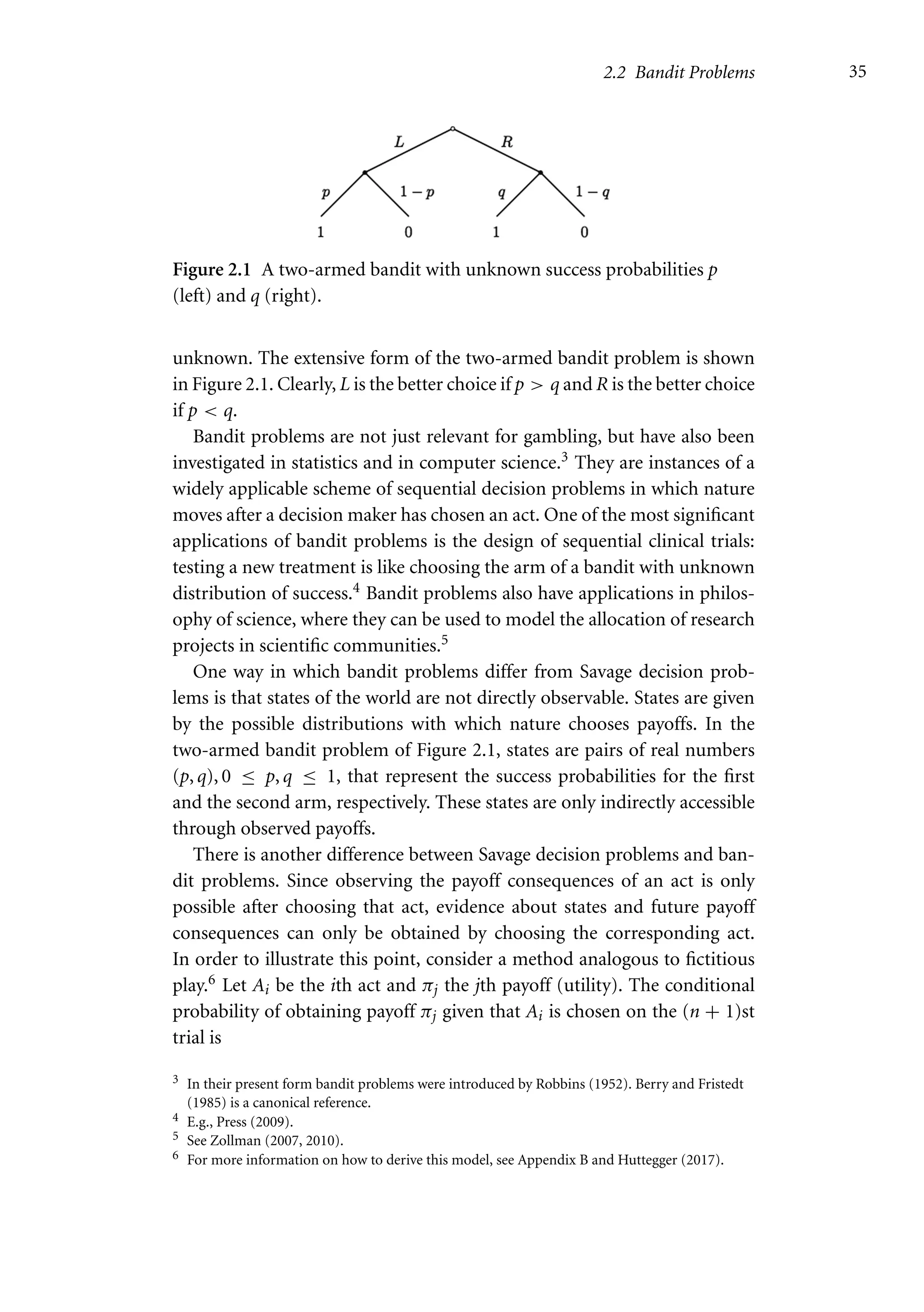
2.1 Two-armed banditproblem. [35]
3.1 Taking Turns game. [58]
3.2 Number of transitions. [62]
3.3 The Shapley game. [64]
3.4 Payoffs based on Markov chain. [68]
x
16.
Preface and Acknowledgments
Thework presented here develops a comprehensive probabilistic approach
to learning from experience. The central question I try to answer is: “What
is a correct response to some new piece of information?” This question
calls for an evaluative analysis of learning which tells us whether, or when,
a learning procedure is rational. At its core, this book embraces a Bayesian
approach to rational learning, which is prominent in economics, philos-
ophy of science, statistics, and epistemology. Bayesian rational learning
rests on two pillars: consistency and symmetry. Consistency requires that
beliefs are probabilities and that new information is incorporated consis-
tently into one’s old beliefs. Symmetry leads to tractable models of how to
update probabilities. I will endorse this approach to rational learning, but
my main objective is to extend it to models of learning that seem to fall out-
side the Bayesian purview – in particular, to models of so-called “bounded
rationality.” While these models may often not be reconciled with Bayesian
decision theory (maximization of expected utility), I hope to show that they
are governed by consistency and symmetry; as it turns out, many bounded
learning models can be derived from first principles in the same way as
Bayesian learning models.
This project is a continuation of Richard Jeffrey’s epistemological pro-
gram of radical probabilism. Radical probabilism holds that a proper
Bayesian epistemology should be broad enough to encompass many dif-
ferent forms of learning from experience besides conditioning on factual
evidence, the standard form of Bayesian updating. The fact that boundedly
rational learning can be treated in a Bayesian manner, by using consistency
and symmetry, allows us to bring them under the umbrella of radical prob-
abilism; in a sense, a broadly conceived Bayesian approach provides us with
“the one ring to rule them all” (copyright Jeff Barrett). As a consequence,
the difference between high rationality models and bounded rationality
models of learning is not as large as it is sometimes thought to be; rather
than residing in the core principles of rational learning, it originates in the
type of information used for updating.
Many friends and colleagues have helped with working out the ideas
presented here. Jeff Barrett (who contributed much more than the ring xi
17.
xii Preface andAcknowledgments
metaphor), Brian Skyrms, and Kevin Zollman have provided immensely
helpful feedback prior to as well as throughout the process of writing this
book. My late friend Werner Callebaut introduced me to Herbert Simon’s
ideas about bounded rationality. Hannah Rubin spotted a number of weak-
nesses in my arguments. Gregor Grehslehner, Sabine Kunrath, and Gerard
Rothfus read the entire manuscript very carefully and gave detailed com-
ments. Many others have provided important feedback: Johannes Brandl,
Justin Bruner, Kenny Easwaran, Jim Joyce, Theo Kuipers, Louis Narens,
Samir Okasha, Jan-Willem Romeijn, Teddy Seidenfeld, Bas van Fraassen,
and Carl Wagner. I have also profited from presenting material at the Uni-
versity of Groningen, the University of Salzburg, the University of Munich,
the University of Bielefeld, and the University of Michigan, and from
conversations with Albert Anglberger, Brad Armendt, Cristina Bicchieri,
Peter Brössel, Jake Chandler, Christian Feldbacher, Patrick Forber, Norbert
Gratzl, Josef Hofbauer, Hannes Leitgeb, Arthur Merin, Cailin O’Connor,
Richard Pettigrew, Gerhard Schurz, Reuben Stern, Peter Vanderschraaf,
Kai Wehmeier, Paul Weingartner, Charlotte Werndl, Greg Wheeler, Sandy
Zabell, and Francesca Zaffora Blando. I would, moreover, like to thank the
team at Cambridge University Press and two anonymous referees.
UC Irvine provided time for a much needed sabbatical leave in 2013–14,
which I spent writing the first third of this book by commuting between
the Department of Philosophy at Salzburg and the Munich Center for
Mathematical Philosophy. I’d like to thank these two institutions for their
hospitality, as well as Laura Perna and Volker Springel for allowing me to
live in their beautiful and wonderfully quiet Munich apartment.
Some parts of the book rely on previously published articles. Material
from “Inductive Learning in Small and Large Worlds” (Philosophy and Phe-
nomenological Research) is spread out over Chapters 2, 4, and 5; Chapter 6
is mostly based on “In Defense of Reflection” (Philosophy of Science) and
“Learning Experiences and the Value of Knowledge” (Philosophical Stud-
ies); and Chapter 8 draws on my “Merging of Opinions and Probability
Kinematics” (The Review of Symbolic Logic). I thank the publishers for
permission to reproduce this material here.
My greatest personal thanks go to a number of people whose generos-
ity and help have been essential for putting me in the position to write
this book. Back in Salzburg, I’m particularly indebted to Hans Czermak
and Georg Dorn; without Georg I would have left philosophy, and with-
out Hans I wouldn’t have learned any interesting mathematics. Since I first
came to Irvine, the members of the Department of Logic and Philosophy
18.
Preface and Acknowledgmentsxiii
of Science, and especially Brian Skyrms, have taken an interest in my intel-
lectual development and my career that has gone far beyond the call of
duty. The unwavering support of my parents, to whom I dedicate this book,
has been invaluable; I learned from them that meaningfulness and deep
engagement are more important than mere achievement or success. My
sisters and my brother have been my earliest companions and friends, and
they still are among my best. Finally, I thank Sabine, Teresa, and Benedikt
for their love.
20.
Introduction
Abstract Models ofLearning
Learning is something we are all very familiar with. As children we learn
to recognize faces, to walk, to speak, to climb trees and ride bikes, and so
many other things that it would be a hopeless task to continue the list. Later
we learn how to read and write; we learn arithmetic, calculus, and foreign
languages; we learn how to cook spaghetti, how to drive a car, or what’s
the best response to telemarketing calls. Even as adults, when many of our
beliefs have become entrenched and our behaviors often are habitual, there
are new alternatives to explore if we wish to do so; and sometimes we even
may revise long-held beliefs or change our conduct based on something we
have learned.
So learning is a very important part of our lives. But it is not restricted
to humans, assuming we understand it sufficiently broadly. Animals learn
when they adjust their behavior to external stimuli. Even plants and very
simple forms of life like bacteria can be said to “learn” in the sense of
responding to information from their environment, as do some of the
machines and computer programs created by us; search engines learn a
lot about you from your search history (leading to the funky marketing
idea that the underlying algorithms know more about you than you do
yourself).
Thus, learning covers a wide variety of phenomena that share a partic-
ular pattern: some old state of an individual (what you believe, how you
act, etc.) is altered in response to new information. This general descrip-
tion encompasses many distinct ways of learning, but it is too broad to
characterize learning events. There are all kinds of epistemically irrelevant
or even harmful factors that can have an influence on how an individual’s
state is altered. In order to better understand learning events and what sets
them apart from other kinds of events, this book uses abstract models of
learning, that is, precise mathematical representations of learning proto-
cols. Abstract models of learning are studied in many fields, such as decision
and game theory, mathematical psychology, and computer science. I will
explore some learning models that I take to be especially interesting. But
this should by no means suggest that this book provides a comprehensive
overview of learning models. A cursory look into the literature already 1
21.
2 Introduction
reveals agreat and sometimes bewildering variety of learning methods,
which are applied in many different contexts for various purposes. My
hope is, of course, that the ideas put forward in this book will also help
to illuminate other models of learning.
One reason to study mathematical representations of learning has to do
with finding descriptively adequate models of human or animal learning. In
contrast, the question of how to justify particular methods of learning takes
center stage if we wish to study the philosophical foundations of learning.
Here we are not asking whether a learning model describes a real individ-
ual, but whether the learning method expressed by the model is rational.
A theory of rational learning allows us to evaluate which of various learn-
ing methods is the correct one to use. The descriptive function of abstract
learning models is of obvious importance, and there certainly is an inter-
play between the descriptive and the evaluative levels – after all, we do think
that sometimes we actually learn from new information according to a cor-
rect scheme. In this book, however, I will mostly focus on the evaluative
side.
Before I explain how I hope to achieve this goal, let me clarify two imme-
diate points of concern. First, it is tempting to speak of rational learning
only in cases where the learner has reflective attitudes about her own modes
of learning. By this I mean that a learner has the cognitive abilities and
the language to analyze and evaluate her own learning process. If rational
learning is restricted in this way, a theory of rational learning can only be
developed for very sophisticated agents; organisms or machines who lack
these self-reflective abilities could never learn rationally, by definition. I’m
not going to follow this very narrow understanding of rational learning, for
a simple reason: even if an agent lacks sophisticated reflective abilities, it is
at least in principle possible to evaluate her learning process from her per-
spective; that is to say, we can ask whether, or under which circumstances,
it is rational for an agent to adopt this learning procedure in the light of
a set of evaluative criteria. This allows us to investigate many otherwise
unintelligible ways of updating on new information.
The second point is a rather obvious fact about learning models, which
is nonetheless easily forgotten (for this reason I’m going to highlight it at
several points in the book). Abstract models of learning, like all models,
involve idealizations. For the descriptive function of learning models this
means that many of the complexities of a real individual’s learning behavior
are ignored in a learning model in order to make it tractable. If we wanted
a model that captures each and every aspect of a learner, then we might
as well forego the modeling process and stick to the original. Something
22.
Abstract Models ofLearning 3
similar is true for matters of rational learning. Without idealizing and sim-
plifying assumptions it is impossible to obtain sharp results, and without
sharp results it is difficult to have a focused discussion of the problems asso-
ciated with rational learning. This is not to deny that idealizations require
critical scrutiny; they certainly do, but scrutiny has to come from a plausi-
ble point of view. One point of view from which to examine idealizations
in models of rational learning will come up repeatedly in our discussion
of updating procedures. Rational models express an ideal according to a
set of evaluative standards. In practice, such an ideal might be difficult to
attain. But this by itself does not speak against the evaluative standards. A
rational model conveys a set of standards in its pure form, and this helps in
evaluating real learning processes even if they fail to meet those standards
completely.
In philosophy, the question of which learning procedures are rational is
closely connected to the problem of induction. The problem of induction
suggests that there is no unconditional justification for our most cherished
patterns of inductive inference, namely those that project past regularities
into the future. Chapter 1 presents what I take to be the Bayesian estab-
lishment view of the problem of induction, which mostly goes back to the
groundbreaking work of Bruno de Finetti. The Bayesian treatment builds
on the idea that the rationality of inductive procedures is a conditional, rel-
ative one. Inductive learning methods are evaluated against the background
of particular inductive assumptions, which describe the fundamental beliefs
of an agent about a learning situation. The Bayesian program consists in
identifying a class of rational learning rules for each salient set of inductive
assumptions, while acknowledging the fact that inductive assumptions may
not themselves be justified unconditionally.
The two fundamental ideas underlying this program are consistency and
symmetry. Chapter 1 shows how consistency fixes the basic structure of
learning models: static consistency requires rational degrees of belief to
be probabilities; dynamic consistency requires that rational learning poli-
cies incorporate new information consistently into an agents old system
of beliefs. Symmetries are used to capture inductive assumptions that
fine-tune the basic structure of consistent learning models to fit specific
epistemic situations. The most famous example is exchangeability, which
says that probabilities are order invariant. Exchangeability is the basic
building block of de Finetti’s theory of inductive inference and Rudolf Car-
nap’s inductive logic. Combining de Finetti’s and Carnap’s works leads to
a subjective inductive logic which successfully solves the problem of how
23.
4 Introduction
to learnfrom observations in a special but important type of epistemic
situation.
In my opinion, the Bayesian establishment view is entirely satisfactory
for the kinds of learning situations de Finetti and his successors were
concerned with. The main drawback is its range of applicability. Richard
Jeffrey shed light on this matter by challenging an implicit assumption of
the orthodox theory: that new information always comes as learning the
truth value of an observational proposition, such as whether a coin lands
heads or tails. Working from another direction, Herbert Simon noted that
the Bayesian model only applies to very sophisticated agents. In partic-
ular, standard Bayesian learning often violates plausible procedural and
informational bounds of real-world agents. But there are other learning
procedures that respect those bounds, at least to some extent. One of the
most important ones is reinforcement learning. Reinforcement learning has
a bad reputation in some circles because of its association with behavior-
ism. However, it exhibits quite interesting and robust properties in learning
situations where an agent has no observational access to states of the world,
but only to realized payoffs, which determine success. Reinforcement learn-
ing requires agents to choose acts with higher probability if they were
successful in the past. While this suggests some kind of rationality, rein-
forcement learning seems to fall short of the Bayesian ideal of choosing an
act that maximizes expected utility with respect to a system of beliefs. The
same is true of other boundedly rational learning procedures. Are bounded
rationality learning procedures therefore irrational, full stop? Or do they
live up to some standards of rationality?
An affirmative answer to the first question would run against the inclu-
sive view I wish to promote in this book: evaluating the virtues of bounded
rationality learning procedures will be blocked if rational learning is the
exclusive province of classical Bayesian agents. What brings us closer to an
affirmative answer to the second question is to keep separate Bayesian deci-
sion theory and Bayesian learning theory. A learning procedure may fail
to maximize expected payoffs while adhering to the two basic principles
of rational Bayesian learning, consistency and symmetry; just think of a
model that chooses acts with the help of the conditional probabilities of
Bayesian updating, but uses them in other ways than maximizing expected
utility. This indicates that models of learning that are incompatible with
Bayesian decision theory may nonetheless be rational in a way that is similar
to Bayesian updating.
Various aspects of this idea will be developed in Chapters 2–6, where
I hope to show how Bayesian principles of consistency and symmetry
24.
Abstract Models ofLearning 5
apply to boundedly rational learning rules and to probabilistic learning
in general. Thus, I will argue that there is a rational core to learning
that encompasses both classical Bayesian updating and other probabilistic
models of learning.
In Chapter 2, I consider the class of payoff-based learning models. This
class is of special importance in decision and game theory because payoff-
based processes do not need any information about states of the world.
Most of the chapter focuses on a particular reinforcement learning model,
called the basic model of reinforcement learning. The basic model is concep-
tually challenging because it is based on the notions of choice probability
and propensity, which depart quite significantly from the elements of the
classical Bayesian model. The key to developing the foundations of the
basic model is Duncan Luce’s seminal work on individual choice behavior.
In particular, Luce’s choice axiom and the theory of commutative learning
operators can be used to establish principles of consistency and symmetry
for the basic model of reinforcement learning. At the same time, this will
provide a template for analyzing other models.
The learning procedures discussed in Chapters 1 and 2 have a very sim-
ple structure, since their symmetries express order invariance: that is, the
order in which new pieces of evidence arrive has no effect on how an agent
updates. However, order invariance makes it impossible to detect patterns
– a criticism Hilary Putnam has brought against Carnap’s inductive logic.
Chapter 3 shows that de Finetti’s ideas on generalizing exchangeability can
be used to solve these problems. Order invariant learning procedures can
be modified in a way that allows them to detect patterns. Besides deflat-
ing Putnam’s criticism of inductive logic, this demonstrates that there is a
sense in which learning rules can be successful in learning environments of
arbitrary finite complexity.
The topic of Chapter 4 is the problem of learning in large worlds. An
abstract model of learning operates within its own small world. What I
mean by this is that the inferences drawn within the model are not based
on all the information that one might deem relevant in a learning situa-
tion. A description of the learning situation is a large world if it includes all
relevant distinctions one can possibly think of. Consequently, conceptual-
izing the large world is a forbidding task even under the most favorable
circumstances. Since learning does usually take place in a small world,
the rationality of consistent inductive inferences drawn within the learn-
ing model are called into question. Without any clear understanding of
the large world, it seems difficult to judge whether small world inductive
inferences would also be judged rational in the large world.
25.
6 Introduction
The problemof large worlds has also been discussed in decision theory
by Leonard Savage, Jim Joyce, and others. By taking a clue from Joyce’s
discussion we will be able to clarify one aspect of the problem of learn-
ing in large worlds. The main idea is to require learning processes to be
consistently embeddable into larger worlds. Consistent embeddability guar-
antees that one’s coarse-grained inferences stay the same in larger worlds.
I demonstrate the usefulness of this idea with two examples of large world
learning procedures. One is a generalization of Carnap’s inductive logic to
situations where types of observations are not known in advance. The pro-
totypical example of this is what is known in statistics as the “sampling of
species process,” in which one may observe hitherto unknown species. A
similar process can be used to modify the basic model of reinforcement
learning. Both models exhibit a particular invariance that renders them
robust in large worlds. This invariance is based on Luce’s choice axiom. I
will argue that, while this does not give us a fully general solution to the
problem of learning in large worlds, it does provide us with some guidance
as to how to approach learning in complex situations that involve many
unknowns.
The first four chapters present a variety of learning procedures. How-
ever, with the exception of standard Bayesian learning, it is unclear why they
deserve to be called learning procedures. At a purely formal level all we have
is a sequence of quantities that describe how the state of an agent changes
over time. Bayesian updating proceeds from learning the truth of an obser-
vational proposition, but there are no such evidential propositions in the
other models. Now, obviously, a change in belief or behavior may be due
to all kinds of influences (having too many drinks, low blood sugar level,
forgetting, etc.). How can we make sure that individuals update on genuine
information if information cannot be captured by a factual proposition?
I try to answer this question in Chapters 5 and 6. Chapter 5 lays the
groundwork by embedding abstract models of learning into Jeffrey’s epis-
temology of radical probabilism. As mentioned above, Jeffrey has argued
that standard Bayesian learning is too narrow because it does not take
into account uncertain evidence – evidence that cannot be neatly summa-
rized by a factual proposition. Jeffrey extended Bayesian updating to what
he called probability kinematics, also known as Jeffrey conditioning. I will
argue that we should think of other probabilistic learning procedures along
the same lines. My argument relies on criteria for generalized probabilistic
learning studied by Michael Goldstein, Bas van Fraassen, and Brian Skyrms.
Generalized probabilistic learning can be thought of in terms of a black box,
where nothing at all is assumed about the structure of the learning event.
26.
Abstract Models ofLearning 7
Despite this lack of structure, consistency requires that generalized learning
observes reflection and martingale principles. These principles say, roughly
speaking, that an agent’s new opinions need to cohere with her old opin-
ions. Such principles of dynamic consistency are rather controversial. For
this reason, Chapter 6 presents an extended discussion of three ways of jus-
tifying reflection principles and their proper place as principles of epistemic
rationality.
In the final two chapters, I switch gears and turn to applications of ratio-
nal learning to social settings. That learning often does take place in a social
context is a commonplace observation. One question that arises out of the
concerns of this book is whether there can be disagreement among rational
agents. Chapters 7 and 8 examine two aspects of that question: learning
from others and learning from the same evidence. Chapter 7 treats the
problem of expert disagreement in terms of Bayesian rational learning. The
main question is how one should respond to learning that epistemic peers
disagree with one another; epistemic peers are, roughly speaking, equally
qualified to judge the matter at hand. Proposals range from conciliatory
views (meeting midway between the opinions of peers) to extreme views
(stick close to one opinion). I present a reconstruction of the peer dis-
agreement problem in terms of Carnapian inductive logic that explains the
epistemic conditions under which an agent should respond to disagreement
in a conciliatory or a steadfast way.
Chapter 8 develops some consequences of rational learning from the
same evidence. This topic is of interest to Bayesian philosophy of science,
since a couple of convergence theorems in Bayesian statistics demonstrate
the irrelevance of prior opinions in the long run: even if our initial beliefs
disagree, under certain conditions our beliefs come closer as we update
on the same evidence. Besides discussing the implications of this result, I
will drop one of its main assumptions – that evidence is learned with cer-
tainty – to see whether convergence also holds for Jeffrey conditioning. The
answer depends on which kind of uncertain evidence is available. There is a
solid kind of uncertain evidence that implies convergence in the proper cir-
cumstances. However, there also is a fluid kind of uncertain evidence that
allows agents to have sustained, long-run disagreements even though they
are updating on the same evidence. Overall, Chapters 7 and 8 show that
whether there is rational disagreement depends on the epistemic circum-
stances; they also suggest that there are plausible epistemic circumstances
in which rational learning is compatible with deep disagreements. I finish
Chapter 8 by arguing that there is nothing wrong with this view.
27.
8 Introduction
If youhave gotten this far through the introduction, you would proba-
bly like to know more about the background required for reading this book.
A little background in probability theory and decision theory is desirable,
but otherwise I have tried to make the book rather accessible. My empha-
sis is on revealing the main ideas without getting lost in technicalities, but
also without distorting them. Some of the more technical material has been
published in journal articles, and the rest can be found in the appendices.
The material covered in this book can sometimes be fairly dry and
abstract. This is partly an inherent feature of a foundational study that seeks
to unravel the rational principles underlying abstract models of learning. I
try to counteract this tendency by using examples from decision and game
theory so that one can see learning processes in action. However, I also trust
that the reader will find some joy in the austere charm of formal modeling.
28.
1 Consistency andSymmetry
From the theoretical, mathematical point of view, even the fact that the evalua-
tion of probability expresses somebody’s opinion is then irrelevant. It is purely
a question of studying it and saying whether it is coherent or not; i.e., whether
it is free of, or affected by, intrinsic contradictions. In the same way, in the
logic of certainty one ascertains the correctness of the deductions but not the
accuracy of the factual data assumed as premises.
Bruno de Finetti
Theory of Probability I
Symmetry arguments are tools of great power; therein lies not only their utility
and attraction, but also their potential treachery. When they are invoked one
may find, as did the sorcerer’s apprentice, that the results somewhat exceed
one’s expectations.
Sandy Zabell
Symmetry and Its Discontents
This chapter is a short introduction to the philosophy of inductive infer-
ence. After motivating the issues at stake, I’m going to focus on the two
ideas that will be developed in this book: consistency and symmetry.
Consistency is a minimal requirement for rational beliefs. It comes in
two forms: static consistency guarantees that one’s degrees of beliefs are not
self-contradictory, and dynamic consistency requires that new information
is incorporated consistently into one’s system of beliefs. I am not going to
present consistency arguments in full detail; my goal is, rather, to give a
concise account of the ideas that underlie the standard theory of proba-
bilistic learning, known as Bayesian conditioning or conditionalization, in
order to set the stage for generalizing these ideas in subsequent chapters.
Bayesian conditioning provides the basic framework for rational learn-
ing from factual propositions, but it does not always give rise to tractable
models of inductive inference. In practice, nontrivial inductive inference
requires degrees of beliefs to exhibit some kind of symmetry. Symmetries
are useful because they simplify a domain of inquiry by distinguishing some
of its features as invariant. In this chapter, we examine the most famous
probabilistic symmetry, which is known as exchangeability and was stud-
ied extensively by Bruno de Finetti in his work on inductive inference. 9
29.
10 Consistency andSymmetry
Exchangeability also plays an important role in the works of W. E. John-
son and Rudolf Carnap, which together with de Finetti’s contributions give
rise to a very plausible model of inductive reasoning.
Although there is no new material in this chapter, some parts of it –
in particular, dynamic consistency – are not wholly uncontroversial. The
reader who is familiar with these ideas and essentially agrees with a broadly
Bayesian point of view is encouraged to skip ahead to Chapter 2. Everyone
else, please stay with me.
1.1 Probability
In our lives we can’t help but adopt certain patterns of inductive reasoning.
Will my son be sick tomorrow? What will the outcome of the next presi-
dential election be? How much confidence should we have in the standard
model of particle physics? These sorts of questions challenge us to form
an opinion based on the information available to us. If most children in
my son’s preschool are sick in addition to him being unusually tired and
mopish, I conclude that he will most likely be sick tomorrow. When pre-
dicting the outcomes of elections, we look at past elections, at polls, at the
opinions of experts, and other sources of evidence. In order to gauge the
empirical correctness of scientific theories, we examine the relevant exper-
imental data. Despite many differences, there is a common theme in these
examples: one aims to evaluate the probability of events or hypotheses in
the light of one’s current information.
We usually feel quite comfortable making such inferences because they
seem perfectly valid to us. What is known as “Hume’s problem of induc-
tion” might therefore seem dispiriting. David Hume presented a remark-
ably simple and robust argument leading to the conclusion that there is
no unqualified rational justification for our inductive inferences. The logic
of inductive reasoning can neither be justified by deductive reasoning nor
by inductive reasoning (at least, not without begging the question).1 Many
philosophers have taken Hume’s conclusion as a call to arms, perceiving
it as a challenge to come up with a genuine solution – an unqualified
and fully general justification of induction that somehow bypasses Hume’s
arguments. If this is what we understand by a solution, it seems fair to say
that none has been forthcoming.2
1 The argument can be found in Hume (1739) and in Hume (1748). Skyrms (1986) provides a
very accessible introduction.
2 This is argued in detail by Howson (2000).
30.
1.1 Probability 11
Thereis a sense in which this is as it should be (or, at least, as it has to
be): according to the subjective Bayesianism of Frank Ramsey, Bruno de
Finetti, and Leonard Savage, an absolute foundation of inductive reasoning
would be a little bit like magic. The subjectivist tradition has no problem
with Hume’s problem. Savage puts it as follows:
In fact, Hume’s arguments, and modern variants of them such as Goodman’s dis-
cussion of “bleen” and “grue,” appeal to me as correct and realistic. That all my
beliefs are but my personal opinions, no matter how well some of them may
coincide with opinions of others, seems to me not a paradox but a truism.3
The theory of inductive inference created by de Finetti, Savage, and their
successors is more than a mere consolation prize, though. While it does not
exhibit the kind of ultimate, blank-slate rationality that has been exposed
as illusory by Hume, the theory is far from being arbitrary, for it provides
us with qualified and local justifications of inductive reasoning.
Inductive inference, according to the Bayesian school of thought, is
about our beliefs and opinions and how they change in the light of
new information. More specifically, Bayesians take beliefs to be partial or
graded judgments. That these epistemic states exist and are of considerable
importance for our epistemic lives is fairly uncontroversial. What’s equally
uncontroversial is that partial beliefs sometimes change. But what might be
less clear is how to model partial beliefs and their dynamics. Leaving aside
the fine print, Bayesians hold that partial beliefs are best modeled by assign-
ing probabilities to propositions, and that the dynamics of partial beliefs
should proceed by updating probability assignments by conditionalization.
Together, these basic premises are known as probabilism.
Let me be a bit more precise. Throughout this book I will use the most
common framework for representing partial beliefs: an agent’s epistemic
state is given by a measurable space consisting of a set of basic events, or
atoms, , and a σ-algebra, F, of subsets of .4 The elements of can
be thought of as “possible worlds” (not in a metaphysically loaded sense),
and the elements of F may be referred to as “events,” “states of affairs,” or
“propositions.” The conditions under which elements of F are the case are
the objects of an epistemic agent’s partial beliefs. I will model partial beliefs
3 Savage (1967, p. 602). Goodman’s grue paradox highlights another problem of inductive
inference: how to justify which properties we project into the future; see Goodman (1955).
4 A σ-algebra of subsets of is a class of sets closed under complementation and under taking
countable unions. If a class of subsets of is only closed under taking finite unions (as well as
complementation), it is an algebra.
31.
12 Consistency andSymmetry
as a probability measure P which assigns probabilities to all elements of F. I
also take P to be countably additive (since this is a somewhat controversial
assumption in the philosophy of probability, I’ll provide some comments
in Chapters 6 and 8). The triple (, F, P) is a probability space.
There is a good deal of idealization that goes into representing an agent’s
partial beliefs by a probability space. Probabilism, though, does not require
all these idealizations. In particular, an agent’s best judgments need not
always be representable by a unique probability measure. Richard Jeffrey
explains the issue with characteristic sharpness:
Probabilism does not insist that you have a precise judgment in every case. Thus,
a perfectly intelligible judgmental state is one in which you take rain to be more
probable than snow and less probable than fair weather but cannot put numbers
to any of the three because there is no fact of the matter. (It’s not that there are
numbers in your mind but it’s too dark in there for you to read them.)5
Probabilism is about the partial beliefs of epistemic agents, and not all par-
tial beliefs lend themselves to being represented by a probability space. A
probability space has a rich mathematical structure that sometimes is too
precise for the actual epistemic state of an agent. Probabilism has ways of
dealing with epistemic states of this sort, such as comparative probabili-
ties or interval-valued probability assignments, which greatly enhance its
applicability. Still, I think the standard approach is a good compromise;
probability spaces are plausible approximations of actual epistemic states,
but they are also tractable and allow us to derive precise results.
In the next two sections, I will briefly consider a couple of more prin-
cipled reasons why we should represent partial beliefs as probabilities.
Besides providing some insights as to how probabilities should be under-
stood, this serves to introduce the idea of consistency. In its manifestation as
dynamic consistency, we will see that this idea proves to be the key to under-
standing the second element of probabilism: how partial beliefs change over
time.
1.2 Pragmatic Approaches
The connection between probability and fairness has been a central aspect
of probability theory since Pascal, Fermat, and Huygens.6 So it is perhaps
no surprise that fair betting odds constitute the best known bridge between
5 Jeffrey (1992, p. 48).
6 Pascal and Fermat discuss the fair distribution of stakes in gambles that are prematurely
terminated; see the letters translated in Smith (1984).
32.
1.2 Pragmatic Approaches13
probabilities and beliefs. Ramsey mentioned the possibility of using fair
betting odds to show that rational degrees of belief must be probabili-
ties, and de Finetti actually carried out the project; a similar argument can
already be found in Bayes’ essay.7
The basic premise of the betting approach is that your fair odds for a
proposition A – the odds at which you see no advantage in either side of a
bet on A – can be taken as a measure of your partial belief that A is true.
While this way of measuring degrees of belief might not always work, the
underlying idea is very plausible. When do you regard one side of a bet
on A to be more advantageous? Answer: if your partial beliefs tilt toward it.
Thus, odds are unfair if your partial beliefs favor one side of the bet over the
other. By adjusting the bet, we can in principle find your fair odds for A (at
least as long as your partial beliefs are sufficiently determinate). Given your
beliefs, you don’t prefer one side of a bet at fair odds over the other. This is
the sense in which fair odds represent your partial belief that A is true.8
The Dutch book theorem asserts a tight connection between fair betting
odds and probabilities. It says, in effect, that whenever fair betting odds fail
to behave like probabilities, there exist fair bets which together lead to a
sure loss – a loss no matter how the world turns out to be; the converse is
also true.9 Thus, fair odds can be exploited unless they are probabilities.
Being led into a sure loss is unfortunate for one’s financial bottom line.
What is more important, however, is the type of epistemic defect the Dutch
book theorem indicates. Partial beliefs that give rise to exploitable fair odds
are inconsistent. This insight goes back to one of Ramsey’s passing remarks
and has been elaborated more fully by Brian Skyrms, Brad Armendt, and
David Christensen.10 What makes sure loss possible is the fact that differ-
ent numerical beliefs (fair betting odds) are assigned to propositions with
exactly the same truth conditions. For example, assigning degrees of belief
to two mutually exclusive events and their union in a way that violates
additivity is tantamount to assigning two distinct degrees of belief to one
and the same event (the union).11
7 Ramsey mentions the approach to probability through fair bets in Ramsey (1931). De Finetti
(1937) gives a thorough account of an approach that he developed a few years earlier (e.g.,
de Finetti, 1931). The thought that Bayes already had the essential argument is advanced in
Howson (2000); see also Bayes (1763).
8 I ignore many details here. In particular, I assume that fair betting odds exist and are unique.
Because our beliefs often are vague or ambiguous, this need not be the case. Even if they exist,
they need not be unique, in which case we might have upper and lower probabilities instead.
9 Kemeny (1955).
10 See Ramsey (1931), Skyrms (1987b), Armendt (1993), and Christensen (1996).
11 There are other ways to explain the Dutch book argument in terms of inconsistency; they do
not get at the inconsistency of beliefs, though, and might therefore be taken as only indirectly
33.
14 Consistency andSymmetry
Partial beliefs that exhibit such inconsistencies are irrational. An anal-
ogy with deductive logic might be used to illustrate this point. Truth value
assignments can be thought of as expressions of full belief.12 There is a con-
sensus among epistemologists that consistency is a minimal requirement
for the rationality of full beliefs; the reason is that no inconsistent set of full
beliefs is satisfiable (it does not have a model).13 As a result, inconsistent
beliefs are self-undermining: some beliefs necessarily defeat others. Partial
beliefs that are not represented by a probability model are self-undermining
in a similar way, since the numerical beliefs they correspond to contradict
one another.
It is important to note that classical logic plays a crucial role in these
considerations. Partial beliefs that fail to give rise to probabilities assign
distinct numerical beliefs to propositions that are equivalent according
to the underlying Boolean logic. If we instead use some alternative logic,
such as intuitionistic logic, a calculus of numerical beliefs may emerge
that is different from the probability calculus.14 There is nothing wrong
with this. Propositions that are classically equivalent need not be equiv-
alent according to the standards of nonclassical logics, and thus beliefs
that are formed with an eye toward nonclassical standards need not be
probabilities.
Conceived in this way, the Dutch book approach is, in my view, highly
plausible.15 Like any idealized model it has some drawbacks. The most
important limitation of the Dutch book approach is its reliance on measur-
ing beliefs as fair betting odds. This connection is crucial: probabilism is an
epistemological theory, so it is the partial beliefs of an epistemic agent, and
not her betting behavior, which are probabilism’s primary concern. If odds
don’t reflect partial beliefs, then inconsistent odds are just that – incon-
sistent evaluations of betting schemes – and not indicators of inconsistent
beliefs; inconsistent odds would in this case fail to diagnose any epistemic
defect.
relevant for the question of whether Dutch books indicate epistemic defects. Jeffrey (1965) and
Howson and Urbach (1993) think the Dutch book theorem diagnoses an inconsistency in
one’s evaluations of fairness. Seidenfeld et al. (1990) emphasize the fact that a Dutch book is
tantamount to violating the principle of strict dominance. Betting is always worse than not
betting if it leads to a sure loss. Strict dominance can be understood in terms of consistency. If
I prefer the status quo to a sure loss regardless of the state of the world, but choose otherwise,
my choices contradict my preferences.
12 Although there are more nuanced views on full beliefs, see, e.g., Leitgeb (2017).
13 There are dissenters though; for instance, Christensen (2004) argues against logical consistency
as a rationality constraint on full beliefs because of, for example, the preface paradox.
14 As indeed it does; see Weatherson (2003).
15 I have discussed this in more detail in Huttegger (2013).
34.
1.3 Epistemic Approaches15
It is well known that the connection between odds and beliefs can be
distorted in many ways. For example, going back to the earlier quote by
Jeffrey, your beliefs may be incomplete or not fully articulated. Forcing
you to announce the precise odds at which you are willing or unwill-
ing to bet does not, of course, say much about such a hazy state of
opinion.
Another limitation is that beliefs are measured on a monetary scale;
this might distort our judgments because we usually don’t just care about
money. This problem can be solved by moving to utility scales. More
generally, starting with Ramsey, decision theorists have developed joint
axiomatizations of utility and probability.16 In this framework, probabili-
ties are embedded into a structure of consistent preferences among acts that
are not restricted to betting arrangements. Partial beliefs are again required
to be free of internal contradictions, which would result in inconsistent
preferences.
1.3 Epistemic Approaches
The two approaches of the previous section are pragmatic: they are based
on the idea that belief manifests itself in action, and that, at least some-
times, an epistemic agent’s behavior can be used to say something about
her opinions. Some probabilists, such as Savage, subscribe to the view that
an agent’s beliefs are basically reducible to her choices or preferences:
Revolving as it does around pleasure and pain, profit and loss, the preference theory
is sometimes thought to be too mundane to guide pure science or idle curiosity.
Should there indeed be a world of action and a separate world of the intellect and
should the preference theory be a valid guide for the one, yet utterly inferior to some
other guide for the other, then even its limited range of applicability would be vast
in interest and importance; but this dualistic possibility is for me implausible on
the face of it and not supported by the theories advanced in its name.17
Similarly, Ramsey stipulates that partial beliefs should be understood as
dispositions to act.18 The pragmatism of Ramsey and Savage suggests that
belief cannot remain a meaningful concept if it is separated from decision
making.
16 Savage has worked out Ramsey’s ideas by combining them with the work of John von
Neumann and Oskar Morgenstern (von Neumann and Morgenstern, 1944; Savage, 1954). See
also Jeffrey (1965).
17 Savage (1967, p. 599). See also Savage (1954).
18 Ramsey (1931).
35.
16 Consistency andSymmetry
There is a sense in which this view must be too narrow. There are
nonpragmatic theories for representing partial beliefs by probabilities –
that is, theories that don’t include preferences or choices as primitive con-
cepts. One such theory, which was originally put forward by de Finetti, is
based on qualitative probability. A qualitative probability order summarizes
an epistemic agent’s judgments of likelihood in terms of the two-place rela-
tion “more probable than.” As Jeffrey has mentioned in the remark quoted
earlier, qualitative probability does not always give rise to numerical prob-
ability; but it does so if it satisfies certain axioms, some of which, such as
transitivity, are consistency conditions for partial beliefs. De Finetti him-
self thought of qualitative probability as less artificial than the Dutch book
argument.19
The basic idea of another nonpragmatic approach to probabilism also
goes back to de Finetti.20 According to this approach, partial beliefs are esti-
mates of truth values. The truth value of a proposition A of the σ-algebra
F can be represented by its indicator, IA, which is a random variable with
IA(ω) = 1 if A is true (ω ∈ A) and IA(ω) = 0 otherwise (ω /
∈ A). Over-
all, the best estimate of IA is of course IA itself. But the truth value IA is
often unavailable as an estimate, unless one knows whether A is true. In
general, an epistemic agent should choose a best estimate of IA from among
those estimates that are available to her. A best estimate is the agent’s best
judgment, all things considered, as to the truth of A. The set of available
estimates depends on the background information the agent has.
In order to see which estimates may be best estimates one can use loss
functions. Loss functions evaluate estimates by penalizing them according
to their distance from indicators. Your best estimates are those that you
think are closest to indicators. This idea gives rise to the central norm of
accuracy epistemology, which requires you to have opinions that, in your
best judgement, are as close as possible to the truth.21
The best-known loss function is the quadratic loss function, which
penalizes the estimate DA of IA as (DA − IA)2. However, as Jim Joyce
has shown, the main result about best estimates holds for a large range
of loss functions, and not only the quadratic loss function.22 This result
19 See de Finetti (1931). De Finetti was not the first one to study qualitative probability; see
Bernstein (1917). For an excellent general introduction to axiomatizations of qualitative
probability and their representation, see Krantz et al. (1971).
20 See de Finetti (1974).
21 See Joyce (1998). For a book-length treatment of the epistemology of accuracy see Pettigrew
(2016).
22 See Joyce (1998, 2009), where he argues that these loss functions capture the concept of
epistemic accuracy.
36.
1.3 Epistemic Approaches17
says that estimates which fail to be probabilities are strictly dominated by
other estimates: that is to say, there are estimates with a strictly lower
loss no matter how the world turns out to be. What this shows is that
the very idea of non-probabilistic best estimates of truth values leads to
contradictions: if you evaluate your estimates according to Joyce’s class
of loss functions, non-probabilistic estimates cannot be vindicated as best
estimates.
Pragmatic and epistemic approaches are sometimes pitted against one
another. As mentioned above, some pragmatic views regard beliefs to be
meaningless outside a decision context. On the other hand, pragmatic
considerations are sometimes dismissed as irrelevant for epistemic ratio-
nality. Hannes Leitgeb and Richard Pettigrew, for example, dramatize the
pragmatic–epistemic divide in terms of a trade-off:
Despite the obvious joys and dangers of betting, and despite the practical conse-
quences of disastrous betting outcomes, an agent would be irrational qua epistemic
being if she were to value her invincibility to Dutch Books so greatly that she would
not sacrifice it in favor of a belief function that she expects to be more accurate.23
Similar sentiments are voiced by Ralph Kennedy and Charles Chihara and
by Roger Rosenkrantz.24 Other proponents of epistemic approaches strike
a more conciliatory tone. Joyce writes:
I have suggested that the laws of rational belief are ultimately grounded not in facts
about the relationship between belief and desire, but in considerations that have
to do with the pursuit of truth. No matter what our practical concerns might be, I
maintain, we all have a (defeasible) epistemic obligation to try our best to believe
truths as strongly as possible and falsehoods as weakly as possible. Thus we should
look to epistemology rather than decision theory to find the laws of rational belief.
Just to make the point clear, I am not denying that we can learn important and
interesting things about the nature of rational belief by considering its relationship
to rational desire and action. What I am denying is the radical pragmatist’s claim
that this is the only, or even the most fruitful, way to approach such issues.25
Like Joyce, I don’t see a fundamental conflict between pragmatic and epis-
temic approaches. They are conceptually different ways to move toward
the same underlying issues. Epistemic accuracy takes rational beliefs to
be best estimates of indicators. But the same is true for the Dutch book
approach; the only difference is that indicators are given a decision theoretic
23 Leitgeb and Pettigrew (2010b, pp. 244–245).
24 See Kennedy and Chihara (1979) and Rosenkrantz (1981).
25 Joyce (1999, p. 90).
37.
18 Consistency andSymmetry
interpretation as stakes of bets (up to multiplicative constants).26 But this
is not where the common ground ends. The quality of your decisions – in
gambling as in more general choice situations – obviously depends on the
quality of your beliefs. No decision maker would think of her choices as
fully rational unless her beliefs are her best estimates of what is truly going
on, just as required by epistemic accuracy. The epistemic norm of accuracy
is implicit in what it means to make good decisions. Thus, the pragmatic
analysis of rational beliefs is typically going to be fully compatible with the
epistemic analysis of the very same beliefs.
Another point of contact between epistemic and pragmatic approaches
is the type of strategy they use for justifying probabilities. Beliefs are
evaluated according to some – pragmatic or epistemic – standard. A min-
imal criterion of adequacy for a set of beliefs is that, with respect to that
standard, they can in principle be at least as good as any other set of
beliefs. For instance, under some states of affairs they should be more
accurate or lead to better decisions. Non-probabilistic beliefs turn out to
be self-undermining because some other set of beliefs is uniformly supe-
rior. Pragmatic and epistemic ways of thinking emphasize different, yet
complementary, aspects of this basic insight.
The two approaches have so much in common that I think a more
catholic view is called for: all roads lead to Rome!27 The complementar-
ity of the approaches also speaks to the issue of fruitfulness raised by Joyce.
Whether a pragmatic or an epistemic approach is more fruitful depends
on what our goal is. An accuracy approach is preferable if we want to
understand what it means for beliefs to be epistemically rational. But for
other purposes, accuracy is not of much help. I’m thinking in particular
of measuring beliefs. An accuracy epistemology provides no guidance as to
how we should assign numerical beliefs. Numerical assignments are simply
assumed to be given. This is a strong assumption because these numbers
are not a given for actual epistemic agents. Beliefs are often ambiguous and
vague, and they may need some massaging to yield a numerical represen-
tation. Having no tool besides the guiding principle of epistemic accuracy
can make this process as difficult as trying to drive a nail into a wall without
a hammer.
26 Joyce appropriately calls his approach an “epistemic Dutch book argument” (Joyce, 1998, p.
588).
27 Many others have a similar point of view. For example, de Finetti (1974) develops the Dutch
book argument alongside an approach via losses which shows that both can be used to capture
the geometry of convex sets. A similar idea is developed in Williams (2012).
38.
1.4 Conditioning andDynamic Consistency 19
Fair prices of bets are one tool for measuring beliefs. Evaluating the
fairness of betting arrangements – even if they are only hypothetical – can
often give us a good sense of how strongly we believe something. Quali-
tative probability can also be used to this end, as long as the measurable
space of propositions is sufficiently rich to allow for fine-grained compar-
isons. Tying belief to action has an additional advantage, though: because
something is at stake, it can serve as an incentive to have a system of beliefs
that represent one’s best judgments. Thus, besides providing a tool for
measuring beliefs, a pragmatic setting also supports the epistemic norm
of accuracy by encouraging norm-abiding behavior.
Taken together, then, pragmatic and epistemic arguments give rise to
a robust case for the claim that rational partial beliefs are probabilities.
They also show that probabilistic models have a distinctively normative
flavor. Our actual beliefs often are just snap judgments, but probabilism
requires an epistemic agent to hold a system of beliefs that represents her
best judgments of the issues at hand.
1.4 Conditioning and Dynamic Consistency
Just as consistency puts constraints on rational beliefs, it also regulates
learning – that is, how beliefs ought to change in response to new informa-
tion. The best-known learning method is Bayesian conditioning or condi-
tionalization. In the simplest case, conditioning demands that you update
your current probability measure, P, to the new probability measure, Q,
given by
Q[A] = P[A|B],
provided that B has positive probability and that it is the strongest proposi-
tion you have learned to be true. The rationality principle that underwrites
conditioning is dynamic consistency. Since dynamic consistency is more
controversial than the arguments of the two preceding sections, I am going
to explain and defend dynamic consistency for conditioning in somewhat
more detail here. I hope to dissolve some doubts about dynamic consis-
tency right upfront, but I will also set aside some larger issues until we have
developed a general theory of probabilistic learning (see Chapters 5 and 6).
The conceptual difficulties associated with conditioning already appear
in Ramsey’s essay “Truth and Probability.”28 On the one hand, Ramsey
writes:
28 This point is discussed by Howson (2000, p. 145). My discussion is closely aligned with
Binmore (2009, p. 134).
39.
20 Consistency andSymmetry
This [the conditional probability of p given q] is not the same as the degree to
which he would believe p, if he believed q for certain; for knowledge of q might for
psychological reasons profoundly alter his whole system of beliefs.29
One way to understand this remark is that Ramsey describes a process in
which learning the truth of a proposition changes an agent’s beliefs. What
he seems to suggest here is that the new beliefs are completely uncon-
strained by the agent’s previous conditional beliefs. Yet, strangely, in a later
passage Ramsey apparently arrives at the opposite conclusion:
We have therefore to explain how exactly the observation should modify my degrees
of belief; obviously if p is the fact observed, my degree of belief in q after the
observation should be equal to my degree of belief in q given p before, or by the
multiplication law to the quotient of my degree of belief in pq by my degree of
belief in p. When my degrees of belief change in this way we can say that they have
been changed consistently by my observation.30
Whereas in the foregoing quote he seems to say that anything goes after
learning the truth of a proposition, here it looks as though Ramsey thinks
of Bayesian conditioning as a form of rational learning. What is going on?
Is Ramsey just confused? Or is there a way to reconcile the two passages?
No answer will be forthcoming unless we understand what exactly the
learning situation is that Ramsey had in mind. To this end, we may con-
sider the best known justification of Bayesian conditioning, the dynamic
or diachronic Dutch book argument, which is due to David Lewis.31 The
epistemic situation underlying Lewis’s dynamic Dutch book argument is
a slight generalization of the situation Ramsey mentioned in his essay.
You are about to learn which member of a finite partition of propositions
P = {B1, . . . , Bn} is true. Let’s assume, for simplicity, that P is a partition
of factual propositions whose truth values can be determined by observa-
tion. An update rule is a mapping that assigns a posterior probability to
each member of the partition. Such a rule is thus a complete contingency
plan for the learning situation given by P.
Lewis’s dynamic Dutch book argument shows that conditioning is the
only dynamically consistent update rule in this learning situation. For any
other update rule there exists a set of bets that leads to a loss come what
may, with all betting odds being fair according to the agent’s prior or
29 Ramsey (1931, p. 180).
30 See Ramsey (1931, p. 192), my emphasis.
31 See Teller (1973). Skyrms (1987a) provides a clear account of the argument.
40.
1.4 Conditioning andDynamic Consistency 21
according to the posterior which is determined by the update rule. Because
both the prior and the posteriors are probabilities, the update rule is the
source of the economic malaise that befalls a dynamically inconsistent
agent.
Some critics of the dynamic Dutch book argument – notably Isaac Levi,
David Christensen, and Colin Howson and Peter Urbach32 – maintain
that the inconsistency is only apparent: there really can be no inconsis-
tency. Fair betting odds can only be regarded as internally contradictory if
they are simultaneously accepted as fair by an agent. Having two different
betting odds for equivalent propositions at two different times is not self-
contradictory. Thus no dynamic Dutch book argument could ever succeed
in showing that an agent is inconsistent.
This line of reasoning misses how update rules are being evaluated in
Lewis’s argument. For a correct understanding of the argument we need
to distinguish between evaluations that are made ex ante (before the learn-
ing event) and those that are made ex post (after the learning event). For
example, when making decisions we have to make a choice before we know
which outcomes result from our choice. After we’ve chosen an act, the true
outcomes are revealed. If it is not what we had hoped for, we regret our
choice (the familiar “if only I had known ...”). That is, we tend to evaluate
acts differently ex post, after we’ve experienced their consequences. How-
ever, that is of no help when making a choice; a choice must be made ex
ante without this kind of ex post knowledge.
In Lewis’s dynamic Dutch book argument, update rules are evaluated
ex ante. An epistemic agent adopts an update rule before observing which
member of the partition P is true. This is implicit in the setup: the agent
is assumed to accept bets that are fair not just according to her prior, but
also those bets that will be fair in the future according to her update rule.
Thus, she does commit to all these fair odds simultaneously from an ex ante
perspective. This is the point Howson and Urbach, Christensen, and other
critics of dynamic Dutch book arguments deny because they think of fair
odds (and the partial beliefs they accompany) from an ex post perspective.
After the learning event we focus purely on the outcome of learning and not
on how the outcome came about. From this point of view, the only require-
ment is that my beliefs represent my best judgments given everything I
know after having observed which member of P is true. This explains
why critics of dynamic consistency think of beliefs in a Lewisian learning
situation just as beliefs at different times.
32 See Levi (1987), Christensen (1991), Howson and Urbach (1993) and Howson (2000).
41.
22 Consistency andSymmetry
Whether update rules should be evaluated ex ante or ex post is, I think,
the main point of contention in the debate about dynamic consistency. Ex
ante our future opinions are required to cohere with our present opinions,
and ex post anything goes. What is the right point of view? There are good
reasons to prefer the ex ante approach. In particular, it can be argued that
for epistemically rational agents an ex post evaluation cannot differ from an
ex ante evaluation. In order to explain why, let me start with a remark by de
Finetti; in this remark, he refers to “previsions,” a term that includes partial
beliefs but also more general types of opinions:
If, on the basis of observations, and, in particular, observed frequencies, one for-
mulates new and different previsions for future events whose outcome is unknown,
it is not a question of correction. It is simply a question of a new evaluation, cohering
with the previous one, and making use – by means of Bayes’s theorem – of the new
results which enrich one’s state of information, drawing out of this the evaluations
corresponding to this new state of information. For the person making them (You,
me, some other individual), these evaluations are as correct now, as were, and are,
the preceding one’s, thought of then. There is no contradiction in saying that my
watch is correct because it now says 10.05 p.m., and that it was also correct four
hours ago, although it then said 6.05 p.m.33
It is well known that de Finetti did not have a dynamic Dutch book
argument for conditioning.34 But this quote shows quite clearly that he
understood the underlying issues very well. He distinguishes an evaluation
that coheres “with the previous one” from “correcting previous evalua-
tions” based on what he later calls “wisdom after the event” – an ex post
evaluation. This distinction, according to de Finetti, is “of genuine rele-
vance to the conceptual and mathematical construction of the theory of
probability.”35
I have chosen to quote this passage because it can be used to illus-
trate what is involved when ex ante beliefs and ex post beliefs diverge. An
33 De Finetti (1974, p. 208), his emphasis.
34 Hacking (1967).
35 See de Finetti (1974, p. 208). Many other authors have developed a view of consistent updating
along similar lines. One instance is Good’s device of imaginary observations (Good, 1950).
Savage considers decisions as complete contingency plans that are made in advance of
sequences of events (Savage, 1954). This prompts Binmore (2009) in his comments on
Savage’s system to view a subjective probability space as the result of a “massaging” process of
an agent’s beliefs where she already now considers the effect of all possible future observations.
For the dynamic Dutch book argument, Skyrms (1987a), for instance, makes it very clear that
an agent considers the effects of learning from her current point of view. It also seems to me
that in the appendix of Kadane et al. (2008) the authors understand conditioning in essentially
the same way as here. See also Lane and Sudderth (1984) for a particularly clear statement of
coherence over time.
42.
1.4 Conditioning andDynamic Consistency 23
epistemic agent’s ex ante beliefs include her prior probabilities before learn-
ing which proposition of the observational partition P is true. In particular,
they include her probabilities conditional on the members of that parti-
tion. De Finetti speaks of “correct evaluations,” which is a little misleading
because it suggests that there is something like a “true” system of probabil-
ities that is adopted by the agent. Since de Finetti vigorously opposed the
idea of true or objective probabilities throughout his career, this cannot be
what he had in mind. What de Finetti calls a correct evaluation corresponds
to what we have earlier referred to as “best judgments” or “best estimates.”
A system of opinions represents an agent’s best judgments if it takes into
account all the information she has at a time. In other words, nothing short
of new information would change her beliefs. That her beliefs are an agent’s
best judgments clearly is a necessary condition for epistemic rationality.
Suppose now that the agent is epistemically rational: her ex ante beliefs
are her best judgments before the learning event. If the agent updates
to a posterior that is incompatible with her prior conditional probabili-
ties, she cannot endorse that posterior ex post without contradicting the
assumption that her prior probabilities are best judgments ex ante. To put
it another way, if the agent is epistemically rational her probabilities con-
ditional on members of the partition are her best estimates given what she
knows before the learning event together with the information from the learn-
ing event; therefore a deviating posterior cannot represent her best estimates
given the very same information as a matter of consistency (otherwise, she
would have two distinct best estimates). This is what drives Lewis’s dynamic
Dutch book argument, and this is also why de Finetti concludes that a ratio-
nal epistemic agent – that is, an agent who makes best judgments before and
after the learning event – is dynamically consistent.
Since ex post evaluations cannot disagree with ex ante evaluations
in a Lewisian learning event unless the agent is epistemically irrational,
the ex ante point of view seems entirely adequate for analyzing rational
update rules. This is not to say that ex post and ex ante perspectives can
never come apart. The arguments above presuppose that nothing unantic-
ipated happens. This is an especially stringent assumption for the dynamic
Dutch book argument considered here, since the Lewisian learning event is
restricted to an observational partition P. There is much besides learning
which member of P is true that can happen: we might obtain unantici-
pated information or derive unanticipated conclusions from what has been
observed. There are many ways in which learning the truth of a proposition
can, in Ramsey’s words, “profoundly alter” a system of beliefs. So, returning
to Ramsey’s views about belief change, in the first quote Ramsey plausibly
43.
24 Consistency andSymmetry
referred to situations that go beyond a simple Lewisian learning event. The
second quote, though, is clearly compatible with the ex ante perspective of
Lewis’s dynamic Dutch book.
At this point we do not have the conceptual resources to model situ-
ations that go beyond a Lewisian learning event. After having developed
those resources over the next several chapters, we are going to see that
dynamic consistency is not just crucially important for conditioning, but
also for other classes of learning models. In fact, all probabilistic models of
learning are dynamically consistent in the sense that they incorporate new
information consistently into an agent’s old system of opinions, regardless
of how “information” and “opinions” are being represented in the model.
Dynamic consistency establishes a deep connection among probabilis-
tic learning models. I now turn to another such connection: probabilistic
symmetries.
1.5 Symmetry and Inductive Inference
Learning from an observation is usually not an isolated event, but part of
a larger observational investigation. When learning proceeds sequentially,
observations reveal an increasing amount of evidence that allows an agent
to adjust her opinions, which thereby become increasingly informed. Tak-
ing the conditioning model of the previous section as our basic building
block leads to Bayesian inductive inference along a sequence of learning
events. The sequence of learning events is often assumed to be infinite –
not because the agent actually makes infinitely many observations, but in
order to approximate the case of a having a large, but finite, sequence of
observations. At this point, though, Bayesian inductive inference runs into
a practical problem: while the conditioning model is in principle applicable
to an infinite sequence of learning events, the specification of a full proba-
bility measure over the measurable space of all learning events is, in general,
forbiddingly complex.
In order to illustrate this point, consider the canonical example of flip-
ping a coin infinitely often. This process can be represented by the set of
all infinite sequences of heads and tails together with the standard Borel
σ-algebra of measurable sets of those sequences, which is the smallest
σ-algebra that includes all finite events. A probability measure needs to
assign probabilities to all those sets, for otherwise conditional probabilities
(and, hence, conditioning) will sometimes be undefined. Without any prin-
ciples that guide the assignment of probabilities, it seems that finite minds
44.
1.5 Symmetry andInductive Inference 25
could never be modeled as rational epistemic agents when flipping coins
infinitely often.
What gets us out of this predicament is a time-honored strategy against
oppressive complexity: the use of symmetries. Symmetry considerations
have been immensely successful in the sciences and mathematics because
they simplify a domain of inquiry by identifying those of its features that
are invariant in some appropriate sense.36 In the example of flipping a coin
infinitely often, the simplest invariances are the ones we are most familiar
with: the coin is fair and the probabilities of heads and tails do not depend
on the past – that is, coin tosses are independently and equally distributed.
Giving up one invariance – equal probabilities – but retaining the other –
fixed probabilities of heads and tails regardless of the past – leads to inde-
pendently and identically distributed (i.i.d.) coin tosses, which may be biased
toward heads or tails. These symmetries are very strong; in particular, they
make it impossible to learn from experience: even after having observed a
thousand heads with a fair coin, the probability of heads on the next trial
still is only one-half.
Inductive learning becomes possible for i.i.d. coin flips if the chance of
heads is unknown. Since Thomas Bayes and Pierre Simon de Laplace such
learning situations have been modeled in terms of chance priors – that is,
distributions over the set of possible chances of heads.37 A chance prior
can be updated by conditioning in response to observations. The chance
posterior, then, expresses an agent’s new opinions about chances.
Consider, for instance, the uniform chance prior, which judges all chance
hypotheses to be equally likely. In this case, an agent’s new probability of
observing heads on the next trial given that she has observed h heads in the
first n trials is equal to
h + 1
n + 2
.
This inductive procedure is due to Laplace. John Venn, in an attempt to
ridicule Laplace’s approach, called it “Laplace’s rule of succession,” and the
name stuck.38 In modern parlance, the uniform prior is a special case of a
beta distribution. The family of beta distributions is parametrized by two
positive parameters, α and β, which together determine the shape of the
distribution. By setting α = β = 1, we get the uniform distribution;
36 For a superb introduction to symmetry and invariance, see Weyl (1952). For a philosophical
treatise of symmetries, see van Fraassen (1989).
37 See Bayes (1763) and Laplace (1774).
38 Venn (1866).
45.
26 Consistency andSymmetry
other specifications express different kinds of prior opinions about chances.
Given a beta distribution, Laplace’s rule of succession generalizes to the
following conditional probability of observing heads on the next trial:
h + α
n + α + β
.
The parameters α and β regulate both the initial probabilities of heads and
tails and the speed of learning. Prior to having made any observations, the
initial probability of heads is α
α+β . The values of α and β determine how
many observations it takes to outweigh an agent’s initial opinions. However,
regardless of α and β, in the limit of infinitely many coin flips the agent’s
conditional probabilities of heads converge to its relative frequency.
There is nothing special about coin flips. The Bayes–Laplace model can
be extended to infinite sequences of observations with any finite number m
of outcomes. Such a process is represented by an infinite sequence of ran-
dom variables X1, X2, . . ., each of which takes on values in the set {1, . . . , m}
that represents m possible outcomes. Let ni be the number of times an
outcome i has been observed in the first n trials, X1, . . . , Xn. If an epis-
temic agent updates according to a generalized rule of succession, there are
positive numbers αj for each outcome j such that the agent’s conditional
probabilities satisfy the following equation for all i and n:
P[Xn+1 = i|X1, . . . , Xn] =
ni + αi
n +
j αj
. (1.1)
Within the Bayes–Laplace framework, a generalized rule of succession is
a consequence of the following two conditions:
(i) Trials are i.i.d. with unknown chances p1, . . . , pm of obtaining out-
comes 1, . . . , m, and
(ii) chances are distributed according to a Dirichlet distribution.
The first condition defines Bayes–Laplace models; it says that they are the
counterpart to classical models of statistical inference, which rely on i.i.d.
processes with known chances. The restriction to Dirichlet priors in (ii) is
necessary for conditional probabilities to be given by a generalized rule of
succession. Dirichlet priors are the natural extension of beta priors to mod-
els with more than two outcomes. They are parametrized by m parameters,
αj, 1 ≤ j ≤ m, which together determine the shape of the distribution.
Both (i) and (ii) rely on the substantive assumption that chances are
properties of physical objects, such as coins. But can chances be unequiv-
ocally ascribed to physical objects in an observationally determinate sense?
46.
1.5 Symmetry andInductive Inference 27
This seems to be difficult: flipping a coin finitely often is, after all, com-
patible with almost any chance hypothesis. Whatever one’s take is on this
question, using objective chances to derive something as down-to-earth
as a rule of succession is a bit like cracking a nut with a sledgehammer.
It should be possible to derive rules of succession by just appealing to an
agent’s beliefs about the observational process X1, X2, etc.
De Finetti, who, as already mentioned, was a vigorous critic of objec-
tive probabilities, developed a foundation for Bayes–Laplace models that
doesn’t rely on chances. His approach is based on studying the symmetry
that characterizes the i.i.d. chance setup. This symmetry is generally called
exchangeability. A probability measure is exchangeable if it is order invari-
ant; reordering a finite sequence of outcomes does not alter its probability.
Exchangeability is a property of an agent’s beliefs. It says that the agent
believes the order in which outcomes are observed is irrelevant. Notice that
exchanegability does not refer to unobservable properties, such as objective
chances, and is thus observationally meaningful.
Exchangeability is closely tied to Bayes–Laplace models. It is easy to see
that i.i.d. processes with unknown chances are exchangeable. Less trivially,
de Finetti proved that the converse is also true: If your probabilities for infi-
nite sequences of outcomes are exchangeable, then they can be represented
uniquely as an i.i.d. process with unknown chances. This is the main content
of de Finetti’s celebrated representation theorem. The theorem also shows
that relative frequencies of outcomes converge almost surely, and that they
coincide with the chances of the i.i.d. process.39
De Finetti’s theorem is a genuine philosophical success. It constitutes
a reconciliation of the three ways in which probabilities have tradition-
ally been interpreted – namely, beliefs, chances, and relative frequencies.
If your beliefs are exchangeable, then you may think of the observational
process as being governed by a chance setup in which chances agree with
limiting relative frequencies. Conversely, if you already think of the process
as being governed by such a chance setup, your beliefs are exchangeable.
The probabilist who does not wish to commit herself to the existence of
objective chances is, by virtue of de Finetti’s theorem, entitled to use the
full power of Bayes–Laplace models while regarding chances and limiting
relative frequencies as mere mathematical idealizations.
So de Finetti has shown that chance setups are, to some extent, superflu-
ous. However, his representation theorem does not provide a fully satisfying
39 See de Finetti (1937). For a survey of de Finetti’s theorem and its generalizations, see Aldous
(1985).
47.
28 Consistency andSymmetry
foundation for generalized rules of succession. Exchangeability provides a
foundation for i.i.d. processes with unknown chances, but it doesn’t say
anything about Dirichlet priors. In fact, de Finetti emphasized the qualita-
tive aspects of his representation theorem – that is, those aspects that don’t
depend on a particular choice of a chance prior (which he denotes by in
the following quote):
It must be pointed out that precise applications, in which would have a deter-
minate analytic expression, do not appear to be of much interest: as in the case of
exchangeability, the principal interest of the present methods resides in the fact that
the conclusions depend on a gross, qualitative knowledge of , the only sort we can
reasonably suppose to be given (except in artificial examples).40
It would seem, then, that there is no principled justification for generalized
rules of succession unless one is willing, after all, to buy into the existence
of chances in order to stipulate Dirichlet priors.
As it turns out, another symmetry assumption can be used to character-
ize the family of Dirchlet priors without explicit reference to the chance
setup. This symmetry was popularized as “Johnson’s sufficientness pos-
tulate” by I. J. Good, in reference to W. E. Johnson, who was the first to
introduce it in a paper published posthumously in 1931. The same sym-
metry was independently used by Rudolf Carnap in his work on inductive
logic.41 Unlike exchangeability, which is defined in terms of unconditional
probabilities for sequences of outcomes, Johnson’s sufficientness postulate
is a symmetry of conditional probabilities for sequences of outcomes. In its
most general form, which was studied by Carnap and Sandy Zabell, the
sufficientness postulate requires the conditional probability of an outcome
i given all past observations to be a function of i, the number of times ni it
has been observed, and the total sample size n:
P[Xn+1 = i|X1, . . . , Xn] = fi(ni, n). (1.2)
This says that all other information about the sample – in particular, how
often outcomes other than i have been observed or the patterns among
outcomes – is irrelevant for i’s predictive probability.
If an epistemic agent updates according to a generalized rule of suc-
cession, her beliefs clearly are both exchangeable and satisfy Johnson’s
40 See de Finetti (1938, p. 203).
41 See Johnson (1932). Johnson also introduced exchangeability before de Finetti did; see the
“permutation postulate” in Johnson (1924). On Carnap, see Carnap (1950, 1952, 1971, 1980).
Kuipers (1978) is an excellent overview of the Carnapian program. Zabell (1982) provides a
precise reconstruction of Johnson’s work.
48.
1.6 Summary andOutlook 29
sufficientness postulate. The converse is also true if we assume that the
agent’s probabilities are regular (that is, every finite sequence of outcomes
has positive prior probability). More precisely, suppose we substitute the
following two conditions for (i) and (ii) above:
(i) Prior probabilities are exchangeable; and
(ii) conditional predictive probabilities satisfy Johnson’s sufficientness
postulate (1.2).
Then it can be shown that conditional probabilities are given by a gener-
alized rule of succession, as in (1.1). Since the crucial contribution to this
result is due to Johnson and Carnap, generalized rules of succession are
often referred to as the Johnson–Carnap continuum of inductive methods in
inductive logic.
In the foregoing remarks I have tried to avoid technical details. But since
the approach to inductive inference outlined here will play an important
role in later chapters, I invite readers to take a look at Appendix A, where I
provide more details on exchangeability and inductive logic.
The upshot of this section is that conditionalization specializes to the
Johnson–Carnap continuum of inductive methods if an agent’s beliefs
satisfy two plausible symmetry assumptions – exchangeability and the
sufficientness postulate. By de Finetti’s representation theorem, this is tan-
tamount to assuming an i.i.d. chance setup that generates the sequence of
observations, with chances being chosen according to a Dirichlet distribu-
tion.
1.6 Summary and Outlook
The Johnson–Carnap continuum of inductive methods is rightly regarded
as the most fundamental family of probabilistic learning models. What we
have discussed so far shows that this model is a natural consequence of the
basic elements of probabilism:
(a) Probability measures, modeling partial beliefs.
(b) Conditioning on observational propositions.
(c) Symmetry assumptions on sequences of observations.
Both (a) and (b) are, in my view, principles of epistemic rationality. How
symmetry assumptions should be understood is one of the main topics
of this book. Now, symmetries require certain events to have the same
49.
30 Consistency andSymmetry
probability. Assignments of equal probabilities are sometimes justified by
some form of the principle of indifference, which says that certain events
have the same probability in the absence of evidence to the contrary. If a
principle of indifference could support (c), then the Johnson–Carnap con-
tinuum would follow from rationality assumptions alone. However, there
are serious reasons to doubt the cogency of principles of indifference. I shall
return to this topic in Chapter 5. For now, let me just note that it would be
surprising to have a principle for assigning sharp probabilities regardless
of one’s epistemic circumstances. As an alternative, we can view symme-
tries as the inductive assumptions of an agent, which express her basic
beliefs about the structure of a learning situation.42 On this understanding
of symmetry assumptions, the Johnson–Carnap continuum follows from
rationality considerations (the two consistency requirements (a) and (b))
together with substantive beliefs about the world. This approach offers us
the kind of qualified and local justification of inductive inference men-
tioned at the beginning of this chapter. A method of updating beliefs, such
as the Johnson–Carnap continuum, is never unconditionally justified, but
only justified with respect to an underlying set of inductive assumptions. To
put it differently, inductive reasoning is not justified by a particularly ratio-
nal starting point, but from rationally incorporating new information into
one’s system of beliefs, which is itself not required to be unconditionally
justified.
Richard Jeffrey pointed out that the model of Bayesian conditioning,
referred to in (b), is often too restrictive.43 Conditioning is the correct
way of updating only in what we have called Lewisian learning situa-
tions. Jeffrey’s deep insight was that changing one’s opinions can also be
epistemically rational in other types of learning situations. His primary
model is learning from uncertain observations, which is known as proba-
bility kinematics or Jeffrey conditioning. But Jeffrey by no means thought
that probability kinematics is the only alternative to conditioning. New
information can come in many forms other than certain or uncertain
observations.
This insight becomes especially important in the light of considerations
of “bounded rationality.” The criticisms Herbert Simon has directed against
classical decision theory apply verbatim to classical Bayesian models of
learning, which also ignore informational, procedural, and other bounding
42 I borrow the term “inductive assumptions” from Howson (2000) and Romeijn (2004).
43 Jeffrey (1957, 1965, 1968).
50.
1.6 Summary andOutlook 31
aspects of learning processes.44 Weakening the assumptions of classi-
cal models gives rise to learning procedures that combine Jeffrey’s ideas
with considerations of symmetry. In the following chapters, we explore
some salient models and try to connect them to the classical Bayesian
theory.
44 See Simon (1955, 1956).
51.
2 Bounded Rationality
Itis surprising, and perhaps a reflection of a certain provincialism in philos-
ophy, that the problem of induction is so seldom linked to learning. On the
face of it, an animal in a changing environment faces problems no different
in general principle from those that we as ordinary humans or as specialized
scientists face in trying to make predictions about the future.
Patrick Suppes
Learning and Projectibility
This chapter applies the ideas developed in the preceding chapter to a
class of bounded resource learning procedures known as payoff-based mod-
els. Payoff-based models are alternatives to classical Bayesian models that
reduce the complexity of a learning situation by disregarding informa-
tion about states of the world. I am going to focus on one particular
payoff-based model, the “basic model of reinforcement learning,” which
captures in a precise and mathematically elegant way the idea that acts
which are deemed more successful (according to some specific criterion)
are more likely to be chosen.
What we are going to see is that the basic model can be derived from cer-
tain symmetry principles, analogous to the derivation of Carnap’s family
of inductive methods. Studying the symmetries involved in this derivation
leads into a corner of decision theory that is relatively unknown in philoso-
phy. Duncan Luce, in the late 1950s, introduced a thoroughly probabilistic
theory of individual choice behavior in which preferences are replaced by
choice probabilities. A basic constraint on choice probabilities, known as
“Luce’s choice axiom,” together with the theory of commutative learning
operators, provides us with the fundamental principles governing the basic
model of reinforcement learning.
Our exploration of the basic model does not, of course, exhaust the study
of payoff-based and other learning models. I indicate some other possible
models throughout the chapter and in the appendices. The main conclu-
sion is that learning procedures that stay within a broadly probabilistic
framework often arise from symmetry principles in a way that is analogous
to Bayesian models.
32
52.
2.1 Fictitious Play33
2.1 Fictitious Play
Learning can be seen as a good in itself, independent of all the other aims
we might have. But learning can also help with choosing what to do. We
typically expect to make better decisions after having obtained more infor-
mation about the issues at hand. Taking this thought a little bit further, we
typically expect to choose optimally when we have attained a maximally
informed opinion about a learning situation.
These ideas are simplifications, no doubt. But they bear out to some
extent within the basic theory developed in the preceding chapter. Suppose
there are k states, S1, . . . , Sk, and m acts, A1, . . . , Am. Each pair of states and
acts, AS, has a cardinal utility, u(AS), which represents the desirability
of the outcome AS for the agent. This is the standard setup of classical
decision theory as developed, for instance, by Savage.1
Let’s suppose, for simplicity, that the decision problem is repeated
infinitely often. Let’s also assume that the agent has a prior probability
over the measurable space of all infinite sequences of states. She updates the
prior to a posterior by conditioning on observed states. At the next stage of
the process she chooses an act that maximizes some sort of expected utility
with respect to the posterior. What kind of expected utility is being max-
imized depends on how sophisticated the agent is supposed to be. A very
sophisticated agent may contemplate the effects of choices on future payoffs
and maximize a discounted future expected utility. At the other end of the
spectrum, a myopic agent chooses an act that only maximizes immediate
expected utility.
The simplest implementation of this idea, known as fictitious play, com-
bines myopic choice behavior with the Johnson–Carnap continuum of
inductive methods.2 A fictitious player’s conditional probability of observ-
ing state Si at the (n + 1)st stage is given by a generalized rule of succession
(ni is the number of times Si has been observed thus far):
ni + αi
n +
j αj
Before the true state is revealed, she chooses an act A that maximizes
expected utility relative to predictive probabilities:
1 Savage (1954).
2 Fictitious play was introduced in Brown (1951). For more information on fictitious play, see
Fudenberg and Levine (1998) and Young (2004).
53.
34 Bounded Rationality
i
u(ASi)
ni+ αi
n +
j αj
.
Any such act A is called a best response. If there is more than one best
response, one of them is chosen according to some rule for breaking ties
(e.g., by choosing a best response at random).
Fictitious play is rather simple compared to its more sophisticated
Bayesian cousins. It still is successful in certain learning environments,
though. If the sequence of states of the world is generated by an i.i.d. chance
setup – that is, if the learning environment is indeed order invariant –
fictitious play will converge to choosing a best response to the chance distri-
bution. This is an immediate consequence of the law of large numbers. For
each state Si, if pi denotes the chance of Si, then any generalized rule of suc-
cession converges to pi with probability one. Since fictitious play chooses a
best response to the probabilities at each stage, it converges with probabil-
ity one to choosing an act A that maximizes expected utility with respect to
the chances p1, . . . , pn:
i
u(ASi)pi.
Fictitious play thus exemplifies the idea that inductive learning helps us
make good decisions. Needless to say, it comes with inductive assumptions
(the learning environment is assumed to be order invariant). On top of this,
there are assumptions about choice behavior. A fictitious player chooses in
a way that is consistent with maximizing expected utility. This commits us
to consider the agent as conforming to Savage’s theory of preferences or a
similar system.
2.2 Bandit Problems
Fictitious play involves being presented with information about states of
the world and choosing acts based on that information. This works because
in Savage’s theory acts and states are independent. But not all repeated
decision situations have this structure. Consider a class of sequential deci-
sion situations known as bandit problems. The paradigmatic example of
a bandit problem is a slot machine with multiple arms (or, equivalently,
multiple one-armed slot machines) with unknown payoff distribution.
In the simplest case there are two arms, L (left) and R (right), and two
payoffs, 0 (failure) and 1 (success). The success probability of L is p,
and the success probability of R is q. In general, the values p and q are
54.
2.2 Bandit Problems35
Figure 2.1 A two-armed bandit with unknown success probabilities p
(left) and q (right).
unknown. The extensive form of the two-armed bandit problem is shown
in Figure 2.1. Clearly, L is the better choice if p q and R is the better choice
if p q.
Bandit problems are not just relevant for gambling, but have also been
investigated in statistics and in computer science.3 They are instances of a
widely applicable scheme of sequential decision problems in which nature
moves after a decision maker has chosen an act. One of the most significant
applications of bandit problems is the design of sequential clinical trials:
testing a new treatment is like choosing the arm of a bandit with unknown
distribution of success.4 Bandit problems also have applications in philos-
ophy of science, where they can be used to model the allocation of research
projects in scientific communities.5
One way in which bandit problems differ from Savage decision prob-
lems is that states of the world are not directly observable. States are given
by the possible distributions with which nature chooses payoffs. In the
two-armed bandit problem of Figure 2.1, states are pairs of real numbers
(p, q), 0 ≤ p, q ≤ 1, that represent the success probabilities for the first
and the second arm, respectively. These states are only indirectly accessible
through observed payoffs.
There is another difference between Savage decision problems and ban-
dit problems. Since observing the payoff consequences of an act is only
possible after choosing that act, evidence about states and future payoff
consequences can only be obtained by choosing the corresponding act.
In order to illustrate this point, consider a method analogous to fictitious
play.6 Let Ai be the ith act and πj the jth payoff (utility). The conditional
probability of obtaining payoff πj given that Ai is chosen on the (n + 1)st
trial is
3 In their present form bandit problems were introduced by Robbins (1952). Berry and Fristedt
(1985) is a canonical reference.
4 E.g., Press (2009).
5 See Zollman (2007, 2010).
6 For more information on how to derive this model, see Appendix B and Huttegger (2017).
respect as thefather of the Liberal press in this district, and for the
honesty and independence and goodness of character which
distinguished his long career, once made an admirable hit upon it,
which, although it has been in print before, will bear repeating, and
is worth preserving. When Mr. John Bourne, as worthy a man as
ever lived, was Mayor under the old Corporation, Mr. Currie was one
of his bailiffs; and Egerton, being asked on some occasion for a toast
or sentiment, following the Lancashire pronunciation of their names,
electrified the company by proposing, “Burn the Mayor, and Curry
the bailiff.”
And now for one more witticism from Daltera, of whom we have
already related so much. It was at the expense of the same Mr.
Fogg, whose impalement by Richmond, in an electioneering song,
we have immortalised in a former chapter. At a dinner given at
Ormskirk by the mess of a regiment of volunteers, or local militia, in
which Fogg was a subaltern, Daltera was among the guests. When
the cloth was removed, Poor Joe, as was “his custom of an
afternoon,” became very lively and exhilarated, and, fancying that
the other was somewhat dull, suddenly turned to him, and slapping
him on the back, exclaimed, “Come, Fogg, clear up!” amidst roars of
laughter from the party. A veteran officer of the Guards, who
happened to be one of the company, still tells this story with the
greatest glee and pleasure, and looks back upon the day in question
as one of the merriest and most amusing he ever spent.
But we mentioned the name of Mr. William Wallace Currie just now.
We must return to him. He was not a man to be casually mentioned
and then passed by. He was the eldest son of the great Dr. Currie.
His abilities were above mediocrity, and his mind well-cultivated and
stored with literature. He may be described as a reading man, in an
almost non-reading community. As a speaker, he was ready, but not
eloquent. He had more affluence of argument than command of
oratory, but he never failed to express himself to the satisfaction of
his hearers. In his own circle of society he was much esteemed. As
a party leader, he was greatly respected by the public, who regarded
57.
him as thatrara avis, an honest politician. His life confirms the
verdict, for, with undoubted influence at his command, he never
used it to subserve his own ambition or push his own private
interest. That he was never in Parliament may be ascribed to his
own modesty. We have heard of more than one borough where the
electors would gladly have chosen him to be their representative.
Mr. Currie is still remembered with strong affection by his friends,
and, when they likewise have passed away, his name will yet survive
for many a generation in the title-page of one of the most delightful
books which we ever remember to have read. We speak of the Life
of Dr. Currie, by his son. In reading it, we were charmed and
fascinated by the letters and sentiments of the father, and so
pleased with the setting in which these jewels were exhibited to us,
that our only regret was, that the biographer did not, in executing
his task so well, give us more of his own work, but left us to rise
from the intellectual treat which he had set before us with an
appetite rather whetted than satisfied by the feast which we had
been enjoying.
We have said that the reading men in old Liverpool were few. Let us
chronicle another of their names, Mr. Alexander Freeland, who still
survives amongst us. His inquisitive mind has long since, we may
say, made the tour of literature, and the stores of it which he has
accumulated are surprising, as he unlocks the treasuries of his mind
in the chosen circle before whom “he comes out.” We must also
place another veteran, Mr. Henry Lawrence, in the ranks of both
well-read and literary men. He always had a good seat in the
intellectual tournament, and carried a good lance in the tilting of
wit. He was never wanting to contribute his part, when present, at
“the feast of reason and the flow of soul.” To catalogue all his clever
sayings would be an endless work. His conversational powers were
brilliant and infinite. His wit was keen and of the purest order. We
defy the young stagers of to-day to produce his match out of their
ranks.
58.
CHAPTER XVI.
t wouldbe a strange picture of “Liverpool a few years since”
which did not exhibit Mr. (afterwards Sir) John Gladstone in the
foreground of the canvas. He had, in those early days, already
taken his position, and was evidently destined to play a conspicuous
part in this busy world. We never remember to have met with a
man who possessed so inexhaustible a fund of that most useful of all
useful qualities, good common sense. It was never at fault, never
baffled. His shrewdness as a man of business was proverbial. His
sagacity in all matters connected with commerce was only not
prophetic. He seemed to take the whole map of the world into his
mind at one glance, and almost by intuition to discover, not only
which were the best markets for to-day, but where there would be
the best opening to-morrow. What was speculation with others was
calculation with him. The letters which from time to time, through a
long series of years, he sent forth, like so many signal-rockets, to
the trading world, under the signature of Mercator, were looked
upon as oracular by a large portion of the public. And there is little
doubt that his authority was often sought and acted upon, in
commercial legislation, by the different Administrations by which the
country has been governed during the last half-century. We
recollect, many years ago, standing under the gallery of the House
of Commons with the late Mr. Huskisson. A sugar question was
under discussion, and Mr. Goulburn was hammering and stammering
through a string of figures and details, which it was clear he did not
comprehend himself, and which he was in vain labouring to make
the House comprehend. Mr. Huskisson smiled, as he quietly
observed, “Goulburn has got his facts, and figures, and statistics
59.
from Mr. Gladstone,and they are all as correct and right as possible,
but he does not understand them, and will make a regular hash of
it!” Mr. Gladstone was himself in Parliament for some years, and was
always listened to most respectfully on mercantile affairs. If he did
not make any very distinguished figure, it was because he did not
enter upon public life until he had reached an age at which men’s
habits are formed, and at which they rather covet a seat in the
House of Commons as a feather or crowning honour of their
fortunes, than as an admission into an arena in which they intend to
become gladiators in the strife, and to plunge into all the toils, and
intrigues, and bustle of statesmanship. Had our clever townsman
entered Parliament at an earlier period, and devoted himself to it,
we have no doubt that he would have been found a match for the
best of them, and might have risen to the highest departments of
the Government. His name is well represented amongst us still. He
left four sons behind him, one of whom, the Right Honourable
William Ewart Gladstone, is second to no statesman of the day,
either in promise or performance, eloquence or abilities. Mr.
Gladstone lived in Rodney-street, in a house subsequently taken by
Mr. Cardwell, the father of our late clever and gifted representative.
So that, by a remarkable coincidence, Mr. W. E. Gladstone and Mr.
Cardwell, severally the best men of their standing, first at the
university, and now in the list of statesmen, are not only from the
same county of Lancaster, which produces so large a proportion of
the able men in every profession, but from the same town, and the
same street in the same town, and the same house in the same
street. Did ever house so carry double, and with two such illustrious
riders, before? Nor must we forget to mention Mr. Robert Gladstone,
an amiable, kind-hearted man, and one of the most agreeable
persons ever to be met with in society, always anxious to please and
be pleased.
And there was Dr. Crompton, a fearless, outspoken man, English all
over in his bearing. He was the father of the new judge, whose
appointment enabled proud Liverpool to say that, as before in Judge
Parke, she had furnished the cleverest occupant of the bench, so
60.
now she mayboast that the two best are both her sons. And what a
glorious old fellow, kind, clever, benevolent, well-read, well-informed,
and well-disposed was Ottiwell Wood. Who can forget him? His
Christian name was a curious and rare one. He was once a witness
on some trial, when the judge, rather puzzled in making out his
name, called upon him to spell it. Out came the answer in sonorous
thunder: “O double T, I double U, E double L, double U, double O,
D.” His lordship, if puzzled before, was now, if we may perpetrate
such an atrocious pun, fairly “doubled up,” amidst the laughter of
the court. We lately, in our travels, met with a gentleman at a party
in a distant county. His name, as he entered the room, was
announced, “The Rev. Ottiwell —.” When we had been introduced to
him, we ventured to ask him where he got it. “Oh!” he replied, “I
was so called after an old Lancashire relation of mine, as worthy a
man as ever lived, Mr. Ottiwell Wood, of Liverpool.” We struck up an
alliance, offensive and defensive, and “swore eternal friendship” on
the spot. We recollect another gentleman, also called Wood, who
once, playing upon the names of some of our fashionables, at a
party where he was amongst the guests, thus exclaimed, as he
entered the room, “There are, I see, Hills, Lakes, and Littledales, it
only wanted Wood to perfect the scene.”
The Littledales here mentioned were then, as the representatives of
the family still are, among the most thriving and prosperous of our
leading people. They brought both intelligence and industry to their
work. They owed nothing to chance, for they left nothing to
chance. And we may truly say of them, that, to whatever branch of
commerce or the professions they devoted themselves, they
deserved and adorned the success which they achieved. And here
we cannot pass on without relating an excellent bon mot from the
lips of Judge Littledale, the brother of Anthony, Isaac and George, of
the last generation, all, in their different ways, distinguished men
amongst our old stagers. Some years since, a gentleman, now one
of the most prominent of the rising barristers on the Northern
Circuit, had, when almost a boy, to appear before the judge in some
legal matter. We do not understand the jargon and technicalities of
61.
the law. Theopposing party, however, moved that, in a certain case,
“the rule be enlarged.” To this our young friend demurred, alleging,
according to the letter of his instructions, that “he had never, in the
whole course of his experience, heard of a rule being enlarged under
such circumstances.” “Then,” replied the judge, with the blandest of
smiles, “young gentleman, we will enlarge the rule and your
experience at the same time.” Never was anything better than this
uttered in a court of justice. We heard the story from the young
gentleman of such great experience himself. It made an impression
on him that will never be effaced; and, doubtless, when a judge
himself, he will repeat the anecdote for the benefit of the horse-hair
wigs of the next generation.
But, to keep to Liverpool, there must be many yet alive who
remember Mr. D’Aguilar among the celebrities and fashionables of
the town. A tall, fine-looking, portly man he was. Mrs. D’Aguilar
was a charming person in society, the life of every party, and
retained to the end of a long life all the vivacity and cheerfulness, as
well as the appearance, of youth. She seemed never to grow older.
One of their sons, Mr. Joseph D’Aguilar, was decidedly among the
wits of the day, and had many a sharp saying and good story
attributed to him. Another was General D’Aguilar, who distinguished
himself in the Peninsular war, and is the soldier, scholar and
gentleman, all three combined in one. Mrs. Laurence, so long the
queen of fashion in this locality, was one of their daughters, and, like
her brothers, inherited a large portion of intellect from her parents.
The patroness of literature in others, she has herself just gone far
enough into its realms to excite our regret that she has not gone
further. A kindred spirit of Mrs. Hemans, we often wish that she had
not only extended her sympathies to that gifted genius, but had,
with her own pen, roamed with her, “fancy free,” into the regions of
poesy, and emulated her inspirations.
And here let us turn aside to embalm the memory of another old
stager, well known and much liked in his day, William Rigby. A
gentleman in his bearing, endowed with no slight powers of
62.
conversation; clever, witty,social, convivial, he was a most popular
man in his circle. And, besides, he played a hand at whist second to
none, which always made him a welcome guest at houses where
card tables appeared. He was a tall, handsome man, with eyes
twinkling with the humour and jocularity which made him such an
agreeable companion. And shall we forget Devaynes, that nonpareil
of an amateur in the conjuring line? Talk not to us of your wizards
of the north, or of the south, or of the east, or of the west.
Devaynes was worth them all put together. How we have stared in
our boyish days, half in wonder and half in alarm, at his wonderful
tricks, perfectly convinced in our own mind that such an
accomplished master of arts must assuredly be in league with some
unmentionable friend in the unseen world. As you sat at table with
him, your piece of bread would suddenly begin to walk towards
him. Before you had recovered from this astonishment your wine
glass would start after it, next your knife and fork, and then your
plate would move, like a hen after its chickens, in the same
direction. And then how he would swallow dishes, joints of meat,
decanters, and everything that came in his way. He was a perfect
terror to the market-women, who really believed that he was on the
most intimate terms with the unmentionable old gentleman
aforesaid. Having made his purchases and got his change for his
guinea or half guinea, he would put the coin into their hand, and say
to them, “Now, hold it fast, and be sure you have it;” and then,
before leaving them, he would add, “Look again, and be certain,”
when, the hand being opened, there was either nothing in it, or
perhaps a farthing, or a sixpence. And even when the joke was
over, and he had left the market, they eyed the fairy money both
with suspicion and alarm, lest it should disappear, and were never
easy until they had paid it away in change to some other customer.
How well we remember these things! The performer of them was a
quiet, unassuming man, much respected by all who knew him, and
certainly one of whom it could not be said that he was “no conjuror.”
63.
CHAPTER XVII.
e havespoken in a former chapter of the oil lamps, which,
“few and far between,” just made darkness visible, and of the
old watchmen, who were supposed or not supposed to be the
guardians of our lives and property. The latter deserve another
word. The old watchmen, or “Charleys,” as they were generally
called, were perfect “curiosities of humanity,” and the principle on
which they were selected and the rules by which they were guided
were as curious as themselves. They seem to be chosen as
schoolmasters are still chosen in remote villages in the rural districts,
namely, because they were fit for nothing else, and must be kept off
the parish as long as possible. They were for the most part, wheezy,
asthmatic old men, generally with a very bad cough, and groaning
under the weight of an immense great coat, with immense capes,
which almost crushed them to the ground, the very ditto, indeed of
him of whom it was written,
“Pity the sorrows of a poor old man,
Whose trembling limbs have borne him to your door.”
They carried a thick staff, not so much a weapon of offence as to
support their tottering steps. They had also rattles in their hands,
typical, we presume, of the coming rattles in the throat, for they
were of no earthly use whatever. Each of them was furnished with a
snug box, in which they slept as long as possible. But, if ever they
did wake up, their proceedings were of a most remarkable kind.
They set forth round their beat with a lantern in their hands, as a
kind of a beacon to warn thieves and rogues that it was time to
64.
hide, until theseguardians of the night had performed the farce of
vigilance and gone back to snore. Moreover, like an army marching
to surprise an enemy with all the regimental bands performing a
grand chorus, they also gave notice of their approach to the same
kind of gentry by yelling the hour of the night and the state of the
weather with a tremulous and querulous voice, something between
a grunt and a squeak, which even yet reminds us of the lines in
Dunciad;
“Silence, ye wolves! while Ralph to Cynthia howls,
And makes night hideous: answer him, ye owls.”
But, to be sure, the wisdom of our forefathers had a double object in
view when they ordered this musical performance to be got up. It
not only saved the poor old watchmen from conflicts in which they
must have suffered grievously, but it served another purpose, and so
“killed two birds with one stone” with a vengeance. Only fancy the
happiness of a peaceful citizen, fast asleep after the toils and
fatigues of the day, to have his first slumber disturbed that he might
be told that it was “half-past eleven o’clock, and a cloudy night,” and
then, by the time that he had digested this interesting intelligence
and was composing himself on his pillow again, to be again aroused
to learn that it was now “twelve o’clock, and a starlight morning,”
and so on every half-hour until day-break. The vagaries of the
veritable queen Mab, with “tithe-pigs’ tails” and all the rest of it,
were only more poetical, not the least more rest-disturbing, than the
shouts of these bawlers of the night. Truly, the watch committee of
those days might have taken for their motto, “Macbeth does murder
sleep.” And many were the funny tricks played upon these poor,
helpless old creatures, by the practical jokers who then so abounded
amongst us. Sometimes they would, when caught napping, be
nailed up in their boxes, while occasionally, by way of variety, their
persecutors would lay them gently on the ground with the doors
downwards, so that their unhappy inmates would be as helpless as a
turtle turned upon its back, and be kept prisoners till morning. In
short, “a Charley” was considered fair game for every lover of
65.
mischief to practiseupon, and their tormentors were never tired of
inventing new devices for teazing and annoying them. Latterly,
however, as the town grew larger, the veteran battalions, the
cripples, wheezers, coughers, and asthmatics, were superseded by a
more stalwart race, who looked as if they would stand no nonsense,
and could do a little fighting at a pinch.
The last of these men, whom we recollect before the establishment
of the new police, had the beat in the neighbourhood of Clayton-
square. Many of our readers must recollect him. He was a six-foot
muscular Irishman. “Well, Pat,” some of the young ones, who are
middle aged gentlemen now, used to say to him, “Well, Pat, what of
O’Connell?” On such occasions Pat invariably drew himself up, like a
soldier on parade, to his full height, looked devoutly upwards, and
then solemnly exclaimed, “There’s One above, sir—and—next to him
—is Daniel O’Connell!” And it was a name to conjure with in his
day! We respected, as often as we heard of it, that poor fellow’s
reverence for his mighty countryman, and felt that, had we been
Irish, we also should have placed that name first and foremost in our
calendar of saints, martyrs, patriots and heroes. Who is there now
of his name and nation who can rise and say, “Mr. Speaker, I address
you as the representative of Ireland.” But, forward. How the old
times, and the old things, and the old oil-lamps, and the old
watchmen have all passed away and disappeared! And the old
pigtails, too, have vanished with them. When we first escaped from
petticoats into jacket and trousers, every man, young and old, wore
a hairy appendage at the back of his head, called a pigtail, as if
anxious to support Lord Monboddo’s theory, that man had originally
been a tailed animal of the monkey tribe; for surely our wholesale
re-tailing, if we may so speak, could have been for no other
purpose. Pigtails were of various sorts and sizes. The sailors wore
an immense club of hair reaching half-way down their backs, like
that worn by one of Ingoldsby’s heroes, and thus described by him,
—
66.
“And his pigtailis long, and bushy, and thick,
Like a pump handle stuck on the end of a stick.”
Those of the soldiers were somewhat less in magnitude, but still
enormous in their proportions. And quiet citizens wore jauntily one
little dainty lock, tied up neatly with black ribbon, and just showing
itself over the coat collar. It was a strange practice, but custom
renders us familiar with everything. At last, however, Fashion, in
one of her capricious moods, issued her fiat, and pigtails were
curtailed. But some few old stagers, lovers of things as they were,
and the enemies of all innovation, saw revolution in the doom of
pigtails, and persevered in wearing them long after they had
generally disappeared. The pigtail finally seen in society in Liverpool
dangled on the back of —; but, no, no! never mind his name. He
still toddles about on ’Change, and might not like to be joked about
it, even at this distance of time. Its fate was curious. Through evil
report and good report he had stood by that pigtail as part and
parcel of the British Constitution, the very Palladium of Magna
Charta, Habeas Corpus, and the Bill of Rights. But the time for a
new edition of The Rape of the Lock arrived. He dined one day with
a party of gay fellows like himself. The bottle went freely round,
until, under its influence, our unlucky friend fell fast asleep. The
opportunity was seized upon. After some hours’ refreshing slumber
he awoke, and found himself alone. On the table before him was a
neat little parcel, directed to him, made up in silvery paper, and tied
with a delicate blue ribbon. What could it be? He eagerly opened it,
and found, Il Diavolo! that it was his pigtail. “Achilles’ wrath,” as
sung by Homer, was nothing compared with the fury of the wretched
man. He stormed, he swore, he threatened, but he could never
discover who had been the operator who had so despoiled him, like
another Samson, of his pride. Let us hope that remorse has
severely visited the guilty criminal. Its work, however, must have
been inwardly, for outwardly he is a hale, hearty, cheerful-looking old
man, who still carries himself among his brother merchants as if he
had never perpetrated such an enormous atrocity.
67.
This, we said,was the last of the pigtails seen in Liverpool society.
But we did meet with another, the very Ultimus Romanorum, after a
lapse of many years, under very peculiar and interesting
circumstances. We were walking in Lime-street, when all at once we
caught sight of a tall, patriarchal, respectably-dressed man, some
three-quarters of a century old, with a pigtail. It was like the ghost
of the past, or a mummy from Egypt, rising suddenly before us. The
old gentleman, whose pigtail seemed saucily to defy all modern
improvements as the works of Satan and his emissaries, was, with
spectacles on nose, reading some document on the wall. Being
naturally of an inquisitive turn of mind, and especially anxious at
that moment to find out what still on earth could interest a pigtail,
we stopped to make the discovery. Ha! ha ha! It nearly killed us
with laughter. It was the electioneering address of Sir Howard
Douglas. No wonder the old man’s sympathies were excited: it was
pigtail studying pigtail, Noah holding sweet communion with
Methuselah or Tubal Cain. We often marvel within ourselves
whether that last survivor of the pigtail dynasty is yet alive, and
whether he believes in steam-ships, and railways, and electric
telegraphs; whether indeed he believes in the nineteenth century at
all, or in anything except Sir Howard Douglas and pigtails.
Hair-powder, which also used generally to be worn in those days,
went out of fashion with pigtails. It was in allusion to this practice
that the old song laughingly asked,
“And what are bachelors made of?
Powder and puff,
And such like stuff,
Such are bachelors made of—
Made of!
Such are bachelors made of.”
Even ladies wore hair-powder. The last, within our memory, so
adorned, was Mrs. Bridge, the mother of Mr. James Oakes Bridge,
68.
who lived inSt. Anne-street, and a fine, stately, venerable lady of
the old school she was.
A terrible time was it for hair-dressers, who then carried on a
thriving business, when pigtails and hair-powder were abolished at
one fell swoop. It was in reality to them like the repeal of the
Navigation laws, in idea, to the ship-owners, or free-trade to the
farmers. We were amusingly reminded of it only a few weeks since.
Being on our travels, with rather a wilderness of hair upon our head,
we turned into a barber’s shop, in a small town through which a
railway, lately opened, runs. The barber had a melancholy look, and
seemed to be borne down by some secret sorrow, to which he gave
utterance from time to time in the most dreadful groans. At length
he found a voice, and rather sobbed than said, “Oh sir, these
railways will be the ruin of the country!” Did our ears deceive us?
Or was the barber really gone mad? We were silent, but, we
suppose, looked unutterable things, for he continued, “Yes, sir,
before this line was opened, I shaved twenty post-boys a day from
the White Hart, and now if I shave one in a week I am in high luck.”
Unhappy shaver, to be thus shaved by the march of improvement!
And inconsistent George Hudson! thou talkest of the vested rights of
shipowners and landlords, and yet didst thou ever stay thy ruthless
hand and project a line the less that country post-boys might
flourish, and country barbers live by shaving their superfluous
beards? O! most close shaver thyself, not to make compensation to
thy shavers thus thrown out of bread and beards by thy countless
innovations!
But it is time that we should finish this chapter, and we will do so
with copying an anecdote touching hair powder, which greatly struck
us as we lately read it in the History of Hungary. Some great
measure was under discussion in the diet of that country, when
Count Szechenyi appeared in the Chamber of Magnates, on the 28th
of October, 1844, in splendid uniform, his breast covered with stars
and ribbons of the various orders to which he belonged. “It is now
thirty-three years,” said he, “and eleven days since I was sent to the
69.
camp of MarshalBlucher. I arrived at the dawn of day, and at the
entrance of the tent found a soldier occupied in powdering his hair
before a looking-glass. I was rather surprised, but, on passing on a
little further, I found a page engaged in the same way. At last I
reached the tent of the old general himself, and found him, like the
others, powdering and dressing his hair also. ‘General,’ said I, ‘I
should have thought this was the time to put powder in the cannon
and not in the hair.’ ‘We hope,’ was the reply, ‘to celebrate a grand
fête to-day, and we must, therefore, appear in our best costume.’
On that day the battle of Leipsic was fought. For a similar reason,
gentlemen, I appear here to-day, dressed in this singular manner. I
believe that we are to-day about to perform one of the brightest acts
in the history of our nation.” The address was received with loud
acclamations. But hair-powder and gunpowder have, we believe,
long since been divorced, even in the camp. It was inconvenient. It
was found, as touching the former, that, on a hot day, it was
impossible “to keep your powder dry.”
70.
CHAPTER XVIII.
hether weconsider the magnificence of its estate, the amount
of its revenue, or the extent of its influence, the Liverpool
Corporation might ever be compared to a German principality
put into commission. We have, in a former chapter, alluded briefly
to its state and condition in those old days, when
“All went merry as a marriage bell,”
and no Municipal Reform Bill ever loomed in the distance. But we
feel that we must say something more about such an important
body. The old Liverpool self-elected Corporation was always looked
up to and spoken of with respect from one end of the country to the
other. It was, indeed, considered to be a kind of model Corporation
by all others, and quoted, and emulated, and imitated on all
occasions and in all directions.
We have said that it was self-elected. We must add that it was most
exclusive in its character and formation. “We don’t shave gentlemen
in your line,” says the hair-dresser in Nicholas Nickleby to the coal-
heaver. “Why?” retorted the other, “I see you a-shaving of a baker,
when I was a-looking through the winder last week.” “It’s necessary
to draw the line somewheres, my fine feller,” replied the principal.
“We draw the line there. We can’t go beyond bakers.” And so it was
with the old Corporation. They drew a line in the admission of select
recruits into their body, and strictly kept to it. All tradesmen and
shopkeepers, and everything retail, were carefully excluded, and
classified in the non-presentable “coal-heavers’ schedule.” But they
were not only exclusive in the fashion which has been indicated, but
71.
in other waysalso. Their line of distinction was more than a
separation of class from class. They were not only a self-elected
body, but a family party, and carefully guarded the introduction of
too many “outsiders,” if we may so speak, of their own rank and
order in society. They would, indeed, occasionally admit a stranger,
without any ties of relationship to recommend him. But this was
only done at long intervals, and just to save appearances. Thus,
such men as Mr. Leyland, Mr. Lake, and Mr. Thomas Case were, from
time to time, introduced into the old Corporation. But extreme care
was taken that the new blood should never be admitted in too large
a current. For the same reason, that of saving appearances, our
ancient municipals, although ultra-Tory in their politics, occasionally
opened the door of the Council Chamber to a very select Whig.
Nothing, however, was gained for the public by this quasi-liberality of
conduct. The Whigs, so introduced, generally fell into the ways of
the company into which they had been admitted; and it was
remarked, that in every distribution of patronage they were at least
as hearty and zealous jobbers as the most inveterate Tories. This
may have been said enviously. But, at all events, it was said. We
are, recollect, writing history, not censure. Human nature is of one
colour under every shade of politics. “Cæsar and Pompey very much
‘like, Massa; ‘specially Pompey.”
We have said that, with the exception of the occasional Whig
admitted for the sake of appearances, or to be ornamental, the
politics of the old Corporators tended to extreme Toryism. They
were, nevertheless, divided into two parties, as cordially hating each
other as the rival factions in Jerusalem. As their opinions on all
great public matters exactly coincided, the apple of discord between
them must have been the immense patronage at their disposal, and
which was too often considered as the heirloom of the Corporate
families. On one side were the Hollingsheads, Drinkwaters, Harpers,
etc. On the other, and at that time, and for years after, the stronger
interest, were arrayed the Cases, Aspinalls, Clarkes, Branckers, etc.
The latter party owed much of their preponderance to the influence
of the great John Foster of that day, who, although not a member of
72.
the Council himself,possessed a strange power over its decisions
and judgments, and brought to his friends the aid of as much
common sense and as strong an intellect as ever were possessed by
any individual. But it is not to be supposed that the members of the
former Corporation limited their attention and zeal to the battle for
patronage and place. Let us do them justice. Considering the
immensity of the trust committed to their charge, the fact that there
was no direct responsibility to check, control, or guide them, and the
sleepy sort of animal which public opinion, now so vigilant and
wakeful, so open-eared, open-eyed, and loud-tongued, was in those
old stagnant times, our conviction has always been that they
performed their duty miraculously well. We are neither their
accusers nor eulogists. If they were not perfect, they were not
altogether faulty. They expended the town’s revenues for the town’s
good. Their foresight extended to the future as well as the present.
They perceived the elements of coming greatness which the port of
Liverpool possessed, and laid the foundation, often in the face of as
loud clamour and criticism as those days were capable of exciting, of
their growth and development. Their successors have but walked in
the path which they had opened, and carried out the plans which
these Council forefathers had devised. In every part of the town
may be seen their works and creations, carried on under the
superintendence of the Mr. Foster whom we have mentioned, and of
his gifted son, too little appreciated amongst us until he was beyond
the reach of all human praise and applause. On the tablet to Sir
Christopher Wren, in St. Paul’s, London, it is written, Si
monumentum quæris, circumspice. And, even so, if we are asked to
point out the ever-abiding epitaph which, from generation to
generation till the world’s last blaze, will uphold the memory of our
old defunct Corporation, we should answer “Liverpool.” When we are
told of their extravagance; when we hear of their nepotism; when
their spirit of exclusion is scoffed at; when their ultra politics are
ridiculed; let us draw a veil over all and everything, as we
contemplate our docks, our churches, our public buildings, and once
more exclaim, Si monumentum quæris, circumspice. These
speaking memorials will remain when all their faults are forgotten!
73.
But we said,just now, that the members of the old Corporation
would, from time to time, for the sake of appearances, admit a
select Whig or Liberal into their number. This reminds us of a good
story, which was circulated at the time, when it was debated among
them whether they should or should not elect the present Mr.
William Earle. “He is a very clever fellow,” said one of them to a
grim old banker, thinking thereby to conciliate his favour and win his
support. The eulogy had just a contrary effect. “So much the
worse,” replied old money-bags, “we have too many clever fellows
amongst us already.” As nobody cried out, “Name, name!” the list of
this multitude, this constellation of clever ones, is lost to posterity.
And, having mentioned this joke against one of the old Council, let
us add another. One day Prince William of Gloucester and his staff
of officers were dining with a certain member thereof, who treated
them with the best which his house contained and which money
could command. When the cloth was drawn, his wines, which were
excellent, were not only enjoyed, but highly praised. Being a little
bit of a boaster, he perpetrated a small white fib by saying, “Yes!
that port is certainly very fine, but I have some better in the cellar.”
“Let us try it,” instantly rejoined a saucy young aide-de-camp, amidst
the laughter of the company at the alderman being thus caught in
his own trap. On another occasion it was said that the presiding
genius at a table where His Royal Highness was a guest, thus
encouraged his appetite, “Eat away, your Royal Highness, there’s
plenty more in the kitchen.” For the honour of Liverpool refinement,
be it known that it was not one of our natives who made this
speech, so much more hospitable than polite. It was a gentleman of
an aristocratic family, officially connected with the town. But taste
was not so fastidious, neither was society so conventional, in those
days as they are now. The most expressive word was the word used
when it was intended to mean warm sincerity, not empty form.
And what a crowd of the county nobility and the gentry were invited
to the Corporation banquets in those old days. There was the
venerable Earl of Derby, the grandfather of the present Lord. There
was likewise the Earl of Sefton, gay, dashing, and agreeable. Mr.
74.
Bootle Wilbraham, andMr. Bold of Bold Hall, then Mr. Patten, were
frequent guests at the Mayor’s table. And there was old Mr.
Blackburne, who was the county member for so many years in those
quiet times of Toryism, when the squirearchy reigned supreme even
in the manufacturing districts. An easy-going man, of very moderate
abilities, was old Squire Blackburne. He stuck by his party, and his
party stuck by him. Many a sugar-plum of patronage fell into the
mouths of his family and friends. The Mr. Blundell of Ince, of that
day, came frequently amongst us, although, generally speaking, a
man of reserved habits, and more given to cultivate his literary
tastes than to mix in company. He presented one of the Mayors of
Liverpool, Mr. John Bridge Aspinall, with a portrait of himself, half-
length, and an admirable likeness. It hung for many years in the
drawing-room of the gentleman in Duke-street. Side by side with it
was a splendid painting of Prince William of Gloucester, also a gift
from His Royal Highness to Mr. Aspinall. Where they are now we
know not. But, when dotting down the names of some of the
neighbouring gentry who used to look in upon us some forty odd
years ago, we must not forget to recall honest John Watkins, “the
Squire” of Ditton. Squire Watkins, as many of our old stagers will
recollect, was a Tory, if ever there was one in the world. But a
noble-souled, true-hearted, generous, hospitable man was he withal,
as ever lived, a kind of Sir Roger de Coverley, from the crown of his
head to the sole of his foot. And what a house he kept! And how
he came out in his especial glory on his coursing days, when all the
Nimrods and Ramrods in the county assembled under his roof, and
did not resemble a temperance society in the slightest degree. Poor
old Squire Watkins! Some terrible Philistine once planted a hedge,
or built a wall, we forget which, which trespassed, or was supposed
to trespass, an inch or two upon his land. It was just the sort of
trifle for two people in the country with nothing to do to quarrel
about. The feud, or “fun, grew fast and furious.” The squire insisted
upon the removal of the encroachment. His opponent refused.
Threats followed, defiance succeeded, until, one morning, like
Napoleon making his swoop upon Brussels, John Watkins, Esq., took
the field at the head of his household troops, the butler, coachman,
75.
groom, gardener, etc.At last they arrived on the field of Waterloo.
But the opposing Wellington was already there, in position with his
followers, himself in front with a double-barrelled gun in his hand.
Nothing daunted, the squire, pointing to the encroaching fence
which was to be destroyed, cheered on his men to the attack, and
the “Old Guard” advanced merrily to the charge. But they were
presently brought to a check. “Up Guards!” shouted the hostile
Wellington as they approached, while “click” went the cock of his
double-barrelled gun, as he raised it to his shoulder, vehemently
swearing at the same time that he would shoot the first man who
dared to lay hands upon the debatable boundary. The assailants
wavered. The squire shouted to them in vain. Even he himself did
not like the look of the double-barrelled gun, but, fixing upon John,
his butler, to be his Marshal Ney, he encouraged him to the attack.
John, however, feeling that “discretion was the better part of valour,”
hesitated, when his master again cheered him to the fight with this
promise of posthumous consolation, “Never mind him, John; if the
scoundrel does shoot you, we’ll have him hanged for it afterwards.”
“But please, master,” said John, as wisely and innocently, “I’d rather
you hanged him first.” This was too much. There was no help for
it. Hugoumont was saved. Napoleon and his forces retreated,
baffled and discomfited, from the field. The squire, peace to his
memory, fine old fellow, used often to tell this story in after years,
never failing to revile poor John for his cowardice, which lost the
day. But we always defended John, and turned the laugh against
the squire, by gently insinuating that there was somebody more
interested in the quarrel, who was even more prudent than prudent
John.
76.
CHAPTER XIX.
he Church,in the days we are speaking of, was in a very torpid
and sleepy state, not only in Liverpool, but throughout the
land. None of the evangelical clergy had then appeared in this
district, to stimulate the pace of the old-fashioned jog-trot High
Churchmen. Neither had Laudism revived, under its new name of
Puseyism. Nothing was heard from our pulpits but what might have
passed muster at Athens, or been preached without offence in the
great Mosque of Constantinople. In fact, “Extract of Blair” was the
dose administered, Sunday after Sunday, by drowsy teachers to
drowsy congregations. If it did no harm, it did no good. We do not
here speak of James Blair, Commissary of Virginia, President of
William and Mary College, etc., whose works, little known, contain a
mine of theological wealth. We allude to Dr. Hugh Blair, whose
sermons, so celebrated in his day and long after, are really, when
analysed, nothing better than a string of cold moral precepts, mixed
up with a few gaudy flowers culled from the garden of rhetoric. We
have often wondered at the praise beyond measure which Dr.
Johnson again and again bestowed upon Blair’s diluted slip-slop and
namby-pamby trifles. He not only spoke of them in the highest
terms on every occasion, but thus, in his strange way, once
exclaimed, “I love Blair’s sermons. Though the dog is a Scotchman,
and a Presbyterian, and everything he should not be, I was the first
to praise them. Such was my candour.” At all events, as we have
already stated, “Extract of Blair” was the pulpit panacea universally
prescribed at the beginning of the nineteenth century. And we are
bound to add, as far as our youthful recollections go, that the
77.
majority of theLiverpool clergy in those days were rather below than
above the average of mediocrity.
There were some among them, however, whose names are worth
recalling. One of the best preachers in those old times was the
incumbent of St. Stephen’s, Byrom-street, the Rev. G. H. Piercy, a
fine fellow in every way. He is still alive at his living of Chaddesley,
in Worcestershire, to which he was presented through the influence
of old Queen Charlotte. His mother-in-law, the wife of the Rev. Mr.
Sharp, then vicar of Childwall, had been about the court in some
capacity or other, and it was the good fashion of her Majesty never
to forget her friends. Mr. Piercy must have reached the age of the
patriarchs at least. Then there was the Rev. Mr. Milner, of St.
Catharine’s Church, Temple-street, which was removed in making
some improvements in that part of the town. Poor Mr. Milner!
When not washing his hands, he employed each hour of the day in
running after the hour before, and was always losing ground in the
race. A kind-hearted man he was, and a pleasant one when you
could catch him. He was known as “the late Mr. Milner.” The Rev.
Mr. Vause preached in those days at Christ Church. He was
considered to be a brilliant star in the pulpit, and was indeed a first-
rate scholar, a fellow-student with the illustrious Canning, who made
many and strong efforts to reclaim him from a course of life which
unhappily contradicted and marred all his Sunday teachings. But,
even with regard to his sermons, effective and telling as they were
made by style, voice and manner, it was found, after his death,
when they passed into other hands, that they were chiefly Blair, with
others copied from the popular writers of the day. A clergyman, who
was to preach before the Archbishop of York, had the choice of them
for the occasion. He picked out the one which seemed to him to be
the most spicy and telling, and, confident at the time that it was the
production of Vause himself, delivered it with mighty emphasis and
stunning effect. When it was over, the Archbishop blandly smiled,
praised it exceedingly, and then, to the horror and astonishment of
the preacher, whispered, “I always liked —’s sermons,” naming the
78.
author from whomit was taken. Never did poor jackdaw feel so
much pain at being divested of his borrowed plumage.
One of the ablest men, although a mumbling kind of preacher, in
those times, was the Rev. Mr. Kidd, who was for so many years one
of the curates of Liverpool, a kind of Church serf, who could never
rise to be a Church ruler. He had many kind friends, and at many a
table which we could mention a plate and knife and fork were
always laid for the poor curate. But he ever appeared to us to be an
oppressed and depressed man, with a weight upon his spirits which
nothing could shake off. There was indeed a romance attached to
his history, although he was perhaps the most unromantic looking
person that the human eye ever rested upon. He was a brilliant
scholar, when a student at Brasenose College, Oxford, and his hopes
and ambition naturally aspired to a fellowship. It was supposed to
be within his grasp. But how wide is the distance between the cup
and the lip! The principal was unpopular, and some of his doings
were severely flogged in a satirical poem which appeared without a
name. Its cleverness led him to suspect Mr. Kidd, and, without
looking for any other proof of the authorship, he became his sworn
enemy, and used all his influence, and only too successfully, to turn
the election against him. Some love affair, we have also heard, but
this was, it may be, only “one of the tales of our grand-father,” went
wrong with him about the same time. So that, altogether, he was
thrown upon the world a sad and downcast man, with blighted
hopes and blasted expectations from his very youth, and settled
down into the curacy of Liverpool, where he saw more than one
generation of inferior men, inferior in scholarship, in learning, in wit,
in all and everything, promoted over his head. A pleasant,
agreeable, quaint and original companion was poor Kidd amongst his
intimates, but tongue-tied in a large party. He saw through the
hollowness of the world, and despised it. There was nobody like him
for unmasking a sham, and reducing a pretender to his real and
proper dimensions. And then his chuckling laugh when he had
accomplished such a feat, and impaled the human cockchafer upon
the point of his sarcasm! And how bitterly he would allude to his
79.
curate’s poverty, as,smacking his lips over a glass of old port at
some friend’s table, and he did not dislike his glass of port, he would
tell us that his own domestic allowance of the same was “to smell at
the cork on a week-day, and to take a single glass to support him
through his duties on a Sunday.” Poor fellow! Once upon a time,
and such godsends did not often fall to his portion, he had married a
couple among the higher orders, and received for it a banknote
which perfectly dazzled him. Then came the marriage breakfast,
then the marriage dinner. He was a guest at both, and perhaps took
his share of the good things which were stirring. His way home was
through the Haymarket. Another gentleman, whose path was in the
same direction, hearing a great noise, came up and found our friend
fighting furiously for his fee with a lamp-post, and exclaiming, as he
struck it with his stick, “You want to rob me of it, you scoundrel, do
you? But come on, we’ll see!” He was a relation of the celebrated
Dr. Kidd, who wrote one of the Bridgewater treatises, and who lately
died at Oxford full of years and honours.
Another well-known clergyman in those days was the Rev. Mr. Moss,
who was afterwards vicar of Walton for so many years. His share of
“the drum ecclesiastic” was decidedly the drum stick. But, although
a very moderate performer in the pulpit, he had a very good
standing in society, and was very much liked in his own “set.” Not
over witty himself, never was man the cause of so much wit in
others, and often at his own expense. He was known in his own
circle as “Old England,” because “he expected every man to do his
duty;” that is, he never met a brother clergyman by any chance
without seizing upon him, and asking him if he could do his duty on
the next Sunday. In allusion to his convivial qualities and bad
preaching, somebody once said of him that “he was better in the
bottle than in the wood.” This gave him such dreadful offence that
he positively consulted his lawyer on the subject of prosecuting the
impious blasphemer for a libel. The answer to his enquiry was a
hearty laugh on the part of the solicitor himself, with an intimation
that he would be laughed out of court also, amidst a shower of jokes
about the poet’s description of the Oxonians of that day,
80.
“Steeped in oldprejudice and older port,”
and be poked with all sorts of fun about canting, recanting, and
decanting. The decanter triumphed, although it was a strong
allusion to the original offending joke, and the idea of a prosecution
was abandoned.
Mr. Moss had an intense horror of all sorts of innovations, and, in the
case of the first railway, that between Manchester and Liverpool, this
feeling was greatly increased by the fact of his being a large
shareholder in a certain canal which might be affected by its
success. He was in a fever of excitement and almost raved
whenever the subject was mentioned in company. He long clung to
the notion that the accomplishment of the line was impossible and
fabulous. He magnified every difficulty, dwelt upon every obstacle,
and concluded every harangue on the question with the triumphant
exclamation, “But, never mind, they cannot do it; Chat Moss will
stop it; Chat Moss will stop it.” This was said in allusion to that great
boggy waste, so called, which for so long a time did really battle
with and baffle the skill and efforts of the engineers. On one
occasion, when our friend had been holding forth in his usual strain,
and finished with a look of defiance at all around him, “Chat Moss
will stop it,” Mr. Thomas Crowther, who was one of the party, quietly
answered, “Depend upon it, your chat, Moss, will not stop it.” This
to us is the purest essence of wit, the very ne plus ultraism of it.
“The force of humour can no further go.”
Like Pitt’s description of what a battle should be, “it is sharp, short,
and decisive.” It is brilliant, pointed, telling.
There is a joke of almost a similar kind in Boswell’s Life of Johnson.
“I told him” (writes the former) “of one of Mr. Burke’s playful sallies
upon Dean Marley: ‘I don’t like the Deanery of Ferns, it sounds so
like a barren title.’ ‘Dr. Heath should have it,’ said I. Johnson
laughed, and, condescending to trifle in the same mode of conceit,
suggested Dr. Moss.” But the wit here is overdone and wire-drawn,
81.
until it becomesforced, heavy, and exhausted. Crowther’s
extempore retort beats the laboured efforts of Burke, Boswell, and
Johnson, all put together, as it bursts forth, sparkling, glittering,
dazzling, on the spur of the moment. “Depend upon it, your chat,
Moss, will not stop it.” We treasure a good thing when we hear it,
and love to embalm it. Mr. Crowther, the author of this unrivalled
witticism, had a twinkle about the eye which seemed to say for him,
that he had many “a shot in the locker,” of equal calibre and ready
for action. We did not know much of him ourselves, but have
always been told that his stores of humour and wit were as rich as
they were inexhaustible. The specimen, or, as men say in Liverpool,
the sample, which we have given amply justifies such an opinion.
We must not forget to mention, in connection with the Rev. G. H.
Piercy, that of the sons of Liverpool worthies under his care in 1804,
and who thumbed their lexicons with redoubled zeal when promised
a holiday to witness the marching and counter-marching of the
“brave army” before his Royal Highness Prince William of Gloucester,
in Mosslake fields or Bankhall Sands, (where are these now?) the
following, although in the “sere and yellow leaf,” are still fit for active
service:—W. C. Ritson, E. Molyneux, Thomas Brandreth, F. Haywood,
R. W. Preston, and James Boardman. The Rev. James Aspinall,
rector of Althorpe, Lincolnshire, was also long a favourite pupil of the
reverend patriarch.
82.
CHAPTER XX.
he tworectors of those old days were the Rev. Samuel
Renshaw and the Rev. R. H. Roughsedge. They were both
men past the meridian of life, at the earliest period to which
our recollection extends. There was a tradition among the old
ladies, that Rector Renshaw in his younger days had been a popular
and sparkling preacher of “simples culled” from “the flowery empire”
of Blair. We only knew him as a venerable-looking old gentleman,
with a sharp eye, a particularly benevolent countenance, and a kind
word for everybody. Rector Roughsedge also was a mild, amiable,
good-hearted man of the old school, with much more of the
innocence of the dove than of the wisdom of the serpent in his
composition. He was, in fact, the most guileless and unsophisticated
person we ever met with. His studies must have been of books.
Certainly they had not extended to the human volume. He was
utterly ignorant of the world and the world’s ways, thereby strongly
reminding us of the great navigator, of whom it was said that “he
had been round the world, but never in it.” As a proof of this we
may mention, that once, when the Bishop of Chester, the present
Bishop of London, was his guest, he invited Alexandré, the
ventriloquist, to meet him at breakfast. There surely never was a
worse assortment than this in any cargo of Yankee “notions.”
Alexandré, who had a fair share of modest assurance, was quite at
home, and made great efforts to draw the bishop into conversation.
The latter, however, rather recoiled from his advances, and was very
monosyllabic in his answers. Nothing daunted, however, the
ventriloquist rattled away quite at his ease, and, amongst other
things, assured his lordship that “he had had the honour of being
83.
introduced to severalof the episcopacy; that, in fact, he had
received from more than one of them copies of sermons which they
had published, and which he had kept and valued amongst his
greatest treasures;” and then finished up with the expression of a
wish that he would himself favour him with a similar memento. This
was too much, and prompt and tart and cutting was the bishop’s
answer—“Yes; I will write one on purpose; it shall be on Modesty!”
Vulcan never forged such a thunderbolt as that for Jupiter Tonans
himself. It completely floored Alexandré, overwhelming the chaplain
and scorching the rector’s wig in its way.
And having mentioned the name of Bishop Bloomfield, let us give
another specimen of his ability to check any improper intrusion upon
his dignity and position. He was a very young man when first he
came into this diocese, and some of the older clergy rather
presumed upon this. There were at that time many among them
who would cross the country, and take a five-barred gate as if it
were that fortieth article of which Theodore Hook spoke to the Vice-
Chancellor of Oxford. The bishop one day met a number of these
black-coated Nimrods. The scene was not far from Manchester.
After dinner, some of the old incorrigibles persevered for a long time,
with marvellously bad taste, in talking of their dogs and horses, and
nothing else. His lordship looked grave, but was silent. At last, one
of them, directing his conversation immediately to him, began to tell
him a long story about a famous horse which he owned, and “which
he had lately ridden sixty miles on the North road without drawing
bit.” It was the bishop’s turn now, and down came his sledge
hammer with all the force of a steam-engine. “Ah,” he said, with the
most cutting indifference, “I recollect hearing of the same feat being
once accomplished before, and, by a strange coincidence, on the
North road, too: it was Turpin, the highwayman.” Warner’s long
range was nothing to this. It was a regular stunner. The reverend
fox-hunter had never met with such a rasper before. He was fairly
run to earth, and did not break cover again that night, you may be
sure. The idea of a Church dignitary, for such he was, having had
Turpin for his college tutor, was a view of the case which he had
84.
never studied before,and old Tally-ho left the table fully convinced
that his spiritual superior was more than his match even at the lex
Tally-ho-nis. The same annoyance was never attempted again. The
lesson had its effect upon more than one.
But to go back to Rector Roughsedge; he also once perpetrated a
joke, and it was so dreadfully heavy that it deserves recording for its
exceeding badness. He was a man of strong opinions, prejudices
some people would call them. He did not like the evangelical clergy,
who so greatly increased in number towards the latter end of his
reign in this locality, and, at their expense, he perpetrated the single
jest of eighty years. He was at Bangor, on a tour, and, at the same
inn there was a large party of the rival section of the Church. They
were in the room exactly over the one in which he was sitting, and,
as they moved about with rather heavy tread, the old man suddenly
exclaimed, “Sure the gentlemen must be walking on their heads!”
We do not say much for this ponderous effort ourselves. But it was,
we are informed, duly reported at the Clerical Club, and entered
among their memorabilia. The curates especially relished it as a
great joke, a very gem of brilliancy, and would persist in laughing at
and repeating it for months and months in all companies, parties
and meetings; and their mirth, it was observed, was always
particularly jocund and boisterous when the rector himself was
present. But who grudges them the enjoyment of their laugh? A
poor curate’s life is such a career of toil and hardship, that anything
which can enliven him, even a rector’s jest, should be most
welcome. We, at all events, are not iron-hearted enough to envy
their few enjoyments. But it was real happiness to hear the old
rector and his old wife talk of their son in India. He was their pride,
their boast, their treasure, their idol. We never met with him; but
from all that we have heard of him, we believe that there was no
exaggeration of praise even in the character which his fond parents
drew of him. Everybody endorsed it as fact, not eulogy. But the
church of churches in that day was St. George’s. How we used to
rush down to Castle-street, about a quarter of an hour before the
service began, to see the mayor and his train march to church! We
85.
were never tiredof watching that procession. It was super-royal in
our estimation. Sunday after Sunday we would gaze at it with
never-wearying and still-increasing admiration. Such cloaks they
wore! There never were such cloaks. And such cocked hats! No
other cocked-hats ever seemed to be like them. And one man
carried a huge sword, which, in our nursery, we verily believed to
have been the identical one taken by David from Goliath, although
there was a counter tradition, which asserted that Richard the First
had won it from a Pagan knight in single combat when in Palestine.
We now rather ascribe a “Brummagem” origin to it. And there were
other men who carried maces, and various kinds of paraphernalia,
which, if not useful, were supposed to be vastly ornamental and
magnificent. The mayor himself held what was called a white wand
in his hand, which was intended, we opine, to impress the public
with the notion that his worship, for the time being, was a bit of a
conjurer. But even we little boys knew better than that. Heaven
help those dear, darling, innocent old mayors! They knew how to
fish up the green fat out of a turtle-mug, and had a tolerably correct
idea touching the taste of turbot and lobster-sauce; but as to doing
anything in the conjuring line, they were as guiltless on that head as
any babe unborn. They would never have run any chance of being
burnt for witches. But, nevertheless, it was a very imposing
spectacle to see them tramping along Castle-street every Sunday
morning to St. George’s Church. Our impression always was, that
the very Gauls who paid such small respect to the Roman senate
would have trembled with awe at such a sight. Such was our
enthusiasm that, often as we witnessed it, we still, on our return
home, assembled all our brothers and sister, and arraying ourselves
in table-cloths and great-coats, with the shovel, tongs and poker
carried before us as our official insignia, performed a solemn march
upstairs and downstairs, from garret to cellar, until interrupted by
some older member of the family, who looked upon our imitations to
be as sinful as sacrilege or “flat blasphemy” itself.
And what a congregation there used to be at St. George’s in those
days! It was a regular cram. Every corporator had a pew there, and
86.
felt himself induty bound to attend out of respect to the mayor. And
how gay and smart were the bonnets and dresses of their wives and
daughters. There was one seat in particular which always divided
our attention with the service. It was constantly full of children, who
were not at all more unruly than the rest of us. But their mother,
who was of a very Christian and pious turn of mind, seemed to be of
a different opinion; for when she thought nobody was watching her
(but we were always watching her), what sly opportunities she
would take of pulling their hair, treading on their toes, and pinching
them in all directions. Pinching was the favourite mode of dealing
with them. How we used to speculate during the sermon upon the
consequences of her practices! We wondered that they did not cry
out. And then we wondered more whether hair-pulling, toe-
treading, and pinching were apostolical receipts for training young
Christians. And then we thought within ourselves that they would
be quite bald in so many years at the rate of so many hairs pulled
out every Sunday; and then we used to long to know how many
square inches of their skin had turned black and blue under the
pinching process, and to speculate whether their fond mother boxed
their ears, or set them a chapter to learn, or kept them without their
dinner when she got them home, and found that we had grinned
them out of all memory of the text as we telegraphed them out of
our pew to let them know that we were quietly enjoying the fun in
theirs.
And what a muster of carriages there always was at St. George’s, to
take the corporators and fashionables home after service. How the
coachmen squared their elbows, and how the horses pranced, and
how the footmen banged-to the doors! And then when “all right”
was heard, how they dashed off, to the right and left, some taking
one turn and some the other, down narrow old Castle-ditch, and so
into narrow old Lord-street, down which they flew “like mad,” until
the profane vulgar called these exhibitions “the Liverpool Sunday
races!” And what a crowd of dandies and exquisites always
assembled on the Athenæum steps, not to discuss the sermon, we
fear, but to criticise the equipages as they rattled by, and, when they
87.
were gone, topass judgment upon the walkers, their dress,
appearance, etc. The ladies, we recollect, invariably pronounced this
phalanx of quizzers to be an accumulation of “sad dogs” and
“insufferable puppies;” but it always struck our young mind that it
was very odd, if they really thought so, that they did not avoid them
by ordering their carriages to be driven, or themselves walking,
some other way. If the moth flies into the candle more than once,
we must presume that it does not dislike the operation.
88.
CHAPTER XXI.
e spoke,in the last chapter, of St. George’s as the church
which the mayor and corporation always attended. Once,
when Mr. Jonas Bold was Mayor, it happened that Prince
William of Gloucester was present. By a strange coincidence, which
somewhat disturbed the seriousness of the congregation, the
preacher for the day took for his text, “Behold, a greater than Jonas
is here.” Both Mayor and Prince, we believe, as well as the
discerning public, fancied that there was something more than
chance in the selection of so very telling and apposite a text. It
reminds us of the Cambridge clergyman, who, when Pitt, Chancellor
of the Exchequer, while yet almost a boy, attended the University
Church, preached from the words, “There is a lad here which hath
five barley loaves and two small fishes; but what are they among so
many?”
Some years since the Duke of Wellington, attended by a single aide-
de-camp, walked into a Church at Cheltenham. Here there could
have been no design; he was totally unexpected. But, when the text
was announced, out came the startling words, “Now, Naaman,
captain of the host of the king of Syria, was a great man with his
master and honourable, because by him the Lord had given
deliverance unto Syria: he was also a mighty man in valour, but he
was a leper.” This chance shot evidently told. A grim smile seemed
for a moment to gather upon the features of the “Iron Duke,” as he
cast an intelligent look at his companion, who telegraphed him in
return with an equally knowing glance. They were both particularly
attentive to the sermon, in which there were many hard hits, which
89.
Welcome to ourwebsite – the perfect destination for book lovers and
knowledge seekers. We believe that every book holds a new world,
offering opportunities for learning, discovery, and personal growth.
That’s why we are dedicated to bringing you a diverse collection of
books, ranging from classic literature and specialized publications to
self-development guides and children's books.
More than just a book-buying platform, we strive to be a bridge
connecting you with timeless cultural and intellectual values. With an
elegant, user-friendly interface and a smart search system, you can
quickly find the books that best suit your interests. Additionally,
our special promotions and home delivery services help you save time
and fully enjoy the joy of reading.
Join us on a journey of knowledge exploration, passion nurturing, and
personal growth every day!
ebookbell.com






![Contents
List of Figures page [x]
Preface and Acknowledgments [xi]
Introduction [1]
Abstract Models of Learning [1]
1 Consistency and Symmetry [9]
1.1 Probability [10]
1.2 Pragmatic Approaches [12]
1.3 Epistemic Approaches [15]
1.4 Conditioning and Dynamic Consistency [19]
1.5 Symmetry and Inductive Inference [24]
1.6 Summary and Outlook [29]
2 Bounded Rationality [32]
2.1 Fictitious Play [33]
2.2 Bandit Problems [34]
2.3 Payoff-Based Learning Procedures [37]
2.4 The Basic Model of Reinforcement Learning [41]
2.5 Luce’s Choice Axiom [43]
2.6 Commutative Learning Operators [47]
2.7 A Minimal Model [50]
2.8 Rationality and Learning [52]
3 Pattern Learning [56]
3.1 Taking Turns [56]
3.2 Markov Fictitious Play [59]
3.3 Markov Exchangeability [62]
3.4 Cycles [64]
3.5 Markov Reinforcement Learning [68]
3.6 Markov Learning Operators [72]
3.7 The Complexity of Learning [73]
4 Large Worlds [77]
4.1 It’s a Large World (After All) [78]
4.2 Small World Rationality [82]
4.3 Learning the Unknown [85]
vii](https://image.slidesharecdn.com/3386824-250604122705-1fac739e/75/The-Probabilistic-Foundations-Of-Rational-Learning-Simon-M-Huttegger-12-2048.jpg)
![viii Contents
4.4 Exchangeable Random Partitions [88]
4.5 Predicting the Unpredictable [90]
4.6 Generalizing Fictitious Play [94]
4.7 Generalizing Reinforcement Learning [96]
4.8 Learning in Large Worlds with Luce’s Choice Axiom [98]
5 Radical Probabilism [102]
5.1 Prior Probabilities [103]
5.2 Probability Kinematics [106]
5.3 Radical Probabilism [111]
5.4 Dynamically Consistent Models [114]
5.5 Martingales [119]
5.6 Conditional Probability and Conditional Expectation [121]
5.7 Predicting Choices [124]
6 Reflection [126]
6.1 Probabilities of Future Probabilities [126]
6.2 Dynamic Consistency [129]
6.3 Expected Accuracy [131]
6.4 Best Estimates [133]
6.5 General Distance Measures [137]
6.6 The Value of Knowledge [139]
6.7 Genuine Learning [141]
6.8 Massaging Degrees of Belief [143]
6.9 Countable Additivity [146]
7 Disagreement [149]
7.1 Agreeing to Disagree [150]
7.2 Diverging Opinions [151]
7.3 Learning from Others [154]
7.4 Averaging and Inductive Logic [156]
7.5 Generalizations [161]
7.6 Global Updates [163]
7.7 Alternatives [164]
7.8 Conclusion [165]
8 Consensus [167]
8.1 Convergence to the Truth [168]
8.2 Merging of Opinions [171]
8.3 Nash Equilibrium [173]
8.4 Merging and Probability Kinematics [177]
8.5 Divergence and Probability Kinematics [181]
8.6 Alternative Approaches [184]
8.7 Rational Disagreement [185]
Appendix A Inductive Logic [189]
A.1 The Johnson–Carnap Continuum of Inductive Methods [189]](https://image.slidesharecdn.com/3386824-250604122705-1fac739e/75/The-Probabilistic-Foundations-Of-Rational-Learning-Simon-M-Huttegger-13-2048.jpg)
![Contents ix
A.2 De Finetti Representation [191]
A.3 Bandit Problems [192]
Appendix B Partial Exchangeability [196]
B.1 Partial Exchangeability [196]
B.2 Representations of Partially Exchangeable Arrays [197]
B.3 Average Reinforcement Learning [198]
B.4 Regret Learning [199]
Appendix C Marley’s Axioms [201]
C.1 Abstract Families [201]
C.2 Marley’s Theorem [202]
C.3 The Basic Model [204]
Bibliography [206]
Index [220]](https://image.slidesharecdn.com/3386824-250604122705-1fac739e/75/The-Probabilistic-Foundations-Of-Rational-Learning-Simon-M-Huttegger-14-2048.jpg)
![Figures
2.1 Two-armed bandit problem. [35]
3.1 Taking Turns game. [58]
3.2 Number of transitions. [62]
3.3 The Shapley game. [64]
3.4 Payoffs based on Markov chain. [68]
x](https://image.slidesharecdn.com/3386824-250604122705-1fac739e/75/The-Probabilistic-Foundations-Of-Rational-Learning-Simon-M-Huttegger-15-2048.jpg)

![1.4 Conditioning and Dynamic Consistency 19
Fair prices of bets are one tool for measuring beliefs. Evaluating the
fairness of betting arrangements – even if they are only hypothetical – can
often give us a good sense of how strongly we believe something. Quali-
tative probability can also be used to this end, as long as the measurable
space of propositions is sufficiently rich to allow for fine-grained compar-
isons. Tying belief to action has an additional advantage, though: because
something is at stake, it can serve as an incentive to have a system of beliefs
that represent one’s best judgments. Thus, besides providing a tool for
measuring beliefs, a pragmatic setting also supports the epistemic norm
of accuracy by encouraging norm-abiding behavior.
Taken together, then, pragmatic and epistemic arguments give rise to
a robust case for the claim that rational partial beliefs are probabilities.
They also show that probabilistic models have a distinctively normative
flavor. Our actual beliefs often are just snap judgments, but probabilism
requires an epistemic agent to hold a system of beliefs that represents her
best judgments of the issues at hand.
1.4 Conditioning and Dynamic Consistency
Just as consistency puts constraints on rational beliefs, it also regulates
learning – that is, how beliefs ought to change in response to new informa-
tion. The best-known learning method is Bayesian conditioning or condi-
tionalization. In the simplest case, conditioning demands that you update
your current probability measure, P, to the new probability measure, Q,
given by
Q[A] = P[A|B],
provided that B has positive probability and that it is the strongest proposi-
tion you have learned to be true. The rationality principle that underwrites
conditioning is dynamic consistency. Since dynamic consistency is more
controversial than the arguments of the two preceding sections, I am going
to explain and defend dynamic consistency for conditioning in somewhat
more detail here. I hope to dissolve some doubts about dynamic consis-
tency right upfront, but I will also set aside some larger issues until we have
developed a general theory of probabilistic learning (see Chapters 5 and 6).
The conceptual difficulties associated with conditioning already appear
in Ramsey’s essay “Truth and Probability.”28 On the one hand, Ramsey
writes:
28 This point is discussed by Howson (2000, p. 145). My discussion is closely aligned with
Binmore (2009, p. 134).](https://image.slidesharecdn.com/3386824-250604122705-1fac739e/75/The-Probabilistic-Foundations-Of-Rational-Learning-Simon-M-Huttegger-38-2048.jpg)
![20 Consistency and Symmetry
This [the conditional probability of p given q] is not the same as the degree to
which he would believe p, if he believed q for certain; for knowledge of q might for
psychological reasons profoundly alter his whole system of beliefs.29
One way to understand this remark is that Ramsey describes a process in
which learning the truth of a proposition changes an agent’s beliefs. What
he seems to suggest here is that the new beliefs are completely uncon-
strained by the agent’s previous conditional beliefs. Yet, strangely, in a later
passage Ramsey apparently arrives at the opposite conclusion:
We have therefore to explain how exactly the observation should modify my degrees
of belief; obviously if p is the fact observed, my degree of belief in q after the
observation should be equal to my degree of belief in q given p before, or by the
multiplication law to the quotient of my degree of belief in pq by my degree of
belief in p. When my degrees of belief change in this way we can say that they have
been changed consistently by my observation.30
Whereas in the foregoing quote he seems to say that anything goes after
learning the truth of a proposition, here it looks as though Ramsey thinks
of Bayesian conditioning as a form of rational learning. What is going on?
Is Ramsey just confused? Or is there a way to reconcile the two passages?
No answer will be forthcoming unless we understand what exactly the
learning situation is that Ramsey had in mind. To this end, we may con-
sider the best known justification of Bayesian conditioning, the dynamic
or diachronic Dutch book argument, which is due to David Lewis.31 The
epistemic situation underlying Lewis’s dynamic Dutch book argument is
a slight generalization of the situation Ramsey mentioned in his essay.
You are about to learn which member of a finite partition of propositions
P = {B1, . . . , Bn} is true. Let’s assume, for simplicity, that P is a partition
of factual propositions whose truth values can be determined by observa-
tion. An update rule is a mapping that assigns a posterior probability to
each member of the partition. Such a rule is thus a complete contingency
plan for the learning situation given by P.
Lewis’s dynamic Dutch book argument shows that conditioning is the
only dynamically consistent update rule in this learning situation. For any
other update rule there exists a set of bets that leads to a loss come what
may, with all betting odds being fair according to the agent’s prior or
29 Ramsey (1931, p. 180).
30 See Ramsey (1931, p. 192), my emphasis.
31 See Teller (1973). Skyrms (1987a) provides a clear account of the argument.](https://image.slidesharecdn.com/3386824-250604122705-1fac739e/75/The-Probabilistic-Foundations-Of-Rational-Learning-Simon-M-Huttegger-39-2048.jpg)
![26 Consistency and Symmetry
other specifications express different kinds of prior opinions about chances.
Given a beta distribution, Laplace’s rule of succession generalizes to the
following conditional probability of observing heads on the next trial:
h + α
n + α + β
.
The parameters α and β regulate both the initial probabilities of heads and
tails and the speed of learning. Prior to having made any observations, the
initial probability of heads is α
α+β . The values of α and β determine how
many observations it takes to outweigh an agent’s initial opinions. However,
regardless of α and β, in the limit of infinitely many coin flips the agent’s
conditional probabilities of heads converge to its relative frequency.
There is nothing special about coin flips. The Bayes–Laplace model can
be extended to infinite sequences of observations with any finite number m
of outcomes. Such a process is represented by an infinite sequence of ran-
dom variables X1, X2, . . ., each of which takes on values in the set {1, . . . , m}
that represents m possible outcomes. Let ni be the number of times an
outcome i has been observed in the first n trials, X1, . . . , Xn. If an epis-
temic agent updates according to a generalized rule of succession, there are
positive numbers αj for each outcome j such that the agent’s conditional
probabilities satisfy the following equation for all i and n:
P[Xn+1 = i|X1, . . . , Xn] =
ni + αi
n +
j αj
. (1.1)
Within the Bayes–Laplace framework, a generalized rule of succession is
a consequence of the following two conditions:
(i) Trials are i.i.d. with unknown chances p1, . . . , pm of obtaining out-
comes 1, . . . , m, and
(ii) chances are distributed according to a Dirichlet distribution.
The first condition defines Bayes–Laplace models; it says that they are the
counterpart to classical models of statistical inference, which rely on i.i.d.
processes with known chances. The restriction to Dirichlet priors in (ii) is
necessary for conditional probabilities to be given by a generalized rule of
succession. Dirichlet priors are the natural extension of beta priors to mod-
els with more than two outcomes. They are parametrized by m parameters,
αj, 1 ≤ j ≤ m, which together determine the shape of the distribution.
Both (i) and (ii) rely on the substantive assumption that chances are
properties of physical objects, such as coins. But can chances be unequiv-
ocally ascribed to physical objects in an observationally determinate sense?](https://image.slidesharecdn.com/3386824-250604122705-1fac739e/75/The-Probabilistic-Foundations-Of-Rational-Learning-Simon-M-Huttegger-45-2048.jpg)
![28 Consistency and Symmetry
foundation for generalized rules of succession. Exchangeability provides a
foundation for i.i.d. processes with unknown chances, but it doesn’t say
anything about Dirichlet priors. In fact, de Finetti emphasized the qualita-
tive aspects of his representation theorem – that is, those aspects that don’t
depend on a particular choice of a chance prior (which he denotes by in
the following quote):
It must be pointed out that precise applications, in which would have a deter-
minate analytic expression, do not appear to be of much interest: as in the case of
exchangeability, the principal interest of the present methods resides in the fact that
the conclusions depend on a gross, qualitative knowledge of , the only sort we can
reasonably suppose to be given (except in artificial examples).40
It would seem, then, that there is no principled justification for generalized
rules of succession unless one is willing, after all, to buy into the existence
of chances in order to stipulate Dirichlet priors.
As it turns out, another symmetry assumption can be used to character-
ize the family of Dirchlet priors without explicit reference to the chance
setup. This symmetry was popularized as “Johnson’s sufficientness pos-
tulate” by I. J. Good, in reference to W. E. Johnson, who was the first to
introduce it in a paper published posthumously in 1931. The same sym-
metry was independently used by Rudolf Carnap in his work on inductive
logic.41 Unlike exchangeability, which is defined in terms of unconditional
probabilities for sequences of outcomes, Johnson’s sufficientness postulate
is a symmetry of conditional probabilities for sequences of outcomes. In its
most general form, which was studied by Carnap and Sandy Zabell, the
sufficientness postulate requires the conditional probability of an outcome
i given all past observations to be a function of i, the number of times ni it
has been observed, and the total sample size n:
P[Xn+1 = i|X1, . . . , Xn] = fi(ni, n). (1.2)
This says that all other information about the sample – in particular, how
often outcomes other than i have been observed or the patterns among
outcomes – is irrelevant for i’s predictive probability.
If an epistemic agent updates according to a generalized rule of suc-
cession, her beliefs clearly are both exchangeable and satisfy Johnson’s
40 See de Finetti (1938, p. 203).
41 See Johnson (1932). Johnson also introduced exchangeability before de Finetti did; see the
“permutation postulate” in Johnson (1924). On Carnap, see Carnap (1950, 1952, 1971, 1980).
Kuipers (1978) is an excellent overview of the Carnapian program. Zabell (1982) provides a
precise reconstruction of Johnson’s work.](https://image.slidesharecdn.com/3386824-250604122705-1fac739e/75/The-Probabilistic-Foundations-Of-Rational-Learning-Simon-M-Huttegger-47-2048.jpg)