
CIVIL COURTS
STARTER
Each table will get a topic on solicitors
or barristers.
You need to create a mind map or fact
sheet on the topic.
LEARNING OBJECTIVES
To be able to explain the different court jurisdictions
and the track system
 To be able to Illustrate the appeal routes and give
examples for each civil court
Evaluate the civil courts issues regarding access to
justice and fairness.
CIVIL CASES
Civil claims arise when an individual or business believes
their rights have been infringed in some way.
Main areas of civil law include contract law, law of tort,
family law and employment law.
A case could involve claiming compensation for injuries (tort
law).
It could be a company claiming money is owed to them
(contract law).
ROLLS ROYCE
Rolls Royce was a term used by Lord Woolf to describe
the civil court process.
What did he mean ?
The Civil Courts had remained largely unchanged
for 100 years.
It was expensive, with only the wealthy being able
to afford to use it.
The process was slow.
WOOLF REVIEW
Lord Woolf’s 1996 Report on Access to Justice
Changed the Language
The Court allocation of the track system
The active encouragement of Alternative Dispute
Resolution
CIVIL PROCEDURE RULES –
OVERRIDING OBJECTIVE
The CPR requires that all cases are dealt with in a way that enables
the court to deal with cases justly.
This includes:
Ensuring parties are on an equal footing;
Dealing with the case in ways which are proportionate
Ensuring that the case is dealt with expeditiously and fairly.
N1 CLAIM FORM
When someone wants to start a court case they have to fill in a N1
claim form outlining the details of their claim.
Please fill in an N1 claim form with your own claim that you wish to
make and estimate how much the total of your claim will be.
TRACK SYSTEM OVERVIEW –
FILL IN THE PICTURE WITH
KEY INFORMATION ABOUT
EACH TRACK.Multi Track
Fast Track
Small Claims
High Court
County Court
SMALL CLAIMS
Under £10,000 and personal injury £1,000.
People are encouraged to represent
themselves in order to keep costs down.
Winner cannot recover the cost of their lawyer
from the losing party.
FAST TRACK
Claims with a financial value of no more than £25,000.
This track allows the court to set down a strict timetable
for pre-trial matters to stop time-wasting and running up
unnecessary costs.
Once a case is set down for hearing the aim is that it is
heard within 30 weeks.
The case will be heard by a Circuit Judge and take place in
MULTI TRACK
Any case not allocated to the other tracks is heard here.
These cases are heard in the County or the High Court.
They will be heard by a Circuit Judge who can set
timetables to speed up the case.
The Judge can ask the parties to try an alternative
method of dispute resolution to prevent wasting time and
money.
CIVIL COURT STRUCTURE
CIVIL COURT JURISDICTION
Jurisdiction –the official power to make legal decisions
and Judgements.
Area of law
Financial limits
CIVIL COURT HIERARCHY
ACTIVITY
You will be given a court to
research.
Use your hand out and the
text book to create a fact
sheet.
These fact sheets will be
SUPREME COURT
 Established on 1st October 2009
Hears appeals from the Court of Appeal
Points of Law
Public Importance
https://www.youtube.com/watch?v=wTHrynZIsBo
EUROPEAN COURT OF
JUSTICE
The Court of Justice of the European must ensure that in the
interpretation and application of the Treaties are correct.
It makes sure that EU legislation is interpreted and applied in the same
way in all EU countries, so that the law is equal for everyone.
It ensures, for example, that national courts do not give different rulings
on the same issue.
The Court has the power to settle legal disputes between EU Member
States, EU institutions, businesses and individuals.
APPEAL ROUTES
In your hand-out there is a blank diagram
which needs to be filled in.
Before writing the answers in the hand-out
use whiteboard pens on the tables to work the
answers out using the bullet points
Only consider the first diagram
APPEAL ROUTES
Hint:
Judges
APPEAL ROUTES
District Judge Circuit Judge Multi - Track
High Court
Judge
Circuit Judge
Court of
Appeal
Supreme
Court
Route 3
M – Mad
C – Cats
S – Sing
•The appeal routes
are hard to
remember!
•Try and make your
own to help you
remember the
different appeal
routes.
•Can also be a story,
rhyme or diagram.
•Going to ask each
person how they can
Route 1
D – Don’t
C – Carry
C – Cow
S – S**t
Route 2
C –
Chickens
H – Hate
C –
Christmas
S – Season
LEAPFROG APPEAL
Multi Track
Court of
Appeal
Supreme
CourtAdministratio
n of Justice
Act 1969
https://www.youtube.com/watch?v=Wf5-oBkqkbU
ADVANTAGES AND
DISADVANTAGES OF CIVIL
COURTS
Homework create 3 advantages and
three disadvantages to bring to next
lesson.
EVALUATION OF THE CIVIL
COURTS AND TRACKS
On page 4 there are 6 issues which need to be
discussed
Each table will be assigned a different issue to talk
about
Then each group will feedback their idea to the rest
of the class
ADVANTAGES OF CIVIL
COURTS
1. A legally qualified Judge will decide the case.
2. There is an appeal system if a party is unhappy with
the decision of the trial Judge.
3. Legal Aid is available for those on a low income
(below £2,657 a month).
DISADVANTAGES OF CIVIL
COURTS
1. The courts are open to the public and press, which
could lead to adverse publicity.
2. There is a winner and a loser.
3. The court service chooses the trial date.
4. Cost and time.
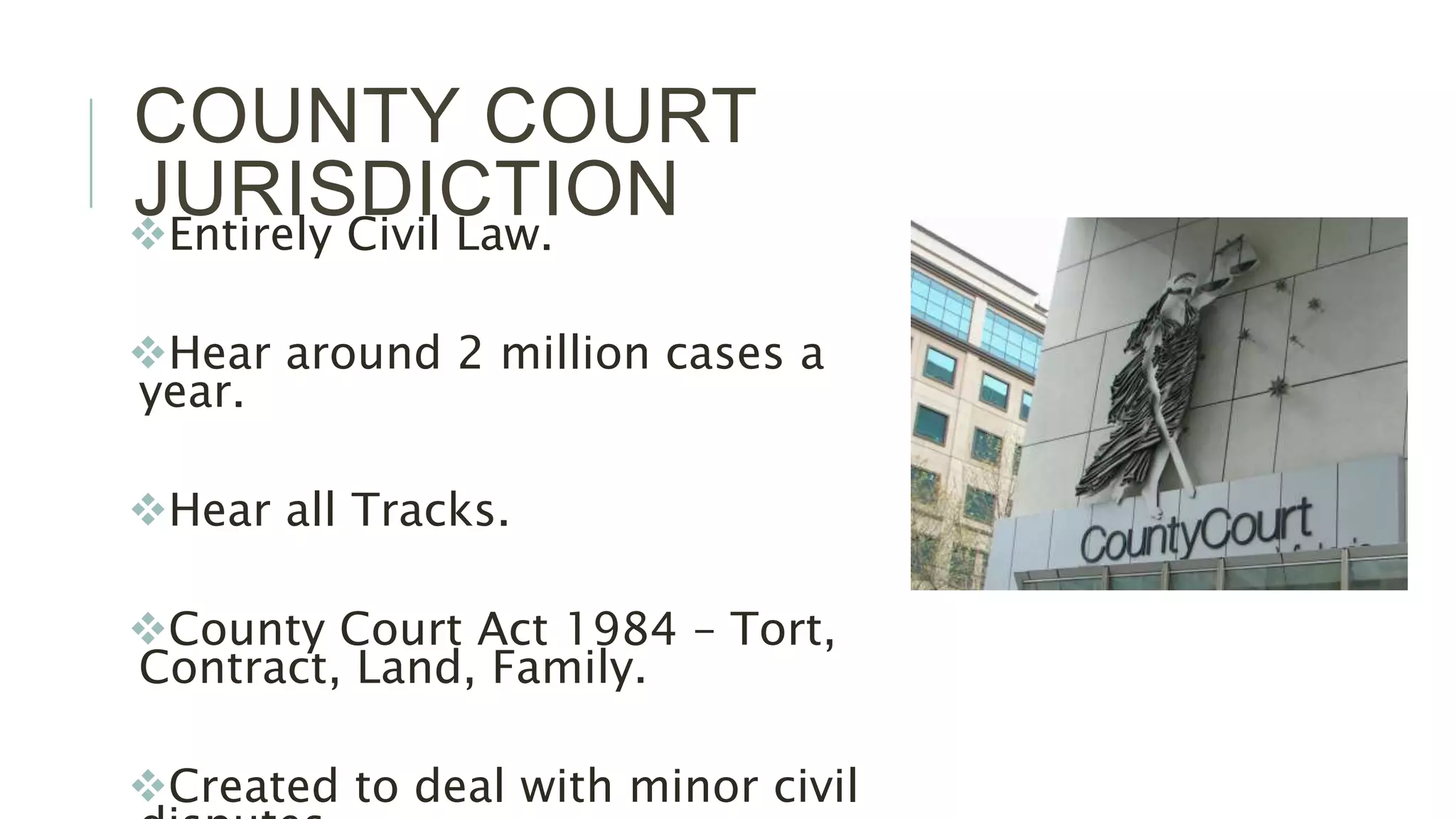
COUNTY COURT
JURISDICTIONEntirely Civil Law.
Hear around 2 million cases a
year.
Hear all Tracks.
County Court Act 1984 – Tort,
Contract, Land, Family.
Created to deal with minor civil
HIGH COURT
Both Criminal and Civil Jurisdiction
Three Divisions:
Queens Bench Division
Chancery Division
Family Division
Multi Track
QUEEN’S BENCH DIVISION
About 70 Judges sitting in the division with the Lord Chief
Justice at the head.
It deals with contract and tort cases of over £50,000
Claims over £15,000 can be heard here if the parties choose).
Usually cases are heard by a single Judge.
Cases are expensive to hear and can take a long time (on
average about three years).
CHANCERY DIVISION
There are about 17 High Court Judges in this
division.
They deal with matters such as insolvency, enforcing
mortgages, disputes relating to trust property,
copyright and patents, intellectual property matters
and probate.
Cases are heard by a single Judge, but high costs and
excessive delays are also a problem.
FAMILY DIVISION
Has 17 High Court Judges assigned to it.
Hears all cases relating to children, matters relating
to the family, such as declarations for the nullity of
marriage and also grants probate.
Cases are heard by a single Judge.
COURT OF APPEAL
Divided into two divisions
Legal Arguments and Documentary evidence
They mainly hear appeals from the following –
All three divisions of the High Court.
The County Court for Multi-Track cases.
Permission is needed for a case to be heard in this
court

Civil courts and track system

  • 1.
  • 2.
    STARTER Each table willget a topic on solicitors or barristers. You need to create a mind map or fact sheet on the topic.
  • 3.
    LEARNING OBJECTIVES To beable to explain the different court jurisdictions and the track system  To be able to Illustrate the appeal routes and give examples for each civil court Evaluate the civil courts issues regarding access to justice and fairness.
  • 4.
    CIVIL CASES Civil claimsarise when an individual or business believes their rights have been infringed in some way. Main areas of civil law include contract law, law of tort, family law and employment law. A case could involve claiming compensation for injuries (tort law). It could be a company claiming money is owed to them (contract law).
  • 5.
    ROLLS ROYCE Rolls Roycewas a term used by Lord Woolf to describe the civil court process. What did he mean ? The Civil Courts had remained largely unchanged for 100 years. It was expensive, with only the wealthy being able to afford to use it. The process was slow.
  • 6.
    WOOLF REVIEW Lord Woolf’s1996 Report on Access to Justice Changed the Language The Court allocation of the track system The active encouragement of Alternative Dispute Resolution
  • 7.
    CIVIL PROCEDURE RULES– OVERRIDING OBJECTIVE The CPR requires that all cases are dealt with in a way that enables the court to deal with cases justly. This includes: Ensuring parties are on an equal footing; Dealing with the case in ways which are proportionate Ensuring that the case is dealt with expeditiously and fairly.
  • 8.
    N1 CLAIM FORM Whensomeone wants to start a court case they have to fill in a N1 claim form outlining the details of their claim. Please fill in an N1 claim form with your own claim that you wish to make and estimate how much the total of your claim will be.
  • 9.
    TRACK SYSTEM OVERVIEW– FILL IN THE PICTURE WITH KEY INFORMATION ABOUT EACH TRACK.Multi Track Fast Track Small Claims High Court County Court
  • 10.
    SMALL CLAIMS Under £10,000and personal injury £1,000. People are encouraged to represent themselves in order to keep costs down. Winner cannot recover the cost of their lawyer from the losing party.
  • 11.
    FAST TRACK Claims witha financial value of no more than £25,000. This track allows the court to set down a strict timetable for pre-trial matters to stop time-wasting and running up unnecessary costs. Once a case is set down for hearing the aim is that it is heard within 30 weeks. The case will be heard by a Circuit Judge and take place in
  • 12.
    MULTI TRACK Any casenot allocated to the other tracks is heard here. These cases are heard in the County or the High Court. They will be heard by a Circuit Judge who can set timetables to speed up the case. The Judge can ask the parties to try an alternative method of dispute resolution to prevent wasting time and money.
  • 13.
  • 14.
    CIVIL COURT JURISDICTION Jurisdiction–the official power to make legal decisions and Judgements. Area of law Financial limits
  • 15.
    CIVIL COURT HIERARCHY ACTIVITY Youwill be given a court to research. Use your hand out and the text book to create a fact sheet. These fact sheets will be
  • 16.
    SUPREME COURT  Establishedon 1st October 2009 Hears appeals from the Court of Appeal Points of Law Public Importance https://www.youtube.com/watch?v=wTHrynZIsBo
  • 17.
    EUROPEAN COURT OF JUSTICE TheCourt of Justice of the European must ensure that in the interpretation and application of the Treaties are correct. It makes sure that EU legislation is interpreted and applied in the same way in all EU countries, so that the law is equal for everyone. It ensures, for example, that national courts do not give different rulings on the same issue. The Court has the power to settle legal disputes between EU Member States, EU institutions, businesses and individuals.
  • 18.
    APPEAL ROUTES In yourhand-out there is a blank diagram which needs to be filled in. Before writing the answers in the hand-out use whiteboard pens on the tables to work the answers out using the bullet points Only consider the first diagram
  • 19.
  • 20.
    APPEAL ROUTES District JudgeCircuit Judge Multi - Track High Court Judge Circuit Judge Court of Appeal Supreme Court
  • 21.
    Route 3 M –Mad C – Cats S – Sing •The appeal routes are hard to remember! •Try and make your own to help you remember the different appeal routes. •Can also be a story, rhyme or diagram. •Going to ask each person how they can Route 1 D – Don’t C – Carry C – Cow S – S**t Route 2 C – Chickens H – Hate C – Christmas S – Season
  • 22.
    LEAPFROG APPEAL Multi Track Courtof Appeal Supreme CourtAdministratio n of Justice Act 1969 https://www.youtube.com/watch?v=Wf5-oBkqkbU
  • 23.
    ADVANTAGES AND DISADVANTAGES OFCIVIL COURTS Homework create 3 advantages and three disadvantages to bring to next lesson.
  • 24.
    EVALUATION OF THECIVIL COURTS AND TRACKS On page 4 there are 6 issues which need to be discussed Each table will be assigned a different issue to talk about Then each group will feedback their idea to the rest of the class
  • 25.
    ADVANTAGES OF CIVIL COURTS 1.A legally qualified Judge will decide the case. 2. There is an appeal system if a party is unhappy with the decision of the trial Judge. 3. Legal Aid is available for those on a low income (below £2,657 a month).
  • 26.
    DISADVANTAGES OF CIVIL COURTS 1.The courts are open to the public and press, which could lead to adverse publicity. 2. There is a winner and a loser. 3. The court service chooses the trial date. 4. Cost and time.
  • 27.
    COUNTY COURT JURISDICTIONEntirely CivilLaw. Hear around 2 million cases a year. Hear all Tracks. County Court Act 1984 – Tort, Contract, Land, Family. Created to deal with minor civil
  • 28.
    HIGH COURT Both Criminaland Civil Jurisdiction Three Divisions: Queens Bench Division Chancery Division Family Division Multi Track
  • 29.
    QUEEN’S BENCH DIVISION About70 Judges sitting in the division with the Lord Chief Justice at the head. It deals with contract and tort cases of over £50,000 Claims over £15,000 can be heard here if the parties choose). Usually cases are heard by a single Judge. Cases are expensive to hear and can take a long time (on average about three years).
  • 30.
    CHANCERY DIVISION There areabout 17 High Court Judges in this division. They deal with matters such as insolvency, enforcing mortgages, disputes relating to trust property, copyright and patents, intellectual property matters and probate. Cases are heard by a single Judge, but high costs and excessive delays are also a problem.
  • 31.
    FAMILY DIVISION Has 17High Court Judges assigned to it. Hears all cases relating to children, matters relating to the family, such as declarations for the nullity of marriage and also grants probate. Cases are heard by a single Judge.
  • 32.
    COURT OF APPEAL Dividedinto two divisions Legal Arguments and Documentary evidence They mainly hear appeals from the following – All three divisions of the High Court. The County Court for Multi-Track cases. Permission is needed for a case to be heard in this court

Editor's Notes

  • #8 Were introduced in 1998 to govern the procedure that is followed within the English civil court system. to the amount of money involved, the importance of the case, the complexity of the issues and the financial position of each party;
  • #11 Advantages Cost is low - If you lose you don’t have to pay the other parties costs People don’t have to use lawyers Quicker Disadvantages Cases over £1,000 have an allocation fee of £115 Legal Funding is not available Could be unfair if one party uses a lawyer and the other doesn't Only around 60% of successful claims receive their money
  • #12 Advantages of Fast track cases is the strict timetable set by the Judge. The parties will be aware that there is an agenda in hand to help resolve the case as quickly as possible. Cost low - kept low due to the hearing only being limited to one day. Thirdly, the introduction of strict timetables has lessened the delays a little. Disadvantages of fast track cases the total waiting time for the trial is still considerably long - 59 weeks The limitation of one witness could also prove to be a disadvantage as it limits the evidence in your favour. The limitation of a one day trial hearing could also prove to be a disadvantage as there may not be sufficient time for your case to be heard.
  • #13 Advantages of multi-track cases pre-trial review which decides the timetable for the trial itself, who will give evidence at the trial and in what order, the content of the trial bundle Multi-track cases are dealt with as soon as possible Claimant receives a Judgement in their favour they are often entitled to court fees, compensation for lost earnings, travel expenses and cost of expert testimony. Disadvantages of multi-track cases Even after a case has been successfully resolved there may be more work ahead of the claimant. After receiving a Judgement it may not be easy to receive it and some defendant’s avoid paying the claimant can pursue a warrant of execution, an attachment of earnings, or a garnishee order so that the Judgement will be enforced.
  • #19 It is the right of an individual to apply for the wrong decision of the court to be reviewed by a higher court and possibly be quashed. Such a right is not automatic.
  • #21 If a party is unhappy about the decision made by the Judge, it is sometimes possible to appeal against the decision to a Judge in a higher court.   There must be proper grounds for making an appeal and there are strict time limits within which to do so. From a small claims decision there is usually no appeal (only on a point of law or misconduct); An appeal from other County Court decisions and from the High Court go to the Court of Appeal (Civil Division). 
  • #23 Under the act it states that from the High Court there can be an appeal directly to the House of Lords – now supreme court Both parties must agree Must involve a point of law of general public importance Interpretation of statute Binding precedents Start 5.35 – 13.03