University of El Salvador
Western Multidisciplinary Campus
Literature II
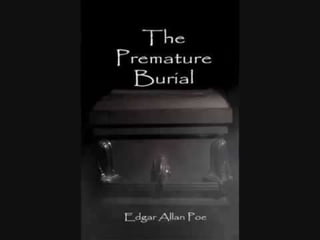
The Premature Burial by: Edgar
Allan Poe
Katherinne Hernandez
Carmen Lima
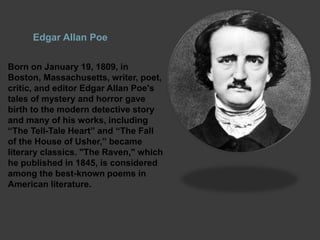
Edgar Allan Poe
Born on January 19, 1809, in
Boston, Massachusetts, writer, poet,
critic, and editor Edgar Allan Poe's
tales of mystery and horror gave
birth to the modern detective story
and many of his works, including
“The Tell-Tale Heart” and “The Fall
of the House of Usher,” became
literary classics. "The Raven," which
he published in 1845, is considered
among the best-known poems in
American literature.
Characters
Setting
Plot
Point of view
Theme
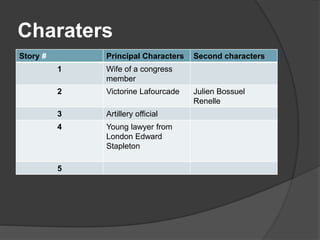
Charaters
Story # Principal Characters Second characters
1 Wife of a congress
member
2 Victorine Lafourcade Julien Bossuel
Renelle
3 Artillery official
4 Young lawyer from
London Edward
Stapleton
5
Setting
Story Setting
1 Baltimore
2 1810 France
3
4 1831 London
5 Richmond Virginia
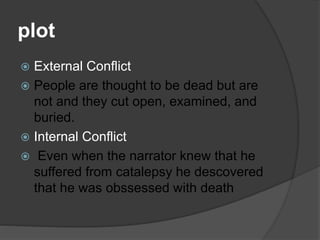
plot
 External Conflict
 People are thought to be dead but are
not and they cut open, examined, and
buried.
 Internal Conflict
 Even when the narrator knew that he
suffered from catalepsy he descovered
that he was obssessed with death
Exposition
“…It is the fact -- it is the reality -- it is
the history which excites. As
inventions, we should regard them
with simple abhorrence…”
• the Passage of the Beresina
• the Earthquake at Lisbon
• the Plague at London
• the Massacre of St. Bartholomew
Rising action
The Narrator mentions
several people who have
been buried alive.
Climax
Attacks of catalepsy and the
narrator awakens in pitch
darkness in a confined area.
He cries out but is
immediately hushed.
Falling action
He realizes he's in the berth
of a boat, not a grave.
Resolution
The event snaps him out of
his obsession with death
Point of view
3r prson that turns into a 1st person
narration
Theme
 Being buried alive is, as Poe puts it, "The
most terrific of extremes ever faced by
mere mortals". His horror story explains
the terror experienced by those who have
been buried alive, as well as their diseases
that gave the conjecture of the victim being
dead. Normally, the victims went into deep
comas which in Poe's time were often
mistaken for death, so they were
accidentally buried alive. In some of his
examples, the people were discovered, dug
up and saved from a horrible fate.
 Terror
 The central theme of "The Premature
Burial" is extreme terror and its effects
on the human mind. The narrator's terror
is the result of his dwelling obsessively
on morbid thoughts.
 Isolation
 Being cut off, being isolated from the world
of the living, is in part the cause of the
narrator's abnormal fear of being buried
alive. The thought of being alone and
abandoned, without hope of ever seeing
another human being, petrifies the narrator.
Ironically, to avoid the possibility of
premature burial, he avoids leaving his
home to be among people. "I hesitated to
ride, or to walk, or to indulge in any
exercise that would carry me from home,"
he says.
The premature burial.

The premature burial.

  • 1.
    University of ElSalvador Western Multidisciplinary Campus Literature II The Premature Burial by: Edgar Allan Poe Katherinne Hernandez Carmen Lima
  • 2.
    Edgar Allan Poe Bornon January 19, 1809, in Boston, Massachusetts, writer, poet, critic, and editor Edgar Allan Poe's tales of mystery and horror gave birth to the modern detective story and many of his works, including “The Tell-Tale Heart” and “The Fall of the House of Usher,” became literary classics. "The Raven," which he published in 1845, is considered among the best-known poems in American literature.
  • 4.
  • 5.
    Charaters Story # PrincipalCharacters Second characters 1 Wife of a congress member 2 Victorine Lafourcade Julien Bossuel Renelle 3 Artillery official 4 Young lawyer from London Edward Stapleton 5
  • 6.
    Setting Story Setting 1 Baltimore 21810 France 3 4 1831 London 5 Richmond Virginia
  • 7.
    plot  External Conflict People are thought to be dead but are not and they cut open, examined, and buried.  Internal Conflict  Even when the narrator knew that he suffered from catalepsy he descovered that he was obssessed with death
  • 8.
    Exposition “…It is thefact -- it is the reality -- it is the history which excites. As inventions, we should regard them with simple abhorrence…” • the Passage of the Beresina • the Earthquake at Lisbon • the Plague at London • the Massacre of St. Bartholomew
  • 9.
    Rising action The Narratormentions several people who have been buried alive.
  • 10.
    Climax Attacks of catalepsyand the narrator awakens in pitch darkness in a confined area. He cries out but is immediately hushed.
  • 11.
    Falling action He realizeshe's in the berth of a boat, not a grave.
  • 12.
    Resolution The event snapshim out of his obsession with death
  • 13.
    Point of view 3rprson that turns into a 1st person narration
  • 14.
    Theme  Being buriedalive is, as Poe puts it, "The most terrific of extremes ever faced by mere mortals". His horror story explains the terror experienced by those who have been buried alive, as well as their diseases that gave the conjecture of the victim being dead. Normally, the victims went into deep comas which in Poe's time were often mistaken for death, so they were accidentally buried alive. In some of his examples, the people were discovered, dug up and saved from a horrible fate.
  • 15.
     Terror  Thecentral theme of "The Premature Burial" is extreme terror and its effects on the human mind. The narrator's terror is the result of his dwelling obsessively on morbid thoughts.
  • 16.
     Isolation  Beingcut off, being isolated from the world of the living, is in part the cause of the narrator's abnormal fear of being buried alive. The thought of being alone and abandoned, without hope of ever seeing another human being, petrifies the narrator. Ironically, to avoid the possibility of premature burial, he avoids leaving his home to be among people. "I hesitated to ride, or to walk, or to indulge in any exercise that would carry me from home," he says.