Unlocking of Difficulties
• Opiate – A drug that induces sleep or relaxation
• Vapor – A mist or fine spray
• Drowsily – In a way that causes sleepiness or a lack of energy.
• Musically – In a manner that is melodious or harmonious
• Lethe – In Greek mythology, the river of forgetfulness in the
underworld, describe something that induces forgetfulness or a state of
oblivion.
• Pallor – An unusual or extreme paleness of the skin, often associated
with illness or death.
• Destinies – Fates or predetermined outcomes of one’s life.
• Lattice – A structure of crossed wooden or metal strips, often used for
windows
Unlocking of Difficulties
• Bodiless – Without a physical body; in the poem
• Canopy – A covering or a roof-like structure, often made of fabric or
material, that provides shelter.
• Fringéd – line or relatively narrow space that marks the outer limit of
something
• Melancholy – A deep, persistent sadness or sorrow.
• Vault – A burial chamber or tomb, typically large and underground.
• Sepulchre – A tomb or burial place; a vault for the dead.
• Palls – Heavy cloths used to cover a coffin; in the poem, it refers to
funeral drapes.
• Groaned – Made a low, mournful sound, often associated with pain
or distress.
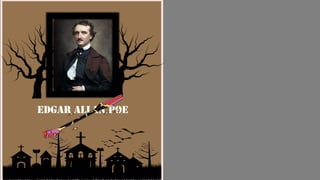
Edgar Allan Poe
Life
of
Edgar
Allan
Poe
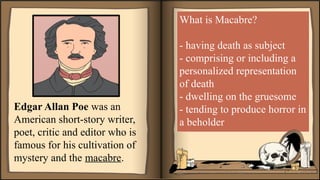
Edgar Allan Poe was an
American short-story writer,
poet, critic and editor who is
famous for his cultivation of
mystery and the macabre.
What is Macabre?
- having death as subject
- comprising or including a
personalized representation
of death
- dwelling on the gruesome
- tending to produce horror in
a beholder
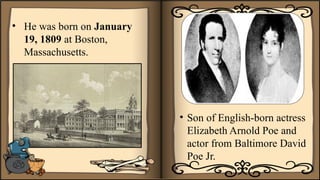
• He was born on January
19, 1809 at Boston,
Massachusetts.
• Son of English-born actress
Elizabeth Arnold Poe and
actor from Baltimore David
Poe Jr.
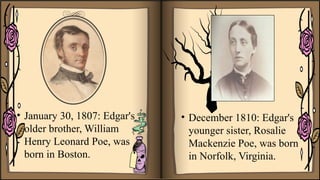
• January 30, 1807: Edgar's
older brother, William
Henry Leonard Poe, was
born in Boston.
• December 1810: Edgar's
younger sister, Rosalie
Mackenzie Poe, was born
in Norfolk, Virginia.
• 1810: Poe’s father
abandoned the family.
• December 8, 1811: Poe’s
mother, Elizabeth Arnold
Poe, dies of tuberculosis,
leaving Edgar, Henry, and
Rosalie orphaned.
• Edgar is taken in by John
Allan, a wealthy
businessman from Scotland
and his wife Frances
Valentine Allan in
Richmond, Virginia.
• Henry went to live with their
paternal grandparents in
Baltimore, while Rosalie was
adopted by the Mackenzie
family in Richmond.
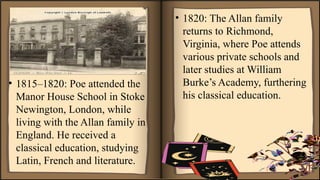
• 1815–1820: Poe attended the
Manor House School in Stoke
Newington, London, while
living with the Allan family in
England. He received a
classical education, studying
Latin, French and literature.
• 1820: The Allan family
returns to Richmond,
Virginia, where Poe attends
various private schools and
later studies at William
Burke’s Academy, furthering
his classical education.
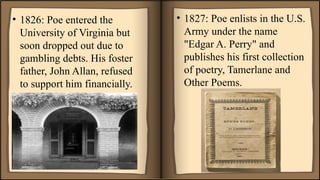
• 1826: Poe entered the
University of Virginia but
soon dropped out due to
gambling debts. His foster
father, John Allan, refused
to support him financially.
• 1827: Poe enlists in the U.S.
Army under the name
"Edgar A. Perry" and
publishes his first collection
of poetry, Tamerlane and
Other Poems.
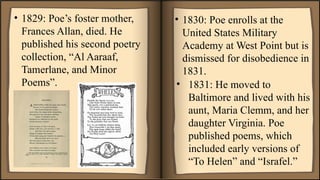
• 1829: Poe’s foster mother,
Frances Allan, died. He
published his second poetry
collection, “Al Aaraaf,
Tamerlane, and Minor
Poems”.
• 1830: Poe enrolls at the
United States Military
Academy at West Point but is
dismissed for disobedience in
1831.
• 1831: He moved to
Baltimore and lived with his
aunt, Maria Clemm, and her
daughter Virginia. Poe
published poems, which
included early versions of
“To Helen” and “Israfel.”
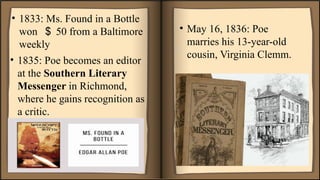
• 1835: Poe becomes an editor
at the Southern Literary
Messenger in Richmond,
where he gains recognition as
a critic.
• May 16, 1836: Poe
marries his 13-year-old
cousin, Virginia Clemm.
• 1833: Ms. Found in a Bottle
won $ 50 from a Baltimore
weekly
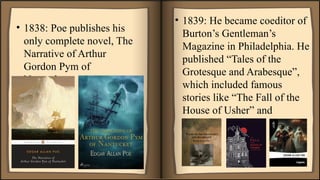
• 1838: Poe publishes his
only complete novel, The
Narrative of Arthur
Gordon Pym of
Nantucket.
• 1839: He became coeditor of
Burton’s Gentleman’s
Magazine in Philadelphia. He
published “Tales of the
Grotesque and Arabesque”,
which included famous
stories like “The Fall of the
House of Usher” and
“Ligeia.”
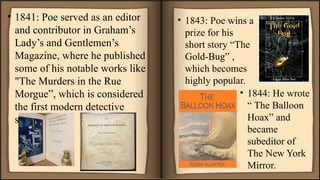
• 1841: Poe served as an editor
and contributor in Graham’s
Lady’s and Gentlemen’s
Magazine, where he published
some of his notable works like
"The Murders in the Rue
Morgue”, which is considered
the first modern detective
story.
• 1843: Poe wins a
prize for his
short story “The
Gold-Bug” ,
which becomes
highly popular.
• 1844: He wrote
“ The Balloon
Hoax” and
became
subeditor of
The New York
Mirror.
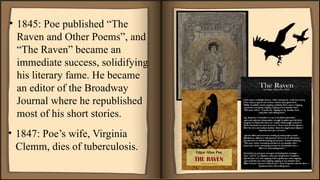
• 1845: Poe published “The
Raven and Other Poems”, and
“The Raven” became an
immediate success, solidifying
his literary fame. He became
an editor of the Broadway
Journal where he republished
most of his short stories.
• 1847: Poe’s wife, Virginia
Clemm, dies of tuberculosis.
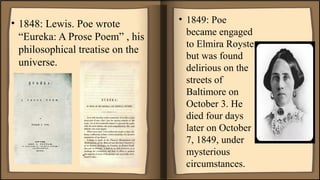
• 1849: Poe
became engaged
to Elmira Royster
but was found
delirious on the
streets of
Baltimore on
October 3. He
died four days
later on October
7, 1849, under
mysterious
circumstances.
• 1848: Lewis. Poe wrote
“Eureka: A Prose Poem” , his
philosophical treatise on the
universe.
LITERARY WORKS
• To Helen (1831)
• The City in the Sea (1831)
• Lenore (1843)
• The Raven (1845)
• Ulalume (1847)
• The Bells (1849)
• Annabel Lee (1849)
• A Dream Within a Dream
(1849)
 Poems
 Short Stories
• Manuscript Found in a Bottle
(1833)
• Ligeia (1838)
• The Fall of the House of
Usher (1839)
• The Murders in the Rue
Morgue (1841)
• The Pit and the Pendulum
(1842)
• The Masque of the Red Death
(1842)
 Essays
• The Oval Portrait (1842)
• The Tell-Tale Heart (1843)
• The Gold-Bug (1843)
• The Black Cat (1843)
• The Purloined Letter (1844)
• The Cask of Amontillado
(1846)
 Novel
• The Narrative of Arthur
Gordon Pym of
Nantucket (1838)
• The Philosophy of
Composition (1846)
• The Poetic Principle (1848)
• Eureka: A Prose Poem (1848)
AWARDS
• Baltimore Saturday Visiter
Prize (1833)
• Dollar Newspaper Prize
(1843)
Edgar Allan Poe
History of The Sleeper
• First Publication (1831)
The poem appeared in April 1831, funded by Poe's classmates from the
United States Military Academy at West Point, where he had been dismissed
earlier that year. In this early version, many themes about death and sleep
were present, but the language and style were not fully developed.
• Revisions and Final Version (1845)
Poe revised The Sleeper several times. The final version, with its current
title, was published in 1845. In this version, the poem became more polished
and emotional. The central idea of the woman in deep sleep, often seen as a
symbol for death, became clearer. Poe’s revisions showed his growing skill
in writing. He used strong imagery and a haunting tone, making the poem
feel both beautiful and eerie.
History of The Sleeper
• Themes and Influence
Poe often wrote about death and loss, influenced by the early deaths of
women in his life, like his mother and wife. In The Sleeper, he presents
death as peaceful, reflecting his desire to find beauty in stillness. The poem
captures his thoughts on how death can be both sad and serene.
• Legacy of The Sleeper
Although The Sleeper is not as famous as some of Poe's other works, it is
still an important part of his poetry. It showcases his ability to mix beauty
with sadness and explore themes of life and death. The poem remains a
significant example of his gothic style and his deep reflections on mortality.
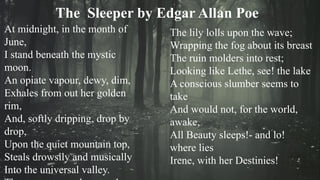
At midnight, in the month of
June,
I stand beneath the mystic
moon.
An opiate vapour, dewy, dim,
Exhales from out her golden
rim,
And, softly dripping, drop by
drop,
Upon the quiet mountain top,
Steals drowsily and musically
Into the universal valley.
The Sleeper by Edgar Allan Poe
The lily lolls upon the wave;
Wrapping the fog about its breast
The ruin molders into rest;
Looking like Lethe, see! the lake
A conscious slumber seems to
take
And would not, for the world,
awake,
All Beauty sleeps!- and lo!
where lies
Irene, with her Destinies!
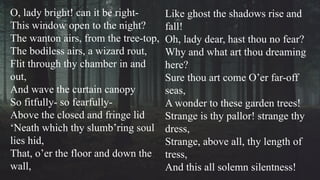
O, lady bright! can it be right-
This window open to the night?
The wanton airs, from the tree-top,
The bodiless airs, a wizard rout,
Flit through thy chamber in and
out,
And wave the curtain canopy
So fitfully- so fearfully-
Above the closed and fringe lid
‘Neath which thy slumb’ring soul
lies hid,
That, o’er the floor and down the
wall,
Like ghost the shadows rise and
fall!
Oh, lady dear, hast thou no fear?
Why and what art thou dreaming
here?
Sure thou art come O’er far-off
seas,
A wonder to these garden trees!
Strange is thy pallor! strange thy
dress,
Strange, above all, thy length of
tress,
And this all solemn silentness!
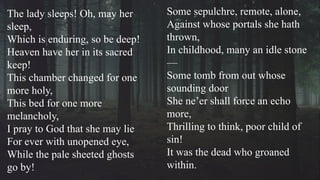
Some sepulchre, remote, alone,
Against whose portals she hath
thrown,
In childhood, many an idle stone
—
Some tomb from out whose
sounding door
She ne’er shall force an echo
more,
Thrilling to think, poor child of
sin!
It was the dead who groaned
within.
The lady sleeps! Oh, may her
sleep,
Which is enduring, so be deep!
Heaven have her in its sacred
keep!
This chamber changed for one
more holy,
This bed for one more
melancholy,
I pray to God that she may lie
For ever with unopened eye,
While the pale sheeted ghosts
go by!
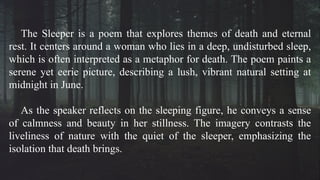
The Sleeper is a poem that explores themes of death and eternal
rest. It centers around a woman who lies in a deep, undisturbed sleep,
which is often interpreted as a metaphor for death. The poem paints a
serene yet eerie picture, describing a lush, vibrant natural setting at
midnight in June.
As the speaker reflects on the sleeping figure, he conveys a sense
of calmness and beauty in her stillness. The imagery contrasts the
liveliness of nature with the quiet of the sleeper, emphasizing the
isolation that death brings.
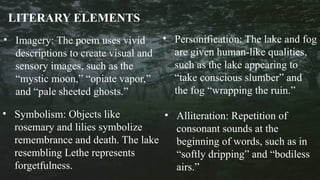
• Imagery: The poem uses vivid
descriptions to create visual and
sensory images, such as the
“mystic moon,” “opiate vapor,”
and “pale sheeted ghosts.”
• Symbolism: Objects like
rosemary and lilies symbolize
remembrance and death. The lake
resembling Lethe represents
forgetfulness.
LITERARY ELEMENTS
• Personification: The lake and fog
are given human-like qualities,
such as the lake appearing to
“take conscious slumber” and
the fog “wrapping the ruin.”
• Alliteration: Repetition of
consonant sounds at the
beginning of words, such as in
“softly dripping” and “bodiless
airs.”
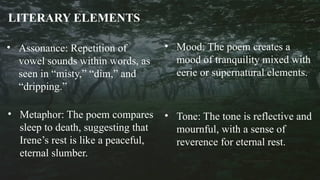
LITERARY ELEMENTS
• Assonance: Repetition of
vowel sounds within words, as
seen in “misty,” “dim,” and
“dripping.”
• Metaphor: The poem compares
sleep to death, suggesting that
Irene’s rest is like a peaceful,
eternal slumber.
• Tone: The tone is reflective and
mournful, with a sense of
reverence for eternal rest.
• Mood: The poem creates a
mood of tranquility mixed with
eerie or supernatural elements.
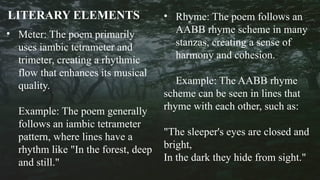
• Meter: The poem primarily
uses iambic tetrameter and
trimeter, creating a rhythmic
flow that enhances its musical
quality.
Example: The poem generally
follows an iambic tetrameter
pattern, where lines have a
rhythm like "In the forest, deep
and still."
• Rhyme: The poem follows an
AABB rhyme scheme in many
stanzas, creating a sense of
harmony and cohesion.
Example: The AABB rhyme
scheme can be seen in lines that
rhyme with each other, such as:
"The sleeper's eyes are closed and
bright,
In the dark they hide from sight."
LITERARY ELEMENTS
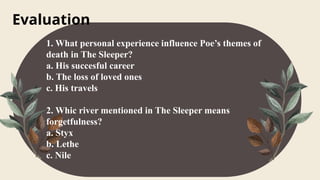
Evaluation
Evaluation
1. What personal experience influence Poe’s themes of
death in The Sleeper?
a. His succesful career
b. The loss of loved ones
c. His travels
2. Whic river mentioned in The Sleeper means
forgetfulness?
a. Styx
b. Lethe
c. Nile
Evaluation
3. What main theme does The Sleeper explore?
a. The joy of life
b. The link between sleep and death
c. The beauty of nature
4. What happened when Poe was three years old?
a. He published his first poem
b. His mother
c. He got married
Evaluation
5. How did Poe’s upbringing affect his writing?
a. He focused on romance
b. His loss and struggles shaped his themes of death
c. He became wealthy
6. In The Sleeper, what does the lady’s pale face mean/
a. She is healthy
b. She looks dead
c. She is happy
Evaluation
7. What role does nature play in the poem?
a. It distracts from the main themes
b. It shows peace and death
c. It represents chaos
8. What does the speaker wish for Irene’s sleep?
a. That it be shallow
b. That it be deep and lasting
c. That she wakes up soon
Evaluation
9. What jo helped Poe become known as a writer?
a. Novelist
b. Editor or magazines
c. Playwright
10. How does Poe’s view of death show in The Sleeper?
a. By celebrating life
b. By showing sadness and beauty in death
c. Through happy themes
Evaluation
11. What kind of mood does Poe create In The Sleeper?
a. Happy and cheerful
b. Darl and eerie
c. Energetic and lively
12. How did Poe’s experiences with loss shape his
poetry?
a. They made him write only comedies
b. They led him

The Sleeper by Edgar Allan Poe powerpointpresentation

  • 2.
    Unlocking of Difficulties •Opiate – A drug that induces sleep or relaxation • Vapor – A mist or fine spray • Drowsily – In a way that causes sleepiness or a lack of energy. • Musically – In a manner that is melodious or harmonious • Lethe – In Greek mythology, the river of forgetfulness in the underworld, describe something that induces forgetfulness or a state of oblivion. • Pallor – An unusual or extreme paleness of the skin, often associated with illness or death. • Destinies – Fates or predetermined outcomes of one’s life. • Lattice – A structure of crossed wooden or metal strips, often used for windows
  • 3.
    Unlocking of Difficulties •Bodiless – Without a physical body; in the poem • Canopy – A covering or a roof-like structure, often made of fabric or material, that provides shelter. • Fringéd – line or relatively narrow space that marks the outer limit of something • Melancholy – A deep, persistent sadness or sorrow. • Vault – A burial chamber or tomb, typically large and underground. • Sepulchre – A tomb or burial place; a vault for the dead. • Palls – Heavy cloths used to cover a coffin; in the poem, it refers to funeral drapes. • Groaned – Made a low, mournful sound, often associated with pain or distress.
  • 5.
  • 6.
    Edgar Allan Poewas an American short-story writer, poet, critic and editor who is famous for his cultivation of mystery and the macabre. What is Macabre? - having death as subject - comprising or including a personalized representation of death - dwelling on the gruesome - tending to produce horror in a beholder
  • 7.
    • He wasborn on January 19, 1809 at Boston, Massachusetts. • Son of English-born actress Elizabeth Arnold Poe and actor from Baltimore David Poe Jr.
  • 8.
    • January 30,1807: Edgar's older brother, William Henry Leonard Poe, was born in Boston. • December 1810: Edgar's younger sister, Rosalie Mackenzie Poe, was born in Norfolk, Virginia.
  • 9.
    • 1810: Poe’sfather abandoned the family. • December 8, 1811: Poe’s mother, Elizabeth Arnold Poe, dies of tuberculosis, leaving Edgar, Henry, and Rosalie orphaned. • Edgar is taken in by John Allan, a wealthy businessman from Scotland and his wife Frances Valentine Allan in Richmond, Virginia. • Henry went to live with their paternal grandparents in Baltimore, while Rosalie was adopted by the Mackenzie family in Richmond.
  • 10.
    • 1815–1820: Poeattended the Manor House School in Stoke Newington, London, while living with the Allan family in England. He received a classical education, studying Latin, French and literature. • 1820: The Allan family returns to Richmond, Virginia, where Poe attends various private schools and later studies at William Burke’s Academy, furthering his classical education.
  • 11.
    • 1826: Poeentered the University of Virginia but soon dropped out due to gambling debts. His foster father, John Allan, refused to support him financially. • 1827: Poe enlists in the U.S. Army under the name "Edgar A. Perry" and publishes his first collection of poetry, Tamerlane and Other Poems.
  • 12.
    • 1829: Poe’sfoster mother, Frances Allan, died. He published his second poetry collection, “Al Aaraaf, Tamerlane, and Minor Poems”. • 1830: Poe enrolls at the United States Military Academy at West Point but is dismissed for disobedience in 1831. • 1831: He moved to Baltimore and lived with his aunt, Maria Clemm, and her daughter Virginia. Poe published poems, which included early versions of “To Helen” and “Israfel.”
  • 13.
    • 1835: Poebecomes an editor at the Southern Literary Messenger in Richmond, where he gains recognition as a critic. • May 16, 1836: Poe marries his 13-year-old cousin, Virginia Clemm. • 1833: Ms. Found in a Bottle won $ 50 from a Baltimore weekly
  • 14.
    • 1838: Poepublishes his only complete novel, The Narrative of Arthur Gordon Pym of Nantucket. • 1839: He became coeditor of Burton’s Gentleman’s Magazine in Philadelphia. He published “Tales of the Grotesque and Arabesque”, which included famous stories like “The Fall of the House of Usher” and “Ligeia.”
  • 15.
    • 1841: Poeserved as an editor and contributor in Graham’s Lady’s and Gentlemen’s Magazine, where he published some of his notable works like "The Murders in the Rue Morgue”, which is considered the first modern detective story. • 1843: Poe wins a prize for his short story “The Gold-Bug” , which becomes highly popular. • 1844: He wrote “ The Balloon Hoax” and became subeditor of The New York Mirror.
  • 16.
    • 1845: Poepublished “The Raven and Other Poems”, and “The Raven” became an immediate success, solidifying his literary fame. He became an editor of the Broadway Journal where he republished most of his short stories. • 1847: Poe’s wife, Virginia Clemm, dies of tuberculosis.
  • 17.
    • 1849: Poe becameengaged to Elmira Royster but was found delirious on the streets of Baltimore on October 3. He died four days later on October 7, 1849, under mysterious circumstances. • 1848: Lewis. Poe wrote “Eureka: A Prose Poem” , his philosophical treatise on the universe.
  • 18.
    LITERARY WORKS • ToHelen (1831) • The City in the Sea (1831) • Lenore (1843) • The Raven (1845) • Ulalume (1847) • The Bells (1849) • Annabel Lee (1849) • A Dream Within a Dream (1849)  Poems  Short Stories • Manuscript Found in a Bottle (1833) • Ligeia (1838) • The Fall of the House of Usher (1839) • The Murders in the Rue Morgue (1841) • The Pit and the Pendulum (1842) • The Masque of the Red Death (1842)
  • 19.
     Essays • TheOval Portrait (1842) • The Tell-Tale Heart (1843) • The Gold-Bug (1843) • The Black Cat (1843) • The Purloined Letter (1844) • The Cask of Amontillado (1846)  Novel • The Narrative of Arthur Gordon Pym of Nantucket (1838) • The Philosophy of Composition (1846) • The Poetic Principle (1848) • Eureka: A Prose Poem (1848) AWARDS • Baltimore Saturday Visiter Prize (1833) • Dollar Newspaper Prize (1843)
  • 20.
  • 21.
    History of TheSleeper • First Publication (1831) The poem appeared in April 1831, funded by Poe's classmates from the United States Military Academy at West Point, where he had been dismissed earlier that year. In this early version, many themes about death and sleep were present, but the language and style were not fully developed. • Revisions and Final Version (1845) Poe revised The Sleeper several times. The final version, with its current title, was published in 1845. In this version, the poem became more polished and emotional. The central idea of the woman in deep sleep, often seen as a symbol for death, became clearer. Poe’s revisions showed his growing skill in writing. He used strong imagery and a haunting tone, making the poem feel both beautiful and eerie.
  • 22.
    History of TheSleeper • Themes and Influence Poe often wrote about death and loss, influenced by the early deaths of women in his life, like his mother and wife. In The Sleeper, he presents death as peaceful, reflecting his desire to find beauty in stillness. The poem captures his thoughts on how death can be both sad and serene. • Legacy of The Sleeper Although The Sleeper is not as famous as some of Poe's other works, it is still an important part of his poetry. It showcases his ability to mix beauty with sadness and explore themes of life and death. The poem remains a significant example of his gothic style and his deep reflections on mortality.
  • 23.
    At midnight, inthe month of June, I stand beneath the mystic moon. An opiate vapour, dewy, dim, Exhales from out her golden rim, And, softly dripping, drop by drop, Upon the quiet mountain top, Steals drowsily and musically Into the universal valley. The Sleeper by Edgar Allan Poe The lily lolls upon the wave; Wrapping the fog about its breast The ruin molders into rest; Looking like Lethe, see! the lake A conscious slumber seems to take And would not, for the world, awake, All Beauty sleeps!- and lo! where lies Irene, with her Destinies!
  • 24.
    O, lady bright!can it be right- This window open to the night? The wanton airs, from the tree-top, The bodiless airs, a wizard rout, Flit through thy chamber in and out, And wave the curtain canopy So fitfully- so fearfully- Above the closed and fringe lid ‘Neath which thy slumb’ring soul lies hid, That, o’er the floor and down the wall, Like ghost the shadows rise and fall! Oh, lady dear, hast thou no fear? Why and what art thou dreaming here? Sure thou art come O’er far-off seas, A wonder to these garden trees! Strange is thy pallor! strange thy dress, Strange, above all, thy length of tress, And this all solemn silentness!
  • 25.
    Some sepulchre, remote,alone, Against whose portals she hath thrown, In childhood, many an idle stone — Some tomb from out whose sounding door She ne’er shall force an echo more, Thrilling to think, poor child of sin! It was the dead who groaned within. The lady sleeps! Oh, may her sleep, Which is enduring, so be deep! Heaven have her in its sacred keep! This chamber changed for one more holy, This bed for one more melancholy, I pray to God that she may lie For ever with unopened eye, While the pale sheeted ghosts go by!
  • 26.
    The Sleeper isa poem that explores themes of death and eternal rest. It centers around a woman who lies in a deep, undisturbed sleep, which is often interpreted as a metaphor for death. The poem paints a serene yet eerie picture, describing a lush, vibrant natural setting at midnight in June. As the speaker reflects on the sleeping figure, he conveys a sense of calmness and beauty in her stillness. The imagery contrasts the liveliness of nature with the quiet of the sleeper, emphasizing the isolation that death brings.
  • 27.
    • Imagery: Thepoem uses vivid descriptions to create visual and sensory images, such as the “mystic moon,” “opiate vapor,” and “pale sheeted ghosts.” • Symbolism: Objects like rosemary and lilies symbolize remembrance and death. The lake resembling Lethe represents forgetfulness. LITERARY ELEMENTS • Personification: The lake and fog are given human-like qualities, such as the lake appearing to “take conscious slumber” and the fog “wrapping the ruin.” • Alliteration: Repetition of consonant sounds at the beginning of words, such as in “softly dripping” and “bodiless airs.”
  • 28.
    LITERARY ELEMENTS • Assonance:Repetition of vowel sounds within words, as seen in “misty,” “dim,” and “dripping.” • Metaphor: The poem compares sleep to death, suggesting that Irene’s rest is like a peaceful, eternal slumber. • Tone: The tone is reflective and mournful, with a sense of reverence for eternal rest. • Mood: The poem creates a mood of tranquility mixed with eerie or supernatural elements.
  • 29.
    • Meter: Thepoem primarily uses iambic tetrameter and trimeter, creating a rhythmic flow that enhances its musical quality. Example: The poem generally follows an iambic tetrameter pattern, where lines have a rhythm like "In the forest, deep and still." • Rhyme: The poem follows an AABB rhyme scheme in many stanzas, creating a sense of harmony and cohesion. Example: The AABB rhyme scheme can be seen in lines that rhyme with each other, such as: "The sleeper's eyes are closed and bright, In the dark they hide from sight." LITERARY ELEMENTS
  • 31.
  • 32.
    Evaluation 1. What personalexperience influence Poe’s themes of death in The Sleeper? a. His succesful career b. The loss of loved ones c. His travels 2. Whic river mentioned in The Sleeper means forgetfulness? a. Styx b. Lethe c. Nile
  • 33.
    Evaluation 3. What maintheme does The Sleeper explore? a. The joy of life b. The link between sleep and death c. The beauty of nature 4. What happened when Poe was three years old? a. He published his first poem b. His mother c. He got married
  • 34.
    Evaluation 5. How didPoe’s upbringing affect his writing? a. He focused on romance b. His loss and struggles shaped his themes of death c. He became wealthy 6. In The Sleeper, what does the lady’s pale face mean/ a. She is healthy b. She looks dead c. She is happy
  • 35.
    Evaluation 7. What roledoes nature play in the poem? a. It distracts from the main themes b. It shows peace and death c. It represents chaos 8. What does the speaker wish for Irene’s sleep? a. That it be shallow b. That it be deep and lasting c. That she wakes up soon
  • 36.
    Evaluation 9. What johelped Poe become known as a writer? a. Novelist b. Editor or magazines c. Playwright 10. How does Poe’s view of death show in The Sleeper? a. By celebrating life b. By showing sadness and beauty in death c. Through happy themes
  • 37.
    Evaluation 11. What kindof mood does Poe create In The Sleeper? a. Happy and cheerful b. Darl and eerie c. Energetic and lively 12. How did Poe’s experiences with loss shape his poetry? a. They made him write only comedies b. They led him