By: Ryder Ward
 The picture on the left is a 
illustration of what the settlers 
first saw when they ventured 
into the unknown Powhatan 
village. They discovered the 
yehakins, which were the 
buildings within the village. 
Theses buildings housed from 6 
to 20 people and varied in size. 
As usual in hierarchical 
societies, the ruler had a larger 
more intricate home, and 
Powhatan's yehakin was 
exceptionally larger than the 
others. Additionally, these 
buildings or homes were built by 
the women of the society.
 The daily scene of the Powhatan 
consisted of men, women, and 
children hunting, gathering, and 
cooking. As you can see in the 
picture, the Indians are having a 
community meeting to great 
John smith and trading with him 
and one another. Additionally, 
there are fish being cooked to 
the right and it seems that they 
are sort of preparing a meeting 
and gifts for him. After the 
arrival of the Europeans, the 
Powhatan didn’t do many of 
these meetings, except to discuss 
and establish a plan to better 
help themselves in their war-filled 
surroundings.
 In this image, you see many tools 
that the Powhatan used, such as 
the bow and arrow, various rock 
and bone knives and axes, and a 
hammer made from wood and 
rock in the lower left of the 
picture. These tools would be 
used for the same reasons that 
we use our modern counterparts 
to these tools today. We use the 
bow and arrow for hunting, the 
rock hammer for building or 
crushing something, and the 
sharpened rocks to cut and slice 
things just as we use knives 
today.
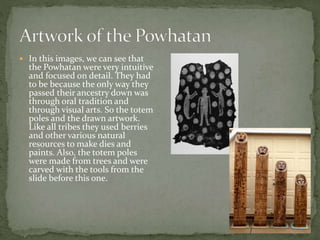
 In this images, we can see that 
the Powhatan were very intuitive 
and focused on detail. They had 
to be because the only way they 
passed their ancestry down was 
through oral tradition and 
through visual arts. So the totem 
poles and the drawn artwork. 
Like all tribes they used berries 
and other various natural 
resources to make dies and 
paints. Also, the totem poles 
were made from trees and were 
carved with the tools from the 
slide before this one.
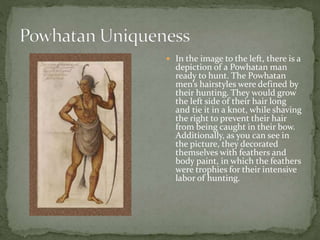
 In the image to the left, there is a 
depiction of a Powhatan man 
ready to hunt. The Powhatan 
men’s hairstyles were defined by 
their hunting. They would grow 
the left side of their hair long 
and tie it in a knot, while shaving 
the right to prevent their hair 
from being caught in their bow. 
Additionally, as you can see in 
the picture, they decorated 
themselves with feathers and 
body paint, in which the feathers 
were trophies for their intensive 
labor of hunting.
 "Powhatan Gallert." Powhatan Gallert. N.p., n.d.Web. 22 
Sept. 2014. 
 "She-philosopher.com: Gallery Exhibit (Powhatan's Map on 
Deerskin Mantle)." She-philosopher.com: Gallery Exhibit 
(Powhatan's Map on Deerskin Mantle). N.p., n.d.Web. 22 
Sept. 2014. 
 United States. National Park Service. "Captain John Smith." 
National Parks Service. U.S. Department of the Interior, 30 
Aug. 2014. Web. 22 Sept. 2014. 
 United States. National Park Service. "The Powhatan 
Indian World." National Parks Service. U.S. Department of 
the Interior, 09 Sept. 2014. Web. 22 Sept. 2014. 
 "Virginia Historical Society." Pocahontas and the Powhatan 
Nation. N.p., n.d.Web. 22 Sept. 2014.

The powhatan culture

  • 1.
  • 2.
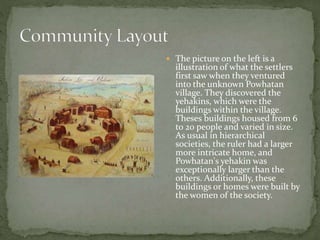
     The pictureon the left is a illustration of what the settlers first saw when they ventured into the unknown Powhatan village. They discovered the yehakins, which were the buildings within the village. Theses buildings housed from 6 to 20 people and varied in size. As usual in hierarchical societies, the ruler had a larger more intricate home, and Powhatan's yehakin was exceptionally larger than the others. Additionally, these buildings or homes were built by the women of the society.
  • 3.
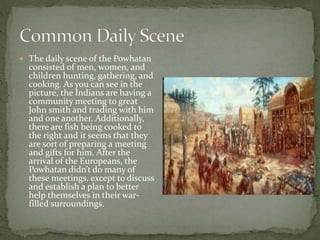
     The dailyscene of the Powhatan consisted of men, women, and children hunting, gathering, and cooking. As you can see in the picture, the Indians are having a community meeting to great John smith and trading with him and one another. Additionally, there are fish being cooked to the right and it seems that they are sort of preparing a meeting and gifts for him. After the arrival of the Europeans, the Powhatan didn’t do many of these meetings, except to discuss and establish a plan to better help themselves in their war-filled surroundings.
  • 4.
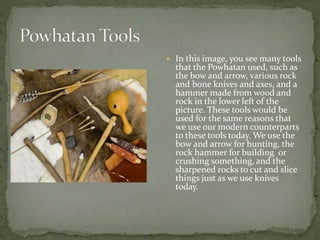
     In thisimage, you see many tools that the Powhatan used, such as the bow and arrow, various rock and bone knives and axes, and a hammer made from wood and rock in the lower left of the picture. These tools would be used for the same reasons that we use our modern counterparts to these tools today. We use the bow and arrow for hunting, the rock hammer for building or crushing something, and the sharpened rocks to cut and slice things just as we use knives today.
  • 5.
     In thisimages, we can see that the Powhatan were very intuitive and focused on detail. They had to be because the only way they passed their ancestry down was through oral tradition and through visual arts. So the totem poles and the drawn artwork. Like all tribes they used berries and other various natural resources to make dies and paints. Also, the totem poles were made from trees and were carved with the tools from the slide before this one.
  • 6.
     In theimage to the left, there is a depiction of a Powhatan man ready to hunt. The Powhatan men’s hairstyles were defined by their hunting. They would grow the left side of their hair long and tie it in a knot, while shaving the right to prevent their hair from being caught in their bow. Additionally, as you can see in the picture, they decorated themselves with feathers and body paint, in which the feathers were trophies for their intensive labor of hunting.
  • 7.
     "Powhatan Gallert."Powhatan Gallert. N.p., n.d.Web. 22 Sept. 2014.  "She-philosopher.com: Gallery Exhibit (Powhatan's Map on Deerskin Mantle)." She-philosopher.com: Gallery Exhibit (Powhatan's Map on Deerskin Mantle). N.p., n.d.Web. 22 Sept. 2014.  United States. National Park Service. "Captain John Smith." National Parks Service. U.S. Department of the Interior, 30 Aug. 2014. Web. 22 Sept. 2014.  United States. National Park Service. "The Powhatan Indian World." National Parks Service. U.S. Department of the Interior, 09 Sept. 2014. Web. 22 Sept. 2014.  "Virginia Historical Society." Pocahontas and the Powhatan Nation. N.p., n.d.Web. 22 Sept. 2014.