The Pmp ExamQuick Reference Guide Andy Crowe
download
https://ebookbell.com/product/the-pmp-exam-quick-reference-guide-
andy-crowe-44625966
Explore and download more ebooks at ebookbell.com
2.
Here are somerecommended products that we believe you will be
interested in. You can click the link to download.
The Pmp Exam Quick Reference Guide Test Prep Series Crds Andy Crowe
Pmp Pgmp
https://ebookbell.com/product/the-pmp-exam-quick-reference-guide-test-
prep-series-crds-andy-crowe-pmp-pgmp-2244010
The Pmp Exam Test Prep Series Andy Crowe
https://ebookbell.com/product/the-pmp-exam-test-prep-series-andy-
crowe-47571452
The Pmp Exam How To Pass On Your First Try 5th Edition Andy Crowe
https://ebookbell.com/product/the-pmp-exam-how-to-pass-on-your-first-
try-5th-edition-andy-crowe-5907906
The Pmp Exam How To Pass On Your First Try 6th Andy Crowe
https://ebookbell.com/product/the-pmp-exam-how-to-pass-on-your-first-
try-6th-andy-crowe-10556116
3.
The Pmp ExamHow To Pass On Your First Try Test Prep Series Third
Edition Andy Crowe Pmp
https://ebookbell.com/product/the-pmp-exam-how-to-pass-on-your-first-
try-test-prep-series-third-edition-andy-crowe-pmp-1859568
The Pmp Exam How To Pass On Your First Try Test Prep Series 6th
Edition Andy Crowe Pmp Pgmp
https://ebookbell.com/product/the-pmp-exam-how-to-pass-on-your-first-
try-test-prep-series-6th-edition-andy-crowe-pmp-pgmp-46707326
The Pmp Exam 7 Things That Keep You Up At Night Stuart Brunt
https://ebookbell.com/product/the-pmp-exam-7-things-that-keep-you-up-
at-night-stuart-brunt-48694510
The Pmp Exam Test Prep Series Andy Crowe
https://ebookbell.com/product/the-pmp-exam-test-prep-series-andy-
crowe-47618282
The Pmp Exam Test Prep Series Andy Crowe
https://ebookbell.com/product/the-pmp-exam-test-prep-series-andy-
crowe-47574518
topographical explanations. Forthe contemporaries of the Pharaohs
both Memphis and Thebes belong to Upper Egypt, and if we adopted
their method of speech we should be under the continual necessity of
stopping the narration to define geographical positions; but with the
tri-partite division we may speak of Beni-Hassan as in Middle, and
Abydos as in Upper Egypt, and thus give a sufficient idea of their
relative positions.
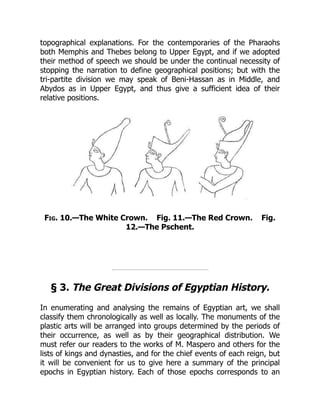
Fig. 10.—The White Crown. Fig. 11.—The Red Crown. Fig.
12.—The Pschent.
§ 3. The Great Divisions of Egyptian History.
In enumerating and analysing the remains of Egyptian art, we shall
classify them chronologically as well as locally. The monuments of the
plastic arts will be arranged into groups determined by the periods of
their occurrence, as well as by their geographical distribution. We
must refer our readers to the works of M. Maspero and others for the
lists of kings and dynasties, and for the chief events of each reign, but
it will be convenient for us to give here a summary of the principal
epochs in Egyptian history. Each of those epochs corresponds to an
8.
artistic period witha special character and individuality of its own. The
following paragraphs taken from the history of M. Maspero give all the
necessary information in a brief form.
"In the last years of the prehistoric period, the sacerdotal class had
obtained a supremacy over the other classes of the nation. A man
called Menes (Menha or Ména in the Egyptian texts) destroyed this
supremacy and founded the Egyptian monarchy.
"This monarchy existed for at least four thousand years, under thirty
consecutive dynasties, from the reign of Menes to that of Nectanebo
(340 years before our era). This interval of time, the longest of which
political history takes note, is usually divided into three parts: the
Ancient Empire, from the first to the eleventh dynasty; the Middle
Empire, from the eleventh dynasty to the invasion of the Hyksos or
Shepherds; the New Empire from the shepherd kings to the Persian
conquest. This division is inconvenient in one respect; it takes too little
account of the sequence of historical events.
"There were indeed, three great revolutions in the historical
development of Egypt. At the beginning of its long succession of
human dynasties (the Egyptians, like other peoples, placed a number
of dynasties of divine rulers before their first human king) the political
centre of the country was at Memphis; Memphis was the capital and
the burying-place of the kings; Memphis imposed sovereigns upon the
rest of the country and was the chief market for Egyptian commerce
and industry. With the commencement of the sixth dynasty, the centre
of gravity began to shift southwards. During the ninth and tenth
dynasties it rested at Heracleopolis, in Middle Egypt, and in the time of
the eleventh dynasty, it fixed itself at Thebes. From that period
onwards Thebes was the capital of the country and furnished the
sovereign. From the eleventh to the twenty-first all the Egyptian
dynasties were Theban with the single exception of the fourteenth
Xoite dynasty. At the time of the shepherd invasion, the Thebaïd
became the citadel of Egyptian nationality, and its princes, after
centuries of war against the intruders, finally succeeded in freeing the
whole valley of the Nile for the benefit of the eighteenth dynasty,
which opened the era of great foreign wars.
9.
"Under the nineteenthdynasty an inverse movement to that of the
first period carried the political centre of the country back towards the
north. With the twenty-first Tanite dynasty, Thebes ceased to be the
capital, and the cities of the Delta, Tanis, Bubastis, Mendes,
Sebennytos, and above all Sais, rose into equal or superior
importance. From that time the political life of the country
concentrated itself in the maritime districts. The nomes of the
Thebaïd, ruined by the Ethiopian and Assyrian invasions, lost their
influence; and Thebes itself fell into ruin and became nothing more
than a rendezvous for curious travellers.
"I propose, therefore, to divide Egyptian history into three periods,
each corresponding to the political supremacy of one town or province
over the whole of Egypt:—
"First Period, Memphite (the first ten dynasties). The supremacy of
Memphis and of the sovereigns furnished by her.
"Second Period, Theban (from the eleventh to the twentieth dynasties
inclusive). Supremacy of Thebes and the Theban kings. This period is
divided into two sub-periods by the Shepherd dynasties.
"a. The old Theban empire, from the eleventh to the sixteenth
dynasties.
"b. The new Theban empire, from the sixteenth to the twentieth
dynasties.
"Third Period, Sait (from the twenty-first to the thirtieth dynasties,
inclusive). Supremacy of Sais and the other cities of the Delta. This
period is divided into two by the Persian invasion:—
"First Sait period, from the twenty-first to the twenty-sixth dynasties.
"Second Sait period, from the twenty-seventh to the thirtieth
dynasties."[54]
Mariette places the accession of Ména or Menes at about the fiftieth
century before our era, while Bunsen and other Egyptologists bring
forward his date to 3,600 or 3,500 B.C. as they believe some of the
10.
dynasties of Manethoto have been contemporary with each other.
Neither Mariette nor Maspero deny that Egypt, in the course of its long
existence, was often partitioned between princes who reigned in
Upper and Lower Egypt respectively; but, guided by circumstances
which need not be described here, they incline to believe that
Manetho confined himself to enumerating those dynasties which were
looked upon as the legitimate ones. The work of elimination which has
been attempted by certain modern savants, must have been
undertaken, to a certain extent, in Egypt itself; and some of the
collateral dynasties must have been effaced and passed over in
silence, because the monuments still remaining preserve the names of
reigning families which are ignored by history.
Whatever may be thought of this initial date, Egypt remains, as has
been so well said by M. Renan, "a lighthouse in the profound darkness
of remote antiquity." Its period of greatest power was long anterior to
the earliest traditions of the Greek race; the reign of Thothmes III.,
who, according to a contemporary expression, "drew his frontiers
where he pleased," is placed by common consent in the seventeenth
century, B.C. The Egyptian empire then comprised Abyssinia, the
Soudan, Nubia, Syria, Mesopotamia, part of Arabia, Khurdistan, and
Armenia. Founded by the kings of the eighteenth dynasty, this
greatness was maintained by those of the nineteenth. To this dynasty
belonged Rameses II., the Sesostris of the Greeks, who flourished in
the fifteenth century. It was the superiority of its civilization, even
more than the valour of its princes and soldiers, which made Egypt
supreme over Western Asia.
This supremacy declined during the twenty-first and twenty-second
dynasties, but, at the same time, Egyptian chronology becomes more
certain as opportunities of comparison with the facts of Hebrew
history increase. The date of 980, within a year or two, may be given
with confidence as that of the accession of Sheshonk I., the
contemporary of Solomon and Rehoboam. From that date onwards,
the constant struggles between Egypt and its neighbours, especially
with Assyria, multiply our opportunities for synchronic comparison. In
the seventh century the country was opened to the Greeks, the real
11.
creators of history,who brought with them their inquiring spirit and
their love for exactitude. After the accession of Psemethek I., the
founder of the twenty-sixth dynasty, in 656, our historical materials
are abundant. For that we must thank the Greek travellers who
penetrated everywhere, taking notes which they afterwards amplified
into narratives. It is a singular thing, that even as late as the
Ptolemies, when the power of the Macedonian monarchy was fully
developed, the Egyptians never seem to have felt the want of what we
call an era, of some definite point from which they could measure the
course of time and the progress of the centuries. "They were satisfied
with calculating by the years of the reigning sovereign, and even those
calculations had no certain point of departure. Sometimes they
counted from the commencement of the year which had witnessed the
death of his predecessor, sometimes from the day of his own
coronation. The most careful calculations will therefore fail to enable
modern science to restore to the Egyptians that which, in fact, they
never possessed."[55]
Even thus summarily stated, these historical indications are enough to
show how little foundation there is for the opinion which was held by
the ancient Greeks, and too long accepted by modern historians. It
was, they said, from Ethiopia that Egyptian civilization had come. A
colony of Ethiopian priests from the island of Meroè in Upper Nubia,
had introduced their religion, their written characters, their art and
their civil institutions into the country. The exact opposite of this is the
truth. "It was the Egyptians who advanced up the banks of the Nile to
found cities, fortresses, and temples in Ethiopia; it was the Egyptians
who carried their civilization into the midst of savage negro tribes. The
error was caused by the fact that at one epoch in the history of Egypt
the Ethiopians played an important part.
"If it were true that Egypt owed its political existence to Ethiopia, we
should be able to find in the latter country monuments of a more
remote antiquity, and as we descended the Nile, we should find the
remains comparatively modern; but, strangely enough, the study of all
these monuments incontestably proves that the sequence of towns,
holy places, and tombs, constructed by the Egyptians on the banks of
12.
their river, followeach other in such chronological order that the oldest
remains, the Pyramids, are found in the north, in Lower Egypt, near
the southern point of the Delta. The nearer our steps take us to the
cataracts of Ethiopia, the less ancient do the monuments become.
They show ever increasing signs of the decadence of art, of taste, and
of the love for beauty. Finally, the art of Ethiopia, such as its still
existing monuments reveal it to us, is entirely wanting in originality. A
glance is sufficient to tell us that it represents the degeneracy only of
the Egyptian style, that the spirit of Egyptian forms has been weakly
grasped, and that their execution is generally mediocre."[56]
We may condense all these views into a simple and easily
remembered formula; we may say that as we mount towards the
springs of the Nile, we descend the current of time. Thebes is younger
than Memphis, and Meroè than Thebes. The river which Egypt
worshipped, and by which the walls of its cities were bathed, flowed
from the centre of Africa, from the south to the north; but the stream
of civilization flowed in the other direction, until it was lost in the
country of the negro, in the mysterious depths of Ethiopia. The springs
of this latter stream must be sought in that district where the waters
of the Nile, as if tired by their long journey, divide into several arms
before falling into the sea; in that district near the modern capital,
over which stretch the long shadows of the Pyramids.
§ 4. The Constitution of Egyptian Society—
Influence of that Constitution upon Monuments
of Art.
During the long sequence of centuries which we have divided into
three great periods, the national centre of gravity was more than once
displaced. The capital was at one time in Middle Egypt, at another in
13.
Upper, and ata third period in Lower Egypt, in accordance with its
political necessities. At one period the nation had nothing to fear from
external enemies, at others it had to turn a bold front to Asia or
Ethiopia. At various times Egypt had to submit to her foreign foes; to
the shepherd invaders, to the kings of Assyria and Persia, to the
princes of Ethiopia, and finally to Alexander, to whom she lost her
independence never again to recover it. And yet it appears that the
character and social condition of the race never underwent any great
change. At the time of the pyramid-builders, Egypt was the most
absolute monarchy that ever existed, and so she remained till her final
conquest.
"Successor and descendant of the deities who once reigned over the
valley of the Nile, the king was the living manifestation and incarnation
of God: child of the sun (Se Râ), as he took care to proclaim whenever
he wrote his name, the blood of the gods flowed in his veins and
assured to him the sovereign power."[57] He was the priest above all
others. Such a form of worship as that of Egypt, required no doubt a
large sacerdotal class, each member of which had his own special
function in the complicated and gorgeous ceremonies in which he took
part; but the king alone, at least in the principal temples, had the right
to enter the sanctuary and to open the door of the kind of chapel in
which the symbolical representation of the divinity was kept; he alone
saw the god face to face, and spoke to him in the name of his people.
[58] The pre-eminent dignity of this priestly office did not, however,
prevent the king from taking his proper share in war or political affairs
generally. The army of scribes and various functionaries, whose titles
may still be read upon the most ancient monuments of the country,
depended upon him for their orders from one end of the country to
the other, and in war, it was he who led the serried battalions of the
Egyptian army. The king was thus a supreme pontif, the immediate
chief of all civil and military officers; and, as the people believed that
his career was directed by the gods with whom he held converse, he
became to them a visible deity and, in the words of an inscription,
"the representative of Râ among the living." His divinity, begun on
earth, was completed and rendered perpetual in another life. All the
14.
dead Pharaohs becamegods, so that the Egyptian pantheon obtained
a new deity at the death of each sovereign. The deceased Pharaohs
thus constituted a series of gods to whom the reigning sovereign
would of course address himself when he had anything to ask; hence
the monuments upon which we find living Pharaohs offering worship
to their predecessors.[59]
Fig. 13.—Seti I. in his War-Chariot, bas-relief at Thebes.
(Champollion, pl. 297.)
The prestige which such a theory of
royalty was calculated to give to the
Egyptian kings may easily be
imagined. They obtained more than
respect; they were the objects of
adoration, of idolatry. Brought up
from infancy in this religious
veneration, to which their hereditary
qualities also inclined them,
15.
Fig. 14.—Rameses II.
inadoration before Seti.
From Abydos (Mariette).
generation succeeded generation among
the Egyptians, without any attempt to
rebel against the royal authority or even
to dispute it. Ancient Egypt, like its
modern descendant, was now and then
the scene of military revolts. These were generally provoked by the
presence of foreign mercenaries, sometimes by their want of discipline
and licence, sometimes by the jealousy which they inspired in the
native soldiery; but never, from the time of Menes to that of Tewfik-
Pacha, has the civil population, whether of the town or of the fields,
shown any desire to obtain the slightest guarantee for what we should
call their rights and liberties. During all those thousands of years not
the faintest trace is to be discovered of that spirit from which sprung
the republican constitutions of Greece and ancient Italy, a spirit which,
in yet later times, has led to the parliamentary governments of
Christian Europe. The Egyptian labourer or artisan never dreamt of
calling in question the orders of any one who might be master for the
time. Absolute obedience to the will of a single man—such was the
constant and instinctive national habit, and by it every movement of
the social machine, under foreign and native kings alike, was
regulated.
From the construction of the pyramids of Cheops and Chephren, and
the cutting of a new canal between the two seas under Nekau, to the
Mahmoudieh canal of Mehemet-Ali and that abortive enterprise, the
barrage of the Nile, the only method thought of for obtaining the
necessary labour was compulsion.[60] An order is received by the
governor, who has it proclaimed from one village to another
throughout his province; next day the whole male population is driven,
like a troop of sheep, to the workshops. Each man carries a bag or
basket which holds his provisions for a fortnight or a month, as the
case may be; a few dry cakes, onions, garlic, and Egyptian beans, as
the Greeks called the species of almond which is contained in the fruit
of the lotus. Old men and children, all had to obey the summons. The
more vigorous and skilful among them dressed and put in place the
blocks of granite or limestone; the weakest were useful for the
transport of the rubbish to a distance, for carrying clay and water from
16.
the Nile tothe brickmakers, for arranging the bricks in the sun so that
they might be dried and hardened.
Fig. 15.—Homage to Amenophis III. (From Prisse.[61])
Under the stimulus of the rod, this multitude worked well and
obediently under the directions of the architect's foreman and of
skilled artisans who were permanently employed upon the work; they
did all that could be done by men without special education. At the
end of a certain period they were relieved by fresh levies from another
province, and all who had not succumbed to the hard and continuous
work, returned to their own places. Those who died were buried in
hasty graves dug in the sands of the desert by the natives of their own
village.
The massive grandeur of some of the Egyptian monuments is only to
be explained by this levy en masse of every available pair of hands.
The kings of the ancient empire, at least, were unable to dispose of
those prisoners of war captured in myriads, in whole races, by the
Assyrian kings, and apparently employed by them in the construction
of Nineveh. Now, it is impossible that such works as the Pyramids
could have been begun and finished in the course of a single reign by
free and remunerated labour, even if it had the help of numerous
slaves. Certain arrangements in their design and the marvellously
exact execution of the more important details of the masonry, prove
17.
that architects ofgreat ability and skilful workmen were, indeed,
employed upon those gigantic works; but the great bulk of the task
must have required the collective effort of a whole population; of a
population devoting themselves night and day to complete the work
when once begun, like ants over their subterranean city or bees over
their comb.
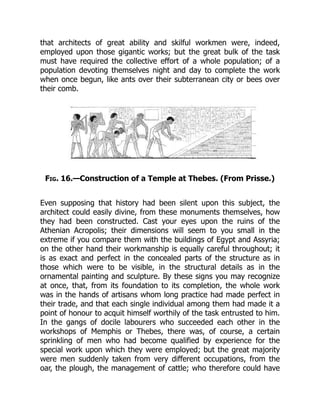
Fig. 16.—Construction of a Temple at Thebes. (From Prisse.)
Even supposing that history had been silent upon this subject, the
architect could easily divine, from these monuments themselves, how
they had been constructed. Cast your eyes upon the ruins of the
Athenian Acropolis; their dimensions will seem to you small in the
extreme if you compare them with the buildings of Egypt and Assyria;
on the other hand their workmanship is equally careful throughout; it
is as exact and perfect in the concealed parts of the structure as in
those which were to be visible, in the structural details as in the
ornamental painting and sculpture. By these signs you may recognize
at once, that, from its foundation to its completion, the whole work
was in the hands of artisans whom long practice had made perfect in
their trade, and that each single individual among them had made it a
point of honour to acquit himself worthily of the task entrusted to him.
In the gangs of docile labourers who succeeded each other in the
workshops of Memphis or Thebes, there was, of course, a certain
sprinkling of men who had become qualified by experience for the
special work upon which they were employed; but the great majority
were men suddenly taken from very different occupations, from the
oar, the plough, the management of cattle; who therefore could have
18.
nothing but theirunskilled labour to bestow. To such men as these a
great part of the work had perforce to be confided, in order that it
might be complete at the required time. In spite of the strictest
supervision, the almost religious care in the placing and fixing of
masonry, which might be fairly expected from the practised members
of a trade guild, could not be ensured. Hence the singular inequalities
and inconsistences which have been noticed in most of the great
Egyptian buildings; sometimes it is the foundations which are in fault,
and, by their sinking, have compromised the safety of the whole
building;[62] sometimes it is the built up columns of masonry, which,
when deprived by time of their coating of stucco, appear very poor
and mean. The infinite foresight and self-respect, the passionate love
for perfection for its own sake, which is characteristic of Greek work at
its best time, is not here to be found. But this defect was inseparable
from the system under which the Egyptian buildings were erected.
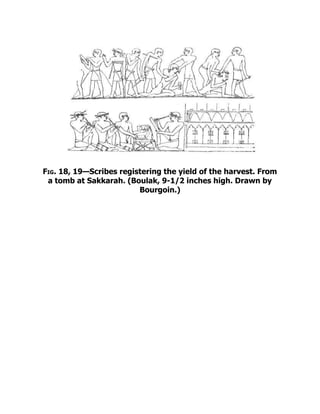
Fig. 18, 19—Scribesregistering the yield of the harvest. From
a tomb at Sakkarah. (Boulak, 9-1/2 inches high. Drawn by
Bourgoin.)
21.
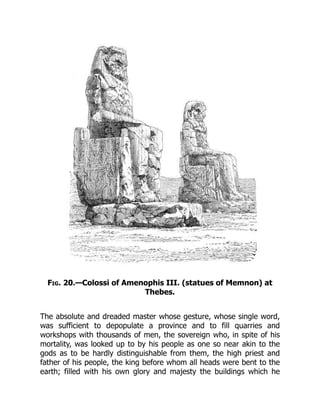
Fig. 20.—Colossi ofAmenophis III. (statues of Memnon) at
Thebes.
The absolute and dreaded master whose gesture, whose single word,
was sufficient to depopulate a province and to fill quarries and
workshops with thousands of men, the sovereign who, in spite of his
mortality, was looked up to by his people as one so near akin to the
gods as to be hardly distinguishable from them, the high priest and
father of his people, the king before whom all heads were bent to the
earth; filled with his own glory and majesty the buildings which he
22.
caused to spring,as if by magic, from the earth. His effigy was
everywhere. Seated in the form of colossal statues in front of the
temples, in bas-reliefs upon pylons, upon the walls of porticos and
pillared halls, he was represented sometimes offering homage to the
gods, sometimes leading his troops to battle or bringing them home
victorious. The supreme efforts of architect and sculptor were directed
to constructing for their prince a tomb which should excel all others in
magnificence and durability, or to immortalizing him by a statue which
should raise its head as much above its rivals as the royal power
surpassed the power and dignity of ordinary men. The art of Egypt
was, in this sense, a monarchical art; and in so being it was the direct
expression of the sentiments and ideas of the society which had to
create it from its foundations.
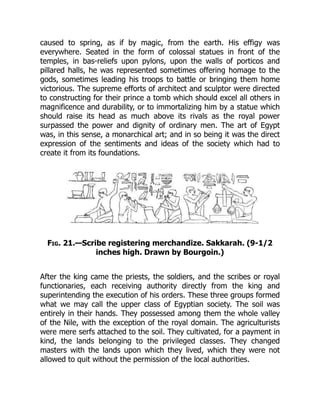
Fig. 21.—Scribe registering merchandize. Sakkarah. (9-1/2
inches high. Drawn by Bourgoin.)
After the king came the priests, the soldiers, and the scribes or royal
functionaries, each receiving authority directly from the king and
superintending the execution of his orders. These three groups formed
what we may call the upper class of Egyptian society. The soil was
entirely in their hands. They possessed among them the whole valley
of the Nile, with the exception of the royal domain. The agriculturists
were mere serfs attached to the soil. They cultivated, for a payment in
kind, the lands belonging to the privileged classes. They changed
masters with the lands upon which they lived, which they were not
allowed to quit without the permission of the local authorities.
23.
Their position didnot greatly differ from that of the modern fellahs,
who cultivate the Egyptian soil for the benefit of the effendis, beys,
and pachas or for that of the sovereign, who is still the greatest
landowner in the country.
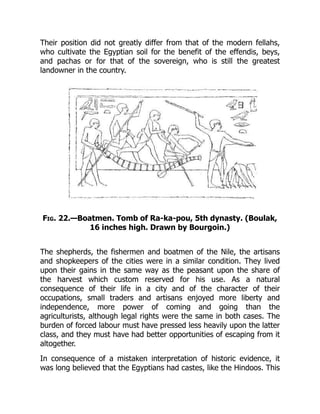
Fig. 22.—Boatmen. Tomb of Ra-ka-pou, 5th dynasty. (Boulak,
16 inches high. Drawn by Bourgoin.)
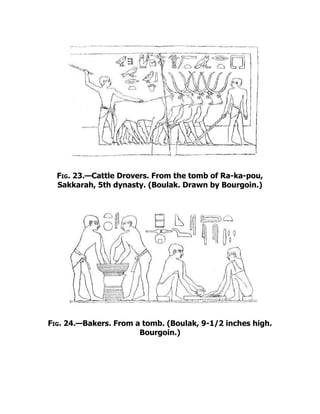
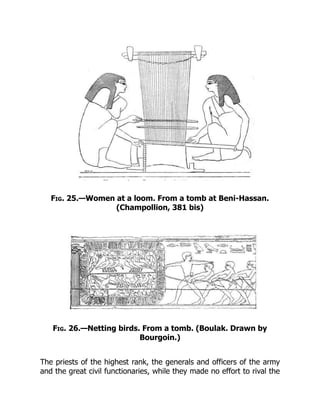
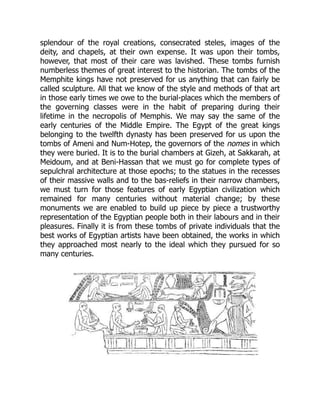
The shepherds, the fishermen and boatmen of the Nile, the artisans
and shopkeepers of the cities were in a similar condition. They lived
upon their gains in the same way as the peasant upon the share of
the harvest which custom reserved for his use. As a natural
consequence of their life in a city and of the character of their
occupations, small traders and artisans enjoyed more liberty and
independence, more power of coming and going than the
agriculturists, although legal rights were the same in both cases. The
burden of forced labour must have pressed less heavily upon the latter
class, and they must have had better opportunities of escaping from it
altogether.
In consequence of a mistaken interpretation of historic evidence, it
was long believed that the Egyptians had castes, like the Hindoos. This
24.
notion has beendispelled by more careful study of their remains. The
vigorous separation of classes according to their social functions, the
enforced heredity of professions, and the prohibition of intermarriage
between the different groups, never obtained a footing in Egypt. We
often find, in Egyptian writings, two members of a single family
attached one to the civil service and the other to the army, or the
daughter of a general marrying the son of a priest. Nay, it often
happens that the offices of soldier and priest, of priest and civil
servant, or of civil servant and soldier, are united in the person of a
single individual. In families which did not belong to these aristocratic
classes there was, in all probability, more heredity of occupation; in
the ordinary course the paternal employment fixed that of the
children, but yet there was nothing approaching to an absolute rule.
The various trades were formed into corporations or guilds, rather
than castes in the strict sense of the word. From this it resulted that
great natural talents, fortunate circumstances, or the favour of the
sovereign could raise a man of the lowest class up to the highest
dignities of the state. In the latter days of the monarchy we have an
example of this in the case of Amasis, who, born among the dregs of
the population, finally raised himself to the throne.[63] Such events
were of frequent occurrence in all those oriental monarchies where the
will of the sovereign was the supreme and undisputed law. Even in our
own days, similar things have taken place in Turkey and Persia to the
surprise of none but Europeans. When the master of all is placed so
high above his fellow men that his subjects seem mere human dust
about his feet, his caprice is quite sufficient to raise the most
insignificant of its atoms to a level with the most illustrious.
25.
Fig. 23.—Cattle Drovers.From the tomb of Ra-ka-pou,
Sakkarah, 5th dynasty. (Boulak. Drawn by Bourgoin.)
Fig. 24.—Bakers. From a tomb. (Boulak, 9-1/2 inches high.
Bourgoin.)
26.
Fig. 25.—Women ata loom. From a tomb at Beni-Hassan.
(Champollion, 381 bis)
Fig. 26.—Netting birds. From a tomb. (Boulak. Drawn by
Bourgoin.)
The priests of the highest rank, the generals and officers of the army
and the great civil functionaries, while they made no effort to rival the
27.
splendour of theroyal creations, consecrated steles, images of the
deity, and chapels, at their own expense. It was upon their tombs,
however, that most of their care was lavished. These tombs furnish
numberless themes of great interest to the historian. The tombs of the
Memphite kings have not preserved for us anything that can fairly be
called sculpture. All that we know of the style and methods of that art
in those early times we owe to the burial-places which the members of
the governing classes were in the habit of preparing during their
lifetime in the necropolis of Memphis. We may say the same of the
early centuries of the Middle Empire. The Egypt of the great kings
belonging to the twelfth dynasty has been preserved for us upon the
tombs of Ameni and Num-Hotep, the governors of the nomes in which
they were buried. It is to the burial chambers at Gizeh, at Sakkarah, at
Meidoum, and at Beni-Hassan that we must go for complete types of
sepulchral architecture at those epochs; to the statues in the recesses
of their massive walls and to the bas-reliefs in their narrow chambers,
we must turn for those features of early Egyptian civilization which
remained for many centuries without material change; by these
monuments we are enabled to build up piece by piece a trustworthy
representation of the Egyptian people both in their labours and in their
pleasures. Finally it is from these tombs of private individuals that the
best works of Egyptian artists have been obtained, the works in which
they approached most nearly to the ideal which they pursued for so
many centuries.
28.
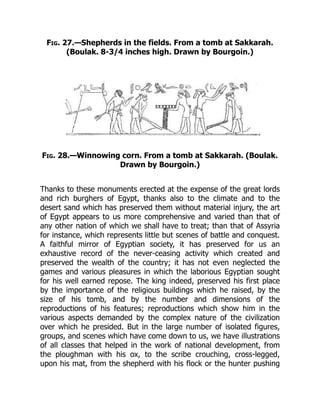
Fig. 27.—Shepherds inthe fields. From a tomb at Sakkarah.
(Boulak. 8-3/4 inches high. Drawn by Bourgoin.)
Fig. 28.—Winnowing corn. From a tomb at Sakkarah. (Boulak.
Drawn by Bourgoin.)
Thanks to these monuments erected at the expense of the great lords
and rich burghers of Egypt, thanks also to the climate and to the
desert sand which has preserved them without material injury, the art
of Egypt appears to us more comprehensive and varied than that of
any other nation of which we shall have to treat; than that of Assyria
for instance, which represents little but scenes of battle and conquest.
A faithful mirror of Egyptian society, it has preserved for us an
exhaustive record of the never-ceasing activity which created and
preserved the wealth of the country; it has not even neglected the
games and various pleasures in which the laborious Egyptian sought
for his well earned repose. The king indeed, preserved his first place
by the importance of the religious buildings which he raised, by the
size of his tomb, and by the number and dimensions of the
reproductions of his features; reproductions which show him in the
various aspects demanded by the complex nature of the civilization
over which he presided. But in the large number of isolated figures,
groups, and scenes which have come down to us, we have illustrations
of all classes that helped in the work of national development, from
the ploughman with his ox, to the scribe crouching, cross-legged,
upon his mat, from the shepherd with his flock or the hunter pushing
29.
his shallop throughthe brakes of papyrus, to the directors of the great
public works and the princes of the blood who governed conquered
provinces or guarded the frontiers of the country at the head of ever
faithful armies.
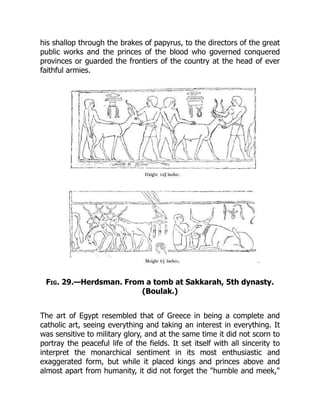
Fig. 29.—Herdsman. From a tomb at Sakkarah, 5th dynasty.
(Boulak.)
The art of Egypt resembled that of Greece in being a complete and
catholic art, seeing everything and taking an interest in everything. It
was sensitive to military glory, and at the same time it did not scorn to
portray the peaceful life of the fields. It set itself with all sincerity to
interpret the monarchical sentiment in its most enthusiastic and
exaggerated form, but while it placed kings and princes above and
almost apart from humanity, it did not forget the "humble and meek,"
30.
on the contrary,it frankly depicted them in their professional attitudes,
with all those ineffaceable characteristics, both of face and figure
which the practice of some special trade so certainly imparts. Looked
at from this point of view Egyptian art was popular, it might even be
called democratic, but that such a phrase would sound curious when
used in connection with the most absolute monarchy which the world
has ever seen.
This absolute power, however, does not seem, speaking generally, to
have been put in force in a hard or oppressive manner either by the
king himself or by his agents. M. Maspero and others who, like him,
live in intimate communion with the ancient Egyptians, declare that
they were by no means unhappy. They tell us that the confidences
whispered to them in the pictured tomb-houses of Sakkarah and
Memphis complain of no misery, from the time of Mena to that of
Psemethek, except during a few violent reigns and a few moments of
national crisis. The country suffered only on those comparatively rare
occasions when the sceptre passed into the hands of an incapable
master or into those of some insatiable warrior who thought only of
satisfying his own ambition, and sacrificed to the day the resources of
the future. Egypt, with her river, her teeming soil and her splendid
climate, found life easy as long as she enjoyed an easy and capable
administration. She then gave to her princes almost without an effort
all they could desire or demand.
It was one of the fundamental principles of Egyptian morality that
those who were powerful should treat the poor and feeble with
kindness and consideration. Their sepulchral inscriptions tell us that
their kings and princes of the blood, their feudal lords and
functionaries of every grade, made it a point of honour to observe this
rule. They were not content with strict justice, they practised a
bountiful charity which reminds us of that which is the chief beauty of
the Christian's morality. The "Book of the Dead"—that passport for
Egyptians into the other world which is found upon every mummy—
gives us the most simple, and at the same time the most complete
description of this virtue. "I have given bread to the hungry, I have
given water to the thirsty, I have clothed the naked ... I have not
31.
calumniated the slavein the ears of his master." The lengthy
panegyrics of which some epitaphs consist, are, in reality no more
than amplifications of this theme. "As for me, I have been the staff of
the old man, the nurse of the infant, the help of the distressed, a
warm shelter for all who were cold in the Thebaïd, the bread and
sustenance of the down-trodden, of whom there is no lack in Middle
Egypt, and their protector against the barbarians."[64] The prince
Entef relates that he has "arrested the arm of the violent, used brute
force to those who used brute force, showed hauteur to the haughty,
and lowered the shoulders of those who raised them up," that he
himself on the other hand, "was a man in a thousand, wise, learned,
and of a sound and truthful judgment, knowing the fool from the wise
man, paying attention to the skilful and turning his back upon the
ignorant, ... the father of the miserable and the mother of the
motherless, the terror of the cruel, the protector of the disinherited,
the defender of those whose goods were coveted by men stronger
than themselves, the husband of the widow, the asylum of the
orphan."[65]
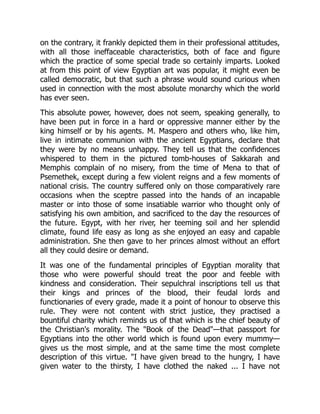
Fig. 30.—From the tomb of Menofre, at Sakkarah.
(Champollion, pl. 408.)
32.
Amoni, hereditary princeof the nome of Meh, talks in the same
fashion. "I have caused sorrow to no youth under age, I have
despoiled no widow, nor have I repelled any labourer, I have
imprisoned no shepherd, I have never taken for the labour gangs the
serfs of him who had but five, there have been no paupers, nor has
any man or woman starved in my time; for, although there have been
years of scarcity, I have caused all the tillable land in Meh to be tilled,
from the northern frontier to that of the south, and have made such
arrangements and such provision for the people that there has been
no famine among them; I have given to the widow and to the married
woman alike, and I have never made any distinction between the
great and the small in my gifts."[66]
Doubtless these laudatory self-descriptions may be exaggerated in
some respects; hyperbole has ever been a favourite figure with the
composers of epitaphs, and those of Egypt formed no exception to the
rule. As M. Maspero remarks in connection with this question, "The
man as he is, often differs very greatly from the man as he thinks he
is." But we may safely say that the Egyptian realized some portion of
the ideal which he set before himself. If only to obtain admiration and
esteem, he would practice, to a certain extent, the virtues of which he
boasted. Many signs combine to tell us that the Egyptians of all
classes possessed a large fund of tenderness and good-will. The
master was often both clement and charitable; the peasant, the
servant, and the slave, were patient and cheerful, and that in spite of
the fatigue of labours which could never enrich them. In a country so
favoured by nature, men had so few wants that they had no
experience of all that is implied by that doleful word poverty, with us.
The pure skies and brilliant sunshine, the deep draughts of Nile water,
and the moments of repose under the shadows of the sycamores, the
freshness of the evening bath, the starry night with its reinvigorating
breezes, were all enjoyments which the poorest could share.
We need feel no surprise therefore at the vivacity with which one of
the most learned of the historians of Egypt, Brugsch-Bey, protests
against the common misconception of the Egyptians "as a race grave,
serious, morose, exclusive, religious, thinking much of the next world,
33.
and little ofthis; living, in a word, like the Trappists of former days.
Are we to believe," he cries, "that this majestic river and the fertile soil
through which it flows, this azure sky with its unclouded sun,
produced a nation of living mummies, a race of solemn philosophers
who looked upon life in this world as a burden to be shuffled off as
quickly as possible? Travel over Egypt; examine the scenes painted
and sculptured upon the walls of sepulchral chambers; read the
inscriptions carved upon stone or traced in ink upon the rolls of
papyrus, and you will find yourself compelled to modify the false
notions you have imbibed as to the Egyptian philosophers. Nothing
could be more cheerful, more amusing or more frank, than the social
life of this pleasure-loving people. Far from wishing to die, they prayed
to the gods for a long life and a happy old age; they prayed that, 'if
possible, they might live to the perfect age of one hundred and ten.'
They were addicted to all kinds of pleasures. They drank, they sang,
they danced, they were fond of excursions into the country, where the
sports of hunting and fishing were specially reserved for the upper
class. As a natural effect of this desire for enjoyment, gay conversation
and pleasantry which was sometimes rather free, jokes and what we
should call chaff, were much in vogue: even their tombs were not
sacred from their desire for a jest."[67]
The worst government, the sternest oppression, could never
extinguish this natural gaiety; it was too intimately connected with the
climate and the natural conditions of the country, conditions which had
never changed since the days of Menes. Never were the Egyptians
more roughly treated than under Mehemet Ali and the late viceroy;
their condition was compared, with justice, to that of the negroes in
Carolina and Virginia, who, before the American civil war, laboured
under the whips of their drivers, and enjoyed no more of the fruits of
their own labour than what was barely sufficient to keep life in their
bodies. Torn from their homes and kept by force in the public works,
the fellahs died in thousands; those who remained in the fields had to
pay the taxes one or two years in advance; they were never out of
debt, nominally, to the public treasury, and the rattan of the collector
extorted from them such savings as they might make during years of
plenty, up to the last coin. But still laughter did not cease in Egypt!
34.
Look, for instance,at the children in the streets of Cairo who let out
mounts to sight-seeing Europeans. Let the tourist trot or gallop as he
will, when he stops he finds his donkey-boy by his side, full of spirits
and good humour; and yet perhaps while running behind his "fare" he
has been making his midday meal upon a few grains of maize tied up
in a corner of his shirt.
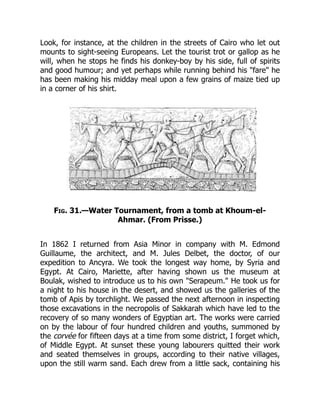
Fig. 31.—Water Tournament, from a tomb at Khoum-el-
Ahmar. (From Prisse.)
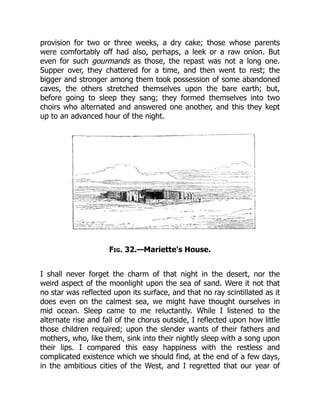
In 1862 I returned from Asia Minor in company with M. Edmond
Guillaume, the architect, and M. Jules Delbet, the doctor, of our
expedition to Ancyra. We took the longest way home, by Syria and
Egypt. At Cairo, Mariette, after having shown us the museum at
Boulak, wished to introduce us to his own "Serapeum." He took us for
a night to his house in the desert, and showed us the galleries of the
tomb of Apis by torchlight. We passed the next afternoon in inspecting
those excavations in the necropolis of Sakkarah which have led to the
recovery of so many wonders of Egyptian art. The works were carried
on by the labour of four hundred children and youths, summoned by
the corvée for fifteen days at a time from some district, I forget which,
of Middle Egypt. At sunset these young labourers quitted their work
and seated themselves in groups, according to their native villages,
upon the still warm sand. Each drew from a little sack, containing his
35.
provision for twoor three weeks, a dry cake; those whose parents
were comfortably off had also, perhaps, a leek or a raw onion. But
even for such gourmands as those, the repast was not a long one.
Supper over, they chattered for a time, and then went to rest; the
bigger and stronger among them took possession of some abandoned
caves, the others stretched themselves upon the bare earth; but,
before going to sleep they sang; they formed themselves into two
choirs who alternated and answered one another, and this they kept
up to an advanced hour of the night.
Fig. 32.—Mariette's House.
I shall never forget the charm of that night in the desert, nor the
weird aspect of the moonlight upon the sea of sand. Were it not that
no star was reflected upon its surface, and that no ray scintillated as it
does even on the calmest sea, we might have thought ourselves in
mid ocean. Sleep came to me reluctantly. While I listened to the
alternate rise and fall of the chorus outside, I reflected upon how little
those children required; upon the slender wants of their fathers and
mothers, who, like them, sink into their nightly sleep with a song upon
their lips. I compared this easy happiness with the restless and
complicated existence which we should find, at the end of a few days,
in the ambitious cities of the West, and I regretted that our year of
36.
travel, our twelvemonths of unrestrained life in the desert or the
forest, had come to an end.
§ 5. The Egyptian Religion and its Influence
upon the Plastic Arts.
We have still to notice the profoundly religious character of Egyptian
art. "The first thing that excites our surprise, when we examine the
reproductions of Egyptian monuments which have been published in
our day, is the extraordinary number of scenes of sacrifice and worship
which have come down to us. In the collection of plates which we owe
to contemporary archæologists, we can hardly find one which does
not contain the figure of some deity, receiving with impassive
countenance the prayers or offerings of a prostrate king or priest. One
would say that a country with so many sacred pictures and sculptures,
must have been inhabited by gods, and by just enough men for the
service of their temples.[68] The Egyptians were a devout people.
Either by natural tendency or by force of education, they saw God
pervading the whole of their universe; they lived in Him and for Him.
Their imaginations were full of His greatness, their words of His praise,
and their literature was in great part inspired by gratitude for the
benefits which He showered upon them. Most of their manuscripts
which have come down to us treat of religious matters, and even in
those which are ostensibly concerned only with profane subjects,
mythological names and allusions occur on every page, almost at
every line."[69]
An examination into the primitive religious beliefs of the Egyptians is
full of difficulty. In discovering new papyri, in determining the
signification of signs which have been puzzling egyptologists, the
inquirer will undoubtedly do good work, and will establish facts which
37.
Welcome to ourwebsite – the perfect destination for book lovers and
knowledge seekers. We believe that every book holds a new world,
offering opportunities for learning, discovery, and personal growth.
That’s why we are dedicated to bringing you a diverse collection of
books, ranging from classic literature and specialized publications to
self-development guides and children's books.
More than just a book-buying platform, we strive to be a bridge
connecting you with timeless cultural and intellectual values. With an
elegant, user-friendly interface and a smart search system, you can
quickly find the books that best suit your interests. Additionally,
our special promotions and home delivery services help you save time
and fully enjoy the joy of reading.
Join us on a journey of knowledge exploration, passion nurturing, and
personal growth every day!
ebookbell.com






!["Under the nineteenth dynasty an inverse movement to that of the
first period carried the political centre of the country back towards the
north. With the twenty-first Tanite dynasty, Thebes ceased to be the
capital, and the cities of the Delta, Tanis, Bubastis, Mendes,
Sebennytos, and above all Sais, rose into equal or superior
importance. From that time the political life of the country
concentrated itself in the maritime districts. The nomes of the
Thebaïd, ruined by the Ethiopian and Assyrian invasions, lost their
influence; and Thebes itself fell into ruin and became nothing more
than a rendezvous for curious travellers.
"I propose, therefore, to divide Egyptian history into three periods,
each corresponding to the political supremacy of one town or province
over the whole of Egypt:—
"First Period, Memphite (the first ten dynasties). The supremacy of
Memphis and of the sovereigns furnished by her.
"Second Period, Theban (from the eleventh to the twentieth dynasties
inclusive). Supremacy of Thebes and the Theban kings. This period is
divided into two sub-periods by the Shepherd dynasties.
"a. The old Theban empire, from the eleventh to the sixteenth
dynasties.
"b. The new Theban empire, from the sixteenth to the twentieth
dynasties.
"Third Period, Sait (from the twenty-first to the thirtieth dynasties,
inclusive). Supremacy of Sais and the other cities of the Delta. This
period is divided into two by the Persian invasion:—
"First Sait period, from the twenty-first to the twenty-sixth dynasties.
"Second Sait period, from the twenty-seventh to the thirtieth
dynasties."[54]
Mariette places the accession of Ména or Menes at about the fiftieth
century before our era, while Bunsen and other Egyptologists bring
forward his date to 3,600 or 3,500 B.C. as they believe some of the](https://image.slidesharecdn.com/22312983-250620212351-c0bee77f/85/The-Pmp-Exam-Quick-Reference-Guide-Andy-Crowe-9-320.jpg)
![creators of history, who brought with them their inquiring spirit and
their love for exactitude. After the accession of Psemethek I., the
founder of the twenty-sixth dynasty, in 656, our historical materials
are abundant. For that we must thank the Greek travellers who
penetrated everywhere, taking notes which they afterwards amplified
into narratives. It is a singular thing, that even as late as the
Ptolemies, when the power of the Macedonian monarchy was fully
developed, the Egyptians never seem to have felt the want of what we
call an era, of some definite point from which they could measure the
course of time and the progress of the centuries. "They were satisfied
with calculating by the years of the reigning sovereign, and even those
calculations had no certain point of departure. Sometimes they
counted from the commencement of the year which had witnessed the
death of his predecessor, sometimes from the day of his own
coronation. The most careful calculations will therefore fail to enable
modern science to restore to the Egyptians that which, in fact, they
never possessed."[55]
Even thus summarily stated, these historical indications are enough to
show how little foundation there is for the opinion which was held by
the ancient Greeks, and too long accepted by modern historians. It
was, they said, from Ethiopia that Egyptian civilization had come. A
colony of Ethiopian priests from the island of Meroè in Upper Nubia,
had introduced their religion, their written characters, their art and
their civil institutions into the country. The exact opposite of this is the
truth. "It was the Egyptians who advanced up the banks of the Nile to
found cities, fortresses, and temples in Ethiopia; it was the Egyptians
who carried their civilization into the midst of savage negro tribes. The
error was caused by the fact that at one epoch in the history of Egypt
the Ethiopians played an important part.
"If it were true that Egypt owed its political existence to Ethiopia, we
should be able to find in the latter country monuments of a more
remote antiquity, and as we descended the Nile, we should find the
remains comparatively modern; but, strangely enough, the study of all
these monuments incontestably proves that the sequence of towns,
holy places, and tombs, constructed by the Egyptians on the banks of](https://image.slidesharecdn.com/22312983-250620212351-c0bee77f/85/The-Pmp-Exam-Quick-Reference-Guide-Andy-Crowe-11-320.jpg)
![their river, follow each other in such chronological order that the oldest
remains, the Pyramids, are found in the north, in Lower Egypt, near
the southern point of the Delta. The nearer our steps take us to the
cataracts of Ethiopia, the less ancient do the monuments become.
They show ever increasing signs of the decadence of art, of taste, and
of the love for beauty. Finally, the art of Ethiopia, such as its still
existing monuments reveal it to us, is entirely wanting in originality. A
glance is sufficient to tell us that it represents the degeneracy only of
the Egyptian style, that the spirit of Egyptian forms has been weakly
grasped, and that their execution is generally mediocre."[56]
We may condense all these views into a simple and easily
remembered formula; we may say that as we mount towards the
springs of the Nile, we descend the current of time. Thebes is younger
than Memphis, and Meroè than Thebes. The river which Egypt
worshipped, and by which the walls of its cities were bathed, flowed
from the centre of Africa, from the south to the north; but the stream
of civilization flowed in the other direction, until it was lost in the
country of the negro, in the mysterious depths of Ethiopia. The springs
of this latter stream must be sought in that district where the waters
of the Nile, as if tired by their long journey, divide into several arms
before falling into the sea; in that district near the modern capital,
over which stretch the long shadows of the Pyramids.
§ 4. The Constitution of Egyptian Society—
Influence of that Constitution upon Monuments
of Art.
During the long sequence of centuries which we have divided into
three great periods, the national centre of gravity was more than once
displaced. The capital was at one time in Middle Egypt, at another in](https://image.slidesharecdn.com/22312983-250620212351-c0bee77f/85/The-Pmp-Exam-Quick-Reference-Guide-Andy-Crowe-12-320.jpg)
![Upper, and at a third period in Lower Egypt, in accordance with its
political necessities. At one period the nation had nothing to fear from
external enemies, at others it had to turn a bold front to Asia or
Ethiopia. At various times Egypt had to submit to her foreign foes; to
the shepherd invaders, to the kings of Assyria and Persia, to the
princes of Ethiopia, and finally to Alexander, to whom she lost her
independence never again to recover it. And yet it appears that the
character and social condition of the race never underwent any great
change. At the time of the pyramid-builders, Egypt was the most
absolute monarchy that ever existed, and so she remained till her final
conquest.
"Successor and descendant of the deities who once reigned over the
valley of the Nile, the king was the living manifestation and incarnation
of God: child of the sun (Se Râ), as he took care to proclaim whenever
he wrote his name, the blood of the gods flowed in his veins and
assured to him the sovereign power."[57] He was the priest above all
others. Such a form of worship as that of Egypt, required no doubt a
large sacerdotal class, each member of which had his own special
function in the complicated and gorgeous ceremonies in which he took
part; but the king alone, at least in the principal temples, had the right
to enter the sanctuary and to open the door of the kind of chapel in
which the symbolical representation of the divinity was kept; he alone
saw the god face to face, and spoke to him in the name of his people.
[58] The pre-eminent dignity of this priestly office did not, however,
prevent the king from taking his proper share in war or political affairs
generally. The army of scribes and various functionaries, whose titles
may still be read upon the most ancient monuments of the country,
depended upon him for their orders from one end of the country to
the other, and in war, it was he who led the serried battalions of the
Egyptian army. The king was thus a supreme pontif, the immediate
chief of all civil and military officers; and, as the people believed that
his career was directed by the gods with whom he held converse, he
became to them a visible deity and, in the words of an inscription,
"the representative of Râ among the living." His divinity, begun on
earth, was completed and rendered perpetual in another life. All the](https://image.slidesharecdn.com/22312983-250620212351-c0bee77f/85/The-Pmp-Exam-Quick-Reference-Guide-Andy-Crowe-13-320.jpg)
![dead Pharaohs became gods, so that the Egyptian pantheon obtained
a new deity at the death of each sovereign. The deceased Pharaohs
thus constituted a series of gods to whom the reigning sovereign
would of course address himself when he had anything to ask; hence
the monuments upon which we find living Pharaohs offering worship
to their predecessors.[59]
Fig. 13.—Seti I. in his War-Chariot, bas-relief at Thebes.
(Champollion, pl. 297.)
The prestige which such a theory of
royalty was calculated to give to the
Egyptian kings may easily be
imagined. They obtained more than
respect; they were the objects of
adoration, of idolatry. Brought up
from infancy in this religious
veneration, to which their hereditary
qualities also inclined them,](https://image.slidesharecdn.com/22312983-250620212351-c0bee77f/85/The-Pmp-Exam-Quick-Reference-Guide-Andy-Crowe-14-320.jpg)
![Fig. 14.—Rameses II.
in adoration before Seti.
From Abydos (Mariette).
generation succeeded generation among
the Egyptians, without any attempt to
rebel against the royal authority or even
to dispute it. Ancient Egypt, like its
modern descendant, was now and then
the scene of military revolts. These were generally provoked by the
presence of foreign mercenaries, sometimes by their want of discipline
and licence, sometimes by the jealousy which they inspired in the
native soldiery; but never, from the time of Menes to that of Tewfik-
Pacha, has the civil population, whether of the town or of the fields,
shown any desire to obtain the slightest guarantee for what we should
call their rights and liberties. During all those thousands of years not
the faintest trace is to be discovered of that spirit from which sprung
the republican constitutions of Greece and ancient Italy, a spirit which,
in yet later times, has led to the parliamentary governments of
Christian Europe. The Egyptian labourer or artisan never dreamt of
calling in question the orders of any one who might be master for the
time. Absolute obedience to the will of a single man—such was the
constant and instinctive national habit, and by it every movement of
the social machine, under foreign and native kings alike, was
regulated.
From the construction of the pyramids of Cheops and Chephren, and
the cutting of a new canal between the two seas under Nekau, to the
Mahmoudieh canal of Mehemet-Ali and that abortive enterprise, the
barrage of the Nile, the only method thought of for obtaining the
necessary labour was compulsion.[60] An order is received by the
governor, who has it proclaimed from one village to another
throughout his province; next day the whole male population is driven,
like a troop of sheep, to the workshops. Each man carries a bag or
basket which holds his provisions for a fortnight or a month, as the
case may be; a few dry cakes, onions, garlic, and Egyptian beans, as
the Greeks called the species of almond which is contained in the fruit
of the lotus. Old men and children, all had to obey the summons. The
more vigorous and skilful among them dressed and put in place the
blocks of granite or limestone; the weakest were useful for the
transport of the rubbish to a distance, for carrying clay and water from](https://image.slidesharecdn.com/22312983-250620212351-c0bee77f/85/The-Pmp-Exam-Quick-Reference-Guide-Andy-Crowe-15-320.jpg)
![the Nile to the brickmakers, for arranging the bricks in the sun so that
they might be dried and hardened.
Fig. 15.—Homage to Amenophis III. (From Prisse.[61])
Under the stimulus of the rod, this multitude worked well and
obediently under the directions of the architect's foreman and of
skilled artisans who were permanently employed upon the work; they
did all that could be done by men without special education. At the
end of a certain period they were relieved by fresh levies from another
province, and all who had not succumbed to the hard and continuous
work, returned to their own places. Those who died were buried in
hasty graves dug in the sands of the desert by the natives of their own
village.
The massive grandeur of some of the Egyptian monuments is only to
be explained by this levy en masse of every available pair of hands.
The kings of the ancient empire, at least, were unable to dispose of
those prisoners of war captured in myriads, in whole races, by the
Assyrian kings, and apparently employed by them in the construction
of Nineveh. Now, it is impossible that such works as the Pyramids
could have been begun and finished in the course of a single reign by
free and remunerated labour, even if it had the help of numerous
slaves. Certain arrangements in their design and the marvellously
exact execution of the more important details of the masonry, prove](https://image.slidesharecdn.com/22312983-250620212351-c0bee77f/85/The-Pmp-Exam-Quick-Reference-Guide-Andy-Crowe-16-320.jpg)
![nothing but their unskilled labour to bestow. To such men as these a
great part of the work had perforce to be confided, in order that it
might be complete at the required time. In spite of the strictest
supervision, the almost religious care in the placing and fixing of
masonry, which might be fairly expected from the practised members
of a trade guild, could not be ensured. Hence the singular inequalities
and inconsistences which have been noticed in most of the great
Egyptian buildings; sometimes it is the foundations which are in fault,
and, by their sinking, have compromised the safety of the whole
building;[62] sometimes it is the built up columns of masonry, which,
when deprived by time of their coating of stucco, appear very poor
and mean. The infinite foresight and self-respect, the passionate love
for perfection for its own sake, which is characteristic of Greek work at
its best time, is not here to be found. But this defect was inseparable
from the system under which the Egyptian buildings were erected.](https://image.slidesharecdn.com/22312983-250620212351-c0bee77f/85/The-Pmp-Exam-Quick-Reference-Guide-Andy-Crowe-18-320.jpg)
![notion has been dispelled by more careful study of their remains. The
vigorous separation of classes according to their social functions, the
enforced heredity of professions, and the prohibition of intermarriage
between the different groups, never obtained a footing in Egypt. We
often find, in Egyptian writings, two members of a single family
attached one to the civil service and the other to the army, or the
daughter of a general marrying the son of a priest. Nay, it often
happens that the offices of soldier and priest, of priest and civil
servant, or of civil servant and soldier, are united in the person of a
single individual. In families which did not belong to these aristocratic
classes there was, in all probability, more heredity of occupation; in
the ordinary course the paternal employment fixed that of the
children, but yet there was nothing approaching to an absolute rule.
The various trades were formed into corporations or guilds, rather
than castes in the strict sense of the word. From this it resulted that
great natural talents, fortunate circumstances, or the favour of the
sovereign could raise a man of the lowest class up to the highest
dignities of the state. In the latter days of the monarchy we have an
example of this in the case of Amasis, who, born among the dregs of
the population, finally raised himself to the throne.[63] Such events
were of frequent occurrence in all those oriental monarchies where the
will of the sovereign was the supreme and undisputed law. Even in our
own days, similar things have taken place in Turkey and Persia to the
surprise of none but Europeans. When the master of all is placed so
high above his fellow men that his subjects seem mere human dust
about his feet, his caprice is quite sufficient to raise the most
insignificant of its atoms to a level with the most illustrious.](https://image.slidesharecdn.com/22312983-250620212351-c0bee77f/85/The-Pmp-Exam-Quick-Reference-Guide-Andy-Crowe-24-320.jpg)
![calumniated the slave in the ears of his master." The lengthy
panegyrics of which some epitaphs consist, are, in reality no more
than amplifications of this theme. "As for me, I have been the staff of
the old man, the nurse of the infant, the help of the distressed, a
warm shelter for all who were cold in the Thebaïd, the bread and
sustenance of the down-trodden, of whom there is no lack in Middle
Egypt, and their protector against the barbarians."[64] The prince
Entef relates that he has "arrested the arm of the violent, used brute
force to those who used brute force, showed hauteur to the haughty,
and lowered the shoulders of those who raised them up," that he
himself on the other hand, "was a man in a thousand, wise, learned,
and of a sound and truthful judgment, knowing the fool from the wise
man, paying attention to the skilful and turning his back upon the
ignorant, ... the father of the miserable and the mother of the
motherless, the terror of the cruel, the protector of the disinherited,
the defender of those whose goods were coveted by men stronger
than themselves, the husband of the widow, the asylum of the
orphan."[65]
Fig. 30.—From the tomb of Menofre, at Sakkarah.
(Champollion, pl. 408.)](https://image.slidesharecdn.com/22312983-250620212351-c0bee77f/85/The-Pmp-Exam-Quick-Reference-Guide-Andy-Crowe-31-320.jpg)
![Amoni, hereditary prince of the nome of Meh, talks in the same
fashion. "I have caused sorrow to no youth under age, I have
despoiled no widow, nor have I repelled any labourer, I have
imprisoned no shepherd, I have never taken for the labour gangs the
serfs of him who had but five, there have been no paupers, nor has
any man or woman starved in my time; for, although there have been
years of scarcity, I have caused all the tillable land in Meh to be tilled,
from the northern frontier to that of the south, and have made such
arrangements and such provision for the people that there has been
no famine among them; I have given to the widow and to the married
woman alike, and I have never made any distinction between the
great and the small in my gifts."[66]
Doubtless these laudatory self-descriptions may be exaggerated in
some respects; hyperbole has ever been a favourite figure with the
composers of epitaphs, and those of Egypt formed no exception to the
rule. As M. Maspero remarks in connection with this question, "The
man as he is, often differs very greatly from the man as he thinks he
is." But we may safely say that the Egyptian realized some portion of
the ideal which he set before himself. If only to obtain admiration and
esteem, he would practice, to a certain extent, the virtues of which he
boasted. Many signs combine to tell us that the Egyptians of all
classes possessed a large fund of tenderness and good-will. The
master was often both clement and charitable; the peasant, the
servant, and the slave, were patient and cheerful, and that in spite of
the fatigue of labours which could never enrich them. In a country so
favoured by nature, men had so few wants that they had no
experience of all that is implied by that doleful word poverty, with us.
The pure skies and brilliant sunshine, the deep draughts of Nile water,
and the moments of repose under the shadows of the sycamores, the
freshness of the evening bath, the starry night with its reinvigorating
breezes, were all enjoyments which the poorest could share.
We need feel no surprise therefore at the vivacity with which one of
the most learned of the historians of Egypt, Brugsch-Bey, protests
against the common misconception of the Egyptians "as a race grave,
serious, morose, exclusive, religious, thinking much of the next world,](https://image.slidesharecdn.com/22312983-250620212351-c0bee77f/85/The-Pmp-Exam-Quick-Reference-Guide-Andy-Crowe-32-320.jpg)
![and little of this; living, in a word, like the Trappists of former days.
Are we to believe," he cries, "that this majestic river and the fertile soil
through which it flows, this azure sky with its unclouded sun,
produced a nation of living mummies, a race of solemn philosophers
who looked upon life in this world as a burden to be shuffled off as
quickly as possible? Travel over Egypt; examine the scenes painted
and sculptured upon the walls of sepulchral chambers; read the
inscriptions carved upon stone or traced in ink upon the rolls of
papyrus, and you will find yourself compelled to modify the false
notions you have imbibed as to the Egyptian philosophers. Nothing
could be more cheerful, more amusing or more frank, than the social
life of this pleasure-loving people. Far from wishing to die, they prayed
to the gods for a long life and a happy old age; they prayed that, 'if
possible, they might live to the perfect age of one hundred and ten.'
They were addicted to all kinds of pleasures. They drank, they sang,
they danced, they were fond of excursions into the country, where the
sports of hunting and fishing were specially reserved for the upper
class. As a natural effect of this desire for enjoyment, gay conversation
and pleasantry which was sometimes rather free, jokes and what we
should call chaff, were much in vogue: even their tombs were not
sacred from their desire for a jest."[67]
The worst government, the sternest oppression, could never
extinguish this natural gaiety; it was too intimately connected with the
climate and the natural conditions of the country, conditions which had
never changed since the days of Menes. Never were the Egyptians
more roughly treated than under Mehemet Ali and the late viceroy;
their condition was compared, with justice, to that of the negroes in
Carolina and Virginia, who, before the American civil war, laboured
under the whips of their drivers, and enjoyed no more of the fruits of
their own labour than what was barely sufficient to keep life in their
bodies. Torn from their homes and kept by force in the public works,
the fellahs died in thousands; those who remained in the fields had to
pay the taxes one or two years in advance; they were never out of
debt, nominally, to the public treasury, and the rattan of the collector
extorted from them such savings as they might make during years of
plenty, up to the last coin. But still laughter did not cease in Egypt!](https://image.slidesharecdn.com/22312983-250620212351-c0bee77f/85/The-Pmp-Exam-Quick-Reference-Guide-Andy-Crowe-33-320.jpg)
![travel, our twelve months of unrestrained life in the desert or the
forest, had come to an end.
§ 5. The Egyptian Religion and its Influence
upon the Plastic Arts.
We have still to notice the profoundly religious character of Egyptian
art. "The first thing that excites our surprise, when we examine the
reproductions of Egyptian monuments which have been published in
our day, is the extraordinary number of scenes of sacrifice and worship
which have come down to us. In the collection of plates which we owe
to contemporary archæologists, we can hardly find one which does
not contain the figure of some deity, receiving with impassive
countenance the prayers or offerings of a prostrate king or priest. One
would say that a country with so many sacred pictures and sculptures,
must have been inhabited by gods, and by just enough men for the
service of their temples.[68] The Egyptians were a devout people.
Either by natural tendency or by force of education, they saw God
pervading the whole of their universe; they lived in Him and for Him.
Their imaginations were full of His greatness, their words of His praise,
and their literature was in great part inspired by gratitude for the
benefits which He showered upon them. Most of their manuscripts
which have come down to us treat of religious matters, and even in
those which are ostensibly concerned only with profane subjects,
mythological names and allusions occur on every page, almost at
every line."[69]
An examination into the primitive religious beliefs of the Egyptians is
full of difficulty. In discovering new papyri, in determining the
signification of signs which have been puzzling egyptologists, the
inquirer will undoubtedly do good work, and will establish facts which](https://image.slidesharecdn.com/22312983-250620212351-c0bee77f/85/The-Pmp-Exam-Quick-Reference-Guide-Andy-Crowe-36-320.jpg)