The Planners
By: Catalina Grosso and Luna
Pérez Muñiz
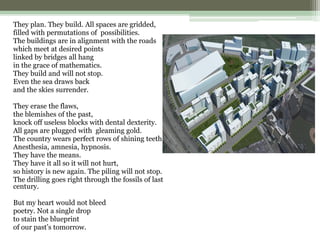
They plan. They build. All spaces are gridded,
filled with permutations of possibilities.
The buildings are in alignment with the roads
which meet at desired points
linked by bridges all hang
in the grace of mathematics.
They build and will not stop.
Even the sea draws back
and the skies surrender.
They erase the flaws,
the blemishes of the past,
knock off useless blocks with dental dexterity.
All gaps are plugged with gleaming gold.
The country wears perfect rows of shining teeth.
Anesthesia, amnesia, hypnosis.
They have the means.
They have it all so it will not hurt,
so history is new again. The piling will not stop.
The drilling goes right through the fossils of last
century.
But my heart would not bleed
poetry. Not a single drop
to stain the blueprint
of our past’s tomorrow.
Themes
The themes of this poem are:
• Reducing the quality of the future. “They build and
will not stop” This means that as they keep building,
the nature will pass to take a second place.
• Progress is destroying nature as well as history.
This is seen in the poem when is says “Even the sea
draws back and the sky surrenders” This
personification explains that they are building and
nature is afraid, so it surrenders.
• Art resists. The author says in the second stanza
“the blemishes of the past, knock off” the blemishes
must be history and art. So art resists.
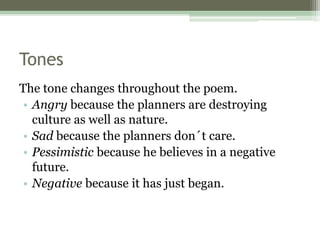
Tones
The tone changes throughout the poem.
• Angry because the planners are destroying
culture as well as nature.
• Sad because the planners don´t care.
• Pessimistic because he believes in a negative
future.
• Negative because it has just began.
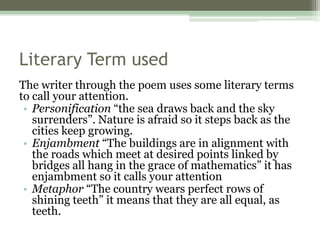
Literary Term used
The writer through the poem uses some literary terms
to call your attention.
• Personification “the sea draws back and the sky
surrenders”. Nature is afraid so it steps back as the
cities keep growing.
• Enjambment “The buildings are in alignment with
the roads which meet at desired points linked by
bridges all hang in the grace of mathematics” it has
enjambment so it calls your attention
• Metaphor “The country wears perfect rows of
shining teeth” it means that they are all equal, as
teeth.
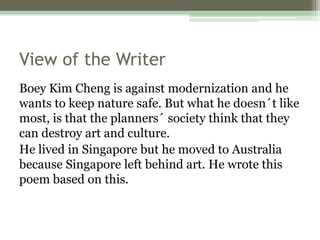
View of the Writer
Boey Kim Cheng is against modernization and he
wants to keep nature safe. But what he doesn´t like
most, is that the planners´ society think that they
can destroy art and culture.
He lived in Singapore but he moved to Australia
because Singapore left behind art. He wrote this
poem based on this.
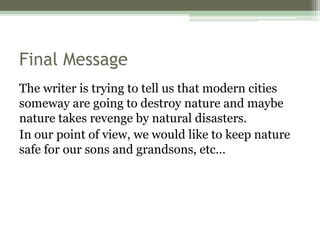
Final Message
The writer is trying to tell us that modern cities
someway are going to destroy nature and maybe
nature takes revenge by natural disasters.
In our point of view, we would like to keep nature
safe for our sons and grandsons, etc…
The City Planners
Analysis
Cruising these residential Sunday
streets in dry August sunlight:
what offends us is
the sanities:
the houses in pedantic rows, the planted
sanitary trees, assert
levelness of surface like a rebuke
to the dent in our car door.
No shouting here, or
shatter of glass; nothing more abrupt
than the rational whine of a power mower
cutting a straight swath in the discouraged
grass.
But though the driveways neatly
sidestep hysteria
by being even, the roofs all display
the same slant of avoidance to the hot sky,
certain things:
the smell of spilled oil a faint
sickness lingering in the garages,
a splash of paint on brick surprising as a
bruise,
a plastic hose poised in a vicious
coil; even the too-fixed stare of the wide
windows
give momentary access to
the landscape behind or under
the future cracks in the plaster
when the houses, capsized, will slide
obliquely into the clay seas, gradual as glaciers
that right now nobody notices.
That is where the City Planners
with the insane faces of political conspirators
are scattered over unsurvey
territories, concealed from each other,
each in his own private blizzard;
guessing directions, they sketch
transitory lines rigid as wooden borders
on a wall in the white vanishing air
tracing the panic of suburb
order in a bland madness of snows
Themes
• False/plastic beauty of modern cities. Because
cities are hidden by perfection but that
perfection isn´t as good as colors or originality.
“the roofs all displayed the same slant of
avoidance”.
• Blizzards. Every planner is “in his own private
blizzard”. The city planners don´t care about
anything they only want perfect cities.
Tones
• Depressed. Because the cities are very
depressing as they are all the same color and
everything.
• Mad. Because being the same isn´t sane.
Originality is what cities need.
• Angry. Because this is very unoriginal.
• Remorseful. Because everyone stays quiet and
the city planners can´t be stopped.
Literary Terms Used
• Enjambment. There are stanzas and lines which
don´t have dots so capital letters became important
and call your attention.
• Alliteration. When there is alliteration you have to
pay a lot of attention because it is something
important. In this case, it is that imperfect things are
being enumerated.
“The smell of spilled oil a faint
sickness lingering in the garages,
a splash of paint on brick surprising as a bruise,
a plastic hose poised in a vicious
coil; even the too-fixed stare of the wide windows”.
View of the Writer
Margaret Atwood wants to describe in this poem
the modernization and false beauty of modern
cities. She thinks that politicians are in their own
problems trying to make the cities more modern
and they are leaving behind nature and history.
The city that Margaret describes is so perfect
that a simple blemish is prominent over the
perfect background.
Final Message
For us the final message is that new cities try to be
perfect and the planners don´t care about
anything.
The planners & The city planners

The planners & The city planners

  • 1.
    The Planners By: CatalinaGrosso and Luna Pérez Muñiz
  • 2.
    They plan. Theybuild. All spaces are gridded, filled with permutations of possibilities. The buildings are in alignment with the roads which meet at desired points linked by bridges all hang in the grace of mathematics. They build and will not stop. Even the sea draws back and the skies surrender. They erase the flaws, the blemishes of the past, knock off useless blocks with dental dexterity. All gaps are plugged with gleaming gold. The country wears perfect rows of shining teeth. Anesthesia, amnesia, hypnosis. They have the means. They have it all so it will not hurt, so history is new again. The piling will not stop. The drilling goes right through the fossils of last century. But my heart would not bleed poetry. Not a single drop to stain the blueprint of our past’s tomorrow.
  • 3.
    Themes The themes ofthis poem are: • Reducing the quality of the future. “They build and will not stop” This means that as they keep building, the nature will pass to take a second place. • Progress is destroying nature as well as history. This is seen in the poem when is says “Even the sea draws back and the sky surrenders” This personification explains that they are building and nature is afraid, so it surrenders. • Art resists. The author says in the second stanza “the blemishes of the past, knock off” the blemishes must be history and art. So art resists.
  • 4.
    Tones The tone changesthroughout the poem. • Angry because the planners are destroying culture as well as nature. • Sad because the planners don´t care. • Pessimistic because he believes in a negative future. • Negative because it has just began.
  • 5.
    Literary Term used Thewriter through the poem uses some literary terms to call your attention. • Personification “the sea draws back and the sky surrenders”. Nature is afraid so it steps back as the cities keep growing. • Enjambment “The buildings are in alignment with the roads which meet at desired points linked by bridges all hang in the grace of mathematics” it has enjambment so it calls your attention • Metaphor “The country wears perfect rows of shining teeth” it means that they are all equal, as teeth.
  • 6.
    View of theWriter Boey Kim Cheng is against modernization and he wants to keep nature safe. But what he doesn´t like most, is that the planners´ society think that they can destroy art and culture. He lived in Singapore but he moved to Australia because Singapore left behind art. He wrote this poem based on this.
  • 7.
    Final Message The writeris trying to tell us that modern cities someway are going to destroy nature and maybe nature takes revenge by natural disasters. In our point of view, we would like to keep nature safe for our sons and grandsons, etc…
  • 8.
  • 9.
    Cruising these residentialSunday streets in dry August sunlight: what offends us is the sanities: the houses in pedantic rows, the planted sanitary trees, assert levelness of surface like a rebuke to the dent in our car door. No shouting here, or shatter of glass; nothing more abrupt than the rational whine of a power mower cutting a straight swath in the discouraged grass. But though the driveways neatly sidestep hysteria by being even, the roofs all display the same slant of avoidance to the hot sky, certain things: the smell of spilled oil a faint sickness lingering in the garages, a splash of paint on brick surprising as a bruise, a plastic hose poised in a vicious coil; even the too-fixed stare of the wide windows give momentary access to the landscape behind or under the future cracks in the plaster when the houses, capsized, will slide obliquely into the clay seas, gradual as glaciers that right now nobody notices. That is where the City Planners with the insane faces of political conspirators are scattered over unsurvey territories, concealed from each other, each in his own private blizzard; guessing directions, they sketch transitory lines rigid as wooden borders on a wall in the white vanishing air tracing the panic of suburb order in a bland madness of snows
  • 10.
    Themes • False/plastic beautyof modern cities. Because cities are hidden by perfection but that perfection isn´t as good as colors or originality. “the roofs all displayed the same slant of avoidance”. • Blizzards. Every planner is “in his own private blizzard”. The city planners don´t care about anything they only want perfect cities.
  • 11.
    Tones • Depressed. Becausethe cities are very depressing as they are all the same color and everything. • Mad. Because being the same isn´t sane. Originality is what cities need. • Angry. Because this is very unoriginal. • Remorseful. Because everyone stays quiet and the city planners can´t be stopped.
  • 12.
    Literary Terms Used •Enjambment. There are stanzas and lines which don´t have dots so capital letters became important and call your attention. • Alliteration. When there is alliteration you have to pay a lot of attention because it is something important. In this case, it is that imperfect things are being enumerated. “The smell of spilled oil a faint sickness lingering in the garages, a splash of paint on brick surprising as a bruise, a plastic hose poised in a vicious coil; even the too-fixed stare of the wide windows”.
  • 13.
    View of theWriter Margaret Atwood wants to describe in this poem the modernization and false beauty of modern cities. She thinks that politicians are in their own problems trying to make the cities more modern and they are leaving behind nature and history. The city that Margaret describes is so perfect that a simple blemish is prominent over the perfect background.
  • 14.
    Final Message For usthe final message is that new cities try to be perfect and the planners don´t care about anything.