PASSIVE VOICE II
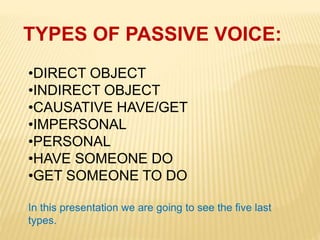
TYPES OF PASSIVE VOICE:
•DIRECT OBJECT
•INDIRECT OBJECT
•CAUSATIVE HAVE/GET
•IMPERSONAL
•PERSONAL
•HAVE SOMEONE DO
•GET SOMEONE TO DO
In this presentation we are going to see the five last
types.
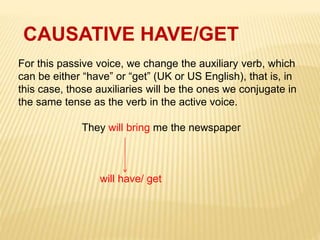
CAUSATIVE HAVE/GET
For this passive voice, we change the auxiliary verb, which
can be either “have” or “get” (UK or US English), that is, in
this case, those auxiliaries will be the ones we conjugate in
the same tense as the verb in the active voice.
They will bring me the newspaper
will have/ get
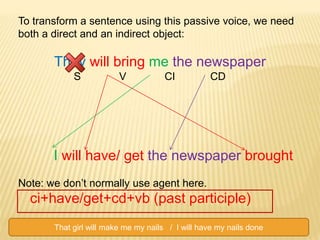
To transform a sentence using this passive voice, we need
both a direct and an indirect object:
They will bring me the newspaper
S V CI CD
I will have/ get the newspaper brought
Note: we don’t normally use agent here.
ci+have/get+cd+vb (past participle)
That girl will make me my nails / I will have my nails done
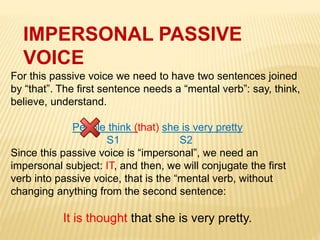
IMPERSONAL PASSIVE
VOICE
For this passive voice we need to have two sentences joined
by “that”. The first sentence needs a “mental verb”: say, think,
believe, understand.
People think (that) she is very pretty
S1 S2
Since this passive voice is “impersonal”, we need an
impersonal subject: IT, and then, we will conjugate the first
verb into passive voice, that is the “mental verb, without
changing anything from the second sentence:
It is thought that she is very pretty.
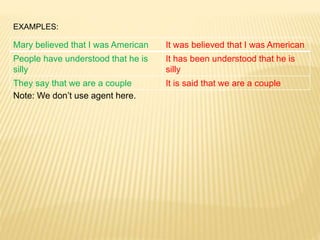
EXAMPLES:
Note: We don’t use agent here.
Mary believed that I was American It was believed that I was American
People have understood that he is
silly
It has been understood that he is
silly
They say that we are a couple It is said that we are a couple
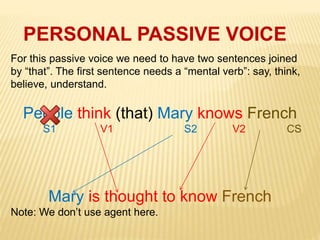
PERSONAL PASSIVE VOICE
For this passive voice we need to have two sentences joined
by “that”. The first sentence needs a “mental verb”: say, think,
believe, understand.
People think (that) Mary knows French
S1 V1 S2 V2 CS
Mary is thought to know French
Note: We don’t use agent here.
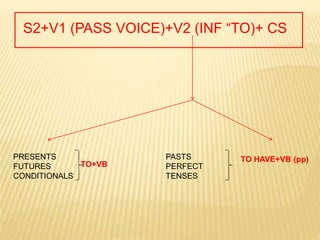
S2+V1 (PASS VOICE)+V2 (INF “TO)+ CS
PRESENTS
FUTURES
CONDITIONALS
TO+VB
PASTS
PERFECT
TENSES
TO HAVE+VB (pp)
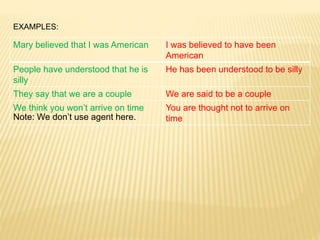
EXAMPLES:
Note: We don’t use agent here.
Mary believed that I was American I was believed to have been
American
People have understood that he is
silly
He has been understood to be silly
They say that we are a couple We are said to be a couple
We think you won’t arrive on time You are thought not to arrive on
time
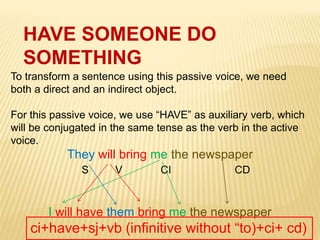
HAVE SOMEONE DO
SOMETHING
To transform a sentence using this passive voice, we need
both a direct and an indirect object.
For this passive voice, we use “HAVE” as auxiliary verb, which
will be conjugated in the same tense as the verb in the active
voice.
They will bring me the newspaper
S V CI CD
I will have them bring me the newspaper
ci+have+sj+vb (infinitive without “to)+ci+ cd)
GET SOMEONE TO DO
SOMETHING
To transform a sentence using this passive voice, we need
both a direct and an indirect object.
For this passive voice, we use “GET” as auxiliary verb, which
will be conjugated in the same tense as the verb in the active
voice.
They will bring me the newspaper
S V CI CD
I will get them to bring me the newspaper
ci+get+sj+vb (infinitive with “to)+ci+ cd)

THE PASSIVE VOICE - TYPES.pptx

  • 1.
  • 2.
    TYPES OF PASSIVEVOICE: •DIRECT OBJECT •INDIRECT OBJECT •CAUSATIVE HAVE/GET •IMPERSONAL •PERSONAL •HAVE SOMEONE DO •GET SOMEONE TO DO In this presentation we are going to see the five last types.
  • 3.
    CAUSATIVE HAVE/GET For thispassive voice, we change the auxiliary verb, which can be either “have” or “get” (UK or US English), that is, in this case, those auxiliaries will be the ones we conjugate in the same tense as the verb in the active voice. They will bring me the newspaper will have/ get
  • 4.
    To transform asentence using this passive voice, we need both a direct and an indirect object: They will bring me the newspaper S V CI CD I will have/ get the newspaper brought Note: we don’t normally use agent here. ci+have/get+cd+vb (past participle) That girl will make me my nails / I will have my nails done
  • 5.
    IMPERSONAL PASSIVE VOICE For thispassive voice we need to have two sentences joined by “that”. The first sentence needs a “mental verb”: say, think, believe, understand. People think (that) she is very pretty S1 S2 Since this passive voice is “impersonal”, we need an impersonal subject: IT, and then, we will conjugate the first verb into passive voice, that is the “mental verb, without changing anything from the second sentence: It is thought that she is very pretty.
  • 6.
    EXAMPLES: Note: We don’tuse agent here. Mary believed that I was American It was believed that I was American People have understood that he is silly It has been understood that he is silly They say that we are a couple It is said that we are a couple
  • 7.
    PERSONAL PASSIVE VOICE Forthis passive voice we need to have two sentences joined by “that”. The first sentence needs a “mental verb”: say, think, believe, understand. People think (that) Mary knows French S1 V1 S2 V2 CS Mary is thought to know French Note: We don’t use agent here.
  • 8.
    S2+V1 (PASS VOICE)+V2(INF “TO)+ CS PRESENTS FUTURES CONDITIONALS TO+VB PASTS PERFECT TENSES TO HAVE+VB (pp)
  • 9.
    EXAMPLES: Note: We don’tuse agent here. Mary believed that I was American I was believed to have been American People have understood that he is silly He has been understood to be silly They say that we are a couple We are said to be a couple We think you won’t arrive on time You are thought not to arrive on time
  • 10.
    HAVE SOMEONE DO SOMETHING Totransform a sentence using this passive voice, we need both a direct and an indirect object. For this passive voice, we use “HAVE” as auxiliary verb, which will be conjugated in the same tense as the verb in the active voice. They will bring me the newspaper S V CI CD I will have them bring me the newspaper ci+have+sj+vb (infinitive without “to)+ci+ cd)
  • 11.
    GET SOMEONE TODO SOMETHING To transform a sentence using this passive voice, we need both a direct and an indirect object. For this passive voice, we use “GET” as auxiliary verb, which will be conjugated in the same tense as the verb in the active voice. They will bring me the newspaper S V CI CD I will get them to bring me the newspaper ci+get+sj+vb (infinitive with “to)+ci+ cd)