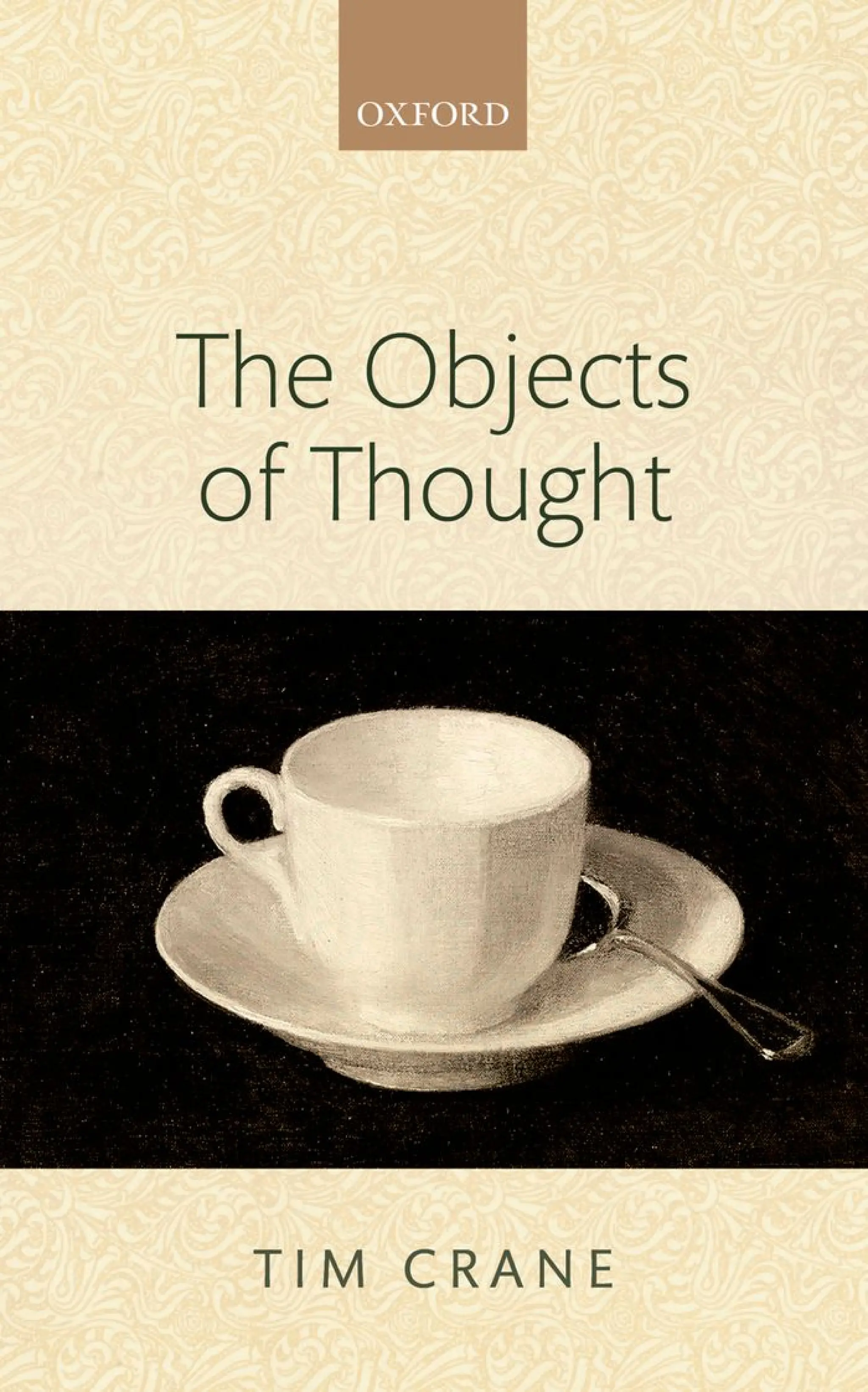
The Objects OfThought 1st Edition Tim Crane
download
https://ebookbell.com/product/the-objects-of-thought-1st-edition-
tim-crane-23400352
Explore and download more ebooks at ebookbell.com
2.
Here are somerecommended products that we believe you will be
interested in. You can click the link to download.
Representational Content And The Objects Of Thought Nicholas Rimell
https://ebookbell.com/product/representational-content-and-the-
objects-of-thought-nicholas-rimell-37303190
Musical Representations Subjects And Objects The Construction Of
Musical Thought In Zarlino Descartes Rameau And Weber Musical Meaning
And Interpretation Jairo Moreno
https://ebookbell.com/product/musical-representations-subjects-and-
objects-the-construction-of-musical-thought-in-zarlino-descartes-
rameau-and-weber-musical-meaning-and-interpretation-jairo-
moreno-2368246
The Objects Of Social Science 1st Edition Montuschi Eleonora
https://ebookbell.com/product/the-objects-of-social-science-1st-
edition-montuschi-eleonora-38165596
The Objects Of Life In Central Africa Robert Ross Marja Hinfelaar
https://ebookbell.com/product/the-objects-of-life-in-central-africa-
robert-ross-marja-hinfelaar-5231680
3.
The Objects OfAffection Semiotics And Consumer Culture 1st Edition
Arthur Asa Berger Auth
https://ebookbell.com/product/the-objects-of-affection-semiotics-and-
consumer-culture-1st-edition-arthur-asa-berger-auth-5332206
The Objects Of Experience Transforming Visitorobject Encounters In
Museums Elizabeth Wood
https://ebookbell.com/product/the-objects-of-experience-transforming-
visitorobject-encounters-in-museums-elizabeth-wood-5660078
The Objects Of Attraction The Complete 6book Collection Penelope Bloom
https://ebookbell.com/product/the-objects-of-attraction-the-
complete-6book-collection-penelope-bloom-230837768
Economic Objects And The Objects Of Economics 1st Ed Peter Rna
https://ebookbell.com/product/economic-objects-and-the-objects-of-
economics-1st-ed-peter-rna-7323396
Platonism And The Objects Of Science Scott Berman
https://ebookbell.com/product/platonism-and-the-objects-of-science-
scott-berman-50233022
If I havean idea of the god Jupiter, this god is my presented object, he is
‘immanently present’ in my act, he has ‘mental inexistence’ in the latter . . .
This intentional experience may be dismembered as one chooses in descrip-
tive analysis, but the god Jupiter will not be found in it. The ‘immanent’,
‘mental object’ is not therefore part of the descriptive or real make-up of the
experience, it is in truth not really immanent or mental. But it also does not
exist extramentally, it does not exist at all . . . If, however, the intended
object exists, nothing becomes phenomenologically different. It makes no
essential difference to an object presented and given to consciousness
whether it exists, or is fictitious, or is perhaps completely absurd.
(Husserl 1901: V, }11)
12.
Acknowledgements
Some material insome chapters is taken from the following papers, and is
reprinted here with the permission of the publishers:
Chapter 1: from ‘What is the Problem of Non-Existence?’ Philosophia
40 (2012) 417–34. Published by Springer.
Chapter 2: from ‘Existence and Quantification Reconsidered’ in
Tuomas Tahko (ed.) Aristotelian Metaphysics (Cambridge: Cambridge
University Press, 2011), 44–65.
Chapter 6: from ‘The Singularity of Singular Thought’ Proceedings of
the Aristotelian Society Supplementary Volume LXXXV (2011) 21–43; ‘Tye
on Acquaintance and the Problems of Consciousness’ Philosophy and
Phenomenological Research 84 (2012) 190–8.
Preface
This is mythird book on intentionality—a fact that calls, if not for an
apology, at least for an explanation. My first book, The Mechanical Mind
(1995) was an elementary exposition and critique of how the computa-
tional theory of mind can give an account of mental representation (that is,
intentionality). A second book, Elements of Mind (2001) presented the main
concepts of a general theory of intentionality, and a defence of intention-
alism, the thesis that all mental phenomena are intentional. In that book,
I argued that intentionality is not a relation to its objects, because of the
phenomenon of thought about the non-existent. But I gave no proper
account of what it means to think about the non-existent, and in the years
since that book was published I have come to realize that unless we
understand non-existence we cannot understand intentionality. Hence
the present book.
In the time I have been working on this book, I have been greatly
helped by discussions with many people. My first attempts to think about
these things were guided by the knowledge and insight of Tamar Gendler,
Mike Martin, and Zoltán Szabó. Since then, I’ve profited from discussions
with Jody Azzouni, Hanoch Ben-Yami, Bill Brewer, Ray Buchanan,
Dave Chalmers, John Collins, Sacha Golob, Andrew Janiak, Mark
Kalderon, Steve Makin, Hugh Mellor, Kevin Mulligan, Stephen Neale,
Graham Priest, Panu Raatikainen, Greg Restall, Mark Sainsbury, Jonathan
Schaffer, Barry C. Smith, Gianfranco Soldati, Alberto Voltolini, and Ed
Zalta, in addition to those mentioned below. As ever, Katalin Farkas has
been my closest philosophical discussant; every single thing I have said here
is something I have discussed with her (sometimes many times) and every
page bears her influence.
I am very grateful to the participants in a series of research seminars on
existence and non-existence at the Institute of Philosophy in London
between 2005 and 2008: many thanks here to Keith Allen, Stacie Friend,
Colin Johnston, Rory Madden, Ian Phillips, Sarah Richmond, and Lee
Walters. In the spring of 2010, I presented a draft of this book to a seminar
in Cambridge, and benefitted greatly from the constructive criticism of
Tim Button, Emily Caddick, Fraser MacBride, Makoto Suzuki, Rob
15.
Trueman, Tatjana vonSolodkoff, Adam Stewart-Wallace, Nathan Wildman,
and Richard Woodward. My students Jamie Burns, Tom Graham, and Jeff
Kaplan saved me from a number of errors.
In 2008, I had the honour to be the Seybert Lecturer at the Philosophy
Department of the University of Pennsylvania. This allowed me to present
the first version of this book, and gave me the opportunity to discuss my
views in the excellent environment of that department. I would like to
thank the Penn department as a whole, but especially Liz Camp, Gary
Hatfield, and Michael Weisberg for their hospitality and much philosoph-
ical conversation. In 2010, the University of Umeå invited me to give its
Burman Lectures, which were based on a heavily revised version of the
Seybert lectures; special thanks to Sten Lindström and Pär Sündström for
their hospitality and for very helpful discussion. In the spring of 2011,
Katalin Farkas and I gave the Carnap Lectures at the University of
Bochum, at the kind invitation of Albert Newen. My Carnap lectures
summarized the main themes of the book as it had developed over the
years since my first attempts to deal with this problem.
Various institutions have also provided helpful support along the way,
and I would like to thank them here: the UK’s Arts and Humanities
Research Council for a term’s research leave in 2004; the (now sadly defunct)
Collegium Budapest for a fellowship in 2003–4; David Chalmers’s Centre
for Consciousness at the Research School of the Social Sciences at
the Australian National University for a fellowship in 2008; and the
Philosophy Department of the Central European University in Budapest
for a visiting professorship in 2011.
Peter Momtchiloff of OUP has provided typically generous and
indefatigable support for the project, and he also gathered substantial
critical comments from three referees. The final version of the book was
written in response to their comments. I doubt if I will have entirely
satisfied them; but I hope the disagreements that remain are the result of
substantive differences of opinion rather than misunderstanding, confu-
sion, or ignorance. I am deeply grateful to Peter for all his help, and to the
referees for their excellent comments.
I have resisted the temptation to attribute particular insights or
criticisms to particular individuals in footnotes. I hope this general
acknowledgement here will suffice to record my gratitude to all those
mentioned above.
x PREFACE
16.
Contents
Part I. Objects
1.The Problem of Non-Existence 3
1.1 ‘About’ 3
1.2 Relational conceptions of intentionality 8
1.3 Non-existent objects 13
1.4 Truths about the non-existent 18
1.5 Existence, being, and reality 23
1.6 Conclusion and prospectus 27
2. Existence and Quantification 28
2.1 Introduction 28
2.2 The formalization of claims about existence
and non-existence 29
2.3 ‘Exists’ as a predicate 32
2.4 Quantification in natural language 34
2.5 How to quantify over non-existents 37
2.6 Existential sentences: ‘there is’/‘there are’ 42
2.7 Quantification, ontological commitment, and ‘believing in’ 47
2.8 Conclusion: the irrelevance of quantification 50
3. The Nature of Existence and Non-Existence 52
3.1 The problem posed by non-existents 52
3.2 Truth about the non-existent: the logical approach 53
3.3 Truth about the non-existent: the metaphysical approach 58
3.4 Properties and relations 64
3.5 Negative existentials 71
3.6 Do fictional characters exist? 75
3.7 Fundamentality and existence 81
3.8 Conclusion to Part I 85
Part II. Thought
4. The Structure of Intentionality 89
4.1 Introduction: non-existence and intentionality 89
4.2 Varieties of intentional object 90
4.3 Varieties of intentional content 96
4.4 Varieties of intentional mode 102
4.5 Propositionalism 108
17.
4.6 Existing objectsof thought 112
4.7 Conclusion: representation as basic 116
5. Reductionism and Psychologism 118
5.1 Introduction: truths about the non-existent and their explanation 118
5.2 The idea of reduction 122
5.3 Reductionism and the propositional attitudes 125
5.4 The reduction of indeterminate intentional objects 131
5.5 The reduction of non-existent intentional objects 133
5.6 Conclusion: varieties of reduction 137
6. Thinking about Specific Things 138
6.1 Introduction 138
6.2 Specific thought, singular terms, and singular thought 139
6.3 Names and thought 143
6.4 Acquaintance and existence-dependence 146
6.5 De Re thought 153
6.6 Psychology and semantics again 156
6.7 Specific thoughts: a psychologistic account 158
6.8 No identity without an entity 162
6.9 Conclusion: reductionism and specific thought 167
Concluding Remarks 168
Bibliography 170
Index 181
xii CONTENTS
1
The Problem of
Non-Existence
Discoursewhich is not ‘about reality’ is ‘about unreality’; and un-
reality is just that: it is not another reality.
(Cartwright 1960: 639)
1.1 ‘About’
Whenever someone thinks, they think about something. Or in other
words: whenever someone thinks, there is something they think about.
Some of the things they think about exist, and some of them do not. There
are truths and falsehoods about the non-existent things they think about.
And yet the entire world—the real world, reality, being, the universe, call
it what you like—does not contain more than what exists.
The aim of this book is to defend these truisms.
Some philosophers will claim that they are not truisms, because they
are not even true. They will say that it is not true that when someone
thinks, there is something that they think about. So they will deny that
this is another way of saying ‘whenever someone thinks they think
about something’. Nor is it true, they will say, that some of the things
we think about exist and some do not. They may even deny that there
are any genuine truths about non-existent objects, since something has
to exist for there to be genuine truths about it. I think these philosophers
are wrong. So one of the things I have to do is to explain why they are
wrong.
But I have to do more than this. It’s not enough to correct the mistakes
of others. We all make mistakes—but not all are worth correcting. Nor is
21.
it enough todefend truisms—not all truisms are worth defending. One
must also have some reason for defending them. My own reason for
defending these truisms is to defend a certain conception of the mind.
The guiding thought behind this book is that we have no adequate
understanding of the mind unless we also have an understanding of the
non-existent.
My conception of the mind has at its heart the idea of intentionality,
what Brentano (1874) called ‘the mind’s direction on its objects’
(see Crane 2009a). Our mental life seems to involve the presence to the
mind—or apparent presence to the mind—of things in the world. These
things can be mental or material, concrete or abstract, and—so I say—
existent and non-existent. I believe that there are general characteristics
of intentionality which apply to all, or almost all, intentional states and
episodes. One of these is that every intentional state or episode has an
object—something it is about or directed on. Another is that every
intentional state or episode has a content—the way it represents what it is
about or directed on. A third is that every intentional state involves what
I call (following Searle 1983, 1992) an intentional mode, what some (e.g.
Chalmers 2004) call a ‘manner’, or what many others call an ‘attitude’. By
this I mean the psychological type by means of which the mind is directed
upon its object, via a content: whether it is through belief, memory, hope,
fear, etc. All these things I call intentional modes.
The notions of mode and content can be criticized; they form the
beginnings of a theory of intentionality, and some might want to theorize
about intentionality without using these notions. My fundamental starting
point, however, is the notion of an intentional object, or an object of
thought (and desire, fear, etc.—but for ease of expression, I will not always
make this qualification). And I do not see how, or why, this notion should
be rejected by anyone who takes the phenomenon of intentionality
seriously. Intentional objects are, by definition, those things in the world
which we think about; or those things which we take, or pretend, or
otherwise represent to be in the world; or which we merely represent in
thought. If there is such a thing as thinking about ‘things’ (in these various
senses of ‘thing’) then there are intentional objects.
In this book, I will argue that thought about the non-existent is best
construed, as my ‘truisms’ above suggest, in terms of thought about non-
existent intentional objects. It is of the greatest importance to emphasize at the
outset that by saying this, I do not mean that there is a special category of
4 OBJECTS
22.
entities or quasi-entitiesor pseudo-entities called ‘intentional objects’ or ‘non-
existent objects’. Nor am I committing myself to—nor do I believe in—
more entities than those that really exist. There are no non-existent entities.
All entities exist. As my last truism makes explicit: reality does not contain
more than what exists.
So the claim that there are non-existent intentional objects is not an
ontological claim. It is simply another way of saying that we can genuinely
think about things that don’t exist, and that we can think about them
in the same way in which we think about existing things. I use the term
‘non-existent intentional object’ to describe what it is that we think about
when we think about the non-existent. I believe that if we want to think
of intentional states in terms of ‘aboutness’ at all, then we should also
think in terms of what intentional states are about; and what intentional
states are about are (by definition) intentional objects. Since we can think
about things that don’t exist, it follows that some intentional objects
do not exist. But if we accept this claim, we are already on the way to
accepting one or more of the ‘truisms’ above.
I think we should accept these truisms because they form part of the best
phenomenological account of intentionality. The notion of an intentional
object should be the central notion of a theory of intentionality, and some
intentional objects do not exist. Hence the theory of intentionality cannot
do without the notion of a non-existent object. This is the first main thesis
of this book.
However, accepting the truisms is not without problems. For one thing,
they seem to be inconsistent with some widely-held views in contempor-
ary philosophy (for example, the view that quantification and existence
are intimately related). For another, they look as if they might be internally
inconsistent: how can there be objects that do not exist if being and existence
are the same thing? Even more fundamentally, perhaps, the very idea that
there can be truths about non-existent things seems deeply problematic,
once we accept the weakest possible assumptions about the relationship
between truth and reality. If non-existent things are no part of reality, then
how can there be any truths about them? This is what I will call the
problem of non-existence. I think we should solve this problem by
accepting that there are genuine truths about non-existent objects, but
that we should be able to explain why these truths are true in terms of truths
about existing things. This is the second main thesis of this book.
THE PROBLEM OF NON-EXISTENCE 5
23.
My aim isto combine two ideas. The first is a phenomenological concep-
tion of the objects of thought, a conception of what we think about that
takes the appearances seriously and tries to preserve them as far as possible.
And the second is a reductionist solution to the problem of non-existence.
A reduction in this sense is an explanation of truths of one kind in terms
of truths of another kind: in this case, truths about the non-existent in
terms of truths about what exists. My ambition, then, is to accept the
appearances as far as we can, while at the same time explaining them in
terms of an underlying reality.
Having explained the overall aim of this book, I can now return to my
truisms.
The first truism is that whenever someone thinks, they think about
something. What do I mean by ‘thought’ and ‘thinking’ here? In one
common usage, the word ‘thinking’ refers to mental episodes in which
one is considering how things are, or are not, or might be. One can think
(in this sense) about what is the case, what one wants to be the case, what
one fears to be the case, what one hopes to be the case, and so on. Thinking
in this sense need not be truth-directed: that is, one can be thinking
about next week’s weather without this being a matter of mentally asserting,
or claiming, that next week’s weather is a certain way. The words ‘I think
that . . . ’ can be used to indicate that one is making a judgement—that is,
forming or expressing a belief that something is the case. In this book, I will
not restrict ‘thinking’ to judgement, but will sometimes use it in a
broader sense to encompass the other attitudes or modes just mentioned.
In this broad sense, desire and fear (etc.) involve thinking; and it has
some commonsense support too, since one can hardly desire or fear some-
thing without thinking about it.
Thinking is often conscious; indeed, I believe that the paradigmatic
ordinary use of the word suggests consciousness. But there is also uncon-
scious intentionality, although the distinction between the conscious and
the unconscious will not be very important in what follows. This is not to
say that consciousness itself is unimportant—on the contrary, conscious
thought is one of the most important topics in the philosophy of mind. But
consciousness is not especially central to the study of the non-existent. It is
relevant that many thoughts about the non-existent are conscious, and
I will often use examples of conscious acts of thinking. But I will not
presuppose any particular account of it.
6 OBJECTS
24.
Next, aboutness. Itis not possible for someone to think without
thinking about something. They may be confused, misinformed, vague
or in some way unspecific in what they are thinking, but they are aiming
their thoughts at the world. As Brentano said, ‘in presentation, something
is presented, in judgement something is affirmed or denied, in love loved,
in hate hated, in desire desired and so on’ (1995: 88). As I have already
made clear, these ‘somethings’ are what I call intentional objects.
I also call them objects of thought. In his posthumously published book
Objects of Thought, whose title I shamelessly plagiarize with the mere
addition of the definite article, A.N. Prior distinguished between two
senses of ‘object of thought’ (1971). The first is what we think—when we
think that something is the case. When we believe or judge, what we
believe or judge is sometimes called the object of our thought; normally
these things are called ‘propositions’ and states of thinking them are now
called ‘propositional attitudes’ (the term comes from Russell 1921). But
the second sense is what we think about: the objects of thought in what
Prior called ‘a more natural sense’. Objects of thought in Prior’s second
sense are intentional objects in my sense. Propositions can be intentional
objects; but only when we think about propositions, not when they are
simply what we think.
It should be obvious from what has been said so far that my explanation
of the idea of an intentional object is in terms of the idea of ‘what a
thought is about’, and so a lot in what follows will depend on the way I am
understanding the idea of ‘aboutness’. I am using the word ‘about’ in
a very liberal way, in the way John Hawthorne and David Manley (2012:
1, 9) call ‘loose’. Thoughts have a subject matter; what they are about
may be the entire subject matter, or some part of it. The thought that the
barbarians attacked the city is about the barbarians, about the city, and
about the fact that they attacked the city: it is about all these things (see
Ryle 1933). Context or interest may lead us to talk of one of these things
rather than another as ‘what the thought is about’; but in fact, it is about all
of them. In this way, this notion of ‘what a thought is about’ is similar to
the linguist’s notion of topic. The topic of the sentence ‘The barbarians
attacked the city’ might be the barbarians or the city, with these different
topics sometimes picked out by emphasis. Thoughts, like sentences, can be
about many different things. This is not, pace Goodman (1961) the same as
saying they are about everything.
THE PROBLEM OF NON-EXISTENCE 7
Fig. 133.—Vertical Sectionof the Dolmen of Locmariaker, in Brittany. In the
Museum of Saint-Germain.
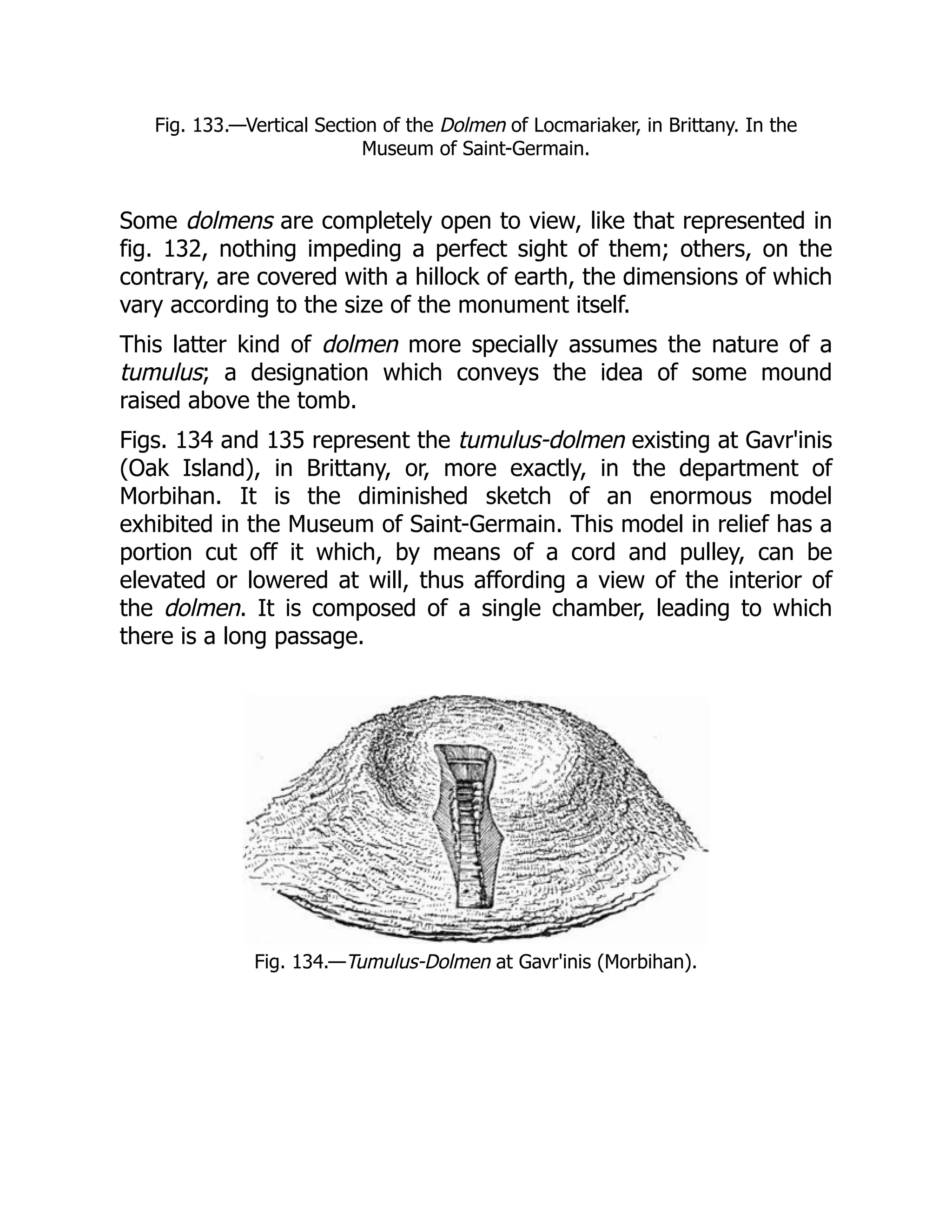
Some dolmens are completely open to view, like that represented in
fig. 132, nothing impeding a perfect sight of them; others, on the
contrary, are covered with a hillock of earth, the dimensions of which
vary according to the size of the monument itself.
This latter kind of dolmen more specially assumes the nature of a
tumulus; a designation which conveys the idea of some mound
raised above the tomb.
Figs. 134 and 135 represent the tumulus-dolmen existing at Gavr'inis
(Oak Island), in Brittany, or, more exactly, in the department of
Morbihan. It is the diminished sketch of an enormous model
exhibited in the Museum of Saint-Germain. This model in relief has a
portion cut off it which, by means of a cord and pulley, can be
elevated or lowered at will, thus affording a view of the interior of
the dolmen. It is composed of a single chamber, leading to which
there is a long passage.
Fig. 134.—Tumulus-Dolmen at Gavr'inis (Morbihan).
27.
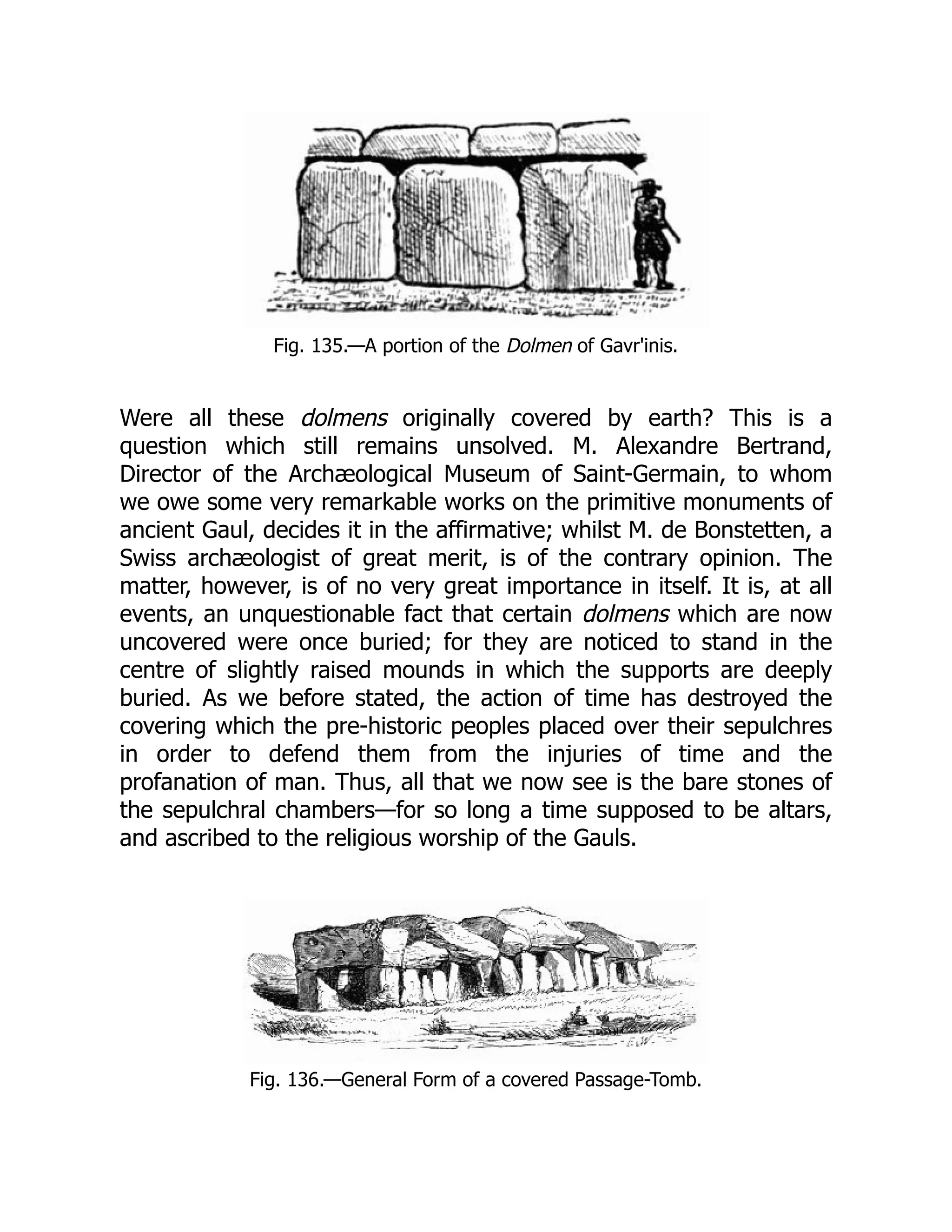
Fig. 135.—A portionof the Dolmen of Gavr'inis.
Were all these dolmens originally covered by earth? This is a
question which still remains unsolved. M. Alexandre Bertrand,
Director of the Archæological Museum of Saint-Germain, to whom
we owe some very remarkable works on the primitive monuments of
ancient Gaul, decides it in the affirmative; whilst M. de Bonstetten, a
Swiss archæologist of great merit, is of the contrary opinion. The
matter, however, is of no very great importance in itself. It is, at all
events, an unquestionable fact that certain dolmens which are now
uncovered were once buried; for they are noticed to stand in the
centre of slightly raised mounds in which the supports are deeply
buried. As we before stated, the action of time has destroyed the
covering which the pre-historic peoples placed over their sepulchres
in order to defend them from the injuries of time and the
profanation of man. Thus, all that we now see is the bare stones of
the sepulchral chambers—for so long a time supposed to be altars,
and ascribed to the religious worship of the Gauls.
Fig. 136.—General Form of a covered Passage-Tomb.
28.
In considering, therefore,the dolmens of Brittany, which have been
so many times described by antiquarians and made to figure among
the number of our historical monuments, we must renounce the idea
of looking upon them as symbols of the religion of our ancestors.
They can now only be regarded as sepulchral chambers.
Fig. 137.—Passage-Tomb at Bagneux, near Saumur.
Dolmens are very numerous in France; much more numerous,
indeed, than is generally thought. It used to be the common idea
that they existed only in Brittany, and those curious in such matters
wondered at the supposed Druidical altars which were so plentifully
distributed in this ancient province of France. But Brittany is far from
possessing the exclusive privilege of these megalithic constructions.
They are found in fifty-eight of the French departments, belonging,
for the most part, to the regions of the south and south-west. The
department of Finisterre contains 500 of them; Lot, 500; Morbihan,
250; Ardèche, 155; Aveyron, 125; Dordogne, 100; &c. [26]
29.
Fig. 138.—Passage-Tomb atPlouharnel (Morbihan).
The authors who have written on the question we are now
considering, especially Sir J. Lubbock in his work on 'Pre-historic
Times,' and Nilsson, the Swedish archæologist, have given a much
too complicated aspect to their descriptions of the tombs of pre-
historic ages, owing to their having multiplied the distinctions in this
kind of monument. We should only perplex our readers by following
these authors into all their divisions. We must, however, give some
few details about them.
Fig. 139.—Passage-Tomb; the so-called Table de César, at Locmariaker (Morbihan).
Sir J. Lubbock gives the name of passage grave, to that which the
northern archæologists call Ganggraben (tomb with passages); of
these we have given four representations (figs. 136, 137, 138, 139),
all selected from specimens in France. This name is applied to a
passage leading to a more spacious chamber, round which the
bodies are ranged. The gallery, formed of enormous slabs of stone
placed in succession one after the other, almost always points
30.
towards the samepoint of the compass; in the Scandinavian states,
it generally has its opening facing the south or east, never the north.
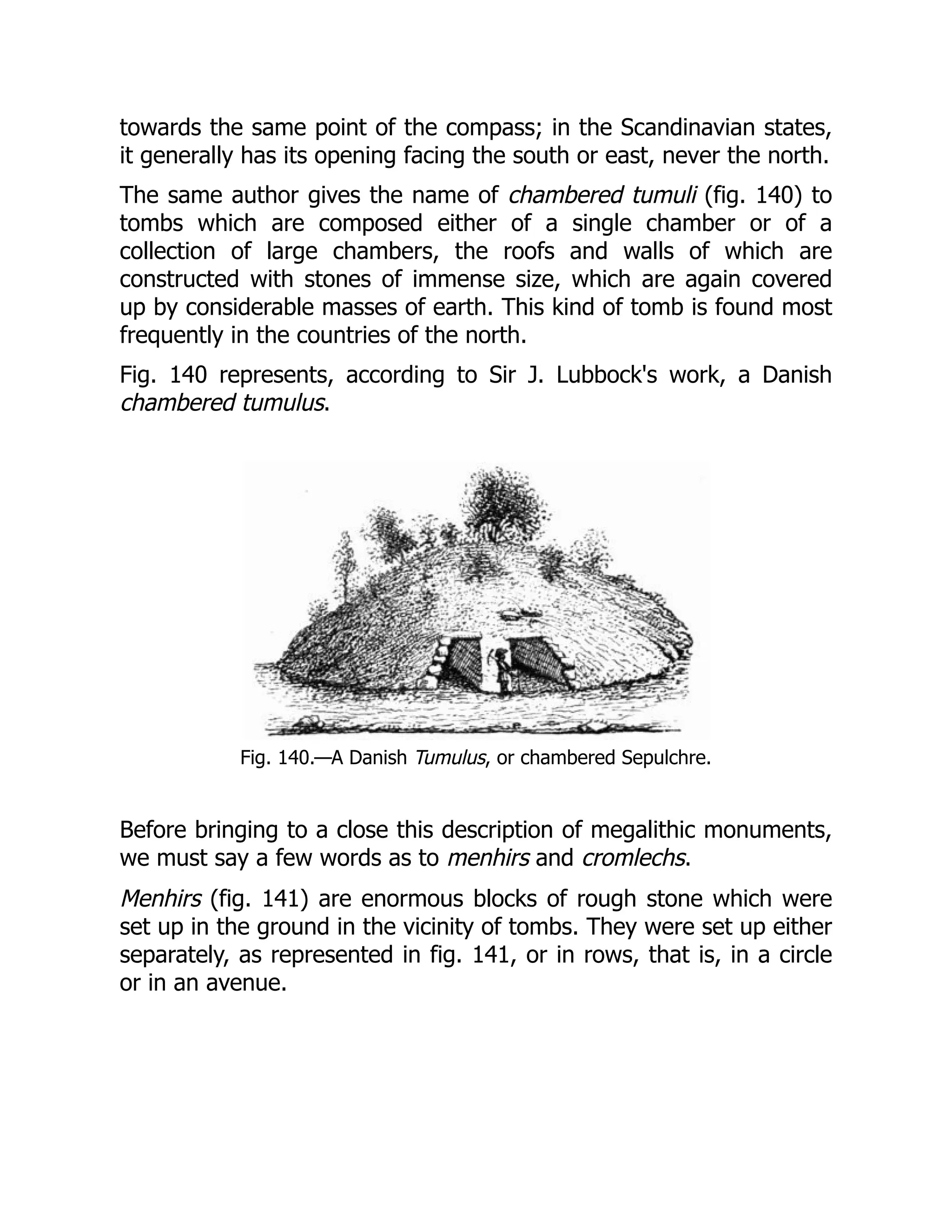
The same author gives the name of chambered tumuli (fig. 140) to
tombs which are composed either of a single chamber or of a
collection of large chambers, the roofs and walls of which are
constructed with stones of immense size, which are again covered
up by considerable masses of earth. This kind of tomb is found most
frequently in the countries of the north.
Fig. 140 represents, according to Sir J. Lubbock's work, a Danish
chambered tumulus.
Fig. 140.—A Danish Tumulus, or chambered Sepulchre.
Before bringing to a close this description of megalithic monuments,
we must say a few words as to menhirs and cromlechs.
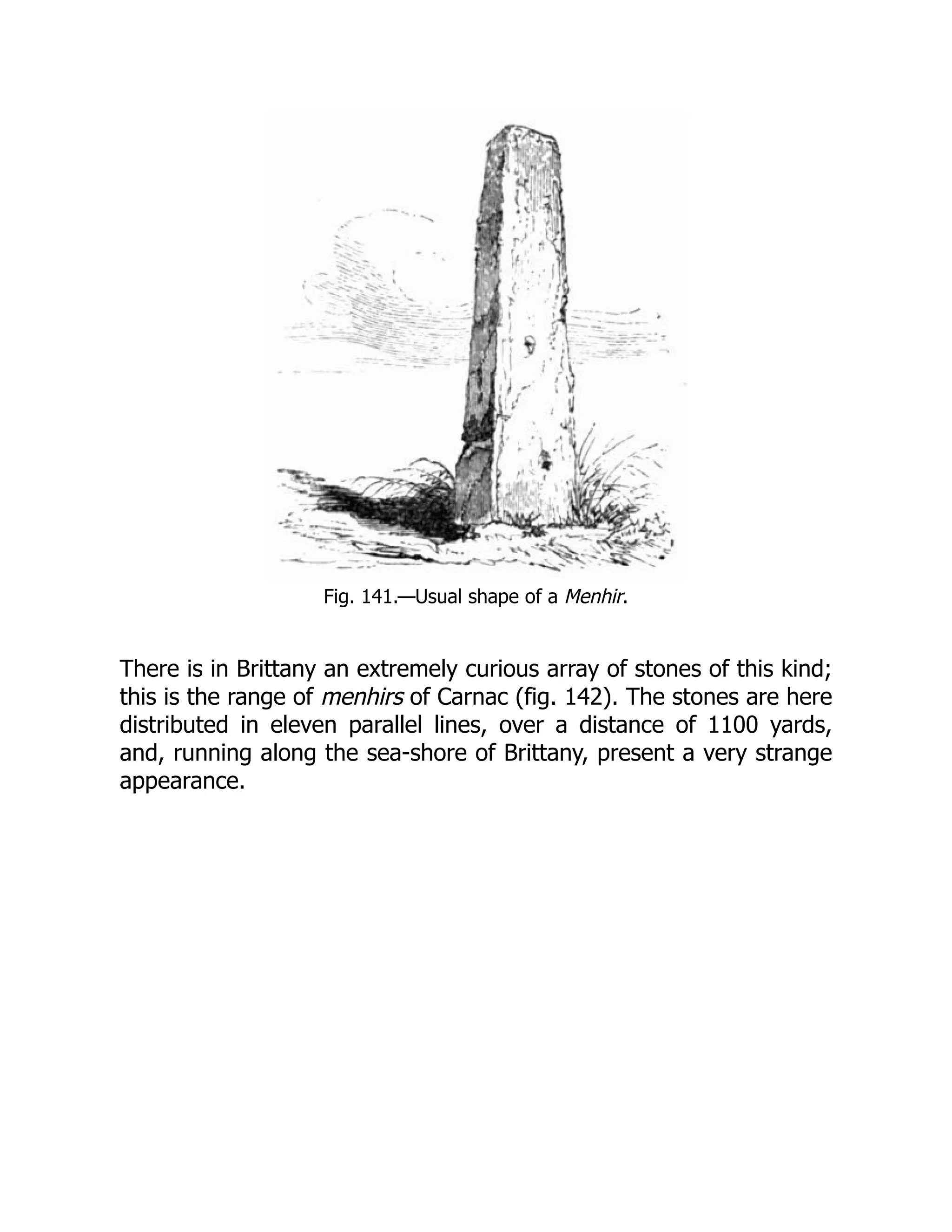
Menhirs (fig. 141) are enormous blocks of rough stone which were
set up in the ground in the vicinity of tombs. They were set up either
separately, as represented in fig. 141, or in rows, that is, in a circle
or in an avenue.
31.
Fig. 141.—Usual shapeof a Menhir.
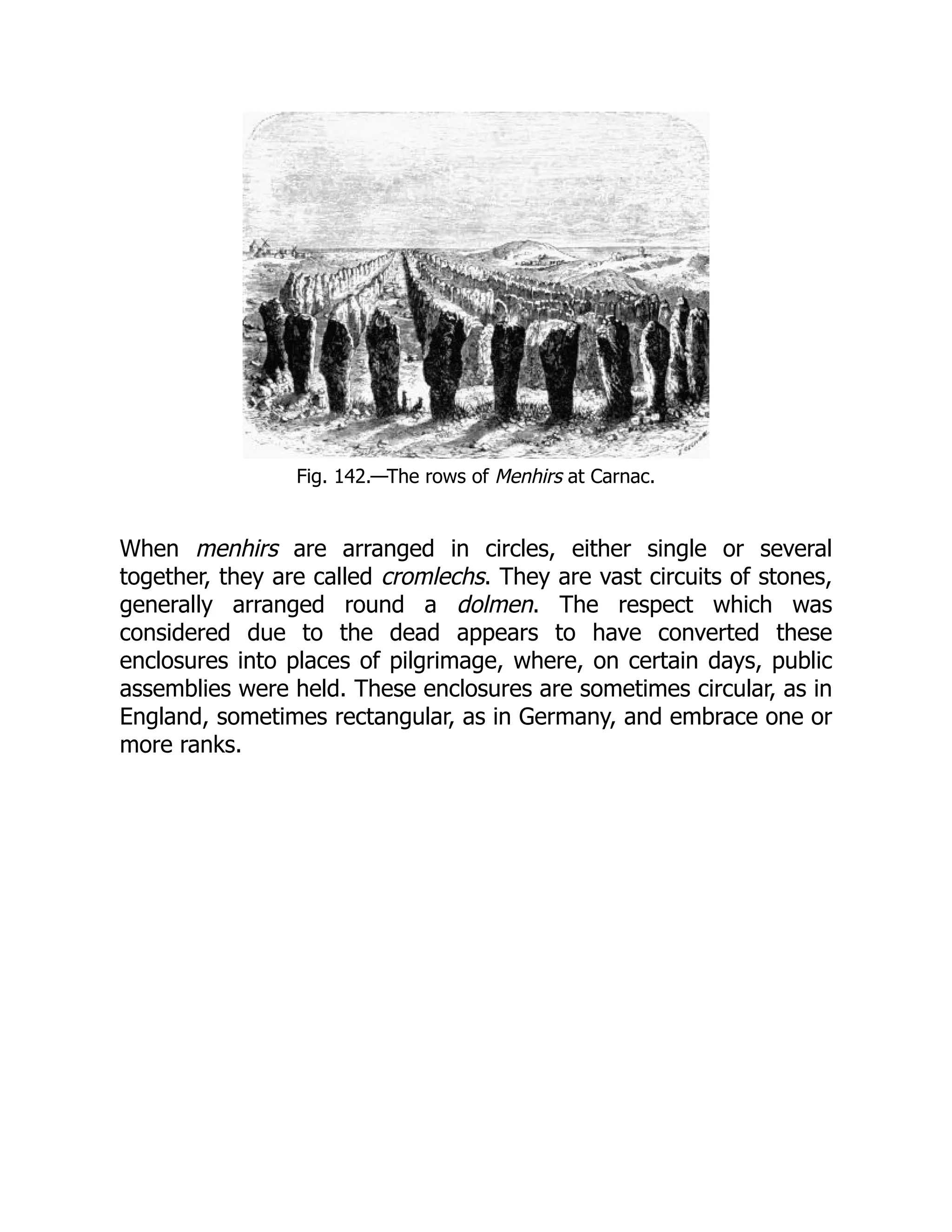
There is in Brittany an extremely curious array of stones of this kind;
this is the range of menhirs of Carnac (fig. 142). The stones are here
distributed in eleven parallel lines, over a distance of 1100 yards,
and, running along the sea-shore of Brittany, present a very strange
appearance.
32.
Fig. 142.—The rowsof Menhirs at Carnac.
When menhirs are arranged in circles, either single or several
together, they are called cromlechs. They are vast circuits of stones,
generally arranged round a dolmen. The respect which was
considered due to the dead appears to have converted these
enclosures into places of pilgrimage, where, on certain days, public
assemblies were held. These enclosures are sometimes circular, as in
England, sometimes rectangular, as in Germany, and embrace one or
more ranks.
33.
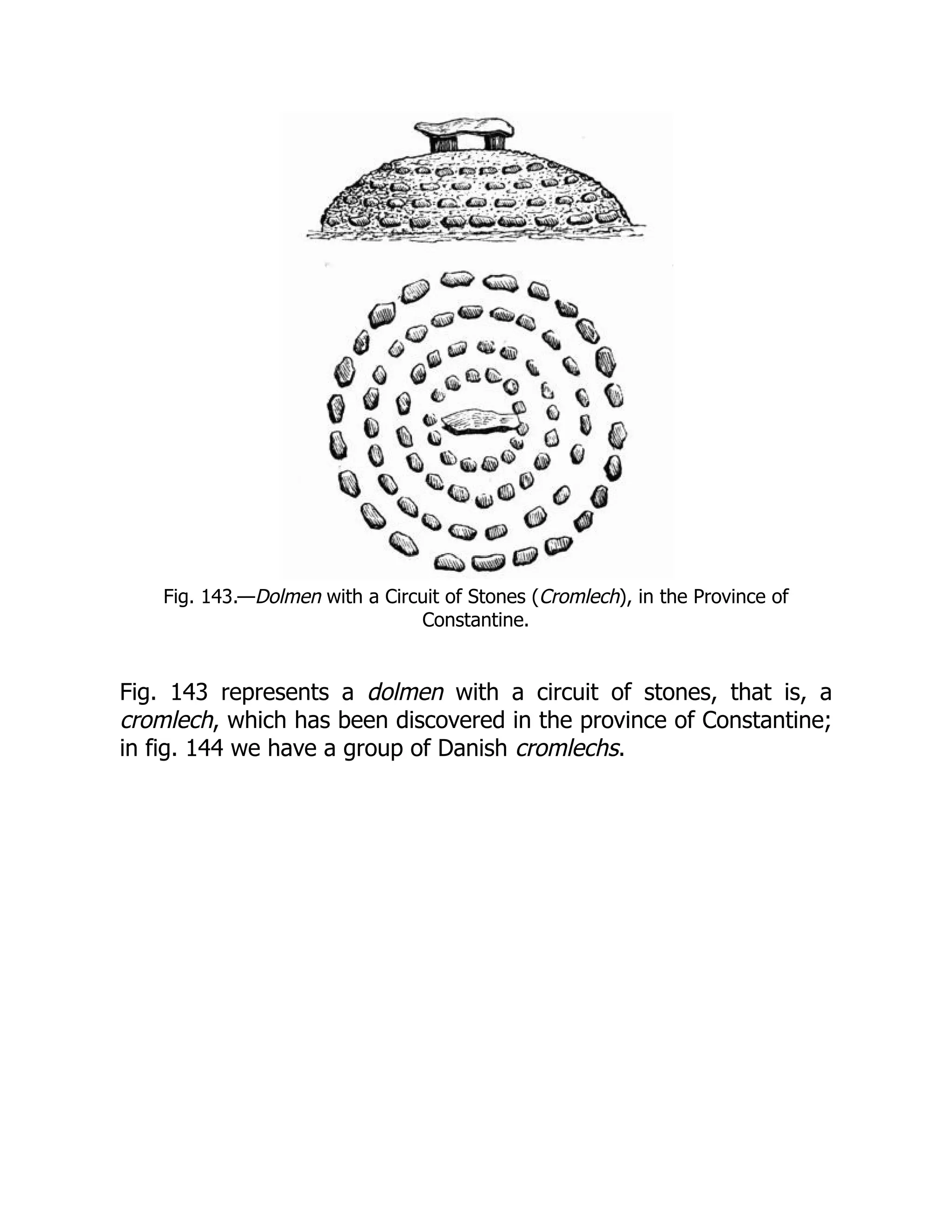
Fig. 143.—Dolmen witha Circuit of Stones (Cromlech), in the Province of
Constantine.
Fig. 143 represents a dolmen with a circuit of stones, that is, a
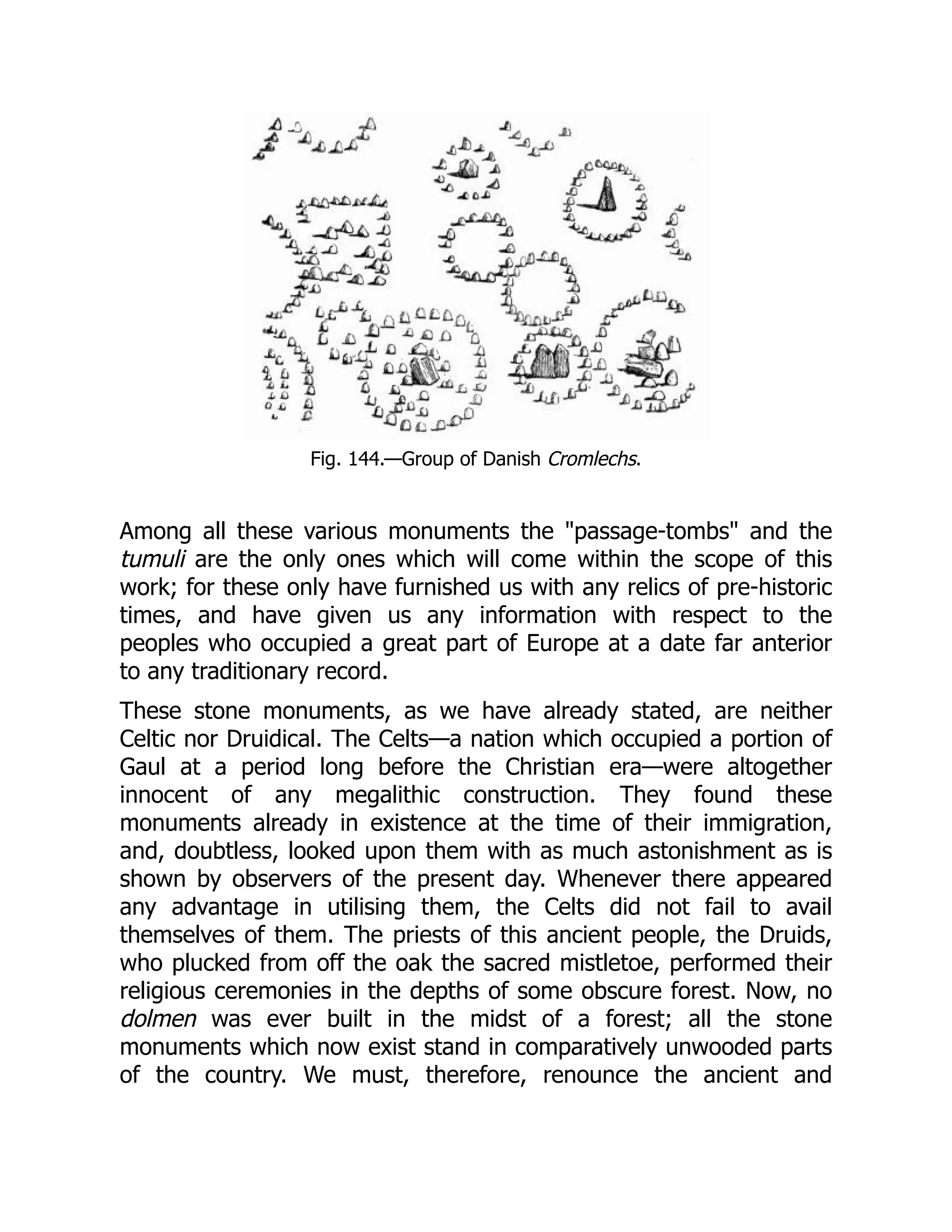
cromlech, which has been discovered in the province of Constantine;
in fig. 144 we have a group of Danish cromlechs.
34.
Fig. 144.—Group ofDanish Cromlechs.
Among all these various monuments the "passage-tombs" and the
tumuli are the only ones which will come within the scope of this
work; for these only have furnished us with any relics of pre-historic
times, and have given us any information with respect to the
peoples who occupied a great part of Europe at a date far anterior
to any traditionary record.
These stone monuments, as we have already stated, are neither
Celtic nor Druidical. The Celts—a nation which occupied a portion of
Gaul at a period long before the Christian era—were altogether
innocent of any megalithic construction. They found these
monuments already in existence at the time of their immigration,
and, doubtless, looked upon them with as much astonishment as is
shown by observers of the present day. Whenever there appeared
any advantage in utilising them, the Celts did not fail to avail
themselves of them. The priests of this ancient people, the Druids,
who plucked from off the oak the sacred mistletoe, performed their
religious ceremonies in the depths of some obscure forest. Now, no
dolmen was ever built in the midst of a forest; all the stone
monuments which now exist stand in comparatively unwooded parts
of the country. We must, therefore, renounce the ancient and
35.
poetical idea whichrecognised in these dolmens the sacrificial altars
of the religion of our ancestors.
Some tumuli attain proportions which are really colossal. Among
these is Silbury Hill, the largest in Great Britain, which is nearly 200
feet high. The enormous amount of labour which would be involved
in constructions of this kind has led to the idea that they were not
raised except in honour of chiefs and other great personages.
On consulting those records of history which extend back to the
most remote antiquity, we arrive at the fact that the custom of
raising colossal tombs to the illustrious dead was one that was much
in vogue in the ancient Eastern world. Traces of these monuments
are found among the Hebrews, the Assyrians, the Greeks, the
Egyptians, &c.
Thus Semiramis, Queen of Nineveh, raised a mound over the tomb
of Ninus, her husband. Stones were likewise piled up over the
remains of Laïus, father of Œdipus. In the 'Iliad,' Homer speaks of
the mounds that were raised to the memory of Hector and Patroclus.
That dedicated to Patroclus—the pious work of Achilles—was more
than 100 feet in diameter. Homer speaks of the tumuli existing in
Greece, which, even in his time, were considered very ancient, and
calls them the tombs of the heroes. A tumulus was raised by
Alexander the Great over the ashes of his friend Hephæstio, and so
great were the dimensions of this monument that it is said to have
cost 1200 talents, that is about £240,000 of our money. In Roman
history, too, we find instances of the same kind. Lastly, the pyramids
of Egypt, those costly and colossal funeral monuments, are the still
visible representations of the highest expression of posthumous
homage which was rendered by the generations of antiquity to their
most illustrious and mighty men.
This, however, could not have been in every case the prevailing idea
in the men of the Stone Age, in causing the construction of these
tumuli. The large number of bodies which have been found in some
of these monuments completely does away with the notion that they
were raised in honour of a single personage, or even of a single
36.
family. They wereoften sepulchres or burial-places common to the
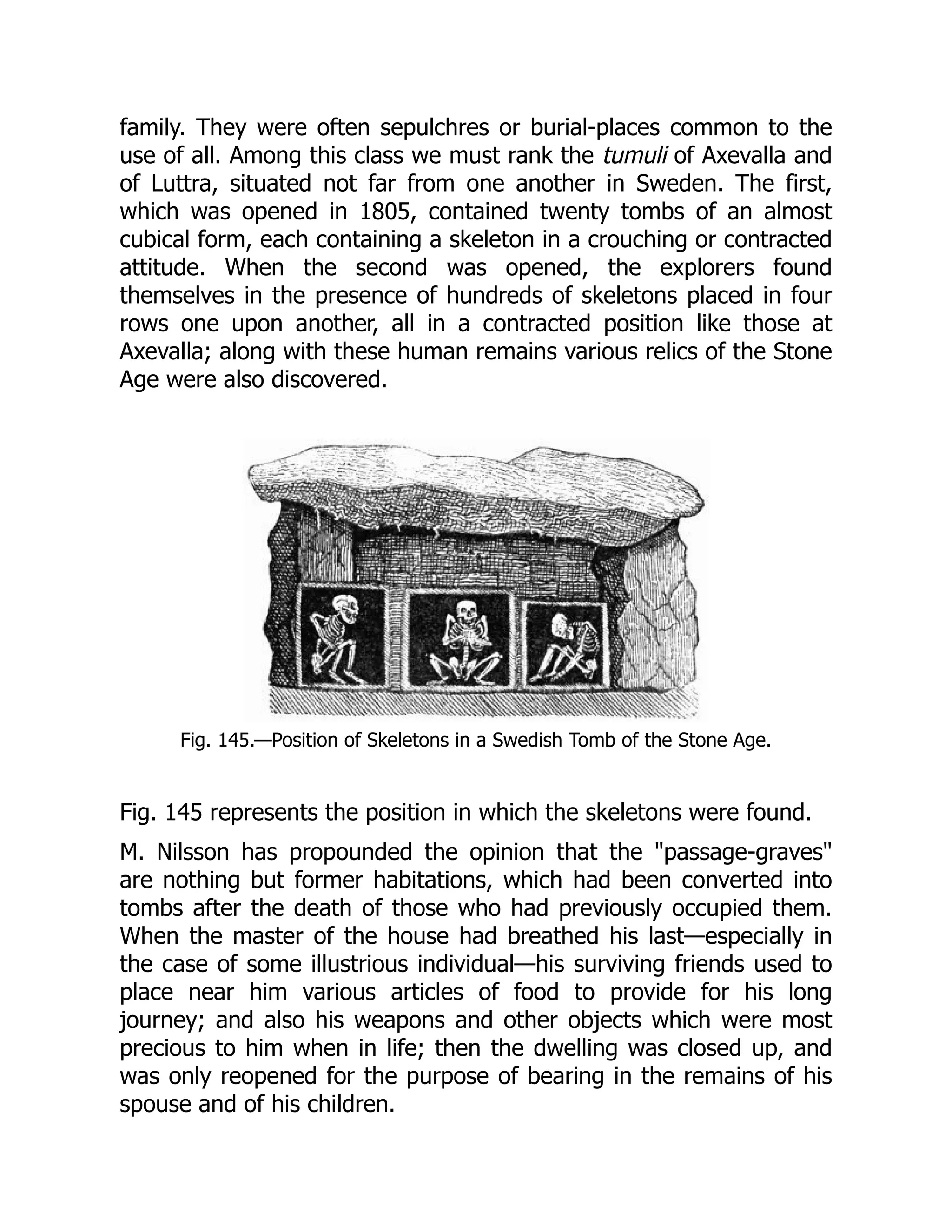
use of all. Among this class we must rank the tumuli of Axevalla and
of Luttra, situated not far from one another in Sweden. The first,
which was opened in 1805, contained twenty tombs of an almost
cubical form, each containing a skeleton in a crouching or contracted
attitude. When the second was opened, the explorers found
themselves in the presence of hundreds of skeletons placed in four
rows one upon another, all in a contracted position like those at
Axevalla; along with these human remains various relics of the Stone
Age were also discovered.
Fig. 145.—Position of Skeletons in a Swedish Tomb of the Stone Age.
Fig. 145 represents the position in which the skeletons were found.
M. Nilsson has propounded the opinion that the "passage-graves"
are nothing but former habitations, which had been converted into
tombs after the death of those who had previously occupied them.
When the master of the house had breathed his last—especially in
the case of some illustrious individual—his surviving friends used to
place near him various articles of food to provide for his long
journey; and also his weapons and other objects which were most
precious to him when in life; then the dwelling was closed up, and
was only reopened for the purpose of bearing in the remains of his
spouse and of his children.
37.
Sir J. Lubbockshares in this opinion, and brings forward facts in its
favour. He recites the accounts of various travellers, according to
which, the winter-dwellings of certain people in the extreme north
bear a very marked resemblance to the "passage-tombs" of the
Stone Age. Of this kind are the habitations of the Siberians and the
Esquimaux, which are composed of an oval or circular chamber
placed a little under the surface of the ground, and completely
covered with earth. Sir J. Lubbock thinks, therefore, that in many
cases habitations of this kind may have been taken for tumuli—a
mistake, he adds, all the more likely to be made because some of
these mounds, although containing ashes, remains of pottery, and
various implements, have not furnished any relics of human bones.
In his work on the 'Sépultures de l'Age de la Pierre chez les Parisii,'
M. Leguay, a learned architect and member of the Archælogical
Society, has called attention to the fact that the construction of these
dolmens betrays, as existing in the men of this epoch, a somewhat
advanced degree of knowledge of the elements of architecture:—
"The interment of the dead," says M. Leguay, "took place, during the
polished-stone epoch, in vaults, or a kind of tomb constructed on the
spot, of stones of various thicknesses, generally flat in shape, and
not elevated to any very great height, being laid without any kind of
cement or mortar. These vaults, which were at first undivided, were
subsequently separated into compartments by stones of a similar
character, in which compartments bodies were placed in various
positions. They were covered with earth or with flat stones, and
sometimes we meet with a circular eminence raised over them,
formed of a considerable heap of stones which had been
subsequently brought thither; this fact was verified by M. Brouillet in
1862 at the Tombelle de Brioux (Vienne).
"This kind of interment bears evidence of some real progress.
Polished flint instruments are met with intermingled with worked
stones which have been brought from a distance. Pottery of a very
significant character approaches that of the epoch at which
ornamentation commenced; and the Tombelle de Brioux has
38.
furnished two vesselswith projecting and perforated handles formed
in the clay itself. I met with specimens similar to these both in shape
and workmanship in the cremation-tombs at Villeneuve-Saint-
Georges, which, as I have previously stated, appeared to me to be
later in date than the simple interment situated below them.
"The first element in the art of construction, that is, stability, is
manifested in these latter monuments. They do not come up to the
fine dolmens, or to the monuments which followed them, but the
principle on which stones should be laid together is already arrived
at. The slab forming the covering is the first attempt at the lintel, the
primitive base of architectural science. By insensible degrees the
dimensions of the monument increased, the nature of the materials
were modified, and, from the small elementary monument to the
grand sepulchral dolmen, but one step remained to be made—a
giant step, certainly, but not beyond the reach of human intelligence.
"This step, however, was not accomplished suddenly and without
transitional stages. We find a proof of this in the beautiful ossuary
discovered in 1863, at Chamant near Senlis (Oise), on the property
of the Comte de Lavaulx. This monument does not yet come up to
the most beautiful of the class; but it possesses all the inspirations
which suggested the form of its successors, of which, indeed, it is
the type.
"Almost flat slabs of stone, of a greater height than those forming
the vaults, and of rather considerable dimensions, are placed on
edge so as to form a square chamber. A partition, formed of stones
of a similar character, leaving a space or passage between them,
separates the chamber into two unequal portions. Some
arrangement of this kind has been observed in most of the finest
dolmens; it is found at a spot not far from Chamant, in a covered
way known under the name of the Pierres Turquoises, in the forest
of Carnelle, near Beaumont-sur-Oise (Seine-et-Oise).
"At Chamant, however, the chamber was not more than 3 to 4 feet
in height under the roof, which was formed of large flat stones, and
was large enough to allow of a considerable number of bodies to be
39.
deposited within it,either in a recumbent or contracted position.
Near them there were placed delicately-wrought flints, and also
some fine-polished hatchets, one of which was of serpentine;
another of large dimensions, sculptured after the fashion of the
diluvial hatchets, appeared to me to have been prepared for
polishing.
"The researches which have been made have brought to light but
slight traces of pottery, and the small fragments that I have
examined do not point out any very remote age for this monument.
Nevertheless, the investigation of this sepulchre, in which I was
guided by a somewhat different idea from that of merely studying
the monument itself, was not carried out with the exact care that
would be necessary for collecting all the indications which it might
have furnished.
"Between the sepulchre of Chamant and the finest dolmens, the
distinction is nothing more than a question of dimensions rather than
any chronological point. The latter are formed of colossal stones,
and when one examines them and seeks to realise the process
which must have been employed for raising them, the mind is utterly
perplexed, and the imagination finds a difficulty in conceiving how it
was possible to move these immense masses, and, especially, to
place them in the positions they now occupy; for at the present day,
in order to arrive at similar results, it would be necessary to employ
all the means which science has at command."[27]
The megalithic constructions do not all date back to the same epoch.
Some were raised during the Stone Age, others during the Bronze
Age. There is nothing in their mode of architecture which will enable
us to recognise their degree of antiquity; but the relics which they
contain afford us complete information in this respect. Thus, in
France, according to M. Alexandre Bertrand, the dolmens and the
tumuli-dolmens contain, in a general way, nothing but stone and
bone articles; those of bronze and gold are very rare, and iron is
never met with. In the true tumuli, on the contrary, bronze objects
predominate, and iron is very abundant; this is an evident proof that
40.
these monuments areof less ancient origin than the dolmens. In the
same way we ascertain that the Danish dolmens and the great
sepulchral chambers of Scandinavia, all belong to the polished-stone
epoch. When, therefore, we class the dolmens in this last-named
epoch of man's history, we are deciding in full harmony with the
great body of data which bear upon the point.
In order to fix the period with still greater accuracy, we might add
that the dolmens belong to the latter portion of the polished-stone
epoch and the commencement of the bronze age. But, as we before
said, we do not attach any importance to these distinctions, which
would only uselessly embarrass the mind of the reader.
An examination of the Danish dolmens has led the author of the
'Catalogue of Pre-historic Objects sent by Denmark to the Universal
Exposition of 1867,' to sum up in the following words the details
concerning these sepulchral monuments:—
"As regards the Danish dolmens, the number of skeletons contained
in them varies much; in the largest, there are as many as twenty,
and in the smallest there are not more than five or six; sometimes
they are placed in stages one above the other.
"The bones are never found in natural order; the head lies close to
the knees, and no limb is in its natural place. It follows from this,
that in the course of interment the body was contracted into a
crouching position.
"The bottom of the sepulchral chamber of a dolmen is generally
covered with a layer of flints which have been subjected to fire; this
is the floor on which the body was deposited; it was then covered
with a thin coating of earth, and the tomb was closed. Yet, as we
have just observed, it was but very rarely that dolmens contained
only one skeleton. They must, therefore, have been opened afresh
in order to deposit other bodies. It must have been on these
occasions, in order to contend with the miasma of putrefaction, that
they lighted the fires, of which numerous and evident traces are
seen inside the dolmens. This course of action continued, as it
41.
appears, until thetime when the dolmen was entirely filled up: but
even then, the tomb does not, in every case, seem to have been
abandoned. Sometimes the most ancient skeletons have been
displaced to make room for fresh bodies. This had taken place in a
dolmen near Copenhagen, which was opened and searched in the
presence of the late King Frederick VII.
"A dolmen situated near the village of Hammer, opened a few years
ago by M. Boye, presented some very curious peculiarities. In
addition to flint instruments, human bones were discovered, which
had also been subjected to the action of fire. We are, therefore, led
to suppose, that a funeral banquet had taken place in the vicinity of
the tomb, and that some joints of human flesh had formed an
addition to the roasted stag. This is, however, the only discovery of
the kind which has been made up to the present time, and we
should by no means be justified in drawing the inference that the
inhabitants of Denmark at this epoch were addicted to cannibalism.
"The dead bodies were deposited along with their weapons and
implements, and also with certain vessels which must have
contained the food which perhaps some religious usage induced
them to leave close to the body. For a long time it was supposed
that it was the custom to place these weapons by the side of men
only. But in a dolmen at Gieruen, a hatchet was found near a
skeleton which was evidently that of a woman.
"We now give the inventory of a 'find' made in a Danish dolmen, that
of Hielm, in the Isle of Moen, which was opened in 1853. The
sepulchral chamber was 16½ feet in length, 11½ feet in width, and
4½ feet in height.
"In it were discovered twenty-two spear-heads, the largest of which
was 11 inches in length, and the smallest 5½ inches; more than
forty flint flakes or knives from 2 to 5 inches in length; three flat
hatchets, and one rather thicker; three carpenter's chisels, the
longest of which measured 8 inches; a finely-made hammer 5 inches
long; three flint nuclei exactly similar to those found in the kitchen-
42.
middens; and lastly,in addition to all these flint articles, some amber
beads and forty earthen vessels moulded by the hand." [28]
What were the funeral customs in use among men during the
polished-stone epoch? and what were the ceremonies which took
place at that period when they buried their dead? These are
questions which it will not be difficult to answer after a due
investigation of the dolmens and tumuli.
In a great number of tumuli, animal bones have been found either
broken or notched by sharp instruments. This is an indication that
the funeral rites were accompanied by feasts just as in the preceding
epochs.
The body which was about to be enclosed in the tumulus was borne
upon boughs of trees, as is the case among some savage tribes of
the present day. The men and women attending wore their best
attire; necklaces of amber and shells adorned their necks. Men
carrying torches walked in front of the procession, in order to guide
the bearers into the dark recesses of the sepulchral chambers.
From these data fig. 146 has been designed, which gives a
representation of a funeral ceremony during the polished-stone
epoch.
Fig. 146.—A Tumulus of the Polished-stone Epoch.
43.
If we mayjudge by the calcined human bones which are rather
frequently met with in tombs, there is reason to believe that
sometimes victims were sacrificed over the body of the defunct,
perhaps slaves, perhaps even his widow—the custom of sacrificing
the widow still being in practice in certain parts of India.
Sir J. Lubbock is, besides, of opinion that when a woman died in
giving birth to a child, or even whilst she was still suckling it, the
child was interred alive with her. This hypothesis appears a natural
one, when we take into account the great number of cases in which
the skeletons of a woman and child have been found together.
M. Leguay in his 'Mémoire sur les Sépultures des Parisii,' which we
quoted above, expresses the opinion that after each interment, in
addition to the funeral banquet, a fire was lighted on the mound
above the tumulus, and that each attendant threw certain precious
objects into the flames.
The objects which were most precious during the polished-stone
epoch were flints wrought into hatchets, poniards, or knives.
"On to this burning hearth," says M. Leguay, "as numerous instances
prove, those who were present were in the habit of casting stones,
or more generally wrought flints, utensils and instruments, all made
either of some kind of stone or of bone; also fragments of pottery,
and, doubtless, other objects which the fire has destroyed.
"There are many of these objects which have not suffered any injury
from the fire; some of the flints, indeed, seem so freshly cut and are
so little altered by the lapse of time, that it might be readily
imagined that they had been but recently wrought; these were not
placed in the sepulchre, but are met with intermingled with the earth
which covers or surrounds the hearth, and appear in many cases to
have been cast in after the extinction of the fire as the earth was
being filled in.
"Sometimes, indeed, when the archæologist devotes especial care to
his digging, he comes across a kind of layer of wrought flints which
are, in fact, to be looked upon as refuse rather than wrought
44.
articles. Their positionappears to indicate the surface of the soil
during that epoch, a surface which has been covered up by the
successive deposits of subsequent ages; and although some of these
flakes may have been due to some of the objects which had been
placed in the sepulchre having been chipped on the spot, there are
many others which have not originated in this way, and have come
from objects which have been deposited in other places.
"All these stones, which are common to three kinds of burial-places,
have fulfilled, in my opinion, a votive function; that is to say, that
they represent, as regards this epoch, the wreaths and coronals of
immortelles, or the other objects which we in the present day place
upon the tombs of our relations or friends; thus following out a
custom the origin of which is lost in the night of time.
"And let not the reader treat with ridicule these ideas, which I hold
to be not far from the truth. Men, as individuals, may pass away,
and generations may disappear; but they always hand down to their
progeny and those that succeed them the customs of their epoch;
which customs will undergo little or no change until the causes
which have produced them also disappear. Thus it is with all that
concerns the ceremonies observed in bearing man to his last resting-
place—a duty which can never change, and always brings with it its
train of sorrow and regret. Nowadays, a small sum of money is
sufficient to give outward expression to our grief; but at these
remote epochs each individual fashioned his own offering, chipped
his own flint, and bore it himself to the grave of his friend.
"This idea will explain the diversity of shape in the flints placed
round and in the sepulchres, and especially the uncouthness of
many of the articles which, although all manufactured of the same
material, betray a style of workmanship exercised by numerous
hands more or less practised in the work.
"It may, however, be readily conceived that during an epoch when
stones were the chief material for all useful implements, every
wrought flint represented a certain value. To deprive themselves of
these objects of value in order to offer them to the manes of the
45.
dead was considereda laudable action, just as was the case
subsequently as regards still more precious objects; and this custom,
which was observed during many long ages, although sometimes
and perhaps often practised with the declining energy inherent in
every religious custom, was the origin of a practice adopted by many
of the nations of antiquity, that, namely, of casting a stone upon the
tomb of the dead. Thus were formed those sepulchral heaps of
stones called gal-gals, some of which still exist.
"It is, without doubt, to this votive idea that we must attribute the
fact that so many beautiful objects which ornament our museums
have been found deposited in these sepulchres; but we must remark
that the large and roughly-hewn hatchets, and also the knives of the
second epoch, are replaced, in the third epoch, by polished hatchets
often even fitted with handles, and also by knives of much larger
size and finer workmanship.
"As an additional corroboration of my ideas, I will mention a curious
fact which I ascertained to exist in two sepulchres of this kind which
I searched; the significance of this fact can only be explained by a
hypothesis which any one may readily develop.
"Each of them contained one long polished hatchet, broken in two in
the middle; the other portion of which was not found in the
sepulchre.
"One is now in the Museum at Cluny, where I deposited it; the other
is still in my own possession. It is beyond all dispute that they were
thus broken at the time of the interment.
"Numerous hatchets broken in a similar way have been found by M.
A. Forgeais in the bed of the Seine at Paris, and also in various other
spots; all of them were broken in the middle, and I have always
been of opinion that they proceeded from sepulchres of a like kind,
which, having been placed on the edge of the river, had been
washed away by the flow of water which during long ages had eaten
away the banks."
46.
[2
6] [2
7] [2
8]
Ata subsequent period, that is, during the bronze epoch, dead
bodies were often, as we shall see, reduced to ashes either wholly or
in part, and the ashes were enclosed in urns.
FOOTNOTES:
Alexandre Bertrand's 'Les Monuments Primitifs de la Gaule.'
'Des Sépultures à l'Age de la Pierre,' pp. 15, 16. 1865.
'Le Danemark à l'Exposition Universelle de 1867.'
Paris. 1868.
THE AGE OF METALS.
I.
THE BRONZE EPOCH.
47.
CHAPTER I.
The Discoveryof Metals—Various Reasons suggested for explaining the Origin of Bronze in
the West—The Invention of Bronze—A Foundry during the Bronze Epoch—Permanent
and Itinerant Foundries existing during the Bronze Epoch—Did the knowledge of Metals
take its rise in Europe owing to the Progress of Civilisation, or was it a Foreign
Importation?
The acquisition and employment of metals is one of the greatest
facts in our social history. Thenard, the chemist, has asserted that
we may judge of the state of civilisation of any nation by the degree
of perfection at which it has arrived in the workmanship of iron.
Looking at the matter in a more general point of view, we may safely
say that if man had never become acquainted with metals he would
have remained for ever in his originally savage state.
There can be no doubt that the free use of, or privation from, metals
is a question of life and death for any nation. When we take into
account the important part that is played by metals in all modern
communities, we cannot fail to be convinced that, without metals
civilisation would have been impossible. That astonishing scientific
and industrial movement which this nineteenth century presents to
us in its most remarkable form—the material comfort which existing
generations are enjoying—all our mechanical appliances,
manufactures of such diverse kinds, books and arts—not one of all
these benefits for man, in the absence of metals, could ever have
come into existence. Without the help of metal, man would have
been condemned to live in great discomfort; but, aided by this
irresistible lever, his powers have been increased a hundredfold, and
man's empire has been gradually extended over the whole of nature.
In all probability, gold, among all the metals, is the first with which
man became acquainted. Gold, in a metallic state, is drifted down by
the waters of many a river, and its glittering brightness would
naturally point it out to primitive peoples. Savages are like children;
48.
they love everythingthat shines brightly. Gold, therefore, must, in
very early days, have found its way into the possession of the
primitive inhabitants of our globe.
Gold is still often met with in the Ural mountains; and thence,
perhaps, it originally spread all over the north of Europe. The
streams and the rivers of some of the central countries of Europe,
such as Switzerland, France, and Germany, might also have
furnished a small quantity.
After gold, copper must have been the next metal which attracted
the attention of men; in the first place, because this metal is
sometimes found in a native state, and also because cupriferous
ores, and especially copper pyrites, are very widely distributed.
Nevertheless, the extraction of copper from the ores is an operation
of such a delicate character, that it must have been beyond the
reach of the metallurgic appliances at the disposal of men during the
early pre-historic period.
The knowledge of tin also dates back to a very high antiquity. Still,
although men might become acquainted with tin ores, a long interval
must have elapsed before they could have succeeded in extracting
the pure metal.
Silver did not become known to men until a much later date; for this
metal is very seldom met with in the tumuli of the bronze epoch.
The fact is, that silver is seldom found in a pure state, and scarcely
ever except in combination with lead ores; lead, however, was not
known until after iron.
Bronze, as every one knows, is an alloy of copper and tin (nine parts
of copper and one of tin). Now it is precisely this alloy, namely
bronze, which was the first metallic substance used in Europe;
indeed the sole substance used, to the exclusion of copper. We have,
therefore, to explain the somewhat singular circumstance that an
alloy and not a pure metal was the metallic substance that was
earliest used in Europe; and we must also inquire how it was that
49.
bronze could havebeen composed by the nations which succeeded
those of the polished-stone epoch.
At first sight, it might appear strange that an alloy like bronze should
have been the first metallic substance used by man, thus setting
aside iron, deposits of which are very plentiful in Europe. But it is to
be remarked, in the first place, that iron ores do not attract the
attention so much as those of tin and copper. Added to this, the
extraction of iron from its ores is one of the most difficult operations
of the kind. When dealing with ferruginous ores, the first operation
produces nothing more than rough cast iron—a very impure
substance, which is so short and brittle that it possesses scarcely
any metallic qualities, and differs but little from stone as regards any
use it could be applied to. It requires re-heating and hammering to
bring it into the condition of malleable iron. On the other hand, by
simply smelting together copper and tin ores and adding a little
charcoal, bronze might be at once produced, without any necessity
for previously extracting and obtaining pure copper and tin in a
separate state. This will explain how it came to pass that the earliest
metal-workers produced bronze at one operation, without even
being acquainted with the separate metals which enter into its
composition.
We are left entirely to hypothesis in endeavouring to realise to
ourselves how men were led to mix together copper and tin ores,
and thus to produce bronze—a hard, durable and fusible alloy, and
consequently well adapted, without much trouble, for the
fabrication, by melting in moulds, of hatchets, poniards, and swords,
as well as agricultural and mechanical instruments.
Bronze was endowed with all the most admirable qualities for aiding
the nascent industrial skill of mankind. It is more fusible than copper
and is also harder than this metal; indeed, in the latter respect, it
may compete with iron. It is a curious fact that bronze has the
peculiarity of hardening when cooled gradually. If it is made red-hot
in the fire and is then suddenly cooled by plunging it into water, the
metal becomes more ductile and may be easily hammered; but it
50.
regains its originalhardness if it is again heated red-hot and then
allowed to cool slowly. This, as we see, is just the contrary to the
properties of steel.
By taking advantage of this quality of bronze they were enabled to
hammer it, and, after the necessary work with the hammer was
finished, they could, by means of gradual cooling, restore the metal
to its original hardness. At the present day, cymbals and tom-toms
are made exactly in this way.
All these considerations will perhaps sufficiently explain to the reader
why the use of bronze preceded that of iron among all the European
and Asiatic peoples.
On this quasi-absence of manufactured copper in the pre-historic
monuments of Europe, certain archæologists have relied when
propounding the opinion that bronze was brought into Europe by a
people coming from the East, a more advanced and civilised people,
who had already passed through their copper age, that is, had
known and made use of pure copper. This people, it is said, violently
invaded Europe, and in almost every district took the place of the
primitive population; so that, in every country, bronze suddenly
succeeded stone for the manufacture of instruments, weapons and
implements.
By the side of these savants, who represent to some extent, in
ethnological questions, the partisans of the great geological
cataclysms or revolutions of the globe, there are others who would
refer the appearance of bronze in Europe to a great extension of
commercial relations. They utterly reject the idea of any conquest, of
any great invasion having brought with it a complete change in
manners, customs, and processes of industrial skill. In their opinion,
it was commerce which first brought bronze from the East and
introduced it to the men of the West. This is the view of Sir
Cornewall Lewis, the archæologist and statesman, and also of Prof.
Nilsson, who attributes to the Phœnicians the importation of bronze
into Europe.
51.
Without attaining anygreat result, Nilsson has taken much trouble in
supporting this idea by acceptable proofs. We are called upon to
agree with the Danish archæologist in admitting that the
Phœnicians, that is, the inhabitants of Tyre and Sidon went with
their ships to procure tin from Great Britain, in order to make an
alloy with it in their own country, which alloy they subsequently
imported into Europe.
This is nothing but historic fancy. To this romance of archæology we
shall oppose the simple explanation which chemistry suggests to us.
Our belief is that the bronze was fabricated on the spot by the very
people who made use of it. All that was requisite in order to obtain
bronze, was to mix and smelt together the ores of oxidised copper
or copper pyrites, and tin ore, adding a small quantity of charcoal.
Now, copper ore abounds in Europe; that of tin is certainly rare; and
it is this rarity of tin ore which is appealed to in support of the
conjecture against which we are contending. But, although tin ores
are nowadays rare in Europe, except in England and Saxony, they
are, nevertheless, to be met with in the centre and south of the
Continent; and, doubtless, in the early ages of mankind the
quantities were quite sufficient to supply the slender requirements of
the dawning efforts of industrial skill. We may, perhaps, be permitted
to allege that the cause of the supplies of tin ores being so poor in
the centre and south of Europe, may be the fact that they were
exhausted by the workings of our ancestors. Thus, at least, many of
the deposits of copper, silver, and lead, have been exhausted by the
Romans, and we now find nothing more than the mere remains of
mines which were once very productive.
We may easily see that, in order to account for the presence of
bronze in Europe during the primitive epochs of mankind, it was not
necessary to build up such a framework of hypothesis as Prof.
Nilsson has so elaborately raised.
To sum up the whole matter, we may say that the use of bronze
preceded that of iron in the primitive industry of Europe and Asia;
and that the people of our hemisphere were acquainted with bronze
52.
before they cameto the knowledge of pure copper and tin; this is all
that we can safely assert on the point.
It might of course have been the case that copper and tin were first
used alone, and that the idea was subsequently entertained of
combining the two metals so as to improve both. But the facts
evidently show that, so far as regards Europe, things did not take
place in this way, and that bronze was employed in the works of
primitive industry before copper and tin were known as existing in a
separate state.[29]
We must, however, state that in the New World the matter was
different. The Indians of North America, long before they knew
anything about bronze, were in the habit of hammering the copper
which was procured from the mines of Lake Superior, and of making
of it weapons, ornaments and implements.
After considering these general and theoretical points, we shall now
pass on to the history of the employment of bronze among men of
pre-historic ages, and shall endeavour to give some description of
their works for the manufacture of metals.
Facts handed down by tradition evidently show that, among the
peoples both of Europe and Asia, the use of bronze preceded that of
iron.
Homer tells us that the soldiers of the Greek and Trojan armies were
provided with iron weapons, yet he reserves for the heroes weapons
made of bronze. It seems that bronze being the most ancient, was
therefore looked upon as the more noble metal; hence, its use is
reserved for chiefs or great warriors. Among all nations, that which
is the most ancient is ever the most honourable and the most
sacred. Thus, to mention one instance only, the Jews of our own
times still perform the ceremony of circumcision with a knife made
of stone. In this case, the stone-knife is an object consecrated by
religion, because the antiquity of this instrument is actually lost in
the night of time.
53.
Bronze (or brass)is often mentioned in the Book of Genesis. Tubal-
cain, the first metal-worker of the Scriptures, who forged iron for all
kinds of purposes, also wrought in bronze (or brass). This alloy was
devoted to the production of objects of ornament.
We read in the First Book of Kings (vii. 13, 14), "And King Solomon
sent and fetched Hiram out of Tyre. He was a widow's son of the
tribe of Naphtali, and his father was a man of Tyre, a worker in
brass: and he was filled with wisdom, and understanding, and
cunning to work all works in brass."
The word brass must be here understood as being synonymous with
bronze, and certainly the Hebrew term had this signification.
As a specially remarkable object of bronze work, we may mention
the "sea of brass" of the Hebrews, which contained 3000 measures
of water.
Herodotus[30] speaks of another colossal basin made of bronze,
which was sixty times the size of that which Pausanias, son of
Cleobrontos, presented to the temple of Jupiter Orios, a temple
which had been built near the Euxine, on the borders of Scythia. Its
capacity was six hundred amphoræ, and it was six "fingers" in
thickness. The Greeks used to employ these enormous basins in
their religious ceremonies.
In Sweden and Norway, large receptacles of a similar kind were in
primitive ages employed in sacrificial ceremonies; they used to
receive the blood which flowed from the slaughtered animals.
In order to produce objects of this magnitude it was of course
necessary to have at disposal large foundries of bronze. These
foundries, which existed during historic periods, were preceded by
others of less importance used during the pre-historic epochs which
we are considering, that is, during the bronze epoch.
Vestiges of these ancient foundries have been discovered in
Switzerland, at Devaine, near Thonon, and at Walflinger, near
Wintherthur; especially also at Echallens, where objects have been
54.
found which evidentlyoriginated from the working of some pre-
historic foundry.
At Morges, in Switzerland, a stone mould has been discovered,
intended for casting hatchets. By running bronze into this ancient
mould, a hatchet has been made exactly similar to some of those in
our collections.
The casting was also effected in moulds of sand, which is the more
usual and more easy plan.
From these data, it is possible to imagine what sort of place a
foundry must have been during the bronze epoch.
In the production of bronze, they used to mix oxydated tin ore, in
the proportions which experience had taught them, with oxydated
copper ore or copper pyrites; to this mixture was added a small
quantity of charcoal. The whole was placed in an earthen vessel in
the midst of a burning furnace. The two oxides were reduced to a
metallic state by means of the charcoal; the copper and tin being set
free, blended and formed bronze.
When the alloy was obtained, all that was necessary was to dip it
out and pour it into sand or stone moulds which had been previously
arranged for the purpose.
The art of casting in bronze must have played a very essential part
among primitive peoples. There was no instrument that they used
which could not be made by casting it in bronze. The sword-blades
were thus made; and, in order to harden the edge of the weapon, it
was first heated and then cooled suddenly, being afterwards
hammered with a stone hammer.
In fig. 147, we represent the workshop of a caster in bronze during
the epoch we are considering. The alloy, having been previously
mixed, has been smelted in a furnace, and a workman is pouring it
into a sand-mould. Another man is examining a sword-blade which
has just been cast.
55.
Fig. 147.—A Founder'sWorkshop during the Bronze Epoch.
Bronze being precious, it is probable that in these ancient
communities bronze weapons and implements were reserved for rich
and powerful personages, and that stone weapons remained the
attribute of the common people. The use of bronze could only
become general after the lapse of time.
The high value of bronze would lead to its being economised as
much as possible. The Pre-historic Museum at Copenhagen contains
unquestionable proofs of this scarcity of the metal, and the means
which were used for obviating it. Among the bronze hatchets in the
Museum of Copenhagen, there are some which could only have
served as ornaments, for they contained a nucleus of clay, and the
metal of which they were composed was not thicker than a sheet of
paper.
We must also add that worn-out instruments of bronze and utensils
which were out of use were carefully preserved in order to be re-
56.
Welcome to ourwebsite – the perfect destination for book lovers and
knowledge seekers. We believe that every book holds a new world,
offering opportunities for learning, discovery, and personal growth.
That’s why we are dedicated to bringing you a diverse collection of
books, ranging from classic literature and specialized publications to
self-development guides and children's books.
More than just a book-buying platform, we strive to be a bridge
connecting you with timeless cultural and intellectual values. With an
elegant, user-friendly interface and a smart search system, you can
quickly find the books that best suit your interests. Additionally,
our special promotions and home delivery services help you save time
and fully enjoy the joy of reading.
Join us on a journey of knowledge exploration, passion nurturing, and
personal growth every day!
ebookbell.com








![In considering, therefore, the dolmens of Brittany, which have been
so many times described by antiquarians and made to figure among
the number of our historical monuments, we must renounce the idea
of looking upon them as symbols of the religion of our ancestors.
They can now only be regarded as sepulchral chambers.
Fig. 137.—Passage-Tomb at Bagneux, near Saumur.
Dolmens are very numerous in France; much more numerous,
indeed, than is generally thought. It used to be the common idea
that they existed only in Brittany, and those curious in such matters
wondered at the supposed Druidical altars which were so plentifully
distributed in this ancient province of France. But Brittany is far from
possessing the exclusive privilege of these megalithic constructions.
They are found in fifty-eight of the French departments, belonging,
for the most part, to the regions of the south and south-west. The
department of Finisterre contains 500 of them; Lot, 500; Morbihan,
250; Ardèche, 155; Aveyron, 125; Dordogne, 100; &c. [26]](https://image.slidesharecdn.com/11700176-250605134707-3eadb50f/75/The-Objects-Of-Thought-1st-Edition-Tim-Crane-28-2048.jpg)

![deposited within it, either in a recumbent or contracted position.
Near them there were placed delicately-wrought flints, and also
some fine-polished hatchets, one of which was of serpentine;
another of large dimensions, sculptured after the fashion of the
diluvial hatchets, appeared to me to have been prepared for
polishing.
"The researches which have been made have brought to light but
slight traces of pottery, and the small fragments that I have
examined do not point out any very remote age for this monument.
Nevertheless, the investigation of this sepulchre, in which I was
guided by a somewhat different idea from that of merely studying
the monument itself, was not carried out with the exact care that
would be necessary for collecting all the indications which it might
have furnished.
"Between the sepulchre of Chamant and the finest dolmens, the
distinction is nothing more than a question of dimensions rather than
any chronological point. The latter are formed of colossal stones,
and when one examines them and seeks to realise the process
which must have been employed for raising them, the mind is utterly
perplexed, and the imagination finds a difficulty in conceiving how it
was possible to move these immense masses, and, especially, to
place them in the positions they now occupy; for at the present day,
in order to arrive at similar results, it would be necessary to employ
all the means which science has at command."[27]
The megalithic constructions do not all date back to the same epoch.
Some were raised during the Stone Age, others during the Bronze
Age. There is nothing in their mode of architecture which will enable
us to recognise their degree of antiquity; but the relics which they
contain afford us complete information in this respect. Thus, in
France, according to M. Alexandre Bertrand, the dolmens and the
tumuli-dolmens contain, in a general way, nothing but stone and
bone articles; those of bronze and gold are very rare, and iron is
never met with. In the true tumuli, on the contrary, bronze objects
predominate, and iron is very abundant; this is an evident proof that](https://image.slidesharecdn.com/11700176-250605134707-3eadb50f/75/The-Objects-Of-Thought-1st-Edition-Tim-Crane-39-2048.jpg)
![middens; and lastly, in addition to all these flint articles, some amber
beads and forty earthen vessels moulded by the hand." [28]
What were the funeral customs in use among men during the
polished-stone epoch? and what were the ceremonies which took
place at that period when they buried their dead? These are
questions which it will not be difficult to answer after a due
investigation of the dolmens and tumuli.
In a great number of tumuli, animal bones have been found either
broken or notched by sharp instruments. This is an indication that
the funeral rites were accompanied by feasts just as in the preceding
epochs.
The body which was about to be enclosed in the tumulus was borne
upon boughs of trees, as is the case among some savage tribes of
the present day. The men and women attending wore their best
attire; necklaces of amber and shells adorned their necks. Men
carrying torches walked in front of the procession, in order to guide
the bearers into the dark recesses of the sepulchral chambers.
From these data fig. 146 has been designed, which gives a
representation of a funeral ceremony during the polished-stone
epoch.
Fig. 146.—A Tumulus of the Polished-stone Epoch.](https://image.slidesharecdn.com/11700176-250605134707-3eadb50f/75/The-Objects-Of-Thought-1st-Edition-Tim-Crane-42-2048.jpg)
![[2
6] [2
7] [2
8]
At a subsequent period, that is, during the bronze epoch, dead
bodies were often, as we shall see, reduced to ashes either wholly or
in part, and the ashes were enclosed in urns.
FOOTNOTES:
Alexandre Bertrand's 'Les Monuments Primitifs de la Gaule.'
'Des Sépultures à l'Age de la Pierre,' pp. 15, 16. 1865.
'Le Danemark à l'Exposition Universelle de 1867.'
Paris. 1868.
THE AGE OF METALS.
I.
THE BRONZE EPOCH.](https://image.slidesharecdn.com/11700176-250605134707-3eadb50f/75/The-Objects-Of-Thought-1st-Edition-Tim-Crane-46-2048.jpg)
![before they came to the knowledge of pure copper and tin; this is all
that we can safely assert on the point.
It might of course have been the case that copper and tin were first
used alone, and that the idea was subsequently entertained of
combining the two metals so as to improve both. But the facts
evidently show that, so far as regards Europe, things did not take
place in this way, and that bronze was employed in the works of
primitive industry before copper and tin were known as existing in a
separate state.[29]
We must, however, state that in the New World the matter was
different. The Indians of North America, long before they knew
anything about bronze, were in the habit of hammering the copper
which was procured from the mines of Lake Superior, and of making
of it weapons, ornaments and implements.
After considering these general and theoretical points, we shall now
pass on to the history of the employment of bronze among men of
pre-historic ages, and shall endeavour to give some description of
their works for the manufacture of metals.
Facts handed down by tradition evidently show that, among the
peoples both of Europe and Asia, the use of bronze preceded that of
iron.
Homer tells us that the soldiers of the Greek and Trojan armies were
provided with iron weapons, yet he reserves for the heroes weapons
made of bronze. It seems that bronze being the most ancient, was
therefore looked upon as the more noble metal; hence, its use is
reserved for chiefs or great warriors. Among all nations, that which
is the most ancient is ever the most honourable and the most
sacred. Thus, to mention one instance only, the Jews of our own
times still perform the ceremony of circumcision with a knife made
of stone. In this case, the stone-knife is an object consecrated by
religion, because the antiquity of this instrument is actually lost in
the night of time.](https://image.slidesharecdn.com/11700176-250605134707-3eadb50f/75/The-Objects-Of-Thought-1st-Edition-Tim-Crane-52-2048.jpg)
![Bronze (or brass) is often mentioned in the Book of Genesis. Tubal-
cain, the first metal-worker of the Scriptures, who forged iron for all
kinds of purposes, also wrought in bronze (or brass). This alloy was
devoted to the production of objects of ornament.
We read in the First Book of Kings (vii. 13, 14), "And King Solomon
sent and fetched Hiram out of Tyre. He was a widow's son of the
tribe of Naphtali, and his father was a man of Tyre, a worker in
brass: and he was filled with wisdom, and understanding, and
cunning to work all works in brass."
The word brass must be here understood as being synonymous with
bronze, and certainly the Hebrew term had this signification.
As a specially remarkable object of bronze work, we may mention
the "sea of brass" of the Hebrews, which contained 3000 measures
of water.
Herodotus[30] speaks of another colossal basin made of bronze,
which was sixty times the size of that which Pausanias, son of
Cleobrontos, presented to the temple of Jupiter Orios, a temple
which had been built near the Euxine, on the borders of Scythia. Its
capacity was six hundred amphoræ, and it was six "fingers" in
thickness. The Greeks used to employ these enormous basins in
their religious ceremonies.
In Sweden and Norway, large receptacles of a similar kind were in
primitive ages employed in sacrificial ceremonies; they used to
receive the blood which flowed from the slaughtered animals.
In order to produce objects of this magnitude it was of course
necessary to have at disposal large foundries of bronze. These
foundries, which existed during historic periods, were preceded by
others of less importance used during the pre-historic epochs which
we are considering, that is, during the bronze epoch.
Vestiges of these ancient foundries have been discovered in
Switzerland, at Devaine, near Thonon, and at Walflinger, near
Wintherthur; especially also at Echallens, where objects have been](https://image.slidesharecdn.com/11700176-250605134707-3eadb50f/75/The-Objects-Of-Thought-1st-Edition-Tim-Crane-53-2048.jpg)