Identity And Modality Mind Association Occasional Series Fraser Macbride
Identity And Modality Mind Association Occasional Series Fraser Macbride
Identity And Modality Mind Association Occasional Series Fraser Macbride
Identity And Modality Mind Association Occasional Series Fraser Macbride
Identity And Modality Mind Association Occasional Series Fraser Macbride
1.
Identity And ModalityMind Association
Occasional Series Fraser Macbride download
https://ebookbell.com/product/identity-and-modality-mind-
association-occasional-series-fraser-macbride-1719982
Explore and download more ebooks at ebookbell.com
2.
Here are somerecommended products that we believe you will be
interested in. You can click the link to download.
Ontology Identity And Modality Essays In Metaphysics 1st Edition Peter
Van Inwagen
https://ebookbell.com/product/ontology-identity-and-modality-essays-
in-metaphysics-1st-edition-peter-van-inwagen-1893256
Morality Identity And Narrative In The Fiction Of Richard Ford Brian
Duffy
https://ebookbell.com/product/morality-identity-and-narrative-in-the-
fiction-of-richard-ford-brian-duffy-1889530
Disdeining Life Desiring Leaue To Die Spenser And The Psychology Of
Despair James Joyce Developing Irish Identity Decadences Morality And
Studies In English Literatures Volume 10 Paola Baseotto
https://ebookbell.com/product/disdeining-life-desiring-leaue-to-die-
spenser-and-the-psychology-of-despair-james-joyce-developing-irish-
identity-decadences-morality-and-studies-in-english-literatures-
volume-10-paola-baseotto-33355794
Children And Social Exclusion Morality Prejudice And Group Identity
Melanie Killen
https://ebookbell.com/product/children-and-social-exclusion-morality-
prejudice-and-group-identity-melanie-killen-4300846
3.
Adolescent Rationality AndDevelopment Cognition Morality And Identity
3rd Edition 3rd Ed David Moshman
https://ebookbell.com/product/adolescent-rationality-and-development-
cognition-morality-and-identity-3rd-edition-3rd-ed-david-
moshman-2372922
Adolescent Rationality And Development Cognition Morality And Identity
David Moshman
https://ebookbell.com/product/adolescent-rationality-and-development-
cognition-morality-and-identity-david-moshman-4136998
Adolescent Psychological Development Rationality Morality And Identity
2nd Edition David Moshman
https://ebookbell.com/product/adolescent-psychological-development-
rationality-morality-and-identity-2nd-edition-david-moshman-2348320
Narrating Stance Morality And Political Identity Building A Movement
On Facebook Lauren Zentz
https://ebookbell.com/product/narrating-stance-morality-and-political-
identity-building-a-movement-on-facebook-lauren-zentz-33002610
Wrestling With An Angel Power Morality And Jewish Identity Ehud Luz
Michael Swirsky
https://ebookbell.com/product/wrestling-with-an-angel-power-morality-
and-jewish-identity-ehud-luz-michael-swirsky-50350688
MIND ASSOCIATION OCCASIONALSERIES
This series consists of occasional volumes of original
papers on predefined themes. The Mind Association
nominates an editor or editors for each collection, and
may cooperate with other bodies in promoting
conferences or other scholarly activities in connection
with the preparation of particular volumes.
Publications Officer: M. A. Stewart
Secretary: R. D. Hopkins
CONTENTS
Acknowledgements vii
Notes oncontributors ix
Introduction 1
Fraser MacBride
Part I: Modality 11
1. The Limits of Contingency 13
Gideon Rosen
2. Modal Infallibilism and Basic Truth 40
Scott Sturgeon
3. The Modal Fictionalist Predicament 57
John Divers and Jason Hagen
4. On Realism about Chance 74
Philip Percival
Part II: Identity and Individuation 107
5. Structure and Identity 109
Stewart Shapiro
6. The Identity Problem for Realist Structuralism II:
A Reply to Shapiro 146
Jukka Keränen
7. The Governance of Identity 164
Stewart Shapiro
11.
vi / Contents
8.The Julius Caesar Objection: More Problematic than Ever 174
Fraser MacBride
9. Sortals and the Binding Problem 203
John Campbell
Part III: Personal Identity 219
10. Vagueness and Personal Identity 221
Keith Hossack
11. Is There a Bodily Criterion of Personal Identity? 242
Eric T. Olson
Index 261
12.
ACKNOWLEDGEMENTS
This volume grewout of a conference held at the University of St Andrews
in July 2000, the first of an ongoing series of conferences held under the
auspices of Arché (now the AHRC Research Centre for the Philosophy of
Logic, Language, Mathematics and the Mind).
The conference was funded by the British Academy, the British Society for
the Philosophy of Science, the John Wright Trust, the Mind Association, the
Royal Society of Edinburgh, the Scots Philosophical Club, and the School of
PhilosophicalandAnthropologicalStudiesattheUniversityofStAndrews.The
Analysis Trust and the Stirling–St Andrews Graduate Programme performed
the invaluable service of subsidising graduate attendance at the conference.
I gratefully acknowledge the support of the Arts and Humanities Research
Council who funded a period of leave during which the volume was prepared
for publication.
Fraser MacBride
Birkbeck College London
NOTES ON CONTRIBUTORS
JohnCampbellisWillisS.andMarionSlusserProfessorofPhilosophy,University
ofCalifornia at Berkeley. He is the author of Past, Space and Self (1994) and
Reference and Consciousness (2002).
JohnDiversisaProfessorofPhilosophyatSheffieldUniversity.Heistheauthor
of Possible Worlds (Routledge 2002).
Jason Hagen is a graduate student in the Philosophy Department at Purdue
University.
Keith Hossack is Lecturer in Philosophy at King’s College London. He is the
author of The Metaphysics of Knowledge (Oxford University Press, forthcoming).
Jukka Keränen is a visiting Professor in the Philosophy Department at North
western University.
FraserMacBrideisReaderinPhilosophyatBirkbeckCollegeLondon.Heisthe
author of several papers in metaphysics and the philosophy of mathematics.
Eric T. Olson is Reader in Philosophy at Sheffield University. He is the
author of The Human Animal: Personal Identity Without Psychology (Oxford University
Press, 1997).
Philip Percival is Reader in Philosophy at Glasgow University. His publications
include papers on metaphysics and philosophy of science.
Gideon Rosen is Professor of Philosophy at Princeton University. He is the
author (with John P. Burgess) of A Subject With No Object (Oxford University
Press, 1997).
Stewart Shapiro is O’Donnell Professor of Philosophy at the Ohio State
University and Professorial Fellow in Arché: the AHRC Research Centre for
the Philosophy of Logic, Language, Mathematics Mind at the University
of St Andrews. His is the author of Foundations Without Foundationalism (Oxford
15.
x / Noteson Contributors
University Press, 1991), Philosophy of Mathematics: Structure and Ontology (Oxford
University Press, 1997), and Thinking about Mathematics: Philosophy of Mathematics
(Oxford University Press, 2000).
Scott Sturgeon is Reader in Philosophy at Birkbeck College London. He is
the author of Matters of Mind (Routledge, 2000).
16.
Introduction
Fraser MacBride
The papersin this volume constellate about fundamental philosophical issues
concerning modality and identity: How are we to understand the concepts of
metaphysical necessity and possibility? Is chance a basic ingredient of reality?
How are we to make sense of claims about personal identity? Do numbers
require distinctive identity criteria? Does the capacity to identify an object
presuppose an ability to bring it under a sortal concept? In order to provide a
guide to the reader I will provide a brief overview of the content of the papers
collected here and some of the interrelations that obtain between them.
Part I: Modality
In ‘The Limits of Contingency’ Gideon Rosen sets out to examine the
modal status of metaphysical and mathematical propositions. Typically such
propositions—that, for example, universals or aggregates or sets exist—are
claimed to be metaphysically necessary. But such claims of metaphysical
necessity, Rosen maintains, are inherently deficient. This is because the kinds
of elucidation philosophers typically offer of the concept of metaphysical
necessity fail to pin down a unique concept of necessity; in fact no conception
exactly fits the elucidations given, and at least two conceptions—which
Rosen dubs ‘Standard’ and ‘Non-Standard’—fit the elucidations equally well.
According to the Standard Conception, the synthetic apriori truths of basic
17.
2 / Introduction
ontologyare always necessary. By contrast, according to the Non-Standard
Conception, such truths are sometimes contingent. Consider, for example,
Armstrong’s claim that qualitative similarity between particulars is secured
by the recurrence of immanent universals. By the lights of the Standard
Conception this claim, if it is true, is metaphysically necessary. For whilst
it is not a logical or a conceptual necessity—there is no reason think
it’s denial self-contradictory or otherwise inconceivable—it is not aposteriori
either. But, by the lights of the Non-Standard Conception, Armstrong’s claim
is contingent. For other metaphysical accounts that eschew universals—in
favour, for example, of duplicate tropes—are also compatible with the nature
of the similarity relation. So, if it is true, Armstrong’s claim tells us only about
howsimilarityhappenstobesecuredintheactualworld;inotherpossibleworlds
similarityissecureddifferently.Sincephilosophicalelucidationsoftheconcept
of metaphysical necessity favour neither the Standard nor the Non-Standard
Conception Rosen concludes that philosophical discourse about metaphysical
necessity is shot through with ambiguity, an ambiguity that we ignore at
our peril.
In ‘Modal Infallibilism and Basic Truth’ Scott Sturgeon investigates
further the relationship between metaphysical possibility and intelligibility.
Most philosophers agree that apriori reflection provides at best a fallible
guide to genuine possibility. The schema (L) that says: if a proposition is
intelligible then it is genuinely possible, is generally recognized not to be
valid. Nevertheless, Sturgeon argues, philosophers have frequently failed to
practise what they preach. They have been led by (L) to advance contradictory
claims about the fundamental structure of reality. Sturgeon provides as a
representative example of the capacity of (L) to mislead, a battery of six
basic metaphysical claims about change and identity that Lewis has advanced
but together generate contradiction. They generate contradiction because,
Sturgeon maintains, Lewis accepts at least one instance of (L), inferring from
the intelligibility of objects that endure identically through time—Sturgeon
calls these ‘enduring runabouts’—that such objects are genuinely possible.
The contradiction Sturgeon uncovers suggests that (L), if it is true at all, must
be significantly qualified. But, Sturgeonargues, thereisnorestrictedreading of
(L) that is valid either. The first restriction Sturgeon considers qualifies (L) to
accommodate Kripke’s insight that there are intelligible propositions that
fail to mark genuine possibility because the negations of these propositions
are aposteriori necessary. Sturgeon rejects (L) so qualified because there is at
18.
Fraser MacBride /3
least one intelligible proposition P whose equally intelligible negation ¬P
fails to be a posteriori necessary but nevertheless it cannot be the case that
P and ¬P are both genuinely possible. Sturgeon provides as an example
of such a P the Lewisian proposition that concrete possible worlds are the
truth-makers for claims of genuine possibility. After considering yet further
unsatisfactory qualifications to (L) Sturgeon concludes that philosophers
have been mislead by the ‘ep--met tendency’, the human tendency to
fuse epistemic and metaphysical matters; what is required is to recognize
where this tendency misleads us whilst—and this is where the task becomes
almost insuperably difficult—continuing to respect the fact that it is a
cornerstone of our modal practice that intelligibility defeasibly marks genuine
possibility.
In ‘The Modal Fictionalist Predicament’, John Divers and Jason Hagen
turn to consider the metaphysics of modality itself. According to ‘genuine
modal realism’, the metaphysical status of modal statements is rendered
perspicuous by translating claims about what is possible into (counterpart-
theoretic) claims about possible worlds. But the doctrine that there really are
such outlandish entities as possible worlds encounters familiar metaphysical
andepistemological difficulties. Howevertheadherentsof ‘modal fictionalism’
maintain that the benefits of possible worlds discourse may be secured without
these associated costs. They attempt to achieve this by conceiving of possible
worlds discourse as itself just an immensely useful fiction that does not
commit us to the existence of possible worlds. Part of what makes modal
fictionalism plausible is what Divers has called a ‘safety result’: the result that
translating our ordinary modal claims in and out of the fictional discourse
of possible worlds will never lead us astray. However Divers and Hagen
question whether the modal fictionalist is in a position to take advantage
of this result. Two objections to modal fictionalism have arisen over the
decade since the doctrine was first advanced. According to the first objection,
modal fictionalism, despite surface appearances, is committed to the existence
of a plurality of possible worlds. According to the second objection modal
fictionalism is not even consistent; its acceptance results in modal collapse,
so that for any modal claim X, both X and ¬X are true. Divers and Hagen
argue that each objection may be avoided by deft handling of the doctrine.
But what, they maintain, modal fictionalists cannot do is to avoid one or other
of these objections whilst maintaining a right to the safety result that makes
modal fictionalism plausible in the first place. Divers and Hagen conclude that
19.
4 / Introduction
modalfictionalism is in a serious predicament. Modal fictionalism must be
rescued from this predicament if it is to be considered a genuine competitor to
genuine modal realism.
Philip Percival’s ‘On Realism about Chance’ considers the metaphysical
status of another modal notion, namely chance. Chance, as Percival conceives
it, is a single-case (applying to individual events), temporally relative (liable
to change over time), objective probability (existing independently of what
anyone thinksaboutit)towardswhichourcognitive attitudesare normatively
constrained. Percival construes the question of whether chance exists as the
question of whether there are objectively true statements of the form ‘the
chance at time t of event E is r’. Famously, Lewis has advanced realism about
chance but Percival takes issue with this assessment, arguing for scepticism
about the kinds of reason one might give for realism about chance. One
common reason for affirming realism about chance is that chance may be used
toexplainstatisticalphenomenaorthewarrantednessofcertaincredences.But,
Percival argues, the notion of chance cannot perform this kind of explanatory
role. Consequently, an inference to the best explanation of (e.g.) statistical
phenomena cannot be employed to ground realism about chance. Another
reason commonly offered for affirming realism about chance is that chance
may be analysed in terms of non-chance. If chance is analysable then either
chance supervenes (relatively) locally upon non-chance or chance supervenes
globallyuponnon-chance.Buthoweverchancesupervenes,Percivalargues,no
extant analysis—including Lewis’s ‘best-system’ analysis—succeeds. Percival
concludes upon the sceptical reflection that there is little prospect of a correct
analysis of chance being forthcoming in the future that vindicates realism
about chance.
Part II: Identity and Individuation
The next three papers reflect upon the identity and individuation of math-
ematical objects. In his ‘Structure and Identity’ Stewart Shapiro reflects
upon the doctrine (advanced in his Philosophy of Mathematics: Structure and Ontology
(Oxford: OUP, 1997)) that mathematical objects are places in structures where
the latter are conceived as ante rem universals. This doctrine—that Shapiro
dubs ‘ante rem structuralism’—suggests that there is no more to a mathem-
atical object than the (structural) relations it bears to the other objects within
20.
Fraser MacBride /5
the structure to which it belongs. However, as Shapiro recognizes, when
conceived in this way ante rem structuralism is open to a variety of criticisms.
This is because there appears to be more to a mathematical object than the
relations it bears to other objects within its parent structure. Mathematical
objects enjoy relations to (i) items outside the mathematical realm (e.g. the
concreteobjectstheyareusedtomeasureorcount)and(ii)objectsthatbelong
to other structures inside the mathematical realm. Moreover, (iii) there are
mathematical objects (e.g. points in a Euclidean plane) that are indiscernible
with respect to their (structural) relations but nevertheless distinct. This
makes it appear that ante rem structuralism is committed to the absurdity of
identifying these objects. Shapiro seeks to overcome these difficulties by a
series of interlocking manoeuvres. First, he seeks to overturn the metaphysical
tradition about numbers, suggesting that it may be contingent whether a
given mathematical object is abstract or concrete. Second, Shapiro questions
whether mathematical discourse is semantically determinate. Finally, Shapiro
rejects the requirement that ante rem structuralism provide for the non-trivial
individuation of mathematical objects.
In ‘The Identity Problem for Realist Stucturalism II: A Reply to
Shapiro’ Jukka Keränen argues that Shapiro nevertheless fails to provide an
adequate account of the identity of numbers conceived as places in structures.
According to Keränen, it is an adequacy constraint upon the introduction
of a type of object that some account be given of the kinds of fact that
metaphysically underwrite the sameness and difference of objects of this type.
More specifically, Keränen favours the view that facts about the sameness and
difference of objects must be underwritten by facts about the properties they
possess or relations they stand in. He holds up set theory as an exemplar of a
theorythatmeetsthisadequacyconstraint,groundingtheidentityofsets—via
the Axiom of Extensionality—in facts about their members. Keränen doubts,
however, whether ante rem structuralism can meet this adequacy constraint
because there are no structural properties or relations that can be used to
distinguish between (e.g.) the structurally indiscernible points in a Euclidean
plane. Of course, the structuralist can meet the constraint by force majeure,
positing a supply of haecceitistic properties to distinguish between structurally
indiscernible objects. But, as Keränen reflects, the positing of haecceities opens
up the possibility of indiscernible structures that differ only haecceitistically.
Since mathematical discourse lacks the descriptive resources to distinguish
between these structures, this manoeuvre on the part of the structuralist
21.
6 / Introduction
threatensto render reference to mathematical objects deeply inscrutable.
Keränen concludes that the particular difficulties encountered by ante rem
structuralism in particular reflect deep difficulties for ontological realism in
general.
‘The Governance of Identity’ is Shapiro’s response to Keränen. Shapiro
first concedes, for the sake of argument, the adequacy constraint on the
introduction of a type of object Keränen imposes. Shapiro then argues that
indiscernible objects within a structure S may be distinguished by embedding
S within a larger structure S∗
whose positions are discernible. Later, lifting the
concession, Shapiro questions whether it is necessary to supply non-trivial
identity conditions for a type of object introduced. He concludes rather that
identity must be taken as primitive.
In ‘The Julius Caesar Objection: More Problematic than Ever’ Fraser
MacBride further explores issues surrounding the identity and individuation
ofnumbersfromaFregeanpointofview.AccordingtoFregeitisarequirement
upon the introduction of a range of objects into discourse that identity criteria
are supplied for them—criteria that determine whether it is appropriate
to label and then relabel an object on a different occasion as the same
again. In order to introduce cardinal numbers into discourse Frege therefore
proposed the following principle—Hume’s Principle that specifies necessary
and sufficient conditions for the identity of cardinal numbers: the number of
Fs = the number of G’s iff there is a 1-1 correspondence between the Fs and
the Gs. Famously, however, Frege became dissatisfied with Hume’s Principle as
a criterion of identity, maintaining that it failed even to settle whether (e.g.)
the number two was identical or distinct to an object of an apparently quite
different sort (e.g.) the man Caesar. MacBride subjects this difficulty—the
so-called ‘Julius Caesar Objection’—to critical examination, arguing that
beneath the superficial simplicity of the problem that bedevilled Frege there
lies a welter of distinct difficulties. These may be arranged along three
different dimensions. (A) Epistemology: does the identity criterion supplied
for introducing numbers into discourse provide warrant for the familiar
piece of common-sense knowledge that numbers are distinct from persons?
(B) Metaphysics:doestheidentitycriteriongivendeterminewhetherthethings
that are numbers might also be such objects as Caesar? (C) Meaning: does the
identitycriterionsuppliedbestowupontheexpressionsthatpurporttodenote
numbers the distinctive significance of singular terms? It is because, MacBride
argues, these different problems and the interrelations between them often
22.
Fraser MacBride /7
fail to be disentangled that (in part) the different (purported) solutions to the
Julius Caesar—neo-Fregean and supervaluationist solutions—fail. MacBride
concludes by suggesting that Frege may have been too strict in imposing
the requirement that objects introduced into discourse have identity criteria,
noting that not even sets have identity criteria in the strict sense Frege
required.
John Campbell’s ‘Sortals and the Binding Problem’ sets out to question
the related doctrine that singular reference to an object depends upon a
knowledge of the sort of object (whether a number or a man) to which one is
referring. Part of what makes this doctrine plausible is the fact that, as Quine
emphasized, our pointing to something remains ambiguous until the sort of
thing that we are pointing is made evident. For example, I can point towards
the river and variously be taken to refer to the river itself which continues
downstream, a temporal part of the river that exists contemporaneously with
my pointing gesture, the collection of water molecules that occupies the river
when I point, and so on. But if I specify the sort of object to which I wish to
drawyourattentionthenitbecomesdeterminatewhatIampointingto.These
kinds of consideration have led philosophers to adopt what Campbell calls
‘The Delineation Thesis’: Conscious attention to an object has to be focused
by the use of a sortal concept that delineates the boundaries of the object
to which you are attending. Campbell argues however that the delineating
thesis is false. Instead, Campbell proposes, attention to an object arises from
the way in which the visual system binds together the information it receives
in various processing streams. Roughly speaking, the visual system does so by
exploiting the location of an object together with the Gestalt organization of
characteristics found at that location. Since this integration may be achieved
without the use of a semantic classification of an object as of a certain sort it
appears that we can single out an object without the use of a sortal concept.
Philosophers have nevertheless been mislead into supposing the Delineation
Thesis because, Campbell maintains, of the typical use that is made of sortal
concepts in demonstrative constructions (‘that mountain’) and our readiness
to withdraw these constructions when it transpires that these sortal concepts
are misapplied (when, for example, it turns out that our attention is being
drawn to what is merely a hill). Campbell argues nonetheless that sortal
concepts employed in demonstrative construction serve merely to orientate
our attention to an object without necessarily contributing to the content of
what is said by the use of these constructions.
23.
8 / Introduction
PartIII: Personal Identity
The remaining two papers of the collection turn to a consideration of issues
related to the identity of persons. In ‘Vagueness and Personal Identity’
KeithHossackconsiderstheinfluential‘BafflementArgument’putforwardby
Bernard Williams, an argument that threatens to undermine the materialistic
conception of the self. The well-known thought experiments about personal
identity suggest that there are possible situations—where, for example, a
subject undergoes fission—in which it is indefinite whether the subject
survives. If materialism is true it appears that this indefiniteness must be
objective. For it appears that there are no sharp boundaries to the biological
processes or physical mechanisms that sustain human life. By contrast, if
dualism is true it appears that this indefiniteness can only be a matter of
ignorance. For the kinds of issues in ethics and philosophy of religion that give
rise to dualism suggest that the boundaries between souls must be sharp.
Williams’s Bafflement Argument suggests however that we cannot make sense
ofobjectivelyindefiniteidentityinthecaseofpersons,andsomaterialismmust
be abandoned. This is because we cannot make sense—we are baffled by—the
suggestion that it is objectively indefinite whether I (or you) will continue
to exist tomorrow. Hossack seeks to defend materialism by showing that the
Bafflement Argument owes its persuasive force to a skewed conception of the
self that fails to recognize that the correct way to understand the ‘I’ concept is
as the intersection of subjective and objective ways of thinking about the self.
What is wrong with the Cartesian conception of the self is that it fails to give
due weight to the location of the self in the objective worldly order. But what
is wrong with the bodily conception of the self—a conception advanced, for
example, by Strawson and Evans—is that by identifying the self with the body
it fails to sufficiently stress the subjective aspect of the ‘I’ concept. The mistake
that underlies the Bafflement Argument, Hossack maintains, is a misguided
solipsistic conception of the self that arises from focusing exclusively upon the
subjective aspect of the ‘I’ concept. Once this mistake is corrected by giving
proper weight to the place of persons in the objective order—without falling
over into the corresponding failings of the bodily conception of the self—the
Bafflement Argument need no longer pose a threat to materialism.
Eric T. Olson’s ‘Is There a Bodily Criterion of Personal Identity?’
continues the theme of questioning how we relate to our bodies. One of the
perennial debates about personal identity concerns whether we should adopt
24.
Fraser MacBride /9
a bodily criterion of personal identity as opposed, say, to a psychologistic
criterion. But this debate only makes sense if there is such a thing as a bodily
criterion of personal identity; about the existence of such a criterion Olson
expresses scepticism. The bodily criterion is supposed to offer an account
according to which we are our bodies or, at least, that our identity over time
consists in the identity of our bodies. So the bodily criterion is supposed to
be a non-trivial thesis about our bodies and how we are related to them that
determines that we go where our bodies go. But, Olson argues, we cannot
specify the bodily criterion in such a way as to ensure that it does what it is
supposedtodo. Olson’sargumentforthisconclusionproceeds by elimination,
considering in turn a variety of different purported specifications of the
bodily criterion. Either these criteria imply too little or they imply too much:
either (1) they say nothing about, or leave it open that we may survive, the
destruction of our bodies or (2) they imply that you could never be a foetus or
a corpse. It may be suggested that the difficulties identified are a consequence
of the surreptitious assumption of a Cartesian account of body ownership. But
Olson dismisses this suggestion, arguing that the accounts of body ownership
proposed by Shoemaker and Tye imply that the bodily criterion is not the
substantial thesis debate assumes but a trivial consequence of materialism.
How did such a depth of misunderstanding arise? Olson ventures a diagnosis.
We are misled by the superficial grammar of such expressions as ‘Wilma’s
body’; in this case, an expression that appears to be the name of an object with
which Wilma enjoys an especially intimate relationship. But, Olson argues, we
should no more believe that ‘Wilma’s body’ names a special object than we
should believe that the expression ‘Wilma’s mind’ names another object with
which she enjoys a different, but not less intimate, relationship.
1
The Limits ofContingency
Gideon Rosen
1. What is Metaphysical Necessity?
There are two ways to understand the question. We might imagine it asked by
an up-to-date philosopher who grasps the concept well enough but wants to
know more about what it is for a proposition to hold of metaphysical necessity.
Alternatively, we might imagine it asked by a neophyte who’s never heard the
phrase before and simply wants to know what philosophers have in mind by it.
My main interest in this paper is the first sort of question. But for several
reasons it will help to begin with the second. Suppose it were your job to
explain the concept of metaphysical necessity to a beginner. What might
you say?
The task is not straightforward. The concepts of metaphysical possibility
and necessity are technical concepts of philosophy. Not only is the phrase
‘metaphysical necessity’ a bit of jargon. No ordinary word or phrase means
exactly what the technical phrase is supposed to mean. So you cannot say,
‘Ah, it’s really very simple: What we call ‘‘metaphysical necessity’’ is what you
call. . .’. If you’re going to explain the technical idiom to the neophyte you’re
going to have to introduce him to a novel concept. You’re going to have to
teach him how to make distinctions that he does not already know how to
An earlier version of this paper was presented at the Arché conference in St Andrews in June 2000.
I am grateful to Scott Sturgeon for his exemplary comments on that occasion and for extensive
correspondence. I have been unable to take many of his important suggestions into account.
29.
14 / TheLimits of Contingency
make. And so the question comes down to this: How is this novel concept to
be explained?
The best sort of explanation would be an informative definition: an explicit
specification, framed in ordinary terms, of what it means to say that P
is metaphysically necessary. Unfortunately, no such definition is readily
available. But we know in advance that it must be possible to get along without
one. For the fact is that no one comes to master the concept of metaphysical
necessity in this way. To the contrary, the project of definition and analysis in
modal metaphysics invariably presupposes aprior grasp of the technical modal
concepts. For up-to-date philosophers it always works like this: First, we learn
what it means to say that P is metaphysically necessary. Then we look for an
account of what this comes to in other terms. We may or may not find one.
It would not be surprising if the basic concepts of modal metaphysics were
absolutely fundamental.1
But even if we do, our capacity to recognize it as
correct will depend on prior grasp of the metaphysical modal idiom. And it is
this prior grasp that we are attempting to inculcate in our neophyte.
If we do not begin with a definition, we must offer some sort of informal
elucidation. We all know roughly how this works in other parts of philosophy.
The neophyte is presented with a battery of paradigms and foils, ordinary
languageparaphrases(withcommentary),andbitsandpiecesoftheinferential
roleofthetargetnotion,andthensomehowasaresultofthisbarragehecottons
on.Toaskhowtheconceptofmetaphysicalnecessitymightbeexplainedtothe
neophyteistoaskhowthisinformalelucidationoughttogointhemodalcase.
No doubt, there is more than one way to proceed. But here is one possibility.
2. An Informal Elucidation
The first thing to say is that metaphysical necessity is a kind of necessity. To
say that P is metaphysically necessary is to say that P must be the case, that it
has to be the case, that it could not fail to be the case, and so on. If the ordinary
modalidiomswereunivocal,thiswouldbeenough.Butitclearlyisn’tenough.
When I drop an apple there is a sense in which it cannot fail to fall. When I
promise to meet you there is a sense in which I have to keep the date. But
these claims involve two very different modal notions, and neither is a claim
1
For an argument to this effect, see Kit Fine (2002).
30.
Gideon Rosen /15
of metaphysical necessity. So granted, the metaphysical ‘must’ is a kind of
‘must’. The challenge remains to distinguish it from the many others.
Some distinctions are easy. Thus, unlike the various practical and ethical
‘musts’, the metaphysical ‘must’ is alethic. If P is metaphysically necessary, then
it’s true. And unlike the various epistemic and doxastic musts (e.g. the ‘must’
in ‘She must be home by now. She left an hour ago.’) claims of metaphysical
necessity are not in general claims about what is known or believed.
Other distinctions are less straightforward. Thus, some philosophers believe
in something called logical necessity, and some believe in something called analytic
or conceptual necessity, where a truth is logically necessary when some sentence
that expresses it is true in all models of the language (or some such thing) and
conceptually necessary when it is true in virtue of the concepts it contains
(or some such thing). It is controversial whether these are genuine species of
necessity. After all, it is one thing to say that P is necessary in some generic
sense because it is a truth of logic. It is something else to say that P therefore enjoys
a special sort of necessity. But if there is a distinctively logical or conceptual
species of necessity, then it is (presumably) both alethic and non-epistemic,
and in that case we must say something to distinguish metaphysical necessity
from such notions.
At this point the usual procedure is to invoke an epistemological distinction
along with certain crucial paradigms. One says: ‘Unlike the various logical
and semantic species of necessity, metaphysically necessary propositions are
sometimessyntheticandaposteriori.Toafirstapproximation,thelogicoconceptual
necessities are accessible to ‘Humean reflection’. To suppose the falsity of a
logical or a conceptual truth is to involve oneself in the sort of self-
contradiction or incoherence that a sufficiently reflective thinker might detect
in the armchair simply through the exercise of his logical and semantic
capacities. By contrast, some metaphysically necessary truths can be rejected
without such incoherence. The most famous examples are the Kripkean
necessities: true identities flanked by rigid terms; truths about the essences
of individuals, kinds, and stuffs. But one might also mention the claims of
pure mathematics in this connection. Mathematical truths are among the
paradigms of metaphysical necessity. But logicism not withstanding, it is not
self-contradictory to reject mathematical objects across the board, or to deny
selected existential principles such as the axiom of infinity. So if substantive
truths of these sorts can be necessary in the metaphysical sense, metaphysical
necessity differs from logical or conceptual necessity. Indeed, the natural thing
31.
16 / TheLimits of Contingency
tosayisthatmetaphysicalnecessityisastrictlyweakernotion,inthesensethat
some metaphysically necessities are neither logical nor conceptual necessities,
but not vice versa.
Let’s call any modality that is alethic, non-epistemic, and sometimes
substantive or synthetic a real modality. So far we have it that metaphysical
modality is a real modality. But this is still not enough to pin the notion
down. For the same might be said of the various causal or nomic modalities:
physical necessity, historical inevitability, technical impossibility (as in: ‘It’s
impossible to fabricate an artificial liver’), and so on. And here the natural
thing to say is that among the real modalities, the metaphysical modalities
are absolute or unrestricted. Metaphysical necessity is the strictest real necessity
and metaphysical possibility is the least restrictive sort of real possibility in the
following sense: If P is metaphysically necessary, it is necessary in every real
sense: If P is really possible in any sense, then it’s possible in the metaphysical
sense. So if you can’t square the circle because it’s metaphysically impossible
to square the circle, then it’s certainly not physically or biologically possible
for you to do so. But if you can’t move faster than the speed of light because
to do so would be to violate a law of nature, then it does not follow that
superluminal velocities are metaphysically impossible. One has the palpable
sense—though philosophy might correct it—that some of the laws of nature
might have been otherwise. To say this is not just to say that these laws are not
logical or conceptual truths. That is too obvious to be worth saying. And it’s
certainly not to say that the laws of nature amount to physical contingencies.
No, to entertain the philosophical suggestion that the laws might have been
otherwise is to presuppose that there exists a genuine species of contingency
‘intermediate’ between physical contingency on the one hand and conceptual
contingency on the other. Focus on this sense of contingency, it might be said,
and you are well on your way to knowing what ‘metaphysical’ modality is
supposed to be. It is the sort of modality relative to which it is an interesting
question whether the laws of nature are necessary or contingent.
3. A Question about the Informal Elucidation
Informalexplanationsofthissortaretheindispensablestartingpointformodal
metaphysics. In the end we may hope for more: an account of what it is for a
proposition to be metaphysically necessary; an account of what in reality makes it the case that P
32.
Gideon Rosen /17
ismetaphysicallynecessarywhenitis.Butbeforewecanasktheseprofoundquestions,
we must identify our topic. We must distinguish metaphysical possibility and
necessity from the various other species of possibility and necessity. And it is
natural to suppose that for this restricted purpose something like the informal
explanation sketched above should be sufficient.
In fact, this is almost universally supposed. A small handful of philosophers
reject the notions of metaphysical possibility and necessity altogether.2
But
among those who accept them, it is universally assumed that a question
about the metaphysical modal status of any given proposition is clear and
unambiguous, at least as regards the predicate. We may not be able to say what
metaphysical necessity really is in its inner most nature. But thanks to the
informal elucidation sketched above or something like it, we know enough
about it to ask unambiguous questions about its nature and its extension. Our
questions may be hard to answer. In some cases we may not even know where
to begin. But even so, it is perfectly clear what is being asked when we ask
whether P holds as a matter of a metaphysical necessity.
One of my aims in this paper is to reconsider this supposition. I shall suggest
that the informal explanation sketched above is consistent with two distinct
conceptions of necessity and possibility; or better, since no single conception is
fully consistent with the sketch, that two relatively natural conceptions fit
the elucidation equally well. If this is right then our working conception
of metaphysical necessity is confused in the sense in which the Newtonian
conception of mass is supposed to have been confused.3
Questions about
metaphysical necessity are ambiguous, and where divergent resolutions of
the ambiguity yield different answers, the modal question as we normally
understand it has no answer. Indeed, I shall suggest that this is just what we
shouldthinkaboutaninteresting(thoughlargelyneglected)classofquestions.
4. The Standard Conception and the Differential Class
If there are two conceptions of metaphysical necessity, they must overlap
considerably in extension. The informal explanation functions as a constraint
2
Dummett (1993: 453) calls it ‘misbegotten’, though he is elsewhere moderately sympathetic
to a closely related notion of ‘ontic necessity’ (cf. Dummett 1973: 117; 1981: 30). Field (1989: esp.
235 ff.) expresses general skepticism about the notion.
3
Field (1974).
33.
18 / TheLimits of Contingency
on both, and it includes a list of paradigms, a significant number of which
must count as ‘metaphysically necessary’ on any modal conception worth the
name. On the account I propose to consider, the (non-indexical) logical truths
and the conceptual truths more generally will count as necessary on both
conceptions, as will the uncontroversial Kripkean necessities: (propositions
expressed by) true identities flanked by rigid terms and essential predications:
propositions of the form Fa, where a is essentially F. The two conceptions will
diverge in application to certain claims of fundamental ontology, which do
not slot easily into any of these categories.
For an example of the sort of claim I have in mind, consider the axioms
of standard set theory. At least one is plausibly analytic—the axiom of
extensionality, according to which sets are identical if and only if they have
just the same members. Insofar as this axiom is uncontroversial, it does not
entail that sets exist. It says that if sets exist, they are extensional collections.
And since this is presumably part of what it is to be a set—or if you prefer,
part of what the word ‘set’ means—the axiom of extensionality will count as
metaphysically necessary on any reasonable conception of the notion.4
The same cannot be said for the remaining axioms. Consider the simplest:
the pair set axiom:
(Pairing) For any things x and y, there exists a set containing just x and y.
In conjunction with Extensionality, Pairing entails that given a single non-set,
infinitely many sets exist. The truth of Pairing is not guaranteed by what it is
to be a set, or by what the word ‘set’ means. It may lie in the nature of the
sets to satisfy the principle, but only in the sense that if there are any sets,
then it lies in their collective nature to conform to pairing. (That is part of
what makes them the sets, it might be said.) It may be that no relation deserves
the name ‘∈’ unless it satisfies the pairing axiom, just as nothing deserves the
name ‘bachelor’ unless it is male. But it is not in the nature of bachelorhood to
be instantiated; and likewise, it is not in the nature of the epsilon relation
that something should bear it to something else. You can know full well
what set membership is supposed to be—what it is to be a set, what the word
‘set’ means—without knowing whether any sets exist, and hence without
knowing whether Pairing is true.
4
But see Frankel, Bar Hillel, and Levy (1973: 27–8). For discussion of the analyticity of
extensionality, see Maddy (1997: 39).
34.
Gideon Rosen /19
What is the modal status of the Pairing axiom? Suppose it’s true. Is it a
metaphysically necessary truth or a contingent one? As we have said, it is tradi-
tional to regard the truths of pure mathematics as paradigms of metaphysical
necessity. On this view, while there may be room for dispute about whether
sets exist, and if so, which principles they satisfy, there is no room for dispute
about the modal status of those principles. If sets exist and satisfy Pairing, then
Pairing holds of necessity. If sets do not exist (or if they do exist and somehow
fail to satisfy the principle) then not only is Pairing false; it could not possibly
have been true.
What I call the Standard Conception of metaphysical necessity extends
this familiar thought to a range of synthetic claims in metaphysics. As another
example, consider classical mereology. Once again, some of the axioms are
plausibly analytic. ‘A is part of A’; ‘If A is part of B and B of C, then A is part of
C’. But the ‘analytic core’ of the theory does not entail that composite things
exist, or that they must exist given the existence of at least objects. It says (in
effect) that a relation counts as the mereological part-whole relation only if it
is transitive and reflexive. But it does not say whether two things ever manage
to stand in this relation.
By way of contrast, consider the axiom that gives the theory its teeth.
UMC: Whenever there are some things, there is something that they
compose (where the Fs compose X iff every F is part of X and
every part of X overlaps an F ).
UMC is not a conceptual truth. Given anodyne input it delivers an entity
composed of my head and your body, Cleopatra’s arms and Nixon’s legs.
And whatever one thinks of such scattered monstrosities, it is not a sign of
logicolinguistic confusion to reject them.5
Nor is it true in virtue of the nature
of the part–whole relation. Once again, a conditional version of the principle
might be accorded such a status, viz.: If there are mereological aggregates, then whenever
there are some things, there is something they compose. But you can know perfectly well
what a mereological aggregate is supposed to be (as the opponents of classical
mereology clearly do) without being in a position to assert the unconditional
version of UMC.
UMC and pairing have at least this much in common. (a) They are
substantive principles. They can be rejected without self-contradiction or
5
For more on the epistemological status of UMC, see Dorr and Rosen (2001).
35.
20 / TheLimits of Contingency
absurdity. (b) They entail the existence of a distinctive sort of object (perhaps
conditionally on the existence of things of some other, more basic, sort).
(c) Their epistemological status is uncertain, but they are palpably more apriori
than aposteriori. If they are empirical truths they are empirical truths of a
peculiar sort, since it is hard to imagine a course of experience that would
bear differentially upon their acceptability. (d) They concern matters of basic
ontology. Unlike the principles of ornithology, for example, they are not
concerned with what exists hereabouts. To put the point somewhat grandly,
they concern the structure of the world, not just its inventory. (e) They
are standardly regarded as metaphysically non-contingent. Philosophers have
questioned the existence of sets and mereological aggregates. But hardly
anyone has suggested that the basic principles governing such things might
have been other than they are.
These are some central features of what I shall call the Differential Class:
the class of claims with respect to which the two conceptions of metaphysical
necessity will diverge. On the Standard Conception, the synthetic apriori truths
of basic ontology are always necessary. On the Non-Standard Conception,
as I shall call it, they are sometimes contingent.
This characterization of the Differential Class leaves much to be desired.
Matters will improve somewhat as we proceed. But for now it may help to list
some further examples.
Existence claims elsewhere in mathematics, e.g. the existential principles
of arithmetic and analysis.
Neo-Fregean abstraction principles of the form ‘F(a) = F(b) iff a and
b are equivalent in some respect’, e.g. ‘The temperature of a = the
temperature of b iff a and b are in thermal equilibrium.’
Meinongian abstraction principles to the effect that for any (suitably
restricted) class of properties, there exists an abstract entity (arbitrary
object, subsistent entity) that possesses just those properties.
Accounts of the ontological underpinnings of genuine similarity; e.g. the
neo-Aristotelian claim that whenever a and b are genuinely similar, they
have an immanent universal part in common.
Accounts of the ontological underpinnings of persistence through time,
e.g. the claim that whenever a persisting object exists at a time it has a
momentary part that exists wholly at that time.
36.
Gideon Rosen /21
In each of these domains we are concerned with synthetic, seemingly non-
empirical facts of metaphysics. The Standard Conception does not say which
claimsaretrueintheseareas.Butitdoessaythatthetruth,whateveritis,could
notbeotherwise. If PetervanInwagen(1990)isrightthataplurality of material
things constitute a single thing only whether their activity constitutes the life
of an organism, then the Standard Conception says this is so of necessity. If
Hartry Field (1989) is right that abstract objects do not exist, then according to
the Standard Conception, this sort of nominalism is a necessary truth.6
5. The Non-Standard Conception
TheStandardConceptionisfamiliar.Insofarasyouhaveanyusefortheconcept
ofmetaphysicalnecessity,itisprobablyyourconception.TheDifferentialClass
is a class of metaphysical principles par excellence, and we normally take it for
grantedthatmetaphysicshasametaphysicallynon-contingentsubjectmatter.7
That’s what we think. But consider the Others: a tribe of outwardly compet-
ent philosophers whose contact with the mainstream has been intermittent
over the past (say) thirty years. The Others share our tradition and they are
concerned with many of the same problems. In particular, they take them-
selves to have absorbed the main lessons of the modal revolution of the 1960s.
Metaphysical modality is the modality that mainly interests them, and they
do not confuse it with analyticity and the other semantico-epistemological
modalities. When they introduce the notion to their students their informal
gloss is much like ours. In particular, they agree that the Kripkean ‘aposteriori’
necessities are paradigm cases of metaphysical necessity, along with the truths
of logic and the analytic truths more generally.
You’ve been looking in on the Others, reading their journals, attending
their conferences; and so far as you can tell they might as well be some of
6
Seealso Field(1993).Asnotedabove,Fieldhimselfrejectsthenotionofmetaphysicalnecessity.
For him, modal questions about abstract objects can only be questions about the conceptual
modalities.SinceFieldhimselfregardsbothnominalismanditsnegationasnon-self-contradictory
in the relevant sense, he regards the existence of mathematical objects as a contingent matter.
7
With some exceptions. It is widely acknowledged, for example, that the debate over
materialism (or physicalism) concerns a contingent proposition. (See Lewis 1983.) The suggestion
to follow is that much of what passes under the name ‘ontology’ might be understood in a similar
spirit.
37.
22 / TheLimits of Contingency
Us. But now you see something that makes you wonder. In the philosophy
of mathematics seminar, Professors P and N disagree about whether sets exist.
According to P, the utility of set-theoretic mathematics gives us reason to
believe the standard axioms. N agrees that set theory is useful, but points out
that it is just as useful in worlds without sets as it is in worlds that have them,
and so maintains, on grounds of economy, that set theory is best regarded as
a useful fiction. You’ve heard most of this before, but you are struck by the
suggestion that sets might exist in some worlds but not in others.8
You know
thatwesometimesindulgeinloosetalkofthissortamongstourselves.Butyou
want to know whether N takes the idea seriously. So you ask, and she answers:
‘I meant exactly what I said. Platonism may be profligate, but it is not
incoherent or self-contradictory. I can conceive a world in which sets exist.
I can conceive a world in which they don’t. Each view thus corresponds to
a metaphysical possibility. There might have been sets, but then again, there
might not have been. The only question is which sort of world we inhabit.
That’s what my colleague and I disagree about.’
You are flabbergasted—not simply by the suggestion that the truths of
mathematics might be contingent, but by the blithe transition from a claim of
conceivability to a claim of metaphysical possibility. You point out that we’ve
knownforyearsthattheinferencefromconceivabilitytopossibilityisnogood.
‘There is no incoherence in the supposition that water is an element,’ you say.
‘But even so, we know that water could not possibly have been an element.
You agree about this. So how can you be so blasé about the corresponding
inference in the case of sets?’
‘Ah, but the cases are very different,’ says N. ‘The ancients could see no
incoherence in the supposition that water is an element. Indeed, insofar as
they had reason to believe that water was an element, they had reason to
believe that there was no such incoherence. Perhaps this gives a sense in which
it was conceivable for the ancients that water should have been an element. And if
so, we agree: that sort of conceivability does not entail possibility. But when
I say that a world containing sets is conceivable, I have in mind a somewhat
different sort of conceivability. I’m talking about what we call informed or
correct conceivability. Here’s the idea:’
‘If the ancients could conceive a world in which water is an element, this is
only because they were ignorant of certain facts about the natures of things.
8
See van Fraassen (1977).
38.
Gideon Rosen /23
In particular, it is because they did not know what it is to be water. They did
not know that to be water just is to be a certain compound of hydrogen
and oxygen—that to be a sample of water just is to be a quantity of matter
predominantly composed of molecules of H2O. This is not to say that they
did not understand their word for water. But it’s one thing to understand a
word, another to know the nature of its referent. The ancients could see no
contradiction in the supposition that water is an element because they did not
know thatwaterisacompoundby itsvery nature. Butweknow this; andgiven
that we do, we can see that to suppose a world in which water is an element is
to suppose a world in which a substance that is by nature a compound is not a
compound. And that’s absurd.’
‘In one sense of the phrase, P is conceivable for X if and only if that X can see
no absurdity or incoherence in the supposition of a world in which P is true.
Correct conceivability begins life as an idealization of this notion of relative
conceivability. To a first approximation, P is correctly conceivable iff it would
be conceivable for a logically omniscient being who was fully informed about
the natures of the things. The mind boggles at this sort of counterfactual,
to be sure. But once we see what it amounts to, we can see that it is merely
heuristic. If it’s true that an ideally informed conceiver would see no absurdity
in the supposition of a P-world, this is because there is no such absurdity
to be seen. The ideally informed conceiver is simply an infallible detector of
latent absurdity. And once we see this we can drop the reference to the ideal
conceiver altogether.’
‘As we understand the notion, metaphysical possibility is, as it were, the
default status for propositions. When the question arises, ‘‘Is P metaphysically
possible?’’thefirstquestionweaskis‘‘Whyshouldn’titbepossible?’’According
tous, P ismetaphysically possibleunlessthereissomereasonwhy itshouldnot
be—unless there is, as we say, some sort of obstacle to its possibility. Moreover,
the only such obstacle we recognize is latent absurdity or contradiction.9
If the
9
What is an ‘absurdity’ in the relevant sense? For present purposes, it will suffice to take an
absurdity to be a formal contradiction: a proposition of the form P not-P, or a = a. [This assumes
that propositions, as distinct from the sentences that express them, may be said to have a ‘form’.]
A complication arises from the fact that not everyone agrees that contradictions are absurd in the
relevant sense. Dialethists maintain that some contradictions are not manifestly absurd. Nearly
everyone else disagrees. This proponent of the Non-Standard Conception may remain neutral on
this point. His fundamental contention is that a proposition is metaphysically impossible when
it entails a manifest absurdity or impossibility. For the purposes of exposition, I assume that this
39.
24 / TheLimits of Contingency
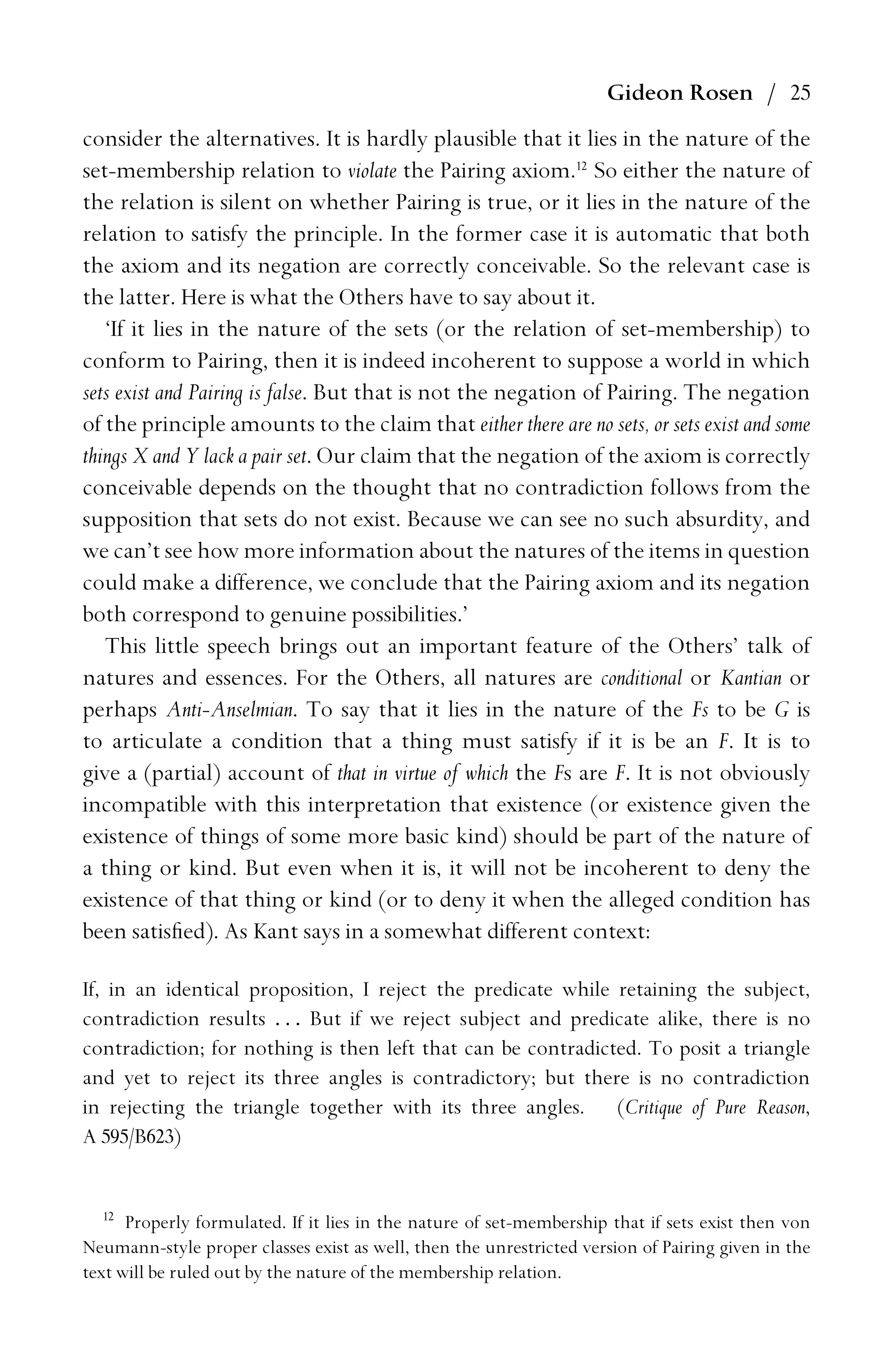
question arises, ‘‘Why shouldn’t there by a world at which P is true?’’ the only
answer cogent response is a demonstration that the supposition that there is
such a world involves a contradiction or some other manifest absurdity. (This
is tantamount to a principle of plenitude. It has the effect that the space of
possible worlds is as large as it can coherently be said to be.) Now, whether
P harbors an absurdity is not in general an apriori matter. To say that it does
is to say that P logically entails an absurdity given a full specification of the
natures of the items it concerns. And since these natures are often available
only aposteriori, it is often an aposteriori matter whether P is correctly conceivable.
That’swhyitisoftenanaposteriorimatterwhetherPismetaphysicallypossible.’10
TheOthershaveadoptedtheNon-StandardConceptionofthemetaphysical
modalities. According to this conception, correct conceivability—logical
consistency with propositions that express the natures of things—is both
necessaryandsufficientformetaphysicalpossibility.Thisneednotbeconstrued
as a reductive analysis. It may be that the full account of correct conceivability
must make use of metaphysical modal notions.11
But even if the equivalence
is not reductive, it may nonetheless be true. And if it is then it would appear
to yield a series of deviant verdict about the Differential truths.
Consider the Pairing axiom once again. The axiom and its denial are
both logically consistent. Moreover, it is plausible that both are correctly
conceivable. To be sure, we have no adequate conception of what it is to be
a set. But even in the absence of a fully explicit such conception, we can
amounts to entailing a contradiction. But this is not strictly speaking a commitment of the view.
A complete account of the Non-Standard Conception would involve an account of the more
fundamental notion.
10
The Non-Standard Conception presented here is inspired by some remarks of Kit Fine.
Fine (1994) defines metaphysical necessity as truth in virtue of the natures of things. However,
Fine would not agree that the account is revisionary in the ways I have suggested. In particular,
he would not agree that the account entails that the existential truths of mathematics and
metaphysics are uniformly contingent. The question would seem to come down to whether
natures are to be construed as ‘conditional’ or ‘Anti-Anselmian’ (see below): whether it can lie in
the nature of some thing that it exist, or whether it can lie in the nature of some kind that it have
instances whenever some more basic kind has instances. I am grateful to Fine for conversation
on these questions and for his eye-opening seminar at Princeton in 1999. But he would certainly
resist my abuse of his ideas in the present context.
11
The account of correct conceivability involves three ingredients: the notion of a proposition,
the notion of logical entailment among propositions, and the notion of an absurdityorcontradiction. It may well
be that a correct account of some or all of these notions presupposes the notion of metaphysical
necessity.
40.
Gideon Rosen /25
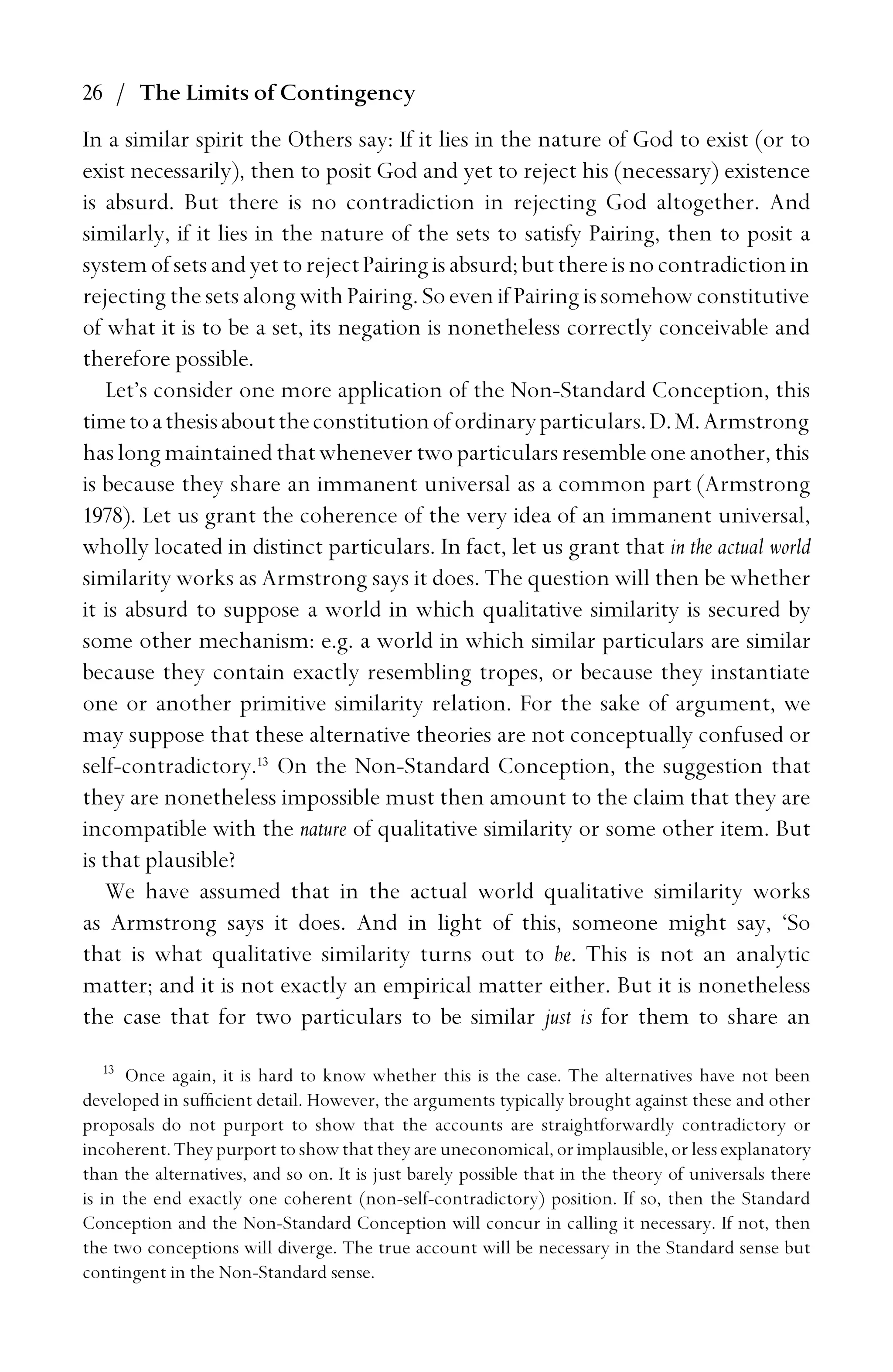
consider the alternatives. It is hardly plausible that it lies in the nature of the
set-membership relation to violate the Pairing axiom.12
So either the nature of
the relation is silent on whether Pairing is true, or it lies in the nature of the
relation to satisfy the principle. In the former case it is automatic that both
the axiom and its negation are correctly conceivable. So the relevant case is
the latter. Here is what the Others have to say about it.
‘If it lies in the nature of the sets (or the relation of set-membership) to
conform to Pairing, then it is indeed incoherent to suppose a world in which
sets exist and Pairing is false. But that is not the negation of Pairing. The negation
of the principle amounts to the claim that either there are no sets, or sets exist and some
things X and Y lack a pair set. Our claim that the negation of the axiom is correctly
conceivable depends on the thought that no contradiction follows from the
supposition that sets do not exist. Because we can see no such absurdity, and
we can’t see how more information about the natures of the items in question
could make a difference, we conclude that the Pairing axiom and its negation
both correspond to genuine possibilities.’
This little speech brings out an important feature of the Others’ talk of
natures and essences. For the Others, all natures are conditional or Kantian or
perhaps Anti-Anselmian. To say that it lies in the nature of the Fs to be G is
to articulate a condition that a thing must satisfy if it is be an F. It is to
give a (partial) account of that in virtue of which the Fs are F. It is not obviously
incompatible with this interpretation that existence (or existence given the
existence of things of some more basic kind) should be part of the nature of
a thing or kind. But even when it is, it will not be incoherent to deny the
existence of that thing or kind (or to deny it when the alleged condition has
been satisfied). As Kant says in a somewhat different context:
If, in an identical proposition, I reject the predicate while retaining the subject,
contradiction results . . . But if we reject subject and predicate alike, there is no
contradiction; for nothing is then left that can be contradicted. To posit a triangle
and yet to reject its three angles is contradictory; but there is no contradiction
in rejecting the triangle together with its three angles. (Critique of Pure Reason,
A 595/B623)
12
Properly formulated. If it lies in the nature of set-membership that if sets exist then von
Neumann-style proper classes exist as well, then the unrestricted version of Pairing given in the
text will be ruled out by the nature of the membership relation.
41.
26 / TheLimits of Contingency
In a similar spirit the Others say: If it lies in the nature of God to exist (or to
exist necessarily), then to posit God and yet to reject his (necessary) existence
is absurd. But there is no contradiction in rejecting God altogether. And
similarly, if it lies in the nature of the sets to satisfy Pairing, then to posit a
systemofsetsandyettorejectPairingisabsurd;butthereisnocontradictionin
rejecting the sets along with Pairing. So even if Pairing is somehow constitutive
of what it is to be a set, its negation is nonetheless correctly conceivable and
therefore possible.
Let’s consider one more application of the Non-Standard Conception, this
timetoathesisabouttheconstitutionofordinaryparticulars.D.M.Armstrong
haslong maintainedthatwhenevertwoparticularsresembleoneanother, this
is because they share an immanent universal as a common part (Armstrong
1978). Let us grant the coherence of the very idea of an immanent universal,
wholly located in distinct particulars. In fact, let us grant that in the actual world
similarity works as Armstrong says it does. The question will then be whether
it is absurd to suppose a world in which qualitative similarity is secured by
some other mechanism: e.g. a world in which similar particulars are similar
because they contain exactly resembling tropes, or because they instantiate
one or another primitive similarity relation. For the sake of argument, we
may suppose that these alternative theories are not conceptually confused or
self-contradictory.13
On the Non-Standard Conception, the suggestion that
they are nonetheless impossible must then amount to the claim that they are
incompatible with the nature of qualitative similarity or some other item. But
is that plausible?
We have assumed that in the actual world qualitative similarity works
as Armstrong says it does. And in light of this, someone might say, ‘So
that is what qualitative similarity turns out to be. This is not an analytic
matter; and it is not exactly an empirical matter either. But it is nonetheless
the case that for two particulars to be similar just is for them to share an
13
Once again, it is hard to know whether this is the case. The alternatives have not been
developed in sufficient detail. However, the arguments typically brought against these and other
proposals do not purport to show that the accounts are straightforwardly contradictory or
incoherent. They purport to show that they are uneconomical, or implausible, or less explanatory
than the alternatives, and so on. It is just barely possible that in the theory of universals there
is in the end exactly one coherent (non-self-contradictory) position. If so, then the Standard
Conception and the Non-Standard Conception will concur in calling it necessary. If not, then
the two conceptions will diverge. The true account will be necessary in the Standard sense but
contingent in the Non-Standard sense.
42.
Gideon Rosen /27
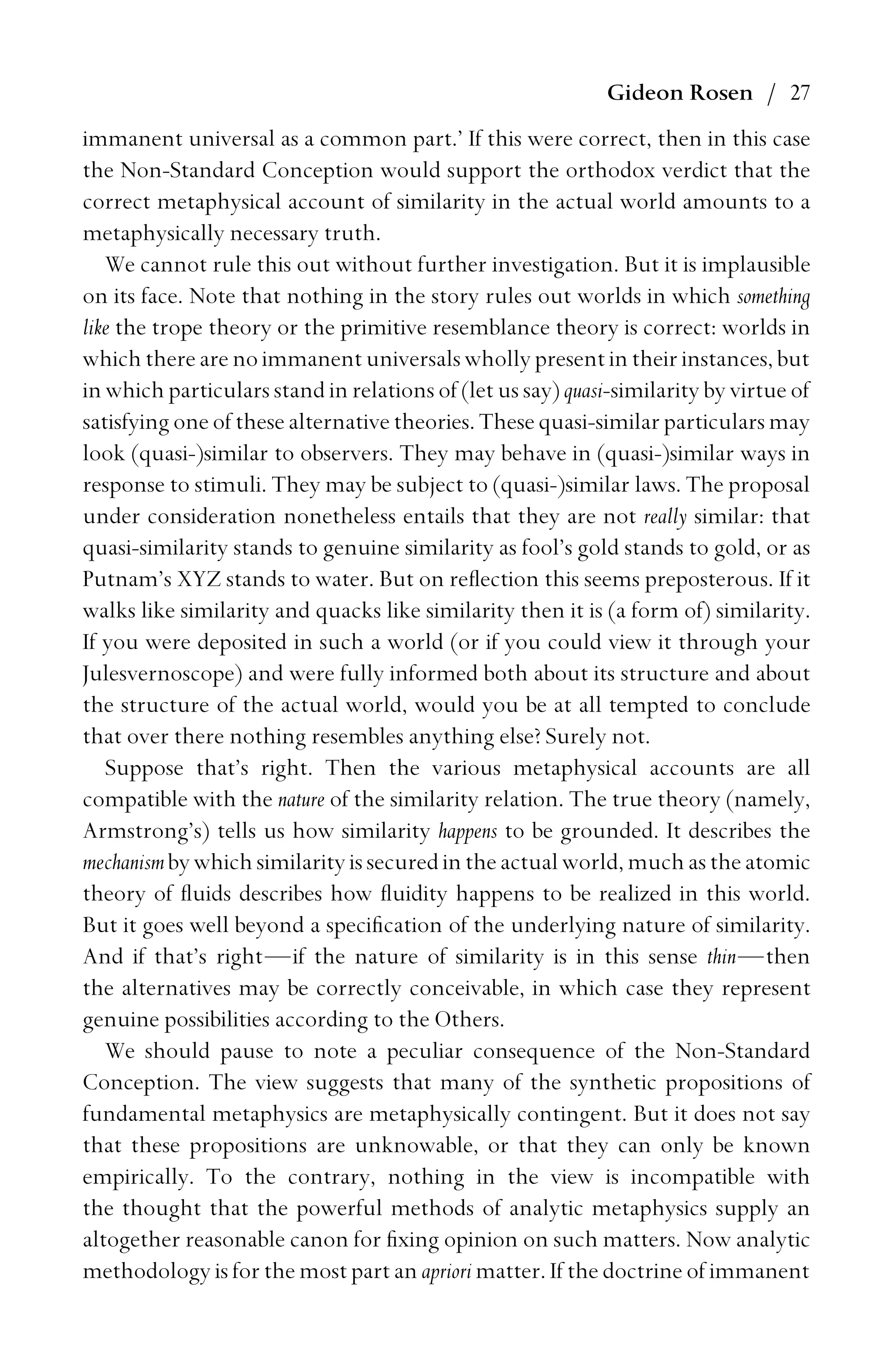
immanent universal as a common part.’ If this were correct, then in this case
the Non-Standard Conception would support the orthodox verdict that the
correct metaphysical account of similarity in the actual world amounts to a
metaphysically necessary truth.
We cannot rule this out without further investigation. But it is implausible
on its face. Note that nothing in the story rules out worlds in which something
like the trope theory or the primitive resemblance theory is correct: worlds in
which there are no immanent universals wholly present in their instances, but
in which particulars stand in relations of (let us say) quasi-similarity by virtue of
satisfying one of these alternative theories. These quasi-similar particulars may
look (quasi-)similar to observers. They may behave in (quasi-)similar ways in
response to stimuli. They may be subject to (quasi-)similar laws. The proposal
under consideration nonetheless entails that they are not really similar: that
quasi-similarity stands to genuine similarity as fool’s gold stands to gold, or as
Putnam’s XYZ stands to water. But on reflection this seems preposterous. If it
walks like similarity and quacks like similarity then it is (a form of) similarity.
If you were deposited in such a world (or if you could view it through your
Julesvernoscope) and were fully informed both about its structure and about
the structure of the actual world, would you be at all tempted to conclude
that over there nothing resembles anything else? Surely not.
Suppose that’s right. Then the various metaphysical accounts are all
compatible with the nature of the similarity relation. The true theory (namely,
Armstrong’s) tells us how similarity happens to be grounded. It describes the
mechanismby whichsimilarity issecuredinthe actual world, muchastheatomic
theory of fluids describes how fluidity happens to be realized in this world.
But it goes well beyond a specification of the underlying nature of similarity.
And if that’s right—if the nature of similarity is in this sense thin—then
the alternatives may be correctly conceivable, in which case they represent
genuine possibilities according to the Others.
We should pause to note a peculiar consequence of the Non-Standard
Conception. The view suggests that many of the synthetic propositions of
fundamental metaphysics are metaphysically contingent. But it does not say
that these propositions are unknowable, or that they can only be known
empirically. To the contrary, nothing in the view is incompatible with
the thought that the powerful methods of analytic metaphysics supply an
altogether reasonable canon for fixing opinion on such matters. Now analytic
methodology is for the most part an apriori matter. If the doctrine of immanent
43.
28 / TheLimits of Contingency
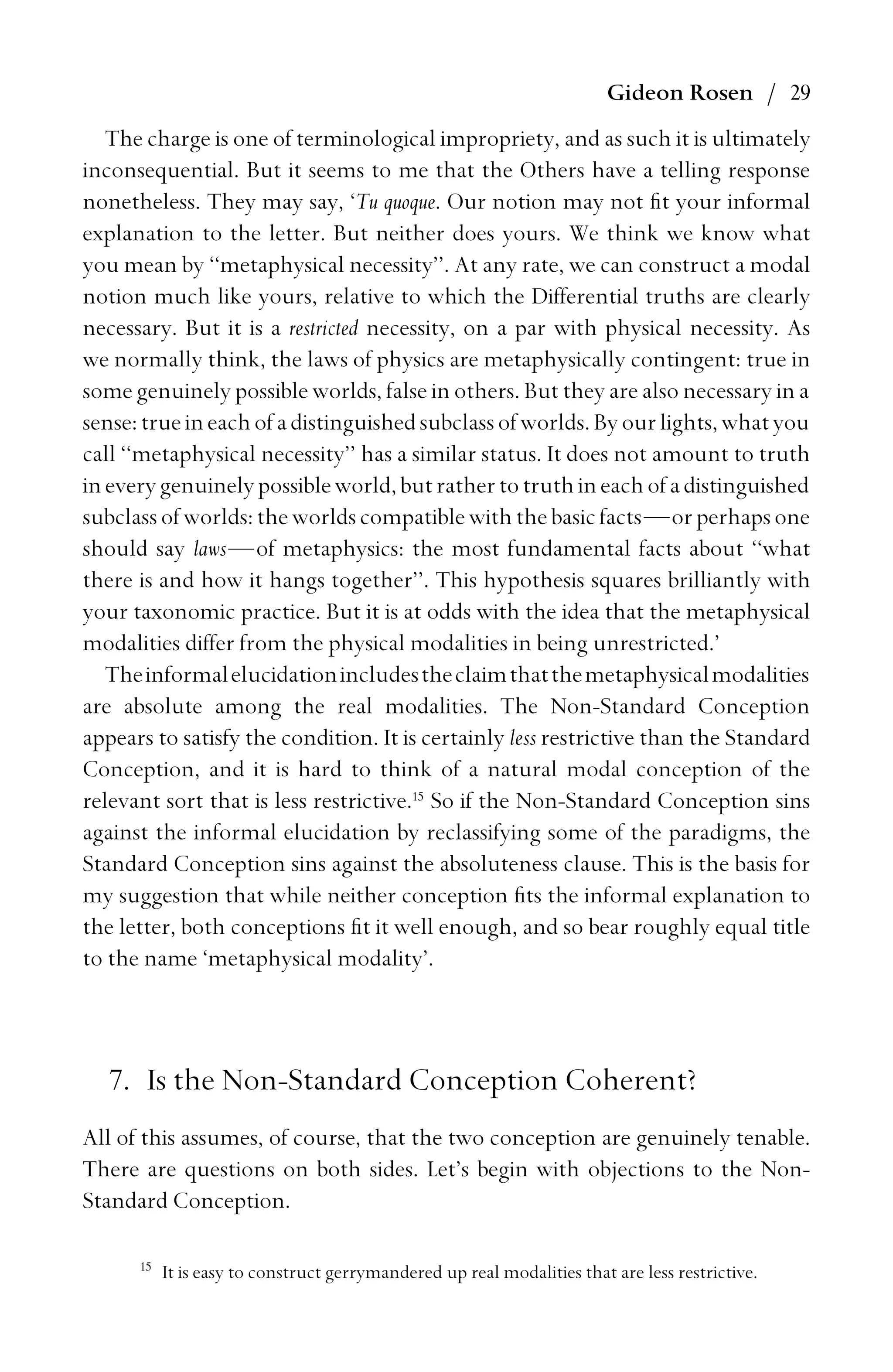
universals is to be preferred as an account of qualitative similarity, this is
because it is elegant, intrinsically plausible, philosophically fruitful, immune
tocompelling counterexample, andsoon. All of these featuresarepresumably
available to apriori philosophical reflection insofar as they are available at all.
The view therefore yields a new species of the so-called ‘contingent apriori’. One
need not appeal to claims involving indexicals (‘I am here now’) or stipulative
reference fixing (‘Julius invented the zip’). According to the Others, the claims
of basic ontology (including the existential claims of mathematics), are both
contingent and apriori (insofar as they are knowable); but in this case the
mechanism has nothing to do with indexicality.14
6. The Two Conceptions and the Informal Explanation
Let us suppose—just for a moment—that the Non-Standard Conception is
tolerably clear, in the sense that there might a coherent practice in which pro-
positions are classified as ‘necessary’ or not depending on whether their nega-
tionsarecorrectlyconceivable.Onemightobjectthatanotionofthissort,how-
ever interesting, does not deserve the name ‘metaphysical necessity’. After all,
the main controls on this notion are supplied by the informal elucidation with
whichwebegan.Amodalnotiondeservestobecalled‘metaphysical’onlytothe
extentthatitconformstothisaccount.AndtheNon-StandardConceptionfalls
shortinoneobviousrespect. Weexplainwhatwemeanby ‘metaphysical neces-
sity’inpartbyholdingupthetruthsofmathematicsandfundamentalontology
and saying, ‘You want to know what metaphysical necessity is supposed to be?
It’sthesortofnecessitythatattachestoclaimslikethat.’SincetheNon-Standard
Conception threatens to classify many of these paradigms as ‘contingent’, this
counts against regarding it as a conception of metaphysical necessity.
14
Note that if these mathematical and metaphysical truths are indeed both apriori and
contingent, then the warrant for them (whatever it comes to) will presumably be available even
in worlds where they are false. Apriori warrant is therefore fallible: an interesting result, but not a
problem. Compare the force of considerations of simplicity in the empirical case. We are supposed
to have reason to believe the simplest theory simply in virtue of its simplicity; but there are
deceptive worlds in which the simplest empirically adequate theory is wildly false. This does not
show that simplicity is not a reason for empirical belief; it just shows that in deceptive worlds a
belief can be both false and justified. The present picture supports a similar conception of (one
sort of) apriori warrant. Thanks to a referee for Oxford University Press on this point.
44.
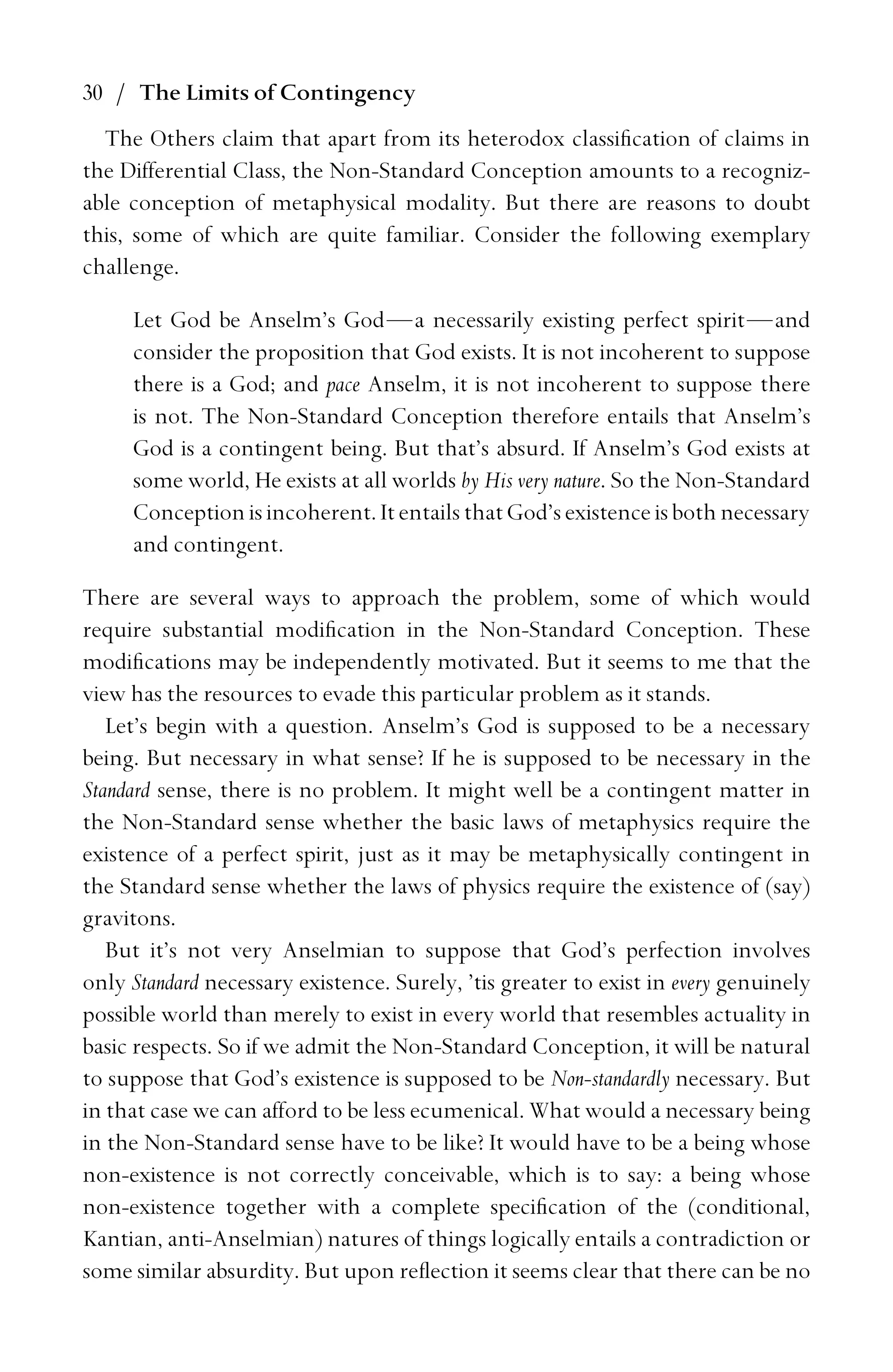
Gideon Rosen /29
The charge is one of terminological impropriety, and as such it is ultimately
inconsequential. But it seems to me that the Others have a telling response
nonetheless. They may say, ‘Tu quoque. Our notion may not fit your informal
explanation to the letter. But neither does yours. We think we know what
you mean by ‘‘metaphysical necessity’’. At any rate, we can construct a modal
notion much like yours, relative to which the Differential truths are clearly
necessary. But it is a restricted necessity, on a par with physical necessity. As
we normally think, the laws of physics are metaphysically contingent: true in
some genuinely possible worlds, false in others. But they are also necessary in a
sense:trueineachofadistinguishedsubclassofworlds.Byourlights,whatyou
call ‘‘metaphysical necessity’’ has a similar status. It does not amount to truth
ineverygenuinelypossibleworld,butrathertotruthineachofadistinguished
subclassof worlds: theworldscompatiblewiththebasicfacts—orperhapsone
should say laws—of metaphysics: the most fundamental facts about ‘‘what
there is and how it hangs together’’. This hypothesis squares brilliantly with
your taxonomic practice. But it is at odds with the idea that the metaphysical
modalities differ from the physical modalities in being unrestricted.’
Theinformalelucidationincludestheclaimthatthemetaphysicalmodalities
are absolute among the real modalities. The Non-Standard Conception
appears to satisfy the condition. It is certainly less restrictive than the Standard
Conception, and it is hard to think of a natural modal conception of the
relevant sort that is less restrictive.15
So if the Non-Standard Conception sins
against the informal elucidation by reclassifying some of the paradigms, the
Standard Conception sins against the absoluteness clause. This is the basis for
my suggestion that while neither conception fits the informal explanation to
the letter, both conceptions fit it well enough, and so bear roughly equal title
to the name ‘metaphysical modality’.
7. Is the Non-Standard Conception Coherent?
All of this assumes, of course, that the two conception are genuinely tenable.
There are questions on both sides. Let’s begin with objections to the Non-
Standard Conception.
15
It is easy to construct gerrymandered up real modalities that are less restrictive.
45.
30 / TheLimits of Contingency
The Others claim that apart from its heterodox classification of claims in
the Differential Class, the Non-Standard Conception amounts to a recogniz-
able conception of metaphysical modality. But there are reasons to doubt
this, some of which are quite familiar. Consider the following exemplary
challenge.
Let God be Anselm’s God—a necessarily existing perfect spirit—and
consider the proposition that God exists. It is not incoherent to suppose
there is a God; and pace Anselm, it is not incoherent to suppose there
is not. The Non-Standard Conception therefore entails that Anselm’s
God is a contingent being. But that’s absurd. If Anselm’s God exists at
some world, He exists at all worlds by His very nature. So the Non-Standard
Conception is incoherent. It entails that God’s existence is both necessary
and contingent.
There are several ways to approach the problem, some of which would
require substantial modification in the Non-Standard Conception. These
modifications may be independently motivated. But it seems to me that the
view has the resources to evade this particular problem as it stands.
Let’s begin with a question. Anselm’s God is supposed to be a necessary
being. But necessary in what sense? If he is supposed to be necessary in the
Standard sense, there is no problem. It might well be a contingent matter in
the Non-Standard sense whether the basic laws of metaphysics require the
existence of a perfect spirit, just as it may be metaphysically contingent in
the Standard sense whether the laws of physics require the existence of (say)
gravitons.
But it’s not very Anselmian to suppose that God’s perfection involves
only Standard necessary existence. Surely, ’tis greater to exist in every genuinely
possible world than merely to exist in every world that resembles actuality in
basic respects. So if we admit the Non-Standard Conception, it will be natural
to suppose that God’s existence is supposed to be Non-standardly necessary. But
in that case we can afford to be less ecumenical. What would a necessary being
in the Non-Standard sense have to be like? It would have to be a being whose
non-existence is not correctly conceivable, which is to say: a being whose
non-existence together with a complete specification of the (conditional,
Kantian, anti-Anselmian) natures of things logically entails a contradiction or
some similar absurdity. But upon reflection it seems clear that there can be no
46.
Gideon Rosen /31
such thing. The Anti-Anselmian natures of things are given by formulae of
the form:
To be an F is to be . . .
To be A is to be . . .
But it seems clear that no collection of such formulae can yield a contradiction
when conjoined with a negative existential proposition of the form
There are no Fs, or.
A does not exist
The proposition that a Non-Standard necessary being sense exists is thus
incoherent;itisnotcorrectlyconceivable.TheproponentoftheNon-Standard
Conception may therefore resist the objection.
The same response applies to non-theological versions of the objection. It
is sometimes said, for example, that the idea of Number includes the idea
of necessary existence, so that nothing counts as a number unless it exists
necessarily. (Of course, the textbook definitions tend to omit this condition,
just as they omit to mention that numbers do not exist in space and time.
But still it might be said that our ‘full conception’ of the natural numbers
entails that numbers exist necessarily if they exist at all.)16
The worry is
that the Non-Standard theorist will be forced to concede that is coherent to
suppose that numbers so-conceived exist, and also that it is coherent to deny
their existence, in which case it will follow, absurdly, that numbers are both
necessary and contingent.
The response is to distinguish two senses in which numbers might be said
to be necessary. If the claim is that numbers, if they exist, must be necessary
in the Standard sense, then once again there is no problem. It might be
contingent in the Non-Standard sense whether some Standardly Necessary
Being exists. On the other hand, if the claim is that numbers must be necessary
in the Non-Standard sense, then we may conclude straight away that numbers
so-conceived are impossible, since it is not correctly conceivable to suppose
that they exist.
As a final example, consider the claim that there exists an actual golden
mountain.Sincethereisnogoldenmountainintheactualworld,weknowthat
this proposition is not possibly true. But is the proponent of the Non-Standard
Conception entitled to this verdict? Is the supposition of a world in which
16
Balaguer (1998).
47.
32 / TheLimits of Contingency
there exists an actually existing golden mountain logically incompatible with
the natures of things? Couldn’t you know all there was to know about what
it is to be gold, what it is to be a mountain, and what it is to be actual without
being in a position to rule out the existence of an actual golden mountain?
No. For there to be an actual golden mountain is for there to be a golden
mountain in the actual world. And in the relevant sense, the actual world
has its complete intrinsic nature essentially. To be the actual world is to
be a world such that P, Q, . . . where these are all the contingently true
propositions. Propositions of the form ‘Actually P’ are singular propositions
about this world and will thus be true (or false) in virtue of the nature
of the actual world. It follows that for propositions of this sort, the Non-
Standard Conception agrees with the Standard one. All such propositions are
metaphysically non-contingent.
8. Objections to the Standard Conception
There is much more to say about whether the Non-Standard Conception
represents a tenable conception of the metaphysical modalities.17
But if we
suppose that it does, then our critical focus naturally shifts to the Standard
Conception. For once we have the Non-Standard Conception clearly in focus,
it is no longer obvious that the Standard Conception represents a genuine
alternative. A skeptic might suggest that it was just thoughtless acquiescence
in tradition that led us to regard the substantive principles of fundamental
ontology as metaphysically necessary according to our usual understanding
of the notion. After all, if there really is no obstacle to the possibility of a world
in which (say) mereological aggregates do not exist, is it really so obvious that
such worlds should be deemed impossible? Presumably, we have never faced
17
In his very useful comments on an earlier version of this paper, Scott Sturgeon objected
to the Non-Standard Conception on the ground that David Lewis’s theory of possibility—his
version of modal realism—and its negation are both correctly conceivable, whereas it is absurd to
suppose that a modal account of this sort might be a contingent truth. In response, I am inclined
to say that Lewis’s metaphysics of many worlds, shorn of its modal gloss, is indeed contingent in
the Non-Standard sense, and that no contradiction follows from this concession. On the other
hand, Lewis’s package includes account of what it is for a truth to be necessary, and that account is
either compatible with the nature of necessity (in which case the negation of Lewis’s theory is an
impossibility) or incompatible with it (in which case Lewis’s theory itself is an impossibility).
48.
Gideon Rosen /33
the question directly. And it is tempting to suppose that when we do, our
reaction should be not to reaffirm the Standard verdict, but rather to conclude
that what I have been calling the Non-Standard conception really is our own
conception and that we have been systematically misapplying it in such cases.
Tobesure,evengiventhetenabilityoftheNon-StandardConception,westill
know how to classify truths as necessary or contingent in the Standard sense.
We still know how to identify the truths (or putative truths) of fundamental
ontology, along with the uncontroversial metaphysical necessities. That is, we
know how to apply the Standard Conception in practice. So never mind what
we would say if we were to confront the question sketched above. Is there any
reason to doubt that the Standard Conception as I have described it tracks a
perfectly genuine modal distinction (even if it is not the only such distinction
in the neighborhood?)
Let’s not deny that it tracks a distinction. The question is whether that
distinction amounts to a distinction in modal status. Let me explain.
As we have seen, from the standpoint of the Non-Standard Conception,
Standard metaphysical necessity is best seen as a restricted modality. To be
necessary in the Standard sense is to hold, not in every genuinely possible
world, but rather in every world that meets certain conditions. Now it is
sometimes supposed that restricted modalities are cheap. After all, given any
proposition, φ we can always introduce a ‘restricted necessity operator’ by
means of a formula of the form
φ(P) =df (φ → P).
And in that case, there can be no objection to the Standard Conception. The
trouble is that most such ‘restricted necessity operators’ do not correspond to
genuine species of necessity. Let NJ be the complete intrinsic truth about the
State of New Jersey, and say that P is NJ-necessary just in case NJ strictly implies
P. It will then be NJ-necessary that Rosen is in Princeton, but NJ-contingent
that Blair is in London. But of course we know full well that there is no sense
whatsoever in which I have my location of necessity while Blair has his only
contingently. So NJ-necessity is not a species of necessity.
The moral is that one cannot in general infer, from the fact that a certain
consequence (φ → P) holds of necessity, that there is any sense in which the
consequent (P) holds of necessity. (If there were then every proposition would be
necessary in a sense, even the contradictions.)
49.
34 / TheLimits of Contingency
Now, metaphysical necessity on the Standard Conception is supposed to be
a restriction of Non-Standard metaphysical necessity for which the restricting
proposition φ is the conjunction of what we have been calling the ‘laws’
of metaphysics. The challenge is thus to show that Standard necessity so
conceived amounts to a genuine species of necessity—that it is more like
physical necessity than it is like NJ-necessity.
It is unclear what it would take to meet this challenge. There is some
temptation to say that φ-necessity amounts to a genuine species of necessity
only when the restricting proposition φ has independent modal force—only when
there is already some sense in which it must be true. But what could this mean?
Consider the Mill–Ramsey–Lewis (MRL) account of the laws of nature,
according to which a generalization L is a law just in case L is a theorem of
every true account of the actual world that achieves the best overall balance
of simplicity and strength (Lewis 1973). Let us grant that this standard picks
out a tolerably well-defined class of truths. Still, one might ask, ‘Why should
propositions incompatible with the laws so conceived be called impossible?’
Considerarelatedclassof truths: those propositions that would figurein every
true account of the State of New Jersey that achieves the best overall balance
of simplicity and strength. If the Encyclopedia Britannica is any guide, one such
truth is the proposition that New Jersey is a haven for organized crime. But
one needs a dark view of things to suppose that this proposition is in some
sense necessary. It certainly doesn’t follow from the fact that it is important
enough to be worth mentioning in a brief account of New Jersey that it enjoys
a distinctive modal status. So why is it than when the MRL-theory in question
is a theory about the entire world, we are inclined to credit its general theorems
with some sort of necessity?
One way with this sort of question is a sort of nominalism. There no
objective constraints on which restricted necessities we recognize. We take
an interest in some but not in others. We hold their associated restricting
propositions fixed in counterfactual reasoning for certain purposes. And in
these cases we dignify the operator in question with a modal name. But our
purposes might have been otherwise, and if they had been then we might have
singled out a different set of operators. On this sort of view there can be no
principledobjectiontotheStandardConception. The worst onecan say isthat
the restricted necessity upon which it fastens is not particularly interesting or
useful. But one cannot say that it fails to mark a genuine modal distinction,
50.
Gideon Rosen /35
for on the view in question any modal distinction we see fit to mark as such is
ipso facto genuine.
If we set this sort of nominalism to one side, then one natural thing to say is
that a putative restricted necessity counts as genuine only when the boundary
it draws between the necessary and the contingent is non-arbitrary or non-
ad hoc from a metaphysical point of view. (Note that this is at best a necessary
condition.) The truths about NJ are not a natural class from the standpoint of
general metaphysics; nor are the Mill–Ramsey–Lewis generalizations about
New Jersey. On the other hand, the most important general facts about nature
as a whole may well be thought to constitute a metaphysically significant class
of facts. And if so, there would be no objection on this score to the idea that
physical necessity defined in Lewis’s way amounts to a genuine species of necessity.
The Standard Conception of metaphysical necessity conditionalizes upon
what we have been calling the basic laws or facts of fundamental ontology. Just
as the Mill–Ramsey–Lewis laws of nature are supposed to represent the goal
of one sort of natural science, the metaphysical laws are supposed to represent
the goal of one sort of metaphysics: nuts and bolts systematic ontology.
Clearly, there is no worry that these truths might constitute an arbitrary class
from the standpoint of metaphysics. But it might still be wondered whether
anything substantial can be said about what unifies them, and in particular,
about what fits them to serve in the specification of a restricted modality.
I have a conjecture (and some rhetoric) to offer on this point. Consider the
true propositions in the Differential class: the truths in the theory of universals
and the metaphysics of material constitution; the truths about how abstract
entities of various sorts are ‘generated’ from concrete things and from one
another. To know these truths would not be to know which particulars there
are or how they happen to be disposed in space and time. But it would be to
know what might be called the form of the world: the principles governing how
objects in general are put together. If the world is a text then these principles
constitute its syntax. They specify the categories of basic constituents and
the rules for their combination. They determine how non-basic entities are
generated from or ‘grounded in’ the basic array. Worlds that agree with the
actual world in these respects, though they may differ widely in their ‘matter’,
are nonetheless palpably of a piece. They are constructed according to the
same rules, albeit in different ways, and perhaps even from different ultimate
ingredients. In this sense, they are like sentences in a single language. The
metaphysically necessary truths on the Standard Conception may not be
51.
36 / TheLimits of Contingency
absolutely necessary. But they hold in any world that shares the form of the
actual world in this sense.
Combinatorial theories of possibility typically take it for granted that
the combinatorial principles characterize absolutely every possibility: that
possible worlds in general share a syntax, as it were, differing only in the
constituents from which they are generated or in the particular manner or
theirarrangement.TheNon-StandardConceptionisnotstrictlycombinatorial
inthissense,sinceitallowsthatthefundamentalprinciplesofcomposition—the
syntax—may vary massively from world to world. The actual grammar is
not privileged. Any coherent grammar will do. But the Standard Conception
carves out an inner sphere within this larger domain: the sphere of worlds that
share the combinatorial essence of actuality. As I have stressed, it is unclear
what it takes to show that a class of truths is sufficiently distinguished to count
as a legitimate basis for a restricted modality. Nonetheless, the foregoing may
be taken to suggest that if any restricted modality is to be reckoned genuine,
the restricted modality marked out by Standard Conception should be so
reckoned.
9. Physical Necessity Reconsidered
This way of thinking raises a question about the boundary between physical
necessity and Standard metaphysical necessity. Some physical necessities
will presumably be Standardly contingent. Suppose the laws of nature
involve particular numerical constants that determine the strengths of the
fundamental forces or the charges or masses of the fundamental particles.
It will then be natural to suppose that the precise values of these constants
are not aspects of the general combinatorial structure of the world and that
they are therefore contingent in the Standard sense. But other claims that
might feature in the Mill–Ramsey–Lewis theory of the natural world might
be candidates for metaphysical necessity in the standard sense: that the laws
of nature all assume a certain mathematical form (e.g. that they are quantum
mechanical); that the space–time manifold has certain geometrical features,
e.g.: that it has only one ‘time’ dimension; that the ultimate particles are
excitation states of one-dimensional strings; and so on. It is not inconceivable
that such physical features should be sufficiently basic to count as aspects of
the underlying form or structure of the world: that any world in which such
52.
Gideon Rosen /37
physical features failed to be manifest, would fail to share a syntax with the
actual world. Andinsofarasthisisso, these physical truths should bereckoned
metaphysically necessary on the Standard conception for the same reason
that the facts of fundamental ontology are to be reckoned necessary on that
conception.
The point I wish to stress, however, is that on the present conception it is
to be expected that the border between Standard metaphysical necessity and
physical necessity should be vague—not simply because the notion of physical
necessity (or a law of nature) is vague, but also because it is vague when a truth
is ‘fundamental’ or ‘structural’ enough to count as part of the combinatorial
essence of the world. This is not the prevailing view on this matter. Most
writers take it for granted that the question whether a certain law of nature
is also metaphysically necessary is a well-defined question whose answer is in
no way up for stipulation. On the present conception, that is unlikely to be
the case. If the question is whether some given law of nature is a Non-Standard
necessity, then indeed, for all we have said, it may be sharp. However hard it
may be to find the answer, the question then is whether the negation of the
law is ruled out by the natures of the properties and relations it concerns, and
we have seen no reason to believe that this question is a vague one. (There
may be such reasons, but we have not seen them.)18
On the other hand, if
the question is whether the law is a Standard metaphysical necessity, then we
should expect that in some cases it will have no answer, since the boundary
between structural or formal truths and mere ‘material’ truths has only been
vaguely specified.
10. Conclusion
We have distinguished two conceptions of metaphysical necessity, both of
which cohere well enough with the usual informal explications to deserve
the name. According to the Non-Standard Conception, P is metaphysically
necessarywhenitsnegationislogicallyincompatiblewiththenaturesofthings.
According to the Standard Conception, P is metaphysically necessary when
18
For example, it might turn out to be a vague matter whether P holds in virtue of the nature
of things. This is immensely plausible when P is a proposition about a particular organism or a
biological species.
53.
38 / TheLimits of Contingency
it holds in every (Non-Standard) possible world in which the actual laws of
metaphysicsalsohold,wherethebasiclawsofmetaphysicsarethetruthsabout
the form or structure of the actual world. Neither conception has received a
fully adequate explanation. But if both are tenable, then our discourse about
necessity is shot through with ambiguity. The ambiguity only matters when
we are discussing the modal status of metaphysical propositions—or perhaps
the modal status of certain laws of nature. But when it does matter, we ignore
it at our peril. We are inclined to believe that questions about the modal status
of the claims of mathematics and metaphysics are unambiguous. But if I’m
right, that is not so. In particular, it may be metaphysically necessary in one
sense that sets or universals or mereological aggregates exist, while in another
sense existence is always a contingent matter.
References
Armstrong, D. M. (1978), Universals and Scientific Realism, 2 vols. (Cambridge: CUP).
Balaguer, Mark (1998), Platonism and Anti-Platonism in Mathematics (Oxford: OUP)
Dorr, Cian, and Rosen, Gideon (2001), ‘Composition as a Fiction’, in R. Gale (ed.),
Blackwell’s Guide to Metaphysics (Oxford: Blackwell), 151–74.
Dummett, Michael (1973), Frege: Philosophy of Language (2nd edn., Cambridge, Mass.:
Harvard University Press).
(1981), The Interpretation of Frege’s Philosophy (Cambridge, Mass.: Harvard University
Press).
(1993), ‘Wittgenstein on Necessity: Some Reflections’, repr. in his The Seas of
Language (Oxford: OUP), 446–61.
Field, Hartry (1974), ‘Quine and the Correspondence Theory’, Philosophical Review 83:
200–28.
(1989), Realism, Mathematics and Modality (Oxford: Blackwell).
(1993), ‘The Conceptual Contingency of Mathematical Objects’, Mind, 102:
285–99.
Fine, Kit (1994), ‘Essence and Modality’, in J. E. Tomberlin (ed.), Philosophical Perspectives
8: Logic and Language (Atascadero, Calif.: Ridgeview), 1–16.
(2002), ‘The Varieties of Necessity’, in J. Hawthorne and T. Gendler (eds.),
Conceivability and Possibility (Oxford: OUP), 253–81.
Frankel, Abraham, Bar Hillel Yehoshua, and Levy, Azriel (1973), Foundations of Set
Theory (2nd edn., Amsterdam: North Holland).
Lewis, David (1973), Counterfactuals (Cambridge, Mass.: Harvard University Press).
54.
Gideon Rosen /39
(1983), ‘New Work for a Theory of Universals’, Australasian Journal of Philosophy, 61:
343–77.
Maddy, Penelope (1997), Naturalism in Mathematics (Oxford: OUP).
van Fraassen, Bas (1977), ‘Platonism’s Pyrrhic Victory’, in Marcus et al. (eds.), The
Logical Enterprise (New Haven: Yale University Press), 39–50.
van Inwagen, Peter (1990), Material Beings (Ithaca, NY: Cornell University Press).
and laugh atthe English press for its blindness and onesidedness.
They happen to know beyond all doubt how this Correspondent was
bought over with so much money down; how that one is in the toils
of such or such a Minister's wife; why a third got his appointment;
how a fourth keeps his; and they could, if they chose, give you
chapter and verse for all they say.
If they chance to have been in India some twenty or thirty years
ago, they will tell you why the Mutiny took place, and how the
change of Government works; and they can put their fingers on all
the sore places of the Empire, beginning with the distribution of
patronage and ending with the deficiency of revenue, as aptly as if
they were on the spot and had the confidence of the ruling officials.
But in spite of these little foibles they are amusing companions as a
rule, if shallow and radically ill-informed; and as it is for their own
interest to be good company, they have cultivated the art of
conversation to the highest pitch of which they are capable, and can
entertain if not instruct. When they aim at instruction indeed, they
are pretty sure to miss the mark; and the social nomad who lays
down the law on foreign statesmen and politics, and who speaks
from personal knowledge, is just the one authority not to be
accepted.
Always living in public, yet having to fight, each for his own hand,
the manners of social nomads in pensions are generally a strange
mixture of suavity and selfishness; and the small intrigues and crafty
stratagems going on among them for the possession of the favourite
seat in the drawing-room, the special attention of the head-waiter at
table, the earliest attendance of the housemaid in the morning, is in
strange contrast with the ready smiles, the personal flatteries, the
affectation of sympathetic interest kept for show. But every social
nomad knows how to appraise this show at its just value, and can
weigh it in the balance to a grain. He does not much prize it; for he
knows one characteristic of these communities to be that everybody
speaks against everybody else, and that all concur in speaking
against the management.
57.
Still, life seemsto go easily enough among them. They are all well-
dressed and for the most part have their tempers under control.
Some of the women play well, and some sing prettily. There are
always to be found a sufficient number of the middle-aged of either
sex to make up a whist-table, where the game is sound and
sometimes brilliant; and there are sure to be men who play billiards
creditably and with a crisp, clean stroke worth looking at. And there
are very often lively women who make amusement for the rest. But
these are smartly handled behind backs, though they are petted in
public and undeniably useful to the society at large.
The nomadic widow is by some odd fatality generally the widow of
an officer, naval or military, to whose rank she attaches an almost
superstitious value, thinking that when she can announce herself as
the relict of a major or an admiral she has given an unanswerable
guarantee and smoothed away all difficulties. She may have many
daughters, but more probably she has only one;—for where olive-
branches abound nomadism is more expensive than housekeeping,
and to live in one's own house is less costly than to live in a
boarding-house. But of this one daughter the nomadic widow makes
much to the community; and especially calls attention to her
simplicity and absolute ignorance of the evils so familiar to the girls
of the present day. And she looks as if she expects to be believed.
Perhaps credence is difficult; the young lady in question having been
for some years considerably in public, where she has learnt to take
care of herself with a skill which, how much soever it may be
deserving of praise, can scarcely claim to be called ingenuous. She
has need of this skill; for, apparently, she and her mother have no
male relations belonging to them, and if flirtations are common with
the nomadic tribe, marriages are rare. Poor souls; one cannot but
pity them for all their labour in vain, all their abortive hopes. For
though there is more society in the mode of life they have chosen
than they would have had if they had lived quietly down in the
village where they were known and respected, and where, who
knows? the fairy prince might one day have alighted—there are very
58.
few chances; andmarriages among 'the inmates' are as rare as
winter swallows.
The men who live in these places, whether as nomadic or permanent
guests, never have money enough to marry on; and the flirtations
always budding and blossoming by the piano or about the billiard-
table never by any chance fructify in marriage. But in spite of their
infertile experience you see the same mother and the same
daughter year after year, season after season, returning to the
charge with renewed vigour, and a hope which is the one
indestructible thing about them. Let us deal tenderly with them, poor
impecunious nomads; drifting like so much sea-wrack along the
restless current of life; and wish them some safe resting-place
before it is too late.
A lady nomad of this kind, especially one with a daughter, is strictly
orthodox and cultivates with praiseworthy perseverance the society
of any clergyman who may have wandered into the community of
which she is a member. She is punctual in church-going; and the
minister is flattered by her evident appreciation of his sermons, and
the readiness with which she can remember certain points of last
Sunday's discourse. As a rule she is Evangelically inclined, and is as
intolerant of Romanism on the one hand as of Rationalism on the
other. She has seen the evils of both, she says, and quotes the state
of Rome and of Heidelberg in confirmation. She is as strict in morals
as in orthodoxy, and no woman who has got herself talked about,
however innocently, need hope for much mercy at her hands. Her
Rhadamanthine faculty has apparently ample occasion for exercise,
for her list of scandalous chronicles is extensive; and if she is to be
believed, she and her daughter are almost the sole examples of a
pure and untainted womanhood afloat. She is as rigid too, in all
matters connected with her social status; and brings up her
daughter in the same way of thinking. By virtue of the admiral or the
major, at peace in his grave, they are emphatically ladies; and,
though nomadic, impecunious, homeless, and tant soit peu
adventuresses, they class themselves as of the cream of the cream,
59.
and despise thosewhose rank is of the uncovenanted kind, and who
are gentry, may be, by the grace of God only without any Act of
Parliament to help.
Sometimes the lady nomad is a spinster, not necessarily passée,
though obviously she cannot be in her first youth; still she may be
young enough to be attractive, and adventurous enough to care to
attract. Women of this kind, unmarried, nomadic and still young,
work themselves into every movement afoot. They even face the
perils and discomforts of war-time, and tell their friends at home
that they are going out as nurses to the wounded. That dash of the
adventuress, of which we have spoken before, runs through all this
section of the social nomads; and one wonders why some uncle or
cousin, some aunt or family friend, does not catch them up in time.
If not attractive nor passably young, these nomadic spinsters are
sure to be exceedingly odd. Constant friction with society in its most
selfish form, the absence of home-duties, the want of the sweetness
and sincerity of home love, and the habit of change, bring out all
that is worst in them and kill all that is best. They have nothing to
hope for from society and less to lose; it is wearisome to look
amiable and sweet-tempered when you feel bitter and disappointed;
and politeness is a farce where the fact of the day is a fight. So the
nomadic spinster who has lived so long in this rootless way that she
has ceased even to make such fleeting friendships as the mode of
life affords—has ceased even to wear the transparent mark of such
thin politeness as is required—becomes a 'character' notorious in
proportion to her candour. She never stays long in one
establishment, and generally leaves abruptly because of a
misunderstanding with some other lady, or maybe because some
gentleman has unwittingly affronted her. She and the officer's widow
are always on peculiarly unfriendly terms, for she resents the
pretensions of the officer's daughter, and calls her a bold minx or a
sly puss almost within hearing; while she throws grave doubts on
the widow herself, and drops hints which the rest of the community
gather up like manna, and keep by them, to much the same result
60.
as that ofthe wilderness. But the nomadic spinster soon wanders
away to another temporary resting-place; and before half her life is
done she becomes as well known to the heads of the various
establishments in her line as the taxgatherer himself, and dreaded
almost as much.
Nomads are generally remarkable for not leaving tracks behind
them. You see them here and there, and they are sure to turn up at
Baden-Baden or at Vichy, at Scarborough or at Dieppe, when you
least expect them; but you know nothing about them in the interim.
They are like those birds which hybernate at some place of retreat
no one yet ever found; or like those which migrate, who can tell
where? They come and they go. You meet and part and meet again
in all manner of unlikely places; and it seems to you that they have
been over half the world since you last met, you meanwhile having
settled quietly to your work, save for your summer holiday which
you are now taking, and which you are enjoying as the nomad
cannot enjoy any change that falls to his lot. He is sated with
change; wearied of novelty; yet unable to fix himself, however much
he may wish it. He has got into the habit of change; and the habit
clings even when the desire has gone. Always hoping to be at rest,
always intending to settle as years flow on, he never finds the exact
place to suit him; only when he feels the end approaching, and by
reason of old age and infirmity is a nuisance in the community
where formerly he was an acquisition, and where too all that once
gave him pleasure has now become an insupportable burden and
weariness—only then does he creep away into some obscure and
lonely lodging, where he drags out his remaining days alone, and
dies without the touch of one loved hand to smooth his pillow,
without the sound of one dear voice to whisper to him courage,
farewell, and hope. The home he did not plant when he might is
impossible to him now, and there is no love that endures if there is
no home in which to keep it. And so all the class of social nomads
find when dark days are on them, and society, which cares only to
be amused, deserts them in their hour of greatest need.
62.
GREAT GIRLS.
Nothing ismore distinctive among women than the difference of
relative age to be found between them. Two women of the same
number of years will be substantially of different epochs of life—the
one faded in person, wearied in mind, fossilized in sympathy; the
other fresh both in face and feeling, with sympathies as broad and
keen as they were when she was in her first youth; with a brain still
as receptive, as quick to learn, a temper still as easy to be amused,
as ready to love, as when she emerged from the school-room to the
drawing-room. The one you suspect of understating her age by half-
a-dozen years or more when she tells you she is not over forty; the
other makes you wonder if she has not overstated hers by just so
much when she laughingly confesses to the same age. The one is an
old woman who seems as if she had never been young, the other
'just a great girl yet,' who seems as if she would never grow old; and
nothing is equal between them but the number of days each has
lived.
This kind of woman, so fresh and active, so intellectually as well as
emotionally alive, is never anything but a girl; never loses some of
the sweetest characteristics of girlhood. You see her first as a young
wife and mother, and you imagine she has left the school-room for
about as many months as she has been married years. Her face has
none of that untranslatable expression, that look of robbed bloom,
which experience gives; in her manner is none of the preoccupation
so observable in most young mothers, whose attention never seems
wholly given to the thing on hand, and whose hearts seem always
full of a secret care or an unimparted joy. Brisk and airy, braving all
weathers, ready for any amusement, interested in the current
63.
questions of historyand society, by some wonderful faculty of
organizing seeming to have all her time to herself as if she had no
house cares and no nursery duties, yet these somehow not
neglected, she is the very ideal of a happy girl roving through life as
through a daisy field, on whom sorrow has not yet laid its hand and
to whose lot has fallen no Dead Sea apple. And when one hears her
name and style for the first time as a matron, and sees her with two
or three sturdy little fellows hanging about her slender neck and
calling her mamma, one feels as if nature had somehow made a
mistake, and that our slim and simple-mannered damsel had only
made-believe to have taken up the serious burdens of life, and was
nothing but a great girl after all.
Grown older she is still the great girl she was ten years ago, if her
type of girlishness is a little changed and her gaiety of manner a
little less persistent. But even now, with a big boy at Eton and a
daughter whose presentation is not so far off, she is younger than
her staid and melancholy sister, her junior by many years, who has
gone in for the Immensities and the Worship of Sorrow, who thinks
laughter the sign of a vacant mind, and that to be interesting and
picturesque a woman must have unserviceable nerves and a
defective digestion. Her sister looks as if all that makes life worth
living for lies behind her, and only the grave is beyond; she, the
great girl, with her bright face and even temper, believes that her
future will be as joyous as her present, as innocent as her past, as
full of love and as purely happy. She has known some sorrows truly,
and she has gained such experience as comes only through the
rending of the heart-strings; but nothing that she has passed
through has seared nor soured her, and if it has taken off just the
lighter edge of her girlishness it has left the core as bright and
cheery as ever.
In person she is generally of the style called 'elegant' and
wonderfully young in mere physical appearance. Perhaps sharp eyes
might spy out here and there a little silver thread among the soft
brown hair; and when fatigued or set in a cross light, lines not quite
64.
belonging to theteens may be traced about her eyes and mouth;
but in favourable conditions, with her graceful figure advantageously
draped and her fair face flushed and animated, she looks just a
great girl, no more; and she feels as she looks. It is well for her if
her husband is a wise man, and more proud of her than he is
jealous; for he must submit to see her admired by all the men who
know her, according to their individual manner of expressing
admiration. But as purity of nature and singleness of heart belong to
her qualification for great girlishness, he has no cause for alarm, and
she is as safe with Don Juan as with St. Anthony.
These great girls, as middle-aged matrons, are often seen in the
country; and one of the things which most strikes a Londoner is the
abiding youthfulness of this kind of matron. She has a large family,
the elders of which are grown up, but she has lost none of the
beauty for which her youth was noted, though it is now a different
kind of beauty from what it was then; and she has still the air and
manners of a girl. She blushes easily, is shy, and sometimes apt to
be a little awkward, though always sweet and gentle; she knows
very little of real life and less of its vices; she is pitiful to sorrow,
affectionate to her friends who are few in number, and strongly
attached to her own family; she has no theological doubts, no
scientific proclivities, and the conditions of society and the family do
not perplex her. She thinks Darwinism and protoplasm dangerous
innovations; and the doctrine of Free Love with Mrs. Cady Staunton's
development is something too shocking for her to talk about. She
lifts her calm clear eyes in wonder at the wild proceedings of the
shrieking sisterhood, and cannot for the life of her make out what all
this tumult means, and what the women want. For herself, she has
no doubts whatever, no moral uncertainties. The path of duty is as
plain to her as are the words of the Bible, and she loves her husband
too well to wish to be his rival or to desire an individualized
existence outside his. She is his wife, she says; and that seems more
satisfactory to her than to be herself a Somebody in the full light of
notoriety, with him in the shade as her appendage.
65.
If inclined tobe intolerant to any one, it is to those who seek to
disturb the existing state of things, or whose speculations unsettle
men's minds; those who, as she thinks, entangle the sense of that
which is clear and straightforward enough if they would but leave it
alone, and who, by their love of iconoclasm, run the risk of
destroying more than idols. But she is intolerant only because she
believes that when men put forth false doctrines they put them forth
for a bad purpose, and to do intentional mischief. Had she not this
simple faith, which no philosophic questionings have either enlarged
or disturbed, she would not be the great girl she is; and what she
would have gained in catholicity she would have lost in freshness.
For herself, she has no self-asserting power, and would shrink from
any kind of public action; but she likes to visit the poor, and is
sedulous in the matter of tracts and flannel-petticoats, vexing the
souls of the sterner, if wiser, guardians and magistrates by her
generosity which they affirm only encourages idleness and creates
pauperism. She cannot see it in that light. Charity is one of the
cardinal virtues of Christianity; accordingly, charitable she will be, in
spite of all that political economists may say.
She belongs to her family, they do not belong to her; and you
seldom hear her say 'I went' or 'I did.' It is always 'we;' which,
though a small point, is a significant one, showing how little she
holds to anything like an isolated individuality, and how entirely she
feels a woman's life to belong to and be bound up in her home
relations. She is romantic too, and has her dreams and memories of
early days; when her eyes grow moist as she looks at her husband—
the first and only man she ever loved—and the past seems to be
only part of the present. The experience which she must needs have
had has served only to make her more gentle, more pitiful, than the
ordinary girl, who is naturally inclined to be a little hard; and of all
her household she is the kindest and the most intrinsically
sympathetic. She keeps up her youth for the children's sake she
says; and they love her more like an elder sister than the traditional
mother. They never think of her as old, for she is their constant
companion and can do all that they do. She is fond of exercise; is a
66.
good walker; anactive climber; a bold horsewoman; a great
promoter of picnics and open-air amusements. She looks almost as
young as her eldest daughter differentiated by a cap and covered
shoulders; and her sons have a certain playfulness in their love for
her which makes them more her brothers than her sons. Some of
them are elderly men before she has ceased to be a great girl; for
she keeps her youth to the last by virtue of a clear conscience, a
pure mind and a loving nature. She is wise in her generation and
takes care of her health by means of active habits, fresh air, cold
water and a sparing use of medicines and stimulants; and if the dear
soul is proud of anything it is of her figure, which she keeps trim and
elastic to the last, and of the clearness of her complexion, which no
heated rooms have soddened, no accustomed strong waters have
clouded nor bloated.
Then there are great girls of another kind—women who, losing the
sweetness of youth, do not get in its stead the dignity of maturity;
who are fretful, impatient, undisciplined, knowing no more of
themselves nor human nature than they did when they were
nineteen, yet retaining nothing of that innocent simplicity, that
single-hearted freshness and joyousness of nature which one does
not wish to see disturbed even for the sake of a deeper knowledge.
These are the women who will not get old and who consequently do
not keep young; who, when they are fifty, dress themselves in gauze
and rosebuds, and think to conceal their years by a judicious use of
many paint-pots and the liberality of the hairdresser; who are
jealous of their daughters, whom they keep back as much and as
long as they can, and terribly aggrieved at their irrepressible six feet
of sonship; women who have a trick of putting up their fans before
their faces as if they were blushing; who give you the impression of
flounces and ringlets, and who flirt by means of much laughter and
a long-sustained giggle; who talk incessantly, yet have said nothing
to the purpose when they have done; and who simper and confess
they are not strong-minded but only 'awfully silly little things,' when
you try to lead the conversation into anything graver than fashion
and flirting. They are women who never learn repose of mind nor
67.
dignity of manner;who never lose their taste for mindless
amusements, and never acquire one for nature nor for quiet
happiness; and who like to have lovers always hanging about them
—men for the most part younger than themselves, whom they call
naughty boys and tap playfully by way of rebuke. They are women
unable to give young girls good advice on prudence or conduct;
mothers who know nothing of children; mistresses ignorant of the
alphabet of housekeeping; wives whose husbands are merely the
bankers, and most probably the bugbears, of the establishment;
women who think it horrible to get old and to whom, when you talk
of spiritual peace or intellectual pleasures, you are as unintelligible
as if you were discoursing in the Hebrew tongue. As a class they are
wonderfully inept; and their hands are practically useless, save as
ring-stands and glove-stretchers. For they can do nothing with them,
not even frivolous fancy-work. They read only novels; and one of the
marvels of their existence is what they do with themselves in those
hours when they are not dressing, flirting, nor paying visits.
If they are of a querulous and nervous type, their children fly from
them to the furthest corners of the house; if they are molluscous
and good-natured, they let themselves be manipulated up to a
certain point, but always on the understanding that they are only a
few years older than their daughters; almost all these women, by
some fatality peculiar to themselves, having married when they were
about ten years old, and having given birth to progeny with the
uncomfortable property of looking at the least half a dozen years
older than they are. This accounts for the phenomenon of a girlish
matron of this kind, dressed to represent first youth, with a sturdy
black-browed débutante by her side, looking, you would swear to it,
of full majority if a day. Her only chance is to get that black-browed
tell-tale married out of hand; and this is the reason why so many
daughters of great girls of this type make such notoriously early—
and bad—matches; and why, when once married, they are never
seen in society again.
68.
Grandmaternity and girlishnessscarcely fit in well together, and
rosebuds are a little out of place when a nursery of the second
degree is established. There are scores of women fluttering through
society at this moment whose elder daughters have been socially
burked by the friendly agency of a marriage almost as soon as, or
even before, they were introduced, and who are therefore, no longer
witnesses against the hairdresser and the paint-pots; and there are
scores of these same marriageable daughters eating out their hearts
and spoiling their pretty faces in the school-room a couple of years
beyond their time, that mamma may still believe the world takes her
to be under thirty yet—and young at that.
69.
SHUNTED DOWAGERS.
The typicalmother-in-law is, as we all know, fair game for every
one's satire; and according to the odd notions which prevail on
certain points, a man is assumed to show his love for his wife by
systematic disrespect to her mother, and to think that her new
affections will be knit all the closer the more loosely he can induce
her to hold her old ones. The mother-in-law, according to this view
of things, has every fault. She interferes, and always at the wrong
time and on the wrong side; she makes a tiff into a quarrel and
widens a coolness into a breach; she is self-opinionated and does
not go with the times; she treats her daughter like a child and her
son-in-law like an appendage; she spoils the elder children and feeds
the baby with injudicious generosity; she spends too much on her
dress, wears too many rings, trumps her partner's best card and
does not attend to the 'call;'—and she is fat. But even the well
abused mother-in-law—the portly old dowager who has had her day
and is no longer pleasing in the eyes of men—even she has her
wrongs like most of us; and if she sometimes asserts her rights more
aggressively than patiently, she has to put up with many
disagreeable rubs for her own part; and female tempers over fifty
are not notorious for humility.
Take the case of a widow with means, whose family is settled. Not a
daughter to chaperone, not a son to marry; all are so far happily off
her hands, and she is left alone. But what does her loneliness mean?
In the first place, while her grief for her husband is yet new—and we
will assume that she does grieve for him—she has to turn out of the
house where she has been queen and mistress for the best years of
her life; to abdicate state and style in favour of her son and her
70.
son's wife whomshe is sure not to like; and, however good her
jointure may be, she must necessarily find her new home one of
second-rate importance. Perhaps however, the family objects to her
having a home of her own. Dear mamma must give up
housekeeping and divide her time among them all; but specially
among her daughters, being more likely to get on well with their
husbands than with her sons' wives.
Dear mamma has means, be it remembered. Perhaps she is a good
natured soul, a trifle weak and vain in proportion; who knows what
evil-disposed person may not get influence over her and exercise it
to the detriment of all concerned? She has the power of making her
will, and, granting that she is proof against the fascinations of some
fortune-hunting scamp twenty years at the least her junior—may be
forty, who knows? do not men continually marry their grandmothers
if they are well paid for it?—and though every daughter's mamma is
of course normally superior to weakness of this kind, yet accidents
will happen where least expected. And even if there is no possible
fear of the fascinating scamp on the look-out for a widow with a
jointure, there are artful companions and intriguing maids who worm
themselves into confidence and ultimate power; sly professors of
faiths dependent on filthy lucre for their proof of divinity; and on the
whole, all things considered, dear mamma's purse and person are
safest in the custody of her children. So the poor lady, who was once
the head of a place, gives up all title to a home of her own, and
spends her time among her married daughters, in whose houses she
is neither guest nor mistress. She is only mamma; one of the family
without a voice in the family arrangements; a member of a
community without a recognized status; shunted; set aside; and yet
with dangers of the most delicate kind besetting her path in all
directions. Nothing can be much more unsatisfactory than such a
position; and none much more difficult to steer through, without
renouncing the natural right of self-assertion on the one hand, or
certainly rasping the exaggerated susceptibilities of touchy people on
the other.
71.
In general theshunted dowager has as little indirect influence as
direct power; and her opinion is never asked nor desired as a matter
of graceful acknowledgment of her maturer judgment. If she is
appealed to, it is in some family dispute between her son and
daughter, where her partizanship is sought only as a makeweight for
one or other of the belligerents. But, so far as she individually is
concerned, she is given to understand that she is rococo, out of
date, absurd; that, since she was young and active, things have
entered on a new phase where she is nowhere, and that her past
experience is not of the slightest use as things are nowadays. If she
has still energy enough left, so that she likes to have her say and do
her will, she has to pass under a continual fire of opposition. If she
is timid, phlegmatic, indolent, or peaceable, and with no fight in her,
she is quietly sat upon and extinguished.
Dear mamma is the best creature in the world so long as she is the
mere pawn on the young folks' domestic chess-board, to be placed
without an opposing will or sentiment of her own. She is the
'greatest comfort' to her daughter; and even her son-in-law assents
to her presence, so long as she takes the children when required to
do so, does her share of the tending and more than her share of the
giving, but never presuming to administer nor to correct; so long as
she is placidly ready to take off all the bores; listen to the
interminable story-tellers; play propriety for the young people; make
conversation for the helplessly stupid or nervous; so long in fact as
she will make herself generally useful to others, demand nothing on
her own account, and be content to stand on the siding while the
younger world whisks up and down at express speed at its pleasure.
Let her do more than this—let her sometimes attempt to manage
and sometimes object to be managed—let her have a will of her own
and seek to impose it—and then 'dear mamma is so trying, so fond
of interfering, so unable to understand things;' and nothing but
mysterious 'considerations' induce either daughter or son-in-law to
keep her.
72.
No one seemsto understand the heartache it must have cost her,
and that it must be continually costing her, to see herself so
suddenly and completely shunted. Only a year ago and she had
pretensions of all kinds. Time had dealt with her leniently, and no
moment had come when she had suddenly leaped a gulf and passed
from one age to another without gradations. She had drifted almost
imperceptibly through the various stages into a long term of mature
sirenhood, remaining always young and pretty to her husband. But
now her widow's cap marks an era in her life, and the loss of her old
home a new and descending step in her career. She is plainly held to
have done with the world and all individual happiness—all personal
importance; plainly told that she is now only an interposing cushion
to soften the shock or ease the strain for others. But she does not
quite see it for her own part, and after having been so long first—
first in her society, in her home, with her husband, with her children
—it is a little hard on her that she should have to sink down all at
once into a mere rootless waif, a kind of family possession belonging
to every one in turn and the common property of all, but possessing
nothing of herself.
Of course dear mamma can make herself bitterly disagreeable if she
likes. She can taunt instead of letting herself be snubbed. She can
interfere where she is not wanted; give unpalatable advice; make
unpleasant remarks; tell stinging truths; and in all ways act up to the
reputation of the typical mother-in-law. But in general that is only
when she has kept her life in her own hands; has still her place and
her own home; remains the centre of the family and its recognized
head; with the dreadful power of making innumerable codicils and
leaving munificent bequests. If she has gone into the Learism of
living about among her daughters, it is scarce likely that she has
character enough to be actively disagreeable or aggressive.
On a first visit to a country-house it is sometimes difficult to rightly
localize the old lady on the sofa who goes in and out of the room
apparently without purpose, and who seems to have privileges but
no rights. Whose property is she? What is she doing here? She is
73.
dear mamma certainly;but is she a personage or a dependent? Is
she on a visit like the rest of us? Is she the maternal lodger whose
income helps not unhandsomely? or, has she no private fortune, and
so lives with her son-in-law because she cannot afford to keep house
on her own account? She is evidently shunted, whatever her
circumstances, and has no locus standi save that given by
sufferance, convenience, or affection. Naturally she is the last of the
dowagers visiting at the house. She may come before the younger
women, from the respect due to age; but her place is at the rear of
all her own contemporaries; not for the graceful fiction of hospitality,
but because she is one of the family and therefore must give
precedence to strangers.
She is the movable circumstance of the home life. The young wife,
of course, has her fixed place and settled duties; the master is the
master; the guests have their graduated rights; but the shunted
dowager is peripatetic and elastic as well as shunted, and to be used
according to general convenience. If a place is vacant, which there is
no one else to fill, dear mamma must please to take it; if the party is
larger than there are places, dear mamma must please stay away.
She is assumed to have got over the age when pleasure means
pleasure, and to know no more of disappointment than of skipping.
In fact, she is assumed to have got over all individuality of every
kind, and to be able to sacrifice or to restrain as she may be
required by the rest.
Perhaps one of her greatest trials lies in the silence she is obliged to
keep, if she would keep peace. She must sit still and see things done
which are gall and wormwood to her. Say that she has been specially
punctilious in habits, suave in bearing, perhaps a trifling
humbugging and flattering—she has to make the best of her
daughter's brusqueries and uncontrolled tempers, of her son-in-law's
dirty boots, and the new religion of outspokenness which both
profess. Say that she has been accustomed to speak her mind with
the uncompromising boldness of a woman owning a place and stake
in the county—she has to curb the natural indignation of her soul
74.
when her youngpeople, wiser in their generation or not so securely
planted, make friends with all sorts and conditions, are universally
sweet to everybody, hunt after popularity with untiring zest, and live
according to the doctrine of angels unawares. The ways of the house
are not her ways, and things are not ordered as she used to order
them. People are invited with whom she would not have shaken
hands, and others are left out whose acquaintance she would have
specially affected. All sorts of subversive doctrines are afloat, and
the old family traditions are sure to be set aside. She abhors the
Ritualistic tendencies of her son-in-law, or she despises his
Evangelical proclivities; his politics are not sound and his vote fatally
on the wrong side; and she laments that her daughter, so differently
brought up, should have been won over as she has been to her
husband's views. But what of that? She is only a dowager shunted
and laid on the shelf; and what she likes or dislikes does not weigh a
feather in the balance, so long as her purse and person are safe in
the family, and her will securely locked up in the solicitor's iron safe,
with no likelihood of secret codicils upstairs. On the whole then,
there is a word to be said even for the dreadful mother-in-law of
general scorn; and, as the shunted dowager, the poor soul has her
griefs of no slight weight and her daily humiliations bitter enough to
bear.
75.
PRIVILEGED PERSONS.
We allnumber among our acquaintances certain privileged persons;
people who make their own laws without regard to the received
canons of society, and who claim exemption from some of the moral
and most of the conventional obligations which are considered
binding on others. The privileged person may be male or female; but
is more often the latter; sundry restraining influences keeping men
in check which are inoperative with women. Women indeed, when
they choose to fall out of the ranks and follow an independent path
of their own, care very little for any influences at all, the restraining
power which will keep them in line being yet an unknown quantity.
As a woman then, we will first deal with the privileged person.
One embodiment of the privileged person is she whose forte lies in
saying unpleasant things with praiseworthy coolness. She aims at a
reputation for smartness or for honesty, according to the character
of her intellect, and she uses what she gets without stint or sparing.
If clever, she is noted for her sarcastic speeches and epigrammatic
brilliancy; and her good things are bandied about from one to the
other of her friends; with an uneasy sense however, in the laughter
they excite. For every one feels that he who laughs to-day may have
cause to wince to-morrow, and that dancing on one's own grave is
by no means an exhilarating exercise.
No one is safe with her—not even her nearest and dearest; and she
does not care how deeply she wounds when she is about it. But her
victims rarely retaliate; which is the oddest part of the business.
They resign themselves meekly enough to the scalpel, and comfort
themselves with the reflection that it is only pretty Fanny's way, and
76.
that she isknown to all the world as a privileged person who may
say what she likes. It falls hard though, on the uninitiated and
sensitive, when they are first introduced to a privileged person with
a talent for saying smart things and no pity to speak of. Perhaps
they have learned their manners too well to retort in kind, if even
they are able; and so feel themselves constrained to bear the
unexpected smart, as the Spartan boy bore his fox. One sees them
at times endure their humiliation before folk with a courageous kind
of stoicism which would do honour to a better cause. Perhaps they
are too much taken aback to be able to marshal their wits for a
serviceable counter-thrust; all they can do is to look confused and
feel angry; but sometimes, if seldom, the privileged person with a
talent for sarcastic sayings meets with her match and gets paid off in
her own coin—which greatly offends her, while it rejoices those of
her friends who have suffered many things at her hands before. If
she is rude in a more sledge-hammer kind of way—rude through
what it pleases her to call honesty and the privilege of speaking her
mind—her attacks are easier to meet, being more openly made and
less dependent on quickness or subtlety of intellect to parry.
Sometimes indeed, by their very coarseness they defeat themselves.
When a woman of this kind says in a loud voice, as her final
argument in a discussion, 'Then you must be a fool,' as we have
known a woman tell her hostess, she has blunted her own weapon
and armed her opponent. All her privileges cannot change the
essential constitution of things; and, rudeness being the boomerang
of the drawing-room which returns on the head of the thrower, the
privileged person who prides herself on her honesty, and who is not
too squeamish as to its use, finds herself discomfited by the very
silence and forbearance of her victim. In either case however,
whether using the rapier or the sledge-hammer, the person
privileged in speech is partly a nuisance and partly a stirrer-up of
society. People gather round to hear her, when she has grappled
with a victim worthy of her steel, and is using it with effect. Yet
unless her social status is such that she can command a following by
reason of the flunkeyism inherent in human nature, she is sure to
77.
find herself droppedbefore her appointed end has come. People get
afraid of her ill-nature for themselves, and tired of hearing the same
things repeated of others. For even a clever woman has her
intellectual limits, and is forced after a time to double back on
herself and re-open the old workings. It is all very well, people think,
to read sharp satires on society in the abstract, and to fit the cap as
one likes. Even if it fits oneself, one can bear the fool's crown with
some small degree of equanimity in the hope that others will not
discover the fact; but when it comes to a hand-to-hand attack, with
bystanders to witness, and oneself reduced to an ignominious
silence, it is another matter altogether; and, however sparkling the
gifts of one's privileged friend, one would rather not put oneself in
the way of their exercise. So she is gradually shunned till she is
finally abandoned; what was once the clever impertinence of a
pretty person, or the frank insolence of a cherubic hoyden, having
turned by time into the acrid humour of a grim female who keeps no
terms with any one, and with whom therefore, no terms are kept.
The pretty person given to smart sayings with a sting in them and
the cherubic hoyden who allows herself the use of the weapon of
honesty, would do well to ponder on the inevitable end, when the
only real patent of their privileges has run out, and they have no
longer youth and beauty to plead in condonation for their bad
breeding.
Another exercise of peculiar privilege is to be found in the matter of
flirting. Some women are able to flirt with impunity to an extent
which would simply destroy any one else. They flirt with the most
delicious frankness, yet for all practical purposes keep their place in
society undisturbed and their repute intact. They have the art of
making the best of two worlds, the secret of which is all their own,
yet which causes the weak to stumble and the rash to fall. They ride
on two horses at once, with a skill as consummate as their daring;
but the feeble sisters who follow after them slip down between, and
come to grief and public disaster as their reward. It is in vain to try
to analyze the terms on which this kind of privilege is founded. Say
that one pretty person takes the tone of universal relationship—that
78.
she has anillimitable fund of sisterliness always at command for a
host of 'dear boys' of her own age; or, when a little older and
drawing near to the borders of mature sirenhood, that she is a kind
of œcumenical aunt to a large congregation of well-looking nephews
—she may steer safely through the shallows of this dangerous coast
and land at last on the terra firma of a respected old age; but let
another try it, and she goes to the bottom like a stone. And yet the
first has pushed her privileges as far as they will go, while the
second has only played with hers; but the one comes triumphantly
into port with all colours flying, and the other makes shipwreck and
is lost.
And why the one escapes and the other goes down is a mystery
given to no one to fathom. But so it is; and every student of society
is aware of this strange elasticity of privilege with certain pretty
friends, and must have more than once wondered at Mrs. Grundy's
leniency to the flagrant sinner on the right side of the square,
coupled with her severity to the lesser naughtiness on the left. The
flirting form of privilege is the most partial in its limitations of all;
and things which one fair patentee may do with impunity, retaining
her garlands, will cause another to be stripped bare and chastised
with scorpions; and no one knows why nor how the difference is
made.
Another self-granted privilege is the licence some give themselves in
the way of taking liberties, and the boldness with which they force
your barriers. Indeed there is no barrier that can stand against these
resolute invaders. You are not at home, say, to all the world, but the
privileged person is sure you will see him or her, and forthwith
mounts your stairs with a cheerful conscience, carrying his welcome
with him—so he says. Admitted into your penetralia, the privileges of
this bold sect increase, being of the same order as the traditional ell
on the grant of the inch. They drop in at all times, and are never
troubled with modest doubts. They elect themselves your 'casuals,'
for whom you are supposed to have always a place at your table;
and you are obliged to invite them into the dining-room when the
79.
servant sounds thegong and the roast mutton makes itself evident.
They hear you are giving an evening, and they tell you they will
come, uninvited; taking for granted that you intended to ask them,
and would have been sorry if you had forgotten. They tack
themselves on to your party at a fête and air their privileges in
public—when the man whom of all others you would like best for a
son-in-law is hovering about, kept at bay by the privileged person's
familiar manner towards yourself and your daughter.
Your friend would laugh at you if you hinted to him that he might by
chance be misinterpreted. He argues that every one knows him and
his ways; and acts as if he held a talisman by which the truth could
be read through the thickest crust of appearances. It would be well
sometimes if he had this talisman, for his familiarity is a bewildering
kind of thing to strangers on their first introduction to a house where
he has privileges; and it takes time, and some misapprehension,
before it is rightly understood. We do not know how to catalogue
this man who is so wonderfully at ease with our new friends. We
know that he is not a relation, and yet he acts as one bound by the
closest ties. The girls are no longer children, but his manner towards
them would be a little too familiar if they were half a dozen years
younger than they are; and we come at last to the conclusion that
the father owes him money, or that the wife had been—well, what?
—in the days gone by; and that he is therefore master of the
situation and beyond the reach of rebuke. All things considered, this
kind of privilege is dangerous, and to be carefully avoided by parents
and guardians. Indeed, every form of this patent is dangerous; the
chances being that sooner or later familiarity will degenerate into
contempt and a bitter rupture take the place of the former excessive
intimacy.
The neglect of all ordinary social observances is another reading of
the patent of privilege which certain people grant themselves. These
are the people who never return your calls; who do not think
themselves obliged to answer your invitations; who do not keep their
appointments; and who forget their promises. It is useless to
80.
reproach them, toexpect from them the grace of punctuality, the
politeness of a reply, or the faintest stirrings of a social conscience in
anything. They are privileged to the observance of a general neglect,
and you must make your account with them as they are. If they are
good-natured, they will spend much time and energy in framing
apologies which may or may not tell. If women, graceful, and liking
to be liked without taking much trouble about it, they will profess a
thousand sorrows and shames the next time they see you, and play
the pretty hypocrite with more or less success. You must not mind
what they do, they say pleadingly; no one does; they are such
notoriously bad callers no one ever expects them to pay visits like
other people; or they are so lazy about writing, please don't mind if
they don't answer your letters nor even your invitations: they don't
mean to be rude, only they don't like writing; or they are so
dreadfully busy they cannot do half they ought and are sometimes
obliged to break their engagements; and so on. And you, probably
for the twentieth time, accept excuses which mean nothing but 'I am
a privileged person,' and go on again as before, hoping for better
things against all the lessons of past experience. How can you do
otherwise with that charming face looking so sweetly into yours, and
the coquettish little hypocrisies played off for your benefit? If that
charming face were old or ugly, things would be different; but so
long as women possess la beauté du diable men can do nothing but
treat them as angels.
And so we come round to the root of the matter once more. The
privileged person, whose patent society has endorsed, must be a
young, pretty, charming woman. Failing these conditions, she is a
mere adventuress whose discomfiture is not far off; with these, her
patent will last just so long as they do. And when they have gone,
she will degenerate into a 'horror,' at whom the bold will laugh, the
timid tremble, and whose company the wise will avoid.
81.
MODERN MAN-HATERS.
Among themany odd social phenomena of the present day may be
reckoned the class of women who are professed despisers and
contemners of men; pretty misanthropes, doubtful alike of the
wisdom of the past and the distinctions of nature, but vigorously
believing in a good time coming when women are to take the lead
and men to be as docile dogs in their wake. To be sure, as if by way
of keeping the balance even and maintaining the sum of forces in
the world in due equilibrium, a purely useless and absurd kind of
womanhood is more in fashion than it used to be; but this does not
affect either the accuracy or the strangeness of our first statement;
and the number of women now in revolt against the natural, the
supremacy of men is something unparalleled in our history. Both
before and during the first French Revolution the esprits forts in
petticoats were agents of no small account in the work of social
reorganization going on; but hitherto women, here in England, have
been content to believe as they have been taught, and to trust the
men to whom they belong with a simple kind of faith in their
friendliness and good intentions, which reads now like a tradition of
the past.
With the advanced class of women, the modern man-haters, one of
the articles of their creed is to regard men as their natural enemies
from whom they must both protect themselves and be protected;
and one of their favourite exercises is to rail at them as both weak
and wicked, both moral cowards and personal bullies, with whom
the best wisdom is to have least intercourse, and on whom no
woman who has either common-sense or self-respect would rely. To
those who get the confidence of women many startling revelations
82.
are made; butone of the most startling is the fierce kind of
contempt for men, and the unnatural revolt against anything like
control or guidance, which animates the class of modern man-
haters. That husbands, fathers, brothers should be thought by
women to be tyrannical, severe, selfish, or anything else expressive
of the misuse of strength, is perhaps natural and no doubt too often
deserved; but we confess it seems an odd inversion of relations
when a pretty, frail, delicate woman, with a narrow forehead,
accuses her broad-shouldered, square-browed male companions of
the meaner and more cowardly class of faults hitherto considered
distinctively feminine. And when she says with a disdainful toss of
her small head, 'Men are so weak and unjust, I have no respect for
them!' we wonder where the strength and justice of the world can
have taken shelter, for, if we are to trust our senses, we can scarcely
credit her with having them in her keeping.
On the other hand, the man-hater ascribes to her own sex every
good quality under heaven; and, not content with taking the more
patient and negative virtues which have always been allowed to
women, boldly bestows on them the energetic and active as well,
and robs men of their inborn characteristics that she may deck her
own sex with their spoils. She grants, of course, that men are
superior in physical strength and courage; but she qualifies the
admission by adding that all they are good for is to push a way for
her in a crowd, to protect her at night against burglars, to take care
of her on a journey, to fight for her when occasion demands, to bear
the heavy end of the stick always, to work hard that she may enjoy
and encounter dangers that she may be safe. This is the only use of
their lives, so far as she is concerned. And to women of this way of
thinking the earth is neither the Lord's, nor yet man's, but woman's.
Apart from this mere brute strength which has been given to men
mainly for her advantage, she says they are nuisances and for the
most part shams; and she wonders with less surprise than disdain at
those of her sisters who have kept trust in them; who still honestly
profess to both love and respect them; and who are not ashamed to
83.
own that theyrely on men's better judgment in all important matters
of life, and look to them for counsel and protection generally. The
modern man-hater does none of these things. If she has a husband
she holds him as her enemy ex officio, and undertakes home-life as
a state of declared warfare where she must be in antagonism if she
would not be in slavery. Has she money? It must be tied up safe
from his control; not as a joint precaution against future misfortune,
but as a personal protection against his malice; for the modern
theory is that a husband will, if he can get it, squander his wife's
money simply for cruelty and to spite her, though in so doing he may
ruin himself as well. It is a new reading of the old saying about
being revenged on one's face. Has she friends whom he, in his
quality of man of the world, knows to be unsuitable companions for
her, and such as he conscientiously objects to receive into his house?
His advice to her to drop them is an unwarrantable interference with
her most sacred affections, and she stands by her undesirable
acquaintances, for whom she has never particularly cared until now,
with the constancy of a martyr defending her faith. If it would please
her to rush into public life as the noisy advocate of any nasty subject
that may be on hand—his refusal to have his name dragged through
the mire at the instance of her folly is coercion in its worst form—the
coercion of her conscience, of her mental liberty; and she complains
bitterly to her friends among the shrieking sisterhood of the harsh
restrictions he places on her freedom of action. Her heart is with
them, she says; and perhaps she gives them pecuniary and other aid
in private; but she cannot follow them on to the platform, nor sign
her name to passionate manifestoes as ignorant as they are
unseemly; nor tout for signatures to petitions on things of which she
knows nothing, and the true bearing of which she cannot
understand; nor dabble in dirt till she has lost the sense of its being
dirt at all. And, not being able to disgrace her husband that she may
swell the ranks of the unsexed, she is quoted by the shriekers as
one among many examples of the subjection of women and the
odious tyranny under which they live.
84.
As for theman, no hard words are too hard for him. It is only enmity
which animates him, only tyranny and oppression which govern him.
There is no intention of friendly guidance in his determination to
prevent his wife from making a gigantic blunder—feeling of kindly
protection in the authority which he uses to keep her from offering
herself as a mark for public ridicule and damaging discussion,
wherein the bloom of her name and nature would be swept away for
ever. It is all the base exercise of an unrighteous power; and the first
crusade to be undertaken in these latter days is the woman's
crusade against masculine supremacy.
Warm partizan however, as she is of her own sex, the modern man-
hater cannot forgive the woman we spoke of who still believes in
old-fashioned distinctions; who thinks that nature framed men for
power and women for tenderness, and that the fitting, because the
natural, division of things is protection on the one side and a
reasonable measure of—we will not mince the word—obedience on
the other. For indeed the one involves the other. Women of this kind,
whose sentiment of sex is natural and healthy, the modern man-
hater regards as traitors in the camp; or as slaves content with their
slavery, and therefore in more pitiable case than those who, like
herself, jangle their chains noisily and seek to break them by loud
uproar.
But even worse than the women who honestly love and respect the
men to whom they belong, and who find their highest happiness in
pleasing them and their truest wisdom in self-surrender, are those
who frankly confess the shortcomings of their own sex, and think the
best chance of mending a fault is first to understand that it is a fault.
With these worse than traitors no terms are to be kept; and the
man-haters rise in a body and ostracize the offenders. To be known
to have said that women are weak; that their best place is at home;
that filthy matters are not for their handling; that the instinct of
feminine modesty is not a thing to be disregarded in the education
of girls nor the action of matrons; are sins for which these self-
accusers are accounted 'creatures' not fit for the recognition of the
85.
nobler-souled man-hater. Thegynecian war between these two
sections of womanhood is one of the oddest things belonging to this
odd condition of affairs.
This sect of modern man-haters is recruited from three classes
mainly—those who have been cruelly treated by men, and whose
faith in one half of the human race cannot survive their own one sad
experience; those restless and ambitious persons who are less than
women, greedy of notoriety, indifferent to home life, holding home
duties in disdain, with strong passions rather than warm affections,
with perverted instincts in one direction and none worthy of the
name in another; and those who are the born vestals of nature,
whose organization fails in the sweeter sympathies of womanhood,
and who are unsexed by the atrophy of their instincts as the other
class are by the perversion and coarsening of theirs. By all these
men are held to be enemies and oppressors; and even love is ranked
as a mere matter of the senses, whereby women are first
subjugated and then betrayed.
The crimes of which these modern man-haters accuse their
hereditary enemies are worthy of Munchausen. A great part of the
sorry success gained by the opposers of the famous Acts has been
due to the monstrous fictions which have been told of men's
dealings with the women under consideration. No brutality has been
too gross to be related as an absolute truth, of which the name,
address, and all possible verification could be given, if desired. And
the women who have taken the lead in this matter have not been
afraid to ascribe to some of the most honourable names in the
opposite ranks words and deeds which would have befouled a
savage. Details of every apocryphal crime have been passed from
one credulous or malicious matron to the other, over the five o'clock
tea; and tender-natured women, horror-stricken at what they heard,
have accepted as proofs of the ineradicable enmity of man to
woman these unfounded fables which the unsexed so positively
asserted among themselves as facts.
86.
The ease ofconscience with which the man-hating propagandists
have accepted and propagated slanderous inventions in this matter
has been remarkable, to say the least of it; and were it not for the
gravity of the principles at stake, and the nastiness of the subject,
the stories of men's vileness in connexion with this matter, would
make one of the absurdest jest-books possible, illustrative of the
credulity, the falsehood, and the ingenious imagination of women.
We do not say that women have no just causes of complaint against
men. They have; and many. And so long as human nature is what it
is, strength will at times be brutal rather than protective, and
weakness will avenge itself with more craft than patience. But that is
a very different thing from the sectional enmity which the modern
man-haters assert, and the revolt which they make it their religion to
preach. No good will come of such a movement, which is in point of
fact creating the ill-feeling it has assumed. On the contrary, if
women will but believe that on the whole men wish to be their
friends and to treat them with fairness and generosity, they will find
the work of self-protection much easier and the reconcilement of
opposing interests greatly simplified.
87.
VAGUE PEOPLE.
The coreof society is compact enough, made up as it is of those real
doers of the world's work who are clear as to what they want and
who pursue a definite object with both meaning and method. But
outside this solid nucleus lies a floating population of vague people;
nebulous people; people without mental coherence or the power of
intellectual growth; people without purpose, without aim, who drift
with any current anywhere, making no attempt at conscious steering
and having no port to which they desire to steer; people who are
emphatically loose in their mental hinges, and who cannot be
trusted with any office requiring distinct perception or exact
execution; people to whom existence is something to be got through
with as little trouble and as much pleasure as may be, but who have
not the faintest idea that life contains a principle which each man
ought to make clear to himself and work out at any cost, and to
which he ought to subordinate and harmonize all his faculties and
his efforts. These vague people of nebulous minds compose the
larger half of the world, and count for just so much dead weight
which impedes, or gives its inert strength to the active agents, as it
chances to be handled. They are the majority who vote in
committees and all assemblies as they are influenced by the one or
two clear-minded leaders who know what they are about, and who
drive them like sheep by the mere force of a definite idea and a
resolute will.
Yet if there is nothing on which vague people are clear, and if they
are not difficult to influence as the majority, there is much on which
they are positive as a matter of private conviction. In opposition to
the exhortation to be able to give a reason for the faith that is in us,
88.
they can giveno reason for anything they believe, or fancy they
believe. They are sure of the result; but the logical method by which
that result has been reached is beyond their power to remember or
understand. To argue with them is to spend labour and strength in
vain, like trying to make ropes out of sea-sand. Beaten off at every
point, they settle down again into the old vapoury, I believe; and it is
like fighting with ghosts to attempt to convince them of a better
way. They look at you helplessly; assent loosely to your propositions;
but when you come to the necessary deduction, they double back in
a vague assertion that they do not agree with you—they cannot
prove you wrong but they are sure that they are right; and you
know then that the collapse is hopeless. If this meant tenacity, it
would be so far respectable, even though the conviction were
erroneous; but it is the mere unimpressible fluidity of vagueness, the
impossibility of giving shape and coherence to a floating fog or a
formless haze.
Vague as to the basis of their beliefs, they are vaguer still as to their
facts. These indeed are like a ladder of which half the rungs are
missing. They never remember a story and they cannot describe
what they have seen. Of the first they are sure to lose the point and
to entangle the thread; of the last they forget all the details and
confound both sequence and position. As to dates, they are as if lost
in a wood when you require definite centuries, years, months; but
they are great in the chronological generosity of 'about,' which is to
them what the Middle Ages and Classic Times are to uncertain
historians. It is as much as they can do to remember their own
birthday; but they are never sure of their children's; and generally
mix up names and ages in a manner that exasperates the young
people like a personal insult.
With the best intentions in the world they do infinite mischief. They
detail what they think they have heard of their neighbours' sayings
and doings; but as they never detail anything exactly, nor twice
alike, by the time they have told the story to half a dozen friends
they have given currency to half a dozen different chimeras which
89.
Welcome to ourwebsite – the perfect destination for book lovers and
knowledge seekers. We believe that every book holds a new world,
offering opportunities for learning, discovery, and personal growth.
That’s why we are dedicated to bringing you a diverse collection of
books, ranging from classic literature and specialized publications to
self-development guides and children's books.
More than just a book-buying platform, we strive to be a bridge
connecting you with timeless cultural and intellectual values. With an
elegant, user-friendly interface and a smart search system, you can
quickly find the books that best suit your interests. Additionally,
our special promotions and home delivery services help you save time
and fully enjoy the joy of reading.
Join us on a journey of knowledge exploration, passion nurturing, and
personal growth every day!
ebookbell.com


![1
Great Clarendon Street, Oxford ox2 6dp
Oxford University Press is a department of the University of Oxford.
It furthers the University’s objective of excellence in research, scholarship,
and education by publishing worldwide in
Oxford New York
Auckland Cape Town Dar es Salaam Hong Kong Karachi
Kuala Lumpur Madrid Melbourne Mexico City Nairobi
New Delhi Shanghai Taipei Toronto
With offices in
Argentina Austria Brazil Chile Czech Republic France Greece
Guatemala Hungary Italy Japan Poland Portugal Singapore
South Korea Switzerland Thailand Turkey Ukraine Vietnam
Oxford is a registered trade mark of Oxford University Press
in the UK and in certain other countries
Published in the United States
by Oxford University Press Inc., New York
© the several contributors 2006
The moral rights of the authors have been asserted
Database right Oxford University Press (maker)
First published 2006
All rights reserved. No part of this publication may be reproduced,
stored in a retrieval system, or transmitted, in any form or by any means,
without the prior permission in writing of Oxford University Press,
or as expressly permitted by law, or under terms agreed with the appropriate
reprographics rights organization. Enquiries concerning reproduction
outside the scope of the above should be sent to the Rights Department,
Oxford University Press, at the address above
You must not circulate this book in any other binding or cover
and you must impose this same condition on any acquirer
British Library Cataloguing in Publication Data
Data available
Library of Congress Cataloging in Publication Data
Identity and modality / [edited by] Fraser MacBride.
p. cm.—(Mind Association occasional series)
Includes bibliographical references and index.
ISBN-13: 978–0–19–928574–7 (alk. paper)
ISBN-10: 0–19–928574–8 (alk. paper)
1. Identity (Philosophical concept) 2. Modality (Theory of knowledge) I. MacBride,
Fraser. II. Series.
BD236.I4155 2006
111
.82—dc22 2006009859
Typeset by Laserwords Private Limited, Chennai, India
Printed in Great Britain
on acid-free paper by
Biddles Ltd, King’s Lynn, Norfolk
ISBN 0–19–928574–8 978–0–19–928574–7
1 3 5 7 9 10 8 6 4 2](https://image.slidesharecdn.com/859991-250604220315-274a9eae/75/Identity-And-Modality-Mind-Association-Occasional-Series-Fraser-Macbride-9-2048.jpg)
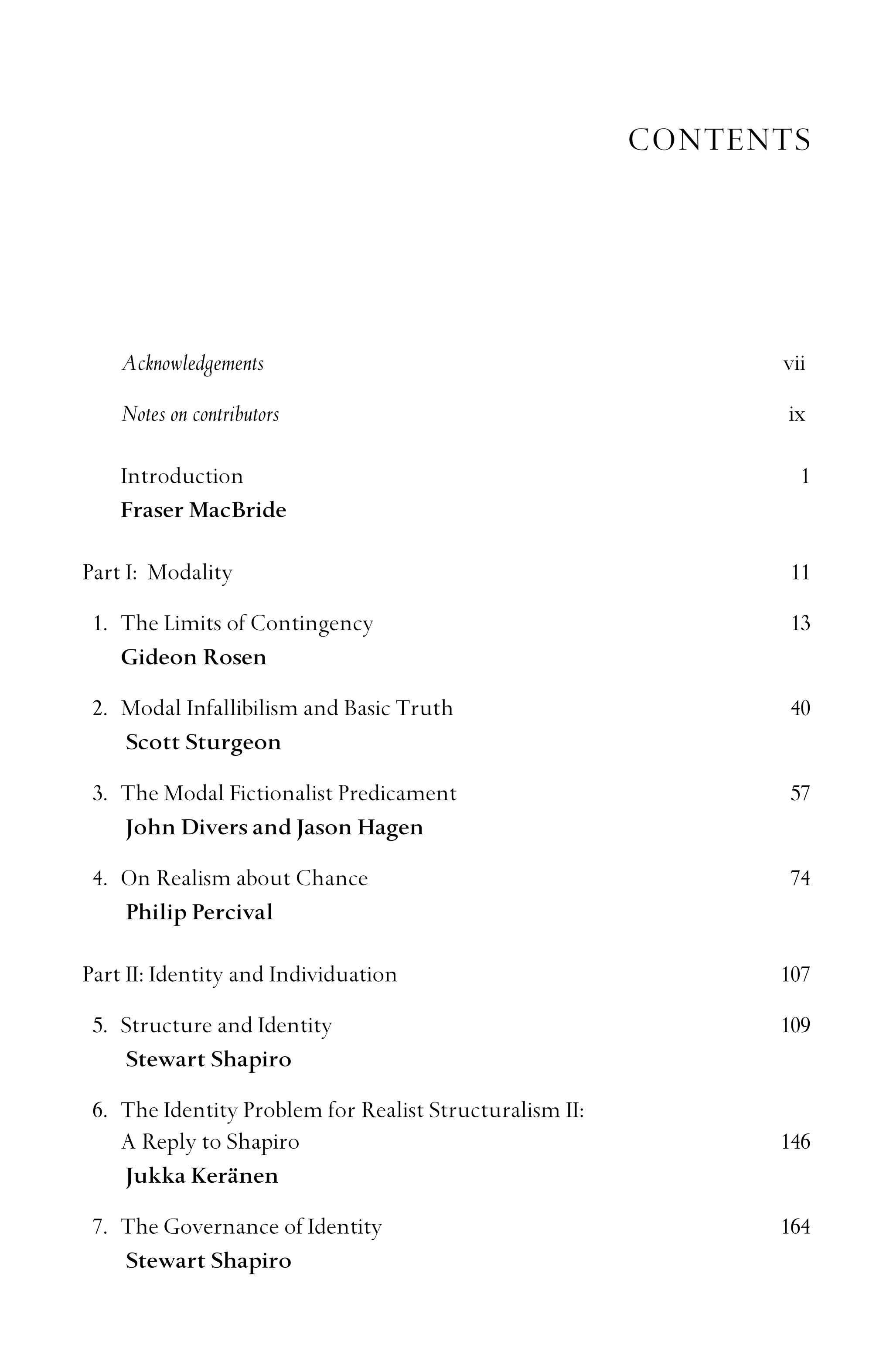
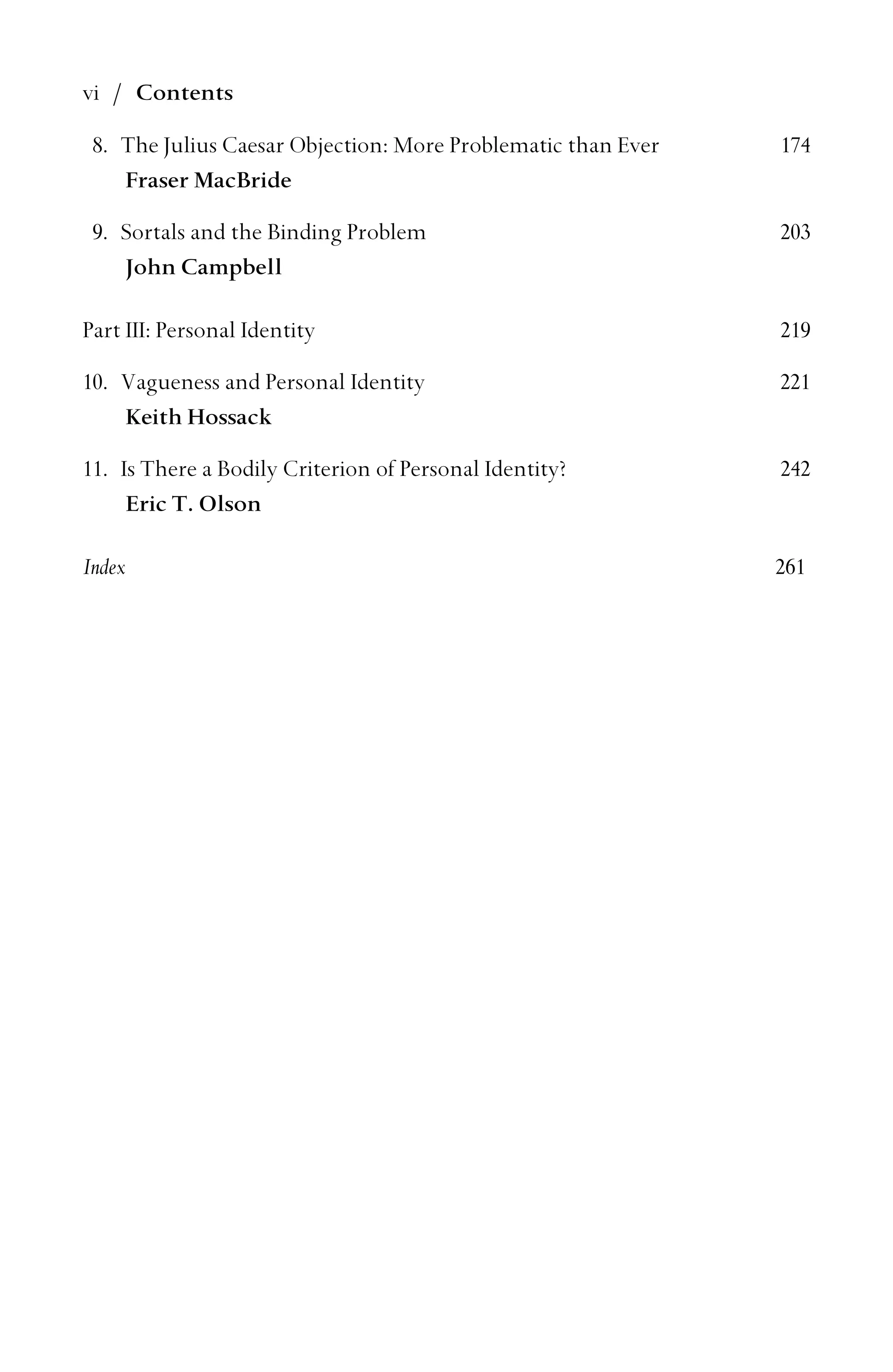



![Gideon Rosen / 23
In particular, it is because they did not know what it is to be water. They did
not know that to be water just is to be a certain compound of hydrogen
and oxygen—that to be a sample of water just is to be a quantity of matter
predominantly composed of molecules of H2O. This is not to say that they
did not understand their word for water. But it’s one thing to understand a
word, another to know the nature of its referent. The ancients could see no
contradiction in the supposition that water is an element because they did not
know thatwaterisacompoundby itsvery nature. Butweknow this; andgiven
that we do, we can see that to suppose a world in which water is an element is
to suppose a world in which a substance that is by nature a compound is not a
compound. And that’s absurd.’
‘In one sense of the phrase, P is conceivable for X if and only if that X can see
no absurdity or incoherence in the supposition of a world in which P is true.
Correct conceivability begins life as an idealization of this notion of relative
conceivability. To a first approximation, P is correctly conceivable iff it would
be conceivable for a logically omniscient being who was fully informed about
the natures of the things. The mind boggles at this sort of counterfactual,
to be sure. But once we see what it amounts to, we can see that it is merely
heuristic. If it’s true that an ideally informed conceiver would see no absurdity
in the supposition of a P-world, this is because there is no such absurdity
to be seen. The ideally informed conceiver is simply an infallible detector of
latent absurdity. And once we see this we can drop the reference to the ideal
conceiver altogether.’
‘As we understand the notion, metaphysical possibility is, as it were, the
default status for propositions. When the question arises, ‘‘Is P metaphysically
possible?’’thefirstquestionweaskis‘‘Whyshouldn’titbepossible?’’According
tous, P ismetaphysically possibleunlessthereissomereasonwhy itshouldnot
be—unless there is, as we say, some sort of obstacle to its possibility. Moreover,
the only such obstacle we recognize is latent absurdity or contradiction.9
If the
9
What is an ‘absurdity’ in the relevant sense? For present purposes, it will suffice to take an
absurdity to be a formal contradiction: a proposition of the form P not-P, or a = a. [This assumes
that propositions, as distinct from the sentences that express them, may be said to have a ‘form’.]
A complication arises from the fact that not everyone agrees that contradictions are absurd in the
relevant sense. Dialethists maintain that some contradictions are not manifestly absurd. Nearly
everyone else disagrees. This proponent of the Non-Standard Conception may remain neutral on
this point. His fundamental contention is that a proposition is metaphysically impossible when
it entails a manifest absurdity or impossibility. For the purposes of exposition, I assume that this](https://image.slidesharecdn.com/859991-250604220315-274a9eae/75/Identity-And-Modality-Mind-Association-Occasional-Series-Fraser-Macbride-38-2048.jpg)