Presented by:
 El Kid Clooney A. Lara
 Millian Rey Villahermoso
 Clarence Jude Gregorio
Sumerian also known as (''native tongue'') is the
language of ancient Sumer. It is one of the oldest
attested languages, dating back to at least 2900 BC. It is
accepted to be a local language isolate and to have been
spoken in ancient Mesopotamia, in the area that is
modern-day Iraq.
The Hindu tradition of linguistics had its
origins in the first millennium BC, and was
stimulated by changes in Sanskrit (Indo-
European, India), the sacred language of
religious texts.
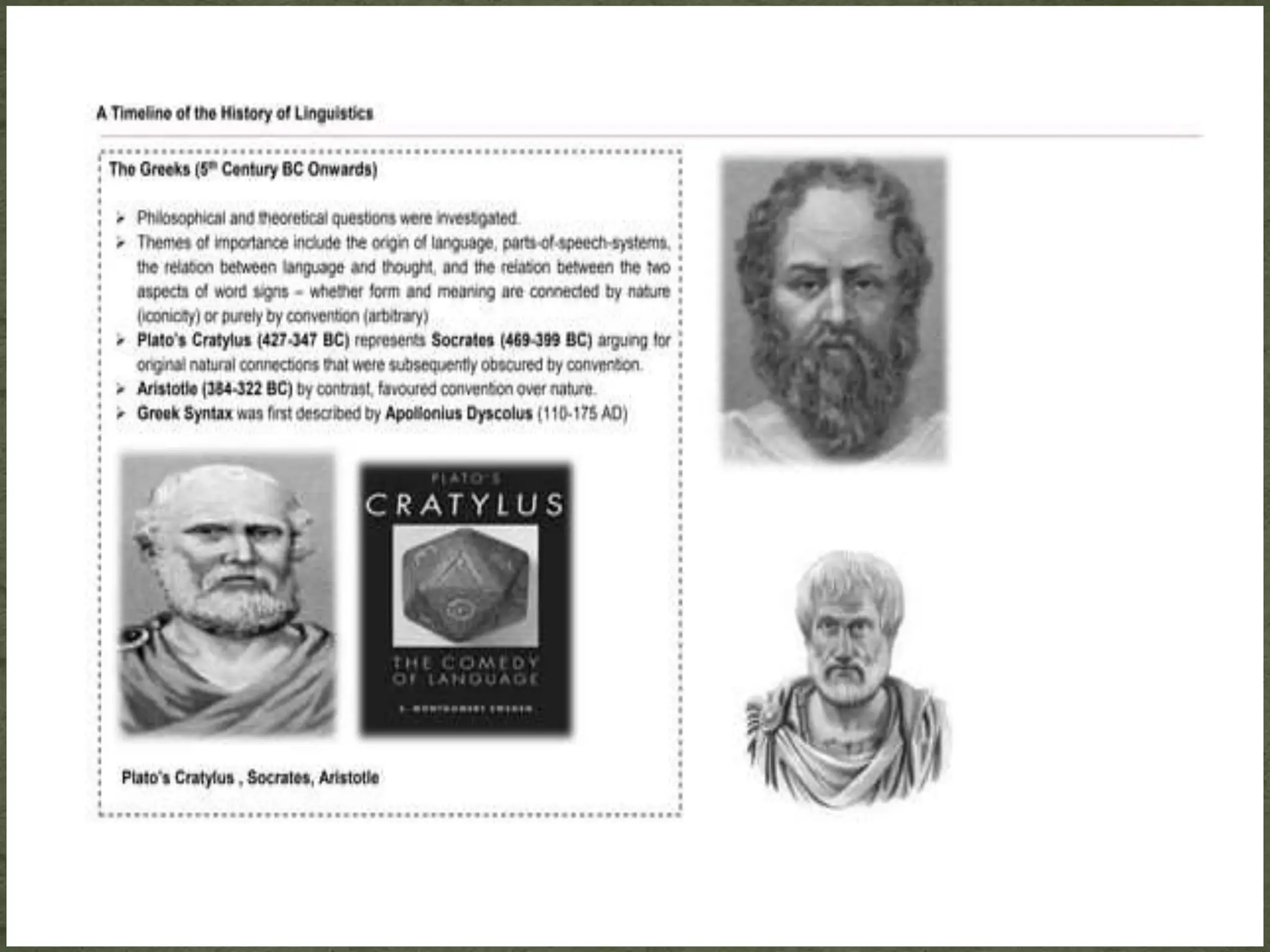
Cratylus is the name of a dialogue by Plato.
Most modern scholars agree that it was written
mostly during Plato's so-called middle period.
Socrates was a Greek philosopher from Athens
who is credited as the founder of Western
philosophy and among the first moral philosophers
of the ethical tradition of thought.
Aristotle was an Ancient Greek philosopher and
polymath. His writings cover a broad range of
subjects spanning the natural sciences, philosophy,
linguistics, economics, politics, psychology and the
arts.
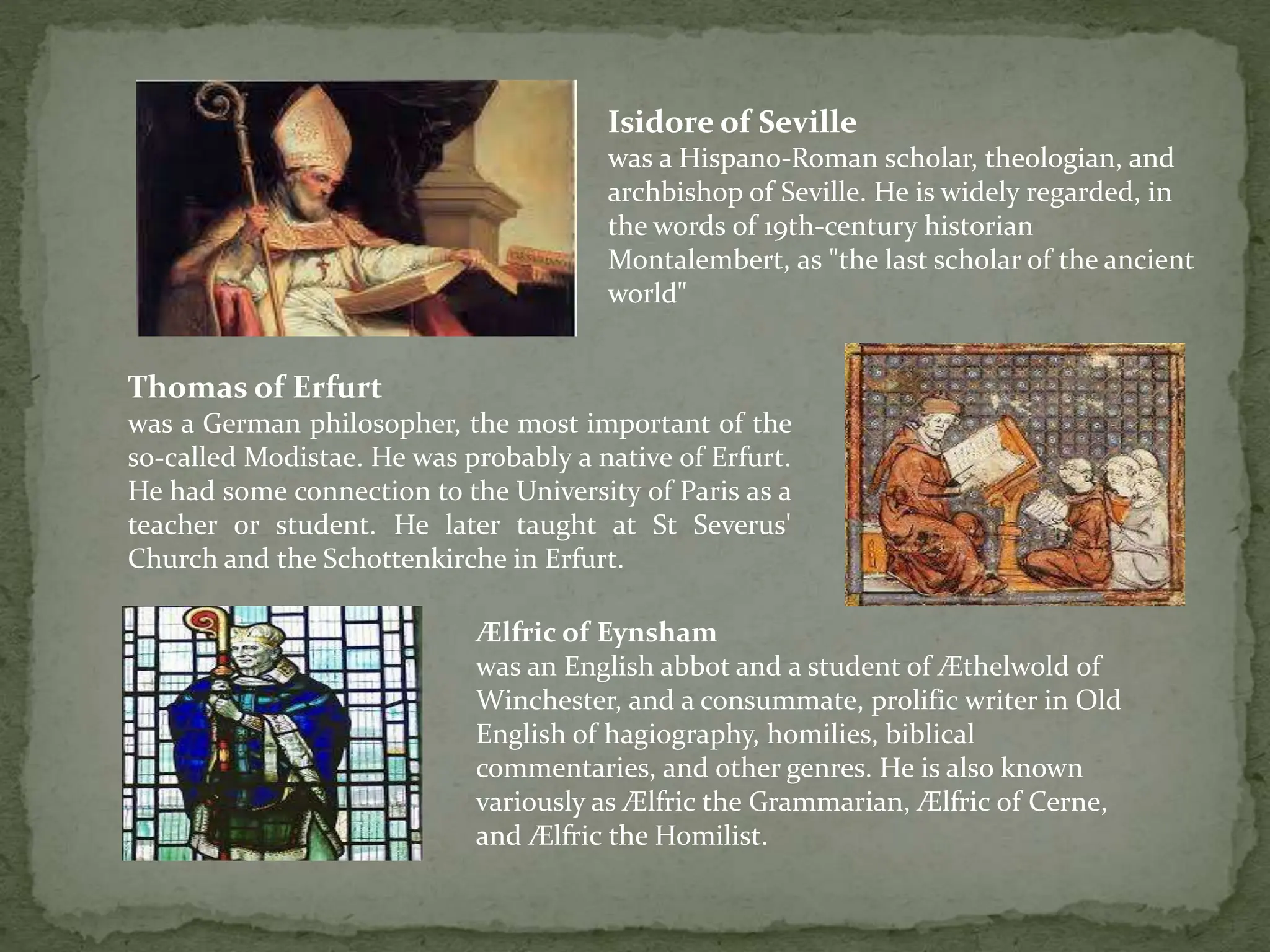
Isidore of Seville
was a Hispano-Roman scholar, theologian, and
archbishop of Seville. He is widely regarded, in
the words of 19th-century historian
Montalembert, as "the last scholar of the ancient
world"
Thomas of Erfurt
was a German philosopher, the most important of the
so-called Modistae. He was probably a native of Erfurt.
He had some connection to the University of Paris as a
teacher or student. He later taught at St Severus'
Church and the Schottenkirche in Erfurt.
Ælfric of Eynsham
was an English abbot and a student of Æthelwold of
Winchester, and a consummate, prolific writer in Old
English of hagiography, homilies, biblical
commentaries, and other genres. He is also known
variously as Ælfric the Grammarian, Ælfric of Cerne,
and Ælfric the Homilist.
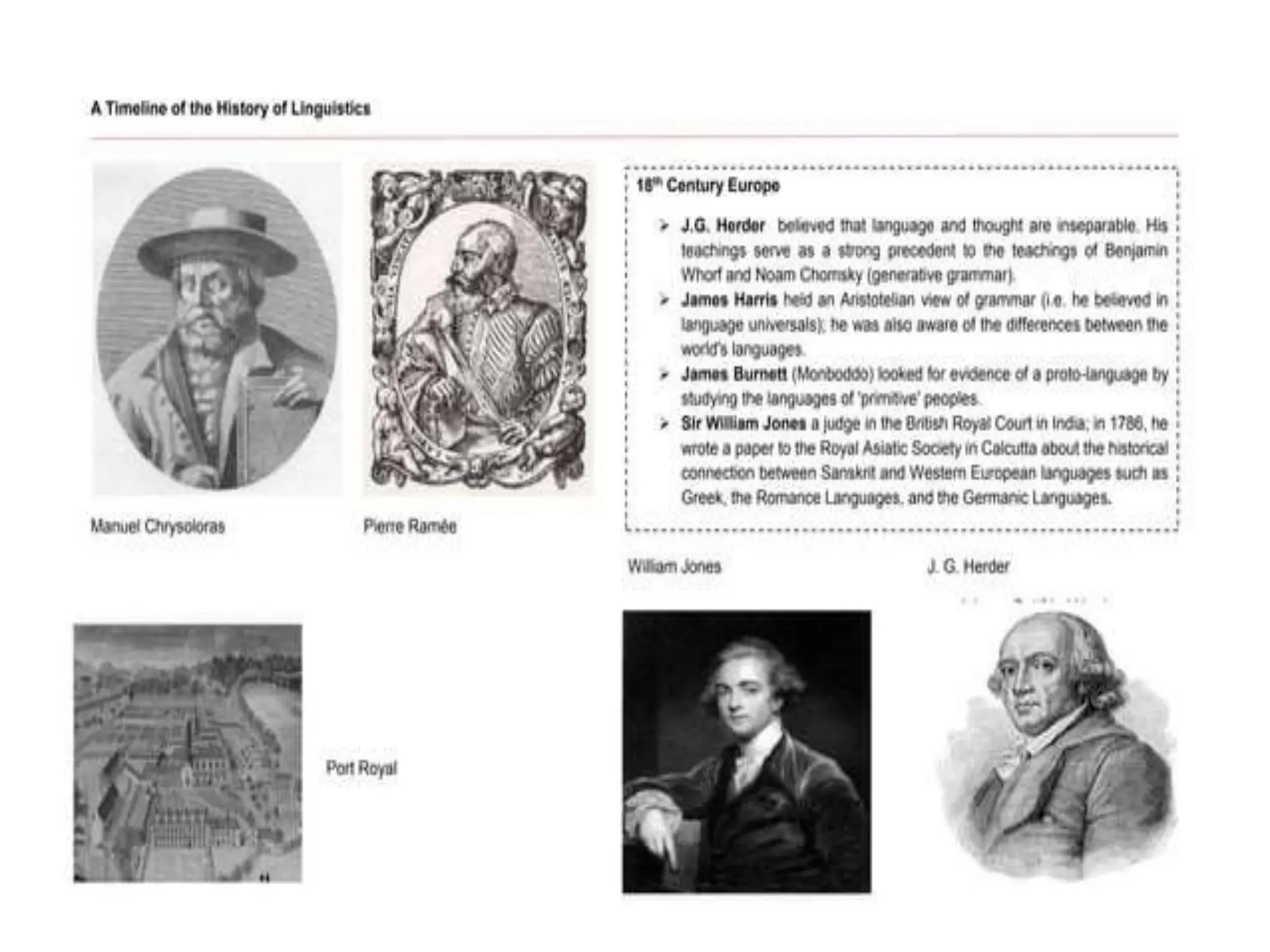
Manuel Chrysoloras
Produced the first grammar
book of the Greek Western
Europe.
Pierre de la Ramee
Grammarian whose though precludes modern
concepts of European and American Structuralism.
He made pokes at Aristotelian (from which
Formalism would sprout) approaches to language,
and argued that all language should be appreciated
in their own right.
Port Royal Grammarians
Took a Rationalist approach to language.
They believed in language universals as
Evidenced by a common though structures
in people throughout the civilized world.
William Jones
A judge in the British Royal Court in
India , in 1786, he wrote a paper to
the Royal Asiatic Society in Calcutta
about the historical connection
between Sanskrit and Western
European languages such as Greek,
the Romance Languages and the
Germanic Languages
Johann Gottfried Herder
He believed that language and thought
are inseparable. His teachings serve
as a strong precedent to the teachings
of Benjamin Whorf and Noam Chomsky
(generative grammar).
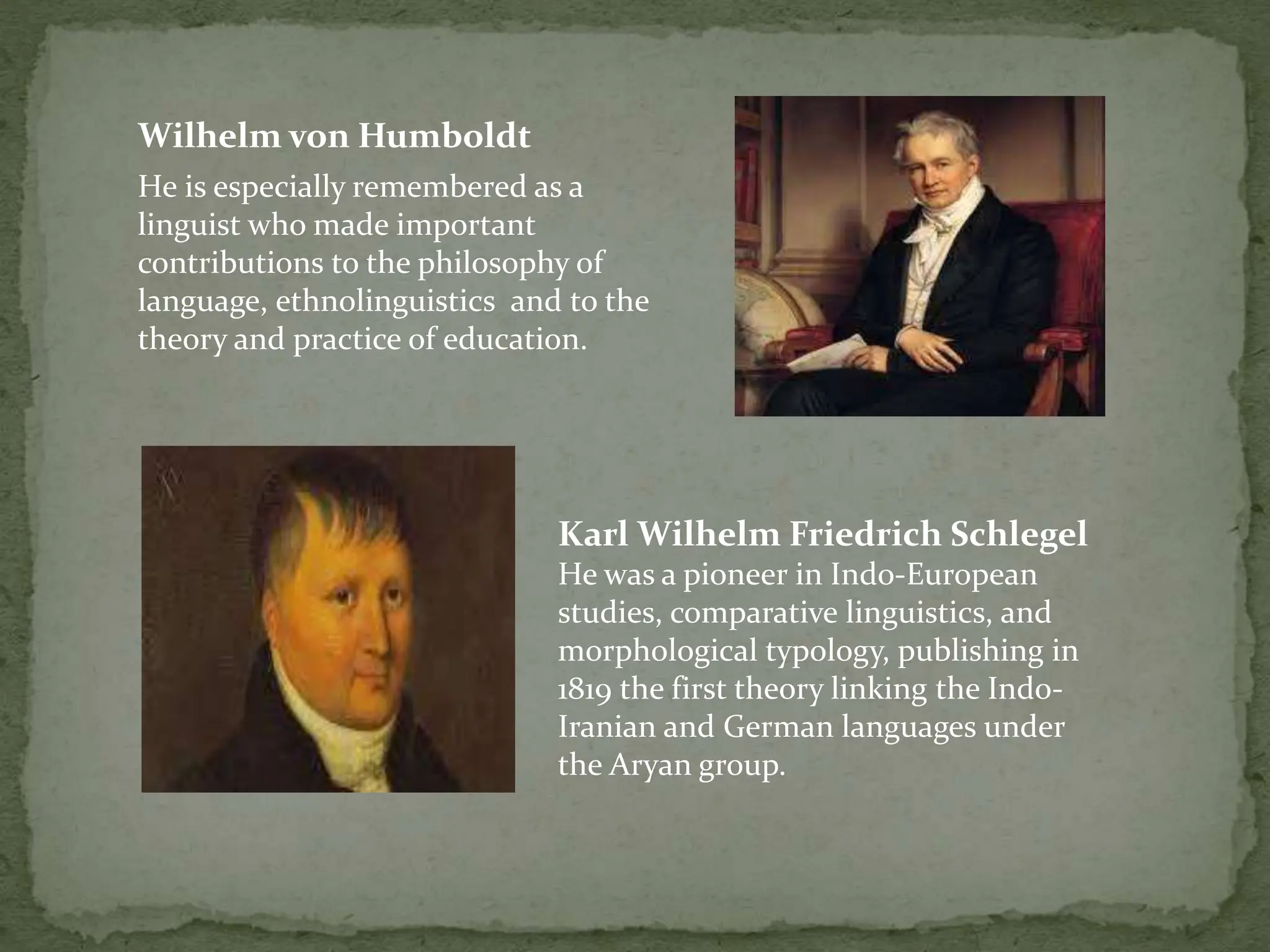
Wilhelm von Humboldt
He is especially remembered as a
linguist who made important
contributions to the philosophy of
language, ethnolinguistics and to the
theory and practice of education.
Karl Wilhelm Friedrich Schlegel
He was a pioneer in Indo-European
studies, comparative linguistics, and
morphological typology, publishing in
1819 the first theory linking the Indo-
Iranian and German languages under
the Aryan group.
Jacob Ludwig Karl Grimm
also known as Ludwig Karl, was a German
author, linguist, philologist, jurist, and
folklorist. He formulated Grimm's law of
linguistics, and was the co-author of the
Deutsches Wörterbuch, the author of
Deutsche Mythologie, and the editor of
Grimms' Fairy Tales.
Franz Bopp
was a German linguist known
for extensive and pioneering
comparative work on Indo-
European languages.
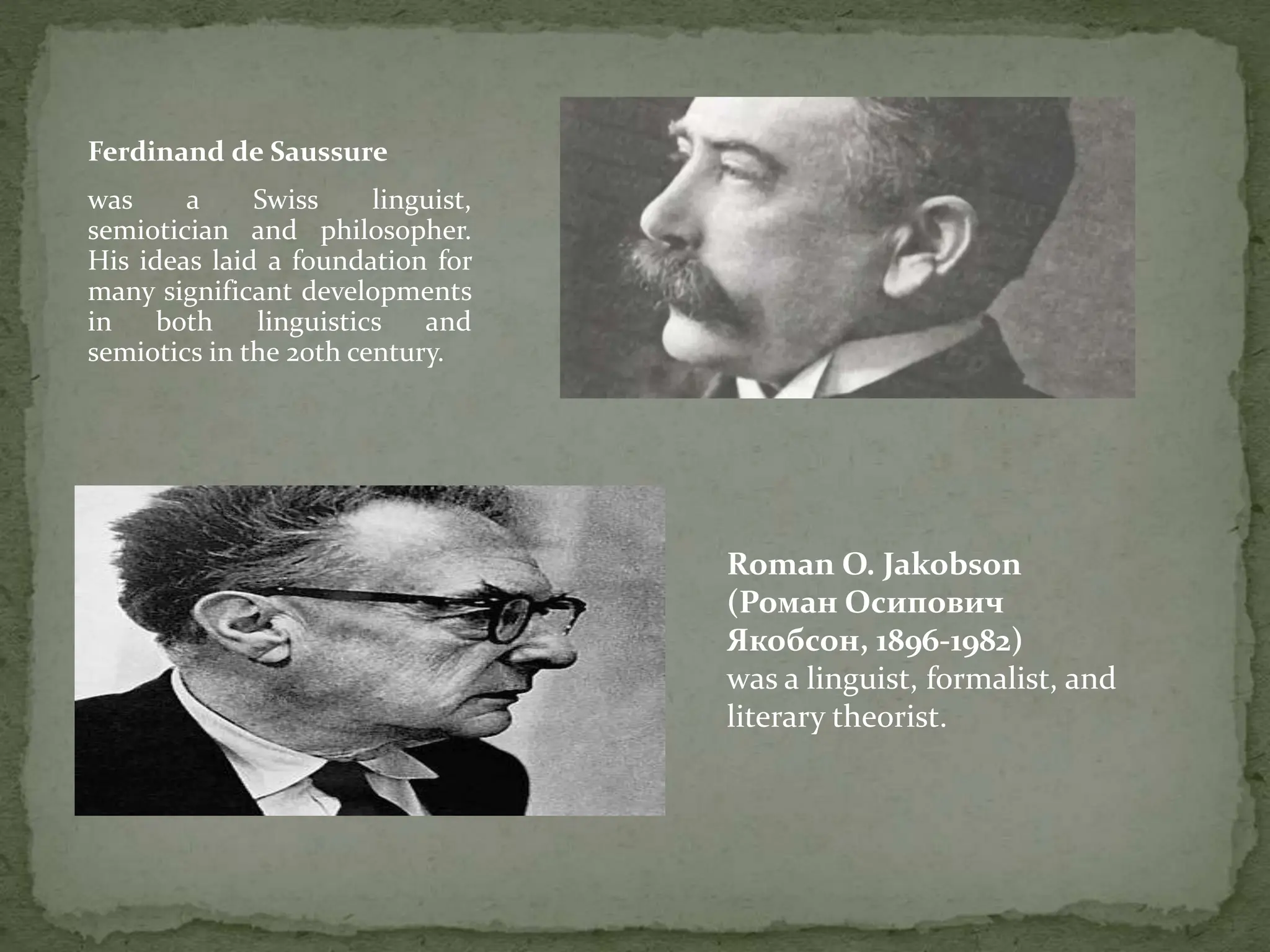
Ferdinand de Saussure
was a Swiss linguist,
semiotician and philosopher.
His ideas laid a foundation for
many significant developments
in both linguistics and
semiotics in the 20th century.
Roman O. Jakobson
(Роман Осипович
Якобсон, 1896-1982)
was a linguist, formalist, and
literary theorist.
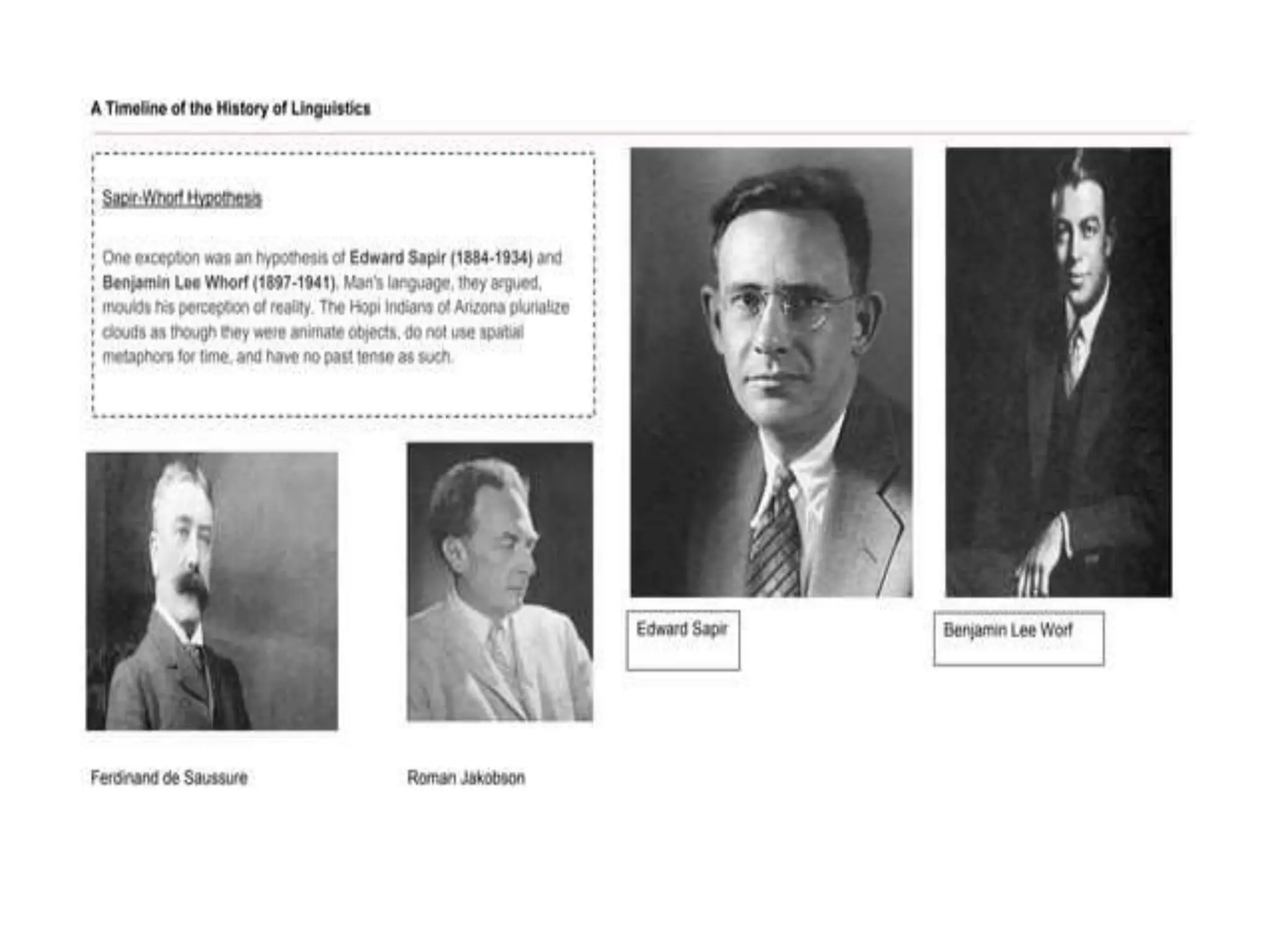
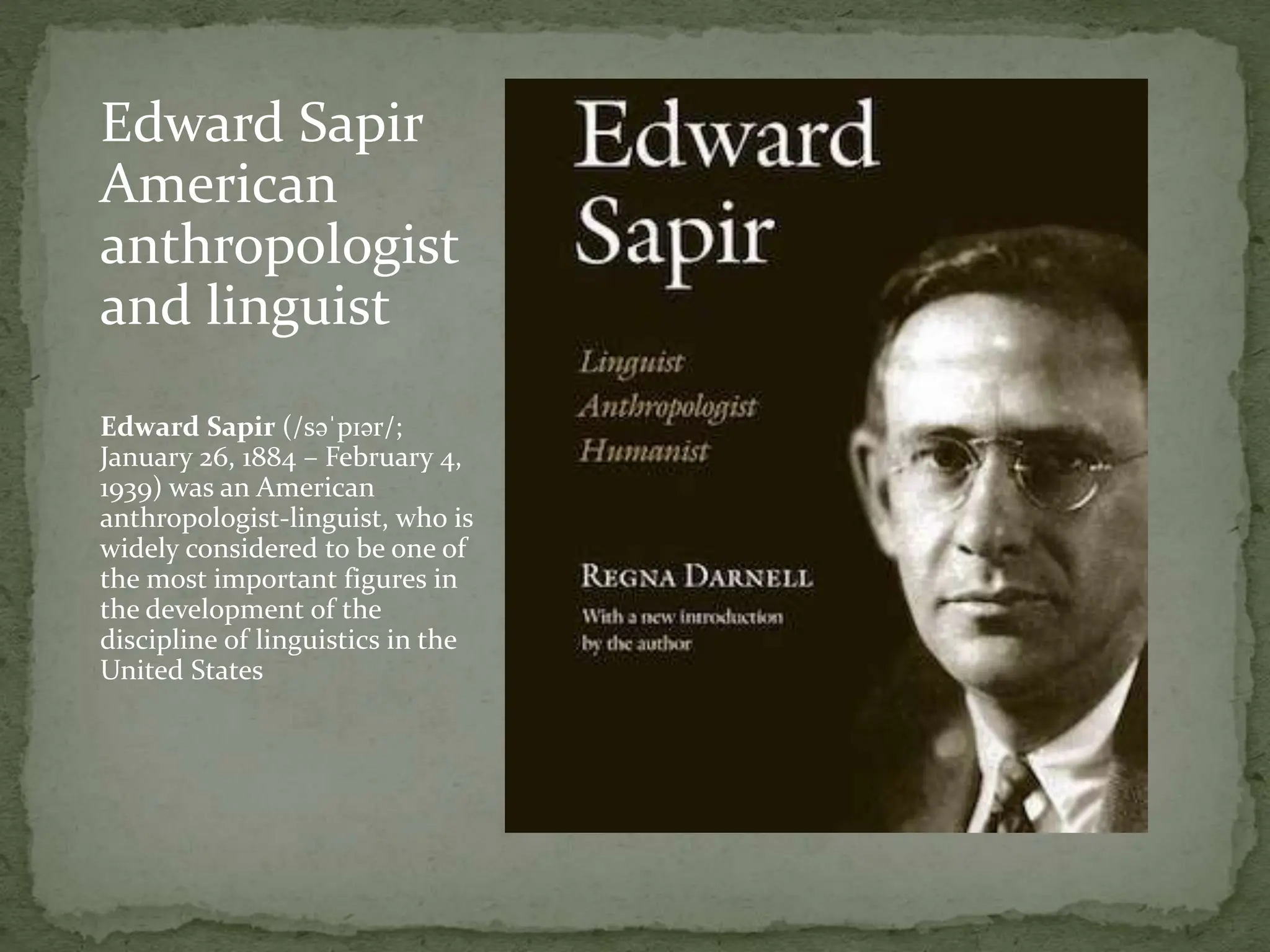
Edward Sapir
American
anthropologist
and linguist
Edward Sapir (/səˈpɪər/;
January 26, 1884 – February 4,
1939) was an American
anthropologist-linguist, who is
widely considered to be one of
the most important figures in
the development of the
discipline of linguistics in the
United States
Benjamin Lee Whorf (/hwɔːrf/;
April 24, 1897 – July 26, 1941) was
an American linguist and fire
prevention engineer who is
famous for proposing the
"Sapir–Whorf hypothesis." He
believed that the structures of
different languages shape how
their speakers perceive and
conceptualize the world.
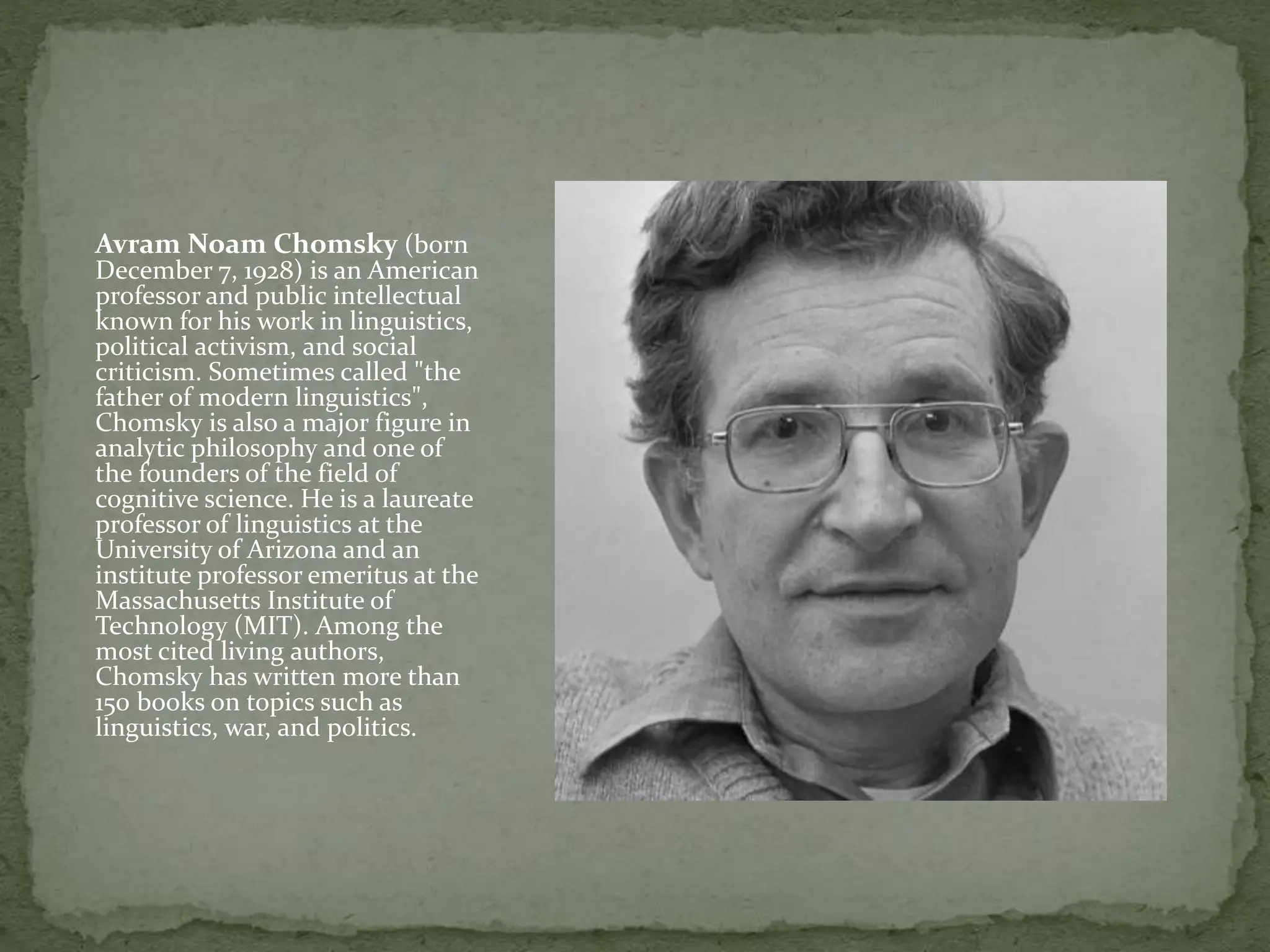
Avram Noam Chomsky (born
December 7, 1928) is an American
professor and public intellectual
known for his work in linguistics,
political activism, and social
criticism. Sometimes called "the
father of modern linguistics",
Chomsky is also a major figure in
analytic philosophy and one of
the founders of the field of
cognitive science. He is a laureate
professor of linguistics at the
University of Arizona and an
institute professor emeritus at the
Massachusetts Institute of
Technology (MIT). Among the
most cited living authors,
Chomsky has written more than
150 books on topics such as
linguistics, war, and politics.
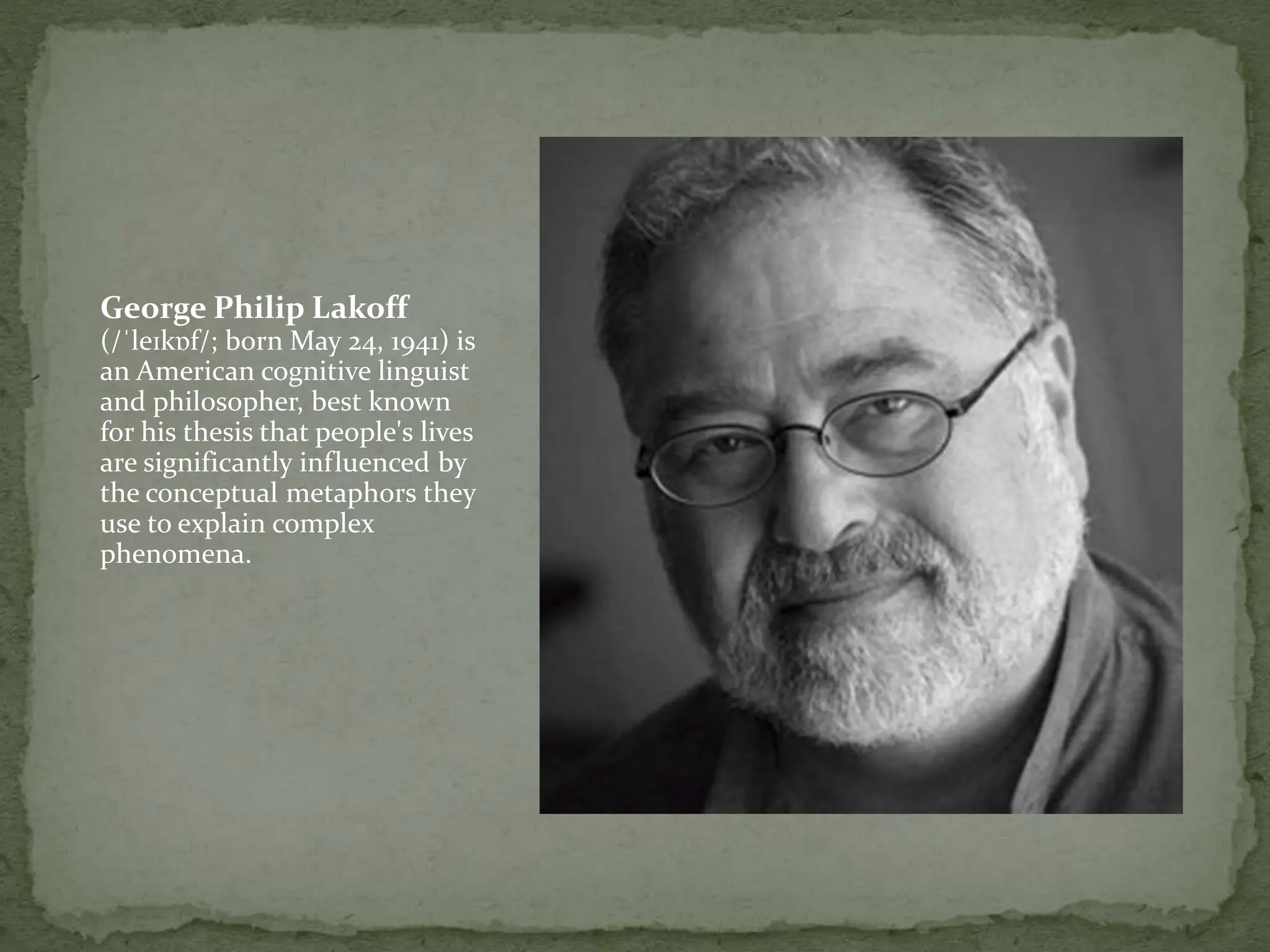
George Philip Lakoff
(/ˈleɪkɒf/; born May 24, 1941) is
an American cognitive linguist
and philosopher, best known
for his thesis that people's lives
are significantly influenced by
the conceptual metaphors they
use to explain complex
phenomena.
The Noteworthy-Linguists.pptx

The Noteworthy-Linguists.pptx

  • 1.
    Presented by:  ElKid Clooney A. Lara  Millian Rey Villahermoso  Clarence Jude Gregorio
  • 3.
    Sumerian also knownas (''native tongue'') is the language of ancient Sumer. It is one of the oldest attested languages, dating back to at least 2900 BC. It is accepted to be a local language isolate and to have been spoken in ancient Mesopotamia, in the area that is modern-day Iraq. The Hindu tradition of linguistics had its origins in the first millennium BC, and was stimulated by changes in Sanskrit (Indo- European, India), the sacred language of religious texts.
  • 5.
    Cratylus is thename of a dialogue by Plato. Most modern scholars agree that it was written mostly during Plato's so-called middle period. Socrates was a Greek philosopher from Athens who is credited as the founder of Western philosophy and among the first moral philosophers of the ethical tradition of thought. Aristotle was an Ancient Greek philosopher and polymath. His writings cover a broad range of subjects spanning the natural sciences, philosophy, linguistics, economics, politics, psychology and the arts.
  • 8.
    Isidore of Seville wasa Hispano-Roman scholar, theologian, and archbishop of Seville. He is widely regarded, in the words of 19th-century historian Montalembert, as "the last scholar of the ancient world" Thomas of Erfurt was a German philosopher, the most important of the so-called Modistae. He was probably a native of Erfurt. He had some connection to the University of Paris as a teacher or student. He later taught at St Severus' Church and the Schottenkirche in Erfurt. Ælfric of Eynsham was an English abbot and a student of Æthelwold of Winchester, and a consummate, prolific writer in Old English of hagiography, homilies, biblical commentaries, and other genres. He is also known variously as Ælfric the Grammarian, Ælfric of Cerne, and Ælfric the Homilist.
  • 10.
    Manuel Chrysoloras Produced thefirst grammar book of the Greek Western Europe.
  • 11.
    Pierre de laRamee Grammarian whose though precludes modern concepts of European and American Structuralism. He made pokes at Aristotelian (from which Formalism would sprout) approaches to language, and argued that all language should be appreciated in their own right.
  • 12.
    Port Royal Grammarians Tooka Rationalist approach to language. They believed in language universals as Evidenced by a common though structures in people throughout the civilized world.
  • 13.
    William Jones A judgein the British Royal Court in India , in 1786, he wrote a paper to the Royal Asiatic Society in Calcutta about the historical connection between Sanskrit and Western European languages such as Greek, the Romance Languages and the Germanic Languages
  • 14.
    Johann Gottfried Herder Hebelieved that language and thought are inseparable. His teachings serve as a strong precedent to the teachings of Benjamin Whorf and Noam Chomsky (generative grammar).
  • 16.
    Wilhelm von Humboldt Heis especially remembered as a linguist who made important contributions to the philosophy of language, ethnolinguistics and to the theory and practice of education. Karl Wilhelm Friedrich Schlegel He was a pioneer in Indo-European studies, comparative linguistics, and morphological typology, publishing in 1819 the first theory linking the Indo- Iranian and German languages under the Aryan group.
  • 17.
    Jacob Ludwig KarlGrimm also known as Ludwig Karl, was a German author, linguist, philologist, jurist, and folklorist. He formulated Grimm's law of linguistics, and was the co-author of the Deutsches Wörterbuch, the author of Deutsche Mythologie, and the editor of Grimms' Fairy Tales. Franz Bopp was a German linguist known for extensive and pioneering comparative work on Indo- European languages.
  • 20.
    Ferdinand de Saussure wasa Swiss linguist, semiotician and philosopher. His ideas laid a foundation for many significant developments in both linguistics and semiotics in the 20th century. Roman O. Jakobson (Роман Осипович Якобсон, 1896-1982) was a linguist, formalist, and literary theorist.
  • 21.
    Edward Sapir American anthropologist and linguist EdwardSapir (/səˈpɪər/; January 26, 1884 – February 4, 1939) was an American anthropologist-linguist, who is widely considered to be one of the most important figures in the development of the discipline of linguistics in the United States
  • 22.
    Benjamin Lee Whorf(/hwɔːrf/; April 24, 1897 – July 26, 1941) was an American linguist and fire prevention engineer who is famous for proposing the "Sapir–Whorf hypothesis." He believed that the structures of different languages shape how their speakers perceive and conceptualize the world.
  • 24.
    Avram Noam Chomsky(born December 7, 1928) is an American professor and public intellectual known for his work in linguistics, political activism, and social criticism. Sometimes called "the father of modern linguistics", Chomsky is also a major figure in analytic philosophy and one of the founders of the field of cognitive science. He is a laureate professor of linguistics at the University of Arizona and an institute professor emeritus at the Massachusetts Institute of Technology (MIT). Among the most cited living authors, Chomsky has written more than 150 books on topics such as linguistics, war, and politics.
  • 25.
    George Philip Lakoff (/ˈleɪkɒf/;born May 24, 1941) is an American cognitive linguist and philosopher, best known for his thesis that people's lives are significantly influenced by the conceptual metaphors they use to explain complex phenomena.