The NINE systems in systems
engineering
Joseph Kasser
Temasek Defence Systems Institute (NUS)
Yang Yang Zhao
Norwegian Institute of System Engineering
Revision 1.0
July
Topics
• The undesirable situation
• Previous attempts to manage complexity
• The Nine-System Model
• Examples of the Nine-System Model
• Benefits of the nine systems approach
• Questions and discussion
2
July
State of the art?
• Systems engineering has been defined as
– “the science of designing complex systems in
their totality to ensure that the component
subsystems making up the system are
designed, fitted together, checked and operated
in the most efficient way” (Jenkins, 1969).
• However, in the ensuring 45 years, systems
engineers seem to have been busy creating
more and more complex models and
processes.
3
July
Building artificial complexity
4
July
IS 2009 submission
(not in proceedings)
5
July
Holistic systems approach to
managing problems and solutions
6
Undesirable
situation (t0)
Feasible
Conceptual Future
Desirable Situation
(FCFDS) (t0)
Problem
Remedial
action
(problem
solving)
Solution
Actual situation
(t1)
Still
undesirable?
No
Yes or partial
End
Undesirable
situation (t2)
July
Managing complexity
• The undesirable situation
– The failure of systems engineering to manage the complexity of
the systems development environment
• The FCFDS
– Systems engineering managing the complexity of the systems
development environment
• The solution
1. A theory of how to manage complexity
2. A set of tools for managing complexity based on the theory
• The problem
– How to develop
1. a theory for managing complexity and
2. the tools for managing complexity based on the theory
7
July
Definition: System (SOI)
• A system is an abstraction from the real world of
a set of objects, each at some level of
decomposition, at some period of time, in an
arbitrary boundary, crafted for a purpose”
(Kasser, 2013a) pages 251 to 252).
– Product
– Process
– Organization
– Situation
8
July
Topics
• The undesirable situation
• Previous attempts to manage complexity
– In the INCOSE Symposia proceedings
• The Nine-System Model
• Examples of the Nine-System Model
• Benefits of the nine systems approach
• Questions and discussion
9
July
2004: Martin’s 7 samurai*
10
* Martin 7 samurai, INCOSE 2004
July
2005 Whole System Model
• Operational system
– The system which goes into service
• Support system
– The system which supports the Operational
system in service
• Production system
– The system which manufactures the relevant
parts of the Operational and support systems
• Development system
– The system, which develops the Operational,
Support and Production systems
• Containing system
– The related systems and the environment in
which the above systems interact
11
July
2006: Systems project
• Four systems
– The Existing system
– The Required system
– The Producing system
– The Maintenance and Support system
12
July
Comparing the models:1
Systems addressed by the models 7 Samurai WSM SP
Existing “as-is” situation Context (S1) - -
Existing system in “as-is” situation - - E-system
Process to develop conceptual
solution system
- - -
Conceptual solution system at time
development begins (FCFDS)
Intervention (S2) - R-System
Process to plan transition from
existing situation to situation in
which the solution system will be
deployed
Realization (S3) Production P-System
Process to realize solution system Realization (S3) Production P-System
Solution system at and after time of
deployment
Deployed (S4) Operational R-System
[new] situation after solution system
has been deployed
- - -
13
July
Comparing the models:2
Systems addressed by the models 7 Samurai WSM SP
Adjacent systems operating in
association with the solution system
at and after time of deployment
Collaborating
(S5)
- -
System or systems that keeps the
solution system operational at and
after deployment
Sustainment
(S6)
Support M-System
Process to determine situation after
deployment of solution system
contains no undesirable elements
Implied
Realization (S3)
Implied
Production
Implied
P-System
Resources to be applied to realize the
solution system
Realization (S3) Development P-System
Alternative solution systems Competing (S7) - -
Enterprise and environment Realization (S3) Containing -
14
July
Conclusions
• Each model is a different set of systems.
• Each model is incomplete since other models contain
systems that the model does not.
• Systems present in one model are not present in another
model.
• Each model invokes the temporal perspective (considers
the time to realize the solution system) but in different
ways.
• The situation after the solution system has been
deployed is not considered in any of the three models
– Martin does refer to it as a modified context system (S1’).
15
July
Topics
• The undesirable situation
• Previous attempts to manage complexity
• The Nine-System Model
• Examples of the Nine-System Model
• Benefits of the nine systems approach
• Questions and discussion
16
July
The Nine-System model
• Makes complexity manageable
– Principles of hierarchies
– Does not reduce complexity
• Fractal or self similar
• Multiple views of each system from 8 standard
perspectives
– Holistic Thinking Perspectives
• Provides a framework to fill in the gaps in the other
models
• Based on a set of rules stated in the paper
• Explained from three perspectives
17
July
Holistic systems approach to
managing problems and solutions
Undesirable
situation (t0)
Feasible
Conceptual Future
Desirable Situation
(FCFDS) (t0)
Problem
Remedial
action
(problem
solving)
Solution
Actual situation
(t1)
Still
undesirable?
No
Yes or partial
End
Undesirable
situation (t2)
18
July
Holistic systems approach to
managing problems and solutions
Undesirable
situation (t0)
Feasible
Conceptual Future
Desirable Situation
(FCFDS) (t0)
Problem
Remedial
action
(problem
solving)
Solution
Actual situation
(t1)
Still
undesirable?
No
Yes or partial
End
Undesirable
situation (t2)
What happens here?
What happens in here?
19
July
Holistic systems approach to
managing problems and solutions
Undesirable
situation (t0)
Feasible
Conceptual Future
Desirable Situation
(FCFDS) (t0)
Problem
Remedial
action
(problem
solving)
Solution
Actual situation
(t1)
Still
undesirable?
No
Yes or partial
End
Undesirable
situation (t2)
S1
S2
S3
S4 S5 S6
S7
S8
S1’
Nine-
System
Model
20
July
The Nine-System model
22
1. The solution systems and
the adjacent systems are
subsystems in the actual
situation
2. Considered as one [class
of] system but generally
is at least two
organizations
(S1) Undesirable
situation (S3) Feasible Conceptual
Future Desirable Situation
(FCFDS)
(S7) Actual
(created)
situation1
(S8) Process to determine
degree of remedy
(S6)
Solution
system
(S5) Process performing
transition to S7
(S2) Process
developing S3
Operating in
context of
(S4) Process planning
transition to S7
S8S5S2
Organization(s) (S9)2
S4 S6
Functional HTP
Structural HTP
Realizes
July
The Nine-System model
Undesirable Situation S1
Concept dev. process S2
FCFDS S3
Planning process S4
Realization process S5
Solution system S6
Created situation S7
Validation process S8
Undesirable Situation’ S1’
t0 t1 t2
Time
Temporal HTP
SRR
23
July
Holistic thinking perspectives
1. Big picture
– Purpose, adjacent systems
2. Operational
– Missions which the system performs
3. Functional
– Functions performed by the system (used in missions)
4. Structural
– Technology, hardware, resources comprising the system
5. Generic
– Pertinent information from similar systems
6. Continuum
– Pertinent differences between system and similar systems
7. Quantitative
– Numerical information, pertaining to other perspectives
8. Temporal
– Past present and future aspects of the system
9. Scientific
– Conclusions, inferences about the problems
24
Issue or
situation
1
2
9
5
4
3
8
6
7
July
S1. Undesirable situation
• Perceived from holistic thinking perspectives
• As-is
• Baselined at t0
– Eight descriptive perspectives
• Observations
• Assumptions
– Scientific perspective
• Causes of undesirability
– May be more than one
• Statement of problem
– A hypothesis of the cause of the undesirable situation
25
July
S2. Process: early stage
• Develops Feasible Conceptual Future
Desirable Situation (FCFDS)
• Develops CONOPS of solution system
operating within FCFDS
• Uses Steps 2-6 in Hitchins’ systems
engineering approach to problem solving
– Hitchins, 2007
26
July
S3. FCFDS
• Begin with the end in mind
– 7 Habits of …, Covey, 1989
• Assumption
– FCFDS will remedy the undesirable situation
• Sometimes consensus on FCFDS may be
achieved without consensus on the
underlying cause of the undesirable
situation
• Described from eight descriptive HTPs
27
July
S4. Process: planning the transition
• Planning/creating the process that will provide the
solution system
– Assembled from activities documented in textbooks, Standards,
experience, etc.
– Following a Standard (cf. use of COTS)
– Build/buy decisions
– Creates SEMP and TEMP
• Step 7 in Hitchins systems engineering process
• Creating the matched set of specifications for the
solution system
• Generally terminates with a SRR
28
July
S5. Process: providing the
transition
• Commonly known as the
– ‘system development process (SDP)’
– ‘system development lifecycle (SDLC)’
– “systems engineering process (SEP)”
• Three streams of work
1. Management
2. Development/production
3. Development Test and Evaluation (DT&E)
• May require several iterations
– Temporal perspective
• Must be able to cope with changes in need before
process terminates
29
July
S6. Solution system
• Conceived as part of FCFDS
• Realized in providing actual situation
• May comprise more than one system
• Contains mission and support functions
• Conforms to 7 principles paper
– Kasser and Hitchins, 2011
• May be provided in stages or Builds
• Contains a mixture of technology and people
30
July
S6: HTPs
• Operational perspective
– Interactions with adjacent systems
– What the system does (Scenarios)
• Functional perspective
– Internal Mission and support functions
• Structural perspective
– Technology and physical components
• Quantitative perspective
– Numbers associated with functions and other aspects
• costs, reliability, etc.
31
July
S7. Actual (created) situation
• Realization of the FCFDS
– Situation at time solution system is realized
• Contains solution system and adjacent systems
operating interdependently
• May only partially remedy original undesirable
situation
• May not remedy new undesirable aspects that
show up during time taken by realization process
• May contain unanticipated undesirable emergent
properties from solution system and its interactions
with adjacent systems in the situation
• May be realized in partial remedies
32
July
S8. Process closing stage
• Determines if the solution system,
operating in its context, remedies the new
evolved undesirable situation at t1.
• Operational Test and Evaluation (OT&E)
• Acceptance test at end of first iteration
• Evolves into change management process
– Triggers new iteration via change process to
modify/upgrade solution system
– May lead to disposal phase
33
July
S9. System containing processes
• Organizations
– Generally at least two organizations
• Customer and contractor
– Grouped as one system because of common
features
• Each organization is an instance of a class of
systems
• Provides personnel and other resources to
process systems
34
July
Topics
• The undesirable situation
• Previous attempts to manage complexity
• The Nine-System Model
• Examples of the Nine-System Model
• Benefits of the nine systems approach
• Questions and discussion
35
July
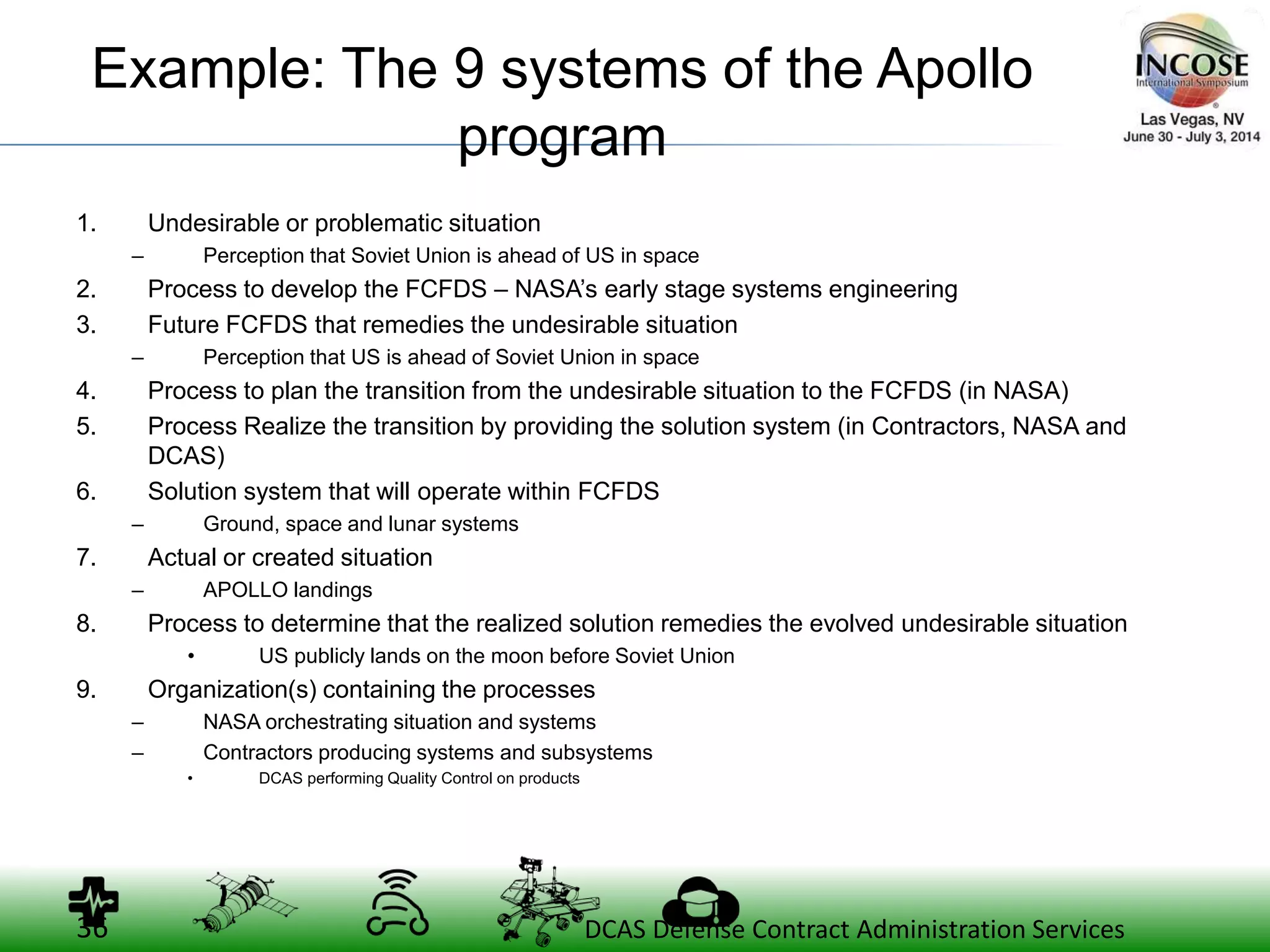
Example: The 9 systems of the Apollo
program
1. Undesirable or problematic situation
– Perception that Soviet Union is ahead of US in space
2. Process to develop the FCFDS – NASA’s early stage systems engineering
3. Future FCFDS that remedies the undesirable situation
– Perception that US is ahead of Soviet Union in space
4. Process to plan the transition from the undesirable situation to the FCFDS (in NASA)
5. Process Realize the transition by providing the solution system (in Contractors, NASA and
DCAS)
6. Solution system that will operate within FCFDS
– Ground, space and lunar systems
7. Actual or created situation
– APOLLO landings
8. Process to determine that the realized solution remedies the evolved undesirable situation
• US publicly lands on the moon before Soviet Union
9. Organization(s) containing the processes
– NASA orchestrating situation and systems
– Contractors producing systems and subsystems
• DCAS performing Quality Control on products
36 DCAS Defense Contract Administration Services
July
Example: The 9 systems in aerial
reconnaissance
1. Undesirable situation
– Need for accurate and timely information about something happening in a remote location
2. Process to develop the FCFDS
3. Future FCFDS that remedies the undesirable situation
– Accurate and timely information is being provided
4. Process to plan the transformation from the undesirable situation to the FCFDS
5. Process to realize the transformation from the undesirable situation to the FCFDS
by providing the solution system (purchase COTS or develop)
6. Solution system
– UAV and associated ground support equipment
7. Actual or created situation
– UAV operational returning accurate and timely information to personnel
8. Process to compare actual or created system with the FCFDS
9. Organization(s) containing the processes
a) Defence force
b) Contractor or vendor
37
July
Applies in each level of hierarchy
38
(S1) Undesirable
situation
(S3) FCFDS
(S7) Actual
(created)
situation(S8) Remedy?
(S6) Solution
system
(S4) (S5)
Processes
(S2) Process
Operating in
context of
RADAR
Aircraft
Airfield
Aircraft
RADAR Weapons
Hangar
AH-1
July
Applies in each level of hierarchy
39
(S1) Undesirable
situation
(S3) FCFDS
(S7) Actual
(created)
situation(S8) Remedy?
(S6) Solution
system
(S4) (S5)
Processes
(S2) Process
Operating in
context of
Aircraft
Airfield
Airfield
Aircraft
RADAR Weapons
Hangar
AH-1
July
Applies in each level of hierarchy
40
(S1) Undesirable
situation
(S3) FCFDS
(S7) Actual
(created)
situation(S8) Remedy?
(S6) Solution
system
(S4) (S5)
Processes
(S2) Process
Operating in
context of
Hangar
Airfield
Airfield
Aircraft
RADAR Weapons
Hangar
AH-1
July
Applies in each level of hierarchy
41
(S1) Undesirable
situation
(S3) FCFDS
(S7) Actual
(created)
situation(S8) Remedy?
(S6) Solution
system
(S4) (S5)
Processes
(S2) Process
Operating in
context of
Airfield
Air Defence
system
Airfield
Aircraft
RADAR Weapons
Hangar
AH-1
Reductionist
view
July
It depends
• Each system has its own 9 systems
• S6 and its adjacent systems are subsystems of S7
• S7 perceived from this view is an S6 to the systems
engineers working on it
• Each systems engineer needs to be concerned with their
subsystems, S6 and S7, and abstract out rest of
complexity
42
(S1) Undesirable
situation (S1) (S3) FCFDS
(S7) Actual
(created)
situation(S8) Remedy?
(S6) Solution
system
(S4) (S5)
Processes
(S2) Process
Operating in
context of
July
Perceptions of complexity
• Joe is systems engineer realizing S6 which is subsystem in S7
• Yang Yang is systems engineer realizing adjacent system S6yy which
is also subsystem in S7
• Eileen is systems engineer realizing (S6e) which is also S7(j/yy)
43
S6j
S6yy
S7
Yang YangJoe
Eileen
July
Perceptions of complexity
• Joe is systems engineer realizing (S6j) which is subsystem in S7j
• Yang Yang is systems engineer realizing adjacent system (S6yy)
which is also subsystem in S7yy. S7j = S7yy.
• Eileen is systems engineer realizing (S6e) which is also S7(j/yy)
44
Undesirable
situation (S1)
FCFDS (S3)
Actual
(created)
situation (S7)
Remedy? (S8)
Solution
system (S6)
Processes
(S4)(S5)
Process (S2)
Operating in
context of
S1(j) and S1 (yy) may
be the same
S9 may be the same if
they are part of the
same organization
Undesirable
situation (S1)
FCFDS (S3)
Actual
(created)
situation (S7)
Remedy? (S8)
Solution
system (S6)
Processes
(S4)(S5)
Process (S2)
Operating in
context of
Undesirable
situation (S1)
FCFDS (S3)
Actual
(created)
situation
(S7)
Remedy? (S8)
Solution
system (S6)
Processe
s (S4)(S5)
Process (S2)
Operating in
context of
July
More perceptions
Federated
Aerospace
Projects
Joe’s project
Yang Yang’s
project
Eileen’s
project
Other
projects
Human
resources
Other
departments
• S1 Lack of competent staff in projects and
other departments
• S2 Corporate management process
• S3 Projects fully staffed with competent
personnel and retaining staff
• S4/5 Hiring and prevention of leaving
processes
• S6 HR personnel management system
• S7 Projects fully staffed with competent
personnel and retaining staff
– Same as S3 in this instance
• S8 Corporate management process
• S9 Federated Aerospace
45
• Federated Aerospace: Structural perspective
• Each Block is part of its own 9 systems
• e.g. Human Resources (HR)
July
Topics
• The undesirable situation
• Previous attempts to manage complexity
• The Nine-System Model
• Examples of the Nine-System Model
• Benefits of the nine systems approach
• Questions and discussion
46
July
Focus of the Standards, problem-
solving and the nine systems
System MIL-
STD-499
EIA-
632
IEEE
1220
ISO/IEC
15288
Hitchins
(2007)
SIMILAR Problem
solving
process
S1 X
S2 X X
S3 X X
S4 X Partial X X X
S5 X X X X X
S6 X X X X
S7 X
S8 X X
S9 Partial X
48
July
Builds in good practice
• Removes some reductionist views
– Containing or Metasystem view built-in
• Encourages testing of solution system in context of
created situation
• Abstracts out complexity
– Minimizes tendency to make things more complex
• Clear boundaries, interfaces and lines of demarcation
• Shows aspects that tend to be ignored in current
paradigm
– Planning realization process
– Top level system is something else’s subsystem
• E.g. airfield is part of Air Defence System (ADS)
49
July
Conclusions: Benefits of this
approach
• Can be used without consensus on problem
• Simplified non-overlapping system boundaries and
interfaces
• Applicable in all levels of system hierarchy
• Abstracts out complexity
– Using principle of hierarchies
• Foundation in theory
– Problem-solving body of literature
– System engineering literature
• Links to existing paradigm anchor points
• Builds best practices into systems engineering
50
July
Summary
• The undesirable situation
• Previous attempts to manage complexity
• The Nine-System Model
• Examples of the Nine-System Model
• Benefits of the nine systems approach
• Questions and discussion
51
July
Questions and comments?
52
52

The nine system model

  • 1.
    The NINE systemsin systems engineering Joseph Kasser Temasek Defence Systems Institute (NUS) Yang Yang Zhao Norwegian Institute of System Engineering Revision 1.0
  • 2.
    July Topics • The undesirablesituation • Previous attempts to manage complexity • The Nine-System Model • Examples of the Nine-System Model • Benefits of the nine systems approach • Questions and discussion 2
  • 3.
    July State of theart? • Systems engineering has been defined as – “the science of designing complex systems in their totality to ensure that the component subsystems making up the system are designed, fitted together, checked and operated in the most efficient way” (Jenkins, 1969). • However, in the ensuring 45 years, systems engineers seem to have been busy creating more and more complex models and processes. 3
  • 4.
  • 5.
  • 6.
    July Holistic systems approachto managing problems and solutions 6 Undesirable situation (t0) Feasible Conceptual Future Desirable Situation (FCFDS) (t0) Problem Remedial action (problem solving) Solution Actual situation (t1) Still undesirable? No Yes or partial End Undesirable situation (t2)
  • 7.
    July Managing complexity • Theundesirable situation – The failure of systems engineering to manage the complexity of the systems development environment • The FCFDS – Systems engineering managing the complexity of the systems development environment • The solution 1. A theory of how to manage complexity 2. A set of tools for managing complexity based on the theory • The problem – How to develop 1. a theory for managing complexity and 2. the tools for managing complexity based on the theory 7
  • 8.
    July Definition: System (SOI) •A system is an abstraction from the real world of a set of objects, each at some level of decomposition, at some period of time, in an arbitrary boundary, crafted for a purpose” (Kasser, 2013a) pages 251 to 252). – Product – Process – Organization – Situation 8
  • 9.
    July Topics • The undesirablesituation • Previous attempts to manage complexity – In the INCOSE Symposia proceedings • The Nine-System Model • Examples of the Nine-System Model • Benefits of the nine systems approach • Questions and discussion 9
  • 10.
    July 2004: Martin’s 7samurai* 10 * Martin 7 samurai, INCOSE 2004
  • 11.
    July 2005 Whole SystemModel • Operational system – The system which goes into service • Support system – The system which supports the Operational system in service • Production system – The system which manufactures the relevant parts of the Operational and support systems • Development system – The system, which develops the Operational, Support and Production systems • Containing system – The related systems and the environment in which the above systems interact 11
  • 12.
    July 2006: Systems project •Four systems – The Existing system – The Required system – The Producing system – The Maintenance and Support system 12
  • 13.
    July Comparing the models:1 Systemsaddressed by the models 7 Samurai WSM SP Existing “as-is” situation Context (S1) - - Existing system in “as-is” situation - - E-system Process to develop conceptual solution system - - - Conceptual solution system at time development begins (FCFDS) Intervention (S2) - R-System Process to plan transition from existing situation to situation in which the solution system will be deployed Realization (S3) Production P-System Process to realize solution system Realization (S3) Production P-System Solution system at and after time of deployment Deployed (S4) Operational R-System [new] situation after solution system has been deployed - - - 13
  • 14.
    July Comparing the models:2 Systemsaddressed by the models 7 Samurai WSM SP Adjacent systems operating in association with the solution system at and after time of deployment Collaborating (S5) - - System or systems that keeps the solution system operational at and after deployment Sustainment (S6) Support M-System Process to determine situation after deployment of solution system contains no undesirable elements Implied Realization (S3) Implied Production Implied P-System Resources to be applied to realize the solution system Realization (S3) Development P-System Alternative solution systems Competing (S7) - - Enterprise and environment Realization (S3) Containing - 14
  • 15.
    July Conclusions • Each modelis a different set of systems. • Each model is incomplete since other models contain systems that the model does not. • Systems present in one model are not present in another model. • Each model invokes the temporal perspective (considers the time to realize the solution system) but in different ways. • The situation after the solution system has been deployed is not considered in any of the three models – Martin does refer to it as a modified context system (S1’). 15
  • 16.
    July Topics • The undesirablesituation • Previous attempts to manage complexity • The Nine-System Model • Examples of the Nine-System Model • Benefits of the nine systems approach • Questions and discussion 16
  • 17.
    July The Nine-System model •Makes complexity manageable – Principles of hierarchies – Does not reduce complexity • Fractal or self similar • Multiple views of each system from 8 standard perspectives – Holistic Thinking Perspectives • Provides a framework to fill in the gaps in the other models • Based on a set of rules stated in the paper • Explained from three perspectives 17
  • 18.
    July Holistic systems approachto managing problems and solutions Undesirable situation (t0) Feasible Conceptual Future Desirable Situation (FCFDS) (t0) Problem Remedial action (problem solving) Solution Actual situation (t1) Still undesirable? No Yes or partial End Undesirable situation (t2) 18
  • 19.
    July Holistic systems approachto managing problems and solutions Undesirable situation (t0) Feasible Conceptual Future Desirable Situation (FCFDS) (t0) Problem Remedial action (problem solving) Solution Actual situation (t1) Still undesirable? No Yes or partial End Undesirable situation (t2) What happens here? What happens in here? 19
  • 20.
    July Holistic systems approachto managing problems and solutions Undesirable situation (t0) Feasible Conceptual Future Desirable Situation (FCFDS) (t0) Problem Remedial action (problem solving) Solution Actual situation (t1) Still undesirable? No Yes or partial End Undesirable situation (t2) S1 S2 S3 S4 S5 S6 S7 S8 S1’ Nine- System Model 20
  • 21.
    July The Nine-System model 22 1.The solution systems and the adjacent systems are subsystems in the actual situation 2. Considered as one [class of] system but generally is at least two organizations (S1) Undesirable situation (S3) Feasible Conceptual Future Desirable Situation (FCFDS) (S7) Actual (created) situation1 (S8) Process to determine degree of remedy (S6) Solution system (S5) Process performing transition to S7 (S2) Process developing S3 Operating in context of (S4) Process planning transition to S7 S8S5S2 Organization(s) (S9)2 S4 S6 Functional HTP Structural HTP Realizes
  • 22.
    July The Nine-System model UndesirableSituation S1 Concept dev. process S2 FCFDS S3 Planning process S4 Realization process S5 Solution system S6 Created situation S7 Validation process S8 Undesirable Situation’ S1’ t0 t1 t2 Time Temporal HTP SRR 23
  • 23.
    July Holistic thinking perspectives 1.Big picture – Purpose, adjacent systems 2. Operational – Missions which the system performs 3. Functional – Functions performed by the system (used in missions) 4. Structural – Technology, hardware, resources comprising the system 5. Generic – Pertinent information from similar systems 6. Continuum – Pertinent differences between system and similar systems 7. Quantitative – Numerical information, pertaining to other perspectives 8. Temporal – Past present and future aspects of the system 9. Scientific – Conclusions, inferences about the problems 24 Issue or situation 1 2 9 5 4 3 8 6 7
  • 24.
    July S1. Undesirable situation •Perceived from holistic thinking perspectives • As-is • Baselined at t0 – Eight descriptive perspectives • Observations • Assumptions – Scientific perspective • Causes of undesirability – May be more than one • Statement of problem – A hypothesis of the cause of the undesirable situation 25
  • 25.
    July S2. Process: earlystage • Develops Feasible Conceptual Future Desirable Situation (FCFDS) • Develops CONOPS of solution system operating within FCFDS • Uses Steps 2-6 in Hitchins’ systems engineering approach to problem solving – Hitchins, 2007 26
  • 26.
    July S3. FCFDS • Beginwith the end in mind – 7 Habits of …, Covey, 1989 • Assumption – FCFDS will remedy the undesirable situation • Sometimes consensus on FCFDS may be achieved without consensus on the underlying cause of the undesirable situation • Described from eight descriptive HTPs 27
  • 27.
    July S4. Process: planningthe transition • Planning/creating the process that will provide the solution system – Assembled from activities documented in textbooks, Standards, experience, etc. – Following a Standard (cf. use of COTS) – Build/buy decisions – Creates SEMP and TEMP • Step 7 in Hitchins systems engineering process • Creating the matched set of specifications for the solution system • Generally terminates with a SRR 28
  • 28.
    July S5. Process: providingthe transition • Commonly known as the – ‘system development process (SDP)’ – ‘system development lifecycle (SDLC)’ – “systems engineering process (SEP)” • Three streams of work 1. Management 2. Development/production 3. Development Test and Evaluation (DT&E) • May require several iterations – Temporal perspective • Must be able to cope with changes in need before process terminates 29
  • 29.
    July S6. Solution system •Conceived as part of FCFDS • Realized in providing actual situation • May comprise more than one system • Contains mission and support functions • Conforms to 7 principles paper – Kasser and Hitchins, 2011 • May be provided in stages or Builds • Contains a mixture of technology and people 30
  • 30.
    July S6: HTPs • Operationalperspective – Interactions with adjacent systems – What the system does (Scenarios) • Functional perspective – Internal Mission and support functions • Structural perspective – Technology and physical components • Quantitative perspective – Numbers associated with functions and other aspects • costs, reliability, etc. 31
  • 31.
    July S7. Actual (created)situation • Realization of the FCFDS – Situation at time solution system is realized • Contains solution system and adjacent systems operating interdependently • May only partially remedy original undesirable situation • May not remedy new undesirable aspects that show up during time taken by realization process • May contain unanticipated undesirable emergent properties from solution system and its interactions with adjacent systems in the situation • May be realized in partial remedies 32
  • 32.
    July S8. Process closingstage • Determines if the solution system, operating in its context, remedies the new evolved undesirable situation at t1. • Operational Test and Evaluation (OT&E) • Acceptance test at end of first iteration • Evolves into change management process – Triggers new iteration via change process to modify/upgrade solution system – May lead to disposal phase 33
  • 33.
    July S9. System containingprocesses • Organizations – Generally at least two organizations • Customer and contractor – Grouped as one system because of common features • Each organization is an instance of a class of systems • Provides personnel and other resources to process systems 34
  • 34.
    July Topics • The undesirablesituation • Previous attempts to manage complexity • The Nine-System Model • Examples of the Nine-System Model • Benefits of the nine systems approach • Questions and discussion 35
  • 35.
    July Example: The 9systems of the Apollo program 1. Undesirable or problematic situation – Perception that Soviet Union is ahead of US in space 2. Process to develop the FCFDS – NASA’s early stage systems engineering 3. Future FCFDS that remedies the undesirable situation – Perception that US is ahead of Soviet Union in space 4. Process to plan the transition from the undesirable situation to the FCFDS (in NASA) 5. Process Realize the transition by providing the solution system (in Contractors, NASA and DCAS) 6. Solution system that will operate within FCFDS – Ground, space and lunar systems 7. Actual or created situation – APOLLO landings 8. Process to determine that the realized solution remedies the evolved undesirable situation • US publicly lands on the moon before Soviet Union 9. Organization(s) containing the processes – NASA orchestrating situation and systems – Contractors producing systems and subsystems • DCAS performing Quality Control on products 36 DCAS Defense Contract Administration Services
  • 36.
    July Example: The 9systems in aerial reconnaissance 1. Undesirable situation – Need for accurate and timely information about something happening in a remote location 2. Process to develop the FCFDS 3. Future FCFDS that remedies the undesirable situation – Accurate and timely information is being provided 4. Process to plan the transformation from the undesirable situation to the FCFDS 5. Process to realize the transformation from the undesirable situation to the FCFDS by providing the solution system (purchase COTS or develop) 6. Solution system – UAV and associated ground support equipment 7. Actual or created situation – UAV operational returning accurate and timely information to personnel 8. Process to compare actual or created system with the FCFDS 9. Organization(s) containing the processes a) Defence force b) Contractor or vendor 37
  • 37.
    July Applies in eachlevel of hierarchy 38 (S1) Undesirable situation (S3) FCFDS (S7) Actual (created) situation(S8) Remedy? (S6) Solution system (S4) (S5) Processes (S2) Process Operating in context of RADAR Aircraft Airfield Aircraft RADAR Weapons Hangar AH-1
  • 38.
    July Applies in eachlevel of hierarchy 39 (S1) Undesirable situation (S3) FCFDS (S7) Actual (created) situation(S8) Remedy? (S6) Solution system (S4) (S5) Processes (S2) Process Operating in context of Aircraft Airfield Airfield Aircraft RADAR Weapons Hangar AH-1
  • 39.
    July Applies in eachlevel of hierarchy 40 (S1) Undesirable situation (S3) FCFDS (S7) Actual (created) situation(S8) Remedy? (S6) Solution system (S4) (S5) Processes (S2) Process Operating in context of Hangar Airfield Airfield Aircraft RADAR Weapons Hangar AH-1
  • 40.
    July Applies in eachlevel of hierarchy 41 (S1) Undesirable situation (S3) FCFDS (S7) Actual (created) situation(S8) Remedy? (S6) Solution system (S4) (S5) Processes (S2) Process Operating in context of Airfield Air Defence system Airfield Aircraft RADAR Weapons Hangar AH-1 Reductionist view
  • 41.
    July It depends • Eachsystem has its own 9 systems • S6 and its adjacent systems are subsystems of S7 • S7 perceived from this view is an S6 to the systems engineers working on it • Each systems engineer needs to be concerned with their subsystems, S6 and S7, and abstract out rest of complexity 42 (S1) Undesirable situation (S1) (S3) FCFDS (S7) Actual (created) situation(S8) Remedy? (S6) Solution system (S4) (S5) Processes (S2) Process Operating in context of
  • 42.
    July Perceptions of complexity •Joe is systems engineer realizing S6 which is subsystem in S7 • Yang Yang is systems engineer realizing adjacent system S6yy which is also subsystem in S7 • Eileen is systems engineer realizing (S6e) which is also S7(j/yy) 43 S6j S6yy S7 Yang YangJoe Eileen
  • 43.
    July Perceptions of complexity •Joe is systems engineer realizing (S6j) which is subsystem in S7j • Yang Yang is systems engineer realizing adjacent system (S6yy) which is also subsystem in S7yy. S7j = S7yy. • Eileen is systems engineer realizing (S6e) which is also S7(j/yy) 44 Undesirable situation (S1) FCFDS (S3) Actual (created) situation (S7) Remedy? (S8) Solution system (S6) Processes (S4)(S5) Process (S2) Operating in context of S1(j) and S1 (yy) may be the same S9 may be the same if they are part of the same organization Undesirable situation (S1) FCFDS (S3) Actual (created) situation (S7) Remedy? (S8) Solution system (S6) Processes (S4)(S5) Process (S2) Operating in context of Undesirable situation (S1) FCFDS (S3) Actual (created) situation (S7) Remedy? (S8) Solution system (S6) Processe s (S4)(S5) Process (S2) Operating in context of
  • 44.
    July More perceptions Federated Aerospace Projects Joe’s project YangYang’s project Eileen’s project Other projects Human resources Other departments • S1 Lack of competent staff in projects and other departments • S2 Corporate management process • S3 Projects fully staffed with competent personnel and retaining staff • S4/5 Hiring and prevention of leaving processes • S6 HR personnel management system • S7 Projects fully staffed with competent personnel and retaining staff – Same as S3 in this instance • S8 Corporate management process • S9 Federated Aerospace 45 • Federated Aerospace: Structural perspective • Each Block is part of its own 9 systems • e.g. Human Resources (HR)
  • 45.
    July Topics • The undesirablesituation • Previous attempts to manage complexity • The Nine-System Model • Examples of the Nine-System Model • Benefits of the nine systems approach • Questions and discussion 46
  • 46.
    July Focus of theStandards, problem- solving and the nine systems System MIL- STD-499 EIA- 632 IEEE 1220 ISO/IEC 15288 Hitchins (2007) SIMILAR Problem solving process S1 X S2 X X S3 X X S4 X Partial X X X S5 X X X X X S6 X X X X S7 X S8 X X S9 Partial X 48
  • 47.
    July Builds in goodpractice • Removes some reductionist views – Containing or Metasystem view built-in • Encourages testing of solution system in context of created situation • Abstracts out complexity – Minimizes tendency to make things more complex • Clear boundaries, interfaces and lines of demarcation • Shows aspects that tend to be ignored in current paradigm – Planning realization process – Top level system is something else’s subsystem • E.g. airfield is part of Air Defence System (ADS) 49
  • 48.
    July Conclusions: Benefits ofthis approach • Can be used without consensus on problem • Simplified non-overlapping system boundaries and interfaces • Applicable in all levels of system hierarchy • Abstracts out complexity – Using principle of hierarchies • Foundation in theory – Problem-solving body of literature – System engineering literature • Links to existing paradigm anchor points • Builds best practices into systems engineering 50
  • 49.
    July Summary • The undesirablesituation • Previous attempts to manage complexity • The Nine-System Model • Examples of the Nine-System Model • Benefits of the nine systems approach • Questions and discussion 51
  • 50.

Editor's Notes

  • #5 4
  • #6 This is agile ?????
  • #11 The seven samurai of systems engineering: dealing with the complexity of 7 interrelated systems, INCOSE 2004.
  • #12 Adcock, 2005, Mackley 2008
  • #13 Paul and Owunwanne, INCOSE 2006
  • #42 Reductionist view of airfield without S6
  • #43 Reductionist view of airfield without S6
  • #44 Reductionist view of airfield without S6
  • #45 Reductionist view of airfield without S6
  • #48 Other approaches use different views in the different layers which adds to artificial complexity of dealing with heirararchy.