Consumer
Retail &


The New Consumer Behavior Paradigm:
Permanent or Fleeting?


                                                      Post-Recession Shopping Behavior
                                                      Highlights
                                                       • As a result of the shifts in shopping behavior emerging from this recession,
                                                          shoppers will take a more thoughtful approach to buying, leaning toward
                                                          more pragmatic and practical purchases vs. rampant deal-seeking
                                                          behaviors.
                                                       • Up-market Gen X and Gen Y shoppers will take the lead in the recovery.
                                                          Gen X is in the middle of a high-spending life stage and Gen Y has a greater
                                                          willingness to spend, especially on new technologies.
                                                       • Companies need to recognize that there will not be a wholesale return to a
                                                          pre-recession shopping mode and will need to adapt to the changed
                                                          behaviors and patterns to win in today’s changed marketplace.


                                                      An enduring shift
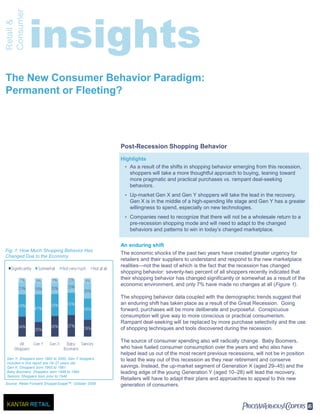
Fig. 1: How Much Shopping Behavior Has
                                                      The economic shocks of the past two years have created greater urgency for
Changed Due to the Economy
                                                      retailers and their suppliers to understand and respond to the new marketplace
                                                      realities—not the least of which is the fact that the recession has changed
                                                      shopping behavior: seventy-two percent of all shoppers recently indicated that
                                                      their shopping behavior has changed significantly or somewhat as a result of the
                                                      economic environment, and only 7% have made no changes at all (Figure 1).

                                                      The shopping behavior data coupled with the demographic trends suggest that
                                                      an enduring shift has taken place as a result of the Great Recession. Going
                                                      forward, purchases will be more deliberate and purposeful. Conspicuous
                                                      consumption will give way to more conscious or practical consumerism.
                                                      Rampant deal-seeking will be replaced by more purchase selectivity and the use
                                                      of shopping techniques and tools discovered during the recession.

                                                      The source of consumer spending also will radically change. Baby Boomers,
                                                      who have fueled consumer consumption over the years and who also have
                                                      helped lead us out of the most recent previous recessions, will not be in position
Gen Y: Shoppers born 1982 to 2000; Gen Y shoppers     to lead the way out of this recession as they near retirement and conserve
included in this report are 18–27 years old
Gen X: Shoppers born 1965 to 1981                     savings. Instead, the up-market segment of Generation X (aged 29–45) and the
Baby Boomers: Shoppers born 1946 to 1964              leading edge of the young Generation Y (aged 10–28) will lead the recovery.
Seniors: Shoppers born prior to 1946
                                                      Retailers will have to adapt their plans and approaches to appeal to this new
Source: Retail Forward ShopperScapeTM, October 2009   generation of consumers.


                                                                                                            PwC
PricewaterhouseCoopers
The New Shopping Environment
                                                                                                           The new shopper ROI: “Return on Involvement”
                                                                                                           Throughout the recession, shoppers sought out and were exposed to a growing
                                                                                                           array of tools, techniques and programs—many facilitated by emerging
                                                                                                           technologies—to help manage spending and maximize savings, including list-
                                                                                                           making and meal-planning tools, online and mobile coupons, "opt-in" e-mails,
                                                                                                           comparison shopping sites and stepped-up loyalty/rewards programs. Shoppers’
                                                                                                           experience with these tools and techniques taught them that the time invested in
                                                                                                           incorporating the tools into the shopping experience, i.e., more involvement in the
                                                                                                           process, yielded a significant return (ROI) in terms of both dollar and time
                                                                                                           savings.

                                                                                                           Retailers that want to capitalize on this trend of shoppers looking to maximize
                                                                                                           this return on involvement need to make promotion and savings-related
                                                                                                           information more easily accessible across all shopper touchpoints. They need to
                                                                                                           make savings explicit—no small print or jumping through hoops to get savings—
                                                                                                           and they need to make promotion redemptions an easy, seamless experience
                                                                                                           across all purchase channels.
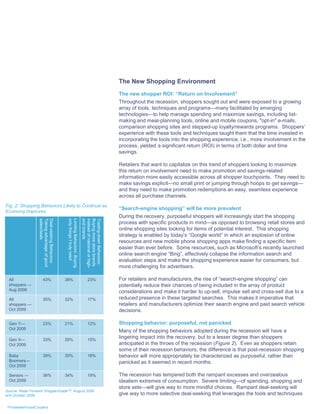
Fig. 2: Shopping Behaviors Likely to Continue as
                                                                                                           “Search-engine shopping” will be more prevalent
Economy Improves
                                                                                                           During the recovery, purposeful shoppers will increasingly start the shopping
                   sales/deals
                   Taking advantage of good
                   Deal-seeking Behaviors:


                                               only things I truly need
                                               Limiting Behaviors: Buying

                                                                            end brands
                                                                            instead of national or high-
                                                                            Buying more store brands
                                                                            Trading-down Behaviors:


                                                                                                           process with specific products in mind—as opposed to browsing retail stores and
                                                                                                           online shopping sites looking for items of potential interest. This shopping
                                                                                                           strategy is enabled by today’s “Google world” in which an explosion of online
                                                                                                           resources and new mobile phone shopping apps make finding a specific item
                                                                                                           easier than ever before. Some resources, such as Microsoft’s recently launched
                                                                                                           online search engine “Bing”, effectively collapse the information search and
                                                                                                           evaluation steps and make the shopping experience easier for consumers, but
                                                                                                           more challenging for advertisers.

  All                    43%                  38%                                   23%                    For retailers and manufacturers, the rise of “search-engine shopping” can
  shoppers —                                                                                               potentially reduce their chances of being included in the array of product
  Aug 2008                                                                                                 considerations and make it harder to up-sell, impulse sell and cross-sell due to a
  All                    35%                  32%                                   17%                    reduced presence in these targeted searches. This makes it imperative that
  shoppers —                                                                                               retailers and manufacturers optimize their search engine and paid search vehicle
  Oct 2009                                                                                                 decisions.

  Gen Y—                 23%                  21%                                   12%                    Shopping behavior: purposeful, not panicked
  Oct 2009
                                                                                                           Many of the shopping behaviors adopted during the recession will have a
  Gen X—                 33%                  29%                                   15%
                                                                                                           lingering impact into the recovery, but to a lesser degree than shoppers
  Oct 2009                                                                                                 anticipated in the throes of the recession (Figure 2). Even as shoppers retain
                                                                                                           some of their recession behaviors, the difference is that post-recession shopping
  Baby                   39%                  35%                                   18%                    behavior will more appropriately be characterized as purposeful, rather than
  Boomers—                                                                                                 panicked as it seemed in recent months.
  Oct 2009

  Seniors —              36%                  34%                                   19%                    The recession has tempered both the rampant excesses and overzealous
  Oct 2009                                                                                                 idealism extremes of consumption. Severe limiting—of spending, shopping and
                                                                                                           store sets—will give way to more mindful choices. Rampant deal-seeking will
Source: Retail Forward ShopperScapeTM, August 2008
and October 2009                                                                                           give way to more selective deal-seeking that leverages the tools and techniques

 PricewaterhouseCoopers
shoppers have discovered in the recession. Broad-scale trading down—across
   products, brands, and retailers—will give way to more reasoned and rational
   trading down of purchases.

   • Deal-seeking behaviors, e.g., taking advantage of sales, using coupons,
      comparison shopping, will not be completely abandoned post-recession.
      However, Boomers and Seniors are significantly more likely than their younger
      counterparts to be in bargain-hunting mode as the recovery gains traction.

   • Even though many shoppers will keep spending on “wants” in check, “wants”
      are steadily being reintroduced into the equation. Overall, limiting behaviors—
      e.g., buying only things truly needed, postponing purchases, buying fewer
      things—will level off. Even so, nearly a third of shoppers will only buy things
      they truly need and about one-fourth will buy fewer things and shop less often.
      Expect these behaviors to be more widespread among older shoppers,
      especially Boomers.

   • Trading-down behaviors related to the choice of retailer, product, or brand will
      lose some traction in the recovery, but private label brands (especially in Fast
      Moving Consumer Goods categories) will remain a significant factor due to their
      high quality at lower prices.


   What Will Shoppers Be Buying?
   Pragmatic consumption
   The recession has ushered in a cultural shift away from extravagance and toward
   more restraint in consumption, exacerbated by “fire sales” last fall that made
   shoppers question whether full-priced merchandise was ever really worth the
   price. There will be a stigma associated with wasteful, impulsive spending, while
   thoughtful, responsible spending will be more socially acceptable. From grocery
   to apparel shopping, about one-fifth of consumers will continue to forgo buying
   items that seem “just too expensive.”

   As a result, markets for luxury and gourmet goods will contract. Luxury providers
   will need to reengage their core customer bases—i.e., the truly wealthy.
   Business models that rely on growth through appealing to shoppers who aspire
   to, but cannot afford, a luxury lifestyle will need rework.

   A more thoughtful approach to spending on luxury and non-discretionary goods is
   emerging. Shoppers are placing a premium on goods that exhibit qualities of
   timeliness, usefulness and versatility. Items that make shoppers feel like they are
   getting something that will hold its value for the money (rather than something that
   is going to go out of style next season or has limited, narrow usefulness) will be
   judged worth the investment. Shoppers also continue to look for goods that are
   "green" or sustainable and appear to be willing to pay a slight premium for green
   goods that also deliver a personal economic benefit—e.g., energy-saving light
   bulbs and appliances.


PricewaterhouseCoopers
Practical pleasures
                                                         Shoppers are beginning to show signs of being sick and tired of sacrificing, even if
                                                         not yet exhibiting a full-blown case of “frugal fatigue.” However, shoppers have to
                                                         balance budget realities with the desire to give themselves a reward.

                                                         Retailers and suppliers that give shoppers an affordable “do-it-yourself”
                                                         alternative to more expensive products and services can help shoppers combat
                                                         this frugal fatigue. Examples of offers that will resonate with shoppers include at-
Fig 3: Median Household Wealth of Boomers                home alternatives to pricey spa and salon treatments for the budget-minded
                                                         beauty lover, restaurant-quality meal takeout options that replace dining out, and
                                                         home entertainment options that substitute for pricier leisure time activities.

                                                         The recession also exacerbated a trend away from premium, highest-quality
                                                         products to those that are “good enough” quality for the price vs. the very best.
                                                         The trend has been fueled by the democratization of design—i.e., the extension of
                                                         designer offerings into mass retail channels—and the evolution of private brands
                                                         that match (and quite often exceed) the quality and functionality of branded
                                                         goods. Shoppers have even more reason to respond favorably to these good-
                                                         enough products in the recovery.
Source: Center for Economic and Policy Research


                                                         Who Will Be Shopping in the Recovery?

                                                         Boomers will not lead shoppers into the recovery
                                                         Hit hard by the effects of the recession at a point of in life when financial
                                                         commitments loom large and retirement is on the horizon, the huge Baby Boomer
                                                         generation (82 million, 37% of all households) will not be able to quickly lead the
                                                         way out of the recession as it did after the past two recessions. In the early 1990s,
                                                         the Baby Boomers were at a life stage characterized by high spending, and their
                                                         appetite for material goods seemed insatiable. During the post-dot.com bust at
Fig. 4: Characteristics of Gen X and Gen Y               the start of this decade, many Baby Boomers were in prime earning years and
                         Gen X                           able to resume pre-recession spending behaviors relatively quickly after that less
 Positive        Entering peak spending years           severe downturn. At the edge of this recovery, the median household wealth of
                 Big spending life stage: kids and
                  homes                                  Boomer households has shrunk considerably, hampering their continued ability to
                                                         lead the way out of this recession (Figure 3). With significant wealth losses to
 Negative        With Boomers staying in workforce
                  longer, harder for Gen X to advance    recoup, the need to save and invest for the future will compete with spending at
                 Paying down debt                       retail in a way it never has before for this generation.
                 Serious about saving
                            Gen Y                        With near-term Boomer spending handcuffed by current circumstances,
 Positive        Younger = more discretionary           marketers will need to look to the smaller Gen X generation and large Gen Y
                  income
                                                         population to fuel growth in the initial stages of the post-recession recovery
                 Tech lifestyle is a need not a want;
                  i.e., will spend on technology         (Figure 4).
                 Leading edge entering household-
                  formation years                        Gen X fuels growth in initial stage of recovery
 Negative        Less recession falloff = less          Even though Gen X—those aged 29 to 45—is only about three-fourths the size of
                  recovery rebound
                 Spending shaped by tighter credit      the Boomer generation—it is in a big spending life stage. Many have spent the
                 A fragmented and difficult segment     past few years establishing a household and starting a family: seventy-one
                  to reach with conventional marketing   percent have children younger than 18. Plus, this generation is at the point when
                  approaches                             it should be entering its peak earning years—another net positive for its spending
Source: Retail Forward                                   outlook.

PricewaterhouseCoopers
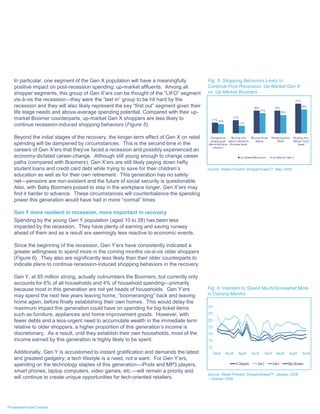
In particular, one segment of the Gen X population will have a meaningfully             Fig. 5: Shopping Behaviors Likely to
   positive impact on post-recession spending: up-market affluents. Among all              Continue Post-Recession: Up-Market Gen X
   shopper segments, this group of Gen X’ers can be thought of the “LIFO” segment          vs. Up-Market Boomers
   vis-à-vis the recession—they were the “last in” group to be hit hard by the
   recession and they will also likely represent the key “first out” segment given their
   life stage needs and above-average spending potential. Compared with their up-
   market Boomer counterparts, up-market Gen X shoppers are less likely to
   continue recession-induced shopping behaviors (Figure 5).

   Beyond the initial stages of the recovery, the longer-term effect of Gen X on retail
   spending will be dampened by circumstances. This is the second time in the
   careers of Gen X’ers that they’ve faced a recession and possibly experienced an
   economy-dictated career-change. Although still young enough to change career
   paths (compared with Boomers), Gen X’ers are still likely paying down hefty
   student loans and credit card debt while trying to save for their children’s            Source: Retail Forward ShopperScapeTM, May 2009
   education as well as for their own retirement. This generation has no safety
   net—pensions are non-existent and the future of social security is questionable.
   Also, with Baby Boomers poised to stay in the workplace longer, Gen X’ers may
   find it harder to advance. These circumstances will counterbalance the spending
   power this generation would have had in more “normal” times.

   Gen Y more resilient in recession, more important in recovery
   Spending by the young Gen Y population (aged 10 to 28) has been less
   impacted by the recession. They have plenty of earning and saving runway
   ahead of them and as a result are seemingly less reactive to economic events.

   Since the beginning of the recession, Gen Y’ers have consistently indicated a
   greater willingness to spend more in the coming months vis-à-vis older shoppers
   (Figure 6). They also are significantly less likely than their older counterparts to
   indicate plans to continue recession-induced shopping behaviors in the recovery.

   Gen Y, at 85 million strong, actually outnumbers the Boomers, but currently only
   accounts for 6% of all households and 4% of household spending—primarily
   because most in this generation are not yet heads of households. Gen Y’ers              Fig. 6: Intention to Spend Much/Somewhat More
   may spend the next few years leaving home, “boomeranging” back and leaving              in Coming Months
   home again, before finally establishing their own homes. This would delay the
   maximum impact this generation could have on spending for big-ticket items
   such as furniture, appliances and home improvement goods. However, with
   fewer debts and a less-urgent need to accumulate wealth in the immediate term
   relative to older shoppers, a higher proportion of this generation’s income is
   discretionary. As a result, until they establish their own households, most of the
   income earned by this generation is highly likely to be spent.

   Additionally, Gen Y is accustomed to instant gratification and demands the latest
   and greatest gadgetry; a tech lifestyle is a need, not a want. For Gen Y’ers,
   spending on the technology staples of this generation—iPods and MP3 players,
   smart phones, laptop computers, video games, etc.—will remain a priority and
                                                                                           Source: Retail Forward ShopperScapeTM, January 2008
   will continue to create unique opportunities for tech-oriented retailers.               – October 2009


PricewaterhouseCoopers
Winning in the Recovery

                         Responding to altered consumer behaviors
                         As much as retailers and suppliers hope that shopping behavior will return to
                         “normal” as the economic environment starts to improve, the changed
                         circumstances of key shopper segments and the individual behaviors of shoppers
                         themselves are indicating that there will not be a wholesale return to previous
                         shopping patterns and behaviors.
                         To win in the recovery, retailers and suppliers will need to:
                         • Recognize that even in the recovery, some shopper segments will still be in
                           “recession” shopping mode.
                         • Make sure customer targets are aligned with the marketplace—which means that
                           many companies need to tune up their understanding of Gen X shoppers and
                           tune in, perhaps for the first time, to Gen Y.
                         • Leverage all components of their offerings that are “need to haves” and create
                           more “must haves” by building the case—through marketing, positioning and
                           merchandising—that their offer is responsive and relevant to shoppers’ needs.


                         Contacts

                         For further information, please contact:
                         Susan McPartlin
                         US Retail & Consumer Practice Leader
                         PricewaterhouseCoopers, LLP
                         513.361.8094
                         susan.m.mcpartlin@us.pwc.com


                         Lisa Feigen Dugal
                         Retail & Consumer Advisory Leader
                         PricewaterhouseCoopers, LLP
                         646.471.6916
                         lisa.feigen.dugal@us.pwc.com


                         Mary Brett Whitfield
                         Senior Vice President
                         Retail Forward, a Kantar Retail Company
                         614.355.4010
                         marybrett.whitfield@kantarretail.com


PricewaterhouseCoopers
pwc.com
PricewaterhouseCoopers’ Retail & Consumer practice is dedicated to providing assurance, tax and advisory services to suppliers and retailers, from source to sale, across the entire supply
chain.


© 2010 PricewaterhouseCoopers LLP and Kantar Retail. All rights reserved. “PricewaterhouseCoopers” refers to PricewaterhouseCoopers LLP, a Delaware limited liability partnership, or,
as the context requires, the PricewaterhouseCoopers global network or other member firms of the network, each of which is a separate and independent legal entity.

The new-consumer-behavior-paradigm

  • 1.
    Consumer Retail & The NewConsumer Behavior Paradigm: Permanent or Fleeting? Post-Recession Shopping Behavior Highlights • As a result of the shifts in shopping behavior emerging from this recession, shoppers will take a more thoughtful approach to buying, leaning toward more pragmatic and practical purchases vs. rampant deal-seeking behaviors. • Up-market Gen X and Gen Y shoppers will take the lead in the recovery. Gen X is in the middle of a high-spending life stage and Gen Y has a greater willingness to spend, especially on new technologies. • Companies need to recognize that there will not be a wholesale return to a pre-recession shopping mode and will need to adapt to the changed behaviors and patterns to win in today’s changed marketplace. An enduring shift Fig. 1: How Much Shopping Behavior Has The economic shocks of the past two years have created greater urgency for Changed Due to the Economy retailers and their suppliers to understand and respond to the new marketplace realities—not the least of which is the fact that the recession has changed shopping behavior: seventy-two percent of all shoppers recently indicated that their shopping behavior has changed significantly or somewhat as a result of the economic environment, and only 7% have made no changes at all (Figure 1). The shopping behavior data coupled with the demographic trends suggest that an enduring shift has taken place as a result of the Great Recession. Going forward, purchases will be more deliberate and purposeful. Conspicuous consumption will give way to more conscious or practical consumerism. Rampant deal-seeking will be replaced by more purchase selectivity and the use of shopping techniques and tools discovered during the recession. The source of consumer spending also will radically change. Baby Boomers, who have fueled consumer consumption over the years and who also have helped lead us out of the most recent previous recessions, will not be in position Gen Y: Shoppers born 1982 to 2000; Gen Y shoppers to lead the way out of this recession as they near retirement and conserve included in this report are 18–27 years old Gen X: Shoppers born 1965 to 1981 savings. Instead, the up-market segment of Generation X (aged 29–45) and the Baby Boomers: Shoppers born 1946 to 1964 leading edge of the young Generation Y (aged 10–28) will lead the recovery. Seniors: Shoppers born prior to 1946 Retailers will have to adapt their plans and approaches to appeal to this new Source: Retail Forward ShopperScapeTM, October 2009 generation of consumers. PwC
  • 2.
  • 3.
    The New ShoppingEnvironment The new shopper ROI: “Return on Involvement” Throughout the recession, shoppers sought out and were exposed to a growing array of tools, techniques and programs—many facilitated by emerging technologies—to help manage spending and maximize savings, including list- making and meal-planning tools, online and mobile coupons, "opt-in" e-mails, comparison shopping sites and stepped-up loyalty/rewards programs. Shoppers’ experience with these tools and techniques taught them that the time invested in incorporating the tools into the shopping experience, i.e., more involvement in the process, yielded a significant return (ROI) in terms of both dollar and time savings. Retailers that want to capitalize on this trend of shoppers looking to maximize this return on involvement need to make promotion and savings-related information more easily accessible across all shopper touchpoints. They need to make savings explicit—no small print or jumping through hoops to get savings— and they need to make promotion redemptions an easy, seamless experience across all purchase channels. Fig. 2: Shopping Behaviors Likely to Continue as “Search-engine shopping” will be more prevalent Economy Improves During the recovery, purposeful shoppers will increasingly start the shopping sales/deals Taking advantage of good Deal-seeking Behaviors: only things I truly need Limiting Behaviors: Buying end brands instead of national or high- Buying more store brands Trading-down Behaviors: process with specific products in mind—as opposed to browsing retail stores and online shopping sites looking for items of potential interest. This shopping strategy is enabled by today’s “Google world” in which an explosion of online resources and new mobile phone shopping apps make finding a specific item easier than ever before. Some resources, such as Microsoft’s recently launched online search engine “Bing”, effectively collapse the information search and evaluation steps and make the shopping experience easier for consumers, but more challenging for advertisers. All 43% 38% 23% For retailers and manufacturers, the rise of “search-engine shopping” can shoppers — potentially reduce their chances of being included in the array of product Aug 2008 considerations and make it harder to up-sell, impulse sell and cross-sell due to a All 35% 32% 17% reduced presence in these targeted searches. This makes it imperative that shoppers — retailers and manufacturers optimize their search engine and paid search vehicle Oct 2009 decisions. Gen Y— 23% 21% 12% Shopping behavior: purposeful, not panicked Oct 2009 Many of the shopping behaviors adopted during the recession will have a Gen X— 33% 29% 15% lingering impact into the recovery, but to a lesser degree than shoppers Oct 2009 anticipated in the throes of the recession (Figure 2). Even as shoppers retain some of their recession behaviors, the difference is that post-recession shopping Baby 39% 35% 18% behavior will more appropriately be characterized as purposeful, rather than Boomers— panicked as it seemed in recent months. Oct 2009 Seniors — 36% 34% 19% The recession has tempered both the rampant excesses and overzealous Oct 2009 idealism extremes of consumption. Severe limiting—of spending, shopping and store sets—will give way to more mindful choices. Rampant deal-seeking will Source: Retail Forward ShopperScapeTM, August 2008 and October 2009 give way to more selective deal-seeking that leverages the tools and techniques PricewaterhouseCoopers
  • 4.
    shoppers have discoveredin the recession. Broad-scale trading down—across products, brands, and retailers—will give way to more reasoned and rational trading down of purchases. • Deal-seeking behaviors, e.g., taking advantage of sales, using coupons, comparison shopping, will not be completely abandoned post-recession. However, Boomers and Seniors are significantly more likely than their younger counterparts to be in bargain-hunting mode as the recovery gains traction. • Even though many shoppers will keep spending on “wants” in check, “wants” are steadily being reintroduced into the equation. Overall, limiting behaviors— e.g., buying only things truly needed, postponing purchases, buying fewer things—will level off. Even so, nearly a third of shoppers will only buy things they truly need and about one-fourth will buy fewer things and shop less often. Expect these behaviors to be more widespread among older shoppers, especially Boomers. • Trading-down behaviors related to the choice of retailer, product, or brand will lose some traction in the recovery, but private label brands (especially in Fast Moving Consumer Goods categories) will remain a significant factor due to their high quality at lower prices. What Will Shoppers Be Buying? Pragmatic consumption The recession has ushered in a cultural shift away from extravagance and toward more restraint in consumption, exacerbated by “fire sales” last fall that made shoppers question whether full-priced merchandise was ever really worth the price. There will be a stigma associated with wasteful, impulsive spending, while thoughtful, responsible spending will be more socially acceptable. From grocery to apparel shopping, about one-fifth of consumers will continue to forgo buying items that seem “just too expensive.” As a result, markets for luxury and gourmet goods will contract. Luxury providers will need to reengage their core customer bases—i.e., the truly wealthy. Business models that rely on growth through appealing to shoppers who aspire to, but cannot afford, a luxury lifestyle will need rework. A more thoughtful approach to spending on luxury and non-discretionary goods is emerging. Shoppers are placing a premium on goods that exhibit qualities of timeliness, usefulness and versatility. Items that make shoppers feel like they are getting something that will hold its value for the money (rather than something that is going to go out of style next season or has limited, narrow usefulness) will be judged worth the investment. Shoppers also continue to look for goods that are "green" or sustainable and appear to be willing to pay a slight premium for green goods that also deliver a personal economic benefit—e.g., energy-saving light bulbs and appliances. PricewaterhouseCoopers
  • 5.
    Practical pleasures Shoppers are beginning to show signs of being sick and tired of sacrificing, even if not yet exhibiting a full-blown case of “frugal fatigue.” However, shoppers have to balance budget realities with the desire to give themselves a reward. Retailers and suppliers that give shoppers an affordable “do-it-yourself” alternative to more expensive products and services can help shoppers combat this frugal fatigue. Examples of offers that will resonate with shoppers include at- Fig 3: Median Household Wealth of Boomers home alternatives to pricey spa and salon treatments for the budget-minded beauty lover, restaurant-quality meal takeout options that replace dining out, and home entertainment options that substitute for pricier leisure time activities. The recession also exacerbated a trend away from premium, highest-quality products to those that are “good enough” quality for the price vs. the very best. The trend has been fueled by the democratization of design—i.e., the extension of designer offerings into mass retail channels—and the evolution of private brands that match (and quite often exceed) the quality and functionality of branded goods. Shoppers have even more reason to respond favorably to these good- enough products in the recovery. Source: Center for Economic and Policy Research Who Will Be Shopping in the Recovery? Boomers will not lead shoppers into the recovery Hit hard by the effects of the recession at a point of in life when financial commitments loom large and retirement is on the horizon, the huge Baby Boomer generation (82 million, 37% of all households) will not be able to quickly lead the way out of the recession as it did after the past two recessions. In the early 1990s, the Baby Boomers were at a life stage characterized by high spending, and their appetite for material goods seemed insatiable. During the post-dot.com bust at Fig. 4: Characteristics of Gen X and Gen Y the start of this decade, many Baby Boomers were in prime earning years and Gen X able to resume pre-recession spending behaviors relatively quickly after that less Positive  Entering peak spending years severe downturn. At the edge of this recovery, the median household wealth of  Big spending life stage: kids and homes Boomer households has shrunk considerably, hampering their continued ability to lead the way out of this recession (Figure 3). With significant wealth losses to Negative  With Boomers staying in workforce longer, harder for Gen X to advance recoup, the need to save and invest for the future will compete with spending at  Paying down debt retail in a way it never has before for this generation.  Serious about saving Gen Y With near-term Boomer spending handcuffed by current circumstances, Positive  Younger = more discretionary marketers will need to look to the smaller Gen X generation and large Gen Y income population to fuel growth in the initial stages of the post-recession recovery  Tech lifestyle is a need not a want; i.e., will spend on technology (Figure 4).  Leading edge entering household- formation years Gen X fuels growth in initial stage of recovery Negative  Less recession falloff = less Even though Gen X—those aged 29 to 45—is only about three-fourths the size of recovery rebound  Spending shaped by tighter credit the Boomer generation—it is in a big spending life stage. Many have spent the  A fragmented and difficult segment past few years establishing a household and starting a family: seventy-one to reach with conventional marketing percent have children younger than 18. Plus, this generation is at the point when approaches it should be entering its peak earning years—another net positive for its spending Source: Retail Forward outlook. PricewaterhouseCoopers
  • 6.
    In particular, onesegment of the Gen X population will have a meaningfully Fig. 5: Shopping Behaviors Likely to positive impact on post-recession spending: up-market affluents. Among all Continue Post-Recession: Up-Market Gen X shopper segments, this group of Gen X’ers can be thought of the “LIFO” segment vs. Up-Market Boomers vis-à-vis the recession—they were the “last in” group to be hit hard by the recession and they will also likely represent the key “first out” segment given their life stage needs and above-average spending potential. Compared with their up- market Boomer counterparts, up-market Gen X shoppers are less likely to continue recession-induced shopping behaviors (Figure 5). Beyond the initial stages of the recovery, the longer-term effect of Gen X on retail spending will be dampened by circumstances. This is the second time in the careers of Gen X’ers that they’ve faced a recession and possibly experienced an economy-dictated career-change. Although still young enough to change career paths (compared with Boomers), Gen X’ers are still likely paying down hefty student loans and credit card debt while trying to save for their children’s Source: Retail Forward ShopperScapeTM, May 2009 education as well as for their own retirement. This generation has no safety net—pensions are non-existent and the future of social security is questionable. Also, with Baby Boomers poised to stay in the workplace longer, Gen X’ers may find it harder to advance. These circumstances will counterbalance the spending power this generation would have had in more “normal” times. Gen Y more resilient in recession, more important in recovery Spending by the young Gen Y population (aged 10 to 28) has been less impacted by the recession. They have plenty of earning and saving runway ahead of them and as a result are seemingly less reactive to economic events. Since the beginning of the recession, Gen Y’ers have consistently indicated a greater willingness to spend more in the coming months vis-à-vis older shoppers (Figure 6). They also are significantly less likely than their older counterparts to indicate plans to continue recession-induced shopping behaviors in the recovery. Gen Y, at 85 million strong, actually outnumbers the Boomers, but currently only accounts for 6% of all households and 4% of household spending—primarily because most in this generation are not yet heads of households. Gen Y’ers Fig. 6: Intention to Spend Much/Somewhat More may spend the next few years leaving home, “boomeranging” back and leaving in Coming Months home again, before finally establishing their own homes. This would delay the maximum impact this generation could have on spending for big-ticket items such as furniture, appliances and home improvement goods. However, with fewer debts and a less-urgent need to accumulate wealth in the immediate term relative to older shoppers, a higher proportion of this generation’s income is discretionary. As a result, until they establish their own households, most of the income earned by this generation is highly likely to be spent. Additionally, Gen Y is accustomed to instant gratification and demands the latest and greatest gadgetry; a tech lifestyle is a need, not a want. For Gen Y’ers, spending on the technology staples of this generation—iPods and MP3 players, smart phones, laptop computers, video games, etc.—will remain a priority and Source: Retail Forward ShopperScapeTM, January 2008 will continue to create unique opportunities for tech-oriented retailers. – October 2009 PricewaterhouseCoopers
  • 7.
    Winning in theRecovery Responding to altered consumer behaviors As much as retailers and suppliers hope that shopping behavior will return to “normal” as the economic environment starts to improve, the changed circumstances of key shopper segments and the individual behaviors of shoppers themselves are indicating that there will not be a wholesale return to previous shopping patterns and behaviors. To win in the recovery, retailers and suppliers will need to: • Recognize that even in the recovery, some shopper segments will still be in “recession” shopping mode. • Make sure customer targets are aligned with the marketplace—which means that many companies need to tune up their understanding of Gen X shoppers and tune in, perhaps for the first time, to Gen Y. • Leverage all components of their offerings that are “need to haves” and create more “must haves” by building the case—through marketing, positioning and merchandising—that their offer is responsive and relevant to shoppers’ needs. Contacts For further information, please contact: Susan McPartlin US Retail & Consumer Practice Leader PricewaterhouseCoopers, LLP 513.361.8094 susan.m.mcpartlin@us.pwc.com Lisa Feigen Dugal Retail & Consumer Advisory Leader PricewaterhouseCoopers, LLP 646.471.6916 lisa.feigen.dugal@us.pwc.com Mary Brett Whitfield Senior Vice President Retail Forward, a Kantar Retail Company 614.355.4010 marybrett.whitfield@kantarretail.com PricewaterhouseCoopers
  • 8.
    pwc.com PricewaterhouseCoopers’ Retail &Consumer practice is dedicated to providing assurance, tax and advisory services to suppliers and retailers, from source to sale, across the entire supply chain. © 2010 PricewaterhouseCoopers LLP and Kantar Retail. All rights reserved. “PricewaterhouseCoopers” refers to PricewaterhouseCoopers LLP, a Delaware limited liability partnership, or, as the context requires, the PricewaterhouseCoopers global network or other member firms of the network, each of which is a separate and independent legal entity.