The new production of knowledge: The dynamics of science and research in contemporay societies. Gibbons, M., Limoges, C., Nowotny, H., Schwartzman, S., Scott, P., & Trow, M.
Introduction Mode 2 Revisited: The New Production of Knowledge The nature of research process: The steering of research priorities The commercialization of research The accountability of science
Introduction Mode 2 Revisited: The New Production of Knowledge The steering of research priorities The supranational level The national level The system level
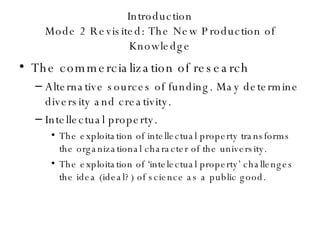
Introduction Mode 2 Revisited: The New Production of Knowledge The commercialization of research Alternative sources of funding. May determine diversity and creativity. Intellectual property.  The exploitation of intellectual property transforms the organizational character of the university. The exploitation of ‘intelectual property’ challenges the idea (ideal?) of science as a public good.
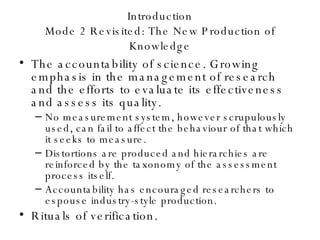
Introduction Mode 2 Revisited: The New Production of Knowledge The accountability of science.  Growing emphasis in the management of research and the efforts to evaluate its effectiveness and assess its quality. No measurement system, however scrupulously used, can fail to affect the behaviour of that which it seeks to measure. Distortions are produced and hierarchies are reinforced by the taxonomy of the assessment process itself. Accountability has encouraged researchers to espouse industry-style production. Rituals of verification.
Introduction Mode 2 Revisited: The New Production of Knowledge New language Aplication Relevance Contextualization Reach-out Technology transfer Knowledge management. At the core of the debate lies the question about science being scrutinized (with the consecuent lack of freedom) vs. Intelectual production as a public good that has to be in relation to the needs of society.
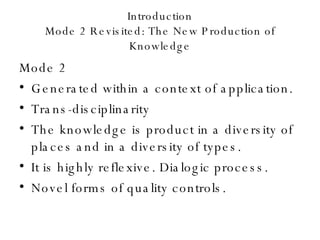
Introduction Mode 2 Revisited: The New Production of Knowledge Mode 2 Generated within a context of application. Trans-disciplinarity The knowledge is product in a diversity of places and in a diversity of types. It is highly reflexive. Dialogic process. Novel forms of quality controls.
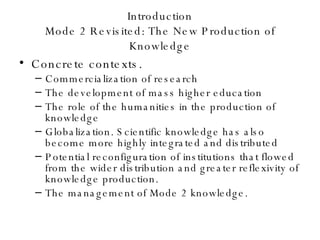
Introduction Mode 2 Revisited: The New Production of Knowledge Concrete contexts. Commercialization of research The development of mass higher education The role of the humanities in the production of knowledge Globalization. Scientific knowledge has also become more highly integrated and distributed Potential reconfiguration of institutions that flowed from the wider distribution and greater reflexivity of knowledge production. The management of Mode 2 knowledge.
Introduction Mode 2 Revisited: The New Production of Knowledge Four key characteristics which were evident both in society and science. The generation of uncertainty/ies, which reduces the possibility of post-positivistic planning. The trends towards self organization. The emergence of new forms of ‘economic rationality’, according to which, as in amy ‘futures’ market, the potential of science is measured by its immanent rather than its instrumental value. The re-constitution of time/space, of which the revolution in information and communication technology is one aspect.

The New Production Of Knowledge

  • 1.
    The new productionof knowledge: The dynamics of science and research in contemporay societies. Gibbons, M., Limoges, C., Nowotny, H., Schwartzman, S., Scott, P., & Trow, M.
  • 2.
    Introduction Mode 2Revisited: The New Production of Knowledge The nature of research process: The steering of research priorities The commercialization of research The accountability of science
  • 3.
    Introduction Mode 2Revisited: The New Production of Knowledge The steering of research priorities The supranational level The national level The system level
  • 4.
    Introduction Mode 2Revisited: The New Production of Knowledge The commercialization of research Alternative sources of funding. May determine diversity and creativity. Intellectual property. The exploitation of intellectual property transforms the organizational character of the university. The exploitation of ‘intelectual property’ challenges the idea (ideal?) of science as a public good.
  • 5.
    Introduction Mode 2Revisited: The New Production of Knowledge The accountability of science. Growing emphasis in the management of research and the efforts to evaluate its effectiveness and assess its quality. No measurement system, however scrupulously used, can fail to affect the behaviour of that which it seeks to measure. Distortions are produced and hierarchies are reinforced by the taxonomy of the assessment process itself. Accountability has encouraged researchers to espouse industry-style production. Rituals of verification.
  • 6.
    Introduction Mode 2Revisited: The New Production of Knowledge New language Aplication Relevance Contextualization Reach-out Technology transfer Knowledge management. At the core of the debate lies the question about science being scrutinized (with the consecuent lack of freedom) vs. Intelectual production as a public good that has to be in relation to the needs of society.
  • 7.
    Introduction Mode 2Revisited: The New Production of Knowledge Mode 2 Generated within a context of application. Trans-disciplinarity The knowledge is product in a diversity of places and in a diversity of types. It is highly reflexive. Dialogic process. Novel forms of quality controls.
  • 8.
    Introduction Mode 2Revisited: The New Production of Knowledge Concrete contexts. Commercialization of research The development of mass higher education The role of the humanities in the production of knowledge Globalization. Scientific knowledge has also become more highly integrated and distributed Potential reconfiguration of institutions that flowed from the wider distribution and greater reflexivity of knowledge production. The management of Mode 2 knowledge.
  • 9.
    Introduction Mode 2Revisited: The New Production of Knowledge Four key characteristics which were evident both in society and science. The generation of uncertainty/ies, which reduces the possibility of post-positivistic planning. The trends towards self organization. The emergence of new forms of ‘economic rationality’, according to which, as in amy ‘futures’ market, the potential of science is measured by its immanent rather than its instrumental value. The re-constitution of time/space, of which the revolution in information and communication technology is one aspect.